US5438792A - Insect traps - Google Patents
Insect traps Download PDFInfo
- Publication number
- US5438792A US5438792A US08/186,295 US18629594A US5438792A US 5438792 A US5438792 A US 5438792A US 18629594 A US18629594 A US 18629594A US 5438792 A US5438792 A US 5438792A
- Authority
- US
- United States
- Prior art keywords
- adhesive
- insect trap
- sheet
- insect
- paperboard
- Prior art date
- Legal status (The legal status is an assumption and is not a legal conclusion. Google has not performed a legal analysis and makes no representation as to the accuracy of the status listed.)
- Expired - Fee Related
Links
- 241000238631 Hexapoda Species 0.000 title claims abstract description 76
- 239000000853 adhesive Substances 0.000 claims abstract description 68
- 230000001070 adhesive effect Effects 0.000 claims abstract description 68
- 239000002131 composite material Substances 0.000 claims abstract description 32
- 239000011087 paperboard Substances 0.000 claims description 29
- 239000000123 paper Substances 0.000 claims description 23
- KPUWHANPEXNPJT-UHFFFAOYSA-N disiloxane Chemical class [SiH3]O[SiH3] KPUWHANPEXNPJT-UHFFFAOYSA-N 0.000 claims description 4
- 229920000642 polymer Polymers 0.000 claims description 4
- 238000005192 partition Methods 0.000 abstract description 6
- 239000000463 material Substances 0.000 description 15
- 238000004519 manufacturing process Methods 0.000 description 5
- 239000004033 plastic Substances 0.000 description 5
- 229920003023 plastic Polymers 0.000 description 5
- -1 poly(vinyl acetate) Polymers 0.000 description 5
- 239000005667 attractant Substances 0.000 description 4
- 230000031902 chemoattractant activity Effects 0.000 description 4
- 238000010276 construction Methods 0.000 description 4
- 238000005520 cutting process Methods 0.000 description 4
- 239000002655 kraft paper Substances 0.000 description 4
- 239000000203 mixture Substances 0.000 description 4
- BASFCYQUMIYNBI-UHFFFAOYSA-N platinum Chemical compound [Pt] BASFCYQUMIYNBI-UHFFFAOYSA-N 0.000 description 4
- 230000004888 barrier function Effects 0.000 description 3
- 235000013870 dimethyl polysiloxane Nutrition 0.000 description 3
- 239000000499 gel Substances 0.000 description 3
- 239000002184 metal Substances 0.000 description 3
- 229910052751 metal Inorganic materials 0.000 description 3
- 231100000614 poison Toxicity 0.000 description 3
- 229920000435 poly(dimethylsiloxane) Polymers 0.000 description 3
- 230000001681 protective effect Effects 0.000 description 3
- 239000000126 substance Substances 0.000 description 3
- 241000274582 Pycnanthus angolensis Species 0.000 description 2
- 125000000118 dimethyl group Chemical group [H]C([H])([H])* 0.000 description 2
- 239000004205 dimethyl polysiloxane Substances 0.000 description 2
- 235000013305 food Nutrition 0.000 description 2
- 239000002985 plastic film Substances 0.000 description 2
- 229910052697 platinum Inorganic materials 0.000 description 2
- 229920001296 polysiloxane Polymers 0.000 description 2
- 206010003497 Asphyxia Diseases 0.000 description 1
- 241001674044 Blattodea Species 0.000 description 1
- 241000238814 Orthoptera Species 0.000 description 1
- CBENFWSGALASAD-UHFFFAOYSA-N Ozone Chemical compound [O-][O+]=O CBENFWSGALASAD-UHFFFAOYSA-N 0.000 description 1
- 241000607479 Yersinia pestis Species 0.000 description 1
- NIXOWILDQLNWCW-UHFFFAOYSA-N acrylic acid group Chemical group C(C=C)(=O)O NIXOWILDQLNWCW-UHFFFAOYSA-N 0.000 description 1
- 230000032683 aging Effects 0.000 description 1
- 230000015556 catabolic process Effects 0.000 description 1
- 239000003054 catalyst Substances 0.000 description 1
- 238000006243 chemical reaction Methods 0.000 description 1
- 239000003795 chemical substances by application Substances 0.000 description 1
- 239000004927 clay Substances 0.000 description 1
- 239000011248 coating agent Substances 0.000 description 1
- 238000000576 coating method Methods 0.000 description 1
- 238000006731 degradation reaction Methods 0.000 description 1
- 230000009977 dual effect Effects 0.000 description 1
- 238000005516 engineering process Methods 0.000 description 1
- 230000007613 environmental effect Effects 0.000 description 1
- 239000003292 glue Substances 0.000 description 1
- 239000001257 hydrogen Substances 0.000 description 1
- 229910052739 hydrogen Inorganic materials 0.000 description 1
- 230000002209 hydrophobic effect Effects 0.000 description 1
- 239000004615 ingredient Substances 0.000 description 1
- 230000002401 inhibitory effect Effects 0.000 description 1
- 239000002418 insect attractant Substances 0.000 description 1
- 239000002917 insecticide Substances 0.000 description 1
- 239000007788 liquid Substances 0.000 description 1
- 235000013379 molasses Nutrition 0.000 description 1
- 239000003973 paint Substances 0.000 description 1
- 230000035515 penetration Effects 0.000 description 1
- 239000002574 poison Substances 0.000 description 1
- 230000007096 poisonous effect Effects 0.000 description 1
- 229920006289 polycarbonate film Polymers 0.000 description 1
- 229920006267 polyester film Polymers 0.000 description 1
- 229920000098 polyolefin Polymers 0.000 description 1
- 229920002689 polyvinyl acetate Polymers 0.000 description 1
- 239000011118 polyvinyl acetate Substances 0.000 description 1
- 239000004800 polyvinyl chloride Substances 0.000 description 1
- 229920000915 polyvinyl chloride Polymers 0.000 description 1
- 230000001846 repelling effect Effects 0.000 description 1
- 238000005507 spraying Methods 0.000 description 1
- XLYOFNOQVPJJNP-UHFFFAOYSA-N water Substances O XLYOFNOQVPJJNP-UHFFFAOYSA-N 0.000 description 1
- 239000001993 wax Substances 0.000 description 1
Images



Classifications
-
- A—HUMAN NECESSITIES
- A01—AGRICULTURE; FORESTRY; ANIMAL HUSBANDRY; HUNTING; TRAPPING; FISHING
- A01M—CATCHING, TRAPPING OR SCARING OF ANIMALS; APPARATUS FOR THE DESTRUCTION OF NOXIOUS ANIMALS OR NOXIOUS PLANTS
- A01M1/00—Stationary means for catching or killing insects
- A01M1/14—Catching by adhesive surfaces
Definitions
- This invention relates generally to devices for trapping pests, and more particularly to devices for trapping insects.
- U.S. Pat. No. 2,291,358 to Treadwell is directed to an insect bait holder adapted to contain adhesively applied to the inner face of the container bottom, a substance which can contain a bait to attract the insect and a poisonous ingredient.
- the device is not adapted to restrain the insect, but rather allows the insect to take the bait and leave through any one of a number of openings in the outer container, which is generally rectangular in shape.
- U.S. Pat. No. 3,304,646 to Staley is directed to traps for bugs and the like which in one embodiment provides holes or the like by means of a corrugated sheet to provide channels which may be cylindrical, triangular, wave form, corrugated or polygonal in cross-section.
- the device is formed from a cheap construction of paper, plastic, composition, metal, etc., and the inside surfaces away from the end or entrances to the chambers are coated with a sticky glue like fly paper or birdlime, which can be poisoned and provided with a food smell to attract the particular insects desired.
- U.S. Pat. No. 4,581,845 to Burkholder et al. is directed to a suffocation type insect trap with an attractant for the insect and a pitfall chamber that contains a pool to suffocate insects which fall into the chamber.
- the trap is constructed from single-faced corrugated paperboard.
- U.S. Pat. No. 4,819,371 to Cohen is directed to an insect trap that comprises a generally rectangular shaped enclosure with interior dual triangular shaped chambers which are coated with a contact poison for the insect.
- the trap is formed by folding a paperboard blank having an outer moisture barrier.
- U.S. Pat. No. 4,866,877 to Barak et al. is directed to a vertical wall mount insect trap having an oil containing pitfall chamber and insect attractant. This trap is also constructed from single faced corrugated paperboard.
- U.S. Pat. No. 5,042,194 to Cohen is directed to an insect trap which comprises inner walls, within a rectangular shaped enclosed, which define triangular-shaped hollow spaces.
- the insect trap is formed by folding a paperboard blank having an outer moisture inhibiting coating and treated with an insecticide.
- insects traps can be therefore divided into three main classes: insects traps adapted to restrain an insect by mean of an adhesive; insect traps adapted to suffocate an insect by means of a body of liquid oil; and insect traps.
- an insect trap which comprises: (1) a generally rectangular shaped enclosure provided with a plurality of openings therethrough, and (2) a plurality of inner partition walls positioned within the enclosure to provide a plurality of generally triangular passageways within the enclosure, the inner partition walls comprising a folded composite planar sheet having an upper and lower sheet member housing an adhesive sheet, the upper and lower sheet members having a plurality of openings therein to permit an insect passing thereon to contact an adhesive surface of the adhesive sheet and the adhesive sheet member and the upper and lower sheet members having a plurality of connecting apertures therethrough to permit insects to pass through the composite planar sheet.
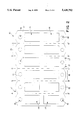
- FIG. 1 is a bottom view of an unfolded rectangular shaped enclosure member.
- FIG. 2 is a top view of an upper sheet member.
- FIG. 3 is an exploded view of a composite planar sheet formed with upper sheet member 12 and lower sheet member 12', with adhesive sheet member 20 positioned therebetween.
- FIG. 4A is a side cross-sectional view of composite planar sheet formed with upper sheet member 12 and lower sheet member 12', with adhesive sheet member 20 positioned therebetween.
- FIG. 4B is a side cross-sectional view of adhesive sheet member 20.
- FIG. 5 is an inverted perspective view of one embodiment of the device of the present invention wherein triangular passageways are provided along an axis which is perpendicular to the longitudinal axis of the rectangular housing.
- FIG. 6 is an inverted perspective view of a second embodiment of the device of the present invention wherein triangular passageways are provided along an axis which is parallel to the longitudinal axis of the rectangular housing.
- an insect trap which comprises: (1) a generally rectangular shaped enclosure 40 provided with a plurality of openings 94 therethrough, and (2) a plurality of inner partition walls positioned within the enclosure to provide a plurality of generally triangular passageways 13 within the enclosure, the inner partition walls comprising a folded composite planar sheet 30 having an upper sheet member 12 and lower sheet member 12' housing an adhesive sheet 20, the upper and lower sheet members having a plurality of openings 14 therein to permit an insect passing thereon to contact an adhesive surface of the adhesive sheet 20, and the adhesive sheet member 20, the upper sheet member 12 and lower sheet member 12' having a plurality of connecting apertures 16 therethrough to permit insects to pass through the composite planar sheet 30.
- enclosure 40 may be formed by folding a blank form having a bottom 60, top 52, side walls 56 and 58, and end walls 70 and 80. Also provided are tabs 54, 74, 76, 72, 82, 84 and 86 to one or more of which a conventional adhesive can be applied to securely close the enclosure 40.
- One or more apertures 94 are provided in one or more of the outer walls 56, 58, 70 and 80 of enclosure 40 to permit insects to pass from the exterior of the enclosure to the interior passageways, as will be more fully described below.
- apertures 94 are provided in each outer wall, with at least one aperture 94 being preferably provided in the outer walls which are transverse to the triangular passageways 13 disposed within the device of this invention.
- At least one window aperture 90 is provided in bottom 60 of enclosure 40 to permit viewing of the extent to which insects are trapped within enclosure 40.
- Aperture 90 is preferably covered with a clear plastic sheet (not shown). In use, window aperture 90 and bottom 60 of the device of this invention rests on the floor or other surface.
- FIG. 2 there is illustrated a top view of an upper sheet member 12 of one embodiment of a composite planar sheet 30 which is provided with a plurality of sections 15, each having apertures 14 and openings 16, and (as is preferred) opposed angular edge portions 17.
- the composite planar sheet 30 is adapted to be folded along fold lines A--A', B--B', C--C', D--D' and E--E', alternately upwardly and downwardly, to provide a folded composite planar sheet 30 having a series of generally V-shaped cross-section portions.
- Opposed angular edge portions 17 are adapted, when sections 15 are folded, to provide a "notched" passageways through folded sheet 30.
- Lower sheet member 12' is similarly constructed as sheet member 12.
- FIG. 3 an exploded view of one embodiment of composite planar sheet 30 is illustrated having upper sheet member 12, lower sheet member 12', and adhesive sheet member 20 adapted for being folded into six sections.
- the upper sheet member 12, and lower sheet member 12' are provided with openings 16 to communicate the upper and lower surfaces of composite planar sheet 30 to permit an insect to pass through sheet 30.
- composite planar sheet 30 When folded, composite planar sheet 30 is adapted to be housed within enclosure 40, as will be more fully discussed below.
- composite planar sheet 30 is shown in a side cross-sectional view.
- Adhesive sheet member 20 is positioned between upper sheet member 12 and lower sheet member 12', with openings 16 cooperating to permit insects to pass through composite planar sheet 30.
- a plurality of apertures 14 are provided in both upper sheet member 12 and lower sheet member 12' to permit an insect to contact the exposed adhesive surfaces of adhesive sheet member 20.
- Adhesive sheet member 20 is composed of a film base 24 and upper and lower adhesive surfaces 22 and 26, respectively.
- Adhesive sheet 20 can be provided with added openings therethrough at one or more, but preferably not all, of apertures 14 in upper sheet member 12 and lower sheet member 12' to provide added openings in composite 30 through which insects can pass.
- Adhesive sheet member 20 is manufactured to provide upper and lower adhesive surfaces 22 and 26 by applying adhesive (e.g., by means of a conventional roller, spraying means or other means), sequentially or simultaneously, to the upper and lower surfaces of a film material 24 (e.g., a plastic sheet such as polyester film (which is preferred), polyolefin film, polyvinyl chloride film, poly(vinyl acetate) film, polycarbonate film, and the like), and thereafter applying removable protective sheets 21 and 25, respectively, to the adhesive surfaces for ease of handling of the sheet 20. These protective sheets 21 and 25 can then be removed (e.g, by manually stripping them away) during manufacture of the composite planar sheet 30 to expose the adhesive surfaces.
- a film material 24 e.g., a plastic sheet such as polyester film (which is preferred), polyolefin film, polyvinyl chloride film, poly(vinyl acetate) film, polycarbonate film, and the like
- an inverted perspective view of device 100 (one embodiment of the device of the present invention) is provided wherein triangular passageways 13 are provided along an axis which is perpendicular to the longitudinal axis of the rectangular enclosure 40.
- Bottom 60 is provided with a clear plastic covered opening 90.
- Enclosure 40 is provided with two elongated apertures 94 in front wall 58 and in the opposed back wall to permit insects to pass from the exterior of enclosure 40 to a plurality of triangular passageways 13 within device 100.
- a folded composite planar sheet 30 which includes a plurality of apertures 14 in the upper sheet member 12 and in lower sheet member 12' (not shown) in each section of the folded composite planar sheet 30. Folded composite sheet 30 also forms a plurality of "notched" passageways for insects by means of the opposed angular edge portions 17.
- FIG. 6 an inverted perspective view of a second and preferred embodiment of the present invention is illustrated as device 102, which comprises enclosure 40 and folded composite planar sheet 30, whereby triangular passageways are provided along an axis which is parallel to the longitudinal axis of the rectangular housing.
- Bottom 60 can be provided with a clear plastic covered opening 90.
- Enclosure 40 is provided with two elongated apertures 94 in front wall 58 and in the opposed back wall to permit insects to pass from the exterior of enclosure 40 to a triangular passageway 13 within device 102.
- a folded composite planar sheet 30 which includes a plurality of apertures 14 in the upper sheet member 12 and in lower sheet member 12' (not shown) in each section of the folded composite planar sheet 30.
- a plurality of openings 16 are provided in upper sheet member 12, lower sheet member 12', and adhesive sheet member 20 which communicate the upper and lower triangular passageways 13.
- One or more aperture 14 in upper sheet member 12 and lower sheet member 12' can be offset from one another, and .
- upper sheet member 12 and lower sheet member 12' can each have one or more, and preferably a plurality of apertures 14.
- the materials of construction of enclosure 40 can vary widely and can be paperboard, plastic, metal or the like.
- a paperboard material e.g., a stiff paperboard
- a water barrier wax, clay, paint, acrylic, and the like
- the paperboard is comprised of from 15 to 100 wt %, most preferably from 40 to 90 wt %, recycled paper, with paperboard comprising at least 50 wt % (e.g., 50-90 wt %) recycled newsprint being most preferred.
- the balance of the paperboard material can comprise any of the materials conventionally used in the manufacture of paper containing recycled products (e.g, mixed papers, boxboard cuttings, shavings, regular corrugated, double-lined kraft, ledger stocks, computer print outs, printed leached kraft, manifold white ledger, manila tab cards, white envelope cuttings and the like).
- recycled products e.g, mixed papers, boxboard cuttings, shavings, regular corrugated, double-lined kraft, ledger stocks, computer print outs, printed leached kraft, manifold white ledger, manila tab cards, white envelope cuttings and the like.
- upper sheet member 12 and lower sheet member 12' can also vary widely, and can be the same or different as the material used in construction of enclosure 40. These sheet members can therefore be constructed of paperboard, plastic, metal or the like. A moisture barrier is not generally required for materials used in constructing sheets 12 and 12'.
- a paperboard material is used. More preferably, the paperboard is comprised of from 15 to 100 wt %, most preferably from 40 to 90 wt %, recycled paper, with paperboard comprising at least 50 wt % (e.g., 50-90 wt %) recycled newsprint being most preferred.
- the balance of the paperboard material can comprise any of the materials conventionally used in the manufacture of paper containing recycled products (e.g, mixed papers, boxboard cuttings, shavings, regular corrugated, double-lined kraft, ledger stocks, computer print outs, printed leached kraft, manifold white ledger, manila tab cards, white envelope cuttings and the like).
- recycled products e.g, mixed papers, boxboard cuttings, shavings, regular corrugated, double-lined kraft, ledger stocks, computer print outs, printed leached kraft, manifold white ledger, manila tab cards, white envelope cuttings and the like.
- insects such as roaches, crickets and the like are attracted to the devices of the present invention, without the need for an artificial (e.g., chemical or biological) attractant or a food attractant (molasses, sugar, and other foodstuffs), and it is believed that paperboard comprised of recycled paper, and particularly recycled newsprint, is itself a strong attractant for household insects.
- an artificial attractant e.g., chemical or biological
- a food attractant molasses, sugar, and other foodstuffs
- paperboard comprised of recycled paper, and particularly recycled newsprint
- Composite planar sheet 30 can be made by assembling upper sheet member 12 and lower sheet member 12' together with adhesive sheet member 20 wherein adhesive sheet member 20 is manufactured by removing the protective sheets 21 and 25 (e.g, by manually stripping it away) followed by applying the exposed adhesive surfaces to upper sheet member 12 and lower sheet member 12', thereby causing these members to be securely adhered to opposite sides of adhesive sheet member 20, to form a "sandwich"-like structure.
- the composite planar sheet 30 so formed can then be folded in a separate operation and inserted into one open end 70 or 80 of enclosure 40 (which is constructed from the blank form in an earlier step, as discussed above in regard to FIG. 1).
- the adhesive material used on adhesive sheet member 20 can vary widely, depending on such factors as the types and numbers of insects a given device is intended to contain, the environmental conditions of use of the device, and other factors.
- the adhesive is hydrophobic, and maintains sufficient adhesion to retain an insect thereon for at least 1 month, and more preferably at least 3 months.
- the adhesive should preferably retain its tackiness over a wide range of temperatures, e.g. from -70° F. to +350° F., more preferably from -50° F. to +300° F., and will resist degradation pr aging when subject to UV light or high concentrations of ozone. Further, the adhesive is preferably free of insect poisons.
- silicone gel materials such as polydimethyl siloxanes (such as Sylgard 527 primerless silicone dielectric gel) available from Dow Coming), which may be readily synthesized by curing a mixture of A and B components, where A is a mixture of dimethylvinyl terminated polydimethyl siloxane and dimethyl cyclosiloxane, and B is a mixture of dimethylvinyl terminated polydimethyl siloxane and dimethyl cyclosiloxane with methyl hydrogen dimethyl siloxane coploymer.
- the components can be mixed prior to being applied to the upper or lower surface of film 24. Curing is preferably accomplished after applying the uncured adhesive to the film 24.
- the adhesive curing conditions will vary depending on the adhesive used, the curing oven used, and a variety of other factors.
- the adhesive is cured for about 10-20 minutes at a temperature of from about 200° F. to 220° F.
- Gels having various degrees of tacticity may be synthesized simply by varying the weight ratio of A to B. For example, increasing the weight ratio of A:B from 1:1 to 2:1 results in a higher tacticity (greater degree of penetration), that increases the insect holding ability of the adhesive gel.
- the curing agent for the hydrosilyation reaction can comprise a platinum catalyst. Platinum cured siloxane polymers are disclosed in U.S. Pat. Nos. 4,785,066, 4,122,246, 4,954,597, 5,004,792, 5,153,332, and 5,239,085.
Landscapes
- Life Sciences & Earth Sciences (AREA)
- Pest Control & Pesticides (AREA)
- Engineering & Computer Science (AREA)
- Insects & Arthropods (AREA)
- Wood Science & Technology (AREA)
- Zoology (AREA)
- Environmental Sciences (AREA)
- Catching Or Destruction (AREA)
Abstract
Description
Claims (20)
Priority Applications (2)
| Application Number | Priority Date | Filing Date | Title |
|---|---|---|---|
| US08/186,295 US5438792A (en) | 1994-01-25 | 1994-01-25 | Insect traps |
| PCT/US1995/001024 WO1995019704A1 (en) | 1994-01-25 | 1995-01-24 | Improved insect traps |
Applications Claiming Priority (1)
| Application Number | Priority Date | Filing Date | Title |
|---|---|---|---|
| US08/186,295 US5438792A (en) | 1994-01-25 | 1994-01-25 | Insect traps |
Publications (1)
| Publication Number | Publication Date |
|---|---|
| US5438792A true US5438792A (en) | 1995-08-08 |
Family
ID=22684379
Family Applications (1)
| Application Number | Title | Priority Date | Filing Date |
|---|---|---|---|
| US08/186,295 Expired - Fee Related US5438792A (en) | 1994-01-25 | 1994-01-25 | Insect traps |
Country Status (2)
| Country | Link |
|---|---|
| US (1) | US5438792A (en) |
| WO (1) | WO1995019704A1 (en) |
Cited By (32)
| Publication number | Priority date | Publication date | Assignee | Title |
|---|---|---|---|---|
| US5713153A (en) * | 1994-05-24 | 1998-02-03 | Us Agriculture | Insect trap containing olfactory lure |
| US5930944A (en) * | 1997-02-18 | 1999-08-03 | Kness Mfg. Co., Inc. | Apparatus and method for trapping and monitoring mice and insects |
| US6442889B1 (en) | 1998-10-20 | 2002-09-03 | Elliot W. Lee | Insect and animal traps and holder for same |
| US20030170341A1 (en) * | 2002-03-07 | 2003-09-11 | Gerald Goodman | Arthropodicidal bait composition |
| US20030208952A1 (en) * | 2002-05-08 | 2003-11-13 | Dible William E. | Insect trap |
| US20050011111A1 (en) * | 2003-07-15 | 2005-01-20 | Cohen Harold L. | Insect control product with insert and production methods |
| US20060283075A1 (en) * | 2003-05-08 | 2006-12-21 | Ecs Environment Care Systems Gmbh | Insect trap comprising a transparent adhesive film |
| US20080083156A1 (en) * | 2006-10-10 | 2008-04-10 | Steven Frisch | Rodent bait station |
| US20080313951A1 (en) * | 2007-06-25 | 2008-12-25 | Dennis Siebert | Pest control apparatus and systems |
| US20120012046A1 (en) * | 2009-01-16 | 2012-01-19 | David Cain | Insect monitoring device and method of detection |
| US20120210628A1 (en) * | 2011-02-17 | 2012-08-23 | Jee Sun Park | Insect Trapping Apparatus and Method of Use Thereof |
| WO2013061265A1 (en) * | 2011-10-24 | 2013-05-02 | Universidad Industrial De Santander | Trap for live insects |
| US20130219771A1 (en) * | 2010-08-31 | 2013-08-29 | Fmc Corporation | Bed Bug Monitoring Device |
| US20130232849A1 (en) * | 2012-03-08 | 2013-09-12 | Joseph Schumacher | Insect Trap and Monitor |
| US8572890B1 (en) * | 2007-10-30 | 2013-11-05 | Ecolab Usa Inc. | Insect trap |
| US20140007488A1 (en) * | 2012-07-09 | 2014-01-09 | Frank M. Calabrese | Passive Flycatcher |
| US20140144065A1 (en) * | 2012-11-26 | 2014-05-29 | Patents Innovations, Llc | Adhesive-based pest trap for use with toilets |
| US20150237842A1 (en) * | 2014-02-24 | 2015-08-27 | Ecolab Usa Inc. | Bed bug trap and monitor |
| US9737065B1 (en) * | 2014-07-17 | 2017-08-22 | University Of Florida Research Foundation, Inc. | Bed bug sticky trap with specific textured surface |
| US20180184634A1 (en) * | 2017-01-04 | 2018-07-05 | Novelty Manufacturing Co. | Insect control device |
| US10123534B2 (en) | 2014-06-19 | 2018-11-13 | Ecolab Usa Inc. | Composition for detection and treatment of bed bugs |
| USD838806S1 (en) * | 2016-05-23 | 2019-01-22 | Zobele Holding S.P.A. | Insect trap |
| US10455832B1 (en) | 2010-10-26 | 2019-10-29 | Ecolab Usa Inc. | Compositions and methods of product application to target and kill all life stages of bed bugs |
| US11445719B1 (en) * | 2021-06-29 | 2022-09-20 | Michael McGrade | Augmented rodent trap device and method of use |
| US20220408716A1 (en) * | 2021-06-29 | 2022-12-29 | Michael McGrade McGrade | Augmented rodent trap device and method of use |
| US11653641B2 (en) | 2015-02-06 | 2023-05-23 | University Of Florida Research Foundation, Inc. | Furniture protector against bed bugs and other crawling insects |
| US11661399B2 (en) | 2018-06-04 | 2023-05-30 | Ecolab Usa Inc. | Methods and compositions for preventing degradation of dimethyl trisulfide |
| US11684057B2 (en) * | 2016-11-21 | 2023-06-27 | Rentokil Initial 1927 Plc | Insect light trap |
| USD1002785S1 (en) | 2019-02-15 | 2023-10-24 | Novelty Manufacturing Co. | Insect trap |
| US11937593B1 (en) * | 2023-06-01 | 2024-03-26 | Nick Suteerawanit | German cockroach glue trap |
| US20240397929A1 (en) * | 2023-06-01 | 2024-12-05 | Nick Suteerawanit | Rodent Glue Trap |
| US12284997B2 (en) * | 2023-06-01 | 2025-04-29 | Nick Suteerawanit | German cockroach glue trap |
Families Citing this family (1)
| Publication number | Priority date | Publication date | Assignee | Title |
|---|---|---|---|---|
| WO2008036996A1 (en) * | 2006-09-28 | 2008-04-03 | Anthony Joseph Kennedy | An insect trap |
Citations (16)
| Publication number | Priority date | Publication date | Assignee | Title |
|---|---|---|---|---|
| US827006A (en) * | 1905-06-12 | 1906-07-24 | Emil A Gathmann | Fly-paper guard and holder. |
| US1820186A (en) * | 1928-02-25 | 1931-08-25 | Maude E Gaskins | Bait holder |
| US2291358A (en) * | 1941-02-06 | 1942-07-28 | Treadwell Lowndes | Insect bait holder |
| US3023539A (en) * | 1960-08-15 | 1962-03-06 | Jr Alfred Emerson | Insect trap |
| US3304646A (en) * | 1964-11-09 | 1967-02-21 | Thomas G Staley | Trap for bugs and the like |
| US4122246A (en) * | 1977-09-21 | 1978-10-24 | Dow Corning Corporation | Method of preventing discoloration of platinum containing silicone gels |
| US4581845A (en) * | 1984-05-16 | 1986-04-15 | The United States Of America As Represented By The Secretary Of Agriculture | Suffocation-type insect trap with pitfall and attractant |
| US4785066A (en) * | 1986-08-22 | 1988-11-15 | Dow Corning Corporation | Novel organosiloxane inhibitors for hydrosilation reactions |
| US4819371A (en) * | 1987-03-13 | 1989-04-11 | The Research Foundation Of State University Of New York | Insect traps |
| US4866877A (en) * | 1988-09-22 | 1989-09-19 | The United States Of America As Represented By The Secretary Of Agriculture | Vertical wall mount insect trap |
| US4954597A (en) * | 1989-08-11 | 1990-09-04 | Dow Corning Corporation | Methylhydrosiloxane paper coatings |
| US4959924A (en) * | 1989-04-05 | 1990-10-02 | S. C. Johnson & Son, Inc. | Insect bait station |
| US5004792A (en) * | 1986-08-22 | 1991-04-02 | Dow Corning Corporation | Method for extending the working life of organosiloxane compositions curable by a platinum catalyzed hydrosilation reaction |
| US5042194A (en) * | 1987-03-13 | 1991-08-27 | The Research Foundation Of State University Of New York | Insect traps |
| US5153332A (en) * | 1990-09-13 | 1992-10-06 | Dow Corning Toray Silicone Company, Ltd. | Organocyclosiloxane and method for its preparation |
| US5239085A (en) * | 1991-03-06 | 1993-08-24 | Dow Corning Toray Silicone Co., Ltd. | Organocyclosiloxane and method for its preparation |
-
1994
- 1994-01-25 US US08/186,295 patent/US5438792A/en not_active Expired - Fee Related
-
1995
- 1995-01-24 WO PCT/US1995/001024 patent/WO1995019704A1/en not_active Ceased
Patent Citations (16)
| Publication number | Priority date | Publication date | Assignee | Title |
|---|---|---|---|---|
| US827006A (en) * | 1905-06-12 | 1906-07-24 | Emil A Gathmann | Fly-paper guard and holder. |
| US1820186A (en) * | 1928-02-25 | 1931-08-25 | Maude E Gaskins | Bait holder |
| US2291358A (en) * | 1941-02-06 | 1942-07-28 | Treadwell Lowndes | Insect bait holder |
| US3023539A (en) * | 1960-08-15 | 1962-03-06 | Jr Alfred Emerson | Insect trap |
| US3304646A (en) * | 1964-11-09 | 1967-02-21 | Thomas G Staley | Trap for bugs and the like |
| US4122246A (en) * | 1977-09-21 | 1978-10-24 | Dow Corning Corporation | Method of preventing discoloration of platinum containing silicone gels |
| US4581845A (en) * | 1984-05-16 | 1986-04-15 | The United States Of America As Represented By The Secretary Of Agriculture | Suffocation-type insect trap with pitfall and attractant |
| US5004792A (en) * | 1986-08-22 | 1991-04-02 | Dow Corning Corporation | Method for extending the working life of organosiloxane compositions curable by a platinum catalyzed hydrosilation reaction |
| US4785066A (en) * | 1986-08-22 | 1988-11-15 | Dow Corning Corporation | Novel organosiloxane inhibitors for hydrosilation reactions |
| US4819371A (en) * | 1987-03-13 | 1989-04-11 | The Research Foundation Of State University Of New York | Insect traps |
| US5042194A (en) * | 1987-03-13 | 1991-08-27 | The Research Foundation Of State University Of New York | Insect traps |
| US4866877A (en) * | 1988-09-22 | 1989-09-19 | The United States Of America As Represented By The Secretary Of Agriculture | Vertical wall mount insect trap |
| US4959924A (en) * | 1989-04-05 | 1990-10-02 | S. C. Johnson & Son, Inc. | Insect bait station |
| US4954597A (en) * | 1989-08-11 | 1990-09-04 | Dow Corning Corporation | Methylhydrosiloxane paper coatings |
| US5153332A (en) * | 1990-09-13 | 1992-10-06 | Dow Corning Toray Silicone Company, Ltd. | Organocyclosiloxane and method for its preparation |
| US5239085A (en) * | 1991-03-06 | 1993-08-24 | Dow Corning Toray Silicone Co., Ltd. | Organocyclosiloxane and method for its preparation |
Cited By (44)
| Publication number | Priority date | Publication date | Assignee | Title |
|---|---|---|---|---|
| US5713153A (en) * | 1994-05-24 | 1998-02-03 | Us Agriculture | Insect trap containing olfactory lure |
| US5930944A (en) * | 1997-02-18 | 1999-08-03 | Kness Mfg. Co., Inc. | Apparatus and method for trapping and monitoring mice and insects |
| US6202339B1 (en) | 1997-02-18 | 2001-03-20 | Kness Mfg. Co., Inc. | Apparatus and method for trapping and monitoring mice and insects |
| US6442889B1 (en) | 1998-10-20 | 2002-09-03 | Elliot W. Lee | Insect and animal traps and holder for same |
| US20030170341A1 (en) * | 2002-03-07 | 2003-09-11 | Gerald Goodman | Arthropodicidal bait composition |
| US20030208952A1 (en) * | 2002-05-08 | 2003-11-13 | Dible William E. | Insect trap |
| US20060283075A1 (en) * | 2003-05-08 | 2006-12-21 | Ecs Environment Care Systems Gmbh | Insect trap comprising a transparent adhesive film |
| US20090123644A1 (en) * | 2003-07-15 | 2009-05-14 | Cohen Harold L | Insect control product with insert and production methods |
| US7481022B2 (en) * | 2003-07-15 | 2009-01-27 | Global Vector Controls Inc. | Insect control product with insert and production methods |
| WO2005009123A3 (en) * | 2003-07-15 | 2006-06-22 | Global Vector Controls Inc | Insect control product with insert and production methods |
| US20050011111A1 (en) * | 2003-07-15 | 2005-01-20 | Cohen Harold L. | Insect control product with insert and production methods |
| US20080083156A1 (en) * | 2006-10-10 | 2008-04-10 | Steven Frisch | Rodent bait station |
| US7669363B2 (en) * | 2006-10-10 | 2010-03-02 | Steven Frisch | Rodent bait station |
| US20080313951A1 (en) * | 2007-06-25 | 2008-12-25 | Dennis Siebert | Pest control apparatus and systems |
| US7743551B2 (en) * | 2007-06-25 | 2010-06-29 | Dennis Siebert | Pest control apparatus and systems |
| US8572890B1 (en) * | 2007-10-30 | 2013-11-05 | Ecolab Usa Inc. | Insect trap |
| US9549542B2 (en) * | 2009-01-16 | 2017-01-24 | Bed Bugs Limited | Insect monitoring device and method of detection |
| US20120012046A1 (en) * | 2009-01-16 | 2012-01-19 | David Cain | Insect monitoring device and method of detection |
| US20130219771A1 (en) * | 2010-08-31 | 2013-08-29 | Fmc Corporation | Bed Bug Monitoring Device |
| US10455832B1 (en) | 2010-10-26 | 2019-10-29 | Ecolab Usa Inc. | Compositions and methods of product application to target and kill all life stages of bed bugs |
| US20120210628A1 (en) * | 2011-02-17 | 2012-08-23 | Jee Sun Park | Insect Trapping Apparatus and Method of Use Thereof |
| WO2013061265A1 (en) * | 2011-10-24 | 2013-05-02 | Universidad Industrial De Santander | Trap for live insects |
| US20130232849A1 (en) * | 2012-03-08 | 2013-09-12 | Joseph Schumacher | Insect Trap and Monitor |
| US9226488B2 (en) * | 2012-03-08 | 2016-01-05 | Be-Gone Inc. | Insect trap and monitor |
| US20140007488A1 (en) * | 2012-07-09 | 2014-01-09 | Frank M. Calabrese | Passive Flycatcher |
| US20140144065A1 (en) * | 2012-11-26 | 2014-05-29 | Patents Innovations, Llc | Adhesive-based pest trap for use with toilets |
| US10136631B2 (en) * | 2014-02-24 | 2018-11-27 | Ecolab Usa Inc. | Bed bug trap and monitor |
| US20150237842A1 (en) * | 2014-02-24 | 2015-08-27 | Ecolab Usa Inc. | Bed bug trap and monitor |
| US10123534B2 (en) | 2014-06-19 | 2018-11-13 | Ecolab Usa Inc. | Composition for detection and treatment of bed bugs |
| US20190098898A1 (en) * | 2014-06-19 | 2019-04-04 | Ecolab Usa Inc. | Composition for detection and treatment of bed bugs |
| US10918099B2 (en) * | 2014-06-19 | 2021-02-16 | Ecolab Usa Inc. | Composition for detection and treatment of bed bugs |
| US9737065B1 (en) * | 2014-07-17 | 2017-08-22 | University Of Florida Research Foundation, Inc. | Bed bug sticky trap with specific textured surface |
| US11653641B2 (en) | 2015-02-06 | 2023-05-23 | University Of Florida Research Foundation, Inc. | Furniture protector against bed bugs and other crawling insects |
| USD838806S1 (en) * | 2016-05-23 | 2019-01-22 | Zobele Holding S.P.A. | Insect trap |
| US11684057B2 (en) * | 2016-11-21 | 2023-06-27 | Rentokil Initial 1927 Plc | Insect light trap |
| US20180184634A1 (en) * | 2017-01-04 | 2018-07-05 | Novelty Manufacturing Co. | Insect control device |
| US11661399B2 (en) | 2018-06-04 | 2023-05-30 | Ecolab Usa Inc. | Methods and compositions for preventing degradation of dimethyl trisulfide |
| USD1002785S1 (en) | 2019-02-15 | 2023-10-24 | Novelty Manufacturing Co. | Insect trap |
| US20220408716A1 (en) * | 2021-06-29 | 2022-12-29 | Michael McGrade McGrade | Augmented rodent trap device and method of use |
| US11445719B1 (en) * | 2021-06-29 | 2022-09-20 | Michael McGrade | Augmented rodent trap device and method of use |
| US11937593B1 (en) * | 2023-06-01 | 2024-03-26 | Nick Suteerawanit | German cockroach glue trap |
| US20240397929A1 (en) * | 2023-06-01 | 2024-12-05 | Nick Suteerawanit | Rodent Glue Trap |
| US12256726B2 (en) * | 2023-06-01 | 2025-03-25 | Nick Suteerawanit | Rodent glue trap |
| US12284997B2 (en) * | 2023-06-01 | 2025-04-29 | Nick Suteerawanit | German cockroach glue trap |
Also Published As
| Publication number | Publication date |
|---|---|
| WO1995019704A1 (en) | 1995-07-27 |
Similar Documents
| Publication | Publication Date | Title |
|---|---|---|
| WO1995019704A1 (en) | Improved insect traps | |
| US5572825A (en) | Glue trap | |
| US6195934B1 (en) | Termite bait station | |
| CA2042313C (en) | Insect trap | |
| US6071529A (en) | Termite bait | |
| AU737408B2 (en) | Sectional bait station | |
| AU726871B2 (en) | Methods and apparatus for pest monitoring or control | |
| US3304646A (en) | Trap for bugs and the like | |
| US5271179A (en) | Insecticidal compositions and articles of manufacture containing the same | |
| US20230094244A1 (en) | Insect control device and method for household outdoor garbage receptacles | |
| US2956366A (en) | Device for combatting insects, in particular, flies | |
| AU718879B2 (en) | Termite bait station | |
| EP0810820A1 (en) | Compositions containing aggregation pheromones, their production and uses | |
| JP2002253101A (en) | Adhesive for catching insect and insect catcher | |
| US5022180A (en) | Rodent trap | |
| JP2002253102A (en) | Adhesive for catching insect and insect catcher | |
| EP4129059A1 (en) | Fly killing bait station | |
| AU734518B2 (en) | Methods and apparatus for pest monitoring or control | |
| IE20230006A1 (en) | Insect Trap | |
| KR950001558Y1 (en) | Trap for cockroach | |
| MXPA97004589A (en) | Pegame trap | |
| JPH0362375B2 (en) | ||
| MXPA97006726A (en) | Bait station for termi |
Legal Events
| Date | Code | Title | Description |
|---|---|---|---|
| AS | Assignment |
Owner name: BLACKMAN, ROBERT, NEW JERSEY Free format text: ASSIGNMENT OF ASSIGNORS INTEREST;ASSIGNOR:MONETT, EDWARD;REEL/FRAME:007496/0638 Effective date: 19941217 |
|
| REMI | Maintenance fee reminder mailed | ||
| LAPS | Lapse for failure to pay maintenance fees | ||
| FP | Lapsed due to failure to pay maintenance fee |
Effective date: 19990808 |
|
| FEPP | Fee payment procedure |
Free format text: PETITION RELATED TO MAINTENANCE FEES DENIED/DISMISSED (ORIGINAL EVENT CODE: PMFD); ENTITY STATUS OF PATENT OWNER: SMALL ENTITY |
|
| FEPP | Fee payment procedure |
Free format text: PETITION RELATED TO MAINTENANCE FEES FILED (ORIGINAL EVENT CODE: PMFP); ENTITY STATUS OF PATENT OWNER: SMALL ENTITY |
|
| STCH | Information on status: patent discontinuation |
Free format text: PATENT EXPIRED DUE TO NONPAYMENT OF MAINTENANCE FEES UNDER 37 CFR 1.362 |