US524326A - Riveting-machine - Google Patents
Riveting-machine Download PDFInfo
- Publication number
- US524326A US524326A US524326DA US524326A US 524326 A US524326 A US 524326A US 524326D A US524326D A US 524326DA US 524326 A US524326 A US 524326A
- Authority
- US
- United States
- Prior art keywords
- work
- supports
- punch
- riveting
- frame
- Prior art date
- Legal status (The legal status is an assumption and is not a legal conclusion. Google has not performed a legal analysis and makes no representation as to the accuracy of the status listed.)
- Expired - Lifetime
Links
- 230000004048 modification Effects 0.000 description 3
- 238000012986 modification Methods 0.000 description 3
- XLYOFNOQVPJJNP-UHFFFAOYSA-N water Substances O XLYOFNOQVPJJNP-UHFFFAOYSA-N 0.000 description 2
- 238000010276 construction Methods 0.000 description 1
- 210000003746 feather Anatomy 0.000 description 1
- 238000003780 insertion Methods 0.000 description 1
- 230000037431 insertion Effects 0.000 description 1
- 239000002184 metal Substances 0.000 description 1
- 238000000034 method Methods 0.000 description 1
Images




Classifications
-
- B—PERFORMING OPERATIONS; TRANSPORTING
- B21—MECHANICAL METAL-WORKING WITHOUT ESSENTIALLY REMOVING MATERIAL; PUNCHING METAL
- B21J—FORGING; HAMMERING; PRESSING METAL; RIVETING; FORGE FURNACES
- B21J15/00—Riveting
- B21J15/38—Accessories for use in connection with riveting, e.g. pliers for upsetting; Hand tools for riveting
- B21J15/46—Positioners for rivets for making tube joints
-
- Y—GENERAL TAGGING OF NEW TECHNOLOGICAL DEVELOPMENTS; GENERAL TAGGING OF CROSS-SECTIONAL TECHNOLOGIES SPANNING OVER SEVERAL SECTIONS OF THE IPC; TECHNICAL SUBJECTS COVERED BY FORMER USPC CROSS-REFERENCE ART COLLECTIONS [XRACs] AND DIGESTS
- Y10—TECHNICAL SUBJECTS COVERED BY FORMER USPC
- Y10T—TECHNICAL SUBJECTS COVERED BY FORMER US CLASSIFICATION
- Y10T29/00—Metal working
- Y10T29/53—Means to assemble or disassemble
- Y10T29/53709—Overedge assembling means
- Y10T29/5377—Riveter
- Y10T29/53774—Single header
- Y10T29/53778—Pipe joiner
Definitions
- the invention consists in an apparatus having two ,movable punches, one exterior and the other interior to the shell or hollow work to be riveted, and having automatically adjustable means for forming, together with the punches, a continuous abutting connection from one exterior support, to and through the work, to another exterior supportythe thrust of the punches being thereby transmittedin a continuous line through the work without lateral strain on the support of the interior punch.
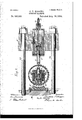
- Figure 1 is a sectionalside elevation taken on the line i 'az-m, Fig. 2; Fig.- 2, a plan view; the head of the drum beingin section according to theY showing a modiication of a punchand abutment mechanism, in a position prior to acting on a rivet.
- Fig. 5 is a section of the same showing the parts in another position.
- Fig. 6 is a section of the same showing the parts ,the pistons 3, 3, may abut. plunger 5, and its punch 8, are retracted into the cylinder G, containingsuch plunger, the
- Fig. 7 is a plan view l of another modification, and Fig. 8, is in section on ⁇ the lines m', of Fig. 7.
- A represents the external structure or frame work of the apparatus which extends into the pit B.
- the interior column I for supporting the interior punch 7 and the abutting parts interior to the work K, is mounted upon the base H of the frame work A, A, while the standar ⁇ ds D, E, of said frame work-support the movable frame M, N, that carries the abutment F. 1
- the frameheade M, N are united together by tie rods 32, 32, which are endwise movable in the supports D, D, E, E.
- the tie rods 32. are screw threaded in order to provide forsecuring' the adjustment thereon of the head M, relatively to the head N.
- This adjustment of the head M is produced by vmeans of hydranlic cylinders 50, containing pistons attachedto the rods 51.
- the heads M, and N when relatively adj usted, are free to move together-by the slid- ⁇ ing of their tie rods through the supporting bearings D, D, E, F..v Y
- the riveting punch 8 is mounted upon a plunger 5.
- the pistons 3, are attached tothe punch 8, and the plunger 5, by means of the cross-head 6.
- frame A is provided 'with an adjusting standard E', against which the extensions of
- the extensionsot the pistons 3, 3, and their relation to the standard E' are so adjusted that The supportingpart E, of the4 their abutment shall occur after'the'punch 8,
- an intermediate abutting piece 9 is inserted between the cylinder J, and the work in line with the abutment F.
- the piece 9, is provided with a suitable yoke 9', as indicated, which serves as a brace for holding it in position upon the column I.
- the system of pipes 23, extend from a source of variable maximum pressure for advancing the punch-plum gers 4, 'and' 5, and performing the work, While the system of pipes 20, communicate with the retracting pistons 2, 2, and 3, 3, and are supplied withr constant minimum pressure.
- the pipes 20, may be connected to the constant pressure pipes of an apparatus for hydraulically intensifying and equalizin g pressure, such as described in my separate patent application filed simultaneously herewith, Se-
- the pressure pipes 23, may be connected to the delivery pipe of the compressor described therein, and controlled by means of a suitable distributing valve adapted to alternately charge and exhaust such pipes 23, at each operation.
- the pipes 23, communicate also with the lesser area of the pistons 52, in the cylinders 50, to draw the frame M, N, up to the work, while the pipes 20, communicate constant minimum pressure to the greater area of said pistons 52, for retiring said frame to the position in Fig. 3.
- the pipes 23, which communicate with the cylinders 50, are designed to be controlled by independent valves. y
- Figs. 4, 5, and 6, in which I employ in connection with the interior punch an abutment, or support, movable in advance of the movement of the punch; 7, designates the punch mounted in the plunger 4, movable Within the cylinder J.
- the cylinder J has an extension J movablein a cylinder J 2, mounted on the standard I.
- From the forward end of the The Varii ple comprises a movable abutment arranged in line with the riveting mechanism, and it is shown as a punch 5S, supported by one of the cross-heads 56, and constructed and actuatedin a similar manner to thepunch S.
- a punch 5S supported by one of the cross-heads 56, and constructed and actuatedin a similar manner to thepunch S.
- a fixed frame comprising ⁇ cross-heads 56, and tie rods 57.
- lateral supports for thev i work.
- These lateral supports are adjustable longitudinally of the machine, and to and from thework, for the purpose of adapting them to work of various sizes. For instance, for the support laterally of small or large cylinders during the process of rveting.
- These lateral supports are constructed and operated as follows: 59, designates acylindric block mounted on the tie-rod 57, so as to have a movement longitudinally of said rod, and also to have a swinging movement relatively to the rod.
- 6.0 is a bar seated in a channel in the inner side of the block 59, and movable outward and inward ⁇ relatively' to the block.
- This bar 60 has a bail 61, attached to it, and adapted to engage the outer side of the work operated upon, as
- This bail 6l is removable from the bar 60, so that another may be substituted for it, to accommodate the lateral abutment to a cylinder, or work of smaller cross-section, as shown in dotted lines in Fig. 7.
- a lateral adjustmentof this lateral abutment, or support, is made through the meblock 59, and the sleeve 65, are movable lon- ⁇ gitudinally of the rod.
- the rod may be longitudid nally channeled, and the sleeve pro vided with a feather to extend into this channel.
- I employ ashaft 68, mounted in bearings secured to the frame of the machine, and having beveled gears 69, engaging with beveled gears 70, on the rods 66.
- the shaft 68 may berotated by means of a crank 7l. As the shaft 68, is located below the horizontal plane of the lateral abutments, or supports, the rods 66, are provided withuniversal joints 72.
- the blocks 59 may be moved longitudinally of the tie-rods 57, by hand power.
- the lateral abutments, or supports may be deflected upward, as shown in dotted lines at the right-hand end of Fig. 8, ⁇ by turning the blocks 59 on the tie-rods 57.
- the said lateral supports will be automatically returned to their normal or horizontal position by means of the weighted arm, or counter-balance 73, extended from the lower side of the blocks 59.
- I have termed these devices last described as lateral abutments, or supports, because they angles to the'operation of the riveting mechanis-m and the aligned support or abutment.
- the frame heads N, N, or external supports may be permanently connected at a given distance apart as in Fig. 7, or made adjustablev with reference to one another as in Fig. 2, and provided with means for'retaining them at a given distance during the performance of the work; and said supports may be supported in a proper working position by obvious other means than that shown; and 'the riveting mechanism S, and 7, and the resisting mechanisin comprising the parts J, or 9, or F', or 58, or any or all of them, abut in a continuous series from one said external support M to and through the hollow work to the other said external support N Having thus fully described my invention, what Ielaim is- 1.
- Ariveting machine constructed with op- Y posing punches, and adapted respectively for shell and the interior punch, and an exterioroperation on a rivet at the outside and inside of a drum or shell, hydraulic rams operating said punches, an abutment piece adapted for insertion between one side of the drum or abutment opposing the interior abutment piece, substantially as described, and for the purposes set forth.
- a riveting machine constructed with a j su p portin g frame, two supports exterior to the ⁇ Work connected together, and movable on said frame, one support carrying a riveting punch,
- a riveting machine constructed with a supporting frame, two supports exterlor to the work connected together, one support carrying a riveting punch, the other kcarrylngan abutment, said punch and abutmentl being adapted for operation at opposite exterlor sides of the work, means for supporting the interior sides of the Work, and the adjustable lateral supports, or abutmen ts, substantlally as specified.
Landscapes
- Engineering & Computer Science (AREA)
- Mechanical Engineering (AREA)
- Press Drives And Press Lines (AREA)
Description
(No maal.) A 4 f 5 sheets-sheet 1.
C. P. HIGGINS.
RIVBTING MACHINE. y l
Patented Aug. 14, 1894.
I' 'a T-ffl..
WW1/msec f/ngue'wloz i www 55113 Stro/mam n I I @M 5 n 74.
5 Sheets-SheerI '2.
(No Model.)
C P. HIGGINS.
RIVBTING MACHINE. No. 524,326. Patented Aug. `14, 1894.-
l irq olv-l t nu B h ,.S. w nu e h. S 5 NT.. IH GG G A ...w HN .n D.. ...L .W C R .d 0 M 0 m NQ. 524,326 .Patented Aug. 14.11894.
t..- n" Il m a. m, W. ou m w., u m m (N6 Modem l 5V sheets-snm 5.
o. P. HIGGINS. RIVETING MACHINE.
.Patented A ug. y14, 1894.
PATENT l' OEEIcE.l
CAMPBELL P. HIGGINS, OF ROSELLE, NEW J ERSY.
RIVETINc-MACHINE.
SPECIFICATION forming part of Letters IPatent No. 524,326, dated August 14, 1894'.
Application tiled May 27, 1.893.
'To tu whom it may concern:
Be it known that l, CAMPBELL AP. HIGGINS,- a citlzen of the United States, residing at Ro- Iselle,in the county of Union and State of New lng machines of the general character described in my separate patent application, tiled simultaneously l1erewith, Serial No. 475,787, requiring an interior support for the work having a long reach; and said invention is especially adapted for riveting cylindrical drums or other shells of wrought metal.
The invention consists in an apparatus having two ,movable punches, one exterior and the other interior to the shell or hollow work to be riveted, and having automatically adjustable means for forming, together with the punches, a continuous abutting connection from one exterior support, to and through the work, to another exterior supportythe thrust of the punches being thereby transmittedin a continuous line through the work without lateral strain on the support of the interior punch.
In order to enable others skilled in the art to which the said invention appertains, to understand and use the same, I will proceed to describe its construction, explain its operation, and point out in the appended claims its novel characteristics.
Referring to the accompanying drawings, in which like characters of reference indicate corresponding partsthroughout: Figure 1, is a sectionalside elevation taken on the line i 'az-m, Fig. 2; Fig.- 2, a plan view; the head of the drum beingin section according to theY showing a modiication of a punchand abutment mechanism, in a position prior to acting on a rivet. Fig. 5, is a section of the same showing the parts in another position., Fig. 6, is a section of the same showing the parts ,the pistons 3, 3, may abut. plunger 5, and its punch 8, are retracted into the cylinder G, containingsuch plunger, the
Serial No. 475,788. (No model.)
in still yanother position. Fig. 7, is a plan view l of another modification, and Fig. 8, is in section on` the lines m', of Fig. 7.
Referring first to Figs. l, 2, 2 and 3: A, represents the external structure or frame work of the apparatus which extends into the pit B.
The interior column I for supporting the interior punch 7 and the abutting parts interior to the work K, is mounted upon the base H of the frame work A, A, while the standar`ds D, E, of said frame work-support the movable frame M, N, that carries the abutment F. 1
The frameheade M, N, are united together by tie rods 32, 32, which are endwise movable in the supports D, D, E, E. The tie rods 32., are screw threaded in order to provide forsecuring' the adjustment thereon of the head M, relatively to the head N. This adjustment of the head M, is produced by vmeans of hydranlic cylinders 50, containing pistons attachedto the rods 51. When the head M, is slid to the desired position, passing freely over the threaded rods 32, the nuts 54, which are the only parts threaded to said rods 32, are turned until they abut upon the head M, securing its adjustment firmly with reference to the head N. l
The heads M, and N, when relatively adj usted, are free to move together-by the slid-` ing of their tie rods through the supporting bearings D, D, E, F..v Y
The riveting punch 8, is mounted upon a plunger 5. The pistons 3, are attached tothe punch 8, and the plunger 5, by means of the cross-head 6. frame A, is provided 'with an adjusting standard E', against which the extensions of Thus, when the frame M, N, is pushed bodily away from said adjusting standard E', so that the abutment' F shall release and clear the work. The extensionsot the pistons 3, 3, and their relation to the standard E', are so adjusted that The supportingpart E, of the4 their abutment shall occur after'the'punch 8,
has retracted a sufficient distancefrom the rivet heads in the work to clear the same, as'
seen in Fig. 3. i y In order to provide for the permanent water connection of the pipe 23,with the cylinder G, irrespective of the movements of the Y system of pipesy 20.
various suitable or well known ways, and pro-I When the work is of large diameter, as in Figs. l and 2, an intermediate abutting piece 9, is inserted between the cylinder J, and the work in line with the abutment F. The piece 9, is provided with a suitable yoke 9', as indicated, which serves as a brace for holding it in position upon the column I.
When thework is of small diameter, as in Fig. 3, the back of the cylinder J, which is provided with `a suitable groove 60, is permitted to abut directly on the work. ouspieces9, may be interchanged or substituted to tit the sizes of the work.
The hydraulic connections for operating the several cylinder-plungers and pistons hereinbefore described, may be attached in vided with valves for controlling the admission of uid under pressure.
For convenience, the system of pipes 23, extend from a source of variable maximum pressure for advancing the punch-plum gers 4, 'and' 5, and performing the work, While the system of pipes 20, communicate with the retracting pistons 2, 2, and 3, 3, and are supplied withr constant minimum pressure.
The pipes 20, may be connected to the constant pressure pipes of an apparatus for hydraulically intensifying and equalizin g pressure, such as described in my separate patent application filed simultaneously herewith, Se-
rial No. 475,787, and the pressure pipes 23, may be connected to the delivery pipe of the compressor described therein, and controlled by means of a suitable distributing valve adapted to alternately charge and exhaust such pipes 23, at each operation. The pipes 23, communicate also with the lesser area of the pistons 52, in the cylinders 50, to draw the frame M, N, up to the work, while the pipes 20, communicate constant minimum pressure to the greater area of said pistons 52, for retiring said frame to the position in Fig. 3. The pipes 23, which communicate with the cylinders 50, are designed to be controlled by independent valves. y
Referring now to the modifications shown in Figs. 4, 5, and 6, in which I employ in connection with the interior punch an abutment, or support, movable in advance of the movement of the punch; 7, designates the punch mounted in the plunger 4, movable Within the cylinder J. The cylinder J ,has an extension J movablein a cylinder J 2, mounted on the standard I. From the forward end of the The Varii ple comprises a movable abutment arranged in line with the riveting mechanism, and it is shown as a punch 5S, supported by one of the cross-heads 56, and constructed and actuatedin a similar manner to thepunch S. In
,cylinder J, an abutment J5, extendsand surinner end of the extension J', forces the cylinder J, the plunger 4, and the punch 7, to the position shown in Fig. 5, with the abutment J 3 tightly closed against the inner side of the work. Now, by admitting water pressure to the chamber J, and thus acting on the plunger 4, the punch 7, will be forced forward to the position shown in Fig. 6, and heading the rivet. abutment may be applied to the exteriorpunch if desired.
Referring now to the modifications shown in Figs. 7 and 8, a fixed frame is shown, comprising` cross-heads 56, and tie rods 57. In this example the riveting mechanism, or punches,`
may be the same, and operated in the same manner as heretofore described. This examthis example I provide lateral supports for thev i work. These lateral supports are adjustable longitudinally of the machine, and to and from thework, for the purpose of adapting them to work of various sizes. For instance, for the support laterally of small or large cylinders during the process of rveting. These lateral supports are constructed and operated as follows: 59, designates acylindric block mounted on the tie-rod 57, so as to have a movement longitudinally of said rod, and also to have a swinging movement relatively to the rod. 6.0, is a bar seated in a channel in the inner side of the block 59, and movable outward and inward `relatively' to the block. This bar 60, has a bail 61, attached to it, and adapted to engage the outer side of the work operated upon, as
Itv is obvious that this movable shown in Fig. 7. This bail 6l, is removable from the bar 60, so that another may be substituted for it, to accommodate the lateral abutment to a cylinder, or work of smaller cross-section, as shown in dotted lines in Fig. 7. A lateral adjustmentof this lateral abutment, or support, is made through the meblock 59, and the sleeve 65, are movable lon-` gitudinally of the rod.
To impart a rotary movement to the sleeve I 65, with the rod 66, the rod may be longitudid nally channeled, and the sleeve pro vided with a feather to extend into this channel. To impart a simultaneous adjustment to the lateral abutments, or supports, I employ ashaft 68, mounted in bearings secured to the frame of the machine, and having beveled gears 69, engaging with beveled gears 70, on the rods 66. The shaft 68, may berotated by means of a crank 7l. As the shaft 68, is located below the horizontal plane of the lateral abutments, or supports, the rods 66, are provided withuniversal joints 72.
The blocks 59, may be moved longitudinally of the tie-rods 57, by hand power.
As the work is lifted from the machine in the usual manner, the lateral abutments, or supports, may be deflected upward, as shown in dotted lines at the right-hand end of Fig. 8,`by turning the blocks 59 on the tie-rods 57. After the removal of the work, the said lateral supports will be automatically returned to their normal or horizontal position by means of the weighted arm, or counter-balance 73, extended from the lower side of the blocks 59. I have termed these devices last described as lateral abutments, or supports, because they angles to the'operation of the riveting mechanis-m and the aligned support or abutment.
' The frame heads N, N, or external supports may be permanently connected at a given distance apart as in Fig. 7, or made adjustablev with reference to one another as in Fig. 2, and provided with means for'retaining them at a given distance during the performance of the work; and said supports may be supported in a proper working position by obvious other means than that shown; and 'the riveting mechanism S, and 7, and the resisting mechanisin comprising the parts J, or 9, or F', or 58, or any or all of them, abut in a continuous series from one said external support M to and through the hollow work to the other said external support N Having thus fully described my invention, what Ielaim is- 1. Ariveting machine, constructed with op- Y posing punches, and adapted respectively for shell and the interior punch, and an exterioroperation on a rivet at the outside and inside of a drum or shell, hydraulic rams operating said punches, an abutment piece adapted for insertion between one side of the drum or abutment opposing the interior abutment piece, substantially as described, and for the purposes set forth.
operate at substantially rightl2. A riveting machine, constructed with a j su p portin g frame, two supports exterior to the` Work connected together, and movable on said frame, one support carrying a riveting punch,
of a' supporting frame, two supports at opposite sidesof thc'work connected together and movably mounted on ysaid frame, a riveting punch movably'mounted on one ofsaid supports, and means for advancing or retractmg the opposite support toward or from the work by the advancing or 'retracting movements, respectively, of said punch.
4. A riveting machine constructed with a supporting frame, two supports exterlor to the work connected together, one support carrying a riveting punch, the other kcarrylngan abutment, said punch and abutmentl being adapted for operation at opposite exterlor sides of the work, means for supporting the interior sides of the Work, and the adjustable lateral supports, or abutmen ts, substantlally as specified. y
5. The combination with riveting mechan-/ ism, substantially such as described, and a `frame comprising tie-rods, of the abutments or supports, movable longitudinally on said tie-rods, and mechanism for adjusting said abutments or supports, laterally, substan-l tially as specified.
6. The combination with riveting mechanism, substantially such as described, and a frame comprising tie-rods, of -the abutments or supports, having a longitudinal or swinging'movement relatively to said tie rods, and
lmechanism for causing a lateral adjustment Y as specified. n
7; The combination with riveting mechanism, substantially such as described, and a frame comprising tie-rods, of the lateral abutments or supports, having a longitudinal and swinging movement relatively to said tie-rods, and a cou nter-balancc for returning said abut` CAMPBELL nP. HIGGINS.
of said abutments, or supports, substantially IOO 105. i ments, or supports, to a normal or horizontal J position, substantially as specltied.
Publications (1)
| Publication Number | Publication Date |
|---|---|
| US524326A true US524326A (en) | 1894-08-14 |
Family
ID=2593120
Family Applications (1)
| Application Number | Title | Priority Date | Filing Date |
|---|---|---|---|
| US524326D Expired - Lifetime US524326A (en) | Riveting-machine |
Country Status (1)
| Country | Link |
|---|---|
| US (1) | US524326A (en) |
Cited By (1)
| Publication number | Priority date | Publication date | Assignee | Title |
|---|---|---|---|---|
| US2441981A (en) * | 1943-11-01 | 1948-05-25 | Parker Pattern And Foundry Com | Bearing driver |
-
0
- US US524326D patent/US524326A/en not_active Expired - Lifetime
Cited By (1)
| Publication number | Priority date | Publication date | Assignee | Title |
|---|---|---|---|---|
| US2441981A (en) * | 1943-11-01 | 1948-05-25 | Parker Pattern And Foundry Com | Bearing driver |
Similar Documents
| Publication | Publication Date | Title |
|---|---|---|
| US3030835A (en) | Tube rolling machine | |
| US2594126A (en) | Mill for reducing metal stock | |
| US3211027A (en) | Tube rolling method | |
| US2356790A (en) | Power press | |
| US1070379A (en) | Tube-pointing machine. | |
| IT8367114A1 (en) | Device for the compression application of tubular joining elements. | |
| US3059509A (en) | Billet center punching apparatus | |
| GB757526A (en) | Improvements in or relating to apparatus for forging crank-shafts | |
| US1382309A (en) | Straightening-machine | |
| US1804002A (en) | Machine for flanging pipes | |
| US445935A (en) | Riveting-machine | |
| US1514425A (en) | Tube-reducing mill | |
| US780539A (en) | Hydraulic internal riveter for pipes. | |
| US512829A (en) | Washinqton | |
| AU2017303835B2 (en) | Can bodymaker ram alignment | |
| US612927A (en) | Riveting-machine | |
| US2935114A (en) | Work gripping and drawing mechanism for sheet shaping machines operating on the forming-by-drawing principle | |
| US73715A (en) | harding | |
| US445936A (en) | Riveting-machine | |
| GB1272503A (en) | Apparatus for the bending of wire | |
| US606213A (en) | Machine for forming polygonal tubes | |
| US961131A (en) | Machine for forming seamless tubes. | |
| SU120401A1 (en) | Press for are flexible cutters | |
| US671430A (en) | Punching and forging apparatus. | |
| US1275258A (en) | Forging-press. |