US5215918A - Enantiomeric enrichment of (R,S)-3-quinuclidinol - Google Patents
Enantiomeric enrichment of (R,S)-3-quinuclidinol Download PDFInfo
- Publication number
- US5215918A US5215918A US07/901,553 US90155392A US5215918A US 5215918 A US5215918 A US 5215918A US 90155392 A US90155392 A US 90155392A US 5215918 A US5215918 A US 5215918A
- Authority
- US
- United States
- Prior art keywords
- quinuclidinol
- ester
- fatty acid
- alcohol
- acid anhydride
- Prior art date
- Legal status (The legal status is an assumption and is not a legal conclusion. Google has not performed a legal analysis and makes no representation as to the accuracy of the status listed.)
- Expired - Fee Related
Links
- 238000000034 method Methods 0.000 claims abstract description 14
- IVLICPVPXWEGCA-UHFFFAOYSA-N 3-quinuclidinol Chemical compound C1C[C@@H]2C(O)C[N@]1CC2 IVLICPVPXWEGCA-UHFFFAOYSA-N 0.000 claims abstract description 11
- LFQSCWFLJHTTHZ-UHFFFAOYSA-N Ethanol Chemical compound CCO LFQSCWFLJHTTHZ-UHFFFAOYSA-N 0.000 claims abstract description 10
- 108090000787 Subtilisin Proteins 0.000 claims abstract description 5
- 235000014113 dietary fatty acids Nutrition 0.000 claims description 9
- 229930195729 fatty acid Natural products 0.000 claims description 9
- 239000000194 fatty acid Substances 0.000 claims description 9
- 239000000203 mixture Substances 0.000 claims description 7
- -1 fatty acid ester Chemical class 0.000 claims description 6
- 150000004665 fatty acids Chemical class 0.000 claims description 5
- 239000011541 reaction mixture Substances 0.000 claims description 4
- IVLICPVPXWEGCA-SSDOTTSWSA-N (3s)-1-azabicyclo[2.2.2]octan-3-ol Chemical compound C1CC2[C@H](O)CN1CC2 IVLICPVPXWEGCA-SSDOTTSWSA-N 0.000 claims description 3
- YHASWHZGWUONAO-UHFFFAOYSA-N butanoyl butanoate Chemical group CCCC(=O)OC(=O)CCC YHASWHZGWUONAO-UHFFFAOYSA-N 0.000 claims description 3
- 238000011084 recovery Methods 0.000 claims description 3
- 239000003054 catalyst Substances 0.000 claims description 2
- 238000000638 solvent extraction Methods 0.000 claims description 2
- 125000004432 carbon atom Chemical group C* 0.000 claims 1
- 230000003301 hydrolyzing effect Effects 0.000 claims 1
- 150000008065 acid anhydrides Chemical class 0.000 abstract description 4
- 230000007071 enzymatic hydrolysis Effects 0.000 abstract description 2
- 238000006047 enzymatic hydrolysis reaction Methods 0.000 abstract description 2
- 230000032050 esterification Effects 0.000 abstract 1
- 238000005886 esterification reaction Methods 0.000 abstract 1
- OKKJLVBELUTLKV-UHFFFAOYSA-N Methanol Chemical compound OC OKKJLVBELUTLKV-UHFFFAOYSA-N 0.000 description 12
- 150000002148 esters Chemical class 0.000 description 9
- VLKZOEOYAKHREP-UHFFFAOYSA-N n-Hexane Chemical compound CCCCCC VLKZOEOYAKHREP-UHFFFAOYSA-N 0.000 description 9
- HEMHJVSKTPXQMS-UHFFFAOYSA-M Sodium hydroxide Chemical compound [OH-].[Na+] HEMHJVSKTPXQMS-UHFFFAOYSA-M 0.000 description 6
- YXFVVABEGXRONW-UHFFFAOYSA-N Toluene Chemical compound CC1=CC=CC=C1 YXFVVABEGXRONW-UHFFFAOYSA-N 0.000 description 6
- 230000007062 hydrolysis Effects 0.000 description 6
- 238000006460 hydrolysis reaction Methods 0.000 description 6
- 239000002904 solvent Substances 0.000 description 5
- 238000000605 extraction Methods 0.000 description 4
- 239000000243 solution Substances 0.000 description 4
- FERIUCNNQQJTOY-UHFFFAOYSA-N Butyric acid Chemical compound CCCC(O)=O FERIUCNNQQJTOY-UHFFFAOYSA-N 0.000 description 3
- YMWUJEATGCHHMB-UHFFFAOYSA-N Dichloromethane Chemical compound ClCCl YMWUJEATGCHHMB-UHFFFAOYSA-N 0.000 description 3
- 102000004190 Enzymes Human genes 0.000 description 3
- 108090000790 Enzymes Proteins 0.000 description 3
- CDBYLPFSWZWCQE-UHFFFAOYSA-L Sodium Carbonate Chemical compound [Na+].[Na+].[O-]C([O-])=O CDBYLPFSWZWCQE-UHFFFAOYSA-L 0.000 description 3
- FSNYTEYOTCTPSO-ZETCQYMHSA-N (2s)-1-azabicyclo[2.2.2]octan-2-ol Chemical compound C1CN2[C@@H](O)CC1CC2 FSNYTEYOTCTPSO-ZETCQYMHSA-N 0.000 description 2
- 241000193830 Bacillus <bacterium> Species 0.000 description 2
- BVKZGUZCCUSVTD-UHFFFAOYSA-L Carbonate Chemical compound [O-]C([O-])=O BVKZGUZCCUSVTD-UHFFFAOYSA-L 0.000 description 2
- HEDRZPFGACZZDS-UHFFFAOYSA-N Chloroform Chemical compound ClC(Cl)Cl HEDRZPFGACZZDS-UHFFFAOYSA-N 0.000 description 2
- 108091005804 Peptidases Proteins 0.000 description 2
- 102000035195 Peptidases Human genes 0.000 description 2
- 239000004365 Protease Substances 0.000 description 2
- UIIMBOGNXHQVGW-UHFFFAOYSA-M Sodium bicarbonate Chemical compound [Na+].OC([O-])=O UIIMBOGNXHQVGW-UHFFFAOYSA-M 0.000 description 2
- 108010056079 Subtilisins Proteins 0.000 description 2
- 102000005158 Subtilisins Human genes 0.000 description 2
- 238000006243 chemical reaction Methods 0.000 description 2
- 239000003795 chemical substances by application Substances 0.000 description 2
- 238000004821 distillation Methods 0.000 description 2
- 230000014509 gene expression Effects 0.000 description 2
- 238000002360 preparation method Methods 0.000 description 2
- 238000000926 separation method Methods 0.000 description 2
- NQPDZGIKBAWPEJ-UHFFFAOYSA-N valeric acid Chemical compound CCCCC(O)=O NQPDZGIKBAWPEJ-UHFFFAOYSA-N 0.000 description 2
- IVLICPVPXWEGCA-ZETCQYMHSA-N (3r)-1-azabicyclo[2.2.2]octan-3-ol Chemical compound C1CC2[C@@H](O)CN1CC2 IVLICPVPXWEGCA-ZETCQYMHSA-N 0.000 description 1
- FSNYTEYOTCTPSO-UHFFFAOYSA-N 1-azabicyclo[2.2.2]octan-2-ol Chemical class C1CN2C(O)CC1CC2 FSNYTEYOTCTPSO-UHFFFAOYSA-N 0.000 description 1
- BJNCVECKNVBHBP-UHFFFAOYSA-N 1-azabicyclo[2.2.2]octan-3-yl butanoate Chemical compound C1CC2C(OC(=O)CCC)CN1CC2 BJNCVECKNVBHBP-UHFFFAOYSA-N 0.000 description 1
- HBAQYPYDRFILMT-UHFFFAOYSA-N 8-[3-(1-cyclopropylpyrazol-4-yl)-1H-pyrazolo[4,3-d]pyrimidin-5-yl]-3-methyl-3,8-diazabicyclo[3.2.1]octan-2-one Chemical class C1(CC1)N1N=CC(=C1)C1=NNC2=C1N=C(N=C2)N1C2C(N(CC1CC2)C)=O HBAQYPYDRFILMT-UHFFFAOYSA-N 0.000 description 1
- 241000194108 Bacillus licheniformis Species 0.000 description 1
- 244000063299 Bacillus subtilis Species 0.000 description 1
- 235000014469 Bacillus subtilis Nutrition 0.000 description 1
- BVKZGUZCCUSVTD-UHFFFAOYSA-M Bicarbonate Chemical compound OC([O-])=O BVKZGUZCCUSVTD-UHFFFAOYSA-M 0.000 description 1
- 239000004215 Carbon black (E152) Substances 0.000 description 1
- 102100032404 Cholinesterase Human genes 0.000 description 1
- 101710083761 Cholinesterase Proteins 0.000 description 1
- 101100386054 Saccharomyces cerevisiae (strain ATCC 204508 / S288c) CYS3 gene Proteins 0.000 description 1
- BJNCVECKNVBHBP-JTQLQIEISA-N [(3r)-1-azabicyclo[2.2.2]octan-3-yl] butanoate Chemical compound C1CC2[C@@H](OC(=O)CCC)CN1CC2 BJNCVECKNVBHBP-JTQLQIEISA-N 0.000 description 1
- OIPILFWXSMYKGL-UHFFFAOYSA-N acetylcholine Chemical compound CC(=O)OCC[N+](C)(C)C OIPILFWXSMYKGL-UHFFFAOYSA-N 0.000 description 1
- 229960004373 acetylcholine Drugs 0.000 description 1
- 230000010933 acylation Effects 0.000 description 1
- 238000005917 acylation reaction Methods 0.000 description 1
- 150000001298 alcohols Chemical class 0.000 description 1
- 230000001022 anti-muscarinic effect Effects 0.000 description 1
- 239000002585 base Substances 0.000 description 1
- 239000003637 basic solution Substances 0.000 description 1
- 238000009835 boiling Methods 0.000 description 1
- 150000004648 butanoic acid derivatives Chemical class 0.000 description 1
- 150000004652 butanoic acids Chemical class 0.000 description 1
- 239000013626 chemical specie Substances 0.000 description 1
- 150000001875 compounds Chemical class 0.000 description 1
- 238000007796 conventional method Methods 0.000 description 1
- 239000013078 crystal Substances 0.000 description 1
- XBDQKXXYIPTUBI-UHFFFAOYSA-N dimethylselenoniopropionate Natural products CCC(O)=O XBDQKXXYIPTUBI-UHFFFAOYSA-N 0.000 description 1
- 230000000694 effects Effects 0.000 description 1
- 125000000524 functional group Chemical group 0.000 description 1
- 230000002068 genetic effect Effects 0.000 description 1
- 239000002035 hexane extract Substances 0.000 description 1
- PKHMTIRCAFTBDS-UHFFFAOYSA-N hexanoyl hexanoate Chemical class CCCCCC(=O)OC(=O)CCCCC PKHMTIRCAFTBDS-UHFFFAOYSA-N 0.000 description 1
- 229930195733 hydrocarbon Natural products 0.000 description 1
- 150000002430 hydrocarbons Chemical class 0.000 description 1
- 244000005700 microbiome Species 0.000 description 1
- 238000002156 mixing Methods 0.000 description 1
- 230000003551 muscarinic effect Effects 0.000 description 1
- 230000003287 optical effect Effects 0.000 description 1
- 238000005192 partition Methods 0.000 description 1
- IUVKMZGDUIUOCP-BTNSXGMBSA-N quinbolone Chemical compound O([C@H]1CC[C@H]2[C@H]3[C@@H]([C@]4(C=CC(=O)C=C4CC3)C)CC[C@@]21C)C1=CCCC1 IUVKMZGDUIUOCP-BTNSXGMBSA-N 0.000 description 1
- 125000004621 quinuclidinyl group Chemical group N12C(CC(CC1)CC2)* 0.000 description 1
- 210000002966 serum Anatomy 0.000 description 1
- 229910000030 sodium bicarbonate Inorganic materials 0.000 description 1
- 235000017557 sodium bicarbonate Nutrition 0.000 description 1
- 229910000029 sodium carbonate Inorganic materials 0.000 description 1
- 101150035983 str1 gene Proteins 0.000 description 1
- 239000000126 substance Substances 0.000 description 1
- 230000009466 transformation Effects 0.000 description 1
- XLYOFNOQVPJJNP-UHFFFAOYSA-N water Substances O XLYOFNOQVPJJNP-UHFFFAOYSA-N 0.000 description 1
Images
Classifications
-
- C—CHEMISTRY; METALLURGY
- C12—BIOCHEMISTRY; BEER; SPIRITS; WINE; VINEGAR; MICROBIOLOGY; ENZYMOLOGY; MUTATION OR GENETIC ENGINEERING
- C12P—FERMENTATION OR ENZYME-USING PROCESSES TO SYNTHESISE A DESIRED CHEMICAL COMPOUND OR COMPOSITION OR TO SEPARATE OPTICAL ISOMERS FROM A RACEMIC MIXTURE
- C12P17/00—Preparation of heterocyclic carbon compounds with only O, N, S, Se or Te as ring hetero atoms
- C12P17/18—Preparation of heterocyclic carbon compounds with only O, N, S, Se or Te as ring hetero atoms containing at least two hetero rings condensed among themselves or condensed with a common carbocyclic ring system, e.g. rifamycin
- C12P17/182—Heterocyclic compounds containing nitrogen atoms as the only ring heteroatoms in the condensed system
-
- C—CHEMISTRY; METALLURGY
- C07—ORGANIC CHEMISTRY
- C07D—HETEROCYCLIC COMPOUNDS
- C07D453/00—Heterocyclic compounds containing quinuclidine or iso-quinuclidine ring systems, e.g. quinine alkaloids
- C07D453/02—Heterocyclic compounds containing quinuclidine or iso-quinuclidine ring systems, e.g. quinine alkaloids containing not further condensed quinuclidine ring systems
-
- C—CHEMISTRY; METALLURGY
- C12—BIOCHEMISTRY; BEER; SPIRITS; WINE; VINEGAR; MICROBIOLOGY; ENZYMOLOGY; MUTATION OR GENETIC ENGINEERING
- C12P—FERMENTATION OR ENZYME-USING PROCESSES TO SYNTHESISE A DESIRED CHEMICAL COMPOUND OR COMPOSITION OR TO SEPARATE OPTICAL ISOMERS FROM A RACEMIC MIXTURE
- C12P41/00—Processes using enzymes or microorganisms to separate optical isomers from a racemic mixture
- C12P41/003—Processes using enzymes or microorganisms to separate optical isomers from a racemic mixture by ester formation, lactone formation or the inverse reactions
- C12P41/004—Processes using enzymes or microorganisms to separate optical isomers from a racemic mixture by ester formation, lactone formation or the inverse reactions by esterification of alcohol- or thiol groups in the enantiomers or the inverse reaction
-
- C—CHEMISTRY; METALLURGY
- C07—ORGANIC CHEMISTRY
- C07B—GENERAL METHODS OF ORGANIC CHEMISTRY; APPARATUS THEREFOR
- C07B2200/00—Indexing scheme relating to specific properties of organic compounds
- C07B2200/07—Optical isomers
-
- Y—GENERAL TAGGING OF NEW TECHNOLOGICAL DEVELOPMENTS; GENERAL TAGGING OF CROSS-SECTIONAL TECHNOLOGIES SPANNING OVER SEVERAL SECTIONS OF THE IPC; TECHNICAL SUBJECTS COVERED BY FORMER USPC CROSS-REFERENCE ART COLLECTIONS [XRACs] AND DIGESTS
- Y10—TECHNICAL SUBJECTS COVERED BY FORMER USPC
- Y10S—TECHNICAL SUBJECTS COVERED BY FORMER USPC CROSS-REFERENCE ART COLLECTIONS [XRACs] AND DIGESTS
- Y10S435/00—Chemistry: molecular biology and microbiology
- Y10S435/8215—Microorganisms
- Y10S435/822—Microorganisms using bacteria or actinomycetales
- Y10S435/832—Bacillus
- Y10S435/836—Bacillus licheniformis
-
- Y—GENERAL TAGGING OF NEW TECHNOLOGICAL DEVELOPMENTS; GENERAL TAGGING OF CROSS-SECTIONAL TECHNOLOGIES SPANNING OVER SEVERAL SECTIONS OF THE IPC; TECHNICAL SUBJECTS COVERED BY FORMER USPC CROSS-REFERENCE ART COLLECTIONS [XRACs] AND DIGESTS
- Y10—TECHNICAL SUBJECTS COVERED BY FORMER USPC
- Y10S—TECHNICAL SUBJECTS COVERED BY FORMER USPC CROSS-REFERENCE ART COLLECTIONS [XRACs] AND DIGESTS
- Y10S435/00—Chemistry: molecular biology and microbiology
- Y10S435/8215—Microorganisms
- Y10S435/822—Microorganisms using bacteria or actinomycetales
- Y10S435/832—Bacillus
- Y10S435/839—Bacillus subtilis
Definitions
- esters of 3-quinuclidinol contain the functional groups of acetylcholine and are known to possess muscarinic and antimuscarinic activity.
- Biologically active quinuclidinol derivatives contain chiral centers, and so it is often highly desirable that they be in an enantiomerically-enriched or pure form, so as to improve specificity and reduce side effects. Consequently, the preparation of high optical purity quinuclidinols is of great interest.
- racemic 3-quinuclidinol may be enantiomerically enriched by simply mixing the same with an acid anhydride, followed by selective enzymatic hydrolysis of the (S)-ester with a subtilisin protease and separating the desired enantiomer or its ester.
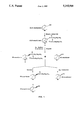
- FIG. 1 is a schematic showing the reaction scheme of the method of the present invention.
- a method of enantiomerically enriching (R,S)-3-quinuclidinol comprising an acid anhydride acylation of the racemic mixture, followed by an enantioselective protease-catalyzed hydrolysis, and separation of the desired enantiomer or its ester.
- the catalyst is a subtilisin protease
- the acylating agent is a lower fatty acid anhydride selected from propionic, butyric, pentanoic and hexanoic acid anhydrides.
- enantiomeric enrichment refers to the increase in the amount of one enantiomer as compared to the other. Enantiomeric enrichment may be effected by an increase or a decrease in the amount of one chiral form as compared to the other.
- a convenient method of expressing enantiomeric enrichment uses the concept of enantiomeric excess ("ee"), expressed by ##EQU1## wherein E1 is the amount of the first chiral form of the alcohol (or its ester) and E2 is amount of the second chiral form.
- the reaction scheme shown in FIG. 1 illustrates the method when the acylating agent is butyric anhydride.
- a mixture of (R,S)-3-quinuclidinol is allowed to react with a slight excess of the acid anhydride to form the ester salt, which is then catalytically hydrolyzed in a slightly basic solution (5 wt. % aqueous bicarbonate).
- the hydrolysis is enantioselective for the (S)-enantiomer, which results in the enrichment of the ester and the (R)-enantiomer, and produces alcohol enriched in the (S)-enantiomer.
- the unreacted (R)-ester may be separated from the alcohol by raising the pH slightly, as by the addition of sodium carbonate to the solution to obtain a total carbonate concentration of 5 wt. %, which renders the (R)-ester (but not the (S)-quinuclidinol) extractable by a hydrocarbon solvent, such as hexane.
- the (R)-ester may be hydrolyzed by conventional methods to the (R)-alcohol.
- a particularly preferred method of hydrolysis comprises the use base and an alcohol, preferably sodium hydroxide and methanol.
- the (S)-alcohol may then be recovered from the reaction mixture by solvent extraction with a solvent having a high partition coefficient for quinuclidinol from water. Two exemplary and preferred such solvents are dichloromethane and chloroform.
- Subtilisin proteases suitable for use in the hydrolysis of the (S)-quinuclidinyl ester include all proteases and genetic variants thereof which are produced by any member of the Bacillus genus. Exemplary sources of such proteases include the microorganisms Bacillus subtilis. Bacillus amvloliouifaciens and Bacillus licheniformis. Subtilisin Carlsberg is a preferred enzyme, as it is readily available from many sources.
- the process of the present invention uses an enzyme to selectively carry out a transformation that leaves the two enantiomers as two different chemical species that may then be separated by conventional chemical separation means.
- the (R)-enantiomer remains as the ester while the (S)-enantiomer is transformed into the alcohol (S)-3-quinuclidinol.
- the extraction solvent is selected so that the solubility of the ester is high relative to the solubility of the alcohol. This is key to obtaining (R)-3-quinuclidinol of high enantiomeric excess, since any alcohol extracted along with the ester will be the wrong enantiomer.
- this alcohol would be chemically indistinguishable from the (R)-quiniclidinol, and its presence would lower the enantiomeric excess of the (R)-alcohol.
- reaction mixture was cooled to 4° C., and 27 g of anhydrous sodium carbonate was added to bring the total carbonate concentration to 5 wt. %.
- the so-formed reaction mixture was then extracted with 6 400 ml portions of ice-cold hexane.
- the hexane extracts were combined, and the hexane was removed by distillation at reduced pressure. The residue was confirmed as the (R)-ester (R)-quinuclidinyl butyrate by the sign of its rotation.
Landscapes
- Chemical & Material Sciences (AREA)
- Organic Chemistry (AREA)
- Wood Science & Technology (AREA)
- Life Sciences & Earth Sciences (AREA)
- Engineering & Computer Science (AREA)
- Zoology (AREA)
- Biotechnology (AREA)
- Microbiology (AREA)
- General Chemical & Material Sciences (AREA)
- Chemical Kinetics & Catalysis (AREA)
- Health & Medical Sciences (AREA)
- Biochemistry (AREA)
- Bioinformatics & Cheminformatics (AREA)
- General Engineering & Computer Science (AREA)
- General Health & Medical Sciences (AREA)
- Genetics & Genomics (AREA)
- Analytical Chemistry (AREA)
- Preparation Of Compounds By Using Micro-Organisms (AREA)
- Nitrogen Condensed Heterocyclic Rings (AREA)
Abstract
A method for the enantiomeric enrichment of 3-quinuclidinol is disclosed, comprising acid anhydride esterification of the alcohol, followed by preferential enzymatic hydrolysis with a subtilisin protease.
Description
The esters of 3-quinuclidinol, the structure of which is shown below, contain the functional groups of acetylcholine and are known to possess muscarinic and antimuscarinic activity. ##STR1## Biologically active quinuclidinol derivatives contain chiral centers, and so it is often highly desirable that they be in an enantiomerically-enriched or pure form, so as to improve specificity and reduce side effects. Consequently, the preparation of high optical purity quinuclidinols is of great interest.
The resolution of racemic mixtures of 3-quinuclidinol derivities has been reported. Rehavi et al., in 21 Life Sciences 1293 (1977), disclose the enzyme-catalyzed hydrolysis of (R)-3-quinuclidinol butyrate by butyrylcholine esterase from horse serum. However, the enantioselective hydrolysis of the (R)-ester to obtain R-alcohol was very slow (about 10 hours), resulted in low recovery and relatively low enantiomeric enrichment of the R-enantiomer, and required an enzyme which is very expensive.
There is still a need in the art for a simple, efficient, and inexpensive method of enantiomerically enriching chiral quinuclidinol and its derivatives. This need and others are met by the process of the present invention, which is summarized and described in detail below.
It has been found that racemic 3-quinuclidinol may be enantiomerically enriched by simply mixing the same with an acid anhydride, followed by selective enzymatic hydrolysis of the (S)-ester with a subtilisin protease and separating the desired enantiomer or its ester.
FIG. 1 is a schematic showing the reaction scheme of the method of the present invention.
According to the present invention, there is provided a method of enantiomerically enriching (R,S)-3-quinuclidinol comprising an acid anhydride acylation of the racemic mixture, followed by an enantioselective protease-catalyzed hydrolysis, and separation of the desired enantiomer or its ester. The catalyst is a subtilisin protease, and the acylating agent is a lower fatty acid anhydride selected from propionic, butyric, pentanoic and hexanoic acid anhydrides.
The term "enantiomeric enrichment" refers to the increase in the amount of one enantiomer as compared to the other. Enantiomeric enrichment may be effected by an increase or a decrease in the amount of one chiral form as compared to the other. A convenient method of expressing enantiomeric enrichment uses the concept of enantiomeric excess ("ee"), expressed by ##EQU1## wherein E1 is the amount of the first chiral form of the alcohol (or its ester) and E2 is amount of the second chiral form. Thus, if the initial ratio of the two chiral forms E1 and E2 is 50:50, as in a racemic mixture, and an enantiomeric enrichment is achieved that is sufficient to produce a final E1 to E2 ratio of 75:25, the ee with respect to the first chiral form would be 50%, calculated as ##EQU2##
The reaction scheme shown in FIG. 1 illustrates the method when the acylating agent is butyric anhydride. A mixture of (R,S)-3-quinuclidinol is allowed to react with a slight excess of the acid anhydride to form the ester salt, which is then catalytically hydrolyzed in a slightly basic solution (5 wt. % aqueous bicarbonate). The hydrolysis is enantioselective for the (S)-enantiomer, which results in the enrichment of the ester and the (R)-enantiomer, and produces alcohol enriched in the (S)-enantiomer. The unreacted (R)-ester may be separated from the alcohol by raising the pH slightly, as by the addition of sodium carbonate to the solution to obtain a total carbonate concentration of 5 wt. %, which renders the (R)-ester (but not the (S)-quinuclidinol) extractable by a hydrocarbon solvent, such as hexane. Following extraction, the (R)-ester may be hydrolyzed by conventional methods to the (R)-alcohol. A particularly preferred method of hydrolysis comprises the use base and an alcohol, preferably sodium hydroxide and methanol. The (S)-alcohol may then be recovered from the reaction mixture by solvent extraction with a solvent having a high partition coefficient for quinuclidinol from water. Two exemplary and preferred such solvents are dichloromethane and chloroform.
Subtilisin proteases suitable for use in the hydrolysis of the (S)-quinuclidinyl ester include all proteases and genetic variants thereof which are produced by any member of the Bacillus genus. Exemplary sources of such proteases include the microorganisms Bacillus subtilis. Bacillus amvloliouifaciens and Bacillus licheniformis. Subtilisin Carlsberg is a preferred enzyme, as it is readily available from many sources.
In general terms, the process of the present invention uses an enzyme to selectively carry out a transformation that leaves the two enantiomers as two different chemical species that may then be separated by conventional chemical separation means. Specifically, the (R)-enantiomer remains as the ester while the (S)-enantiomer is transformed into the alcohol (S)-3-quinuclidinol. The extraction solvent is selected so that the solubility of the ester is high relative to the solubility of the alcohol. This is key to obtaining (R)-3-quinuclidinol of high enantiomeric excess, since any alcohol extracted along with the ester will be the wrong enantiomer. Hence, when the (R)-ester is hydrolyzed, this alcohol would be chemically indistinguishable from the (R)-quiniclidinol, and its presence would lower the enantiomeric excess of the (R)-alcohol.
If it is desired to isolate the (S)-quinuclidinol, it is important that all of the (R)-ester has been removed prior to the extraction of the (S)-alcohol, since it is difficult to find an extraction solvent in which the alcohol dissolves preferentially to the ester.
Twenty eight grams of racemic 3-quinuclidinol was dissolved in 35.0 g of butyric anhydride, and the mixture stirred for 16 hours, to form 62.2 g of the butyric acid salt of 3-quinuclidinyl butyrate. This ester salt was dissolved in 570 ml of 5 wt. % aqueous sodium bicarbonate solution, 2.8 ml of Alcalse 2.4 L (a preparation of subtilisin Carlsberg obtained from Novo Industri of Bagsvaerd, Denmark) was added, and the mixture was stirred at room temperature (23±2°) for 3.5 hours, at the end of which time no (S)-quinuclidnyl butyrate salt remained in the reactor.
The reaction mixture was cooled to 4° C., and 27 g of anhydrous sodium carbonate was added to bring the total carbonate concentration to 5 wt. %. The so-formed reaction mixture was then extracted with 6 400 ml portions of ice-cold hexane. The hexane extracts were combined, and the hexane was removed by distillation at reduced pressure. The residue was confirmed as the (R)-ester (R)-quinuclidinyl butyrate by the sign of its rotation.
An 18.7 g portion of the (R)-ester isolated in this fashion was dissolved in 15 ml of methanol and hydrolyzed with 2 ml of a 1M sodium hydroxide solution in methyl alcohol. The methanol was removed by distillation at reduced pressure, and the residue was dissolved in boiling toluene. The hot toluene solution was filtered and then allowed to cool to room temperature. The crystals that formed were collected and analyzed for yield, specific rotation, and enantiomeric excess (ee), all of which are reported in the table below.
______________________________________
                         Specific
Compound     Yield       Rotation ee
______________________________________
quinuclidinyl
             100%         --      --
butyrate
(R)-quinuclidinyl
             91%          33°
                                  --
butyrate
(R)-quinuclidinol
             91%         -44.6°
                                  >95%
                          (46°*)
______________________________________
 *Literature value
The terms and expressions which have been employed in the foregoing specification are used therein as terms of description and not of limitation, and there is no intention in the use of such terms and expressions of excluding equivalents of the features shown and described or portions thereof, it being recognized that the scope of the invention is defined and limited only by the claims which follow.
Claims (5)
1. A method of enentiomerically enriching chiral quinuclidinol comprising:
(a) acylating a mixture of (R,S)-3-quinuclidinol with a lower fatty acid anhydride to form the corresponding (R,S)-lower fatty acid ester;
(b) preferentially hydrolyzing the (S)-ester to (S) -3-quinuclidinol with a subtilisin protease as the catalyst; and
(c) recovering (S)-3-quinuclidinol or the (R)-lower fatty acid ester of 3-quinuclidinol from the reaction mixture.
2. The method of the claim 1 wherein said fatty acid anhydride contains from 3 to 6 carbon atoms in the fatty acid.
3. The method of claim 2 wherein said fatty acid anhydride is butyric acid anhydride.
4. The method of claim 1 wherein the recovery of the (R)-lower fatty acid ester of 3-quinuclidinol is conducted by solvent extraction.
5. The method of claim 4 wherein, following recovery of said (R)-lower fatty acid ester, the same is hydrolyzed to the alcohol.
Priority Applications (6)
| Application Number | Priority Date | Filing Date | Title |
|---|---|---|---|
| US07/901,553 US5215918A (en) | 1992-06-19 | 1992-06-19 | Enantiomeric enrichment of (R,S)-3-quinuclidinol |
| CA002093890A CA2093890A1 (en) | 1992-06-19 | 1993-04-13 | Enantiomeric enrichment of (r,s)-3-quinuclidinol |
| AU38320/93A AU659058B2 (en) | 1992-06-19 | 1993-04-30 | Enantiomeric enrichment of (R,S)-3-quinuclidinol |
| EP93303613A EP0577253A3 (en) | 1992-06-19 | 1993-05-10 | Enantiomeric enrichment of (R,S)-3-quinuclidinol. |
| JP5110461A JPH0656830A (en) | 1992-06-19 | 1993-05-12 | Enantiomeric concentration method of (r,s)-3-quinuclidinol |
| KR1019930010238A KR940000459A (en) | 1992-06-19 | 1993-06-07 | How to increase enantiomer of (R, S) -3-quinuclidinol |
Applications Claiming Priority (1)
| Application Number | Priority Date | Filing Date | Title |
|---|---|---|---|
| US07/901,553 US5215918A (en) | 1992-06-19 | 1992-06-19 | Enantiomeric enrichment of (R,S)-3-quinuclidinol |
Publications (1)
| Publication Number | Publication Date |
|---|---|
| US5215918A true US5215918A (en) | 1993-06-01 |
Family
ID=25414409
Family Applications (1)
| Application Number | Title | Priority Date | Filing Date |
|---|---|---|---|
| US07/901,553 Expired - Fee Related US5215918A (en) | 1992-06-19 | 1992-06-19 | Enantiomeric enrichment of (R,S)-3-quinuclidinol |
Country Status (6)
| Country | Link |
|---|---|
| US (1) | US5215918A (en) |
| EP (1) | EP0577253A3 (en) |
| JP (1) | JPH0656830A (en) |
| KR (1) | KR940000459A (en) |
| AU (1) | AU659058B2 (en) |
| CA (1) | CA2093890A1 (en) |
Cited By (7)
| Publication number | Priority date | Publication date | Assignee | Title |
|---|---|---|---|---|
| US5808085A (en) * | 1995-12-22 | 1998-09-15 | Boehringer Ingelheim (Canada) Ltd. | Stereoselective preparation of 2-substituted succinic acid derivatives |
| US5888804A (en) * | 1997-03-04 | 1999-03-30 | Daicel Chemical Industries, Ltd. | Processes for production of optically active quinuclidinol |
| EP0945518A4 (en) * | 1996-11-05 | 1999-11-17 | Mitsubishi Rayon Co | Process for producing optically active 3-quinuclidinol derivatives |
| US20050227336A1 (en) * | 2001-12-07 | 2005-10-13 | Daicel Chemical Industries, Ltd. | Methods for producing optically active alcohols |
| US20060293521A1 (en) * | 2005-06-07 | 2006-12-28 | Kausch Charles M | Cationic surfactants |
| WO2012007965A1 (en) | 2010-07-14 | 2012-01-19 | Cadila Healthcare Limited | Enzyme for the production of optically pure 3 - quinuclidinol |
| DE102013104418A1 (en) | 2013-04-30 | 2014-10-30 | Cambrex Iep Gmbh | Biocatalytic process for the preparation of (R) -3-quinuclidinol |
Families Citing this family (4)
| Publication number | Priority date | Publication date | Assignee | Title |
|---|---|---|---|---|
| DK0785198T3 (en) * | 1996-01-19 | 2000-11-13 | Lonza Ag | Process for Preparation of Optically Active 3-Quinuclidinol |
| CN100413972C (en) | 2001-09-25 | 2008-08-27 | 弗·哈夫曼-拉罗切有限公司 | Enzymatic process for preparing substituted 2-amino-3- (2-amino-thiophenyl) -propionic acids |
| EP1318200A3 (en) * | 2001-12-07 | 2004-04-07 | Daicel Chemical Industries, Ltd. | Methods for producing optically active alcohols |
| US8194168B2 (en) | 2005-06-03 | 2012-06-05 | Mediapod Llc | Multi-dimensional imaging system and method |
Family Cites Families (2)
| Publication number | Priority date | Publication date | Assignee | Title |
|---|---|---|---|---|
| IL44707A (en) * | 1974-04-24 | 1978-10-31 | Mordechai Sokolovsky | Process for the preparation of(+)enatiomers of 3-alkanoyloxy quinuclidines,new (+) acetoxy quinuclidine, salts thereof and ophthalmic compositions containing them |
| DE3638762A1 (en) * | 1986-11-13 | 1988-05-26 | Schering Ag | RACEMAT CLEAVAGE OF 7 (ALPHA) -ACYLOXY-6SS-HYDROXY-METHYL-2-OXABICYCLO (3.3.0) OCTAN-3-ONES BY STEREO-SPECIFIC ENZYMATIC ACYLATE HYDROLYSIS |
-
1992
- 1992-06-19 US US07/901,553 patent/US5215918A/en not_active Expired - Fee Related
-
1993
- 1993-04-13 CA CA002093890A patent/CA2093890A1/en not_active Abandoned
- 1993-04-30 AU AU38320/93A patent/AU659058B2/en not_active Ceased
- 1993-05-10 EP EP93303613A patent/EP0577253A3/en not_active Withdrawn
- 1993-05-12 JP JP5110461A patent/JPH0656830A/en active Pending
- 1993-06-07 KR KR1019930010238A patent/KR940000459A/en not_active Withdrawn
Non-Patent Citations (4)
| Title |
|---|
| Rehavi, M., Life Sci. 21(9):1293 1302 (1977). * |
| Rehavi, M., Life Sci. 21(9):1293-1302 (1977). |
| Ringdahl, B., Acta Pharm. Suec. 16(4):281 3 (1979). * |
| Ringdahl, B., Acta Pharm. Suec. 16(4):281-3 (1979). |
Cited By (13)
| Publication number | Priority date | Publication date | Assignee | Title |
|---|---|---|---|---|
| US5808085A (en) * | 1995-12-22 | 1998-09-15 | Boehringer Ingelheim (Canada) Ltd. | Stereoselective preparation of 2-substituted succinic acid derivatives |
| EP0945518A4 (en) * | 1996-11-05 | 1999-11-17 | Mitsubishi Rayon Co | Process for producing optically active 3-quinuclidinol derivatives |
| US6121025A (en) * | 1996-11-05 | 2000-09-19 | Mitsubishi Rayon Co., Ltd. | Process for producing optically active 3-quinuclidinol derivatives |
| EP0945518B1 (en) * | 1996-11-05 | 2003-05-07 | Mitsubishi Rayon Co., Ltd. | Process for producing optically active 3-quinuclidinol derivatives |
| US5888804A (en) * | 1997-03-04 | 1999-03-30 | Daicel Chemical Industries, Ltd. | Processes for production of optically active quinuclidinol |
| EP0863212A3 (en) * | 1997-03-04 | 1999-11-17 | Daicel Chemical Industries, Ltd. | Processes for production of optical active quinuclidinol |
| US20050227336A1 (en) * | 2001-12-07 | 2005-10-13 | Daicel Chemical Industries, Ltd. | Methods for producing optically active alcohols |
| US7645599B2 (en) | 2001-12-07 | 2010-01-12 | Daicel Chemical Industries, Ltd. | Methods for producing optically active alcohols |
| US20060293521A1 (en) * | 2005-06-07 | 2006-12-28 | Kausch Charles M | Cationic surfactants |
| US7608710B2 (en) * | 2005-06-07 | 2009-10-27 | Omnova Solutions Inc. | Cationic surfactants |
| WO2012007965A1 (en) | 2010-07-14 | 2012-01-19 | Cadila Healthcare Limited | Enzyme for the production of optically pure 3 - quinuclidinol |
| DE102013104418A1 (en) | 2013-04-30 | 2014-10-30 | Cambrex Iep Gmbh | Biocatalytic process for the preparation of (R) -3-quinuclidinol |
| DE102013104418B4 (en) | 2013-04-30 | 2018-09-27 | Cambrex Iep Gmbh | Biocatalytic process for the preparation of (R) -3-quinuclidinol |
Also Published As
| Publication number | Publication date |
|---|---|
| AU3832093A (en) | 1993-12-23 |
| CA2093890A1 (en) | 1993-12-20 |
| EP0577253A2 (en) | 1994-01-05 |
| EP0577253A3 (en) | 1995-04-05 |
| JPH0656830A (en) | 1994-03-01 |
| KR940000459A (en) | 1994-01-03 |
| AU659058B2 (en) | 1995-05-04 |
Similar Documents
| Publication | Publication Date | Title |
|---|---|---|
| US5215918A (en) | Enantiomeric enrichment of (R,S)-3-quinuclidinol | |
| JP2707076B2 (en) | Production method of optically active compound | |
| JPH0436195A (en) | Production of optically active alpha-hydroxyesters | |
| JP3060187B2 (en) | Method for producing (2R, 3S) -3- (4-methoxy-phenyl) -glycidic acid ester | |
| US5658796A (en) | Optical resolution of alkyl chroman-2-carboxylates | |
| CA2065433C (en) | Synthesis of aryl alkanediols having high optical purity | |
| EP0833937B1 (en) | Optical resolution of alkyl 1,4-benzodioxan-2-carboxylates using esterase from serratia marcescens | |
| JP4843812B2 (en) | Method for optical resolution of racemic α-substituted heterocyclic carboxylic acids using enzymes | |
| Kato et al. | Preparation of optically active trifluoromethylated (3′-indolyl) thiacarboxylic acids, novel plant growth regulators, through lipase-catalyzed enantioselective hydrolysis | |
| EP0474861B1 (en) | Alcohol-ester separation by reaction with acetate | |
| EP0474854B1 (en) | Alcohol-ester separation by recrystallization | |
| EP1428888B1 (en) | Method for the production of (1S,4R)-(-)-4-Hydroxycyclopent-2-enyl esters | |
| US8008062B2 (en) | Production of (R)- and (S)-4-(1-aminoethyl) benzoic acid methyl ester sulfate by lipase acylation of racemic 4-(1-aminoethyl) benzoic acid methyl ester and sulfuric acid precipitation | |
| JP2542838B2 (en) | Process for producing optically active secondary alcohol and ester | |
| JP3545442B2 (en) | Method for producing optically active 4- (2-halo-1-hydroxyethyl) -2-trifluoromethylthiazole | |
| JPS63123399A (en) | Production of optically active alcohol and ester | |
| JP3893721B2 (en) | Method for producing optically active compound | |
| JP4834208B2 (en) | Method for producing (2S, 3R) -2,3-epoxybutyric acid ester | |
| JPH08119958A (en) | Method for producing optically active chroman compound | |
| EP0414453A1 (en) | Optically active cyclopentenols and process for preparing the same | |
| AU705275C (en) | Optical resolution of alkyl 1,4-benzodioxan-2-carboxylates using esterase from serratia marcescens | |
| JP3125448B2 (en) | Method for producing optically active 2-alkoxycarbonyl-2-cycloalkene-1-ol using enzyme | |
| JP3741758B2 (en) | Process for producing optically active glycerol derivatives | |
| JPH05111392A (en) | Production of optically active sulfur-containing compound | |
| KR20040042666A (en) | Method for preparing an optically active (R)-2-amino-1-butanol by enzymatic method |
Legal Events
| Date | Code | Title | Description |
|---|---|---|---|
| AS | Assignment |
Owner name: BEND RESEARCH, INC., OREGON Free format text: ASSIGNMENT OF ASSIGNORS INTEREST.;ASSIGNOR:MUCHMORE, DAVID C.;REEL/FRAME:006166/0706 Effective date: 19920608 |
|
| CC | Certificate of correction | ||
| REMI | Maintenance fee reminder mailed | ||
| LAPS | Lapse for failure to pay maintenance fees | ||
| FP | Lapsed due to failure to pay maintenance fee |
Effective date: 19970604 |
|
| STCH | Information on status: patent discontinuation |
Free format text: PATENT EXPIRED DUE TO NONPAYMENT OF MAINTENANCE FEES UNDER 37 CFR 1.362 |