US5207909A - Plasma polymer membrane (C-2564) - Google Patents
Plasma polymer membrane (C-2564) Download PDFInfo
- Publication number
- US5207909A US5207909A US07/857,200 US85720092A US5207909A US 5207909 A US5207909 A US 5207909A US 85720092 A US85720092 A US 85720092A US 5207909 A US5207909 A US 5207909A
- Authority
- US
- United States
- Prior art keywords
- membrane
- plasma
- feeds
- component
- saturated
- Prior art date
- Legal status (The legal status is an assumption and is not a legal conclusion. Google has not performed a legal analysis and makes no representation as to the accuracy of the status listed.)
- Expired - Fee Related
Links
Images




Classifications
-
- B—PERFORMING OPERATIONS; TRANSPORTING
- B01—PHYSICAL OR CHEMICAL PROCESSES OR APPARATUS IN GENERAL
- B01D—SEPARATION
- B01D69/00—Semi-permeable membranes for separation processes or apparatus characterised by their form, structure or properties; Manufacturing processes specially adapted therefor
- B01D69/12—Composite membranes; Ultra-thin membranes
- B01D69/125—In situ manufacturing by polymerisation, polycondensation, cross-linking or chemical reaction
- B01D69/127—In situ manufacturing by polymerisation, polycondensation, cross-linking or chemical reaction using electrical discharge or plasma-polymerisation
-
- C—CHEMISTRY; METALLURGY
- C07—ORGANIC CHEMISTRY
- C07C—ACYCLIC OR CARBOCYCLIC COMPOUNDS
- C07C7/00—Purification; Separation; Use of additives
- C07C7/144—Purification; Separation; Use of additives using membranes, e.g. selective permeation
-
- C—CHEMISTRY; METALLURGY
- C08—ORGANIC MACROMOLECULAR COMPOUNDS; THEIR PREPARATION OR CHEMICAL WORKING-UP; COMPOSITIONS BASED THEREON
- C08F—MACROMOLECULAR COMPOUNDS OBTAINED BY REACTIONS ONLY INVOLVING CARBON-TO-CARBON UNSATURATED BONDS
- C08F2/00—Processes of polymerisation
- C08F2/58—Polymerisation initiated by direct application of electric current
Definitions
- the present invention relates to plasma polymer membrane for the separation of one component from an organic feed.
- the separation is aromatics from saturates.
- U.S. Pat. No. 3,370,102 describes a general process for separating a feed into a permeate stream and a retentate stream and utilizes a sweep liquid to remove the permeate from the face of the membrane to thereby maintain the concentration gradient driving force.
- the process can be used to separate a wide variety of mixtures including various petroleum fractions, naphthas, oils, hydrocarbon mixtures. Expressly recited is the separation of aromatics from kerosene.
- U.S. Pat. No. 2,958,656 teaches the separation of hydrocarbons by type, i.e., aromatic, unsaturated, by permeating a portion of the mixture through a non-porous cellulose ether membrane and removing permeate from the permeate side of the membrane using a sweep gas or liquid.
- Feeds include hydrocarbon mixtures, e.g., naphtha (including virgin naphtha, naphtha from thermal or catalytic cracking, etc.).
- U.S. Pat. No. 2,930,754 teaches a method for separating hydrocarbons, e.g., aromatic and/or olefins from gasoline boiling range mixtures, by the selective permeation of the aromatic through certain non-porous cellulose ester membranes.
- the permeated hydrocarbons are continuously removed from the permeate zone using a sweep gas or liquid.
- the principle in the separation of aromatics and saturates in the above polymer membranes is that in a feed consisting of a mixture of aromatics and saturates the aromatic molecules are preferably soluble in the membrane compared to the saturated molecules and, as a result, the aromatics are preferentially removed at the permeate side of the membrane.
- the polymer consists of a hard block-soft block copolymer.
- the soft blocks preferentially sorb aromatics while the hard blocks act as effective crosslink to provide the mechanical stability for the membrane.
- the soft blocks usually consist of polyethylene adipate oligamers in which the carbonyl groups are responsible for the preferential sorbtion of the aromatics.
- the diffusion coefficient also plays a role in determining the selectivity of the membrane. This is because the flux F i of molecular species i through the membrane is given by:
- the present invention is a membrane for separating at least one component from an organic feed.
- the feed is a mixture of aromatics and non-aromatics.
- the membrane of the present invention is used for separating linear hydrocarbons from feeds which are mixtures of linear and branched hydrocarbons.
- the membrane of the present invention is a plasma polymer formed from plasma polymerizing monomers.
- the membrane is a plasma polymer film formed from plasma polymerizing the monomer 2,4 pentane dione.
- FIG. 1 shows a schematic diagram of capacitive plasma CVD reactor used for depositing the polymer membrane films.
- FIG. 2 shows the structure of plasma polymer membrane.
- FIG. 3 shows an IR transmission spectrum of 2 ⁇ m thick plasma polymer film on KBr substrate.
- the characteristic carbonyl vibrational mode at 1700 cm -1 is indicated in the figure.
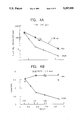
- FIGS. 4A and 4B show the temperature dependence of flux and selectivity, respectively, of 1:1 mixture by weight of toluene and n-octane permeating through a cathodic plasma polymer film. Measurements were made at 10 bar inlet pressure. Virgin film undergoes irreversible change on initial heating while in contact with the hydrocarbon feed.
- FIGS. 5A and 5B show the temperature dependence of flux and selectivity, respectively, of 1:1 mixture weight of toluene and i-octane for the same film as in FIG. 4. Measurements made at 1 and 10 bar inlet pressures.
- FIGS. 6A and 6B show the temperature dependence of flux and selectivity, respectively, of 1:1 mixture by weight of n-octane and i-octane for the same film as in FIG. 4. Measurements made at 1 and 10 bar inlet pressures.
- the plasma polymerized membrane of the present invention shall be illustrated and described for separating aromatics from mixtures of aromatic and non-aromatics.
- the membrane also shall be illustrated and described for separating linear hydrocarbons from mixtures of linear and branched hydrocarbons.
- the plasma membrane of the present invention separate the mixtures by the solution-diffusion mechanism.
- the membranes of the present invention are prepared by plasma polymerization.
- the process of plasma polymerization differs fundamentally from the conventional free radical polymerization by which the polymers in the patents cited above were made.
- polymer chains grow by repeated addition of monomers where the monomers retain their original identify in the chain.
- plasma polymerization the plasma discharge breaks up the precursor monomer into a wide range of molecular weight charged and neutral fragments which are then reconstituted on the substrate as a film or in the gas phase as a powder.
- the resulting polymer is strongly crosslinked and its structure bears little resemblance to that of the precursor monomer. Because plasma polymer films are so strongly crosslinked only small molecules are soluble in them.
- membranes made by plasma polymerization of organic or organosilicon monomers have been used extensively in the past only for separation of small molecules such as N 2 , O 2 , CO 2 , H 2 , CH 4 , etc.
- Hidetoshi Kita Taro Sakamoto, Kazuhiro Tanaka and Ken-Ichi Okomoto, Polymer Bulletin 20, 349-354 (1988); N. Inagaki, N. Kobayashi and M. Matsushima, J. Membr. Science 38, 85 (1988); Mitsuyasu Kawakami, Yukinori Yamashita, Masakazu Iwamoto and Shuichi Kagawa J. Membr. Science 19, 249 (1984); A. E. Stancell and A. T. Spencer J. Appl. Polymer Science 16, 1505 (1972)) and desalination of water, and ethanol water separation.
- These membranes work on the basis of reverse osmosis, in which separation is achieved primarily by molecular sieving.
- the plasma polymer membranes of the present invention are based on the solution-diffusion mechanism just as the conventional membranes disclosed in the patents cited above.
- two conditions must be satisfied (1) the polymer must contain functional groups which have a relatively larger attractive energy for aromatics than for saturates (2) the polymer must be sufficiently loosely crosslinked to permit permeation of large hydrocarbon molecules.
- the first condition can be achieved by using precursors with functional groups that are strongly polar such as C ⁇ O, C--Cl, C--F, etc.
- the plasma discharge energy must be sufficiently low not to cause excessive crosslinking and to avoid fragmentation of the desirable functional groups, but not so low that the network would become soluble in the feed solvents. This places rather narrow limits on the choice of the precursor molecules and on the plasma discharge conditions.
- the plasma polymer membrane of the present invention was prepared by plasma polymerizing the monomer 2,4 pentane dione. This particular monomer was used because carbonyl groups are strongly polar and so are expected to have a large attractive energy with respect to aromatic molecules. Furthermore, 2,4 pentane dione is similar in structure to the polyethylene adipate oligomer used as a building block of the soft segment block in polyurethane membranes. Finally 2,4 pentane dione has a sufficiently large vapor pressure at room temperature required for the plasma discharge.
- the plasma polymer films were deposited in a RF capacitive reactor (see FIG. 1) using the monomer 2,4 pentane dione diluted with Ar.
- the substrates used for the membranes were alumina discs with the trade name "Anapore" from Anotec. The discs were 25 mm in diameter and had 0.02 ⁇ m pores.
- the alumina substrates were placed on both the anode and cathode electrodes of the plasma reactor. Films deposited on cathode are referred to as cathodic, and those on the anode as anodic.
- FIG. 2 shows the structure of the plasma polymer membrane which was used for the permeation measurements. The optimum film deposition conditions are listed in Table 1.
- FIG. 3 shows a typical IR spectrum of the polymer.
- the strong absorption peak at 1720 cm -1 corresponds to the carbonyl group.
- Permeation and selectivity of mixtures of toluene, n-octane and isooctane through the plasma membranes were determined by pervaporation. Initially at room temperature the membranes had a very low permeability and selectivity. Only after heating the membrane to 200° C. under operating conditions did the flux and selectivity rise and reach their final steady state values. During the forming process, the feed dissolves and removes molecules that are only weakly crosslinked, thereby producing a looser network and consequently increasing the permeability of the polymer. After the initial forming process the membranes remained stable under operating conditions over many days and could be temperature cycled without any hysteresis. The forming process is illustrated in FIG. 4 for a 1000 ⁇ cathodic plasma polymer film for the case of a mixture 1:1 by weight of toluene/n-octane.
- the flux through the membrane was found to be independent of hydraulic pressure. This finding, illustrated for the case of separating toluene from toluene/i-octane in FIG. 5 and separating n-octane from n-octane/isooctane in FIG. 6 indicated that transport through the membrane is diffusive rather than by reverse osmosis.
- the fact that the selectivity decreases with increasing hydraulic pressure is believed to be the result of small pinholes. Flow through pinholes is proportional to the hydraulic pressure and has no selectivity. Thus at high hydraulic pressures the flow through pinholes becomes more important and thus reduces the selectivity.
Landscapes
- Chemical & Material Sciences (AREA)
- Organic Chemistry (AREA)
- Health & Medical Sciences (AREA)
- Engineering & Computer Science (AREA)
- Chemical Kinetics & Catalysis (AREA)
- Life Sciences & Earth Sciences (AREA)
- Physics & Mathematics (AREA)
- Molecular Biology (AREA)
- Medicinal Chemistry (AREA)
- Polymers & Plastics (AREA)
- Plasma & Fusion (AREA)
- Analytical Chemistry (AREA)
- Oil, Petroleum & Natural Gas (AREA)
- Water Supply & Treatment (AREA)
- Separation Using Semi-Permeable Membranes (AREA)
Abstract
The present invention is a membrane for separating aromatics from feeds which are mixtures of aromatics and saturates and for separating saturated linear hydrocarbons from feeds which are mixtures of saturated linear and saturated branched hydrocarbons. The membrane is a plasma polymer formed from plasma polymerizing monomers. In a preferred embodiment, the membrane is a plasma polymer film formed from plasma polymerizing the monomer 2,4 pentane dione.
Description
The present invention relates to plasma polymer membrane for the separation of one component from an organic feed. In a preferred embodiment the separation is aromatics from saturates.
The use of membranes to separate aromatics from saturates has long been pursued by the scientific and industrial community and is the subject of numerous patents.
U.S. Pat. No. 3,370,102 describes a general process for separating a feed into a permeate stream and a retentate stream and utilizes a sweep liquid to remove the permeate from the face of the membrane to thereby maintain the concentration gradient driving force. The process can be used to separate a wide variety of mixtures including various petroleum fractions, naphthas, oils, hydrocarbon mixtures. Expressly recited is the separation of aromatics from kerosene.
U.S. Pat. No. 2,958,656 teaches the separation of hydrocarbons by type, i.e., aromatic, unsaturated, by permeating a portion of the mixture through a non-porous cellulose ether membrane and removing permeate from the permeate side of the membrane using a sweep gas or liquid. Feeds include hydrocarbon mixtures, e.g., naphtha (including virgin naphtha, naphtha from thermal or catalytic cracking, etc.).
U.S. Pat. No. 2,930,754 teaches a method for separating hydrocarbons, e.g., aromatic and/or olefins from gasoline boiling range mixtures, by the selective permeation of the aromatic through certain non-porous cellulose ester membranes. The permeated hydrocarbons are continuously removed from the permeate zone using a sweep gas or liquid.
U.S. Pat. No. 4,115,465 teaches the use of polyurethane membranes to selectively separate aromatics from saturates via pervaporation.
The principle in the separation of aromatics and saturates in the above polymer membranes is that in a feed consisting of a mixture of aromatics and saturates the aromatic molecules are preferably soluble in the membrane compared to the saturated molecules and, as a result, the aromatics are preferentially removed at the permeate side of the membrane. In the case of polyurethane membranes, the polymer consists of a hard block-soft block copolymer. The soft blocks preferentially sorb aromatics while the hard blocks act as effective crosslink to provide the mechanical stability for the membrane. The soft blocks usually consist of polyethylene adipate oligamers in which the carbonyl groups are responsible for the preferential sorbtion of the aromatics.
In addition to its solubility of the molecule, the diffusion coefficient also plays a role in determining the selectivity of the membrane. This is because the flux Fi of molecular species i through the membrane is given by:
F.sub.i =D.sub.i (dC.sub.i /dx)
where Di is the diffusion coefficient, Ci is the concentration in the membrane and dCi /dx is the concentration gradient. Thus the flux of the molecules is governed both by the solubility as well as by the diffusion coefficient.
The present invention is a membrane for separating at least one component from an organic feed. In a preferred embodiment, the feed is a mixture of aromatics and non-aromatics. In another embodiment, the membrane of the present invention is used for separating linear hydrocarbons from feeds which are mixtures of linear and branched hydrocarbons. The membrane of the present invention is a plasma polymer formed from plasma polymerizing monomers. In a preferred embodiment, the membrane is a plasma polymer film formed from plasma polymerizing the monomer 2,4 pentane dione.
FIG. 1 shows a schematic diagram of capacitive plasma CVD reactor used for depositing the polymer membrane films.
FIG. 2 shows the structure of plasma polymer membrane.
FIG. 3 shows an IR transmission spectrum of 2 μm thick plasma polymer film on KBr substrate. The characteristic carbonyl vibrational mode at 1700 cm-1 is indicated in the figure.
FIGS. 4A and 4B show the temperature dependence of flux and selectivity, respectively, of 1:1 mixture by weight of toluene and n-octane permeating through a cathodic plasma polymer film. Measurements were made at 10 bar inlet pressure. Virgin film undergoes irreversible change on initial heating while in contact with the hydrocarbon feed.
FIGS. 5A and 5B show the temperature dependence of flux and selectivity, respectively, of 1:1 mixture weight of toluene and i-octane for the same film as in FIG. 4. Measurements made at 1 and 10 bar inlet pressures.
FIGS. 6A and 6B show the temperature dependence of flux and selectivity, respectively, of 1:1 mixture by weight of n-octane and i-octane for the same film as in FIG. 4. Measurements made at 1 and 10 bar inlet pressures.
For descriptive purposes, the plasma polymerized membrane of the present invention shall be illustrated and described for separating aromatics from mixtures of aromatic and non-aromatics. The membrane also shall be illustrated and described for separating linear hydrocarbons from mixtures of linear and branched hydrocarbons. The plasma membrane of the present invention separate the mixtures by the solution-diffusion mechanism.
The membranes of the present invention are prepared by plasma polymerization. The process of plasma polymerization differs fundamentally from the conventional free radical polymerization by which the polymers in the patents cited above were made. In the conventional polymerization process polymer chains grow by repeated addition of monomers where the monomers retain their original identify in the chain. In contrast in plasma polymerization the plasma discharge breaks up the precursor monomer into a wide range of molecular weight charged and neutral fragments which are then reconstituted on the substrate as a film or in the gas phase as a powder. The resulting polymer is strongly crosslinked and its structure bears little resemblance to that of the precursor monomer. Because plasma polymer films are so strongly crosslinked only small molecules are soluble in them. Hence membranes made by plasma polymerization of organic or organosilicon monomers have been used extensively in the past only for separation of small molecules such as N2, O2, CO2, H2, CH4, etc. (Hidetoshi Kita, Taro Sakamoto, Kazuhiro Tanaka and Ken-Ichi Okomoto, Polymer Bulletin 20, 349-354 (1988); N. Inagaki, N. Kobayashi and M. Matsushima, J. Membr. Science 38, 85 (1988); Mitsuyasu Kawakami, Yukinori Yamashita, Masakazu Iwamoto and Shuichi Kagawa J. Membr. Science 19, 249 (1984); A. E. Stancell and A. T. Spencer J. Appl. Polymer Science 16, 1505 (1972)) and desalination of water, and ethanol water separation. These membranes work on the basis of reverse osmosis, in which separation is achieved primarily by molecular sieving.
The plasma polymer membranes of the present invention are based on the solution-diffusion mechanism just as the conventional membranes disclosed in the patents cited above. To achieve plasma polymer membranes with such properties two conditions must be satisfied (1) the polymer must contain functional groups which have a relatively larger attractive energy for aromatics than for saturates (2) the polymer must be sufficiently loosely crosslinked to permit permeation of large hydrocarbon molecules. The first condition can be achieved by using precursors with functional groups that are strongly polar such as C═O, C--Cl, C--F, etc. To achieve the second condition the plasma discharge energy must be sufficiently low not to cause excessive crosslinking and to avoid fragmentation of the desirable functional groups, but not so low that the network would become soluble in the feed solvents. This places rather narrow limits on the choice of the precursor molecules and on the plasma discharge conditions.
The plasma polymer membrane of the present invention was prepared by plasma polymerizing the monomer 2,4 pentane dione. This particular monomer was used because carbonyl groups are strongly polar and so are expected to have a large attractive energy with respect to aromatic molecules. Furthermore, 2,4 pentane dione is similar in structure to the polyethylene adipate oligomer used as a building block of the soft segment block in polyurethane membranes. Finally 2,4 pentane dione has a sufficiently large vapor pressure at room temperature required for the plasma discharge.
The plasma polymer films were deposited in a RF capacitive reactor (see FIG. 1) using the monomer 2,4 pentane dione diluted with Ar. The substrates used for the membranes were alumina discs with the trade name "Anapore" from Anotec. The discs were 25 mm in diameter and had 0.02 μm pores. The alumina substrates were placed on both the anode and cathode electrodes of the plasma reactor. Films deposited on cathode are referred to as cathodic, and those on the anode as anodic. FIG. 2 shows the structure of the plasma polymer membrane which was used for the permeation measurements. The optimum film deposition conditions are listed in Table 1.
              TABLE 1
______________________________________
Deposition Parameters
______________________________________
Argon           21      cc/min (STP)
Pentane Dione   4       cc/min (STP)
Pressure        230     mtorr
RF Power        28-32   Watt, 13.56 MHz
Deposition Rate 0.6     Å/sec
______________________________________
FIG. 3 shows a typical IR spectrum of the polymer. The strong absorption peak at 1720 cm-1 corresponds to the carbonyl group.
Permeation and selectivity of mixtures of toluene, n-octane and isooctane through the plasma membranes were determined by pervaporation. Initially at room temperature the membranes had a very low permeability and selectivity. Only after heating the membrane to 200° C. under operating conditions did the flux and selectivity rise and reach their final steady state values. During the forming process, the feed dissolves and removes molecules that are only weakly crosslinked, thereby producing a looser network and consequently increasing the permeability of the polymer. After the initial forming process the membranes remained stable under operating conditions over many days and could be temperature cycled without any hysteresis. The forming process is illustrated in FIG. 4 for a 1000 Å cathodic plasma polymer film for the case of a mixture 1:1 by weight of toluene/n-octane.
The flux through the membrane was found to be independent of hydraulic pressure. This finding, illustrated for the case of separating toluene from toluene/i-octane in FIG. 5 and separating n-octane from n-octane/isooctane in FIG. 6 indicated that transport through the membrane is diffusive rather than by reverse osmosis. The fact that the selectivity decreases with increasing hydraulic pressure is believed to be the result of small pinholes. Flow through pinholes is proportional to the hydraulic pressure and has no selectivity. Thus at high hydraulic pressures the flow through pinholes becomes more important and thus reduces the selectivity.
The separation for a mixture toluene/i-octane is even larger then for the toluene/n-octane feed. This is demonstrated in FIG. 5 for a feed of 1:1 toluene/i-octane where the selectivity for toluene at 200° C. and pressure of 10 barr is 20. This enhanced selectivity may be in part due to a smaller solubility in the membrane of i-octane compared to n-octane. However, the major effect is likely due to the diffusion coefficient for i-octane being smaller then for n-octane because the former molecule is branched while the latter is linear and thus finds it easier to diffuse through the polymer network. The fact that n-octane diffuses faster then i-octane is demonstrated directly in FIG. 5 for a mixture of 1:1 n-octane/i-octane which shows a selectivity of 6 for n-octane.
Claims (9)
1. A membrane for separating at least one component selected from the group consisting of an aromatic and linear hydrocarbons, from organic feeds comprising a plasma polymer formed from plasma polymerizing monomers which contain functional groups selected from the group consisting of C--Cl, C--F, and C═O, having polarity so as to separate said component from said feed.
2. The membrane of claim 1 wherein said component is an aromatic and said feeds are a mixture of aromatics and saturates and said membrane includes a plasma polymer formed from plasma polymerizing the monomer 2-4 pentane dione.
3. The membrane of claim 1 wherein said component is an aromatic and said feeds are a mixture of aromatics and saturates.
4. The membrane of claim 1 wherein said component is a saturated linear hydrocarbon and said feeds are mixtures of saturated linear and saturated branched hydrocarbons and said membrane includes a plasma polymer formed from plasma polymerizing monomers which contain functional groups that have a larger attractive energy for linears than for branched.
5. The membrane of claim 1 wherein said component is a linear hydrocarbon and said feeds are mixtures of saturated linear and saturated branched hydrocarbons and said membrane includes a plasma polymer formed from plasma polymerizing the monomer 2-4 pentane dione.
6. The membrane of claim 1 wherein said component is a saturated linear hydrocarbon and said feeds are mixtures of saturated linear and branched linear hydrocarbons.
7. A membrane of claim 1 wherein said component is a saturated linear hydrocarbon and said feeds are mixtures of saturated linear and saturated branched hydrocarbons, and said membrane includes a plasma polymer in which the diffusion coefficient for the linear molecules is larger then for the branched molecules.
8. The plasma polymerized membrane of claim 1 wherein said membrane has its permeability and selectivity increased by the forming process which consists of pervaporating toluene through the membrane.
9. The plasma polymerized membrane of claim 1 wherein said membrane has its permeability and selectivity increased by the forming process in which the membrane is placed for several hours in toluene.
Priority Applications (1)
| Application Number | Priority Date | Filing Date | Title |
|---|---|---|---|
| US07/857,200 US5207909A (en) | 1992-03-25 | 1992-03-25 | Plasma polymer membrane (C-2564) |
Applications Claiming Priority (1)
| Application Number | Priority Date | Filing Date | Title |
|---|---|---|---|
| US07/857,200 US5207909A (en) | 1992-03-25 | 1992-03-25 | Plasma polymer membrane (C-2564) |
Publications (1)
| Publication Number | Publication Date |
|---|---|
| US5207909A true US5207909A (en) | 1993-05-04 |
Family
ID=25325432
Family Applications (1)
| Application Number | Title | Priority Date | Filing Date |
|---|---|---|---|
| US07/857,200 Expired - Fee Related US5207909A (en) | 1992-03-25 | 1992-03-25 | Plasma polymer membrane (C-2564) |
Country Status (1)
| Country | Link |
|---|---|
| US (1) | US5207909A (en) |
Cited By (4)
| Publication number | Priority date | Publication date | Assignee | Title |
|---|---|---|---|---|
| US5354469A (en) * | 1993-06-14 | 1994-10-11 | Bend Research, Inc. | Layered plasma polymer composite membranes |
| US5559254A (en) * | 1992-11-21 | 1996-09-24 | Basf Aktiengesellschaft | Separation of a mixture of methanol and tetrahydrofuran into its constituents |
| EP0760252A1 (en) | 1995-08-25 | 1997-03-05 | Nederlandse Organisatie Voor Toegepast-Natuurwetenschappelijk Onderzoek Tno | A membrane and method for the separation of aromatic hydrocarbons from a mixture of various aromatic hydrocarbons or from a mixture of such aromatic hydrocarbons and non-aromatic hydrocarbons |
| US20060113189A1 (en) * | 2002-09-05 | 2006-06-01 | Atsunori Hiratsuka | Method for separating substances |
Citations (2)
| Publication number | Priority date | Publication date | Assignee | Title |
|---|---|---|---|---|
| US4876294A (en) * | 1988-09-13 | 1989-10-24 | Ashland Oil, Inc. | Foundry binder systems based upon acrylated epoxy resins and epoxy resins |
| US4974659A (en) * | 1989-10-02 | 1990-12-04 | Ashland Oil, Inc. | Cold box process for preparing foundry shapes which use acrylated epoxy resins |
-
1992
- 1992-03-25 US US07/857,200 patent/US5207909A/en not_active Expired - Fee Related
Patent Citations (2)
| Publication number | Priority date | Publication date | Assignee | Title |
|---|---|---|---|---|
| US4876294A (en) * | 1988-09-13 | 1989-10-24 | Ashland Oil, Inc. | Foundry binder systems based upon acrylated epoxy resins and epoxy resins |
| US4974659A (en) * | 1989-10-02 | 1990-12-04 | Ashland Oil, Inc. | Cold box process for preparing foundry shapes which use acrylated epoxy resins |
Non-Patent Citations (5)
| Title |
|---|
| A. E. Stancell and A. T. Spencer, J. Appl. Polymer Science 16, 1505 (1972). * |
| Hidetoshi Kita, Taro Sakamoto, Kazuhiro Tanaka and Ken Ichi Okomoto, Polymer Bulletin 20, 349 354 (1988). * |
| Hidetoshi Kita, Taro Sakamoto, Kazuhiro Tanaka and Ken-Ichi Okomoto, Polymer Bulletin 20, 349-354 (1988). |
| Mitsuyasu Kawakami, Yukinori Yamashita, Masakazu Iwamoto and Shuichi Kagawa, J. Membr. Science 19, 249 (1984). * |
| N. Inagaki, N. Kobayashi and M. Matsushima, J. Membr. Science 38, 85 (1988). * |
Cited By (4)
| Publication number | Priority date | Publication date | Assignee | Title |
|---|---|---|---|---|
| US5559254A (en) * | 1992-11-21 | 1996-09-24 | Basf Aktiengesellschaft | Separation of a mixture of methanol and tetrahydrofuran into its constituents |
| US5354469A (en) * | 1993-06-14 | 1994-10-11 | Bend Research, Inc. | Layered plasma polymer composite membranes |
| EP0760252A1 (en) | 1995-08-25 | 1997-03-05 | Nederlandse Organisatie Voor Toegepast-Natuurwetenschappelijk Onderzoek Tno | A membrane and method for the separation of aromatic hydrocarbons from a mixture of various aromatic hydrocarbons or from a mixture of such aromatic hydrocarbons and non-aromatic hydrocarbons |
| US20060113189A1 (en) * | 2002-09-05 | 2006-06-01 | Atsunori Hiratsuka | Method for separating substances |
Similar Documents
| Publication | Publication Date | Title |
|---|---|---|
| Fadeev et al. | Extraction of butanol from aqueous solutions by pervaporation through poly (1-trimethylsilyl-1-propyne) | |
| US3775308A (en) | Method for preparation of composite semipermeable membrane | |
| US4330406A (en) | Semipermeable membrane and process of making same | |
| US4046843A (en) | Process for preparing membranes for separation of substances | |
| Zhang et al. | Ultra‐thin skin carbon hollow fiber membranes for sustainable molecular separations | |
| EP0207721B1 (en) | Anisotropic membranes for gas separation | |
| US4581043A (en) | Composite dense membrane | |
| Hirotsu | Water‐ethanol separation by pervaporation through plasma graft polymerized membranes | |
| US4533369A (en) | Gas-permselective composite membranes and process for the production thereof | |
| US4032440A (en) | Semipermeable membrane | |
| EP0428052A2 (en) | Gas separation by adsorbent membranes | |
| JP2004500381A (en) | Method for purifying liquid hydrocarbon products | |
| JPH0783825B2 (en) | Surfactant treatment of polyaramid gas separation membrane | |
| US4751104A (en) | Preparation of gas selective membranes | |
| JPS588517A (en) | Method for producing gas selectively permeable composite membrane | |
| US5700374A (en) | Pervaporation membranes and use thereof | |
| Yasuda et al. | Preparation of composite reverse osmosis membranes by plasma polymerization. II. Copolymerization of unusual comonomers | |
| Inui et al. | Effect of permeation temperature on permeation and separation of a benzene/cyclohexane mixture through liquid‐crystalline polymer membranes | |
| Matsuyama et al. | Plasma polymerized membranes from organosilicon compounds for separation of oxygen over nitrogen | |
| JPH038808B2 (en) | ||
| JPS5924843B2 (en) | Method for producing gas selectively permeable composite membrane | |
| EP0467903B1 (en) | Process for the preparation of chlorine-resistant polyester semipermeable membranes | |
| US4737165A (en) | Multicomponent membranes | |
| US20250091017A1 (en) | Tunable hydrophilic crosslinked polymer membranes for separation applications | |
| RU2491983C1 (en) | Composite membrane on basis of highly porous vitreous polymers |
Legal Events
| Date | Code | Title | Description |
|---|---|---|---|
| AS | Assignment |
Owner name: EXXON RESEARCH AND ENGINEERING CO., NEW JERSEY Free format text: ASSIGNMENT OF ASSIGNORS INTEREST.;ASSIGNOR:ABELES, BENJAMIN;REEL/FRAME:006419/0558 Effective date: 19920320 |
|
| REMI | Maintenance fee reminder mailed | ||
| LAPS | Lapse for failure to pay maintenance fees | ||
| FP | Lapsed due to failure to pay maintenance fee |
Effective date: 19970507 |
|
| STCH | Information on status: patent discontinuation |
Free format text: PATENT EXPIRED DUE TO NONPAYMENT OF MAINTENANCE FEES UNDER 37 CFR 1.362 |