US5202902A - Carrier recovery method for modulation having a large number of states, and apparatus for implementing the method - Google Patents

Carrier recovery method for modulation having a large number of states, and apparatus for implementing the method Download PDF

Info

Publication number
US5202902A
US5202902A US07/688,396 US68839691A US5202902A US 5202902 A US5202902 A US 5202902A US 68839691 A US68839691 A US 68839691A US 5202902 A US5202902 A US 5202902A
Authority
US
United States
Prior art keywords
gravity
constellation
center
quadrants
quadrant
Prior art date
Legal status (The legal status is an assumption and is not a legal conclusion. Google has not performed a legal analysis and makes no representation as to the accuracy of the status listed.)
Expired - Fee Related
Application number
US07/688,396
Inventor
Marc Isard
Christophe Mostkowy
Current Assignee (The listed assignees may be inaccurate. Google has not performed a legal analysis and makes no representation or warranty as to the accuracy of the list.)
Alcatel Transmission par Faisceaux Hertziens SA
Original Assignee
Alcatel Transmission par Faisceaux Hertziens SA
Priority date (The priority date is an assumption and is not a legal conclusion. Google has not performed a legal analysis and makes no representation as to the accuracy of the date listed.)
Filing date
Publication date
Application filed by Alcatel Transmission par Faisceaux Hertziens SA filed Critical Alcatel Transmission par Faisceaux Hertziens SA
Assigned to ALCATEL TRANSMISSION PAR FAISCEAUX HERTZIENS A.T.F.H. reassignment ALCATEL TRANSMISSION PAR FAISCEAUX HERTZIENS A.T.F.H. ASSIGNMENT OF ASSIGNORS INTEREST. Assignors: MARC ISARD, CHRISTOPHE MOSTKOWY
Application granted granted Critical
Publication of US5202902A publication Critical patent/US5202902A/en
Anticipated expiration legal-status Critical
Expired - Fee Related legal-status Critical Current

Links

Images

Classifications

    • HELECTRICITY
    • H04ELECTRIC COMMUNICATION TECHNIQUE
    • H04LTRANSMISSION OF DIGITAL INFORMATION, e.g. TELEGRAPHIC COMMUNICATION
    • H04L27/00Modulated-carrier systems
    • H04L27/32Carrier systems characterised by combinations of two or more of the types covered by groups H04L27/02, H04L27/10, H04L27/18 or H04L27/26
    • H04L27/34Amplitude- and phase-modulated carrier systems, e.g. quadrature-amplitude modulated carrier systems
    • H04L27/38Demodulator circuits; Receiver circuits
    • H04L27/3818Demodulator circuits; Receiver circuits using coherent demodulation, i.e. using one or more nominally phase synchronous carriers

Definitions

  • the invention relates to a carrier recovery method for modulation having a large number of states, and to apparatus for implementing the method.
  • 4-state phase modulation (4-PSK type) sampled estimators are used. They rely on samples of the demodulated signals being available, which samples are taken at the symbol rate and at the instant of maximum opening in the eye diagram. These samples come from analog-to-digital converters and they enable the transmitted symbols to be estimated and also the associated distortion to be evaluated.
  • the conversion-estimation grid has been solved up to now by being reduced to useful information bits defining the symbol plus one or two extra bits giving the distortion.
  • Such regeneration and estimation structures are now conventional and simplified gradient algorithms have been constructed for them based on knowing the sign of the received signal and the sign of the corresponding distortion.
  • This family of estimators directs control of the regenerator (carrier, sync., amplitude) and of the time equalizer.
  • the carrier estimator relies on calculating the effect of the in-phase X channel on the quadrature Y channel (sgnX.sgn err Y) and the effect of the Y channel on the X channel (sgnY.sgn err X).
  • An object of the present invention is to solve this problem by proposing a robust carrier recovery criterion applicable to modulation using a large number of states and capable of accommodating high levels of noise or of distortion.
  • the present invention provides a carrier recovery method for modulation having a large number of states, wherein the demodulated constellation is brought into the monotonic range of a conventional estimator, with sufficient accuracy to enable autonomous operation on this new criterion.
  • Switching to the conventional estimator is preferable for minimizing demodulation jitter, but is not essential with a narrow loop bandwidth for which the new criterion turns out to be satisfactory.
  • the center of gravity of the received constellation in each quadrant of the regeneration plane is calculated.
  • the method of the invention makes it possible to avoid depending on the distortion estimate of each symbol, since such an estimate is too easily degraded by noise or by linear or non-linear distortion, thereby becoming dangerously fragile for modulation using a large number of states.
  • the method of the invention therefore does not apply to the decision grid, but proposes a criterion based on the geometrical properties of the constellation to be demodulated.
  • the concept of this type of estimator fits in well with the recent introduction of high resolution (8 bit) analog-to-digital converters in regenerators for performing digital filtering.
  • FIG. 1 shows the validity of a prior art phase estimator for phase rotation of the constellation
  • FIG. 2 is a circuit diagram of apparatus for implementing the method of the invention.
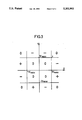
  • FIG. 3 shows the sign of the phase estimator in the regeneration plane.
  • FIG. 1 is a graph showing phase validity V as a function of the number n of modulation states.
  • 2 n state modulation which comprises both amplitude modulation and phase modulation, may be described by representing signals as coordinates in two dimensions.
  • the states may be disposed so that they are uniformly distributed relative to axes corresponding to two orthogonal carriers X and Y.
  • a constellation is thus obtained which corresponds to a vector representation of carrier states whose projections on the X and Y axes give the end coordinates of the vector shown.
  • the center of gravity is calculated of the constellation as received in each quadrant of the regeneration XY plane.
  • the equilibrium position of this center of gravity thus lies on the middle axes when carrier lock has been achieved.
  • the position of the center of gravity provides information directly on the rotation of the constellation relative to the locking position.
  • This method reduces estimating the phase of complex modulation to the case of modulation having four phase states. It enables similar performance to be obtained during acquisition.
  • the apparatus 10 for implementing the method and as shown in FIG. 2 comprises, at the output from the two analog-to-digital converters 11 and 12 of the regenerator:
  • two calculation circuits 13 and 14 e.g. memories
  • the circuits deliver signals sgn(
  • This apparatus thus provides automatic gain control on each of the channels X and Y, thereby ensuring that the estimate of the center of gravity offset is valid.
  • Ex sgn(
  • mean) and Ey sgn(
  • the difference Ex-Ey provides the phase estimator for the first quadrant. The interpretation of phase rotation is valid only in those portions of the plane where (
  • FIG. 3 shows the value of this estimator in regeneration XY space.
  • a QAM-256 constellation remains properly locked even when suffering from a high level of noise since the noise level is compared with the weight of the center of gravity of the constellation in a quadrant.
  • the estimator thus makes it possible to use signal-to-noise ratios which are as low as are used in 4-phase modulation.

Landscapes

  • Engineering & Computer Science (AREA)
  • Computer Networks & Wireless Communication (AREA)
  • Signal Processing (AREA)
  • Digital Transmission Methods That Use Modulated Carrier Waves (AREA)

Abstract

A method of recovering the carrier for modulation having a large number of states, the method being wherein the demodulated constellation is brought to the monotonic range of a conventional estimator, with sufficient accuracy to enable autonomous operation on this new criterion. The invention also provides apparatus for implementing the method. The invention is particularly applicable to digital ratio beam transmission.

Description

The invention relates to a carrier recovery method for modulation having a large number of states, and to apparatus for implementing the method.
BACKGROUND OF THE INVENTION
In the field of digital radio beams, modems are using modulation of ever increasing density. Only coherent demodulation is then possible since differential demodulation would give rise to too great a threshold displacement when using modulation having a very large number of states. Such coherent demodulation is based on the reliability and the quality of the carrier phase estimator as generated at the reception end.
Beyond 4-state phase modulation (4-PSK type) sampled estimators are used. They rely on samples of the demodulated signals being available, which samples are taken at the symbol rate and at the instant of maximum opening in the eye diagram. These samples come from analog-to-digital converters and they enable the transmitted symbols to be estimated and also the associated distortion to be evaluated.
For technological reasons, the conversion-estimation grid has been solved up to now by being reduced to useful information bits defining the symbol plus one or two extra bits giving the distortion.
The article by A. Leclert and P. Vandamme entitled "Universal carrier recovery loop for QASK and PSK signal sets" (Globecom '82 Conf. Rec., Vol. 3, pp. 1228-1232, Nov. 29-Dec. 2, 1982, Miami, FL) describes a carrier loop applicable to quadrature amplitude shift keying (QASK) and to phase shift keying (PSK). This article presents several QASK-16 estimation and conversion systems.
Such regeneration and estimation structures are now conventional and simplified gradient algorithms have been constructed for them based on knowing the sign of the received signal and the sign of the corresponding distortion. This family of estimators directs control of the regenerator (carrier, sync., amplitude) and of the time equalizer. The carrier estimator relies on calculating the effect of the in-phase X channel on the quadrature Y channel (sgnX.sgnerr Y) and the effect of the Y channel on the X channel (sgnY.sgnerr X).
However such a conventional estimator suffers from the drawback of seeing its monotonic range reduced to the range for which the distortion estimate is valid. This means that the criterion is valid only if the demodulated constellation has meaningful correspondence with the estimation grid. This condition restricts the possibilities of achieving phase locking to low levels of noise and of distortion.
An object of the present invention is to solve this problem by proposing a robust carrier recovery criterion applicable to modulation using a large number of states and capable of accommodating high levels of noise or of distortion.
SUMMARY OF THE INVENTION
To this end, the present invention provides a carrier recovery method for modulation having a large number of states, wherein the demodulated constellation is brought into the monotonic range of a conventional estimator, with sufficient accuracy to enable autonomous operation on this new criterion. Switching to the conventional estimator is preferable for minimizing demodulation jitter, but is not essential with a narrow loop bandwidth for which the new criterion turns out to be satisfactory.
More precisely, in the method of the invention the center of gravity of the received constellation in each quadrant of the regeneration plane is calculated.
Advantageously, the method of the invention makes it possible to avoid depending on the distortion estimate of each symbol, since such an estimate is too easily degraded by noise or by linear or non-linear distortion, thereby becoming dangerously fragile for modulation using a large number of states. The method of the invention therefore does not apply to the decision grid, but proposes a criterion based on the geometrical properties of the constellation to be demodulated. The concept of this type of estimator fits in well with the recent introduction of high resolution (8 bit) analog-to-digital converters in regenerators for performing digital filtering.
BRIEF DESCRIPTION OF THE DRAWINGS
An embodiment of the invention is described by way of example with reference to the accompanying drawings, in which:
FIG. 1 shows the validity of a prior art phase estimator for phase rotation of the constellation;
FIG. 2 is a circuit diagram of apparatus for implementing the method of the invention; and
FIG. 3 shows the sign of the phase estimator in the regeneration plane.
DETAILED DESCRIPTION
FIG. 1 is a graph showing phase validity V as a function of the number n of modulation states.
From this curve, it can be seen that when the number of modulation states increases, the phase validity range of the estimator decreases: thus, beyond 64-QAM (64 state quadrature amplitude modulation) the validity range of the phase criterion falls below 10°.
2n state modulation, which comprises both amplitude modulation and phase modulation, may be described by representing signals as coordinates in two dimensions. The states may be disposed so that they are uniformly distributed relative to axes corresponding to two orthogonal carriers X and Y. A constellation is thus obtained which corresponds to a vector representation of carrier states whose projections on the X and Y axes give the end coordinates of the vector shown.
In the method of the invention, the center of gravity is calculated of the constellation as received in each quadrant of the regeneration XY plane. The equilibrium position of this center of gravity thus lies on the middle axes when carrier lock has been achieved. The position of the center of gravity provides information directly on the rotation of the constellation relative to the locking position.
This method reduces estimating the phase of complex modulation to the case of modulation having four phase states. It enables similar performance to be obtained during acquisition.
The apparatus 10 for implementing the method and as shown in FIG. 2 comprises, at the output from the two analog-to-digital converters 11 and 12 of the regenerator:
two calculation circuits 13 and 14 (e.g. memories) for discovering the difference between the center of gravity as obtained and the expected center of gravity, which circuits deliver signals sgn(|x|t-|x|mean) and sgn(|y|t-|y|mean) which are used respectively for servo-controlling the amplitudes of channels X and Y, i.e. AX and AY as shown in FIG. 2;
three exclusive- OR logic gates 15, 16, and 17 receiving the sign bits (i.e. the most significant bits "MSB") enabling the following two signals to be obtained (xMSB ⊕ yMSB) ⊕ (|x|t-|x|mean)MSB and (xMSB ⊕ yMSB) ⊕ (|y|t-|y|mean)MSB corresponding to the following terms of equation 1 as given further on:
sgn[x(t)].sgn[y(t)].[sgn|x|(t)-|x|mean]
and
sgn[x(t)].sgn[y(t)].[sgn|y|(t)-|y|mean];
and and an integrator circuit 18 for obtaining the difference between these two signals, which difference is then used for recovering the carrier.
Recovering the rates Hx and Hy makes it possible to find the symbol rate by detecting zero crossings, and the instant at which the eye diagram is open at its widest, i.e. the optimum sampling instant. Samples of the in-phase signal channel X and of the quadrature channel Y are obtained at the outputs from the analog-to-digital converters of the regenerator. Their position relative to the centers of gravity |x|mean and |y|mean can then be determined. |x|(t)-|x|mean and |y|(t)-|y|mean are calculated in two read only memories (ROM) for example. The two estimators created in this way serve to govern the amplitude servo-control associated with each channel. This apparatus thus provides automatic gain control on each of the channels X and Y, thereby ensuring that the estimate of the center of gravity offset is valid. For the first quadrant, Ex=sgn(|x|(t)-|x|mean) and Ey=sgn(|y|(t)-|y|mean) respectively define the signs of the displacements of the center of gravity of the constellation relative to equilibrium. The difference Ex-Ey provides the phase estimator for the first quadrant. The interpretation of phase rotation is valid only in those portions of the plane where (|x|-|x|mean).(|y|-.vertline.y|mean)<0, since in other regions the estimator cancels. Generalization to all four quadrants is performed by applying an operator that folds regeneration space onto the first quadrant: i.e. by multiplying the expression Ex-Ey by sgn[x(t)].sgn[y(t)]. The estimator provided in this way can be written:
Exy=sgn[x(t)].sgn[y(t)].[sgn|x|(t)-|x|mean)-sgn(|y|(t)-|y|mean)]
(this is the above-mentioned Equation 1)
FIG. 3 shows the value of this estimator in regeneration XY space.
By using the method of the invention, a QAM-256 constellation remains properly locked even when suffering from a high level of noise since the noise level is compared with the weight of the center of gravity of the constellation in a quadrant. The estimator thus makes it possible to use signal-to-noise ratios which are as low as are used in 4-phase modulation.
Naturally the present invention has been described and shown merely by way of preferred example and its component parts could be replaced by equivalent parts without thereby going beyond the scope of the invention.

Claims (5)

We claim:
1. A method of recovering the carrier from a received signal, said received signal having a large number of modulation states represented by a received constellation having quadrants in a regeneration plane, said method comprising the steps of:
calculating a center of gravity of the received constellation in each quadrant of the regeneration plane in order to bring the demodulated constellation within the monotonic range of a conventional estimator, with sufficient accuracy to enable autonomous operation on this new criterion; and
generating a phase estimate in accordance with the calculated center of gravity.
2. A method according to claim 1, further comprising the step of applying an operator which folds the regeneration plane onto a first of said quadrants, thereby generalizing the method to all four quadrants.
3. An apparatus for recovering the carrier from a received signal, said received signal having a large number of modulation states represented by a received constellation having quadrants in a regeneration plane, said apparatus including:
first means for calculating a center of gravity of the received constellation in each quadrant of the regeneration plane in order to bring the demodulated constellation within the monotonic range of a conventional estimator, with sufficient accuracy to enable autonomous operation on this new criterion; and
second means for generating a phase estimate in accordance with the calculated center of gravity, said second means comprising:
two circuits for calculating the difference between the calculated center of gravity and an expected center of gravity of the received constellation in each quadrant, respectively for an X channel and for a Y channel corresponding to two orthogonal carriers; and
a circuit for calculating the phase estimate for the four quadrants.
4. An apparatus according to claim 3, wherein the two circuits for calculating the difference between the calculated center of gravity and the expected center of gravity are two read only memories.
5. Apparatus according to claim 3, wherein the circuit for calculating the phase estimate comprises a circuit giving the phase estimator for the first quadrant and three exclusive-OR logic gates for applying an operator that folds the regeneration plane onto the first quadrant, thereby generalizing to all four quadrants.
US07/688,396 1990-04-27 1991-04-22 Carrier recovery method for modulation having a large number of states, and apparatus for implementing the method Expired - Fee Related US5202902A (en)

Applications Claiming Priority (2)

Application Number Priority Date Filing Date Title
FR9005410A FR2661580B1 (en) 1990-04-27 1990-04-27 CARRIER RECOVERY METHOD FOR MODULATION WITH A LARGE NUMBER OF STATES AND DEVICE FOR CARRYING OUT SAID METHOD.
FR9005410 1990-04-27

Publications (1)

Publication Number Publication Date
US5202902A true US5202902A (en) 1993-04-13

Family

ID=9396178

Family Applications (1)

Application Number Title Priority Date Filing Date
US07/688,396 Expired - Fee Related US5202902A (en) 1990-04-27 1991-04-22 Carrier recovery method for modulation having a large number of states, and apparatus for implementing the method

Country Status (7)

Country Link
US (1) US5202902A (en)
EP (1) EP0455089B1 (en)
JP (1) JPH04229752A (en)
CA (1) CA2041251C (en)
DE (1) DE69128975T2 (en)
ES (1) ES2114864T3 (en)
FR (1) FR2661580B1 (en)

Cited By (2)

* Cited by examiner, † Cited by third party
Publication number Priority date Publication date Assignee Title
WO2002091639A1 (en) * 2001-05-08 2002-11-14 Comsat Corporation Method and apparatus for parameter estimation, modulation classification and interference characterization in satellite communication systems
US6707863B1 (en) 1999-05-04 2004-03-16 Northrop Grumman Corporation Baseband signal carrier recovery of a suppressed carrier modulation signal

Families Citing this family (2)

* Cited by examiner, † Cited by third party
Publication number Priority date Publication date Assignee Title
FR2710166A1 (en) * 1993-09-13 1995-03-24 Trt Telecom Radio Electr Decision device for coded modulations and modem comprising such a device.
EP1033852A1 (en) 1999-02-05 2000-09-06 Alcatel DC offset correction for direct-conversion receiver

Citations (3)

* Cited by examiner, † Cited by third party
Publication number Priority date Publication date Assignee Title
US4835790A (en) * 1987-06-23 1989-05-30 Nec Corporation Carrier-to-noise detector for digital transmission systems
US4847872A (en) * 1987-01-09 1989-07-11 Ant Nachrichtentechnik Gmbh Method and arrangement for synchronizing a receiver in digital transmission systems
US5042052A (en) * 1990-02-16 1991-08-20 Harris Corporation Carrier acquisition scheme for QAM and QPSK data

Family Cites Families (2)

* Cited by examiner, † Cited by third party
Publication number Priority date Publication date Assignee Title
FR2510331A1 (en) * 1981-07-23 1983-01-28 Leclert Alain CIRCUIT FOR REGENERATING A CARRIER WAVE
US4771438A (en) * 1987-08-04 1988-09-13 Hayes Microcomputer Products, Inc. Method and apparatus for phase reference recovery in high speed fast turnaround modem

Patent Citations (3)

* Cited by examiner, † Cited by third party
Publication number Priority date Publication date Assignee Title
US4847872A (en) * 1987-01-09 1989-07-11 Ant Nachrichtentechnik Gmbh Method and arrangement for synchronizing a receiver in digital transmission systems
US4835790A (en) * 1987-06-23 1989-05-30 Nec Corporation Carrier-to-noise detector for digital transmission systems
US5042052A (en) * 1990-02-16 1991-08-20 Harris Corporation Carrier acquisition scheme for QAM and QPSK data

Cited By (2)

* Cited by examiner, † Cited by third party
Publication number Priority date Publication date Assignee Title
US6707863B1 (en) 1999-05-04 2004-03-16 Northrop Grumman Corporation Baseband signal carrier recovery of a suppressed carrier modulation signal
WO2002091639A1 (en) * 2001-05-08 2002-11-14 Comsat Corporation Method and apparatus for parameter estimation, modulation classification and interference characterization in satellite communication systems

Also Published As

Publication number Publication date
FR2661580B1 (en) 1992-06-12
EP0455089A1 (en) 1991-11-06
JPH04229752A (en) 1992-08-19
EP0455089B1 (en) 1998-03-04
DE69128975D1 (en) 1998-04-09
ES2114864T3 (en) 1998-06-16
CA2041251C (en) 1994-12-13
DE69128975T2 (en) 1998-07-02
FR2661580A1 (en) 1991-10-31

Similar Documents

Publication Publication Date Title
US5475710A (en) Adaptive equalizer and receiver
Meyers et al. Joint carrier phase and symbol timing recovery for PAM systems
US5311545A (en) Modem for fading digital channels affected by multipath
US5049830A (en) Carrier recovery system and digital phase demodulator
EP0989707B1 (en) Phase estimation in carrier recovery for QAM signals
US6768780B1 (en) Non-data aided maximum likelihood based feedforward timing synchronization method
EP1032172A2 (en) Decision directed phase locked loop (DD-PLL) for use with short block codes in digital communication systems
CA1192615A (en) Carrier recovery circuit
CN111343125A (en) Synchronization method for 32APSK modulation system receiver
US5497400A (en) Decision feedback demodulator with phase and frequency estimation
US8571139B2 (en) Method for tracking the phase of a signal modulated by continuous phase modulation and synchronization device implementing said method
CA2148200C (en) Method and apparatus for recovering a qam carrier
JP3189138B2 (en) Automatic frequency control method and device
US5036296A (en) Frequency tracking circuit using samples equalized at different sampling instants of same clock period
EP0262644A2 (en) QAM Demodulator with rapid resynchronization function
US5202902A (en) Carrier recovery method for modulation having a large number of states, and apparatus for implementing the method
US4466109A (en) Carrier recovery arrangement for sixteen-state amplitude and phase modulation and receiving system for digital data, comprising such an arrangement
US5067139A (en) Coherent detector for QPSK modulation in a TDMA system
JP4315549B2 (en) Signal carrier recovery processing method
US7433428B2 (en) Method of reducing the variance of the signal-to-noise rate estimated for a signal with amplitude differential phase-shift keying modulation
JPH0621992A (en) Demodulator
JP2008530951A (en) Demodulator and receiver for pre-encoded partial response signals
US5058136A (en) Coherent detection for QPSK modulation
Matsuo et al. Carrier recovery systems for arbitrarily mapped APK signals
JPH06311195A (en) APSK modulated signal demodulator

Legal Events

Date Code Title Description
AS Assignment

Owner name: ALCATEL TRANSMISSION PAR FAISCEAUX HERTZIENS A.T.F

Free format text: ASSIGNMENT OF ASSIGNORS INTEREST.;ASSIGNOR:MARC ISARD, CHRISTOPHE MOSTKOWY;REEL/FRAME:006312/0968

Effective date: 19910312

FEPP Fee payment procedure

Free format text: PAYOR NUMBER ASSIGNED (ORIGINAL EVENT CODE: ASPN); ENTITY STATUS OF PATENT OWNER: LARGE ENTITY

Free format text: PAYER NUMBER DE-ASSIGNED (ORIGINAL EVENT CODE: RMPN); ENTITY STATUS OF PATENT OWNER: LARGE ENTITY

FEPP Fee payment procedure

Free format text: PAYOR NUMBER ASSIGNED (ORIGINAL EVENT CODE: ASPN); ENTITY STATUS OF PATENT OWNER: LARGE ENTITY

FPAY Fee payment

Year of fee payment: 4

REMI Maintenance fee reminder mailed
LAPS Lapse for failure to pay maintenance fees
FP Lapsed due to failure to pay maintenance fee

Effective date: 20010413

STCH Information on status: patent discontinuation

Free format text: PATENT EXPIRED DUE TO NONPAYMENT OF MAINTENANCE FEES UNDER 37 CFR 1.362