FIELD OF THE INVENTION
This invention relates to high frequency filter circuits and, in particular, to a coupled line filter structure and specifically an interdigital notch filter apparatus.
BACKGROUND OF THE INVENTION
At high frequencies, resonant circuits such as filter circuits, use distributed components in place of the discrete lumped circuit components used at lower frequencies. Hence, distributed component filter circuitry is used in microwave radio circuits as the band pass and band reject filters in the various stages of the radio circuitry. These filters are typically required, depending on their immediate application, to meet certain size, weight and performance constraints.
Coupled line filter structures having interdigital or comb line structures are frequently used for these applications. These filters include a series of resonant elements arranged in a comb like pattern in an air chamber. These resonant elements are tuned so that the coupled line exhibits some desired frequency characteristic such as frequency band pass. They are easy to manufacture since they do not demand tight tolerances, however for many applications their size and weight may be too great and/or their electrical characteristics such as Q (quality) may not provide the desired electrical performance.
For a given frequency and performance response, a standard resonant cavity filter may have a size exceeding permissible dimensions required by the circuitry package for the intended application. It may have electrical performance requirements that require a high Q value not attainable in the structure under consideration.
SUMMARY OF THE INVENTION
A coupled line filter structure embodying the principles of the invention is folded to provide two series connected air chambers located side by side and in parallel with each other. Each chamber includes interdigitized resonators. A center plate divides the two chambers with a slot at one end to permit the two chambers to function as one resonant cavity. In accord with the invention, the slot is tunable for adjusting electrical coupling between the chambers.
In a particular embodiment shown herein, each chamber includes interdigital resonators that are tuned to enable the folded resonant cavity to produce a band pass filter action. The input to the folded resonant cavity is applied to one chamber through a circulator and the output of the second chamber is terminated in the characteristic impedance of the coupled line or resonant cavity. Output of the filter is through the circulator thereby causing the overall structure to operate as a high quality notch filter.
BRIEF DESCRIPTION OF THE DRAWING
In the drawing:
FIG. 1 is a block diagram of a cellular radio communication system;
FIG. 2 is a block diagram of a remote transmitter/receiver of the cellular radio communication system;
FIG. 3 is a graph of a frequency allocation of the radio communication system;
FIG. 4 is a graph of a frequency spectrum of a radio communication system;
FIG. 5 is a block schematic of a coupled line filter structure used in the remote transmitter/receiver of FIG. 2;
FIG. 6 is a pictorial view of a coupled line filter embodying the principles of the invention;
FIGS. 7-18 are cross sectional and orthographic projection views of the coupled line filter of FIG. 6 and its component piece parts; and
FIGS. 19, 20 are orthographic projections of another illustrative embodiment of the filter structure.
DETAILED DESCRIPTION
Cellular radiotelephone communications are based on a cell division scheme having specific communication frequencies assigned to specific cells with each cell serving a specific geographical area. The communications are handled through a cell site within the cell having the necessary radiating and receiving antennas and related transmitting and receiving equipment. Often the complete coverage of the cell or geographical area from the cell site is inadequate. In some instances the cell site antenna does not properly radiate the total area of the cell leaving dead areas in which the service to radiotelephones is substandard or non-existent. Splitting the cell into smaller cell areas to improve service is often not desirable due to a lack of suitable cell site locations and/or the expense of providing many new cell sites with its extensive and expensive equipment. One solution to this dilemma is to provide satellite or remote signal radiator and signal receivers at specific locations within the cell where there is poor radio transmission and reception to and from the cell site. These satellite or remote transceivers are connected by land lines to the central cell site and are operative to radiate and receive radio signals. This improves the signal coverage in areas where the cell site radiation and reception is substandard.
A cellular telephone system including remote transceivers (e.g. radiators and receivers) is shown in the FIG. 1. A mobile switching center 101 interconnects a land telephone system 102 to the various base sites 103, 104 and 105. Each of the base sites includes radio equipment connected to communicate to the mobile radiotelephones and each has a cell site antenna 113, 114 and 115, respectively, to transmit and receive radio signals. It also includes the necessary stored program controls to control channel assignments, handoffs and registrations. The base site 105 does not properly radiate all of its intended area to provide the desired service level and, hence, various locations of its cell 120 are poorly radiated. Remote transceiver stations 106, 107 and 108, each having an antenna 116, 117 and 118 respectively, have been installed at various locations within the cell 120 to radiate these otherwise poorly radiated locations of the cell. These stations, connected to the mobile switching control 101 by land lines, are all located within the cell in order to provide substantially uniform illumination of the cell. Each remote transceiver station includes transmission and switching equipment to couple it to the base site 105 which has all the stored program controls of the cell.
Each remote transceiver station includes the necessary circuitry for providing line communication between the satellite station and the cell site. Since the remote transceiver station is designed to eliminate the expense of cell splitting into a plurality of cells it is of necessity small and light in weight so it may be mounted on external building walls, inside buildings and other similar mounting locations to obviate the need for new cell sites. A block diagram of a portion of the processing circuitry of a remote transceiver station is shown in FIG. 2. A transmitting and receiving antenna 201 is connected to a band pass filter 202. The bandpass filter 202 is connected to a band rejection filter 203. It in turn is connected to transceiver equipment 204 to process received signals and signals intended for transmission. A cellular frequency allocation, in which the cell site and its remote transceiver stations operate, is shown in the graph of FIG. 3. The frequencies assigned to system A includes the portions 301 and 302 of the spectrum. The frequencies assigned to system B includes the portions 305 and 306 of the spectrum. Each system has a discontinuous assigned frequency spectrum and, hence, has a band with a portion of frequencies that must be blocked out. This blocking is performed with a band rejection filter. The allowable spectrum for system B, for example is shown by the waveform of FIG. 4. As is shown, the frequencies from f1 to f2 and from f3 to f4 are permissible and the frequencies from f2 to f3 are interference and must be blocked. The blocking of these frequencies is performed by a band rejection filter also called a notch filter. At the radio frequencies used for radiotelephone service, coupled line filters with distributed components are used in the remote station equipment. Their use, however, is limited by the size and weight of a coupled line air chamber filter needed to meet the quality requirements of a notch filter for blocking the non-allowable (ie interfering) band of frequencies and the size and weight constraints of the remote transceiver station.
A coupled line notch filter, suitable for this application, is shown in the block schematic of FIG. 5. The block 501 depicts a folded coupled line interdigital filter device with a folded air chamber serving as a resonant cavity. Two coaxial connectors 502 and 503 electrically couple the electrical signals of the cavity to the external circuitry outside of the cavity. A grounded terminating impedance 505 with an impedance value equaling the characteristic impedance of the cavity resonator is connected to the connector 503. A circulator device 506 has its central port 509 connected to the connector 502. The circulator device also includes an input port 507 and an output port 508. The circulator device 506 is a radio frequency unidirectional signal transmission device and is operative to unidirectionally permute power signals from one port to the next port of the circulator device. Input signals having a broad band of frequency extending from f1 to f4, with the frequencies from f2 to f3, to be rejected are applied to the input port 507 and are circulated to the central port 509 where they are input, via the coaxial connector 502, to the chamber of the coupled line filter, 501. The coupled line filter operates as a band pass filter transmitting the signal frequencies between f2 to f3 to the terminating impedance 505. All other frequency signals are reflected back to the port 509 of the circulator device 506 and these signals exclusive of the band from f2 to f3 are permuted to the output port 508. This particular arrangement produces a notch filter having an operative quality Q significantly higher than that of the coupled line band pass filter.
The overall filter apparatus is shown in pictorial form in the FIG. 6. Two conductive members 601 and 602 having substantially a channel shape are joined to a central or common planar member 606 (substantially internal to the apparatus) which divides the apparatus into substantially two chambers. In a preferred arrangement, these components are joined by welding at the junction located along the two longitudinal edges of the channel of the conductive channel shaped members 601 and 602 and the common planar member 606.
Coaxial connectors 611 and 612 are connected to and penetrate an endplate 609 joined to the near end of the chambers of the apparatus. The coaxial connector 612 is connected to a ground 617 through an impedance device 618 having an impedance value equaling the characteristic impedance of the coupled line structure cavity. A wave signal circulator device 621 is connected to the coaxial connector 611. This device has its central port 622 connected to the coaxial connector 611. It has an input port 621 and an output port 623.
An endplate 625 (not shown) closes the other end of the chamber. The common planar conductor, separating the two internal chambers, terminates short of reaching the end plate 625 to form a slot to allow signal energy to pass from one chamber to another chamber. This produces a folding of the resonant cavity and allows signal energy to be applied as an input to the coaxial connector 611 and to be output at the coaxial connector 612. Each individual chamber includes resonator rods mounted horizontally and interdigitally in each chamber. Tuning screws 630 are positioned opposite the free ends of the resonator rods to permit individual tuning of these resonator rods. Tuning screws 641 are also provided to electrically tune the slot.
A vertical cross section (x-y plane) of the two chambers is shown in FIG. 7. The channel shaped conductive members 701 and 702 are each connected to the common planar conductor 703 by welding or other fastening means. The channel sections 701 and 702 are each substantially rectangular in cross section and with the common planar conductor 703 form the two chambers 721 and 722. Each chamber 721 and 722 includes resonator rods 711 and 712 affixed to one sidewall of the channel member and having their longitudinal axis in the x axis direction (FIG. 6). Opposite the free end of each resonator rod is a tuning screw 717 threaded through a side well and secured in place with a nut 716 threaded onto the body of the screw.
A cross sectional view (x-z plane) of one of the two chambers is shown in FIG. 8. This chamber includes a plurality of interdigital resonators 801. The cavity also includes a transformer rod 802 connected to a coaxial connector 803. The use of a transformer rod may provide superior impedance matching in the connection of the resonant cavity to the coaxial connectors 803. The transformer rods 802 may be different in longitudinal dimension from the adjacent resonator rods 801. It is to be understood that the coaxial connectors 803 may be directly connected to an end resonator rod with proper care given to the location of the coaxial connector contact point addressing the adjacent resonator rod. A resonator rod in this connection arrangement has the same dimensions as the remaining resonator rods 801 in the chamber.
A schematic cross sectional view (y-z plane) of the resonator cavity is shown in FIG. 9. The common planar conductor 101 has a shorter longitudinal dimension than the channel shaped conductive members forming the outside wall of the cavities. The slot (shown by dimension S) between the end 101A of the planar conductor 101 and the endplate 102 allows the signal energy to flow from one chamber to the other or fold about so that the length of the combined resonant or folded resonant cavity is substantially twice the length of the two chambers of the apparatus.
Orthogonal projections of the coupled line resonator cavity structure members are shown in FIGS. 10, 11 and 12. The channel shaped conductive member 110 has a substantially channel cross section consisting of the base 111 and two side walls 112 and 113. Two channel shaped conductive members are joined at their longitudinal edges 107 by welds to a planar conductive member 108 which divides the structure into two chambers 101 and 102. Tuning screws 103 are provided at the slot to adjust its electrical characteristics. Threaded apertures 116 are provided in the sidewalls for securing the transformer rods and the alternately interdigitized resonator rods and the associated tuning screws to the sidewalls. Tuning screws threaded into the sidewalls are provided opposite the rods for the purpose of electronically tuning them. The channel shaped conducting members 110 are constructed out of sheet invar pressed or stamped by compressive force into the desired channel shape. Other materials may be used, however, depending on the desired operating characteristics of the resonant cavity.
The end plate 141 attached at the folded end of the chamber is shown in FIG. 13 and is a flat plate of invar having a periphery conforming to the vertical cross section shape of the folded cavity structure. It is fastened to the end edges of the channel shaped conductive members by welds. The plate 141 is made of a conductive material such as sheet invar.
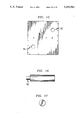
The opposite endplate 151 is shown in FIG. 14 and is fastened to the opposite end edges of the channel shaped conductive members by welds. Threaded apertures are provided for attachment and penetration of coaxial connectors 153 and 154 which apply and receive electrical energy to and from the chambers of the resonant cavity. This plate is also constructed of conductive sheet invar. The opposite endplate is also shown in FIG. 15 without the coaxial connectors which are inserted into the threaded apertures 163 and 164.
A plan and end view of the resonator rods 161 are shown in FIGS. 16 an 17. These rods are circular in cross section and include a threaded stud 162 at one end to facilitate attachment to the threaded holes in the side walls of the channel shaped conducting members. The transformer rods are similar in shape although differing in dimensions.
The common planar member 181 is shown in FIG. 18. It is secured to the longitudinal edges at the channel shaped conductive member by welds. Planar member 181 is constructed of sheet invar.
Another embodiment of the invention in which the component parts are secured together by threaded fasteners is shown in FIGS. 19 and 20. Flanges 192 are provided along the longitudinal edges of each of the channel members to provide a base for the inclusion of pairs of threaded and threadless apertures to accept threaded fasteners 191 to secure the two channel members 195 and 196 and the included common planar conductor 197 into one integral unit. The endplates 198 are secured to the ends of the channel members and the common planar conductor by the threaded fasteners 193.
The two preceding examples have disclosed a filter construction in which the structure is either joined by welded joints (FIGS. 6-13) or joined by threaded fastening devices (FIGS. 18-20). Construction may utilize a hybrid of these two methods of joining the components together. One suitable arrangement is utilizing channel members with flanges as shown in FIGS. 19 and 20 and joining the two channel members together with threaded fasteners as shown in FIGS. 19 and 20. The endplates would be fastened to the ends of the channel members by welding as shown in FIGS. 6 and 14. Various combinations of hybrid fastening may be used and devised by those skilled in the art without departing from the spirit and scope of the invention.