US5124193A - Injection-molded product - Google Patents

Injection-molded product Download PDF

Info

Publication number
US5124193A
US5124193A US07/529,210 US52921090A US5124193A US 5124193 A US5124193 A US 5124193A US 52921090 A US52921090 A US 52921090A US 5124193 A US5124193 A US 5124193A
Authority
US
United States
Prior art keywords
injection
molded product
component
product according
weight
Prior art date
Legal status (The legal status is an assumption and is not a legal conclusion. Google has not performed a legal analysis and makes no representation as to the accuracy of the status listed.)
Expired - Fee Related
Application number
US07/529,210
Inventor
Hironari Sano
Hideaki Nakagawa
Kenichi Tange
Yoshinori Yamamori
Current Assignee (The listed assignees may be inaccurate. Google has not performed a legal analysis and makes no representation or warranty as to the accuracy of the list.)
Mitsubishi Chemical Corp
Mitsubishi Motors Corp
Original Assignee
Mitsubishi Motors Corp
Mitsubishi Petrochemical Co Ltd
Priority date (The priority date is an assumption and is not a legal conclusion. Google has not performed a legal analysis and makes no representation as to the accuracy of the date listed.)
Filing date
Publication date
Application filed by Mitsubishi Motors Corp, Mitsubishi Petrochemical Co Ltd filed Critical Mitsubishi Motors Corp
Assigned to MITSUBISHI PETROCHEMICAL COMPANY LIMITED reassignment MITSUBISHI PETROCHEMICAL COMPANY LIMITED ASSIGNMENT OF 1/2 OF ASSIGNORS INTEREST Assignors: NAKAGAWA, HIDEAKI, SANO, HIRONARI, TANGE, KENICHI, YAMAMORI, YOSHINORI
Application granted granted Critical
Publication of US5124193A publication Critical patent/US5124193A/en
Anticipated expiration legal-status Critical
Expired - Fee Related legal-status Critical Current

Links

Images

Classifications

    • CCHEMISTRY; METALLURGY
    • C08ORGANIC MACROMOLECULAR COMPOUNDS; THEIR PREPARATION OR CHEMICAL WORKING-UP; COMPOSITIONS BASED THEREON
    • C08JWORKING-UP; GENERAL PROCESSES OF COMPOUNDING; AFTER-TREATMENT NOT COVERED BY SUBCLASSES C08B, C08C, C08F, C08G or C08H
    • C08J5/00Manufacture of articles or shaped materials containing macromolecular substances
    • CCHEMISTRY; METALLURGY
    • C08ORGANIC MACROMOLECULAR COMPOUNDS; THEIR PREPARATION OR CHEMICAL WORKING-UP; COMPOSITIONS BASED THEREON
    • C08LCOMPOSITIONS OF MACROMOLECULAR COMPOUNDS
    • C08L23/00Compositions of homopolymers or copolymers of unsaturated aliphatic hydrocarbons having only one carbon-to-carbon double bond; Compositions of derivatives of such polymers
    • C08L23/02Compositions of homopolymers or copolymers of unsaturated aliphatic hydrocarbons having only one carbon-to-carbon double bond; Compositions of derivatives of such polymers not modified by chemical after-treatment
    • C08L23/10Homopolymers or copolymers of propene
    • BPERFORMING OPERATIONS; TRANSPORTING
    • B29WORKING OF PLASTICS; WORKING OF SUBSTANCES IN A PLASTIC STATE IN GENERAL
    • B29CSHAPING OR JOINING OF PLASTICS; SHAPING OF MATERIAL IN A PLASTIC STATE, NOT OTHERWISE PROVIDED FOR; AFTER-TREATMENT OF THE SHAPED PRODUCTS, e.g. REPAIRING
    • B29C45/00Injection moulding, i.e. forcing the required volume of moulding material through a nozzle into a closed mould; Apparatus therefor
    • B29C45/0001Injection moulding, i.e. forcing the required volume of moulding material through a nozzle into a closed mould; Apparatus therefor characterised by the choice of material
    • CCHEMISTRY; METALLURGY
    • C08ORGANIC MACROMOLECULAR COMPOUNDS; THEIR PREPARATION OR CHEMICAL WORKING-UP; COMPOSITIONS BASED THEREON
    • C08LCOMPOSITIONS OF MACROMOLECULAR COMPOUNDS
    • C08L23/00Compositions of homopolymers or copolymers of unsaturated aliphatic hydrocarbons having only one carbon-to-carbon double bond; Compositions of derivatives of such polymers
    • C08L23/02Compositions of homopolymers or copolymers of unsaturated aliphatic hydrocarbons having only one carbon-to-carbon double bond; Compositions of derivatives of such polymers not modified by chemical after-treatment
    • C08L23/16Ethene-propene or ethene-propene-diene copolymers

Definitions

  • This invention relates to an injection-molded product which is greatly improved in terms of its appearance (or clear appearance of a coating applied on it) and its low linear expandability, and possesses excellent low-temperature impact resistance and flexibility.
  • Automobile parts have now been much more increasingly made of plastics with a view to cutting down fuel costs by weight saving, and so various plastic materials have been used not only for interior parts such as instrumental panels, console boxes, glove compartments, steering wheels and trims and exterior parts such as laces, lamp housings, front grills, mud guards and side bumpers, but also for bumpers, facias and (parts of) bodies heretofore made of metals.
  • Plastics used for such automobile parts include, for instance, RIM/urethane, composite polypropylene and polymer alloys such as polycarbonate & ABS.
  • materials used for bumpers and facias are currently broken down into two types, i.e., materials of low rigidity having the property of absorbing impact energy primarily by their deformation and, then, recovering to their original form and the other type of materials of high rigidity which are inferior in deformation recovery properties but are lighter in weight and less expensive.
  • the former materials are represented by RIM/urethane and polypropylene blended with partially crosslinked ethylene/propylene copolymer rubber (EPR), and generally have a modulus in flexure of about 2,000 to 5,000 kg/cm 2 .
  • EPR partially crosslinked ethylene/propylene copolymer rubber
  • the latter materials represented by polypropylene blended with EPR & inorganic filler, generally have a modulus-in-flexure of about 8,000 to 12,000 kg/cm 2 .
  • low-rigidity type materials are polypropylene compositions comprising partially crosslinked ethylene/propylene copolymer rubber, oil and so on which are prepared by methods as disclosed in Japanese Patent Kokai Publication Nos. 53(1978)-145857, 54(1979)-16554 and 57(1982)-135847, and polypropylene compositions comprising non-crosslinked ethylene/propylene copolymer rubber and high-density polyethylene which are prepared by a method as described in Japanese Patent Kokai Publication No. 56(1981)-106948.
  • Such low-rigidity type materials are also exemplified by, for instance, polypropylene compositions comprising non-crosslinked ethylene/propylene copolymer rubber and oil, which are prepared by methods as disclosed in Japanese Patent Kokai Publication Nos. 52(1977)-23148, 52(1977)-12650 and 63(1988)-146951.
  • low-rigidity type materials as prepared by the methods disclosed in the above Kokai publications are often lacking in well-balanced quality in view of low-temperature impact resistance and appearance, when injection-molded, and are less than satisfactory when recent car design, esp., the generally uniform flatness of bodies and a coating finish close to sheet metal working are taken in account, because their coefficient of linear expansion is as high as about 15 ⁇ 10 -5 /°C. and the clearness of coatings applied on them becomes unsatisfactory.
  • such low-rigidity materials are prepared by complicated steps including, esp., a crosslinking step so that they are likely to have an ununiform flowability. In consequence, they tend to become unsatisfactory in view of appearance and low-temperature impact resistance, when injection-molded.
  • the high-rigidity type materials prepared by the above Kokai publications are well-balanced in terms of such properties as low-temperature impact resistance, heat resistance and moldability, but are not satisfactory if the generally uniform flatness of bodies and a coating finish close to sheet metal working are in mind, because like the low-rigidity type materials, they are unsatisfactory in terms of the clearness of coatings applied on them and their coefficient of linear expansion.
  • the injection-molded product according to the present invention comprises:
  • component A 45 to 70% by weight of a propylene polymer resin having a melt flow rate (at 230° C. under a load of 2.16 kg) of 10 to 100 g/10 min and an ethylene content of 0 to 15% by weight; and
  • component B 30 to 55% by weight of an ethylene/propylene copolymer-based rubber having a melt flow rate (at 230° C. under a load of 5 kg) of 0.5 to 20 g/10 min and a propylene content of 20 to 40% by weight;
  • the ratio MFR A /MFR B of said melt flow rate (MFR A ) of component A to said melt flow rate (MFR B ) of component B being 0.5 to 50
  • said molded product having such physical properties as expressed in terms of a modulus in flexure of 2,000 to 5,000 kg/cm 2 , as determined according to JIS-K7203 and a coefficient of linear expansion of 10 ⁇ 10 -5 /°C. or below, as determined according to ASTM-D696, and having an average thickness of 2 to 7 mm.
  • the injection-molded product of the present invention has proper flexibility and excellent low-temperature impact resistance and appearance (the clearness of a coating applied on it), and are so improved in its low linear expandability that it excels in dimensional stability. Therefore, it is best-suited for various parts of long length, esp., automobile parts of a large size such as bumpers.
  • One characteristic feature of the injection-molded product of the present invention is that its coefficient of linear expansion in the direction of injection is as low as 10 ⁇ 10 -5 /°C. or below. It is indeed a surprise that when the specific components A and B are combined with each other, such a reduction in the coefficient of linear expansion is achievable--see the comparative examples given later.
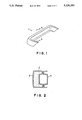
  • FIG. 1 is a perspective view of an injection-molded automotive bumper prepared in the Examples
  • FIG. 2 is a sectional view taken along the line A--A in FIG. 1;
  • FIG. 3 is a hexane-etching electron micrograph showing the matrix/domain structure of stretched rubber particles in the skin layer of an injection-molded product produced in Example 2;
  • FIG. 4 is a hexane-etching electron micrograph showing the matrix/domain structure of rubber particles in a press-molded sheet produced in Comparative Example 1.
  • reference numeral 1 stands for an automobile bumper, 2 a bumper facia, 3 a shock absorber and 4 a bumper lean forcement.
  • the component A used for the injection-molded product of the present invention is a crystalline propylene polymer resin. More particularly, a propylene polymer resin having an ethylene content of 0 to 15% by weight, preferably 0 to 10% by weight, more preferably 2 to 10% by weight and a melt flow rate (MFR for short and determined at 230° C. under a load of 2.16 kg according to ASTM-D1238, conditions L) of 10 to 100 g/10 min, preferably 20 to 80 g/10 min.
  • MFR melt flow rate
  • ethylene content exceeds the above upper limit, then problems arise in connection with not only injection moldability (releasability) but also attachability. If a resin having an MFR less than the above lower limit is used, then there is a drop of moldability and degradation of the appearance of the obtained moldings, e.g., occurrence of flow marks, whereas if a resin having an MFR higher than the above upper limit is used, then there is a drop of low-temperature impact resistance.
  • the proportion of the component A to be used is 45 to 70% by weight, preferably 55 to 65% by weight (relative to the total weight of it and the component B).
  • That proportion is below the above lower limit, the appearance and releasability-upon-molding of the injection moldings will deteriorate, whereas when it exceeds the above upper limit, the coefficient of linear expansion and the low-temperature impact resistance of the moldings will deteriorate.
  • the component B used for the injection-molded product of the present invention is an ethylene/propylene copolymer-based rubber.
  • ethylene/propylene copolymer-based rubber refers to copolymers of ethylene and propylene, optionally with other comonomers, esp., non-conjugated dienes.
  • the non-conjugated dienes include dicyclopentadiene, 1,4-hexadiene, cyclooctadiene, methyl norbornene, 5-ethylene-2-norbornene and so on.
  • ethylene/propylene copolymer base rubber is prepared by polymerization using a vanadium base catalyst comprising a vanadium compound such as vanadium chloride or vanadium oxychloride and an organoaluminum compound such as triethyl aluminum sesquichloride.
  • a vanadium base catalyst comprising a vanadium compound such as vanadium chloride or vanadium oxychloride and an organoaluminum compound such as triethyl aluminum sesquichloride.
  • copolymer rubbers prepared with such a catalyst system excels in randomness.
  • the ethylene/propylene copolymer-based rubber used as the component B in the present invention has a propylene content of 20 to 40% by weight, preferably 22 to 30% by weight and a melt flow rate (at 230° C. under a load of 5 kg according to ASTM-D1238) of 0.5 to 20 g/10 min, preferably 1 to 12 g/10 min.
  • the elastic modulus of the resulting injection-molded product becomes too high, whereas when the propylene content exceeds the above upper limit, then the appearance and releasability-upon-molding of the molded product will deteriorate. Further, if the MFR is less than the above lower limit, then not only is the coefficient of linear expansion of the obtained molded product increased, but there is also degradation of moldability (esp., the degradation of the appearance of the molded product, for instance, the occurrence of flow marks). If the MFR exceeds the above upper limit, then there is a drop of low-temperature impact resistance.
  • the proportion of the component B to be used is 30 to 55% by weight, preferably 35 to 45% by weight (relative to the total weight of it and the component A). If that proportion is below the above lower limit, then not only is the coefficient of linear expansion of the resulting injection-molded product increased, there may also be a drop of low-temperature impact resistance. If that proportion is higher than the above upper limit, on the other hand, then the appearance and releasability-upon-molding of the molded product will deteriorate.
  • the injection-molded product according to the present invention comprises the above components A and B. It is here to be understood that the wording "comprises” means that they may contain, in addition to the above components A and B, auxiliary components (to be described later in greater detail) within the purport of the present invention.
  • the injection-molded product of the present invention may contain, in addition to the above components A and B, pigments, stabilizers, antioxidants, UV-absorbers, foaming agents and the like, which are generally incorporated in ordinary resin materials, according to the purposes.
  • the injection-molded product of the present invention may contain other resins such as ethylene polymers (high-pressure polyethylene: LDPE, low-pressure low-density polyethylene LLPE, low-pressure polyethylene: HDPE, ethylene/vinyl acetate copolymers: EVA, ethylene/acrylate copolymers: EEA, ethylene/acrylic acid copolymers: EAA, and the like), polyamide and polybutene, on condition that the effect of the present invention is not substantially impaired.
  • ethylene polymers high-pressure polyethylene: LDPE, low-pressure low-density polyethylene LLPE, low-pressure polyethylene: HDPE, ethylene/vinyl acetate copolymers: EVA, ethylene/acrylate copolymers: EEA, ethylene/acrylic acid copolymers: EAA, and the like
  • polyamide and polybutene on condition that the effect of the present invention is not substantially impaired.
  • softeners based on mineral oils which are generally used as softeners for rubbers and called process or extender oils, and further inorganic fillers such as calcium carbonate, carbon black, talc, clay whiskers and glass fibers may be added.
  • the injection-molded product of the present invention is characterized by various physical properties.
  • the ratio of the melt flow rate (at 230° C. under a load of 2.16 kg) of the component A to the melt flow rate (at 230° C. under a load of 5 kg) of the component B, or the melt flow rate ratio of the components A/B be 0.5 to 50, preferably 1 to 40.
  • melt flow rate ratio When the melt flow rate ratio is below the above lower limit, then the releasability-upon-molding and appearance of the molded product will deteriorate, whereas when it is higher than the above upper limit, then there may be a drop of the low-temperature impact resistance of the resulting product with possible increase in its coefficient of linear expansion.
  • the modulus in flexure which is one of the essential requirements of the present invention, is 2,000 to 5,000 kg/cm 2 , preferably 2,500 to 4,000 kg/cm 2 .
  • the modulus in flexure is 2,000 to 5,000 kg/cm 2 , preferably 2,500 to 4,000 kg/cm 2 .
  • the coefficient of linear expansion esp., its coefficient of linear expansion in the direction of flow of resin should be 10 ⁇ 10 -5 /°C. or lower.
  • the injection-molded product may vary greatly in size at practical temperatures, e.g., at temperatures ranging from -40° C. to 80° C., thus giving rise to inconvenience at the time of assembling.
  • Still another important feature of the injection-molded product of the present invention is that its average thickness (a thickness of the molded product over 70% or more of its overall area) be in a range of 2 to 7 mm, preferably 2.5 to 5 mm.
  • the injection-molded product of the present invention is provided on their surfaces with a skin layer (an orientated layer of rubber) of 300 ⁇ m to about 1 mm in thickness, thereby achieving satisfactorily low coefficients of linear expansion.
  • such a skin layer is considered to be of a lengthwisely elongated matrix/domain structure.
  • the components A and B are blended together within the range of the aforesaid proportions in ordinary kneading machines such as Banbury mixers, tumbler type mixers, Henschel type mixers, kneaders, single-screw extruders or double-screw extruders and, then, injection-molded in conventional manners.
  • the thus obtained injection moldings may be used as exterior automotive parts such as bumpers, facias, fenders, air dams, air spoilers, laces, front grills and mud guards.
  • the modulus in flexure of 3 mm injection molded sheets prepared under molding conditions A was measured according to JIS-K7203.
  • Each of injection-molded bumpers having an average thickness of 4 mm and prepared under molding conditions B, was provided inside with a shock absorber of propylene foamed body (15 times), in compliance with the practical use, and attached to a given jig at its 16 upper and lower points. Thereafter, impact testing was performed at -30° C. according to FMVSS--Part 581.
  • Injection-molded bumpers having an average thickness of 4 mm and prepared under molding conditions B, were visually observed as to whether or not there were flow marks and variations in gloss.
  • Injection molding was carried out under molding conditions B. The results were then estimated with a mark ⁇ showing that the molded products were releasable with no difficulty, and a mark x indicating that the molded products were caught up on the cavity side at the time of mold opening or demolding, or they were not smoothly ejected from the core side with an ejector pin.
  • each of injection-molded bumpers having an average thickness of 4 mm and prepared under molding conditions B, was provided inside with a shock absorber of propylene foamed body (15 times), as actually carried out, and was attached to a given jig at a total of 16 points, nine points on its upper surface and seven points on its lower surface.
  • the thus attached molded bumper was horizontally fixed and the flatness (or undulation) of its upper surface was observed visually. The results were then estimated with a mark x showing that the tested bumpers were noticeably undulated and a mark ⁇ indicating that the tested bumpers were not substantially deformed.
  • the injection-molded bumpers were subjected to temperature resistance testing at a high temperature of 80° C., at a low temperature of -30° C. and at high temperature and humidity of 40° C. and 95% in a testing run d according to the Automotive Standards JASO-M312-85 entitled "Testing Methods of Molded Plastic Parts". The results were again estimated in similar visual manners as mentioned above.
  • injection-molded bumpers having an average thickness of 4 mm and prepared under molding conditions B, were allowed to stand in that vapor for 30 seconds and, then, cooled off for 60 seconds. For a further 30 seconds, they were allowed to stand in that vapor.
  • a halogenated polypropylene primer was coated on each bumper to a thickness of 10 to 15 ⁇ m on dry basis, which was in turn allowed to stand at room temperature for 3 to 5 minutes.
  • a two-pack urethane coating was applied on the coated bumper to a thickness of 30 to 35 ⁇ m on dry basis, which was in turn permitted to stand at room temperature for 10 to 15 minutes, followed by baking and drying at 100° C. for 20 minutes, thereby preparing a coated sample.
  • the thus coated samples were set in an image visibility meter made by Suga Shikenki Co., Ltd. to estimate the clearness of the coatings with a mark ⁇ indicating 50 points or higher and a mark x indicating less than 50 points.
  • Comparative Example 1 the pellet was pressmolded at 200° C. into a sheet.
  • Examples 1-6 and Comparative Examples 2-12 injection molding was carried out under the molding conditions A as specified in Table 3 to obtain 120 ⁇ 120 ⁇ 3 mm or 120 ⁇ 120 ⁇ 8 mm molded sheets for estimation.

Landscapes

  • Chemical & Material Sciences (AREA)
  • Health & Medical Sciences (AREA)
  • Chemical Kinetics & Catalysis (AREA)
  • Medicinal Chemistry (AREA)
  • Polymers & Plastics (AREA)
  • Organic Chemistry (AREA)
  • Engineering & Computer Science (AREA)
  • Manufacturing & Machinery (AREA)
  • Mechanical Engineering (AREA)
  • Materials Engineering (AREA)
  • Injection Moulding Of Plastics Or The Like (AREA)
  • Compositions Of Macromolecular Compounds (AREA)
  • Manufacture Of Macromolecular Shaped Articles (AREA)

Abstract

An injection-molded product comprising: component A: 45 to 70% by weight of a propylene polymer 2.16 kg) of 10 to 100 g/10 min and an ethylene content of 0 to 15% by weight; and component B: 30 to 55% by weight of an ethylene/propylene copolymer-based rubber having a melt flow rate (at 230 DEG C. under a load of 5 kg) of 0.5 to 20 g/10 min and a propylene content of 20 to 40% by weight; the ratio MFRA/MFRB of the melt flow rate (MFRA) of component A to the melt flow rate (MFRB) of component B being 0.5 to 50, and the molded product having such physical properties as expressed in terms of a modulus in flexure of 2,000 to 5,000 kg/cm2, as determined according to JIS-K7203 and a coefficient of linear expansion of 10 x10-5/ DEG C. or below, as determined according to ASTM-D696, and having an average thickness of 2 to 7 mm.

Description

BACKGROUND OF THE INVENTION
1. Field of the Invention
This invention relates to an injection-molded product which is greatly improved in terms of its appearance (or clear appearance of a coating applied on it) and its low linear expandability, and possesses excellent low-temperature impact resistance and flexibility.
2. Background Art
Automobile parts have now been much more increasingly made of plastics with a view to cutting down fuel costs by weight saving, and so various plastic materials have been used not only for interior parts such as instrumental panels, console boxes, glove compartments, steering wheels and trims and exterior parts such as laces, lamp housings, front grills, mud guards and side bumpers, but also for bumpers, facias and (parts of) bodies heretofore made of metals.
Plastics used for such automobile parts include, for instance, RIM/urethane, composite polypropylene and polymer alloys such as polycarbonate & ABS. In particular, materials used for bumpers and facias are currently broken down into two types, i.e., materials of low rigidity having the property of absorbing impact energy primarily by their deformation and, then, recovering to their original form and the other type of materials of high rigidity which are inferior in deformation recovery properties but are lighter in weight and less expensive.
Of these materials, the former materials are represented by RIM/urethane and polypropylene blended with partially crosslinked ethylene/propylene copolymer rubber (EPR), and generally have a modulus in flexure of about 2,000 to 5,000 kg/cm2. The latter materials, represented by polypropylene blended with EPR & inorganic filler, generally have a modulus-in-flexure of about 8,000 to 12,000 kg/cm2. These materials are now widely used because of low cost and high productivity upon processing into articles by injection molding.
Specific examples of the low-rigidity type materials are polypropylene compositions comprising partially crosslinked ethylene/propylene copolymer rubber, oil and so on which are prepared by methods as disclosed in Japanese Patent Kokai Publication Nos. 53(1978)-145857, 54(1979)-16554 and 57(1982)-135847, and polypropylene compositions comprising non-crosslinked ethylene/propylene copolymer rubber and high-density polyethylene which are prepared by a method as described in Japanese Patent Kokai Publication No. 56(1981)-106948.
Such low-rigidity type materials are also exemplified by, for instance, polypropylene compositions comprising non-crosslinked ethylene/propylene copolymer rubber and oil, which are prepared by methods as disclosed in Japanese Patent Kokai Publication Nos. 52(1977)-23148, 52(1977)-12650 and 63(1988)-146951.
However, it has been found that the low-rigidity type materials as prepared by the methods disclosed in the above Kokai publications are often lacking in well-balanced quality in view of low-temperature impact resistance and appearance, when injection-molded, and are less than satisfactory when recent car design, esp., the generally uniform flatness of bodies and a coating finish close to sheet metal working are taken in account, because their coefficient of linear expansion is as high as about 15×10-5 /°C. and the clearness of coatings applied on them becomes unsatisfactory. Thus, such low-rigidity materials are prepared by complicated steps including, esp., a crosslinking step so that they are likely to have an ununiform flowability. In consequence, they tend to become unsatisfactory in view of appearance and low-temperature impact resistance, when injection-molded.
The high-rigidity type materials prepared by the above Kokai publications are well-balanced in terms of such properties as low-temperature impact resistance, heat resistance and moldability, but are not satisfactory if the generally uniform flatness of bodies and a coating finish close to sheet metal working are in mind, because like the low-rigidity type materials, they are unsatisfactory in terms of the clearness of coatings applied on them and their coefficient of linear expansion.
In order to prepare materials of low linear expandability, on the other hand, it is a general technique to fill resins with sheet-like or fibrous fillers. As set forth in, for instance, Japanese Patent Kokai Publication Nos. 61(1986)-21145 and 63(1988)-57653, it is known to use glass fibers, talc, whiskers or the like as fillers. In order to obtain materials of sufficiently low linear expandability, however, it is required to add large amounts of fillers. This results in deterioration in flowability and, hence, the appearance (including the clearness of coatings applied on them) and low-temperature impact resistance of molded products.
SUMMARY OF THE INVENTION
As a result of intensive studies made to seek a solution to these problems, the present inventors have found that when a blend of a specific propylene polymer resin and a specific ethylene/propylene copolymer-based rubber at a specific ratio is injection-molded to a specific thickness, then an injection-molded product can be obtained, which is considerably improved in terms of its appearance (the clearness of a coating applied on it) with its low-temperature impact resistance and flexibility being well-balanced, and have thus accomplished the present invention.
Thus, the injection-molded product according to the present invention comprises:
component A: 45 to 70% by weight of a propylene polymer resin having a melt flow rate (at 230° C. under a load of 2.16 kg) of 10 to 100 g/10 min and an ethylene content of 0 to 15% by weight; and
component B: 30 to 55% by weight of an ethylene/propylene copolymer-based rubber having a melt flow rate (at 230° C. under a load of 5 kg) of 0.5 to 20 g/10 min and a propylene content of 20 to 40% by weight;
the ratio MFRA /MFRB of said melt flow rate (MFRA) of component A to said melt flow rate (MFRB) of component B being 0.5 to 50, and
said molded product having such physical properties as expressed in terms of a modulus in flexure of 2,000 to 5,000 kg/cm2, as determined according to JIS-K7203 and a coefficient of linear expansion of 10×10-5 /°C. or below, as determined according to ASTM-D696, and having an average thickness of 2 to 7 mm.
The injection-molded product of the present invention has proper flexibility and excellent low-temperature impact resistance and appearance (the clearness of a coating applied on it), and are so improved in its low linear expandability that it excels in dimensional stability. Therefore, it is best-suited for various parts of long length, esp., automobile parts of a large size such as bumpers.
One characteristic feature of the injection-molded product of the present invention is that its coefficient of linear expansion in the direction of injection is as low as 10×10-5 /°C. or below. It is indeed a surprise that when the specific components A and B are combined with each other, such a reduction in the coefficient of linear expansion is achievable--see the comparative examples given later.
BRIEF DESCRIPTION OF THE DRAWINGS
FIG. 1 is a perspective view of an injection-molded automotive bumper prepared in the Examples;
FIG. 2 is a sectional view taken along the line A--A in FIG. 1;
FIG. 3 is a hexane-etching electron micrograph showing the matrix/domain structure of stretched rubber particles in the skin layer of an injection-molded product produced in Example 2; and
FIG. 4 is a hexane-etching electron micrograph showing the matrix/domain structure of rubber particles in a press-molded sheet produced in Comparative Example 1.
In FIGS. 1 and 2, reference numeral 1 stands for an automobile bumper, 2 a bumper facia, 3 a shock absorber and 4 a bumper lean forcement.
DETAILED DESCRIPTION OF THE INVENTION I. Components/Composition Component A
The component A used for the injection-molded product of the present invention is a crystalline propylene polymer resin. More particularly, a propylene polymer resin having an ethylene content of 0 to 15% by weight, preferably 0 to 10% by weight, more preferably 2 to 10% by weight and a melt flow rate (MFR for short and determined at 230° C. under a load of 2.16 kg according to ASTM-D1238, conditions L) of 10 to 100 g/10 min, preferably 20 to 80 g/10 min.
If the ethylene content exceeds the above upper limit, then problems arise in connection with not only injection moldability (releasability) but also attachability. If a resin having an MFR less than the above lower limit is used, then there is a drop of moldability and degradation of the appearance of the obtained moldings, e.g., occurrence of flow marks, whereas if a resin having an MFR higher than the above upper limit is used, then there is a drop of low-temperature impact resistance.
The proportion of the component A to be used is 45 to 70% by weight, preferably 55 to 65% by weight (relative to the total weight of it and the component B). When that proportion is below the above lower limit, the appearance and releasability-upon-molding of the injection moldings will deteriorate, whereas when it exceeds the above upper limit, the coefficient of linear expansion and the low-temperature impact resistance of the moldings will deteriorate.
Component B
The component B used for the injection-molded product of the present invention is an ethylene/propylene copolymer-based rubber. It is here to be noted that the term "ethylene/propylene copolymer-based rubber" refers to copolymers of ethylene and propylene, optionally with other comonomers, esp., non-conjugated dienes.
The non-conjugated dienes include dicyclopentadiene, 1,4-hexadiene, cyclooctadiene, methyl norbornene, 5-ethylene-2-norbornene and so on. Typically, such ethylene/propylene copolymer base rubber is prepared by polymerization using a vanadium base catalyst comprising a vanadium compound such as vanadium chloride or vanadium oxychloride and an organoaluminum compound such as triethyl aluminum sesquichloride. In general, copolymer rubbers prepared with such a catalyst system excels in randomness.
The ethylene/propylene copolymer-based rubber used as the component B in the present invention has a propylene content of 20 to 40% by weight, preferably 22 to 30% by weight and a melt flow rate (at 230° C. under a load of 5 kg according to ASTM-D1238) of 0.5 to 20 g/10 min, preferably 1 to 12 g/10 min.
When a rubber having a propylene content less than the above lower limit is used, the elastic modulus of the resulting injection-molded product becomes too high, whereas when the propylene content exceeds the above upper limit, then the appearance and releasability-upon-molding of the molded product will deteriorate. Further, if the MFR is less than the above lower limit, then not only is the coefficient of linear expansion of the obtained molded product increased, but there is also degradation of moldability (esp., the degradation of the appearance of the molded product, for instance, the occurrence of flow marks). If the MFR exceeds the above upper limit, then there is a drop of low-temperature impact resistance.
The proportion of the component B to be used is 30 to 55% by weight, preferably 35 to 45% by weight (relative to the total weight of it and the component A). If that proportion is below the above lower limit, then not only is the coefficient of linear expansion of the resulting injection-molded product increased, there may also be a drop of low-temperature impact resistance. If that proportion is higher than the above upper limit, on the other hand, then the appearance and releasability-upon-molding of the molded product will deteriorate.
Other Components
The injection-molded product according to the present invention comprises the above components A and B. It is here to be understood that the wording "comprises" means that they may contain, in addition to the above components A and B, auxiliary components (to be described later in greater detail) within the purport of the present invention.
Thus, the injection-molded product of the present invention may contain, in addition to the above components A and B, pigments, stabilizers, antioxidants, UV-absorbers, foaming agents and the like, which are generally incorporated in ordinary resin materials, according to the purposes.
Further, the injection-molded product of the present invention may contain other resins such as ethylene polymers (high-pressure polyethylene: LDPE, low-pressure low-density polyethylene LLPE, low-pressure polyethylene: HDPE, ethylene/vinyl acetate copolymers: EVA, ethylene/acrylate copolymers: EEA, ethylene/acrylic acid copolymers: EAA, and the like), polyamide and polybutene, on condition that the effect of the present invention is not substantially impaired.
If desired, softeners based on mineral oils, which are generally used as softeners for rubbers and called process or extender oils, and further inorganic fillers such as calcium carbonate, carbon black, talc, clay whiskers and glass fibers may be added.
II Injection-Molded Product (1) Physical Values
The injection-molded product of the present invention is characterized by various physical properties.
In the injection-molded product of the present invention, it is of importance that the ratio of the melt flow rate (at 230° C. under a load of 2.16 kg) of the component A to the melt flow rate (at 230° C. under a load of 5 kg) of the component B, or the melt flow rate ratio of the components A/B, be 0.5 to 50, preferably 1 to 40.
When the melt flow rate ratio is below the above lower limit, then the releasability-upon-molding and appearance of the molded product will deteriorate, whereas when it is higher than the above upper limit, then there may be a drop of the low-temperature impact resistance of the resulting product with possible increase in its coefficient of linear expansion.
When injection moldings containing such components are used in the form of, e.g., exterior automotive trim of a large size, it is important that their modulus in flexure (determined according to JIS-K7203) be within a certain range. In other words, the proportion of the respective components A and B is desirously selected from the above ranges such that the modulus in flexure, which is one of the essential requirements of the present invention, is 2,000 to 5,000 kg/cm2, preferably 2,500 to 4,000 kg/cm2. When a molded product having a modulus in flexure less than 2,000 kg/cm2 is used as exterior automotive trim, it poses a problem in connection with its mounting, because it is too flexible for large-sized parts such as bumpers. At higher than 5,000 kg/cm2, on the other hand, there are deteriorations of such properties as shock absorption properties and deformation recovery properties as well as detrimental effects on bodies.
Another important feature of the injection-molded product of the present invention is that its coefficient of linear expansion, esp., its coefficient of linear expansion in the direction of flow of resin should be 10 ×10-5 /°C. or lower. At a value higher than the upper limit, the injection-molded product may vary greatly in size at practical temperatures, e.g., at temperatures ranging from -40° C. to 80° C., thus giving rise to inconvenience at the time of assembling.
Still another important feature of the injection-molded product of the present invention is that its average thickness (a thickness of the molded product over 70% or more of its overall area) be in a range of 2 to 7 mm, preferably 2.5 to 5 mm.
At a thickness higher than 7 mm, the coefficient of linear expansion of the molded product will be large. At a thickness less than 2 mm, on the other hand, the attachability and shape retention of a molded product of such a large size as a length of 1.5 m or longer will deteriorate.
(2) Micro-structure
The injection-molded product of the present invention is provided on their surfaces with a skin layer (an orientated layer of rubber) of 300 μm to about 1 mm in thickness, thereby achieving satisfactorily low coefficients of linear expansion.
Although not fully clarified as yet, such a skin layer is considered to be of a lengthwisely elongated matrix/domain structure. Thus, when the mixture of the above components is vigorously inputted into a mold in injection molding, it flows along the wall surface of the mold while cooled thereby, whereby the ethylene/propylene copolymer-based rubber contained in said mixture is assumed to be stretched in the direction of its flow to form the matrix/domain structure.
Why the injection-molded product having such a matrix/domain structure has a reduced coefficient of linear expansion is considered to be that the stretched rubber component of the matrix/domain structure is thermally shrunk and the amount of shrinkage is reduced from the coefficient of thermal expansion of the propylene polymer in the injection-molded product, whereby the coefficient of linear expansion of the whole injection-molded product is reduced. When the thickness of the injection-molded product is too large, however, the effect of reducing thermal expansion coefficient by the skin layer becomes relatively small, resulting in failure of the attainment of the intended low coefficient of linear expansion of the product. Thus above described range of thickness of the molded product is thus necessary.
Injection Molding
Usually, the components A and B (with other components, if required) are blended together within the range of the aforesaid proportions in ordinary kneading machines such as Banbury mixers, tumbler type mixers, Henschel type mixers, kneaders, single-screw extruders or double-screw extruders and, then, injection-molded in conventional manners. The thus obtained injection moldings may be used as exterior automotive parts such as bumpers, facias, fenders, air dams, air spoilers, laces, front grills and mud guards.
EXPERIMENTAL EXAMPLES
The following examples and comparative examples are given for a more illustrative explanation of the present invention.
Given below are testing methods used for the evaluation of various properties in the examples and comparative examples.
Evaluation (1) Modulus in Flexure
The modulus in flexure of 3 mm injection molded sheets prepared under molding conditions A was measured according to JIS-K7203.
(2) Coefficient of Linear Expansion
The coefficients of linear expansion of 3 mm injection-molded sheets and 3 mm press-molded sheets prepared under molding conditions A were measured according to ASTM-D696.
(3) Low-Temperature Impact Resistance and Recovery after Deformation
Each of injection-molded bumpers, having an average thickness of 4 mm and prepared under molding conditions B, was provided inside with a shock absorber of propylene foamed body (15 times), in compliance with the practical use, and attached to a given jig at its 16 upper and lower points. Thereafter, impact testing was performed at -30° C. according to FMVSS--Part 581.
The results were then estimated with a mark x indicating that the test samples broken and cracked and a mark ◯ indicating that the test samples did not break and crack.
Thirty minutes after impact testing, the shapes of the molded bumpers were also visually observed to estimate their recovery after deformation.
The results were then estimated with a mark ◯ indicating that the test samples struck deformed 3/4 inches or less at their fronts and 3/8 inches or less at their corners with respect to their original shapes and a mark x showing that the test samples struck deformed much more.
(4) Appearance of Injection Moldings
Injection-molded bumpers, having an average thickness of 4 mm and prepared under molding conditions B, were visually observed as to whether or not there were flow marks and variations in gloss.
The results were then estimated with marks x and indicating the presence and absence of flow marks and variations in gloss, respectively.
(5) Injection Moldability
Injection molding was carried out under molding conditions B. The results were then estimated with a mark ◯ showing that the molded products were releasable with no difficulty, and a mark x indicating that the molded products were caught up on the cavity side at the time of mold opening or demolding, or they were not smoothly ejected from the core side with an ejector pin.
(6) Attachability and Deformation after Attachment
As shown in FIG. 2, each of injection-molded bumpers, having an average thickness of 4 mm and prepared under molding conditions B, was provided inside with a shock absorber of propylene foamed body (15 times), as actually carried out, and was attached to a given jig at a total of 16 points, nine points on its upper surface and seven points on its lower surface.
As in the case with an actual bumper, the thus attached molded bumper was horizontally fixed and the flatness (or undulation) of its upper surface was observed visually. The results were then estimated with a mark x showing that the tested bumpers were noticeably undulated and a mark ◯ indicating that the tested bumpers were not substantially deformed.
Thereafter, the injection-molded bumpers were subjected to temperature resistance testing at a high temperature of 80° C., at a low temperature of -30° C. and at high temperature and humidity of 40° C. and 95% in a testing run d according to the Automotive Standards JASO-M312-85 entitled "Testing Methods of Molded Plastic Parts". The results were again estimated in similar visual manners as mentioned above.
(7) Coating Receptivity (Clearness of Coating)
With a vapor cleaner using the vapor of 1,1,1-trichloroethane, injection-molded bumpers, having an average thickness of 4 mm and prepared under molding conditions B, were allowed to stand in that vapor for 30 seconds and, then, cooled off for 60 seconds. For a further 30 seconds, they were allowed to stand in that vapor.
Then, a halogenated polypropylene primer was coated on each bumper to a thickness of 10 to 15 μm on dry basis, which was in turn allowed to stand at room temperature for 3 to 5 minutes. Next, a two-pack urethane coating was applied on the coated bumper to a thickness of 30 to 35 μm on dry basis, which was in turn permitted to stand at room temperature for 10 to 15 minutes, followed by baking and drying at 100° C. for 20 minutes, thereby preparing a coated sample.
The thus coated samples were set in an image visibility meter made by Suga Shikenki Co., Ltd. to estimate the clearness of the coatings with a mark ◯ indicating 50 points or higher and a mark x indicating less than 50 points.
In this connection, a steel plate applied with a coating (based on melamine alkyd) for automobile bodies scored about 60 points.
EXAMPLES 1-6 & COMPARATIVE EXAMPLES 1-12 Components
The components A and B used in the examples and comparative examples are shown below in Tables 1 and 2.
              TABLE 1                                                     
______________________________________                                    
Component A              Ethylene                                         
Propylene polymer                                                         
            230° C., 2.16 kg                                       
                         content   Type of                                
resins      MFR (g/10 min)                                                
                         (weight %)                                       
                                   polymer                                
______________________________________                                    
PP-1        30           9         Block                                  
PP-2        60           5         Block                                  
PP-3        25           0         Homo                                   
PP-4        20           17        Block                                  
PP-5        120          5         Block                                  
PP-6         3           6         Block                                  
______________________________________                                    
              TABLE 2                                                     
______________________________________                                    
Component B                                                               
Ethylene/propylene       Propylene                                        
copolymer based                                                           
            230° C., 5 kg                                          
                         content   Catalyst                               
rubber      MFR (g/10 min)                                                
                         (weight %)                                       
                                   System                                 
______________________________________                                    
EP-1        2            25        Vanadium                               
EP-2        9            25        Vanadium                               
EP-3        2            70        Titanium                               
EP-4        0.1          30        Vanadium                               
EP-5        30           25        Vanadium                               
______________________________________                                    
Blending
The propylene polymer resins as the component A and the ethylene/propylene copolymer-based rubber as the component B, respectively shown in Tables 1 and 2, were blended with a peroxide "Perhexa 25B"--trade name--made by Nippon Yushi Co., Ltd., divinylbenzene as a crosslinking agent and 13 μm diameter and 200 μm long glass powder "Cut Fiber"--trade name--made by Fuji Fiber Co., Ltd. as a fibrous filler at the proportions indicated in Table 3 with a Henschel type mixer, and the mixtures were then melted at 200° C. and extruded through a double-screw extruder having a diameter of 45 mm to obtain pellets.
Molding
In Comparative Example 1, the pellet was pressmolded at 200° C. into a sheet. In Examples 1-6 and Comparative Examples 2-12, injection molding was carried out under the molding conditions A as specified in Table 3 to obtain 120×120×3 mm or 120×120×8 mm molded sheets for estimation.
Another injection molding was carried out under the molding conditions B as specified in Table 3 to obtain a 1,675 mm long, 600 mm wide and 300 mm high molded bumper for automobiles having an average thickness of 4 mm, which is shown in FIG. 1.
The results are shown in Table 4.
                                  TABLE 3                                 
__________________________________________________________________________
             Molding Conditions-A                                         
                           Molding Conditions-B                           
             Molding Machine                                              
             Closing pressure:                                            
                           Closing pressure:                              
             140 Ton In-line Screw Type                                   
                           2,500 Ton In-Line Screw Type                   
Injection Molding                                                         
             Moldings                                                     
Conditions   Injection-molded Sheet                                       
                           Automobile Bumper                              
__________________________________________________________________________
Set Temp.    220° C.                                               
                           220° C.                                 
Primary Pressure, Time                                                    
             600 kg/cm.sup.2 · 5 sec                             
                           900 kg/cm.sup.2 · 18 sec              
Secondary Pressure, Time                                                  
             500 kg/cm.sup.2 · 10 sec                            
                           700 kg/cm.sup.2 · 10 sec              
Cooling Temp.                                                             
             30° C. 25° C.                                  
Cooling Time 20 sec.       50 sec.                                        
Rotating Speed of Screw                                                   
             80 r.p.m.     90 r.p.m.                                      
__________________________________________________________________________
                                  TABLE 4                                 
__________________________________________________________________________
                Examples                Comparative Examples              
                1   2   3   4   5   6   1   2   3   4                     
__________________________________________________________________________
COMPOSITION                                                               
Component A                                                               
    MFR(2.16)                                                             
          C2                                                              
PP-1                                                                      
    30    9     65  60                  60  75  40  60                    
2   60    5             60  60      50                                    
3   25    HOMO                  55                                        
4   20    17                                                              
5   120   5                                                               
6    3    6                                                               
Component B                                                               
   MFR(5)                                                                 
        C3                                                                
          TYPE                                                            
EP-1                                                                      
   2    25                                                                
          Vanadium                                                        
                35      40      45  50                                    
2  9    25                                                                
          Vanadium  40      40          40  25  60  40                    
3  2    70                                                                
          Titanium                                                        
4  0.1  30                                                                
          Vanadium                                                        
5  30   25                                                                
          Vanadium                                                        
MFR.sub.A /MFR.sub.B                                                      
                15  3.3 30  6.7 13  30  3.3 3.3 3.3 3.3                   
Cut Fiber                                                                 
 13 μm diameter                                                        
200 μm length                                                          
Peroxide-1 Perhexa 25B                                                    
Divinylbenzene                                                            
EVALUATION                                                                
Sheet           --  --  --  --  --  --  3 mm                              
                                            --  --  --                    
Press-molded sheet                                                        
Injection-molded sheet                                                    
                3 mm                                                      
                    3 mm                                                  
                        3 mm                                              
                            3 mm                                          
                                3 mm                                      
                                    3 mm                                  
                                        --  3 mm                          
                                                3 mm                      
                                                    3 mm                  
Physical Properties                                                       
                4000                                                      
                    3500                                                  
                        4400                                              
                            4300                                          
                                4000                                      
                                    3600                                  
                                        --  6300                          
                                                1800                      
                                                    --                    
Modulus in Flexure                                                        
kg/cm.sup.2                                                               
Coefficient of Linear                                                     
                9.0 8.5 9.0 8.2 7.8 6.2 16.0                              
                                            13.8                          
                                                4.5 12.5                  
Expansion × 10.sup.-5 /°C.                                   
Low-temperature Impact                                                    
                ◯                                             
                    ◯                                         
                        ◯                                     
                            ◯                                 
                                ◯                             
                                    ◯                         
                                        --  x   ◯             
                                                    --                    
Resistance 30° C.                                                  
Deformation Recovery                                                      
                ◯                                             
                    ◯                                         
                        ◯                                     
                            ◯                                 
                                ◯                             
                                    ◯                         
                                        --  x   ◯             
                                                    --                    
Appearance      ◯                                             
                    ◯                                         
                        ◯                                     
                            ◯                                 
                                ◯                             
                                    ◯                         
                                        --  ◯                 
                                                x   --                    
Injection Moldability                                                     
                ◯                                             
                    ◯                                         
                        ◯                                     
                            ◯                                 
                                ◯                             
                                    ◯                         
                                        --  ◯                 
                                                x   --                    
(Releasability)                                                           
Attachability   ◯                                             
                    ◯                                         
                        ◯                                     
                            ◯                                 
                                ◯                             
                                    ◯                         
                                        --  ◯                 
                                                x   --                    
Deformation after                                                         
                ◯                                             
                    ◯                                         
                        ◯                                     
                            ◯                                 
                                ◯                             
                                    ◯                         
                                        --  x   ◯             
                                                    --                    
attachment                                                                
Coating Receptivity                                                       
                ◯                                             
                    ◯                                         
                        ◯                                     
                            ◯                                 
                                ◯                             
                                    ◯                         
                                        --  ◯                 
                                                ◯             
                                                    --                    
(Clearness of Coating)                                                    
__________________________________________________________________________
                        Comparative Examples                              
                        5   6   7   8   9   10  11  12                    
__________________________________________________________________________
        COMPOSITION                                                       
        Component A                                                       
            MFR(2.16)                                                     
                  C2                                                      
        PP-1                                                              
            30    9                 60  60  60      65                    
        2   60    5                             30                        
        3   25    HOMO                                                    
        4   20    17    60                                                
        5   120   5         60                                            
        6    3    6             60                                        
        Component B                                                       
           MFR(5)                                                         
                C3                                                        
                  TYPE                                                    
        EP-1                                                              
           2    25                                                        
                  Vanadium                                                
                        40  40                  50  35                    
        2  9    25                                                        
                  Vanadium      40                                        
        3  2    70                                                        
                  Titanium          40                                    
        4  0.1  30                                                        
                  Vanadium              40                                
        5  30   25                                                        
                  Vanadium                  40                            
        MFR.sub.A /MFR.sub.B                                              
                        10  60  0.33                                      
                                    15  300  1  30  15                    
        Cut Fiber                               20                        
         13 μm diameter                                                
        200 μm length                                                  
        Peroxide-1 Perhexa 25B                      0.05                  
        Divinylbenzene                              0.1                   
        EVALUATION                                                        
        Sheet           --  --  --  --  --  --  --  --                    
        Press-molded sheet                                                
        Injection-molded sheet                                            
                        3 mm                                              
                            3 mm                                          
                                3 mm                                      
                                    3 mm                                  
                                        3 mm                              
                                            3 mm                          
                                                3 mm                      
                                                    3 mm                  
        Physical Properties                                               
                        1300                                              
                            4500                                          
                                3200                                      
                                    2800                                  
                                        3400                              
                                            3600                          
                                                4000                      
                                                    3500                  
        Modulus in Flexure                                                
        kg/cm.sup.2                                                       
        Coefficient of Linear                                             
                        8.3 11.5                                          
                                4.8 15.2                                  
                                        13.5                              
                                            5.1 4.6 14.8                  
        Expansion × 10.sup.-5 /°C.                           
        Low-temperature Impact                                            
                        ◯                                     
                            x   ◯                             
                                    ◯                         
                                        x   x   ◯             
                                                    ◯         
        Resistance 30° C.                                          
        Deformation Recovery                                              
                        ◯                                     
                            x   ◯                             
                                    ◯                         
                                        x   x   ◯             
                                                    ◯         
        Appearance      ◯                                     
                            ◯                                 
                                x   x   ◯                     
                                            ◯                 
                                                ◯             
                                                    x                     
        Injection Moldability                                             
                        x   ◯                                 
                                x   ◯                         
                                        ◯                     
                                            ◯                 
                                                ◯             
                                                    ◯         
        (Releasability)                                                   
        Attachability   x   ◯                                 
                                ◯                             
                                    ◯                         
                                        ◯                     
                                            ◯                 
                                                ◯             
                                                    ◯         
        Deformation after                                                 
                        ◯                                     
                            x   ◯                             
                                    x   x   ◯                 
                                                ◯             
                                                    x                     
        attachment                                                        
        Coating Receptivity                                               
                        ◯                                     
                            ◯                                 
                                ◯                             
                                    x   ◯                     
                                            ◯                 
                                                x   x                     
        (Clearness of Coating)                                            
__________________________________________________________________________
Claims (12)

What is claimed is:
1. An injection-molded product consisting essentially of:
component A: 55 to 65% by weight of a propylene polymer resin having a melt flow rate (at 230° C. under a load of 2.16 kg) of 10 to 100 g/10 min and an ethylene content of 0 to 15% by weight; and
component B; 35 to 45% by weight of an ethylene/propylene copolymer-based rubber having a melt flow rate (at 230° C. under a load of 5 kg) of 0.5 to 20 g/10 min and a propylene content of 20 to 40% by weight;
the ratio MFRA /MFRB of said melt flow rate (MFRA) of component A to said melt flow rate (MFRB) of component B being 0.5 to 50, and
said molded product having such physical properties as expressed in terms of a modulus in flexure of 2,000 to 5,000 kg/cm2, as determined according to JIS-K7203 and a coefficient of linear expansion of 10×10-5 /°C. or below, as determined according to ASTM-D696, and having an average thickness of 2 to 7 mm.
2. The injection-molded product according to claim 1, wherein the component A has a melt flow rate of 20 to 80 g/10 min and an ethylene content of 2 to 10% by weight.
3. The injection-molded product according to claim 1, wherein the ethylene/propylene copolymer-based rubber of component B is a copolymer of ethylene, propylene and a non-conjugated diene.
4. The injection-molded product according to claim 3, wherein the non-conjugated diene is selected from the group consisting of dicyclopentadiene, 1,4-hexadiene, cyclooctadiene, methyl norbornene and 5-ethylidene-2norbornene.
5. The injection-molded product according to claim 1, wherein the component B has a melt flow rate of 1 to 12 g/10 min and a propylene content of 22 to 30% by weight.
6. The injection-molded product according to claim 1 further comprising adjuvants selected from the group consisting of pigments, stabilizers, antioxidants, UV-absorbers and foaming agents.
7. The injection-molded product according to claim 1 further comprising a resin selected from the group consisting of an ethylene polymer, polyamide and polybutene.
8. The injection-molded product according to claim 1 further comprising a process oil or an extender oil.
9. The injection-molded product according to claim 1 further comprising an inorganic filler selected from the group consisting of calcium carbonate, carbon black, talc, clay whiskers and glass fibers.
10. The injection-molded product according to claim 1, wherein the ratio MFRA /MFRB is 1 to 40.
11. The injection-molded product according to claim 1, wherein said modulus in flexure is 2,500 to 4,000 kg/cm2.
12. The injection-molded product according to claim 1, wherein said average thickness is 2.5 to 5 mm.
US07/529,210 1989-05-26 1990-05-25 Injection-molded product Expired - Fee Related US5124193A (en)

Applications Claiming Priority (2)

Application Number Priority Date Filing Date Title
JP1-133860 1989-05-26
JP1133860A JPH02311533A (en) 1989-05-26 1989-05-26 Injection molded article

Publications (1)

Publication Number Publication Date
US5124193A true US5124193A (en) 1992-06-23

Family

ID=15114740

Family Applications (1)

Application Number Title Priority Date Filing Date
US07/529,210 Expired - Fee Related US5124193A (en) 1989-05-26 1990-05-25 Injection-molded product

Country Status (3)

Country Link
US (1) US5124193A (en)
JP (1) JPH02311533A (en)
KR (1) KR930002068B1 (en)

Cited By (10)

* Cited by examiner, † Cited by third party
Publication number Priority date Publication date Assignee Title
US5298549A (en) * 1991-07-19 1994-03-29 Hoechst Aktiengesellschaft Reinforced polypropylene molding composition
EP0856473A1 (en) * 1997-02-04 1998-08-05 L'oreal Piable thermoplastic material and compressible tube therefrom
EP0911363A1 (en) * 1997-10-24 1999-04-28 Union Carbide Chemicals & Plastics Technology Corporation Polypropylene impact copolymers of high ethylene content
US6481690B2 (en) * 2000-02-17 2002-11-19 Kobe Steel, Ltd. Car body energy absorber and bumper stay
US20030015824A1 (en) * 2001-02-12 2003-01-23 Forbes Alan H. Injection-molded, mineral-filled articles and processes for making the same
US6846533B2 (en) 2001-05-08 2005-01-25 Pactiv Corporation Sheets made of filled polymer compositions
US20060287435A1 (en) * 2005-06-17 2006-12-21 Delphi Technologies Inc. Thermoplastic compounds with flexible processing options for multi-applications
US20110056906A1 (en) * 2009-09-07 2011-03-10 Grant Robert Meadows Bottle cap made from a material comprising polypropylene, particulate calcium carbonate and additives
US9273204B2 (en) 2010-10-01 2016-03-01 Asahi Kasei Chemicals Corporation Uncoated highly reflective impact-resistant injection-molded article and process for producing same
CN112706430A (en) * 2019-10-25 2021-04-27 内蒙古蒙牛乳业(集团)股份有限公司 Yogurt eight-connecting-cup, modified PP sheet for manufacturing yogurt eight-connecting-cup and preparation method of modified PP sheet

Citations (5)

* Cited by examiner, † Cited by third party
Publication number Priority date Publication date Assignee Title
JPS58157839A (en) * 1982-03-16 1983-09-20 Nippon Oil Co Ltd Impact-resistant polyolefin resin composition
JPS58210949A (en) * 1982-06-02 1983-12-08 Showa Denko Kk Preparation of impact-resistant polypropylene composition
US4634740A (en) * 1984-04-09 1987-01-06 Toa Nenryo Kogyo Kabushiki Kaisha Polypropylene composition
US4748206A (en) * 1985-11-11 1988-05-31 Nippon Petrochemicals Company, Limited Polyolefin composition and the same used for vehicle exterior members
US4812526A (en) * 1987-06-08 1989-03-14 Union Carbide Corporation Impact polypropylene

Patent Citations (5)

* Cited by examiner, † Cited by third party
Publication number Priority date Publication date Assignee Title
JPS58157839A (en) * 1982-03-16 1983-09-20 Nippon Oil Co Ltd Impact-resistant polyolefin resin composition
JPS58210949A (en) * 1982-06-02 1983-12-08 Showa Denko Kk Preparation of impact-resistant polypropylene composition
US4634740A (en) * 1984-04-09 1987-01-06 Toa Nenryo Kogyo Kabushiki Kaisha Polypropylene composition
US4748206A (en) * 1985-11-11 1988-05-31 Nippon Petrochemicals Company, Limited Polyolefin composition and the same used for vehicle exterior members
US4812526A (en) * 1987-06-08 1989-03-14 Union Carbide Corporation Impact polypropylene

Cited By (15)

* Cited by examiner, † Cited by third party
Publication number Priority date Publication date Assignee Title
US5298549A (en) * 1991-07-19 1994-03-29 Hoechst Aktiengesellschaft Reinforced polypropylene molding composition
EP0856473A1 (en) * 1997-02-04 1998-08-05 L'oreal Piable thermoplastic material and compressible tube therefrom
FR2759086A1 (en) * 1997-02-04 1998-08-07 Oreal FLEXIBLE THERMOPLASTIC MATERIAL AND COMPRESSIBLE TUBE MADE OF SUCH MATERIAL
US6159566A (en) * 1997-02-04 2000-12-12 L'oreal Flexible thermoplastic and compressible tube made of this material
EP0911363A1 (en) * 1997-10-24 1999-04-28 Union Carbide Chemicals & Plastics Technology Corporation Polypropylene impact copolymers of high ethylene content
US6197886B1 (en) 1997-10-24 2001-03-06 Union Carbide Chemicals & Plastics Technology Corporation Compositions containing impact copolymers made from a blend of a homopolymer phase and a rubber phase having a high ethylene content
US6481690B2 (en) * 2000-02-17 2002-11-19 Kobe Steel, Ltd. Car body energy absorber and bumper stay
US20030015824A1 (en) * 2001-02-12 2003-01-23 Forbes Alan H. Injection-molded, mineral-filled articles and processes for making the same
US6846533B2 (en) 2001-05-08 2005-01-25 Pactiv Corporation Sheets made of filled polymer compositions
US6893694B2 (en) 2001-05-08 2005-05-17 Pactiv Corporation Containers and sheets made of filled polymer compositions
US20060287435A1 (en) * 2005-06-17 2006-12-21 Delphi Technologies Inc. Thermoplastic compounds with flexible processing options for multi-applications
US20110056906A1 (en) * 2009-09-07 2011-03-10 Grant Robert Meadows Bottle cap made from a material comprising polypropylene, particulate calcium carbonate and additives
US9309031B2 (en) 2009-09-07 2016-04-12 The Procter & Gamble Company Bottle cap made from a material comprising polypropylene, particulate calcium carbonate and additives
US9273204B2 (en) 2010-10-01 2016-03-01 Asahi Kasei Chemicals Corporation Uncoated highly reflective impact-resistant injection-molded article and process for producing same
CN112706430A (en) * 2019-10-25 2021-04-27 内蒙古蒙牛乳业(集团)股份有限公司 Yogurt eight-connecting-cup, modified PP sheet for manufacturing yogurt eight-connecting-cup and preparation method of modified PP sheet

Also Published As

Publication number Publication date
KR900018249A (en) 1990-12-20
JPH02311533A (en) 1990-12-27
KR930002068B1 (en) 1993-03-26

Similar Documents

Publication Publication Date Title
US5180629A (en) Injection-molded article
US6150026A (en) Polypropylene-based resin exterior panel and process for producing the same
US6441075B2 (en) Polyolefin-based resin composition and automotive molded plastic made from same
CN110312759B (en) Thermoplastic composition
US5124193A (en) Injection-molded product
JP2512275B2 (en) Thermoplastic film or molding
US5965654A (en) Polyolefin-based plastic composition and automotive molded article formed thereof
US20170335098A1 (en) Non-painting metallic polypropylene resin composition
US5516582A (en) Multilayer molded article and method for producing the same
GB2161490A (en) Propylene-ethylene copolymer base resin composition for molding purposes
CN110325579B (en) Automobile parts
JP2008255191A (en) Polypropylene resin composition for foaming and foamed molded article comprising the same
KR100506756B1 (en) Composition for automobile interior materials with a high scratch-resistance
US6214442B1 (en) Resin molded product and method for producing the same
US6383654B1 (en) Molded article and process for producing same
US5574087A (en) Molded protective strip for automobiles
EP0577255A2 (en) Elastomer composition for covering materials and covering materials for industrial parts comprising the same
KR20040008806A (en) Polypropylene resin composition for automobil thinwall bumper cover
JPH05117489A (en) Polymer composition for injection molding
JP2672341B2 (en) Painted car exterior parts
JP4078168B2 (en) Polypropylene resin injection compression molded product
JP3124583B2 (en) Thermoplastic soft resin composition
JP3539514B2 (en) Molded body for automobile
US20250263542A1 (en) Composition for vehicle parts based on recycled polypropylene and a molded body for vehicle parts including same
JP3404791B2 (en) Polyolefin resin composition and molded article thereof

Legal Events

Date Code Title Description
AS Assignment

Owner name: MITSUBISHI PETROCHEMICAL COMPANY LIMITED, JAPAN

Free format text: ASSIGNMENT OF 1/2 OF ASSIGNORS INTEREST;ASSIGNORS:SANO, HIRONARI;NAKAGAWA, HIDEAKI;TANGE, KENICHI;AND OTHERS;REEL/FRAME:005325/0755

Effective date: 19900518

FPAY Fee payment

Year of fee payment: 4

REMI Maintenance fee reminder mailed
LAPS Lapse for failure to pay maintenance fees
FP Lapsed due to failure to pay maintenance fee

Effective date: 20000623

FEPP Fee payment procedure

Free format text: PAYOR NUMBER ASSIGNED (ORIGINAL EVENT CODE: ASPN); ENTITY STATUS OF PATENT OWNER: LARGE ENTITY

STCH Information on status: patent discontinuation

Free format text: PATENT EXPIRED DUE TO NONPAYMENT OF MAINTENANCE FEES UNDER 37 CFR 1.362