US5074236A - Canister contained emergency boat ladder - Google Patents
Canister contained emergency boat ladder Download PDFInfo
- Publication number
- US5074236A US5074236A US07/588,218 US58821890A US5074236A US 5074236 A US5074236 A US 5074236A US 58821890 A US58821890 A US 58821890A US 5074236 A US5074236 A US 5074236A
- Authority
- US
- United States
- Prior art keywords
- ladder
- container
- latch
- emergency
- canister
- Prior art date
- Legal status (The legal status is an assumption and is not a legal conclusion. Google has not performed a legal analysis and makes no representation as to the accuracy of the status listed.)
- Expired - Fee Related
Links
- XLYOFNOQVPJJNP-UHFFFAOYSA-N water Substances O XLYOFNOQVPJJNP-UHFFFAOYSA-N 0.000 claims description 6
- 238000004873 anchoring Methods 0.000 claims description 3
- 230000004913 activation Effects 0.000 claims 1
- 230000000694 effects Effects 0.000 claims 1
- 239000000463 material Substances 0.000 description 4
- 230000007812 deficiency Effects 0.000 description 3
- 229920003023 plastic Polymers 0.000 description 3
- 239000004033 plastic Substances 0.000 description 3
- 230000009194 climbing Effects 0.000 description 2
- 238000009434 installation Methods 0.000 description 2
- 239000004677 Nylon Substances 0.000 description 1
- 230000006978 adaptation Effects 0.000 description 1
- 230000004048 modification Effects 0.000 description 1
- 238000012986 modification Methods 0.000 description 1
- 229920001778 nylon Polymers 0.000 description 1
- 229920000915 polyvinyl chloride Polymers 0.000 description 1
- 239000004800 polyvinyl chloride Substances 0.000 description 1
Images

Classifications
-
- B—PERFORMING OPERATIONS; TRANSPORTING
- B63—SHIPS OR OTHER WATERBORNE VESSELS; RELATED EQUIPMENT
- B63B—SHIPS OR OTHER WATERBORNE VESSELS; EQUIPMENT FOR SHIPPING
- B63B27/00—Arrangement of ship-based loading or unloading equipment for cargo or passengers
- B63B27/14—Arrangement of ship-based loading or unloading equipment for cargo or passengers of ramps, gangways or outboard ladders ; Pilot lifts
Definitions
- the present invention relates to emergency ladders, and more particularly to a rope ladder which is stored in a canister and which can be quickly released for emergency use.
- Rope ladders are known, but are often stored away from where they are needed. Thus, in the situation where a person on a boat falls overboard and where there is no one on board the boat to get the rope ladder or any other safety device, the overboard person may have no way to reboard the boat. What is needed is an emergency ladder system which is compact and which is stored in an always convenient position accessible to the overboard person.
- U.S. Pat. No. 4,788,926 overcomes some of the deficiencies of the earlier prior art by providing a combined boat fender or bumper and emergency rope ladder.
- the rope ladder is contained inside and is part of the fender, and when a person falls overboard he can pull on a handle which causes the bottom of the fender to drop down releasing a rope ladder for egress back onto the boat.
- a major deficiency of the '926 bumper is that it is located outside the bounds of the vessel. Thus, it will not be available as an emergency ladder when the bumper is being used as a bumper. For instance, if the bumper is tight against an adjacent boat or a dock, there may be only 3 to 4 inches clearance, not enough for use of the emergency ladder.
- the ladder may inadvertently deploy.
- the bumper is not a permanent installation and must be set in place for use. Safe boating practice dictates that no portable bumpers should be outside the bounds of a vessel when approaching a dock in order to prevent the bumper from getting caught on a piling or another boat. Thus, the bumper/ladder will not be available for emergency use at that time.
- the bumper is part of the ladder reboarding mechanism.
- the whole structure must be strong enough to support a person. This will require that every part of the structure be made of very strong and expensive materials.
- a rope ladder stored in a canister which ladder can be released from the canister for emergency use.
- a person overboard can pull down on a lanyard causing the canister to open by means of a quick release latch mechanism and the ladder to drop down into an emergency use position.
- the released ladder is supported at a position outside of and away from the canister so that the weight of person climbing the ladder can be adequately supported.
- the ladder anchor will be able to support virtually any user.
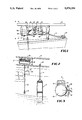
- FIG. 1 is a front perspective view of a canister holding an emergency ladder in accordance with the present invention attached to a boat and held in the closed position;
- FIG. 2 is a front perspective view similar to FIG. 1 but with the emergency ladder deployed and the canister open;
- FIG. 3 is a partial sectional view along line 3--3 of FIG. 1 including an end view of the canister of FIGS. 1 and 2 in the closed position;
- FIG. 4 is a front perspective view of the canister of FIG. 1-3 just as the canister has opened and the ladder is about to fall out of the canister;
- FIG. 5 is a close-up side view of an easy opening latch in the closed position which can be used to close the canister in accordance with the present invention.
- FIG. 6 is a close-up perspective view of the easy opening latch of FIG. 5 in the open position.
- FIGS. 1-6 A preferred embodiment of the present invention is shown in FIGS. 1-6.
- a canister 2 preferably made of a plastic material such as polyvinyl chloride, is shown in a closed position in FIG. 1.
- the canister 2 includes a top section 2a and a bottom section 2b.
- the canister 2 holds a ladder 6 made of suitable flexible material, preferably nylon rope.
- the canister 2 is made to be permanently mounted on a boat railing 8 by means of a holder 10 so that the canister 2 does not extend outside the bounds of the vessel.
- a rope ladder leader 4 which is securely attached to the vessel at a position apart from the canister 2, such as by means of a permanent ring, hook, cleat or eye, e.g. ring 12 shown in FIGS. 1 and 2.
- the rope ladder leader 4 leaves the canister 2 through a hole 11.
- the cannister sections 2a and 2b are hingedly attached along a rear portion as shown in FIGS. 2 and 3 so that when the sections 2a and 2b are not latched together the bottom section 2b drops down as shown in FIGS. 2 and 4.
- a releasable latch 26 normally keeps the canister 2 closed as shown in FIGS. 1 and 5.
- Part of the latch 26 comprises a release handle 27 to which is connected, directly or indirectly, a grasping piece 13, as best seen in FIG. 2.
- the grasping piece 13 hangs down near the water by means of a lanyard or rope 14 which is attached to a hook 16.
- Two lines 18 and 20 come off the hook 16 to the canister 2.
- Line 18 goes directly to a hole 28 in latch handle 26 while the pin line 20, ending at pin 22, goes through a pin line holder 38.
- Pin 22 is releasably held in hole 24 of a part 29 of the latch 26.
- a latch retaining bar 30 in the top half 2a of the canister 2 holds the latch 26 in place in the closed position.
- Latch part 29 forms an extension of the latch handle 27 and these pivot as a unit about an axis piece or shaft 32 which in turn is held at the free end of a latch piece 34 which itself is pivotably supported on the bottom section 2b along an axis piece or shaft 36.
- the overboard swimmer can grab a hold of the grasping piece 13 and make a pulling down motion. This in turn pulls down lanyard 14.
- the resulting force on the hook 16 causes both the line 18 and the pin line 20 to be pulled down.
- the pin line holder 38 guides the pin line 20 in the horizontal direction causing the pin 22 to be pulled out of the hole 24.
- the downward force on line 18 pulls the handle 27 of the latch 26 down causing it to pivot about axis 32 and then causes latch piece 34 to rotate pivotably about axis 36 as latch part 29 is forced against the retaining bar 30.
- the bottom half 2b of the canister is allowed to fall away from the top half 2a of the canister 2.
- FIG. 4 shows the canister just as it has opened and
- FIG. 2 shows the canister 2 and a ladder 6 after the ladder has fallen into the water.
- the ladder 6 attached to a permanent mooring such as the hook 12, and not attached to the canister 2 because the canister 2, preferably made of a plastic material, will not have the same high strength as the hook 12 for supporting a person on the ladder.
- the person overboard can climb out of the water using ladder 6, and then the ladder can be pulled up, folded and put back into canister 2, and the canister 2 closed for reuse.
- An important advantage of the present invention is that the latch system of the stored ladder may be opened by very little force. Yet there is very little chance of an inadvertent release.
- the canister 2 is fixed to a railing 8 located within the bounds of the vessel. Only the emergency pullrope, lanyard 14, is outside of the vessel bounds.
- the canister 2 is available for use at all times in case of the need for emergency boarding, especially when the canister and ladder system is mounted to the back railing of the boat. It is preferable that the canister ladder system is part of a permanent installation thus making both the canister 2 and the ladder fixed and secured at all times, the latter to a cleat or eye attachment such as hook 12.
Landscapes
- Chemical & Material Sciences (AREA)
- Engineering & Computer Science (AREA)
- Combustion & Propulsion (AREA)
- Mechanical Engineering (AREA)
- Ocean & Marine Engineering (AREA)
- Ladders (AREA)
Abstract
Description
Claims (15)
Priority Applications (1)
| Application Number | Priority Date | Filing Date | Title |
|---|---|---|---|
| US07/588,218 US5074236A (en) | 1990-09-26 | 1990-09-26 | Canister contained emergency boat ladder |
Applications Claiming Priority (1)
| Application Number | Priority Date | Filing Date | Title |
|---|---|---|---|
| US07/588,218 US5074236A (en) | 1990-09-26 | 1990-09-26 | Canister contained emergency boat ladder |
Publications (1)
| Publication Number | Publication Date |
|---|---|
| US5074236A true US5074236A (en) | 1991-12-24 |
Family
ID=24352966
Family Applications (1)
| Application Number | Title | Priority Date | Filing Date |
|---|---|---|---|
| US07/588,218 Expired - Fee Related US5074236A (en) | 1990-09-26 | 1990-09-26 | Canister contained emergency boat ladder |
Country Status (1)
| Country | Link |
|---|---|
| US (1) | US5074236A (en) |
Cited By (22)
| Publication number | Priority date | Publication date | Assignee | Title |
|---|---|---|---|---|
| USD355886S (en) | 1993-10-28 | 1995-02-28 | Indikon Company, Inc. | Stowable boarding apparatus |
| US5499595A (en) * | 1995-01-23 | 1996-03-19 | Pollen; Randall P. | Personal water craft with rear mounting means |
| US5540178A (en) * | 1995-05-30 | 1996-07-30 | Damron; Janet K. | Recreational and emergency ladder for watercraft |
| US5690187A (en) * | 1996-08-12 | 1997-11-25 | Wang; Wen-Chung | Life-saving travel bag |
| US5704447A (en) * | 1995-05-16 | 1998-01-06 | Doyle; David A. | Snap-in, rope loop step pad |
| US6695528B2 (en) * | 2000-03-29 | 2004-02-24 | Tomio Fukui | Method for constructing structures useful as scaffolds on slopes |
| WO2004024554A3 (en) * | 2002-09-11 | 2004-04-22 | David Hulbert | Service and survival dinghy |
| US6792887B1 (en) | 2003-10-14 | 2004-09-21 | Blue Splash, Inc. | Portable and stowable step for water-borne vessel |
| US20040200197A1 (en) * | 2003-04-11 | 2004-10-14 | Peterson Robert A. | Portable ladder for mounting a horse |
| FR2854124A1 (en) * | 2003-04-23 | 2004-10-29 | Sarl Seatech | Navigator safety device, has housing receiving ladder with bars interposed between two mountings, and extraction unit permitting to exercise traction on ladder and ensuring ladders extraction from housing by navigator |
| GB2409438A (en) * | 2003-12-22 | 2005-06-29 | Terence Bernard Galligan | Deployable step or vessel access aid |
| WO2005037640A3 (en) * | 2003-10-14 | 2005-09-29 | Blue Splash Inc | Portable and stowable safety device |
| US20070240626A1 (en) * | 2003-10-14 | 2007-10-18 | Blue Splash, Inc. | Portable and stowable safety device |
| US20080060872A1 (en) * | 2006-09-11 | 2008-03-13 | Tech Safety Lines, Inc. | Fall Arrest Lanyard |
| US20090065303A1 (en) * | 2007-09-07 | 2009-03-12 | Davies Rebecca M | Marine emergency rope ladder apparatus |
| US7585197B1 (en) | 2005-08-26 | 2009-09-08 | Merten C William | Crew overboard self rescue device and method for unassisted crew overboard watercraft reentry |
| GB2486344A (en) * | 2010-12-10 | 2012-06-13 | Brian Hanna | Emergency ladder |
| USD697469S1 (en) * | 2013-01-07 | 2014-01-14 | R S Marine | Boat docking assist apparatus |
| US9550550B1 (en) * | 2014-06-17 | 2017-01-24 | Eric T. Housman | Tow rope terminal section with climb-aboard provisions |
| US20210001959A1 (en) * | 2019-07-02 | 2021-01-07 | Goodrich Corporation | Flotation device with boarding apparatus |
| US20220195799A1 (en) * | 2020-12-22 | 2022-06-23 | Ashot Aroian | Reflective Rope Ladder |
| US20230234676A1 (en) * | 2020-09-22 | 2023-07-27 | Jarrett MCNEELY | Illuminated marine ladder |
Citations (7)
| Publication number | Priority date | Publication date | Assignee | Title |
|---|---|---|---|---|
| US3216030A (en) * | 1964-01-31 | 1965-11-09 | Jackson W Garfield | Life line apparatus |
| US3664457A (en) * | 1971-01-11 | 1972-05-23 | James M York | Fire escape apparatus |
| US4164991A (en) * | 1978-04-03 | 1979-08-21 | Aldo Marra | Fire escape device |
| US4376419A (en) * | 1981-07-08 | 1983-03-15 | Sidewinder International, Ltd. | Marine fender |
| US4383592A (en) * | 1981-03-25 | 1983-05-17 | Hoffa Kenneth R | Escape ladder |
| US4788926A (en) * | 1985-06-28 | 1988-12-06 | Johan Ullman | Combined boat fender and emergency ladder |
| US4811817A (en) * | 1988-05-17 | 1989-03-14 | Geary Timothy C | Self-contained ladder system for a boat |
-
1990
- 1990-09-26 US US07/588,218 patent/US5074236A/en not_active Expired - Fee Related
Patent Citations (7)
| Publication number | Priority date | Publication date | Assignee | Title |
|---|---|---|---|---|
| US3216030A (en) * | 1964-01-31 | 1965-11-09 | Jackson W Garfield | Life line apparatus |
| US3664457A (en) * | 1971-01-11 | 1972-05-23 | James M York | Fire escape apparatus |
| US4164991A (en) * | 1978-04-03 | 1979-08-21 | Aldo Marra | Fire escape device |
| US4383592A (en) * | 1981-03-25 | 1983-05-17 | Hoffa Kenneth R | Escape ladder |
| US4376419A (en) * | 1981-07-08 | 1983-03-15 | Sidewinder International, Ltd. | Marine fender |
| US4788926A (en) * | 1985-06-28 | 1988-12-06 | Johan Ullman | Combined boat fender and emergency ladder |
| US4811817A (en) * | 1988-05-17 | 1989-03-14 | Geary Timothy C | Self-contained ladder system for a boat |
Cited By (32)
| Publication number | Priority date | Publication date | Assignee | Title |
|---|---|---|---|---|
| USD355886S (en) | 1993-10-28 | 1995-02-28 | Indikon Company, Inc. | Stowable boarding apparatus |
| US5499595A (en) * | 1995-01-23 | 1996-03-19 | Pollen; Randall P. | Personal water craft with rear mounting means |
| US5704447A (en) * | 1995-05-16 | 1998-01-06 | Doyle; David A. | Snap-in, rope loop step pad |
| US5540178A (en) * | 1995-05-30 | 1996-07-30 | Damron; Janet K. | Recreational and emergency ladder for watercraft |
| US5690187A (en) * | 1996-08-12 | 1997-11-25 | Wang; Wen-Chung | Life-saving travel bag |
| US6695528B2 (en) * | 2000-03-29 | 2004-02-24 | Tomio Fukui | Method for constructing structures useful as scaffolds on slopes |
| US20060096518A1 (en) * | 2002-09-11 | 2006-05-11 | David Hulbert | Service and survival dinghy |
| WO2004024554A3 (en) * | 2002-09-11 | 2004-04-22 | David Hulbert | Service and survival dinghy |
| US20040200197A1 (en) * | 2003-04-11 | 2004-10-14 | Peterson Robert A. | Portable ladder for mounting a horse |
| US7051497B2 (en) * | 2003-04-11 | 2006-05-30 | Peterson Robert A | Portable ladder for mounting a horse |
| FR2854124A1 (en) * | 2003-04-23 | 2004-10-29 | Sarl Seatech | Navigator safety device, has housing receiving ladder with bars interposed between two mountings, and extraction unit permitting to exercise traction on ladder and ensuring ladders extraction from housing by navigator |
| US20070240626A1 (en) * | 2003-10-14 | 2007-10-18 | Blue Splash, Inc. | Portable and stowable safety device |
| US6968801B2 (en) | 2003-10-14 | 2005-11-29 | Baker Stephen J | Portable and stowable safety device |
| WO2005037640A3 (en) * | 2003-10-14 | 2005-09-29 | Blue Splash Inc | Portable and stowable safety device |
| US20070125292A1 (en) * | 2003-10-14 | 2007-06-07 | Blue Splash, Inc. | Portable and stowable safety device |
| US6792887B1 (en) | 2003-10-14 | 2004-09-21 | Blue Splash, Inc. | Portable and stowable step for water-borne vessel |
| US7455028B2 (en) | 2003-10-14 | 2008-11-25 | Baker Stephen J | Portable and stowable safety device |
| US7458334B2 (en) * | 2003-10-14 | 2008-12-02 | Baker Stephen J | Portable and stowable safety device |
| GB2409438A (en) * | 2003-12-22 | 2005-06-29 | Terence Bernard Galligan | Deployable step or vessel access aid |
| US7585197B1 (en) | 2005-08-26 | 2009-09-08 | Merten C William | Crew overboard self rescue device and method for unassisted crew overboard watercraft reentry |
| US20080060872A1 (en) * | 2006-09-11 | 2008-03-13 | Tech Safety Lines, Inc. | Fall Arrest Lanyard |
| US8292028B2 (en) | 2006-09-11 | 2012-10-23 | Tech Safety Lines, Inc. | Fall arrest lanyard |
| US7938229B2 (en) * | 2007-09-07 | 2011-05-10 | Davies Rebecca M | Marine emergency rope ladder apparatus |
| US20090065303A1 (en) * | 2007-09-07 | 2009-03-12 | Davies Rebecca M | Marine emergency rope ladder apparatus |
| GB2486344A (en) * | 2010-12-10 | 2012-06-13 | Brian Hanna | Emergency ladder |
| USD697469S1 (en) * | 2013-01-07 | 2014-01-14 | R S Marine | Boat docking assist apparatus |
| US9550550B1 (en) * | 2014-06-17 | 2017-01-24 | Eric T. Housman | Tow rope terminal section with climb-aboard provisions |
| US20210001959A1 (en) * | 2019-07-02 | 2021-01-07 | Goodrich Corporation | Flotation device with boarding apparatus |
| US11148760B2 (en) * | 2019-07-02 | 2021-10-19 | Goodrich Corporation | Flotation device with boarding apparatus |
| US20230234676A1 (en) * | 2020-09-22 | 2023-07-27 | Jarrett MCNEELY | Illuminated marine ladder |
| US12600439B2 (en) * | 2020-09-22 | 2026-04-14 | Jarrett MCNEELY | Illuminated marine ladder |
| US20220195799A1 (en) * | 2020-12-22 | 2022-06-23 | Ashot Aroian | Reflective Rope Ladder |
Similar Documents
| Publication | Publication Date | Title |
|---|---|---|
| US5074236A (en) | Canister contained emergency boat ladder | |
| US4747797A (en) | Man overboard retrieval apparatus | |
| US4343056A (en) | Man-overboard rescue apparatus for sailboats | |
| US4843994A (en) | Boat fender cover and hanger assembly | |
| US9500026B2 (en) | Folding and self-erecting ladder | |
| US5848667A (en) | Flexible and foldable marine ladder | |
| US5301630A (en) | Inflatable rescue ramp | |
| US5540178A (en) | Recreational and emergency ladder for watercraft | |
| US4811817A (en) | Self-contained ladder system for a boat | |
| JPS60500952A (en) | personal flotation device | |
| US5192238A (en) | Self-activated man overboard recovery system | |
| SE444801B (en) | FENDER | |
| US3754291A (en) | Quick release life saving equipment | |
| US5257954A (en) | Rescue buoy package | |
| WO1994001324A1 (en) | Improvement of life rafts on ships | |
| US4033276A (en) | Support for life ring and associated retrieval line | |
| US5468167A (en) | Life raft utility tether | |
| US4823724A (en) | Bumper storage system | |
| US4139079A (en) | Flexible stile or rope ladder for climbing poles or like members | |
| CN112368205B (en) | Horseshoe-shaped life buoy for water rescue and related rescue rope assembly | |
| AU8155387A (en) | Person or article retrieving device for boats | |
| US6038994A (en) | Small boat support and rigging apparatus and method of use | |
| US4014057A (en) | Chain-like rescue devices particularly for small boats | |
| SE412884B (en) | VESSEL SAVING DEVICE | |
| US4000533A (en) | Anchoring device for buoyant life saving equipment |
Legal Events
| Date | Code | Title | Description |
|---|---|---|---|
| AS | Assignment |
Owner name: JAWITZ, JACK, FLORIDA Free format text: ASSIGNOR ASSIGNS TO EACH ASSIGNEE 1/3 INTEREST;ASSIGNOR:ROBERTSON, ERIC B.;REEL/FRAME:005824/0084 Effective date: 19910820 Owner name: SPENSER, MAC, FLORIDA Free format text: ASSIGNOR ASSIGNS TO EACH ASSIGNEE 1/3 INTEREST;ASSIGNOR:ROBERTSON, ERIC B.;REEL/FRAME:005824/0084 Effective date: 19910820 |
|
| AS | Assignment |
Owner name: NATIONAL IMPROVEMENT COMPANY, INC., FLORIDA Free format text: ASSIGNMENT OF ASSIGNORS INTEREST.;ASSIGNORS:ROBERTSON, ERIC B.;JAWITZ, JACK C.;MAC SPENCER, DONALD;AND OTHERS;REEL/FRAME:006012/0059 Effective date: 19920130 |
|
| REMI | Maintenance fee reminder mailed | ||
| LAPS | Lapse for failure to pay maintenance fees | ||
| FP | Lapsed due to failure to pay maintenance fee |
Effective date: 19951227 |
|
| STCH | Information on status: patent discontinuation |
Free format text: PATENT EXPIRED DUE TO NONPAYMENT OF MAINTENANCE FEES UNDER 37 CFR 1.362 |