US5050320A - Multi-shaft kneading auger system - Google Patents

Multi-shaft kneading auger system Download PDF

Info

Publication number
US5050320A
US5050320A US07/424,987 US42498789A US5050320A US 5050320 A US5050320 A US 5050320A US 42498789 A US42498789 A US 42498789A US 5050320 A US5050320 A US 5050320A
Authority
US
United States
Prior art keywords
blades
shafts
kneading
grouting
rotating shafts
Prior art date
Legal status (The legal status is an assumption and is not a legal conclusion. Google has not performed a legal analysis and makes no representation as to the accuracy of the status listed.)
Expired - Lifetime
Application number
US07/424,987
Inventor
Mitsuhiro Shibazaki
Tsutao Takahashi
Current Assignee (The listed assignees may be inaccurate. Google has not performed a legal analysis and makes no representation or warranty as to the accuracy of the list.)
Kajima Corp
Chemical Grouting Co Ltd
Chemical Grouting Co
Original Assignee
Kajima Corp
Chemical Grouting Co Ltd
Priority date (The priority date is an assumption and is not a legal conclusion. Google has not performed a legal analysis and makes no representation as to the accuracy of the date listed.)
Filing date
Publication date
Priority claimed from JP26822688A external-priority patent/JPH02115406A/en
Priority claimed from JP13866988U external-priority patent/JPH0542151Y2/ja
Application filed by Kajima Corp, Chemical Grouting Co Ltd filed Critical Kajima Corp
Assigned to CHEMICAL GROUTING COMPANY A CORPORATION OF JAPAN, KAJIMA CORPORATION A CORPORATION OF JAPAN reassignment CHEMICAL GROUTING COMPANY A CORPORATION OF JAPAN ASSIGNMENT OF 1/2 OF ASSIGNORS INTEREST Assignors: TAKAHASHI, TSUTAO, SHIBAZAKI, MITSUHIRO
Application granted granted Critical
Publication of US5050320A publication Critical patent/US5050320A/en
Anticipated expiration legal-status Critical
Expired - Lifetime legal-status Critical Current

Links

Images

Classifications

    • EFIXED CONSTRUCTIONS
    • E21EARTH OR ROCK DRILLING; MINING
    • E21BEARTH OR ROCK DRILLING; OBTAINING OIL, GAS, WATER, SOLUBLE OR MELTABLE MATERIALS OR A SLURRY OF MINERALS FROM WELLS
    • E21B7/00Special methods or apparatus for drilling
    • E21B7/001Drilling a non circular hole
    • EFIXED CONSTRUCTIONS
    • E02HYDRAULIC ENGINEERING; FOUNDATIONS; SOIL SHIFTING
    • E02DFOUNDATIONS; EXCAVATIONS; EMBANKMENTS; UNDERGROUND OR UNDERWATER STRUCTURES
    • E02D19/00Keeping dry foundation sites or other areas in the ground
    • E02D19/06Restraining of underground water
    • E02D19/12Restraining of underground water by damming or interrupting the passage of underground water
    • E02D19/16Restraining of underground water by damming or interrupting the passage of underground water by placing or applying sealing substances
    • EFIXED CONSTRUCTIONS
    • E02HYDRAULIC ENGINEERING; FOUNDATIONS; SOIL SHIFTING
    • E02DFOUNDATIONS; EXCAVATIONS; EMBANKMENTS; UNDERGROUND OR UNDERWATER STRUCTURES
    • E02D3/00Improving or preserving soil or rock, e.g. preserving permafrost soil
    • E02D3/12Consolidating by placing solidifying or pore-filling substances in the soil
    • E02D3/126Consolidating by placing solidifying or pore-filling substances in the soil and mixing by rotating blades

Definitions

  • the present invention relates to a multi-shaft kneading auger system including a plurality of kneading shafts (i.e., rotating shafts) having grouting blades.
  • the kneading or rotating shafts are used to form a continuous wall in the ground.
  • An original position earth mixing method has been widely used to form an earth retaining wall in the ground or a dead water wall in a sheet pile earth retaining construction or the like.
  • This method includes the steps of: digging the ground and grouting a wall body, discharging a mixing liquid such as cement or the like from the tip of a kneading shaft, and mixing the liquid with the original position earth in the ground to thereby form a continuous wall.
  • FIGS. 7 and 8 show a conventional multi-shaft kneading auger system used to form such a continuous wall.
  • a guide post 2 is vertically arranged on a self-propelled truck 1.
  • a driving apparatus 3 is attached to the guide post 2 so as to be vertically movable.
  • a multi-shaft apparatus 4 is coupled to the lower portion of the driving apparatus 3.
  • a plurality of kneading or rotating shafts 5A, 5B, and 5C (sometimes generally referred to as reference numeral 5) are attached to the multi-shaft apparatus 4.
  • the rotating directions of the shafts 5A-5C are predetermined so as to rotate in a direction opposite that of an adjacent shaft.
  • the shafts 5A-5C are coupled by a coupling apparatus 9 which also serves as a bearing.
  • Grouting blades 6 are attached to the lower ends of the kneading shafts 5.
  • a screw-shaped moving wing 7 and a rod-shaped kneading wing 8, each having the same diameter as that of the grouting blade 6, are alternatively arranged above the grouting blade 6.
  • the tips of the adjacent kneading wings 8 cooperatively mix the original position earth and the mixing liquid, thereby forming a unit of a continuous wall. If necessary, H-shaped steels and/or sheet piles are vertically buried into the continuous wall, thereby improving the earth retaining property and the dead water property.
  • the outer kneading shafts 5A and 5C and the central kneading shaft 5B are rotated in opposite directions (i.e., adjacent shafts are rotated in opposite directions) in order to execute the mixing work.
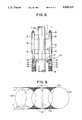
  • the distance between the kneading shafts 5 is limited in other words, as shown in FIG. 9, rotational ranges A 1 to A 2 of the grouting blades 6 are mutually overlapped, and shaded portions N remain ungrouted.
  • the distance between the shafts 5 cannot be set to a value equal to or larger than a predetermined limit value because the total area of the portions N increases as the distance between the rotating shafts 5 increases. Consequently, the grouting performance of the above-mentioned conventional auger system is limited.
  • An objective of the present invention is to provide a multi-shaft kneading auger system which can form a continuous wall having good linearity, which does not limit the vertical burying position of an H-shaped steel, and which can provide a relatively large distance between kneading shafts.
  • the multi-shaft kneading auger system of the present invention has a plurality of kneading shafts which are used to form a continuous wall in the ground.
  • Grouting blades, driven by chains, are provided near lower ends of the kneading shafts.
  • Grouting edges are formed on the blades at a predetermined angle with the surface of the kneading shafts.
  • the grouting blades can also be arranged near or proximate the lower ends of the kneading shafts depending on the grouting condition of the continuous hole.
  • the chains can be driven by any one of the kneading shafts.
  • the multi-shaft kneading auger system of the present invention also has a scraping apparatus provided in a part of the rotating shafts.
  • the scraping apparatus comprises a supporting member laterally supported on part of the rotating shafts and plain blades vertically and movably supported on the supporting member.
  • the plain blades are substantially located on common tangential lines with the rotational surfaces of the grouting blades.
  • the part of the rotating shafts is separately constructed from the other parts, upper and lower end portions of the part are respectively coupled with the other parts of the rotating shafts or grouting blade portions through joint means, and at least two rotating shafts are used as driving shafts and the others are used as supporting shafts. Also, preferably a return spring is arranged between the supporting member and the plain blades.
  • the kneading shafts are rotated and one of the kneading shafts drives the chains to circulatingly move the grouting blades.
  • the grouting blades dig and grout the earth within their circulating range and form one unit of the continuous wall.
  • the moving (i.e., circulating) direction of the grouting blades moved by each chain is a single direction, and the direction of the rotation reaction forces applied to the grouting blades is also a single direction.
  • the rotational reaction forces are balanced as a whole so that the unit of the continuous wall is continuously and rectilinearly formed.
  • the cams are rotated by the rotating shafts and come into contact with the rollers.
  • the rollers and coupling member the plane blades vertically move. That is, the rollers function as cam followers and convert the rotation of the cams into vertical motion (i.e., reciprocation).
  • the plain blades scrape down the earth between the rotational surfaces of the grouting blades and the common forming an elongate-shaped hole.
  • FIG. 1 is a front view showing a main section of a multi-shaft kneading auger system according to the present invention:
  • FIG. 2 is a plan view of the main section shown in FIG. 1;
  • FIG. 3 is a side elevational view showing the multi-shaft kneading auger system according to the present invention
  • FIG. 4 is a front view showing the rotating shafts of the multi-shaft kneading auger system
  • FIG. 5 is a front view showing the scraping apparatus of the multi-shaft kneading auger system
  • FIG. 6 is a side elevational view of the scraping apparatus shown in FIG. 5;
  • FIG. 7 is a side elevational view showing a conventional auger system
  • FIG. 8 is a front view showing conventional kneading shafts.
  • FIG. 9 is a plan view showing a grouting range.
  • FIG. 1 shows an auger system including three kneading shafts 5A, 5B, and 5C coupled by a coupling apparatus 17.
  • the coupling apparatus 17 serves as a bearing and keeps a predetermined distance between neighboring shafts.
  • the shafts 5A and 5C are rotated in a clockwise direction and the shaft 5B is rotated in a counterclockwise direction by a multi-shaft apparatus 4 shown in FIG. 3.
  • Driven sprockets 10 and 11 and driving sprocket 12 are provided with upper and lower tooth portions and are positioned just under the coupling apparatus 17.
  • Boss portions of the driven sprockets 10 and 11 are rotatably supported (i.e., can freely race) on the kneading shafts 5A and 5B by means of metals 13.
  • a boss portion of the driving sprocket 12 is fixedly supported on the kneading shaft 5C by a key 14.
  • Chains 15 are wound around the sprockets 10 and 12.
  • Grouting blades 16, having blade portions 16a in the vertical direction, are fixed to the outer peripheries of the chains.
  • the grouting blades 16 are positioned at the lower ends of the kneading shafts 5.
  • the grouting blades 16 can be also arranged at various locations near the lower ends of the kneading shafts 5, depending upon grouting conditions of the continuous hole.
  • the kneading shafts 5A and 5C are rotated in the direction indicated by the arrow.
  • the kneading shaft 5C drives the driving sprocket 12 which in turn drives the chains 15. Since the driven sprockets 10 and 11 are rotatably supported on the kneading shafts 5A and 5B, the driven sprockets 10 and 11 race with respect to the kneading shafts 5A and 5B, and the grouting blades 16 circulating move in the direction of arrow A together with the chains 15.
  • FIGS. 3 and 4 show a scraping apparatus 110 arranged on the rotating shafts 5.
  • the scraping apparatus is positioned near the upper portions of the grouting blades 6 and just over the lower coupling apparatus 9.
  • FIGS. 5 and 6 show a detail of the scraping apparatus 110.
  • the scraping apparatus 110 has outer drive shafts 5a and 5c and a central supporting shaft 5b. Upper and lower end portions of the shafts 5a, 5b and 5c are respectively coupled with the rotating shafts 5A, 5B, and 5C and portions of the grouting blades 6 through a joint means (not shown).
  • Supporting brackets 111 serving as supporting members, are attached to the shafts 5a, 5b and 5c at the upper and lower positions.
  • the supporting members 111 are attached such that the shafts 5a, 5b and 5c are rotatable but not movable in an axial (i.e., longitudinal) direction.
  • boss portions 112 are formed in central portions of the supporting brackets 111 located between the shafts.
  • Rods 113 protrude through the upper and lower boss portions 112.
  • Plain scraping blades 114 having outer portions located on common tangential lines C (FIG. 9) of the rotational surfaces A 1 , A 2 , and A 3 of the grouting blades 6, are integrally formed at the lower ends of the rods 113.
  • the plain blades 114 are coupled by a beam 115 serving as a coupling member and extending in a lateral direction. Both ends of the beam 115 are provided with a roller 116, respectively.
  • Disks 117 are positioned above the beams 115 of the drive shafts 5a and 5c, respectively.
  • Cams 118, for engaging with the rollers 116, are formed on the disks 117.
  • Return springs 119 are arranged between the upper end of the rods 113 and the upper supporting bracket 111.
  • the cams 118 When the drive shafts 5a and 5c are rotated by the rotating shafts 5A and 5C, the cams 118 come into contact with the rollers 116 and depress the plain blades 114 through depression of the rollers 116 and beams 115. When the cams 118 are removed from the rollers 116, the plain blades 114 are drawn up by operation of the return springs 119. Thus, the plain blades 114 vertically move (i.e., reciprocate) and scrape down the earth in the portions N shown in FIG. 9.
  • the ground in the movement circulation range of the grouting blades is dug and grouted into a rectilinear shape having semicircular shapes at both ends, to thereby form a unit of the continuous wall. Since the direction of rotational reaction forces of the grouting blades are set to a single direction and are balanced as a whole, the rectilinear portion of the unit of the continuous wall can be rectilinearly formed. Furthermore, since the grouting blades are moved by the chains, the distance between the kneading shafts can be increased. In addition, since a rectilinear continuous hole can be formed, the limitation of position, in which an H-shaped steel is vertically buried, can be eliminated. Finally, in the case where diameters of the holes are identical, an H-shaped steel, larger than one buried in a conventional hole, can be buried.
  • the earth between the rotational surfaces of the grouting blades and the common tangential lines of the rotational surfaces is scraped down by the vertical motions (i.e., reciprocation) of the plain blades and dug and grouted into an elongate-shaped hole.
  • the grouting performance can be improved, and the limitation of the position at which the H-shaped steel is vertically buried can be further eliminated.

Landscapes

  • Engineering & Computer Science (AREA)
  • Life Sciences & Earth Sciences (AREA)
  • Environmental & Geological Engineering (AREA)
  • Mining & Mineral Resources (AREA)
  • Structural Engineering (AREA)
  • General Life Sciences & Earth Sciences (AREA)
  • General Engineering & Computer Science (AREA)
  • Civil Engineering (AREA)
  • Paleontology (AREA)
  • Hydrology & Water Resources (AREA)
  • Geology (AREA)
  • Physics & Mathematics (AREA)
  • Fluid Mechanics (AREA)
  • Geochemistry & Mineralogy (AREA)
  • Agronomy & Crop Science (AREA)
  • Soil Sciences (AREA)
  • Consolidation Of Soil By Introduction Of Solidifying Substances Into Soil (AREA)

Abstract

The present invention relates to a multi-shaft kneading auger system having a plurality of kneading shafts or rotating shafts used to form a continuous wall in the ground. Grouting blades driven by chains, are positioned near the lower ends of the kneading shafts. A grouting edge of the blade forms a predetermined angle with the surface of the kneading shafts. Also, a scraping apparatus is formed in a part of the rotating shafts. The scraping apparatus comprises a supporting member laterally supported in the part of the rotating shafts, plain blades vertically movably supported on the supporting member and substantially located on common tangential lines of the rotational surfaces of the grouting blades, a coupling member including rollers and laterally coupling the plain blades, and cams provided in the part of the rotating shafts and adapted to engage with the rollers. Thus, a unit of the continuous wall, having a rectilinear central portion and semicircular end portions, can be dug and grouted without losing linearity of the rectilinear portion.

Description

FIELD OF THE INVENTION
The present invention relates to a multi-shaft kneading auger system including a plurality of kneading shafts (i.e., rotating shafts) having grouting blades. The kneading or rotating shafts are used to form a continuous wall in the ground.
DESCRIPTION OF THE PRIOR ART
An original position earth mixing method has been widely used to form an earth retaining wall in the ground or a dead water wall in a sheet pile earth retaining construction or the like. This method includes the steps of: digging the ground and grouting a wall body, discharging a mixing liquid such as cement or the like from the tip of a kneading shaft, and mixing the liquid with the original position earth in the ground to thereby form a continuous wall.
FIGS. 7 and 8 show a conventional multi-shaft kneading auger system used to form such a continuous wall. A guide post 2 is vertically arranged on a self-propelled truck 1. A driving apparatus 3 is attached to the guide post 2 so as to be vertically movable. A multi-shaft apparatus 4 is coupled to the lower portion of the driving apparatus 3. A plurality of kneading or rotating shafts 5A, 5B, and 5C (sometimes generally referred to as reference numeral 5) are attached to the multi-shaft apparatus 4. The rotating directions of the shafts 5A-5C are predetermined so as to rotate in a direction opposite that of an adjacent shaft. The shafts 5A-5C are coupled by a coupling apparatus 9 which also serves as a bearing.
Grouting blades 6 are attached to the lower ends of the kneading shafts 5. A screw-shaped moving wing 7 and a rod-shaped kneading wing 8, each having the same diameter as that of the grouting blade 6, are alternatively arranged above the grouting blade 6. The tips of the adjacent kneading wings 8 cooperatively mix the original position earth and the mixing liquid, thereby forming a unit of a continuous wall. If necessary, H-shaped steels and/or sheet piles are vertically buried into the continuous wall, thereby improving the earth retaining property and the dead water property.
However, in the above-mentioned conventional multi-shaft kneading auger system, the outer kneading shafts 5A and 5C and the central kneading shaft 5B are rotated in opposite directions (i.e., adjacent shafts are rotated in opposite directions) in order to execute the mixing work. This results in the rotational reaction forces of the grouting blades 6 becoming unbalanced at a ratio of 2:1, thereby causing the unit of the continuous wall to lack linearity.
Furthermore, since it is necessary to continuously execute the grouting work so as to overlap the rotating ranges of the grouting blades 6, the distance between the kneading shafts 5 is limited In other words, as shown in FIG. 9, rotational ranges A1 to A2 of the grouting blades 6 are mutually overlapped, and shaded portions N remain ungrouted. Although minimizing the total area of the portions N is desirable, the distance between the shafts 5 cannot be set to a value equal to or larger than a predetermined limit value because the total area of the portions N increases as the distance between the rotating shafts 5 increases. Consequently, the grouting performance of the above-mentioned conventional auger system is limited.
As further shown in FIG. 9, when reinforcing by vertically burying an H-shaped steel H: or H2, the H-shaped steel must be inserted along the shaft line of the rotating shaft 5. This type of insertion limits the position in which the H-shaped steel can be vertically buried.
SUMMARY OF THE INVENTION
An objective of the present invention is to provide a multi-shaft kneading auger system which can form a continuous wall having good linearity, which does not limit the vertical burying position of an H-shaped steel, and which can provide a relatively large distance between kneading shafts.
The multi-shaft kneading auger system of the present invention has a plurality of kneading shafts which are used to form a continuous wall in the ground. Grouting blades, driven by chains, are provided near lower ends of the kneading shafts. Grouting edges are formed on the blades at a predetermined angle with the surface of the kneading shafts.
Although preferably positioned at the lower ends of the kneading shafts, the grouting blades can also be arranged near or proximate the lower ends of the kneading shafts depending on the grouting condition of the continuous hole. Also, the chains can be driven by any one of the kneading shafts.
The multi-shaft kneading auger system of the present invention also has a scraping apparatus provided in a part of the rotating shafts. The scraping apparatus comprises a supporting member laterally supported on part of the rotating shafts and plain blades vertically and movably supported on the supporting member. The plain blades are substantially located on common tangential lines with the rotational surfaces of the grouting blades. A coupling member, including rollers, laterally couples the plain blades to each other, and cams, provided on the rotating shafts, come into engagement with the rollers.
Preferably, the part of the rotating shafts is separately constructed from the other parts, upper and lower end portions of the part are respectively coupled with the other parts of the rotating shafts or grouting blade portions through joint means, and at least two rotating shafts are used as driving shafts and the others are used as supporting shafts. Also, preferably a return spring is arranged between the supporting member and the plain blades.
In operation of the multi-shaft kneading auger system of the present invention, the kneading shafts are rotated and one of the kneading shafts drives the chains to circulatingly move the grouting blades. The grouting blades dig and grout the earth within their circulating range and form one unit of the continuous wall. The moving (i.e., circulating) direction of the grouting blades moved by each chain is a single direction, and the direction of the rotation reaction forces applied to the grouting blades is also a single direction. Thus, the rotational reaction forces are balanced as a whole so that the unit of the continuous wall is continuously and rectilinearly formed.
Furthermore, in the multi-shaft kneading auger system of the present invention, the cams are rotated by the rotating shafts and come into contact with the rollers. Through the rollers and coupling member, the plane blades vertically move. That is, the rollers function as cam followers and convert the rotation of the cams into vertical motion (i.e., reciprocation). Thus, the plain blades scrape down the earth between the rotational surfaces of the grouting blades and the common forming an elongate-shaped hole.
BRIEF DESCRIPTION OF THE DRAWINGS
FIG. 1 is a front view showing a main section of a multi-shaft kneading auger system according to the present invention:
FIG. 2 is a plan view of the main section shown in FIG. 1;
FIG. 3 is a side elevational view showing the multi-shaft kneading auger system according to the present invention;
FIG. 4 is a front view showing the rotating shafts of the multi-shaft kneading auger system;
FIG. 5 is a front view showing the scraping apparatus of the multi-shaft kneading auger system;
FIG. 6 is a side elevational view of the scraping apparatus shown in FIG. 5;
FIG. 7 is a side elevational view showing a conventional auger system;
FIG. 8 is a front view showing conventional kneading shafts; and
FIG. 9 is a plan view showing a grouting range.
DETAILED DESCRIPTION OF THE PREFERRED EMBODIMENTS
FIG. 1 shows an auger system including three kneading shafts 5A, 5B, and 5C coupled by a coupling apparatus 17. The coupling apparatus 17 serves as a bearing and keeps a predetermined distance between neighboring shafts.
The shafts 5A and 5C are rotated in a clockwise direction and the shaft 5B is rotated in a counterclockwise direction by a multi-shaft apparatus 4 shown in FIG. 3. Driven sprockets 10 and 11 and driving sprocket 12 are provided with upper and lower tooth portions and are positioned just under the coupling apparatus 17.
Boss portions of the driven sprockets 10 and 11 are rotatably supported (i.e., can freely race) on the kneading shafts 5A and 5B by means of metals 13. On the other hand, a boss portion of the driving sprocket 12 is fixedly supported on the kneading shaft 5C by a key 14.
Chains 15 are wound around the sprockets 10 and 12. Grouting blades 16, having blade portions 16a in the vertical direction, are fixed to the outer peripheries of the chains.
Preferably, the grouting blades 16 are positioned at the lower ends of the kneading shafts 5. However, the grouting blades 16 can be also arranged at various locations near the lower ends of the kneading shafts 5, depending upon grouting conditions of the continuous hole.
Referring to FIG. 2, in digging and grouting a continuous hole, the kneading shafts 5A and 5C are rotated in the direction indicated by the arrow. The kneading shaft 5C drives the driving sprocket 12 which in turn drives the chains 15. Since the driven sprockets 10 and 11 are rotatably supported on the kneading shafts 5A and 5B, the driven sprockets 10 and 11 race with respect to the kneading shafts 5A and 5B, and the grouting blades 16 circulating move in the direction of arrow A together with the chains 15. Since the rotational reaction forces are balanced, the earth is dug and grouted in a rectilinear range B without losing the linearity of the range B. Therefore, a unit C of a continuous wall, both ends of which have semicircular shapes, is formed by the circulating movement of the grouting blades 16.
FIGS. 3 and 4 show a scraping apparatus 110 arranged on the rotating shafts 5. The scraping apparatus is positioned near the upper portions of the grouting blades 6 and just over the lower coupling apparatus 9.
FIGS. 5 and 6 show a detail of the scraping apparatus 110. The scraping apparatus 110 has outer drive shafts 5a and 5c and a central supporting shaft 5b. Upper and lower end portions of the shafts 5a, 5b and 5c are respectively coupled with the rotating shafts 5A, 5B, and 5C and portions of the grouting blades 6 through a joint means (not shown). Supporting brackets 111, serving as supporting members, are attached to the shafts 5a, 5b and 5c at the upper and lower positions. The supporting members 111 are attached such that the shafts 5a, 5b and 5c are rotatable but not movable in an axial (i.e., longitudinal) direction. Four boss portions 112 are formed in central portions of the supporting brackets 111 located between the shafts. Rods 113 protrude through the upper and lower boss portions 112. Plain scraping blades 114, having outer portions located on common tangential lines C (FIG. 9) of the rotational surfaces A1, A2, and A3 of the grouting blades 6, are integrally formed at the lower ends of the rods 113. The plain blades 114 are coupled by a beam 115 serving as a coupling member and extending in a lateral direction. Both ends of the beam 115 are provided with a roller 116, respectively.
Disks 117 are positioned above the beams 115 of the drive shafts 5a and 5c, respectively. Cams 118, for engaging with the rollers 116, are formed on the disks 117. Return springs 119 are arranged between the upper end of the rods 113 and the upper supporting bracket 111.
When the drive shafts 5a and 5c are rotated by the rotating shafts 5A and 5C, the cams 118 come into contact with the rollers 116 and depress the plain blades 114 through depression of the rollers 116 and beams 115. When the cams 118 are removed from the rollers 116, the plain blades 114 are drawn up by operation of the return springs 119. Thus, the plain blades 114 vertically move (i.e., reciprocate) and scrape down the earth in the portions N shown in FIG. 9.
The ground in the movement circulation range of the grouting blades is dug and grouted into a rectilinear shape having semicircular shapes at both ends, to thereby form a unit of the continuous wall. Since the direction of rotational reaction forces of the grouting blades are set to a single direction and are balanced as a whole, the rectilinear portion of the unit of the continuous wall can be rectilinearly formed. Furthermore, since the grouting blades are moved by the chains, the distance between the kneading shafts can be increased. In addition, since a rectilinear continuous hole can be formed, the limitation of position, in which an H-shaped steel is vertically buried, can be eliminated. Finally, in the case where diameters of the holes are identical, an H-shaped steel, larger than one buried in a conventional hole, can be buried.
Moreover, according to the invention, the earth between the rotational surfaces of the grouting blades and the common tangential lines of the rotational surfaces is scraped down by the vertical motions (i.e., reciprocation) of the plain blades and dug and grouted into an elongate-shaped hole. Thus, the grouting performance can be improved, and the limitation of the position at which the H-shaped steel is vertically buried can be further eliminated.

Claims (4)

What is claimed is:
1. A multi-shaft kneading auger system comprising:
a plurality of kneading shafts for forming a continuous wall in the ground; and
grouting blades positioned near the lower ends of said kneading shafts and driven to form said continuous wall, said grouting blades
i.) having a grouting edge formed at a predetermined angle with the surface of said kneading shafts, and
ii) being fixed to and which are driven by the movement of a chain encircling but not rigidly affixed to said kneading shafts.
2. A multi-shaft kneading auger system, comprising:
a plurality of rotating shafts having grouting blades for forming a continuous wall in the ground;
a scraping apparatus formed in a part of said rotating shafts, said scraping apparatus including:
a supporting member laterally supported in said part of said rotating shafts,
plain blades movably supported on said supporting member and substantially located on common tangential lines of the rotational surfaces of said grouting blades,
a coupling member laterally coupling said plain blades with each other, and
cams provided in said part of said rotating shafts and adapted to engage with said coupling member, wherein said blades move up and down through the action of the cams.
3. The multi-shaft kneading auger system according to claim 1, wherein said grouting blades are positioned at the lower ends of said kneading shafts.
4. A multi-shaft kneading auger system according to claim 1 wherein said chain is driven by rotation of one or more of said kneading shafts.
US07/424,987 1988-10-26 1989-10-23 Multi-shaft kneading auger system Expired - Lifetime US5050320A (en)

Applications Claiming Priority (4)

Application Number Priority Date Filing Date Title
JP26822688A JPH02115406A (en) 1988-10-26 1988-10-26 Multi-shaft kneading auger machine
JP13866988U JPH0542151Y2 (en) 1988-10-26 1988-10-26
JP63-138669[U] 1988-10-26
JP63-268226 1988-10-26

Publications (1)

Publication Number Publication Date
US5050320A true US5050320A (en) 1991-09-24

Family

ID=26471662

Family Applications (1)

Application Number Title Priority Date Filing Date
US07/424,987 Expired - Lifetime US5050320A (en) 1988-10-26 1989-10-23 Multi-shaft kneading auger system

Country Status (1)

Country Link
US (1) US5050320A (en)

Cited By (3)

* Cited by examiner, † Cited by third party
Publication number Priority date Publication date Assignee Title
US5575345A (en) * 1994-11-15 1996-11-19 Chemical Grouting Company. Ltd. Multi shaft drilling unit
BE1018657A5 (en) * 2009-02-13 2011-06-07 Smet Luc Maria Hugo Corneel DRILL INSTALLATION.
EP2423388A1 (en) * 2010-08-30 2012-02-29 Bauer Spezialtiefbau GmbH Method and device for manufacturing a slotted wall

Citations (4)

* Cited by examiner, † Cited by third party
Publication number Priority date Publication date Assignee Title
US2553541A (en) * 1947-07-17 1951-05-22 Jr Albert G Bodine Deep well pump
US3969902A (en) * 1973-07-23 1976-07-20 Yoshino Ichise Contruction method for continuous row of piles and earth drill for use therefor
US4148367A (en) * 1977-03-14 1979-04-10 Reich Wendell L Well drilling apparatus
US4886400A (en) * 1988-03-23 1989-12-12 S.M.W. Seiko, Inc. Side cutting blades for multi-shaft auger system and improved soil mixing wall formation process

Patent Citations (4)

* Cited by examiner, † Cited by third party
Publication number Priority date Publication date Assignee Title
US2553541A (en) * 1947-07-17 1951-05-22 Jr Albert G Bodine Deep well pump
US3969902A (en) * 1973-07-23 1976-07-20 Yoshino Ichise Contruction method for continuous row of piles and earth drill for use therefor
US4148367A (en) * 1977-03-14 1979-04-10 Reich Wendell L Well drilling apparatus
US4886400A (en) * 1988-03-23 1989-12-12 S.M.W. Seiko, Inc. Side cutting blades for multi-shaft auger system and improved soil mixing wall formation process

Cited By (3)

* Cited by examiner, † Cited by third party
Publication number Priority date Publication date Assignee Title
US5575345A (en) * 1994-11-15 1996-11-19 Chemical Grouting Company. Ltd. Multi shaft drilling unit
BE1018657A5 (en) * 2009-02-13 2011-06-07 Smet Luc Maria Hugo Corneel DRILL INSTALLATION.
EP2423388A1 (en) * 2010-08-30 2012-02-29 Bauer Spezialtiefbau GmbH Method and device for manufacturing a slotted wall

Similar Documents

Publication Publication Date Title
US5050320A (en) Multi-shaft kneading auger system
US6421938B1 (en) Endless chain type cutter
DE2008873A1 (en) Control unit for barges
DE202023102256U1 (en) A pipe jacking machine to prevent collapse of existing roads and buildings
US2223608A (en) Boom type excavator
EP0678628B1 (en) Multi-shaft excavating device
JPH0115653B2 (en)
US3406767A (en) Multiple auger assembly
CN215292360U (en) Rectangular Pile Hole Drill Bit
JPH02115406A (en) Multi-shaft kneading auger machine
JPH0718677A (en) Pillar line type underground continuous wall construction method
JPH0542151Y2 (en)
RU2068057C1 (en) Versatile excavating-conveying tool
KR20080006147U (en) Multi-Axis Stirring Excavator with Auxiliary Stirring Device
JPH05141182A (en) Pre-lining type tunnel excavation method and apparatus
JPH06136741A (en) Ground improving method and its device
JP3177840B2 (en) Drilling rig for caisson
CN222302359U (en) Pool making machine capable of deepening pool making depth
JP2025084550A (en) Wall-shaped improvement body, ground improvement machine, and construction method for wall-shaped improvement body
SU808594A1 (en) Screw pile
JPH01146019A (en) Trencher
JP2604528Y2 (en) Multi-axis drilling rig
JP2002105953A (en) Screwing steel pipe pile
EP0685603B1 (en) Multi-shaft excavating device
JPH0523621Y2 (en)

Legal Events

Date Code Title Description
AS Assignment

Owner name: CHEMICAL GROUTING COMPANY A CORPORATION OF JAP

Free format text: ASSIGNMENT OF 1/2 OF ASSIGNORS INTEREST;ASSIGNORS:SHIBAZAKI, MITSUHIRO;TAKAHASHI, TSUTAO;REEL/FRAME:005699/0030;SIGNING DATES FROM 19910523 TO 19910524

Owner name: KAJIMA CORPORATION A CORPORATION OF JAPAN, JAPAN

Free format text: ASSIGNMENT OF 1/2 OF ASSIGNORS INTEREST;ASSIGNORS:SHIBAZAKI, MITSUHIRO;TAKAHASHI, TSUTAO;REEL/FRAME:005699/0030;SIGNING DATES FROM 19910523 TO 19910524

STCF Information on status: patent grant

Free format text: PATENTED CASE

FEPP Fee payment procedure

Free format text: PAYOR NUMBER ASSIGNED (ORIGINAL EVENT CODE: ASPN); ENTITY STATUS OF PATENT OWNER: LARGE ENTITY

FPAY Fee payment

Year of fee payment: 4

REMI Maintenance fee reminder mailed
FPAY Fee payment

Year of fee payment: 8

SULP Surcharge for late payment
FPAY Fee payment

Year of fee payment: 12