US5049593A - Stranded conductor filling compound of low molecular weight polymer and water swellable organic material - Google Patents
Stranded conductor filling compound of low molecular weight polymer and water swellable organic material Download PDFInfo
- Publication number
- US5049593A US5049593A US07/333,773 US33377389A US5049593A US 5049593 A US5049593 A US 5049593A US 33377389 A US33377389 A US 33377389A US 5049593 A US5049593 A US 5049593A
- Authority
- US
- United States
- Prior art keywords
- conductor
- wires
- polymer
- filling composition
- compound
- Prior art date
- Legal status (The legal status is an assumption and is not a legal conclusion. Google has not performed a legal analysis and makes no representation as to the accuracy of the status listed.)
- Expired - Lifetime
Links
- 239000004020 conductor Substances 0.000 title claims abstract description 58
- XLYOFNOQVPJJNP-UHFFFAOYSA-N water Substances O XLYOFNOQVPJJNP-UHFFFAOYSA-N 0.000 title claims abstract description 40
- 229920000642 polymer Polymers 0.000 title claims abstract description 22
- 239000011368 organic material Substances 0.000 title claims 2
- 150000001875 compounds Chemical class 0.000 title abstract description 71
- 239000000463 material Substances 0.000 claims abstract description 29
- 239000002245 particle Substances 0.000 claims abstract description 29
- 230000035515 penetration Effects 0.000 claims abstract description 8
- 229920001971 elastomer Polymers 0.000 claims description 15
- 239000000203 mixture Substances 0.000 claims description 14
- 229920002367 Polyisobutene Polymers 0.000 claims description 7
- 229920005549 butyl rubber Polymers 0.000 claims description 5
- 229920001577 copolymer Polymers 0.000 claims description 5
- 229920000181 Ethylene propylene rubber Polymers 0.000 claims description 4
- 150000002148 esters Chemical class 0.000 claims description 3
- 229920005615 natural polymer Polymers 0.000 claims description 3
- 229920001495 poly(sodium acrylate) polymer Polymers 0.000 claims description 3
- 229920002401 polyacrylamide Polymers 0.000 claims description 3
- 229920000058 polyacrylate Polymers 0.000 claims description 3
- NNMHYFLPFNGQFZ-UHFFFAOYSA-M sodium polyacrylate Chemical compound [Na+].[O-]C(=O)C=C NNMHYFLPFNGQFZ-UHFFFAOYSA-M 0.000 claims description 3
- 150000001408 amides Chemical class 0.000 claims description 2
- 239000001913 cellulose Substances 0.000 claims description 2
- 229920002678 cellulose Polymers 0.000 claims description 2
- 229920003086 cellulose ether Polymers 0.000 claims description 2
- 229920000609 methyl cellulose Polymers 0.000 claims description 2
- 239000001923 methylcellulose Substances 0.000 claims description 2
- 235000010981 methylcellulose Nutrition 0.000 claims description 2
- 239000000945 filler Substances 0.000 abstract description 16
- 238000009413 insulation Methods 0.000 abstract description 13
- 238000004519 manufacturing process Methods 0.000 abstract description 4
- 238000000034 method Methods 0.000 abstract description 4
- 230000005540 biological transmission Effects 0.000 abstract description 3
- 238000013508 migration Methods 0.000 abstract description 2
- 230000005012 migration Effects 0.000 abstract description 2
- 239000000843 powder Substances 0.000 description 25
- 230000035882 stress Effects 0.000 description 17
- 238000001125 extrusion Methods 0.000 description 9
- VQTUBCCKSQIDNK-UHFFFAOYSA-N Isobutene Chemical group CC(C)=C VQTUBCCKSQIDNK-UHFFFAOYSA-N 0.000 description 7
- 239000010419 fine particle Substances 0.000 description 4
- 239000012764 mineral filler Substances 0.000 description 4
- 238000012216 screening Methods 0.000 description 4
- 239000000126 substance Substances 0.000 description 4
- OKTJSMMVPCPJKN-UHFFFAOYSA-N Carbon Chemical compound [C] OKTJSMMVPCPJKN-UHFFFAOYSA-N 0.000 description 3
- 239000006057 Non-nutritive feed additive Substances 0.000 description 3
- VNWKTOKETHGBQD-UHFFFAOYSA-N methane Chemical compound C VNWKTOKETHGBQD-UHFFFAOYSA-N 0.000 description 3
- 238000012360 testing method Methods 0.000 description 3
- VYPSYNLAJGMNEJ-UHFFFAOYSA-N Silicium dioxide Chemical compound O=[Si]=O VYPSYNLAJGMNEJ-UHFFFAOYSA-N 0.000 description 2
- GWEVSGVZZGPLCZ-UHFFFAOYSA-N Titan oxide Chemical compound O=[Ti]=O GWEVSGVZZGPLCZ-UHFFFAOYSA-N 0.000 description 2
- 239000000853 adhesive Substances 0.000 description 2
- 230000001070 adhesive effect Effects 0.000 description 2
- 230000032683 aging Effects 0.000 description 2
- 229920005601 base polymer Polymers 0.000 description 2
- 229910052799 carbon Inorganic materials 0.000 description 2
- 239000006229 carbon black Substances 0.000 description 2
- 229940125810 compound 20 Drugs 0.000 description 2
- 125000004122 cyclic group Chemical group 0.000 description 2
- 238000010586 diagram Methods 0.000 description 2
- 230000009969 flowable effect Effects 0.000 description 2
- 239000007770 graphite material Substances 0.000 description 2
- JAXFJECJQZDFJS-XHEPKHHKSA-N gtpl8555 Chemical compound OC(=O)C[C@H](N)C(=O)N[C@@H](CCC(O)=O)C(=O)N[C@@H](C(C)C)C(=O)N[C@@H](C(C)C)C(=O)N1CCC[C@@H]1C(=O)N[C@H](B1O[C@@]2(C)[C@H]3C[C@H](C3(C)C)C[C@H]2O1)CCC1=CC=C(F)C=C1 JAXFJECJQZDFJS-XHEPKHHKSA-N 0.000 description 2
- 238000010438 heat treatment Methods 0.000 description 2
- 238000005086 pumping Methods 0.000 description 2
- 239000013535 sea water Substances 0.000 description 2
- 230000008961 swelling Effects 0.000 description 2
- 239000004215 Carbon black (E152) Substances 0.000 description 1
- 229920002134 Carboxymethyl cellulose Polymers 0.000 description 1
- 238000010521 absorption reaction Methods 0.000 description 1
- 230000000903 blocking effect Effects 0.000 description 1
- 239000001768 carboxy methyl cellulose Substances 0.000 description 1
- 235000010948 carboxy methyl cellulose Nutrition 0.000 description 1
- 239000008112 carboxymethyl-cellulose Substances 0.000 description 1
- 239000004927 clay Substances 0.000 description 1
- 229910052570 clay Inorganic materials 0.000 description 1
- 239000000356 contaminant Substances 0.000 description 1
- 230000008602 contraction Effects 0.000 description 1
- 238000001816 cooling Methods 0.000 description 1
- 230000001351 cycling effect Effects 0.000 description 1
- 238000011161 development Methods 0.000 description 1
- 230000018109 developmental process Effects 0.000 description 1
- 239000006185 dispersion Substances 0.000 description 1
- 239000012153 distilled water Substances 0.000 description 1
- 230000000694 effects Effects 0.000 description 1
- 230000007717 exclusion Effects 0.000 description 1
- 239000010439 graphite Substances 0.000 description 1
- 229910002804 graphite Inorganic materials 0.000 description 1
- 229930195733 hydrocarbon Natural products 0.000 description 1
- 150000002430 hydrocarbons Chemical class 0.000 description 1
- 239000008235 industrial water Substances 0.000 description 1
- 239000011810 insulating material Substances 0.000 description 1
- 239000007788 liquid Substances 0.000 description 1
- 230000014759 maintenance of location Effects 0.000 description 1
- 229910052751 metal Inorganic materials 0.000 description 1
- 239000002184 metal Substances 0.000 description 1
- 239000012188 paraffin wax Substances 0.000 description 1
- 239000004014 plasticizer Substances 0.000 description 1
- 238000012545 processing Methods 0.000 description 1
- 239000011347 resin Substances 0.000 description 1
- 229920005989 resin Polymers 0.000 description 1
- 230000000717 retained effect Effects 0.000 description 1
- 238000010058 rubber compounding Methods 0.000 description 1
- 239000000377 silicon dioxide Substances 0.000 description 1
- 230000000153 supplemental effect Effects 0.000 description 1
- 239000000454 talc Substances 0.000 description 1
- 229910052623 talc Inorganic materials 0.000 description 1
- 239000008399 tap water Substances 0.000 description 1
- 235000020679 tap water Nutrition 0.000 description 1
- 239000004408 titanium dioxide Substances 0.000 description 1
- 238000012546 transfer Methods 0.000 description 1
- 230000004580 weight loss Effects 0.000 description 1
- 238000009736 wetting Methods 0.000 description 1
Images

Classifications
-
- H—ELECTRICITY
- H01—ELECTRIC ELEMENTS
- H01B—CABLES; CONDUCTORS; INSULATORS; SELECTION OF MATERIALS FOR THEIR CONDUCTIVE, INSULATING OR DIELECTRIC PROPERTIES
- H01B9/00—Power cables
- H01B9/02—Power cables with screens or conductive layers, e.g. for avoiding large potential gradients
- H01B9/027—Power cables with screens or conductive layers, e.g. for avoiding large potential gradients composed of semi-conducting layers
-
- B—PERFORMING OPERATIONS; TRANSPORTING
- B29—WORKING OF PLASTICS; WORKING OF SUBSTANCES IN A PLASTIC STATE IN GENERAL
- B29C—SHAPING OR JOINING OF PLASTICS; SHAPING OF MATERIAL IN A PLASTIC STATE, NOT OTHERWISE PROVIDED FOR; AFTER-TREATMENT OF THE SHAPED PRODUCTS, e.g. REPAIRING
- B29C48/00—Extrusion moulding, i.e. expressing the moulding material through a die or nozzle which imparts the desired form; Apparatus therefor
- B29C48/03—Extrusion moulding, i.e. expressing the moulding material through a die or nozzle which imparts the desired form; Apparatus therefor characterised by the shape of the extruded material at extrusion
- B29C48/06—Rod-shaped
-
- H—ELECTRICITY
- H01—ELECTRIC ELEMENTS
- H01B—CABLES; CONDUCTORS; INSULATORS; SELECTION OF MATERIALS FOR THEIR CONDUCTIVE, INSULATING OR DIELECTRIC PROPERTIES
- H01B13/00—Apparatus or processes specially adapted for manufacturing conductors or cables
- H01B13/32—Filling or coating with impervious material
- H01B13/321—Filling or coating with impervious material the material being a powder
-
- H—ELECTRICITY
- H01—ELECTRIC ELEMENTS
- H01B—CABLES; CONDUCTORS; INSULATORS; SELECTION OF MATERIALS FOR THEIR CONDUCTIVE, INSULATING OR DIELECTRIC PROPERTIES
- H01B7/00—Insulated conductors or cables characterised by their form
- H01B7/17—Protection against damage caused by external factors, e.g. sheaths or armouring
- H01B7/28—Protection against damage caused by moisture, corrosion, chemical attack or weather
- H01B7/282—Preventing penetration of fluid, e.g. water or humidity, into conductor or cable
- H01B7/285—Preventing penetration of fluid, e.g. water or humidity, into conductor or cable by completely or partially filling interstices in the cable
- H01B7/288—Preventing penetration of fluid, e.g. water or humidity, into conductor or cable by completely or partially filling interstices in the cable using hygroscopic material or material swelling in the presence of liquid
-
- B—PERFORMING OPERATIONS; TRANSPORTING
- B29—WORKING OF PLASTICS; WORKING OF SUBSTANCES IN A PLASTIC STATE IN GENERAL
- B29C—SHAPING OR JOINING OF PLASTICS; SHAPING OF MATERIAL IN A PLASTIC STATE, NOT OTHERWISE PROVIDED FOR; AFTER-TREATMENT OF THE SHAPED PRODUCTS, e.g. REPAIRING
- B29C48/00—Extrusion moulding, i.e. expressing the moulding material through a die or nozzle which imparts the desired form; Apparatus therefor
-
- Y—GENERAL TAGGING OF NEW TECHNOLOGICAL DEVELOPMENTS; GENERAL TAGGING OF CROSS-SECTIONAL TECHNOLOGIES SPANNING OVER SEVERAL SECTIONS OF THE IPC; TECHNICAL SUBJECTS COVERED BY FORMER USPC CROSS-REFERENCE ART COLLECTIONS [XRACs] AND DIGESTS
- Y02—TECHNOLOGIES OR APPLICATIONS FOR MITIGATION OR ADAPTATION AGAINST CLIMATE CHANGE
- Y02A—TECHNOLOGIES FOR ADAPTATION TO CLIMATE CHANGE
- Y02A30/00—Adapting or protecting infrastructure or their operation
- Y02A30/14—Extreme weather resilient electric power supply systems, e.g. strengthening power lines or underground power cables
Definitions
- the present invention relates to a filling compound for electrical cables, and cables including such a compound, which prevents migration of water lengthwise of the stranded wires of the conductor of the cable.
- Another advantage indicated by the use of the filling compound disclosed in U.S. Pat. No. 4,095,039 is that the filling compound can be applied by means of a pump supplying the compound to an applicator where the spaces between the wires are filled and the wires coated. This indicates that the compound is flowable and does not require high pressures for its application. This property eliminates the need for an extrusion head and the expense thereof which is necessary for some filling compounds which can be extruded over the wires.
- U.S. Pat. No. 4,145,567 discloses a similar filling compound made of ethylene propylene rubber compounded with a substantial amount of carbon black so as to give it a putty-like consistency and a drip-point above 100° C.
- the volume of filling compound is difficult to control and the extent of the fill can vary along the length of the stranded conductor.
- the outer interstices of the stranded conductor are filled by the pressure extrusion of the conductor stress control layer and no supplemental filling of the spaces is required.
- the extrusion of the semiconducting stress control layer over the stranded conductor can cause penetration of filling compound into the outer interstices of the conductor resulting in protrusion of the extruded semiconducting stress control layer into the insulation.
- One object of this invention is to improve the resistance to ingress and movement of water between and around the wires of an electrical cable conductor by providing an improved filling compound of the type disclosed in said U.S. Pat. Nos. 4,095,039 and 4,145,567.
- Another object of the invention is to provide a cable particularly adapted for high voltage operation which is less subject to failure due to water/chemical treeing by exclusion of water between and around the wires of the conductor thereof.
- a further object of the invention is to provide a new concept for a filling compound system which significantly reduces any irregularities in the extruded semiconducting stress control layer around the conductor of the cable due to overfilling of the spaces between the wires between the outer layer of wires and the next to outer layer of wires.
- the filling compound comprises a low molecular weight rubber admixed with fine particles of a material and/or with a thin layer of fine particles of a material applied over the filling compound which swells when it absorbs water.
- the filling compound is soft and flowable when applied and can be applied to the conductor without the use cf extrusion equipment.
- the filling compound is applied to the conductor wires as they are brought together in concentric layers, except in most cases for the outer layer of wires, and thereafter the inner layers of wires with the filling compound therearound and therebetween and the outer surface of the conductor are covered by extrusion with a conventional semiconducting stress control layer.
- the pressure extruded semiconducting conductor stress control layer completely fills the interstices in the outer layer of wires.
- a suitable semiconducting rubber filled tape is applied with overlap over the completely compound filled conductor followed by extrusion of the semiconducting conductor stress control layer.
- a layer of extruded insulation is applied over the screening layer, and if desired, further conventional layers, such as another semi-conductive screening layer, a metal shield, etc., may be applied over the layer of insulation.
- the filling compound may be applied to the conductor wires in the known manner, i.e. without extruding it thereover, but in a preferred method of the invention, the filling compound is applied to each layer of wires in a known manner so that the filling compound fills all spaces between the inner layers of wires and the layer of wires applied thereto.
- the filling compound is exposed to said fine particles of swellable material, such as by passing the filled layer through a trough containing such particles which are pneumatically agitated or blown about, so that such particles adhere to any filling compound exposed thereto.
- the inner spaces between these wires and the wires coated with the filling compound and said fine particles of swellable material are filled by transfer from the underlying filled layers of wires.
- the filled and coated layers of wires, except for the outer interstices and surface of the outermost layer of wires which normally are not filled or coated pass through a final closing die which places all wires and layers in intimate contact with each other.
- the conventional semiconducting conductor stress control layer, insulation, etc. are subsequently extruded over the conductor. In this way the semiconducting conductor stress control layer fills all outer interstices in the outer layer of wires. Of course, any spaces between the inner wires and the outer wires are filled by the filling compound.
- the water swellable powder may be previously mixed with the filling compound and applied in the manner described heretofore.
- FIG. 1 is a block diagram illustrating one method of making cable of the invention
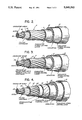
- FIG. 2 is a cut-away perspective view of a cable of the invention showing the filling compound containing or without the particles of water swellable powder contained therein filling all spaces between wires except for the interstices of the outer layer which are filled by the pressure extruded semiconducting conductor stress control layer;
- FIG. 3 is the same as FIG. 2 except that the filling compound with or without the particles of water swellable powder contained therein has a thin layer of particles of water swellable powder applied to one, several or all layers of the filling compound;
- FIG. 4 is a cut-away perspective view of a cable similar to FIGS. 2 and 3 except showing filling compound in the interstices of the outer layer of wires followed by a semiconducting tape applied lapped on itself, the extruded semiconducting conductor stress control layer etc.
- FIG. 1 is a block diagram illustrating the steps of the preferred embodiment of the method of the invention in which the polymeric compound and the water swellable powder is applied to only the inner layers of a stranded conductor 7.
- a plurality of wires 8 carried on a conventional wire cage 3 are pulled and stranded and enter a closing die 2.
- the filling compound either with or without the particles of the water swellable material admixed therein, is applied around the wires at the applicator 1. If the particles are not admixed with the filling compound, the particles are separately applied to the filling compound on the wires, such as by passing the coated wires through a suitable conventional powder applicator. If the particles are admixed with the filling compound, the particles may also be separately applied or the separate application of the particles may be omitted.
- next layer of wires 9 are similarly stranded over the first layer of wires at the wire cage 3a and are similarly coated with the filling compound and the particles at the closing die 2aand the applicator 1a.
- next layer of wires 10 are similarly stranded over the first two layers of wires at the wire cage 3b and pulled through the closing die 26.
- the filling compound is not applied to the wires forming the outer layer.
- the wire assembly or conductor 7 is pulled by the pull out capstan 5 and the conductor 7 is collected on the take-up reel 6.
- the conductor 7 is drawn off the reel 6 at a conventional extrusion line where the semi-conductive screens and insulation are extruded over the conductor, and if desired, other layers of materials are applied.
- the conductor 7 may have a layer of semi-conductive tape applied thereto prior to the application of the first semi-conductive screen or stress control layer.
- the filling compound and particles may also be applied to the wires 10 forming the outer layer in the same manner as they are applied to the wires forming the inner layers.
- the screening layer may be applied directly to the outer surface of the conductor 7, but preferably a layer of semi-conducting tape is applied over the conductor 7 before the screening layer is applied.
- FIG. 2 illustrates a cable with inner wires, e.g. wires 8 or 9, with the filling compound and admixed particles 20 thereon and filling any interstices therebetween.
- the filling compound has not been applied to the outer wires 10, the outer interstices of which are filled with a layer 11 of semi-conductive material.
- the layer 11 is covered by a layer 12 of insulating material which in turn is covered by a layer 13 of semi-conductive material.
- other layers of material may surround the layer 13.
- FIG. 3 illustrates a cable similar to the cable shown in FIG. 2 except that particles 20a of the water swellable material are applied to the surface of the compound 20, with or without admixed particles, applied to the inner wires.
- FIG. 4 illustrates a cable similar to the cables shown in FIGS. 2 and 3 except that the outer wires 10 are also covered with, and the interstices therebetween are filled with, the filling compound 20 with particles admixed with, or applied to the surface of the compound and except for the addition of a layer of semi-conducting tape 14 between the wires 10 and the semi-conducting screen 11.
- the electrical cable conductor filling compound of the invention comprises a polymer which can be readily pumped at elevated temperatures above 100° C. Normally, this means that the polymer will be a low molecular weight polymer such as low molecular weight polyisobutylene rubber and a low molecular weight copolymer of isobutylene-isoprene rubber and can be a mixture of ethylene propylene rubber compounded with a substantial amount of carbon black as described in said U.S. Pat. Nos. 4,095,039 and 4,145,567 or other suitable mineral fillers. Other polymers having such characteristics will be apparent to those skilled in the art.
- a polymer which has been found to be particularly suitable is low molecular weight LM polyisobutylene sold by Exxon Chemical Americas, P.0. Box 3272, Houston, Tex. under the trademark VISTANEX.
- the preferred base polymer of the filling compound of the invention does not have any significant Shore A hardness.
- a test or determining whether or not the base polymer has acceptable properties is the Penetrometer Test incorporated in ASTM D5 Penetration of Bituminous Materials. The 100 grams needle penetration value at 25° C. should be in the range from 110 to 180 tenths of a millimeter.
- the material which swells or expands in the presence of water should be a powder having the following properties:
- the powder has to be substantially insoluble in water.
- the powder wetting time (corresponding to the time lapse between the moment the powder is put in contact with water and the moment at which the expansion and swelling begins) should be in the range of less than 1 to 10 seconds whether the water is tap water, industrial use water, or sea water;
- the powder water absorbing capability expressed in cm 3 of water absorbed by 1 gr of powder should be in the range from 10 to 800 cm 3 /gr. or greater.
- the powder capability in relation to industrial water should be in the range from 200 to 800 cm 3 /gr. or greater, while its capability for the absorption of sea water should be in the range from 10 to 150 cm 3 /gr or greater;
- the particle size of the powder should be less than 200 microns and preferably, at least 50% of the particles of such powder should have sizes less than 150 microns.
- Examples of materials which may be used for the swellable powders are polyacrylates and polyacrylamides, either alone or copolymerized with natural polymers such as amides and cellulose and the esters of, methyl cellulose and cellulose ethers, such as carboxymethyl cellulose.
- a material which has been found to be especially suitable is the Type J-550 sodium polyacrylate sold by the Grain Processing Corporation, Muscatine, Iowa.
- the weight of the powder to the weight of the resin (PHR) may vary over a fairly wide range, but preferably, the powder is present from an effective amount to the amount necessary to provide the desired results which can be determined empirically. Normally, the powder will be present in an amount of at least 0.5 PHR to not more than 50 PHR and preferably, is present in an amount in the range from 0.5 PHR to 20 PHR.
- the filler material that fills all spaces of the stranded conductor is a compound of low molecular weight polyisobutylene rubber or a low molecular weight copolymer of isobutylene-isoprene rubber.
- 15 to 150 parts by weight of electrical conductive carbon black or graphite material or non-conductive mineral filler such as silica, talc, titanium dioxide, clay is added for each 100 parts of the isobutylene rubber material.
- the addition of the carbon makes the filler material semi-conductive.
- the addition of the carbon or non-conductive mineral fillers serves an important function in that it prevents flow of the isobutylene rubber material at temperatures up to 200° C.
- the filler material can withstand temperatures encountered during heavy loads on the power transmission lines without softening and having its viscosity become so low that it will flow out of the cable at cable ends or flow lengthwise where the cable is on a substantial slope.
- Some material can be added, if necessary, as a processing aid; for example, a hydrocarbon oil, such as used in rubber compounding, or a chlorinated paraffin or isobutylene liquid plasticizer can be used to bring the isobutylene rubber compound to a pumping consistency without utilizing excessive heat. It is preferable, however, to use as little processing aid as possible or none at all when it is not necessary for obtaining a pumping consistency.
- a hydrocarbon oil such as used in rubber compounding
- a chlorinated paraffin or isobutylene liquid plasticizer can be used to bring the isobutylene rubber compound to a pumping consistency without utilizing excessive heat. It is preferable, however, to use as little processing aid as possible or none at all when it is not necessary for obtaining a pumping consistency.
- the disadvantages of the processing aids are that they may migrate into the insulation shield and cause swelling and a consequent reduction in the conductivity of the shield.
- the amount of electrical conductive carbon black or graphite material or mineral filler which is mixed with the isobutylene rubber material is from 15 to 150 parts by weight of the filler to 100 parts of the isobutylene rubber compound; and the preferred range is from 15 to 50 parts.
- the 100 grams needle penetration of the preferred compound at 25° C. should be in the range of 50 to 100 tenths of a millimeter.
- the thickness of the particles of water swellable powder shall be in the order of several tens to several hundreds of microns.
- the filler compound of this invention is of a putty-like consistency at room temperatures, and it has good adhesiveness.
- One of the outstanding advantages of the filler of this invention is its retention of adhesiveness in spite of repeated heating and cooling resulting from load cycling of high voltage power transmission cables. It is essential for a filler compound to retain both its flexibility and its adhesiveness in order to be satisfactory. If the compound becomes brittle, it will separate easily from an adjacent face of the material or fracture as the result of expansion and contraction of the cable.
- the filler compound of this invention by virtue of the addition of particles of water swellable powder in the mixture of the compound or applied as a thin layer over the filler compound serves as a more effective block against ingress and movement of the water and permits underfilling of the space between the outer layer of wires and the next to outer layer of wires thus minimizing the risk of penetration of the filling compound into the outer interstices of the conductor during extrusion of the semiconducting conductor stress control layer causing objectionable protrusions of this layer into the insulation while still blocking ingress of and movement of water through the conductor.
- the filler material of this invention For use between the outer interstices of the stranded conductor and the conductor shield, the filler material of this invention must be semi-conductive and also retain its resistivity.
- the volume resistivity of the filling compound applied, as above described, preferably does not exceed 50,000ohm-centimeters, a value established by the cable industry for semi-conductive material used in cables.
- the filler material of this invention is not intended as a replacement for the conductor shield. Its primary purpose is to provide an adhesive filler that sticks to the conductor and to the inside surface of the conductor shield. If the conductor is stranded, as is usually the case, then the filler of this invention eliminates voids in spaces between the strands of the conductor.
Landscapes
- Engineering & Computer Science (AREA)
- Mechanical Engineering (AREA)
- Manufacturing & Machinery (AREA)
- Insulated Conductors (AREA)
Abstract
Description
Claims (9)
Priority Applications (1)
| Application Number | Priority Date | Filing Date | Title |
|---|---|---|---|
| US07/333,773 US5049593A (en) | 1986-05-16 | 1989-04-05 | Stranded conductor filling compound of low molecular weight polymer and water swellable organic material |
Applications Claiming Priority (3)
| Application Number | Priority Date | Filing Date | Title |
|---|---|---|---|
| US06/864,196 US4703132A (en) | 1986-05-16 | 1986-05-16 | Filling compound for multi-wire conductor of an electrical cable and cables including such compound |
| US6867087A | 1987-07-01 | 1987-07-01 | |
| US07/333,773 US5049593A (en) | 1986-05-16 | 1989-04-05 | Stranded conductor filling compound of low molecular weight polymer and water swellable organic material |
Related Parent Applications (1)
| Application Number | Title | Priority Date | Filing Date |
|---|---|---|---|
| US6867087A Continuation | 1986-05-16 | 1987-07-01 |
Publications (1)
| Publication Number | Publication Date |
|---|---|
| US5049593A true US5049593A (en) | 1991-09-17 |
Family
ID=27371388
Family Applications (1)
| Application Number | Title | Priority Date | Filing Date |
|---|---|---|---|
| US07/333,773 Expired - Lifetime US5049593A (en) | 1986-05-16 | 1989-04-05 | Stranded conductor filling compound of low molecular weight polymer and water swellable organic material |
Country Status (1)
| Country | Link |
|---|---|
| US (1) | US5049593A (en) |
Cited By (28)
| Publication number | Priority date | Publication date | Assignee | Title |
|---|---|---|---|---|
| US5698615A (en) * | 1995-05-09 | 1997-12-16 | Siemens Aktiengesellschaft | Cable with a filling compound and method for the manufacture thereof |
| US5983618A (en) * | 1998-03-31 | 1999-11-16 | Pirelli Cable Corporation | Apparatus, systems and methods for applying filling compound and water absorbing particles in a stranded conductor |
| US6087456A (en) * | 1996-11-25 | 2000-07-11 | Kaneka Corporation | Curable composition |
| US6184473B1 (en) * | 1999-01-11 | 2001-02-06 | Southwire Company | Electrical cable having a self-sealing agent and method for preventing water from contacting the conductor |
| US20010049344A1 (en) * | 1995-06-07 | 2001-12-06 | Lee County Mosquito Control District | Lubricant compositions and methods |
| US6331353B1 (en) | 1999-08-17 | 2001-12-18 | Pirelli Cables And Systems Llc | Stranded conductor filling compound and cables using same |
| US6359231B2 (en) * | 1999-01-11 | 2002-03-19 | Southwire Company, A Delaware Corporation | Electrical cable having a self-sealing agent and method for preventing water from contacting the conductor |
| US6374023B1 (en) * | 1999-05-28 | 2002-04-16 | Corning Cable Systems Llc | Communication cable containing novel filling material in buffer tube |
| US6463199B1 (en) | 1999-05-28 | 2002-10-08 | Corning Cable Systems Llc | Fiber optic cables with at least one water blocking zone |
| US20020198114A1 (en) * | 1995-06-07 | 2002-12-26 | Lee County Mosquito Control District | Lubricant compositions and methods |
| US20030013615A1 (en) * | 1995-06-07 | 2003-01-16 | Lee County Mosquito Control District | Lubricant compositions and methods |
| US6664476B2 (en) | 1998-03-04 | 2003-12-16 | Pirelli Cavi E Sistemi S.P.A. | Electrical cable with self-repairing protection |
| US20040065456A1 (en) * | 1999-12-20 | 2004-04-08 | Sergio Belli | Electric cable resistant to water penetration |
| US6748146B2 (en) | 1999-05-28 | 2004-06-08 | Corning Cable Systems Llc | Communication cable having a soft housing |
| US7006740B1 (en) | 1999-05-28 | 2006-02-28 | Corning Cable Systems, Llc | Communication cable having a soft housing |
| US20060090925A1 (en) * | 1999-01-11 | 2006-05-04 | Spruell Stephen L | Self-sealing electrical cable using rubber resins |
| US7367373B2 (en) | 2000-12-06 | 2008-05-06 | Southwire Company | Multi-layer extrusion head for self-sealing cable |
| US20090003780A1 (en) * | 2007-06-26 | 2009-01-01 | Bringuier Anne G | Optical fiber assemblies having relatively low-levels of water-swellable powder and methods therefor |
| US20100027949A1 (en) * | 2008-07-31 | 2010-02-04 | Bringuier Anne G | Optical fiber assemblies having a powder or powder blend at least partially mechanically attached |
| US20100170693A1 (en) * | 2009-01-08 | 2010-07-08 | Randy Szilagyi | Swellable tapes and yarns to replace strand filling compounds |
| US20110135816A1 (en) * | 2008-08-15 | 2011-06-09 | Burns Rodney M | Optical Fiber Assemblies, and Methods and Apparatus for the Manufacture Thereof |
| US8470108B2 (en) | 1999-01-11 | 2013-06-25 | Southwire Company | Self-sealing electrical cable using rubber resins |
| US20160125976A1 (en) * | 2014-11-04 | 2016-05-05 | Sumitomo Wiring Systems, Ltd. | Conductive wire with seal function and manufacturing method thereof |
| WO2021178686A1 (en) * | 2020-03-05 | 2021-09-10 | Novinium, Inc. | Method for injecting strand-blocked cable |
| US20220017748A1 (en) * | 2020-07-17 | 2022-01-20 | Unigel IP Limited | Gel Compositions |
| US11437166B2 (en) * | 2019-05-20 | 2022-09-06 | Nkt Hv Cables Ab | HVDC power cable with water-blocking capability |
| US20220375656A1 (en) * | 2021-05-21 | 2022-11-24 | Novinium, Inc. | Method for injecting strand-blocked cable |
| US12165784B2 (en) | 2021-05-21 | 2024-12-10 | Novinium, Llc | Method for injecting strand-blocked cable |
Citations (9)
| Publication number | Priority date | Publication date | Assignee | Title |
|---|---|---|---|---|
| US2558929A (en) * | 1947-04-11 | 1951-07-03 | Anaconda Wire & Cable Co | Rubber insulated power cable |
| DE1465676A1 (en) * | 1964-06-03 | 1969-04-24 | Kabel Metallwerke Ghh | Filling compound for cable sleeves |
| DE2320254A1 (en) * | 1973-04-19 | 1974-11-07 | Siemens Ag | Water-repellent filler for cable-fittings - contg paraffin oil, polybutene, polyethylene wax and colloidal silica |
| US3893962A (en) * | 1974-01-07 | 1975-07-08 | Basil Vivian Edwin Walton | Telephone cable filling composition (II) |
| FR2378337A1 (en) * | 1977-01-20 | 1978-08-18 | Trefimetaux | Sealant strip for insulated electric cable - contains elastomer and/or plastomer and water swellable material e.g. cellulose ether |
| GB2092176A (en) * | 1981-01-30 | 1982-08-11 | Bicc Ltd | Compositions for use in electric cables |
| US4351913A (en) * | 1981-02-19 | 1982-09-28 | Siecor Corporation | Filling materials for electrical and light waveguide communications cables |
| US4382821A (en) * | 1980-05-02 | 1983-05-10 | Siecor Corporation | Filling materials for communications cable |
| DE3438780A1 (en) * | 1984-10-23 | 1986-04-24 | Hüls AG, 4370 Marl | METHOD FOR THE PRODUCTION OF CABLE COMPOUNDS |
-
1989
- 1989-04-05 US US07/333,773 patent/US5049593A/en not_active Expired - Lifetime
Patent Citations (9)
| Publication number | Priority date | Publication date | Assignee | Title |
|---|---|---|---|---|
| US2558929A (en) * | 1947-04-11 | 1951-07-03 | Anaconda Wire & Cable Co | Rubber insulated power cable |
| DE1465676A1 (en) * | 1964-06-03 | 1969-04-24 | Kabel Metallwerke Ghh | Filling compound for cable sleeves |
| DE2320254A1 (en) * | 1973-04-19 | 1974-11-07 | Siemens Ag | Water-repellent filler for cable-fittings - contg paraffin oil, polybutene, polyethylene wax and colloidal silica |
| US3893962A (en) * | 1974-01-07 | 1975-07-08 | Basil Vivian Edwin Walton | Telephone cable filling composition (II) |
| FR2378337A1 (en) * | 1977-01-20 | 1978-08-18 | Trefimetaux | Sealant strip for insulated electric cable - contains elastomer and/or plastomer and water swellable material e.g. cellulose ether |
| US4382821A (en) * | 1980-05-02 | 1983-05-10 | Siecor Corporation | Filling materials for communications cable |
| GB2092176A (en) * | 1981-01-30 | 1982-08-11 | Bicc Ltd | Compositions for use in electric cables |
| US4351913A (en) * | 1981-02-19 | 1982-09-28 | Siecor Corporation | Filling materials for electrical and light waveguide communications cables |
| DE3438780A1 (en) * | 1984-10-23 | 1986-04-24 | Hüls AG, 4370 Marl | METHOD FOR THE PRODUCTION OF CABLE COMPOUNDS |
Cited By (59)
| Publication number | Priority date | Publication date | Assignee | Title |
|---|---|---|---|---|
| US5698615A (en) * | 1995-05-09 | 1997-12-16 | Siemens Aktiengesellschaft | Cable with a filling compound and method for the manufacture thereof |
| US20050197259A1 (en) * | 1995-06-07 | 2005-09-08 | Lee County Mosquito Control District | Lubricant compositions and methods |
| US20040167038A1 (en) * | 1995-06-07 | 2004-08-26 | Lee County Mosquito Control District | Lubricant compositions and methods |
| US7338926B2 (en) | 1995-06-07 | 2008-03-04 | Lee County Mosquito Control District | Lubricant compositions and methods |
| US7358216B2 (en) | 1995-06-07 | 2008-04-15 | Lee County Mosquito Control District | Lubricant compositions and methods |
| US20010049344A1 (en) * | 1995-06-07 | 2001-12-06 | Lee County Mosquito Control District | Lubricant compositions and methods |
| US7553541B2 (en) | 1995-06-07 | 2009-06-30 | Lee County Mosquite Control District | Lubricant compositions and methods |
| US20030013615A1 (en) * | 1995-06-07 | 2003-01-16 | Lee County Mosquito Control District | Lubricant compositions and methods |
| US20020198114A1 (en) * | 1995-06-07 | 2002-12-26 | Lee County Mosquito Control District | Lubricant compositions and methods |
| US20040167043A1 (en) * | 1995-06-07 | 2004-08-26 | Lee County Mosquito Control District | Lubricant compositions and method |
| US20040029748A1 (en) * | 1995-06-07 | 2004-02-12 | Lee County Mosquito Control District | Lubricant compositions and methods |
| US7767631B2 (en) | 1995-06-07 | 2010-08-03 | Lee County Mosquito Control District | Lubricant compositions and methods |
| US6087456A (en) * | 1996-11-25 | 2000-07-11 | Kaneka Corporation | Curable composition |
| US6664476B2 (en) | 1998-03-04 | 2003-12-16 | Pirelli Cavi E Sistemi S.P.A. | Electrical cable with self-repairing protection |
| US5983618A (en) * | 1998-03-31 | 1999-11-16 | Pirelli Cable Corporation | Apparatus, systems and methods for applying filling compound and water absorbing particles in a stranded conductor |
| US20060090925A1 (en) * | 1999-01-11 | 2006-05-04 | Spruell Stephen L | Self-sealing electrical cable using rubber resins |
| US6359231B2 (en) * | 1999-01-11 | 2002-03-19 | Southwire Company, A Delaware Corporation | Electrical cable having a self-sealing agent and method for preventing water from contacting the conductor |
| WO2001052272A1 (en) * | 1999-01-11 | 2001-07-19 | Southwire Company | Electrical cable having a self-sealing agent and method for preventing water from contacting the conductor |
| US6184473B1 (en) * | 1999-01-11 | 2001-02-06 | Southwire Company | Electrical cable having a self-sealing agent and method for preventing water from contacting the conductor |
| US8470108B2 (en) | 1999-01-11 | 2013-06-25 | Southwire Company | Self-sealing electrical cable using rubber resins |
| US8101862B2 (en) | 1999-01-11 | 2012-01-24 | Southwire Company | Self-sealing electrical cable using rubber resins |
| US6463199B1 (en) | 1999-05-28 | 2002-10-08 | Corning Cable Systems Llc | Fiber optic cables with at least one water blocking zone |
| US6374023B1 (en) * | 1999-05-28 | 2002-04-16 | Corning Cable Systems Llc | Communication cable containing novel filling material in buffer tube |
| US7006740B1 (en) | 1999-05-28 | 2006-02-28 | Corning Cable Systems, Llc | Communication cable having a soft housing |
| US6748146B2 (en) | 1999-05-28 | 2004-06-08 | Corning Cable Systems Llc | Communication cable having a soft housing |
| US6331353B1 (en) | 1999-08-17 | 2001-12-18 | Pirelli Cables And Systems Llc | Stranded conductor filling compound and cables using same |
| US20040065456A1 (en) * | 1999-12-20 | 2004-04-08 | Sergio Belli | Electric cable resistant to water penetration |
| US7087842B2 (en) * | 1999-12-20 | 2006-08-08 | Pirelli Cavi E Sistemi S.P.A. | Electric cable resistant to water penetration |
| US7637298B2 (en) | 2000-12-06 | 2009-12-29 | Southwire Company | Multi-layer extrusion head for self-sealing cable |
| US7367373B2 (en) | 2000-12-06 | 2008-05-06 | Southwire Company | Multi-layer extrusion head for self-sealing cable |
| US8267140B2 (en) | 2000-12-06 | 2012-09-18 | Southwire Company | Multi-layer extrusion head for self-sealing cable |
| US20080286399A1 (en) * | 2000-12-06 | 2008-11-20 | Southwire Company | Multi-Layer Extrusion Head for Self-Sealing Cable |
| US7630605B2 (en) | 2007-06-26 | 2009-12-08 | Corning Cable Systems Llc | Optical fiber assemblies having relatively low-levels of water-swellable powder and methods therefor |
| US20100001420A1 (en) * | 2007-06-26 | 2010-01-07 | Bringuier Anne G | Methods of Making Optical Fiber Assemblies Having Relatively Low-Levels of Water-Swellable Powder |
| US20090003780A1 (en) * | 2007-06-26 | 2009-01-01 | Bringuier Anne G | Optical fiber assemblies having relatively low-levels of water-swellable powder and methods therefor |
| US7983520B2 (en) | 2007-06-26 | 2011-07-19 | Corning Cable Systems Llc | Methods of making optical fiber assemblies having relatively low-levels of water-swellable powder |
| US7916989B2 (en) | 2008-07-31 | 2011-03-29 | Corning Cable Systems Llc | Optical fiber assemblies having a powder or powder blend at least partially mechanically attached |
| US8542966B2 (en) | 2008-07-31 | 2013-09-24 | Corning Cable Systems Llc | Optical fiber assemblies having a powder or powder blend at least partially mechanically attached |
| US20110188821A1 (en) * | 2008-07-31 | 2011-08-04 | Bringuier Anne G | Optical Fiber Assemblies Having a Powder or Powder Blend at Least Partially Mechanically Attached |
| US8750661B2 (en) | 2008-07-31 | 2014-06-10 | Corning Cable Systems Llc | Optical fiber assemblies having a powder or powder blend at least partially mechanically attached |
| US8180190B2 (en) | 2008-07-31 | 2012-05-15 | Corning Cable Systems Llc | Optical fiber assemblies having a powder or powder blend at least partially mechanically attached |
| US8989542B2 (en) | 2008-07-31 | 2015-03-24 | Corning Optical Communications LLC | Optical fiber assemblies having a powder or powder blend at least partially mechanically attached |
| US20100027949A1 (en) * | 2008-07-31 | 2010-02-04 | Bringuier Anne G | Optical fiber assemblies having a powder or powder blend at least partially mechanically attached |
| US20110135816A1 (en) * | 2008-08-15 | 2011-06-09 | Burns Rodney M | Optical Fiber Assemblies, and Methods and Apparatus for the Manufacture Thereof |
| US9417421B2 (en) | 2008-08-15 | 2016-08-16 | Corning Cable Systems Llc | Optical fiber assemblies, and methods and apparatus for the manufacture thereof |
| US10514521B2 (en) | 2008-08-15 | 2019-12-24 | Corning Optical Communications LLC | Optical fiber assemblies, and methods and apparatus for the manufacture thereof |
| US20100170693A1 (en) * | 2009-01-08 | 2010-07-08 | Randy Szilagyi | Swellable tapes and yarns to replace strand filling compounds |
| US7884282B2 (en) * | 2009-01-08 | 2011-02-08 | Randy Szilagyi | Swellable tapes and yarns to replace strand filling compounds |
| US20160125976A1 (en) * | 2014-11-04 | 2016-05-05 | Sumitomo Wiring Systems, Ltd. | Conductive wire with seal function and manufacturing method thereof |
| US11437166B2 (en) * | 2019-05-20 | 2022-09-06 | Nkt Hv Cables Ab | HVDC power cable with water-blocking capability |
| US12009119B2 (en) | 2020-03-05 | 2024-06-11 | Novinium, Llc | Method for injecting strand-blocked cable |
| WO2021178686A1 (en) * | 2020-03-05 | 2021-09-10 | Novinium, Inc. | Method for injecting strand-blocked cable |
| US12567521B2 (en) | 2020-03-05 | 2026-03-03 | Novinium, Llc | Method for injecting strand-blocked cable |
| US20220017748A1 (en) * | 2020-07-17 | 2022-01-20 | Unigel IP Limited | Gel Compositions |
| US11760880B2 (en) * | 2020-07-17 | 2023-09-19 | Unigel IP Limited | Gel compositions |
| WO2022245379A1 (en) * | 2021-05-21 | 2022-11-24 | Novinium, Inc. | Method for injecting strand-blocked cable |
| US12131839B2 (en) * | 2021-05-21 | 2024-10-29 | Novinium, Llc | Method for injecting strand-blocked cable |
| US12165784B2 (en) | 2021-05-21 | 2024-12-10 | Novinium, Llc | Method for injecting strand-blocked cable |
| US20220375656A1 (en) * | 2021-05-21 | 2022-11-24 | Novinium, Inc. | Method for injecting strand-blocked cable |
Similar Documents
| Publication | Publication Date | Title |
|---|---|---|
| US4703132A (en) | Filling compound for multi-wire conductor of an electrical cable and cables including such compound | |
| US5049593A (en) | Stranded conductor filling compound of low molecular weight polymer and water swellable organic material | |
| US5010209A (en) | Power cable with water swellable agents and elongated metal elements outside cable insulation | |
| US6573456B2 (en) | Self-sealing electrical cable having a finned inner layer | |
| US8267140B2 (en) | Multi-layer extrusion head for self-sealing cable | |
| US6184473B1 (en) | Electrical cable having a self-sealing agent and method for preventing water from contacting the conductor | |
| US3775548A (en) | Filled telephone cable | |
| US8470108B2 (en) | Self-sealing electrical cable using rubber resins | |
| US7666503B2 (en) | Self-healing cables | |
| US6359231B2 (en) | Electrical cable having a self-sealing agent and method for preventing water from contacting the conductor | |
| US6331353B1 (en) | Stranded conductor filling compound and cables using same | |
| US8101862B2 (en) | Self-sealing electrical cable using rubber resins | |
| US20020108773A1 (en) | Self-sealing electrical cable having a finned inner layer | |
| US20030168245A1 (en) | Self-sealing electrical cable having a finned or ribbed structure between protective layers | |
| CA2439367C (en) | Self-sealing electrical cable having a finned or ribbed structure between protective layers | |
| EP0041407B1 (en) | Improvements relating to metal sheathed elastomeric cables | |
| US20040104535A1 (en) | Self-healing cables | |
| AU1544499A (en) | Power cable with water swellable agents and elongated metal elements outside cable insulation | |
| AU1562902A (en) | Power cable with water swellable agents and elongated metal elements outside cable insulation |
Legal Events
| Date | Code | Title | Description |
|---|---|---|---|
| STCF | Information on status: patent grant |
Free format text: PATENTED CASE |
|
| FEPP | Fee payment procedure |
Free format text: PAYOR NUMBER ASSIGNED (ORIGINAL EVENT CODE: ASPN); ENTITY STATUS OF PATENT OWNER: LARGE ENTITY |
|
| CC | Certificate of correction | ||
| FPAY | Fee payment |
Year of fee payment: 4 |
|
| FPAY | Fee payment |
Year of fee payment: 8 |
|
| FPAY | Fee payment |
Year of fee payment: 12 |
|
| AS | Assignment |
Owner name: PRYSMIAN POWER CABLES AND SYSTEMS USA, LLC, SOUTH Free format text: ASSIGNMENT OF ASSIGNORS INTEREST;ASSIGNOR:PRYSMIAN COMMUNICATIONS CABLES AND SYSTEMS USA, LLC;REEL/FRAME:024964/0160 Effective date: 20100824 |