US4928509A - Method for manufacturing a pipe with projections - Google Patents
Method for manufacturing a pipe with projections Download PDFInfo
- Publication number
- US4928509A US4928509A US07/327,512 US32751289A US4928509A US 4928509 A US4928509 A US 4928509A US 32751289 A US32751289 A US 32751289A US 4928509 A US4928509 A US 4928509A
- Authority
- US
- United States
- Prior art keywords
- pipe
- recess
- predetermined position
- bulge
- projection
- Prior art date
- Legal status (The legal status is an assumption and is not a legal conclusion. Google has not performed a legal analysis and makes no representation as to the accuracy of the status listed.)
- Expired - Fee Related
Links
Images


Classifications
-
- B—PERFORMING OPERATIONS; TRANSPORTING
- B21—MECHANICAL METAL-WORKING WITHOUT ESSENTIALLY REMOVING MATERIAL; PUNCHING METAL
- B21C—MANUFACTURE OF METAL SHEETS, WIRE, RODS, TUBES, PROFILES OR LIKE SEMI-MANUFACTURED PRODUCTS OTHERWISE THAN BY ROLLING; AUXILIARY OPERATIONS USED IN CONNECTION WITH METAL-WORKING WITHOUT ESSENTIALLY REMOVING MATERIAL
- B21C37/00—Manufacture of metal sheets, rods, wire, tubes, profiles or like semi-manufactured products, not otherwise provided for; Manufacture of tubes of special shape
- B21C37/06—Manufacture of metal sheets, rods, wire, tubes, profiles or like semi-manufactured products, not otherwise provided for; Manufacture of tubes of special shape of tubes or metal hoses; Combined procedures for making tubes, e.g. for making multi-wall tubes
- B21C37/15—Making tubes of special shape; Making tube fittings
- B21C37/28—Making tube fittings for connecting pipes, e.g. U-pieces
- B21C37/29—Making branched pieces, e.g. T-pieces
- B21C37/294—Forming collars by compressing a fluid or a yieldable or resilient mass in the tube
-
- B—PERFORMING OPERATIONS; TRANSPORTING
- B21—MECHANICAL METAL-WORKING WITHOUT ESSENTIALLY REMOVING MATERIAL; PUNCHING METAL
- B21D—WORKING OR PROCESSING OF SHEET METAL OR METAL TUBES, RODS OR PROFILES WITHOUT ESSENTIALLY REMOVING MATERIAL; PUNCHING METAL
- B21D26/00—Shaping without cutting otherwise than using rigid devices or tools or yieldable or resilient pads, i.e. applying fluid pressure or magnetic forces
- B21D26/02—Shaping without cutting otherwise than using rigid devices or tools or yieldable or resilient pads, i.e. applying fluid pressure or magnetic forces by applying fluid pressure
- B21D26/033—Deforming tubular bodies
- B21D26/037—Forming branched tubes
-
- Y—GENERAL TAGGING OF NEW TECHNOLOGICAL DEVELOPMENTS; GENERAL TAGGING OF CROSS-SECTIONAL TECHNOLOGIES SPANNING OVER SEVERAL SECTIONS OF THE IPC; TECHNICAL SUBJECTS COVERED BY FORMER USPC CROSS-REFERENCE ART COLLECTIONS [XRACs] AND DIGESTS
- Y10—TECHNICAL SUBJECTS COVERED BY FORMER USPC
- Y10T—TECHNICAL SUBJECTS COVERED BY FORMER US CLASSIFICATION
- Y10T29/00—Metal working
- Y10T29/49—Method of mechanical manufacture
- Y10T29/49805—Shaping by direct application of fluent pressure
Definitions
- This invention relates to a manufacturing method for pipes having branched pipes, such as manifolds.
- Pipe members having branch pipes on the periphery thereof are often used to connect other pipes or devices to each other.
- a known method for manufacturing a pipe with branch pipes of this type comprises the step of opening holes on the peripheral surface of a pipe member, and connecting other pipe members at their ends over the holes by welding. But this method needs much labour for welding, especially when the number of branch pipes is large as in the case of a manifold, and moreover, the strength of the pipe member is susceptible to deterioration owing to the heat during the welding process.
- the bulging process comprises the steps of inserting a pipe member into a bulge mold which has recesses or spaces for forming bulges, pressurizing fluid (such as water) into the pipe member to deform and bulge the material of the pipe member into spaces in the bulge mold, forming projections from the peripheral surface of the pipe material, and forming the branch pipes either by cutting the tip ends of the projections or opening holes thereon.
- pressurizing fluid such as water
- the aforementioned bulging process is detrimental in that when the length or diameter of a branch pipe is large, the thickness thereof becomes insufficient since the bulged portion or the projection has been made with material gathered around the location. The strength of the pipe therefore is not sufficient.
- one or two projections may be formed with a sufficient thickness even if they are formed with the material gathered from the surrounding areas, when three or more projections are to be formed simultaneously, the material required for the middle projections is prevented from being gathered by two adjacent branch pipes. The thickness of the projection at the middle is inevitably insufficient and presents a problem in the manufacturing process.
- This invention aims at providing a manufacturing method for a pipe with projections, and more particularly to a method which can be employed to manufacture a pipe having projecting portions with a predetermined thickness even if the bulged region (i.e., the region for providing branch pipes) is long.
- Another object of this invention is to provide a manufacturing method for a pipe with projections which can gather sufficient material for projections and secure a uniform thickness for the projections even if the number of projections exceeds three.
- the process comprises the steps of preliminarily deforming a pipe member to make recesses by such means as press work near the locations where the projections are to be formed, inserting the preliminarily deformed pipe member in a bulge mold, pressurizing fluid into the pipe member and bulging the areas near said deformed portions to form projections which are to be formed as branch pipes. Because the pipe member is preliminarily deformed to have recesses thereon, additional pipe material is gathered or folded in the vicinity of the recesses. When the pipe member is subsequently bulged, the gathered excess material is pulled in to the projected bulges to give them sufficient thickness.
- the second object of this invention can be achieved by the following manufacturing method for a pipe with projections.
- the process is characterized by the use of a bulge mold which has a fixed recess or space provided at an axially intermediate portion of a bulge mold, variable spaces at the sides of said fixed space (or spaces), and detachable members removably mounted in said variable spaces in a manner so as to occupy each variable space fully.
- a pipe member is placed in a bulge mold where detachable members have already been mounted in the variable spaces.
- a highly pressurized fluid is forced into the pipe member, and the pipe member is pressed from both ends simultaneously to bulge an intermediate portion thereof. Then the detachable members are pulled out from the bulge mold to use the variable spaces as the spaces for bulging.
- Highly pressurized fluid is again forced into the pipe member and the pipe member is pressed from both ends of the mold to bulge the material of the pipe member toward outside.
- this embodiment of the method of the invention bulges the middle portion of a pipe member when the variable spaces are filled with the detachable members, sufficient pipe material is gathered and folded in the middle portion to provide projections having sufficient thickness. Projections closer to ends of the pipe member are formed after the completion of the middle projection, so that a sufficient thickness for the branch pipes is guaranteed at all the bulged projections.
- FIGS. 1 through 8 relate to a first embodiment according to the invention.
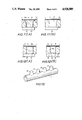
- FIG. 1 is a perspective view showing a pipe member which has been preliminarily deformed
- FIG. 2 is a cross section of the pipe member at the portion deformed
- FIG. 3 is a cross section showing the state of the pipe member of FIG. 1 when it is contained in a bulge mold
- FIG. 4 is a cross section showing the state after bulging
- FIG. 5 is a perspective view showing the pipe member after the completion of forming process
- FIG. 6 is a cross section showing the pipe member sectioned at the projected portion
- FIG. 7 is a perspective view showing a pipe member which has been deformed preliminarily to have a bulge by the bulging process
- FIG. 8 is a cross section showing the preliminarily deformed pipe material.
- FIGS. 9 through 13 show a second embodiment according to the invention.
- FIG. 9 is a cross section showing a pipe member which has been formed to have projections at the middle portion thereof;
- FIG. 10 is a cross section showing the state of the pipe member when the projections closer to the ends of the pipe member have been formed;
- FIGS. 11A and 11B are cross sections showing a modification of the second embodiment with variable spaces and detachable members being flared;
- FIGS. 12A and 12B are cross sections showing another modification of the second embodiment;
- FIG. 13 is a perspective view showing a completed pipe having projections formed with the embodiment shown in FIG. 9.
- the reference numeral 1 in FIGS. 1 and 2 denotes a pipe member which has preliminarily deformed portions 2,2 in the form of recesses produced by a press at two locations near the position where a projection is to be formed.
- the recesses 2 are in alignment in the longitudinal direction of the pipe 1.
- the preliminarily deformed pipe member 1 is placed in a bulge mold 5 in such a manner that the portion 3 having excess folded pipe material between said deformed locations 2,2 is put in a recess or space 4 of the mold reserved for the bulge as shown in FIG. 3.
- both ends of the pipe member 1 are sealed, and pressurized fluid (such as water) is forced into the pipe member 1 from an inlet 6 on the bulge mold 5.
- pressurized fluid such as water
- a pipe-like projection 7 is formed from the surface of the pipe member 1 as shown in FIGS. 5 and 6.
- the projection 7 is either cut at the end or bored thereon to form a predetermined branch pipe.
- a pipe member 1 is bulged for a predetermined length in the longitudinal direction thereof to have a bulged portion 8 and the bulged portion 8 is pressed at two positions at the ends thereof (as indicated by arrows 20) to form deformed positions 2,2 as shown in FIG. 1, additional material is retained for the projection to thereby further facilitate formation of a projection 7.
- FIGS. 9 through 13 The embodiment shown in the figures relates to a pipe member 11 having four projections 12,12,12',12' formed axially at predetermined intervals on the peripheral surface thereof. An example of a completed pipe with projections is shown in FIG. 13.
- the mold spaces 14,14 corresponding to the projections 12,12 at axially middle positions of the pipe member 11 are fixed spaces of a shape identical to that of the projections 12,12.
- the mold spaces 14',14' corresponding to the projections 12',12' closer to the ends of the pipe member 11 are "variable" spaces in which detachable members 15,15 are movably mounted to initially occupy the spaces as fully as possible.
- variable spaces 14',14' at positions closer to ends of the mold 13 are formed as throuqh holes penetrating through the wall of the mold 13, and detachable members 15,15 having a length equal to the thickness of the bulge mold 13 are inserted as closely as possible.
- Pressing members 16,16 are mounted on the outer surface of the mold 13 in a manner so as to freely slide in parallel to the axial direction of the pipe member 11 placed in the mold 13.
- the internal surfaces of the members 15,15 partially define the internal circumference of the bulge mold 13.
- holders 17,17 are provided for pressing the pipe member 11 from both ends. Holders 17,17 are penetrated by through holes 18,18 for pressurizing fluid (such as water) in the bulging process.
- the holders 17,17 abut on both ends of the pipe member 11, which is housed within a space defined with the bulge molds 13,13', and are pressed from both sides axially by oil pressure or the like so as to fold the material 11.
- the pressing members 16,16 are notched at the ends thereof at a height identical to the depth of the fixed spaces 14,14.
- the movable members 15,15 may be moved upwardly until they abut on the surfaces of the notches 16a,16a.
- a pipe member 11 is placed inside bulge molds 13,13' which are bound by tightening. Holders 17,17 are moved into abutment at both ends of the pipe member 11, and detachable members 15,15 are inserted into the spaces 14',14' and retained by the abutment of pressing members 16,16.
- Pressurized fluid is then forced in via through holes 18,18 in the holders 17,17, and the holders are moved under pressure toward the center of the mold. Under the folding effect by the holders 17,17, the pipe material 11 is caused to bulge toward the fixed spaces 14,14 by the pressurized fluid, so as to conform to the shapes thereof. (Refer to FIG. 9).
- variable spaces 14',14' are filled with the detachable members 15,15, the material is efficiently and smoothly folded without being disturbed by the spaces 14',14'.
- the pressing members 16,16 are slided until the notches 16a,16a are positioned immediately above the spaces 14',14' to release the detachable members 15,15.
- the pressurized fluid is forced in again via the through holes 18,18, and the pipe material 11 is pressed with the holders 17,17 at both ends thereof. Because the detachable members 15,15 are not retained any more, the internal pressure in the pipe material 11 overcomes the weight of the members 15,15 to cause the material 11 to bulge into the spaces 14',14' due to the folding effect by the holders 17,17.
- bulged portions 12',12' are formed to have the same height as the middle bulges 12,12. (Refer to FIG. 10). As the bulged portions 12',12' are formed under a suitable folding effect at positions closer to the ends of the pipe material 11, the projections are formed to have uniform thickness.
- FIGS. 11 and 12 show a modification of this embodiment of the invention to form a projection which is shaped like a bell having a larger diameter at the base thereof.
- a detachable member 15' has a larger diameter 15'A at its base so as to be accommodated within a space 14' having a divergently curved wall.
- the member 15' may be pulled out into the mold 13 from the upper surface thereof.
- the fixed space 14 is not shown, it may be shaped similarly to the variable space 14' shown in FIG. 11B.
- an improved bulge mold 13 comprises a first detachable member 15a of columner shape as shown in FIG. 12A, and a second detachable member 15b as shown in FIG. 12B.
- the second detachable member 15b has a cylindrical shape with a closed end, and the inner edges of the open end are rounded to provide a predetermined diameter and curvature.
- the members 15a and 15b are freely insertable into and removable from the space 14'.
- bulged portions 12,12 at the middle positions are formed when the first detachable columner member 15a is retained within the space 14'. Then the first detachable member 15a is taken out after the pressing member 16 has been removed. The second detachable member 15b is then inserted into the space 14' and retained by pressing member 16 while a bulged portion is formed.
- the bulged portion 12' conforms to the curvature of the inner surface 19 of the member 15b in the mold 13, thereby forming a curved portion at the base of a projection.
- the number of the bulged portions 12,12' to be formed on the pipe member 11 may be determined arbitrarily.
- the number of the fixed spaces 14 may be one.
- the central projection is made first, and then additional portions are bulged into variable spaces at the outer sides of those spaces already used to attain the necessary number of bulged portions having sufficient thickness.
- the branch pipes are further guaranteed to have uniform thickness.
- the first embodiment relates to a manufacturing method for a pipe with projections, characterized by deforming a pipe member to have recesses at areas near the position to form a projection.
- the method of this embodiment can bulge projections with evenly distributed thickness since a projection is formed with the sag which has been folded in advance.
- the second embodiment relates to a manufacturing method for a pipe with branch pipes, characterized by using fixed spaces at the middle position and variable spaces positioned at the sides thereof. Since the method allows folding of excess material at locations where bulged portions are to be formed, with the pressure applied from both sides axially, branch pipes in a plural number, three or more, can be formed smoothly to have a uniform thickness. Three or more branch pipes used to present the problem of an insufficient bulging effect.
- the method of the present invention is highly applicable to the production of parts having a large number of branch pipes, such as manifolds for automobiles.
Landscapes
- Engineering & Computer Science (AREA)
- Mechanical Engineering (AREA)
- Physics & Mathematics (AREA)
- Fluid Mechanics (AREA)
- Shaping Metal By Deep-Drawing, Or The Like (AREA)
Abstract
A method for forming projections on the periphery of a pipe in order to provide branch pipes, such as a manifold for automobiles, is characterized in that the branch pipes are formed by a bulging process to have a predetermined thickness without thinning. A first embodiment includes the step of indenting a pipe member by press work or the like, at locations close to the position of a projection which is to be formed, in a preliminary deforming process. The deformed pipe member is then placed in a bulge mold having a recess or space, with the pipe member being positioned so that the indentations in the pipe member lie adjacent the recess in the bulge mold. Pressurized fluid is then introduced into the interior of the pipe member to bulge the wall of the pipe member into the recess in the bulge mold. A second embodiment employs a bulge mold having fixed recesses or spaces and variable recesses or spaces for forming a plurality of projections. The second embodiment includes the step of bulging the pipe material into the fixed spaces while the variable spaces are occupied by detachable members, and the step of removing the detachable members from the mold and then bulging the pipe member again.
Description
This is a division of application Ser. No. 139,811, filed Dec. 30, 1987, now U.S. Pat. No. 4,840,053.
This invention relates to a manufacturing method for pipes having branched pipes, such as manifolds.
Pipe members having branch pipes on the periphery thereof are often used to connect other pipes or devices to each other.
A known method for manufacturing a pipe with branch pipes of this type comprises the step of opening holes on the peripheral surface of a pipe member, and connecting other pipe members at their ends over the holes by welding. But this method needs much labour for welding, especially when the number of branch pipes is large as in the case of a manifold, and moreover, the strength of the pipe member is susceptible to deterioration owing to the heat during the welding process.
In order to overcome such defects, a bulging process has been employed for forming a pipe having branch pipes in recent years.
The bulging process comprises the steps of inserting a pipe member into a bulge mold which has recesses or spaces for forming bulges, pressurizing fluid (such as water) into the pipe member to deform and bulge the material of the pipe member into spaces in the bulge mold, forming projections from the peripheral surface of the pipe material, and forming the branch pipes either by cutting the tip ends of the projections or opening holes thereon.
However, the aforementioned bulging process is detrimental in that when the length or diameter of a branch pipe is large, the thickness thereof becomes insufficient since the bulged portion or the projection has been made with material gathered around the location. The strength of the pipe therefore is not sufficient.
Further, although one or two projections may be formed with a sufficient thickness even if they are formed with the material gathered from the surrounding areas, when three or more projections are to be formed simultaneously, the material required for the middle projections is prevented from being gathered by two adjacent branch pipes. The thickness of the projection at the middle is inevitably insufficient and presents a problem in the manufacturing process.
This invention aims at providing a manufacturing method for a pipe with projections, and more particularly to a method which can be employed to manufacture a pipe having projecting portions with a predetermined thickness even if the bulged region (i.e., the region for providing branch pipes) is long.
Another object of this invention is to provide a manufacturing method for a pipe with projections which can gather sufficient material for projections and secure a uniform thickness for the projections even if the number of projections exceeds three.
In order to achieve the first object of this invention, a method for manufacturing a pipe with projections was contrived to have the following steps.
The process comprises the steps of preliminarily deforming a pipe member to make recesses by such means as press work near the locations where the projections are to be formed, inserting the preliminarily deformed pipe member in a bulge mold, pressurizing fluid into the pipe member and bulging the areas near said deformed portions to form projections which are to be formed as branch pipes. Because the pipe member is preliminarily deformed to have recesses thereon, additional pipe material is gathered or folded in the vicinity of the recesses. When the pipe member is subsequently bulged, the gathered excess material is pulled in to the projected bulges to give them sufficient thickness.
The second object of this invention can be achieved by the following manufacturing method for a pipe with projections.
The process is characterized by the use of a bulge mold which has a fixed recess or space provided at an axially intermediate portion of a bulge mold, variable spaces at the sides of said fixed space (or spaces), and detachable members removably mounted in said variable spaces in a manner so as to occupy each variable space fully.
Operation of the process will now be described. A pipe member is placed in a bulge mold where detachable members have already been mounted in the variable spaces. A highly pressurized fluid is forced into the pipe member, and the pipe member is pressed from both ends simultaneously to bulge an intermediate portion thereof. Then the detachable members are pulled out from the bulge mold to use the variable spaces as the spaces for bulging. Highly pressurized fluid is again forced into the pipe member and the pipe member is pressed from both ends of the mold to bulge the material of the pipe member toward outside.
Since this embodiment of the method of the invention bulges the middle portion of a pipe member when the variable spaces are filled with the detachable members, sufficient pipe material is gathered and folded in the middle portion to provide projections having sufficient thickness. Projections closer to ends of the pipe member are formed after the completion of the middle projection, so that a sufficient thickness for the branch pipes is guaranteed at all the bulged projections.
FIGS. 1 through 8 relate to a first embodiment according to the invention. FIG. 1 is a perspective view showing a pipe member which has been preliminarily deformed; FIG. 2 is a cross section of the pipe member at the portion deformed; FIG. 3 is a cross section showing the state of the pipe member of FIG. 1 when it is contained in a bulge mold; FIG. 4 is a cross section showing the state after bulging; FIG. 5 is a perspective view showing the pipe member after the completion of forming process; FIG. 6 is a cross section showing the pipe member sectioned at the projected portion; FIG. 7 is a perspective view showing a pipe member which has been deformed preliminarily to have a bulge by the bulging process; and FIG. 8 is a cross section showing the preliminarily deformed pipe material.
FIGS. 9 through 13 show a second embodiment according to the invention. FIG. 9 is a cross section showing a pipe member which has been formed to have projections at the middle portion thereof; FIG. 10 is a cross section showing the state of the pipe member when the projections closer to the ends of the pipe member have been formed; FIGS. 11A and 11B are cross sections showing a modification of the second embodiment with variable spaces and detachable members being flared; FIGS. 12A and 12B are cross sections showing another modification of the second embodiment; and FIG. 13 is a perspective view showing a completed pipe having projections formed with the embodiment shown in FIG. 9.
This invention will now be described in further detail referring to embodiments shown in drawings.
The reference numeral 1 in FIGS. 1 and 2 denotes a pipe member which has preliminarily deformed portions 2,2 in the form of recesses produced by a press at two locations near the position where a projection is to be formed. The recesses 2 are in alignment in the longitudinal direction of the pipe 1.
The preliminarily deformed pipe member 1 is placed in a bulge mold 5 in such a manner that the portion 3 having excess folded pipe material between said deformed locations 2,2 is put in a recess or space 4 of the mold reserved for the bulge as shown in FIG. 3.
Subsequently, both ends of the pipe member 1 are sealed, and pressurized fluid (such as water) is forced into the pipe member 1 from an inlet 6 on the bulge mold 5.
This applies pressure on the internal surfaces of the deformed portions 2,2 and the portion 3 to bulge the portion 3 outward to fill the space 4 inside the mold 5 as shown in FIG. 4. A pipe-like projection 7 is formed from the surface of the pipe member 1 as shown in FIGS. 5 and 6.
The projection 7 is either cut at the end or bored thereon to form a predetermined branch pipe.
When the pipe member 1 is deformed at the positions 2,2 in advance, excess pipe material is gathered sufficiently to sag around the positions. When the pipe member 1 is then bulged into the space 4 within the mold, the sagged portions at the positions 2,2 are extended to form a projection. As a result, when the material is bulged into the space 4 in the mold, the material will not be unduly thinned at the foot of the projection 7, so the thickness of the projection 7 will be sufficient.
As shown in FIGS. 7 and 8, if a pipe member 1 is bulged for a predetermined length in the longitudinal direction thereof to have a bulged portion 8, and the bulged portion 8 is pressed at two positions at the ends thereof (as indicated by arrows 20) to form deformed positions 2,2 as shown in FIG. 1, additional material is retained for the projection to thereby further facilitate formation of a projection 7.
Although the foregoing discussion concerned a pipe 1 which has only one projection, this method is naturally applicable to a pipe having a large number of branch pipes or projections, such as manifolds.
The second embodiment will now be described referring to FIGS. 9 through 13. The embodiment shown in the figures relates to a pipe member 11 having four projections 12,12,12',12' formed axially at predetermined intervals on the peripheral surface thereof. An example of a completed pipe with projections is shown in FIG. 13.
Inside a bulge mold 13, spaces 14,14,14',14' for bulging are provided at the same intervals as the projections 12,12,12',12' which are to be formed on the peripheral surface of the pipe material 11.
The mold spaces 14,14 corresponding to the projections 12,12 at axially middle positions of the pipe member 11 are fixed spaces of a shape identical to that of the projections 12,12.
The mold spaces 14',14' corresponding to the projections 12',12' closer to the ends of the pipe member 11 are "variable" spaces in which detachable members 15,15 are movably mounted to initially occupy the spaces as fully as possible.
Referring to the embodiment shown in FIGS. 9 and 10, the variable spaces 14',14' at positions closer to ends of the mold 13 are formed as throuqh holes penetrating through the wall of the mold 13, and detachable members 15,15 having a length equal to the thickness of the bulge mold 13 are inserted as closely as possible. Pressing members 16,16 are mounted on the outer surface of the mold 13 in a manner so as to freely slide in parallel to the axial direction of the pipe member 11 placed in the mold 13. When the interfaces of the pressing members 16,16 with the mold 13 restrict the upward movement of the members 15,15, the internal surfaces of the members 15,15 partially define the internal circumference of the bulge mold 13. At both ends of the bulge molds 13,13', holders 17,17 are provided for pressing the pipe member 11 from both ends. Holders 17,17 are penetrated by through holes 18,18 for pressurizing fluid (such as water) in the bulging process.
The holders 17,17 abut on both ends of the pipe member 11, which is housed within a space defined with the bulge molds 13,13', and are pressed from both sides axially by oil pressure or the like so as to fold the material 11.
The pressing members 16,16 are notched at the ends thereof at a height identical to the depth of the fixed spaces 14,14. When the notches 16a,16a are moved to be immediately above the variable spaces 14',14' by the sliding movement of the pressing members 16,16, the movable members 15,15 may be moved upwardly until they abut on the surfaces of the notches 16a,16a.
Four projections are formed as follows: A pipe member 11 is placed inside bulge molds 13,13' which are bound by tightening. Holders 17,17 are moved into abutment at both ends of the pipe member 11, and detachable members 15,15 are inserted into the spaces 14',14' and retained by the abutment of pressing members 16,16.
Pressurized fluid is then forced in via through holes 18,18 in the holders 17,17, and the holders are moved under pressure toward the center of the mold. Under the folding effect by the holders 17,17, the pipe material 11 is caused to bulge toward the fixed spaces 14,14 by the pressurized fluid, so as to conform to the shapes thereof. (Refer to FIG. 9).
Since the variable spaces 14',14' are filled with the detachable members 15,15, the material is efficiently and smoothly folded without being disturbed by the spaces 14',14'. After completion of the bulged portions 12,12 at the middle position, the pressing members 16,16 are slided until the notches 16a,16a are positioned immediately above the spaces 14',14' to release the detachable members 15,15. Then, the pressurized fluid is forced in again via the through holes 18,18, and the pipe material 11 is pressed with the holders 17,17 at both ends thereof. Because the detachable members 15,15 are not retained any more, the internal pressure in the pipe material 11 overcomes the weight of the members 15,15 to cause the material 11 to bulge into the spaces 14',14' due to the folding effect by the holders 17,17.
Since the detachable members 15,15 are restrained by the notches 16a,16a of the members 16,16, bulged portions 12',12' are formed to have the same height as the middle bulges 12,12. (Refer to FIG. 10). As the bulged portions 12',12' are formed under a suitable folding effect at positions closer to the ends of the pipe material 11, the projections are formed to have uniform thickness.
FIGS. 11 and 12 show a modification of this embodiment of the invention to form a projection which is shaped like a bell having a larger diameter at the base thereof.
Referring to FIG. 11A, a detachable member 15' has a larger diameter 15'A at its base so as to be accommodated within a space 14' having a divergently curved wall. The member 15' may be pulled out into the mold 13 from the upper surface thereof.
Although the fixed space 14 is not shown, it may be shaped similarly to the variable space 14' shown in FIG. 11B.
However, since the detachable member 15' must be removed into the bulge mold 13, and the pipe member 11 must be removed temporarily from the bulge mold 13 to permit the member 15' to be pulled out. Consequently, this modification is somewhat time consuming.
In the further modification shown in FIG. 12, the method is improved in order to obviate the trouble of undoing the binding of the bulge molds temporarily and take out the pipe material 11 after the bulged portions are formed in the fixed spaces 14,14. More particularly, an improved bulge mold 13 comprises a first detachable member 15a of columner shape as shown in FIG. 12A, and a second detachable member 15b as shown in FIG. 12B. The second detachable member 15b has a cylindrical shape with a closed end, and the inner edges of the open end are rounded to provide a predetermined diameter and curvature. The members 15a and 15b are freely insertable into and removable from the space 14'.
First, bulged portions 12,12 at the middle positions are formed when the first detachable columner member 15a is retained within the space 14'. Then the first detachable member 15a is taken out after the pressing member 16 has been removed. The second detachable member 15b is then inserted into the space 14' and retained by pressing member 16 while a bulged portion is formed. The bulged portion 12' conforms to the curvature of the inner surface 19 of the member 15b in the mold 13, thereby forming a curved portion at the base of a projection.
Although the foregoing discussion relates to a pipe having four projections, the number of the bulged portions 12,12' to be formed on the pipe member 11 may be determined arbitrarily.
For example, when three bulged portions are formed, one at the center and two at both sides of the first one, the number of the fixed spaces 14 may be one. When more than four bulged portions are to be formed, the central projection is made first, and then additional portions are bulged into variable spaces at the outer sides of those spaces already used to attain the necessary number of bulged portions having sufficient thickness.
Moreover, if preliminarily deformed recesses are made in advance at locations close to the position for bulging a middle projection, using press work or the like as mentioned above, the branch pipes are further guaranteed to have uniform thickness.
The first embodiment relates to a manufacturing method for a pipe with projections, characterized by deforming a pipe member to have recesses at areas near the position to form a projection. The method of this embodiment can bulge projections with evenly distributed thickness since a projection is formed with the sag which has been folded in advance.
The second embodiment relates to a manufacturing method for a pipe with branch pipes, characterized by using fixed spaces at the middle position and variable spaces positioned at the sides thereof. Since the method allows folding of excess material at locations where bulged portions are to be formed, with the pressure applied from both sides axially, branch pipes in a plural number, three or more, can be formed smoothly to have a uniform thickness. Three or more branch pipes used to present the problem of an insufficient bulging effect.
The method of the present invention is highly applicable to the production of parts having a large number of branch pipes, such as manifolds for automobiles.
Claims (9)
1. A method for manufacturing a pipe with a projection at a predetermined position, comprising the steps of:
(a) deforming a pipe to provide a recess close to the predetermined position, the deformation of the pipe altering an inner dimension of the pipe;
(b) placing the pipe in a bulge mold; and
(c) forcing pressurized fluid into the pipe to bulge the pipe at the predetermined position so as to form the projection.
2. The method as claimed in claim 1, wherein step (a) of forming a recess comprises the step of indenting the pipe locally by press work.
3. The method as claimed in claim 1, wherein the bulge mold is has a space for bulging in order to form the projection, and wherein step (b) is conducted by placing the pipe in the bulge mold so that the predetermined position on the pipe faces the space of the bulge mold.
4. A method for manufacturing a pipe with a projection at a predetermined position, comprising the steps of:
(a) deforming a pipe to provide a recesses and an additional recess close to the predetermined position, the recess and additional recess being on opposite sides of the predetermined position on the pipe;
(b) placing the pipe in a bulge mold; and
(c) forcing pressurized fluid into the pipe to bulge the pipe at the predetermined position so as to form the projection.
5. The method as claimed in claim 1, wherein the pipe has a wall with a predetermined thickness before deformation and wherein step (a) of forming a recess is conducted so that the recess has a depth that is greater than the predetermined thickness.
6. A method for manufacturing a pipe with a projection at a predetermined position, comprising the steps of:
(a) deforming a pipe to provide a recess close to the predetermined position;
(b) placing the pipe in a bulge mold; and
(c) forcing pressurized fluid into the pipe to bulge the pipe at the predetermined position so as to form the projection,
wherein step (a) of forming a recess includes the step of slightly bulging the pipe material locally by a bulging process, and the step of indenting the bulged portion by press work.
7. A method for manufacturing a pipe with a projection at a predetermined position, comprising the steps of:
(a) pressing the wall of a pipe so that the inner surface of the wall protrudes inward toward the axis of the pipe and so that the outer surface of the wall provides a recess, the recess being located close to the predetermined position;
(b) placing the pipe in a bulge mold having a space, the pipe being positioned in the bulge mold so that the predetermined position on the pipe faces the space; and
(c) forcing pressurized fluid into the pipe to bulge the pipe at the predetermined position so as to form the projection.
8. The method as claimed in claim 7, wherein step (a) of forming a recess further comprises pressing the wall of the pipe so that the inner surface of the pipe protrudes inward toward the axis of the pipe at an additional location and so that the outer surface of the wall provides an additional recess, the recess and additional recess being on opposite sides of the predetermined position on the pipe.
9. The method as claimed in claim 8, wherein step (a) of forming a recess and an additional recess comprises bulging the wall of the pipe outward along an elongated region which includes the predetermined position on the pipe, and pressing the outwardly bulged region inward at two spaced apart points.
Priority Applications (1)
| Application Number | Priority Date | Filing Date | Title |
|---|---|---|---|
| US07/327,512 US4928509A (en) | 1987-07-29 | 1989-03-22 | Method for manufacturing a pipe with projections |
Applications Claiming Priority (5)
| Application Number | Priority Date | Filing Date | Title |
|---|---|---|---|
| JP62-189384 | 1987-07-29 | ||
| JP62189384A JP2510609B2 (en) | 1987-07-29 | 1987-07-29 | Manufacturing method of pipe with projection |
| JP62203841A JP2517610B2 (en) | 1987-08-17 | 1987-08-17 | Manufacturing method of pipe with projection |
| JP62-203841 | 1987-08-17 | ||
| US07/327,512 US4928509A (en) | 1987-07-29 | 1989-03-22 | Method for manufacturing a pipe with projections |
Related Parent Applications (1)
| Application Number | Title | Priority Date | Filing Date |
|---|---|---|---|
| US07/139,811 Division US4840053A (en) | 1987-07-29 | 1987-12-30 | Method for manufacturing a pipe with projections |
Publications (1)
| Publication Number | Publication Date |
|---|---|
| US4928509A true US4928509A (en) | 1990-05-29 |
Family
ID=27326168
Family Applications (1)
| Application Number | Title | Priority Date | Filing Date |
|---|---|---|---|
| US07/327,512 Expired - Fee Related US4928509A (en) | 1987-07-29 | 1989-03-22 | Method for manufacturing a pipe with projections |
Country Status (1)
| Country | Link |
|---|---|
| US (1) | US4928509A (en) |
Cited By (29)
| Publication number | Priority date | Publication date | Assignee | Title |
|---|---|---|---|---|
| US5303570A (en) * | 1991-02-01 | 1994-04-19 | Hde Metallwerk Gmbh | Hydrostatically deforming a hollow body |
| US5491883A (en) * | 1994-12-19 | 1996-02-20 | Ap Parts Manufacturing Co. | Method of manufacturing a non-linear composite tube |
| US5524466A (en) * | 1994-04-29 | 1996-06-11 | Qa Technology Company, Inc. | Method and apparatus for hydro-forming thin-walled workpieces |
| US5647239A (en) * | 1994-04-07 | 1997-07-15 | The Boeing Company | Die for superplastic forming |
| US5794474A (en) * | 1997-01-03 | 1998-08-18 | Ball Corporation | Method and apparatus for reshaping a container body |
| US5794398A (en) * | 1992-08-25 | 1998-08-18 | Kaehler; Klaus | Framework with hollow members process for producing the same and its use |
| CN1045912C (en) * | 1995-12-11 | 1999-10-27 | 华中理工大学 | Mold-extruding, expanding and forming process for multi-way pipe and its die equipment |
| EP0894548A3 (en) * | 1997-08-02 | 2000-04-19 | DaimlerChrysler AG | Method and device for forming bulges on elements |
| US6079244A (en) * | 1996-01-04 | 2000-06-27 | Ball Corporation | Method and apparatus for reshaping a container body |
| US6112567A (en) * | 1998-03-25 | 2000-09-05 | Daimlerchrysler Ag | Method and apparatus for manufacturing a hollow body from a tubular blank by internal high-pressure shaping |
| US6151939A (en) * | 1996-01-04 | 2000-11-28 | Delaware Capital Formation, Inc. | Can shaping apparatus |
| US6176114B1 (en) | 2000-05-23 | 2001-01-23 | General Motors Corporation | Method and apparatus for sequential axial feed hydroforming |
| US6301766B1 (en) * | 1998-01-12 | 2001-10-16 | Tempress Technologies, Inc. | Method for metal working using high pressure fluid pulses |
| US6343417B1 (en) * | 1997-11-28 | 2002-02-05 | Daimler-Benz Aktiengesellschaft | Process of manufacturing an air-gap-insulating exhaust elbow of a vehicle exhaust system |
| US6349468B1 (en) | 1997-11-28 | 2002-02-26 | Daimlerchrysler Ag | Air gap insulated exhaust pipe with branch pipe stub and method of manufacturing same |
| US6438815B1 (en) * | 1996-03-18 | 2002-08-27 | Volkswagen Ag | Windshield wiper arrangement for vehicles |
| US6497128B1 (en) | 2001-03-16 | 2002-12-24 | Dana Corporation | Method of hydroforming a fuel rail for a vehicular fuel delivery system |
| US20030005737A1 (en) * | 2001-06-25 | 2003-01-09 | Gharib Mohamed T. | Hydroforming process and apparatus for the same |
| US6651327B1 (en) * | 2001-12-10 | 2003-11-25 | Dana Corporation | Method of making hydroformed fuel rails |
| US6769178B1 (en) | 1998-02-18 | 2004-08-03 | Dana Corporation | Method of manufacturing a vehicle frame assembly including hydroformed side rails having integrally formed mounting areas |
| EP1524428A3 (en) * | 2003-10-15 | 2005-08-10 | Robert Bosch Gmbh | Method of manufacturing an accumulator having plane mounting surfaces |
| US20100307833A1 (en) * | 2009-06-08 | 2010-12-09 | Tempress Technologies, Inc. | Jet turbodrill |
| US8443642B2 (en) * | 2011-10-20 | 2013-05-21 | Ford Global Technologies, Llc | Process for pre-forming cylindrical tubes into tubular members having sharp corners |
| US8528649B2 (en) | 2010-11-30 | 2013-09-10 | Tempress Technologies, Inc. | Hydraulic pulse valve with improved pulse control |
| CN104438409A (en) * | 2015-01-07 | 2015-03-25 | 营口昌信管业制造有限公司 | Pipe fitting cold extruding forming machine and forming technology thereof |
| US9249642B2 (en) | 2010-11-30 | 2016-02-02 | Tempress Technologies, Inc. | Extended reach placement of wellbore completions |
| US9279300B2 (en) | 2010-11-30 | 2016-03-08 | Tempress Technologies, Inc. | Split ring shift control for hydraulic pulse valve |
| US10391537B2 (en) * | 2017-03-30 | 2019-08-27 | Ford Motor Company | Method and system for flanging a metal piece |
| US10773292B2 (en) | 2015-08-27 | 2020-09-15 | Sumitomo Heavy Industries, Ltd. | Forming device and forming method |
Citations (9)
| Publication number | Priority date | Publication date | Assignee | Title |
|---|---|---|---|---|
| US588804A (en) * | 1897-08-24 | Nefp e | ||
| US2372917A (en) * | 1941-07-01 | 1945-04-03 | Tuttle Wainwright | Apparatus for producing corrugated tubing |
| GB772134A (en) * | 1954-11-22 | 1957-04-10 | Rodolfo Debenedetti | Improvements in or relating to the manufacture of flexible metal tubes |
| US2960142A (en) * | 1957-12-26 | 1960-11-15 | Johns Manville | Hydro rubber forming of metal |
| US3147545A (en) * | 1962-08-24 | 1964-09-08 | Olin Mathieson | Metal fabrication |
| SU479532A1 (en) * | 1973-06-06 | 1975-08-05 | Предприятие П/Я Р-6543 | Stamp for hydromechanical punching of hollow billets |
| JPS55144334A (en) * | 1979-04-27 | 1980-11-11 | Nippon Baruji Kogyo Kk | Liquid pressure bulging method |
| JPS57206530A (en) * | 1981-06-12 | 1982-12-17 | Akihiko Nakamura | Manufacture of cam shaft |
| JPS5973130A (en) * | 1982-10-19 | 1984-04-25 | Takayasu Kogyo Kk | Production of branch pipe for pipe joint |
-
1989
- 1989-03-22 US US07/327,512 patent/US4928509A/en not_active Expired - Fee Related
Patent Citations (9)
| Publication number | Priority date | Publication date | Assignee | Title |
|---|---|---|---|---|
| US588804A (en) * | 1897-08-24 | Nefp e | ||
| US2372917A (en) * | 1941-07-01 | 1945-04-03 | Tuttle Wainwright | Apparatus for producing corrugated tubing |
| GB772134A (en) * | 1954-11-22 | 1957-04-10 | Rodolfo Debenedetti | Improvements in or relating to the manufacture of flexible metal tubes |
| US2960142A (en) * | 1957-12-26 | 1960-11-15 | Johns Manville | Hydro rubber forming of metal |
| US3147545A (en) * | 1962-08-24 | 1964-09-08 | Olin Mathieson | Metal fabrication |
| SU479532A1 (en) * | 1973-06-06 | 1975-08-05 | Предприятие П/Я Р-6543 | Stamp for hydromechanical punching of hollow billets |
| JPS55144334A (en) * | 1979-04-27 | 1980-11-11 | Nippon Baruji Kogyo Kk | Liquid pressure bulging method |
| JPS57206530A (en) * | 1981-06-12 | 1982-12-17 | Akihiko Nakamura | Manufacture of cam shaft |
| JPS5973130A (en) * | 1982-10-19 | 1984-04-25 | Takayasu Kogyo Kk | Production of branch pipe for pipe joint |
Cited By (41)
| Publication number | Priority date | Publication date | Assignee | Title |
|---|---|---|---|---|
| US5303570A (en) * | 1991-02-01 | 1994-04-19 | Hde Metallwerk Gmbh | Hydrostatically deforming a hollow body |
| US5794398A (en) * | 1992-08-25 | 1998-08-18 | Kaehler; Klaus | Framework with hollow members process for producing the same and its use |
| US5647239A (en) * | 1994-04-07 | 1997-07-15 | The Boeing Company | Die for superplastic forming |
| US5823032A (en) * | 1994-04-07 | 1998-10-20 | The Boeing Company | Prethinning for superplastic forming |
| US5916316A (en) * | 1994-04-07 | 1999-06-29 | The Boeing Company | Deep draw superplastically formed part using prethinning |
| US6098438A (en) * | 1994-04-07 | 2000-08-08 | The Boeing Company | Superplastic forming part |
| US5524466A (en) * | 1994-04-29 | 1996-06-11 | Qa Technology Company, Inc. | Method and apparatus for hydro-forming thin-walled workpieces |
| US5491883A (en) * | 1994-12-19 | 1996-02-20 | Ap Parts Manufacturing Co. | Method of manufacturing a non-linear composite tube |
| CN1045912C (en) * | 1995-12-11 | 1999-10-27 | 华中理工大学 | Mold-extruding, expanding and forming process for multi-way pipe and its die equipment |
| US6151939A (en) * | 1996-01-04 | 2000-11-28 | Delaware Capital Formation, Inc. | Can shaping apparatus |
| US6343496B1 (en) * | 1996-01-04 | 2002-02-05 | Delaware Capital Formation, Ltd. | Can shaping apparatus and method |
| US6079244A (en) * | 1996-01-04 | 2000-06-27 | Ball Corporation | Method and apparatus for reshaping a container body |
| US6438815B1 (en) * | 1996-03-18 | 2002-08-27 | Volkswagen Ag | Windshield wiper arrangement for vehicles |
| US5794474A (en) * | 1997-01-03 | 1998-08-18 | Ball Corporation | Method and apparatus for reshaping a container body |
| US6143235A (en) * | 1997-08-02 | 2000-11-07 | Daimlerchrysler Ag | Method for producing secondary mold elements |
| EP0894548A3 (en) * | 1997-08-02 | 2000-04-19 | DaimlerChrysler AG | Method and device for forming bulges on elements |
| US6519851B2 (en) * | 1997-11-28 | 2003-02-18 | Daimlerchrysler Ag | Air gap insulated exhaust pipe with branch pipe stub and method of manufacturing same |
| US6539764B2 (en) * | 1997-11-28 | 2003-04-01 | Daimlerchrysler Ag | Air gap insulated exhaust pipe with branch pipe stub and method of manufacturing same |
| US6343417B1 (en) * | 1997-11-28 | 2002-02-05 | Daimler-Benz Aktiengesellschaft | Process of manufacturing an air-gap-insulating exhaust elbow of a vehicle exhaust system |
| US6349468B1 (en) | 1997-11-28 | 2002-02-26 | Daimlerchrysler Ag | Air gap insulated exhaust pipe with branch pipe stub and method of manufacturing same |
| US6301766B1 (en) * | 1998-01-12 | 2001-10-16 | Tempress Technologies, Inc. | Method for metal working using high pressure fluid pulses |
| US6769178B1 (en) | 1998-02-18 | 2004-08-03 | Dana Corporation | Method of manufacturing a vehicle frame assembly including hydroformed side rails having integrally formed mounting areas |
| US6112567A (en) * | 1998-03-25 | 2000-09-05 | Daimlerchrysler Ag | Method and apparatus for manufacturing a hollow body from a tubular blank by internal high-pressure shaping |
| US6176114B1 (en) | 2000-05-23 | 2001-01-23 | General Motors Corporation | Method and apparatus for sequential axial feed hydroforming |
| US6497128B1 (en) | 2001-03-16 | 2002-12-24 | Dana Corporation | Method of hydroforming a fuel rail for a vehicular fuel delivery system |
| US20030005737A1 (en) * | 2001-06-25 | 2003-01-09 | Gharib Mohamed T. | Hydroforming process and apparatus for the same |
| US6912884B2 (en) | 2001-06-25 | 2005-07-05 | Mohamed T. Gharib | Hydroforming process and apparatus for the same |
| US6651327B1 (en) * | 2001-12-10 | 2003-11-25 | Dana Corporation | Method of making hydroformed fuel rails |
| EP1318292A3 (en) * | 2001-12-10 | 2004-06-16 | Dana Corporation | Method of manufacturing a fuel rail |
| EP1524428A3 (en) * | 2003-10-15 | 2005-08-10 | Robert Bosch Gmbh | Method of manufacturing an accumulator having plane mounting surfaces |
| US20100307833A1 (en) * | 2009-06-08 | 2010-12-09 | Tempress Technologies, Inc. | Jet turbodrill |
| US8607896B2 (en) | 2009-06-08 | 2013-12-17 | Tempress Technologies, Inc. | Jet turbodrill |
| US8528649B2 (en) | 2010-11-30 | 2013-09-10 | Tempress Technologies, Inc. | Hydraulic pulse valve with improved pulse control |
| US8939217B2 (en) | 2010-11-30 | 2015-01-27 | Tempress Technologies, Inc. | Hydraulic pulse valve with improved pulse control |
| US9249642B2 (en) | 2010-11-30 | 2016-02-02 | Tempress Technologies, Inc. | Extended reach placement of wellbore completions |
| US9279300B2 (en) | 2010-11-30 | 2016-03-08 | Tempress Technologies, Inc. | Split ring shift control for hydraulic pulse valve |
| US8443642B2 (en) * | 2011-10-20 | 2013-05-21 | Ford Global Technologies, Llc | Process for pre-forming cylindrical tubes into tubular members having sharp corners |
| CN104438409A (en) * | 2015-01-07 | 2015-03-25 | 营口昌信管业制造有限公司 | Pipe fitting cold extruding forming machine and forming technology thereof |
| CN104438409B (en) * | 2015-01-07 | 2017-02-22 | 营口昌信管业制造有限公司 | Pipe fitting cold extruding forming machine and forming technology thereof |
| US10773292B2 (en) | 2015-08-27 | 2020-09-15 | Sumitomo Heavy Industries, Ltd. | Forming device and forming method |
| US10391537B2 (en) * | 2017-03-30 | 2019-08-27 | Ford Motor Company | Method and system for flanging a metal piece |
Similar Documents
| Publication | Publication Date | Title |
|---|---|---|
| US4928509A (en) | Method for manufacturing a pipe with projections | |
| US4840053A (en) | Method for manufacturing a pipe with projections | |
| US5363544A (en) | Multi-stage dual wall hydroforming | |
| KR970010546B1 (en) | Method of forming reinforced box-section frame members | |
| US5101561A (en) | Heat exchanger and a method for a liquid-tight mounting of an end plate to an array heat exchanging elements of the heat exchanger | |
| US5485737A (en) | Apparatus for hydroforming a vehicle manifold | |
| JPS62167973A (en) | Device and method of forming cam shaft | |
| US2120067A (en) | Fitting and the manufacture thereof | |
| US3914101A (en) | Apparatus for forming corrugated tubing | |
| US5673470A (en) | Extended jacket end, double expansion hydroforming | |
| US4574444A (en) | Method for the joining of tubular parts in a heat exchanger and tool for practicing the method | |
| CA2452020C (en) | Method for expanding a tubular blank | |
| KR20030087614A (en) | Apparatus and method for hydroforming a tubular part | |
| US4688318A (en) | Method of preparing a joint for a tube | |
| US4580427A (en) | Method for manufacturing ornamented head lug pipes | |
| US4015461A (en) | Closed drop forging die | |
| JP2000511467A (en) | Method of manufacturing torque joint and press mold thereof | |
| US7204114B2 (en) | Method of progressive hydro-forming of tubular members | |
| US6044678A (en) | Method and device for manufacturing a tubular hollow body with spaced-apart increased diameter portions | |
| JP2517610B2 (en) | Manufacturing method of pipe with projection | |
| US3465075A (en) | Method for making a monolithic clay fitting | |
| JPS60210339A (en) | Production of valve sleeve | |
| US5941651A (en) | Process for the fabrication of parts made of cast alloys with reinforcement zones | |
| JP2510609B2 (en) | Manufacturing method of pipe with projection | |
| SU1189537A1 (en) | Method of obtaining relief of round billet ends |
Legal Events
| Date | Code | Title | Description |
|---|---|---|---|
| AS | Assignment |
Owner name: TUBE FORMING CO., LTD. Free format text: CHANGE OF NAME;ASSIGNOR:KOKAN KAKO CO., LTD.;REEL/FRAME:005576/0825 Effective date: 19901212 |
|
| FEPP | Fee payment procedure |
Free format text: PAYOR NUMBER ASSIGNED (ORIGINAL EVENT CODE: ASPN); ENTITY STATUS OF PATENT OWNER: LARGE ENTITY |
|
| FPAY | Fee payment |
Year of fee payment: 4 |
|
| FPAY | Fee payment |
Year of fee payment: 8 |
|
| REMI | Maintenance fee reminder mailed | ||
| LAPS | Lapse for failure to pay maintenance fees | ||
| STCH | Information on status: patent discontinuation |
Free format text: PATENT EXPIRED DUE TO NONPAYMENT OF MAINTENANCE FEES UNDER 37 CFR 1.362 |
|
| FP | Lapsed due to failure to pay maintenance fee |
Effective date: 20020529 |