US4926185A - Multiple radio frequency single receiver radar operation - Google Patents

Multiple radio frequency single receiver radar operation Download PDF

Info

Publication number
US4926185A
US4926185A US07/262,917 US26291788A US4926185A US 4926185 A US4926185 A US 4926185A US 26291788 A US26291788 A US 26291788A US 4926185 A US4926185 A US 4926185A
Authority
US
United States
Prior art keywords
internal
pulses
transmit
repeating sequence
frequency
Prior art date
Legal status (The legal status is an assumption and is not a legal conclusion. Google has not performed a legal analysis and makes no representation as to the accuracy of the status listed.)
Expired - Fee Related
Application number
US07/262,917
Inventor
Peter Wittenberg
Current Assignee (The listed assignees may be inaccurate. Google has not performed a legal analysis and makes no representation or warranty as to the accuracy of the list.)
Raytheon Co
Original Assignee
Hughes Aircraft Co
Priority date (The priority date is an assumption and is not a legal conclusion. Google has not performed a legal analysis and makes no representation as to the accuracy of the date listed.)
Filing date
Publication date
Application filed by Hughes Aircraft Co filed Critical Hughes Aircraft Co
Priority to US07/262,917 priority Critical patent/US4926185A/en
Assigned to HUGHES AIRCRAFT COMPANY reassignment HUGHES AIRCRAFT COMPANY ASSIGNMENT OF ASSIGNORS INTEREST. Assignors: WITTENBERG, PETER
Priority to IL91747A priority patent/IL91747A0/en
Priority to AU43531/89A priority patent/AU610440B2/en
Priority to EP19890310937 priority patent/EP0366406A3/en
Priority to JP1277348A priority patent/JPH02179490A/en
Application granted granted Critical
Publication of US4926185A publication Critical patent/US4926185A/en
Anticipated expiration legal-status Critical
Expired - Fee Related legal-status Critical Current

Links

Images

Classifications

    • GPHYSICS
    • G01MEASURING; TESTING
    • G01SRADIO DIRECTION-FINDING; RADIO NAVIGATION; DETERMINING DISTANCE OR VELOCITY BY USE OF RADIO WAVES; LOCATING OR PRESENCE-DETECTING BY USE OF THE REFLECTION OR RERADIATION OF RADIO WAVES; ANALOGOUS ARRANGEMENTS USING OTHER WAVES
    • G01S13/00Systems using the reflection or reradiation of radio waves, e.g. radar systems; Analogous systems using reflection or reradiation of waves whose nature or wavelength is irrelevant or unspecified
    • G01S13/02Systems using reflection of radio waves, e.g. primary radar systems; Analogous systems
    • G01S13/06Systems determining position data of a target
    • G01S13/08Systems for measuring distance only
    • G01S13/10Systems for measuring distance only using transmission of interrupted, pulse modulated waves
    • G01S13/24Systems for measuring distance only using transmission of interrupted, pulse modulated waves using frequency agility of carrier wave

Definitions

  • the disclosed invention generally relates to a pulse radar system, and is more particularly directed to a pulse radar system that utilizes a plurality of RF frequencies with a single receiver.
  • the transmitted signal comprises a pulse modulated radio frequency (RF) carrier signal.
  • the pulse repetition frequency (PRF) will depend primarily on the maximum range at which targets are expected since for a given pulse emitted, any corresponding return signal should be received during the receive interval prior to the next pulse in order to avoid ambiguities. In other words, if the pulse repetition rate is too high, the likelihood of receiving target echoes from the wrong pulse transmission (multiple-time-around echoes) is increased.
  • pulse repetition frequencies are reduced with increasing maximum expected range. For applications where the range of interest is further away, for example greater than 40 nautical miles, low pulse repetition rates are utilized and only a small portion of the receive interval is useful. The remaining portion of the receive interval is waiting time that is not utilized.
  • a known technique for utilizing otherwise non-useful waiting time of the receive interval utilizes a plurality of respectively associated receivers and fixed frequency RF exciters (i.e., each receiver is responsive only to a specific fixed frequency exciter) to permit simultaneous transmit and receive of different frequencies. Performance is improved, but at the cost of additional hardware and complexity.
  • Performance can also be improved by increasing transmission power. However, this requires larger power supplies, increased power handling capabilities, and in certain applications produces an unwanted increase in interception.
  • Another advantage would be to provide a pulse radar system which provides increased signal to noise ratio without increasing transmission power.
  • a radar system that includes a circuit for generating a repeating sequence of internal pulses of RF energy of different frequencies.
  • a transmit circuit responsive to the internal pulses of RF energy generates a transmit radar signal comprising a transmit repeating sequence of transmit intervals during which pulses of RF energy are transmitted.
  • a single receiver responsive to the repeating sequence of internal RF pulses receives radar return signals based on all of the RF frequencies in a receive repeating sequence of receive intervals which do not occur at the same time as the transmit intervals.
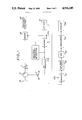
  • FIG. 1 is a block diagram of a pulse radar system in accordance with the invention.
  • FIG. 2A-2C are timeline diagrams illustrating the transmit and receive timing for the different RF frequencies of the radar system of FIG. 1.
  • FIG. 3 is a block diagram of further circuitry that is utilized with the system of FIG. 1 to provide coherent receiver processing.
  • FIG. 1 shown therein is a block diagram of a pulse radar system 10 having a multiple frequency RF exciter 11 which provides an RF output that is switched between different frequencies.
  • the output of the multiple frequency RF exciter 11, which will be described more fully herein, is provided to an RF transmit amplifier 13.
  • the output of the transmit amplifier 13 is coupled to a circulator 17 via a transmit switch 15.
  • the circulator 17 is a known circuit which includes an antenna port and a receive port in addition to the transmit port. It directs signals on the transmit port to an antenna 19 coupled to the antenna port, and directs signals received by the antenna to the receiver port.
  • the receive port of the circulator 17 is coupled to one input of a mixer 23 via a receive switch 21.
  • the other input of the mixer 23 receives the output of a mixer 25.
  • the inputs to the mixer 25 are provided by the RF exciter 11 and an IF oscillator 27 which provides the intermediate frequency (IF) carrier signal IF c .
  • the circulator 17 does not provide sufficient isolation and protection of the radar receiver circuitry (i.e., the circuitry downstream of the receive switch 21) from the transmit signal to the transmit port of the circulator 17.
  • additional receiver protection circuitry of known configuration would be utilized in the implementation of the radar system 10.
  • the receive switch 21 would be incorporated in that receiver protection circuitry.
  • the transmit switch 15 is closed for transmission and is otherwise open.
  • the receive switch 21 is closed when the transmit switch 15 is open.
  • the transmit switch 15 is in position T (for transmit) when it is closed, and is in position R (for receive) when it is open.
  • the receive switch 21 is in the position R when it is closed, and in the position T when it is open.
  • the switches 15, 21 comprise very fast switches as are utilized in present radar systems, and for practical purposes, one of the switches is closed at any given point in time.
  • the output of the mixer 23 is connected to a bandpass filter 29 which provides its output to one input of a mixer 31.
  • the other input of the mixer 31 receives the IF carrier signal IF c provided by the IF oscillator 27.
  • the output of the mixer 31 is provided to a low pass filter 33 whose output is coupled to the input of an analog-to-digital (A/D) converter 35 which provides digital samples of the received radar signals.
  • a processor 37 which can be microprocessor based, processes the digital samples and provides the processed outputs to a display apparatus 39 which can be a video display or a plotter, for example.
  • the foregoing radar system 10 departs from known systems in the use of multiple RF frequencies and the single receiver processing of the received radar signals.
  • FIG. 2A shown therein is a timing diagram showing, by way of illustrative example, the use of two (2) RF frequencies denominated RF A and RF B which are alternately provided by the RF exciter 11 for respective time intervals, which can be equal or unequal.
  • the first RF frequency RF A is provided during the time interval T A
  • the second RF frequency RF B is provided during the time interval T B .
  • the RF exciter provides a repeating sequence of pulses of two different RF frequencies.
  • each of the time intervals T A , T B is allocated into sequential subintervals respectively identified as settling time T s , receive time T r , and transmit time T t .
  • the settling time T s occurs after the RF exciter switches to the frequency RF A and defines the time when the output of the RF exciter settles to the new RF frequency.
  • the receive time T r follows and defines the time when return echoes can be received from the transmission which occurred during the prior time interval T A .
  • the transmit time T t defines the time when the radar system is transmitting a pulse of the frequency RF A .
  • the receive switch 21 is closed during the settling time and receive time subintervals, and is open during the transmit time subinterval.
  • the transmit switch 15 is open during the settling and receive subintervals, and is closed during the transmit subinterval.
  • the operation during the time interval T B is substantially identical except that the output of the exciter circuit 11 is the frequency RF B .
  • FIG. 2B schematically illustrates the transmitted output of the radar system 10 which includes alternating pulses of RF energy of the two frequencies RF A and RF B .
  • the transmitted output can be considered as the interleaving of two pulse trains having the same periodicity, wherein each pulse train comprises pulses of RF energy of one of the RF frequencies.
  • the radar system 10 transmits a pulse of a given RF frequency while waiting for the return signal from the prior pulse of a different RF frequency.
  • FIG. 2C shows the positions of the transmit switch 15 and the receive switch 21 for given subintervals of the time intervals T A and T B . It should be recalled that the T and R positions of the transmit and receive switches are reversed as between them. Thus, position R for the transmit switch means that it is open while position R for the receive switch means that it is closed.
  • signals received during the receive interval T r of a given time interval associated with a given frequency are the result of the pulse of RF energy that was transmitted during the immediately prior time interval for that frequency (T A in this example). Since the time relation between a given receive subinterval and its corresponding transmitted pulse is fixed, each output of the A/D converter 35 has a known time delay associated with it. Since range bins are based on time delay, each output of the A/D converter 35 has a known range bin associated therewith and each output of the A/D converter 35 has a particular RF frequency associated with it.
  • Known circuitry, including resettable counters for example, in the processor 37 is utilized to associate the received signal sample with the appropriate RF frequencies and range bins.
  • the processor 37 receives the received signal samples and associates the received samples with the appropriate range bins without regard for RF frequency. In other words, only time delay is recognized. For each range bin, a predetermined number of received signal samples is integrated, and the integration result is provided to the display apparatus 39.
  • the received signal samples provided by the A/D converter 35 can be stored in different memories respectively associated with the different frequencies, and then integrated separately for a given integration period.
  • the integrated data for each range bin are added to provide a combined output.
  • the RF exciter 11 must provide for each frequency coherence between the intervals associated with such frequency. In other words, when the output of the RF exciter 11 switches for example from RF B to RF A and then to RF B , the waveform of the later occurring RF B must be of the same phase that would have occurred if the switch to RF A had not occurred. The output intervals for RF A must also have the same phase relations. Generally stated, for each RF frequency, the phase of the output of the RF exciter 11 must be predictable.
  • the RF exciter 11 can comprise a phase locked loop that includes a free running reference oscillator that can be switched from one harmonic to another without switching to a different crystal. In other words, within the reference oscillator each harmonic behaves as if it were not interrupted.
  • a mixer 31', a low pass filter 33', and an A/D converter 35 would be connected in parallel with the mixer 31, low pass filter 33, and A/D converter 35 of FIG. 1.
  • the output of the bandpass filter 29 is provided to one of the inputs of the mixer 31' which at its other input receives an IF carrier signal IF c' which is a version of the IF carrier signal IF c (provided to the mixer 31) that is 90 degrees out of phase relative thereto.
  • the A/D converter 35' provides the quadrature components while the A/D converter 35 provides the in-phase components.
  • the processor 37 can integrate the received signal samples for each RF frequency separately for each range bin. That is, the in-phase and quadrature components for each frequency for each range bin are integrated separately. The respective integrated data (in-phase and quadrature) for each frequency for each range bin are then added to provide a combined output for each range bin. Magnitude is then calculated from the in-phase and quadrature components for each range bin or range-bit doppler cell (for coherent processing), which is provided to the display 39.
  • each received signal sample can be utilized to obtain the magnitude of such sample which is then processed non-coherently as discussed above.
  • the disclosed invention contemplates multiple RF frequencies in a predetermined sequence that is continually repeated.
  • the RF exciter could provide a repeating sequence of pulses of three (3) RF frequencies RF A , RF B , RF C during three sequential time intervals T A , T B , T C , which can be of equal or unequal duration. Each interval would have settling time, receive, and transmit intervals as described above.
  • the transmitted output of the N frequency radar can be considered as the interleaving of N pulse trains of the same periodicity wherein each pulse train includes pulses of RF energy of one of the RF frequencies.
  • the invention more generally contemplates multiple RF frequencies wherein the receive and transmit intervals for a given frequency do not have to be adjacent.
  • the invention generally contemplates a repeating sequence of interleaved receive and transmit interval pairs for each of a plurality of different frequencies, where the receive and transmit interval pair for a given RF frequency do not have to be adjacent.
  • the above described two and three frequency radars are examples of adjacent transmit and receive interval pairs for each frequency.
  • the transmit and receive repeating sequence could be:
  • the intervals during which a given RF frequency is provided by the RF exciter is controlled so as to provide the appropriate RF frequency for an appropriate time interval.
  • the RF exciter would provide a given RF frequency output for only a short time as needed for settling time and transmit time.
  • the receive intervals would be longer.
  • the disclosed radar system provides for a repeating sequence of internal RF pulses provided by the RF exciter, a transmit repeating sequence and a receive repeating sequence.
  • the repeating sequence of RF pulses provided by the exciter is (RF A ,RF B ,RF C , RF A , RF B , RF C ).
  • the transmit interval repeating sequence in terms of RF frequency is (RF B ,RF A , RF C ) and the receive interval repeating sequence in terms of RF frequency is (RF A , RF C , RF B ).
  • Transmit and receive intervals do not occur at the same time, and interleaving of the transmit and receive interval sequences defines the repeating sequence of RF pulses provided by the RF exciter.
  • the repeating sequence of RF pulses provided by the RF exciter is (RF A ,RF B ,RF C ), where each pulse of a given frequency is utilized for one receive interval and one transmit interval for that frequency.
  • the transmit interval repeating sequence is (RF A , RF B , RF C ) and the receive interval repeating sequence is (RF A , RF B , RF C ).
  • Transmit and receive intervals do not occur at the same time, and interleaving the transmit and receive interval sequences produces the sequence (RF A ,RF A , RF B , RF B , RF C , RF C ), which defines the repeating sequence of RF pulses (RF A , RF B , RF C ) provided by the RF exciter since each RF pulse of the exciter is used for a receive interval and a transmit interval.
  • the RF exciter rather than providing two adjacent pulses of RF energy at the same frequency, the RF exciter provides one pulse of RF energy for each occurrence of adjacent receive and transmit intervals of a given frequency.
  • the foregoing has been a disclosure of a pulse radar system having multiple RF frequencies and a single receiver, and wherein only one internal RF frequency is present in the system at any given time.
  • the use of multiple frequencies provides for increased signal-to-noise ratio, which allows for longer detection ranges and/or increased visibility of targets as compared to a single frequency radar at the same peak transmit power.
  • the same signal-to-noise ratio is achieved at a lesser peak transmit power as compared to a single frequency radar.
  • multiple RF frequencies reduce speckle, which is particularly advantageous for synthetic aperture radar.
  • the reduced peak transmit power reduces the probability of interception, which is advantageous in certain military applications, as is the improved performance against electronic countermeasures resulting from the use of multiple frequencies.
  • the foregoing advantages are achieved at the sacrifice of not being able to use some of the range bins, the lower limit of which would be determined by the settling time of the RF exciter 11.
  • the multiple frequency radar of the invention cannot be used for high pulse repetition frequencies, for example, above 100 KHz, but such systems already have higher signal-to-noise ratios in comparison to low pulse repetition frequency radar by virtue of higher duty factors and shorter ranges.
  • This invention will, however, somewhat reduce the need to go to a higher pulse repetition rate by providing a higher duty factor with a lower pulse repetition rate.

Landscapes

  • Engineering & Computer Science (AREA)
  • Radar, Positioning & Navigation (AREA)
  • Remote Sensing (AREA)
  • Computer Networks & Wireless Communication (AREA)
  • Physics & Mathematics (AREA)
  • General Physics & Mathematics (AREA)
  • Radar Systems Or Details Thereof (AREA)

Abstract

A pulse radar system including an RF exciter for generating a repeating sequence of internal pulses of RF energy of different frequencies. A transmit circuit responsive to the internal pulses of RF energy generates a transmit radar signal comprising a transmit repeating sequence of transmit intervals during which pulses of RF energy are transmitted. A single receiver responsive to the repeating sequence of internal RF pulses receives radar return signals based on all of the RF frequencies in a receive repeating sequence of receive intervals which do not occur at the same time as said transmit intervals.

Description

BACKGROUND OF THE INVENTION
The disclosed invention generally relates to a pulse radar system, and is more particularly directed to a pulse radar system that utilizes a plurality of RF frequencies with a single receiver.
In a typical pulse radar system, the transmitted signal comprises a pulse modulated radio frequency (RF) carrier signal. The pulse repetition frequency (PRF) will depend primarily on the maximum range at which targets are expected since for a given pulse emitted, any corresponding return signal should be received during the receive interval prior to the next pulse in order to avoid ambiguities. In other words, if the pulse repetition rate is too high, the likelihood of receiving target echoes from the wrong pulse transmission (multiple-time-around echoes) is increased.
Thus, unless ambiguous ranges are acceptable, or unless techniques are utilized to distinguish multiple-time-around echoes, which pose other problems, pulse repetition frequencies are reduced with increasing maximum expected range. For applications where the range of interest is further away, for example greater than 40 nautical miles, low pulse repetition rates are utilized and only a small portion of the receive interval is useful. The remaining portion of the receive interval is waiting time that is not utilized.
A known technique for utilizing otherwise non-useful waiting time of the receive interval utilizes a plurality of respectively associated receivers and fixed frequency RF exciters (i.e., each receiver is responsive only to a specific fixed frequency exciter) to permit simultaneous transmit and receive of different frequencies. Performance is improved, but at the cost of additional hardware and complexity.
Performance can also be improved by increasing transmission power. However, this requires larger power supplies, increased power handling capabilities, and in certain applications produces an unwanted increase in interception.
SUMMARY OF THE INVENTION
It would therefore be an advantage to provide a pulse radar system which utilizes a portion of the receive interval to improve performance with a single receiver.
It would be a particular advantage to provide a pulse radar system which interleaves pulse trains of different RF frequencies with a single receiver.
Another advantage would be to provide a pulse radar system which provides increased signal to noise ratio without increasing transmission power.
The foregoing and other advantages are provided in a radar system that includes a circuit for generating a repeating sequence of internal pulses of RF energy of different frequencies. A transmit circuit responsive to the internal pulses of RF energy generates a transmit radar signal comprising a transmit repeating sequence of transmit intervals during which pulses of RF energy are transmitted. A single receiver responsive to the repeating sequence of internal RF pulses receives radar return signals based on all of the RF frequencies in a receive repeating sequence of receive intervals which do not occur at the same time as the transmit intervals.
BRIEF DESCRIPTION OF THE DRAWING
The advantages and features of the disclosed invention will readily be appreciated by persons skilled in the art from the following detailed description when read in conjunction with the drawing wherein:
FIG. 1 is a block diagram of a pulse radar system in accordance with the invention.
FIG. 2A-2C are timeline diagrams illustrating the transmit and receive timing for the different RF frequencies of the radar system of FIG. 1.
FIG. 3 is a block diagram of further circuitry that is utilized with the system of FIG. 1 to provide coherent receiver processing.
DETAILED DESCRIPTION
In the following detailed description and in the several figures of the drawing, like elements are identified with like reference numerals.
Referring now to FIG. 1, shown therein is a block diagram of a pulse radar system 10 having a multiple frequency RF exciter 11 which provides an RF output that is switched between different frequencies. The output of the multiple frequency RF exciter 11, which will be described more fully herein, is provided to an RF transmit amplifier 13. The output of the transmit amplifier 13 is coupled to a circulator 17 via a transmit switch 15. The circulator 17 is a known circuit which includes an antenna port and a receive port in addition to the transmit port. It directs signals on the transmit port to an antenna 19 coupled to the antenna port, and directs signals received by the antenna to the receiver port.
The receive port of the circulator 17 is coupled to one input of a mixer 23 via a receive switch 21. The other input of the mixer 23 receives the output of a mixer 25. The inputs to the mixer 25 are provided by the RF exciter 11 and an IF oscillator 27 which provides the intermediate frequency (IF) carrier signal IFc.
It is well known in the art that the circulator 17 does not provide sufficient isolation and protection of the radar receiver circuitry (i.e., the circuitry downstream of the receive switch 21) from the transmit signal to the transmit port of the circulator 17. Thus, although not shown to avoid the complexity of unnecessary details, additional receiver protection circuitry of known configuration would be utilized in the implementation of the radar system 10. Typically, the receive switch 21 would be incorporated in that receiver protection circuitry.
In operation, the transmit switch 15 is closed for transmission and is otherwise open. The receive switch 21 is closed when the transmit switch 15 is open. For ease of reference, the transmit switch 15 is in position T (for transmit) when it is closed, and is in position R (for receive) when it is open. By the same reasoning, the receive switch 21 is in the position R when it is closed, and in the position T when it is open. The switches 15, 21 comprise very fast switches as are utilized in present radar systems, and for practical purposes, one of the switches is closed at any given point in time.
The output of the mixer 23 is connected to a bandpass filter 29 which provides its output to one input of a mixer 31. The other input of the mixer 31 receives the IF carrier signal IFc provided by the IF oscillator 27. The output of the mixer 31 is provided to a low pass filter 33 whose output is coupled to the input of an analog-to-digital (A/D) converter 35 which provides digital samples of the received radar signals. A processor 37, which can be microprocessor based, processes the digital samples and provides the processed outputs to a display apparatus 39 which can be a video display or a plotter, for example.
The foregoing radar system 10 departs from known systems in the use of multiple RF frequencies and the single receiver processing of the received radar signals. Referring specifically to FIG. 2A, shown therein is a timing diagram showing, by way of illustrative example, the use of two (2) RF frequencies denominated RFA and RFB which are alternately provided by the RF exciter 11 for respective time intervals, which can be equal or unequal. Thus, for example, the first RF frequency RFA is provided during the time interval TA, while the second RF frequency RFB is provided during the time interval TB. Essentially, the RF exciter provides a repeating sequence of pulses of two different RF frequencies.
As shown in FIG. 2A, each of the time intervals TA, TB is allocated into sequential subintervals respectively identified as settling time Ts, receive time Tr, and transmit time Tt. Taking specifically the time interval TA, the settling time Ts occurs after the RF exciter switches to the frequency RFA and defines the time when the output of the RF exciter settles to the new RF frequency. The receive time Tr follows and defines the time when return echoes can be received from the transmission which occurred during the prior time interval TA. The transmit time Tt defines the time when the radar system is transmitting a pulse of the frequency RFA.
The receive switch 21 is closed during the settling time and receive time subintervals, and is open during the transmit time subinterval. The transmit switch 15 is open during the settling and receive subintervals, and is closed during the transmit subinterval.
The operation during the time interval TB is substantially identical except that the output of the exciter circuit 11 is the frequency RFB.
FIG. 2B schematically illustrates the transmitted output of the radar system 10 which includes alternating pulses of RF energy of the two frequencies RFA and RFB. The transmitted output can be considered as the interleaving of two pulse trains having the same periodicity, wherein each pulse train comprises pulses of RF energy of one of the RF frequencies. Essentially, the radar system 10 transmits a pulse of a given RF frequency while waiting for the return signal from the prior pulse of a different RF frequency.
FIG. 2C shows the positions of the transmit switch 15 and the receive switch 21 for given subintervals of the time intervals TA and TB. It should be recalled that the T and R positions of the transmit and receive switches are reversed as between them. Thus, position R for the transmit switch means that it is open while position R for the receive switch means that it is closed.
For ease of understanding of the processing of the digitized radar data, it should be recalled that signals received during the receive interval Tr of a given time interval associated with a given frequency (for example TA for the frequency RFA) are the result of the pulse of RF energy that was transmitted during the immediately prior time interval for that frequency (TA in this example). Since the time relation between a given receive subinterval and its corresponding transmitted pulse is fixed, each output of the A/D converter 35 has a known time delay associated with it. Since range bins are based on time delay, each output of the A/D converter 35 has a known range bin associated therewith and each output of the A/D converter 35 has a particular RF frequency associated with it. Known circuitry, including resettable counters for example, in the processor 37 is utilized to associate the received signal sample with the appropriate RF frequencies and range bins.
For non-coherent processing, the processor 37 receives the received signal samples and associates the received samples with the appropriate range bins without regard for RF frequency. In other words, only time delay is recognized. For each range bin, a predetermined number of received signal samples is integrated, and the integration result is provided to the display apparatus 39.
Alternatively, the received signal samples provided by the A/D converter 35 can be stored in different memories respectively associated with the different frequencies, and then integrated separately for a given integration period. The integrated data for each range bin (one for each RF frequency) are added to provide a combined output.
If the processing provided is coherent processing, there are further considerations. First, the RF exciter 11 must provide for each frequency coherence between the intervals associated with such frequency. In other words, when the output of the RF exciter 11 switches for example from RFB to RFA and then to RFB, the waveform of the later occurring RFB must be of the same phase that would have occurred if the switch to RFA had not occurred. The output intervals for RFA must also have the same phase relations. Generally stated, for each RF frequency, the phase of the output of the RF exciter 11 must be predictable.
The necessary coherence can be achieved with known phase-locked loop techniques. For example, the RF exciter 11 can comprise a phase locked loop that includes a free running reference oscillator that can be switched from one harmonic to another without switching to a different crystal. In other words, within the reference oscillator each harmonic behaves as if it were not interrupted.
Further as to coherent processing in-phase and quadrature components must be determined. For example, referring specifically to FIG. 3, a mixer 31', a low pass filter 33', and an A/D converter 35 would be connected in parallel with the mixer 31, low pass filter 33, and A/D converter 35 of FIG. 1. The output of the bandpass filter 29 is provided to one of the inputs of the mixer 31' which at its other input receives an IF carrier signal IFc' which is a version of the IF carrier signal IFc (provided to the mixer 31) that is 90 degrees out of phase relative thereto. The A/D converter 35' provides the quadrature components while the A/D converter 35 provides the in-phase components.
For coherent processing, the processor 37 can integrate the received signal samples for each RF frequency separately for each range bin. That is, the in-phase and quadrature components for each frequency for each range bin are integrated separately. The respective integrated data (in-phase and quadrature) for each frequency for each range bin are then added to provide a combined output for each range bin. Magnitude is then calculated from the in-phase and quadrature components for each range bin or range-bit doppler cell (for coherent processing), which is provided to the display 39.
Alternatively, the in-phase and quadrature components of each received signal sample can be utilized to obtain the magnitude of such sample which is then processed non-coherently as discussed above.
The above-described processing is based on known single frequency processing techniques. Essentially, known processing techniques are utilized with the modification, to the extent necessary, that the received radar data for the different RF frequencies be separated and processed separately.
It should be appreciated that although the foregoing illustrative example utilizes two RF frequencies, the disclosed invention contemplates multiple RF frequencies in a predetermined sequence that is continually repeated. Thus, for example, the RF exciter could provide a repeating sequence of pulses of three (3) RF frequencies RFA, RFB, RFC during three sequential time intervals TA, TB, TC, which can be of equal or unequal duration. Each interval would have settling time, receive, and transmit intervals as described above. Like the two RF frequency example, the transmitted output of the N frequency radar can be considered as the interleaving of N pulse trains of the same periodicity wherein each pulse train includes pulses of RF energy of one of the RF frequencies.
The invention more generally contemplates multiple RF frequencies wherein the receive and transmit intervals for a given frequency do not have to be adjacent. Thus, the invention generally contemplates a repeating sequence of interleaved receive and transmit interval pairs for each of a plurality of different frequencies, where the receive and transmit interval pair for a given RF frequency do not have to be adjacent. The above described two and three frequency radars are examples of adjacent transmit and receive interval pairs for each frequency. For a multiple RF radar utilizing three (3) RF frequencies RFA, RFB, RFC and non-adjacent receive and transmit intervals for a given frequency, the transmit and receive repeating sequence could be:
Receive RFA
Transmit RFB
Receive RFC
Transmit RFA
Receive RFB
Transmit RFC
In this example, the intervals during which a given RF frequency is provided by the RF exciter is controlled so as to provide the appropriate RF frequency for an appropriate time interval. Thus, during a transmit interval, the RF exciter would provide a given RF frequency output for only a short time as needed for settling time and transmit time. The receive intervals would be longer.
Essentially, the disclosed radar system provides for a repeating sequence of internal RF pulses provided by the RF exciter, a transmit repeating sequence and a receive repeating sequence. Thus, for the example discussed above of a three (3) RF frequency radar with non-adjacent receive and transmit intervals for each RF frequency, the repeating sequence of RF pulses provided by the exciter is (RFA,RFB,RFC, RFA, RFB, RFC). The transmit interval repeating sequence in terms of RF frequency is (RFB,RFA, RFC) and the receive interval repeating sequence in terms of RF frequency is (RFA, RFC, RFB). Transmit and receive intervals do not occur at the same time, and interleaving of the transmit and receive interval sequences defines the repeating sequence of RF pulses provided by the RF exciter.
For the example discussed earlier of a three (3) RF frequency radar with adjacent receive and transmit intervals for each RF frequency, the repeating sequence of RF pulses provided by the RF exciter is (RFA,RFB,RFC), where each pulse of a given frequency is utilized for one receive interval and one transmit interval for that frequency. The transmit interval repeating sequence is (RFA, RFB, RFC) and the receive interval repeating sequence is (RFA, RFB, RFC). Transmit and receive intervals do not occur at the same time, and interleaving the transmit and receive interval sequences produces the sequence (RFA,RFA, RFB, RFB, RFC, RFC), which defines the repeating sequence of RF pulses (RFA, RFB, RFC) provided by the RF exciter since each RF pulse of the exciter is used for a receive interval and a transmit interval. In other words, rather than providing two adjacent pulses of RF energy at the same frequency, the RF exciter provides one pulse of RF energy for each occurrence of adjacent receive and transmit intervals of a given frequency.
The foregoing has been a disclosure of a pulse radar system having multiple RF frequencies and a single receiver, and wherein only one internal RF frequency is present in the system at any given time. The use of multiple frequencies provides for increased signal-to-noise ratio, which allows for longer detection ranges and/or increased visibility of targets as compared to a single frequency radar at the same peak transmit power. Conversely, with the radar system of the invention, the same signal-to-noise ratio is achieved at a lesser peak transmit power as compared to a single frequency radar. Further, multiple RF frequencies reduce speckle, which is particularly advantageous for synthetic aperture radar. The reduced peak transmit power reduces the probability of interception, which is advantageous in certain military applications, as is the improved performance against electronic countermeasures resulting from the use of multiple frequencies.
It should be appreciated, however, that the foregoing advantages are achieved at the sacrifice of not being able to use some of the range bins, the lower limit of which would be determined by the settling time of the RF exciter 11. It should also be appreciated that the multiple frequency radar of the invention cannot be used for high pulse repetition frequencies, for example, above 100 KHz, but such systems already have higher signal-to-noise ratios in comparison to low pulse repetition frequency radar by virtue of higher duty factors and shorter ranges. This invention will, however, somewhat reduce the need to go to a higher pulse repetition rate by providing a higher duty factor with a lower pulse repetition rate.
Although the foregoing has been a description and illustration of specific embodiments of the invention, various modifications and changes thereto can be made by persons skilled in the art without departing from the scope and spirit of the invention as defined by the following claims.
Claims (15)

What is claimed is:
1. A pulse radar system comprising:
single RF generating means having a multiple frequency RF signal exciter for generating an internal RF repeating sequence of internal pulses of RF energy of different frequencies at different times;
means responsive to said internal repeating sequence of pulses of RF energy for generating a transmit radar signal comprising a transmit repeating sequence of transmit intervals during which pulses of RF energy are transmitted; and
means responsive to said internal RF repeating sequence of pulses for receiving radar return signals based on all of said RF frequencies of said transmit radar signal in a single receive port in a receive repeating sequence of receive intervals which do not occur at the same time as said transmit intervals.
2. The pulse radar system of claim 1 wherein a transmit interval for a given frequency is not adjacent a receive interval for such frequency.
3. The pulse radar system of claim 1 wherein a transmit interval for a given frequency is adjacent a receive interval for such frequency.
4. The pulse radar system of claim 1 wherein said RF generating means comprises means for providing a single RF output comprising said internal RF repeating sequence of internal pulses of RF energy of different frequencies.
5. The pulse radar system of claim 4 wherein said RF generating means maintains coherence between the occurrences of each different RF frequency in said sequence.
6. A pulse radar system comprising:
single RF generating means having a multiple frequency RF signal exciter for generating an internal RF repeating sequence of internal pulses of RF energy of different frequencies at different times;
means responsive to said internal repeating sequence of pulses of RF energy for generating a transmit radar signal comprising a transmit repeating sequence of transmitted pulses of RF energy, said transmitted pulses being narrower than said internal pulses and said transmit sequence corresponding to said internal RF repeating sequence; and
means responsive to said internal RF repeating sequence of pulses for receiving radar return signal based on all of said RF frequencies of said transmit radar signal in a single receive port in a receive repeating sequence corresponding to said internal RF repeating sequence.
7. The pulse radar system of claim 6 wherein said internal RF sequence of pulses comprises pulses of constant interval.
8. The pulse radar system of claim 6 wherein said internal RF sequence of pulses includes a pulse of a first RF frequency and a pulse of a second RF frequency.
9. The pulse radar system of claim 6 wherein said RF generating means comprises means for providing a single RF output comprising said internal RF repeating sequence of internal pulses of RF energy of different frequencies.
10. The pulse radar system of claim 9 wherein said RF generating means maintains coherence between the occurrences of each different RF frequency in said sequence.
11. The pulse radar system of claim 6 wherein each of said internal pulses of RF energy includes receive and transmit subintervals, and wherein:
said transmit generating means includes means for coupling said internal RF pulses to said transmit generating means during said transmit subintervals; and
said receiving means includes means for coupling said internal RF pulses to said receiving means during said receive subintervals.
12. A pulse radar system comprising:
single RF generating means having a multiple frequency RF signal exciter for generating a single internal RF signal comprising an internal RF repeating sequence of pulses of RF energy of different frequencies at different times;
transmit means responsive to said internal repeating sequence of pulses of RF energy for generating a transmit radar signal comprising a transmit repeating sequence of transmitted pulses of RF energy, said transmitted pulses being narrower than said internal RF pulses and said transmit sequence corresponding to said internal RF repeating sequence; and
receive means responsive to said internal RF repeating sequence of pulse for receiving radar return signals based on all of said RF frequencies of said transmit radar signal in a single receive port in a receive repeating sequence corresponding to said internal RF repeating sequence.
13. The pulse radar system of claim 12 wherein said internal RF sequence of pulses comprises pulses of constant interval.
14. The pulse radar system of claim 12 wherein said internal RF sequence of pulses includes a pulse of a first RF frequency and a pulse of a second RF frequency.
15. The pulse radar system of claim 12 wherein said RF generating means maintains coherence between the occurrences of each different RF frequency in said sequence.
US07/262,917 1988-10-26 1988-10-26 Multiple radio frequency single receiver radar operation Expired - Fee Related US4926185A (en)

Priority Applications (5)

Application Number Priority Date Filing Date Title
US07/262,917 US4926185A (en) 1988-10-26 1988-10-26 Multiple radio frequency single receiver radar operation
IL91747A IL91747A0 (en) 1988-10-26 1989-09-22 Multiple radio frequency single receiver radar operation
AU43531/89A AU610440B2 (en) 1988-10-26 1989-10-19 Multiple radio frequency single receiver radar operation
EP19890310937 EP0366406A3 (en) 1988-10-26 1989-10-24 Multiple radio frequency single receiver radar operation
JP1277348A JPH02179490A (en) 1988-10-26 1989-10-26 Pulse radar system

Applications Claiming Priority (1)

Application Number Priority Date Filing Date Title
US07/262,917 US4926185A (en) 1988-10-26 1988-10-26 Multiple radio frequency single receiver radar operation

Publications (1)

Publication Number Publication Date
US4926185A true US4926185A (en) 1990-05-15

Family

ID=22999626

Family Applications (1)

Application Number Title Priority Date Filing Date
US07/262,917 Expired - Fee Related US4926185A (en) 1988-10-26 1988-10-26 Multiple radio frequency single receiver radar operation

Country Status (4)

Country Link
US (1) US4926185A (en)
EP (1) EP0366406A3 (en)
JP (1) JPH02179490A (en)
AU (1) AU610440B2 (en)

Cited By (15)

* Cited by examiner, † Cited by third party
Publication number Priority date Publication date Assignee Title
US5552793A (en) * 1994-12-02 1996-09-03 Hughes Missile Systems Company Self calibrated act pulse compression system
US6714157B2 (en) 2002-08-02 2004-03-30 The Boeing Company Multiple time-interleaved radar operation using a single radar at different angles
US20060238742A1 (en) * 2005-04-25 2006-10-26 Hunt Jeffrey H Short duty cycle lidar
DE102007010236A1 (en) * 2007-03-02 2008-09-04 Toposys Topographische Systemdaten Gmbh Device, particularly light detection and ranging device, for determination of distance by light pulses, has two timers that are connected to controller and detector, where controller generates start signal that triggers time measurement
WO2020016878A1 (en) * 2018-07-19 2020-01-23 Arbe Robotics Ltd. Apparatus and method of eliminating settling time delays in a radar system
US10915717B1 (en) * 2020-04-23 2021-02-09 Avid Identification Systems, Inc. Muting circuit for analog filters in radio frequency identification (RFID) systems
CN112953656A (en) * 2019-10-30 2021-06-11 是德科技股份有限公司 System and method for measuring repetitive complex and pulsed RF signals
US11509042B2 (en) 2019-12-09 2022-11-22 Arbe Robotics Ltd. Radome for automotive radar patch antenna
US11513187B2 (en) 2018-05-07 2022-11-29 Arbe Robotics Ltd. FMCW automotive radar incorporating modified slow time processing of fine range-doppler data
US11520003B2 (en) 2017-11-29 2022-12-06 Arbe Robotics Ltd. Detection, mitigation and avoidance of mutual interference between automotive radars
US11650286B2 (en) 2017-01-24 2023-05-16 Arbe Robotics Ltd. Method for separating targets and clutter from noise, in radar signals
US11811142B2 (en) 2018-09-05 2023-11-07 Arbe Robotics Ltd. Skewed MIMO antenna array for use in automotive imaging radar
US11808881B2 (en) 2018-07-19 2023-11-07 Arbe Robotics Ltd. Apparatus and method of two-stage signal processing in a radar system
US11921195B2 (en) 2018-07-19 2024-03-05 Arbe Robotics Ltd. Apparatus and method of RF built in self-test (RFBIST) in a radar system
US12422538B2 (en) 2020-11-09 2025-09-23 Arbe Robotics Ltd. Efficient direction of arrival estimation using low rank approximation

Families Citing this family (5)

* Cited by examiner, † Cited by third party
Publication number Priority date Publication date Assignee Title
SE503495C2 (en) * 1994-10-04 1996-06-24 Ericsson Telefon Ab L M Procedure for controlling a radar station
JP2007170846A (en) * 2005-12-19 2007-07-05 Toshiba Corp Radar equipment
JP2008002811A (en) * 2006-06-20 2008-01-10 Daido Signal Co Ltd Pulse radar device for short distance measurement
FR2968771B1 (en) * 2010-12-10 2012-12-28 Thales Sa OPTICAL EQUIPMENT AND METHOD FOR TELEMETRY AND HIGH-SPEED COMMUNICATION
CN109212487B (en) * 2018-09-27 2023-03-24 芜湖博高光电科技股份有限公司 Dual-band integrated TR (transmitter-receiver) assembly

Citations (6)

* Cited by examiner, † Cited by third party
Publication number Priority date Publication date Assignee Title
US2817832A (en) * 1951-02-02 1957-12-24 Robert H Mathes Multiple sweep
US3390391A (en) * 1965-11-05 1968-06-25 Philips Corp Radar system employing variable frequency pulses
US3566408A (en) * 1969-02-26 1971-02-23 Avco Corp Method of and apparatus for three color-echo ranging
US4197540A (en) * 1977-04-27 1980-04-08 Hughes Aircraft Company Simultaneous transmit and receive radar subsystem
JPS60170774A (en) * 1984-02-15 1985-09-04 Natl Space Dev Agency Japan<Nasda> Synthetic aperture radar
US4562438A (en) * 1980-09-27 1985-12-31 The Marconi Company Limited Radar apparatus

Family Cites Families (4)

* Cited by examiner, † Cited by third party
Publication number Priority date Publication date Assignee Title
FR2201476B1 (en) * 1972-09-26 1977-07-29 Thomson Csf
FR2220797B1 (en) * 1973-03-06 1977-09-02 Thomson Csf
GB2044571A (en) * 1979-03-17 1980-10-15 Marconi Co Ltd Pulse radar system
IT1206287B (en) * 1987-05-26 1989-04-14 Selenia Ind Elettroniche THE DETECTION AND RECOGNITION OF RADAR WITH AGILITY OF FREQUENCY FROM MULTI-PULSE TRACK TARGETS TO PULSE, USED FOR

Patent Citations (6)

* Cited by examiner, † Cited by third party
Publication number Priority date Publication date Assignee Title
US2817832A (en) * 1951-02-02 1957-12-24 Robert H Mathes Multiple sweep
US3390391A (en) * 1965-11-05 1968-06-25 Philips Corp Radar system employing variable frequency pulses
US3566408A (en) * 1969-02-26 1971-02-23 Avco Corp Method of and apparatus for three color-echo ranging
US4197540A (en) * 1977-04-27 1980-04-08 Hughes Aircraft Company Simultaneous transmit and receive radar subsystem
US4562438A (en) * 1980-09-27 1985-12-31 The Marconi Company Limited Radar apparatus
JPS60170774A (en) * 1984-02-15 1985-09-04 Natl Space Dev Agency Japan<Nasda> Synthetic aperture radar

Non-Patent Citations (2)

* Cited by examiner, † Cited by third party
Title
Skolnik, "Introduction to Radar Systems", McGraw Hill, 1980, Chapter 4.
Skolnik, Introduction to Radar Systems , McGraw Hill, 1980, Chapter 4. *

Cited By (27)

* Cited by examiner, † Cited by third party
Publication number Priority date Publication date Assignee Title
US5552793A (en) * 1994-12-02 1996-09-03 Hughes Missile Systems Company Self calibrated act pulse compression system
US6714157B2 (en) 2002-08-02 2004-03-30 The Boeing Company Multiple time-interleaved radar operation using a single radar at different angles
US20060238742A1 (en) * 2005-04-25 2006-10-26 Hunt Jeffrey H Short duty cycle lidar
DE102007010236A1 (en) * 2007-03-02 2008-09-04 Toposys Topographische Systemdaten Gmbh Device, particularly light detection and ranging device, for determination of distance by light pulses, has two timers that are connected to controller and detector, where controller generates start signal that triggers time measurement
WO2008107129A1 (en) * 2007-03-02 2008-09-12 Toposys Topographishe Systemdaten Gmbh Device and method for the determination of distance by means of light pulses
DE102007010236B4 (en) * 2007-03-02 2008-11-20 Toposys Topographische Systemdaten Gmbh Device and method for distance determination by means of light pulses
US20100066995A1 (en) * 2007-03-02 2010-03-18 Peter Rindle Device and method for the determination of distance by means of light pulses
US8212998B2 (en) 2007-03-02 2012-07-03 Trimble Germany Gmbh Device and method for the determination of distance by means of light pulses
US8605261B2 (en) 2007-03-02 2013-12-10 Trimble Germany Gmbh Device and method for the determination of distance by means of light pulses
US11650286B2 (en) 2017-01-24 2023-05-16 Arbe Robotics Ltd. Method for separating targets and clutter from noise, in radar signals
US11520003B2 (en) 2017-11-29 2022-12-06 Arbe Robotics Ltd. Detection, mitigation and avoidance of mutual interference between automotive radars
US11609303B2 (en) 2018-05-07 2023-03-21 Arbe Robotics Ltd. FMCW automotive radar incorporating nonlinear frequency hopping sequence of fractional bandwidth multiband chirps
US11513187B2 (en) 2018-05-07 2022-11-29 Arbe Robotics Ltd. FMCW automotive radar incorporating modified slow time processing of fine range-doppler data
US11525886B2 (en) 2018-05-07 2022-12-13 Arbe Robotics Ltd. FMCW automotive radar incorporating nonlinear frequency hopping sequence of fractional bandwidth multiband chirps with spectral probability windowing
WO2020016878A1 (en) * 2018-07-19 2020-01-23 Arbe Robotics Ltd. Apparatus and method of eliminating settling time delays in a radar system
US11921195B2 (en) 2018-07-19 2024-03-05 Arbe Robotics Ltd. Apparatus and method of RF built in self-test (RFBIST) in a radar system
US11852747B2 (en) 2018-07-19 2023-12-26 Arbe Robotics Ltd. Apparatus and method of eliminating settling time delays in a radar system
US11808881B2 (en) 2018-07-19 2023-11-07 Arbe Robotics Ltd. Apparatus and method of two-stage signal processing in a radar system
US11811142B2 (en) 2018-09-05 2023-11-07 Arbe Robotics Ltd. Skewed MIMO antenna array for use in automotive imaging radar
CN112953656A (en) * 2019-10-30 2021-06-11 是德科技股份有限公司 System and method for measuring repetitive complex and pulsed RF signals
US11509042B2 (en) 2019-12-09 2022-11-22 Arbe Robotics Ltd. Radome for automotive radar patch antenna
EP4139830A4 (en) * 2020-04-23 2023-11-01 Avid Identification Systems, Inc. NOISE CANCELLATION CIRCUIT FOR ANALOG FILTERS IN RADIO FREQUENCY IDENTIFICATION (RFID) SYSTEMS
US10915717B1 (en) * 2020-04-23 2021-02-09 Avid Identification Systems, Inc. Muting circuit for analog filters in radio frequency identification (RFID) systems
CN115516458A (en) * 2020-04-23 2022-12-23 埃维德鉴定体系股份有限公司 Squelch circuits for analog filters in radio frequency identification (RFID) systems
WO2021216539A1 (en) 2020-04-23 2021-10-28 Avid Identification Systems, Inc. Muting circuit for analog filters in radio frequency identification (rfid) systems
US11907794B2 (en) 2020-04-23 2024-02-20 Avid Identification Systems, Inc. Muting circuit for analog filters in radio frequency identification (RFID) systems
US12422538B2 (en) 2020-11-09 2025-09-23 Arbe Robotics Ltd. Efficient direction of arrival estimation using low rank approximation

Also Published As

Publication number Publication date
JPH02179490A (en) 1990-07-12
AU610440B2 (en) 1991-05-16
EP0366406A3 (en) 1991-05-15
EP0366406A2 (en) 1990-05-02
AU4353189A (en) 1990-05-31

Similar Documents

Publication Publication Date Title
US4926185A (en) Multiple radio frequency single receiver radar operation
US5376939A (en) Dual-frequency, complementary-sequence pulse radar
US4219812A (en) Range-gated pulse doppler radar system
US5784026A (en) Radar detection of accelerating airborne targets
US5151702A (en) Complementary-sequence pulse radar with matched filtering following doppler filtering
US4388622A (en) Double sideband linear frequency modulation system for radar applications
US6225943B1 (en) Method of operating pulse radar
US3878525A (en) Frequency jumping CW radar
EP1754080B1 (en) Short pulse/stepped frequency radar system
US5140332A (en) Short pulse radar system with a long pulse transmitter
EP0389720B1 (en) Radar detection of targets at short and long range
US4292635A (en) Signal processing system
US4035799A (en) Digital mean clutter doppler compensation system
US5389931A (en) Radar signal processing system
US5422646A (en) High frequency MTI radar
US4155088A (en) Dual frequency transmission apparatus for frequency-agile radar systems utilizing MTI techniques
EP0322017B1 (en) Radar apparatus employing different kind of pulses
EP0389606B1 (en) Coherent radar using recirculating fiber-optic delay line
US3383686A (en) Diverse frequency echo detection system with doppler frequency coherence
US4430655A (en) Radar target angle measuring system
US6525686B2 (en) Receiving/transmitting apparatus and radar equipment
US3706095A (en) Signal processor
US5132689A (en) Dual function radar receiver
US4647874A (en) Doppler signal processing circuitry
US3560972A (en) Apparatus for flexibly weighting received echoes in a moving target indicator radar

Legal Events

Date Code Title Description
AS Assignment

Owner name: HUGHES AIRCRAFT COMPANY, LOS ANGELES, CALIFORNIA A

Free format text: ASSIGNMENT OF ASSIGNORS INTEREST.;ASSIGNOR:WITTENBERG, PETER;REEL/FRAME:004970/0631

Effective date: 19881020

Owner name: HUGHES AIRCRAFT COMPANY, CALIFORNIA

Free format text: ASSIGNMENT OF ASSIGNORS INTEREST;ASSIGNOR:WITTENBERG, PETER;REEL/FRAME:004970/0631

Effective date: 19881020

FEPP Fee payment procedure

Free format text: PAYOR NUMBER ASSIGNED (ORIGINAL EVENT CODE: ASPN); ENTITY STATUS OF PATENT OWNER: LARGE ENTITY

REMI Maintenance fee reminder mailed
FPAY Fee payment

Year of fee payment: 4

SULP Surcharge for late payment
FPAY Fee payment

Year of fee payment: 8

REMI Maintenance fee reminder mailed
LAPS Lapse for failure to pay maintenance fees
STCH Information on status: patent discontinuation

Free format text: PATENT EXPIRED DUE TO NONPAYMENT OF MAINTENANCE FEES UNDER 37 CFR 1.362

FP Lapsed due to failure to pay maintenance fee

Effective date: 20020515