US4901050A - Tilt sensor for vehicle steering shaft - Google Patents

Tilt sensor for vehicle steering shaft Download PDF

Info

Publication number
US4901050A
US4901050A US07/225,202 US22520288A US4901050A US 4901050 A US4901050 A US 4901050A US 22520288 A US22520288 A US 22520288A US 4901050 A US4901050 A US 4901050A
Authority
US
United States
Prior art keywords
resistive element
element layer
base
layer
tilt sensor
Prior art date
Legal status (The legal status is an assumption and is not a legal conclusion. Google has not performed a legal analysis and makes no representation as to the accuracy of the status listed.)
Expired - Fee Related
Application number
US07/225,202
Inventor
Mitsuko Kotaki
Takayoshi Tsuzuki
Yukihisa Oda
Ryohei Yabuno
Masami Ishii
Current Assignee (The listed assignees may be inaccurate. Google has not performed a legal analysis and makes no representation or warranty as to the accuracy of the list.)
Aisin Corp
Original Assignee
Aisin Seiki Co Ltd
Priority date (The priority date is an assumption and is not a legal conclusion. Google has not performed a legal analysis and makes no representation as to the accuracy of the date listed.)
Filing date
Publication date
Application filed by Aisin Seiki Co Ltd filed Critical Aisin Seiki Co Ltd
Assigned to AISIN SEIKI KABUSHIKI KAISHA, A CORP. OF JAPAN reassignment AISIN SEIKI KABUSHIKI KAISHA, A CORP. OF JAPAN ASSIGNMENT OF ASSIGNORS INTEREST. Assignors: ISHII, MASAMI, KOTAKI, MITSUKO, ODA, YUKIHISA, TSUZUKI, TAKAYOSHI, YABUNO, RYOHEI
Application granted granted Critical
Publication of US4901050A publication Critical patent/US4901050A/en
Anticipated expiration legal-status Critical
Expired - Fee Related legal-status Critical Current

Links

Images

Classifications

    • BPERFORMING OPERATIONS; TRANSPORTING
    • B62LAND VEHICLES FOR TRAVELLING OTHERWISE THAN ON RAILS
    • B62DMOTOR VEHICLES; TRAILERS
    • B62D1/00Steering controls, i.e. means for initiating a change of direction of the vehicle
    • B62D1/02Steering controls, i.e. means for initiating a change of direction of the vehicle vehicle-mounted
    • B62D1/16Steering columns
    • B62D1/18Steering columns yieldable or adjustable, e.g. tiltable
    • B62D1/187Steering columns yieldable or adjustable, e.g. tiltable with tilt adjustment; with tilt and axial adjustment
    • BPERFORMING OPERATIONS; TRANSPORTING
    • B62LAND VEHICLES FOR TRAVELLING OTHERWISE THAN ON RAILS
    • B62DMOTOR VEHICLES; TRAILERS
    • B62D1/00Steering controls, i.e. means for initiating a change of direction of the vehicle
    • B62D1/02Steering controls, i.e. means for initiating a change of direction of the vehicle vehicle-mounted
    • B62D1/16Steering columns
    • B62D1/18Steering columns yieldable or adjustable, e.g. tiltable
    • B62D1/181Steering columns yieldable or adjustable, e.g. tiltable with power actuated adjustment, e.g. with position memory
    • GPHYSICS
    • G01MEASURING; TESTING
    • G01BMEASURING LENGTH, THICKNESS OR SIMILAR LINEAR DIMENSIONS; MEASURING ANGLES; MEASURING AREAS; MEASURING IRREGULARITIES OF SURFACES OR CONTOURS
    • G01B7/00Measuring arrangements characterised by the use of electric or magnetic techniques
    • G01B7/30Measuring arrangements characterised by the use of electric or magnetic techniques for measuring angles or tapers; for testing the alignment of axes
    • HELECTRICITY
    • H01ELECTRIC ELEMENTS
    • H01CRESISTORS
    • H01C10/00Adjustable resistors
    • H01C10/30Adjustable resistors the contact sliding along resistive element

Definitions

  • the present invention relates to a sliding resistive element layer and particularly to a tilt sensor for a vehicle steering shaft for controlling the angle of a steering shaft for a vehicle.
  • FIG. 4 A prior art technique for controlling the angle of a steering shaft for a vehicle is shown in FIG. 4.
  • a switching end piece is contacted with a fixed contact formed on a base plate and a sensor for outputting the angle of the handle in digital form.
  • the digital tilt sensor only detects ON-OFF conditions. Accordingly, it will not be fatal if, for example, dust enters into the case of the sensor device and the fixed contact is interrupted. Therefore, the structure of the case is relatively simple and is utilized for a tilt sensor in which size of the device is small and attaching positions of the device are limited, however, there is a problem in that detection of continuous volume change can not be performed.
  • a tilt sensor for a vehicle steering shaft including a base resistive element layer having an opposed contact with a base plate surface.
  • a plural layer structure is provided with a protecting resistive element layer constructed by at least one layer formed on the base resistive element layer and a uppermost layer of the volume inherent resistance of the protective resistive element layer is greater than the volume inherent resistance of the base resistive element layer.
  • the volume inherent resistance of the protective resistive element layer is from 2 to 500 times the volume inherent resistance of the base resistive element layer.
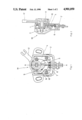
  • FIG. 1 is a plan view of a tilt sensor according to the present invention
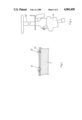
  • FIG. 2 is a sectional view taken along 2--2 line in FIG. 1;
  • FIG. 3 is an enlarged sectional view of a sliding resistive portion
  • FIG. 4 is an explanatory view upon attachment of the tilt sensor on a handle.
  • M indicates a tilt sensor and reference numeral 1 is a holding case which comprises a bottom plate 2 and a cover 3 for covering the bottom plate 2.
  • a main body of the tilt sensor M is contained in the case 1.
  • a base plate 4 is fixedly connected on the bottom plate 2.
  • a resistive element 8 and a current collector 9 are formed on the base plate 4 in a substantially circular arc shape.
  • a sliding member 10 is provided so as to contact with the resistive element 8 and the current collector 9.
  • the sliding member 10 is in engagement with an actuating shaft 12 connected to a steering shaft via an engaging shaft 11 and slides along the surface of the resistive element 8 and the current collector 9 in accordance with the degree of change of the angle of the steering shaft.
  • An analog signal is taken off a terminal 5 which corresponds to the angle degree of the steering shaft when a predetermined voltage is added between terminals 6 and 7.
  • the resistive element 8 has a double wall construction in which a base resistive element layer 21 is formed on the base plate 4 and a protective resistive element layer 22 is provided.
  • the volume inherent resistance of the protective resistive element layer 22 is set at a range of from 2 to 500 times the volume inherent resistance of the base resistive element layer 21.
  • the surface of the base resistive element layer 21 is covered by the protective resistive element layer 22 and is not directly exposed to the outside atmosphere, so that the base resistive element layer 21 is cut off and protected from the outside temperature, outside moisture, and dust. Further the sliding member 10 only slides along and contacts the protective resistive element layer 22, so that the base resistive element layer 21 is not subject to any wear.
  • the protective resistive element layer 22 is worn over a period of time by contact of the sliding member 10, however, the protective resistive element layer 22 and the base element layer 21 are in parallel contact with each other and the volume inherent resistance of the protective resistive element layer 22 is set at a range from 2 to 500 times the volume inherent resistance of the base resistive element layer 21, so that the resistance volume of the entire resistive element is not substantially influenced by the wear of the protective resistive element layer 22.
  • the present invention permits the tilt sensor to be made thin and of a small size so as to minimize the construction of the season.
  • a glass epoxy base plate having an electrode copper foil as the base plate 4 is used and a silver paste as an electrode 23 is deposited by screen printing on the base plate 4.
  • the paste is hardened for half an hour at 170° C.
  • a carbon paste (provided by Asahi Chemical Co., Ltd., having a seat resistance of about 350 ⁇ / ⁇ ) is deposited by screen printing as the base resistive element layer 21 and is hardened in one hour at 170° C.
  • a carbon paste (provided by Asahi Chemical Co., Ltd., having a seat resistance of about 3K ⁇ / ⁇ ) is deposited by screen printing and is hardened to provide the protective resistive layer 21.
  • the base resistive element layer 21 and the protective resistive element layer 22 are formed on the base plate 4.
  • airtight construction is not required due to the plural layer construction of the resistive element in the tilt sensor M and continuous measurements can be attained as in the conventional digital type sensor.
  • the above-mentioned effect can be obtained also in an analog type sensor using oxides as the rigid resistive element however, the degree of wear of the resistive element is greater and an output abnormality is generated. Such an output abnormality is not generated in the tilt sensor M of the present invention.

Landscapes

  • Engineering & Computer Science (AREA)
  • Chemical & Material Sciences (AREA)
  • Combustion & Propulsion (AREA)
  • Transportation (AREA)
  • Mechanical Engineering (AREA)
  • Physics & Mathematics (AREA)
  • General Physics & Mathematics (AREA)
  • Microelectronics & Electronic Packaging (AREA)
  • Measurement Of Length, Angles, Or The Like Using Electric Or Magnetic Means (AREA)
  • Adjustable Resistors (AREA)
  • Transmission And Conversion Of Sensor Element Output (AREA)
  • Steering Controls (AREA)

Abstract

A tilt sensor for a vehicle steering shaft includes a base resistive element layer formed in an opposed contact with a base plate surface. A plural layer structure is provided with a protective resistive element layer constructed by at least one layer formed on the base resistive element layer and an uppermost layer of the volume inherent reistance of the protective resistive element layer is higher than the volume inherent resistance of the base resistive element layer. The volume inherent resistance of the protective resistive element layer is from 2 to 500 times the volume inherent resistance of the base resistive element layer.

Description

BACKGROUND OF THE INVENTION
1. Field of the Invention
The present invention relates to a sliding resistive element layer and particularly to a tilt sensor for a vehicle steering shaft for controlling the angle of a steering shaft for a vehicle.
2. Description of Prior Art
A prior art technique for controlling the angle of a steering shaft for a vehicle is shown in FIG. 4. A switching end piece on a rotational shaft, rotated according to the angle of a handle, is provided on a tilt sensor 31 which determines the angle of a steering shaft 30. A switching end piece is contacted with a fixed contact formed on a base plate and a sensor for outputting the angle of the handle in digital form. However, the digital tilt sensor only detects ON-OFF conditions. Accordingly, it will not be fatal if, for example, dust enters into the case of the sensor device and the fixed contact is interrupted. Therefore, the structure of the case is relatively simple and is utilized for a tilt sensor in which size of the device is small and attaching positions of the device are limited, however, there is a problem in that detection of continuous volume change can not be performed.
On the other hand, continuous detection can be performed in an analog type sensor device in which a sliding member is provided on a resistive element and a current collector in order to obtain an output. Accordingly, precautions must be taken to prevent the resistive element being interrupted by dust invading from the outside and/or deformed by the outside heat. The case of such an analog sensor is required to be of airtight construction which creates a problem in that the whole sensor is of a large size. As a result, although the analog type is desirable as a tilt sensor of a vehicle steering shaft, it has not been used.
SUMMARY OF THE INVENTION
Accordingly, it is an object of the present invention to provide a tilt sensor for a vehicle steering shaft which is of small size and is lightweight.
The above object and others are achieved by a tilt sensor for a vehicle steering shaft including a base resistive element layer having an opposed contact with a base plate surface. A plural layer structure is provided with a protecting resistive element layer constructed by at least one layer formed on the base resistive element layer and a uppermost layer of the volume inherent resistance of the protective resistive element layer is greater than the volume inherent resistance of the base resistive element layer. The volume inherent resistance of the protective resistive element layer is from 2 to 500 times the volume inherent resistance of the base resistive element layer.
BRIEF DESCRIPTION OF THE DRAWINGS
FIG. 1 is a plan view of a tilt sensor according to the present invention;
FIG. 2 is a sectional view taken along 2--2 line in FIG. 1;
FIG. 3 is an enlarged sectional view of a sliding resistive portion; and
FIG. 4 is an explanatory view upon attachment of the tilt sensor on a handle.
DETAILED DESCRIPTION OF THE PREFERRED EMBODIMENTS
Referring to the FIGS. 1 and 2, M indicates a tilt sensor and reference numeral 1 is a holding case which comprises a bottom plate 2 and a cover 3 for covering the bottom plate 2. A main body of the tilt sensor M is contained in the case 1.
A base plate 4 is fixedly connected on the bottom plate 2. A resistive element 8 and a current collector 9 are formed on the base plate 4 in a substantially circular arc shape. A sliding member 10 is provided so as to contact with the resistive element 8 and the current collector 9.
The sliding member 10 is in engagement with an actuating shaft 12 connected to a steering shaft via an engaging shaft 11 and slides along the surface of the resistive element 8 and the current collector 9 in accordance with the degree of change of the angle of the steering shaft. An analog signal is taken off a terminal 5 which corresponds to the angle degree of the steering shaft when a predetermined voltage is added between terminals 6 and 7.
As shown in FIG. 3, the resistive element 8 has a double wall construction in which a base resistive element layer 21 is formed on the base plate 4 and a protective resistive element layer 22 is provided. The volume inherent resistance of the protective resistive element layer 22 is set at a range of from 2 to 500 times the volume inherent resistance of the base resistive element layer 21.
The surface of the base resistive element layer 21 is covered by the protective resistive element layer 22 and is not directly exposed to the outside atmosphere, so that the base resistive element layer 21 is cut off and protected from the outside temperature, outside moisture, and dust. Further the sliding member 10 only slides along and contacts the protective resistive element layer 22, so that the base resistive element layer 21 is not subject to any wear. The protective resistive element layer 22 is worn over a period of time by contact of the sliding member 10, however, the protective resistive element layer 22 and the base element layer 21 are in parallel contact with each other and the volume inherent resistance of the protective resistive element layer 22 is set at a range from 2 to 500 times the volume inherent resistance of the base resistive element layer 21, so that the resistance volume of the entire resistive element is not substantially influenced by the wear of the protective resistive element layer 22.
Accordingly, it is unnecessary to provide the conventional rigid and complete airtight construction of a holding case 1 of the main body of the tilt sensor M. Therefore, the present invention permits the tilt sensor to be made thin and of a small size so as to minimize the construction of the season.
In the method of manufacturing the resistive element, a glass epoxy base plate having an electrode copper foil as the base plate 4 is used and a silver paste as an electrode 23 is deposited by screen printing on the base plate 4. The paste is hardened for half an hour at 170° C. Next, a carbon paste (provided by Asahi Chemical Co., Ltd., having a seat resistance of about 350Ω/□) is deposited by screen printing as the base resistive element layer 21 and is hardened in one hour at 170° C. A carbon paste (provided by Asahi Chemical Co., Ltd., having a seat resistance of about 3KΩ/□) is deposited by screen printing and is hardened to provide the protective resistive layer 21. As a result, the base resistive element layer 21 and the protective resistive element layer 22 are formed on the base plate 4.
According to the present invention, airtight construction is not required due to the plural layer construction of the resistive element in the tilt sensor M and continuous measurements can be attained as in the conventional digital type sensor. The above-mentioned effect can be obtained also in an analog type sensor using oxides as the rigid resistive element however, the degree of wear of the resistive element is greater and an output abnormality is generated. Such an output abnormality is not generated in the tilt sensor M of the present invention.
By the foregoing, there has been disclosed a preferred form of tilt sensor in accordance with the present invention. It will be appreciated that various additional, substitutions, modifications and omissions may be made thereto without departing from the spirit of the invention.
The principles, preferred embodiments and modes of operation of the present invention have been described in the foregoing application. The invention which is intended to be protected herein should not, however, be construed as limited to the particular forms disclosed, as these are to be regarded as illustrative rather than restrictive. Variations and changes may be made by those skilled in the art without departing from the spirit of the present invention. Accordingly, the foregoing detailed description should be considered exemplary in nature and not limited to the scope and spirit of the invention as set forth in the appended claims.
Claims (3)

What is claimed is:
1. A tilt sensor for a vehicle steering shaft comprising:
a base plate;
a base resistive element layer provided on a surface of said base plate, said base resistive layer having a volume inherent resistance; and
a protective resistive element layer of at least one layer formed on said base resistive element layer, said protective resistive element having a volume inherent resistance;
said base resistive element layer and said protective resistive element layer together defining a plural layer structure in which the volume inherent resistance of the protective resistive layer is higher than the volume inherent resistance of the base resistive element layer.
2. A tilt sensor for a vehicle steering shaft as set forth in claim 1, wherein the volume inherent resistance of said protective resistive element layer is approximately 2 to 500 times higher than the volume inherent resistance of said base resistive element layer.
3. A tilt sensor for a vehicle steering shaft as set forth in claim 1, further including a current collector formed on the base plate.
US07/225,202 1987-07-29 1988-07-28 Tilt sensor for vehicle steering shaft Expired - Fee Related US4901050A (en)

Applications Claiming Priority (2)

Application Number Priority Date Filing Date Title
JP62-189780 1987-07-29
JP62189780A JPS6432101A (en) 1987-07-29 1987-07-29 Tilt sensor for steering shaft of automobile

Publications (1)

Publication Number Publication Date
US4901050A true US4901050A (en) 1990-02-13

Family

ID=16247079

Family Applications (1)

Application Number Title Priority Date Filing Date
US07/225,202 Expired - Fee Related US4901050A (en) 1987-07-29 1988-07-28 Tilt sensor for vehicle steering shaft

Country Status (2)

Country Link
US (1) US4901050A (en)
JP (1) JPS6432101A (en)

Cited By (2)

* Cited by examiner, † Cited by third party
Publication number Priority date Publication date Assignee Title
US5754091A (en) * 1996-04-09 1998-05-19 Kia Motors Corporation Potentiometer-type steering sensor
US20160078985A1 (en) * 2014-09-11 2016-03-17 Emhiser Research Limited Dual resolution potentiometer

Families Citing this family (3)

* Cited by examiner, † Cited by third party
Publication number Priority date Publication date Assignee Title
JPH07101643B2 (en) * 1989-05-18 1995-11-01 松下電器産業株式会社 Resistor for variable resistor
JPH0311601A (en) * 1989-06-08 1991-01-18 Murata Mfg Co Ltd Resistor base
US7907045B2 (en) 2007-03-19 2011-03-15 Kito Corporation Hoisting machine

Citations (3)

* Cited by examiner, † Cited by third party
Publication number Priority date Publication date Assignee Title
US3578409A (en) * 1967-08-23 1971-05-11 Trw Inc Sensors unaffected by humidity changes to detect toxic oxidizing vapors
US4500865A (en) * 1982-02-26 1985-02-19 Hitachi, Ltd. Fluid leakage detecting element
US4734065A (en) * 1985-06-05 1988-03-29 Sanshin Kogyo Kabushiki Kaisha System for stable running of marine propulsions

Patent Citations (3)

* Cited by examiner, † Cited by third party
Publication number Priority date Publication date Assignee Title
US3578409A (en) * 1967-08-23 1971-05-11 Trw Inc Sensors unaffected by humidity changes to detect toxic oxidizing vapors
US4500865A (en) * 1982-02-26 1985-02-19 Hitachi, Ltd. Fluid leakage detecting element
US4734065A (en) * 1985-06-05 1988-03-29 Sanshin Kogyo Kabushiki Kaisha System for stable running of marine propulsions

Cited By (3)

* Cited by examiner, † Cited by third party
Publication number Priority date Publication date Assignee Title
US5754091A (en) * 1996-04-09 1998-05-19 Kia Motors Corporation Potentiometer-type steering sensor
US20160078985A1 (en) * 2014-09-11 2016-03-17 Emhiser Research Limited Dual resolution potentiometer
US9558870B2 (en) * 2014-09-11 2017-01-31 Emhiser Research Limited Dual resolution potentiometer

Also Published As

Publication number Publication date
JPS6432101A (en) 1989-02-02

Similar Documents

Publication Publication Date Title
WO1998031044A3 (en) A field emitter device with a current limiter structure
US4901050A (en) Tilt sensor for vehicle steering shaft
JP2832911B2 (en) Variable resistor with switch
JPS6320084Y2 (en)
GB2122033A (en) Rotary potentiometer
JPS6386403A (en) Slottle sensor of internal combustion engine
US4479106A (en) Rotary electric component
IE820150L (en) Metal oxide varistor
EP0999431B1 (en) Method of manufacturing sensor and resistor element
US2939097A (en) Variable resistance device
JPH0236085Y2 (en)
JP2773125B2 (en) Variable resistor with switch
US3760321A (en) Concentric shaft encased variable electronic component
GB2032191A (en) Improvements in Electrical Resistors
JPS6244488Y2 (en)
US3657690A (en) Miniature variable-resistance device with flexible disk contact
US6201464B1 (en) Thermistor device having uninsulated peripheral edge
US5093648A (en) Rotational type variable resistor
JP2844640B2 (en) Variable resistance element
JP3013626B2 (en) Electric pressure sensor
GB817483A (en) Improvements in or relating to variable potentiometers
JPS5492278A (en) Thermal head
JPH054795B2 (en)
JP2574087Y2 (en) Position detection device
JPS5939391Y2 (en) Transparent touch key board switch

Legal Events

Date Code Title Description
AS Assignment

Owner name: AISIN SEIKI KABUSHIKI KAISHA, 1, ASAHI-MACHI, 2-CH

Free format text: ASSIGNMENT OF ASSIGNORS INTEREST.;ASSIGNORS:KOTAKI, MITSUKO;TSUZUKI, TAKAYOSHI;ODA, YUKIHISA;AND OTHERS;REEL/FRAME:004947/0940

Effective date: 19880916

Owner name: AISIN SEIKI KABUSHIKI KAISHA, A CORP. OF JAPAN, JA

Free format text: ASSIGNMENT OF ASSIGNORS INTEREST;ASSIGNORS:KOTAKI, MITSUKO;TSUZUKI, TAKAYOSHI;ODA, YUKIHISA;AND OTHERS;REEL/FRAME:004947/0940

Effective date: 19880916

FEPP Fee payment procedure

Free format text: PAYOR NUMBER ASSIGNED (ORIGINAL EVENT CODE: ASPN); ENTITY STATUS OF PATENT OWNER: LARGE ENTITY

REMI Maintenance fee reminder mailed
LAPS Lapse for failure to pay maintenance fees
FP Lapsed due to failure to pay maintenance fee

Effective date: 19940213

STCH Information on status: patent discontinuation

Free format text: PATENT EXPIRED DUE TO NONPAYMENT OF MAINTENANCE FEES UNDER 37 CFR 1.362