US4901002A - Current source having a wide range of output voltages - Google Patents
Current source having a wide range of output voltages Download PDFInfo
- Publication number
- US4901002A US4901002A US07/315,009 US31500989A US4901002A US 4901002 A US4901002 A US 4901002A US 31500989 A US31500989 A US 31500989A US 4901002 A US4901002 A US 4901002A
- Authority
- US
- United States
- Prior art keywords
- transistor
- collector
- emitter
- output
- transistors
- Prior art date
- Legal status (The legal status is an assumption and is not a legal conclusion. Google has not performed a legal analysis and makes no representation as to the accuracy of the status listed.)
- Expired - Fee Related
Links
- 229920006395 saturated elastomer Polymers 0.000 description 4
- 238000004519 manufacturing process Methods 0.000 description 2
- 230000008878 coupling Effects 0.000 description 1
- 238000010168 coupling process Methods 0.000 description 1
- 238000005859 coupling reaction Methods 0.000 description 1
- 238000000034 method Methods 0.000 description 1
Images
Classifications
-
- G—PHYSICS
- G05—CONTROLLING; REGULATING
- G05F—SYSTEMS FOR REGULATING ELECTRIC OR MAGNETIC VARIABLES
- G05F1/00—Automatic systems in which deviations of an electric quantity from one or more predetermined values are detected at the output of the system and fed back to a device within the system to restore the detected quantity to its predetermined value or values, i.e. retroactive systems
- G05F1/10—Regulating voltage or current
- G05F1/46—Regulating voltage or current wherein the variable actually regulated by the final control device is DC
- G05F1/56—Regulating voltage or current wherein the variable actually regulated by the final control device is DC using semiconductor devices in series with the load as final control devices
- G05F1/565—Regulating voltage or current wherein the variable actually regulated by the final control device is DC using semiconductor devices in series with the load as final control devices sensing a condition of the system or its load in addition to means responsive to deviations in the output of the system, e.g. current, voltage, power factor
-
- G—PHYSICS
- G05—CONTROLLING; REGULATING
- G05F—SYSTEMS FOR REGULATING ELECTRIC OR MAGNETIC VARIABLES
- G05F1/00—Automatic systems in which deviations of an electric quantity from one or more predetermined values are detected at the output of the system and fed back to a device within the system to restore the detected quantity to its predetermined value or values, i.e. retroactive systems
- G05F1/10—Regulating voltage or current
- G05F1/46—Regulating voltage or current wherein the variable actually regulated by the final control device is DC
- G05F1/56—Regulating voltage or current wherein the variable actually regulated by the final control device is DC using semiconductor devices in series with the load as final control devices
- G05F1/59—Regulating voltage or current wherein the variable actually regulated by the final control device is DC using semiconductor devices in series with the load as final control devices including plural semiconductor devices as final control devices for a single load
- G05F1/595—Regulating voltage or current wherein the variable actually regulated by the final control device is DC using semiconductor devices in series with the load as final control devices including plural semiconductor devices as final control devices for a single load semiconductor devices connected in series
Definitions
- the present invention relates to a current source having a wide range of output voltages, in which source the emitter-collector path of a main transistor, arranged to define the value of the current of the current source, is arranged in series with the emitter-collector path of at least one output transistor.
- the invention proposes a current source of the type defined in the opening paragraph, whose current is comparatively large and which can operate at output voltages ranging between one collector-emitter voltage of an output transistor in the saturation mode V CEsat and a value as close as possible to the supply voltage.
- the principle underlying the invention is to combine each output transistor with an associated control transistor of the opposite type whose emitter potential is fixed by coupling this control transistor to another stage, and to operate the output transistors in the BV CEO mode for low output voltages.
- the current source in accordance with the invention is therefore characterized in that it comprises n output transistors, where n ⁇ 2, the first output transistor having its collector connected to the emitter of the main transistor, the p th transistor, where 1 ⁇ p ⁇ n, having its collector connected to the emitter of the (p-1) th transistor, the emitter of the n th transistor constituting the output of the current source, and in that every q th output transistor is associated with a q th control transistor of the opposite type, whose base includes at least one diode poled in the forward direction and referred (i.e.
- U.S. Pat. No. 3,940,683 discloses a circuit of different design, consisting of a current source comprising cascaded transistors in which only the main transistor includes a diode poled in the forward direction in its base.
- said reference potentials are each fixed at the maximum value corresponding to the minimum possible values for the collector-emitter voltages of the output transistors in the saturation mode V CEsat .
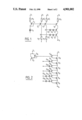
- FIGS. 1 to 3 by way of illustration show test circuits not previously published by the Applicant.
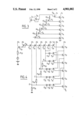
- FIG. 4 shows an embodiment of the invention.
- a pnp-type main transistor T 0 has its emitter coupled to a supply voltage source V c via a resistor R 0 and has its collector connected to the emitter of a transistor T 1 whose collector is connected to the emitter of a transistor T 2 .
- the transistors T 1 and T 2 have their bases connected to two diodes in series, which diodes (D 1 , D' 1 ) and (D 2 , D' 2 ) are poled in the forward direction and serve to ensure that the transistors T 1 and T 2 are operated in the BV CEO mode for low levels of the output voltage V s .
- the number of diodes needed is dictated by the values of the voltages to be handled by these diodes.
- the cathodes of the diodes D' 1 and D' 2 are brought to potentials determined by the current sources (T" 1 , R" 1 ) and (T" 2 , R" 2 ) respectively and by the values of the resistors R 1 and R 2 , which are respectively arranged between points A and B and the common mode terminal.
- a transistor T 3 having its base and collector short-circuited and cooperating with a current source I 3 constitutes a conventional current mirror with the transistors T 0 , T" 1 and T" 2 .
- the output voltage V s is available on the collector of the transistor T 2 . This output voltage varies depending on the load applied to the collector of the transistor T 2 .
- the transistors T 1 and T 2 When the output voltage V s is low (for example of the order of 0.7 V) the transistors T 1 and T 2 will operate in the BV CEO mode, while the transistor T 0 remains in a normal mode of operation. When the output voltage V s approximates to the value of the supply voltage V c (for example, 30 V) the transistors T 1 , T 2 and T 0 will operate in the saturation mode.
- this current problem is solved by employing cells comprising a pnp transistor and an npn transistor.
- the collector current of the pnp transistor is divided by the current gain ⁇ of the associated npn transistor, which itself can supply an adequate current.
- each cell comprises an npn transistor (T 10 . . . T 15 ) and a pnp transistor (T' 10 . . . T' 15 ), the collector of the pnp transistor being connected to the base of the associated npn transistor and the emitter of the pnp transistor being connected to the collector of the npn transistor.
- This type of cell for use in current sources, is known per se, from GB 1,285,621 (FIG. 9) or German patent application DE-OS 2,157,626 or DE-OS 2,738,205.
- the transistors T' 11 to T' 15 have diodes D 11 , D 12 , D 13 , D 14 and D' 14 , D 15 and D' 15 respectively, poled in the forward direction, connected to their bases and each referred to a given fixed potential.
- the transistors T 16 and T 17 are arranged to form a current mirror with the transistor T 10 .
- npn transistors have been replaced by six cells because the BV CEO of an npn transistor is smaller than that of a pnp transistor, in the present example by a factor of approximately 3.
- V s i.e. the output voltage available on the emitter of T 15 .
- V BE npn base-emitter voltage of an npn transistor ⁇ 0.8 V
- FIG. 3 relates to a circuit arrangement which enables this difference to be reduced and to be brought to approximately 6 V CEsat npn.
- the emitter of the transistors T' 11 to T' 15 are no longer connected to the collectors of the transistors T 11 to T 15 , but are coupled to fixed reference potentials via resistors R' 11 to R' 15 .
- the transistor T' 15 For low output levels the transistor T' 15 should be operated fully in the BV CEO mode and the emitter voltage of the transistor T' 15 should be fixed at approximately V s (min) +V BEnpn +BV CEO , V s (min) being the minimum value of the voltage V s .
- the circuit arrangement in accordance with the invention shown in FIG. 4 comprises npn type transistors T 30 to T 35 whose collector-emitter paths are arranged in series in the same way as those of the transistors T 10 to T 15 .
- a transistor T' 30 having its collector connected to the base of the transistor T 30 and having its emitter connected to the supply voltage source V c is arranged as a conventional current mirror with the transistors T 36 and T 37 .
- the transistors T' 31 to T' 35 constituting the control transistors associated with the output transistors T 31 to T 35 have their collectors connected to the bases of the transistors T 31 to T 35 respectively.
- the emitters of the transistors T' 31 and T' 32 are connected to the supply voltage source V C
- the emitters of the transistors T' 33 to T' 35 are connected to the collectors of the transistors T 31 to T 33 respectively.
- the bases of the transistors T' 31 to T' 35 are connected to diodes D 31 , D 32 , D 33 and D' 33 , D 34 and D' 34 , D 35 and D' 35 respectively, which diodes are poled in the forward direction and serve to enable operation in the BV CEO mode in the case of low output voltages V s on the emitter of the transistor T 35 .
- the base reference potential of the transistors T' 31 to T' 35 is determined by current sources formed by the transistors T" 31 to T" 35 arranged as a current mirror with the transistors T 36 and T 37 , and by four resistors R 32 to R 35 arranged in series.
- the resistors R 32 to R 34 are arranged in parallel between the cathodes of the diodes D 32 and D' 33 (points A' and B'), D' 33 and D' 34 (points B' and C'), D' 34 and D' 35 (points C' and D') respectively.
- the resistor R 35 is arranged between the cathode of the diode D' 35 and the common-mode terminal.
- b-1 2 places in rank.
- E(b)-1 the maximum of (aliquot part of b)-1, i.e E(b)-1.
- the integer part E(b) of a number "b" is the portion of the number to the left of the decimal point.
- the emitter potential of, for example, the transistor T' 35 is equal to the collector potential of the transistor T 33 , so that the drawback of the experimental circuit shown in FIG. 3 is avoided, because the emitter voltage of the transistors T' 33 , T' 34 and T' 35 varies as a functionion of the output voltage V s .
- the maximum voltage available on the output is closer to V c than in the experimental circuit of FIG. 2.
- V BE be the base-emitter voltage of a transistor (approximately 0.7 V).
- V n be the emitter-collector voltage of a saturated npn transistor.
- V p be the emitter-collector voltage of a saturated pnp transistor.
- the emitter voltage of T 30 can reach the value
- the emitter voltage of T 31 can reach the value
- the emitter voltage of T 32 can reach the value
- the emitter voltage of T 33 can reach the value
- the emitter voltage of T 34 can reach the value
- the maximum output voltage V s available on the emitter of the transistor T 35 can reach the value
- the circuit can be powered with 30 V, which for example enables a varicap diode to be operated between approximately 0.7 V and 28 V. Since the diodes are formed by means of npn transistors, which can handle a maximum voltage of 20 V (operation in the BV CEO mode), the voltages to be handled being higher than said value for the bases of the transistors T' 33 to T' 35 , two diodes are required for these transistors.
- a requirement to be met is that the transistors T 30 and T' 30 should not come into the avalanche region because these are the two transistors which limit the current.
- the collector voltage of the transistor T 31 is, for example, V B' +3V BE , V B' being the voltage on point B'.
- the potentials on points A', C' and D' are referred to as V A' , V C' and V D' .
- V D31 is the voltage across the diode D 31
- V BE (T' 31 ) the base-emitter voltage of the transistor T' 31 in the BV CEO region.
- the circuit shown in FIG. 4 enables the advantages of the circuits shown in FIGS. 2 and 3 to be obtained without their drawbacks.
- the circuits shown in FIG. 4 has the additional advantage that the difference between the collector currents of the transistors T 30 and T 35 is small in comparison with the situation in FIG. 3, because the currents drawn by the pnp transistors are re-injected into the npn transistors.
- Another advantage of this circuit arrangement is that it can operate even in the case where the transistors T' 33 to T' 35 are in the BV CEO mode, the main current being limited by the transistor T 30 .
Landscapes
- Engineering & Computer Science (AREA)
- Physics & Mathematics (AREA)
- Electromagnetism (AREA)
- General Physics & Mathematics (AREA)
- Radar, Positioning & Navigation (AREA)
- Automation & Control Theory (AREA)
- Amplifiers (AREA)
- Control Of Electrical Variables (AREA)
- Bipolar Integrated Circuits (AREA)
Abstract
A current source having a wide range of output voltages. The emitter-collector path of a main transistor (T30) of the npn type, arranged to define the value of the current, is connected in series with the collector-emitter paths of a plurality of cascaded npn-type output transistors (T31 . . . T35). Each output transistor (T31 . . . T35) is associated with a respective control transistor (T'31 . . . T'35) of the opposite type. At least some of the control transistors have their emitters connected to respective collectors of output transistors of a different rank. This yields an output voltage Vs which can range between small values and a value close to the supply voltage Vc.
Description
The present invention relates to a current source having a wide range of output voltages, in which source the emitter-collector path of a main transistor, arranged to define the value of the current of the current source, is arranged in series with the emitter-collector path of at least one output transistor.
Such a current source is known from U.S. Pat. No. 3,940,683.
By arranging at least one output transistor in series it is possible to obtain output voltages higher than those normally attainable with the I.C. fabrication process for a transistor, but the maximum output voltage then differs substantially from the available supply voltage, which difference increases as the number of output transistors increases.
The invention proposes a current source of the type defined in the opening paragraph, whose current is comparatively large and which can operate at output voltages ranging between one collector-emitter voltage of an output transistor in the saturation mode VCEsat and a value as close as possible to the supply voltage.
The principle underlying the invention is to combine each output transistor with an associated control transistor of the opposite type whose emitter potential is fixed by coupling this control transistor to another stage, and to operate the output transistors in the BVCEO mode for low output voltages.
The current source in accordance with the invention is therefore characterized in that it comprises n output transistors, where n≧2, the first output transistor having its collector connected to the emitter of the main transistor, the pth transistor, where 1<p≦n, having its collector connected to the emitter of the (p-1)th transistor, the emitter of the nth transistor constituting the output of the current source, and in that every qth output transistor is associated with a qth control transistor of the opposite type, whose base includes at least one diode poled in the forward direction and referred (i.e. coupled) to a qth reference potential, whose collector is connected to the base of the corresponding qth output transistor, and whose emitter is connected to the collector of the (q-r)th output transistor if q>r and to the collector of the main transistor as well as to a supply voltage source if q≦r, where r≧1.
It is to be noted that U.S. Pat. No. 3,940,683 discloses a circuit of different design, consisting of a current source comprising cascaded transistors in which only the main transistor includes a diode poled in the forward direction in its base.
In a preferred embodiment r is smaller than or equal to the integer contained in b minus one, b being the ratio between the BVCEO values of the npn and pnp transistors, for example, r=2 and p=5.
In an advantageous embodiment said reference potentials are each fixed at the maximum value corresponding to the minimum possible values for the collector-emitter voltages of the output transistors in the saturation mode VCEsat.
The invention will now be described in more detail, by way of non-limitative example, with reference to the accompanying drawings, in which:
FIGS. 1 to 3 by way of illustration show test circuits not previously published by the Applicant, and
FIG. 4 shows an embodiment of the invention.
In FIG. 1 a pnp-type main transistor T0 has its emitter coupled to a supply voltage source Vc via a resistor R0 and has its collector connected to the emitter of a transistor T1 whose collector is connected to the emitter of a transistor T2. The transistors T1 and T2 have their bases connected to two diodes in series, which diodes (D1, D'1) and (D2, D'2) are poled in the forward direction and serve to ensure that the transistors T1 and T2 are operated in the BVCEO mode for low levels of the output voltage Vs. The number of diodes needed is dictated by the values of the voltages to be handled by these diodes. For this purpose the cathodes of the diodes D'1 and D'2 (points A and B respectively) are brought to potentials determined by the current sources (T"1, R"1) and (T"2, R"2) respectively and by the values of the resistors R1 and R2, which are respectively arranged between points A and B and the common mode terminal.
A transistor T3 having its base and collector short-circuited and cooperating with a current source I3 constitutes a conventional current mirror with the transistors T0, T"1 and T"2. The output voltage Vs is available on the collector of the transistor T2. This output voltage varies depending on the load applied to the collector of the transistor T2.
When the output voltage Vs is low (for example of the order of 0.7 V) the transistors T1 and T2 will operate in the BVCEO mode, while the transistor T0 remains in a normal mode of operation. When the output voltage Vs approximates to the value of the supply voltage Vc (for example, 30 V) the transistors T1, T2 and T0 will operate in the saturation mode.
The problem with this circuit arrangement is that it is difficult to realize integrated pnp transistors supplying a collector current which is adequate for specific uses, for example 1 mA for driving a varicap diode of a tuner in a radio or TV receiver.
In FIG. 2 this current problem is solved by employing cells comprising a pnp transistor and an npn transistor. The collector current of the pnp transistor is divided by the current gain β of the associated npn transistor, which itself can supply an adequate current.
In FIG. 2 each cell comprises an npn transistor (T10 . . . T15) and a pnp transistor (T'10 . . . T'15), the collector of the pnp transistor being connected to the base of the associated npn transistor and the emitter of the pnp transistor being connected to the collector of the npn transistor. This type of cell, for use in current sources, is known per se, from GB 1,285,621 (FIG. 9) or German patent application DE-OS 2,157,626 or DE-OS 2,738,205. The transistors T'11 to T'15 have diodes D11, D12, D13, D14 and D'14, D15 and D'15 respectively, poled in the forward direction, connected to their bases and each referred to a given fixed potential. The transistors T16 and T17 are arranged to form a current mirror with the transistor T10.
Thus, three pnp transistors have been replaced by six cells because the BVCEO of an npn transistor is smaller than that of a pnp transistor, in the present example by a factor of approximately 3.
The problem of this arrangement is that as Vs, i.e. the output voltage available on the emitter of T15, increases its maximum value Vsmax is limited to
V.sub.c -6V.sub.BE npn -6V.sub.CEsat pnp
where
VBE npn =base-emitter voltage of an npn transistor ≃0.8 V, Vp =VCEsat pnp=the emitter-collector voltage of a saturated pnp transistor ≃0.1 V,
which means that
V.sub.smax =V.sub.c -5.4V.
FIG. 3 relates to a circuit arrangement which enables this difference to be reduced and to be brought to approximately 6 VCEsat npn. In order to achieve this the emitter of the transistors T'11 to T'15 are no longer connected to the collectors of the transistors T11 to T15, but are coupled to fixed reference potentials via resistors R'11 to R'15.
For low output levels the transistor T'15 should be operated fully in the BVCEO mode and the emitter voltage of the transistor T'15 should be fixed at approximately Vs(min) +VBEnpn +BVCEO, Vs(min) being the minimum value of the voltage Vs.
Conversely, for high output levels the collector voltage of the transistor T'15 should be very close to VC. This implies inverse operation of this transistor and hence a limited use of this arrangement as regards the output levels.
The circuit arrangement in accordance with the invention shown in FIG. 4 comprises npn type transistors T30 to T35 whose collector-emitter paths are arranged in series in the same way as those of the transistors T10 to T15.
A transistor T'30 having its collector connected to the base of the transistor T30 and having its emitter connected to the supply voltage source Vc is arranged as a conventional current mirror with the transistors T36 and T37. The transistors T'31 to T'35 constituting the control transistors associated with the output transistors T31 to T35 have their collectors connected to the bases of the transistors T31 to T35 respectively. The emitters of the transistors T'31 and T'32 are connected to the supply voltage source VC, and the emitters of the transistors T'33 to T'35 are connected to the collectors of the transistors T31 to T33 respectively. The bases of the transistors T'31 to T'35 are connected to diodes D31, D32, D33 and D'33, D34 and D'34, D35 and D'35 respectively, which diodes are poled in the forward direction and serve to enable operation in the BVCEO mode in the case of low output voltages Vs on the emitter of the transistor T35. The base reference potential of the transistors T'31 to T'35 is determined by current sources formed by the transistors T"31 to T"35 arranged as a current mirror with the transistors T36 and T37, and by four resistors R32 to R35 arranged in series. The resistors R32 to R34 are arranged in parallel between the cathodes of the diodes D32 and D'33 (points A' and B'), D'33 and D'34 (points B' and C'), D'34 and D'35 (points C' and D') respectively. The resistor R35 is arranged between the cathode of the diode D'35 and the common-mode terminal.
This arrangement corresponds to a situation in which Vc ≦6 BVCEO (npn) in order to ensure a stable voltage and for which:
3BV.sub.CEO (npn)=BV.sub.CEO (pnp).
For a low output voltage Vs, the ratio b between the BVCEO of the npn and pnp transistors enables the collector of a control transistor to be connected to that of an output transistor which differs by b-1=2 places in rank. In general it is possible to realize a shift by a number of ranking places equal to the maximum of (aliquot part of b)-1, i.e E(b)-1. The integer part E(b) of a number "b" is the portion of the number to the left of the decimal point.
For high output voltages the emitter potential of, for example, the transistor T'35 is equal to the collector potential of the transistor T33, so that the drawback of the experimental circuit shown in FIG. 3 is avoided, because the emitter voltage of the transistors T'33, T'34 and T'35 varies as a functiion of the output voltage Vs.
Moreover, as will now be shown, the maximum voltage available on the output is closer to Vc than in the experimental circuit of FIG. 2.
Let VBE be the base-emitter voltage of a transistor (approximately 0.7 V).
Let Vn be the emitter-collector voltage of a saturated npn transistor.
Let Vp be the emitter-collector voltage of a saturated pnp transistor.
For high output voltages Vs the transistors T30 to T35 and T'30 to T'35 are saturated.
The emitter voltage of T30 can reach the value
V.sub.c -V.sub.p -V.sub.BE
The emitter voltage of T31 can reach the value
V.sub.c -V.sub.p -V.sub.n -V.sub.BE
The emitter voltage of T32 can reach the value
V.sub.c -V.sub.p -2V.sub.n -V.sub.BE
The emitter voltage of T33 can reach the value
V.sub.c -2V.sub.p -2V.sub.BE
The emitter voltage of T34 can reach the value
V.sub.c -2V.sub.p -V.sub.n -2V.sub.BE.
The maximum output voltage Vs available on the emitter of the transistor T35 can reach the value
V.sub.c -2V.sub.p -2V.sub.n -2V.sub.BE.
By way of example a method of fabricating bipolar integrated circuits, enabling analog and digital circuits to be integrated simultaneously, has the following characteristic values:
V.sub.n =0.1 V, V.sub.p =0.1 V, V.sub.BE ≃0.8 V
BV.sub.CEO npn=5 V
BV.sub.CEO pnp=15 V
The maximum permissible voltage is then:
V.sub.s =V.sub.c -1.8 V.
For the number of cascaded transistors in FIG. 4 the circuit can be powered with 30 V, which for example enables a varicap diode to be operated between approximately 0.7 V and 28 V. Since the diodes are formed by means of npn transistors, which can handle a maximum voltage of 20 V (operation in the BVCEO mode), the voltages to be handled being higher than said value for the bases of the transistors T'33 to T'35, two diodes are required for these transistors.
A requirement to be met is that the transistors T30 and T'30 should not come into the avalanche region because these are the two transistors which limit the current.
It is advantageous to provide the resistor bridge R32 to R35 in order to ensure that the base potential of the transistors T'33 to T'35 has the maximum value corresponding to the minimum possible value for the collector-emitter voltages of the transistors T30 to T32. The collector voltage of the transistor T31 is, for example, VB' +3VBE, VB' being the voltage on point B'. The potentials on points A', C' and D' are referred to as VA', VC' and VD'.
For example, the following relationship may be used:
V.sub.C -V.sub.A' =V.sub.D31 +V.sub.BE (T'.sub.31)
where
VD31 is the voltage across the diode D31
VBE (T'31)=the base-emitter voltage of the transistor T'31 in the BVCEO region.
The voltages on points B', C' and D' are then dictated by the requirement imposed by the above relationship.
Thus, the circuit shown in FIG. 4 enables the advantages of the circuits shown in FIGS. 2 and 3 to be obtained without their drawbacks. The circuits shown in FIG. 4 has the additional advantage that the difference between the collector currents of the transistors T30 and T35 is small in comparison with the situation in FIG. 3, because the currents drawn by the pnp transistors are re-injected into the npn transistors.
Another advantage of this circuit arrangement is that it can operate even in the case where the transistors T'33 to T'35 are in the BVCEO mode, the main current being limited by the transistor T30.
Claims (6)
1. A current source having a wide range of output voltages, said source comprising: an emitter-collector path of a main transistor of the npn type, arranged to define the value of the current of the current source, connected in series with the emitter-collector paths of n output transistors of the npn type, where n≧2, each of said ouput transistors having an emitter, a base and a collector, a first output transistor having its collector connected to the emitter of the main transistor, a pth output transistor, where 1<p≦n, having its collector connected to the emitter of the (p-1)th output transistor, the emitter of the nth output transistor constituting an output of the current sourse, wherein every qth output transistor is associated with a qth control transistor of the opposite type, whose base includes at least one diode poled in the forward direction and referred to a qth reference potential, whose collector is connected to the base of the qth output transistor, and whose emitter is connected to the collector of the (q-r)th output transistor if q>r and to the collector of the main transistor and to a supply voltage source if q≦r, where r≧1.
2. A current source as claimed in claim 1, wherein r≦E(b)-1, where b is the ratio between the BVCEO values of the npn and pnp transistors and E(b) is the integer part of b.
3. A current source as claimed in claim 2, wherein r=2 and p=5.
4. A current source as claimed in claim 3, wherein said reference potential is fixed at a maximum value corresponding to the minimum possible values for the collector-emitter voltages of the output transistors in a saturation mode.
5. A current source as claimed in claim 1, wherein said reference potential is fixed at a maximum value corresponding to the minimum possible values for the collector-emitter voltages of the output transistors in a saturation mode.
6. A current source as claimed in claim 2, wherein said reference potential is fixed at a maximum value corresponding to the minimum possible values for the collector-emitter voltages of the output transistors in a saturation mode.
Applications Claiming Priority (2)
| Application Number | Priority Date | Filing Date | Title |
|---|---|---|---|
| FR8802772A FR2628230B1 (en) | 1988-03-04 | 1988-03-04 | CURRENT SOURCE WITH EXTENDED RANGE OF OUTPUT VOLTAGES |
| FR8802772 | 1988-03-04 |
Publications (1)
| Publication Number | Publication Date |
|---|---|
| US4901002A true US4901002A (en) | 1990-02-13 |
Family
ID=9363918
Family Applications (1)
| Application Number | Title | Priority Date | Filing Date |
|---|---|---|---|
| US07/315,009 Expired - Fee Related US4901002A (en) | 1988-03-04 | 1989-02-23 | Current source having a wide range of output voltages |
Country Status (7)
| Country | Link |
|---|---|
| US (1) | US4901002A (en) |
| EP (1) | EP0331253B1 (en) |
| JP (1) | JPH01266613A (en) |
| KR (1) | KR890015505A (en) |
| DE (1) | DE68907748T2 (en) |
| FR (1) | FR2628230B1 (en) |
| HK (1) | HK178395A (en) |
Cited By (2)
| Publication number | Priority date | Publication date | Assignee | Title |
|---|---|---|---|---|
| US5757175A (en) * | 1996-08-06 | 1998-05-26 | Mitsubishi Denki Kabushiki Kaisha | Constant current generating circuit |
| US8085006B2 (en) | 2006-02-17 | 2011-12-27 | Infineon Technologies Ag | Shunt regulator |
Citations (3)
| Publication number | Priority date | Publication date | Assignee | Title |
|---|---|---|---|---|
| US2888525A (en) * | 1956-03-02 | 1959-05-26 | Emerson Electric Mfg Co | Telescopic voltage amplifier |
| US3940683A (en) * | 1974-08-12 | 1976-02-24 | Signetics Corporation | Active breakdown circuit for increasing the operating range of circuit elements |
| US4166971A (en) * | 1978-03-23 | 1979-09-04 | Bell Telephone Laboratories, Incorporated | Current mirror arrays |
Family Cites Families (4)
| Publication number | Priority date | Publication date | Assignee | Title |
|---|---|---|---|---|
| DE1226193B (en) * | 1959-03-26 | 1966-10-06 | Siemens Ag | Circuit arrangement for regulating the output voltage of a medium voltage power supply by means of transistors |
| GB937506A (en) * | 1960-12-01 | 1963-09-25 | Westinghouse Brake & Signal | Improvements relating to power transistors and voltage regulating circuits therefor |
| US3181010A (en) * | 1962-12-28 | 1965-04-27 | North American Aviation Inc | Transistor current control circuit |
| DE2256603C3 (en) * | 1972-11-17 | 1978-04-20 | Siemens Ag, 1000 Berlin Und 8000 Muenchen | Transistor control circuit for obtaining a constant DC voltage |
-
1988
- 1988-03-04 FR FR8802772A patent/FR2628230B1/en not_active Expired - Fee Related
-
1989
- 1989-02-23 US US07/315,009 patent/US4901002A/en not_active Expired - Fee Related
- 1989-02-27 DE DE89200468T patent/DE68907748T2/en not_active Expired - Fee Related
- 1989-02-27 EP EP89200468A patent/EP0331253B1/en not_active Expired - Lifetime
- 1989-03-02 KR KR1019890002549A patent/KR890015505A/en not_active Abandoned
- 1989-03-04 JP JP1051016A patent/JPH01266613A/en active Pending
-
1995
- 1995-11-23 HK HK178395A patent/HK178395A/en not_active IP Right Cessation
Patent Citations (3)
| Publication number | Priority date | Publication date | Assignee | Title |
|---|---|---|---|---|
| US2888525A (en) * | 1956-03-02 | 1959-05-26 | Emerson Electric Mfg Co | Telescopic voltage amplifier |
| US3940683A (en) * | 1974-08-12 | 1976-02-24 | Signetics Corporation | Active breakdown circuit for increasing the operating range of circuit elements |
| US4166971A (en) * | 1978-03-23 | 1979-09-04 | Bell Telephone Laboratories, Incorporated | Current mirror arrays |
Cited By (2)
| Publication number | Priority date | Publication date | Assignee | Title |
|---|---|---|---|---|
| US5757175A (en) * | 1996-08-06 | 1998-05-26 | Mitsubishi Denki Kabushiki Kaisha | Constant current generating circuit |
| US8085006B2 (en) | 2006-02-17 | 2011-12-27 | Infineon Technologies Ag | Shunt regulator |
Also Published As
| Publication number | Publication date |
|---|---|
| FR2628230A1 (en) | 1989-09-08 |
| EP0331253A1 (en) | 1989-09-06 |
| KR890015505A (en) | 1989-10-30 |
| DE68907748D1 (en) | 1993-09-02 |
| FR2628230B1 (en) | 1990-06-22 |
| JPH01266613A (en) | 1989-10-24 |
| HK178395A (en) | 1995-12-01 |
| EP0331253B1 (en) | 1993-07-28 |
| DE68907748T2 (en) | 1994-02-10 |
Similar Documents
| Publication | Publication Date | Title |
|---|---|---|
| US4806790A (en) | Sample-and-hold circuit | |
| US3743850A (en) | Integrated current supply circuit | |
| US4109162A (en) | Multi-stage integrated injection logic circuit with current mirror | |
| US4329597A (en) | Logic circuit | |
| US4864166A (en) | Tri-state logic level converter circuit | |
| GB1598899A (en) | Logic circuits | |
| US5359241A (en) | ECL circuit | |
| US4658205A (en) | Reference voltage generating circuit | |
| US4833344A (en) | Low voltage bias circuit | |
| US4429270A (en) | Switched current source for sourcing current to and sinking current from an output node | |
| US3828241A (en) | Regulated voltage supply circuit which compensates for temperature and input voltage variations | |
| US4901002A (en) | Current source having a wide range of output voltages | |
| US4221979A (en) | Non-inverting buffer circuits | |
| US4977336A (en) | Schmitt-trigger circuit having no discrete resistor | |
| US5099139A (en) | Voltage-current converting circuit having an output switching function | |
| JPS6038925A (en) | Signal converter | |
| EP0102675A2 (en) | Transistor-transistor logic circuit with hysteresis | |
| US4502016A (en) | Final bridge stage for a receiver audio amplifier | |
| US4590389A (en) | Compensation circuit and method for stabilization of a circuit node by multiplication of displacement current | |
| US5670868A (en) | Low-constant voltage supply circuit | |
| US4553107A (en) | Current mirror circuit having stabilized output current | |
| EP0161015A1 (en) | Input circuit for producing discharge path to enhance operation | |
| EP0346978B1 (en) | Integrated current-mirror arrangement comprising vertical transistors | |
| US4259599A (en) | Complementary transistor switching circuit | |
| US4171492A (en) | Temperature compensated zener diode arrangement |
Legal Events
| Date | Code | Title | Description |
|---|---|---|---|
| AS | Assignment |
Owner name: U.S. PHILIPS CORPORATION, NEW YORK Free format text: ASSIGNMENT OF ASSIGNORS INTEREST.;ASSIGNOR:SIMON, MARC;REEL/FRAME:005092/0530 Effective date: 19890328 |
|
| FEPP | Fee payment procedure |
Free format text: PAYOR NUMBER ASSIGNED (ORIGINAL EVENT CODE: ASPN); ENTITY STATUS OF PATENT OWNER: LARGE ENTITY |
|
| FPAY | Fee payment |
Year of fee payment: 4 |
|
| REMI | Maintenance fee reminder mailed | ||
| LAPS | Lapse for failure to pay maintenance fees | ||
| FP | Lapsed due to failure to pay maintenance fee |
Effective date: 19980218 |
|
| STCH | Information on status: patent discontinuation |
Free format text: PATENT EXPIRED DUE TO NONPAYMENT OF MAINTENANCE FEES UNDER 37 CFR 1.362 |