US4862697A - Cryopump with vibration isolation - Google Patents

Cryopump with vibration isolation Download PDF

Info

Publication number
US4862697A
US4862697A US07/210,724 US21072488A US4862697A US 4862697 A US4862697 A US 4862697A US 21072488 A US21072488 A US 21072488A US 4862697 A US4862697 A US 4862697A
Authority
US
United States
Prior art keywords
bellows
cryopump
dynamic absorber
vibration
secured
Prior art date
Legal status (The legal status is an assumption and is not a legal conclusion. Google has not performed a legal analysis and makes no representation as to the accuracy of the status listed.)
Expired - Fee Related
Application number
US07/210,724
Inventor
Halil Tugal
Bruce R. Bent
Current Assignee (The listed assignees may be inaccurate. Google has not performed a legal analysis and makes no representation or warranty as to the accuracy of the list.)
Azenta Inc
Original Assignee
Helix Technology Corp
Priority date (The priority date is an assumption and is not a legal conclusion. Google has not performed a legal analysis and makes no representation as to the accuracy of the date listed.)
Filing date
Publication date
Application filed by Helix Technology Corp filed Critical Helix Technology Corp
Priority to US07/210,724 priority Critical patent/US4862697A/en
Assigned to HELIX TECHNOLOGY CORPORATION, 266 SECOND AVENUE, WALTHAM, MA 02254, A CORP. OF DE reassignment HELIX TECHNOLOGY CORPORATION, 266 SECOND AVENUE, WALTHAM, MA 02254, A CORP. OF DE ASSIGNMENT OF ASSIGNORS INTEREST. Assignors: BENT, BRUCE R., TUGAL, HALIL
Application granted granted Critical
Publication of US4862697A publication Critical patent/US4862697A/en
Assigned to BROOKS AUTOMATION, INC. reassignment BROOKS AUTOMATION, INC. ASSIGNMENT OF ASSIGNORS INTEREST (SEE DOCUMENT FOR DETAILS). Assignors: HELIX TECHNOLOGY CORPORATION
Anticipated expiration legal-status Critical
Expired - Fee Related legal-status Critical Current

Links

Images

Classifications

    • FMECHANICAL ENGINEERING; LIGHTING; HEATING; WEAPONS; BLASTING
    • F04POSITIVE - DISPLACEMENT MACHINES FOR LIQUIDS; PUMPS FOR LIQUIDS OR ELASTIC FLUIDS
    • F04BPOSITIVE-DISPLACEMENT MACHINES FOR LIQUIDS; PUMPS
    • F04B37/00Pumps having pertinent characteristics not provided for in, or of interest apart from, groups F04B25/00 - F04B35/00
    • F04B37/06Pumps having pertinent characteristics not provided for in, or of interest apart from, groups F04B25/00 - F04B35/00 for evacuating by thermal means
    • F04B37/08Pumps having pertinent characteristics not provided for in, or of interest apart from, groups F04B25/00 - F04B35/00 for evacuating by thermal means by condensing or freezing, e.g. cryogenic pumps
    • FMECHANICAL ENGINEERING; LIGHTING; HEATING; WEAPONS; BLASTING
    • F16ENGINEERING ELEMENTS AND UNITS; GENERAL MEASURES FOR PRODUCING AND MAINTAINING EFFECTIVE FUNCTIONING OF MACHINES OR INSTALLATIONS; THERMAL INSULATION IN GENERAL
    • F16FSPRINGS; SHOCK-ABSORBERS; MEANS FOR DAMPING VIBRATION
    • F16F3/00Spring units consisting of several springs, e.g. for obtaining a desired spring characteristic
    • F16F3/08Spring units consisting of several springs, e.g. for obtaining a desired spring characteristic with springs made of a material having high internal friction, e.g. rubber
    • F16F3/10Spring units consisting of several springs, e.g. for obtaining a desired spring characteristic with springs made of a material having high internal friction, e.g. rubber combined with springs made of steel or other material having low internal friction
    • F16F3/12Spring units consisting of several springs, e.g. for obtaining a desired spring characteristic with springs made of a material having high internal friction, e.g. rubber combined with springs made of steel or other material having low internal friction the steel spring being in contact with the rubber spring
    • YGENERAL TAGGING OF NEW TECHNOLOGICAL DEVELOPMENTS; GENERAL TAGGING OF CROSS-SECTIONAL TECHNOLOGIES SPANNING OVER SEVERAL SECTIONS OF THE IPC; TECHNICAL SUBJECTS COVERED BY FORMER USPC CROSS-REFERENCE ART COLLECTIONS [XRACs] AND DIGESTS
    • Y10TECHNICAL SUBJECTS COVERED BY FORMER USPC
    • Y10STECHNICAL SUBJECTS COVERED BY FORMER USPC CROSS-REFERENCE ART COLLECTIONS [XRACs] AND DIGESTS
    • Y10S417/00Pumps
    • Y10S417/901Cryogenic pumps

Definitions

  • a cryopump typically includes a vacuum vessel, enclosing a cryopump chamber, which can be mounted to a work chamber which is to be evacuated.
  • a cryogenic refrigerator is mounted to the vacuum vessel and a cold finger of the refrigerator extends into the vessel.
  • the refrigerator typically operates on the Gifford-MacMahon cycle.
  • High pressure refrigerant gas such as helium, is introduced into the cold finger and there displaced and expanded by movement of a reciprocating displacer/regenerator.
  • Cryopanels mounted to the cold finger within the cryopump chamber are cooled to cryogenic temperatures. Gases from the work chamber condense on those cryopanels and, with the gases thus removed from the work chamber, its pressure is reduced to a high vacuum in the order of 10 -7 torr.
  • cryopump is a capture system in which no moving parts are exposed to the vacuum environment, it is extremely clean. Cryopumps are also fast and efficient. Cryopumps cooled by closed cycle refrigerators are particularly convenient and economical because there is no need for an expendable cryogen such as liquid nitrogen. The refrigeration is developed in the cold finger which protrudes into the vacuum vessel. Cryopumps driven by closed cycle refrigerators have suffered one disadvantage which has made such cryopumps unsuitable for certain applications. In such applications as electron microscopes and electron beam lithography, vibrations generated in a closed cycle refrigerator can be detrimental.
  • the closed cycle refrigerator is mounted directly to the cryopump vacuum vessel.
  • the refrigerator is vibration isolated from the work chamber.
  • the vibration isolator may be positioned between the cryopump chamber and the work chamber or between the closed cycle refrigerator and the cryopump chamber.
  • a bellows is utilized. The bellows may surround the flow path between the cryopump chamber and the work chamber or it may surround the cold finger of the cryogenic refrigerator.
  • the spring action of the bellows isolates the cryopump chamber from refrigerator vibration frequencies above a resonant frequency. Below the resonant frequency there is no isolation, and at the resonant frequency vibrations are actually amplified.
  • the isolator system can be designed to have a resonant frequency below the most significant vibration frequencies and thus effectively isolate the refrigerator from the work chamber.
  • the bellows is provided for vacuum sealing, and elastomer vibration isolators are positioned about the bellows between the refrigerator and the work chamber.
  • elastomer vibration isolators are positioned about the bellows between the refrigerator and the work chamber.
  • Such a system relies on isolation and damping of vibration amplitudes by the elastomer isolators which also prevent collapse of the bellows.
  • An example can be found in U.S. Pat. No. 4,539,822 to Sundquist.
  • an elastomeric ring surrounds the bellows.
  • a metal band around the elastomeric isolator ring prevents the collapse of the bellows and the cryopump vessel under vacuum.
  • the elastomeric isolator ring provides both vibration isolation and damping of vibration amplitudes.
  • the present invention relates to a vibration isolator placed between a cryopump and a work chamber for eliminating vibration transferred to the chamber.
  • two isolators are connected in series and are separated by an intermediate mass.
  • the two isolators provide for a two degree of freedom system which increases vibration attenuation.
  • the first of the two isolators forms a vacuum housing about cryopanels and that the other isolator be mounted between the first isolator and a refrigerator which cools the cryopanels.
  • the intermediate mass preferably comprises weighted flanges used to mount the two isolators together.
  • a vibration isolator comprises a cylindrical bellows having circumferential corrugations.
  • An elastic vibration damping material fills the spaces between the corrugations of the bellows to prevent collapse of the bellows and to isolate and damp vibrations transmitted through the bellows.
  • the dynamic shear modulus and the dynamic Young's modulus of the damping material are substantially less than that of the bellows in order to maintain isolation as the bellows is collapsed against the material.
  • the bellows has high dynamic moduli and provides rigidity against transverse bowing of the assembly but its corrugated shape provides good isolation.
  • the dynamic shear modulus of the material of the bellows should be at least on the order of 10 11 dynes/square centimeter and that of the damping material should be less than 10 7 dynes/cm 2 .
  • the damping material can provide high or low damping depending on the frequencies and amplitude of the primary vibrations of concern.
  • a metal bellows provides the preferred surface for exposure to the vacuum environment. It is impermeable to gases and minimizes outgasing.
  • the metal bellows can be of welded diaphragms or it can be a formed convoluted bellows.
  • a preferred embodiment of the invention utilizes a dynamic absorber mounted on the cryopump for improved vibration isolation.
  • This dynamic absorber vibrates out of phase with a vibration generated by the motor and displacer system that is used to cool the gas of the cryopump.
  • a cantilever beam mounted on or adjacent the motor and the bellows system is one embodiment of the dynamic absorber.
  • a mass affixed, at the free end of the beam can be adjusted so that the natural frequency of vibration of the absorber can be tuned to the particular frequency generated by the operation of the drive unit of the cryopump which requires attenuation.
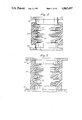
  • FIG. 1 is a longitudinal cross sectional view of a cryopump provided with a welded bellows isolator between the refrigerator and the cryopump chamber.
  • FIG. 2 is an enlarged longitudinal cross sectional view of an alternative convoluted bellows isolator.
  • FIG. 3 is a longitudinal sectional view of another convoluted bellows isolator.
  • FIG. 4 is a side view of an isolator positioned between the cryopump chamber and the work chamber.
  • FIG. 5 is a longitudinal sectional view of the cryopump chamber employing an isolator as a vacuum chamber.
  • FIG. 6 is a longitudinal sectional view of a pair of isolators connected in series.
  • FIG. 7 is a longitudinal sectional view of an alternative pair of isolators connected in series.
  • FIG. 8 is a longitudinal sectional view of an alternative embodiment of the invention having one damped isolator and one undamped isolator forming a cryopump housing.
  • FIG. 9 is a longitudinal sectional view of a second alternative embodiment of the invention having a collar placed between one of the corrugations of the bellows.
  • FIG. 10 is a longitudinal sectional view of a preferred embodiment of the invention utilizing a dynamic absorber.
  • FIG. 11 is a longitudinal sectional view of the exterior of the cryopump of FIG. 10 showing a mass mounted opposite the motor to balance the system.
  • the cryopump of each of the Figures comprises a vacuum vessel 12 which is to be mounted to the wall of a work chamber along a flange 14.
  • a front opening 16 in the vessel 12 communicates with a circular opening in a work chamber.
  • the cryopump assembly may protrude into the chamber and a vacuum seal be made at a rear flange.
  • a two stage cold finger 18 of a refrigerator protrudes into the vessel 12 through an opening 20.
  • the refrigerator is a Gifford-MacMahon refrigerator such as disclosed in U.S. Pat. No. 3,218,815 to Chellis et al., but others may be used.
  • a two stage displacer in the cold finger 18 is driven by a motor 22.
  • a first stage heat sink, or heat station, 28 is mounted at the cold end of the first stage 29 of the refrigerator.
  • a heat sink 30 is mounted to the cold end of the second stage 32.
  • the primary pumping surface is, in this system, an inverted cup 34 mounted to the heat sink 30.
  • a low temperature absorbent 36 such as charcoal particles is epoxied to the inside surface area of the cup.
  • a cup shaped radiation shield 44 is mounted to the first stage, high temperature sink 28.
  • the second stage of the cold finger extends through an opening 45 in that radiation shield.
  • This radiation shield 44 surrounds the second stage array to the rear and sides to minimize heating of the array by radiation.
  • the temperature of this radiation shield is less than about 120° K.
  • a frontal cryopanel array 46 serves as both a radiation shield for the primary cryopanel and as a cryopumping surface for higher boiling temperature gases such as water vapor.
  • This array comprises louvers 48 joined by spokes 50.
  • the frontal array 46 is mounted to the radiation shield 44, and the shield both supports the frontal array and serves as the thermal path from the heat sink 28 to that array.
  • the refrigerator In a conventional cryopump, the refrigerator is connected directly to the vacuum vessel 12. In the system of FIG. 1, however, the refrigerator is mounted to the vessel through a vibration isolator 51.
  • the vibration isolator 51 includes a bellows 52 which in FIG. 1 is a welded diaphragm bellows.
  • Vibration damping material 54 is integrally formed with the bellows to fill the outer spaces between the corrugations of the bellows and to cover the bellows.
  • the bellows is welded at each end to flanges 56 and 58 which allow it to be coupled into the system.
  • the bellows should be stainless steel of thickness between 0.008 inch and 0.12 inch. Silicon rubbers such as methyl phenyl are particularly suited as the damping material because they can be poured about the bellows in liquid form and then cured.
  • the stainless steel of which the bellows is formed has a dynamic shear modulus of about 1 ⁇ 10 12 dynes/cm 2 .
  • a dynamic shear modulus of about 1 ⁇ 10 12 dynes/cm 2 .
  • the corrugated shape of the thin metal results in a relatively low spring constant of the bellows assembly.
  • the bellows configuration does permit significant changing length of the bellows assembly along its axis, but the circumferential length through each cross section of the bellows is maintained constant due to the high dynamic modulus of the metal.
  • the bellows is free to change in axial length but does not bow inwardly or outwardly with changes in pressure acting radially on the bellows and with collapsing of the bellows.
  • the damping material 54 is of a synthetic rubber which has a high damping factor, preferably around one, and a relatively low dynamic shear modulus, preferably less than 5 ⁇ 10 6 dynes/ cm 2 . It, therefore, has a low spring constant regardless of its shape.
  • the material filling the spaces between the bellows corrugations and surrounding the bellows is able to prevent collapse of the bellows when a vacuum is drawn in the vacuum chamber while maintaining the desirable low spring constant.
  • the bellows is impermeable to gas, the rubber is not subjected to significant radial pressure differentials which might otherwise result in bowing of the damping material.
  • the rubber damping material be securely bonded to the metal continuously along the interface between the two.
  • the isolator does not include multiple isolators which must be bolted onto flanges as in the Sundquist system or a bulging elastomer held in place by a metal ring.
  • Another significant advantage of the present isolator is that it provides damping of all frequencies transmitted into the isolator.
  • some vibrations could be transmitted through the bellows with minimal damping.
  • the damping material integral with the bellows those vibrations are likely to be absorbed by the damping material.
  • some vibrations transmitted along the bellows follow a path through alternating layers of metal and rubber.
  • the isolator provides the improved damping of constrained layer damping. Because of the radial structural rigidity provided by the bellows, little radial rigidity is required of the rubber material, so a soft thin damping layer can be used.
  • the typical vibrations produced by a cryopump have both a low frequency component and a high frequency component.
  • the piston stroke of a typical cryopump provides low frequency vibrations, while the high frequency components are due to the vibrations of the stepper motor of the refrigerator and due to the vibrations of the vacuum chamber.
  • the present isolator as in the case of many typical isolators, can be modeled as a spring-mass system having a spring "constant" and a damping factor dependent on frequency and temperature.
  • any vibration isolating spring scheme has a vibration transmissibility of greater than one for a given resonant frequency f o .
  • Such a system has a lower transmissibility below and above that resonant frequency.
  • vibration frequencies above ⁇ 2f o are attenuated (transmissibility is less than 1) while below ⁇ 2f o frequency vibration levels are amplified (transmissibility is greater than one).
  • the transmissibility amplitude is determined by the damping factor. High damping factors lower the amplitude at frequencies below ⁇ 2f o ; but the higher damping factor increases the transmissibility above ⁇ 2f o relative to a lighter damped system, even though the transmissibility is still less than one.
  • the low frequency components of cryopump vibrations do not need be greatly reduced, so they can be attenuated easily via high-damping rubber-like material, and they are much lower in frequency than the resonant frequency of the vibration isolator so as not to be samplified by the isolator.
  • the high frequency vibration components are well above the resonant frequency and are easily attenuated by the isolator.
  • the damping material can be of low damping or high damping rubberlike material.
  • the low damping rubberlike materials at room temperatures exhibit low damping factors and provide better isolation where high frequency vibrations are of primary concern. Higher damping materials typically provide better results where lower frequencies near the resonant frequency are a primary concern.
  • neoprene rubber, natural rubber, SBR rubber (75/25 butadiene-styrene) are filled natural rubber (50 parts by weight of HAF carbon black) exhibit shear moduli and damping factor that vary by a factor of two in the frequency range of 1 Hz to 10,000 Hz. at 35° C.
  • the high-damping rubberlike materials like plasticized polyvinyl butyral resin, thiokol Rd, plasticized polyvinyl acetate and filled butyl rubber (40 parts by weight of MPC carbon black) possess dynamic moduli that increase very rapidly with frequency, and the damping factor is large and again may vary relatively slowly with frequency.
  • the bellows in the isolator of FIG. 1 is formed of welded diaphragms.
  • Alternative isolators having hydroformed convoluted bellows 62 are shown in FIGS. 2 and 3.
  • the outer spaces between corrugations of the bellows are filled with damping material 64 and the entire assembly is surrounded with damping material.
  • the damping material is spaced from the end flanges to allow access to flanges of minimum diameter.
  • larger diameter flanges 66 and 68 are provided and rubber 65 fills the space between the two end flanges. This approach provides some added damping with some increase in the spring constant of the system.
  • FIG. 4 An alternative embodiment of the invention is shown in FIG. 4.
  • the isolator 67 is positioned between the cryopump vacuum vessel 69 and the work chamber 71.
  • the bellows is required to provide the gas flow path from the work chamber to the cryopump chamber.
  • Such positioning of the vibration isolator is suitable for isolating the work chamber from the refrigerator of smaller cryopumps but becomes cumbersome with large diameter cryopumps.
  • the insulator having convoluted bellows is shown as the cryopump's vacuum vessel.
  • damping material fills the outer spaces between corrugations of the bellows as well as the entire assembly.
  • vibration can be further reduced by connecting a second vibration isolators in series with the first as shown in FIG. 6.
  • the two vibration isolators 67 and 69 may be of like or different diameters.
  • one isolator 69 serves as the vacuum vessel 12 while the second isolator 67 is positioned between the cryopump vacuum vessel and the work chamber.
  • the refrigerator may be mounted to the first vibration isolator forming the vacuum vessel 12, as described above, through a second vibration isolator 51. This embodiment is shown in FIG. 7.
  • the two vibration isolators shown in FIGS. 6 and 7 are joined at their respective flanges.
  • the joined flanges serve as a weighted intermediate mass which provides for further vibrational attenuation by creating a two degree of freedom system having two resonant frequencies.
  • the weight of the intermediate mass may vary, however, depending on the operating frequency of the system in order to avoid one of the resonant frequencies from equaling the operating frequency. If the weight of the intermediate mass is properly chosen it can operate as a dynamic absorber, vibrating directly out of phase with one of the vibrational modes of the cryopump.
  • An alternative method for controlling the resonant frequencies is accomplished by removing the damping material surrounding one of the isolators as shown in FIG. 8.
  • the damping material surrounding the bellows positioned between the refrigerator and the vacuum chamber By removing the damping material surrounding the bellows positioned between the refrigerator and the vacuum chamber, the spring constant of that isolator is lowered. This results in the lowering of the lowest resonant frequency.
  • weight may be added to the refrigerator.
  • the combined weight of the refrigerator and the added weight is 30 to 35 pounds for a refrigerator which operates at 53 to 60 Hz.
  • An added advantage of providing an intermediate mass is that wires 70 for suitable temperature sensor and vapor pressure sensor elements 75 and 77 may be inserted though the intermediate mass. Vibration traveling along these wires from the external environment is absorbed by the intermediate mass, thus eliminating vibration that would otherwise be transmitted to the system. Similarly, a value port 72 connecting the vacuum changer to a roughing pump (not shown) is incorporated into the intermediate mass to eliminate vibration transmitted to the system from the external environment.
  • a collar 73 is placed between one of the corrugations of the bellows.
  • This collar serves as an intermediate weighted mass and may be placed in any one of the corrugations along the bellows.
  • the purpose of the collar is to separate the bellows into two bellows for creating a two degree of freedom system discussed above. By splitting the bellows into two bellows having different lengths, different frequencies can be attenuated. Damping material filling, the outer spaces between the corrugations of the bellows and the collar further attenuates vibration.
  • a preferred embodiment of the vibration isolation system utilizes another dynamic absorber system, in place of or in addition to, the intermediate mass discussed above, to reduce the transmittance of mechanical vibrations generated by one or more moving elements operating within the cryopump.
  • FIG. 10 Such a dynamic absorber is illustrated in FIG. 10.
  • Two masses 82 and 84 of mass m w are mounted adjacent the two ends of beam 80.
  • the moment about each end of the beam having a moment arm of length l and mass m b can be adjusted such that a natural frequency of the beam matches the frequency of operation of the vibration of the drive unit of the cryopump.
  • the natural frequency of vibration of a cantilevered beam mounted at one end and a mass m w mounted at the free end of the beam can be determined using the equation: ##EQU2## where W 1 is the natural frequency of the beam and the mass m w , W 2 is the natural frequency of the beam of having a mass m b and length l, and W 3 is the natural frequency of the mass m w , that is attached to a beam that is assumed to be weightless. As W 2 and W 3 are known for any given system, W 1 can be calculated therefrom. It is known that: ##EQU3## where E is Young's modulus, and ##EQU4## is the moment of inertia for a beam of length l and thickness h. Thus, the natural frequency f of the dynamic absorber is ##EQU5## where ##EQU6##
  • the natural frequency of vibration of the system can be accurately controlled so that it matches the frequency of operation of the drive unit.
  • FIG. 10 incorporates a intermediate mass 92 which operates similar to the intermediate mass described in reference to FIG. 6 above. That is, the mass 92 can be selected to operate as a dynamic absorber where it vibrates out of phase with one of the vibrational modes of the cryopump.
  • the mass 92 also provides ports for purging and for thermocouples which monitor temperatures within the cryopump.
  • FIG. 11 is a side view of the drive unit and displacer housing over the cryopump without showing the dynamic absorber 80. This view shows an additional counterbalance mass 100 mounted on beam 102 to the displacer housing 91 opposite the motor housing 22.
  • the mass 100 is designed to aid in the balancing of the system about the vertical axis of the vacuum vessel by eliminating the displacement of the cryopump to one side of the axis due to the weight of the motor 22. Without the mass 100 this displacement can result in a rotational vibration of the unit.
  • the mass 100 also acts as a dynamic absorber which can be tuned to vibrate at a frequency which is generated by the operation of the drive unit.
  • the counterbalance system also adjusts for forces resulting from the evacuation of the system.
  • the three masses 82, 84 and 100 in addition to the mass of the motor, tend to expand the bellows 52 which, without the presence of the additional weight, would be compressed as a result of the vacuum forces exerted by the atmosphere on the outer surface of the bellows 52. This enhances the vibration isolation characteristics of the bellows 52 which are not supported by the damping material 54 positioned about the upper bellows 12.
  • the length of the isolator depends on the desired vibration isolation. The longer the length, the lower the frequencies that will be attenuated.

Landscapes

  • Engineering & Computer Science (AREA)
  • General Engineering & Computer Science (AREA)
  • Mechanical Engineering (AREA)
  • Compressors, Vaccum Pumps And Other Relevant Systems (AREA)

Abstract

A vibration isolator particularly suited to isolating a closed cycle refrigerator in a cryopump includes two bellows covered with vibration damping material and separated by an intermediate mass. The damping material fills the spaces between corrugations of the bellows and is bonded to the bellows. A dynamic absorber operates to attenuate vibrations of a partucular frequency from being transmitted into the refrigerator from a drive unit of the cryopump.

Description

This is a continuation in part of U.S. patent application Ser. No. 931,417 filed on Nov. 14, 1986 by Halil Tugal which is a continuation-in-part of U.S. patent application Ser. No. 839,693 filed Mar. 3, 1986, by Halil Tugal and Peter W. Gaudet abandoned which is a continuation of U.S. patent application Ser. No. 779,786 filed on Sept. 24, 1985, by Halil Tugal and Peter W. Gaudet now abandoned.
BACKGROUND
Cryogenic vacuum pumps, or cryopumps, cooled by closed cycle refrigerators have gained wide acceptance in recent years for high vacuum applications. A cryopump typically includes a vacuum vessel, enclosing a cryopump chamber, which can be mounted to a work chamber which is to be evacuated. A cryogenic refrigerator is mounted to the vacuum vessel and a cold finger of the refrigerator extends into the vessel. The refrigerator typically operates on the Gifford-MacMahon cycle. High pressure refrigerant gas, such as helium, is introduced into the cold finger and there displaced and expanded by movement of a reciprocating displacer/regenerator. Cryopanels mounted to the cold finger within the cryopump chamber are cooled to cryogenic temperatures. Gases from the work chamber condense on those cryopanels and, with the gases thus removed from the work chamber, its pressure is reduced to a high vacuum in the order of 10-7 torr.
Because a cryopump is a capture system in which no moving parts are exposed to the vacuum environment, it is extremely clean. Cryopumps are also fast and efficient. Cryopumps cooled by closed cycle refrigerators are particularly convenient and economical because there is no need for an expendable cryogen such as liquid nitrogen. The refrigeration is developed in the cold finger which protrudes into the vacuum vessel. Cryopumps driven by closed cycle refrigerators have suffered one disadvantage which has made such cryopumps unsuitable for certain applications. In such applications as electron microscopes and electron beam lithography, vibrations generated in a closed cycle refrigerator can be detrimental.
In a conventional cryopump, the closed cycle refrigerator is mounted directly to the cryopump vacuum vessel. To minimize the vibration translated to the work chamber, systems have been proposed in which the refrigerator is vibration isolated from the work chamber. The vibration isolator may be positioned between the cryopump chamber and the work chamber or between the closed cycle refrigerator and the cryopump chamber. In order to provide for relative movement between the vibrating refrigerator and the work chamber, while still providing a vacuum seal between the refrigerator and the work chamber, a bellows is utilized. The bellows may surround the flow path between the cryopump chamber and the work chamber or it may surround the cold finger of the cryogenic refrigerator.
One form of isolator has been described by Guy S. Venuti in U.S. Pat. No. 4,363,217 and in "Use of Vibration Isolated Cryopumps to Improve Electron Microscopes and Electron Beam Lithography Units", Journal of Vacuum Science Technology, A1 (2) April-June 1983, pages 237-240. The closed cycle refrigerator is suspended from the cryopump chamber by the bellows, and the bellows serve as an isolating spring. As a vacuum is created in the cryopump chamber, the difference in pressure, between the vacuum and ambient pressure, across the bellows tends to collapse the bellows. Collapse of the bellows is prevented by the suspended weight of the refrigerator and an additional mass mounted to the refrigerator. In such a system, the spring action of the bellows isolates the cryopump chamber from refrigerator vibration frequencies above a resonant frequency. Below the resonant frequency there is no isolation, and at the resonant frequency vibrations are actually amplified. By selection of the spring constant of the bellows and the mass suspended by the bellows, the isolator system can be designed to have a resonant frequency below the most significant vibration frequencies and thus effectively isolate the refrigerator from the work chamber.
In another form of vibration isolator which has been used with both cryopumps and turbomolecular pumps, the bellows is provided for vacuum sealing, and elastomer vibration isolators are positioned about the bellows between the refrigerator and the work chamber. Such a system relies on isolation and damping of vibration amplitudes by the elastomer isolators which also prevent collapse of the bellows. An example can be found in U.S. Pat. No. 4,539,822 to Sundquist. In a similar system, an elastomeric ring surrounds the bellows. A metal band around the elastomeric isolator ring prevents the collapse of the bellows and the cryopump vessel under vacuum. The elastomeric isolator ring provides both vibration isolation and damping of vibration amplitudes.
DISCLOSURE OF THE INVENTION
The present invention relates to a vibration isolator placed between a cryopump and a work chamber for eliminating vibration transferred to the chamber. Preferably, two isolators are connected in series and are separated by an intermediate mass. The two isolators provide for a two degree of freedom system which increases vibration attenuation. It is preferred that the first of the two isolators forms a vacuum housing about cryopanels and that the other isolator be mounted between the first isolator and a refrigerator which cools the cryopanels. The intermediate mass preferably comprises weighted flanges used to mount the two isolators together.
In accordance with one aspect of the present invention, a vibration isolator comprises a cylindrical bellows having circumferential corrugations. An elastic vibration damping material fills the spaces between the corrugations of the bellows to prevent collapse of the bellows and to isolate and damp vibrations transmitted through the bellows. The dynamic shear modulus and the dynamic Young's modulus of the damping material are substantially less than that of the bellows in order to maintain isolation as the bellows is collapsed against the material. The bellows has high dynamic moduli and provides rigidity against transverse bowing of the assembly but its corrugated shape provides good isolation. The dynamic shear modulus of the material of the bellows should be at least on the order of 1011 dynes/square centimeter and that of the damping material should be less than 107 dynes/cm2. The damping material can provide high or low damping depending on the frequencies and amplitude of the primary vibrations of concern.
A metal bellows provides the preferred surface for exposure to the vacuum environment. It is impermeable to gases and minimizes outgasing. The metal bellows can be of welded diaphragms or it can be a formed convoluted bellows.
A preferred embodiment of the invention utilizes a dynamic absorber mounted on the cryopump for improved vibration isolation. This dynamic absorber vibrates out of phase with a vibration generated by the motor and displacer system that is used to cool the gas of the cryopump.
A cantilever beam mounted on or adjacent the motor and the bellows system is one embodiment of the dynamic absorber. A mass affixed, at the free end of the beam can be adjusted so that the natural frequency of vibration of the absorber can be tuned to the particular frequency generated by the operation of the drive unit of the cryopump which requires attenuation.
BRIEF DESCRIPTION OF THE DRAWINGS
The foregoing and other objects, features, and advantages of the invention will be apparent from the following more particular description of the preferred embodiments of the invention, as illustrated in the accompanying drawings in which like reference characters refer to the same parts throughout the different views. The drawings are not necessarily to scale, emphasis instead being placed upon illustrating the principles of the invention.
FIG. 1 is a longitudinal cross sectional view of a cryopump provided with a welded bellows isolator between the refrigerator and the cryopump chamber.
FIG. 2 is an enlarged longitudinal cross sectional view of an alternative convoluted bellows isolator.
FIG. 3 is a longitudinal sectional view of another convoluted bellows isolator.
FIG. 4 is a side view of an isolator positioned between the cryopump chamber and the work chamber.
FIG. 5 is a longitudinal sectional view of the cryopump chamber employing an isolator as a vacuum chamber.
FIG. 6 is a longitudinal sectional view of a pair of isolators connected in series.
FIG. 7 is a longitudinal sectional view of an alternative pair of isolators connected in series.
FIG. 8 is a longitudinal sectional view of an alternative embodiment of the invention having one damped isolator and one undamped isolator forming a cryopump housing.
FIG. 9 is a longitudinal sectional view of a second alternative embodiment of the invention having a collar placed between one of the corrugations of the bellows.
FIG. 10 is a longitudinal sectional view of a preferred embodiment of the invention utilizing a dynamic absorber.
FIG. 11 is a longitudinal sectional view of the exterior of the cryopump of FIG. 10 showing a mass mounted opposite the motor to balance the system.
DESCRIPTION OF PREFERRED EMBODIMENTS
The cryopump of each of the Figures comprises a vacuum vessel 12 which is to be mounted to the wall of a work chamber along a flange 14. A front opening 16 in the vessel 12 communicates with a circular opening in a work chamber. Alternatively, the cryopump assembly may protrude into the chamber and a vacuum seal be made at a rear flange. A two stage cold finger 18 of a refrigerator protrudes into the vessel 12 through an opening 20. In this case, the refrigerator is a Gifford-MacMahon refrigerator such as disclosed in U.S. Pat. No. 3,218,815 to Chellis et al., but others may be used. A two stage displacer in the cold finger 18 is driven by a motor 22. With each cycle, helium gas introduced into the cold finger under pressure through line 24 is expanded and thus cooled and then exhausted through line 26. A first stage heat sink, or heat station, 28 is mounted at the cold end of the first stage 29 of the refrigerator. Similarly, a heat sink 30 is mounted to the cold end of the second stage 32.
The primary pumping surface is, in this system, an inverted cup 34 mounted to the heat sink 30. A low temperature absorbent 36 such as charcoal particles is epoxied to the inside surface area of the cup.
A cup shaped radiation shield 44 is mounted to the first stage, high temperature sink 28. The second stage of the cold finger extends through an opening 45 in that radiation shield. This radiation shield 44 surrounds the second stage array to the rear and sides to minimize heating of the array by radiation. Preferably the temperature of this radiation shield is less than about 120° K.
A frontal cryopanel array 46 serves as both a radiation shield for the primary cryopanel and as a cryopumping surface for higher boiling temperature gases such as water vapor. This array comprises louvers 48 joined by spokes 50. The frontal array 46 is mounted to the radiation shield 44, and the shield both supports the frontal array and serves as the thermal path from the heat sink 28 to that array.
In a conventional cryopump, the refrigerator is connected directly to the vacuum vessel 12. In the system of FIG. 1, however, the refrigerator is mounted to the vessel through a vibration isolator 51. The vibration isolator 51 includes a bellows 52 which in FIG. 1 is a welded diaphragm bellows. Vibration damping material 54 is integrally formed with the bellows to fill the outer spaces between the corrugations of the bellows and to cover the bellows. The bellows is welded at each end to flanges 56 and 58 which allow it to be coupled into the system.
For vacuum applications the bellows should be stainless steel of thickness between 0.008 inch and 0.12 inch. Silicon rubbers such as methyl phenyl are particularly suited as the damping material because they can be poured about the bellows in liquid form and then cured.
The stainless steel of which the bellows is formed has a dynamic shear modulus of about 1 ×10¹² dynes/cm2. Thus, there is little change in dimension, that is strain, of the metal with a given amount of stress. Despite the high dynamic modulus, the corrugated shape of the thin metal results in a relatively low spring constant of the bellows assembly. The bellows configuration does permit significant changing length of the bellows assembly along its axis, but the circumferential length through each cross section of the bellows is maintained constant due to the high dynamic modulus of the metal. Thus, the bellows is free to change in axial length but does not bow inwardly or outwardly with changes in pressure acting radially on the bellows and with collapsing of the bellows.
The damping material 54, on the other hand, is of a synthetic rubber which has a high damping factor, preferably around one, and a relatively low dynamic shear modulus, preferably less than 5 ×10⁶ dynes/ cm2. It, therefore, has a low spring constant regardless of its shape. The material filling the spaces between the bellows corrugations and surrounding the bellows is able to prevent collapse of the bellows when a vacuum is drawn in the vacuum chamber while maintaining the desirable low spring constant. On the other hand, because the bellows is impermeable to gas, the rubber is not subjected to significant radial pressure differentials which might otherwise result in bowing of the damping material.
To prevent wrinkling of the bellows with pressure differentials across the thin metal, it is best that the rubber damping material be securely bonded to the metal continuously along the interface between the two. To that end, it is best to provide an epoxy layer between the metal bellows and the rubber damping material. The epoxy ensures that the rubber is held against the bellows so that it is not squeezed away from the bellows with axial compression of the assembly.
Advantages of the present isolator are its compactness and the simplicity of its assembly into the cryopump. The isolator does not include multiple isolators which must be bolted onto flanges as in the Sundquist system or a bulging elastomer held in place by a metal ring.
Another significant advantage of the present isolator is that it provides damping of all frequencies transmitted into the isolator. In prior isolators in which the elastomeric isolator was separate from the bellows, some vibrations could be transmitted through the bellows with minimal damping. With the damping material integral with the bellows, those vibrations are likely to be absorbed by the damping material. Further, some vibrations transmitted along the bellows follow a path through alternating layers of metal and rubber. Thus, to some extent, the isolator provides the improved damping of constrained layer damping. Because of the radial structural rigidity provided by the bellows, little radial rigidity is required of the rubber material, so a soft thin damping layer can be used.
The typical vibrations produced by a cryopump have both a low frequency component and a high frequency component. The piston stroke of a typical cryopump provides low frequency vibrations, while the high frequency components are due to the vibrations of the stepper motor of the refrigerator and due to the vibrations of the vacuum chamber. The present isolator, as in the case of many typical isolators, can be modeled as a spring-mass system having a spring "constant" and a damping factor dependent on frequency and temperature. In such vibration isolating models the resonant frequency is determined by the relationship ##EQU1## where k is the spring constant of the cryopump isolator system, g is acceleration due to gravity, and W is the total force acting on the isolator taking into consideration both the vacuum force and the weight of the cryopump. Any vibration isolating spring scheme has a vibration transmissibility of greater than one for a given resonant frequency fo. Such a system has a lower transmissibility below and above that resonant frequency. Usually vibration frequencies above √2fo are attenuated (transmissibility is less than 1) while below √2fo frequency vibration levels are amplified (transmissibility is greater than one). The transmissibility amplitude is determined by the damping factor. High damping factors lower the amplitude at frequencies below √2fo ; but the higher damping factor increases the transmissibility above √2fo relative to a lighter damped system, even though the transmissibility is still less than one. The low frequency components of cryopump vibrations do not need be greatly reduced, so they can be attenuated easily via high-damping rubber-like material, and they are much lower in frequency than the resonant frequency of the vibration isolator so as not to be samplified by the isolator. The high frequency vibration components are well above the resonant frequency and are easily attenuated by the isolator.
The damping material can be of low damping or high damping rubberlike material. The low damping rubberlike materials at room temperatures exhibit low damping factors and provide better isolation where high frequency vibrations are of primary concern. Higher damping materials typically provide better results where lower frequencies near the resonant frequency are a primary concern. As examples, neoprene rubber, natural rubber, SBR rubber (75/25 butadiene-styrene) are filled natural rubber (50 parts by weight of HAF carbon black) exhibit shear moduli and damping factor that vary by a factor of two in the frequency range of 1 Hz to 10,000 Hz. at 35° C. On the other hand, the high-damping rubberlike materials like plasticized polyvinyl butyral resin, thiokol Rd, plasticized polyvinyl acetate and filled butyl rubber (40 parts by weight of MPC carbon black) possess dynamic moduli that increase very rapidly with frequency, and the damping factor is large and again may vary relatively slowly with frequency.
The bellows in the isolator of FIG. 1 is formed of welded diaphragms. Alternative isolators having hydroformed convoluted bellows 62 are shown in FIGS. 2 and 3. As before, the outer spaces between corrugations of the bellows are filled with damping material 64 and the entire assembly is surrounded with damping material. In the embodiments of FIGS. 1 and 2 the damping material is spaced from the end flanges to allow access to flanges of minimum diameter. In the embodiment of FIG. 3, larger diameter flanges 66 and 68 are provided and rubber 65 fills the space between the two end flanges. This approach provides some added damping with some increase in the spring constant of the system.
An alternative embodiment of the invention is shown in FIG. 4. In this case, the isolator 67 is positioned between the cryopump vacuum vessel 69 and the work chamber 71. The bellows is required to provide the gas flow path from the work chamber to the cryopump chamber. Such positioning of the vibration isolator is suitable for isolating the work chamber from the refrigerator of smaller cryopumps but becomes cumbersome with large diameter cryopumps.
Embodied in FIG. 5 the insulator having convoluted bellows is shown as the cryopump's vacuum vessel. As before, damping material fills the outer spaces between corrugations of the bellows as well as the entire assembly.
When the cryopump is not in operation, pressure inside and outside the vacuum vessel are equal, and the vessel is either fully extended or resting on its own weight depending on the attachment orientation of the cryopump. During operation, however, a compressional force is applied to the vessel because of the greater outside atmospheric pressure. This force is resisted by the soft rubber between each bellows, thus rendering the vacuum vessel fully operational and behaving as a vibration isolator.
With either position of the vibration isolator described above, vibration can be further reduced by connecting a second vibration isolators in series with the first as shown in FIG. 6. The two vibration isolators 67 and 69 may be of like or different diameters. In this case one isolator 69 serves as the vacuum vessel 12 while the second isolator 67 is positioned between the cryopump vacuum vessel and the work chamber. Alternatively, the refrigerator may be mounted to the first vibration isolator forming the vacuum vessel 12, as described above, through a second vibration isolator 51. This embodiment is shown in FIG. 7.
The two vibration isolators shown in FIGS. 6 and 7 are joined at their respective flanges. The joined flanges serve as a weighted intermediate mass which provides for further vibrational attenuation by creating a two degree of freedom system having two resonant frequencies. By increasing the weight of intermediate mass relative to the system's mass the higher of the two resonant frequencies can be lowered. The weight of the intermediate mass may vary, however, depending on the operating frequency of the system in order to avoid one of the resonant frequencies from equaling the operating frequency. If the weight of the intermediate mass is properly chosen it can operate as a dynamic absorber, vibrating directly out of phase with one of the vibrational modes of the cryopump.
An alternative method for controlling the resonant frequencies is accomplished by removing the damping material surrounding one of the isolators as shown in FIG. 8. By removing the damping material surrounding the bellows positioned between the refrigerator and the vacuum chamber, the spring constant of that isolator is lowered. This results in the lowering of the lowest resonant frequency. To prevent collapse of the bellows when a vacuum is drawn in the vacuum chamber, weight may be added to the refrigerator. Preferably, the combined weight of the refrigerator and the added weight is 30 to 35 pounds for a refrigerator which operates at 53 to 60 Hz. By removing the damping material from the smaller diameter bellows, rather than the larger diameter bellows, the weight required to prevent the bellows from collapsing is minimized.
An added advantage of providing an intermediate mass is that wires 70 for suitable temperature sensor and vapor pressure sensor elements 75 and 77 may be inserted though the intermediate mass. Vibration traveling along these wires from the external environment is absorbed by the intermediate mass, thus eliminating vibration that would otherwise be transmitted to the system. Similarly, a value port 72 connecting the vacuum changer to a roughing pump (not shown) is incorporated into the intermediate mass to eliminate vibration transmitted to the system from the external environment.
In FIG. 9, a collar 73 is placed between one of the corrugations of the bellows. This collar serves as an intermediate weighted mass and may be placed in any one of the corrugations along the bellows. The purpose of the collar is to separate the bellows into two bellows for creating a two degree of freedom system discussed above. By splitting the bellows into two bellows having different lengths, different frequencies can be attenuated. Damping material filling, the outer spaces between the corrugations of the bellows and the collar further attenuates vibration.
A preferred embodiment of the vibration isolation system utilizes another dynamic absorber system, in place of or in addition to, the intermediate mass discussed above, to reduce the transmittance of mechanical vibrations generated by one or more moving elements operating within the cryopump.
Such a dynamic absorber is illustrated in FIG. 10. A cantilevered beam 80 with its center mounted between the drive unit 22 of the compressor and the welded bellows 52, vibrates directly out of phase with the vibration being attenuated. Two masses 82 and 84 of mass mw are mounted adjacent the two ends of beam 80.
The moment about each end of the beam having a moment arm of length l and mass mb can be adjusted such that a natural frequency of the beam matches the frequency of operation of the vibration of the drive unit of the cryopump.
The natural frequency of vibration of a cantilevered beam mounted at one end and a mass mw mounted at the free end of the beam can be determined using the equation: ##EQU2## where W1 is the natural frequency of the beam and the mass mw, W2 is the natural frequency of the beam of having a mass mb and length l, and W3 is the natural frequency of the mass mw, that is attached to a beam that is assumed to be weightless. As W2 and W3 are known for any given system, W1 can be calculated therefrom. It is known that: ##EQU3## where E is Young's modulus, and ##EQU4## is the moment of inertia for a beam of length l and thickness h. Thus, the natural frequency f of the dynamic absorber is ##EQU5## where ##EQU6##
Thus, for example, by adjusting the magnitude of the mass mw or by varying the distance l at which the mass mw is mounted relative to the fixed end of the beam, the natural frequency of vibration of the system can be accurately controlled so that it matches the frequency of operation of the drive unit.
The embodiment of FIG. 10 incorporates a intermediate mass 92 which operates similar to the intermediate mass described in reference to FIG. 6 above. That is, the mass 92 can be selected to operate as a dynamic absorber where it vibrates out of phase with one of the vibrational modes of the cryopump. The mass 92 also provides ports for purging and for thermocouples which monitor temperatures within the cryopump.
FIG. 11 is a side view of the drive unit and displacer housing over the cryopump without showing the dynamic absorber 80. This view shows an additional counterbalance mass 100 mounted on beam 102 to the displacer housing 91 opposite the motor housing 22.
The mass 100 is designed to aid in the balancing of the system about the vertical axis of the vacuum vessel by eliminating the displacement of the cryopump to one side of the axis due to the weight of the motor 22. Without the mass 100 this displacement can result in a rotational vibration of the unit. The mass 100 also acts as a dynamic absorber which can be tuned to vibrate at a frequency which is generated by the operation of the drive unit.
The counterbalance system also adjusts for forces resulting from the evacuation of the system. The three masses 82, 84 and 100, in addition to the mass of the motor, tend to expand the bellows 52 which, without the presence of the additional weight, would be compressed as a result of the vacuum forces exerted by the atmosphere on the outer surface of the bellows 52. This enhances the vibration isolation characteristics of the bellows 52 which are not supported by the damping material 54 positioned about the upper bellows 12.
While the invention has been particularly shown and described with reference to a preferred embodiment thereof, it will be understood by those skilled in the art that various changes in form and details may be made therein without departing from the spirit and scope of the invention, as defined by the appended claims. For example, the length of the isolator depends on the desired vibration isolation. The longer the length, the lower the frequencies that will be attenuated.

Claims (17)

We claim:
1. A dynamic absorber for absorbing vibrations of a cryopump comprising:
a cryopump having a motor that generates a vibration at a specific frequency; and
a dynamic absorber secured to the cryopump such that the absorber vibrates out of phase with the vibration of the cryopump to attenuate that vibration.
2. The dynamic absorber of claim 1 wherein the dynamic absorber comprises a cantilevered beam.
3. The dynamic absorber of claim 2 further comprising an adjustable mass secured to the beam such that the beam vibrates at a natural frequency that is adjusted to match an operating frequency, or a harmonic thereof, of the cryopump.
4. The dynamic absorber of claim 3 wherein the mass is distributed adjacent the two ends of the beam.
5. The dynamic absorber of claim 1 wherein the dynamic absorber comprises a plurality of cantilevered beams.
6. The dynamic absorber of claim 5 further comprising a dynamic absorber that couples a vacuum vessel of the cryopump with a motor of the cryopump.
7. A vibration isolator comprising:
bellows having corrugations, damping material secured to the corrugations of the bellows along a length of the bellows for absorbing vibrations transmitted along the bellows; and
a dynamic absorber secured to the bellows for attenuating vibrations of a predetermined frequency being transmitted along the bellows.
8. The vibration isolator of claim 7 further comprising a second undamped bellows joined in series with the first bellows and wherein the first and second bellows are separated by the dynamic absorber.
9. The vibration isolator of claim 8 wherein the dynamic absorber comprises a coupler for securing the first and second bellows.
10. The vibration isolator of claim 7 wherein the dynamic absorber comprises a cantilevered beam.
11. The vibration isolator of claim 7 wherein the dynamic absorber comprises a plurality of cantilevered beams.
12. The vibration isolator of claim 11 further comprising a plurality of adjustable masses, each secured to one of said beams such that the beams vibrate at frequencies adjusted to match frequencies being transmitted along the bellows.
13. The vibration isolator of claim 8 further comprising a second dynamic absorber comprised of a cantilevered beam.
14. A vibration isolator comprising:
a first bellows having corrugations and a damping material secured to the corrugations of the bellows along a length of the bellows for absorbing vibrations transmitted along the belllows;
a dynamic absorber secured to the first bellows for attenuating vibrations of a predetermined frequency being transmitted along the bellows; and
a second undamped bellows joined in series with the first bellows such that the first and second bellows are separated by the dynamic absorber.
15. The vibration isolator of claim 14 wherein the dynamic absorber comprises a coupler for securing the first and second bellows.
16. A vibration isolation system for a cryopump comprising:
a cryopump having a motor that generates a vibration of specific frequency;
a bellows assembly to which the motor of the cryopump is secured for attenuating vibrations transmitted along the bellows; and
a dynamic absorber secured to the bellows assembly to attenuate vibrations associated with the cryopump.
17. The vibration isolation system of claim 16 further comprising a damping material secured to the bellows.
US07/210,724 1986-03-13 1988-06-23 Cryopump with vibration isolation Expired - Fee Related US4862697A (en)

Priority Applications (1)

Application Number Priority Date Filing Date Title
US07/210,724 US4862697A (en) 1986-03-13 1988-06-23 Cryopump with vibration isolation

Applications Claiming Priority (2)

Application Number Priority Date Filing Date Title
US83969386A 1986-03-13 1986-03-13
US07/210,724 US4862697A (en) 1986-03-13 1988-06-23 Cryopump with vibration isolation

Related Parent Applications (1)

Application Number Title Priority Date Filing Date
US06/931,417 Continuation-In-Part US4833899A (en) 1986-11-14 1986-11-14 Cryopump with vibration isolation

Publications (1)

Publication Number Publication Date
US4862697A true US4862697A (en) 1989-09-05

Family

ID=26905453

Family Applications (1)

Application Number Title Priority Date Filing Date
US07/210,724 Expired - Fee Related US4862697A (en) 1986-03-13 1988-06-23 Cryopump with vibration isolation

Country Status (1)

Country Link
US (1) US4862697A (en)

Cited By (20)

* Cited by examiner, † Cited by third party
Publication number Priority date Publication date Assignee Title
US5327733A (en) * 1993-03-08 1994-07-12 University Of Cincinnati Substantially vibration-free shroud and mounting system for sample cooling and low temperature spectroscopy
US5345787A (en) * 1991-09-19 1994-09-13 The United States Of America As Represented By The Department Of Health And Human Services Miniature cryosorption vacuum pump
US5363077A (en) * 1994-01-31 1994-11-08 General Electric Company MRI magnet having a vibration-isolated cryocooler
US5542254A (en) * 1993-04-15 1996-08-06 Hughes Aircraft Company Cryogenic cooler
US5775472A (en) * 1995-06-27 1998-07-07 Honeywell Inc. Multi-axis tuned mass damper
US20030053918A1 (en) * 2001-09-17 2003-03-20 Akira Yamauchi Vacuum pump having mechanism for restraining vibrations
JP2003519761A (en) * 2000-01-15 2003-06-24 ライボルト ヴァークウム ゲゼルシャフト ミット ベシュレンクテル ハフツング Vacuum pump with vibration damper
US20040131478A1 (en) * 2003-01-08 2004-07-08 Helix Technology Corporation Radiation shielding coating
US20050204754A1 (en) * 2004-03-22 2005-09-22 Alcatel Vacuum pump damping adapter
US20050229620A1 (en) * 2004-04-15 2005-10-20 Oxford Instruments Superconductivity Ltd. Cooling apparatus
EP1988320A2 (en) 2007-04-18 2008-11-05 Pfeiffer Vacuum GmbH Vibration isolating intermediary component
US20110006185A1 (en) * 2008-03-07 2011-01-13 M-I L.L.C. Shaker deck adjustment apparatus
US20160056009A1 (en) * 2014-08-21 2016-02-25 Nuflare Technology, Inc. Charged-particle beam drawing apparatus and vibration damping mechanism
US20190063790A1 (en) * 2016-12-16 2019-02-28 Fudan University Mechanical vibration isolation liquid helium re-condensation low-temperature refrigeration system
US20190120236A1 (en) * 2015-07-23 2019-04-25 Edwards Japan Limited Exhausting system
CN113646532A (en) * 2019-04-02 2021-11-12 住友重机械工业株式会社 Vibration-proof structure of cryopump and cryogenic refrigerator
US11446074B2 (en) 2017-11-13 2022-09-20 Biocompatibles Uk Limited Cryoablation system with magnetic resonance imaging detection
US20230107183A1 (en) * 2020-03-31 2023-04-06 Edwards Japan Limited Vacuum pump and piping structural portion for vacuum pump
US12016607B2 (en) 2017-11-13 2024-06-25 Biocompatibles Uk Limited Cryoprobe for magnetic resonance imaging
US20250250993A1 (en) * 2022-04-14 2025-08-07 Chevron U.S.A. Inc. Structural damping for subsea noise mitigation

Citations (17)

* Cited by examiner, † Cited by third party
Publication number Priority date Publication date Assignee Title
DE827144C (en) * 1950-07-18 1952-01-07 Ernst Kreissig Rubber steel spring
DE938812C (en) * 1953-12-04 1956-02-09 Adolf Schnorr K G Guide for disc springs
GB855451A (en) * 1957-11-06 1960-11-30 Metalastik Ltd Improvements in or relating to torsion springs
US3125858A (en) * 1964-03-24 joint for pile shell sections
US3345245A (en) * 1960-09-26 1967-10-03 Stauffer Chemical Co Composite structure having shock absorbing properties
US3369826A (en) * 1961-08-22 1968-02-20 Union Carbide Corp Cryogenic fluid transfer conduit
US3894403A (en) * 1973-06-08 1975-07-15 Air Prod & Chem Vibration-free refrigeration transfer
US3952777A (en) * 1972-12-20 1976-04-27 Brown Boveri-Sulzer Turbomaschinen Aktiengesellschaft Hollow body for heated gases
US4352643A (en) * 1979-05-18 1982-10-05 Fujitsu Limited Structure for vibration isolation in an apparatus with a vacuum system
US4363217A (en) * 1981-01-29 1982-12-14 Venuti Guy S Vibration damping apparatus
US4394819A (en) * 1982-08-16 1983-07-26 The United States Of America As Represented By The Administrator Of The National Aeronautics And Space Administration Vibration isolation and pressure compensation apparatus for sensitive instrumentation
US4483425A (en) * 1982-09-09 1984-11-20 North American Philips Corporation Vibration control system
US4494634A (en) * 1981-12-30 1985-01-22 Nhk Spring Co., Ltd. Impact damper
US4526015A (en) * 1984-10-15 1985-07-02 General Electric Company Support for cryostat penetration tube
US4539822A (en) * 1984-02-27 1985-09-10 National Electrostatics Corporation Vibration isolator for cryopump
US4595166A (en) * 1985-03-19 1986-06-17 San-Ai Kogyo Kabushiki Kaisha Vibration isolating table device
US4783968A (en) * 1986-08-08 1988-11-15 Helix Technology Corporation Vibration isolation system for a linear reciprocating machine

Patent Citations (17)

* Cited by examiner, † Cited by third party
Publication number Priority date Publication date Assignee Title
US3125858A (en) * 1964-03-24 joint for pile shell sections
DE827144C (en) * 1950-07-18 1952-01-07 Ernst Kreissig Rubber steel spring
DE938812C (en) * 1953-12-04 1956-02-09 Adolf Schnorr K G Guide for disc springs
GB855451A (en) * 1957-11-06 1960-11-30 Metalastik Ltd Improvements in or relating to torsion springs
US3345245A (en) * 1960-09-26 1967-10-03 Stauffer Chemical Co Composite structure having shock absorbing properties
US3369826A (en) * 1961-08-22 1968-02-20 Union Carbide Corp Cryogenic fluid transfer conduit
US3952777A (en) * 1972-12-20 1976-04-27 Brown Boveri-Sulzer Turbomaschinen Aktiengesellschaft Hollow body for heated gases
US3894403A (en) * 1973-06-08 1975-07-15 Air Prod & Chem Vibration-free refrigeration transfer
US4352643A (en) * 1979-05-18 1982-10-05 Fujitsu Limited Structure for vibration isolation in an apparatus with a vacuum system
US4363217A (en) * 1981-01-29 1982-12-14 Venuti Guy S Vibration damping apparatus
US4494634A (en) * 1981-12-30 1985-01-22 Nhk Spring Co., Ltd. Impact damper
US4394819A (en) * 1982-08-16 1983-07-26 The United States Of America As Represented By The Administrator Of The National Aeronautics And Space Administration Vibration isolation and pressure compensation apparatus for sensitive instrumentation
US4483425A (en) * 1982-09-09 1984-11-20 North American Philips Corporation Vibration control system
US4539822A (en) * 1984-02-27 1985-09-10 National Electrostatics Corporation Vibration isolator for cryopump
US4526015A (en) * 1984-10-15 1985-07-02 General Electric Company Support for cryostat penetration tube
US4595166A (en) * 1985-03-19 1986-06-17 San-Ai Kogyo Kabushiki Kaisha Vibration isolating table device
US4783968A (en) * 1986-08-08 1988-11-15 Helix Technology Corporation Vibration isolation system for a linear reciprocating machine

Non-Patent Citations (6)

* Cited by examiner, † Cited by third party
Title
Acta Technica Csav; Vibration Absorbers for the Stays of Guyed Masts ; Fischer; 1987; pp. 95 111. *
Acta Technica Csav;"Vibration Absorbers for the Stays of Guyed Masts"; Fischer; 1987; pp. 95-111.
Sov. Phys. Acoust. 26(4); "Damping of Tubes by a Constrained Coating"; Vinogradov et al.; Jul.-Aug. 1980; pp. 328-330.
Sov. Phys. Acoust. 26(4); Damping of Tubes by a Constrained Coating ; Vinogradov et al.; Jul. Aug. 1980; pp. 328 330. *
Sov. Phys. Acoust. 26(4); Virbration Damping of Tubes by Vibration Absorbing Coatings; Zeinetdinova et al.; Jul. Aug. 1980; pp. 312 315. *
Sov. Phys. Acoust. 26(4); Virbration Damping of Tubes by Vibration-Absorbing Coatings; Zeinetdinova et al.; Jul.-Aug. 1980; pp. 312-315.

Cited By (35)

* Cited by examiner, † Cited by third party
Publication number Priority date Publication date Assignee Title
US5345787A (en) * 1991-09-19 1994-09-13 The United States Of America As Represented By The Department Of Health And Human Services Miniature cryosorption vacuum pump
US5327733A (en) * 1993-03-08 1994-07-12 University Of Cincinnati Substantially vibration-free shroud and mounting system for sample cooling and low temperature spectroscopy
US5542254A (en) * 1993-04-15 1996-08-06 Hughes Aircraft Company Cryogenic cooler
US5363077A (en) * 1994-01-31 1994-11-08 General Electric Company MRI magnet having a vibration-isolated cryocooler
US5775472A (en) * 1995-06-27 1998-07-07 Honeywell Inc. Multi-axis tuned mass damper
US6814550B1 (en) * 2000-01-15 2004-11-09 Leybold Vakuum Gmbh Vacuum pump with vibration absorber
JP2003519761A (en) * 2000-01-15 2003-06-24 ライボルト ヴァークウム ゲゼルシャフト ミット ベシュレンクテル ハフツング Vacuum pump with vibration damper
US20030053918A1 (en) * 2001-09-17 2003-03-20 Akira Yamauchi Vacuum pump having mechanism for restraining vibrations
US20040131478A1 (en) * 2003-01-08 2004-07-08 Helix Technology Corporation Radiation shielding coating
US7037083B2 (en) * 2003-01-08 2006-05-02 Brooks Automation, Inc. Radiation shielding coating
US7854128B2 (en) * 2004-03-22 2010-12-21 Alcatel Vacuum pump damping adapter
US20050204754A1 (en) * 2004-03-22 2005-09-22 Alcatel Vacuum pump damping adapter
FR2867823A1 (en) * 2004-03-22 2005-09-23 Cit Alcatel SHOCK ABSORBER CONNECTION FOR VACUUM PUMP
EP1580477A1 (en) * 2004-03-22 2005-09-28 Alcatel Damping connection for vacuum pump
CN1673550B (en) * 2004-03-22 2011-06-15 阿尔卡特公司 Vacuum tube and damping connection for vacuum pump
US20050229620A1 (en) * 2004-04-15 2005-10-20 Oxford Instruments Superconductivity Ltd. Cooling apparatus
US7287387B2 (en) 2004-04-15 2007-10-30 Oxford Instruments Superconductivity Ltd Cooling apparatus
EP1988320A3 (en) * 2007-04-18 2010-08-18 Pfeiffer Vacuum GmbH Vibration isolating intermediary component
EP1988320A2 (en) 2007-04-18 2008-11-05 Pfeiffer Vacuum GmbH Vibration isolating intermediary component
DE102007018292B4 (en) 2007-04-18 2024-09-26 Pfeiffer Vacuum Gmbh Vibration-isolating intermediate component
US20110006185A1 (en) * 2008-03-07 2011-01-13 M-I L.L.C. Shaker deck adjustment apparatus
US8313077B2 (en) * 2008-03-07 2012-11-20 M-I L.L.C. Shaker deck adjustment apparatus
US20160056009A1 (en) * 2014-08-21 2016-02-25 Nuflare Technology, Inc. Charged-particle beam drawing apparatus and vibration damping mechanism
US9431208B2 (en) * 2014-08-21 2016-08-30 Nuflare Technology, Inc. Charged-particle beam drawing apparatus and vibration damping mechanism
US20190120236A1 (en) * 2015-07-23 2019-04-25 Edwards Japan Limited Exhausting system
US12276283B2 (en) * 2015-07-23 2025-04-15 Edwards Japan Limited Integrated connector between first and second vacuum pumps creating a vapor phase region environment
US20190063790A1 (en) * 2016-12-16 2019-02-28 Fudan University Mechanical vibration isolation liquid helium re-condensation low-temperature refrigeration system
US12016607B2 (en) 2017-11-13 2024-06-25 Biocompatibles Uk Limited Cryoprobe for magnetic resonance imaging
US11446074B2 (en) 2017-11-13 2022-09-20 Biocompatibles Uk Limited Cryoablation system with magnetic resonance imaging detection
US12042205B2 (en) 2017-11-13 2024-07-23 Biocompatibles Uk Limited Cryoablation system with magnetic resonance imaging detection
US11619215B2 (en) * 2019-04-02 2023-04-04 Sumitomo Heavy Industries, Ltd. Cryopump and cryocooler vibration isolation structure
US20220018342A1 (en) * 2019-04-02 2022-01-20 Sumitomo Heavy Industries, Ltd. Cryopump and cryocooler vibration isolation structure
CN113646532A (en) * 2019-04-02 2021-11-12 住友重机械工业株式会社 Vibration-proof structure of cryopump and cryogenic refrigerator
US20230107183A1 (en) * 2020-03-31 2023-04-06 Edwards Japan Limited Vacuum pump and piping structural portion for vacuum pump
US20250250993A1 (en) * 2022-04-14 2025-08-07 Chevron U.S.A. Inc. Structural damping for subsea noise mitigation

Similar Documents

Publication Publication Date Title
US4862697A (en) Cryopump with vibration isolation
US4833899A (en) Cryopump with vibration isolation
US4835972A (en) Flex-line vibration isolator and cryopump with vibration isolation
US4360087A (en) Suspension and vibration isolation system for a linear reciprocating machine
US8961106B2 (en) Turbomolecular pump and connector device therefor
US3202388A (en) Vibration isolators
US5056319A (en) Refrigerator-operated apparatus
US4539822A (en) Vibration isolator for cryopump
WO2001090597A1 (en) Vertical liquid inertia vibration isolator
JPH06323360A (en) Vibration damping supporter
JP3335159B2 (en) Hydraulic buffer bearing
US5542254A (en) Cryogenic cooler
JPH0143851B2 (en)
WO1987001768A1 (en) Cryopump with vibration isolation
US5348266A (en) Reduced horizontal stiffness vibration isolation system
CA1307313C (en) Linear motor compressor with stationary piston
US7478710B2 (en) Vacuum pump vibration isolator
JPS63501519A (en) Cryopump with vibration isolator
EP0686786A1 (en) Vibration damper apparatus and method of manufacturing therefor
EP0143115B1 (en) Vibration-absorbing mount with hydraulic damping, e.g. for engines
JP3600274B2 (en) Vibration damper
JP2953101B2 (en) Free displacer type Stirling refrigerator
JPH0519589Y2 (en)
US4593891A (en) Vibration-absorbing mounting device with hydraulic damping, especially for engines
CA2239981A1 (en) Active pneumatic mount

Legal Events

Date Code Title Description
AS Assignment

Owner name: HELIX TECHNOLOGY CORPORATION, 266 SECOND AVENUE, W

Free format text: ASSIGNMENT OF ASSIGNORS INTEREST.;ASSIGNORS:TUGAL, HALIL;BENT, BRUCE R.;REEL/FRAME:004938/0678

Effective date: 19880818

FPAY Fee payment

Year of fee payment: 4

REMI Maintenance fee reminder mailed
LAPS Lapse for failure to pay maintenance fees
FP Lapsed due to failure to pay maintenance fee

Effective date: 19970910

AS Assignment

Owner name: BROOKS AUTOMATION, INC., MASSACHUSETTS

Free format text: ASSIGNMENT OF ASSIGNORS INTEREST;ASSIGNOR:HELIX TECHNOLOGY CORPORATION;REEL/FRAME:017176/0706

Effective date: 20051027

STCH Information on status: patent discontinuation

Free format text: PATENT EXPIRED DUE TO NONPAYMENT OF MAINTENANCE FEES UNDER 37 CFR 1.362