US482425A - Thomas t - Google Patents
Thomas t Download PDFInfo
- Publication number
- US482425A US482425A US482425DA US482425A US 482425 A US482425 A US 482425A US 482425D A US482425D A US 482425DA US 482425 A US482425 A US 482425A
- Authority
- US
- United States
- Prior art keywords
- zinc
- screw
- electrode
- battery
- plates
- Prior art date
- Legal status (The legal status is an assumption and is not a legal conclusion. Google has not performed a legal analysis and makes no representation as to the accuracy of the status listed.)
- Expired - Lifetime
Links
- 235000016804 zinc Nutrition 0.000 description 37
- HCHKCACWOHOZIP-UHFFFAOYSA-N Zinc Chemical compound [Zn] HCHKCACWOHOZIP-UHFFFAOYSA-N 0.000 description 36
- 239000011701 zinc Substances 0.000 description 36
- 229910052725 zinc Inorganic materials 0.000 description 36
- 239000002131 composite material Substances 0.000 description 2
- 239000000463 material Substances 0.000 description 2
- RYGMFSIKBFXOCR-UHFFFAOYSA-N Copper Chemical compound [Cu] RYGMFSIKBFXOCR-UHFFFAOYSA-N 0.000 description 1
- 229910052802 copper Inorganic materials 0.000 description 1
- 239000010949 copper Substances 0.000 description 1
- 239000000446 fuel Substances 0.000 description 1
- 239000007788 liquid Substances 0.000 description 1
- 230000002035 prolonged effect Effects 0.000 description 1
- 230000000284 resting effect Effects 0.000 description 1
Images
Classifications
-
- H—ELECTRICITY
- H01—ELECTRIC ELEMENTS
- H01M—PROCESSES OR MEANS, e.g. BATTERIES, FOR THE DIRECT CONVERSION OF CHEMICAL ENERGY INTO ELECTRICAL ENERGY
- H01M4/00—Electrodes
- H01M4/02—Electrodes composed of, or comprising, active material
- H01M4/24—Electrodes for alkaline accumulators
- H01M4/244—Zinc electrodes
-
- Y—GENERAL TAGGING OF NEW TECHNOLOGICAL DEVELOPMENTS; GENERAL TAGGING OF CROSS-SECTIONAL TECHNOLOGIES SPANNING OVER SEVERAL SECTIONS OF THE IPC; TECHNICAL SUBJECTS COVERED BY FORMER USPC CROSS-REFERENCE ART COLLECTIONS [XRACs] AND DIGESTS
- Y02—TECHNOLOGIES OR APPLICATIONS FOR MITIGATION OR ADAPTATION AGAINST CLIMATE CHANGE
- Y02E—REDUCTION OF GREENHOUSE GAS [GHG] EMISSIONS, RELATED TO ENERGY GENERATION, TRANSMISSION OR DISTRIBUTION
- Y02E60/00—Enabling technologies; Technologies with a potential or indirect contribution to GHG emissions mitigation
- Y02E60/10—Energy storage using batteries
Definitions
- the object of the invention is to renew the zinc or that electrode of the battery which'is the more rapidly eaten away by adding fresh parts to those which have been so far consinned as to be incapable of maintaining an efficient action of the cell.
- a single zinc when fresh is of itself sufficient to form the positive electrode of the cell, and when thus employed it will be suspended from the lower end of a zinc screw, whose upper end will be screwedinto the supporting cross-bar.
- the suspendingscrew will be removed from the support and a new zinc placed upon its upper end, and at the same time a second screw will be inserted in the cross-bar to support the composite electrode thus formed, and in like manner one zinc after another may be applied as those already in use become partially consumed.
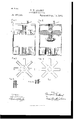
- Figure 1 represents in a battery a side view of a fresh zinc which of itself constitutes the positive element of a cell, together with a cross-bar and screw-support.
- Fig. 2 is a cross-section of a fresh zinc, a side View of a zinc which is partially consumed, and two zinc screws, one for fastening the zines together and the other for suspending them from the cross-bar above the cell.
- Fig. 3 is a top view of one of my zinc plates, showing its upper surface and beveled edges, while Fig. 4 shows its lower surface.
- Fig. 5 is one of the zinc screws which is adapted either to join neighboring plates or to suspend the electrode from a cross-bar or other support above the cell.
- Fig. 6 is a screw thimble having an upper flange, it being adapted to be seated in the supporting cross bar, as shown in Figs. 1 and 2.
- a represents a zinc plate or skeleton, which is provided with a screw-perforation and radially-projecting arms, the upper surfaces being of less area than the lower, while cl is a zinc screw, which is adapted either to join two zincs together by inserting each end a little less than halfway into the screw-openings of neighboring zines or to suspend the electrode in the cell by inserting its lower end into the uppermost plate and its upper end intoa thimble e,having a supporting-flange f, which is in turn screwed through the cross-bar As shown in Figs.
- the plate a first used has the lower end of a screw d turned into its axial aperture, while its upper endis screwed into the supporting-thimble c.
- the upper end of the screw is removed f 0 the thimble e and in turn screwed about halfway into the aperture of a new zinc from the lower side, while a new screw is inserted into the second plate from above, the upper end of the new screw d being then screwed into the thimble c.
- the second male screw will be unscrewed from the thimble e and in turn inserted into a third zinc from the lower side, while a third screw will be inserted into the upper opening of a thirdzinc and its upper end screwed into the supporting-thimble e, and in the same manner one zinc after another indefinitely may be applied to the battery.
- a zinc electrode formed of zinc plates having screw-perforations and separate zinc screws alternately arranged, as and for the purpose described.
- a zinc electrode formed of zinc plates having screw-perf0rations and separate zinc screws alternately arranged and applied and a cross-bar to which the electrode is suspended by one of said screws.
- a zinc electrode formed of perforated zinc plates and separate zinc pins or screws, said pins or screws being employed to fasten adjoining plates together and to suspend the composite electrode from a cross-bar or other support above the cell.
Landscapes
- Chemical & Material Sciences (AREA)
- Chemical Kinetics & Catalysis (AREA)
- Electrochemistry (AREA)
- General Chemical & Material Sciences (AREA)
- Battery Electrode And Active Subsutance (AREA)
- Primary Cells (AREA)
Description
T. T. EOKERT. GALVANIG BATTERY.
Patented Sept. 13, 1892.
Fuel. FIQZ.
My Him NITED STATES PATENT OFFICE.
THOMAS T. EOKERT, OF NEW YORK, N. Y.
GALVANIC BATTERY.
SPECIFICATION forming part of Letters Patent No. 482,425, dated September 13, 1892.
Application filed May 16, 1892. Serial No. 433,117. (No model.)
To all whom it may concern:
Be it known that I, THOMAS T. ECKERT, a c tizen of the United States of America, residing in the city, county, and State of New York, have made a new and useful Improvement in Galvanic Batteries, of which the following is a specification.
The object of the invention is to renew the zinc or that electrode of the battery which'is the more rapidly eaten away by adding fresh parts to those which have been so far consinned as to be incapable of maintaining an efficient action of the cell. To this end I propose to add zinc plates one atatime, the fresh plate in each instance being placed above the others, and this Iaccomplish by employingzinc plates, which are fastened together by short screws of the same material, and which are equally adapted to be inserted into a cross-bar or other support resting upon the upper edges of the cell. A single zinc when fresh is of itself sufficient to form the positive electrode of the cell, and when thus employed it will be suspended from the lower end of a zinc screw, whose upper end will be screwedinto the supporting cross-bar. W'hen, however, the zinc has been partially consumed, the suspendingscrew will be removed from the support and a new zinc placed upon its upper end, and at the same time a second screw will be inserted in the cross-bar to support the composite electrode thus formed, and in like manner one zinc after another may be applied as those already in use become partially consumed.
In the drawings, Figure 1 represents in a battery a side view of a fresh zinc which of itself constitutes the positive element of a cell, together with a cross-bar and screw-support. Fig. 2 is a cross-section of a fresh zinc, a side View of a zinc which is partially consumed, and two zinc screws, one for fastening the zines together and the other for suspending them from the cross-bar above the cell. Fig. 3 is a top view of one of my zinc plates, showing its upper surface and beveled edges, while Fig. 4 shows its lower surface. Fig. 5 is one of the zinc screws which is adapted either to join neighboring plates or to suspend the electrode from a cross-bar or other support above the cell. Fig. 6 is a screw thimble having an upper flange, it being adapted to be seated in the supporting cross bar, as shown in Figs. 1 and 2.
Referring to the drawings, a represents a zinc plate or skeleton, which is provided with a screw-perforation and radially-projecting arms, the upper surfaces being of less area than the lower, while cl is a zinc screw, which is adapted either to join two zincs together by inserting each end a little less than halfway into the screw-openings of neighboring zines or to suspend the electrode in the cell by inserting its lower end into the uppermost plate and its upper end intoa thimble e,having a supporting-flange f, which is in turn screwed through the cross-bar As shown in Figs. 1 and 2 of the drawings, on is an ordinary battery-jar; c, the copper electrode; 0, a wire connected therewith, and n a wire leading to the zinc electrode. Ordinarily not more than two plates at a time need be used in making the zinc electrode, though obviously the element may include a larger number and be prolonged to any desired length by a simple alternation of plates and screws.
In applying and renewing the zinc electrode in a battery-cell the plate a first used has the lower end of a screw d turned into its axial aperture, while its upper endis screwed into the supporting-thimble c. When, however, the first zinc is so far consumed that it is no longer sufficient to support the battery, the upper end of the screw is removed f 0 the thimble e and in turn screwed about halfway into the aperture of a new zinc from the lower side, while a new screw is inserted into the second plate from above, the upper end of the new screw d being then screwed into the thimble c. In like manner after the second zinc is partly consumed the second male screw will be unscrewed from the thimble e and in turn inserted into a third zinc from the lower side, while a third screw will be inserted into the upper opening of a thirdzinc and its upper end screwed into the supporting-thimble e, and in the same manner one zinc after another indefinitely may be applied to the battery.
The employment of an alternation of zinc screws and disks according to my plan is especially advantageous in that such arrangement permits a vertical adjustment of the zinc plates with reference to each other and with reference to the support at the top of the cell, thus permitting the zinc plates to be more widely separated or to be brought more closely together or to be raised and lowered in the battery liquid.
What I claim, and desire to secure by Letters Patent, is
1. In a galvanic battery, a zinc electrode formed of zinc plates having screw-perforations and separate zinc screws alternately arranged, as and for the purpose described.
2. In a galvanic battery, a zinc electrode formed of zinc plates having screw-perf0rations and separate zinc screws alternately arranged and applied and a cross-bar to which the electrode is suspended by one of said screws.
3. In a galvanic battery, a zinc electrode formed of perforated zinc plates and separate zinc pins or screws, said pins or screws being employed to fasten adjoining plates together and to suspend the composite electrode from a cross-bar or other support above the cell.
4. In a galvanic battery, a perforated zinc plate and a separate pin or screw of the same material, substantially as described.
'IHOS. T. EOKERT.
Witnesses:
A. S. BROWN, WM. ARNOUX.
Publications (1)
| Publication Number | Publication Date |
|---|---|
| US482425A true US482425A (en) | 1892-09-13 |
Family
ID=2551277
Family Applications (1)
| Application Number | Title | Priority Date | Filing Date |
|---|---|---|---|
| US482425D Expired - Lifetime US482425A (en) | Thomas t |
Country Status (1)
| Country | Link |
|---|---|
| US (1) | US482425A (en) |
-
0
- US US482425D patent/US482425A/en not_active Expired - Lifetime
Similar Documents
| Publication | Publication Date | Title |
|---|---|---|
| US1347873A (en) | Battery-grid | |
| US482425A (en) | Thomas t | |
| US397796A (en) | Charles d | |
| EP4263907A2 (en) | Arrangement of electrochemical cells | |
| US1934945A (en) | Storage battery | |
| US504455A (en) | Storage-battery | |
| US809742A (en) | Storage-battery plate. | |
| US1096587A (en) | Electric accumulator. | |
| US686886A (en) | Separator for storage batteries. | |
| US408002A (en) | Secondary battery | |
| US274905A (en) | Secondary-battery element | |
| US949256A (en) | Primary battery. | |
| US727496A (en) | Plate for electric accumulators. | |
| US419862A (en) | Secondary battery | |
| US731447A (en) | Process of contructing storage-battery plates. | |
| AT40621B (en) | Primary or secondary element with channels between the electrodes that favor the circulation of the electrolyte. | |
| US758692A (en) | Storage battery. | |
| US189779A (en) | Improvement in galvanic batteries | |
| US589042A (en) | William joseph still | |
| US723791A (en) | Connector for accumulator-plates. | |
| US647753A (en) | Storage-battery electrode. | |
| US1048505A (en) | Galvanic battery. | |
| US620593A (en) | Rankin kennedy | |
| US621523A (en) | Dolphe | |
| US608537A (en) | Battery-electrode |