US4822626A - Coated canine biscuits - Google Patents
Coated canine biscuits Download PDFInfo
- Publication number
- US4822626A US4822626A US07/000,430 US43087A US4822626A US 4822626 A US4822626 A US 4822626A US 43087 A US43087 A US 43087A US 4822626 A US4822626 A US 4822626A
- Authority
- US
- United States
- Prior art keywords
- accordance
- weight percent
- coating
- coating formulation
- biscuit
- Prior art date
- Legal status (The legal status is an assumption and is not a legal conclusion. Google has not performed a legal analysis and makes no representation as to the accuracy of the status listed.)
- Expired - Fee Related
Links
- 235000015895 biscuits Nutrition 0.000 title claims abstract description 107
- 241000282465 Canis Species 0.000 title claims description 22
- 238000000576 coating method Methods 0.000 claims abstract description 92
- 239000011248 coating agent Substances 0.000 claims abstract description 82
- 239000008199 coating composition Substances 0.000 claims abstract description 58
- 238000000034 method Methods 0.000 claims abstract description 49
- 230000008569 process Effects 0.000 claims abstract description 47
- 235000013372 meat Nutrition 0.000 claims abstract description 37
- 235000000346 sugar Nutrition 0.000 claims abstract description 25
- 239000003795 chemical substances by application Substances 0.000 claims abstract description 23
- XLYOFNOQVPJJNP-UHFFFAOYSA-N water Substances O XLYOFNOQVPJJNP-UHFFFAOYSA-N 0.000 claims abstract description 22
- 229920000881 Modified starch Polymers 0.000 claims abstract description 21
- 229920001353 Dextrin Polymers 0.000 claims abstract description 19
- 239000004375 Dextrin Substances 0.000 claims abstract description 19
- 235000019425 dextrin Nutrition 0.000 claims abstract description 19
- 239000007787 solid Substances 0.000 claims abstract description 18
- 108010010803 Gelatin Proteins 0.000 claims abstract description 17
- 229920000159 gelatin Polymers 0.000 claims abstract description 17
- 239000008273 gelatin Substances 0.000 claims abstract description 17
- 235000019322 gelatine Nutrition 0.000 claims abstract description 17
- 235000011852 gelatine desserts Nutrition 0.000 claims abstract description 17
- 150000004676 glycans Chemical class 0.000 claims abstract description 16
- 229920001282 polysaccharide Polymers 0.000 claims abstract description 16
- 239000005017 polysaccharide Substances 0.000 claims abstract description 16
- 150000002772 monosaccharides Chemical class 0.000 claims abstract description 14
- 150000002016 disaccharides Chemical class 0.000 claims abstract description 13
- 229920001285 xanthan gum Polymers 0.000 claims abstract description 13
- 235000012054 meals Nutrition 0.000 claims abstract description 12
- 235000010493 xanthan gum Nutrition 0.000 claims abstract description 12
- 239000000230 xanthan gum Substances 0.000 claims abstract description 12
- 229940082509 xanthan gum Drugs 0.000 claims abstract description 12
- 235000013312 flour Nutrition 0.000 claims abstract description 10
- 235000019197 fats Nutrition 0.000 claims abstract description 7
- 239000000203 mixture Substances 0.000 claims description 59
- 238000009472 formulation Methods 0.000 claims description 51
- 235000013305 food Nutrition 0.000 claims description 39
- 239000000463 material Substances 0.000 claims description 28
- 229920002472 Starch Polymers 0.000 claims description 18
- 235000019698 starch Nutrition 0.000 claims description 18
- 239000008107 starch Substances 0.000 claims description 13
- 241000209140 Triticum Species 0.000 claims description 12
- 235000021307 Triticum Nutrition 0.000 claims description 12
- -1 sucrose disaccharide Chemical class 0.000 claims description 7
- 230000009974 thixotropic effect Effects 0.000 claims description 7
- WQZGKKKJIJFFOK-GASJEMHNSA-N Glucose Natural products OC[C@H]1OC(O)[C@H](O)[C@@H](O)[C@@H]1O WQZGKKKJIJFFOK-GASJEMHNSA-N 0.000 claims description 6
- 239000005913 Maltodextrin Substances 0.000 claims description 6
- 229930006000 Sucrose Natural products 0.000 claims description 6
- 239000008121 dextrose Substances 0.000 claims description 6
- 229940035034 maltodextrin Drugs 0.000 claims description 6
- 239000005720 sucrose Substances 0.000 claims description 6
- 235000019737 Animal fat Nutrition 0.000 claims description 5
- 229920002245 Dextrose equivalent Polymers 0.000 claims description 5
- 235000019735 Meat-and-bone meal Nutrition 0.000 claims description 5
- 235000019764 Soybean Meal Nutrition 0.000 claims description 5
- 239000004455 soybean meal Substances 0.000 claims description 5
- 230000009969 flowable effect Effects 0.000 claims description 4
- 230000007062 hydrolysis Effects 0.000 claims description 4
- 238000006460 hydrolysis reaction Methods 0.000 claims description 4
- 238000007385 chemical modification Methods 0.000 claims description 3
- 235000002864 food coloring agent Nutrition 0.000 claims description 3
- 230000036961 partial effect Effects 0.000 claims description 3
- 239000011236 particulate material Substances 0.000 claims description 3
- 235000020985 whole grains Nutrition 0.000 claims description 2
- 239000000047 product Substances 0.000 description 43
- 239000000796 flavoring agent Substances 0.000 description 21
- 235000019634 flavors Nutrition 0.000 description 21
- 210000004185 liver Anatomy 0.000 description 11
- 235000019629 palatability Nutrition 0.000 description 11
- 239000004615 ingredient Substances 0.000 description 9
- 238000004519 manufacturing process Methods 0.000 description 9
- 239000002245 particle Substances 0.000 description 9
- 239000011162 core material Substances 0.000 description 8
- 238000013459 approach Methods 0.000 description 7
- 238000001035 drying Methods 0.000 description 7
- 241001465754 Metazoa Species 0.000 description 6
- 241000282472 Canis lupus familiaris Species 0.000 description 5
- 230000000694 effects Effects 0.000 description 5
- 239000003925 fat Substances 0.000 description 5
- 238000000465 moulding Methods 0.000 description 5
- 238000012545 processing Methods 0.000 description 5
- 229920002261 Corn starch Polymers 0.000 description 4
- 235000015278 beef Nutrition 0.000 description 4
- 210000000988 bone and bone Anatomy 0.000 description 4
- 238000002156 mixing Methods 0.000 description 4
- 235000015097 nutrients Nutrition 0.000 description 4
- 230000000717 retained effect Effects 0.000 description 4
- 150000008163 sugars Chemical class 0.000 description 4
- 241000251468 Actinopterygii Species 0.000 description 3
- CZMRCDWAGMRECN-UGDNZRGBSA-N Sucrose Chemical compound O[C@H]1[C@H](O)[C@@H](CO)O[C@@]1(CO)O[C@@H]1[C@H](O)[C@@H](O)[C@H](O)[C@@H](CO)O1 CZMRCDWAGMRECN-UGDNZRGBSA-N 0.000 description 3
- 238000007664 blowing Methods 0.000 description 3
- 239000006227 byproduct Substances 0.000 description 3
- 239000003086 colorant Substances 0.000 description 3
- 239000008120 corn starch Substances 0.000 description 3
- 238000011049 filling Methods 0.000 description 3
- 239000013618 particulate matter Substances 0.000 description 3
- 238000000926 separation method Methods 0.000 description 3
- 238000003860 storage Methods 0.000 description 3
- 239000000126 substance Substances 0.000 description 3
- 239000000725 suspension Substances 0.000 description 3
- 210000001519 tissue Anatomy 0.000 description 3
- 230000000007 visual effect Effects 0.000 description 3
- 229920002907 Guar gum Polymers 0.000 description 2
- 244000061456 Solanum tuberosum Species 0.000 description 2
- 235000002595 Solanum tuberosum Nutrition 0.000 description 2
- 229920001938 Vegetable gum Polymers 0.000 description 2
- 240000008042 Zea mays Species 0.000 description 2
- 235000005824 Zea mays ssp. parviglumis Nutrition 0.000 description 2
- 235000002017 Zea mays subsp mays Nutrition 0.000 description 2
- 235000015173 baked goods and baking mixes Nutrition 0.000 description 2
- 239000000306 component Substances 0.000 description 2
- 235000005822 corn Nutrition 0.000 description 2
- 239000000839 emulsion Substances 0.000 description 2
- 239000012467 final product Substances 0.000 description 2
- 239000000499 gel Substances 0.000 description 2
- 235000013882 gravy Nutrition 0.000 description 2
- 235000010417 guar gum Nutrition 0.000 description 2
- 239000000665 guar gum Substances 0.000 description 2
- 229960002154 guar gum Drugs 0.000 description 2
- 230000001965 increasing effect Effects 0.000 description 2
- 230000014759 maintenance of location Effects 0.000 description 2
- 235000016709 nutrition Nutrition 0.000 description 2
- 230000035764 nutrition Effects 0.000 description 2
- 235000008935 nutritious Nutrition 0.000 description 2
- 239000003921 oil Substances 0.000 description 2
- 239000000843 powder Substances 0.000 description 2
- 235000018102 proteins Nutrition 0.000 description 2
- 108090000623 proteins and genes Proteins 0.000 description 2
- 102000004169 proteins and genes Human genes 0.000 description 2
- 238000005086 pumping Methods 0.000 description 2
- 230000009467 reduction Effects 0.000 description 2
- 238000000518 rheometry Methods 0.000 description 2
- 239000008399 tap water Substances 0.000 description 2
- 235000020679 tap water Nutrition 0.000 description 2
- 238000012360 testing method Methods 0.000 description 2
- IXPNQXFRVYWDDI-UHFFFAOYSA-N 1-methyl-2,4-dioxo-1,3-diazinane-5-carboximidamide Chemical compound CN1CC(C(N)=N)C(=O)NC1=O IXPNQXFRVYWDDI-UHFFFAOYSA-N 0.000 description 1
- FHVDTGUDJYJELY-UHFFFAOYSA-N 6-{[2-carboxy-4,5-dihydroxy-6-(phosphanyloxy)oxan-3-yl]oxy}-4,5-dihydroxy-3-phosphanyloxane-2-carboxylic acid Chemical class O1C(C(O)=O)C(P)C(O)C(O)C1OC1C(C(O)=O)OC(OP)C(O)C1O FHVDTGUDJYJELY-UHFFFAOYSA-N 0.000 description 1
- 244000215068 Acacia senegal Species 0.000 description 1
- 235000017060 Arachis glabrata Nutrition 0.000 description 1
- 244000105624 Arachis hypogaea Species 0.000 description 1
- 235000010777 Arachis hypogaea Nutrition 0.000 description 1
- 235000018262 Arachis monticola Nutrition 0.000 description 1
- 108010076119 Caseins Proteins 0.000 description 1
- 102000002322 Egg Proteins Human genes 0.000 description 1
- 108010000912 Egg Proteins Proteins 0.000 description 1
- 229920000084 Gum arabic Polymers 0.000 description 1
- 235000019901 KELTROL® Nutrition 0.000 description 1
- 235000019759 Maize starch Nutrition 0.000 description 1
- 229920002774 Maltodextrin Polymers 0.000 description 1
- 241000124008 Mammalia Species 0.000 description 1
- 240000003183 Manihot esculenta Species 0.000 description 1
- 235000016735 Manihot esculenta subsp esculenta Nutrition 0.000 description 1
- 108010011756 Milk Proteins Proteins 0.000 description 1
- 102000014171 Milk Proteins Human genes 0.000 description 1
- 244000046052 Phaseolus vulgaris Species 0.000 description 1
- 235000010627 Phaseolus vulgaris Nutrition 0.000 description 1
- 240000004713 Pisum sativum Species 0.000 description 1
- 235000010582 Pisum sativum Nutrition 0.000 description 1
- 239000005708 Sodium hypochlorite Substances 0.000 description 1
- QAOWNCQODCNURD-UHFFFAOYSA-L Sulfate Chemical compound [O-]S([O-])(=O)=O QAOWNCQODCNURD-UHFFFAOYSA-L 0.000 description 1
- 239000005862 Whey Substances 0.000 description 1
- 108010046377 Whey Proteins Proteins 0.000 description 1
- 102000007544 Whey Proteins Human genes 0.000 description 1
- 235000010489 acacia gum Nutrition 0.000 description 1
- 239000000205 acacia gum Substances 0.000 description 1
- 230000021736 acetylation Effects 0.000 description 1
- 238000006640 acetylation reaction Methods 0.000 description 1
- 238000005903 acid hydrolysis reaction Methods 0.000 description 1
- 230000005587 bubbling Effects 0.000 description 1
- 235000014121 butter Nutrition 0.000 description 1
- 125000003178 carboxy group Chemical group [H]OC(*)=O 0.000 description 1
- 239000005018 casein Substances 0.000 description 1
- BECPQYXYKAMYBN-UHFFFAOYSA-N casein, tech. Chemical compound NCCCCC(C(O)=O)N=C(O)C(CC(O)=O)N=C(O)C(CCC(O)=N)N=C(O)C(CC(C)C)N=C(O)C(CCC(O)=O)N=C(O)C(CC(O)=O)N=C(O)C(CCC(O)=O)N=C(O)C(C(C)O)N=C(O)C(CCC(O)=N)N=C(O)C(CCC(O)=N)N=C(O)C(CCC(O)=N)N=C(O)C(CCC(O)=O)N=C(O)C(CCC(O)=O)N=C(O)C(COP(O)(O)=O)N=C(O)C(CCC(O)=N)N=C(O)C(N)CC1=CC=CC=C1 BECPQYXYKAMYBN-UHFFFAOYSA-N 0.000 description 1
- 235000021240 caseins Nutrition 0.000 description 1
- 235000013339 cereals Nutrition 0.000 description 1
- 238000005660 chlorination reaction Methods 0.000 description 1
- 235000019219 chocolate Nutrition 0.000 description 1
- 239000008162 cooking oil Substances 0.000 description 1
- 235000014510 cooky Nutrition 0.000 description 1
- 235000012495 crackers Nutrition 0.000 description 1
- 238000005520 cutting process Methods 0.000 description 1
- 238000010586 diagram Methods 0.000 description 1
- 235000005911 diet Nutrition 0.000 description 1
- 230000037213 diet Effects 0.000 description 1
- 230000003467 diminishing effect Effects 0.000 description 1
- 230000002708 enhancing effect Effects 0.000 description 1
- 230000002255 enzymatic effect Effects 0.000 description 1
- 238000001125 extrusion Methods 0.000 description 1
- 235000012041 food component Nutrition 0.000 description 1
- 239000005428 food component Substances 0.000 description 1
- 239000012634 fragment Substances 0.000 description 1
- 210000002216 heart Anatomy 0.000 description 1
- 239000003906 humectant Substances 0.000 description 1
- 230000003301 hydrolyzing effect Effects 0.000 description 1
- 238000007654 immersion Methods 0.000 description 1
- 238000007373 indentation Methods 0.000 description 1
- 229910052500 inorganic mineral Inorganic materials 0.000 description 1
- 230000001788 irregular Effects 0.000 description 1
- 210000003734 kidney Anatomy 0.000 description 1
- 235000021374 legumes Nutrition 0.000 description 1
- 230000000670 limiting effect Effects 0.000 description 1
- 239000000314 lubricant Substances 0.000 description 1
- 244000005700 microbiome Species 0.000 description 1
- 235000013336 milk Nutrition 0.000 description 1
- 239000008267 milk Substances 0.000 description 1
- 210000004080 milk Anatomy 0.000 description 1
- 235000021239 milk protein Nutrition 0.000 description 1
- 239000011707 mineral Substances 0.000 description 1
- 210000000056 organ Anatomy 0.000 description 1
- 238000007254 oxidation reaction Methods 0.000 description 1
- 238000004806 packaging method and process Methods 0.000 description 1
- 235000020232 peanut Nutrition 0.000 description 1
- 229920000642 polymer Polymers 0.000 description 1
- 244000144977 poultry Species 0.000 description 1
- 238000002360 preparation method Methods 0.000 description 1
- 239000003755 preservative agent Substances 0.000 description 1
- 230000002335 preservative effect Effects 0.000 description 1
- 235000012434 pretzels Nutrition 0.000 description 1
- 235000020995 raw meat Nutrition 0.000 description 1
- 230000002829 reductive effect Effects 0.000 description 1
- 235000012471 refrigerated dough Nutrition 0.000 description 1
- 150000003839 salts Chemical class 0.000 description 1
- 229920006395 saturated elastomer Polymers 0.000 description 1
- 238000007493 shaping process Methods 0.000 description 1
- 238000004904 shortening Methods 0.000 description 1
- 239000002356 single layer Substances 0.000 description 1
- 235000011888 snacks Nutrition 0.000 description 1
- 235000010413 sodium alginate Nutrition 0.000 description 1
- 239000000661 sodium alginate Substances 0.000 description 1
- 229940005550 sodium alginate Drugs 0.000 description 1
- SUKJFIGYRHOWBL-UHFFFAOYSA-N sodium hypochlorite Chemical compound [Na+].Cl[O-] SUKJFIGYRHOWBL-UHFFFAOYSA-N 0.000 description 1
- 239000003381 stabilizer Substances 0.000 description 1
- 125000001273 sulfonato group Chemical group [O-]S(*)(=O)=O 0.000 description 1
- 230000003746 surface roughness Effects 0.000 description 1
- 230000008719 thickening Effects 0.000 description 1
- 235000013311 vegetables Nutrition 0.000 description 1
- 235000013343 vitamin Nutrition 0.000 description 1
- 239000011782 vitamin Substances 0.000 description 1
- 229940088594 vitamin Drugs 0.000 description 1
- 229930003231 vitamin Natural products 0.000 description 1
- 150000003722 vitamin derivatives Chemical class 0.000 description 1
- 239000002699 waste material Substances 0.000 description 1
- 235000015099 wheat brans Nutrition 0.000 description 1
Images



Classifications
-
- A—HUMAN NECESSITIES
- A23—FOODS OR FOODSTUFFS; TREATMENT THEREOF, NOT COVERED BY OTHER CLASSES
- A23K—FODDER
- A23K50/00—Feeding-stuffs specially adapted for particular animals
- A23K50/40—Feeding-stuffs specially adapted for particular animals for carnivorous animals, e.g. cats or dogs
- A23K50/42—Dry feed
-
- A—HUMAN NECESSITIES
- A23—FOODS OR FOODSTUFFS; TREATMENT THEREOF, NOT COVERED BY OTHER CLASSES
- A23K—FODDER
- A23K40/00—Shaping or working-up of animal feeding-stuffs
- A23K40/20—Shaping or working-up of animal feeding-stuffs by moulding, e.g. making cakes or briquettes
-
- A—HUMAN NECESSITIES
- A23—FOODS OR FOODSTUFFS; TREATMENT THEREOF, NOT COVERED BY OTHER CLASSES
- A23K—FODDER
- A23K40/00—Shaping or working-up of animal feeding-stuffs
- A23K40/30—Shaping or working-up of animal feeding-stuffs by encapsulating; by coating
-
- A—HUMAN NECESSITIES
- A23—FOODS OR FOODSTUFFS; TREATMENT THEREOF, NOT COVERED BY OTHER CLASSES
- A23L—FOODS, FOODSTUFFS OR NON-ALCOHOLIC BEVERAGES, NOT OTHERWISE PROVIDED FOR; PREPARATION OR TREATMENT THEREOF
- A23L7/00—Cereal-derived products; Malt products; Preparation or treatment thereof
- A23L7/10—Cereal-derived products
- A23L7/117—Flakes or other shapes of ready-to-eat type; Semi-finished or partly-finished products therefor
- A23L7/122—Coated, filled, multilayered or hollow ready-to-eat cereals
-
- Y—GENERAL TAGGING OF NEW TECHNOLOGICAL DEVELOPMENTS; GENERAL TAGGING OF CROSS-SECTIONAL TECHNOLOGIES SPANNING OVER SEVERAL SECTIONS OF THE IPC; TECHNICAL SUBJECTS COVERED BY FORMER USPC CROSS-REFERENCE ART COLLECTIONS [XRACs] AND DIGESTS
- Y10—TECHNICAL SUBJECTS COVERED BY FORMER USPC
- Y10S—TECHNICAL SUBJECTS COVERED BY FORMER USPC CROSS-REFERENCE ART COLLECTIONS [XRACs] AND DIGESTS
- Y10S426/00—Food or edible material: processes, compositions, and products
- Y10S426/805—Pet food for dog, cat, bird, or fish
Definitions
- This invention relates generally to baked food products such as baked pet foods, and more particularly to coated canine biscuits, kibbles and the like.
- Pet foods are generally manufactured and available in dry, moist and semi-moist formulations.
- Moist pet foods having a moisture content of about 50 percent or greater, are typically prepared from proteinaceous material such as meat, meat by-products or fish.
- Such high-moisture pet foods are usually very appealing to animals, but suffer from disadvantages including high production cost, high shipping weight and a potential for biological instability or spoilage, so that high-moisture pet foods are packaged in cans and must be consumed relatively soon after the containers are opened.
- Semi-moist products which typically contain about 15 to 50 weight percent moisture, are formed from a combination of farinaceous materials, such as wheat or other grains, and proteinaceous material. These products also contain flavorings and moisture to improve palatability.
- semi-moist foods also suffer from potential biological instability, requiring sealed packaging such as sealed pouches, and such materials must also be consumed relatively soon after the container is opened.
- Dry pet foods which typically contain less than about 15 percent moisture, are formed primarily from farinaceous materials, and may contain small amounts of proteinaceous material and flavorings to improve palatability, as well as nutrients to insure a proper diet for the animal. While dry pet foods have excellent biological stability and can be packaged in bulk containers that need not be used immediately after opening, such dry pet foods also are often relatively low in palatability for the animal and low in perceived attraction to the consumer who purchases the product.
- a farinaceous core is covered with a coating of slurried liver, which is then dried upon the surface of the core to improve the flavor of the final product and to impart a sheen to the surface of the product, which is stated to be desirable to the consumer.
- a coating of slurried liver which is then dried upon the surface of the core to improve the flavor of the final product and to impart a sheen to the surface of the product, which is stated to be desirable to the consumer.
- the liver content should exceed about 50 weight percent of the coating so that the final dry product has the desired sheen.
- the liver coated dry pet food product described in U.S. Pat. No. 4,229,485 has proved successful commercially, it suffers from several disadvantages.
- the appearance of the product can vary from batch to batch due to variations in liver quality and minor processing variations.
- the relatively high liver content necessary to produce the desired sheen results in a high formulation cost, and a high production cost due to the relatively long drying times needed to reduce the moisture content of the coating to a level which will not support biological instability.
- the desirable surface sheen is obtained only with a coating containing a high proportion of liver, and not from any other possible proteinaceous ingredients.
- the liver-containing coating is applied by immersing a hot baked biscuit in a meaty coating of farinaceous material and liver having a lower temperature, which is said to draw the coating material into the biscuit.
- the coated biscuit is then subjected to a second baking to form a hard crust of glazed-dried meaty substance on the exterior.
- U.S. Pat. No. 4,366,175 is a continuation-in-part of U.S. Pat. No. 4,229,485.
- Various proteinaceous coatings and glazes are available for use on baked goods, including the glaze of U.S. Pat. No. 4,389,420, which is intended for use on refrigerated dough which is stored in containers prior to baking.
- the glaze contains between 4 and 25 weight percent of proteins such as gelatin, whey or casein, and has a viscosity above 10 5 centipoise when measured at 5.5° C.
- U.S. Pat. No. 3,808,341 which describes a food product having a core of nutritious, edible, low cost materials having textures ranging from soft and gelatinous to firm, dry and crunchy (e.g., a biscuit), this core material being covered by a coating of an edible foodstuff of substantially higher palatability than that of the core.
- the coating is a proteinaceous coating such as a suspension or emulsion of materials comprising egg and milk proteins.
- the coating serves to seal in the flavors of the core material and acts a bonding medium for securing particulate flavor bits which are applied to the exterior, the bits comprising proteins such as precooked meat, poultry or fish.
- An object of the present invention is to provide pet biscuits of a hard, crisp or chewy texture with a glossy, flavorful and attractive coating which is moderately resistant to moisture, in contrast to the gravy-forming coatings utilized in certain dry pet foods.
- Another object of the invention is to incorporate a real meat flavor in a stable, glossy coating which can be applied to dry pet food such as biscuits.
- a further object of the present invention is an economical and efficient production process for preparing coated pet biscuits having a glossy coating which can be baked onto the surface without blistering.
- a still further object of the present invention is a proteinaceous coating for baking onto dry pet foods which adheres to a dough piece in a good thickness for good consumer appeal and flavor which is palatable to pets.
- Still another object of the present invention is a coating which is capable of suspending and carrying particles for application to the surface of a dry pet food such as a biscuit to simulate particles of meat in the finished product.
- a process of producing a biscuit with a baked-on proteinaceous coating comprising the steps of:
- a viscous coating formulation comprising from about 10 to about 30 weight percent of a dextrin carrier, from about 10 to about 50 weight percent of meat, from about 10 to about 30 weight percent of a glazing agent, from about 1 to about 5 weight percent of at least one polysaccharide gum, from about 5 to about 15 weight percent of a monosaccharide sugar, from about 5 to about 15 weight perent of a disaccharide sugar, and water, with the weight percentages being based upon total solids content and totaling about 100 weight percent; and
- the glazing agent can comprise at least one modified food starch as described below or at least one gelatin.
- the meat component can comprise at least one dehydrated meat such as a jerky.
- the polysaccharide gum preferably comprises a xanthan gum.
- the dough can comprise particulate proteinaceous and/or farinaceous materials, and/or the coating formulation can comprise a particulate farinaceous texturizer.
- a bone-shaped canine biscuit which is baked from a dough comprising wheat flour, wheat meal, soybean meal, meat and bone meals, animal fat and water, having a baked-on glossy coating produced by a coating formulation comprising from about 15 to about 25 weight percent of a dextrin carrier, from about 20 to about 35 weight percent of at least one dehydrated meat in finely-divided form, from about 15 to about 25 weight percent of at least one modified food starch, from about 2.5 to about 3.5 weight percent of at least one polysaccharide gum, from about 7 to about 10 weight percent of a monosaccharide sugar, from about 7 to about 10 weight percent of a disaccharide sugar, and water, all based upon total solids in the formulation, wherein the coated biscuit has an overall moisture content of less than about 16 weight percent.
- the coated biscuit has at least one recessed area on the top surface area which retains the applied coating formulation and thus the baked-on coating, and has at least one identifying mark in raised letters or symbols within the recessed area, with the top surface of the mark being slightly lower than the top surface of the biscuit, but near enough to the surface of the retained coating that the mark is visible through the glossy, translucent baked-on coating.
- a bakable proteinaceous coating formulation which comprises from about 10 to about 30 weight percent of a dextrin carrier, from about 10 to about 50 weight percent of at least one dehydrated meat, from about 10 to about 30 weight percent of a glazing agent, from about 1 to about 5 weight percent of at least one polysaccharide gum and from about 5 to about 15 weight percent of a monosaccharide sugar, from about 5 to about 15 weight percent of a disaccharide sugar, and water, all based upon the total weight of solids.
- This coating formulation is a viscous, thixotropic composition which is pumpable and flowable and capable of suspending particulate materials therein and is sufficently viscous to adhere to a dough piece to form a coating of a desired thickness.
- the viscosity of the formulation has been found to be remarkably stable over broad temperature ranges, e.g., from 35° to 180° F.
- the coating formulation produces a glossy, flavorful coating which is moderately resistant to moisture, thus providing a baked coated biscuit which is attractive to consumers, palatable to pets and stable in transit and storage.
- FIG. 1 is a block flow diagram of the process of the present invention
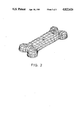
- FIG. 2 is a perspective view of a bone-shaped canine biscuit molded with a surface containing irregularities
- FIG. 3 is a perspective view of a bone-shaped canine biscuit having a baked-on coating of the invention which contains particulate matter;
- FIG. 4 is a perspective view of a bone-shaped canine biscuit having a recess in the top surface area which contains raised letters spelling "MILK BONE" and
- FIG. 5 is a perspective view of the biscuit of FIG. 4 to which a coating of the invention has been applied to cover the surface and fill the recess.
- FIG. 6 is a sectional view of the biscuit of FIG. 5 illustrating the use of the coating to fill the recess and cover the surface of the raised letters.
- the present invention is directed to a process for preparing baked pet foods having a coating baked thereon, and products thus prepared.
- These products can be prepared in a variety of sizes and shapes ranging from kibbles or other bite size units through biscuits of various shapes and sizes, and can be prepared to suit the taste of most carnivorous or ominivorous domestic or pet animals.
- the invention is described herein primarily in terms of a coated bone-shaped canine biscuit, but this should not be takened to limit the scope of the invention, which is delineated by the appended claims.
- the present invention includes biscuits or other baked dough products having a glossy, baked on coating which are of broad utility, but are presently of particular interest for pet foods such as canine biscuits.
- the process of the invention begins with mixing of the dough, which can be a conventional dough such as is used in baking canine biscuits or other desired products.
- Conventional mixing apparatus and processes can be used.
- Dough pieces are then formed by any suitable means such as extrusion, stamping, cutting or molding.
- a rotary molding system is preferred because it permits the rapid forming of dough pieces with good control over their shape, form and surface characteristics. Docker holes are preferably formed in the dough piece during molding to facilitate the escape of moisture during baking, as shown in FIGS. 2 through 5.
- the dough pieces can optionally be subjected to a baking stage at which they are at least partially baked.
- the dough pieces are subjected to only one baking step after application of the coating, as this is more efficient and economical.
- Most prior art processes for the application of baked-on coatings to canine biscuits have required two baking steps.
- the coating formulations of the present invention can be baked in a single step on a dough piece to form a glossy coating essentially free of blistering or other surface imperfections.
- a coating formulation as described below is mixed and heated to a desired application temperature and applied to the dough pieces, uncooked or partially baked, in a manner which provides an essentially complete coating on at least the upper surfaces and sides of the dough piece.
- a desired application temperature Preferably, conventional enrobing apparatus and methods are utilized.
- enrobing systems can be devised to coat all surfaces of the dough piece, the bottom surface is customarily left substantially uncoated to facilitate movement and baking on conveyor belts and other transport equipment.
- air blowing systems such as are used in chocolate enrobing can be employed.
- the coated dough pieces then pass to an oven such as a conventional band oven where the coating is at least partially dried, the biscuit is baked and the coating becomes a glossy, baked-on coating for the baked dough piece or biscuit.
- the conveyer belts of the oven can be coated with an edible lubricant such as a natural or synthetic cooking oil or shortening to facilitate separation from the conveyer belts of the baked products. Temperatures in the range of about 350° to about 600° F. can be used.
- the baked, coated biscuits can also be subjected to a subsequent baking or drying step, at temperatures of about 200° to 400° F., either within the baking oven or separately, to produce the desired moisture content in the final product.
- Any suitable dough comprising at least one flour, meal, fat and water can be employed for the baked product desired; for instance, when the desired product is a canine biscuit, a conventional dough for dog biscuits can be used, optionally containing discrete particles of meat and/or meat byproducts or farinaceous material. Such doughs typically contain fat solids.
- suitable doughs for the production of hard dog biscuits are disclosed in U.S. Pat. No. 4,454,163
- suitable doughs for the production of soft dog biscuits (containing humectant to control water activity) are disclosed in U.S. Pat. No. 4,454,164.
- Those patents are incorporated herein by reference in their entirety.
- Suitable doughs and biscuit shapes are also disclosed in U.S. patent application Ser. No.
- a dough found to produce biscuits highly palatable to dogs includes suitable proportions of wheat flour, wheat meal, soybean meal, meat and bone meal, animal fat and natural flavors in admixture with water.
- the meal used in the doughs suitable for production of biscuits useful in the present invention can comprise meat and/or bone as defined herein, and/or vegetable matter including farinaceous materials, materials prepared from legumes such as beans and peas, tuberous materials such as potato meal, and the like.
- the meals can be finely or coarsely ground as desired for the texture. Flours made from any suitable farinaceous materials can be used.
- coating formulations of the present invention when baked onto a dough piece to form a coated biscuit provide products which are both attractive to consumers and palatable to the pets to which they are fed.
- coating formulations within the scope of those claimed herein can be used in the preparation of baked snack foods for human consumption as well, for example biscuits, crackers, pretzels, food bars and the like.
- a glossy coating which enhances appearance, flavor, protein content and moisture resistance is very desirable in such products.
- Color is normally employed in the formulation to give the baked product a meaty appearance, increasing consumer eye appeal.
- the coating formulation must be pumpable and flowable to permit application with typical enrobing apparatus and processes, but should be viscous, i.e., should regain sufficient viscosity upon application to be retained as a suitably thick coating on the dough piece so that it forms the desired glossy baked-on coating.
- the formulation should also have sufficient suspending ability to suspend particulate matter which may be incorporated in the coatings to add a surface texture to the finished product. Accordingly, the coating formulation must be thixotropic or nearly pseudoplastic.
- a pseudoplastic solution or composition exhibits a sharp reduction in viscosity upon the application of shear, as in mixing or pumping, thereafter abruptly regaining the original viscosity when the shear effects of pumping or processing are removed.
- the formulation be thixotropic, that is undergoing a reduction in viscosity after a finite time delay when shear is applied to the material, thereafter regaining essentially the original viscosity when the shear force is removed, with another finite time delay.
- the formulation as applied retains a substantial proportion of its viscosity during baking, to prevent excessive dripping or runoff. It is desirable that the formulation as applied to the dough piece flows sufficiently to cover essentially the entire surface of the dough piece, thereafter regaining sufficient viscosity to remain in place as a coating of sufficient thickness on the dough piece.
- air blowing systems can be used to aid such flow.
- the formulation provides a coating having a desirable flavor and color as described above.
- the recited ingredients of the formulation are combined in proportions which allows the formulation to bake to a glossy, moisture-resistant finish without blistering during the baking process.
- the dextrin carrier and modified food starch or gelatin glazing agent cooperate to produce a glossy, moderately moisture-resistant baked-on coating.
- the dextrin can broadly be present as about 10 to 40 weight percent, preferably from about 10 to about 30 weight percent, and most preferably from about 15 to 25 weight percent, based on the total weight of dry solids. The proportion of dextrin can be greater or less within these ranges, depending upon the proportions of modified food starch or gelatin used.
- the glazing agent modified food starch or gelatin
- Meat is present in the formulation for flavor and nutrition purposes as from about 10 to about 50 weight percent, preferably from about 15 to about 40 weight percent, and most preferably from about 20 to about 35 weight percent, based on the total weight of dry solids.
- the type and proportions of meat are preferably selected to maximize the flavor appeal and nutrition obtained for a unit product cost.
- small proportions of fats or oils can be included in the coating formulation to produce a glossier, more resilient baked coating, the preferred formulations are substantially free of fats and oils, as the baked coatings produced therefrom are more moisture-resistant.
- the polysaccharide gum has the most significant effect on the formulation,s viscosity (imparting pseudoplasticity and temperature stability) and can be present in amounts in the range of from about 1 to about 5 weight percent, preferably from about 2 to about 4, and most preferably from about 2.5 to about 3.5 weight percent, based on the total weight of dry solids.
- Two sugars are included, preferably comprising at least one monosaccharide sugar such as dextrose and at least one disaccharide sugar such as sucrose.
- Each component can be present as an amount in the range of from about 5 to about 15 weight percent of the total solids, preferably from about 7 to about 10 weight percent, based on the total weight of dry solids.
- the combination of sugars contributes to browning of the baked coating and flavor, as well as flowability and bacteriostasis in the formulation.
- the dry solids can be combined with water in proportions such that the total solids are in the range of from about 10 to about 20, preferably from about 12 to about 18 weight percent, based on the total weight of the mixture.
- the dextrin carrier employed in the formulation can be any suitable dextrin product useful in the food industry, such as the AMAIZO LO-DEX® malto-dextrin products marketed by the American Maize-Products Company of Hammond, Indiana. These are low dextrose equivalent malto-dextrin products produced by hydrolyzing corn starch. AMAIZO LO-DEX® 10 has been found to give satisfactory results in formulations of the present invention. Various partially-hydrolyzed food starches which have similar viscosity characteristics can also be used. The dextrin acts as a carrier as well as aiding in viscosity control and adhesion of the coating.
- Another ingredient of the coating formulation is a substantial quantity of meat in a finely divided, particulate or slurried form, which can encompass any of the meats or meat byproducts obtained from mammals, fish, or fowl which have been described as useful in the pet food industry.
- a dehydrated meat is employed, as the drying and curing processes used reduce the probability of spoilage during processing or subsequent storage and transportation.
- the quantity of water used in the formulation should be adjusted according to whether fresh or dehydrated meats are used.
- a meat jerky product such as beef jerky is employed, as the spicy flavorings of such products enhance the palatability of the coated biscuit for the pet and produce an aroma which is more pleasing to the consumer purchasing the coated biscuit product.
- Such a dehydrated meat in finely divided form is preferably used to form a smooth and continuous coating on the dough piece, but if desired at least a portion of the meat (such as beef jerky) can be in larger particulate form (e.g., passing an 8 to 14 mesh sieve and retained by a 30 mesh sieve), which also provides a desirable rough surface texture to the coating.
- the meat particles in the coating will tend to scorch, requiring adjustment in baking time and/or temperature.
- small proportions of organ meats such as heart, liver or kidney can be included to enhance flavor, but substantial quantities of liver are preferably avoided due to the relatively high cost.
- An object is to obtain the most palatable flavor for the pet while retaining consumer appeal at a relatively low unit cost.
- a modified food starch or at least one gelatin can be applied as a glazing agent.
- the glazing agent is used in a type and quantity effective to produce a glossy or glazed coating having a moist, glossy appearance and having some resiliency.
- Any suitable gelatin product approved for use in the pet food industry can be employed, such as animal gelatin, egg albumen and the like.
- a modified food starch as the glazing agent, encompassing any suitable food starch which has been modified by at least partial hydrolysis and/or chemical modifications so that it produces a glossy film when applied to a surface in a heated formulation of the type described in the present invention.
- Suitable water-soluble starch polymers can be derived from starches such as corn, potato and tapioca by processes including acetylation, chlorination, acid hydrolysis, enzymatic action, oxidization (with sodium hypochlorite or the like), or the introduction of carboxyl, sulfate or sulfonate groups. Such starches can be crosslinked with suitable agents to increase the viscosity and thickening power. Particularly preferred are modified waxy maize starches, such as MIRA-CAP® starch, available from A. E. Staley Manufacturing Company of Decatur, IL; Film Set®, available from the National Starch & Chemical Corp. of Bridgewater, NJ, and various products available from the American Maize-Products Company, including AMAIZO POLAR-GEL® 8 and 10, X-TRA GEL® 7 and AMIOGUM® 688 starch.
- MIRA-CAP® starch available from A. E. Staley Manufacturing Company of Decatur, IL
- Film Set® available from the National Star
- An effective amount of at least one polysaccharide gum is included in the formulation as the primary agent to produce the desired viscosity characteristics. Generally an amount in the range of from about 1 to about 5 percent, based on the total solids will be effective.
- Any suitable vegetable gum can be used which will produce thixotropic or pseudoplastic formulations, including the various natural (e.g., guar gum, gum arabic and the like) and synthetic food gums. Particularly preferred is a xanthan gum, a natural biopolysaccharide produced by microorganisms.
- Xanthan gum solutions exhibit nearly pseudoplastic rheology, permitting a relatively small amount of the gum to be effective in producing viscosity characteristics in a formulation such as described herein which is thixotropic or approaches pseudoplasticity.
- the viscosities of xanthan gum solutions are remarkably stable over a wide range of temperatures, and relatively unaffected by varying pH and varying concentrations of salts in the solution.
- blends of two or more gums can be employed to produce the desired characteristics.
- the degree of pseudoplasticity of a xanthan gum can be reduced by adding an alginate salt such as sodium alginate.
- xanthan gum Because of its yield value and a viscosity which is almost independent of temperature and pH, xanthan gum is regarded as nearly ideal as a suspension stabilizer, and thus is particularly useful in the formulations of the present invention when particulate matter is to be suspended in the coating.
- Xanthan gums are available commercially from the Kelco Co., San Diego, Calif., under the trade names KELTROL® (food grade) and KELZAN® (industrial grade). Other useful gums include guar gum.
- a blend of sugars preferably comprising sucrose disaccharide and dextrose monosaccharide.
- the monosaccharide is believed to contribute to browning of the coating and the disaccharide is believed to contribute to flowability, while both sugars aid in bacteriostasis in the formulation.
- particulate farinaceous texturizers are included in the coating formulation to provide an attractive surface roughness simulating the presence of fragments of meat on bone-shaped coated biscuits and at the same time to provide desirable food components.
- the term "bone-shaped” signifies the typical shape of canine biscuits, having a shank and rounded, broader knobs at the ends suggesting the ball or socket of certain bones. Typical examples are shown in FIGS. 2 through 5. Such shapes are known in the art to be convenient for canines to chew and eat. Any suitable particulate farinaceous matter can be employed, preferably those materials which provide nutrients and/or desirable bulk product properties to the product.
- Preferred materials include raw bran, cracked whole grains such as cracked wheat and "rye chops" and ground hard biscuit materials such as waste or excess baked biscuits of the type to which the coating is to be applied.
- farinaceous materials which preferentially absorb the colors employed in the coating formulation can be used so that they are more noticeable in the baked coating on the surface of the product.
- the particulate farinaceous materials can be employed in any suitable size range, providing the particles are large enough to be observed visually and/or tactilely, but not so large as to readily rub off the finished products during transportation, storage or use or to impede the flow of the coating formulation through the enrobing apparatus. Particles which will pass an 8 mesh sieve or preferably a 14 mesh sieve, and be retained by a 30 mesh sieve are preferred. With some apparatus, it may be necessary to provide slots or grooves in applicator wheels, rollers, coating rolls or other processing equipment if the formulation must pass through a narrow channel.
- Indicative of the viscosity characteristics of the formulations of the present invention is that when measured with the Brookfield Model RV viscometer using a No.3 spindle at 10 rpm, viscosities of less than 10 6 centipoise, and preferably less than 105 centipoise, are attainable at temperatures of 5.5° C. (about 42° F.).
- the coating formulations including a substantial quantity of gelatin typically have been found to attain viscosities between 10 5 and 10 6 centipoise, while the formulations employing a modified food starch as the glazing agent readily attain viscosities of less than 10 5 centipoise.
- the formulations also can attain viscosities of less than about 3,000 centipoise at 120° F. and less than about 2,000 centipoise at 180° F. when tested with the same equipment. Measured at 170° F. with a 15 second flow time, the formulations can also have viscosities in the range of 14 to 18 Bost
- Rotary molding can be used to emboss or impress a regular or random pattern of indentations or irregularities in the molded surface of the dough piece, which aids in retention of the coating formulation on the surface after application.
- FIG. 2 illustrates a biscuit imprinted with a random network or "peanut hull" pattern.
- a similar pattern is used in "NUTTER BUTTER®” cookies, marketed by applicants' assignee, Nabisco Brands, Inc.
- the retention of increased quantities of the coating formulation can enhance the biscuit's visual appeal and palatability.
- the inclusion of such irregular pattern in the mold also facilitates the separation of the molded dough piece.
- a dough piece can have a recess or depression molded in the top surface thereof to hold a quantity of the coating formulation and/or a flavored filling in the finished biscuit.
- a biscuit is shown in FIG. 4, with raised letters within the recess spelling out a trade name.
- this biscuit is shown in a form in which the recess has been filled with the coating formulation and/or a filling, with the coating baked over the entire surface so that the letters of the trade name are visible through the glossy translucent colored coating.
- the filling used in addition to the coating can be any flavorful, nutritious coating which can maintain the desired moisture content and water level equilibria within the finished baked biscuit, but is preferably a gelatinous, translucent colored material which enhances the appearance of the coated biscuit.
- Such products have high visual appeal for consumers and high palatability for pets.
- the coated dough pieces are baked as described above to an overall moisture content of less than about 16 weight percent for a soft or chewy biscuit, or less than about 12 weight percent for a hard biscuit. Further baking and/or drying steps can be employed to reduce the moisture content below that attained in the initial baking step.
- the doughs were mixed to a suitable consistency for rotary molding and molded into bone-shaped canine biscuits about 4 inches in length using a rotary molder.
- some of the biscuits were partially baked before application of the coating formulation, but in the examples below, the coating formulations were applied directly to the uncooked dough pieces as molded, which is preferred for reasons of economy and efficiency.
- a coating formulation was heated to about 180° F. and applied to the raw dough pieces using commercial enrobing equipment.
- the enrobing system provided a curtain of the flowing formulation through which the dough pieces passed, with an air blowing system controlling the flow of the formulation as applied to the pieces.
- the excess formulation which ran off after enrobing of the biscuits was recycled for use on subsequent applications. Numbered examples are indicated in TABLES II and III below for various formulations which were tested.
- the coating formulations were heated and applied with commercial enrobing equipment at a temperature of approximately 180° F. the formulations are preferably applied hot to fully develop the film-forming properties of the modified food starches used and to restrict bio-growth.
- the application temperature can be in the range of about 150° to 200° F.
- the preferred temperature range is from about 170° to 185° F.
- the radius of curvature of the edges should be as large as possible, for example at least about 0.25 inch in a bone-shaped biscuit about 4 inches long with a shank about 1 inch wide. Additionally, the sides of the biscuit slope downward at angles in the range of approximately 75 to 85 degrees. These features also facilitate separation of the molded dough pieces from the mold. Generally, a coating of approximately tissue thickness was obtained. To provide good coverage of the biscuit for maximum consumer eye appeal and palatability, the coating should be at least about tissue thick as applied, and preferably in the range of from about tissue to index card thickness. If the coating is too thick, it may interfere with the loss of moisture during baking and/or drying, and the baked coating may be brittle or vulnerable to flaking or fracture during the operations from production to consumer, diminishing the perceived value of the product.
- the coated dough pieces were baked for ten minutes in a band oven having the temperature settings in various zones indicated in TABLE V:
- the coatings containing the modified food starch as glazing agent baked into a smooth, glossy coating having a translucent character, without significant bubbling or blistering.
- trials 1 and 4 with formulations containing gelatin as the glazing agent produced baked coatings with discontinuities.
- the formulations relying upon modified food starches as the glazing agent are presently preferred.
- the baking step was followed with a drying step of about 15 minutes at 250° F. in a band dryer.
- the biscuits were baked to a moisture content of about 12 weight percent for a hard canine biscuit, with the drying step reducing the moisture content further to below 10 weight percent.
- Coatings were applied using colors of brown, reddish-brown and a combination of discrete color units of brown, red and orange. Using focus group tests, coatings of these colors presented as representing cooked or raw meat products were all found to have acceptable consumer eye appeal.
- the baked, dried biscuits were tested by immersion in water and the coating was found not to form a gravy or emulsion, but to withstand the effects of water for a few minutes until the biscuit became saturated and crumbly.
- the coated biscuits produced were found to be at least as palatable as commercially available coated dog biscuits.
Landscapes
- Life Sciences & Earth Sciences (AREA)
- Chemical & Material Sciences (AREA)
- Polymers & Plastics (AREA)
- Engineering & Computer Science (AREA)
- Food Science & Technology (AREA)
- Zoology (AREA)
- Health & Medical Sciences (AREA)
- Nutrition Science (AREA)
- Animal Husbandry (AREA)
- Birds (AREA)
- Fodder In General (AREA)
- Bakery Products And Manufacturing Methods Therefor (AREA)
Abstract
Description
              TABLE I
______________________________________
Ingredient             Weight (lbs)
______________________________________
Wheat flour            940
Soybean meal           135
Meat and bone meals    100
Wheat meal              40
Animal fat (with preservative)
                        32
Natural flavors         21
Vitamin & mineral preblend
                        25
Water (warm tap water, 100°-140° F.)
                       500
Total ingredients      1,793
______________________________________
              TABLE II
______________________________________
              Example/Trial No.
              Weight percent.sup.1
              1       2/3     4
______________________________________
Dextrin.sup.2   23.5      23.5    35.5
Food Starch, Modified.sup.3
                --        23.5    --
Beef Jerky powder
                30.0      30.0    30.0
Flavorant       0.6       0.6     0.6
Polysaccharide gum.sup.4
                4.0       4.0     4.0
Food colors     0.74      0.74    0.74
Monosaccharide (dextrose)
                8.83      8.83    8.83
Disaccharide (sucrose)
                8.83      8.83    8.83
Gelatin.sup.5   23.5      --      11.5
______________________________________
 Notes:
 .sup.1 Approximate weight percent, based upon total solids. Tap water was
 added as approximately 85 weight percent of the total mixture to produce
 solution/suspension having the desired viscosity characteristics.
 .sup.2 AMAIZO LODEX ® 10, a powdered maltodextrin product produced
 hydrolysis of corn starch and having a low dextrose equivalent
 (approximately 11). Obtained from American MaizeProducts Co., Corn
 Processing Div., 1100 Indianapolis Blvd., Hammond, Indiana 46320.
 .sup.3 Example 2 used Film Set ® starch, a modified food starch
 available from the National Starch & Chemical Corp., of Bridgewater, NJ;
 Example 3 used MIRACAP ® Starch, a modified waxy corn starch obtained
 from A. E. Staley Industrial Products, 2200 East Eldorado St., Decatur, I
 62525.
 .sup.4 KELTROL ®, a food grade xanthan gum obtained from the Kelco
 Co., San Diego, CA.
 .sup.5 A commercial 250 bloom animal gelatin.
              TABLE III
______________________________________
              Example/Trial No.
              WEIGHT PERCENT.sup.1
INGREDIENTS:    5          6      7
______________________________________
Dextrin.sup.1   20.0       20.0   20.0
Food Starch, modified.sup.1
                20.0       20.0   20.0
Beef Jerky powder
                30.0       30.0   30.0
Flavorant       0.6        0.6    0.6
Polysaccharide gum.sup.1
                3.3        3.3    3.3
Food colors     1.1        1.1    1.1
Monosaccharide (dextrose)
                7.5        7.5    7.5
Disaccharide (sucrose)
                7.5        7.5    7.5
Raw Wheat Bran  10.0       --     --
Rye Chops       --         10.0   --
Ground Dog Biscuit.sup.2
                --         --     10.0
______________________________________
 Notes:
 .sup.1 Footnotes 1 to 4 of TABLE II apply; MIRACAP ® was used as the
 modified food starch.
 .sup.2 Finely ground biscuits prepared from the formula of TABLE I.
              TABLE IVA
______________________________________
Temperature, °F.
             35°
                    50°
                           70°
                                80°
                                     100°
                                          110°
                                               180°
Visc., Cent.
            4000   4350   4050 3600 3550 2950 1800
______________________________________
              TABLE IVB
______________________________________
Temperature, °F.
                  68.sup.1
                         77.sup.2
                                 110°
                                       180°
Viscosity, Centipoise
               10,000   7200    3400  1100
______________________________________
 Notes:
 .sup.1 Formulation gelled and became nonfluid.
 .sup.2 Formulation began to set.
                                  TABLE V
__________________________________________________________________________
Zone     1  2  3  4  5   6  7  8  9
Temperature, °F.
         .sup. 530°
            .sup. 530°
               .sup. 550°
                  .sup. 540°
                     .sup. 400°
                         .sup. 520°
                            OFF
                               OFF
                                  OFF
__________________________________________________________________________
Claims (51)
Priority Applications (1)
| Application Number | Priority Date | Filing Date | Title |
|---|---|---|---|
| US07/000,430 US4822626A (en) | 1987-01-05 | 1987-01-05 | Coated canine biscuits |
Applications Claiming Priority (1)
| Application Number | Priority Date | Filing Date | Title |
|---|---|---|---|
| US07/000,430 US4822626A (en) | 1987-01-05 | 1987-01-05 | Coated canine biscuits |
Publications (1)
| Publication Number | Publication Date |
|---|---|
| US4822626A true US4822626A (en) | 1989-04-18 |
Family
ID=21691502
Family Applications (1)
| Application Number | Title | Priority Date | Filing Date |
|---|---|---|---|
| US07/000,430 Expired - Fee Related US4822626A (en) | 1987-01-05 | 1987-01-05 | Coated canine biscuits |
Country Status (1)
| Country | Link |
|---|---|
| US (1) | US4822626A (en) |
Cited By (69)
| Publication number | Priority date | Publication date | Assignee | Title |
|---|---|---|---|---|
| US4913919A (en) * | 1986-11-18 | 1990-04-03 | Frito-Lay, Inc. | Coating composition for comestible products |
| US5000973A (en) * | 1989-05-30 | 1991-03-19 | Nabisco Brands, Inc. | Nutritionally-balanced canine biscuits containing an inorganic pyrophosphate |
| US5000940A (en) * | 1989-05-30 | 1991-03-19 | Nabisco Brands, Inc. | Devices, compositions and the like having or containing an inorganic pyrophosphate |
| US5000943A (en) * | 1989-05-30 | 1991-03-19 | Nabisco Brands, Inc. | Canine biscuits containing an inorganic pyrophosphate |
| US5015485A (en) * | 1989-05-30 | 1991-05-14 | Nabisco Brands, Inc. | Dog biscuits having a coating containing an inorganic pyrophosphate |
| US5094870A (en) * | 1989-05-30 | 1992-03-10 | Nabisco Brands, Inc. | Canine biscuits containing an inorganic pyrophosphate |
| US5100651A (en) * | 1986-12-05 | 1992-03-31 | Danielle Boyer | Health product, in particular for the caring of the teeth of dogs |
| US5114704A (en) * | 1989-05-30 | 1992-05-19 | Nabisco Brands, Inc. | Raw hide having a coating containing an inorganic pyrophosphate |
| US5532010A (en) * | 1993-05-28 | 1996-07-02 | Nabisco, Inc. | Coated canine biscuits and preparation process |
| WO1998015194A1 (en) * | 1996-10-09 | 1998-04-16 | Mjm Technologies, L.L.P. | Milk and protein powder-coated cereal products |
| US5798132A (en) * | 1996-06-17 | 1998-08-25 | Recot, Inc. | Process for applying a flavored coating to a food product |
| US5904928A (en) * | 1996-04-19 | 1999-05-18 | Societe A Responsabilite Limitee | Antitartar composition and its use in food supplements for animals |
| US6063412A (en) * | 1995-08-07 | 2000-05-16 | Hoy; Stephen B. | Edible animal greeting cards |
| US6083554A (en) * | 1998-05-05 | 2000-07-04 | Parker; Leroy | Food article in the form of a taco chip |
| US6228418B1 (en) * | 1999-04-07 | 2001-05-08 | Cyvex Nutrition | Vegetarian pet treat |
| US6238715B1 (en) * | 1999-02-02 | 2001-05-29 | Robert Scott Baikie | Chew toy for dogs and method of making the same |
| US6280779B1 (en) * | 1999-12-28 | 2001-08-28 | Colgate-Palmolive Company | Pet food for maintaining normal bowel health |
| US20030082277A1 (en) * | 2001-07-23 | 2003-05-01 | Avtar Sokhey | System and method for on-line mixing and application of surface coating compositions for food products |
| US20030099744A1 (en) * | 2001-11-13 | 2003-05-29 | Yong-Cheng Shi | Use of converted low-viscosity, high solids starch in foods |
| US20030152666A1 (en) * | 1997-04-10 | 2003-08-14 | Stephen Hoy | Edible animal greeting cards and treats |
| WO2003094629A1 (en) * | 2002-05-08 | 2003-11-20 | Berend-Jan Te Winkel | Animal food and method and machine for the production thereof |
| US20030215547A1 (en) * | 2002-05-16 | 2003-11-20 | Leyh Joseph Conrad | Pet treat coating composition and process |
| US6713103B2 (en) * | 2001-04-20 | 2004-03-30 | Par-Way Group, Inc. | Protein free non-tacky egg wash substitute |
| US20040194732A1 (en) * | 2003-02-28 | 2004-10-07 | Tiandong Jia | Pet chews and methods of making pet chews |
| US20040219260A1 (en) * | 2002-11-26 | 2004-11-04 | Anderson David A. | Foodstuff containing a moist meaty filling |
| US20040228958A1 (en) * | 2003-05-15 | 2004-11-18 | Tiandong Jia | Dental chew chips for dogs and method of making the same |
| US20040237904A1 (en) * | 2003-05-15 | 2004-12-02 | Tiandong Jia | Dental chew roll and method of making the same |
| US20040244720A1 (en) * | 2003-05-15 | 2004-12-09 | Tiandong Jia | Flavored dental crew |
| US20050042260A1 (en) * | 2003-03-12 | 2005-02-24 | Wai Cheuk | Method and composition |
| US20050048189A1 (en) * | 2003-08-27 | 2005-03-03 | Robert Lombard | Meat-containing, strip-shaped food product and method of making same |
| WO2005041682A2 (en) | 2003-11-03 | 2005-05-12 | Hill's Pet Nutrition, Inc. | Coated pet food composition |
| US20050106289A1 (en) * | 2000-03-31 | 2005-05-19 | Hoy Stephen B. | Edible animal greeting cards and treats |
| US20050181097A1 (en) * | 2002-09-16 | 2005-08-18 | Mars, Inc. | Nutritionally complete pet food and method of feeding and manufacturing same |
| US20060167940A1 (en) * | 2005-01-24 | 2006-07-27 | Paul Colton | System and method for improved content delivery |
| EP1692946A1 (en) * | 2005-02-18 | 2006-08-23 | Mars, Incorporated | Edible pet chew |
| US20060233916A1 (en) * | 2003-09-15 | 2006-10-19 | Trouw International B.V. | Fish fodder for freshwater fish and use of such fodder |
| EP1745703A1 (en) * | 2005-07-22 | 2007-01-24 | Mars Incorporated | Animal feed comprising a core and a shell |
| US20070020355A1 (en) * | 2005-07-22 | 2007-01-25 | Schlebusch Johannes P | Method of producing an animal food product with a core and shell |
| US20070048432A1 (en) * | 2005-08-25 | 2007-03-01 | Archer-Daniels-Midland Company | Use of dextrin in animal feeds |
| US20070098841A1 (en) * | 2005-07-22 | 2007-05-03 | William Keehn | Dog chew treats |
| US20080118606A1 (en) * | 2006-11-21 | 2008-05-22 | Mark Stern | Edible pet chew |
| US20080138464A1 (en) * | 2002-09-16 | 2008-06-12 | Mars Incorporated | Nutritionally complete pet food and method of feeding and manufacturing same |
| USD571076S1 (en) * | 2007-05-07 | 2008-06-17 | Kellogg Company | Cookie |
| USD572428S1 (en) * | 2007-05-07 | 2008-07-08 | Kellogg Company | Cookie |
| US20090274800A1 (en) * | 2006-07-05 | 2009-11-05 | Mars Incorporated | Pet food product with flavoring |
| EP2123169A1 (en) * | 2008-05-20 | 2009-11-25 | Paragon Products B.V. | Pet chew and manufacturing process |
| US20100303968A1 (en) * | 2009-05-28 | 2010-12-02 | Gregory Dean Sunvold | Pet Food in the Form of a Coated Kibble |
| US20100303966A1 (en) * | 2009-05-28 | 2010-12-02 | Gregory Dean Sunvold | Pet Food in the Form of a Coated Kibble |
| US20100303976A1 (en) * | 2009-05-28 | 2010-12-02 | Patrick Joseph Corrigan | Process for Making a Pet Food in the Form of a Coated Kibble |
| US20100303951A1 (en) * | 2009-05-28 | 2010-12-02 | Gregory Dean Sunvold | Delivering an Active Ingredient in Pet Food |
| US20100303967A1 (en) * | 2009-05-28 | 2010-12-02 | Gregory Dean Sunvold | Pet Food Having Improved Animal Preference |
| US20130000565A1 (en) * | 2010-03-18 | 2013-01-03 | Forcans Inc. | Multifunctional chewing gum for a pet and method for preparing same |
| US8455025B2 (en) | 2010-04-21 | 2013-06-04 | Petmatrix LLC | Edible pet chew made from a single initially malleable sheet |
| US20140377424A1 (en) * | 2009-04-24 | 2014-12-25 | General Mills, Inc. | Soft shaped tortillas |
| WO2015071845A1 (en) * | 2013-11-18 | 2015-05-21 | Nestec Sa | Compositions and methods for coating dry pet food kibbles |
| US20150164047A1 (en) * | 2013-11-07 | 2015-06-18 | Urban Pet Haus, LLC | Edible cat toy |
| US20150245639A1 (en) * | 2012-09-20 | 2015-09-03 | Unicharm Corporation | Pet food and method of manufacturing pet food |
| USD752841S1 (en) | 2013-12-13 | 2016-04-05 | Natural Balance Pet Foods, Inc. | Pet chew |
| USD759341S1 (en) | 2014-12-17 | 2016-06-21 | Natural Balance Pet Foods, Inc. | Pet chew |
| US9380802B2 (en) | 2014-04-03 | 2016-07-05 | Redbarn Pet Products, Inc. | Coated pet chew product |
| US10104903B2 (en) | 2009-07-31 | 2018-10-23 | Mars, Incorporated | Animal food and its appearance |
| US10624317B2 (en) | 2006-11-21 | 2020-04-21 | Petmatrix LLC | Edible pet chew made from an edible malleable sheet |
| EP3777552A4 (en) * | 2018-05-18 | 2021-06-09 | Unicharm Corporation | FEED FOR PETS, GRANULAR FEED FOR PETS AND PROCESS FOR THE PRODUCTION OF FEED FOR PETS |
| US11154077B2 (en) | 2009-07-31 | 2021-10-26 | Mars, Incorporated | Process for dusting animal food |
| US20210352937A1 (en) * | 2018-11-06 | 2021-11-18 | Unicharm Corporation | Pet food |
| US11388914B2 (en) | 2015-04-28 | 2022-07-19 | Mars, Incorporated | Process of preparing a wet pet food, wet pet food produced by the process and uses thereof |
| US11547125B2 (en) | 2015-02-13 | 2023-01-10 | Mars, Incorporated | Pet food feeding system |
| US11602419B2 (en) | 2017-09-27 | 2023-03-14 | Mars, Incorporated | Animal dentistry apparatus and methods |
| US11672263B2 (en) | 2015-12-17 | 2023-06-13 | Mars, Incorporated | Food product for reducing muscle breakdown and methods thereof |
Citations (40)
| Publication number | Priority date | Publication date | Assignee | Title |
|---|---|---|---|---|
| US1018415A (en) * | 1908-12-10 | 1912-02-27 | Ellis Foster Co | Feeding-stuff. |
| GB412772A (en) * | 1933-03-27 | 1934-07-05 | City Auto Stamping Co | Improved radiator guard |
| GB473704A (en) * | 1936-05-12 | 1937-10-19 | Henry George Pattle | Improvements in or relating to foodstuffs for animals |
| US2784093A (en) * | 1954-11-12 | 1957-03-05 | Feld Samuel | Method of adding fat to feed |
| US2945764A (en) * | 1957-07-15 | 1960-07-19 | Ralston Purina Co | Method of manufacturing stable pelleted foods |
| US3004852A (en) * | 1959-12-23 | 1961-10-17 | David E Rothschild | Method of preparing an animal feed of high fat content |
| US3119691A (en) * | 1962-04-23 | 1964-01-28 | Gen Foods Corp | Novel farinaceous animal food |
| US3139342A (en) * | 1959-08-17 | 1964-06-30 | Corn Products Co | Animal food process |
| US3284211A (en) * | 1963-12-17 | 1966-11-08 | Central Soya Co | Method of preparation of fat coated feed annuli |
| US3467525A (en) * | 1964-12-14 | 1969-09-16 | Ralston Purina Co | Process for making an animal food |
| US3615647A (en) * | 1968-03-27 | 1971-10-26 | Perk Foods Co | Expanded fat-coated animal food having a coherent coating |
| US3679429A (en) * | 1969-05-14 | 1972-07-25 | Ralston Purina Co | Cat food with hexamic acid flavorant |
| US3745023A (en) * | 1971-02-05 | 1973-07-10 | Robins Co Inc A H | Compositions for enhancing flavor of pet foods |
| US3808341A (en) * | 1971-11-15 | 1974-04-30 | Kal Kan Foods | Food product |
| US3808340A (en) * | 1971-07-12 | 1974-04-30 | Kal Kan Foods | Meat coated product |
| GB1359901A (en) * | 1972-02-08 | 1974-07-17 | Star Kist Foods | Process for coating dry pet food and products resulting therefrom |
| GB1433657A (en) * | 1974-05-31 | 1976-04-28 | Quaker Oatsco | Stabilization of dry pet food |
| US3968255A (en) * | 1974-04-08 | 1976-07-06 | General Foods Corporation | Method of preparing animal food of increased palatability |
| US3997675A (en) * | 1974-03-05 | 1976-12-14 | Robert James Eichelburg | Cat food coated with ascomycetus or asporogenous yeasts |
| GB1465267A (en) * | 1973-05-01 | 1977-02-23 | Mars Ltd | Animal food product |
| US4015026A (en) * | 1975-08-14 | 1977-03-29 | The Quaker Oats Company | Process for preparing a moist pet food additive, the additive, and the resultant pet food |
| US4016295A (en) * | 1973-10-18 | 1977-04-05 | Pedigree Petfoods Limited | Proteinaceous food product |
| US4029821A (en) * | 1973-01-26 | 1977-06-14 | Pedigree Petfoods Limited | Animal food |
| US4039692A (en) * | 1974-11-01 | 1977-08-02 | General Foods Corporation | Intermediate-moisture animal food process |
| US4039687A (en) * | 1973-09-07 | 1977-08-02 | Colgate-Palmolive Company | Animal food |
| US4070490A (en) * | 1976-03-09 | 1978-01-24 | General Foods Corporation | Liver-like pet food |
| US4089978A (en) * | 1976-03-30 | 1978-05-16 | General Foods Corporation | Pet food acceptability enhancer |
| US4104406A (en) * | 1973-03-02 | 1978-08-01 | General Foods Corporation | Coated expanded animal food |
| US4104407A (en) * | 1973-03-02 | 1978-08-01 | General Foods Corporation | Expanded animal food coated with dextrin and fat |
| US4211797A (en) * | 1977-12-29 | 1980-07-08 | General Foods Corporation | Dry dog food of improved palatability |
| US4229485A (en) * | 1978-07-25 | 1980-10-21 | Jerky Treats, Inc. | Glazed liver coated biscuit or kibble for pets |
| US4294857A (en) * | 1979-12-05 | 1981-10-13 | Ralston Purina Company | Dog food compositions of improved palatability to dogs |
| US4296132A (en) * | 1980-03-13 | 1981-10-20 | General Foods Corporation | Dog food of improved acceptability |
| US4366175A (en) * | 1978-07-25 | 1982-12-28 | Brown Bruce W | Glazed liver coated biscuit or kibble for pets |
| US4389420A (en) * | 1981-05-11 | 1983-06-21 | The Pillsbury Company | Dough glaze |
| US4393085A (en) * | 1981-08-13 | 1983-07-12 | General Foods Corporation | Enzyme digestion for a dog food of improved palatability |
| US4418086A (en) * | 1982-01-28 | 1983-11-29 | General Foods Corporation | Expanded textured protein product and method for making same |
| US4444796A (en) * | 1979-09-14 | 1984-04-24 | Kabushiki Kaisha Ueno Seiyaku Oyo Kenkyujo | Method for production of pet foods |
| US4508741A (en) * | 1982-09-15 | 1985-04-02 | Star-Kist Foods, Inc. | Coated pet food and process for preparation thereof |
| US4702926A (en) * | 1982-05-10 | 1987-10-27 | Frito-Lay, Inc. | Process for producing two-component dough products |
-
1987
- 1987-01-05 US US07/000,430 patent/US4822626A/en not_active Expired - Fee Related
Patent Citations (41)
| Publication number | Priority date | Publication date | Assignee | Title |
|---|---|---|---|---|
| US1018415A (en) * | 1908-12-10 | 1912-02-27 | Ellis Foster Co | Feeding-stuff. |
| GB412772A (en) * | 1933-03-27 | 1934-07-05 | City Auto Stamping Co | Improved radiator guard |
| GB473704A (en) * | 1936-05-12 | 1937-10-19 | Henry George Pattle | Improvements in or relating to foodstuffs for animals |
| US2784093A (en) * | 1954-11-12 | 1957-03-05 | Feld Samuel | Method of adding fat to feed |
| US2945764A (en) * | 1957-07-15 | 1960-07-19 | Ralston Purina Co | Method of manufacturing stable pelleted foods |
| US3139342A (en) * | 1959-08-17 | 1964-06-30 | Corn Products Co | Animal food process |
| US3004852A (en) * | 1959-12-23 | 1961-10-17 | David E Rothschild | Method of preparing an animal feed of high fat content |
| US3119691A (en) * | 1962-04-23 | 1964-01-28 | Gen Foods Corp | Novel farinaceous animal food |
| US3284211A (en) * | 1963-12-17 | 1966-11-08 | Central Soya Co | Method of preparation of fat coated feed annuli |
| US3467525A (en) * | 1964-12-14 | 1969-09-16 | Ralston Purina Co | Process for making an animal food |
| US3615647A (en) * | 1968-03-27 | 1971-10-26 | Perk Foods Co | Expanded fat-coated animal food having a coherent coating |
| US3679429A (en) * | 1969-05-14 | 1972-07-25 | Ralston Purina Co | Cat food with hexamic acid flavorant |
| US3745023A (en) * | 1971-02-05 | 1973-07-10 | Robins Co Inc A H | Compositions for enhancing flavor of pet foods |
| US3808340A (en) * | 1971-07-12 | 1974-04-30 | Kal Kan Foods | Meat coated product |
| US3808340B1 (en) * | 1971-07-12 | 1984-03-20 | ||
| US3808341A (en) * | 1971-11-15 | 1974-04-30 | Kal Kan Foods | Food product |
| GB1359901A (en) * | 1972-02-08 | 1974-07-17 | Star Kist Foods | Process for coating dry pet food and products resulting therefrom |
| US4029821A (en) * | 1973-01-26 | 1977-06-14 | Pedigree Petfoods Limited | Animal food |
| US4104406A (en) * | 1973-03-02 | 1978-08-01 | General Foods Corporation | Coated expanded animal food |
| US4104407A (en) * | 1973-03-02 | 1978-08-01 | General Foods Corporation | Expanded animal food coated with dextrin and fat |
| GB1465267A (en) * | 1973-05-01 | 1977-02-23 | Mars Ltd | Animal food product |
| US4039687A (en) * | 1973-09-07 | 1977-08-02 | Colgate-Palmolive Company | Animal food |
| US4016295A (en) * | 1973-10-18 | 1977-04-05 | Pedigree Petfoods Limited | Proteinaceous food product |
| US3997675A (en) * | 1974-03-05 | 1976-12-14 | Robert James Eichelburg | Cat food coated with ascomycetus or asporogenous yeasts |
| US3968255A (en) * | 1974-04-08 | 1976-07-06 | General Foods Corporation | Method of preparing animal food of increased palatability |
| GB1433657A (en) * | 1974-05-31 | 1976-04-28 | Quaker Oatsco | Stabilization of dry pet food |
| US4039692A (en) * | 1974-11-01 | 1977-08-02 | General Foods Corporation | Intermediate-moisture animal food process |
| US4015026A (en) * | 1975-08-14 | 1977-03-29 | The Quaker Oats Company | Process for preparing a moist pet food additive, the additive, and the resultant pet food |
| US4070490A (en) * | 1976-03-09 | 1978-01-24 | General Foods Corporation | Liver-like pet food |
| US4089978A (en) * | 1976-03-30 | 1978-05-16 | General Foods Corporation | Pet food acceptability enhancer |
| US4211797A (en) * | 1977-12-29 | 1980-07-08 | General Foods Corporation | Dry dog food of improved palatability |
| US4229485A (en) * | 1978-07-25 | 1980-10-21 | Jerky Treats, Inc. | Glazed liver coated biscuit or kibble for pets |
| US4366175A (en) * | 1978-07-25 | 1982-12-28 | Brown Bruce W | Glazed liver coated biscuit or kibble for pets |
| US4444796A (en) * | 1979-09-14 | 1984-04-24 | Kabushiki Kaisha Ueno Seiyaku Oyo Kenkyujo | Method for production of pet foods |
| US4294857A (en) * | 1979-12-05 | 1981-10-13 | Ralston Purina Company | Dog food compositions of improved palatability to dogs |
| US4296132A (en) * | 1980-03-13 | 1981-10-20 | General Foods Corporation | Dog food of improved acceptability |
| US4389420A (en) * | 1981-05-11 | 1983-06-21 | The Pillsbury Company | Dough glaze |
| US4393085A (en) * | 1981-08-13 | 1983-07-12 | General Foods Corporation | Enzyme digestion for a dog food of improved palatability |
| US4418086A (en) * | 1982-01-28 | 1983-11-29 | General Foods Corporation | Expanded textured protein product and method for making same |
| US4702926A (en) * | 1982-05-10 | 1987-10-27 | Frito-Lay, Inc. | Process for producing two-component dough products |
| US4508741A (en) * | 1982-09-15 | 1985-04-02 | Star-Kist Foods, Inc. | Coated pet food and process for preparation thereof |
Cited By (113)
| Publication number | Priority date | Publication date | Assignee | Title |
|---|---|---|---|---|
| US4913919A (en) * | 1986-11-18 | 1990-04-03 | Frito-Lay, Inc. | Coating composition for comestible products |
| US5100651A (en) * | 1986-12-05 | 1992-03-31 | Danielle Boyer | Health product, in particular for the caring of the teeth of dogs |
| US5000973A (en) * | 1989-05-30 | 1991-03-19 | Nabisco Brands, Inc. | Nutritionally-balanced canine biscuits containing an inorganic pyrophosphate |
| US5000940A (en) * | 1989-05-30 | 1991-03-19 | Nabisco Brands, Inc. | Devices, compositions and the like having or containing an inorganic pyrophosphate |
| US5000943A (en) * | 1989-05-30 | 1991-03-19 | Nabisco Brands, Inc. | Canine biscuits containing an inorganic pyrophosphate |
| US5015485A (en) * | 1989-05-30 | 1991-05-14 | Nabisco Brands, Inc. | Dog biscuits having a coating containing an inorganic pyrophosphate |
| US5094870A (en) * | 1989-05-30 | 1992-03-10 | Nabisco Brands, Inc. | Canine biscuits containing an inorganic pyrophosphate |
| US5114704A (en) * | 1989-05-30 | 1992-05-19 | Nabisco Brands, Inc. | Raw hide having a coating containing an inorganic pyrophosphate |
| US5532010A (en) * | 1993-05-28 | 1996-07-02 | Nabisco, Inc. | Coated canine biscuits and preparation process |
| US6063412A (en) * | 1995-08-07 | 2000-05-16 | Hoy; Stephen B. | Edible animal greeting cards |
| US6511687B2 (en) | 1995-08-07 | 2003-01-28 | Stephen Hoy | Edible animal greeting cards and treats |
| US6355285B1 (en) | 1995-08-07 | 2002-03-12 | Stephen B. Hoy | Edible animal greeting cards |
| US5904928A (en) * | 1996-04-19 | 1999-05-18 | Societe A Responsabilite Limitee | Antitartar composition and its use in food supplements for animals |
| US5798132A (en) * | 1996-06-17 | 1998-08-25 | Recot, Inc. | Process for applying a flavored coating to a food product |
| WO1998015194A1 (en) * | 1996-10-09 | 1998-04-16 | Mjm Technologies, L.L.P. | Milk and protein powder-coated cereal products |
| US5894027A (en) * | 1996-10-09 | 1999-04-13 | Mjm Technologies, L.L.P. | Milk and protein powder-coated cereal products |
| US6838101B2 (en) | 1997-04-10 | 2005-01-04 | Stephen Hoy | Edible animal greeting cards and treats |
| US20030152666A1 (en) * | 1997-04-10 | 2003-08-14 | Stephen Hoy | Edible animal greeting cards and treats |
| US6083554A (en) * | 1998-05-05 | 2000-07-04 | Parker; Leroy | Food article in the form of a taco chip |
| US6238715B1 (en) * | 1999-02-02 | 2001-05-29 | Robert Scott Baikie | Chew toy for dogs and method of making the same |
| US6228418B1 (en) * | 1999-04-07 | 2001-05-08 | Cyvex Nutrition | Vegetarian pet treat |
| US6280779B1 (en) * | 1999-12-28 | 2001-08-28 | Colgate-Palmolive Company | Pet food for maintaining normal bowel health |
| US20050106289A1 (en) * | 2000-03-31 | 2005-05-19 | Hoy Stephen B. | Edible animal greeting cards and treats |
| US6713103B2 (en) * | 2001-04-20 | 2004-03-30 | Par-Way Group, Inc. | Protein free non-tacky egg wash substitute |
| US7980194B2 (en) | 2001-07-23 | 2011-07-19 | The Procter & Gamble Company | System and method for on-line mixing and application of surface coating compositions for food products |
| US7479294B2 (en) * | 2001-07-23 | 2009-01-20 | The Procter & Gamble Company | System and method for on-line mixing and application of surface coating compositions for food products |
| US20090086570A1 (en) * | 2001-07-23 | 2009-04-02 | Avtar Sokhey | System andmethod for on-line mixing and application of surface coating compositions for food products |
| US20030082277A1 (en) * | 2001-07-23 | 2003-05-01 | Avtar Sokhey | System and method for on-line mixing and application of surface coating compositions for food products |
| US20030099744A1 (en) * | 2001-11-13 | 2003-05-29 | Yong-Cheng Shi | Use of converted low-viscosity, high solids starch in foods |
| US6896915B2 (en) * | 2001-11-13 | 2005-05-24 | National Starch And Chemical Investment Holding Corporation | Use of converted low-viscosity, high solids starch in foods |
| WO2003094629A1 (en) * | 2002-05-08 | 2003-11-20 | Berend-Jan Te Winkel | Animal food and method and machine for the production thereof |
| US20030215547A1 (en) * | 2002-05-16 | 2003-11-20 | Leyh Joseph Conrad | Pet treat coating composition and process |
| US20080138464A1 (en) * | 2002-09-16 | 2008-06-12 | Mars Incorporated | Nutritionally complete pet food and method of feeding and manufacturing same |
| EP1545238A4 (en) * | 2002-09-16 | 2012-07-18 | Mars Inc | Two-texture pet food product |
| US20050181097A1 (en) * | 2002-09-16 | 2005-08-18 | Mars, Inc. | Nutritionally complete pet food and method of feeding and manufacturing same |
| US20040219260A1 (en) * | 2002-11-26 | 2004-11-04 | Anderson David A. | Foodstuff containing a moist meaty filling |
| US7485330B2 (en) * | 2002-11-26 | 2009-02-03 | Redbarn Pet Products, Inc. | Foodstuff containing a moist meaty filling |
| US20040194732A1 (en) * | 2003-02-28 | 2004-10-07 | Tiandong Jia | Pet chews and methods of making pet chews |
| US8685943B2 (en) * | 2003-03-12 | 2014-04-01 | Hill's Pet Nutrition, Inc. | Methods for reducing diarrhea in a companion animal |
| US20050042260A1 (en) * | 2003-03-12 | 2005-02-24 | Wai Cheuk | Method and composition |
| US9028861B2 (en) | 2003-03-12 | 2015-05-12 | Hill's Pet Nutrition, Inc. | Method and composition to reduce diarrhea in a companion animal |
| US20040244720A1 (en) * | 2003-05-15 | 2004-12-09 | Tiandong Jia | Flavored dental crew |
| US6935275B2 (en) | 2003-05-15 | 2005-08-30 | The Hartz Mountain Corporation | Dental chew roll and method of making the same |
| US20040237904A1 (en) * | 2003-05-15 | 2004-12-02 | Tiandong Jia | Dental chew roll and method of making the same |
| US20040228958A1 (en) * | 2003-05-15 | 2004-11-18 | Tiandong Jia | Dental chew chips for dogs and method of making the same |
| US8309157B2 (en) | 2003-08-27 | 2012-11-13 | Del Monte Corporation | Meat-containing, strip-shaped food product and method of making same |
| US20050048189A1 (en) * | 2003-08-27 | 2005-03-03 | Robert Lombard | Meat-containing, strip-shaped food product and method of making same |
| US7282235B2 (en) | 2003-08-27 | 2007-10-16 | Del Monte Corporation | Meat-containing, strip-shaped food product and method of making same |
| US8709520B2 (en) | 2003-08-27 | 2014-04-29 | Big Heart Pet Brands | Meat-containing, strip shaped food product and method of making same |
| US20080020117A1 (en) * | 2003-08-27 | 2008-01-24 | Delmonte Corporation | Meat-containing, strip-shaped food product and method of making same |
| US8632830B2 (en) | 2003-09-15 | 2014-01-21 | Trouw International B.V. | Fish fodder for freshwater fish and use of such fodder |
| US20060233916A1 (en) * | 2003-09-15 | 2006-10-19 | Trouw International B.V. | Fish fodder for freshwater fish and use of such fodder |
| JP2013255509A (en) * | 2003-11-03 | 2013-12-26 | Hill's Pet Nutrition Inc | Coated pet food composition |
| US20090074827A1 (en) * | 2003-11-03 | 2009-03-19 | Hill's Pet Nutrition, Inc. | Coated pet food composition |
| US8501224B2 (en) * | 2003-11-03 | 2013-08-06 | Hill's Pet Nutrition, Inc. | Coated pet food composition |
| WO2005041682A2 (en) | 2003-11-03 | 2005-05-12 | Hill's Pet Nutrition, Inc. | Coated pet food composition |
| US8263113B2 (en) * | 2003-11-03 | 2012-09-11 | Hill's Pet Nutrition, Inc. | Method for increasing the shelf life of a physically discrete dry pet food composition |
| US20050147651A1 (en) * | 2003-11-03 | 2005-07-07 | Hill's Pet Nutrition, Inc. | Coated pet food composition |
| EP1987723A1 (en) | 2003-11-03 | 2008-11-05 | Hill's Pet Nutrition Inc. | Coated pet food composition |
| EP1679978A4 (en) * | 2003-11-03 | 2007-11-28 | Hills Pet Nutrition Inc | Coated pet food composition |
| AU2004285593B2 (en) * | 2003-11-03 | 2010-12-02 | Hill's Pet Nutrition, Inc. | Coated pet food composition |
| US20090074840A1 (en) * | 2003-11-03 | 2009-03-19 | Hill's Pet Nutrition, Inc. | Coated Pet Food Composition |
| JP2007510427A (en) * | 2003-11-03 | 2007-04-26 | ヒルズ・ペット・ニュートリシャン・インコーポレーテッド | Coated pet food composition |
| EP1722641A4 (en) * | 2004-02-27 | 2008-03-05 | Mars Inc | Nutritionally complete pet food and method of feeding and manufacturing same |
| US8563029B2 (en) | 2004-09-16 | 2013-10-22 | Hill's Pet Nutrition, Inc. | Exopolysaccharide containing food |
| US20080160164A1 (en) * | 2004-09-16 | 2008-07-03 | Colgate-Palmolive Company | Method and Composition |
| US20060167940A1 (en) * | 2005-01-24 | 2006-07-27 | Paul Colton | System and method for improved content delivery |
| EP1692946A1 (en) * | 2005-02-18 | 2006-08-23 | Mars, Incorporated | Edible pet chew |
| US20060188611A1 (en) * | 2005-02-18 | 2006-08-24 | Emine Unlu | Edible pet chew |
| US7651708B2 (en) | 2005-07-22 | 2010-01-26 | Mars, Inc. | Method of producing an animal food product with a core and shell |
| US20070020355A1 (en) * | 2005-07-22 | 2007-01-25 | Schlebusch Johannes P | Method of producing an animal food product with a core and shell |
| EP1745703A1 (en) * | 2005-07-22 | 2007-01-24 | Mars Incorporated | Animal feed comprising a core and a shell |
| US20070098841A1 (en) * | 2005-07-22 | 2007-05-03 | William Keehn | Dog chew treats |
| AU2006203071B2 (en) * | 2005-07-22 | 2011-03-17 | Mars, Incorporated | Method of producing an animal food product with a core and shell |
| US7914835B2 (en) * | 2005-07-22 | 2011-03-29 | Del Monte Corporation | Dog chew treats |
| US20070048432A1 (en) * | 2005-08-25 | 2007-03-01 | Archer-Daniels-Midland Company | Use of dextrin in animal feeds |
| US20090274800A1 (en) * | 2006-07-05 | 2009-11-05 | Mars Incorporated | Pet food product with flavoring |
| US11259500B2 (en) | 2006-11-21 | 2022-03-01 | Petmatrix LLC | Edible pet chew made from an edible malleable sheet |
| US9968117B2 (en) | 2006-11-21 | 2018-05-15 | Spectrum Brands Pet Group, Inc. | Edible pet chew |
| US10624317B2 (en) | 2006-11-21 | 2020-04-21 | Petmatrix LLC | Edible pet chew made from an edible malleable sheet |
| US11712025B2 (en) | 2006-11-21 | 2023-08-01 | Petmatrix LLC | Edible pet chew made from an edible malleable sheet |
| US20080118606A1 (en) * | 2006-11-21 | 2008-05-22 | Mark Stern | Edible pet chew |
| US7677203B2 (en) | 2006-11-21 | 2010-03-16 | Mark Stern | Edible pet chew |
| USD572428S1 (en) * | 2007-05-07 | 2008-07-08 | Kellogg Company | Cookie |
| USD571076S1 (en) * | 2007-05-07 | 2008-06-17 | Kellogg Company | Cookie |
| EP2123169A1 (en) * | 2008-05-20 | 2009-11-25 | Paragon Products B.V. | Pet chew and manufacturing process |
| US11246316B2 (en) | 2009-04-24 | 2022-02-15 | General Mills, Inc. | Soft shaped tortillas |
| US10785985B2 (en) * | 2009-04-24 | 2020-09-29 | General Mills, Inc. | Soft shaped tortillas |
| US12041942B2 (en) | 2009-04-24 | 2024-07-23 | General Mills, Inc. | Soft shaped tortillas |
| US20140377424A1 (en) * | 2009-04-24 | 2014-12-25 | General Mills, Inc. | Soft shaped tortillas |
| US20100303968A1 (en) * | 2009-05-28 | 2010-12-02 | Gregory Dean Sunvold | Pet Food in the Form of a Coated Kibble |
| US20100303966A1 (en) * | 2009-05-28 | 2010-12-02 | Gregory Dean Sunvold | Pet Food in the Form of a Coated Kibble |
| US20100303976A1 (en) * | 2009-05-28 | 2010-12-02 | Patrick Joseph Corrigan | Process for Making a Pet Food in the Form of a Coated Kibble |
| US20100303951A1 (en) * | 2009-05-28 | 2010-12-02 | Gregory Dean Sunvold | Delivering an Active Ingredient in Pet Food |
| US20100303967A1 (en) * | 2009-05-28 | 2010-12-02 | Gregory Dean Sunvold | Pet Food Having Improved Animal Preference |
| US11154077B2 (en) | 2009-07-31 | 2021-10-26 | Mars, Incorporated | Process for dusting animal food |
| US10104903B2 (en) | 2009-07-31 | 2018-10-23 | Mars, Incorporated | Animal food and its appearance |
| US20130000565A1 (en) * | 2010-03-18 | 2013-01-03 | Forcans Inc. | Multifunctional chewing gum for a pet and method for preparing same |
| US8455025B2 (en) | 2010-04-21 | 2013-06-04 | Petmatrix LLC | Edible pet chew made from a single initially malleable sheet |
| US20150245639A1 (en) * | 2012-09-20 | 2015-09-03 | Unicharm Corporation | Pet food and method of manufacturing pet food |
| US10098368B2 (en) * | 2012-09-20 | 2018-10-16 | Unicharm Corporation | Pet food and method of manufacturing pet food |
| US20150164047A1 (en) * | 2013-11-07 | 2015-06-18 | Urban Pet Haus, LLC | Edible cat toy |
| WO2015071845A1 (en) * | 2013-11-18 | 2015-05-21 | Nestec Sa | Compositions and methods for coating dry pet food kibbles |
| USD752841S1 (en) | 2013-12-13 | 2016-04-05 | Natural Balance Pet Foods, Inc. | Pet chew |
| US9380802B2 (en) | 2014-04-03 | 2016-07-05 | Redbarn Pet Products, Inc. | Coated pet chew product |
| USD759341S1 (en) | 2014-12-17 | 2016-06-21 | Natural Balance Pet Foods, Inc. | Pet chew |
| US11547125B2 (en) | 2015-02-13 | 2023-01-10 | Mars, Incorporated | Pet food feeding system |
| US11388914B2 (en) | 2015-04-28 | 2022-07-19 | Mars, Incorporated | Process of preparing a wet pet food, wet pet food produced by the process and uses thereof |
| US11672263B2 (en) | 2015-12-17 | 2023-06-13 | Mars, Incorporated | Food product for reducing muscle breakdown and methods thereof |
| US11602419B2 (en) | 2017-09-27 | 2023-03-14 | Mars, Incorporated | Animal dentistry apparatus and methods |
| EP3777552A4 (en) * | 2018-05-18 | 2021-06-09 | Unicharm Corporation | FEED FOR PETS, GRANULAR FEED FOR PETS AND PROCESS FOR THE PRODUCTION OF FEED FOR PETS |
| US20210352937A1 (en) * | 2018-11-06 | 2021-11-18 | Unicharm Corporation | Pet food |
| US20210400998A1 (en) * | 2018-11-06 | 2021-12-30 | Unicharm Corporation | Pet food |
Similar Documents
| Publication | Publication Date | Title |
|---|---|---|
| US5532010A (en) | Coated canine biscuits and preparation process | |
| US4892748A (en) | Low calorie pet treat | |
| US4508741A (en) | Coated pet food and process for preparation thereof | |
| US3808341A (en) | Food product | |
| US4218485A (en) | Process for preparing a baked coated comestible | |
| US4384009A (en) | Method of manufacturing dehydrated meat product | |
| US4039689A (en) | Soft dry pet food product and process | |
| US4215149A (en) | Process for improving the palatability of pet food | |
| US4330562A (en) | Intermediate moisture stabilized chunky food product and method | |
| US20040005392A1 (en) | Pet treat | |
| JPS5811982B2 (en) | Method of manufacturing animal food | |
| GB2028092A (en) | Glazed liver coated biscuit or kibble for pets | |
| US5891496A (en) | Fat-free chopped and formed potato products and process | |
| CA2005710A1 (en) | Snack product | |
| EP1523246B1 (en) | Scrambled egg snack food | |
| US2560621A (en) | Meat substitute and process of making same | |
| US6153242A (en) | Method for preparing snack food | |
| US6054149A (en) | Use of rice bran extract as a processing aid | |
| US4881889A (en) | Arcuate mold element for rotary dough molder | |
| AU653869B2 (en) | Thermostable starch-based coloured particulate coating material | |
| CA2114204A1 (en) | Batter-like coating | |
| DE2338180A1 (en) | Coating compsn. for meat roasting - contg. frying fat, flour prods, and hydrolysed and unhydrolysed starch | |
| US4873096A (en) | Simulated egg treats for pets | |
| AU770009B2 (en) | Process for producing functional bread crumbs | |
| CA1332309C (en) | Coated canine biscuits |
Legal Events
| Date | Code | Title | Description |
|---|---|---|---|
| AS | Assignment |
Owner name: NABISCO BRANDS, INC., 100 DE FOREST AVE., EAST HAN Free format text: ASSIGNMENT OF ASSIGNORS INTEREST.;ASSIGNORS:SPANIER, HENRY C.;MULLIGAN, PATRICK;SPIEL, ALBERT;AND OTHERS;REEL/FRAME:004756/0581;SIGNING DATES FROM 19870810 TO 19870819 |
|
| FEPP | Fee payment procedure |
Free format text: PAYOR NUMBER ASSIGNED (ORIGINAL EVENT CODE: ASPN); ENTITY STATUS OF PATENT OWNER: LARGE ENTITY |
|
| AS | Assignment |
Owner name: NABISCO, INC., A NJ CORP., NEW JERSEY Free format text: ASSIGNMENT OF ASSIGNORS INTEREST.;ASSIGNOR:NABISCO BRANDS, INC., A DE CORP.;REEL/FRAME:006059/0606 Effective date: 19920323 |
|
| FPAY | Fee payment |
Year of fee payment: 4 |
|
| REMI | Maintenance fee reminder mailed | ||
| LAPS | Lapse for failure to pay maintenance fees | ||
| FP | Lapsed due to failure to pay maintenance fee |
Effective date: 19970423 |
|
| STCH | Information on status: patent discontinuation |
Free format text: PATENT EXPIRED DUE TO NONPAYMENT OF MAINTENANCE FEES UNDER 37 CFR 1.362 |