US4768050A - Pressure development apparatus for imaging sheets employing photosensitive microcapsules - Google Patents
Pressure development apparatus for imaging sheets employing photosensitive microcapsules Download PDFInfo
- Publication number
- US4768050A US4768050A US07/039,393 US3939387A US4768050A US 4768050 A US4768050 A US 4768050A US 3939387 A US3939387 A US 3939387A US 4768050 A US4768050 A US 4768050A
- Authority
- US
- United States
- Prior art keywords
- roll
- pressure
- rolls
- loading
- shaft
- Prior art date
- Legal status (The legal status is an assumption and is not a legal conclusion. Google has not performed a legal analysis and makes no representation as to the accuracy of the status listed.)
- Expired - Fee Related
Links
Images


Classifications
-
- G—PHYSICS
- G03—PHOTOGRAPHY; CINEMATOGRAPHY; ANALOGOUS TECHNIQUES USING WAVES OTHER THAN OPTICAL WAVES; ELECTROGRAPHY; HOLOGRAPHY
- G03G—ELECTROGRAPHY; ELECTROPHOTOGRAPHY; MAGNETOGRAPHY
- G03G15/00—Apparatus for electrographic processes using a charge pattern
-
- G—PHYSICS
- G03—PHOTOGRAPHY; CINEMATOGRAPHY; ANALOGOUS TECHNIQUES USING WAVES OTHER THAN OPTICAL WAVES; ELECTROGRAPHY; HOLOGRAPHY
- G03F—PHOTOMECHANICAL PRODUCTION OF TEXTURED OR PATTERNED SURFACES, e.g. FOR PRINTING, FOR PROCESSING OF SEMICONDUCTOR DEVICES; MATERIALS THEREFOR; ORIGINALS THEREFOR; APPARATUS SPECIALLY ADAPTED THEREFOR
- G03F7/00—Photomechanical, e.g. photolithographic, production of textured or patterned surfaces, e.g. printing surfaces; Materials therefor, e.g. comprising photoresists; Apparatus specially adapted therefor
- G03F7/002—Photomechanical, e.g. photolithographic, production of textured or patterned surfaces, e.g. printing surfaces; Materials therefor, e.g. comprising photoresists; Apparatus specially adapted therefor using materials containing microcapsules; Preparing or processing such materials, e.g. by pressure; Devices or apparatus specially designed therefor
- G03F7/0022—Devices or apparatus
- G03F7/0027—Devices or apparatus characterised by pressure means
-
- G—PHYSICS
- G03—PHOTOGRAPHY; CINEMATOGRAPHY; ANALOGOUS TECHNIQUES USING WAVES OTHER THAN OPTICAL WAVES; ELECTROGRAPHY; HOLOGRAPHY
- G03B—APPARATUS OR ARRANGEMENTS FOR TAKING PHOTOGRAPHS OR FOR PROJECTING OR VIEWING THEM; APPARATUS OR ARRANGEMENTS EMPLOYING ANALOGOUS TECHNIQUES USING WAVES OTHER THAN OPTICAL WAVES; ACCESSORIES THEREFOR
- G03B2227/00—Photographic printing apparatus
- G03B2227/32—Projection printing apparatus, e.g. enlarging apparatus, copying camera
- G03B2227/325—Microcapsule copiers
Definitions
- the invention relates generally to an imaging system utilizing imaging sheets having a surface coating of rupturable photosensitive microcapsules and, more particularly, to apparatus for rupturing the microcapsules on such imaging sheets.
- U.S. Pat. Nos. 4,440,846 and 4,399,209 which are assigned to the same assignee as this invention, and which are herein incorporated by reference, describe an imaging system wherein a photosensitive layer, comprising microcapsules containing a photosensitive composition in the internal phase, is image-wise exposed to actinic radiation and subjected to a uniform rupturing force whereupon the microcapsules rupture and image-wise release the internal phase.
- the imaging system is particularly advantageous because it is a totally dry system and does not rely upon the application of wet developing processing solutions to produce the image.
- An image-forming chromogenic material such as a substantially colorless color former, is typically associated with the microcapsules.
- the color former image-wise reacts with the developer material and produces a color image.
- the microcapsules are typically ruptured by passing image-wise exposed imaging sheets through the nip between a pair of parallel calender rolls.
- the media may exist in either single-sheet or two-sheet versions.
- the microcapsules and developer composition are both coated onto a single substrate layer.
- the microcapsules are carried on a first substrate layer referred to as a donor sheet.
- the developer composition is coated onto a second, separate substrate layer referred to as a receiver sheet.
- the donor sheet is subjected to the actinic radiation, and the exposed microcapsule layer is then brought into contact with the developer layer of the receiver sheet.
- the two sheets are then developed by pressure, with the finished image being formed in the receiver sheet.
- the bending of the second roll can be adjusted by the cross angle of the back-up roll relative to the second roll such that both the second roll and the back-up roll may have a smaller diameter than the first roll. Even in this case, however, the skew angle between the nip rolls must still be relatively small to avoid wrinkling of the sheets.
- This invention is directed to apparatus for forming images on imaging sheet material, such as sheet material, in which microcapsules contain a photosensitive composition which undergo a change in viscosity upon exposure to actinic radiation, and more particularly to a roll-type pressure developer in which a latent image on sheet material is developed by passing the sheet material between the nip of a pair of cylindrical pressure rollers which exert a high localized pressure along the nip on the sheet material.
- the invention is particularly adapted to the apparatus in which the pressure between the nip is controlled throughout a working zone corresponding generally to the width of the web or sheet to be passed therethrough, and which is particularly adapted to provide for reduced or zero loading at axial locations outside of the working zone.
- a pair of pressure rolls are employed, which may be considered as comprising first and second pressure rolls.
- One of these pressure rolls such as the first pressure roll, is hollow in that it is formed as an annular shell.
- This pressure roll incorporates or includes a loading shaft which extends axially through the roll, which shaft is joined to the hollow shell at a central region only of the sheet, and which shaft clears the inside of the shell at all other regions.
- the remote ends of the loading shaft preferably extend axially beyond the shell for suitable journalling in a journal block and for pressure loading.
- the two-roll system has the advantage over a three- or four-roll system in that it is less susceptible to the effects of dirt on the rolls.
- the second roll which may advantageously be approximately the same diameter as that of the first roll, may be conventionally formed of solid material and likewise provided with journalled ends by means of which the second roll is mounted in parallel relation to the axis of the first roll, and journalled for rotation.
- the total width of the pressure rolls at the region of contact therebetween defines a nip which is somewhat wider than the sheet material. It is desirable to provide apparatus in which the pressure loading between the rolls is unloaded at regions axially outside of the desired working zone, corresponding to the width of the sheet material. Such unloading, in the present invention, is accomplished by forming an inside relief, corresponding to the regions to be unloaded, in one or the other of the pairs of pressure rolls.
- the hollow pressure roll is center-loaded, a uniform force may be created between the roll pairs by suitably tapering the wall thickness of the first roll from a maximum thickness at the central region to a lesser thickness at the axial outer portions of the working zone thereof.
- the degree or rate of taper must take into account the fact that the first and second rolls, when loaded by a force applied to the loading shaft of the first roll, will deflect or bend together along a common deflection curve and opposite to the camber of the loading shaft. Since the remote opposite journalled ends of the loading shaft will undergo physical deflection under conditions of loading, it is desirable to journal these ends in suitable bearing blocks employing non-aligning bearings, in such a way that the bearing blocks themselves may deflect and twist as the axis therethrough is deflected.
- the bearing blocks themselves are mounted on short radius arms, which arms, in turn, are mounted to the support frame through conventional non-load carrying self-aligning bearings.
- the trunion bearings for the loading shaft are not required to accommodate bending or deflecting movements of the shaft during loading and during operation, and the self-aligning bearings are not required to carry the pressure load.
- the moment of inertia of the center-loaded roll may be varied by suitably tapering, stepping or or contouring the internal portion of this roll outwardly of the central support region, so that a near uniform curve can be obtained considering the two rolls together.
- the slight curvature in the nip as defined by the rolls provides a camber which may be advantageously employed, by causing the web or sheet material to follow a path which partially wraps about the first or hollow roll, so that a slight spreading tends to occur in the web or sheet material, thereby providing stability for the sheet material and avoiding any tendency for wrinkling.
- a further object of the invention is the provision of a two-roll high-pressure type developer type developer, which provides relatively uniform loading throughout a working portion of the nip and throughout variations in roll loading such as may be caused by variations in the thickness of the sheet material therebetween.
- a further object of the invention is the provision of a reliable two-roll type press, which is capable of relatively high unit loading pressures while providing linearity throughout a working zone, in which the rolls move at the same surface speed at the nip, and in which axially terminal regions of the engaging rolls, outside of the working zone, are unloaded.
- a further object of the invention is the provision of a two-roll pressure developer for applying a uniform pressure across a nip in which one of the rolls is hollow and is mounted at a central region on a loading shaft, and in which the journalled ends of the loading shaft are mounted on arms which provide for self-aligning movement of the journalled ends to accommodate bending of the shaft in relation to the axis of the hollow roll, accompanied by twisting movement of the arms.
- a further object of the invention is the provision of a two-roll sheet developer with camber which applies a spreading force to the sheets.
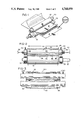
- FIG. 1 is a perspective view showing a pair of rolls constructed according to this invention with sheet material applied therebetween;
- FIG. 2 is an elevated view of the roll pairs showing the first roll in section
- FIG. 3 is a view similar to FIG. 2, showing a slightly modified form of the invention
- FIG. 4 is a perspective view of a two-roll pressure developer made according to this invention.
- FIG. 5 is an enlarged partially broken away end view of the apparatus of FIG. 4, showing the roll mounting arm and spring loading arrangement;
- FIG. 6 is a fragmentary sectional view showing the mounting of the support arm to the frame, taken generally along the line 6--6 of FIG. 5;
- FIG. 7 is an enlarged fragmentary transverse sectional view through the pressure developer showing the preferring arrangement for mounting and driving the pressure rolls and for applying a loading force thereto.
- FIGS. 1 and 4 illustrate a two-roll pressure type developer which includes a first roll 10 and a second roll 12 mounted in parallel to each other, and receiving sheet material therebetween.
- the sheet material may consist of a single sheet, but preferably consists of a donor sheet 15 and a receiver sheet 16 made in accordance with the teachings of U.S. Pat. No. 4,399,209 issued Aug. 16, 1983.
- images are form by exposing a coated composition containing a chromogenic material and the encapsulated photosensitive composition to actinic radiation, and thereafter rupturing the capsules in the presence of a developer carried on the receiver sheet.
- the capsules are ruptured by the application of a high uniform pressure in the nip between a pair of rolls, as more fully explained in the co-pending application Ser. No. 009,851.
- the pressure developing rolls 10 and 12 are mounted for rotation in a frame or housing illustrated generally at 20 in FIGS. 4 and 5.
- the housing structure may, advantageously, be provided with a top 22, a bottom 24, and a pair of spaced-apart side frame members 25 and 26.
- the housing 20 includes a central opening 28 therethrough for passage of the sheets.
- the roll pair includes the first roll 10 which is hollow, or formed like a shell, providing a cylindrically true outer surface 30, and having an axially central part defining a loading region 32.
- a loading shaft 35 extends axially through the roll 10.
- the loading shaft 35 is a support shaft, and is joined to the roll 10 exclusively at the central loading region 32 thereof, and extends axially of the shell in non-contacting relation from the region 32.
- the shaft 35 is permanently attached to the surrounding shell portion of the roll 10 at the central region 32, and it is important that this attachment does not permit the roll to walk or creep with respect to the loading shaft during loading and flexing.
- the shaft 35 and roll 10 may be connected by copper brazing.
- the remote ends of the loading shaft 35 extend beyond the roll and define bearing surfaces 38 which receive non-aligning, thrust transmitting low-friction bearings, such as roller bearings 40 (FIG. 2).
- the second roll 12 which may be solid, as shown, is rotatably mounted in the housing 20 in nip-defining relation to the roll 10. It will be seen that the roll pairs are somewhat wider than the sheet or web material to be applied thereto.
- the span at 42 represents the working zone of the rolls which, for example, may be 81/2", thereby leaving small non-working regions 43 at the axially remote ends of each of the pressure rolls.
- the interior surface of the roll 10 is partially tapered, leading first from a relatively straight section 45, including an intermediate tapered section 46 and an end relief section 48.
- the taper provides for the controlled deflection of the shell portion of the roll 10 when loaded by the application of a downward force, in the direction of the arrows 50, on the bearings 40 at the ends of the roll, as illustrated in FIG. 2.
- the taper or contouring of the internal surface of the roll 10 provides for control of the moment of inertia, such that an approximately uniform pressure distribution may be defined along the nip between the roll pairs throughout the working zone 42.
- the matching of the rolls 10 and 12 is affected by considering the basic theory of beam bending, the deflections caused by shear stresses, the changes in cross-section at axial nodal positions, and the local effects consisting of deflections of the thin-walled portion of the roll 12. It has been found helpful to utilize the finite element analysis method in calculating the expected deflections.
- the rolls 10 and 12 are cylindrical, and are mounted in the housing 20 parallel to each other.
- the roll 10 is mounted for rotation in bearings 40 which, in turn, are carried in journal blocks 52, as best shown in the sectional view of FIG. 7.
- the extended ends of the roll 12 are mounted on self-aligning bearings 55, in relatively fixed journal blocks 56.
- the one end of the roll 12 is formed with a shaft extension 57 by means of which connection may be made to a drive motor 58 diagrammatically illustrated in FIG. 4.
- the journal blocks 52 are each mounted on the end of one radius arm 66, as shown in FIG. 5.
- the arms 66 are, in turn, pivotally mounted to the sides 25 or 26 of the frame 20, through self-aligning bearings 70, as shown in FIG. 6.
- the bearings 70 are carried on stud bolts 71 extending inwardly from the side walls of the frame 20, and are received within suitable enlarged ends 66' of the arm 60.
- the roll 10 is loaded by loading on the journals 52, which transmit a loading force through the bearings 40 to the remote ends of the loading shaft 35 of the roll 10.
- loading springs 80 are positioned within spring housing portions 82 of the housing 20 and bear against a thrust collar 83.
- the force of the spring 80 is transmitted by the collar to a threaded pressure rod 85, the lower end of which is in pressure engagement with a hardened upper surface 86 of the bearing block 85.
- the upper end of the rod 85 extends above the spring housing portion 82 and is adjustable on a nut 87 for varying the effective length of the rod 85. While the mounting and loading arrangement is shown for one end of the roll 10, it is understood that a substantially identical arrangement is provided for the other end of the roll.
- the loading of the shaft 35 results in the deflection of the shaft ends, as illustrated by the arrows 92 in FIG. 2.
- This deflection results in an arcuate and tilting movement of the bearing blocks 52 which is transmitted through the radius arms 66 to the self-aligning bearings 70.
- the arms 66 and bearings 70 provide for the twisting movement which is accompanied by the deflection or bending of the loading shaft 35, thereby permitting a straight or non-self-aligning bearing 40 to be used as the primary thrust transmitting element, and permitting a low cost self-aligning bearing 70 to be employed which does not carry the loading thrust.
- the rolls of the forming apparatus should have a high hardness. While mild steel may be satisfactory for some applications, the rolls must be protected against damage in the event of paper jams, where double or quadruple fold-overs and the like, can very substantially increase the localized loading of the rolls.
- the rolls may be loaded in the region of 500 pli (89 Kg/cm) which, in typical 9" rolls as illustrated, loaded over 8.5 inches requires a load of 2,125 pounds (964 Kg), applied by the spring 30 at the journal ends.
- the rolls 10 and 12 may have a nominal length of 9.0", and a working zone length of 8.5", with the first roll 10 having a nominal diameter of 1.98", and the second roll 12 having a nominal diameter of 2.39".
- the loading shaft 35 is of substantially uniform diameter throughout its length, with a diameter of 1.30".
- the central loading region may extend axially for 1.6", while the relatively cylindrical or straight sections 45 of the relief each have an axial length of 0.616".
- the intermediate tapered portions 46 each have a length of 2.351" and a taper of 0.1049" to 1.0".
- the second relief 48 is an axial length of 0.733" and a taper of 0.3306" to 1.0". While a single intermediate tapered portion is shown, the result of the taper may be achieved in different ways, including the formation in the inside surfaces of a stepped pattern, in which the wall thicknesses are varied in stepped increments.
- the rolls may thus be case hardened to a depth of at least 0.049" (1.25 mm), and hard chromium plating applied to the exposed outer surfaces, to a thickness of at least 0.002" (0.05 mm) for protection against rust.
- a camber will be formed in the rolls, as shown by the broken line 94, and the nip therebetween will not be in a straight line, but rather will be curved.
- a positive camber is formed in roll 10 and a negative camber formed in roll 12. It is thus preferred that the sheet material at least partially wrap the hollow roll 10 so that the sheet material will be transversely stretched slightly by the cambers as it enters and leaves the nip, thereby avoiding tendencies to wrinkle.
- the sheet feed mechanism as disclosed in copending application Ser. No. 009,851 may be used.
- FIGS. 3 and 7 represent a slightly modified form of the invention, in which like parts are illustrated by like reference numerals with the addition of the letter a.
- the hollow roll 10a cooperates with the bottom roll 12a.
- the relief as previously defined by the second taper 48 is eliminated, and an internal axial annular relief 95 is formed at the opposite ends of the roll 12 and extends axially inwardly an amount corresponding approximately to the axial extent of the previous taper 48
- the annular relief defined at 95 in FIG. 3 serves the same function as previously described in connection with the annular relief defined by the taper 48 to relieve the pressure at the terminal end or regions of the rolls.
- a particular advantage of the two-roll system of this invention is that the loading across the nip will remain substantially uniform over a wide range of total loading forces, and is thus relatively unaffected by variations in the thicknesses of the sheet material as far as uniformity is concerned. Further, truly cylindrical rolls are used, thereby eliminating the need for crowning and/or skewing, as in prior arrangements.
Landscapes
- Physics & Mathematics (AREA)
- General Physics & Mathematics (AREA)
- Photographic Developing Apparatuses (AREA)
Abstract
Description
Claims (10)
Priority Applications (5)
| Application Number | Priority Date | Filing Date | Title |
|---|---|---|---|
| US07/039,393 US4768050A (en) | 1987-04-16 | 1987-04-16 | Pressure development apparatus for imaging sheets employing photosensitive microcapsules |
| JP63087103A JP2656298B2 (en) | 1987-04-16 | 1988-04-08 | Pressure developing device |
| CN88102122A CN1031138A (en) | 1987-04-16 | 1988-04-16 | The pressure development apparatus that is used for imaging sheets employing photosensitive microcapsules |
| KR1019880004351A KR880013046A (en) | 1987-04-16 | 1988-04-16 | Pressurization developing device for image paper using photosensitive microcapsule |
| EP88303490A EP0287404A3 (en) | 1987-04-16 | 1988-04-18 | Pressure developer |
Applications Claiming Priority (1)
| Application Number | Priority Date | Filing Date | Title |
|---|---|---|---|
| US07/039,393 US4768050A (en) | 1987-04-16 | 1987-04-16 | Pressure development apparatus for imaging sheets employing photosensitive microcapsules |
Publications (1)
| Publication Number | Publication Date |
|---|---|
| US4768050A true US4768050A (en) | 1988-08-30 |
Family
ID=21905204
Family Applications (1)
| Application Number | Title | Priority Date | Filing Date |
|---|---|---|---|
| US07/039,393 Expired - Fee Related US4768050A (en) | 1987-04-16 | 1987-04-16 | Pressure development apparatus for imaging sheets employing photosensitive microcapsules |
Country Status (5)
| Country | Link |
|---|---|
| US (1) | US4768050A (en) |
| EP (1) | EP0287404A3 (en) |
| JP (1) | JP2656298B2 (en) |
| KR (1) | KR880013046A (en) |
| CN (1) | CN1031138A (en) |
Cited By (32)
| Publication number | Priority date | Publication date | Assignee | Title |
|---|---|---|---|---|
| US4847661A (en) * | 1987-03-20 | 1989-07-11 | Brother Kogyo Kabushiki Kaisha | Image recording apparatus using microcapsule carrying sheet and separate developer sheet |
| US4864343A (en) * | 1988-03-09 | 1989-09-05 | The Mead Corporation | Pressure development roll for imaging sheets employing photosensitive microcapsules |
| US4866473A (en) * | 1987-06-12 | 1989-09-12 | Brother Kogyo Kabushiki Kaisha | Thermal fixing device for use in recording apparatus |
| US4903071A (en) * | 1987-03-17 | 1990-02-20 | Brother Kogyo Kabushiki Kaisha | Image forming system using a photosensitive medium |
| US4914463A (en) * | 1987-11-14 | 1990-04-03 | Sony Corp. | Development of imaging sheets employing photosensitive microcapsules |
| US4945374A (en) * | 1988-04-20 | 1990-07-31 | Brother Kogyo Kabushiki Kaisha | Pressure developing device |
| US4945381A (en) * | 1986-10-07 | 1990-07-31 | Seiko Epson Corporation | Image forming apparatus |
| EP0361812A3 (en) * | 1988-09-26 | 1991-02-13 | Sharp Kabushiki Kaisha | A pressure device for use in image forming apparatuses |
| US5012730A (en) * | 1989-01-19 | 1991-05-07 | J.M. Voith Gmbh | Press roll for paper machines |
| US5092235A (en) * | 1989-05-24 | 1992-03-03 | Tektronix, Inc. | Pressure fixing and developing apparatus |
| WO1992020008A1 (en) * | 1991-04-25 | 1992-11-12 | Pako Corporation | Roller configuration in film processing |
| US5701562A (en) * | 1993-05-26 | 1997-12-23 | Canon Kabushiki Kaisha | Developing sleeve having a cylindrical portion and a non-cylindrical portion provided by the same member, and developing device using the sleeve |
| US5715492A (en) * | 1997-01-31 | 1998-02-03 | Eastman Kodak Company | Electronic camera and associated printer with light shutter |
| US5715234A (en) * | 1996-12-16 | 1998-02-03 | Eastman Kodak Company | Electronic camera and associated printer which uses a display image |
| US5715493A (en) * | 1997-01-08 | 1998-02-03 | Eastman Kodak Company | Apparatus and electronic camera and associated printer with light tight storage receptacle |
| US5742861A (en) * | 1997-01-08 | 1998-04-21 | Eastman Kodak Company | Electronic camera and associated printer which uses a display image |
| US5761597A (en) * | 1996-09-12 | 1998-06-02 | Tektronix, Inc. | Fusing apparatus for a printer |
| US5822637A (en) * | 1997-09-30 | 1998-10-13 | Eastman Kodak Company | Electronic camera and attachable printer |
| US5835809A (en) * | 1997-06-10 | 1998-11-10 | Eastman Kodak Company | Filter for correcting for fluorescent light in color printing |
| US5860036A (en) * | 1997-06-10 | 1999-01-12 | Eastman Kodak Company | Controlling display useable in printers |
| US5894326A (en) * | 1996-08-26 | 1999-04-13 | Eastman Kodak Company | Electronic camera having a printer |
| US5917548A (en) * | 1996-08-26 | 1999-06-29 | Eastman Kodak Company | Electronic camera having a printer for providing improved hard copy images |
| US5949469A (en) * | 1997-06-10 | 1999-09-07 | Eastman Kodak Co | Fluorescent light source for liquid crystal display printing |
| US5970215A (en) * | 1997-04-08 | 1999-10-19 | Eastman Kodak Company | Printing variable density pixels on a photosensitive medium |
| US6016157A (en) * | 1997-08-12 | 2000-01-18 | Eastman Kodak Company | Printer using multiple light sources and monochrome LCD |
| US20040111888A1 (en) * | 2000-06-22 | 2004-06-17 | Jun Yura | Heating roller, method of producing the heating roller, and heating device, fixing device and image forming apparatus using the heating roller |
| US6764293B2 (en) * | 1999-12-13 | 2004-07-20 | Mars, Incorporated | Apparatus for forming confectionery product |
| US20080237386A1 (en) * | 2007-03-30 | 2008-10-02 | Wilhelm Aichele | Rotary cutting device |
| US20090273133A1 (en) * | 2008-04-30 | 2009-11-05 | Sutton Donald C | Roller |
| US20130098215A1 (en) * | 2010-09-28 | 2013-04-25 | Fujikura Ltd. | Scrap collector for optical fiber cutter |
| US20150108709A1 (en) * | 2013-10-17 | 2015-04-23 | Canon Kabushiki Kaisha | Sheet conveying apparatus and image forming apparatus |
| WO2025172823A1 (en) | 2024-02-12 | 2025-08-21 | Polaroid Ip B.V. | Improved imaging devices, apparatus, and methods for the development of image recording media |
Families Citing this family (3)
| Publication number | Priority date | Publication date | Assignee | Title |
|---|---|---|---|---|
| EP0354691A3 (en) * | 1988-08-09 | 1991-05-29 | Seiko Epson Corporation | Image-creating apparatus |
| US5208609A (en) * | 1990-07-16 | 1993-05-04 | Goldstar Co., Ltd. | Roller type developing apparatus for a cycolor type color video printer |
| EP0537890A1 (en) * | 1991-09-25 | 1993-04-21 | Ncr International Inc. | Apparatus and method for providing a coating on a substrate |
Citations (16)
| Publication number | Priority date | Publication date | Assignee | Title |
|---|---|---|---|---|
| US321264A (en) * | 1885-06-30 | Barbed fence | ||
| US2191144A (en) * | 1937-12-31 | 1940-02-20 | Beloit Iron Works | Press roll |
| US3386824A (en) * | 1967-03-27 | 1968-06-04 | Chicago Aerial Ind Inc | Photographic processing film laminate structure utilizing plastic microcapsules |
| US3678846A (en) * | 1969-03-07 | 1972-07-25 | Lars Gstaf Bjorkegren | Roll press comprising two dissimilar rolls with equal deflection characteristics |
| US3990391A (en) * | 1975-03-19 | 1976-11-09 | Addressograph Multigraph Corporation | Mounting for pressure fixing rollers |
| US4022122A (en) * | 1973-08-16 | 1977-05-10 | Develop Kg/Dr. Eisbein And Co. | Pressing installation for a copying arrangement |
| US4145965A (en) * | 1976-04-27 | 1979-03-27 | Sharp Kabushiki Kaisha | Rollers for fixing a developed image in an electrophotographic copying machine |
| US4192229A (en) * | 1977-10-07 | 1980-03-11 | Canon Kabushiki Kaisha | Fixing apparatus |
| US4235166A (en) * | 1977-09-22 | 1980-11-25 | Canon Kabushiki Kaisha | Fixing apparatus |
| US4343234A (en) * | 1978-03-31 | 1982-08-10 | Hitachi Metals, Ltd. | Pressure-fixation apparatus |
| US4356764A (en) * | 1981-05-04 | 1982-11-02 | Minnesota Mining And Manufacturing Company | Pressure rollers for toner fusing station |
| US4602408A (en) * | 1983-11-22 | 1986-07-29 | Bwg Bergwerk- Und Walzwerk-Maschinenbau Gmbh | Roll-stand roll with hydraulically changeable contour |
| US4624560A (en) * | 1985-10-25 | 1986-11-25 | Itt Corporation | Capsule rupture printing system |
| US4648699A (en) * | 1985-10-31 | 1987-03-10 | The Mead Corporation | Point contact development of imaging sheets employing photosensitive microcapsules |
| US4714943A (en) * | 1986-03-11 | 1987-12-22 | Brother Kogyo Kabushiki Kaisha | Imaging device |
| US4727392A (en) * | 1985-05-13 | 1988-02-23 | The Mead Corporation | Pressure development apparatus for imaging sheets employing photosensitive microcapsules |
Family Cites Families (3)
| Publication number | Priority date | Publication date | Assignee | Title |
|---|---|---|---|---|
| DE3108095A1 (en) * | 1981-03-04 | 1982-10-14 | Canon K.K., Tokyo | Fixing device in a photocopier |
| DE3113659C2 (en) * | 1981-04-04 | 1984-04-26 | Canon K.K., Tokio/Tokyo | Pressure fixing device for toner images in a photocopier |
| DE3126064C2 (en) * | 1981-07-02 | 1984-01-26 | Canon Gießen GmbH, 6300 Gießen | Fusing device for fusing toner images onto copy paper |
-
1987
- 1987-04-16 US US07/039,393 patent/US4768050A/en not_active Expired - Fee Related
-
1988
- 1988-04-08 JP JP63087103A patent/JP2656298B2/en not_active Expired - Fee Related
- 1988-04-16 CN CN88102122A patent/CN1031138A/en active Pending
- 1988-04-16 KR KR1019880004351A patent/KR880013046A/en not_active Withdrawn
- 1988-04-18 EP EP88303490A patent/EP0287404A3/en not_active Withdrawn
Patent Citations (16)
| Publication number | Priority date | Publication date | Assignee | Title |
|---|---|---|---|---|
| US321264A (en) * | 1885-06-30 | Barbed fence | ||
| US2191144A (en) * | 1937-12-31 | 1940-02-20 | Beloit Iron Works | Press roll |
| US3386824A (en) * | 1967-03-27 | 1968-06-04 | Chicago Aerial Ind Inc | Photographic processing film laminate structure utilizing plastic microcapsules |
| US3678846A (en) * | 1969-03-07 | 1972-07-25 | Lars Gstaf Bjorkegren | Roll press comprising two dissimilar rolls with equal deflection characteristics |
| US4022122A (en) * | 1973-08-16 | 1977-05-10 | Develop Kg/Dr. Eisbein And Co. | Pressing installation for a copying arrangement |
| US3990391A (en) * | 1975-03-19 | 1976-11-09 | Addressograph Multigraph Corporation | Mounting for pressure fixing rollers |
| US4145965A (en) * | 1976-04-27 | 1979-03-27 | Sharp Kabushiki Kaisha | Rollers for fixing a developed image in an electrophotographic copying machine |
| US4235166A (en) * | 1977-09-22 | 1980-11-25 | Canon Kabushiki Kaisha | Fixing apparatus |
| US4192229A (en) * | 1977-10-07 | 1980-03-11 | Canon Kabushiki Kaisha | Fixing apparatus |
| US4343234A (en) * | 1978-03-31 | 1982-08-10 | Hitachi Metals, Ltd. | Pressure-fixation apparatus |
| US4356764A (en) * | 1981-05-04 | 1982-11-02 | Minnesota Mining And Manufacturing Company | Pressure rollers for toner fusing station |
| US4602408A (en) * | 1983-11-22 | 1986-07-29 | Bwg Bergwerk- Und Walzwerk-Maschinenbau Gmbh | Roll-stand roll with hydraulically changeable contour |
| US4727392A (en) * | 1985-05-13 | 1988-02-23 | The Mead Corporation | Pressure development apparatus for imaging sheets employing photosensitive microcapsules |
| US4624560A (en) * | 1985-10-25 | 1986-11-25 | Itt Corporation | Capsule rupture printing system |
| US4648699A (en) * | 1985-10-31 | 1987-03-10 | The Mead Corporation | Point contact development of imaging sheets employing photosensitive microcapsules |
| US4714943A (en) * | 1986-03-11 | 1987-12-22 | Brother Kogyo Kabushiki Kaisha | Imaging device |
Cited By (36)
| Publication number | Priority date | Publication date | Assignee | Title |
|---|---|---|---|---|
| US4945381A (en) * | 1986-10-07 | 1990-07-31 | Seiko Epson Corporation | Image forming apparatus |
| US4903071A (en) * | 1987-03-17 | 1990-02-20 | Brother Kogyo Kabushiki Kaisha | Image forming system using a photosensitive medium |
| US4847661A (en) * | 1987-03-20 | 1989-07-11 | Brother Kogyo Kabushiki Kaisha | Image recording apparatus using microcapsule carrying sheet and separate developer sheet |
| US4866473A (en) * | 1987-06-12 | 1989-09-12 | Brother Kogyo Kabushiki Kaisha | Thermal fixing device for use in recording apparatus |
| US4914463A (en) * | 1987-11-14 | 1990-04-03 | Sony Corp. | Development of imaging sheets employing photosensitive microcapsules |
| US4864343A (en) * | 1988-03-09 | 1989-09-05 | The Mead Corporation | Pressure development roll for imaging sheets employing photosensitive microcapsules |
| US4945374A (en) * | 1988-04-20 | 1990-07-31 | Brother Kogyo Kabushiki Kaisha | Pressure developing device |
| EP0361812A3 (en) * | 1988-09-26 | 1991-02-13 | Sharp Kabushiki Kaisha | A pressure device for use in image forming apparatuses |
| US5012730A (en) * | 1989-01-19 | 1991-05-07 | J.M. Voith Gmbh | Press roll for paper machines |
| US5092235A (en) * | 1989-05-24 | 1992-03-03 | Tektronix, Inc. | Pressure fixing and developing apparatus |
| WO1992020008A1 (en) * | 1991-04-25 | 1992-11-12 | Pako Corporation | Roller configuration in film processing |
| US5701562A (en) * | 1993-05-26 | 1997-12-23 | Canon Kabushiki Kaisha | Developing sleeve having a cylindrical portion and a non-cylindrical portion provided by the same member, and developing device using the sleeve |
| US5894326A (en) * | 1996-08-26 | 1999-04-13 | Eastman Kodak Company | Electronic camera having a printer |
| US5917548A (en) * | 1996-08-26 | 1999-06-29 | Eastman Kodak Company | Electronic camera having a printer for providing improved hard copy images |
| US5761597A (en) * | 1996-09-12 | 1998-06-02 | Tektronix, Inc. | Fusing apparatus for a printer |
| US5715234A (en) * | 1996-12-16 | 1998-02-03 | Eastman Kodak Company | Electronic camera and associated printer which uses a display image |
| US5715493A (en) * | 1997-01-08 | 1998-02-03 | Eastman Kodak Company | Apparatus and electronic camera and associated printer with light tight storage receptacle |
| US5742861A (en) * | 1997-01-08 | 1998-04-21 | Eastman Kodak Company | Electronic camera and associated printer which uses a display image |
| US5715492A (en) * | 1997-01-31 | 1998-02-03 | Eastman Kodak Company | Electronic camera and associated printer with light shutter |
| US5970215A (en) * | 1997-04-08 | 1999-10-19 | Eastman Kodak Company | Printing variable density pixels on a photosensitive medium |
| US5835809A (en) * | 1997-06-10 | 1998-11-10 | Eastman Kodak Company | Filter for correcting for fluorescent light in color printing |
| US5949469A (en) * | 1997-06-10 | 1999-09-07 | Eastman Kodak Co | Fluorescent light source for liquid crystal display printing |
| US5860036A (en) * | 1997-06-10 | 1999-01-12 | Eastman Kodak Company | Controlling display useable in printers |
| US6016157A (en) * | 1997-08-12 | 2000-01-18 | Eastman Kodak Company | Printer using multiple light sources and monochrome LCD |
| US5822637A (en) * | 1997-09-30 | 1998-10-13 | Eastman Kodak Company | Electronic camera and attachable printer |
| US6764293B2 (en) * | 1999-12-13 | 2004-07-20 | Mars, Incorporated | Apparatus for forming confectionery product |
| US7107681B2 (en) * | 2000-06-22 | 2006-09-19 | Ricoh Company, Ltd. | Heating roller, method of producing the heating roller, and heating device, fixing device and image forming apparatus using the heating roller |
| US20040111888A1 (en) * | 2000-06-22 | 2004-06-17 | Jun Yura | Heating roller, method of producing the heating roller, and heating device, fixing device and image forming apparatus using the heating roller |
| US20080237386A1 (en) * | 2007-03-30 | 2008-10-02 | Wilhelm Aichele | Rotary cutting device |
| US20090273133A1 (en) * | 2008-04-30 | 2009-11-05 | Sutton Donald C | Roller |
| US8206277B2 (en) * | 2008-04-30 | 2012-06-26 | Hewlett-Packard Development Company, L.P. | Idler roller assembly having a roller and a shaft the roller being formed such that it remains parallel to contacted media despite deflection of the shaft |
| US20130098215A1 (en) * | 2010-09-28 | 2013-04-25 | Fujikura Ltd. | Scrap collector for optical fiber cutter |
| US8967025B2 (en) * | 2010-09-28 | 2015-03-03 | Fujikura Ltd. | Scrap collector for optical fiber cutter |
| US20150108709A1 (en) * | 2013-10-17 | 2015-04-23 | Canon Kabushiki Kaisha | Sheet conveying apparatus and image forming apparatus |
| US9206005B2 (en) * | 2013-10-17 | 2015-12-08 | Canon Kabushiki Kaisha | Sheet conveying apparatus and image forming apparatus |
| WO2025172823A1 (en) | 2024-02-12 | 2025-08-21 | Polaroid Ip B.V. | Improved imaging devices, apparatus, and methods for the development of image recording media |
Also Published As
| Publication number | Publication date |
|---|---|
| JPS63271448A (en) | 1988-11-09 |
| EP0287404A3 (en) | 1990-04-25 |
| KR880013046A (en) | 1988-11-29 |
| CN1031138A (en) | 1989-02-15 |
| EP0287404A2 (en) | 1988-10-19 |
| JP2656298B2 (en) | 1997-09-24 |
Similar Documents
| Publication | Publication Date | Title |
|---|---|---|
| US4768050A (en) | Pressure development apparatus for imaging sheets employing photosensitive microcapsules | |
| US4727392A (en) | Pressure development apparatus for imaging sheets employing photosensitive microcapsules | |
| JPH0229797B2 (en) | ||
| US4864343A (en) | Pressure development roll for imaging sheets employing photosensitive microcapsules | |
| US4192229A (en) | Fixing apparatus | |
| US4327468A (en) | Controlled deflection roll | |
| JPS595043B2 (en) | Roller device with at least one deflection adjustment roller | |
| US4974782A (en) | Pressure developer and rolls therefor having segments of elastomeric material for control of modulus of elasticity | |
| JPH0423132B2 (en) | ||
| US4235166A (en) | Fixing apparatus | |
| US4768434A (en) | Pressure development apparatus for imaging sheets | |
| US4798134A (en) | Pressure compensated single nip three-roll press | |
| US4961704A (en) | Sheet meandering movement preventing method | |
| US4389114A (en) | Roll fixing apparatus for a copying machine | |
| GB2100472A (en) | Method and apparatus for controlling roll bending in a rolling mill | |
| ATE313728T1 (en) | FLEXIBLE ROLLER WITH A COMPOSITE SHELL | |
| JP4328017B2 (en) | Web winding method | |
| US3505716A (en) | Roll apparatus | |
| CA1049308A (en) | Rolling device having a controlled-deflection roll | |
| JPH055900U (en) | calendar | |
| JPH0625989A (en) | Press roll | |
| JP3275986B2 (en) | Rolling mill | |
| JP2734903B2 (en) | Expander roll | |
| US6764578B2 (en) | Suspension arrangement for a roll | |
| JPS642443B2 (en) |
Legal Events
| Date | Code | Title | Description |
|---|---|---|---|
| AS | Assignment |
Owner name: MEAD CORPORATION THE, COURTHOUSE PLAZA NORTHEAST, Free format text: ASSIGNMENT OF ASSIGNORS INTEREST.;ASSIGNOR:BEERY, JACK;REEL/FRAME:004698/0153 Effective date: 19870410 Owner name: MEAD CORPORATION THE, A CORP OF OH.,OHIO Free format text: ASSIGNMENT OF ASSIGNORS INTEREST;ASSIGNOR:BEERY, JACK;REEL/FRAME:004698/0153 Effective date: 19870410 |
|
| FEPP | Fee payment procedure |
Free format text: PAYOR NUMBER ASSIGNED (ORIGINAL EVENT CODE: ASPN); ENTITY STATUS OF PATENT OWNER: LARGE ENTITY |
|
| FPAY | Fee payment |
Year of fee payment: 4 |
|
| FPAY | Fee payment |
Year of fee payment: 8 |
|
| AS | Assignment |
Owner name: CYCOLOR IMAGING, INC., OHIO Free format text: ASSIGNMENT OF ASSIGNORS INTEREST;ASSIGNOR:MEAD CORPORATION, THE;REEL/FRAME:008013/0740 Effective date: 19960329 |
|
| FEPP | Fee payment procedure |
Free format text: PAYOR NUMBER ASSIGNED (ORIGINAL EVENT CODE: ASPN); ENTITY STATUS OF PATENT OWNER: LARGE ENTITY Free format text: PAYER NUMBER DE-ASSIGNED (ORIGINAL EVENT CODE: RMPN); ENTITY STATUS OF PATENT OWNER: LARGE ENTITY |
|
| REMI | Maintenance fee reminder mailed | ||
| LAPS | Lapse for failure to pay maintenance fees | ||
| FP | Lapsed due to failure to pay maintenance fee |
Effective date: 20000830 |
|
| AS | Assignment |
Owner name: MEADWESTVACO CORPORATION, CONNECTICUT Free format text: ASSIGNMENT OF ASSIGNORS INTEREST;ASSIGNOR:MEAD CORPORATION, THE;REEL/FRAME:014066/0963 Effective date: 20021231 |
|
| STCH | Information on status: patent discontinuation |
Free format text: PATENT EXPIRED DUE TO NONPAYMENT OF MAINTENANCE FEES UNDER 37 CFR 1.362 |