US4759323A - Combustion engine with one or more "squish" spaces between the piston and the cylinder head - Google Patents

Combustion engine with one or more "squish" spaces between the piston and the cylinder head Download PDF

Info

Publication number
US4759323A
US4759323A US06/840,633 US84063386A US4759323A US 4759323 A US4759323 A US 4759323A US 84063386 A US84063386 A US 84063386A US 4759323 A US4759323 A US 4759323A
Authority
US
United States
Prior art keywords
squish
space
combustion chamber
flow
combustion engine
Prior art date
Legal status (The legal status is an assumption and is not a legal conclusion. Google has not performed a legal analysis and makes no representation as to the accuracy of the status listed.)
Expired - Fee Related
Application number
US06/840,633
Inventor
Paul August
Current Assignee (The listed assignees may be inaccurate. Google has not performed a legal analysis and makes no representation or warranty as to the accuracy of the list.)
GLOTUR TRUST REG
Original Assignee
GLOTUR TRUST REG
Priority date (The priority date is an assumption and is not a legal conclusion. Google has not performed a legal analysis and makes no representation as to the accuracy of the date listed.)
Filing date
Publication date
Application filed by GLOTUR TRUST REG filed Critical GLOTUR TRUST REG
Assigned to GLOTUR TRUST REG. reassignment GLOTUR TRUST REG. ASSIGNMENT OF ASSIGNORS INTEREST. Assignors: AUGUST, PAUL
Application granted granted Critical
Publication of US4759323A publication Critical patent/US4759323A/en
Anticipated expiration legal-status Critical
Expired - Fee Related legal-status Critical Current

Links

Images

Classifications

    • FMECHANICAL ENGINEERING; LIGHTING; HEATING; WEAPONS; BLASTING
    • F02COMBUSTION ENGINES; HOT-GAS OR COMBUSTION-PRODUCT ENGINE PLANTS
    • F02BINTERNAL-COMBUSTION PISTON ENGINES; COMBUSTION ENGINES IN GENERAL
    • F02B23/00Other engines characterised by special shape or construction of combustion chambers to improve operation
    • F02B23/08Other engines characterised by special shape or construction of combustion chambers to improve operation with positive ignition
    • YGENERAL TAGGING OF NEW TECHNOLOGICAL DEVELOPMENTS; GENERAL TAGGING OF CROSS-SECTIONAL TECHNOLOGIES SPANNING OVER SEVERAL SECTIONS OF THE IPC; TECHNICAL SUBJECTS COVERED BY FORMER USPC CROSS-REFERENCE ART COLLECTIONS [XRACs] AND DIGESTS
    • Y02TECHNOLOGIES OR APPLICATIONS FOR MITIGATION OR ADAPTATION AGAINST CLIMATE CHANGE
    • Y02TCLIMATE CHANGE MITIGATION TECHNOLOGIES RELATED TO TRANSPORTATION
    • Y02T10/00Road transport of goods or passengers
    • Y02T10/10Internal combustion engine [ICE] based vehicles
    • Y02T10/12Improving ICE efficiencies

Definitions

  • a proposal from Ford and others is that, in the area of the inlet valves, by means of swirl-creating fittings, a spiral flow is created which continues in the combustion chamber up to the point of ignition.
  • this system does not ensure correct ignition because the rotation cannot definitely be maintained in the compression cycle to the point of ignition and possibly breaks down before then so that the swirl is not maintained until the point of ignition.
  • the "squish" space between the piston head and the corresponding wall of the cylinder head is so formed that near the top dead centre position of the piston at least one "squish” space flow is created in parallel to one wall of the combustion chamber so that this "squish" space flow in conjunction with the guide means arranged inside the combustion chamber results in a rotational flow.
  • the spark plug is fitted in the area of the rotational flow so that even a very weak air-fuel mixture is enough for ignition.
  • the invention is based on the technical problem of the further development of a combustion engine of the type mentioned in the introduction so that despite an even weaker air-fuel mixture, correct ignition an be achieved during all operating conditions of the motor.
  • the invention is characterized in that in the space extending between the valves at least one centre "squish" space is arranged, which, in conjunction with the wall of the cylinder head situated above it, forms a further squish space flow reinforcing the lateral "squish" space flow.
  • a feature of the present invention is, therefore, that adjacent to the previously-known "squish” space flow, a further central “squish” space flow is created which is led directly onto the spark plug.
  • the central "squish" space extends at least partially into the space between the valves, a greater “squish” path is created for the air-fuel mixture by this central "squish” space than as compared to the previously known “squish” space flow.
  • the central "squish” space therefore, continues the previously known “squish” space and achieves, in the centre of the combustion chamber, a rapid acceleration of the flow so that, seen over the width of the combustion chamber, a total of two lateral rotating flow vortices are created, in between which a faster rotating flow vortex is arranged which is created by the centre "squish” space.
  • the faster rotation speed is additionally achieved in that the rotation space and path (distance between the leading edge of the "squish" space and the spark plug) is smaller than that of the lateral adjacent rotation spaces.
  • the combustion process is, among others, accelerated in this way in that the flow vortices have differing speeds of rotation and the central vortex rotates faster than the neighbouring outer ones.
  • the slower rotating vortices to the left and right of the spark plug are laterally met by the faster vortices already ignited by the spark plug, in which the central vortex can be defined as an ignition jet which penetrates into the lateral slower vortices, swirling them so that they quickly and intensively mix with the ignition jet and burn through.
  • the central "squish" space is formed by a wedge-shaped guide projection on the piston head. It is preferred here that this guide protection continues the slope of the lateral mating "squish” spaces so that, seen over the width of the combustion chamber, a smooth transfer from the "squish" spaces into the combustion chamber is ensured.
  • a central "squish" space of a differing slope mates with the outer "squish” spaces, so that the vortices created by the outer long "squish” spaces are led at an angle over the centre "squish” space and subsequently flow into the combustion chamber.
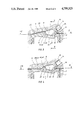
  • FIG. 1 is a section through a combustion chamber of a first embodiment example corresponding to the line C-D in FIG. 2.
  • FIG. 2 is a plan view of the piston head with a section corresponding to the line 11--11 in FIG. 3 with the position of the valves and spark plug shown by dotted lines.
  • FIGS. 3 is section through the combustion chamber in accordance with FIGS. 1 and 2 at the level of line A-B.
  • FIG. 4 is section through another embodiment example of a combustion chamber corresponding to the line 1V--1V in FIG. 6.
  • FIG. 5 is section in accordance with line V--V through the combustion chamber in FIG. 3.
  • FIG. 6 is section in accordance with line V1--V1 in FIG. 4 with the position of the valves and spark plug shown by dotted lines.
  • FIGS. 7 to 9 depict a modified form of combustion chamber as compared to that illustrated in FIGS. 1 to 3.
  • a piston (2) is arranged, and in the cylinder head (5) an inlet valve (6) and an outlet valve (7) are fitted.
  • the combustion chamber (8) formed in the piston head (15) is formed by a trough-shaped recess (22) in the piston head (15) whereas the opposing side is formed by the slope (9) of the wall of the cylinder head (5).
  • the cylinder head (5) has, on the inner side wall, a guide curve (4) which always passes over the trough-shaped recess(22) in the piston head (15).
  • One side wall of the recess (22) is formed by a further guide surface (20) which itself, again, always passes over the upper wall of the cylinder head (5), so that they form together a trough-shaped combustion chamber (8) in which a rotating flow of the mixture is created as described in the following manner.
  • the piston (2) On one side of the firing chamber the piston (2) is formed with a slope (10) in the upwards direction which lies opposite to a parallel slope (9) of the cylinder head (5). These two opposing slopes (9)(10) form a "squish” space (25) whose opening is directed obliquely upwards in the combustion chamber so that the "squish” space flow (29) out of the "squish” space (25) runs roughly parallel to the undersides of the valves (6)(7) and to the upper wall of the cylinder head (5).
  • This flow is directed in arrow direction (23)(Ref. FIG. 3) to the recess (22) in the piston head (15) and is diverted there in the direction of arrow (12) so that it flows along the floor of the recess (22).
  • a further guide projection (17) is arranged which is likewise provided with a slope (9) similar to that of the "squish" space (25) below it.
  • the mixture is then rapidly accelerated through the "squish” space (25) and is directed over the valves (6) (7) in the form of lateral "squish” space flows toward the spark plug (14).
  • spark plug (14) is arranged in a chamber (24) into the cylinder head wall (3) which is recessed relative to the combustion chamber (8).
  • the direction of the chamber (24) must be so arranged that the ignition jet (18) emerging from the chamber (24) is introduced approximately parallel to the "squish" space flow (30) flowing past in the direction of arrow (23).
  • FIG. 5 shows a front face view of the piston head illustrating the central guide projection (17).
  • the central guide projection (17) extends in the form of a wedge into the intermediate space (21) between the valves (6)(7).
  • the guide projection (17) has a central face (28) joining onto the sides of which, at an angle, are wedge faces (27) which always pass over the guide projection (16) joining on to the sides of it.
  • FIGS. 4 and 6 in a further embodiment example, another combustion chamber is shown in which the outer "squish" spaces (45) form an angle relative to the central "squish” space (46).
  • the outer “squish” spaces (45) here form outer “squish” space flows (39) which, as described, rotate slower than the central "squish” space flow (40) created by the "squish” space (46).
  • a central guide projection (37) again extends into the intermediate space between the valves (6)(7) which always passes over the guide projection (36) joining it on the sides.
  • the index numbers are the same as those in FIGS. 1 to 3 for the same parts.
  • the views are also mainly the same as those shown in FIGS. 1 to 3.
  • a differentiating feature of this embodiment example is that the trough-shaped recess (22) in the piston head (15) is dispensed with.
  • the piston head (15) is flat in the area of the combustion chamber (8) and forms, for example, one plane with the right "squish" space (13).
  • the previously-described features and advantages are achieved again by the creation of a central "squish" space flow (30) which is laterally limited by the "squish" space flow (29).
  • the design is simple and economic and requires no expensive electronic or similar control.

Landscapes

  • Engineering & Computer Science (AREA)
  • Chemical & Material Sciences (AREA)
  • Combustion & Propulsion (AREA)
  • Mechanical Engineering (AREA)
  • General Engineering & Computer Science (AREA)
  • Combustion Methods Of Internal-Combustion Engines (AREA)

Abstract

The combustion engine forms "squish" spaces between the piston and the cylinder head and has additional guide means in the combustion chamber which create a rotational flow in the combustion chamber. The floor of the combustion chamber is formed by a trough-shaped recess in the piston head, so that it forms a "squish" space extending over the complete width of the combustion chamber. In the area between the valves, a further, central "squish" space extends which, in conjunction with the wall of the cylinder head which is situated above it, forms a further "squish" space flow which reinforces the lateral "squish" space flow. In this way the ignition timing can be further retarded and the temperature peak reduced together with an additional reduction in emissions of oxides of nitrogen. A very weak mixture with an excess of air of 30% or more can be ignited which likewise maintains a low burning temperature thus producing less nitrous oxide. The emission of carbon monoxide, as a result of the weak mixture, is also low, and the hydrocarbon emissions are minimal due to the total combustion by means of rotation of gases in the combustion chambers. Test results show a reduction in fuel consumption between 15% and 20% when compared with current engines.

Description

BACKGROUND OF THE INVENTION
Systems and procedures are proposed for the detoxification of exhaust gas coupled with low fuel consumption which bring into play, in the case of the Otto motor, a weak mixture in rotation, in which, by means of this rotation the mixture rapidly reaches the spark plug thus ensuring better ignition and proper combustion. Very weak mixtures with a composition of Lambda 1.3 or less are therefore necessary so that not only the hydro carbons and carbon monoxide but also nitrogen content of the exhaust are very low.
A proposal from Ford and others is that, in the area of the inlet valves, by means of swirl-creating fittings, a spiral flow is created which continues in the combustion chamber up to the point of ignition. In the case of the continually-changing operating conditions of revolutions and performance, this system does not ensure correct ignition because the rotation cannot definitely be maintained in the compression cycle to the point of ignition and possibly breaks down before then so that the swirl is not maintained until the point of ignition.
As is known in DE 27 51 993 11, the "squish" space between the piston head and the corresponding wall of the cylinder head is so formed that near the top dead centre position of the piston at least one "squish" space flow is created in parallel to one wall of the combustion chamber so that this "squish" space flow in conjunction with the guide means arranged inside the combustion chamber results in a rotational flow. The spark plug is fitted in the area of the rotational flow so that even a very weak air-fuel mixture is enough for ignition.
BRIEF SUMMARY OF THE INVENTION
The invention is based on the technical problem of the further development of a combustion engine of the type mentioned in the introduction so that despite an even weaker air-fuel mixture, correct ignition an be achieved during all operating conditions of the motor.
To solve this technical problem, the invention is characterized in that in the space extending between the valves at least one centre "squish" space is arranged, which, in conjunction with the wall of the cylinder head situated above it, forms a further squish space flow reinforcing the lateral "squish" space flow.
A feature of the present invention is, therefore, that adjacent to the previously-known "squish" space flow, a further central "squish" space flow is created which is led directly onto the spark plug. In this way, in that the central "squish" space extends at least partially into the space between the valves, a greater "squish" path is created for the air-fuel mixture by this central "squish" space than as compared to the previously known "squish" space flow. The central "squish" space, therefore, continues the previously known "squish" space and achieves, in the centre of the combustion chamber, a rapid acceleration of the flow so that, seen over the width of the combustion chamber, a total of two lateral rotating flow vortices are created, in between which a faster rotating flow vortex is arranged which is created by the centre "squish" space. The faster rotation speed is additionally achieved in that the rotation space and path (distance between the leading edge of the "squish" space and the spark plug) is smaller than that of the lateral adjacent rotation spaces. By means of the differing speeds of rotation in the area of the spark plug in comparison to the neighbouring areas, the combustion process is, among others, accelerated in this way in that the flow vortices have differing speeds of rotation and the central vortex rotates faster than the neighbouring outer ones. In this way the slower rotating vortices to the left and right of the spark plug are laterally met by the faster vortices already ignited by the spark plug, in which the central vortex can be defined as an ignition jet which penetrates into the lateral slower vortices, swirling them so that they quickly and intensively mix with the ignition jet and burn through.
This achieves the advantage in that the combustion process even in the outer vortices takes place quicker because of the differing pressure ratios.
By means of the technical teaching according to the invention it is therefore possible to retard the point of ignition in comparison with current layouts which, in combination with the use of a weak air-fuel mixture, brings about an even further reduction of the emission of oxides of nitrogen.
In a first embodiment example of the present invention, it is provided that the central "squish" space is formed by a wedge-shaped guide projection on the piston head. It is preferred here that this guide protection continues the slope of the lateral mating "squish" spaces so that, seen over the width of the combustion chamber, a smooth transfer from the "squish" spaces into the combustion chamber is ensured.
In a further embodiment example of the present invention it is provided that a central "squish" space of a differing slope mates with the outer "squish" spaces, so that the vortices created by the outer long "squish" spaces are led at an angle over the centre "squish" space and subsequently flow into the combustion chamber.
Further features of the invention are the subject of the remaining sub-claims.
The subject matter of the present invention is defined by the Patent Claims individually and in combination.
In the following, by means of drawings illustrating several embodiment examples, the invention is further explained. In this way further essential features and advantages of the invention arise from the drawings and their descriptions.
BRIEF DESCRIPTION OF THE SEVERAL VIEWS OF THE DRAWINGS
FIG. 1 is a section through a combustion chamber of a first embodiment example corresponding to the line C-D in FIG. 2.
FIG. 2 is a plan view of the piston head with a section corresponding to the line 11--11 in FIG. 3 with the position of the valves and spark plug shown by dotted lines.
FIGS. 3 is section through the combustion chamber in accordance with FIGS. 1 and 2 at the level of line A-B.
FIG. 4 is section through another embodiment example of a combustion chamber corresponding to the line 1V--1V in FIG. 6.
FIG. 5 is section in accordance with line V--V through the combustion chamber in FIG. 3.
FIG. 6 is section in accordance with line V1--V1 in FIG. 4 with the position of the valves and spark plug shown by dotted lines.
FIGS. 7 to 9 depict a modified form of combustion chamber as compared to that illustrated in FIGS. 1 to 3.
DETAILED DESCRIPTION
In a cylinder (1) a piston (2) is arranged, and in the cylinder head (5) an inlet valve (6) and an outlet valve (7) are fitted. The combustion chamber (8) formed in the piston head (15) is formed by a trough-shaped recess (22) in the piston head (15) whereas the opposing side is formed by the slope (9) of the wall of the cylinder head (5). The cylinder head (5) has, on the inner side wall, a guide curve (4) which always passes over the trough-shaped recess(22) in the piston head (15). One side wall of the recess (22) is formed by a further guide surface (20) which itself, again, always passes over the upper wall of the cylinder head (5), so that they form together a trough-shaped combustion chamber (8) in which a rotating flow of the mixture is created as described in the following manner.
On one side of the firing chamber the piston (2) is formed with a slope (10) in the upwards direction which lies opposite to a parallel slope (9) of the cylinder head (5). These two opposing slopes (9)(10) form a "squish" space (25) whose opening is directed obliquely upwards in the combustion chamber so that the "squish" space flow (29) out of the "squish" space (25) runs roughly parallel to the undersides of the valves (6)(7) and to the upper wall of the cylinder head (5).
The "squish" space flow (29), after sweeping over the underside of the valves (6)(7) is diverted by the guide curve (4) and combines itself there with a smaller "squish" space flow from a "squish" space (13) formed on the right side wall of the cylinder which is likewise formed from the corresponding surfaces of the piston (2) and the cylinder (1).
This flow is directed in arrow direction (23)(Ref. FIG. 3) to the recess (22) in the piston head (15) and is diverted there in the direction of arrow (12) so that it flows along the floor of the recess (22).
This fast-rotating flow along the floor of the recess (22) is diverted by the guide surface (20) of the guide projection (16) and is again always diverted in the direction of the cylinder head (5).
In the combustion chamber (8) a fast-rotating flow in the direction of arrows (11)(12) is achieved.
In accordance with the invention, in the intermediate space between the valves a further guide projection (17) is arranged which is likewise provided with a slope (9) similar to that of the "squish" space (25) below it.
In accordance with FIG. 3 the mixture is then rapidly accelerated through the "squish" space (25) and is directed over the valves (6) (7) in the form of lateral "squish" space flows toward the spark plug (14).
In the central area of the combustion chamber these "squish" space flows reach the additional central "squish" space (26) formed by the guide projection (17) and are there further accelerated so that in the middle of the combustion chamber (8) a "squish" space flow (30) of higher speed arises which is directed into the spark plug in the intermediate space between the valves (6)(7).
In the central area of the combustion chamber (8) therefore, a rotating "squish" space (30) is created which impinges at high speed on the opposingly arranged spark plug (14) and is directed in the direction of arrow (25) on the guide curve (4) of the cylinder head wall (3).
An improved effect is achieved if the spark plug (14) is arranged in a chamber (24) into the cylinder head wall (3) which is recessed relative to the combustion chamber (8). The direction of the chamber (24) must be so arranged that the ignition jet (18) emerging from the chamber (24) is introduced approximately parallel to the "squish" space flow (30) flowing past in the direction of arrow (23).
This is achieved in the embodiment example shown in FIG. 3 in that the upper edge (19) of the chamber (24) lies approximately parallel to "squish" space flow (30) flowing past in arrow direction (23) thus ensuring a rapid through-ignition of the mixture.
FIG. 5 shows a front face view of the piston head illustrating the central guide projection (17).
It is seen here that the flow vortices (31) flowing from both lateral "squish" spaces (25) are rotating whereas the "squish" space flow formed by the central "squish" space (26) forms a fasterrotating vortex which impinges, as described, on the spark plug (14) opposite to it.
It is preferred here that the central guide projection (17) extends in the form of a wedge into the intermediate space (21) between the valves (6)(7). In accordance with FIG. 5, the guide projection (17) has a central face (28) joining onto the sides of which, at an angle, are wedge faces (27) which always pass over the guide projection (16) joining on to the sides of it.
In FIGS. 4 and 6, in a further embodiment example, another combustion chamber is shown in which the outer "squish" spaces (45) form an angle relative to the central "squish" space (46). The outer "squish" spaces (45) here form outer "squish" space flows (39) which, as described, rotate slower than the central "squish" space flow (40) created by the "squish" space (46).
In accordance with FIG. 6 a central guide projection (37) again extends into the intermediate space between the valves (6)(7) which always passes over the guide projection (36) joining it on the sides.
In the embodiment example shown in FIGS. 7 to 9 the index numbers are the same as those in FIGS. 1 to 3 for the same parts. The views are also mainly the same as those shown in FIGS. 1 to 3. A differentiating feature of this embodiment example is that the trough-shaped recess (22) in the piston head (15) is dispensed with. The piston head (15) is flat in the area of the combustion chamber (8) and forms, for example, one plane with the right "squish" space (13). In accordance with the description of FIGS. 1 to 3 the previously-described features and advantages are achieved again by the creation of a central "squish" space flow (30) which is laterally limited by the "squish" space flow (29).
By means of the inventive technical teaching it is therefore possible to retard the ignition timing thus reducing the temperature peaks and, additionally, the oxides of nitrogen content of the exhaust. Temperature and nitrogen content of the exhuast are low as the very weak air fuel mixture already has an air excess of 30% or more which maintains a low burning temperature thus producing less oxides of nitrogen. The carbon monoxide is, as a result of the weak air fuel mixture, low and the hydrocarbons in the exhaust are minimal due to the total combustion by means of rotation. Test results show a reduction in combustion of between 15 and 20% compared with current engines.
The design is simple and economic and requires no expensive electronic or similar control.

Claims (8)

What I claim is:
1. A combustion engine with at least one squish space between a piston (2), having a piston head (15), and a cylinder head (5), and guide means (4) (20) within a combustion chamber (8) which create a rotating flow in said combustion chamber (8), wherein an upper wall of said combustion chamber (8) is formed by said cylinder head (5), side walls of said combustion chamber (8) are formed by a cylinder (1), and on at least one side of said piston head (15) a slope (10) is arranged which, together with an opposing slope (9) of said cylinder head (5), forms a first squish space (25) which, close to a top dead-centre position of said piston (2), creates a lateral squish space flow (29) which flows into said combustion chamber (8) parallel to said upper wall of said combustion chamber (8) and forms a rotating flow by action of said guide means (4) (20), characterized in that within an intermediate space (21) of said piston head (15) extending between an intake valve (6) and an exhaust valve (7), at least one further central squish space (26) is arranged which creates a further squish space flow (30) which reinforces said lateral squish space flow (29), said combustion engine further characterized in that said central squish space (26) is formed by a wedge-shaped central guide projection (17) on said piston head (15) and said cylinder head (5), said wedge-shaped central guide projection having a flat upper surface which conforms to said slope of said cylinder head.
2. A combustion engine in accordance with claim 1, characterized in that said central squish space (26) formed by said wedge-shaped central guide projection (17) and said cylinder head (5) is of the same slope (10) as said first squish space (25).
3. A combustion engine in accordance with claim 1, characterized in that a spark plug (14) is arranged in a chamber (24) recessed back from said combustion chamber (8) and an ignition jet (18) exiting from the said chamber (24) is directed to said rotating flow in said combustion chamber (8).
4. A combustion engine in accordance with claim 1, characterized in that said central guide projection (17) has a tapering face (28) reaching into said intermediate space (21) between said intake and exhaust valves (6) (7).
5. A combustion engine in accordance with claim 1, characterized in that a floor of said combustion chamber (8) is formed by a trough-shaped recess (22) in said piston head (15).
6. A combustion engine in accordance with claim 1, characterized in that electrodes of a spark plug (14) are directed toward the direction of squish space flow from said central squish space.
7. A combustion engine in accordance with claim 1, characterized in that said upper surface of said wedge-shaped central guide projection (17) adjoins a central face (28) of said wedge-shaped central guide projection at a sharp angle.
8. A combustion engine in accordance with claim 1, 2, 3, 4, 5, or 6 characterized in that said lateral squish space flow (29) combines with a second lateral squish space flow created by a second squish space (13) to enhance said rotating flow.
US06/840,633 1985-12-20 1986-03-17 Combustion engine with one or more "squish" spaces between the piston and the cylinder head Expired - Fee Related US4759323A (en)

Applications Claiming Priority (2)

Application Number Priority Date Filing Date Title
DE3545504 1985-12-20

Publications (1)

Publication Number Publication Date
US4759323A true US4759323A (en) 1988-07-26

Family

ID=6289204

Family Applications (1)

Application Number Title Priority Date Filing Date
US06/840,633 Expired - Fee Related US4759323A (en) 1985-12-20 1986-03-17 Combustion engine with one or more "squish" spaces between the piston and the cylinder head

Country Status (1)

Country Link
US (1) US4759323A (en)

Cited By (15)

* Cited by examiner, † Cited by third party
Publication number Priority date Publication date Assignee Title
US5195488A (en) * 1992-07-14 1993-03-23 Rattigan Jerry D Internal combustion engine with unique swirl
US5320075A (en) * 1993-03-10 1994-06-14 Chrysler Corporation Internal combustion engine with dual ignition for a lean burn
US5771872A (en) * 1996-04-11 1998-06-30 Toyota Jidosha Kabushiki Kaisha Combustion chamber of an internal combustion engine
US5868112A (en) * 1996-12-19 1999-02-09 Cummins Engine Company, Inc. Deep angle injection nozzle and piston having complementary combustion bowl
US5921215A (en) * 1996-04-01 1999-07-13 Avl List Gmbh Four-stroke internal combustion engine with spark ignition
CN1109183C (en) * 1998-06-18 2003-05-21 本田技研工业株式会社 Combustion chamber structure of internal combustion engine
US6651611B2 (en) * 2002-04-25 2003-11-25 General Motors Corporation Combustion chamber for swirl flow two valve spark ignition direct injection engine
US6732703B2 (en) 2002-06-11 2004-05-11 Cummins Inc. Internal combustion engine producing low emissions
US20060070603A1 (en) * 2002-06-11 2006-04-06 Cummins Inc. Internal combustion engine producing low emissions
US20110005489A1 (en) * 2009-06-06 2011-01-13 Ronald Lewis Advanced angled-cylinder piston device
CN101737145B (en) * 2009-11-06 2011-07-20 北京理工大学 Split swirl combustion chamber
US8677970B2 (en) 2011-03-17 2014-03-25 Cummins Intellectual Property, Inc. Piston for internal combustion engine
US9915222B2 (en) 2014-03-26 2018-03-13 Cummins Inc. Diesel piston with semi-hemispherical crown
US10865735B1 (en) 2018-03-03 2020-12-15 Steven H. Marquardt Power piston
US20210222681A1 (en) * 2018-09-06 2021-07-22 Cytiva Sweden Ab Improvements In and Relating to Pumps

Citations (4)

* Cited by examiner, † Cited by third party
Publication number Priority date Publication date Assignee Title
US2810377A (en) * 1956-01-16 1957-10-22 Weissenbach Joseph Combustion chamber
DE2751993A1 (en) * 1977-11-22 1979-05-23 August Paul Dipl Ing Dr H C IC engine providing squish combustion space - has inclined deflector surfaces on piston and cylinder head to define narrow ignition gap
US4182279A (en) * 1976-12-16 1980-01-08 Toyota Jidosha Kogyo Kabushiki Kaisha Combustion chamber of an internal combustion engine
US4344408A (en) * 1979-03-05 1982-08-17 Toyota Jidosha Kogyo Kabushiki Kaisha Cylinder head, spark plug, and piston configuration

Patent Citations (4)

* Cited by examiner, † Cited by third party
Publication number Priority date Publication date Assignee Title
US2810377A (en) * 1956-01-16 1957-10-22 Weissenbach Joseph Combustion chamber
US4182279A (en) * 1976-12-16 1980-01-08 Toyota Jidosha Kogyo Kabushiki Kaisha Combustion chamber of an internal combustion engine
DE2751993A1 (en) * 1977-11-22 1979-05-23 August Paul Dipl Ing Dr H C IC engine providing squish combustion space - has inclined deflector surfaces on piston and cylinder head to define narrow ignition gap
US4344408A (en) * 1979-03-05 1982-08-17 Toyota Jidosha Kogyo Kabushiki Kaisha Cylinder head, spark plug, and piston configuration

Cited By (22)

* Cited by examiner, † Cited by third party
Publication number Priority date Publication date Assignee Title
US5195488A (en) * 1992-07-14 1993-03-23 Rattigan Jerry D Internal combustion engine with unique swirl
US5320075A (en) * 1993-03-10 1994-06-14 Chrysler Corporation Internal combustion engine with dual ignition for a lean burn
US5921215A (en) * 1996-04-01 1999-07-13 Avl List Gmbh Four-stroke internal combustion engine with spark ignition
US5771872A (en) * 1996-04-11 1998-06-30 Toyota Jidosha Kabushiki Kaisha Combustion chamber of an internal combustion engine
US5868112A (en) * 1996-12-19 1999-02-09 Cummins Engine Company, Inc. Deep angle injection nozzle and piston having complementary combustion bowl
CN1109183C (en) * 1998-06-18 2003-05-21 本田技研工业株式会社 Combustion chamber structure of internal combustion engine
US6651611B2 (en) * 2002-04-25 2003-11-25 General Motors Corporation Combustion chamber for swirl flow two valve spark ignition direct injection engine
US20060070603A1 (en) * 2002-06-11 2006-04-06 Cummins Inc. Internal combustion engine producing low emissions
US6966294B2 (en) 2002-06-11 2005-11-22 Cummins Inc. Internal combustion engine producing low emissions
US6732703B2 (en) 2002-06-11 2004-05-11 Cummins Inc. Internal combustion engine producing low emissions
US7210448B2 (en) 2002-06-11 2007-05-01 Cummins, Inc. Internal combustion engine producing low emissions
US20040182358A1 (en) * 2002-06-11 2004-09-23 Cummins Inc. Internal combustion engine producing low emissions
US8991354B2 (en) * 2009-06-06 2015-03-31 Ronald Lewis Advanced angled-cylinder piston device
US20110005489A1 (en) * 2009-06-06 2011-01-13 Ronald Lewis Advanced angled-cylinder piston device
CN101737145B (en) * 2009-11-06 2011-07-20 北京理工大学 Split swirl combustion chamber
US8677970B2 (en) 2011-03-17 2014-03-25 Cummins Intellectual Property, Inc. Piston for internal combustion engine
USRE46806E1 (en) 2011-03-17 2018-04-24 Cummins Intellectual Property, Inc. Piston for internal combustion engine
US9915222B2 (en) 2014-03-26 2018-03-13 Cummins Inc. Diesel piston with semi-hemispherical crown
US10865735B1 (en) 2018-03-03 2020-12-15 Steven H. Marquardt Power piston
US20210222681A1 (en) * 2018-09-06 2021-07-22 Cytiva Sweden Ab Improvements In and Relating to Pumps
US11815075B2 (en) * 2018-09-06 2023-11-14 Cytiva Sweden Ab Pumps
US12352252B2 (en) * 2018-09-06 2025-07-08 Cytiva Sweden Ab Multiple cavity reciprocating positive displacement fluid pump

Similar Documents

Publication Publication Date Title
US4759323A (en) Combustion engine with one or more "squish" spaces between the piston and the cylinder head
EP0694682B1 (en) A spark-ignited direct fuel injection engine
US3927655A (en) Structure of the combination chamber of internal combustion engines
US6443122B1 (en) Internal combustion engine
US4318377A (en) Internal combustion engine with fuel injection
CA1292702C (en) Rotary valve with facility for stratified combustion in the internal combustionengine
US3797466A (en) Fuel injection internal combustion engine
US4071001A (en) Stratified combustion engine with prechamber
US4625693A (en) Internal combustion engine
JP4395260B2 (en) Engine conversion
US4751902A (en) Procedure and device for the introduction of a layer charge for Otto motors
GB2310003A (en) Combustion chamber for in-cylinder direct fuel injection, spark ignition engine
US4000731A (en) Internal combuston engines
US4459804A (en) Multiple spark ignition internal combustion engine with exhaust gas recirculation
US4127089A (en) Internal combustion engine having main and auxiliary combustion chambers
US4088099A (en) Mixture compressing, external auto-ignition four-stroke cycle internal combustion engine
GB2123482A (en) I.C. Engine combustion chambers
US4193379A (en) Compression-ignition internal combustion engine
JP4381500B2 (en) Stratified combustion internal combustion engine
JPH02140429A (en) Twin piston two-cycle engine
GB1561729A (en) Pre-combustion chamber diesel engines
JPS59231120A (en) Three-valve head type internal-combustion engine
CA1044967A (en) Internal combustion engine
US4355604A (en) Shrouded valve for internal combustion engine
JP2648589B2 (en) Spark ignition internal combustion engine

Legal Events

Date Code Title Description
AS Assignment

Owner name: GLOTUR TRUST REG., STADLE 36 FL-9490 VADUZ/LIECHTE

Free format text: ASSIGNMENT OF ASSIGNORS INTEREST.;ASSIGNOR:AUGUST, PAUL;REEL/FRAME:004584/0733

Effective date: 19860515

Owner name: GLOTUR TRUST REG.,LIECHTENSTEIN

Free format text: ASSIGNMENT OF ASSIGNORS INTEREST;ASSIGNOR:AUGUST, PAUL;REEL/FRAME:004584/0733

Effective date: 19860515

FEPP Fee payment procedure

Free format text: PAYOR NUMBER ASSIGNED (ORIGINAL EVENT CODE: ASPN); ENTITY STATUS OF PATENT OWNER: SMALL ENTITY

REMI Maintenance fee reminder mailed
LAPS Lapse for failure to pay maintenance fees
FP Lapsed due to failure to pay maintenance fee

Effective date: 19920726

STCH Information on status: patent discontinuation

Free format text: PATENT EXPIRED DUE TO NONPAYMENT OF MAINTENANCE FEES UNDER 37 CFR 1.362