US4749445A - Method of finishing paper utilizing substrata thermal molding - Google Patents
Method of finishing paper utilizing substrata thermal molding Download PDFInfo
- Publication number
- US4749445A US4749445A US06/881,867 US88186786A US4749445A US 4749445 A US4749445 A US 4749445A US 88186786 A US88186786 A US 88186786A US 4749445 A US4749445 A US 4749445A
- Authority
- US
- United States
- Prior art keywords
- web
- drum
- nip
- temperature
- process according
- Prior art date
- Legal status (The legal status is an assumption and is not a legal conclusion. Google has not performed a legal analysis and makes no representation as to the accuracy of the status listed.)
- Expired - Lifetime
Links
Images


Classifications
-
- D—TEXTILES; PAPER
- D21—PAPER-MAKING; PRODUCTION OF CELLULOSE
- D21G—CALENDERS; ACCESSORIES FOR PAPER-MAKING MACHINES
- D21G9/00—Other accessories for paper-making machines
- D21G9/009—Apparatus for glaze-coating paper webs
Definitions
- This invention relates generally to the manufacture of paper and in particular to a novel method of finishing printing paper in a manner which improves its properties.
- High quality printing paper must have a number of physical properties. Two of the most important are a flat and smooth surface to facilitate printing in a press and gloss to produce a more attractive surface, particularly after printing. These properties can be obtained by a variety of techniques, such as coating the paper with pigments and binder and finishing it in one or more pressing operations.
- Supercalenders commonly consist of a large number of rolls (9 to 14), alternating steel and resilient, in order to obtain the desired smoothness and gloss.
- rolls 9 to 14
- resilient rolls two resilient rolls running together midway in the stack to perform the necessary reversing of the side toward the steel rolls. This action is only partly successful at providing two smooth sides since the first side finished towards the steel is later deformed by the exposure to the resilient rolls.
- finishing is machine calendering wherein the paper web is passed between two normally unheated steel rolls pressed together at high pressures. This process produces smoothness, but little gloss because of the absence of shear in the nip.
- gloss calendering which uses heated finishing rolls to produce high gloss finishes on coated paper or board without the high pressure of supercalendering.
- the nip pressures for commercial machines are typically between about 87.5 to 175 KN/M (500 to 1000 pounds per lineal inch) of nip loading. This typically results in nip pressures of 6,890 KN/M 2 to 13,780 KN/M 2 (1000 to 2000 p.s.i.).
- the lower pressure causes less densification of the paper, and therefore, better opacity, while the higher temperature softens the coating and permits better gloss enhancement.
- the finishing effect is limited to the coating and the uppermost surface of the web.
- the surface of the sheet is not as smooth and flat as that produced in supercalendering and has generally been applied to coated board rather than high quality papers.
- gloss calendered sheets do not print as satisfactorily in a printing press as do supercalendered sheets.
- the one parameter which has been found to be the most critical in gloss calendering and supercalendering has been the moisture content of the paper. High moisture improves the smoothing and glossing effects of both the coating and the paper substrate. Many developments in supercalendering and gloss calendering involve techniques for increasing the moisture in the web or at least in some portions of it before finishing.
- moisture is an undesirable control parameter. Small variations in moisture cause large variations in the finished properties of the paper. Also, it is undesirable to have more than about 3.5% to about 4.5% moisture in the finished sheet to avoid uneven reel building and sheet curl from later drying. This amount of moisture is a stable amount, and the sheet will not dry significantly below this level under ambient conditions.
- desired high moisture content e.g. 7% to 9%
- Nonuniformity of moisture in the sheet can be even a bigger problem than too much moisture.
- nonuniformity it is meant that the moisture content at one place on the sheet is higher or lower than at other locations across the width of the sheet.
- the nonuniformity can also exist in the machine direction and the thickness of the sheet. Nonuniformity is most severe when calendering takes place immediately after coating, which is to say when the calender is in line with the coater. If coating is done in a separate operation from calendering, the moisture content of the coated paper has time to equalize throughout the web before calendering.
- U.S. Pat. No. 2,214,641 also moistens the surface of the web before finishing.
- gloss calendering is undertaken immediately after coating before too much of the moisture is lost from the coating.
- finishing is carried out at a web moisture content of 9% to 10% of the bone dry weight.
- U.S. Pat. No. 3,268,354 takes special steps to dry the surface of the coating, but to maintain a wet interface between the coating and the fibrous web before gloss calendering.
- the web in this disclosure has a moisture content of at least 15% at the interface.
- the present invention is a new process which permits the manufacture of paper with supercalender smoothness and gloss without the above noted disadvantages of supercalendering.
- the invention is a process for producing gloss and smoothness on the surface of a paper web, comprising:
- the invention is also a process for producing gloss and smoothness on the surface of a paper web, comprising the steps of:
- A. providing a finishing apparatus comprising a smooth metal finishing drum and a resilient backing roll pressed against the drum at a force of between 35 and 700 KN/M (200 and 4000 pounds per lineal inch) to form a nip;
- step B heating the drum to a surface temperature having a value no less than 40° C. below the value determined by the following formula:
- Ts surface temperature of the heated drum, in °C.
- Ti the initial temperature of the web just prior to entering the nip, in °C.
- t dwell time of the web in the nip, in milliseconds
- m moisture content of the fibers in the web in weight percent of the bone dry fiber weight.
- the invention which can be described as substrata thermal molding, is based upon molding the critical substrata of the web into a flat strata permitting the surface of the fibrous web and any coating to be flattened, smoothed and glossed to the degree obtainable by supercalendering.
- This strata is the foundation for the surface, and molding below this level is not critical to obtaining supercalender flatness.
- the molding of the entire thickness of the sheet as in supercalendering is unnecessary, provides little advantage, and results in the previously noted disadvantages.
- the present invention does not require a web as moist as those generally subjected to supercalendering and gloss calendering.
- the present invention performs satisfactorily on a web having a moisture content less than 7% of the bone dry weight of the fibers and even less than 6% or 5%.
- the invention works satisfactorily at even lower moisture contents, even as low as 3%. Consequently, finished products can be easily produced at desirable moisture levels without having to dry them in the finishing process.
- the ability to finish the web at lower moisture contents permits drying down the web immediately before finishing to a low level where moisture content is substantially uniform throughout the web, preferably with no variation greater than 0.5% from the average.
- the invention is particularly valuable where coating and finishing are done continuously in line with each other. It is even more valuable when coating and finishing are done continuously in line with the papermaking machine.
- the finishing apparatus includes a second resilient backing roll pressed against the drum preferbly within the same pressure range as the first to form a second nip.
- the web is advanced through the second nip after the first nip within a short period of time, less than 4 seconds, to provide a great advantage, uniquely valuable to this invention and explained as follows.
- the key to the invention is to heat a critical substrate of the web to its Tg. Obviously, this requires a drum surface temperature hotter than the Tg. At the same time, the Tg increases with reduction in moisture. Thus, conflicting goals exist in selecting the drum temperature.
- the heating time required which is limited to dwell time in the nip, will be too long and cause too much loss in web moisture, as well as a tendency to raise the temperature of the entire web to the same temperature. If the temperature is too high, the web must be sped through the nip too fast to provide the dwell time needed as well as perhaps being beyond commercially feasible machine speeds.
- the critical portion of the web can be brought to the critical temperature using a lower drum temperature or faster process speed than needed with only a single nip.
- the additional pressing time provided by two nips will result in surface improvements also.
- the web will be passed through the nip or nips without contacting the heated drum except in the nips for the reasons stated above.
- it is desirable and not too disadvantageous to have some additional drum contact In those cases, it will be preferable to limit the contact to less than 20% of the drum circumference.
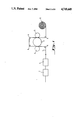
- FIG. 1 illustrates schematically an apparatus suitable for practicing the present invention
- FIG. 2 is a graph illustrating the gloss and smoothness values for the uncoated paper finished at various temperatures in Example 1;
- FIG. 3 is a graph illustrating the gloss and smoothness values for the coated paper finished at various temperatures in Example 2;
- FIG. 4 is a graph illustrating the gloss and smoothness values for the coated paper finished at various temperatures in Example 3;
- FIG. 5 is a graph showing the dynamic Tg of cellulose fibers for various moisture contents
- FIG. 6 illustrates schematically the temperature gradient into the thickness of the paper in a nip of the apparatus illustrated in FIG. 1;
- FIG. 7 is a graph showing the temperature gradient into the thickness of the web for various dwell times of the web in the nip.
- FIG. 8 is a graph showing the drum surface temperature required for the invention for various moisture contents and various dwell times.
- Parker Print-Surf-- a quantitative measurement commonly used in the papermaking field for the printing roughness and porosity of paper made by sensing the leakage of air at low pressure between the surface of the sample and the measuring sensing head. The lower the value, the smoother the paper.
- Parker Print-Surf can be measured with several different pressures of the dam against the paper being measured. In the present specification and claims, all were measured with a pressure of 10 Kg/cm 2 .
- Supercalendered coated woodfree paper will typically have a Parker Print-Surf of less than 1.4 and less than 1.0 for very high quality.
- Gloss calendered coated woodfree paper will typically have a Parker Print-Surf of between 1.2 and 2.0.
- the present invention can be carried out on an apparatus like that illustrated in FIG. 1.
- a paper web 1 is advanced through the first nip formed by smooth surface finishing drum 2 and resilient backing roll 3, around guide rolls 4, and through a second nip formed by drum 2 and a second resilient backing roll 5 pressed against drum 2.
- the web 1 is advanced to a second smooth surface finishing drum with a pair of nips formed by resilient backing rolls similar to the first unit (not illustrated for simplicity).
- the finished web is then wound onto reel 6.
- Variations in the process can be carried out by omitting or bypassing the second nip on each drum and/or finishing on one side only, in which case the second drum is bypassed or omitted.
- the web 1 supplied to the finishing apparatus can come directly from a papermaking machine 7 and/or coater 8, if the paper is to be coated.
- the web 1 can be supplied from a roll of previously manufactured paper which may or may not have already been coated.
- the papermaking machine and coater are illustrated only as blocks since they can be provided by any conventional apparatus well known in the art.
- the finishing apparatus employed in the invention can be provided by any of the many disclosed in the previously described prior art relating to gloss calendering if they are designed or can be adapted to operate at the temperature, pressure and speed conditions of the invention. Accordingly, little description of the apparatus will be given herein except to emphasize the importance of choosing a finishing drum which can be heated to the temperatures required by the invention and has a smooth metal surface and choosing a resilient backing roll which is yieldable but will have sufficient hardness at operating temperatures to provide a nip force between 35 and 700 KN/M (200 and 400 pounds per lineal inch) of nip, which could require pressures as high as 60,000 KN/M 2 (8,700 p.s.i.) at the extreme end of the range.
- the actual pressure to which the paper web is subjected in the nip will depend upon the force applied and the width of the nip.
- Resilient backing rolls flatten somewhat at the nip and will preferably have a nip width of from 1.27 to 2.54 cm (0.5 inch to 1.00 inch) for the present invention.
- Nip widths shorter than 1.27 cm and longer than 2.54 cm could be usable with the invention.
- widths shorter than about 0.635 cm will likely require undesirably slow machine speeds and nip widths wider than 2.54 cm will likely require backing rolls of undesirably large diameter and/or softness If is preferable for the backing roll surface to have a P.&J.
- An uncoated and uncalendered bodystock of a mixture of Northern hardwood and softwood fibers produced in a Kraft pulping process was unwound from a roll and passed through an apparatus similar to that illustrated in FIG. 1.
- the web had been mineral filled and sized to have 10% ash content by weight, and the web weighed 93.3 g/m 2 (63 pounds per ream of 3300 ft 2 ).
- the finishing apparatus was operated with only one nip at a force of 175 KN/M (1000 pounds per lineal inch) and a nip width of 0.47 cm (0.185 in).
- the temperature of the web was about 26.7° C. (80° F.) just before entering the nip.
- the moisture content of the web was measured to be 4.8% of the bone dry weight of the fibers.
- the web was passed through the finishing apparatus at 1.02 m/s (200 feet/min), resulting in a dwell time in the nip of 4.5 milliseconds.
- the temperature of the drum was adjusted throughout the test from a surface temperature of 82.2° C. (180° F.) to 171.1° C. (340° F.), and samples of the finished product were taken at various intervals. The samples were tested for 75° Hunter gloss values and Parker Print-Surf values, which were plotted against drum surface temperature in FIG. 2.
- a bodystock like that of Example 1 was coated on one side with a conventional pigment binder coating having a weight of 14.8 g/m 2 (10 pounds per ream of 3300 ft 2 ), dried and passed through the same apparatus and same procedure as Example 1, except the finishing drum surface temperature was adjusted from 25.6° C. (78° F.) to 190.6° C. (375° F.).
- the coater was in line with the finishing apparatus.
- the moisture content of the coated web was about 3.9% of the bone dry weight of fibers.
- the temperature of the web was about 48.9° C. (120° F.) just before entering the nip. Samples were taken for different temperature intervals and tested for 75° Hunter gloss values and Parker Print-Surf values, which were plotted against drum surface temperature in FIG. 3.
- a bodystock like that of Examples 1 and 2 was coated on both sides with coatings of the same type and amount as in Example 2 and passed through a finishing apparatus in line with the coater and similar to that employed for Examples 1 and 2, but with two finishing drums.
- Each of the drums had two resilient backing rolls forming a pair of nips.
- One side of the paper was finished against one drum and the other side against the other drum.
- the nip pressure for the first drum was varied during the test from 263 KN/M (1500 pounds per lineal inch) to 333 KN/M (1900 pounds per lineal inch).
- the nip pressure on the second drum was held at 333 KN/M (1900 pounds per lineal inch) and its drum surface temperature at 162.8° C. (325° F.) throughout the test.
- FIG. 2 is shown in two portions, the left covering temperature ranges up to about 110° C. (230° F.) and the right from about 104.4° C. (220° F.) up. On the left, one can see that gloss and Parker Print-Surf increase at a steady rate with increasing temperature up to about 104.4° C. (220° F.). This is believed to be the effects from molding and coalescing the surface of the web and is what one would expect from the prior art.
- the same phenomenon which facilitates flattening of the critical substrata in the present invention causes the entire thickness of the web in supercalendering to be molded at a temperature above its Tg. The reason is that the high moisture content of paper employed in supercalendering, can result in a Tg low enough to be reached throughout the web by the temperature conditions of supercalendering, even when unheated.
- FIG. 5 illustrates Tg values for cellulose fibers at various moisture levels.
- the curve was derived from the experimental work of N. L. Salmen and E. L. Beck (The Influence of Water on the Glass Transition Temperature of Cellulose, TAPPI Journal, Dec. 1977. Vol. 60, No. 12) and (Glass Transitions of Wood Components Hold Implications for Molding and Pulping Processes, TAPPI Journal, July 1982, Vol. 65, No. 7, pp. 107-110). The curve was adjusted for the dynamic conditions in a finishing nip.
- the Tg values have been increased over those derived by Salmen and Beck by about 12° C., since the yieldability of any polymer-like material will become less for any given temperature if the force is applied over a shorter time span. The result is that the Tg of the material appears to be higher at dynamic conditions than for static conditions. To make this adjustment, the Williams-Lande-Ferry equation was employed. The very large increase in Tg for small reductions in moisture content in the range of the invention, 3% to 7%, should be noted.
- the web dwells in the nip very briefly, due to short nip widths and fast operating speeds. For example consider nip widths of 0.635 to 2.54 cm (1/4" to 1") and machine speeds of 2.54 to 25.4 M/S (500 to 5000) feet per minute).
- the web dwell time in the nip will be from 0.3 to 12 milliseconds. At these short dwell times, the heat from the drum does not penetrate very far into the web.
- FIG. 6 illustrates the temperature gradient into a web at 1.5 milliseconds of dwell time (corresponding to a nip width of 1.32 cm and a machine speed of 8.9 M/S).
- the drum surface temperature is 138° C.
- the web temperature prior to entering the nip is 71° C.
- the backing roll surface temperature is 71° C.
- Ti initial temperature in °C. of the web entering the nip
- FIG. 7 illustrates the temperature gradient into the thickness of the web for various nip dwell times.
- the drum surface temperature is 138° C. and the paper temperature just prior to reaching the nip is 71° C.
- the approximate location of the critical substrate is believed to be about 0.0076 mm (0.3 mils ) deep and is illustrated by the shaded portion. It can be seen that the temperature of the critical substrata will depend upon dwell time and surface temperature. Whether or not the critical substrata temperature is as high as its Tg will depend in part upon its moisture content. Thus, for the conditions illustrated in FIG. 7, the critical temperature will be reached for moisture contents from 5% to 7.5%, depending upon the dwell time chosen.
- Ts surface temperature of the heated drum, in °C.
- t dwell time of the web in the nip, in milliseconds
- Tg the dynamic glass transition temperature of the web at the moisture conditions existing in the nip, in °C.
- the Tg can be determined from the curve in FIG. 5.
- a formula which very closely approximates that curve is the following:
- Tg glass transition temperature under the dynamic and moisture conditions existing in the nip in °C.
- m moisture content of the fibers in web in % of the bone dry weight of the fibers.
- the following is a guide for determining the drum surface temperature Ts, in °C. required for the present invention for various moisture contents, initial web temperatures and dwell times.
- Ts drum surface temperature
- Example 2 where moisture content was about 3.9%, nip dwell time was 4.5 milliseconds, and initial web temperature was about 48.9° C. (120° F.), the Ts value is about 161.7° C. (323° F.). Looking at FIG. 3, this value, illustrated by the faint line, can be seen to be at the top of the temperature range where the unexpected rise in gloss and flatness occur also. The advantages of the invention actually begin about 40° C. (70° F.) lower. This is considered good correlation with the results for FIG. 2.
- the location of the critical substrata is one already identified. Another is the exact value of the nip dwell time.
- the formula assumes that heating of the web occurs through the entire nip, but the greatest molding pressure only occurs in the center of the nip. Thus, the temperature reached upon exiting the nip is not as meaningful as that reached at some point between the center and the end. Determining what portion of the nip that should be used in the formula is difficult and not necessary. Also, the meaning of reaching the Tg of the fibers needs further explanation.
- the softening of polymeric materials is a second order transition and occurs over a range of temperature rather than sharply as in a first order transition, such as in the melting of ice.
- the breadth of the range is also a function of the molecular weight distribution with a wider distribution giving a wider range. This same softening may occur prior to reaching the temperature where the maximum effects are noted. None of these components need to be known precisely to develop a useful formula, because the formula need only be compared to the test results in the examples and a correction made to determine the starting and ending point of the unexpected rise in gloss and flatness. It is not known nor important to know which component or components have been estimated incorrectly, if any. The empirically determined adjustment corrects them and provides a formula suitable for determining the invention for all conditions contemplated by the invention. The good correlation between the examples is evidence of this.
- FIG. 4 also includes in dotted lines the results of samples 3 and 7 of Example 3. They are located, as expected, slightly higher due to increased pressure effect of 2 nips, but in a nonimproving relationship to each other with increase in temperature. This is believed to be for the reason stated earlier, that two nips in rapid succession are equivalent to higher drum temperature. Thus, if the solid curves were extended into higher temperatures in the manner predicted by FIG. 2, they would be flat. The single point represents the higher pressure of sample 1.
- the drum surface be heated to no less than 20° C. below the Ts to provide about one-half of the beneficial range and even more preferable that all of it be practiced, which requires the drum to be heated to no less than the calculated Ts.
- the Ts are not be exceeded by more than about 25° C., particularly for coated paper.
- the invention is believed applicable for almost any pressure applied in the nip. That is, it is expected that the effects of increasing pressure will follow their known curve, except of course, the results will be significantly better.
- the pressures will preferably be over 13,780 KN/M 2 (2000 pounds per square inch). It is at these pressures that supercalender and better quality can be obtained.
- the principles of the invention are believed to be applicable to any type of web of papermaking fibers, whether coated or uncoated, groundwood or woodfree.
- the invention is valuable for woodfree papers (which will be defined herein as having at least 80% of its papermaking fibers provided by chemical pulp), and groundwood papers (which will be defined herein as having at least 50% of its papermaking fiber provided by groundwood pulp) and those in between, which will comprise from 50% to 80% chemical pulp fibers and from 20% to 50% groundwood fibers. Any of these may be coated.
- Coatings for woodfree sheets preferably will be in an amount of at least 7.5 g/m 2 and those for the other sheets preferably will be in an amount of at least 4.5 g/m 2 .
- the invention is believed to be applicable to all conventional basis weights, including the heavy weight board products.
- the invention is capable of producing, at least with the coated woodfree sheets, gloss higher than 50 and even 70, and Parker Print-Surfs better than 1.4 and even better than 1.0.
- N. L. Salmen has described lignin as having a static Tg at 115° C. (239° F.) or dynamic Tg of 127° C. (260° F.) for moisture content of 2.5% and above. (See previously cited Salmen and Beck references and also Thermal Softening of the Components of Paper and its Effects on Mechanical Properties, N. L. Salmen, C.P.P.A. 65th Annual Meeting, Feb., 1979, pp. B11-B17.) This value is equivalent to the Tg for Cellulose at a moisture content of 4.7%.
Landscapes
- Paper (AREA)
Abstract
Description
Ts=[Ti×0.357t.sup.-0.479 -234.2e.sup.-0.131m ]/[0.357t.sup.-0.479 -1]
______________________________________
Sample No.
          No. of Nips Pressure Temperature
______________________________________
1         2           333      121° C.
2         2           333        147.8° C.
3         2           263        147.8° C.
4         1           263        147.8° C.
5         1           263      135° C.
6         1           263      121° C.
7         2           263      121° C.
______________________________________
Ts=[Ti×0.357t.sup.-0.479 -Tg]/[0.357t.sup.-0.479 -1]
Tg=234.2×e.sup.-0.131m
______________________________________
Dwell    Moisture Content
Time (ms)
         7%        6%     5%      4%   3%
______________________________________
Ti = 26.7 °  C. (80° F.)
.5       160       187.2  217.2   251  288.9
1.0      132.2     153.3  177.5   204.2
                                       233.9
2.5      114.3     132.2  152.1   174.2
                                       198.9
5        107.1     123.6  141.8   162.2
                                       184.9
10       102.7     118.1  135.4   154.7
                                       176.2
15       100.8     116    132.8   151.6
                                       172.6
Ti = 48.9° C. (120° F.)
.5       137.9     165.1  195.6   229.1
                                       266.7
1.0      119.3     140.8  164.8   191.7
                                       221.1
2.5      107.4     125.3  145.2   167.4
                                       192.1
5        102.7     119.1  137.4   157.7
                                       180.4
10       99.7      115.2  132.4   151.7
                                       173.2
15       98.4      113.6  130.4   149.2
                                       170.2
Ti = 71.1° C. (160° F.)
.5       115.5     142.8  172.8   206.1
                                       243.3
1.0      106.7     127.8  152.2   178.3
                                       208.3
2.5      100.6     118.3  138.2   160.3
                                       185
5        98.2      114.6  132.8   153.3
                                       176.1
10       96.7      112.1  129.4   148.9
                                       170
15       96.1      111.1  128.1   146.7
                                       167.8
Ti = 93.3° C. (200° F.)
.5       93.9      121.1  151.4   185.1
                                        222.8
1.0      93.8      115.3  139.2   165.9
                                       195.6
2.5      93.7      111.6  131.5   153.7
                                       178.3
5        93.7      110.1  128.4   148.8
                                       171.4
10       93.65     109.2  126.4   145.7
                                       167.1
15       93.64     108.8  125.7   144.4
                                       165.3
______________________________________
Claims (17)
Ts=[Ti×0.357t.sup.-0.479 -234.2e.sup.-131m] /[0.357t.sup.-0.479-1]
Priority Applications (1)
| Application Number | Priority Date | Filing Date | Title |
|---|---|---|---|
| US06/881,867 US4749445A (en) | 1984-05-18 | 1986-07-03 | Method of finishing paper utilizing substrata thermal molding |
Applications Claiming Priority (2)
| Application Number | Priority Date | Filing Date | Title |
|---|---|---|---|
| US06/611,766 US4624744A (en) | 1984-05-18 | 1984-05-18 | Method of finishing paper utilizing substrata thermal molding |
| US06/881,867 US4749445A (en) | 1984-05-18 | 1986-07-03 | Method of finishing paper utilizing substrata thermal molding |
Related Parent Applications (1)
| Application Number | Title | Priority Date | Filing Date |
|---|---|---|---|
| US06/611,766 Continuation US4624744A (en) | 1984-05-18 | 1984-05-18 | Method of finishing paper utilizing substrata thermal molding |
Publications (1)
| Publication Number | Publication Date |
|---|---|
| US4749445A true US4749445A (en) | 1988-06-07 |
Family
ID=27086591
Family Applications (1)
| Application Number | Title | Priority Date | Filing Date |
|---|---|---|---|
| US06/881,867 Expired - Lifetime US4749445A (en) | 1984-05-18 | 1986-07-03 | Method of finishing paper utilizing substrata thermal molding |
Country Status (1)
| Country | Link |
|---|---|
| US (1) | US4749445A (en) |
Cited By (22)
| Publication number | Priority date | Publication date | Assignee | Title |
|---|---|---|---|---|
| US4945654A (en) * | 1989-04-20 | 1990-08-07 | Mason Robert J H | Application of superheated steam |
| US5378497A (en) * | 1993-02-10 | 1995-01-03 | Westvaco Corporation | Method for providing irreversible smoothness in a paper rawstock |
| EP0710741A2 (en) | 1990-11-30 | 1996-05-08 | S.D. Warren Company | Method and apparatus for calendering paper |
| US5791242A (en) * | 1995-03-09 | 1998-08-11 | Voith Sulzer Finishing Gmbh | Calender for treating both sides of a paper web |
| WO2000017446A1 (en) * | 1998-09-22 | 2000-03-30 | International Paper Company | Method and apparatus for finishing paperboard to achieve improved smoothness and bulk |
| US6203307B1 (en) * | 1997-08-28 | 2001-03-20 | Champion International Corporation | System for finishing surface of a web of paper having an improved continuous finishing belt |
| US6258214B1 (en) * | 1998-05-08 | 2001-07-10 | V.I.B. Apparatebau Gmbh | Process for the on-line manufacture of SC-A paper |
| WO2001051709A1 (en) * | 2000-01-07 | 2001-07-19 | International Paper Company | Paper product having enhanced printing properties and related method of manufacture |
| US6401355B1 (en) * | 1998-07-10 | 2002-06-11 | Metso Paper, Inc. | Method and apparatus for manufacturing calendered paper |
| US6547929B2 (en) | 2000-04-12 | 2003-04-15 | Rohm And Haas Company | Paper having improved print quality and method of making the same |
| EP0966566B1 (en) * | 1996-12-10 | 2003-05-07 | Metso Paper, Inc. | Method of and arrangement for treating a fiber web |
| US20040099391A1 (en) * | 2002-11-26 | 2004-05-27 | Bob Ching | Process for producing super high bulk, light weight coated papers |
| US20040202833A1 (en) * | 2002-08-24 | 2004-10-14 | D.W. Anderson | Uncoated facestock for adhesive-backed labels |
| US20040234802A1 (en) * | 2001-09-05 | 2004-11-25 | Mats Hubinette | Uncoated paperboard for packages |
| US20080230001A1 (en) * | 2006-02-23 | 2008-09-25 | Meadwestvaco Corporation | Method for treating a substrate |
| US20090297808A1 (en) * | 2008-05-28 | 2009-12-03 | Fugitt Gary P | Low density paperboard |
| US20100266819A1 (en) * | 2009-04-21 | 2010-10-21 | Bushhouse Steven G | Basecoat and Associated Paperboard Structure Including A Pigment Blend of Hyper-Platy Clay and Calcined Clay |
| AT505347B1 (en) * | 2007-04-12 | 2012-01-15 | Metso Paper Inc | METHOD FOR CALENDARING A FIBERWORK |
| US8916636B2 (en) | 2013-03-14 | 2014-12-23 | Meadwestvaco Corporation | Basecoat composition and associated paperboard structure |
| US9206553B2 (en) | 2013-03-14 | 2015-12-08 | Westrock Mwv, Llc | Basecoat composition and associated paperboard structure |
| US9732473B2 (en) | 2008-03-21 | 2017-08-15 | Westrock Mwv, Llc | Basecoat and associated paperboard structure |
| US11293142B2 (en) | 2019-05-10 | 2022-04-05 | Westrock Mwv, Llc | Smooth and low density paperboard structures and methods for manufacturing the same |
Citations (15)
| Publication number | Priority date | Publication date | Assignee | Title |
|---|---|---|---|---|
| US3124504A (en) * | 1960-04-04 | 1964-03-10 | Gloss finishing of uncoated paper | |
| US3124480A (en) * | 1961-02-21 | 1964-03-10 | Hot pressure finishing apparatus for web materials | |
| US3230867A (en) * | 1961-12-04 | 1966-01-25 | Benjamin J H Nelson | Paper finishing mechanism |
| US3254593A (en) * | 1963-10-03 | 1966-06-07 | Beloit Corp | Gloss calender drive system and method |
| US3268354A (en) * | 1962-03-23 | 1966-08-23 | Champion Papers Inc | Coating process and product |
| US3442685A (en) * | 1967-03-07 | 1969-05-06 | West Virginia Pulp & Paper Co | Preparation of coated paper having high gloss and high wet rub resistance |
| US3451331A (en) * | 1967-03-01 | 1969-06-24 | Westvaco Corp | Hot roll supercalender |
| US3647619A (en) * | 1969-11-10 | 1972-03-07 | Eastman Kodak Co | High pressure calendering of a paper web between heated calender rolls having non-resilient surfaces |
| US3759785A (en) * | 1969-09-22 | 1973-09-18 | Price Co Ltd | High strength newsprint |
| US3873345A (en) * | 1973-02-12 | 1975-03-25 | Scott Paper Co | Method of finishing coated paper |
| US4012543A (en) * | 1969-06-25 | 1977-03-15 | Scott Paper Company | Coated paper and method of making same |
| US4277524A (en) * | 1978-12-27 | 1981-07-07 | Mitsubishi Paper Mills, Ltd. | Method and apparatus for finishing coated papers |
| US4317849A (en) * | 1979-11-06 | 1982-03-02 | Mitsubishi Paper Mills, Ltd. | Process for producing high-gloss coated paper |
| US4606264A (en) * | 1985-01-04 | 1986-08-19 | Wartsila-Appleton, Incorporated | Method and apparatus for temperature gradient calendering |
| US4624744A (en) * | 1984-05-18 | 1986-11-25 | S. D. Warren Company | Method of finishing paper utilizing substrata thermal molding |
-
1986
- 1986-07-03 US US06/881,867 patent/US4749445A/en not_active Expired - Lifetime
Patent Citations (15)
| Publication number | Priority date | Publication date | Assignee | Title |
|---|---|---|---|---|
| US3124504A (en) * | 1960-04-04 | 1964-03-10 | Gloss finishing of uncoated paper | |
| US3124480A (en) * | 1961-02-21 | 1964-03-10 | Hot pressure finishing apparatus for web materials | |
| US3230867A (en) * | 1961-12-04 | 1966-01-25 | Benjamin J H Nelson | Paper finishing mechanism |
| US3268354A (en) * | 1962-03-23 | 1966-08-23 | Champion Papers Inc | Coating process and product |
| US3254593A (en) * | 1963-10-03 | 1966-06-07 | Beloit Corp | Gloss calender drive system and method |
| US3451331A (en) * | 1967-03-01 | 1969-06-24 | Westvaco Corp | Hot roll supercalender |
| US3442685A (en) * | 1967-03-07 | 1969-05-06 | West Virginia Pulp & Paper Co | Preparation of coated paper having high gloss and high wet rub resistance |
| US4012543A (en) * | 1969-06-25 | 1977-03-15 | Scott Paper Company | Coated paper and method of making same |
| US3759785A (en) * | 1969-09-22 | 1973-09-18 | Price Co Ltd | High strength newsprint |
| US3647619A (en) * | 1969-11-10 | 1972-03-07 | Eastman Kodak Co | High pressure calendering of a paper web between heated calender rolls having non-resilient surfaces |
| US3873345A (en) * | 1973-02-12 | 1975-03-25 | Scott Paper Co | Method of finishing coated paper |
| US4277524A (en) * | 1978-12-27 | 1981-07-07 | Mitsubishi Paper Mills, Ltd. | Method and apparatus for finishing coated papers |
| US4317849A (en) * | 1979-11-06 | 1982-03-02 | Mitsubishi Paper Mills, Ltd. | Process for producing high-gloss coated paper |
| US4624744A (en) * | 1984-05-18 | 1986-11-25 | S. D. Warren Company | Method of finishing paper utilizing substrata thermal molding |
| US4606264A (en) * | 1985-01-04 | 1986-08-19 | Wartsila-Appleton, Incorporated | Method and apparatus for temperature gradient calendering |
Non-Patent Citations (40)
| Title |
|---|
| Agronin, Michael, "Supercalender Variables Affecting Paper Quality." TAPPI Journal (Oct. 1983), pp. 96-99. |
| Agronin, Michael, Supercalender Variables Affecting Paper Quality. TAPPI Journal (Oct. 1983), pp. 96 99. * |
| Agronin, Ronald D., "The Effect of Supercalender Roll Fillings on Paper Printability." TAPPI Publication, vol. 61, no. 9 (Sep., 1978). pp. 73-76. |
| Agronin, Ronald D., The Effect of Supercalender Roll Fillings on Paper Printability. TAPPI Publication, vol. 61, no. 9 (Sep., 1978). pp. 73 76. * |
| Back, Ernest L. and Olsson, Anne Mari, The Effect of Temperature on Gloss Calendering of Board as Evaluated in a Press Simulator. 1981 Paper Finishing and Converting Conference, pp. 63 75. * |
| Back, Ernest L. and Olsson, Anne-Mari, "The Effect of Temperature on Gloss Calendering of Board as Evaluated in a Press Simulator." 1981 Paper Finishing and Converting Conference, pp. 63-75. |
| Back, Ernst L. and Olsson, Anne Mari, The Effect of Temperature on Gloss Calendering of Board as Evaluated in a Press Simulator. EUCEPA Conference, 1982 Budapest. * |
| Back, Ernst L. and Olsson, Anne Mari, The Effect of Temperature on Gloss Calendering of Board as Evaluated in a Press Simulator. Svensk Papperstidning (1983), pp. R31 R41. * |
| Back, Ernst L. and Olsson, Anne-Mari, "The Effect of Temperature on Gloss Calendering of Board as Evaluated in a Press Simulator." EUCEPA Conference, 1982 Budapest. |
| Back, Ernst L. and Olsson, Anne-Mari, "The Effect of Temperature on Gloss Calendering of Board as Evaluated in a Press Simulator." Svensk Papperstidning (1983), pp. R31-R41. |
| Brecht, W. and Muller, G., "Tests Performed with a Gloss Calendar." TAPPI Publication, vol. 51, No. 2, (Feb. 1968), pp. 61A-66A. |
| Brecht, W. and Muller, G., Tests Performed with a Gloss Calendar. TAPPI Publication, vol. 51, No. 2, (Feb. 1968), pp. 61A 66A. * |
| Crotogino, R. H. "Temperature-Gradient Calendering." Publication of Pulp and Paper Research Institute of Canada (Aug. 1981), p. 327. |
| Crotogino, R. H. "Temperature-Gradient Calendering." TAPPI Journal (Oct. 1982), pp. 97-101. |
| Crotogino, R. H. Temperature Gradient Calendering. Publication of Pulp and Paper Research Institute of Canada (Aug. 1981), p. 327. * |
| Crotogino, R. H. Temperature Gradient Calendering. TAPPI Journal (Oct. 1982), pp. 97 101. * |
| Deeg, Rudi F., "What Can be Gained From Controlled Heat in Supercalendering." TAPPI Publication, vol. 64, No. 10 (Oct. 1981), pp. 51-54. |
| Deeg, Rudi F., What Can be Gained From Controlled Heat in Supercalendering. TAPPI Publication, vol. 64, No. 10 (Oct. 1981), pp. 51 54. * |
| DeMontmorency, W. H., "The Calendering of Newsprint: A Laboratory Study of Temperature and Pressure Effects." Publication of the Pulp and Paper Research Institute of Canada (Jul., 1967), pp. T326-T345. |
| DeMontmorency, W. H., The Calendering of Newsprint: A Laboratory Study of Temperature and Pressure Effects. Publication of the Pulp and Paper Research Institute of Canada (Jul., 1967), pp. T326 T345. * |
| Haven, E. A., "Thermoplanishing--By Design and Method." Pulp & Paper Journal (Jun. 10, 1968), pp. 32-33. |
| Haven, E. A., Thermoplanishing By Design and Method. Pulp & Paper Journal (Jun. 10, 1968), pp. 32 33. * |
| Hunger, Dr. Gunther K., The Influence of Pressure, Heat and Moisture on the Finishing of Paper and Board. Symposium on Calendering and Supercalendering of Paper, Publication of the University of Manchester Institute of Science & Technology (Sep. 1975). * |
| Ichinose, Lee Y., "On-Machine Soft Calendering: A Good Idea Whose Time Has Come?" PIMA Magazine (Dec. 1984), pp. 35-40. |
| Ichinose, Lee Y., On Machine Soft Calendering: A Good Idea Whose Time Has Come PIMA Magazine (Dec. 1984), pp. 35 40. * |
| Jackson, Michael and Gavelin, Gunnar, "The Role of Nip Temperature and Surface Moisture in the Calendering and Supercalendering Process." Svensk Papperstidning (Mar. 15, 1966), pp. 131-138, NR5. |
| Jackson, Michael and Gavelin, Gunnar, The Role of Nip Temperature and Surface Moisture in the Calendering and Supercalendering Process. Svensk Papperstidning (Mar. 15, 1966), pp. 131 138, NR5. * |
| Kerekes, R. J. and Pye, I. T., "Newsprint Calendering: An Experimental Comparison of Temperature and Loading Effects." Pulp & Paper Canada, vol. 75, No. 11 (Nov., 1974), pp. 65-72. |
| Kerekes, R. J. and Pye, I. T., Newsprint Calendering: An Experimental Comparison of Temperature and Loading Effects. Pulp & Paper Canada, vol. 75, No. 11 (Nov., 1974), pp. 65 72. * |
| Kroeschell, W. O., "Recent Advances in the High-Temperature Finishing of Paperboard." TAPPI Publication, vol. 46, No. 11, (Nov. 1963), pp. 170A-172A. |
| Kroeschell, W. O., Recent Advances in the High Temperature Finishing of Paperboard. TAPPI Publication, vol. 46, No. 11, (Nov. 1963), pp. 170A 172A. * |
| Lyne, Bruce, "Machine-Calendering: Implications for Surface Structure and Printing Properties." TAPPI Publication, vol. 59, No. 8 (Aug., 1976), pp. 101-105. |
| Lyne, Bruce, Machine Calendering: Implications for Surface Structure and Printing Properties. TAPPI Publication, vol. 59, No. 8 (Aug., 1976), pp. 101 105. * |
| Muench, Erhardt and Schmitz, Wimmar, The Modern Supercalender the Basis of New Concepts for Soft Calendering. EUCEPA Conference, Budapest (Oct. 1982). * |
| Munch, Erhardt E. A., "Application of Hot Water Heated Supercalendar-The Way to the Flexitherm-System." 1966 Annual Meeting CPPA, Montreal, pp. A159-A163. |
| Munch, Erhardt E. A., Application of Hot Water Heated Supercalendar The Way to the Flexitherm System. 1966 Annual Meeting CPPA, Montreal, pp. A159 A163. * |
| Munch, Erhardt E.; Schlunke, Jurgen and Schmitz, Wimmar, Supercalendering: Analyzing Effects of Hot Calendering on the Printability of Coated Papers. Paper Trade Journal (Oct. 15, 1979). * |
| Schmidlin, H. L., "Rubber Roll Hardness-Another Look." Pulp and Paper Magazine (Mar. 18, 1968), pp. 30-32. |
| Schmidlin, H. L., Rubber Roll Hardness Another Look. Pulp and Paper Magazine (Mar. 18, 1968), pp. 30 32. * |
| Schmidt, S. and Kirbis, R., The Effects of Temperature on the Surface Levelling of Paper. Paper Magazine (Aug. 1980), Paper 4. * |
Cited By (39)
| Publication number | Priority date | Publication date | Assignee | Title |
|---|---|---|---|---|
| US4945654A (en) * | 1989-04-20 | 1990-08-07 | Mason Robert J H | Application of superheated steam |
| EP0710741A2 (en) | 1990-11-30 | 1996-05-08 | S.D. Warren Company | Method and apparatus for calendering paper |
| US5378497A (en) * | 1993-02-10 | 1995-01-03 | Westvaco Corporation | Method for providing irreversible smoothness in a paper rawstock |
| US5791242A (en) * | 1995-03-09 | 1998-08-11 | Voith Sulzer Finishing Gmbh | Calender for treating both sides of a paper web |
| EP0966566B1 (en) * | 1996-12-10 | 2003-05-07 | Metso Paper, Inc. | Method of and arrangement for treating a fiber web |
| US6203307B1 (en) * | 1997-08-28 | 2001-03-20 | Champion International Corporation | System for finishing surface of a web of paper having an improved continuous finishing belt |
| US6258214B1 (en) * | 1998-05-08 | 2001-07-10 | V.I.B. Apparatebau Gmbh | Process for the on-line manufacture of SC-A paper |
| US6401355B1 (en) * | 1998-07-10 | 2002-06-11 | Metso Paper, Inc. | Method and apparatus for manufacturing calendered paper |
| US6287424B1 (en) | 1998-09-22 | 2001-09-11 | International Paper Company | Method for finishing paperboard to achieve improved smoothness |
| US6497790B2 (en) | 1998-09-22 | 2002-12-24 | International Paper Company | Paperboard of improved smoothness and bulk |
| WO2000017446A1 (en) * | 1998-09-22 | 2000-03-30 | International Paper Company | Method and apparatus for finishing paperboard to achieve improved smoothness and bulk |
| US6332953B1 (en) | 1998-10-02 | 2001-12-25 | International Paper Company | Paper product having enhanced printing properties and related method of manufacture |
| WO2001051709A1 (en) * | 2000-01-07 | 2001-07-19 | International Paper Company | Paper product having enhanced printing properties and related method of manufacture |
| US6547929B2 (en) | 2000-04-12 | 2003-04-15 | Rohm And Haas Company | Paper having improved print quality and method of making the same |
| US20030178165A1 (en) * | 2000-04-12 | 2003-09-25 | Bobsein Barrett Richard | Paper having improved print quality and method of making the same |
| US6863775B2 (en) | 2000-04-12 | 2005-03-08 | Rohm And Haas Company | Paper having improved print quality and method of making the same |
| US20040234802A1 (en) * | 2001-09-05 | 2004-11-25 | Mats Hubinette | Uncoated paperboard for packages |
| US7628885B2 (en) * | 2001-09-05 | 2009-12-08 | Korsnas Ab (Publ.) | Uncoated paperboard for packages |
| US7666495B2 (en) | 2002-08-24 | 2010-02-23 | International Paper Company | Uncoated facestock for adhesive-backed labels |
| US6946186B2 (en) | 2002-08-24 | 2005-09-20 | International Paper Co. | Uncoated facestock for adhesive-backed labels |
| US20050252630A1 (en) * | 2002-08-24 | 2005-11-17 | International Paper Company | Uncoated facestock for adhesive-backed labels |
| US20040202833A1 (en) * | 2002-08-24 | 2004-10-14 | D.W. Anderson | Uncoated facestock for adhesive-backed labels |
| US7794567B2 (en) | 2002-08-24 | 2010-09-14 | International Paper Co. | Uncoated facestock for adhesive-backed labels |
| US20040099391A1 (en) * | 2002-11-26 | 2004-05-27 | Bob Ching | Process for producing super high bulk, light weight coated papers |
| WO2004048692A3 (en) * | 2002-11-26 | 2004-07-29 | Int Paper Co | Process for producing super high bulk, light weight coated papers |
| US20080230001A1 (en) * | 2006-02-23 | 2008-09-25 | Meadwestvaco Corporation | Method for treating a substrate |
| US20080268158A1 (en) * | 2006-02-23 | 2008-10-30 | Meadwestvaco Corporation | Method for treating a substrate |
| US8349443B2 (en) | 2006-02-23 | 2013-01-08 | Meadwestvaco Corporation | Method for treating a substrate |
| US8673398B2 (en) | 2006-02-23 | 2014-03-18 | Meadwestvaco Corporation | Method for treating a substrate |
| AT505347B1 (en) * | 2007-04-12 | 2012-01-15 | Metso Paper Inc | METHOD FOR CALENDARING A FIBERWORK |
| US9732473B2 (en) | 2008-03-21 | 2017-08-15 | Westrock Mwv, Llc | Basecoat and associated paperboard structure |
| US7749583B2 (en) | 2008-05-28 | 2010-07-06 | Meadwestvaco Corporation | Low density paperboard |
| US20090297808A1 (en) * | 2008-05-28 | 2009-12-03 | Fugitt Gary P | Low density paperboard |
| US8658272B2 (en) | 2009-04-21 | 2014-02-25 | Meadwestvaco Corporation | Basecoat and associated paperboard structure including a pigment blend of hyper-platy clay and calcined clay |
| US20100266819A1 (en) * | 2009-04-21 | 2010-10-21 | Bushhouse Steven G | Basecoat and Associated Paperboard Structure Including A Pigment Blend of Hyper-Platy Clay and Calcined Clay |
| US8916636B2 (en) | 2013-03-14 | 2014-12-23 | Meadwestvaco Corporation | Basecoat composition and associated paperboard structure |
| US9206553B2 (en) | 2013-03-14 | 2015-12-08 | Westrock Mwv, Llc | Basecoat composition and associated paperboard structure |
| US11293142B2 (en) | 2019-05-10 | 2022-04-05 | Westrock Mwv, Llc | Smooth and low density paperboard structures and methods for manufacturing the same |
| US11697908B2 (en) | 2019-05-10 | 2023-07-11 | Westrock Mwv, Llc | Smooth and low density paperboard structures and methods for manufacturing the same |
Similar Documents
| Publication | Publication Date | Title |
|---|---|---|
| US4624744A (en) | Method of finishing paper utilizing substrata thermal molding | |
| US5378497A (en) | Method for providing irreversible smoothness in a paper rawstock | |
| EP0245250B1 (en) | Method of finishing paper utilizing substrata thermal molding | |
| CN1625629B (en) | Processing apparatus for processing coated or uncoated fibrous webs | |
| CA2285301C (en) | Calendering method and a calender that makes use of the method | |
| US6418840B1 (en) | Calendering method and a calender that makes use of the method | |
| RU2303672C2 (en) | Web smoothness enhancing method | |
| US3873345A (en) | Method of finishing coated paper | |
| WO2001098585A1 (en) | Calendering method especially for precalendering and a calender for implementing the method | |
| US6274001B1 (en) | Method for calendering surface sized paper/paperboard to improve smoothness | |
| US3982056A (en) | Method for improving the printability characteristics of gloss calendered paper | |
| CA2386033C (en) | Method for a multi-roll calender as well as a multi-roll calender | |
| US5505820A (en) | Method for providing enhanced smoothness for a paper web | |
| US6589388B1 (en) | Method for manufacturing coated paper and a coated paper | |
| CA2284748C (en) | Multilayer lineboard having improved printing properties and related method of manufacture | |
| JP5068407B2 (en) | Non-coated paper or non-coated paperboard products | |
| US20030089248A1 (en) | Method and device for moisturatization of a paper board web in calendering | |
| US5425851A (en) | Method for improving the printability of web offset paper | |
| US4289808A (en) | Process for producing dry finished paperboard | |
| CA2412441C (en) | Precalendering method, finishing method and apparatus for implementing the methods | |
| CA2382680C (en) | Method and arrangement for surface treatment of a paper and/or board web | |
| CA1250477A (en) | Method of finishing paper utilizing substrata thermal molding | |
| EP0514595A1 (en) | Method of making coated paper and paperboard utilizing impulse drying | |
| US6551454B1 (en) | Method for producing coated calendered paper | |
| EP1238156B1 (en) | Calendering arrangement for a paper machine |
Legal Events
| Date | Code | Title | Description |
|---|---|---|---|
| STCF | Information on status: patent grant |
Free format text: PATENTED CASE |
|
| FEPP | Fee payment procedure |
Free format text: PAYOR NUMBER ASSIGNED (ORIGINAL EVENT CODE: ASPN); ENTITY STATUS OF PATENT OWNER: LARGE ENTITY |
|
| FPAY | Fee payment |
Year of fee payment: 4 |
|
| AS | Assignment |
Owner name: S.D. WARREN COMPANY, MASSACHUSETTS Free format text: ASSIGNMENT OF ASSIGNORS INTEREST;ASSIGNORS:SCOTT PAPER COMPANY;SCOTT CONTINENTAL N.V.;REEL/FRAME:007381/0264 Effective date: 19941220 |
|
| AS | Assignment |
Owner name: CHEMICAL BANK, AGENT, NEW YORK Free format text: SECURITY INTEREST;ASSIGNOR:S.D. WARREN COMPANY;REEL/FRAME:007388/0328 Effective date: 19941220 |
|
| FPAY | Fee payment |
Year of fee payment: 8 |
|
| AS | Assignment |
Owner name: S.D. WARREN SERVICES COMPANY, MASSACHUSETTS Free format text: ASSIGNMENT OF ASSIGNORS INTEREST;ASSIGNOR:S.D. WARREN COMPANY;REEL/FRAME:010310/0362 Effective date: 19990928 |
|
| FPAY | Fee payment |
Year of fee payment: 12 |
|
| AS | Assignment |
Owner name: S.D WARREN COMPANY, MASSACHUSETTS Free format text: TERMINATION AND RELEASE OF SECURITY INTEREST IN PATENTS RECORDED AT REEL 7388 FRAME 0328;ASSIGNOR:JPMORGAN CHASE BANK (F/K/A CHEMICAL BANK);REEL/FRAME:012539/0495 Effective date: 20020116 |