US4703647A - Apparatus for measuring grain hardness - Google Patents
Apparatus for measuring grain hardness Download PDFInfo
- Publication number
- US4703647A US4703647A US06/883,970 US88397086A US4703647A US 4703647 A US4703647 A US 4703647A US 88397086 A US88397086 A US 88397086A US 4703647 A US4703647 A US 4703647A
- Authority
- US
- United States
- Prior art keywords
- frame
- plate
- disc
- openings
- grains
- Prior art date
- Legal status (The legal status is an assumption and is not a legal conclusion. Google has not performed a legal analysis and makes no representation as to the accuracy of the status listed.)
- Expired - Fee Related
Links
- 230000002093 peripheral effect Effects 0.000 claims abstract 2
- NJPPVKZQTLUDBO-UHFFFAOYSA-N novaluron Chemical compound C1=C(Cl)C(OC(F)(F)C(OC(F)(F)F)F)=CC=C1NC(=O)NC(=O)C1=C(F)C=CC=C1F NJPPVKZQTLUDBO-UHFFFAOYSA-N 0.000 claims description 5
- 235000013339 cereals Nutrition 0.000 description 15
- 244000098338 Triticum aestivum Species 0.000 description 9
- 244000098345 Triticum durum Species 0.000 description 9
- 241000209140 Triticum Species 0.000 description 7
- 235000021307 Triticum Nutrition 0.000 description 7
- 235000007264 Triticum durum Nutrition 0.000 description 5
- 238000000034 method Methods 0.000 description 4
- 230000005484 gravity Effects 0.000 description 3
- 239000002245 particle Substances 0.000 description 3
- 238000013459 approach Methods 0.000 description 2
- 238000003801 milling Methods 0.000 description 2
- 239000000523 sample Substances 0.000 description 2
- 238000012360 testing method Methods 0.000 description 2
- 230000000007 visual effect Effects 0.000 description 2
- RYGMFSIKBFXOCR-UHFFFAOYSA-N Copper Chemical compound [Cu] RYGMFSIKBFXOCR-UHFFFAOYSA-N 0.000 description 1
- 241000196324 Embryophyta Species 0.000 description 1
- 241000238631 Hexapoda Species 0.000 description 1
- 102000010029 Homer Scaffolding Proteins Human genes 0.000 description 1
- 108010077223 Homer Scaffolding Proteins Proteins 0.000 description 1
- 240000005979 Hordeum vulgare Species 0.000 description 1
- 235000007340 Hordeum vulgare Nutrition 0.000 description 1
- VVQNEPGJFQJSBK-UHFFFAOYSA-N Methyl methacrylate Chemical compound COC(=O)C(C)=C VVQNEPGJFQJSBK-UHFFFAOYSA-N 0.000 description 1
- 240000007594 Oryza sativa Species 0.000 description 1
- 235000007164 Oryza sativa Nutrition 0.000 description 1
- 229920005372 Plexiglas® Polymers 0.000 description 1
- 240000008042 Zea mays Species 0.000 description 1
- 235000005824 Zea mays ssp. parviglumis Nutrition 0.000 description 1
- 235000002017 Zea mays subsp mays Nutrition 0.000 description 1
- 229910052802 copper Inorganic materials 0.000 description 1
- 239000010949 copper Substances 0.000 description 1
- 235000005822 corn Nutrition 0.000 description 1
- 238000009402 cross-breeding Methods 0.000 description 1
- 238000011161 development Methods 0.000 description 1
- 238000010586 diagram Methods 0.000 description 1
- 238000000227 grinding Methods 0.000 description 1
- 238000007689 inspection Methods 0.000 description 1
- 238000004519 manufacturing process Methods 0.000 description 1
- 239000000203 mixture Substances 0.000 description 1
- 238000012545 processing Methods 0.000 description 1
- 238000011160 research Methods 0.000 description 1
- 235000009566 rice Nutrition 0.000 description 1
- 238000000926 separation method Methods 0.000 description 1
- 238000004513 sizing Methods 0.000 description 1
- 238000003860 storage Methods 0.000 description 1
- 238000012546 transfer Methods 0.000 description 1
Images


Classifications
-
- G—PHYSICS
- G01—MEASURING; TESTING
- G01N—INVESTIGATING OR ANALYSING MATERIALS BY DETERMINING THEIR CHEMICAL OR PHYSICAL PROPERTIES
- G01N3/00—Investigating strength properties of solid materials by application of mechanical stress
- G01N3/40—Investigating hardness or rebound hardness
-
- G—PHYSICS
- G01—MEASURING; TESTING
- G01N—INVESTIGATING OR ANALYSING MATERIALS BY DETERMINING THEIR CHEMICAL OR PHYSICAL PROPERTIES
- G01N3/00—Investigating strength properties of solid materials by application of mechanical stress
- G01N3/56—Investigating resistance to wear or abrasion
- G01N3/565—Investigating resistance to wear or abrasion of granular or particulate material
-
- Y—GENERAL TAGGING OF NEW TECHNOLOGICAL DEVELOPMENTS; GENERAL TAGGING OF CROSS-SECTIONAL TECHNOLOGIES SPANNING OVER SEVERAL SECTIONS OF THE IPC; TECHNICAL SUBJECTS COVERED BY FORMER USPC CROSS-REFERENCE ART COLLECTIONS [XRACs] AND DIGESTS
- Y10—TECHNICAL SUBJECTS COVERED BY FORMER USPC
- Y10T—TECHNICAL SUBJECTS COVERED BY FORMER US CLASSIFICATION
- Y10T83/00—Cutting
- Y10T83/647—With means to convey work relative to tool station
- Y10T83/654—With work-constraining means on work conveyor [i.e., "work-carrier"]
- Y10T83/6545—With means to guide work-carrier in nonrectilinear path
- Y10T83/6547—About axis fixed relative to tool station
- Y10T83/6548—Infeed
- Y10T83/655—About vertical axis
- Y10T83/6552—Cut normal to axis
- Y10T83/6553—Work-guide tube
Definitions
- Bulk testing methods such as time to grind, resistance to grinding, particle size index and near infrared reflectance can be used to delineate hard from soft samples but are not sensitive enough to identify the degree of adulteration in blended samples.
- Federal regulations allow a maximum of 5% adulteration of a wheat class with other wheat classes. Beyond the 5% level the end use quality of the wheat is affected.
- the inventive instrument is constructed to singularize and orient the wheat kernels so that they can be sliced or crushed by rotary means such as a sharp or blunt disc.
- the force experienced by the rotary means is measured by a load cell and it is this recorded breakage event which contains the information necessary to determine if the kernel is a hard or soft kernel.
- the basic premise the instrument operates on is that hard kernels are harder or more brittle than the softer or more ductile soft kernels.
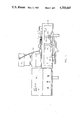
- FIG. 1 is a front elevational view of the inventive instrument
- FIG. 2 is a fragmentary enlarged front elevational view and partially schematic
- FIG. 3 is a top plan view
- FIG. 4 is a fragmentary enlarged rear elevational view
- FIG. 4A is a fragmentary rear elevational view of a modified form of a rotary disc used in the invention.
- FIG. 5 is a chart depicting performance of the invention.
- Singularization of the kernels is achieved using a vibrating feeder mechanism off of a seed counter.
- the feeder also aligns the kernels so that they will feed into a copper drop tube, see FIG. 1 at 10, which gravity feeds the kernels to a rotating plate 11 revolving at 6 rpm.
- the plate contains 48 closely aligned holes that have a 45° beveled entrance 13.
- a cross-sectional diagram of one of the holes 13 is shown in FIG. 4.
- the beveled area acts as a funnel which catches the kernel as it falls from the drop tube.
- the disc groove 15 shown in FIG. 4 extends all the way around the plate and has a depth that goes nearly to the back of the holes. The depth is adjustable through adjustment of the load cell rod 34 and movement of the bearings 30 and 31.
- the illustrated rotary knife 16 sits in this groove and as the kernels are rotated to the knife, the knife slices them through. The edge of the rotary knife is sharp to get a smooth cut.
- the blunt disc 116 seen in FIG. 4A can be employed which provides a crushing action.
- the kernels are cleaned from the holes by two means.
- the first is gravity.
- the stationary plate 17 does not cover the bottom of the rotating plate 11 in this area and kernels can fall out of the hole.
- the second method is by blasts of compressed air which removes fine stuck particles from the hole and the knife groove. Clean-out by this method is very good although occasionally a kernel will lodge in the hole and will require mechanical means for removal.
- the rotary knife is attached to a 50 lbf load cell. Forces experienced by the knife are monitored by the load cell. Load cell values are sampled every millisecond and values recorded by an IBM-PC for analysis. FIG. 5 shows a representative response of the load cell to a breakage event.
- the number 18 designates generally a frame or pedestal which carries the operating elements.
- a motor 19 is carried by the frame 18 and is coupled by a pulley and belt drive 20 to a vertical shaft 21 to which the rotating plate 11 is fixed.
- the shaft 21 is journaled in suitable bearings at 22 and 23.
- the plate 11 is equipped with a plurality of holes 12 which are arranged in a circle.
- the numeral 24 designates a grain feeder arranged to dispense individual grains sequentially.
- a suitable grain feeder can be obtained commercially from FMC Corporation-Syntron Division located at Homer City, Pa., Model No. EB051.
- the grain feeder 24 delivers the grains sequentially to the previously mentioned drop tube 10.
- a grain enters an opening in the rotating plate 11 at 9:00 o'clock and encounters the air blast from positioner 14 at about 7:00 o'clock. Thereafter the grain is engaged by rotary knife 16 at the 3:00 o'clock position. Removal is effected by gravity and another air blast at about 12:00 o'clock.
- a compressed air line 25 supplies air to the positioner 14 and removal branch lines 26, 27.
- the stationary plate 17 extends to most but not all of the periphery of the rotating plate 11. More particularly it terminates short of the removal area, as at 17a.
- a plate of plexiglass 38 is affixed above the removal area to direct broken kernel particles downward into the collection area.
- the pivotal movement of the vertical shaft 28 is transmitted through a yoke 32 (see FIG. 2).
- the yoke 32 is pivotally mounted on the shaft 28 by a pin 33.
- a rod 34 (compare FIGS. 2 and 3) is fixed at one end to the yoke 32 and at the other end fixed to a part of the frame as at 35.
- a load cell 36 Interposed between the yoke 32 and the fixed part 35 is a load cell 36 which advantageously can be of the manufacture of Eaton Corporation located at Troy, Mich. and being Model No. 3108 and which measures the strain exerted by the engagement of the disc with the kernel.
- the output signal from the load cell 36 is delivered to a micro processor 37 also illustrated schematically in FIG. 2. This is advantageously provided as part of the control console 38 (compare the left hand portions of FIGS. 1 and 3).
- the console includes a micro processor manufactured by Zenith Corporation, located in Chicago, Ill. and having Model No. 151.
- the inventive apparatus can test the hardness of other grains.
- it is advantageously employed to determine milling characteristics, viz., how to handle, dry, etc. in processing.
- hardness relates to quality.
- corn it relates to durability in storage and handling--the hard variety is more durable.
Landscapes
- Physics & Mathematics (AREA)
- Health & Medical Sciences (AREA)
- Life Sciences & Earth Sciences (AREA)
- Chemical & Material Sciences (AREA)
- Analytical Chemistry (AREA)
- Biochemistry (AREA)
- General Health & Medical Sciences (AREA)
- General Physics & Mathematics (AREA)
- Immunology (AREA)
- Pathology (AREA)
- Adjustment And Processing Of Grains (AREA)
Abstract
Description
Claims (10)
Priority Applications (1)
| Application Number | Priority Date | Filing Date | Title |
|---|---|---|---|
| US06/883,970 US4703647A (en) | 1986-07-10 | 1986-07-10 | Apparatus for measuring grain hardness |
Applications Claiming Priority (1)
| Application Number | Priority Date | Filing Date | Title |
|---|---|---|---|
| US06/883,970 US4703647A (en) | 1986-07-10 | 1986-07-10 | Apparatus for measuring grain hardness |
Publications (1)
| Publication Number | Publication Date |
|---|---|
| US4703647A true US4703647A (en) | 1987-11-03 |
Family
ID=25383691
Family Applications (1)
| Application Number | Title | Priority Date | Filing Date |
|---|---|---|---|
| US06/883,970 Expired - Fee Related US4703647A (en) | 1986-07-10 | 1986-07-10 | Apparatus for measuring grain hardness |
Country Status (1)
| Country | Link |
|---|---|
| US (1) | US4703647A (en) |
Cited By (14)
| Publication number | Priority date | Publication date | Assignee | Title |
|---|---|---|---|---|
| US5005774A (en) * | 1990-05-03 | 1991-04-09 | The United States Of America As Represented By The Secretary Of Agriculture | Rapid, single kernel grain characterization system |
| US5056721A (en) * | 1990-06-12 | 1991-10-15 | The United States Of America As Represented By The Secretary Of Agriculture | Method for classifying wheat kernels as hard or soft |
| FR2683041A1 (en) * | 1991-10-29 | 1993-04-30 | Framatome Sa | Device for measuring the hardness of vegetable grains or vegetable seeds |
| EP0527191A4 (en) * | 1990-05-03 | 1993-06-30 | Us Agriculture | Device for singulating particles including a rapid, single kernel grain characterization system |
| US5285681A (en) * | 1990-12-20 | 1994-02-15 | Purina Mills, Inc. | On-line pellet durability tester |
| DE4241985A1 (en) * | 1992-12-12 | 1994-06-16 | Hans Juergen Gatermann | Tablet testing appts. - has rotating plate with circular recesses to hold tablets at its periphery with tablet orientation for hardness testing |
| US6173601B1 (en) * | 1996-07-22 | 2001-01-16 | Genecor International, Inc. | Method and device for characterizing granule strength |
| US6457345B1 (en) | 1996-07-22 | 2002-10-01 | Genencor International, Inc. | Repeated impact apparatus and method for characterizing granule strength |
| WO2005064310A1 (en) * | 2003-12-31 | 2005-07-14 | Council Of Scientific And Industrial Research | Method and device for measuring the texture of cooked grains |
| CN100422715C (en) * | 2002-11-08 | 2008-10-01 | 无锡粮食机械厂 | Wheat Hardness Tester |
| CN101713718B (en) * | 2009-07-28 | 2011-06-15 | 甘肃农业大学 | Method for determining corn grain hardness |
| CN102519815A (en) * | 2011-12-14 | 2012-06-27 | 河南工业大学 | Wheat hardness detector and method for detecting wheat hardness by using the apparatus |
| US10739238B2 (en) * | 2015-10-15 | 2020-08-11 | SimSAGe Pty Ltd. | Apparatus and method for determining the hardness of a granular material |
| US10902575B2 (en) * | 2019-05-01 | 2021-01-26 | Inspect Technologies Ltd | Automated grains inspection |
Citations (6)
| Publication number | Priority date | Publication date | Assignee | Title |
|---|---|---|---|---|
| US2226600A (en) * | 1938-09-16 | 1940-12-31 | William R Eddington | Machine for testing tenderness of peas |
| US2839917A (en) * | 1955-10-04 | 1958-06-24 | Webster Instr Inc | Hardness testing machine |
| US3264866A (en) * | 1964-01-07 | 1966-08-09 | Feed Service Corp | Rotating knife tenderometer |
| US3511078A (en) * | 1967-10-19 | 1970-05-12 | Muszeripari Lab | Process and apparatus for the determination of the grindability of cereals |
| US3592362A (en) * | 1969-02-28 | 1971-07-13 | Pin Point Products Inc | Apparatus having invertable metering chamber |
| US4472960A (en) * | 1980-08-06 | 1984-09-25 | Freund Industrial Co., Ltd. | Method of and apparatus for testing properties |
-
1986
- 1986-07-10 US US06/883,970 patent/US4703647A/en not_active Expired - Fee Related
Patent Citations (6)
| Publication number | Priority date | Publication date | Assignee | Title |
|---|---|---|---|---|
| US2226600A (en) * | 1938-09-16 | 1940-12-31 | William R Eddington | Machine for testing tenderness of peas |
| US2839917A (en) * | 1955-10-04 | 1958-06-24 | Webster Instr Inc | Hardness testing machine |
| US3264866A (en) * | 1964-01-07 | 1966-08-09 | Feed Service Corp | Rotating knife tenderometer |
| US3511078A (en) * | 1967-10-19 | 1970-05-12 | Muszeripari Lab | Process and apparatus for the determination of the grindability of cereals |
| US3592362A (en) * | 1969-02-28 | 1971-07-13 | Pin Point Products Inc | Apparatus having invertable metering chamber |
| US4472960A (en) * | 1980-08-06 | 1984-09-25 | Freund Industrial Co., Ltd. | Method of and apparatus for testing properties |
Non-Patent Citations (2)
| Title |
|---|
| "Determination of Hardness in Wheat Mixtures, Part II. Apparatus for Automated Measurement of Hardness of Single Kernels"; Cereal Chemistry, 34 page copy of article therein; published 1985; F. S. Lai et al. |
| Determination of Hardness in Wheat Mixtures, Part II. Apparatus for Automated Measurement of Hardness of Single Kernels ; Cereal Chemistry, 34 page copy of article therein; published 1985; F. S. Lai et al. * |
Cited By (19)
| Publication number | Priority date | Publication date | Assignee | Title |
|---|---|---|---|---|
| US5005774A (en) * | 1990-05-03 | 1991-04-09 | The United States Of America As Represented By The Secretary Of Agriculture | Rapid, single kernel grain characterization system |
| EP0527191A4 (en) * | 1990-05-03 | 1993-06-30 | Us Agriculture | Device for singulating particles including a rapid, single kernel grain characterization system |
| US5056721A (en) * | 1990-06-12 | 1991-10-15 | The United States Of America As Represented By The Secretary Of Agriculture | Method for classifying wheat kernels as hard or soft |
| US5285681A (en) * | 1990-12-20 | 1994-02-15 | Purina Mills, Inc. | On-line pellet durability tester |
| FR2683041A1 (en) * | 1991-10-29 | 1993-04-30 | Framatome Sa | Device for measuring the hardness of vegetable grains or vegetable seeds |
| DE4241985A1 (en) * | 1992-12-12 | 1994-06-16 | Hans Juergen Gatermann | Tablet testing appts. - has rotating plate with circular recesses to hold tablets at its periphery with tablet orientation for hardness testing |
| US6173601B1 (en) * | 1996-07-22 | 2001-01-16 | Genecor International, Inc. | Method and device for characterizing granule strength |
| US6457345B1 (en) | 1996-07-22 | 2002-10-01 | Genencor International, Inc. | Repeated impact apparatus and method for characterizing granule strength |
| CN100422715C (en) * | 2002-11-08 | 2008-10-01 | 无锡粮食机械厂 | Wheat Hardness Tester |
| GB2427118A (en) * | 2003-12-31 | 2006-12-20 | Council Scient Ind Res | Method and device for measuring the texture of cooked grains |
| US20070259078A1 (en) * | 2003-12-31 | 2007-11-08 | Iyengar Narasimha Hampapura V | Method and Device for Measuring the Texture of Cooked Grains |
| GB2427118B (en) * | 2003-12-31 | 2008-07-30 | Council Scient Ind Res | Method and device for measuring the texture of cooked grains |
| WO2005064310A1 (en) * | 2003-12-31 | 2005-07-14 | Council Of Scientific And Industrial Research | Method and device for measuring the texture of cooked grains |
| AU2003300700B2 (en) * | 2003-12-31 | 2008-12-11 | Council Of Scientific And Industrial Research | Method and device for measuring the texture of cooked grains |
| US7640847B2 (en) | 2003-12-31 | 2010-01-05 | Council Of Scientific And Industrial Research | Method and device for measuring the texture of cooked grains |
| CN101713718B (en) * | 2009-07-28 | 2011-06-15 | 甘肃农业大学 | Method for determining corn grain hardness |
| CN102519815A (en) * | 2011-12-14 | 2012-06-27 | 河南工业大学 | Wheat hardness detector and method for detecting wheat hardness by using the apparatus |
| US10739238B2 (en) * | 2015-10-15 | 2020-08-11 | SimSAGe Pty Ltd. | Apparatus and method for determining the hardness of a granular material |
| US10902575B2 (en) * | 2019-05-01 | 2021-01-26 | Inspect Technologies Ltd | Automated grains inspection |
Similar Documents
| Publication | Publication Date | Title |
|---|---|---|
| US4703647A (en) | Apparatus for measuring grain hardness | |
| Watson et al. | Comparison of Eight Devices for Measuring Breakage Susceptibility | |
| Pomeranz et al. | and Breakage Susceptibility of Commercially Dried Corn' | |
| Eckhoff et al. | A rapid single-kernel wheat hardness tester | |
| Slaughter et al. | Comparison of instrumental and manual inspection of clingstone peaches | |
| Gaines | Texture (hardness and softness) variation among individual soft and hard wheat kernels | |
| JP2999681B2 (en) | Nut sorting method | |
| Hehn et al. | Breeding wheat for quality | |
| Kosmolak | Grinding time—a screening test for kernel hardness in wheat | |
| Hahn | Mango firmness sorter | |
| WO2008004895A1 (en) | Sorting by softness: method and apparatus | |
| US7024942B1 (en) | Method and apparatus for non-destructive detection of pits and seed fragments in fruit | |
| US5553792A (en) | Variable analytical sampling mill and method | |
| Lai et al. | Determination of hardness in wheat mixtures. II. Apparatus for automated measurement of hardness of single kernels | |
| US4679737A (en) | Grinding sub-sampling mill and method for preparation of test sample | |
| US4422319A (en) | Apparatus for testing grains for resistance to damage | |
| Chen | Developing a validated model for predicting grain damage using DEM | |
| US3511078A (en) | Process and apparatus for the determination of the grindability of cereals | |
| Sharda | A mechanical damage susceptibility tester for shelled corn | |
| Taylor et al. | Sorting capability and grain recovery of deoxynivalenol contaminated wheat is affected by calibration and vitreous kernel settings from near-infrared transmittance technology | |
| Barry | Hardness discrimination ability of the KSU Individual Wheat Hardness Tester as affected by blade penetration and plate velocity | |
| CA2081662C (en) | Device for singulating particles including a rapid, single kernel grain characterization system | |
| JPS6029892B2 (en) | Grinding and extraction equipment for grains, beans, nuts, etc. for inspection samples | |
| Hung et al. | Firmness-measurement methods | |
| Martin et al. | Evaluation of rotor-crescent design for sensing wheat kernels hardness |
Legal Events
| Date | Code | Title | Description |
|---|---|---|---|
| AS | Assignment |
Owner name: KANSAS STATE UNIVERSITY RESEARCH FOUNDATION, MANHA Free format text: ASSIGNMENT OF ASSIGNORS INTEREST.;ASSIGNORS:ECKHOFF, STEVEN R.;OARD, DARRELL;DAVIS, ARTHUR B.;AND OTHERS;REEL/FRAME:004603/0426 Effective date: 19860708 |
|
| FEPP | Fee payment procedure |
Free format text: PAYOR NUMBER ASSIGNED (ORIGINAL EVENT CODE: ASPN); ENTITY STATUS OF PATENT OWNER: SMALL ENTITY Free format text: PAT HOLDER CLAIMS SMALL ENTITY STATUS - NONPROFIT ORG. (ORIGINAL EVENT CODE: SM03); ENTITY STATUS OF PATENT OWNER: SMALL ENTITY |
|
| REMI | Maintenance fee reminder mailed | ||
| FPAY | Fee payment |
Year of fee payment: 4 |
|
| SULP | Surcharge for late payment | ||
| REMI | Maintenance fee reminder mailed | ||
| LAPS | Lapse for failure to pay maintenance fees | ||
| FP | Lapsed due to failure to pay maintenance fee |
Effective date: 19951108 |
|
| STCH | Information on status: patent discontinuation |
Free format text: PATENT EXPIRED DUE TO NONPAYMENT OF MAINTENANCE FEES UNDER 37 CFR 1.362 |