US4687678A - Process for preparing high temperature materials - Google Patents
Process for preparing high temperature materials Download PDFInfo
- Publication number
- US4687678A US4687678A US06/822,425 US82242585A US4687678A US 4687678 A US4687678 A US 4687678A US 82242585 A US82242585 A US 82242585A US 4687678 A US4687678 A US 4687678A
- Authority
- US
- United States
- Prior art keywords
- coating
- process according
- diffusion
- alloy
- plasma
- Prior art date
- Legal status (The legal status is an assumption and is not a legal conclusion. Google has not performed a legal analysis and makes no representation as to the accuracy of the status listed.)
- Expired - Fee Related
Links
- 239000000463 material Substances 0.000 title claims abstract description 9
- 238000004519 manufacturing process Methods 0.000 title claims abstract 3
- 238000000576 coating method Methods 0.000 claims abstract description 74
- 239000011248 coating agent Substances 0.000 claims abstract description 59
- 238000009792 diffusion process Methods 0.000 claims abstract description 25
- 229910045601 alloy Inorganic materials 0.000 claims abstract description 21
- 239000000956 alloy Substances 0.000 claims abstract description 21
- GUVRBAGPIYLISA-UHFFFAOYSA-N tantalum atom Chemical compound [Ta] GUVRBAGPIYLISA-UHFFFAOYSA-N 0.000 claims abstract description 14
- 229910052715 tantalum Inorganic materials 0.000 claims abstract description 13
- 229910052759 nickel Inorganic materials 0.000 claims abstract description 12
- 230000007797 corrosion Effects 0.000 claims abstract description 8
- 238000005260 corrosion Methods 0.000 claims abstract description 8
- 230000009977 dual effect Effects 0.000 claims abstract description 5
- 229910002543 FeCrAlY Inorganic materials 0.000 claims description 26
- 229910052751 metal Inorganic materials 0.000 claims description 25
- 239000002184 metal Substances 0.000 claims description 25
- 238000000034 method Methods 0.000 claims description 17
- 239000000203 mixture Substances 0.000 claims description 13
- 230000008569 process Effects 0.000 claims description 13
- 238000007750 plasma spraying Methods 0.000 claims description 12
- 239000000843 powder Substances 0.000 claims description 10
- QVGXLLKOCUKJST-UHFFFAOYSA-N atomic oxygen Chemical compound [O] QVGXLLKOCUKJST-UHFFFAOYSA-N 0.000 claims description 7
- 238000005524 ceramic coating Methods 0.000 claims description 7
- 229910052760 oxygen Inorganic materials 0.000 claims description 7
- 239000001301 oxygen Substances 0.000 claims description 7
- 229910052742 iron Inorganic materials 0.000 claims description 5
- 239000007789 gas Substances 0.000 claims description 4
- 229910003266 NiCo Inorganic materials 0.000 claims description 2
- 150000002739 metals Chemical class 0.000 claims description 2
- MCMNRKCIXSYSNV-UHFFFAOYSA-N Zirconium dioxide Chemical compound O=[Zr]=O MCMNRKCIXSYSNV-UHFFFAOYSA-N 0.000 claims 2
- 229910002065 alloy metal Inorganic materials 0.000 claims 1
- 229910010293 ceramic material Inorganic materials 0.000 claims 1
- PXHVJJICTQNCMI-UHFFFAOYSA-N Nickel Chemical compound [Ni] PXHVJJICTQNCMI-UHFFFAOYSA-N 0.000 abstract description 18
- 229910044991 metal oxide Inorganic materials 0.000 abstract description 6
- 230000004888 barrier function Effects 0.000 abstract description 4
- 238000001513 hot isostatic pressing Methods 0.000 abstract description 4
- 150000004706 metal oxides Chemical class 0.000 abstract description 4
- 229910001092 metal group alloy Inorganic materials 0.000 abstract 1
- 239000011148 porous material Substances 0.000 description 15
- 239000011159 matrix material Substances 0.000 description 11
- 229910052782 aluminium Inorganic materials 0.000 description 8
- 238000005240 physical vapour deposition Methods 0.000 description 7
- 229910052804 chromium Inorganic materials 0.000 description 6
- 239000011651 chromium Substances 0.000 description 6
- 230000008901 benefit Effects 0.000 description 5
- 238000010438 heat treatment Methods 0.000 description 5
- XEEYBQQBJWHFJM-UHFFFAOYSA-N iron Substances [Fe] XEEYBQQBJWHFJM-UHFFFAOYSA-N 0.000 description 5
- 239000000758 substrate Substances 0.000 description 5
- 238000012360 testing method Methods 0.000 description 5
- NINIDFKCEFEMDL-UHFFFAOYSA-N Sulfur Chemical compound [S] NINIDFKCEFEMDL-UHFFFAOYSA-N 0.000 description 4
- 239000004411 aluminium Substances 0.000 description 4
- XAGFODPZIPBFFR-UHFFFAOYSA-N aluminium Chemical compound [Al] XAGFODPZIPBFFR-UHFFFAOYSA-N 0.000 description 4
- 239000000919 ceramic Substances 0.000 description 4
- 230000008859 change Effects 0.000 description 4
- 230000003647 oxidation Effects 0.000 description 4
- 238000007254 oxidation reaction Methods 0.000 description 4
- BASFCYQUMIYNBI-UHFFFAOYSA-N platinum Chemical compound [Pt] BASFCYQUMIYNBI-UHFFFAOYSA-N 0.000 description 4
- VYZAMTAEIAYCRO-UHFFFAOYSA-N Chromium Chemical compound [Cr] VYZAMTAEIAYCRO-UHFFFAOYSA-N 0.000 description 3
- NPXOKRUENSOPAO-UHFFFAOYSA-N Raney nickel Chemical compound [Al].[Ni] NPXOKRUENSOPAO-UHFFFAOYSA-N 0.000 description 3
- 239000005864 Sulphur Substances 0.000 description 3
- 230000001627 detrimental effect Effects 0.000 description 3
- 238000010586 diagram Methods 0.000 description 3
- 229910000907 nickel aluminide Inorganic materials 0.000 description 3
- 239000002245 particle Substances 0.000 description 3
- 229910052727 yttrium Inorganic materials 0.000 description 3
- 238000005275 alloying Methods 0.000 description 2
- 238000005266 casting Methods 0.000 description 2
- 239000000567 combustion gas Substances 0.000 description 2
- 238000001816 cooling Methods 0.000 description 2
- 230000001186 cumulative effect Effects 0.000 description 2
- 230000006866 deterioration Effects 0.000 description 2
- 238000000265 homogenisation Methods 0.000 description 2
- 229910000765 intermetallic Inorganic materials 0.000 description 2
- 238000010587 phase diagram Methods 0.000 description 2
- 229910052697 platinum Inorganic materials 0.000 description 2
- 238000010290 vacuum plasma spraying Methods 0.000 description 2
- MYMOFIZGZYHOMD-UHFFFAOYSA-N Dioxygen Chemical compound O=O MYMOFIZGZYHOMD-UHFFFAOYSA-N 0.000 description 1
- 238000007792 addition Methods 0.000 description 1
- PNEYBMLMFCGWSK-UHFFFAOYSA-N aluminium oxide Inorganic materials [O-2].[O-2].[O-2].[Al+3].[Al+3] PNEYBMLMFCGWSK-UHFFFAOYSA-N 0.000 description 1
- 238000004458 analytical method Methods 0.000 description 1
- 238000005229 chemical vapour deposition Methods 0.000 description 1
- VNNRSPGTAMTISX-UHFFFAOYSA-N chromium nickel Chemical compound [Cr].[Ni] VNNRSPGTAMTISX-UHFFFAOYSA-N 0.000 description 1
- 239000008199 coating composition Substances 0.000 description 1
- 229910017052 cobalt Inorganic materials 0.000 description 1
- 239000010941 cobalt Substances 0.000 description 1
- GUTLYIVDDKVIGB-UHFFFAOYSA-N cobalt atom Chemical compound [Co] GUTLYIVDDKVIGB-UHFFFAOYSA-N 0.000 description 1
- 150000001875 compounds Chemical class 0.000 description 1
- 239000013078 crystal Substances 0.000 description 1
- 238000000151 deposition Methods 0.000 description 1
- 230000008021 deposition Effects 0.000 description 1
- 229910001882 dioxygen Inorganic materials 0.000 description 1
- 238000009826 distribution Methods 0.000 description 1
- 238000004453 electron probe microanalysis Methods 0.000 description 1
- 239000000835 fiber Substances 0.000 description 1
- 238000011835 investigation Methods 0.000 description 1
- 229910000953 kanthal Inorganic materials 0.000 description 1
- 238000010297 mechanical methods and process Methods 0.000 description 1
- 238000002156 mixing Methods 0.000 description 1
- 229910052758 niobium Inorganic materials 0.000 description 1
- MCYTYTUNNNZWOK-LCLOTLQISA-N penetratin Chemical compound C([C@H](NC(=O)[C@H](CC=1C2=CC=CC=C2NC=1)NC(=O)[C@H]([C@@H](C)CC)NC(=O)[C@H](CCCCN)NC(=O)[C@@H](NC(=O)[C@H](CCC(N)=O)NC(=O)[C@@H](N)CCCNC(N)=N)[C@@H](C)CC)C(=O)N[C@@H](CCC(N)=O)C(=O)N[C@@H](CC(N)=O)C(=O)N[C@@H](CCCNC(N)=N)C(=O)N[C@@H](CCCNC(N)=N)C(=O)N[C@@H](CCSC)C(=O)N[C@@H](CCCCN)C(=O)N[C@@H](CC=1C2=CC=CC=C2NC=1)C(=O)N[C@@H](CCCCN)C(=O)N[C@@H](CCCCN)C(N)=O)C1=CC=CC=C1 MCYTYTUNNNZWOK-LCLOTLQISA-N 0.000 description 1
- 108010043655 penetratin Proteins 0.000 description 1
- 230000035515 penetration Effects 0.000 description 1
- 230000009467 reduction Effects 0.000 description 1
- 238000005070 sampling Methods 0.000 description 1
- 238000005204 segregation Methods 0.000 description 1
- 229910052710 silicon Inorganic materials 0.000 description 1
- 239000010703 silicon Substances 0.000 description 1
- 239000007921 spray Substances 0.000 description 1
- 238000005728 strengthening Methods 0.000 description 1
- 239000000126 substance Substances 0.000 description 1
- 229910052717 sulfur Inorganic materials 0.000 description 1
- 239000011593 sulfur Substances 0.000 description 1
- 229910052719 titanium Inorganic materials 0.000 description 1
- 230000009466 transformation Effects 0.000 description 1
- 238000011282 treatment Methods 0.000 description 1
- 229910052721 tungsten Inorganic materials 0.000 description 1
- VWQVUPCCIRVNHF-UHFFFAOYSA-N yttrium atom Chemical compound [Y] VWQVUPCCIRVNHF-UHFFFAOYSA-N 0.000 description 1
Images


Classifications
-
- C—CHEMISTRY; METALLURGY
- C23—COATING METALLIC MATERIAL; COATING MATERIAL WITH METALLIC MATERIAL; CHEMICAL SURFACE TREATMENT; DIFFUSION TREATMENT OF METALLIC MATERIAL; COATING BY VACUUM EVAPORATION, BY SPUTTERING, BY ION IMPLANTATION OR BY CHEMICAL VAPOUR DEPOSITION, IN GENERAL; INHIBITING CORROSION OF METALLIC MATERIAL OR INCRUSTATION IN GENERAL
- C23C—COATING METALLIC MATERIAL; COATING MATERIAL WITH METALLIC MATERIAL; SURFACE TREATMENT OF METALLIC MATERIAL BY DIFFUSION INTO THE SURFACE, BY CHEMICAL CONVERSION OR SUBSTITUTION; COATING BY VACUUM EVAPORATION, BY SPUTTERING, BY ION IMPLANTATION OR BY CHEMICAL VAPOUR DEPOSITION, IN GENERAL
- C23C4/00—Coating by spraying the coating material in the molten state, e.g. by flame, plasma or electric discharge
- C23C4/04—Coating by spraying the coating material in the molten state, e.g. by flame, plasma or electric discharge characterised by the coating material
- C23C4/06—Metallic material
-
- C—CHEMISTRY; METALLURGY
- C23—COATING METALLIC MATERIAL; COATING MATERIAL WITH METALLIC MATERIAL; CHEMICAL SURFACE TREATMENT; DIFFUSION TREATMENT OF METALLIC MATERIAL; COATING BY VACUUM EVAPORATION, BY SPUTTERING, BY ION IMPLANTATION OR BY CHEMICAL VAPOUR DEPOSITION, IN GENERAL; INHIBITING CORROSION OF METALLIC MATERIAL OR INCRUSTATION IN GENERAL
- C23C—COATING METALLIC MATERIAL; COATING MATERIAL WITH METALLIC MATERIAL; SURFACE TREATMENT OF METALLIC MATERIAL BY DIFFUSION INTO THE SURFACE, BY CHEMICAL CONVERSION OR SUBSTITUTION; COATING BY VACUUM EVAPORATION, BY SPUTTERING, BY ION IMPLANTATION OR BY CHEMICAL VAPOUR DEPOSITION, IN GENERAL
- C23C4/00—Coating by spraying the coating material in the molten state, e.g. by flame, plasma or electric discharge
- C23C4/02—Pretreatment of the material to be coated, e.g. for coating on selected surface areas
Definitions
- the development is characterized by increased engine temperatures.
- This development has made it necessary to change the composition of for instance nickel base alloys towards lower contents of oxidation resistant elements like chromium and higher contents of high temperature strengthening ⁇ '-forming elements like aluminium.
- the resistance against high temperature corrosion in the low chromium nickel base alloys has then been maintained by coating the components for increased oxidation resistance.
- the most common type of coating has been nickel aluminide with additions of chromium, silicon and sometimes platinum.
- the coating is obtained by forming an aluminium layer on the base material by chemical vapour deposition, and forming the nickel aluminide by a subsequent diffusion heat treatment.
- FeCrAlY only refers to the chemical composition, not to thermodynamical phase composition of the coatings.
- FeCrAlY has a ferritic body centered cubic (bcc) crystal structure which is ductile, the others a face centered (fcc) intermetallic cubic structure which is brittle in comparison.
- FeCrAlY is known since the 1930:s under the designation "Kanthal", the others have been developed later on.
- the present invention which is of interest for aircraft engines and gas turbines, differs from conventional coating in the way that instead of trying to avoid oxides more or less unintentionally formed during coating and considered detrimental, a coating is intentionally formed consisting of a mixture of oxide- and metal phase particles, which by subsequent treatments is turned to a coating with properties equal or superior to those of a pure metallic coating with the same metal phase composition both with regard to hot corrosion and to heat conducting properties.
- a coating is intentionally formed consisting of a mixture of oxide- and metal phase particles, which by subsequent treatments is turned to a coating with properties equal or superior to those of a pure metallic coating with the same metal phase composition both with regard to hot corrosion and to heat conducting properties.
- the characteristics of the invention are evident from the attached patent claims. Rig tests as shown in FIG. 3 confirm that the object of the invention has been reached. The tests also confirm that the low alloy cost plasma sprayed FeCrAlY under these circumstances is quite comparable if not superior to the high alloy cost vacuum plasma sprayed CoCrAlY.
- the bodycentered cubic FeCrAlY-coating is more ductile that the facecentered intermetallic cubic coatings, it can also serve as underlay coating for ceramic coatings with the advantage that the coefficient of expansion is more than 30% lower than for a face centered cubic coating and nearer the coefficient of expansion for ceramics.
- the ductility of FeCrAlY is also an advantage with regard to resistance against thermal fatigue in the matrix-coating-ceramic interfaces.
- Coatings on high temperature alloys are slowly consumed by diffusion of metal atoms from the interior matrix-coating interface inwards and outwards and from oxygen and sulphur from the exterior atmosphere inwards.
- the efficiency of a coating can be judged by the time it takes until the coating shows signs of penetration as shown in FIG. 3.
- the life requirements vary among other things with the times between engine overhauls, which can be 200-600 hrs for military jet engines up to 3000 hrs for civil jet engines and even longer for stationary gas turbines.
- the coating of a matrix metal results in an epitaxial growth (at right angle to the surface).
- the structure obtained contains long porosities so called “leaders” going from the interface of matrix-coating outwards. These leaders increase the diffusion rate of oxygen and sulphur from the combustion gases inwards to the matrix metal.
- a plasma spayed coating also contains pores but in this case more equiaxed. In both cases a closing of pores reduces the oxidation and sulphidation rate of the coatings. A closing of pores is necessary for the dual phase metal-metal oxide coating to work.
- FIG. 1 and FIG. 2 show that a closing of pores is possible without any essential deterioration of the morphology of the oxides. Some phase changes occur in the coating-matrix interface due to diffusion during the closing process. The closing process benefits if it can be performed at temperatures under 1000° C. or lower.
- a typical FeCrAlY composition is Fe balance, 20% Cr, 9% Al and 1.5% Y.
- the content of metal oxide in the coating can be varied by having more or less oxygen gas in the plasma or by mixing ceramic particles into the plasma powder.
- the object of the invention is to increase the usable life time and to minimize the costs of high temperature resistant coatings. This is being done by a series of moves intended to reduce detrimental diffusion without serious loss of mechanical properties in the system or unreasonable increase in costs. If the moves mentioned are not sufficient for the required service life, the coating can be improved by introducing yet another metal diffusion barrier namely a tantalum layer between the matrix and the FeCrAlY coating. Investigations on the alloy IN 738 have shown that when homogenizing the alloy the diffution of tantalum is small. Tantalum forms high temperature stable intermetallic compounds or mixtures with all the elements Al, Co, Fe, Ni, Cr, Y and is especially suitable to prevent diffusion from the FeCrAlY into a cobalt or nickel base alloy or vice versa. To sum up the different steps in obtaining an improved high temperature coating to low costs, these are:
- the metallic coating is substituted by a metal-metal oxide dual phase metal-ceramic coating applied by plasma spraying.
- the morphology of the ceramics is such as to increase metal atom diffusion distances from the coating-matrix interface to the surface of the component.
- a reduction of the possibilities of metal atoms to diffuse from the matrix metal into the FeCrAlY, thereby changing the phase structure from bcc to the more brittle fcc, can further be obtained by introducing a layer of tantalum between the matrix and the FeCrAlY coating. This will improve the mechanical properties of the coating especially with regard to thermal fatique. With regard to diffusion of metals, tantalum also works for the other MCrAlY:s, but the benefit is probably not as great.
- the low costs are obtained by using a simple method, plasma spraying, for application of the coating, and a metal phase FeCrAlY with low costs in alloying elements.
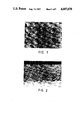
- FIG. 1 shows a plasma sprayed FeCrAlY coating with oxide inclusion
- FIG. 2 shows the coating of FIG. 1 after mechanical closing of pores
- FIG. 3 shows the results of rig tests
- FIGS. 4-6 are diagrams showing cumulative frequencies of alloying elements after homogenizing of the alloy IN 738 at 1180° C. for 128 hours. Random scanning 100 points.
- FIG. 1 an air plasma sprayed, APS, FeCrAlY coating.
- oxide particles with lenticular shape are formed.
- the oxide is developed around the droplets as they fly between the spray gun and the specimen.
- the droplets splat out when impinging upon the surface, i.e., the heat input is high enough.
- the oxides less than 1 micron thick will become preferentially oriented with their flat sides parallel to the substrate which is shown in FIG. 1.
- Metal atoms diffusing into the coating from the substrate have to pass around the oxides and thereby the diffusion times for penetratin of the coating for metal atoms from the substrate is increased.
- the film When using physical vapor deposition, PVD, as a coating method the film consists of densely packed fibers or fine columns oriented perpendicular to the substrate surface.
- the structure obtained contains elongated pores which are called “leaders”. Unless sealed, these leaders increase the diffusion rate of oxygen and sulfur from the combustion gases into the matrix metal.
- An air plasma sprayed coating also contains pores, but in this case, as mentioned before, the longitudinal direction of pores is parallel to the surface. In both cases closing the pores by hot isostatic pressing, HIP, reduces the oxidation and sulphidation rates of the coatings.
- FIG. 2 shows that closing the pores by HIP is possible without any essential deterioration of the orientation and morphology of the oxides and FIG. 3 confirms that the goal of increasing the corrosion resistance in the described way has been reached.
- the corrosion testing has been performed in a burner rig at National Physical Laboratories, NPL, Teddington, England, within the framework of the E.G. Cost 50 exercise, where a variety of coatings have been compared.
- Specimen 11 FeCrAlY with 6% Al air plasma sprayed and hipped
- specimen 12 air plasma sprayed FeCrAlY with 12% Al and hipped, have performed in a satisfactory way showing equal performance as the low pressure plasma sprayed CoCrAlY coatings shown in specimen 1 and 2.
- FIG. 2 the diffusion zone that has been formed when hipping the specimen should be noted.
- the big oxides at the interface area gritblasting alumina residues and FIG. 2 shows that at the original substrate-coating interface diffusion seems to go from the coating into the substrate rather than the opposite way.
- tantalum as a barrier to diffusion is not caused by the metal itself, but by the intermetallic compounds formed with Fe, Ni, Co, Cr etc., which all are high temperature stable compounds as can be found in binary phase diagram books.
- FIGS. 4-6 show an automated electron probe microanalysis of microsegregation in alloy IN 738 in the "as cast" condition and after homogenization heat treatment. Due to the three-dimensional concentration profile, line scans over certain areas randomly chosen are not very well controlled. The maximum or minimum concentration regions may not be passed and segregations indices out of line scan concentration profiles are hence not quantitative enough. A random sampling of point analyses and the cumulative frequency of the measured concentrations will give the most representative information of microsegregation. The diagrams taken from the results show a great difference in behavior of the elements. Co and Ni are homogenized already after casting and cooling and subsequent heat treatment doesn't significantly change the original as cast distribution. W, Ti and Nb are heavily segregated in the as cast condition, but homogenizing heat treatment causes the elements to distribute themselves evenly by diffusion.
- Tantalum shows a different behavior, it is segregated after casting and cooling, but subsequent heat treatment does not generate much homogenization. This finding confirms that tantalum is present in high temperature stable phases as can be predicted by the binry phase diagrams, and therefore the conclusion can be drawn, that a tantalum rich layer on top of a Fe, Ni or Co high temperature alloy can form phases with the elements in the matrix which are resistant to interdiffusion.
- FeCrAlY physical vapour deposition.
- FeCrAlY physical vapour deposition under supply of oxygen.
Landscapes
- Chemical & Material Sciences (AREA)
- Engineering & Computer Science (AREA)
- Organic Chemistry (AREA)
- Chemical Kinetics & Catalysis (AREA)
- Materials Engineering (AREA)
- Mechanical Engineering (AREA)
- Metallurgy (AREA)
- Physics & Mathematics (AREA)
- Plasma & Fusion (AREA)
- Coating By Spraying Or Casting (AREA)
- Glass Compositions (AREA)
- Other Surface Treatments For Metallic Materials (AREA)
- Secondary Cells (AREA)
- Polymers With Sulfur, Phosphorus Or Metals In The Main Chain (AREA)
- Heat Treatments In General, Especially Conveying And Cooling (AREA)
- Adhesives Or Adhesive Processes (AREA)
- Diaphragms For Electromechanical Transducers (AREA)
- Steroid Compounds (AREA)
Abstract
Production of high temperature materials with coatings being resistant to high temperature corrosion by forming a dual phase structure of corrosion resistant metal alloy and metal oxides. The metal oxides function as barriers for the diffusion of alloy elements, heat diffusion and electric conductivity. The result can be further enhanced by hot isostatic pressing of the coating and the use of tantalum as barrier layer, where the functioning of tantalum is the result of the low diffusion speed of tantalum in nickel base alloys.
Description
In the field of gas turbines the development is characterized by increased engine temperatures. This development has made it necessary to change the composition of for instance nickel base alloys towards lower contents of oxidation resistant elements like chromium and higher contents of high temperature strengthening γ'-forming elements like aluminium. The resistance against high temperature corrosion in the low chromium nickel base alloys has then been maintained by coating the components for increased oxidation resistance. The most common type of coating has been nickel aluminide with additions of chromium, silicon and sometimes platinum. The coating is obtained by forming an aluminium layer on the base material by chemical vapour deposition, and forming the nickel aluminide by a subsequent diffusion heat treatment.
A later development has been to build up "overlay coatings" by physical vapour deposition, plasma spraying or vacuum plasma spraying. These types of coatings are often called MCrAlY:s after the elements in the composition, where M can be Fe, Ni, Co or NiCo.
The expression MCrAlY only refers to the chemical composition, not to thermodynamical phase composition of the coatings. FeCrAlY has a ferritic body centered cubic (bcc) crystal structure which is ductile, the others a face centered (fcc) intermetallic cubic structure which is brittle in comparison.
Of the above mentioned methods of deposition, physical vapour deposition is generally considered to be the most expensive method and ordinary plasma spraying the cheapest. Ordinary plasma spraying has up to now not been used so frequently as other methods in spite of the cost factor, because the oxides formed are considered to be detrimental to the properties of the coating. This has been one of the reasons behind the development of the vacuum plasma process intended to give an oxide free coating.
Of the coating compositions mentioned above, FeCrAlY is known since the 1930:s under the designation "Kanthal", the others have been developed later on.
The present invention, which is of interest for aircraft engines and gas turbines, differs from conventional coating in the way that instead of trying to avoid oxides more or less unintentionally formed during coating and considered detrimental, a coating is intentionally formed consisting of a mixture of oxide- and metal phase particles, which by subsequent treatments is turned to a coating with properties equal or superior to those of a pure metallic coating with the same metal phase composition both with regard to hot corrosion and to heat conducting properties. The characteristics of the invention are evident from the attached patent claims. Rig tests as shown in FIG. 3 confirm that the object of the invention has been reached. The tests also confirm that the low alloy cost plasma sprayed FeCrAlY under these circumstances is quite comparable if not superior to the high alloy cost vacuum plasma sprayed CoCrAlY. As the bodycentered cubic FeCrAlY-coating is more ductile that the facecentered intermetallic cubic coatings, it can also serve as underlay coating for ceramic coatings with the advantage that the coefficient of expansion is more than 30% lower than for a face centered cubic coating and nearer the coefficient of expansion for ceramics. The ductility of FeCrAlY is also an advantage with regard to resistance against thermal fatigue in the matrix-coating-ceramic interfaces.
Coatings on high temperature alloys are slowly consumed by diffusion of metal atoms from the interior matrix-coating interface inwards and outwards and from oxygen and sulphur from the exterior atmosphere inwards. The efficiency of a coating can be judged by the time it takes until the coating shows signs of penetration as shown in FIG. 3.
The life requirements vary among other things with the times between engine overhauls, which can be 200-600 hrs for military jet engines up to 3000 hrs for civil jet engines and even longer for stationary gas turbines.
The diffusion of metal atoms from a nickel base alloy into an overlay CoCrAlY-NiCrAlY type of coating will generally not change the crystallographic structure of the coating. If nickel however is allowed to diffuse into a ferritic FeCrAlY coating, a phase change from bcc to fcc occurs and the coating losses ductility. Oxide layers parallel to the matrix surface form obstacles to the diffusion of nickel atoms and delay the transformation from bcc to fcc structure.
The coating of a matrix metal, for instance a nickel base alloy by physical vapour deposition results in an epitaxial growth (at right angle to the surface). The structure obtained contains long porosities so called "leaders" going from the interface of matrix-coating outwards. These leaders increase the diffusion rate of oxygen and sulphur from the combustion gases inwards to the matrix metal. A plasma spayed coating also contains pores but in this case more equiaxed. In both cases a closing of pores reduces the oxidation and sulphidation rate of the coatings. A closing of pores is necessary for the dual phase metal-metal oxide coating to work. FIG. 1 and FIG. 2 show that a closing of pores is possible without any essential deterioration of the morphology of the oxides. Some phase changes occur in the coating-matrix interface due to diffusion during the closing process. The closing process benefits if it can be performed at temperatures under 1000° C. or lower.
During ordinary plasma spraying (not vacuum plasma spraying) aluminium, yttrium and chromium in the powder are oxidized. The composition of the metal powder must be adapted with regard to the oxidized elements so that the composition of the metal phase in the finished coating corresponds to the composition of the alloy with maximum corrosion resistance. This requires at least 2% aluminium more in the metal powder than in the coating metal phase. A typical FeCrAlY composition is Fe balance, 20% Cr, 9% Al and 1.5% Y. The content of metal oxide in the coating can be varied by having more or less oxygen gas in the plasma or by mixing ceramic particles into the plasma powder.
The object of the invention is to increase the usable life time and to minimize the costs of high temperature resistant coatings. This is being done by a series of moves intended to reduce detrimental diffusion without serious loss of mechanical properties in the system or unreasonable increase in costs. If the moves mentioned are not sufficient for the required service life, the coating can be improved by introducing yet another metal diffusion barrier namely a tantalum layer between the matrix and the FeCrAlY coating. Investigations on the alloy IN 738 have shown that when homogenizing the alloy the diffution of tantalum is small. Tantalum forms high temperature stable intermetallic compounds or mixtures with all the elements Al, Co, Fe, Ni, Cr, Y and is especially suitable to prevent diffusion from the FeCrAlY into a cobalt or nickel base alloy or vice versa. To sum up the different steps in obtaining an improved high temperature coating to low costs, these are:
the metallic coating is substituted by a metal-metal oxide dual phase metal-ceramic coating applied by plasma spraying. The morphology of the ceramics is such as to increase metal atom diffusion distances from the coating-matrix interface to the surface of the component.
the above principle works for all MCrAlY-coatings but use of the ductile ferritic FeCrAlY alloy makes it possible to mix more oxides into the coating, increasing diffusion distances even more, without getting a too brittle coating, too susceptible to thermal fatique.
the possibility of diffusion of oxygen and sulphur through the coating are reduced by closing the pores inside the coating. These pores have been formed during plasma spraying. The pores can hardly be avoided in a dual metal-metal oxide coating applied by plasma spraying. Closing can be obtained by hot isostatic pressing, but other mechanical methods are also possible.
a reduction of the possibilities of metal atoms to diffuse from the matrix metal into the FeCrAlY, thereby changing the phase structure from bcc to the more brittle fcc, can further be obtained by introducing a layer of tantalum between the matrix and the FeCrAlY coating. This will improve the mechanical properties of the coating especially with regard to thermal fatique. With regard to diffusion of metals, tantalum also works for the other MCrAlY:s, but the benefit is probably not as great.
all the above operations mentioned will contribute to a step-wise increase in service life expectancy of the coating. Costs versus life expectancy will decide the necessity of a tantalum layer.
the low costs are obtained by using a simple method, plasma spraying, for application of the coating, and a metal phase FeCrAlY with low costs in alloying elements.
the compatibility towards ceramic coatings with regard to lower coefficient of expansion both for the metal-oxide phase and the bcc FeCrAlY-metal compared to the fcc-MCrAlY:s, and the good ductility of FeCrAlY improves the life time expectancy for ceramic coatings with the improved FeCrAlY coating as underlay.
The advantages of the invention are illustraed in more detail in the attached photos and diagrams, in which
FIG. 1 shows a plasma sprayed FeCrAlY coating with oxide inclusion;
FIG. 2 shows the coating of FIG. 1 after mechanical closing of pores;
FIG. 3 shows the results of rig tests; and
FIGS. 4-6 are diagrams showing cumulative frequencies of alloying elements after homogenizing of the alloy IN 738 at 1180° C. for 128 hours. Random scanning 100 points.
In FIG. 1 is shown an air plasma sprayed, APS, FeCrAlY coating. When using this coating method oxide particles with lenticular shape are formed. The oxide is developed around the droplets as they fly between the spray gun and the specimen. The droplets splat out when impinging upon the surface, i.e., the heat input is high enough. Thus, the oxides less than 1 micron thick will become preferentially oriented with their flat sides parallel to the substrate which is shown in FIG. 1. Metal atoms diffusing into the coating from the substrate have to pass around the oxides and thereby the diffusion times for penetratin of the coating for metal atoms from the substrate is increased.
When using physical vapor deposition, PVD, as a coating method the film consists of densely packed fibers or fine columns oriented perpendicular to the substrate surface. The structure obtained contains elongated pores which are called "leaders". Unless sealed, these leaders increase the diffusion rate of oxygen and sulfur from the combustion gases into the matrix metal. An air plasma sprayed coating also contains pores, but in this case, as mentioned before, the longitudinal direction of pores is parallel to the surface. In both cases closing the pores by hot isostatic pressing, HIP, reduces the oxidation and sulphidation rates of the coatings.
FIG. 2 shows that closing the pores by HIP is possible without any essential deterioration of the orientation and morphology of the oxides and FIG. 3 confirms that the goal of increasing the corrosion resistance in the described way has been reached. The corrosion testing has been performed in a burner rig at National Physical Laboratories, NPL, Teddington, England, within the framework of the E.G. Cost 50 exercise, where a variety of coatings have been compared. Specimen 11, FeCrAlY with 6% Al air plasma sprayed and hipped, and specimen 12, air plasma sprayed FeCrAlY with 12% Al and hipped, have performed in a satisfactory way showing equal performance as the low pressure plasma sprayed CoCrAlY coatings shown in specimen 1 and 2.
Regarding FIG. 2, the diffusion zone that has been formed when hipping the specimen should be noted. The big oxides at the interface area gritblasting alumina residues and FIG. 2 shows that at the original substrate-coating interface diffusion seems to go from the coating into the substrate rather than the opposite way.
The role of tantalum as a barrier to diffusion is not caused by the metal itself, but by the intermetallic compounds formed with Fe, Ni, Co, Cr etc., which all are high temperature stable compounds as can be found in binary phase diagram books.
FIGS. 4-6 show an automated electron probe microanalysis of microsegregation in alloy IN 738 in the "as cast" condition and after homogenization heat treatment. Due to the three-dimensional concentration profile, line scans over certain areas randomly chosen are not very well controlled. The maximum or minimum concentration regions may not be passed and segregations indices out of line scan concentration profiles are hence not quantitative enough. A random sampling of point analyses and the cumulative frequency of the measured concentrations will give the most representative information of microsegregation. The diagrams taken from the results show a great difference in behavior of the elements. Co and Ni are homogenized already after casting and cooling and subsequent heat treatment doesn't significantly change the original as cast distribution. W, Ti and Nb are heavily segregated in the as cast condition, but homogenizing heat treatment causes the elements to distribute themselves evenly by diffusion.
Tantalum shows a different behavior, it is segregated after casting and cooling, but subsequent heat treatment does not generate much homogenization. This finding confirms that tantalum is present in high temperature stable phases as can be predicted by the binry phase diagrams, and therefore the conclusion can be drawn, that a tantalum rich layer on top of a Fe, Ni or Co high temperature alloy can form phases with the elements in the matrix which are resistant to interdiffusion.
The rig tests of FIG. 3 were carried out in burner rig at NPL Teddington, England up to 300 hours.
1-2. CoCrAlY, low pressure plasma sprayed.
3-4. FeCrAlY (low Al). Oxides removed by remelting. Polished samples.
5. Same as 3-4 but unpolished samples.
6. Same as 3-4, tested 139 hours.
7. Same as 6, tested 308 hours.
8. FeCrAlY (high Al) remelted to remove oxides, end not protected, 220 hours.
9. Same as 8, end protected 308 hours.
10. FeCrAlY, (high Al) remelted.
11. FeCrAlY, (low Al) pores closed.
12. FeCrAlY, (high Al) pores closed.
13. FeCrAlY, physical vapour deposition.
14. FeCrAlY, physical vapour deposition under supply of oxygen.
15-16. Nickel-aluminide with platinum.
17. Uncoated matrix alloy IN 738.
Claims (11)
1. Process for preparing heat resistant and corrosion resistant materials by coating the material with an alloy of the type MCrAlY, where M is Fe, Ni, Co or NiCo, characterized in that the coating is formed by means of plasma spraying a powder of the alloy metals in the presence of a controlled supply of oxygen and that the plasma sprayed powder comprises an excess of Al and/or Cr and/or Y compared to the final alloy composition, whereby a certain amount of the powder is oxidized so that the resulting coating is of a dual phase structure consisting of a metal phase of the composition MCrAlY and oxide layers which are more or less parallel to the material surface preventing the diffusion of metals or heat in the thickness direction of the layers.
2. Process according to claim 1, characterized in that the oxygen is supplied as gas and/or oxide powder.
3. Process according to claim 1, characterized in that the plasma sprayed powder comprises at least 2% more of Al than the alloy constituting the metal phase of the produced coating.
4. Process according to claim 3, characterized in that the plasma sprayed powder comprises 7% of Al.
5. Process according to claim 1, characterized in that the produced coating is given a ceramic coating.
6. Process according to claim 1, characterized in that the plasma sprayed material is hot isostatically pressed in an encapsulated condition, which improves the adhesion and the diffusion density of the coating.
7. Process according to claim 1, characterized in that the material is given a tantalum layer before the plasma spraying.
8. Process according to claim 1, characterized in that ceramic materials are mixed into the power before the plasma spraying.
9. Process according to claim 1, characterized in that the metal phase of the coating formed by means of the plasma spraying consists of FeCrAlY.
10. Process according to claim 1, characterized in that the produced coating is given a ceramic coating of ZrO2.
11. Process according to claim 1, characterized in that the plasma sprayed material after having been given a ceramic coating is hot isostatically pressed in an encapsulated condition, which improves the adhesion and the diffusion density of the coating.
Applications Claiming Priority (2)
| Application Number | Priority Date | Filing Date | Title |
|---|---|---|---|
| SE8401757A SE8401757L (en) | 1984-03-30 | 1984-03-30 | METAL OXID CERAMIC SURFACES OF HIGH TEMPERATURE MATERIAL |
| SE8401757 | 1984-03-30 |
Publications (1)
| Publication Number | Publication Date |
|---|---|
| US4687678A true US4687678A (en) | 1987-08-18 |
Family
ID=20355359
Family Applications (1)
| Application Number | Title | Priority Date | Filing Date |
|---|---|---|---|
| US06/822,425 Expired - Fee Related US4687678A (en) | 1984-03-30 | 1985-03-29 | Process for preparing high temperature materials |
Country Status (12)
| Country | Link |
|---|---|
| US (1) | US4687678A (en) |
| EP (1) | EP0175750B1 (en) |
| JP (1) | JPS61501637A (en) |
| AT (1) | ATE39133T1 (en) |
| AU (1) | AU571687B2 (en) |
| BR (1) | BR8506214A (en) |
| DE (1) | DE3566680D1 (en) |
| DK (1) | DK555785A (en) |
| FI (1) | FI77899C (en) |
| NO (1) | NO165350C (en) |
| SE (1) | SE8401757L (en) |
| WO (1) | WO1985004428A1 (en) |
Cited By (32)
| Publication number | Priority date | Publication date | Assignee | Title |
|---|---|---|---|---|
| US4902539A (en) * | 1987-10-21 | 1990-02-20 | Union Carbide Corporation | Fuel-oxidant mixture for detonation gun flame-plating |
| US5032469A (en) * | 1988-09-06 | 1991-07-16 | Battelle Memorial Institute | Metal alloy coatings and methods for applying |
| US5273957A (en) * | 1990-12-04 | 1993-12-28 | Hoechst Aktiengesellschaft | Thermally sprayed lead-containing thick layers |
| US5296183A (en) * | 1992-08-21 | 1994-03-22 | Dow-United Technologies Composite Products, Inc. | Method for comolding property enhancing coatings to composite articles |
| US5958521A (en) * | 1996-06-21 | 1999-09-28 | Ford Global Technologies, Inc. | Method of depositing a thermally sprayed coating that is graded between being machinable and being wear resistant |
| US6123998A (en) * | 1992-08-12 | 2000-09-26 | Kabushiki Kaisha Toshiba | Ceramic coating method for metallic substrate utilizing a transitional layer of ceramic-metal |
| US6132890A (en) * | 1997-03-24 | 2000-10-17 | Tocalo Co., Ltd. | High-temperature spray coated member and method of production thereof |
| US6180259B1 (en) | 1997-03-24 | 2001-01-30 | Tocalo Co., Ltd. | Spray coated member resistant to high temperature environment and method of production thereof |
| CN1065570C (en) * | 1994-06-24 | 2001-05-09 | 普拉塞尔·S·T·技术有限公司 | A process for producing carbide particles dispersed in a mcraly-based coating |
| CN1068387C (en) * | 1994-06-24 | 2001-07-11 | 普拉塞尔·S·T·技术有限公司 | A process for producing an oxide dispersed mcraly-based coating |
| US20030113472A1 (en) * | 2001-12-13 | 2003-06-19 | Byrnes Larry Edward | Method of producing thermally sprayed metallic coating |
| US6635362B2 (en) | 2001-02-16 | 2003-10-21 | Xiaoci Maggie Zheng | High temperature coatings for gas turbines |
| US20040042922A1 (en) * | 2002-09-04 | 2004-03-04 | Firooz Rasouli | Methods for modifying oxygen content of atomized intermetallic aluminide powders and for forming articles from the modified powders |
| EP1398394A1 (en) * | 2002-08-13 | 2004-03-17 | Howmet Research Corporation | Cold spraying method for MCrAIX coating |
| US6902768B2 (en) * | 2002-02-13 | 2005-06-07 | General Motors Corporation | Method of producing thermally sprayed metallic coating with additives |
| US7157151B2 (en) | 2002-09-11 | 2007-01-02 | Rolls-Royce Corporation | Corrosion-resistant layered coatings |
| US20090075110A1 (en) * | 2007-09-14 | 2009-03-19 | Siemens Power Generation, Inc. | Combustion Turbine Component Having Rare Earth NiCoCrAl Coating and Associated Methods |
| US20090075112A1 (en) * | 2007-09-14 | 2009-03-19 | Siemens Power Generation, Inc. | Combustion Turbine Component Having Rare Earth FeCrAl Coating and Associated Methods |
| US20090075111A1 (en) * | 2007-09-14 | 2009-03-19 | Siemens Power Generation, Inc. | Combustion Turbine Component Having Rare Earth NiCrAl Coating and Associated Methods |
| US20090075101A1 (en) * | 2007-09-14 | 2009-03-19 | Siemens Power Generation, Inc. | Combustion Turbine Component Having Rare Earth CoNiCrAl Coating and Associated Methods |
| WO2009049796A1 (en) * | 2007-10-09 | 2009-04-23 | Man Turbo Ag | Hot gas-guided component of a turbomachine |
| US20090120101A1 (en) * | 2007-10-31 | 2009-05-14 | United Technologies Corp. | Organic Matrix Composite Components, Systems Using Such Components, and Methods for Manufacturing Such Components |
| US8084096B1 (en) | 2004-05-24 | 2011-12-27 | University Of Central Florida Research Foundation, Inc. | Method for whisker formation on metallic fibers and substrates |
| US8506836B2 (en) | 2011-09-16 | 2013-08-13 | Honeywell International Inc. | Methods for manufacturing components from articles formed by additive-manufacturing processes |
| US9085980B2 (en) | 2011-03-04 | 2015-07-21 | Honeywell International Inc. | Methods for repairing turbine components |
| US9120151B2 (en) | 2012-08-01 | 2015-09-01 | Honeywell International Inc. | Methods for manufacturing titanium aluminide components from articles formed by consolidation processes |
| US9175568B2 (en) | 2010-06-22 | 2015-11-03 | Honeywell International Inc. | Methods for manufacturing turbine components |
| US9266170B2 (en) | 2012-01-27 | 2016-02-23 | Honeywell International Inc. | Multi-material turbine components |
| CN106591727A (en) * | 2016-12-12 | 2017-04-26 | 苏州陈恒织造有限公司 | Corrosion-resistant and high-temperature-resistant shell for oil-immersed transformer |
| US11181000B2 (en) * | 2016-06-02 | 2021-11-23 | General Electric Company | Airfoil with improved coating system and methods of forming the same |
| CN116043155A (en) * | 2022-12-29 | 2023-05-02 | 广东省科学院新材料研究所 | Liquid lead-bismuth erosion-resistant composite coating and its preparation method and application |
| US20250290188A1 (en) * | 2024-03-18 | 2025-09-18 | General Electric Company | Methods of forming a bondcoat for a barrier coating |
Families Citing this family (5)
| Publication number | Priority date | Publication date | Assignee | Title |
|---|---|---|---|---|
| DE3672281D1 (en) * | 1985-10-18 | 1990-08-02 | Union Carbide Corp | THERMO SHOCK RESISTANT COATINGS WITH HIGH VOLUME REFRACTOR OXIDES. |
| IL84067A (en) * | 1986-10-30 | 1992-03-29 | United Technologies Corp | Thermal barrier coating system |
| US5236745A (en) * | 1991-09-13 | 1993-08-17 | General Electric Company | Method for increasing the cyclic spallation life of a thermal barrier coating |
| RU2126458C1 (en) * | 1998-03-31 | 1999-02-20 | Конструкторское бюро "Салют" - филиал Государственного космического научно- производственного центра им.М.В.Хруничева | Coating |
| CN107385359A (en) * | 2017-07-13 | 2017-11-24 | 芜湖县双宝建材有限公司 | A kind of stainless steel burglary-resisting window cracking resistance coating material |
Citations (7)
| Publication number | Priority date | Publication date | Assignee | Title |
|---|---|---|---|---|
| US4095003A (en) * | 1976-09-09 | 1978-06-13 | Union Carbide Corporation | Duplex coating for thermal and corrosion protection |
| US4145481A (en) * | 1977-08-03 | 1979-03-20 | Howmet Turbine Components Corporation | Process for producing elevated temperature corrosion resistant metal articles |
| GB2025469A (en) * | 1978-07-17 | 1980-01-23 | United Technologies Corp | Plasma sprayed MCrAlY coatings |
| US4198442A (en) * | 1977-10-31 | 1980-04-15 | Howmet Turbine Components Corporation | Method for producing elevated temperature corrosion resistant articles |
| US4248940A (en) * | 1977-06-30 | 1981-02-03 | United Technologies Corporation | Thermal barrier coating for nickel and cobalt base super alloys |
| US4275090A (en) * | 1978-10-10 | 1981-06-23 | United Technologies Corporation | Process for carbon bearing MCrAlY coating |
| US4411936A (en) * | 1978-07-04 | 1983-10-25 | Bulten-Kanthal Ab | Sprayed alloy layer and method of making same |
-
1984
- 1984-03-30 SE SE8401757A patent/SE8401757L/en unknown
-
1985
- 1985-03-29 EP EP85901659A patent/EP0175750B1/en not_active Expired
- 1985-03-29 DE DE8585901659T patent/DE3566680D1/en not_active Expired
- 1985-03-29 AU AU42139/85A patent/AU571687B2/en not_active Ceased
- 1985-03-29 US US06/822,425 patent/US4687678A/en not_active Expired - Fee Related
- 1985-03-29 WO PCT/SE1985/000148 patent/WO1985004428A1/en not_active Ceased
- 1985-03-29 BR BR8506214A patent/BR8506214A/en not_active IP Right Cessation
- 1985-03-29 AT AT85901659T patent/ATE39133T1/en not_active IP Right Cessation
- 1985-03-29 JP JP60501625A patent/JPS61501637A/en active Pending
- 1985-11-22 FI FI854621A patent/FI77899C/en not_active IP Right Cessation
- 1985-11-29 NO NO85854803A patent/NO165350C/en unknown
- 1985-11-29 DK DK555785A patent/DK555785A/en not_active Application Discontinuation
Patent Citations (7)
| Publication number | Priority date | Publication date | Assignee | Title |
|---|---|---|---|---|
| US4095003A (en) * | 1976-09-09 | 1978-06-13 | Union Carbide Corporation | Duplex coating for thermal and corrosion protection |
| US4248940A (en) * | 1977-06-30 | 1981-02-03 | United Technologies Corporation | Thermal barrier coating for nickel and cobalt base super alloys |
| US4145481A (en) * | 1977-08-03 | 1979-03-20 | Howmet Turbine Components Corporation | Process for producing elevated temperature corrosion resistant metal articles |
| US4198442A (en) * | 1977-10-31 | 1980-04-15 | Howmet Turbine Components Corporation | Method for producing elevated temperature corrosion resistant articles |
| US4411936A (en) * | 1978-07-04 | 1983-10-25 | Bulten-Kanthal Ab | Sprayed alloy layer and method of making same |
| GB2025469A (en) * | 1978-07-17 | 1980-01-23 | United Technologies Corp | Plasma sprayed MCrAlY coatings |
| US4275090A (en) * | 1978-10-10 | 1981-06-23 | United Technologies Corporation | Process for carbon bearing MCrAlY coating |
Cited By (44)
| Publication number | Priority date | Publication date | Assignee | Title |
|---|---|---|---|---|
| US4902539A (en) * | 1987-10-21 | 1990-02-20 | Union Carbide Corporation | Fuel-oxidant mixture for detonation gun flame-plating |
| US5032469A (en) * | 1988-09-06 | 1991-07-16 | Battelle Memorial Institute | Metal alloy coatings and methods for applying |
| US5273957A (en) * | 1990-12-04 | 1993-12-28 | Hoechst Aktiengesellschaft | Thermally sprayed lead-containing thick layers |
| US6123998A (en) * | 1992-08-12 | 2000-09-26 | Kabushiki Kaisha Toshiba | Ceramic coating method for metallic substrate utilizing a transitional layer of ceramic-metal |
| US5296183A (en) * | 1992-08-21 | 1994-03-22 | Dow-United Technologies Composite Products, Inc. | Method for comolding property enhancing coatings to composite articles |
| CN1065570C (en) * | 1994-06-24 | 2001-05-09 | 普拉塞尔·S·T·技术有限公司 | A process for producing carbide particles dispersed in a mcraly-based coating |
| CN1068387C (en) * | 1994-06-24 | 2001-07-11 | 普拉塞尔·S·T·技术有限公司 | A process for producing an oxide dispersed mcraly-based coating |
| US5958521A (en) * | 1996-06-21 | 1999-09-28 | Ford Global Technologies, Inc. | Method of depositing a thermally sprayed coating that is graded between being machinable and being wear resistant |
| US6180259B1 (en) | 1997-03-24 | 2001-01-30 | Tocalo Co., Ltd. | Spray coated member resistant to high temperature environment and method of production thereof |
| US6132890A (en) * | 1997-03-24 | 2000-10-17 | Tocalo Co., Ltd. | High-temperature spray coated member and method of production thereof |
| US6635362B2 (en) | 2001-02-16 | 2003-10-21 | Xiaoci Maggie Zheng | High temperature coatings for gas turbines |
| US20030113472A1 (en) * | 2001-12-13 | 2003-06-19 | Byrnes Larry Edward | Method of producing thermally sprayed metallic coating |
| US6610369B2 (en) * | 2001-12-13 | 2003-08-26 | General Motors Corporation | Method of producing thermally sprayed metallic coating |
| US6902768B2 (en) * | 2002-02-13 | 2005-06-07 | General Motors Corporation | Method of producing thermally sprayed metallic coating with additives |
| EP1398394A1 (en) * | 2002-08-13 | 2004-03-17 | Howmet Research Corporation | Cold spraying method for MCrAIX coating |
| US20040042922A1 (en) * | 2002-09-04 | 2004-03-04 | Firooz Rasouli | Methods for modifying oxygen content of atomized intermetallic aluminide powders and for forming articles from the modified powders |
| US6863862B2 (en) | 2002-09-04 | 2005-03-08 | Philip Morris Usa Inc. | Methods for modifying oxygen content of atomized intermetallic aluminide powders and for forming articles from the modified powders |
| US7157151B2 (en) | 2002-09-11 | 2007-01-02 | Rolls-Royce Corporation | Corrosion-resistant layered coatings |
| US20090166204A1 (en) * | 2002-09-11 | 2009-07-02 | George Edward Creech | Corrosion-resistant layered coatings |
| US8591996B2 (en) | 2004-05-24 | 2013-11-26 | University Of Central Florida Research Foundation, Inc. | Method for whisker formation on metallic fibers and substrates |
| US8084096B1 (en) | 2004-05-24 | 2011-12-27 | University Of Central Florida Research Foundation, Inc. | Method for whisker formation on metallic fibers and substrates |
| US8247034B2 (en) | 2004-05-24 | 2012-08-21 | University Of Central Florida Research Foundation, Inc. | Advanced catalyst system prepared from a whiskered aluminum-containing metallic alloy substrate |
| US8043718B2 (en) * | 2007-09-14 | 2011-10-25 | Siemens Energy, Inc. | Combustion turbine component having rare earth NiCrAl coating and associated methods |
| US8043717B2 (en) * | 2007-09-14 | 2011-10-25 | Siemens Energy, Inc. | Combustion turbine component having rare earth CoNiCrAl coating and associated methods |
| US20090075112A1 (en) * | 2007-09-14 | 2009-03-19 | Siemens Power Generation, Inc. | Combustion Turbine Component Having Rare Earth FeCrAl Coating and Associated Methods |
| US20090075110A1 (en) * | 2007-09-14 | 2009-03-19 | Siemens Power Generation, Inc. | Combustion Turbine Component Having Rare Earth NiCoCrAl Coating and Associated Methods |
| US7867626B2 (en) * | 2007-09-14 | 2011-01-11 | Siemens Energy, Inc. | Combustion turbine component having rare earth FeCrAI coating and associated methods |
| US8039117B2 (en) * | 2007-09-14 | 2011-10-18 | Siemens Energy, Inc. | Combustion turbine component having rare earth NiCoCrAl coating and associated methods |
| US20090075111A1 (en) * | 2007-09-14 | 2009-03-19 | Siemens Power Generation, Inc. | Combustion Turbine Component Having Rare Earth NiCrAl Coating and Associated Methods |
| US20090075101A1 (en) * | 2007-09-14 | 2009-03-19 | Siemens Power Generation, Inc. | Combustion Turbine Component Having Rare Earth CoNiCrAl Coating and Associated Methods |
| WO2009049796A1 (en) * | 2007-10-09 | 2009-04-23 | Man Turbo Ag | Hot gas-guided component of a turbomachine |
| US20100209733A1 (en) * | 2007-10-09 | 2010-08-19 | Man Turbo Ag | Hot Gas-Guided Component of a Turbomachine |
| US9926629B2 (en) | 2007-10-09 | 2018-03-27 | Man Diesel & Turbo Se | Hot gas-guided component of a turbomachine |
| US20090120101A1 (en) * | 2007-10-31 | 2009-05-14 | United Technologies Corp. | Organic Matrix Composite Components, Systems Using Such Components, and Methods for Manufacturing Such Components |
| US9175568B2 (en) | 2010-06-22 | 2015-11-03 | Honeywell International Inc. | Methods for manufacturing turbine components |
| US9085980B2 (en) | 2011-03-04 | 2015-07-21 | Honeywell International Inc. | Methods for repairing turbine components |
| US8506836B2 (en) | 2011-09-16 | 2013-08-13 | Honeywell International Inc. | Methods for manufacturing components from articles formed by additive-manufacturing processes |
| US9039917B2 (en) | 2011-09-16 | 2015-05-26 | Honeywell International Inc. | Methods for manufacturing components from articles formed by additive-manufacturing processes |
| US9266170B2 (en) | 2012-01-27 | 2016-02-23 | Honeywell International Inc. | Multi-material turbine components |
| US9120151B2 (en) | 2012-08-01 | 2015-09-01 | Honeywell International Inc. | Methods for manufacturing titanium aluminide components from articles formed by consolidation processes |
| US11181000B2 (en) * | 2016-06-02 | 2021-11-23 | General Electric Company | Airfoil with improved coating system and methods of forming the same |
| CN106591727A (en) * | 2016-12-12 | 2017-04-26 | 苏州陈恒织造有限公司 | Corrosion-resistant and high-temperature-resistant shell for oil-immersed transformer |
| CN116043155A (en) * | 2022-12-29 | 2023-05-02 | 广东省科学院新材料研究所 | Liquid lead-bismuth erosion-resistant composite coating and its preparation method and application |
| US20250290188A1 (en) * | 2024-03-18 | 2025-09-18 | General Electric Company | Methods of forming a bondcoat for a barrier coating |
Also Published As
| Publication number | Publication date |
|---|---|
| DK555785D0 (en) | 1985-11-29 |
| NO165350B (en) | 1990-10-22 |
| NO165350C (en) | 1991-01-30 |
| WO1985004428A1 (en) | 1985-10-10 |
| AU571687B2 (en) | 1988-04-21 |
| ATE39133T1 (en) | 1988-12-15 |
| JPS61501637A (en) | 1986-08-07 |
| SE8401757L (en) | 1985-10-01 |
| FI854621L (en) | 1985-11-22 |
| NO854803L (en) | 1985-11-29 |
| DE3566680D1 (en) | 1989-01-12 |
| DK555785A (en) | 1985-11-29 |
| BR8506214A (en) | 1986-04-15 |
| FI77899B (en) | 1989-01-31 |
| FI77899C (en) | 1989-05-10 |
| FI854621A0 (en) | 1985-11-22 |
| AU4213985A (en) | 1985-11-01 |
| EP0175750B1 (en) | 1988-12-07 |
| SE8401757D0 (en) | 1984-03-30 |
| EP0175750A1 (en) | 1986-04-02 |
Similar Documents
| Publication | Publication Date | Title |
|---|---|---|
| US4687678A (en) | Process for preparing high temperature materials | |
| Sivakumar et al. | High temperature coatings for gas turbine blades: a review | |
| Nithin et al. | Comparative analysis of CoCrAlY coatings at high-temperature oxidation behavior using different reinforcement composition profiles | |
| Gonzalez‐Julian et al. | Cr2AlC MAX phase as bond coat for thermal barrier coatings: Processing, testing under thermal gradient loading, and future challenges | |
| KR100347850B1 (en) | A metallic article comprising a metallic substrate having a ceramic coating, and a method of thermally insulating the metallic substrate | |
| DE69719701T2 (en) | Thermal barrier systems and materials | |
| Lee et al. | Concept of functionally graded materials for advanced thermal barrier coating applications | |
| US4399199A (en) | Protective layer | |
| JP3579267B2 (en) | Method for densifying bond coat for thermal barrier coating system and promoting bonding between particles | |
| Ma et al. | Evaluation of new high entropy alloy as thermal sprayed bondcoat in thermal barrier coatings | |
| US6645560B2 (en) | Oxidation resistant coatings for niobium-based silicide composites | |
| US6387541B1 (en) | Titanium article having a protective coating and a method of applying a protective coating to a Titanium article | |
| JPS6136061B2 (en) | ||
| WO1999023278A1 (en) | Product,especially a gas turbine component, withe a ceramic heat insulating layer | |
| Doleker | The examination of microstructure and thermal oxidation behavior of laser-remelted high-velocity oxygen liquid fuel Fe/Al coating | |
| Xinhua et al. | Fabrication and microstructure of ZrO2/NiCrCoAlY graded coating by plasma spraying | |
| Khorram et al. | Surface modification of IN713 LC superalloy with Metco 204NS by laser surface alloying | |
| Dewald et al. | Cubic titanium trialuminide thermal spray coatings—a review | |
| GB2041246A (en) | Improved protective layer | |
| Bhattacharya et al. | High entropy alloy coatings for application as bond coating for thermal barrier coating systems | |
| JPH11264084A (en) | Heat resistant member and method of manufacturing the same | |
| Mousavi et al. | Evaluation of high temperature oxidation behavior of LZ, CSZ, and LZ-CSZ composite thermal barrier coatings | |
| CA1239556A (en) | Process for preparing high temperature materials | |
| Khor et al. | Hot isostatic pressing of plasma sprayed thermal barrier coating systems | |
| US4715902A (en) | Process for applying thermal barrier coatings to metals and resulting product |
Legal Events
| Date | Code | Title | Description |
|---|---|---|---|
| FEPP | Fee payment procedure |
Free format text: PAYOR NUMBER ASSIGNED (ORIGINAL EVENT CODE: ASPN); ENTITY STATUS OF PATENT OWNER: LARGE ENTITY |
|
| FPAY | Fee payment |
Year of fee payment: 4 |
|
| REMI | Maintenance fee reminder mailed | ||
| LAPS | Lapse for failure to pay maintenance fees | ||
| FP | Lapsed due to failure to pay maintenance fee |
Effective date: 19950823 |
|
| STCH | Information on status: patent discontinuation |
Free format text: PATENT EXPIRED DUE TO NONPAYMENT OF MAINTENANCE FEES UNDER 37 CFR 1.362 |