US463575A - Tool for threading bottle-necks - Google Patents
Tool for threading bottle-necks Download PDFInfo
- Publication number
- US463575A US463575A US463575DA US463575A US 463575 A US463575 A US 463575A US 463575D A US463575D A US 463575DA US 463575 A US463575 A US 463575A
- Authority
- US
- United States
- Prior art keywords
- ring
- bottle
- tool
- jaws
- necks
- Prior art date
- Legal status (The legal status is an assumption and is not a legal conclusion. Google has not performed a legal analysis and makes no representation as to the accuracy of the status listed.)
- Expired - Lifetime
Links
- 210000003739 neck Anatomy 0.000 description 16
- 239000011521 glass Substances 0.000 description 12
- 208000002991 Ring chromosome 4 syndrome Diseases 0.000 description 6
- 238000007493 shaping process Methods 0.000 description 5
- ATJFFYVFTNAWJD-UHFFFAOYSA-N Tin Chemical compound [Sn] ATJFFYVFTNAWJD-UHFFFAOYSA-N 0.000 description 2
- 230000015572 biosynthetic process Effects 0.000 description 2
- 238000010276 construction Methods 0.000 description 2
- 210000003298 dental enamel Anatomy 0.000 description 2
- 208000027418 Wounds and injury Diseases 0.000 description 1
- 230000006378 damage Effects 0.000 description 1
- 230000000694 effects Effects 0.000 description 1
- 208000014674 injury Diseases 0.000 description 1
- 230000037431 insertion Effects 0.000 description 1
- 238000003780 insertion Methods 0.000 description 1
- 230000014759 maintenance of location Effects 0.000 description 1
- 238000004519 manufacturing process Methods 0.000 description 1
- 238000000465 moulding Methods 0.000 description 1
Images
Classifications
-
- C—CHEMISTRY; METALLURGY
- C03—GLASS; MINERAL OR SLAG WOOL
- C03B—MANUFACTURE, SHAPING, OR SUPPLEMENTARY PROCESSES
- C03B9/00—Blowing glass; Production of hollow glass articles
- C03B9/13—Blowing glass; Production of hollow glass articles in gob feeder machines
- C03B9/14—Blowing glass; Production of hollow glass articles in gob feeder machines in "blow" machines or in "blow-and-blow" machines
- C03B9/16—Blowing glass; Production of hollow glass articles in gob feeder machines in "blow" machines or in "blow-and-blow" machines in machines with turn-over moulds
- C03B9/165—Details of such machines, e.g. guide funnels, turn-over mechanisms
Definitions
- the invention described herein relates to certain improvements in tools for threading 'and iinishing the necks of bottles, jars, &c.
- the object of this invention is to provide a tool whereby the neck of the bottle may be shaped and iinished and an external 'thread formed thereon Without in. any Way injuring the enamel surface of the bottle.
- the invention consists in the construction and combination of mechanical devices or elements, all as more fully hereinafter described and claimed.
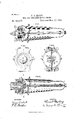
- Figure 1 is a view in side elevation of my improved tool.
- Fig. 2 is a longitudinal section of the same.
- Fig. 3 is an end View, and
- Fig. 4 is a transverse section on the line Fig. 2.
- the external or clamping jaws 1 are secured to the outer ends of arms 2 2a, the inner ends of said arms being connected by a spring 3, preferably formed integral with said arms and constructed to force the outer ends of the arms and the jaws 1 apart.
- These jaws are undercut a short distance from their outer ends for the reception of a supporting-ring 4, which is supported in proper position between the jaws by means of bands 5, having their middle portions curved, so as to partially embrace the ring 4, the ends of the bands being attached to the jaws 1 by means of' screws passingthrough slots 6 in the bands, such slots permitting of the movement of the jaws.
- the ring4 is attached to the bands by means of screws '7.
- VVit-hin the supporting-ring 4 is placed aforming-ring 8, having its inner wall threaded, as shown in Fig. 3, and provided at its inner end with anl inwardly-projecting rim 9, against which the end of the bottleneck bears during the finishing operation.
- the forming-ring 8 is held as against movement inwardly by an internal shoulder 10 on the ring 4, engaging a rebate in the ring 8 and as against outward movement by a washer or annular plate 1l, screwed to the inner end of the ringv 8 and projecting outwardly over the end of' the ring 4.
- Pressing-fingers 12 12a each having a semicylindrical outer wall at its base and tapering to a point at its outer end, are arranged lwith their cylindrical portions within the forming-ring 8. These fingers are attached to the outer ends of iiexible strips 13 13a, whose inner ends are secured to a bar 14, fastened to the spring 3 in or approximately in line with the axis of the forming-ring.
- the flexible strips are connected by rods 15 to the Varms 2 2a in such manner that when these arms are pressed toward each other the fingers will be moved apart, and vice versathat is to say', the strip 13 is connected to the arm 2 and the strip 13 to the arm 2.
- the bottle is formed in the mold in the usual manner except that the neck is made plain or unthreaded, care being taken, however, to provide sufiicient glass in the neck portion for the formation of the threads, as hereinafter described.
- the bottle after being removed from the mold is placed ina snap and the neck heated until the glass is in a plastic condition.
- the neck of the bottle is then thrust into the formingring 8, the jaws 1 being separated and the fingers 12 12a closed together, as shown in Fig. 1.
- the jaws are closed upon opposite sides of the neck above the portion to be threaded, and by the same movement ofthe arms the tin gers are moved outwardly, so as to press the glass into the threads in the forming-ring.
- the diameter of the cylinder formed by the fingers when closed together must be less than the internal diameter of the formingring 8 by an amount a little greater than twice the thickness of the glass in the bottle-neck, so as to permit of the insertion of the neck into the ring. IIence when the fingers are separated they will press the glass against the forming-ring at two points only. It is therefore necessary either to rotate the tool or the bottle, or both, in opposite directions in order to effect the expansion of the entire circumference ofthe neck against the ring 8.
- I provide a catch device or lock operated by the jaws or arms, such as that shown in Figs. 2 and 4, consisting of a series of notches 16, formed in the inner periphery of the washer or annular plate 1l, as shown in Figs. 2 and 4, and rods 17, attached to the jaws or arms, so as to move therewith, said rods being provided at their inner ends with pins 18, adapted when the jaws move outwardly to engage the notches 1b' and lock the washer 11 and the ring S, to which the washer is attached, as against movement independent of the tool. Vhen the jaws or arms are pressed inwardly, the pins are moved out of engagement with the notches and the ring is free to rotate.
- aglass-shaping tool the combination of movable jaws, a supporting-ring connected to said jaws, a forming-ring loosely mounted in the supporting-ring, a washer or annular plate attached to the forming ring and notched on its internal periphery, a pin for engaging the notches and operated by one of the jaws, and movable fingers operated by the jaws, substantially as set forth.
Landscapes
- Engineering & Computer Science (AREA)
- Chemical & Material Sciences (AREA)
- Manufacturing & Machinery (AREA)
- Materials Engineering (AREA)
- Organic Chemistry (AREA)
- Containers Having Bodies Formed In One Piece (AREA)
Description
(No Model.)
T. T. MOCOY.
TOOL FOR THREADING BOTTLE NEGKS.
No. 463,575. Patented Nov. 17, 1891-.
fwrrn'sssss: mvENTon,
15W LUM 'Nrrnn STATES ATENT Fries.A
THOMAS T. MCCOY, OF PITTSBURG, PENNSYLVANIA.
TOOL FOR THREADING BOTTLE-NECKS.
SPECIFICATION forming part of Letters Patent No, 463,575, dated November 17, 1891. Application tiled June 4, 1890. Renewed September 24. 1891. Serial No. 406.681. (No model.)
To ZZ whom, t may concern:
Be it known that I, THOMAS T. McCoy, a citizen ot' the United States, residing at Pit-tsburg, in the county ot' Allegheny and State of Pennsylvania, have invented or discovered certain new and useful Improvements in Tools for Threading Bottle-Necks, of which improvements the following is a speciiication.
The invention described herein relates to certain improvements in tools for threading 'and iinishing the necks of bottles, jars, &c.
Heretofore in manufacturing bottles the threads on the necks have been formed in the mold simultaneous with the formation of the bottle itself. In this molding operation there is always more or less overll at the neck, which has to be ground off in order to provide a seat for the sealinggasket. This grinding operation is not only expensive, but also destroys the exterior shell or enamel and forms a sharp edge, which is liable to cut the hands of the nser. l
The object of this invention is to provide a tool whereby the neck of the bottle may be shaped and iinished and an external 'thread formed thereon Without in. any Way injuring the enamel surface of the bottle.
In general terms, the invention consists in the construction and combination of mechanical devices or elements, all as more fully hereinafter described and claimed.
In the accompanying drawings, forming a part of this specification, Figure 1 is a view in side elevation of my improved tool. Fig. 2 is a longitudinal section of the same. Fig. 3 is an end View, and Fig. 4 is a transverse section on the line Fig. 2.
In the practice of my inventionthe external or clamping jaws 1 are secured to the outer ends of arms 2 2a, the inner ends of said arms being connected by a spring 3, preferably formed integral with said arms and constructed to force the outer ends of the arms and the jaws 1 apart. These jaws are undercut a short distance from their outer ends for the reception of a supporting-ring 4, which is supported in proper position between the jaws by means of bands 5, having their middle portions curved, so as to partially embrace the ring 4, the ends of the bands being attached to the jaws 1 by means of' screws passingthrough slots 6 in the bands, such slots permitting of the movement of the jaws..
independent of' the bands. The ring4 is attached to the bands by means of screws '7. VVit-hin the supporting-ring 4 is placed aforming-ring 8, having its inner wall threaded, as shown in Fig. 3, and provided at its inner end with anl inwardly-projecting rim 9, against which the end of the bottleneck bears during the finishing operation. The forming-ring 8 is held as against movement inwardly by an internal shoulder 10 on the ring 4, engaging a rebate in the ring 8 and as against outward movement by a washer or annular plate 1l, screwed to the inner end of the ringv 8 and projecting outwardly over the end of' the ring 4. This construction insures the retention of the forming-ring in position, while permitting of its free rotation, as hereinafter described., j
Pressing-fingers 12 12a, each having a semicylindrical outer wall at its base and tapering to a point at its outer end, are arranged lwith their cylindrical portions within the forming-ring 8. These fingers are attached to the outer ends of iiexible strips 13 13a, whose inner ends are secured to a bar 14, fastened to the spring 3 in or approximately in line with the axis of the forming-ring. The flexible strips are connected by rods 15 to the Varms 2 2a in such manner that when these arms are pressed toward each other the fingers will be moved apart, and vice versathat is to say', the strip 13 is connected to the arm 2 and the strip 13 to the arm 2.
When employing my tool, the bottle is formed in the mold in the usual manner except that the neck is made plain or unthreaded, care being taken, however, to provide sufiicient glass in the neck portion for the formation of the threads, as hereinafter described.
The bottle after being removed from the mold is placed ina snap and the neck heated until the glass is in a plastic condition. The neck of the bottle is then thrust into the formingring 8, the jaws 1 being separated and the fingers 12 12a closed together, as shown in Fig. 1. By pressure applied to the arms 2 2 the jaws are closed upon opposite sides of the neck above the portion to be threaded, and by the same movement ofthe arms the tin gers are moved outwardly, so as to press the glass into the threads in the forming-ring. AS
ICO
will be readily understood, the diameter of the cylinder formed by the fingers when closed togethermust be less than the internal diameter of the formingring 8 by an amount a little greater than twice the thickness of the glass in the bottle-neck, so as to permit of the insertion of the neck into the ring. IIence when the fingers are separated they will press the glass against the forming-ring at two points only. It is therefore necessary either to rotate the tool or the bottle, or both, in opposite directions in order to effect the expansion of the entire circumference ofthe neck against the ring 8. This independent movement of the tool or bottle is permitted without injury to the threads formed thereon by the ring 8 and fingers 12 by making the ring easily rotatable, as hereinbefore described, the ring moving with the bottle if it be rotated or remaining stationary if the tool be rotated. The jaws 1 prevent any outward-ilow or nievement of the glass under the outward pressure of the fingers. After the glass has hardened the pressure on the arms 2 2a is relaxed, thereby permitting the jaws to move outwardly and the fingers to be moved inwardly. The bottle or tool is then rotated so as to screw the neck of the bottle out of the ring, which must be locked to the tool during this operation. For this purpose I provide a catch device or lock operated by the jaws or arms, such as that shown in Figs. 2 and 4, consisting of a series of notches 16, formed in the inner periphery of the washer or annular plate 1l, as shown in Figs. 2 and 4, and rods 17, attached to the jaws or arms, so as to move therewith, said rods being provided at their inner ends with pins 18, adapted when the jaws move outwardly to engage the notches 1b' and lock the washer 11 and the ring S, to which the washer is attached, as against movement independent of the tool. Vhen the jaws or arms are pressed inwardly, the pins are moved out of engagement with the notches and the ring is free to rotate.
I am aware that tools for threading the necks of bottles have been constructed with internallythreaded jaws, movable toward each other, for the purpose of inclosing the necks of bottles; but such jaws are liable, when closing around the neck, to catch a small portion of glass between their meeting edges and form a iin thereon, whereas in my improved tool the`thread-forming portion being in the form of a ring, there is not the slightest liability of forming a tin.
I claim herein as my invention- 1. In aglass-shaping tool, the combination of an internally-threaded and rotatable ring and outwardlymovable flngers for pressing the glass against such ring, substantially as set forth.
2. In a glass-shaping tool, the combination of an internally-threaded and rotatable ring, outwardly-movable fingers for pressing the glass against such ring, and movable jaws arranged to bear upon the neck below the portion to be th readed,'substantially as set forth.
3. In a glass-shaping tool, the combination of an internally-threaded and rotatable ring, outwardly-movable fingers for pressing the glass against such ring, and a lock for holding the ring as against rotation independent of the fingers, substantially as set forth.
4. In a glass-shaping tool, the combination of an internally-threaded and rotatable ring provided with an inwardlyprojeeting rim and outwardly-movable lingers for pressing the glass against such ring, substantially as set forth.
5. In aglass-shaping tool, the combination of movable jaws, a supporting-ring connected to said jaws, a forming-ring loosely mounted in the supporting-ring, a washer or annular plate attached to the forming ring and notched on its internal periphery, a pin for engaging the notches and operated by one of the jaws, and movable fingers operated by the jaws, substantially as set forth.
In testimony whereof I have hereunto set my hand.
THOMAS T. MCCOY.
Vitnesses:
R. H. WHiT'rLEsEY, DARWIN S. WoLeor'r.
Publications (1)
| Publication Number | Publication Date |
|---|---|
| US463575A true US463575A (en) | 1891-11-17 |
Family
ID=2532447
Family Applications (1)
| Application Number | Title | Priority Date | Filing Date |
|---|---|---|---|
| US463575D Expired - Lifetime US463575A (en) | Tool for threading bottle-necks |
Country Status (1)
| Country | Link |
|---|---|
| US (1) | US463575A (en) |
Cited By (1)
| Publication number | Priority date | Publication date | Assignee | Title |
|---|---|---|---|---|
| WO2015191379A1 (en) * | 2014-06-12 | 2015-12-17 | Ball Corporation | System for compression relief shaping |
-
0
- US US463575D patent/US463575A/en not_active Expired - Lifetime
Cited By (2)
| Publication number | Priority date | Publication date | Assignee | Title |
|---|---|---|---|---|
| WO2015191379A1 (en) * | 2014-06-12 | 2015-12-17 | Ball Corporation | System for compression relief shaping |
| US9358604B2 (en) | 2014-06-12 | 2016-06-07 | Ball Corporation | System for compression relief shaping |
Similar Documents
| Publication | Publication Date | Title |
|---|---|---|
| US750675A (en) | mighelin | |
| US1060201A (en) | Sealing-machine. | |
| US153338A (en) | Improvement in tools for forming the necks of fruit-jars | |
| US115754A (en) | Improvement in screw caps and rings for fruit-jars | |
| US666672A (en) | Machine for rolling locking-lugs on bottle-caps. | |
| US509525A (en) | Bottle-neck and tool for threading same | |
| US744681A (en) | Tool. | |
| US2036751A (en) | Apparatus and method for forming caps | |
| US1012931A (en) | Corkscrew. | |
| US130207A (en) | Improvement in tools for forming mouths of bottles | |
| US442258A (en) | Tool for foemim bottle necks | |
| US680306A (en) | Tool for finishing necks of bottles, &c. | |
| US586532A (en) | Tool for forming heads of bottles | |
| US692957A (en) | Implement for finishing necks and lips of bottles. | |
| US611631A (en) | And william g | |
| US109825A (en) | Improvement in tools for forming screw-threads on glass jars | |
| US2392274A (en) | Bottle cap | |
| US1085854A (en) | Controller-regulator. | |
| US93039A (en) | Improvement in tool for forming- lips on the necks of bottles | |
| US742240A (en) | Wrench. | |
| US333733A (en) | Feldt | |
| US867214A (en) | Sealing-head for bottle-sealing machines. | |
| US624004A (en) | Peter filteau | |
| US1385298A (en) | Bottle-capping machine | |
| US534873A (en) | Implement for threading and finishing bottle-necks |