US4635203A - Passive range measurement apparatus and method - Google Patents
Passive range measurement apparatus and method Download PDFInfo
- Publication number
- US4635203A US4635203A US06/597,629 US59762984A US4635203A US 4635203 A US4635203 A US 4635203A US 59762984 A US59762984 A US 59762984A US 4635203 A US4635203 A US 4635203A
- Authority
- US
- United States
- Prior art keywords
- image
- scene
- addresses
- sensor
- address modification
- Prior art date
- Legal status (The legal status is an assumption and is not a legal conclusion. Google has not performed a legal analysis and makes no representation as to the accuracy of the status listed.)
- Expired - Fee Related
Links
- 238000000034 method Methods 0.000 title claims abstract description 47
- 238000005259 measurement Methods 0.000 title abstract description 3
- 238000012986 modification Methods 0.000 claims abstract description 49
- 230000004048 modification Effects 0.000 claims abstract description 49
- 239000013598 vector Substances 0.000 claims abstract description 33
- 239000011159 matrix material Substances 0.000 claims description 18
- 238000006073 displacement reaction Methods 0.000 claims description 16
- 238000012937 correction Methods 0.000 claims description 13
- 238000013507 mapping Methods 0.000 claims description 11
- 230000008859 change Effects 0.000 claims description 7
- 241000269627 Amphiuma means Species 0.000 claims 1
- 238000004364 calculation method Methods 0.000 abstract description 4
- 238000000605 extraction Methods 0.000 abstract 1
- 230000009466 transformation Effects 0.000 description 27
- 230000006870 function Effects 0.000 description 20
- 230000008569 process Effects 0.000 description 12
- 238000004422 calculation algorithm Methods 0.000 description 8
- 238000012545 processing Methods 0.000 description 8
- 230000000875 corresponding effect Effects 0.000 description 5
- 230000000694 effects Effects 0.000 description 5
- 238000003384 imaging method Methods 0.000 description 4
- 230000015654 memory Effects 0.000 description 4
- 238000010586 diagram Methods 0.000 description 3
- 238000013519 translation Methods 0.000 description 3
- 230000009471 action Effects 0.000 description 2
- 238000013459 approach Methods 0.000 description 2
- 230000008901 benefit Effects 0.000 description 2
- 238000007429 general method Methods 0.000 description 2
- 238000000844 transformation Methods 0.000 description 2
- 238000004458 analytical method Methods 0.000 description 1
- 238000003491 array Methods 0.000 description 1
- 230000002596 correlated effect Effects 0.000 description 1
- 238000009795 derivation Methods 0.000 description 1
- 238000005315 distribution function Methods 0.000 description 1
- 238000000926 separation method Methods 0.000 description 1
- 238000012360 testing method Methods 0.000 description 1
- 238000012876 topography Methods 0.000 description 1
Images




Classifications
-
- G—PHYSICS
- G01—MEASURING; TESTING
- G01C—MEASURING DISTANCES, LEVELS OR BEARINGS; SURVEYING; NAVIGATION; GYROSCOPIC INSTRUMENTS; PHOTOGRAMMETRY OR VIDEOGRAMMETRY
- G01C11/00—Photogrammetry or videogrammetry, e.g. stereogrammetry; Photographic surveying
-
- G—PHYSICS
- G01—MEASURING; TESTING
- G01C—MEASURING DISTANCES, LEVELS OR BEARINGS; SURVEYING; NAVIGATION; GYROSCOPIC INSTRUMENTS; PHOTOGRAMMETRY OR VIDEOGRAMMETRY
- G01C21/00—Navigation; Navigational instruments not provided for in groups G01C1/00 - G01C19/00
- G01C21/005—Navigation; Navigational instruments not provided for in groups G01C1/00 - G01C19/00 with correlation of navigation data from several sources, e.g. map or contour matching
Definitions
- the present invention relates to range finding devices and methods, and more particularly to those devices and methods which use successive two-dimensional images of a scene to derive range or terrain structure information.
- low flying aircraft or remotely piloted vehicles have utilized an active imaging sensor, for example, a laser or radar scanning device in order to derive range or terrain structure information.
- active imaging sensor for example, a laser or radar scanning device
- these terrain sensing devices scan the scene with an appropriate energy source, creating a range-image map of the upcoming terrain scene in which the intensity of each sensed pixel is proportional to the range from the active sensor to the corresponding portion of the scene.
- the above and other objects of the present invention are derived by providing a passive imaging sensor which creates stereo image pairs of the scene of interest, coupled to a digital processor which calculates in three dimensional space the position of the scene detail corresponding to each pixel in the images.
- the device operates by calculation of warping or transformation coefficients and equations which will transform the two dimensional image of one view of a scene to match a second view of the same scene taken from a different sensor position.
- the transformation coefficients are analytically related to the camera-scene orientation and range. Thus, given the transformation coefficients, the orientation of a scene and range to any point in the scene may be computed.
- the digital processor uses an algorithm to determine these transformation coefficients automatically.
- This algorithm finds the function which represents the global transformation that will register all pixels of the two scene images. To do this, a vector field is derived which corresponds to the point-to-point misregistration existing between the two images at any stage in the registration process. Improvements in the transformation function are found from global averages of this vector field. As the transformation function is improved, the misregistration is reduced and the global averages of the vector field tend to zero. Finally, when the global averages of the vector field are substantially all zero, the images have been brought to optimum registration.
- This transformation may also be used to define the coordinates of a median plane through the scene. If the object scene is flat, this median plane will lie on the object scene plane. In this case, the terrain mapping problem is solved since the known coordinates of the object plane allow the three dimensional position of every scene pixel to be computed.
- the misregistration vector field will not be driven to zero by the global transformation process. Rather, only the global averages of the field will be driven to zero. In the latter case, only the range to those points lying on the median plane will be correct. To correctly determine the true position and image of the remaining scene pixels, two approaches may be used.
- the local height of the object scene relative to the median plane is determined by analyzing the residual misregistration vector field derived from the global transformation.
- the same transformation algorithm is applied to the scene image on a local basis until local warping coeffients are determined from which the true pixel position and range may be analytically derived.
- the processing action of the present invention is based on registration of pixels, rather than on registration features in the images, the accuracy of the mapper of the present invention is substantially independent of scene content type.
- the present invention offers the maximum possible range-accuracy from a given stereo image pair since the parallax displacement of detail between the two views (which is the basis for any passive ranging method) is found by bringing all of the detail within the two views into exact area registration.
- Another advantage of the present invention is that all of the geometrical distortion associated with the two different viewing positions is automatically corrected in the proposed method, so that, in addition to range information, camera-scene orientation information may also be derived.
- FIG. 1 shows a block diagram of the device and method of the present invention
- FIG. 2A shows in side view the flight path of and successive positions A and B of an aircraft using the device and method of the present invention
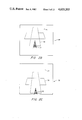
- FIGS. 2B and 2C show the sensor images created by the device and method of the present invention at positions A and B, respectively;
- FIGS. 3A and 3B show alternate input streams for the device and method of the present invention
- FIGS. 4A, 4B, 4C, 4D, 4E and 4F show a flow diagram of the "local frame warping" passive mapping method of the present invention.
- FIGS. 5A, 5B and 5C show a flow diagram of the "range slicing" passive mapping method of the present invention.
- the device of the present invention includes a camera, sensor, or other two-dimensional image creating device 10, a digitizer 12 which transforms the image created by camera 10 into pixel arrays where intensity of each pixel is proportional to the intensity of the corresponding scene detail, digital image memories 14 and 16 which store the desired digitized images, and central processor 18 which operates on the digitized images to derive the desired information (terrain map, range information, etc.). It is understood that memories 14 and 16 may be a single memory.
- the camera 10 may comprise any type of imaging device, for example, a radar system, infrared viewer, or television camera.
- Image digitizer 12 may be any commercial digitization system, for example, a Quantex Image Digitizer, which converts the image, or analog signal from camera 10 to a digital data stream in which each portion of the image frame, or "pixel", is assigned a corresponding intensity value.
- the present invention may include motion sensors 19, such as an inertial guidance system or other inertial platform, and an altitude sensor 21, such as an altimeter, both as shown in FIGS. 3A and 3B.
- Processor 18 may comprise any general purpose processor for executing the described algorithms on the digital image stream in real time during vehicle operation.
- the device of the present invention operates on stereo image pairs taken by camera 10 to derive the desired information.
- the requisite stereo image pairs might be derived from successive images taken by the same camera taken from the platform of the device as it moves (as shown in FIGS. 1 and 2A), or by two cameras spatially separated on the host vehicle, for example on opposite wing tips of an aircraft or other vehicle (as shown in FIGS. 3A and 3B).
- Vehicles which may utilize the range mapping device of the present invention include remotely piloted aircraft or ground vehicles, or low-flying aircraft or terrain following vehicles.
- a second processor (not shown) may be used to access and compile the range information 20 calculated by processor 18 in a more useful format.
- this format may comprise a simple range map of the upcoming scene terrain.
- such information 20 may comprise terrain following and collision avoidance data coupled to the guidance system of the host vehicle 32.
- (X,Y) and (x,y) are the focal plane pixel coordinates in two successive overlapping images 99 and 100 of an object point in the scene of interest 34.
- This transformation can be used to register the two images. For example, let the image functions f(x,y), g(x,y) represent the two different views of scene 34 as shown in FIGS. 2A, 2B and 2C. Then the image function h(x,y), where
- the correspondence will not generally extend over the full area of the image frame.
- the object detail appearing in image 99 will not exist in image 100. That is, the point (X,Y), given by Equations (1) and (2), may lie outside the frame of image 100, or the corresponding object point may be hidden in image 100 by the parallax effects of a three-dimensional object scene.
- the focal plane transformation, Equations (1) and (2), may be derived by projective analysis for the case of a two-dimensional (co-planar) object scene. A description of this derivation is included in J. Merchant, "Exact Area Registration of Different Views of A Common Object Scene,” Opt. Eng. Vol. 20 No. 3, May/June 1981.
- coefficients of the transformation may be visualized as follows: A 1 and A 5 define the magnification between views of the pixel image in x and y directions, respectively; A 2 and A 4 define the degree of rotation of the pixel image in the x and y directions, respectively; A 3 and A 6 define the linear shift in the x and y pixel locations; and A 7 and A 8 define the horizontal and vertical "keystone" effects, respectively, i.e., the object foreshortening normally associated with perspective views created by a camera image.
- Equations (4) and (5) may be expressed in alternative notations in matrix form as Equations (6) and (7), respectively, as follows: ##EQU2## where coefficients A 1 through A 8 , in Equations (4) and (5), appear in matrix notation in Equations (6) and (7), that is, A 1 equals a 1 ,1, A 2 equals a 1 ,2 and so on until A 8 equals a 3 ,2 and a 3 ,3 equals 1.
- FIGS. 2A, 2B and 2C the flight path 30 of vehicle 32 carrying the present invention is shown.
- Two vehicle positions, A and B are shown at which images 99 and 100, respectively, of terrain scene 34 are taken by the camera 10 of the present invention which is mounted on vehicle 32.
- the extent of the field of view of camera 10 abouts its line-of-sight 36 in position A is defined by lines 38 and 40, and by lines 58 and 60 about line-of-sight 56 in position B.
- FIGS. 2B and 2C show images 99 and 100, including typical scene detail 35 and 37, taken at positions A and B, respectively.
- the median plane 64 through terrain scene 34 is defined by distance R measured perpendicular to plane 64 and a direction cosine matrix L j defined by the scene normal and angular relationship of range R to initial camera axis coordinate system 70.
- Camera axis system 70 is shown in FIG. 2A.
- Directions x, y and z are orthogonal, and describe the arbitrary axis system assigned to the initial position of camera 10.
- axis z is shown to correspond with the line of sight 36 of camera 10
- axis y is shown substantially parallel to the scene 34
- axis x is shown perpendicular to both y and z in a substantially vertical direction.
- the x and z directions also describe the directions of cartesian coordinate system (x, y) in images taken by camera 10, such as images 99 and 100.
- FIGS. 3A and 3B In a second embodiment, shown in FIGS. 3A and 3B, two cameras are spatially displaced on the same host vehicle.
- the camera displacement vector v i would then equal the known displacement between the two cameras and the camera rotation matrix l i ,j would equal the relative rotation of the two cameras with respect to their line of sight.
- the unknown component of the address transformation must be within the pull-in range of the algorithm.
- the images will generally be within the pull-in range when there is significant overlap of scene content when the images are superimposed.
- the algorithm works most reliably when the camera or sensor is moved only a small amount between images, or when two sensors look simultaneously at the same scene from different positions.
- a relatively long baseline i.e., distance between camera positions
- This problem is solved in one embodiment by repeated application of the transformation coefficient determination algorithm to a series of successive sensor images where the sensor displacement between images is small, but the displacement between the first and last images in the sequence is large, thus creating a long baseline.
- the choice of a one or two sensor system depends on the scene content, the viewing angle relative to the scene, and vehicle size and speed. The highest range accuracy is obtained from an image pair which displays the maximum viewing effect but which may still be registered by the device. Thus, the sensor configuration is selected to maximize viewing effect within the system tolerances.
- a single camera on an aircraft may produce desirable image pairs when used in a side-looking or down-looking mode.
- a forward looking sensor configuration may be required. In that case, it may be desirable to use two sensors, one placed on each wing tip to give maximum displacement.
- the device and method of the present invention uses successive "global” and “local” application of the address modification transformations of Equations (4) and (5) in order to derive the desired range or terrain information.
- a "global” transformation process is performed which, in the case of a three-dimensional scene, will crudely register the selected images.
- the initial values of the "a” parameters which describe the change in viewing position of camera 10 between the selected images are estimated, either by information obtained from on board motion sensors 19 or by selection of nominal values of zero (0) for all the "a” parameters, except for a 1 ,1 and a 2 ,2 which are set to one (1).
- These starting “a” parameters are applied to the new image g(x,y), producing a "warped” image h(x,y) as described in Equation (3).
- V the eight (8) parameters of the scene difference vector (V) are calculated which quantify the difference gradient between the two unwarped images f(x,y) and g(x,y), as follows: ##EQU4## where h and w are half the image height and width (in pixels), respectively.
- the M k ,n matrix can be found by computing the scene difference vector (V n ) as described by Equations (9) through (16), except that an autocorrelation is performed in each instance rather than a cross-correlation. That is, instead of calculation of the difference between pixel intensities in the two images f(x,y) and g(x,y), the following function ( ⁇ X ⁇ f/ ⁇ x+ ⁇ Y ⁇ .differential.f/ ⁇ y) is substituted, where ⁇ X and ⁇ Y are differential changes applied in a sequence as described in the above-referenced article at pages 435 and 436.
- any residual misregistration between f(x,y) and g(x,y) are the result of missing scene detail resulting from scene parallax and/or local variations in scene height above the median plane 64 defined by initial range R o and the direction cosine vector L j of the scene plane normal.
- local height variation function r(x,y) about the median plane may be determined by "local" transformation of the image, thus creating a complete and corrected range map of the scene of interest.
- the corrected, "localized” address modification algorithm would then substantially register f(x,y) and g(x,y) so that: ##EQU5##
- a correction ⁇ r(x,y) can be found at each point (x,y) for the currently estimated local altitude function r(x,y): ##EQU6##
- This correction can be applied to derive an improved measure r(x,y) new of the altitude profile of the scene relative to the median plane, as follows:
- FIG. 4A shows, in flowchart form, the general method of passive ranging of the present invention.
- a single moving sensor 10 for example, mounted on an aircraft 32
- the baseline is the displacement of sensor 10 between the points A and B where each of two successive frames are taken.
- the first frame f(x,y) (image 99) is obtained (step 100) by the processor, the starting camera positions are initialized (step 102) and the next frame g(x,y) (image 100) is obtained for comparison.
- Frames f(x,y) and g(x,y) are then compared to derive a gross terrain correlation and then a fine terrain correlation, as described by the processing steps in blocks 300 and 302, respectively. If images f(x,y) and g(x,y) are closely spaced they will be easily registered. However, the stereo effect may not be strong enough to derive accurate range information.
- the gross terrain address modification coefficients derived in step 112 and the fine terrain (or altitude variation) address modification coefficients derived in step 118 may then be used as initial conditions when comparing frame f(x,y) with the next frame g(x,y), for example, a new image (not shown) taken from position C along flight path 30.
- a new image not shown
- This technique described above as "micro-stepping", is continued until a baseline is obtained from which accurate range information or a map, may be derived, as shown by steps 122 and 124.
- FIGS. 4B, 4C, 4D and 4E show in greater detail the method of passive ranging of the present invention.
- the first digitized frame f(x,y) becomes available to the processor in step 100. Certain parameters are then initialized.
- the camera displacement vector (v i ) relative to frame f(x,y) are set to zero in step 102-1.
- the direction cosine matrix of the camera rotation (1 i ,j) relative to frame f(x,y) is set to the identity matrix (zero rotation) in step 102-2.
- the estimated tilt of the terrain relative to camera axes, or the scene plane normal (L j ) is initialized in step 102-3.
- the range R is set to the estimated altitude R o of the aircraft in step 102-4.
- the threshold correlation number N (selected in accordance with the expected scene content) is set in step 102-5. For most scenes, correlation number N of 0.01 is sufficient.
- the r(x,y) array which is used to hold the altitude of every pixel (x,y) in frame f(x,y), is set to zero in steps 102-6, 102-7 and 102-8.
- the next digitized image g(x,y) is then obtained, as shown in step 104. This is the first image in the "micro-step" loop 304.
- the first and Nth frames (f(x,y) and g(x,y)) are then processed by taking each pixel (x,y) in turn.
- the address modification coefficients are calculated as a function of (x,y).
- step 106-2 computation of the distance (R(x,y)) along the vector direction (L j ) from the sensor to the pixel (x,y) as the sum of the median plane distance (R o ) and the local altitude variation (r(x,y)), is accomplished.
- the local address modification parameters (a i ,j) are then calculated in step 106-3 as functions of the global displacement parameters l i ,j, v i and L j . These are then used to calculate a modified address (X,Y) for each pixel (x,y) in step 106-5.
- step 110 The accuracy of this registration is assessed in step 110 where the image f(x,y) and the warped image g(X,Y) are correlated.
- the result (averaged over all pixels) will be A i ,j (new) as shown in step 112-8.
- the steps 106 through 110 are repeated for all pixels in the frame by loop 306 connecting steps 106-6 and 106-1, as shown.
- step 110-1 the scene difference vector (V n ) is calculated as shown.
- steps 112-1 through 112-6 the incremental corrections ( ⁇ A i ,j) to the address modification coefficients (A i ,j) are calculated.
- steps 112-3 the starting values of the address modification coefficients (A i ,j) are calculated.
- the distinction between the local parameters (a i ,j) and the global parameters (A i ,j) is that the local parameters are a function of (x,y) and the global parameters are not.
- the global parameters are an approximation for the purpose of computing an update to the camera displacement parameters (v i ) and (l i ,j).
- the global parameters (A i ,j) are computed from the current values of (v i /R o ) and (l i ,j), as shown in step 112-3.
- Step 112-4 calculates a one-dimensional integer subscript (k) equivalent to the two-dimensional subscript (i,j) of the address modification coefficients. That is, when (i,j) equals (1,1), (1,2), (1,3), (2,1) . . . (3,2), k will equal 1, 2, 3, 4 . . . 8.
- step 112-5 through 112-7 the incremental corrections ( ⁇ A i ,j) to the address modification coefficients (A i ,j) are calculated by matrix multiplication of the scene difference vector V n by the 8 ⁇ 8 inverse matrix [M n ,k ] -1 . This M n ,k matrix is calculated as described above.
- step 112-8 a new set of address modification coefficients, A i ,j(new), is calculated by applying the corrections ( ⁇ A i ,j) to the starting values of A i ,j.
- Step 112-2 checks to determine whether the last values of i and j are to be used for the address modification calculations in steps 112-3 through 112-8. Since the scene geometry always defines the A 3 ,3 value to be one, if the values of i and j are both three (3), processing will continue, through step 112-9 to step 112-10. If all values of i and j have not been processed, processing returns via loop 305 to step 112-1. Otherwise, the updated values of A i ,j are then used to compute updated values of the displacement parameters v i , l i ,j and L j as shown in step 114.
- step 118 If the change dA i ,j in A i ,j that has just been computed is smaller than N, the gross terrain correction is not likely to be significantly improved. The process then moves to step 118. If not, it jumps back to step 106-1 via loop 306 and executes another pass over the image f(x,y).
- step 118-1 a processing loop is initiated over all pixels in the image f(x,y) in order to register the fine terrain structure of the two images f(x,y) and g(x,y).
- the modified address (X,Y) is then computed in steps 118-2 and 118-3 in the same manner as in step 106.
- the value of (X,Y) is a function of range (R), as shown in step 118-2.
- step 118-4 the values of dX/dR, dY/dR are computed for each pixel (x,y).
- step 118-5 a correction (dr(x,y)) to the local altitude variation (r(x,y)) is computed.
- Step 118-6 is used to update the altitude variation function (r(,x,y)). If all pixels (x,y) have not been processed, the process continues via loop 308 to step 118-1.
- step 120 the current change (dr(x,y)) in r(x,y) is analyzed in step 120 to determine if the value of x(x,y) has reached its limiting value so that no further change is likely to occur. If further change is possible, the process jumps back to step 106-1 via loop 310 and the processing over all pixels is repeated for fine terrain registration.
- the device and method of the present invention uses a "range slicing" technique in order to ascertain the distance between camera 10 and detail in the scene of interest, thereby creating a range map of the scene.
- the following information is known: the direction cosines vector (L j ) of the scene plane normal, the distance between the camera and the average scene plane (range "R"), the camera rotation matrix (l i ,j), and the camera translation vector (v i ).
- the position of each scene detail pixel (X,Y) of the new image may be related to a given pixel (x,y) of the reference image, by the following address transformations: ##EQU7## where the coefficients a i ,j of the transformation equations are calculated as follows: ##EQU8##
- the camera rotation matrix (l i ,j) and camera translation matrix (v i ) will be known, for example, by position and motion sensors 19 also attached to the platform carrying the present invention.
- the values of the direction cosine matrix (L j ) and range (R) are estimated, either using the last calculated values, or the nominal values of zero (0), zero (0), and one (1) for L 1 , L 2 and L 3 , respectively, and the aircraft 32 altitude (taken from altitude sensor 21) for R.
- the reference image is then warped using Equations (23) and (24), and the address modification coefficients are calculated using Equation (25). This warped image is then compared to the second image 100 by some correlation technique, for example, by subtraction.
- the a i ,j coefficients are calculated, and the transformation and correlation are performed. For each "slice”, those pixels which correlate lie on the slice. The portions of the scene lying in each plane are thus determined.
- the accumulated information relating portions of the image with each range slice are an approximation to the continuous height distribution function with an accuracy of half the plane separation, i.e., a range-based topographic map.
- FIG. 5A shows a flowchart of the general method of passive ranging in this alternate embodiment.
- FIGS. 5B and 5C show the method in greater detail.
- the two stereo images f(x,y) and g(x,y) are obtained from digital image memories 14 and 16 in steps 200 and 202, respectively.
- Camera position data is obtained from altitude sensor 21 and motion sensor 19 in step 204. This includes the camera rotation matrix l i ,j, camera translation vector v i and range R.
- step 204-2 the orientation of the scene plane normal L j is also estimated.
- an altitude resolution dr is selected in step 206-1.
- An initial range R o is selected for the "range slice," as shown in step 206-2.
- Steps 208, 210 and 212 comprise the method steps of computing the appropriate address modification coefficients for the range slice, warping image g(x,y) with the new address modification and comparing f(x,y) with the warped image g(X,Y), respectively.
- step 210 further comprises the steps of, for each pixel (x,y), calculating the address modification (X,Y) in step 210-2, and calculating the difference between f(x,y) and g(X,Y) in step 212.
- step 214 Based on the comparison in step 214, the address (x,y) of all pixels in the two images that match are extracted and assigned a range value of R o . In other words, those pixel locations having matching intensities are defined to lie on the range slice at a distance R o from camera 10. As shown in FIG. 5C, this process includes the steps of evaluating the difference in step 214-1 and then assigning the distance of the range slice R o to the range map function R(x,y) in step 214-2.
- step 216 it is determined whether all range "slices" have been examined. If they have not, a new value of R o is selected in step 217, and processing returns to step 208 via loop 400. Otherwise, the altitude map R(x,y) is generated in step 218-1.
Landscapes
- Engineering & Computer Science (AREA)
- Radar, Positioning & Navigation (AREA)
- Remote Sensing (AREA)
- Physics & Mathematics (AREA)
- General Physics & Mathematics (AREA)
- Multimedia (AREA)
- Automation & Control Theory (AREA)
- Image Analysis (AREA)
- Measurement Of Optical Distance (AREA)
- Length Measuring Devices By Optical Means (AREA)
Priority Applications (3)
| Application Number | Priority Date | Filing Date | Title |
|---|---|---|---|
| US06/597,629 US4635203A (en) | 1984-04-06 | 1984-04-06 | Passive range measurement apparatus and method |
| IL74714A IL74714A (en) | 1984-04-06 | 1985-03-25 | Passive range measurement apparatus and method |
| EP85103990A EP0157414A3 (de) | 1984-04-06 | 1985-04-02 | Verfahren und Vorrichtung zur Distanzmessung |
Applications Claiming Priority (1)
| Application Number | Priority Date | Filing Date | Title |
|---|---|---|---|
| US06/597,629 US4635203A (en) | 1984-04-06 | 1984-04-06 | Passive range measurement apparatus and method |
Publications (1)
| Publication Number | Publication Date |
|---|---|
| US4635203A true US4635203A (en) | 1987-01-06 |
Family
ID=24392297
Family Applications (1)
| Application Number | Title | Priority Date | Filing Date |
|---|---|---|---|
| US06/597,629 Expired - Fee Related US4635203A (en) | 1984-04-06 | 1984-04-06 | Passive range measurement apparatus and method |
Country Status (3)
| Country | Link |
|---|---|
| US (1) | US4635203A (de) |
| EP (1) | EP0157414A3 (de) |
| IL (1) | IL74714A (de) |
Cited By (31)
| Publication number | Priority date | Publication date | Assignee | Title |
|---|---|---|---|---|
| US4695959A (en) * | 1984-04-06 | 1987-09-22 | Honeywell Inc. | Passive range measurement apparatus and method |
| US4828382A (en) * | 1986-04-18 | 1989-05-09 | Sundstrand Data Control, Inc. | Passive radio altimeter |
| US4866626A (en) * | 1987-09-18 | 1989-09-12 | Egli Werner H | Navigation by a video-camera sensed ground array |
| US4891762A (en) * | 1988-02-09 | 1990-01-02 | Chotiros Nicholas P | Method and apparatus for tracking, mapping and recognition of spatial patterns |
| US4916536A (en) * | 1988-11-07 | 1990-04-10 | Flir Systems, Inc. | Imaging range finder and method |
| US4969735A (en) * | 1989-03-07 | 1990-11-13 | Sperry Marine Inc. | Passive range finding apparatus utilizing television sensors |
| US4974010A (en) * | 1989-06-09 | 1990-11-27 | Lc Technologies, Inc. | Focus control system |
| US5090797A (en) * | 1989-06-09 | 1992-02-25 | Lc Technologies Inc. | Method and apparatus for mirror control |
| US5128874A (en) * | 1990-01-02 | 1992-07-07 | Honeywell Inc. | Inertial navigation sensor integrated obstacle detection system |
| US5139327A (en) * | 1990-09-10 | 1992-08-18 | Mitsubishi Denki Kabushiki Kaisha | Vehicle following apparatus with a distance measuring function |
| US5144373A (en) * | 1989-08-02 | 1992-09-01 | Loral Aerospace Corp. | Detection of range discontinuities in stereoscopic imagery |
| US5166681A (en) * | 1990-07-30 | 1992-11-24 | Bottesch H Werner | Passive vehicle presence detection system |
| US5231674A (en) * | 1989-06-09 | 1993-07-27 | Lc Technologies, Inc. | Eye tracking method and apparatus |
| US5259037A (en) * | 1991-02-07 | 1993-11-02 | Hughes Training, Inc. | Automated video imagery database generation using photogrammetry |
| US5764770A (en) * | 1995-11-07 | 1998-06-09 | Trimble Navigation Limited | Image authentication patterning |
| US5799082A (en) * | 1995-11-07 | 1998-08-25 | Trimble Navigation Limited | Secure authentication of images |
| US5831621A (en) * | 1996-10-21 | 1998-11-03 | The Trustees Of The University Of Pennyslvania | Positional space solution to the next best view problem |
| US5990822A (en) * | 1989-04-14 | 1999-11-23 | Honigsbaum; Richard F. | Process and apparatus for finding stealthcraft |
| US6118401A (en) * | 1996-07-01 | 2000-09-12 | Sun Microsystems, Inc. | Aircraft ground collision avoidance system and method |
| US6130639A (en) * | 1997-01-27 | 2000-10-10 | Thomson-Csf | Method for fine modelling of ground clutter received by radar |
| US6282362B1 (en) | 1995-11-07 | 2001-08-28 | Trimble Navigation Limited | Geographical position/image digital recording and display system |
| US20040096119A1 (en) * | 2002-09-12 | 2004-05-20 | Inoe Technologies, Llc | Efficient method for creating a viewpoint from plurality of images |
| US7095488B2 (en) * | 2003-01-21 | 2006-08-22 | Rosemount Aerospace Inc. | System for profiling objects on terrain forward and below an aircraft utilizing a cross-track laser altimeter |
| FR2897163A1 (fr) * | 2006-02-08 | 2007-08-10 | Thales Sa | Procede de geo-localisation d'une ou plusieurs cibles |
| US20080226184A1 (en) * | 2007-03-14 | 2008-09-18 | Micron Technology, Inc. | Image feature identification and motion compensation apparatus, systems, and methods |
| US20080260265A1 (en) * | 2007-04-23 | 2008-10-23 | Amnon Silverstein | Compressed domain image summation apparatus, systems, and methods |
| WO2007106310A3 (en) * | 2006-03-01 | 2008-11-06 | David M Delorme | Method and apparatus for panoramic imaging |
| US20100219988A1 (en) * | 2009-03-02 | 2010-09-02 | Griffith Gregory M | Aircraft collision avoidance system |
| US20160349746A1 (en) * | 2015-05-29 | 2016-12-01 | Faro Technologies, Inc. | Unmanned aerial vehicle having a projector and being tracked by a laser tracker |
| WO2017087813A1 (en) * | 2015-11-20 | 2017-05-26 | Magic Leap, Inc. | Methods and systems for large-scale determination of rgbd camera poses |
| US11682313B2 (en) | 2021-03-17 | 2023-06-20 | Gregory M. Griffith | Sensor assembly for use in association with aircraft collision avoidance system and method of using the same |
Families Citing this family (8)
| Publication number | Priority date | Publication date | Assignee | Title |
|---|---|---|---|---|
| US4802757A (en) * | 1986-03-17 | 1989-02-07 | Geospectra Corporation | System for determining the attitude of a moving imaging sensor platform or the like |
| US4754327A (en) * | 1987-03-20 | 1988-06-28 | Honeywell, Inc. | Single sensor three dimensional imaging |
| DE4216828C2 (de) * | 1992-05-21 | 1994-08-18 | Dornier Gmbh | Verfahren zur Erdbeobachtung |
| DE4416557A1 (de) * | 1994-05-11 | 1995-11-23 | Bodenseewerk Geraetetech | Verfahren und Vorrichtung zur Stützung der Trägheitsnavigation eines ein entferntes Ziel autonom ansteuernden Flugkörpers |
| DE4419359A1 (de) * | 1994-06-03 | 1995-12-07 | Wolfram Dipl Ing Kirchner | Verfahren zur Erfassung, Auswertung, Ausmessung und Speicherung von Geo-Informationen |
| RU2246695C2 (ru) * | 2002-12-20 | 2005-02-20 | 29 Нии Мо Рф | Способ актуализации цифровой карты местности и устройство для его осуществления |
| RU2244260C1 (ru) * | 2003-04-09 | 2005-01-10 | Анцыгин Александр Витальевич | Способ получения и актуализации цифрового картографического материала и устройство для его осуществления |
| CN111006599B (zh) * | 2019-10-30 | 2021-07-20 | 东北大学 | 基于像素光栅和计算机视觉的物体表面微尺度测量方法 |
Citations (6)
| Publication number | Priority date | Publication date | Assignee | Title |
|---|---|---|---|---|
| US3546375A (en) * | 1965-09-20 | 1970-12-08 | Hughes Aircraft Co | Three-dimensional terrain mapping system |
| US3961851A (en) * | 1974-10-03 | 1976-06-08 | The United States Of America As Represented By The Secretary Of The Army | Passive stereovision range finder |
| US4032912A (en) * | 1974-10-03 | 1977-06-28 | General Electric Company | Intensity modulated display system |
| US4122521A (en) * | 1975-10-20 | 1978-10-24 | Northrop Corporation | Correlation system for multiple-sensor reconnaissance vehicle |
| US4359732A (en) * | 1963-11-21 | 1982-11-16 | Goodyear Aerospace Corporation | Topographical mapping radar |
| US4504915A (en) * | 1982-06-30 | 1985-03-12 | Pitney Bowes Inc. | Method and apparatus for individualized postage value computing |
Family Cites Families (1)
| Publication number | Priority date | Publication date | Assignee | Title |
|---|---|---|---|---|
| US3905045A (en) * | 1973-06-29 | 1975-09-09 | Control Data Corp | Apparatus for image processing |
-
1984
- 1984-04-06 US US06/597,629 patent/US4635203A/en not_active Expired - Fee Related
-
1985
- 1985-03-25 IL IL74714A patent/IL74714A/xx unknown
- 1985-04-02 EP EP85103990A patent/EP0157414A3/de not_active Withdrawn
Patent Citations (6)
| Publication number | Priority date | Publication date | Assignee | Title |
|---|---|---|---|---|
| US4359732A (en) * | 1963-11-21 | 1982-11-16 | Goodyear Aerospace Corporation | Topographical mapping radar |
| US3546375A (en) * | 1965-09-20 | 1970-12-08 | Hughes Aircraft Co | Three-dimensional terrain mapping system |
| US3961851A (en) * | 1974-10-03 | 1976-06-08 | The United States Of America As Represented By The Secretary Of The Army | Passive stereovision range finder |
| US4032912A (en) * | 1974-10-03 | 1977-06-28 | General Electric Company | Intensity modulated display system |
| US4122521A (en) * | 1975-10-20 | 1978-10-24 | Northrop Corporation | Correlation system for multiple-sensor reconnaissance vehicle |
| US4504915A (en) * | 1982-06-30 | 1985-03-12 | Pitney Bowes Inc. | Method and apparatus for individualized postage value computing |
Non-Patent Citations (2)
| Title |
|---|
| Merchant, Optical Engineering, "Exact Area Registration of Different View of a Common Scene", pp. 424-436, vol. 20, No. 3, May 81. |
| Merchant, Optical Engineering, Exact Area Registration of Different View of a Common Scene , pp. 424 436, vol. 20, No. 3, May 81. * |
Cited By (48)
| Publication number | Priority date | Publication date | Assignee | Title |
|---|---|---|---|---|
| US4695959A (en) * | 1984-04-06 | 1987-09-22 | Honeywell Inc. | Passive range measurement apparatus and method |
| US4828382A (en) * | 1986-04-18 | 1989-05-09 | Sundstrand Data Control, Inc. | Passive radio altimeter |
| US4866626A (en) * | 1987-09-18 | 1989-09-12 | Egli Werner H | Navigation by a video-camera sensed ground array |
| US4891762A (en) * | 1988-02-09 | 1990-01-02 | Chotiros Nicholas P | Method and apparatus for tracking, mapping and recognition of spatial patterns |
| US4916536A (en) * | 1988-11-07 | 1990-04-10 | Flir Systems, Inc. | Imaging range finder and method |
| US4969735A (en) * | 1989-03-07 | 1990-11-13 | Sperry Marine Inc. | Passive range finding apparatus utilizing television sensors |
| US5990822A (en) * | 1989-04-14 | 1999-11-23 | Honigsbaum; Richard F. | Process and apparatus for finding stealthcraft |
| US5231674A (en) * | 1989-06-09 | 1993-07-27 | Lc Technologies, Inc. | Eye tracking method and apparatus |
| US4974010A (en) * | 1989-06-09 | 1990-11-27 | Lc Technologies, Inc. | Focus control system |
| US5090797A (en) * | 1989-06-09 | 1992-02-25 | Lc Technologies Inc. | Method and apparatus for mirror control |
| US5144373A (en) * | 1989-08-02 | 1992-09-01 | Loral Aerospace Corp. | Detection of range discontinuities in stereoscopic imagery |
| US5128874A (en) * | 1990-01-02 | 1992-07-07 | Honeywell Inc. | Inertial navigation sensor integrated obstacle detection system |
| US5166681A (en) * | 1990-07-30 | 1992-11-24 | Bottesch H Werner | Passive vehicle presence detection system |
| US5139327A (en) * | 1990-09-10 | 1992-08-18 | Mitsubishi Denki Kabushiki Kaisha | Vehicle following apparatus with a distance measuring function |
| US5259037A (en) * | 1991-02-07 | 1993-11-02 | Hughes Training, Inc. | Automated video imagery database generation using photogrammetry |
| US6282362B1 (en) | 1995-11-07 | 2001-08-28 | Trimble Navigation Limited | Geographical position/image digital recording and display system |
| US5799082A (en) * | 1995-11-07 | 1998-08-25 | Trimble Navigation Limited | Secure authentication of images |
| US5764770A (en) * | 1995-11-07 | 1998-06-09 | Trimble Navigation Limited | Image authentication patterning |
| US6118401A (en) * | 1996-07-01 | 2000-09-12 | Sun Microsystems, Inc. | Aircraft ground collision avoidance system and method |
| US5831621A (en) * | 1996-10-21 | 1998-11-03 | The Trustees Of The University Of Pennyslvania | Positional space solution to the next best view problem |
| US6130639A (en) * | 1997-01-27 | 2000-10-10 | Thomson-Csf | Method for fine modelling of ground clutter received by radar |
| US20040096119A1 (en) * | 2002-09-12 | 2004-05-20 | Inoe Technologies, Llc | Efficient method for creating a viewpoint from plurality of images |
| US7447380B2 (en) * | 2002-09-12 | 2008-11-04 | Inoe Technologies, Llc | Efficient method for creating a viewpoint from plurality of images |
| US7095488B2 (en) * | 2003-01-21 | 2006-08-22 | Rosemount Aerospace Inc. | System for profiling objects on terrain forward and below an aircraft utilizing a cross-track laser altimeter |
| WO2007090848A1 (fr) * | 2006-02-08 | 2007-08-16 | Thales | Procede de geo-localisation d'une ou plusieurs cibles |
| US8107684B2 (en) | 2006-02-08 | 2012-01-31 | Thales | Method for geolocalization of one or more targets |
| FR2897163A1 (fr) * | 2006-02-08 | 2007-08-10 | Thales Sa | Procede de geo-localisation d'une ou plusieurs cibles |
| US20090034795A1 (en) * | 2006-02-08 | 2009-02-05 | Thales | Method for geolocalization of one or more targets |
| WO2007106310A3 (en) * | 2006-03-01 | 2008-11-06 | David M Delorme | Method and apparatus for panoramic imaging |
| US20080226184A1 (en) * | 2007-03-14 | 2008-09-18 | Micron Technology, Inc. | Image feature identification and motion compensation apparatus, systems, and methods |
| US20080226192A1 (en) * | 2007-03-14 | 2008-09-18 | Micron Technology, Inc. | Image feature identification and motion compensation apparatus, systems, and methods |
| US20080225125A1 (en) * | 2007-03-14 | 2008-09-18 | Amnon Silverstein | Image feature identification and motion compensation apparatus, systems, and methods |
| US7542614B2 (en) | 2007-03-14 | 2009-06-02 | Micron Technology, Inc. | Image feature identification and motion compensation apparatus, systems, and methods |
| US7599566B2 (en) * | 2007-03-14 | 2009-10-06 | Aptina Imaging Corporation | Image feature identification and motion compensation apparatus, systems, and methods |
| US7924316B2 (en) | 2007-03-14 | 2011-04-12 | Aptina Imaging Corporation | Image feature identification and motion compensation apparatus, systems, and methods |
| US7920746B2 (en) | 2007-04-23 | 2011-04-05 | Aptina Imaging Corporation | Compressed domain image summation apparatus, systems, and methods |
| US20080260265A1 (en) * | 2007-04-23 | 2008-10-23 | Amnon Silverstein | Compressed domain image summation apparatus, systems, and methods |
| US20100219988A1 (en) * | 2009-03-02 | 2010-09-02 | Griffith Gregory M | Aircraft collision avoidance system |
| US8264377B2 (en) | 2009-03-02 | 2012-09-11 | Griffith Gregory M | Aircraft collision avoidance system |
| US8803710B2 (en) | 2009-03-02 | 2014-08-12 | Gregory M. Griffith | Aircraft collision avoidance system |
| US10013888B2 (en) | 2009-03-02 | 2018-07-03 | Wingguard, Llc | Aircraft collision avoidance system |
| US10431104B2 (en) | 2009-03-02 | 2019-10-01 | Wingguard, Llc | Aircraft collision avoidance system |
| US20160349746A1 (en) * | 2015-05-29 | 2016-12-01 | Faro Technologies, Inc. | Unmanned aerial vehicle having a projector and being tracked by a laser tracker |
| WO2017087813A1 (en) * | 2015-11-20 | 2017-05-26 | Magic Leap, Inc. | Methods and systems for large-scale determination of rgbd camera poses |
| US10313639B2 (en) | 2015-11-20 | 2019-06-04 | Magic Leap, Inc. | Methods and systems for large-scale determination of RGBD camera poses |
| US11838606B2 (en) | 2015-11-20 | 2023-12-05 | Magic Leap, Inc. | Methods and systems for large-scale determination of RGBD camera poses |
| US11682313B2 (en) | 2021-03-17 | 2023-06-20 | Gregory M. Griffith | Sensor assembly for use in association with aircraft collision avoidance system and method of using the same |
| US12002372B2 (en) | 2021-03-17 | 2024-06-04 | Gregory M. Griffith | Sensor assembly for use in association with aircraft collision avoidance system and method of using the same |
Also Published As
| Publication number | Publication date |
|---|---|
| EP0157414A3 (de) | 1988-08-24 |
| IL74714A (en) | 1988-11-15 |
| EP0157414A2 (de) | 1985-10-09 |
Similar Documents
| Publication | Publication Date | Title |
|---|---|---|
| US4635203A (en) | Passive range measurement apparatus and method | |
| US4695959A (en) | Passive range measurement apparatus and method | |
| US7773799B2 (en) | Method for automatic stereo measurement of a point of interest in a scene | |
| EP3333538B1 (de) | Vis-scanner | |
| US9322646B2 (en) | Adaptive mechanism control and scanner positioning for improved three-dimensional laser scanning | |
| US5647015A (en) | Method of inferring sensor attitude through multi-feature tracking | |
| US5422828A (en) | Method and system for image-sequence-based target tracking and range estimation | |
| US8098958B2 (en) | Processing architecture for automatic image registration | |
| US10699430B2 (en) | Depth estimation apparatus, autonomous vehicle using the same, and depth estimation method thereof | |
| US9857232B2 (en) | Device for non-contact temperature measurement and temperature measurement method | |
| EP0526948A2 (de) | Verfahren und Vorrichtung zum Determinieren der Distanz zwischen einem Bild und einem Objekt | |
| US20060215935A1 (en) | System and architecture for automatic image registration | |
| Nair et al. | Moving obstacle detection from a navigating robot | |
| Rumpler et al. | Evaluations on multi-scale camera networks for precise and geo-accurate reconstructions from aerial and terrestrial images with user guidance | |
| JP2000339468A (ja) | 3次元データの位置合わせ方法及び装置 | |
| US6175648B1 (en) | Process for producing cartographic data by stereo vision | |
| GB2289389A (en) | Misile location | |
| Chen et al. | Low cost and efficient 3D indoor mapping using multiple consumer RGB-D cameras | |
| Sheikh et al. | Geodetic alignment of aerial video frames | |
| US12072420B2 (en) | Methods and apparatus for geospatial data generation | |
| JPH10153426A (ja) | 地形測定装置 | |
| Short | 3-D Point Cloud Generation from Rigid and Flexible Stereo Vision Systems | |
| US3548210A (en) | Automatic stereoplotter | |
| AU2018213100B2 (en) | Apparatus and method for registering recorded images | |
| CN120445184B (zh) | 利用水面平台相机模组进行无人机定位的装置及方法 |
Legal Events
| Date | Code | Title | Description |
|---|---|---|---|
| AS | Assignment |
Owner name: HONEYWELL INC., MINNEAPOLIS MINNESOTA A CORP OF DE Free format text: ASSIGNMENT OF ASSIGNORS INTEREST.;ASSIGNOR:MERCHANT, JOHN;REEL/FRAME:004259/0647 Effective date: 19840405 Owner name: HONEYWELL INC., A CORP OF DE, MINNESOTA Free format text: ASSIGNMENT OF ASSIGNORS INTEREST;ASSIGNOR:MERCHANT, JOHN;REEL/FRAME:004259/0647 Effective date: 19840405 |
|
| FEPP | Fee payment procedure |
Free format text: PAYER NUMBER DE-ASSIGNED (ORIGINAL EVENT CODE: RMPN); ENTITY STATUS OF PATENT OWNER: LARGE ENTITY Free format text: PAYOR NUMBER ASSIGNED (ORIGINAL EVENT CODE: ASPN); ENTITY STATUS OF PATENT OWNER: LARGE ENTITY |
|
| FEPP | Fee payment procedure |
Free format text: PAYOR NUMBER ASSIGNED (ORIGINAL EVENT CODE: ASPN); ENTITY STATUS OF PATENT OWNER: LARGE ENTITY |
|
| FPAY | Fee payment |
Year of fee payment: 4 |
|
| FEPP | Fee payment procedure |
Free format text: PAYOR NUMBER ASSIGNED (ORIGINAL EVENT CODE: ASPN); ENTITY STATUS OF PATENT OWNER: LARGE ENTITY Free format text: PAYER NUMBER DE-ASSIGNED (ORIGINAL EVENT CODE: RMPN); ENTITY STATUS OF PATENT OWNER: LARGE ENTITY |
|
| REMI | Maintenance fee reminder mailed | ||
| LAPS | Lapse for failure to pay maintenance fees | ||
| FP | Lapsed due to failure to pay maintenance fee |
Effective date: 19950111 |
|
| STCH | Information on status: patent discontinuation |
Free format text: PATENT EXPIRED DUE TO NONPAYMENT OF MAINTENANCE FEES UNDER 37 CFR 1.362 |