US4583006A - High frequency oscillation type proximity switch - Google Patents

High frequency oscillation type proximity switch Download PDF

Info

Publication number
US4583006A
US4583006A US06/616,649 US61664984A US4583006A US 4583006 A US4583006 A US 4583006A US 61664984 A US61664984 A US 61664984A US 4583006 A US4583006 A US 4583006A
Authority
US
United States
Prior art keywords
housing case
proximity switch
notch
high frequency
cable
Prior art date
Legal status (The legal status is an assumption and is not a legal conclusion. Google has not performed a legal analysis and makes no representation as to the accuracy of the status listed.)
Expired - Lifetime
Application number
US06/616,649
Inventor
Toshio Okada
Akira Kanzawa
Current Assignee (The listed assignees may be inaccurate. Google has not performed a legal analysis and makes no representation or warranty as to the accuracy of the list.)
Keyence Corp
Original Assignee
Individual
Priority date (The priority date is an assumption and is not a legal conclusion. Google has not performed a legal analysis and makes no representation as to the accuracy of the date listed.)
Filing date
Publication date
Priority claimed from JP8805383U external-priority patent/JPS59193029U/en
Priority claimed from JP15178983U external-priority patent/JPS6069453U/en
Application filed by Individual filed Critical Individual
Application granted granted Critical
Publication of US4583006A publication Critical patent/US4583006A/en
Assigned to KEYENCE CO., LTD. reassignment KEYENCE CO., LTD. ASSIGNMENT OF ASSIGNORS INTEREST. Assignors: KANZAWA, AKIRA, OKADA, TOSHIO
Anticipated expiration legal-status Critical
Expired - Lifetime legal-status Critical Current

Links

Images

Classifications

    • HELECTRICITY
    • H03ELECTRONIC CIRCUITRY
    • H03KPULSE TECHNIQUE
    • H03K17/00Electronic switching or gating, i.e. not by contact-making and –breaking
    • H03K17/18Modifications for indicating state of switch
    • HELECTRICITY
    • H03ELECTRONIC CIRCUITRY
    • H03KPULSE TECHNIQUE
    • H03K17/00Electronic switching or gating, i.e. not by contact-making and –breaking
    • H03K17/94Electronic switching or gating, i.e. not by contact-making and –breaking characterised by the way in which the control signals are generated
    • H03K17/945Proximity switches
    • H03K17/95Proximity switches using a magnetic detector
    • H03K17/9505Constructional details

Definitions

  • the present invention relates to a proximity switch of the high frequency oscillation type and particularly pertains to an approach switch equipped with a signal detector circuit inserted in a cable connecting a detector head and a power source.
  • a signal detector circuit including a high frequency oscillator circuit, a detector circuit, a wave form shaping circuit, a comparator circuit, a reference voltage generator circuit, and an output circuit, etc., is used.
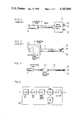
  • FIG. 1 shows a conventional proximity switch of the high frequency oscillation type, in which a detector head 2 having a coil 21 contained therein and a signal detector circuit 3 are interconnected through a cable 1.
  • reference numeral 31 denotes a power supply input line to the signal detector circuit and 32 is a signal line showing "ON" or "OFF" of the proximity switch.
  • the signal detector circuit 3 is housed in a relatively large boxy case.
  • installing the case housing the signal detector circuit 3 in the vicinity of the detector head 2 will be objectonable because of increased spatial restriction in using the proximity switch. It is for this reason that the detector head 2 and the signal detector circuit 3 are normally installed apart from each other. Consequently, the cable 1 connecting the detector head 2 and the signal detector circuit 3 needs to be long, thus tending to be affected by noise.
  • This separation of the signal detector circuit 3 and the detector head 2 from each other usually requires taking the trouble of connecting the signal detector circuit 3 and detector head 2 by wiring, every time this proximity switch is to be used.
  • FIG. 2 depicts a conventional proximity switch of the high frequency oscillator type which has been proposed and practically used for overcoming the above problem.
  • the proximity switch in FIG. 2 is of a type having the signal detector circuit 3 provided within the detector head 2.
  • Proximity switches of this type involve a disadvantage that the larger detector head is more likely to be subject to spatial restriction, although the inducement of noise and the troublesome wiring are averted.
  • the high frequency oscillation type proximity switch of this invention is characterized in that a small-diameter housing case is provided in the cable connecting the detector head and the power source, a printed substrate for a signal detector circuit is provided inside the housing case and the housing case is filled with an insulating resin.
  • This invention has as its object providing an proximity switch of the high frequency oscillation type which is less affected by noise.
  • Another object of this invention is to provide a proximity switch of the high frequency oscillation type which does not require taking trouble of connecting by wiring the detector head and the signal detector circuit proximity
  • FIG. 3 is a external view of an proximity switch of the high frequency oscillation type according to this invention.
  • FIG. 4 is a partly broken perspective view of the housing case used in the proximity switch of high frequency oscillation type shown in FIG. 3,
  • FIG. 5 is a block diagram schematically showing the detector circuit used in the proximity switch of high frequency oscillation type of this invention.
  • FIG. 6 is a drawing illustrating another housing case employed in the proximity switch of high frequency oscillation type of this invention.
  • the cable is composed of the power side cable 12 and the detector head side cable 11.
  • the cable is composed of the power side cable 12 and the detector head side cable 11.
  • a housing case 40 in which the printed circuit for use as the detector circuit is provided.
  • the housing case 40 is so formed as to have a diameter which is, for example, less than twice the cable diameter.
  • Numeral 41 designates a metal tube made of, for example, stainless steel tubing. At one end opening of the metal tube 41, a notch 42 a little wider than the diameter of the luminous part of LED 44 is formed. The terminal part of this notch 42 is of U-shape.
  • Numerals 43a and 43b represent frustoconical support members integrally formed of an insulating resin.
  • the bottom parts of support members 43a and 43b are so stepped as to be inserted into the openings of the metal tube 41.
  • through-holes are formed in the axial direction and on the stepped part of the support member 43a, a lug 45 which is to be inserted into the notch 42 is formed, the tip of said lug having an arcuate concavity.
  • Numeral 46 denotes a rectangular substrate made of ceramic. On this substrate 46, not only the signal detector circuit is formed, but LED 44 for the indication of ON-OFF operation of the proximity switch is mounted. It should be noted that the substrate should desirably be electromagnetically shielded by winding therearound a shielding plate formed by laminating a copper foil with insulating sheets on opposite surfaces thereof.
  • the substrate 46 is inserted into the metal tube 41 in such a way that the luminous part of LED 44 projects out of the housing case at the terminal part of the notch 42 and the support member 43b sleeved on the cable 11 is fitted into the metal tube 41. Thereafter, in order to increase the mechanical strength of the substrate 46, an insulating resin is poured in through the one end opening of the metal tube 41. Then, by fitting the support member 43a into said opening, LED 44 is held between the bottom of the notch 42 and the tip of the lug 45 of the support member 43a. In this way, the mounting of LED 44 is facilitated. Besides, the luminous part of LED 44 projecting from the surface of the metal tube 41 to be clearly visible from any direction enables the operator to be certain of the LED's activation.
  • the signal detector circuit used in this invention is described with reference to FIG. 5.
  • the structure of this signal detector circuit itself is well-known.
  • the signal detector circuit is composed of a high frequency oscillator circuit 4A, a detector circuit 4B, a wave form shaping circuit 4C, a comparator circuit 4D, a reference voltage circuit 4E and an output circuit 4F.
  • the coil 21 is excited by the high frequency oscillator circuit 4A, so that as a result of generation of eddgy current due to approaching metal, the coil's impedance undergoes a change.
  • the change in signal based on such a variation in impedance is extracted through the detector circuit 4B and the wave form shaper circuit 4C.
  • the signal is inputted into the comparator circuit 4D, to be compared with the reference voltage supplied from the reference voltage circuit 4E, and the result is taken out of the output circuit 4F.
  • a housing case of a cylindrical metal tube is taken as an example, but this invention is not restricted to use of such a tube.
  • a V-shape notch 52 with arcuate bottom is formed and on one of the support members 53a and 53b which are fitted into the metal tube 51 is formed with a lug for engagement with the LED 54 projecting at the bottom part of the notch 52 to hold it therebetween.
  • Similar effect as in the this embodiment may be achieved by installing the printed substrate for use as the signal detector circuit in such a housing case.
  • this housing case may be located in proximity to the detector head. It is, therefor, possible to shorten the cable connected to the detector head, thus realizing the effect of reducing induced noise
  • the housing case is preliminarily integrated with the detector head by connecting it therewith by a cable, there is no need of taking the trouble of making the connection above-mentioned when using the proximity switch.
  • the proximity switch of high frequency oscillation type of this invention does not have its signal detector circuit provided in the detector head, the detector head remains small in size.
Landscapes

  • Switches That Are Operated By Magnetic Or Electric Fields (AREA)
  • Electronic Switches (AREA)

Abstract

A high frequency oscillation type proximity switch, being an approach switch adapted for detecting the approach to or departure from the detector coil of a metal body, based on the change in output of the high frequency oscillator circuit, with the oscillator coil of the oscillator circuit as the detector coil, in which a small-diameter housing case is inserted in the cable interconnecting the detector head and the power source, the printed substrate for use as the signal detector circuit is provided in housing case and the housing case is filled with an insulation resin.

Description

BACKGROUND OF THE INVENTION
(1) Field of the Invention
The present invention relates to a proximity switch of the high frequency oscillation type and particularly pertains to an approach switch equipped with a signal detector circuit inserted in a cable connecting a detector head and a power source.
(2) Description of the Prior Art
Recently, high frequency oscillation type proximity switches are widely in use.
In the proximity switch of high frequency oscillation type, a signal detector circuit including a high frequency oscillator circuit, a detector circuit, a wave form shaping circuit, a comparator circuit, a reference voltage generator circuit, and an output circuit, etc., is used.
FIG. 1 shows a conventional proximity switch of the high frequency oscillation type, in which a detector head 2 having a coil 21 contained therein and a signal detector circuit 3 are interconnected through a cable 1. In this figure, reference numeral 31 denotes a power supply input line to the signal detector circuit and 32 is a signal line showing "ON" or "OFF" of the proximity switch.
In this proximity switch, the signal detector circuit 3 is housed in a relatively large boxy case. On this account, installing the case housing the signal detector circuit 3 in the vicinity of the detector head 2 will be objectonable because of increased spatial restriction in using the proximity switch. It is for this reason that the detector head 2 and the signal detector circuit 3 are normally installed apart from each other. Consequently, the cable 1 connecting the detector head 2 and the signal detector circuit 3 needs to be long, thus tending to be affected by noise. This separation of the signal detector circuit 3 and the detector head 2 from each other usually requires taking the trouble of connecting the signal detector circuit 3 and detector head 2 by wiring, every time this proximity switch is to be used.
FIG. 2 depicts a conventional proximity switch of the high frequency oscillator type which has been proposed and practically used for overcoming the above problem. The proximity switch in FIG. 2 is of a type having the signal detector circuit 3 provided within the detector head 2. Proximity switches of this type involve a disadvantage that the larger detector head is more likely to be subject to spatial restriction, although the inducement of noise and the troublesome wiring are averted.
SUMMARY OF THE INVENTION
The high frequency oscillation type proximity switch of this invention is characterized in that a small-diameter housing case is provided in the cable connecting the detector head and the power source, a printed substrate for a signal detector circuit is provided inside the housing case and the housing case is filled with an insulating resin.
This invention has as its object providing an proximity switch of the high frequency oscillation type which is less affected by noise.
Another object of this invention is to provide a proximity switch of the high frequency oscillation type which does not require taking trouble of connecting by wiring the detector head and the signal detector circuit proximity
It is still the other object of this invention to provide an proximity switch which does not require larger-sized detector head.
BRIEF DESCRIPTION OF THE DRAWINGS
FIGS. 1 and 2 depict proximity switches of the high frequency oscillation type which have, heretofore, been in use;
FIG. 3 is a external view of an proximity switch of the high frequency oscillation type according to this invention;
FIG. 4 is a partly broken perspective view of the housing case used in the proximity switch of high frequency oscillation type shown in FIG. 3,
FIG. 5 is a block diagram schematically showing the detector circuit used in the proximity switch of high frequency oscillation type of this invention; and
FIG. 6 is a drawing illustrating another housing case employed in the proximity switch of high frequency oscillation type of this invention.
DESCRIPTION OF THE PREFERRED EMBODIMENTS
In FIG. 3, the parts shown in FIGS. 1 and 2 are represented by the same reference numerals. The cable is composed of the power side cable 12 and the detector head side cable 11. For prevention of inducement of noise, reduction of influence on the temperature characteristics of the cable and for the sake of expediency in making sure of the indications of the LED for confirmation of operation, which will be described later, it is desirable to use a shielded cable shortened to a suitable length for the detector head side cable 11. Between the cable 11 and the cable 12, a housing case 40 in which the printed circuit for use as the detector circuit is provided. The housing case 40 is so formed as to have a diameter which is, for example, less than twice the cable diameter.
In the following, the structure of the housing case 40 is described with reference to FIG. 4.
Numeral 41 designates a metal tube made of, for example, stainless steel tubing. At one end opening of the metal tube 41, a notch 42 a little wider than the diameter of the luminous part of LED 44 is formed. The terminal part of this notch 42 is of U-shape.
Numerals 43a and 43b represent frustoconical support members integrally formed of an insulating resin. The bottom parts of support members 43a and 43b are so stepped as to be inserted into the openings of the metal tube 41. In support members 43a and 43b, through-holes are formed in the axial direction and on the stepped part of the support member 43a, a lug 45 which is to be inserted into the notch 42 is formed, the tip of said lug having an arcuate concavity.
Numeral 46 denotes a rectangular substrate made of ceramic. On this substrate 46, not only the signal detector circuit is formed, but LED 44 for the indication of ON-OFF operation of the proximity switch is mounted. It should be noted that the substrate should desirably be electromagnetically shielded by winding therearound a shielding plate formed by laminating a copper foil with insulating sheets on opposite surfaces thereof.
Then the above-mentioned parts are installed in the following manner:
The substrate 46 is inserted into the metal tube 41 in such a way that the luminous part of LED 44 projects out of the housing case at the terminal part of the notch 42 and the support member 43b sleeved on the cable 11 is fitted into the metal tube 41. Thereafter, in order to increase the mechanical strength of the substrate 46, an insulating resin is poured in through the one end opening of the metal tube 41. Then, by fitting the support member 43a into said opening, LED 44 is held between the bottom of the notch 42 and the tip of the lug 45 of the support member 43a. In this way, the mounting of LED 44 is facilitated. Besides, the luminous part of LED 44 projecting from the surface of the metal tube 41 to be clearly visible from any direction enables the operator to be certain of the LED's activation.
In the following, the signal detector circuit used in this invention is described with reference to FIG. 5. The structure of this signal detector circuit itself is well-known. Thus the signal detector circuit is composed of a high frequency oscillator circuit 4A, a detector circuit 4B, a wave form shaping circuit 4C, a comparator circuit 4D, a reference voltage circuit 4E and an output circuit 4F. The coil 21 is excited by the high frequency oscillator circuit 4A, so that as a result of generation of eddgy current due to approaching metal, the coil's impedance undergoes a change. The change in signal based on such a variation in impedance is extracted through the detector circuit 4B and the wave form shaper circuit 4C. Then the signal is inputted into the comparator circuit 4D, to be compared with the reference voltage supplied from the reference voltage circuit 4E, and the result is taken out of the output circuit 4F.
It should be noted that in the embodiment of this invention, a housing case of a cylindrical metal tube is taken as an example, but this invention is not restricted to use of such a tube. For example, as shown in FIG. 6, at one end opening of a square metal tube 51, a V-shape notch 52 with arcuate bottom is formed and on one of the support members 53a and 53b which are fitted into the metal tube 51 is formed with a lug for engagement with the LED 54 projecting at the bottom part of the notch 52 to hold it therebetween. Similar effect as in the this embodiment may be achieved by installing the printed substrate for use as the signal detector circuit in such a housing case.
Since the proximity switch of the high frequency oscillation type of this invention has its signal detector circuit in a small-diameter housing case, this housing case may be located in proximity to the detector head. It is, therefor, possible to shorten the cable connected to the detector head, thus realizing the effect of reducing induced noise
Furthermore, since the housing case is preliminarily integrated with the detector head by connecting it therewith by a cable, there is no need of taking the trouble of making the connection above-mentioned when using the proximity switch.
Further still, since the proximity switch of high frequency oscillation type of this invention does not have its signal detector circuit provided in the detector head, the detector head remains small in size.

Claims (2)

What is claimed is:
1. In a high frequency oscillation proximity switch comprising a detector head and a signal detector circuit, said signal detector circuit being contained in a small diameter housing case connected at one end by a first cable to said detector head and at the other end by a second cable to a power source, the improvement comprising:
said housing case being formed with a tubular peripheral wall having an opening at each end thereof;
a printed substrate carrying said signal detector circuit positioned in said housing case;
a first support member fitting around said first cable and fitting into one end opening of said housing case;
a second support member fitting around said second cable and fitting into the other end opening of said housing case;
said housing case being formed with a notch in said peripheral wall extending longitudinally into said wall from one open end thereof;
a light emitting diode for indicating the ON-OFF operating condition of said proximity switch mounted on said printed substrate, said light emitting diode having a luminous part projecting through said housing case at said notch; and
said support member at said notched end of said housing case being formed, at the end fitting into said housing case opening, with a lug fitting into said notch to lock said light emitting diode therein, whereby said light emitting diode is mounted in said housing case with its luminous part extending out therefrom to be clearly visible from any direction.
2. The improvement in a high frequency oscillation proximity switch is recited in claim 1 wherein the termianl part of said notch is of U-shape and said lug has a tip formed with an arcuate concavity, whereby said light emitting diode is fixedly held in said notch between said U-shaped terminal portion of said notch and said arcuate concavity of said lug.
US06/616,649 1983-06-09 1984-06-04 High frequency oscillation type proximity switch Expired - Lifetime US4583006A (en)

Applications Claiming Priority (4)

Application Number Priority Date Filing Date Title
JP58-088053[U] 1983-06-09
JP8805383U JPS59193029U (en) 1983-06-09 1983-06-09 High frequency oscillation type proximity switch
JP58-151789[U] 1983-06-29
JP15178983U JPS6069453U (en) 1983-09-29 1983-09-29 LED mounting structure in proximity switch

Publications (1)

Publication Number Publication Date
US4583006A true US4583006A (en) 1986-04-15

Family

ID=26429493

Family Applications (1)

Application Number Title Priority Date Filing Date
US06/616,649 Expired - Lifetime US4583006A (en) 1983-06-09 1984-06-04 High frequency oscillation type proximity switch

Country Status (3)

Country Link
US (1) US4583006A (en)
CH (1) CH663303A5 (en)
DE (1) DE3420920A1 (en)

Cited By (6)

* Cited by examiner, † Cited by third party
Publication number Priority date Publication date Assignee Title
US4667147A (en) * 1985-04-24 1987-05-19 Siemens Aktiengesellschaft Inductive proximity switch
US4719362A (en) * 1985-10-02 1988-01-12 Werner Turck Gmbh & Co., Kg Electronic proximity switch dependent upon a magnetic field
US4757213A (en) * 1986-05-15 1988-07-12 Werner Turch GmbH & Co. KG Non-contact operating proximity switch
US5034621A (en) * 1987-12-16 1991-07-23 Eaton Corporation Inductive proximity switch exhibiting magnetic field immunity
US5811893A (en) * 1995-06-22 1998-09-22 Soyck Gmbh Proximity switch for operation in the presence of interference fields
US6127910A (en) * 1998-06-05 2000-10-03 Topworx, Inc. Hermetically sealed proximity switch

Families Citing this family (2)

* Cited by examiner, † Cited by third party
Publication number Priority date Publication date Assignee Title
US7061234B2 (en) * 2002-03-12 2006-06-13 Omron Corporation Modular proximity sensor
DE10348980A1 (en) * 2003-10-22 2005-06-16 Festo Ag & Co. Electronic component, for example position sensor

Citations (3)

* Cited by examiner, † Cited by third party
Publication number Priority date Publication date Assignee Title
US4271763A (en) * 1978-05-15 1981-06-09 Berger Philip H Proximity detector
US4378504A (en) * 1980-03-25 1983-03-29 Omron Tateisi Electronics Co. Proximity switch
US4456834A (en) * 1980-10-29 1984-06-26 Square D Company Proximity switch

Family Cites Families (4)

* Cited by examiner, † Cited by third party
Publication number Priority date Publication date Assignee Title
DE6602332U (en) * 1967-02-15 1969-05-22 Kabel Metallwerke Ghh AMPLIFIER SLEEVE
GB1270346A (en) * 1970-03-05 1972-04-12 Square D Co Proximity switch
DE7118401U (en) * 1971-05-11 1971-12-02 Ifm Electronic Geraete Gmbh & Co Kg PROBE FOR AN ELECTRONIC NON-CONTACT SWITCHING DEVICE
DE2232917C3 (en) * 1972-07-05 1975-10-02 Euchner & Co, 7022 Leinfelden Contactless switch

Patent Citations (3)

* Cited by examiner, † Cited by third party
Publication number Priority date Publication date Assignee Title
US4271763A (en) * 1978-05-15 1981-06-09 Berger Philip H Proximity detector
US4378504A (en) * 1980-03-25 1983-03-29 Omron Tateisi Electronics Co. Proximity switch
US4456834A (en) * 1980-10-29 1984-06-26 Square D Company Proximity switch

Cited By (6)

* Cited by examiner, † Cited by third party
Publication number Priority date Publication date Assignee Title
US4667147A (en) * 1985-04-24 1987-05-19 Siemens Aktiengesellschaft Inductive proximity switch
US4719362A (en) * 1985-10-02 1988-01-12 Werner Turck Gmbh & Co., Kg Electronic proximity switch dependent upon a magnetic field
US4757213A (en) * 1986-05-15 1988-07-12 Werner Turch GmbH & Co. KG Non-contact operating proximity switch
US5034621A (en) * 1987-12-16 1991-07-23 Eaton Corporation Inductive proximity switch exhibiting magnetic field immunity
US5811893A (en) * 1995-06-22 1998-09-22 Soyck Gmbh Proximity switch for operation in the presence of interference fields
US6127910A (en) * 1998-06-05 2000-10-03 Topworx, Inc. Hermetically sealed proximity switch

Also Published As

Publication number Publication date
CH663303A5 (en) 1987-11-30
DE3420920A1 (en) 1985-03-21

Similar Documents

Publication Publication Date Title
US5789920A (en) Position sensor housing having duroplastic molding compound and thermoplastic molding compound
US5128847A (en) Detachable, low wattage track mounting lamp
US4583006A (en) High frequency oscillation type proximity switch
US20040135572A1 (en) Sensor device
US4459575A (en) High power transformer
EP0395770A2 (en) Proximity switch
EP1744601B1 (en) Discharge lamp lighting apparatus and manufacturing method therefor
US20010025596A1 (en) Heat insulation arrangement of indicating instrument
KR0169399B1 (en) Back light device
US5327110A (en) Ceramic coaxial resonator
KR200143241Y1 (en) Dielectric resonator
US6729775B2 (en) Electro-optical module with a housing
JP3027794U (en) LED mounting structure for transmitting / receiving antenna
JPH11340601A (en) Optical element mounting method and flexible printed wiring board
JPH0541485Y2 (en)
JPS6327508Y2 (en)
JP2005044753A (en) Electrodeless discharge lamp lighting device
JPH0126093Y2 (en)
JPH11312446A (en) Proximity switch
JPH02239575A (en) Terminal connection structure for microwave unit
JPH08306285A (en) Proximity switch
JPH01122533A (en) Proximity switch
JPH05129146A (en) Discharge lamp stabilizer
JPS61163698A (en) High voltage power supply
JPH05290928A (en) Surface mount connector

Legal Events

Date Code Title Description
STCF Information on status: patent grant

Free format text: PATENTED CASE

FEPP Fee payment procedure

Free format text: PAYOR NUMBER ASSIGNED (ORIGINAL EVENT CODE: ASPN); ENTITY STATUS OF PATENT OWNER: LARGE ENTITY

AS Assignment

Owner name: KEYENCE CO., LTD., JAPAN

Free format text: ASSIGNMENT OF ASSIGNORS INTEREST.;ASSIGNORS:OKADA, TOSHIO;KANZAWA, AKIRA;REEL/FRAME:005043/0882

Effective date: 19890303

FPAY Fee payment

Year of fee payment: 4

FEPP Fee payment procedure

Free format text: PAYER NUMBER DE-ASSIGNED (ORIGINAL EVENT CODE: RMPN); ENTITY STATUS OF PATENT OWNER: LARGE ENTITY

Free format text: PAYOR NUMBER ASSIGNED (ORIGINAL EVENT CODE: ASPN); ENTITY STATUS OF PATENT OWNER: LARGE ENTITY

FPAY Fee payment

Year of fee payment: 8

FPAY Fee payment

Year of fee payment: 12