US4562379A - Glow switch starter having metal oxide deposit - Google Patents

Glow switch starter having metal oxide deposit Download PDF

Info

Publication number
US4562379A
US4562379A US06/501,093 US50109383A US4562379A US 4562379 A US4562379 A US 4562379A US 50109383 A US50109383 A US 50109383A US 4562379 A US4562379 A US 4562379A
Authority
US
United States
Prior art keywords
envelope
switch starter
glow switch
stem
weight
Prior art date
Legal status (The legal status is an assumption and is not a legal conclusion. Google has not performed a legal analysis and makes no representation as to the accuracy of the status listed.)
Expired - Fee Related
Application number
US06/501,093
Inventor
Yoshitomi Dobashi
Masahiko Asakura
Kohtaro Kohmoto
Current Assignee (The listed assignees may be inaccurate. Google has not performed a legal analysis and makes no representation or warranty as to the accuracy of the list.)
Toshiba Corp
Original Assignee
Tokyo Shibaura Electric Co Ltd
Priority date (The priority date is an assumption and is not a legal conclusion. Google has not performed a legal analysis and makes no representation as to the accuracy of the date listed.)
Filing date
Publication date
Application filed by Tokyo Shibaura Electric Co Ltd filed Critical Tokyo Shibaura Electric Co Ltd
Assigned to TOKYO SHIBAURA DENKI KABUSHIKI KAISHA reassignment TOKYO SHIBAURA DENKI KABUSHIKI KAISHA ASSIGNMENT OF ASSIGNORS INTEREST. Assignors: ASAKURA, MASAHIKO, DOBASHI, YOSHITOMI, KOHMOTO, KOHTARO
Application granted granted Critical
Publication of US4562379A publication Critical patent/US4562379A/en
Anticipated expiration legal-status Critical
Expired - Fee Related legal-status Critical Current

Links

Images

Classifications

    • HELECTRICITY
    • H05ELECTRIC TECHNIQUES NOT OTHERWISE PROVIDED FOR
    • H05BELECTRIC HEATING; ELECTRIC LIGHT SOURCES NOT OTHERWISE PROVIDED FOR; CIRCUIT ARRANGEMENTS FOR ELECTRIC LIGHT SOURCES, IN GENERAL
    • H05B41/00Circuit arrangements or apparatus for igniting or operating discharge lamps
    • H05B41/02Details
    • H05B41/04Starting switches
    • H05B41/06Starting switches thermal only
    • H05B41/08Starting switches thermal only heated by glow discharge
    • HELECTRICITY
    • H01ELECTRIC ELEMENTS
    • H01JELECTRIC DISCHARGE TUBES OR DISCHARGE LAMPS
    • H01J61/00Gas-discharge or vapour-discharge lamps
    • H01J61/02Details
    • H01J61/30Vessels; Containers
    • H01J61/35Vessels; Containers provided with coatings on the walls thereof; Selection of materials for the coatings

Definitions

  • This invention relates to a glow switch starter, and more specifically to an improved glow switch starter with less deviation in starting characteristics, such as starting voltage, initial glow discharge period, etc.
  • metal barium is deposited on the inner wall of a glass bulb as an airtight envelope and on a discharge electrode.
  • the metal barium serves to keep the starting voltage of the glow switch starter at a predetermined value and to reduce the deviation of the value.
  • barium azide Ba(N 3 ) 2 is deposited on the inner surface of the glass bulb and the electrode, a stem in which the electrode is set is hermetically sealed in the glass bulb, the glass bulb is evacuated to form a vacuum and is then heated to thermally decompose the barium azide.
  • the thermal decomposition of the barium azide in the vacuum is performed explosively, so that metal barium from the barium azide deposited on the inner surface of the glass bulb scatters and sticks to the electrode during the thermal decomposition. Consequently, an excessive amount of metal barium is attached to the electrode to lower the starting voltage of the glow switch starter below the desired value. If the amount of barium azide deposited on the inner surface of the glass bulb is reduced to prevent so much metal barium from sticking to the electrode, the desired amount of metal barium may not be able to be deposited on the inner surface of the bulb. As a result, the gettering effect of the metal barium cannot be fully exhibited, so that tht initial glow discharge period of the glow switch starter and hence the ignition time of the lamp will be extended.
  • the object of this invention is to provide an improved glow switch starter which has fewer deviations in starting characteristics, such as starting voltage, initial glow period, etc.
  • a glow switch starter which comprises an airtight envelope in which a dischargeable gas is contained, and an electrode assembly hermetically sealed in one end of the envelope and having a stem in which a pair of electrodes are set, one or both of which are movable electrodes, wherein a film formed of a mixture of 40% to 90% (by weight) metal barium and 60% to 10% (by weight) metal oxide is deposited on that region of the inner surface of the envelope which is spaced apart from the stem, at a rate of 0.4 mg to 12.5 mg per cubic centimeter of the envelope capacity.
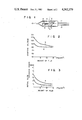
  • FIG. 1 is a partial sectional view of a glow switch starter according to one embodiment of this invention
  • FIG. 2 is a graph showing the relationship between a starting voltage and a weight of a film in a glow switch starter incorporated in a 120 V, 40 W fluorescent lamp;
  • FIG. 3 is a graph showing the relationship between an initial glow discharge period and a weight of a film in a glow switch starter incorporated in a 120 V, 40 W fluorescent lamp;
  • FIG. 4 is a graph showing the relationship between a starting voltage and a weight of a film in a glow switch starter incorporated in a 220 V, 70 W high pressure sodium lamp;
  • FIG. 5 is a graph showing the relationship between an initial glow discharge period and a weight of a film in a glow switch starter incorporated in a 220 V, 70 W high pressure sodium lamp.
  • FIG. 1 is a partial sectional view of a glow switch starter according to one embodiment of this invention.
  • an electrode assembly 2 is housed in a glass bulb 1 with an inside diameter of 6 mm.
  • the electrode assembly 2 is composed of a stem 3 and a pair of inner leads 4 and 5 pinched in the stem 3.
  • a movable electrode 6 formed of a bent bimetal is welded to the extreme end portion of the one inner lead 4, while the other inner lead 5 constitutes a fixed electrode.
  • Argon or a gas mixture of argon and neon (e.g., 1% Ar and 99% Ne) as a dischargeable gas is contained in the glass bulb 1.
  • the region covered with the film 8 is a belt-shaped region of the inner surface of the bulb 1, having a width of approximately 3 to 4 mm.
  • the forward edge of the covered region is at a distance of approximately 8 to 10 mm from the top 9 of the stem 3.
  • An exhaust tube is connected to the apex of the glass bulb 1 before the gas mixture is introduced into the bulb 1.
  • the gas mixture is introduced into the glass bulb 1 after the bulb 1 is exhausted by means of the exhaust tube.
  • reference numeral 10 designates a tipped-off seal end formed after the gas mixture is introduced into the glass bulb 1.
  • the inner leads 4 and 5 set in the stem 3 are led out of the glow bulb 1 to serve as outer leads 11 and 12, respectively.
  • the film 8 deposited on the inner wall of the glass bulb 1 is formed of a mixture of 40% to 90%, e.g., 50%, by weight of metal barium and 60% to 10%, e.g., 50%, by weight of a binder such as aluminum oxide.
  • the film is deposited at a rate of 0.4 mg to 12.5 mg, e.g., 1.4 mg, per cubic centimeter of the glass bulb capacity.
  • the film-deposited region is located in a position spaced apart from the stem 3 because the starting voltage cannot be stabilized if the film 8 is deposited on the region near the stem 3 which is not a discharge region.
  • the film 8 is formed by thermally decomposing a mixture of barium azide and aluminum oxide in a vacuum after depositing it on the predetermined region.
  • the existance of the binder prevents the metal barium from scattering and sticking to the electrode during the thermal decomposition of barium azide. Accordingly, the starting voltage is prevented from dropping excessively, and a fixed amount of metal barium is deposited on the inner wall of the bulb 1. Thus, the starting characteristics are improved, a satisfactory gettering effect is obtained, and the initial glow discharge period can be limited within a fixed time.
  • Glow switch starters of the structure shown in FIG. 1 were made. Argon was contained in a glass bulb 1. They had films 8 of different Ba-Al 2 O 3 mixtures and deposited in different amounts on the limited portions of inner surfaces of bulbs 1. Each limited inner surface portion was at a distance of about 8 to 10 mm from the top of a stem 3 and shaped like an annular band about 3 to 4 mm wide as measured in the direction toward the top of the bulb 1. Each of the starters was incorporated in a 120 V, 40 W fluorescent lamp. The lamp was operated, and the starting voltages and the initial glow discharge periods of the starters were measured.
  • the starting voltage of a glow switch starter in a 120 V, 40 W fluorescent lamp should be preferably 108 V or less to start discharge and should better be 80 V or more to prevent the starter from operating again.
  • the initial glow discharge period of the starter of the lamp should better be 3.5 seconds or less.
  • FIG. 2 is a graph illustrating the relationship between the starting voltage and the amount of Ba-Al 2 O 3 mixture (mg/cm 3 ).
  • FIG. 3 is a graph showing the initial glow discharge period and the amount of Ba-Al 2 O 3 mixture (mg/cm 3 ).
  • curve A indicates said relationships concerning the starters with films 8 made of a mixture consisting of 90% by weight of Ba and 10% by weight of Al 2 O 3
  • curve B represents said relationships concerning the starters with films 8 made of a mixture consisting of 40% by weight of Ba and 60% by weight of Al 2 O 3 .
  • the starting voltage fell within the above-mentioned range, i.e., from 80 V to 108 V, and the initial glow discharge period was 3.5 seconds or less when the film 8 made of a mixture consisting of 40 to 90% by weight of Ba and 10 to 60% by weight of Al 2 O 3 was used in an amount of 0.4 to 12.5 mg per cubic centimeter of the bulb 1.
  • Each of glow switch starters of the same structures as those used in Example 1 except containing a gas mixture of 1% Ar and 99% Ne was incorporated in 220 V, 70 W high pressure sodium lamp. The lamp were operated, and the starting voltages and the initial glow discharge periods of the starters were measured.
  • the starting voltage of a glow switch starter in a 220 V, 70 W high pressure sodium lamp should be preferably 198 V or less to start discharge and be preferably 110 V or more to prevent the starter from operating again.
  • the film 8 should be formed of a mixture consisting of 40 to 60% by weight of Ba and 10 to 60% by weight of Al 2 O 3 and that the film 8 should be used in an amount of 0.4 to 12.5 mg per cubic centimeter of the bulb 1.
  • FIGS. 4 and 5 illustrate these findings.
  • curve A indicates the aforementioned relationships concerning the starters with films 8 made of a mixture consisting of 90% by weight of Ba and 10% by weight of Al 2 O 3 and curve B represents the aforementioned relationships concerning the starters with films 8 made of a mixture consisting of 40% by weight of Ba and 60% by weight of Al 2 O 3 .
  • the films 8 were formed by coating a Ba(N 3 ) 2 -Al 2 O 3 mixture on the inner surface of the bulbs 1 and then by evacuating and heating the bulbs, thereby causing the thermal decomposition of Ba(N 3 ) 2 .
  • the binder was used for the binder in the Examples described above, this invention is not limited to these Examples. The same effect may be obtained with the use of titanium dioxide, silicon dioxide or another metal oxide for that purpose.
  • the glow switch starter used a fluorescent lamp rated at 120 V, 40 W and a high-pressure sodium lamp rated at 220 V, 70 W. However, the same effects may be obtained with the use of other discharge lamps. While the Examples used a combination of a fixed electrode and a movable electrode, a couple of movable electrodes may alternatively be used for the same purpose.
  • the movable electrode is covered with the film formed of a fixed amount of metal barium or a mixture of metal barium and a binder, it is protected against deposition of excessive metal barium or the electrode, since the barium never scatters from the inner wall of the bulb 1.
  • the position of film deposition is not limited to the position stated in the Examples.
  • the film may extend to that portion of the inner wall of the glass bulb 1 which corresponds to the bent portion of the bimetal constituting the movable electrode.
Landscapes

  • Discharge Lamps And Accessories Thereof (AREA)
  • Vessels And Coating Films For Discharge Lamps (AREA)

Abstract

In a glow switch starter comprising an airtight envelope in which a dischargeable gas is contained, and an electrode assembly hermetically sealed in one end of the envelope and having a stem in which a pair of electrodes are set, one or both of which are movable electrodes, a film formed of a mixture of 40% to 90% (by weight) metal barium and 60% to 10% (by weight) metal oxide is deposited on that region of the inner surface of the envelope, which is spaced apart from the stem, at a rate of 0.4 mg to 12.5 mg per cubic centimeter of the envelope capacity.

Description

BACKGROUND OF THE INVENTION
This invention relates to a glow switch starter, and more specifically to an improved glow switch starter with less deviation in starting characteristics, such as starting voltage, initial glow discharge period, etc.
In some glow switch starters used for starting discharge lamps such as preheat-start type fluorescent lamps, metal barium is deposited on the inner wall of a glass bulb as an airtight envelope and on a discharge electrode. The metal barium serves to keep the starting voltage of the glow switch starter at a predetermined value and to reduce the deviation of the value. In a conventional method of depositing metal barium on the glass bulb and electrode, barium azide Ba(N3)2 is deposited on the inner surface of the glass bulb and the electrode, a stem in which the electrode is set is hermetically sealed in the glass bulb, the glass bulb is evacuated to form a vacuum and is then heated to thermally decompose the barium azide. According to this method, however, the thermal decomposition of the barium azide in the vacuum is performed explosively, so that metal barium from the barium azide deposited on the inner surface of the glass bulb scatters and sticks to the electrode during the thermal decomposition. Consequently, an excessive amount of metal barium is attached to the electrode to lower the starting voltage of the glow switch starter below the desired value. If the amount of barium azide deposited on the inner surface of the glass bulb is reduced to prevent so much metal barium from sticking to the electrode, the desired amount of metal barium may not be able to be deposited on the inner surface of the bulb. As a result, the gettering effect of the metal barium cannot be fully exhibited, so that tht initial glow discharge period of the glow switch starter and hence the ignition time of the lamp will be extended.
SUMMARY OF THE INVENTION
The object of this invention is to provide an improved glow switch starter which has fewer deviations in starting characteristics, such as starting voltage, initial glow period, etc.
According to this invention, there is provided a glow switch starter which comprises an airtight envelope in which a dischargeable gas is contained, and an electrode assembly hermetically sealed in one end of the envelope and having a stem in which a pair of electrodes are set, one or both of which are movable electrodes, wherein a film formed of a mixture of 40% to 90% (by weight) metal barium and 60% to 10% (by weight) metal oxide is deposited on that region of the inner surface of the envelope which is spaced apart from the stem, at a rate of 0.4 mg to 12.5 mg per cubic centimeter of the envelope capacity.
BRIEF DESCRIPTION OF THE DRAWINGS
FIG. 1 is a partial sectional view of a glow switch starter according to one embodiment of this invention;
FIG. 2 is a graph showing the relationship between a starting voltage and a weight of a film in a glow switch starter incorporated in a 120 V, 40 W fluorescent lamp;
FIG. 3 is a graph showing the relationship between an initial glow discharge period and a weight of a film in a glow switch starter incorporated in a 120 V, 40 W fluorescent lamp;
FIG. 4 is a graph showing the relationship between a starting voltage and a weight of a film in a glow switch starter incorporated in a 220 V, 70 W high pressure sodium lamp; and
FIG. 5 is a graph showing the relationship between an initial glow discharge period and a weight of a film in a glow switch starter incorporated in a 220 V, 70 W high pressure sodium lamp.
DETAILED DESCRIPTION OF THE PREFERRED EMBODIMENTS
FIG. 1 is a partial sectional view of a glow switch starter according to one embodiment of this invention. In FIG. 1, an electrode assembly 2 is housed in a glass bulb 1 with an inside diameter of 6 mm. The electrode assembly 2 is composed of a stem 3 and a pair of inner leads 4 and 5 pinched in the stem 3. A movable electrode 6 formed of a bent bimetal is welded to the extreme end portion of the one inner lead 4, while the other inner lead 5 constitutes a fixed electrode. Argon or a gas mixture of argon and neon (e.g., 1% Ar and 99% Ne) as a dischargeable gas is contained in the glass bulb 1.
A film 8, which will be described in detail later, is deposited on that region of the inner surface of the glass bulb 1 which is spaced from the top 9 of the stem 3. The region covered with the film 8 is a belt-shaped region of the inner surface of the bulb 1, having a width of approximately 3 to 4 mm. The forward edge of the covered region is at a distance of approximately 8 to 10 mm from the top 9 of the stem 3. An exhaust tube is connected to the apex of the glass bulb 1 before the gas mixture is introduced into the bulb 1. The gas mixture is introduced into the glass bulb 1 after the bulb 1 is exhausted by means of the exhaust tube. In FIG. 1, reference numeral 10 designates a tipped-off seal end formed after the gas mixture is introduced into the glass bulb 1.
The inner leads 4 and 5 set in the stem 3 are led out of the glow bulb 1 to serve as outer leads 11 and 12, respectively.
The film 8 deposited on the inner wall of the glass bulb 1 is formed of a mixture of 40% to 90%, e.g., 50%, by weight of metal barium and 60% to 10%, e.g., 50%, by weight of a binder such as aluminum oxide. The film is deposited at a rate of 0.4 mg to 12.5 mg, e.g., 1.4 mg, per cubic centimeter of the glass bulb capacity. The film-deposited region is located in a position spaced apart from the stem 3 because the starting voltage cannot be stabilized if the film 8 is deposited on the region near the stem 3 which is not a discharge region. The film 8 is formed by thermally decomposing a mixture of barium azide and aluminum oxide in a vacuum after depositing it on the predetermined region.
According to the glow switch starter of this invention, as described above, the existance of the binder prevents the metal barium from scattering and sticking to the electrode during the thermal decomposition of barium azide. Accordingly, the starting voltage is prevented from dropping excessively, and a fixed amount of metal barium is deposited on the inner wall of the bulb 1. Thus, the starting characteristics are improved, a satisfactory gettering effect is obtained, and the initial glow discharge period can be limited within a fixed time.
Examples of this invention will now be described to clarify the reason why the composition of the film and the amount of the film deposited are limited in the glow switch starter of the present invention.
EXAMPLE 1
Glow switch starters of the structure shown in FIG. 1 were made. Argon was contained in a glass bulb 1. They had films 8 of different Ba-Al2 O3 mixtures and deposited in different amounts on the limited portions of inner surfaces of bulbs 1. Each limited inner surface portion was at a distance of about 8 to 10 mm from the top of a stem 3 and shaped like an annular band about 3 to 4 mm wide as measured in the direction toward the top of the bulb 1. Each of the starters was incorporated in a 120 V, 40 W fluorescent lamp. The lamp was operated, and the starting voltages and the initial glow discharge periods of the starters were measured.
The starting voltage of a glow switch starter in a 120 V, 40 W fluorescent lamp should be preferably 108 V or less to start discharge and should better be 80 V or more to prevent the starter from operating again. The initial glow discharge period of the starter of the lamp should better be 3.5 seconds or less. In view of this and from the data obtained by the experiment described above, it was found that the film 8 should be formed of a mixture consisting of 40 to 90% by weight of Ba and 10 to 60% by weight of Al2 O3 and that the film 8 should be used in an amount of 0.4 to 12.5 mg per cubic centimeter of the bulb 1.
FIG. 2 is a graph illustrating the relationship between the starting voltage and the amount of Ba-Al2 O3 mixture (mg/cm3). FIG. 3 is a graph showing the initial glow discharge period and the amount of Ba-Al2 O3 mixture (mg/cm3). In these figures, curve A indicates said relationships concerning the starters with films 8 made of a mixture consisting of 90% by weight of Ba and 10% by weight of Al2 O3 and curve B represents said relationships concerning the starters with films 8 made of a mixture consisting of 40% by weight of Ba and 60% by weight of Al2 O3. As evident from FIGS. 2 and 3, the starting voltage fell within the above-mentioned range, i.e., from 80 V to 108 V, and the initial glow discharge period was 3.5 seconds or less when the film 8 made of a mixture consisting of 40 to 90% by weight of Ba and 10 to 60% by weight of Al2 O3 was used in an amount of 0.4 to 12.5 mg per cubic centimeter of the bulb 1.
EXAMPLE 2
Each of glow switch starters of the same structures as those used in Example 1 except containing a gas mixture of 1% Ar and 99% Ne was incorporated in 220 V, 70 W high pressure sodium lamp. The lamp were operated, and the starting voltages and the initial glow discharge periods of the starters were measured.
The starting voltage of a glow switch starter in a 220 V, 70 W high pressure sodium lamp should be preferably 198 V or less to start discharge and be preferably 110 V or more to prevent the starter from operating again. In view of this and from the data obtained by the experiment described above, it was found that, exactly as in Example 1, the film 8 should be formed of a mixture consisting of 40 to 60% by weight of Ba and 10 to 60% by weight of Al2 O3 and that the film 8 should be used in an amount of 0.4 to 12.5 mg per cubic centimeter of the bulb 1. FIGS. 4 and 5 illustrate these findings. In these figures, curve A indicates the aforementioned relationships concerning the starters with films 8 made of a mixture consisting of 90% by weight of Ba and 10% by weight of Al2 O3 and curve B represents the aforementioned relationships concerning the starters with films 8 made of a mixture consisting of 40% by weight of Ba and 60% by weight of Al2 O3.
In examples 1 and 2, the films 8 were formed by coating a Ba(N3)2 -Al2 O3 mixture on the inner surface of the bulbs 1 and then by evacuating and heating the bulbs, thereby causing the thermal decomposition of Ba(N3)2.
Although aluminum oxide was used for the binder in the Examples described above, this invention is not limited to these Examples. The same effect may be obtained with the use of titanium dioxide, silicon dioxide or another metal oxide for that purpose. In the Examples, moreover, the glow switch starter used a fluorescent lamp rated at 120 V, 40 W and a high-pressure sodium lamp rated at 220 V, 70 W. However, the same effects may be obtained with the use of other discharge lamps. While the Examples used a combination of a fixed electrode and a movable electrode, a couple of movable electrodes may alternatively be used for the same purpose. Even though the movable electrode is covered with the film formed of a fixed amount of metal barium or a mixture of metal barium and a binder, it is protected against deposition of excessive metal barium or the electrode, since the barium never scatters from the inner wall of the bulb 1. Thus, the desired starting characteristics may be obtained. The position of film deposition is not limited to the position stated in the Examples. For example, the film may extend to that portion of the inner wall of the glass bulb 1 which corresponds to the bent portion of the bimetal constituting the movable electrode.

Claims (6)

What we claim is:
1. A glow switch starter comprising:
an airtight envelope,
a dischargeable gas contained within said envelope,
an electrode assembly hermetically sealed in one end of the envelope, said electrode assembly having a stem in which a pair of electrodes, one or both of which are movable electrodes, are set, a film formed of a mixture of 40% to 90% (by weight) metal barium and 60% to 10% (by weight) metal oxide being deposited only on a region of the inner surface of the envelope, which is spaced apart from the stem, deposition having been accomplished at a rate of 0.4 mg to 12.5 mg per cubic centimeter of the envelope capacity, said metal oxide limiting the amount of barium deposited on said electrodes thus preventing a starting voltage of said glow switch starter from dropping excessively.
2. The glow switch starter according to claim 1, wherein said metal oxide is at least one selected among a group including aluminum oxide, titanium dioxide, and silicon dioxide.
3. The glow switch starter according to claim 1, wherein said dischargeable gas is argon.
4. The glow switch starter according to claim 1, wherein said dischargeable gas is a gas mixture of argon and neon.
5. The glow switch starter according to claim 1, wherein said region of the inner surface of the envelope spaced from the stem extends from the position corresponding to a bimetal constituting the movable electrode to the apex of the envelope.
6. The glow switch starter according to claim 5, wherein said region of the inner surface of the envelope spaced apart from the stem is at a distance of 8 mm or more from the apex of the stem.
US06/501,093 1982-06-10 1983-06-06 Glow switch starter having metal oxide deposit Expired - Fee Related US4562379A (en)

Applications Claiming Priority (2)

Application Number Priority Date Filing Date Title
JP57-98552 1982-06-10
JP57098552A JPS58216353A (en) 1982-06-10 1982-06-10 Starter lamp

Publications (1)

Publication Number Publication Date
US4562379A true US4562379A (en) 1985-12-31

Family

ID=14222846

Family Applications (1)

Application Number Title Priority Date Filing Date
US06/501,093 Expired - Fee Related US4562379A (en) 1982-06-10 1983-06-06 Glow switch starter having metal oxide deposit

Country Status (6)

Country Link
US (1) US4562379A (en)
JP (1) JPS58216353A (en)
AU (1) AU541756B2 (en)
CA (1) CA1202655A (en)
DE (1) DE3320933C2 (en)
NL (1) NL187511C (en)

Cited By (2)

* Cited by examiner, † Cited by third party
Publication number Priority date Publication date Assignee Title
WO2000033619A1 (en) * 1998-11-30 2000-06-08 Koninklijke Philips Electronics N.V. Glow discharge starter
US20070075628A1 (en) * 2005-10-04 2007-04-05 General Electric Company Organic light emitting devices having latent activated layers

Families Citing this family (2)

* Cited by examiner, † Cited by third party
Publication number Priority date Publication date Assignee Title
US4646049A (en) * 1985-11-20 1987-02-24 Gte Products Corporation Glow discharge starter containing thorium for improving dark starting
NL1009995C1 (en) * 1998-09-02 2000-03-06 Sjors Franke Van De Meulenreek Starter for a fluorescent lamp.

Citations (5)

* Cited by examiner, † Cited by third party
Publication number Priority date Publication date Assignee Title
GB997961A (en) *
US2372295A (en) * 1942-03-24 1945-03-27 Jacob H Rubenstein Starting device for fluorescent tubes
US2457487A (en) * 1945-10-17 1948-12-28 Sylvania Electric Prod Glow relay
US2650278A (en) * 1951-12-01 1953-08-25 Gen Electric Glow type thermal switch
US3681639A (en) * 1966-09-30 1972-08-01 Tokyo Shibaura Electric Co Glow discharge starter tube with hydrocarbon-rare gas fill

Family Cites Families (5)

* Cited by examiner, † Cited by third party
Publication number Priority date Publication date Assignee Title
AT171614B (en) * 1949-06-22 1952-06-25 Egyesuelt Izzolampa Low-voltage ignition device for gas discharge tubes and process for their production
FR1020641A (en) * 1949-06-22 1953-02-09 Egyesuelt Izzolampa Ignition device for gas discharge tubes and method for its manufacture
FR1070610A (en) * 1951-12-01 1954-08-03 Lampes Sa Thermal glow switch
JPS57172696A (en) * 1981-04-16 1982-10-23 Tokyo Shibaura Electric Co Starter tube
JPS58209051A (en) * 1982-05-31 1983-12-05 Toshiba Corp Starter lamp

Patent Citations (5)

* Cited by examiner, † Cited by third party
Publication number Priority date Publication date Assignee Title
GB997961A (en) *
US2372295A (en) * 1942-03-24 1945-03-27 Jacob H Rubenstein Starting device for fluorescent tubes
US2457487A (en) * 1945-10-17 1948-12-28 Sylvania Electric Prod Glow relay
US2650278A (en) * 1951-12-01 1953-08-25 Gen Electric Glow type thermal switch
US3681639A (en) * 1966-09-30 1972-08-01 Tokyo Shibaura Electric Co Glow discharge starter tube with hydrocarbon-rare gas fill

Non-Patent Citations (2)

* Cited by examiner, † Cited by third party
Title
Ahearn et al., IBM Technical Disclosure Bulletin, "Eliminating Gas Impurities in a Gas Display Panel", vol. 15, No. 8, Jan. 1973, p. 2516.
Ahearn et al., IBM Technical Disclosure Bulletin, Eliminating Gas Impurities in a Gas Display Panel , vol. 15, No. 8, Jan. 1973, p. 2516. *

Cited By (4)

* Cited by examiner, † Cited by third party
Publication number Priority date Publication date Assignee Title
WO2000033619A1 (en) * 1998-11-30 2000-06-08 Koninklijke Philips Electronics N.V. Glow discharge starter
JP2002531929A (en) * 1998-11-30 2002-09-24 コーニンクレッカ フィリップス エレクトロニクス エヌ ヴィ Glow discharge starter
US20070075628A1 (en) * 2005-10-04 2007-04-05 General Electric Company Organic light emitting devices having latent activated layers
WO2008094294A3 (en) * 2006-09-28 2009-02-19 Gen Electric Organic light emitting devices having latent activated layers

Also Published As

Publication number Publication date
CA1202655A (en) 1986-04-01
JPS58216353A (en) 1983-12-16
NL8302039A (en) 1984-01-02
DE3320933C2 (en) 1986-01-09
AU1561683A (en) 1983-12-15
DE3320933A1 (en) 1983-12-15
NL187511C (en) 1991-10-16
NL187511B (en) 1991-05-16
AU541756B2 (en) 1985-01-17

Similar Documents

Publication Publication Date Title
US4157485A (en) Low-pressure mercury vapor discharge lamp with indium-bismuth-mercury amalgam
EP0585446B1 (en) Low pressure mercury vapor discharge lamp containing an amalgam
US3558963A (en) High-intensity vapor arc-lamp
KR0130879B1 (en) Protective metal silicate coating for a metal halide arc
US6356016B1 (en) High-pressure metal-halide lamp that includes a ceramic-carrier oxygen dispenser
US4093889A (en) Low-pressure mercury vapor discharge lamp
GB1578246A (en) Fluorescent lighting
JPH0265046A (en) Light emitting tube and high pressure discharge lamp equipped with this light emitting tube
US4562379A (en) Glow switch starter having metal oxide deposit
EP0449307A2 (en) Fluorescent lamp and its manufacturing method
US3563797A (en) Method of making air stable cathode for discharge device
US6049164A (en) Low-pressure mercury lamp with specific electrode screens
KR920010666B1 (en) Low pressure rare gas discharge lamp
US5327042A (en) Metal halide lamp
US3263113A (en) Tungsten filament lamp comprising hexafluoride gas at partial pressure not exceeding 10 torrs
CA1181049A (en) Low-pressure mercury vapour discharge lamp
US4691141A (en) Dosing composition for high pressure sodium lamps
US3488540A (en) Electric discharge lamp containing metallic iodides including sodium iodide
CA1135763A (en) High-pressure sodium vapour lamp with emissive electrode including oxidized strontium and tungsten
US3549936A (en) Low pressure mercury vapor discharge lamps including an alloy type getter coating
US6469445B1 (en) High CRI metal halide lamp with constant color throughout life
US4209726A (en) Low-pressure sodium vapor discharge lamp
US3349274A (en) Low-pressure mercury vapor discharge lamp
JPS6237518B2 (en)
JPH07105852A (en) Manufacture of fluorescent lamp

Legal Events

Date Code Title Description
AS Assignment

Owner name: TOKYO SHIBAURA DENKI KABUSHIKI KAISHA, 72 HORIKAWA

Free format text: ASSIGNMENT OF ASSIGNORS INTEREST.;ASSIGNORS:DOBASHI, YOSHITOMI;ASAKURA, MASAHIKO;KOHMOTO, KOHTARO;REEL/FRAME:004137/0665

Effective date: 19830518

FEPP Fee payment procedure

Free format text: PAYOR NUMBER ASSIGNED (ORIGINAL EVENT CODE: ASPN); ENTITY STATUS OF PATENT OWNER: LARGE ENTITY

FPAY Fee payment

Year of fee payment: 4

FPAY Fee payment

Year of fee payment: 8

REMI Maintenance fee reminder mailed
LAPS Lapse for failure to pay maintenance fees
FP Lapsed due to failure to pay maintenance fee

Effective date: 19971231

STCH Information on status: patent discontinuation

Free format text: PATENT EXPIRED DUE TO NONPAYMENT OF MAINTENANCE FEES UNDER 37 CFR 1.362