US4558348A - Digital video signal processing system using asynchronous a-to-d encoding - Google Patents
Digital video signal processing system using asynchronous a-to-d encoding Download PDFInfo
- Publication number
- US4558348A US4558348A US06/567,190 US56719083A US4558348A US 4558348 A US4558348 A US 4558348A US 56719083 A US56719083 A US 56719083A US 4558348 A US4558348 A US 4558348A
- Authority
- US
- United States
- Prior art keywords
- chrominance
- burst
- signal
- angles
- analog
- Prior art date
- Legal status (The legal status is an assumption and is not a legal conclusion. Google has not performed a legal analysis and makes no representation as to the accuracy of the status listed.)
- Expired - Lifetime
Links
Images



Classifications
-
- H—ELECTRICITY
- H04—ELECTRIC COMMUNICATION TECHNIQUE
- H04N—PICTORIAL COMMUNICATION, e.g. TELEVISION
- H04N9/00—Details of colour television systems
- H04N9/77—Circuits for processing the brightness signal and the chrominance signal relative to each other, e.g. adjusting the phase of the brightness signal relative to the colour signal, correcting differential gain or differential phase
- H04N9/78—Circuits for processing the brightness signal and the chrominance signal relative to each other, e.g. adjusting the phase of the brightness signal relative to the colour signal, correcting differential gain or differential phase for separating the brightness signal or the chrominance signal from the colour television signal, e.g. using comb filter
-
- H—ELECTRICITY
- H04—ELECTRIC COMMUNICATION TECHNIQUE
- H04N—PICTORIAL COMMUNICATION, e.g. TELEVISION
- H04N9/00—Details of colour television systems
- H04N9/64—Circuits for processing colour signals
Definitions
- This invention relates to a digital video processing system, e.g. a digital TV receiver and more particularly to a system for processing digital representations of an analog video color signal where the digital samples were created by an analog-to-digital converter (ADC) operating asynchronously with the color subcarrier.
- ADC analog-to-digital converter
- VLSI digital very large scale integrated circuits
- TV receivers are being commercially produced which perform the majority of the TV signal processing functions by performing binary computations.
- broadcast analog video signals are applied to a conventional receiving antenna from which they are processed through an analog tuner and intermediate frequency, IF, circuits.
- Baseband composite video signal, e.g. NTSC signal, from the IF circuitry is applied to an analog-to-digital converter (ADC) which develops signal samples which are binary representations of the analog composite video signal.
- ADC analog-to-digital converter
- the binary samples are processed in binary arithmetic circuits to appropriately condition the luminance and chrominance components of the composite video for application to matrixing circuitry for generating conventional R, G and B color signals to drive the display tube. If the matrixing circuit is digital, then the R, G, B signals developed in the matrix are converted back to analog form before application to the display device. In alternate arrangements the processed luminance and chrominance signals are converted to analog form and applied to an analog matrix for generating the R, G, B signals.
- the chrominance component of composite video contains information related to the color of the transmitted image. This component is a phase and amplitude modulated 3.58 MHz, (NTSC) sinusoid.
- the chrominance component of the broadcast signal is developed by combining two quadrature related color difference or color mixture signals. For purposes of processing the chrominance signal in the receiver it is convenient to demodulate the chrominance component into the quadrature components and process these signals.
- the sampling signal which controls the ADC is phase and frequency locked to the color burst signal which is transmitted along with the video signal. Judicious choice of the frequency and phase of the sampling clock or signal greatly facilitates demodulation of the chrominance component to its quadrature components. For example, if the sampling clock rate is at four times the subcarrier rate and in phase with burst, the binary samples of the chrominance component produced by the ADC will be formatted in a sequence --(B--Y) n , (R--Y) n , (B--Y) n , --(R--Y) n , --(B--Y) n+1 , etc. where the signs attendant the samples are indicative of sampling phase, not sample polarity. To demodulate the sequence into the quadrature components, alternate samples are demultiplexed into two data streams.
- phase locking system for generating ADC clock signals is described in SMPTE "DIGITAL VIDEO", Vol. 3, pp. 89-98, June 1980, and an example of a digital TV receiver system is described in U.S. Pat. No. 4,270,139, Flamm et al.
- Phase locking the sampling clock to burst has the further advantage that hue control may be effectuated simply by adjusting the phase differential between the reference oscillator and burst in the phase locked loop.
- the lock time may be in the range of milliseconds which is prohibitive of certain feature applications. For example, consider a picture in picture feature using a single tuner where a primary channel is displayed on the receiver display tube and a second channel is displayed as an inset on a small portion of the tube. Such a feature requires that the tuner switch between channels in a small portion of a line time and that the sampling clock lock up to the currently selected channel in one color burst period. It will be immediately obvious to those skilled in the art of phase locked loops that such a requirement is a practical impossibility using phase lock techniques.
- the present invention is a digital color video processing apparatus which possesses the benefits of a system where the ADC sampling clock is locked to burst, but which operates with an asynchronous sampling clock.
- the system includes an ADC which is clocked by a free running crystal oscillator which is set to a frequency substantially equal to four times the color subcarrier frequency.
- the binary samples produced by the ADC are processed to separate the luminance and chrominance components.
- the chrominance component is demodulated by demultipexing alternate samples.
- phase errors between the free running sampling clock and the axes of the transmitted quadrature component signals are determined and stored for a line interval.
- the demultiplexed chrominance signals are modified in accordance with the stored phase errors to compensate the effects of asynchronous sampling.
- FIG. 1 is a block diagram of a digital television receiver incorporating a system for asynchronous analog-to-digital signal conversion
- FIGS. 2A and 2B are a time versus amplitude waveform diagram showing synchronous sampling clock waveforms in relation to the color burst signal and a phasor diagram of burst relative to the sampling axes;
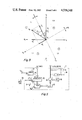
- FIG. 3 is a phasor diagram showing the burst vector relative to the axes of synchronous and asynchronous sampling axes
- FIG. 4 is a block diagram of digital color signal processing circuitry including circuitry for compensating for asynchronous sampling phase errors
- FIG. 5 is a block diagram of circuitry for detecting chrominance signal phase errors resulting from asynchronous sampling by the ADC;
- FIG. 6 is a block diagram of circuitry which may be added to the FIG. 5 circuit for incrementing or decrementing the correcting factor, ⁇ , at selected times during a line interval;
- FIG. 7 is a block diagram of a prior art 2-H comb filter.
- FIG. 1 is a generalized block diagram of a digital TV receiver embodying the present invention.
- element 10 is conventional analog tuner and IF circuitry which accepts broadcast TV signals and develops baseband composite video signal.
- the baseband video signal is applied to the analog signal input terminal of an analog-to-digital converter 12.
- ADC 12 samples the baseband analog composite video signal at substantially four times the color subcarrier frequency (e.g. approximately 14.32 MHz for NTSC signal) and produces binary representations of the analog signal.
- the color subcarrier frequency e.g. approximately 14.32 MHz for NTSC signal
- ADC 12 provides N-bit samples with each of the N-bits available on parallel output connections.
- the broad interconnections in the figure are intended to indicate, e.g., N-bit parallel interconnections.
- Binary samples from ADC 12 are applied to a filter element 16 which removes the chrominance component of the signal and passes the luminance component to the luminance processor 18 which may contain, e.g., peaking, vertical detail enhancement, gain control, etc., circuitry.
- the luminance processor 18 which may contain, e.g., peaking, vertical detail enhancement, gain control, etc., circuitry.
- Processor 18 appropriately conditions the luminance component for application to the color matrix circuit 20 wherein it is combined with processed chrominance signals to develop R, G and B color signals for driving a display device.
- the binary samples from ADC 12 are also applied to filter element 22 which selectively passes the chrominance component of the composite video signal.
- the chrominance signal is applied to a demultiplexor 24 which demodulates the signal to quadrature components designated Is and Qs.
- Components Is and Qs are related to the conventional I and Q color mixture signals via the phase difference between the instantaneous sampling points determined by the free running oscillator and the leading and lagging phase angles of 33 and 57 degrees from the positive peak of burst, respectively.
- Components Is and Qs are related to the conventional (R--Y) and (B--Y) color difference signals via the phase of the instantaneous sampling points relative to the peaks of burst.
- the Is and Qs samples may be converted to either conventional I and Q color mixture signal samples or conventional (R--Y), (B--Y) color difference signal samples with the use of phase information of the sampling points developed by sampling the burst signal.
- Element 26 determines the phase error between the actual samples Is and Qs and the true I and Q color mixture signal axes during the color burst interval.
- the phase error calculated from the burst signal is then applied to the image portions of the signal to properly orient the phase of the chrominance signal to produce accurate color rendition of the image represented by the broadcast signal.
- Element 26 may also include, e.g. circuitry for automatically correcting flesh tones, saturation control circuitry, I, Q-to-(R--Y), (B--Y) matrixing circuitry, etc.
- Appropriately conditioned chrominance signal which may be in component form, is applied to matrix element 20 where it is combined with the processed luminance signal.
- the digital processing elements operate synchronously relative to the binary samples and to each other under the control of clock signals developed from the oscillator 14.
- the oscillator signal is nonsynchronous with the color subcarrier represented by the color burst interval.
- the sampling signal not being frequency locked to the subcarrier, does not substantially affect the quadrature nature of alternate samples as long as the sampling frequency is within a few percent of the subcarrier frequency. It is preferable, however, that the frequency of the sampling signal and the frequency of the subcarrier do not differ by more than an amount to produce a phase differential of greater than 180 degrees over a line interval.
- FIG. 2A represents the timing relationships between the color burst signal, waveform (a), and two different sampling signals, waveforms (b) and (c). Relative to the respective sampling signals the sampling instant is assumed to be coincident with the positive going transitions of the sampling waveform. Both sampling signals (b) and (c) are presumed to be phase and frequency locked to color burst. For systems designed to process equiband (R--Y) and (B--Y) color difference signals, the sampling signal represented by waveform (b) would be employed. Waveform (b) samples burst in phase with the peaks and zero crossings, i.e.
- waveform (c) is the appropriate sampling signal. Waveform (c) is similar to waveform (b) but delayed therefrom by 57 degrees relative to the phase angle of burst.
- FIG. 2B is a phasor representation of the FIG. 2A waveform. Note in FIG. 2B alternate sampling instances define the quadrature axes of the phasor diagram. Burst is shown aligned with the --(B--Y) axis and the (R--Y) axis is displaced from burst by 90 degrees. The conventional I and Q color mixture signal axes are shown displaced from burst by 57 and 147 degrees, respectively.
- FIG. 3 is a phasor diagram showing the burst phasor C B displaced from the phase/frequency locked sampling axis Ic by the angle ⁇ c.
- the phase/frequency locked sampling axis Qc is displaced 90 degrees from the Ic axis indicating their quadrature relationship.
- the axes Is and Qs shown in broken lines are intended to illustrate sampling axes which are not phase/frequency locked to the color burst.
- the Is and Qs axes are slowly rotating, the rate and direction of rotation being a function of the frequency difference between burst (subcarrier) and the Is, Qs sampling clock, and whether the burst frequency is greater or lesser than exactly one-fourth of the sampling rate.
- the Is/Qs axes will rotate relative to the Ic, Qc axes at the rate of 4.25 degrees per line time (63 ⁇ sec).
- the angle ⁇ c formed between the burst phasor C B and the correct axis Ic is by convention well defined at 57 degrees.
- the phase error between the sampling clock (i.e. the Is axis) and the phase locked sampling axis Ic is illustrated by the angle ⁇ which is slowly varying.
- the magnitude of the Is sample is equal to the length of the vector Is'.
- the magnitude of the Qs sample is Qs'.
- the I and Q magnitudes should be equal to Ic' and Qc' for the burst phasor shown. From FIG. 3 it can be shown that:
- the desired I and Q values Ic' and Qc' can be calculated from equations (5) and (6).
- the magnitude C B may be determined by, e.g. calculating the square root of the sum of the squares of Is' and Qs'.
- the angles ⁇ s may be determined by calculating the arctangent of Qs' divided by Is' and the angle ⁇ may be determined by subtracting the angle ⁇ s from 57 degrees.
- FIG. 4 is an illustrative example of the circuitry 26 of FIG. 3 realized using conventional circuit elements.
- the signals being processed are assumed to be in digital format such as pulse code modulated, PCM, binary format (either two's complemented signals or binary signals plus a sign bit) depending on the signal sample rate and the processing speed of the devices, compensating delays may be required in certain of the signal paths, but one skilled in the art of circuit design would know where such delays would be necessary in his particular system.
- PCM pulse code modulated
- binary format either two's complemented signals or binary signals plus a sign bit
- the bandwidth of the information contained in the chrominance signal is less than 1.5 MHz.
- the I and Q samples respectively occur at twice the subcarrier rate, e.g. 7.16 MHz for an NTSC signal.
- the Nyquist sampling criterion may therefore be satisfied if alternate I and alternate Q samples are processed.
- the demultiplexor 24 will be assumed to provide to circuit 26 only the +Is and +Qs samples from the recurring chrominance sequences +Is, +Qs, -Is, -Qs, +Is . . . etc.
- the Is and Qs PCM signals are applied to terminals 100 and 110. These signals are respectively applied to absolute value circuits 50 and 51 which pass the magnitudes of the Is and Qs signals.
- the magnitudes of Is and Qs are applied as address codes to ROM's 53 and 54 which are programmed to produce the logarithms of the address codes applied to their respective address input ports.
- is subtracted from the signal corresponding to the log
- These signal codes are applied along with the sign bits of signals Is and Qs as input address codes to ROM 57 (the Is and Qs sign bits being the most significant bit of the composite address code).
- ROM 57 is programmed to produce output codes corresponding to the arctangent (Qs/Is), i.e., angles ⁇ s. Since the codes produced by subtractor 55 were generated from the magnitudes
- ROM 57 is programmed to output the arctangent of the antilog of the N least significant bits of the applied address code for the N+1 st and N+2 nd address bits equal to 01 respectively, i.e. for the burst vector in quadrant 1 defined by the Is and Qs axes as shown in FIG. 3.
- ROM 57 is programmed to output signals corresponding to 360 degrees minus; 180 degrees plus; and 180 degrees minus the arctangent of the antilog of the N least significant bits of the address code. In this manner ROM 57 produces angles over the range of 0-360 degrees where 0 degrees is defined along the +I axis and positive angles occur counter clockwise from +Is.
- the angle codes produced by ROM 57 are applied to adder 58.
- the angle codes produced by ROM 57 are also applied to the phase error detector 72.
- the phase error detector which will be described with reference to FIG. 5, under control of a burst gate signal, examines the angle codes representing the chrominance phase angle during the burst interval.
- Circuit 72 calculates the difference, ⁇ , between the phase angles represented by the Is and Qs samples and the phase angles that would be produced were the samples taken in phase with the desired or correct axes Ic and Qc.
- the angle ⁇ is stored until the next burst interval and is also applied to adder circuit 58 during the period between burst intervals. Adder circuit 58 sums the angles ⁇ s and ⁇ to produce corrected angles ⁇ ' equal to ⁇ c.
- PCM codes corresponding to angle ⁇ ' from ADDER 58 are applied to circuit 71 which produce flesh corrected PCM codes corresponding to angles ⁇ .
- Circuit 71 may be a ROM nonlinearly programmed to produce flesh corrected angles ⁇ for angles ⁇ ' representing chrominance angles normally associated with flesh colors applied as address codes. For angles ⁇ ' which do not represent chrominance angles in the range of flesh colors the angles ⁇ produced by circuit 71 equal the angles ⁇ '.
- ROM 71 may be programmed to generate angles ⁇ equal to ( ⁇ '-K sin 2 ⁇ ') for angles ⁇ ' equal to ⁇ 90 degrees and angles ⁇ equal to angles ⁇ ' for angles ⁇ from ⁇ 90 degrees to ⁇ 180 degrees. (Note that for ROM 71 programmed with the above function circuit 57 must be programmed to produce angles ⁇ s from 0 to ⁇ 180 degrees rather than angles from 0 to 360 degrees.)
- Angles ⁇ from circuit 71 may be applied as address codes directly to ROM 78 programmed to produce the sines and cosines of angles ⁇ .
- the sines and cosines may then be multiplied by the magnitudes C B to produce flesh tone corrected quadrature signals Ic and Qc.
- the illustrative circuitry of FIG. 4 is arranged to generate flesh corrected (R--Y), (B--Y) and (G--Y) color difference signals.
- the relationship of the (R--Y) and (B--Y) color difference signals to the Ic and Qc axis is illustrated in FIG. 2 if the I and Q axes are presumed to correspond to the Ic and Qc axes.
- the composite video signal, E M of an NTSC system may be mathematically described by the equation:
- E Y , E Q and E I are the instantaneous voltages of the luminance Y and the Q and I signal components.
- the term in the outer parenthesis represents the chrominance components of the signal. If the same signal is represented in terms of the (R--Y) and (B--Y) color mixture signals the composite signal is represented by the equation:
- E B and E R are the instantaneous voltages of the Blue and Red color signals.
- the term in the outer parenthesis again represents the chrominance component of the composite signal.
- the I and Q values in equation (7) are equated to the (R--Y) and (B--Y) terms in equation (8) via the corresponding sine terms and the corresponding cosine terms.
- the correspondence may be made by considering that the instantaneous I and Q values are the projections of the chrominance phase C B on the I and Q axes.
- the instantaneous (R--Y) and (B--Y) values are the projections of the chrominance phase C B on the (R--Y) and (B--Y) axes.
- the I axes is 33 degrees from the (R--Y) axis and 57 degrees from the --(B--Y) axis. Knowing the corrected angle ⁇ of the chrominance phase from the I, i.e. the Ic axis, the (R--Y) and (B--Y) values may be determined from the equations:
- angles 33°, 57° and 66° will be referred to as matrixing angles ⁇ R , ⁇ B and ⁇ G .
- equations (7) and (8) are examined and corresponding sine and cosine terms are respectively equated, it is seen that the transmitted (R--Y) and (B--Y) signals are attenuated.
- the righthand sides of equations (9), (10) and (11) may be multiplied by compensating factors g R , g B and g G , respectively.
- PCM codes ⁇ from element 71 are applied to subtractor 75 to which signal codes corresponding to the (R--Y), (B--Y) and (G--Y) matrixing angles ⁇ R, ⁇ B and ⁇ G are applied.
- the ⁇ codes are applied to subtractor circuit 75 at an f sc sample rate.
- the three matrixing angle codes from storage element 77 e.g., a ROM
- the difference angles ( ⁇ i- ⁇ ) are applied to element 78 which may be a ROM programmed to generate the logarithms of the cosines of the angles applied as address codes thereto, which logarithms are applied to ADDER circuit 79.
- the log cosines ( ⁇ i- ⁇ ) are summed therein with the log (GiC B ), the chrominance magnitude modified by the gain coefficients, to produce signal codewords corresponding to log (GiC B cos( ⁇ i- ⁇ )).
- These signal codewords are applied to antilog circuit 83 which generates the sequence of signals (R--Y), (B--Y) and (G--Y) that are demultiplexed into latches 80, 81 and 82.
- angles ⁇ s from element 57 are applied as address codes to a ROM 59 which is programmed to produce the log
- codewords from ROM 59 are applied to one input port of a subtractor circuit 60 wherein they are subtracted from the log
- This signal is applied to ADDER 70 and the ACC circuit including reference 61, comparator 62 and integrator 63.
- the ACC circuit generates a control signal which is proportional to the average difference between the magnitude of the chrominance signal and a predetermined value.
- the control signal is applied to an input port of the microprocessor 66 along with horizontal and vertical synchronizing signals and a chrominance saturation control signal.
- the coefficients gi may also include a term to compensate for the different color phosphor efficiencies of the particular image display tube employed in the receiver.
- the microprocessor generates the logarithms of the composite gain factors Gi and outputs them to a buffer 68. From buffer 68 the log (Gi) gain factors are multiplexed at a 3f sc rate into ADDER 70 where they are added to the log
- the signal generator for developing the timing signals to the FIG. 4 circuitry is not shown because it is not considered part of this invention. These signals may be developed by conventional techniques which are known by those skilled in the art.
- angle values ⁇ s are applied to an accumulator 90 under the control of a burst gate signal applied to connection 96, and a timing signal from counter 97.
- the burst gate signal may be produced by known conventional techniques.
- Counter 97 is reset by the leading transition of the burst gate pulse available on connection 96.
- Counter 97 responsive to the reset pulse produces an enabling output potential which is applied to accumulator 90.
- a clock signal f sc synchronous with the occurrence of angle values ⁇ s is applied to the clock input of the counter.
- the counter effectively counts a prescribed number, e.g. M, of the f sc clock signals.
- the output potential of the counter changes to a potential value which disables accumulator 90.
- the enabling signal from counter 97 is of such duration to permit M consecutive angle values from circuit 57 to be input to the accumulator 90 during the burst interval.
- the M angle values will nominally be selected from the center of the burst sequence of reference cycles.
- Accumulator 90 sums the applied burst phasor angle values.
- the accumulator may consist of an adder and a latch (not shown). The respective inputs of the adder are coupled to the output of the latch and the input of the accumulator.
- the output of the adder is coupled to the output of the accumulator and the input of the latch. In operation, each successive sum from the adder is input to the latch from which it is available to be added to the next input value.
- the output sum from the accumulator is applied to the latch 92.
- Latch 92 is loaded with the sum in the accumulator at the end of the burst interval by the complement of the burst gate. More paraticularly, the burst gate signal is applied to the inverter 91 which inverts the signal. The falling or trailing edge of the burst gate pulse is converted to a rising potential transition at the output terminal of inverter 91.
- Latch 92 responsive to the rising transition of the inverted burst gate pulse, stores the value currently applied to its input port. This value is stored for one line period until the termination of the next subsequent burst gate pulse.
- the output of the latch is applied to the divider circuit 93 which divides the applied value by M to produce an average value of the angle ⁇ s. It will be appreciated by those skilled in the art of digital signal processing that divider circuit 93 may be positioned to precede latch 92. Further, if the value M is an integral power of two the divider 93 may be eliminated and division may be accomplished by shifting the bits of the PCM codeword rightward to lesser significant bit positions.
- the output value from divider circuit 93 is applied as subtrahend to subtractor circuit 99 and a reference angle value, e.g. 57 degrees, from source 98 is applied as minuend to subtractor circuit 99.
- Subtractor 99 produces a difference value corresponding to the angle ⁇ and which is equal to the reference angle minus the average value ⁇ s determined over the burst interval.
- the value of ⁇ determined on the line-to-line basis may be more appropriately determined from an average of values ⁇ determined from a number of lines. Circuits 94 and 95 shown in phantom lines may be implemented to perform such averaging.
- the differences produced by subtractor 99 are applied as input values to the accumulator 94.
- Accumulator 94 sums the K lastmost values of the differences applied, K being a predetermined integer.
- the running sum of K values of the differences from accumulator 94 is applied to the divider circuit 95 which divides the sum by the value K to generate the average value of ⁇ over K lines.
- This average value of ⁇ is then applied to the adder 58 in FIG. 4.
- the averaging circuitry 94 and 95 may be interposed between latch 92 and divider 93 or between divider 93 and subtractor 99 if desired.
- the value ⁇ applied to adder 58 will be substantially in error towards the end of respective line intervals.
- System performance can be enhanced by incrementing/decrementing the value ⁇ proportional to the change of the value ⁇ between preceding lines. For example, if the lastmost angle ⁇ increased by four degrees over the preceding ⁇ value, it may be anticipated that the nextmost value of ⁇ will also be increased by four degrees over the present value.
- System performance may be enhanced if the value of ⁇ is successively increased by one degree at quarter line intervals so that, at most, the anticipated error in ⁇ will only be one degree. More or less, corrections to ⁇ can be made over the line interval as desired.
- FIG. 6 illustrates exemplary circuitry for altering the angle ⁇ during a line interval.
- Values of ⁇ from subtractor 99 are subtracted in circuit 102 from the previous value of ⁇ stored in latch 101 to generate the value ⁇ .
- the magnitude of ⁇ is applied to an encoder 104 which generates a divisor value, N, for setting the programmable pulse counter 103.
- Counter 103 is clocked with the signal f sc having a frequency equal to the chrominance subcarrier frequency.
- divider 103 Responsive to the divisor N from encoder 104, divider 103 produces an output pulse for every N pulses of the f sc clock signal. For example, assume the clock frequency f sc is 3.58 MHz.
- Encoder 104 may be designed to generate a divisor N equal to 180 divided by ⁇ .
- the divisor will be 180, 90 and 60, . . . respectively.
- divider circuit 103 will generate pulses at the end of the line, at the middle and end of the line, and at 1/3 of the line intervals, respectively.
- the value of ⁇ from subtractor 99 is applied to the increment/decrement circuit 105, having an up/down control input terminal U/D and a clock input terminal C.
- the sign bit of the ⁇ signal is coupled to the U/D terminal and determines whether the input value ⁇ is to be incremented or decremented by a value of one for each clock pulse applied to the C input.
- the output pulses from programmable divider 103 are coupled to the clock input terminal of circuit 105 and determine the points in time when ⁇ is incremented/decremented. Note the value ⁇ applied to the circuit is initially passed to its output port, and thereafter if clock pulses occur at terminal C, the output value from circuit 105 are incremented or decremented accordingly. It may be desirable to interpose a latch 106 between the output port of circuit 105 and adder 58 to ensure that the values applied to adder 58 are uncertain for the minimum time period, i.e. during the increment/decrement process.
- This averaging may be performed by interposing elements similar to elements 94 and 95 of FIG. 5 between subtractor 102 and encoder 104.
- FIGS. 5 and 6 are for illustrative purposes. One skilled in the art of digital processing will readily be able to construct variations thereof. By way of example, all of the functions described with respect to FIGS. 5 and 6 may be performed by a microprocessor appropriately programmed.
- luminance and chrominance components of composite video signal are extracted via trap 16 and bandpass filter 22.
- superior system performance in current video systems is achieved by separating chrominance and luminance signals with the use of comb filters.
- comb filters require that signals be delayed by precisely one line period to guarantee a 180 degree chrominance phase differential between current and delayed signal (for a 1H comb filter).
- the 180 degree phase differential may not be achieved resulting in incompletely combed signals.
- Comb filtering of an asynchronously sampled signal may be accomplished with a 2H comb, however.
- FIG. 7 is a circuit diagram of a 2H comb which is well documented in the literature and which may be substituted for the trap 16 and bandpass filter 22 in FIG. 4.
- current samples, S n are averaged with samples S n-2H which are delayed by two line intervals.
- the averaged samples are then added to and subtracted from samples S n-H which are delayed by one line interval to produce the luminance, Y, and chrominance, C, components, respectively.
- the sampling and subcarrier frequencies differ by an amount such that over a line interval their relative phase relationship changes by ⁇ p degrees.
- the chrominance phase of the current samples, S n will differ from 180 degrees by ⁇ p degrees.
- the phase of samples S n-2H delayed by two line intervals will differ from the phase of samples S n-H by 180 ⁇ P degrees.
- the chrominance phase of the averaged samples will tend to be precisely 180 degrees out of phase with the chrominance phase of the 1H delayed samples S n-H .
- the averaged samples may be additively and subtractively combined with the 1H delayed S n-H samples to produce comb filtered luminance and chrominance signal components substantially free of cross components.
- the chrominance samples are corrected to correspond to a fixed phase relationship with the burst signal by generating the angle and magnitude of the sampled chrominance phasor and manipulating the angle values.
- the chrominance samples may also be corrected by forming the sums of products of respective quadrature chrominance components occurring during the burst interval and samples occurring during the image interval.
- the illustrative example should be construed to be a preferrred embodiment and not the only method contemplated by the scope of the claims.
Landscapes
- Engineering & Computer Science (AREA)
- Multimedia (AREA)
- Signal Processing (AREA)
- Processing Of Color Television Signals (AREA)
Abstract
Description
Is'=C.sub.B cos θs (1)
Qs'=C.sub.B sin θs (2)
Ic'=C.sub.B cos θc (3)
Qc'=C.sub.B sin θc (4),
Ic'=C.sub.B cos(θs+α) (5)
Qc'=C.sub.B sin(θs+α) (6).
E.sub.M =E.sub.Y +(E.sub.Q sin(δt+33°)+E.sub.I cos(δt+33°)) (7)
E.sub.M =E.sub.Y +(0.493(E.sub.B -E.sub.Y)sin δt+0.887(E.sub.R -E.sub.Y)cos δt) (8)
(R--Y)'=C.sub.B cos(33°-φ) (9)
(B--Y)'=C.sub.B cos(57°+φ) (10).
(G--Y)'=C.sub.B cos(66°-φ) (11).
C.sub.B =|Is|/|cos θs|(12).
Claims (10)
Priority Applications (1)
| Application Number | Priority Date | Filing Date | Title |
|---|---|---|---|
| US06/567,190 US4558348A (en) | 1983-12-30 | 1983-12-30 | Digital video signal processing system using asynchronous a-to-d encoding |
Applications Claiming Priority (1)
| Application Number | Priority Date | Filing Date | Title |
|---|---|---|---|
| US06/567,190 US4558348A (en) | 1983-12-30 | 1983-12-30 | Digital video signal processing system using asynchronous a-to-d encoding |
Publications (1)
| Publication Number | Publication Date |
|---|---|
| US4558348A true US4558348A (en) | 1985-12-10 |
Family
ID=24266107
Family Applications (1)
| Application Number | Title | Priority Date | Filing Date |
|---|---|---|---|
| US06/567,190 Expired - Lifetime US4558348A (en) | 1983-12-30 | 1983-12-30 | Digital video signal processing system using asynchronous a-to-d encoding |
Country Status (1)
| Country | Link |
|---|---|
| US (1) | US4558348A (en) |
Cited By (18)
| Publication number | Priority date | Publication date | Assignee | Title |
|---|---|---|---|---|
| US4642693A (en) * | 1984-05-22 | 1987-02-10 | Casio Computer Co., Ltd. | Television video signal A/D converter apparatus |
| US4642694A (en) * | 1984-05-22 | 1987-02-10 | Casio Computer Co., Ltd. | Television video signal A/D converter |
| EP0213913A1 (en) | 1985-09-03 | 1987-03-11 | Rca Licensing Corporation | Timing correction for a video signal processing system |
| US4689664A (en) * | 1984-09-03 | 1987-08-25 | U.S. Philips Corporation | Circuit arrangement for deriving digital color signals from an analog television signal |
| US4700217A (en) * | 1986-08-05 | 1987-10-13 | Rca Corporation | Chrominance signal phase locked loop system for use in a digital television receiver having a line-locked clock signal |
| US4751565A (en) * | 1985-04-12 | 1988-06-14 | Tektronix, Inc. | Microprocessor controlled digital genlock |
| DE3738482A1 (en) * | 1986-11-12 | 1988-06-16 | Sanyo Electric Co | CONVERTER CIRCUIT FOR COLOR DIFFERENTIAL SIGNALS |
| US4882632A (en) * | 1986-10-27 | 1989-11-21 | Canon Kabushiki Kaisha | Color video signal reproducing apparatus using frequency converted chrominance signal |
| US4947241A (en) * | 1986-04-25 | 1990-08-07 | North American Philips Corporation | Training signal for maintaining the correct phase and gain relationship between signals in a two-signal high definition television system |
| EP0336669A3 (en) * | 1988-04-08 | 1990-12-12 | Sony Corporation | Sampling frequency converter |
| EP0322683A3 (en) * | 1987-12-28 | 1991-12-18 | Polaroid Corporation | Video identification card system |
| US5296921A (en) * | 1992-09-16 | 1994-03-22 | Thomson Consumer Electronics, Inc. | Two port network with shared elements for combining and filtering luma and chroma components to form composite video signal |
| EP0555756A3 (en) * | 1992-02-10 | 1994-06-22 | Hitachi Ltd | Colour video signal processing method and device |
| US5365346A (en) * | 1987-03-16 | 1994-11-15 | Sharp Kabushiki Kaisha | Image signal processor generating reduced memory consumption still images yet preserving image quality |
| US5907369A (en) * | 1996-09-10 | 1999-05-25 | Thomson Consumer Electronics, Inc. | Television system for displaying main and auxiliary images with color error correction provisions |
| US6034735A (en) * | 1996-04-22 | 2000-03-07 | Motorola, Inc. | Clock generator for digital video signal processing apparatus |
| US9451227B2 (en) * | 2014-09-09 | 2016-09-20 | Hon Hai Precision Industry Co., Ltd. | Signal synthesis circuit to synthesize luma signals and chroma signals |
| CN109429014A (en) * | 2017-09-04 | 2019-03-05 | 扬智科技股份有限公司 | Video encoding circuit, video output system and related video signal conversion method |
Citations (10)
| Publication number | Priority date | Publication date | Assignee | Title |
|---|---|---|---|---|
| US4219838A (en) * | 1979-03-07 | 1980-08-26 | Cbs Inc. | Horizontal blanking corrector for television signals |
| US4270139A (en) * | 1978-12-15 | 1981-05-26 | Itt Industries, Inc. | Color television receiver comprising at least one integrated circuit for the luminance signal and the chrominance signals |
| US4352123A (en) * | 1980-04-19 | 1982-09-28 | Itt Industries, Inc. | Color-television receiver having integrated circuit for the luminance signal and the chrominance signals |
| FR2507847A1 (en) * | 1981-06-11 | 1982-12-17 | Thomson Csf Mat Tel | SELF-ADAPTIVE DIGITAL EQUALIZER FOR DATA RECEIVER |
| EP0071506A1 (en) * | 1981-07-24 | 1983-02-09 | Thomson-Csf | Digital method and device for the phase error correction of a sampled signal and its application to the correction of television signals |
| US4404583A (en) * | 1980-07-02 | 1983-09-13 | Sony Corporation | Method and apparatus for determining and controlling the sampling phase in sampling the burst signal of a color television signal |
| US4412181A (en) * | 1980-04-01 | 1983-10-25 | Thomson-Csf | Process for the demodulation of an amplitude modulated signal and demodulator performing this process |
| US4475220A (en) * | 1982-01-19 | 1984-10-02 | Rca Corporation | Symbol synchronizer for MPSK signals |
| US4514754A (en) * | 1982-03-05 | 1985-04-30 | U.S. Philips Corporation | Digital color television signal processing circuit |
| US4523221A (en) * | 1983-06-07 | 1985-06-11 | Rca Corporation | TV Receiver circuitry for performing chroma gain, auto-flesh control and the matrixing of I and Q signals to (R-Y), (B-Y) and (G-Y) signals |
-
1983
- 1983-12-30 US US06/567,190 patent/US4558348A/en not_active Expired - Lifetime
Patent Citations (10)
| Publication number | Priority date | Publication date | Assignee | Title |
|---|---|---|---|---|
| US4270139A (en) * | 1978-12-15 | 1981-05-26 | Itt Industries, Inc. | Color television receiver comprising at least one integrated circuit for the luminance signal and the chrominance signals |
| US4219838A (en) * | 1979-03-07 | 1980-08-26 | Cbs Inc. | Horizontal blanking corrector for television signals |
| US4412181A (en) * | 1980-04-01 | 1983-10-25 | Thomson-Csf | Process for the demodulation of an amplitude modulated signal and demodulator performing this process |
| US4352123A (en) * | 1980-04-19 | 1982-09-28 | Itt Industries, Inc. | Color-television receiver having integrated circuit for the luminance signal and the chrominance signals |
| US4404583A (en) * | 1980-07-02 | 1983-09-13 | Sony Corporation | Method and apparatus for determining and controlling the sampling phase in sampling the burst signal of a color television signal |
| FR2507847A1 (en) * | 1981-06-11 | 1982-12-17 | Thomson Csf Mat Tel | SELF-ADAPTIVE DIGITAL EQUALIZER FOR DATA RECEIVER |
| EP0071506A1 (en) * | 1981-07-24 | 1983-02-09 | Thomson-Csf | Digital method and device for the phase error correction of a sampled signal and its application to the correction of television signals |
| US4475220A (en) * | 1982-01-19 | 1984-10-02 | Rca Corporation | Symbol synchronizer for MPSK signals |
| US4514754A (en) * | 1982-03-05 | 1985-04-30 | U.S. Philips Corporation | Digital color television signal processing circuit |
| US4523221A (en) * | 1983-06-07 | 1985-06-11 | Rca Corporation | TV Receiver circuitry for performing chroma gain, auto-flesh control and the matrixing of I and Q signals to (R-Y), (B-Y) and (G-Y) signals |
Non-Patent Citations (2)
| Title |
|---|
| SMPTE, "Digital Video", vol. 3, pp. 89-98, Jun. 1980. |
| SMPTE, Digital Video , vol. 3, pp. 89 98, Jun. 1980. * |
Cited By (20)
| Publication number | Priority date | Publication date | Assignee | Title |
|---|---|---|---|---|
| US4642693A (en) * | 1984-05-22 | 1987-02-10 | Casio Computer Co., Ltd. | Television video signal A/D converter apparatus |
| US4642694A (en) * | 1984-05-22 | 1987-02-10 | Casio Computer Co., Ltd. | Television video signal A/D converter |
| US4689664A (en) * | 1984-09-03 | 1987-08-25 | U.S. Philips Corporation | Circuit arrangement for deriving digital color signals from an analog television signal |
| US4751565A (en) * | 1985-04-12 | 1988-06-14 | Tektronix, Inc. | Microprocessor controlled digital genlock |
| EP0213913A1 (en) | 1985-09-03 | 1987-03-11 | Rca Licensing Corporation | Timing correction for a video signal processing system |
| US4947241A (en) * | 1986-04-25 | 1990-08-07 | North American Philips Corporation | Training signal for maintaining the correct phase and gain relationship between signals in a two-signal high definition television system |
| US4700217A (en) * | 1986-08-05 | 1987-10-13 | Rca Corporation | Chrominance signal phase locked loop system for use in a digital television receiver having a line-locked clock signal |
| US4882632A (en) * | 1986-10-27 | 1989-11-21 | Canon Kabushiki Kaisha | Color video signal reproducing apparatus using frequency converted chrominance signal |
| DE3738482A1 (en) * | 1986-11-12 | 1988-06-16 | Sanyo Electric Co | CONVERTER CIRCUIT FOR COLOR DIFFERENTIAL SIGNALS |
| US5365346A (en) * | 1987-03-16 | 1994-11-15 | Sharp Kabushiki Kaisha | Image signal processor generating reduced memory consumption still images yet preserving image quality |
| EP0322683A3 (en) * | 1987-12-28 | 1991-12-18 | Polaroid Corporation | Video identification card system |
| EP0336669A3 (en) * | 1988-04-08 | 1990-12-12 | Sony Corporation | Sampling frequency converter |
| EP0555756A3 (en) * | 1992-02-10 | 1994-06-22 | Hitachi Ltd | Colour video signal processing method and device |
| US5296921A (en) * | 1992-09-16 | 1994-03-22 | Thomson Consumer Electronics, Inc. | Two port network with shared elements for combining and filtering luma and chroma components to form composite video signal |
| SG81863A1 (en) * | 1992-09-16 | 2001-07-24 | Thomson Consumer Electronics | Luma-chroma video combining circuit |
| US6034735A (en) * | 1996-04-22 | 2000-03-07 | Motorola, Inc. | Clock generator for digital video signal processing apparatus |
| US5907369A (en) * | 1996-09-10 | 1999-05-25 | Thomson Consumer Electronics, Inc. | Television system for displaying main and auxiliary images with color error correction provisions |
| US9451227B2 (en) * | 2014-09-09 | 2016-09-20 | Hon Hai Precision Industry Co., Ltd. | Signal synthesis circuit to synthesize luma signals and chroma signals |
| CN109429014A (en) * | 2017-09-04 | 2019-03-05 | 扬智科技股份有限公司 | Video encoding circuit, video output system and related video signal conversion method |
| US20190075278A1 (en) * | 2017-09-04 | 2019-03-07 | Ali Corporation | Video encoding circuit, video output system, and corresponding video signal encoding method |
Similar Documents
| Publication | Publication Date | Title |
|---|---|---|
| US4558348A (en) | Digital video signal processing system using asynchronous a-to-d encoding | |
| US5459524A (en) | Phase modulation demodulator apparatus and method | |
| US4745463A (en) | Generalized chrominance signal demodulator for a sampled data television signal processing system | |
| US4349833A (en) | Apparatus for digital demodulation or modulation of television chrominance signals | |
| US4636836A (en) | Phase locked loop system for providing a phase shifted output signal | |
| KR920002540B1 (en) | Hue control apparatus as for a tv signal processing system | |
| US4523221A (en) | TV Receiver circuitry for performing chroma gain, auto-flesh control and the matrixing of I and Q signals to (R-Y), (B-Y) and (G-Y) signals | |
| EP0098723B1 (en) | Automatic color control for a digital television receiver | |
| EP0118189B1 (en) | Digital pal colour television signal demodulators | |
| US6034735A (en) | Clock generator for digital video signal processing apparatus | |
| US4785352A (en) | Sampled data amplitude detector as for an AGC multiplier | |
| US4635103A (en) | Phase locked loop system incorporating automatic gain control | |
| KR100225440B1 (en) | Burst Phase Detection Circuit | |
| EP0103128B1 (en) | Digital television receiver | |
| US4864387A (en) | PAL video time base corrector inverts color difference signal (V) axis | |
| US4633298A (en) | Digitally controlled phase locked loop system having coarse and fine locking modes | |
| KR100320881B1 (en) | Chrominance signal processing device and method | |
| US5355172A (en) | Method and apparatus for sampling a reference signal | |
| JP3473076B2 (en) | Color signal demodulator | |
| GB2175479A (en) | Process for synchronising the phase of a chrominance signal with a given reference carrier signal | |
| CA1268540A (en) | Digital television receiver with digital video processing circuit | |
| GB1520634A (en) | Digital encoding system | |
| KR0141113B1 (en) | Carrier generator for decoding chroma signal | |
| JP2570030B2 (en) | Color signal demodulator | |
| JPH02301288A (en) | Color signal processor |
Legal Events
| Date | Code | Title | Description |
|---|---|---|---|
| AS | Assignment |
Owner name: RCA CORPORATION, A DE CORP. Free format text: ASSIGNMENT OF ASSIGNORS INTEREST.;ASSIGNORS:BOLGER, THOMAS V.;LIBBEY, ROBERT L.;REEL/FRAME:004254/0295 Effective date: 19831222 |
|
| STCF | Information on status: patent grant |
Free format text: PATENTED CASE |
|
| AS | Assignment |
Owner name: RCA LICENSING CORPORATION, TWO INDEPENDENCE WAY, PRINCETON, NJ 08540, A CORP. OF DE Free format text: ASSIGNMENT OF ASSIGNORS INTEREST;ASSIGNOR:RCA CORPORATION, A CORP. OF DE;REEL/FRAME:004993/0131 Effective date: 19871208 Owner name: RCA LICENSING CORPORATION, TWO INDEPENDENCE WAY, P Free format text: ASSIGNMENT OF ASSIGNORS INTEREST.;ASSIGNOR:RCA CORPORATION, A CORP. OF DE;REEL/FRAME:004993/0131 Effective date: 19871208 |
|
| FPAY | Fee payment |
Year of fee payment: 4 |
|
| FEPP | Fee payment procedure |
Free format text: PAYOR NUMBER ASSIGNED (ORIGINAL EVENT CODE: ASPN); ENTITY STATUS OF PATENT OWNER: LARGE ENTITY |
|
| FPAY | Fee payment |
Year of fee payment: 8 |
|
| FPAY | Fee payment |
Year of fee payment: 12 |