US4520566A - Shear pin hilt for knife - Google Patents
Shear pin hilt for knife Download PDFInfo
- Publication number
- US4520566A US4520566A US06/582,893 US58289384A US4520566A US 4520566 A US4520566 A US 4520566A US 58289384 A US58289384 A US 58289384A US 4520566 A US4520566 A US 4520566A
- Authority
- US
- United States
- Prior art keywords
- shear pin
- handle
- tool
- knife
- hilt
- Prior art date
- Legal status (The legal status is an assumption and is not a legal conclusion. Google has not performed a legal analysis and makes no representation as to the accuracy of the status listed.)
- Expired - Fee Related
Links
Images
Classifications
-
- B—PERFORMING OPERATIONS; TRANSPORTING
- B26—HAND CUTTING TOOLS; CUTTING; SEVERING
- B26B—HAND-HELD CUTTING TOOLS NOT OTHERWISE PROVIDED FOR
- B26B3/00—Hand knives with fixed blades
-
- B—PERFORMING OPERATIONS; TRANSPORTING
- B25—HAND TOOLS; PORTABLE POWER-DRIVEN TOOLS; MANIPULATORS
- B25G—HANDLES FOR HAND IMPLEMENTS
- B25G3/00—Attaching handles to the implements
- B25G3/02—Socket, tang, or like fixings
- B25G3/12—Locking and securing devices
- B25G3/32—Locking and securing devices in association with, or including, tang, bolt, or other member passing axially through whole length of handle
-
- Y—GENERAL TAGGING OF NEW TECHNOLOGICAL DEVELOPMENTS; GENERAL TAGGING OF CROSS-SECTIONAL TECHNOLOGIES SPANNING OVER SEVERAL SECTIONS OF THE IPC; TECHNICAL SUBJECTS COVERED BY FORMER USPC CROSS-REFERENCE ART COLLECTIONS [XRACs] AND DIGESTS
- Y10—TECHNICAL SUBJECTS COVERED BY FORMER USPC
- Y10S—TECHNICAL SUBJECTS COVERED BY FORMER USPC CROSS-REFERENCE ART COLLECTIONS [XRACs] AND DIGESTS
- Y10S16/00—Miscellaneous hardware, e.g. bushing, carpet fastener, caster, door closer, panel hanger, attachable or adjunct handle, hinge, window sash balance
- Y10S16/24—Handle fastening means
Definitions
- This invention relates to an impact resistant handle. More specifically, this invention relates to a knife hilt or the like equipped with a shear pin mechanism.
- the basic concept of providing a knife with a hilt or handle that can be disassembled and reassembled is generally known.
- the purpose for such a structure is to facilitate manufacturing of the knife with the additional benefit of enhancing the ability to clean the structure.
- One problem that frequently accompanies such a knife and knives in general is the fact that upon severe impact, the knife blade will tend to either break or bend, particularly at the point where the blade decreases in size as it enters the hilt.
- Various other types of hand tools also exhibit this tendency.
- the customary approach to reducing the incidence of breakage is to strengthen the device by increasing the physical size of the blade or tool within the handle. However, this has the disadvantage of altering the balance and dimensions of the tool.
- an improved impact-resistant handle with tool comprising:
- a shear pin means within the handle member wherein the shear pin means is attached to the terminal end of the tool and is threadably engaged to the second end piece such as to apply compressive force to the handle through the shear pin means and hold the handle and tool in an assembled state.
- the shear pin means comprises a clevis attached to the terminal end of the tool within the handle by use of a shear pin passing through this clevis and tool and wherein the clevis also threadably engages to the end cap of the handle.
- the tool according to the present invention is a knife blade having a hole or opening at the end opposite to the point of the knife for accepting the shear pin.
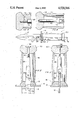
- FIG. 1 illustrates a cross-sectional side view of a knife according to the present invention.
- FIG. 2 is a partial cross-sectional view of the knife hilt of FIG. 1 as seen through line A--A.
- FIG. 3 is a partial cross-sectional view of the knife hilt of FIG. 1 as seen through line B--B.
- FIG. 4 is a partial cross-sectional view of an alternate embodiment of the end cap of a knife hilt according to the present invention.
- FIG. 5 is a partial cross-sectional view of another alternate embodiment of the end cap of a knife hilt according to the present invention.
- FIG. 1 is a side view of a double edged hunting knife or dagger, generally designated by the numeral 10, containing the shear pin hilt according to the present invention. From this external view, the knife 10 appears to be a conventional device in that it is made up of a blade 12, front finger guard 14, handle 16 and front and rear handle caps 18 and 20. However, the partial cut away views of FIGS. 2 and 3 disclose the novel shear pin mechanism of the present invention within the hollow tubular handle member 16.
- the handle member 16 is a hollow tubular element having end caps 18 and 20 enclosing the novel shear pin mechanism.
- the blade 12 passes through the finger guard 14 and front end cap 18 terminating within the hollow handle member 16.
- the terminal end of the blade 12 contains an opening 22 through which shear pin 24 passes.
- Shear pin 24 also passes through openings 26 in the clevis element 28.
- the other end of clevis 28 is threadedly engaged to bolt 30 that passes through opening 32 in the end cap 20.
- FIGS. 4 and 5 illustrate cut-away views of alternate embodiments of the knife hilt wherein the end caps do not have a hole passing therethrough.
- the alternate embodiment of FIG. 4 involves an end cap 34 being drilled and tapped on the inner side such that a threaded stud 36 is used to complete the tension applying connection with the clevis member 38 within hollow handle 40.
- the alternate embodiment of FIG. 5 involves an identical drilled and tapped end cap 42 pivotally engaged to the hollow handle 44 wherein a clevis 46 with threaded shaft 48 completes the tension applying connection.
- the inner circumference of the hollow handles and end caps are circular such that the knife can be assembled and tension applied to the hilt by merely spinning the end cap.
- FIGS. 4 and 5 are of particular interest in that they eliminate a machining step during the fabrication of the end cap and in the case of the embodiment of FIG. 5, one component.
- the knife hilt (or tool handle) will function in a normal manner with one additional feature attributable to the presence of the shear pin mechanism. If the blade of the knife is struck against a hard surface or object with sufficient force to otherwise break the blade, which customarily will occur at the narrow region passing through the handle, instead of breaking the blade, the shear pin will break. Thus, the risk of irreversible damage to the knife on severe impact is significantly reduced. If the shear pin breaks, it can be easily replaced by disassembling and reassembling the hilt (with a new shear pin) as previously described.
- the knife or tool handle can be manufactured out of any of the conventional materials provided the handle or hilt is hollow such as to accommodate the shear pin mechanism.
- the position of the shear pin can be selected according to the anticipated maximum force and torque that the unit will withstand.
- the relative orientation of the clevis and shear pin can also be selected according to the anticipated impact such that the shear force will selectively break the shear pin rather than the blade.
- the shear pin in this specific embodiment is perpendicular to the flat surface of the blade.
- the shear pin and clevis can be easily modified such that the pin is perpendicular to the anticipated force created by the impact.
- the handle or hilt surrounding and enclosing the shear pin mechanism can be made by any of the methods well known in the art.
- the device can involve any of a combination of elements also well known in the art.
- the illustrated knife hilt can involve the finger guard and/or front end piece as well as the handle being assembled or fabricated as a single element.
- the fork element of the clevis can be directed towards the rear of the hilt or handle with use of additional threaded members or fasteners.
Landscapes
- Engineering & Computer Science (AREA)
- Mechanical Engineering (AREA)
- Life Sciences & Earth Sciences (AREA)
- Forests & Forestry (AREA)
- Knives (AREA)
Abstract
An impact-resistant knife hilt comprising a hollow handle containing a clevis with shear pin connecting the knife blade to the end cap of the knife handle. Such a knife is readily assembled and disassembled by spinning the end cap while the hilt with shear pin reduces the risk of blade breakage upon impact.
Description
This application is a continuation-in-part of application Ser. No. 515,200 filed July 20, 1983, now U.S. Pat. No. 4,458,420.
1. Field of the Invention
This invention relates to an impact resistant handle. More specifically, this invention relates to a knife hilt or the like equipped with a shear pin mechanism.
2. Description of the Prior Art
The basic concept of providing a knife with a hilt or handle that can be disassembled and reassembled is generally known. Usually the purpose for such a structure is to facilitate manufacturing of the knife with the additional benefit of enhancing the ability to clean the structure. One problem that frequently accompanies such a knife and knives in general is the fact that upon severe impact, the knife blade will tend to either break or bend, particularly at the point where the blade decreases in size as it enters the hilt. Various other types of hand tools also exhibit this tendency. The customary approach to reducing the incidence of breakage is to strengthen the device by increasing the physical size of the blade or tool within the handle. However, this has the disadvantage of altering the balance and dimensions of the tool. Thus, ideally, it would be useful to have a shock or impact resistant handle without significant increase in the mass or relative distribution of mass of the tool.
In view of the prior art problems, I have discovered an improved impact-resistant handle with tool comprising:
(a) a substantially hollow tubular handle member;
(b) a first end piece covering one end of the hollow tubular handle member wherein the first end piece has an opening therein for accepting one end of a tool;
(c) a tool wherein one end of the tool extends through the opening in the first end piece terminating within the handle member;
(d) a second end piece covering the other end of the hollow tubular handle wherein the second end piece is adapted to threadably engage to a shear pin means; and
(e) a shear pin means within the handle member wherein the shear pin means is attached to the terminal end of the tool and is threadably engaged to the second end piece such as to apply compressive force to the handle through the shear pin means and hold the handle and tool in an assembled state.
Further according to the present invention, the shear pin means comprises a clevis attached to the terminal end of the tool within the handle by use of a shear pin passing through this clevis and tool and wherein the clevis also threadably engages to the end cap of the handle. Preferably, the tool according to the present invention is a knife blade having a hole or opening at the end opposite to the point of the knife for accepting the shear pin.
It is an object of the present invention to provide a knife hilt or tool handle that can be easily assembled and disassembled and also provide improved impact resistance, thus reducing the incidence of breakage. It is a further object of the present invention to provide the impact resistance by use of a shear pin which breaks before the tool or handle would break. Fulfillment of these objects and the presence and fulfillment of other objects will be apparent upon complete reading of the specification and claims when taken in conjunction with the attached drawings.
FIG. 1 illustrates a cross-sectional side view of a knife according to the present invention.
FIG. 2 is a partial cross-sectional view of the knife hilt of FIG. 1 as seen through line A--A.
FIG. 3 is a partial cross-sectional view of the knife hilt of FIG. 1 as seen through line B--B.
FIG. 4 is a partial cross-sectional view of an alternate embodiment of the end cap of a knife hilt according to the present invention.
FIG. 5 is a partial cross-sectional view of another alternate embodiment of the end cap of a knife hilt according to the present invention.
The improved shear pin knife hilt and impact resistant tool handle of the present invention, how they operate and differ from previously known devices and the advantages associated with their use can perhaps be best explained and understood by reference to the drawings. FIG. 1 is a side view of a double edged hunting knife or dagger, generally designated by the numeral 10, containing the shear pin hilt according to the present invention. From this external view, the knife 10 appears to be a conventional device in that it is made up of a blade 12, front finger guard 14, handle 16 and front and rear handle caps 18 and 20. However, the partial cut away views of FIGS. 2 and 3 disclose the novel shear pin mechanism of the present invention within the hollow tubular handle member 16. In describing this feature and the invention as a whole, it should be kept in mind that although the drawings illustrate and the following discussion is limited to a knife hilt, the invention relates broadly to any hand tool wherein breakage upon impact is a problem. As such, the following discussion should be viewed as encompassing more than merely knife hilts
As illustrated in FIGS. 2 and 3, the handle member 16 is a hollow tubular element having end caps 18 and 20 enclosing the novel shear pin mechanism. In the specific embodiment illustrated herein, the blade 12 passes through the finger guard 14 and front end cap 18 terminating within the hollow handle member 16. The terminal end of the blade 12 contains an opening 22 through which shear pin 24 passes. Shear pin 24 also passes through openings 26 in the clevis element 28. The other end of clevis 28 is threadedly engaged to bolt 30 that passes through opening 32 in the end cap 20.
By threading bolt 30 into the clevis 28, tension is applied between the blade 12 and the end cap 18 of the shear pin mechanism. This tension in turn creates a compressive force on the finger guard 14, end caps 18 and 20 and hollow tubular handle 16, thus holding the knife and hilt in an assembled state. To disassemble the knife, bolt 30 is merely removed from the clevis 28 and the remaining pieces essentially fall apart. To reassemble, the pieces are stacked on the blade and the bolt is inserted through the end cap and threaded into the clevis with sufficient force to hold the handle together
FIGS. 4 and 5 illustrate cut-away views of alternate embodiments of the knife hilt wherein the end caps do not have a hole passing therethrough. The alternate embodiment of FIG. 4 involves an end cap 34 being drilled and tapped on the inner side such that a threaded stud 36 is used to complete the tension applying connection with the clevis member 38 within hollow handle 40. Similarly, the alternate embodiment of FIG. 5 involves an identical drilled and tapped end cap 42 pivotally engaged to the hollow handle 44 wherein a clevis 46 with threaded shaft 48 completes the tension applying connection. In both embodiments of FIGS. 4 and 5, the inner circumference of the hollow handles and end caps are circular such that the knife can be assembled and tension applied to the hilt by merely spinning the end cap. Similarly, the knife hilt can be disassembled by unthreading the end cap. These embodiments of FIGS. 4 and 5 are of particular interest in that they eliminate a machining step during the fabrication of the end cap and in the case of the embodiment of FIG. 5, one component.
In operation, the knife hilt (or tool handle) will function in a normal manner with one additional feature attributable to the presence of the shear pin mechanism. If the blade of the knife is struck against a hard surface or object with sufficient force to otherwise break the blade, which customarily will occur at the narrow region passing through the handle, instead of breaking the blade, the shear pin will break. Thus, the risk of irreversible damage to the knife on severe impact is significantly reduced. If the shear pin breaks, it can be easily replaced by disassembling and reassembling the hilt (with a new shear pin) as previously described.
The knife or tool handle can be manufactured out of any of the conventional materials provided the handle or hilt is hollow such as to accommodate the shear pin mechanism. The position of the shear pin can be selected according to the anticipated maximum force and torque that the unit will withstand. The relative orientation of the clevis and shear pin can also be selected according to the anticipated impact such that the shear force will selectively break the shear pin rather than the blade. Thus, as illustrated, the shear pin in this specific embodiment is perpendicular to the flat surface of the blade. For a different application, the shear pin and clevis can be easily modified such that the pin is perpendicular to the anticipated force created by the impact.
The handle or hilt surrounding and enclosing the shear pin mechanism can be made by any of the methods well known in the art. The device can involve any of a combination of elements also well known in the art. Thus, the illustrated knife hilt can involve the finger guard and/or front end piece as well as the handle being assembled or fabricated as a single element. Similarly, the fork element of the clevis can be directed towards the rear of the hilt or handle with use of additional threaded members or fasteners.
Having thus described the preferred embodiments with a certain degree of particularity, it is manifest that many changes can be made in the details of construction, arrangement and fabrication of the elements and their uses without departing from the spirit and scope of this invention. Therefore, it is to be understood that the invention is not limited to the embodiment set forth herein for purposes of exemplification, but is to be limited only by the scope of the attached claims, including a full range of equivalents to which each element thereof is entitled.
Claims (3)
1. An impact-resistant handle with tool comprising:
(a) a substantially hollow tubular handle member;
(b) a first end piece covering one end of said hollow tubular handle member wherein said first end piece has an opening therein for accepting one end of a tool;
(c) a tool wherein one end of said tool extends through said opening in said first end piece terminating within said handle member;
(d) a second end piece covering the other end of said hollow tubular handle wherein said second end piece includes an internally threaded bore to threadably engage one end of a shear pin means; and
(e) a shear pin means within said handle member wherein the other end of said shear pin means is attached to said terminal end of said tool and said one end is threadably engaged to said internally threaded bore in said second end piece such as to apply compressive force to said handle through said shear pin means and hold said handle and tool in an assembled state.
2. An impact-resistant handle of claim 1 wherein said shear pin means further comprises a clevis attached to said terminal end of said tool by use of a shear pin and said clevis threadably engages to said internally threaded bore of said second end piece.
3. An impact-resistant handle of claim 2 wherein said tool is a knife blade.
Priority Applications (1)
| Application Number | Priority Date | Filing Date | Title |
|---|---|---|---|
| US06/582,893 US4520566A (en) | 1983-07-20 | 1984-02-23 | Shear pin hilt for knife |
Applications Claiming Priority (2)
| Application Number | Priority Date | Filing Date | Title |
|---|---|---|---|
| US06/515,200 US4458420A (en) | 1983-07-20 | 1983-07-20 | Shear pin hilt for knife |
| US06/582,893 US4520566A (en) | 1983-07-20 | 1984-02-23 | Shear pin hilt for knife |
Related Parent Applications (1)
| Application Number | Title | Priority Date | Filing Date |
|---|---|---|---|
| US06/515,200 Continuation-In-Part US4458420A (en) | 1983-07-20 | 1983-07-20 | Shear pin hilt for knife |
Publications (1)
| Publication Number | Publication Date |
|---|---|
| US4520566A true US4520566A (en) | 1985-06-04 |
Family
ID=27058432
Family Applications (1)
| Application Number | Title | Priority Date | Filing Date |
|---|---|---|---|
| US06/582,893 Expired - Fee Related US4520566A (en) | 1983-07-20 | 1984-02-23 | Shear pin hilt for knife |
Country Status (1)
| Country | Link |
|---|---|
| US (1) | US4520566A (en) |
Cited By (6)
| Publication number | Priority date | Publication date | Assignee | Title |
|---|---|---|---|---|
| US5711079A (en) * | 1995-05-22 | 1998-01-27 | Underwater Kinetics | Corrosion resistant knife |
| US6112418A (en) * | 1998-04-29 | 2000-09-05 | Plato Products, Inc. | Precision shears with breakaway handle |
| WO2003089195A1 (en) * | 2002-04-18 | 2003-10-30 | Benchmade Knife Co. | Method and apparatus for securing a handle to a knife tang |
| US6782626B1 (en) * | 2004-01-06 | 2004-08-31 | Camillus Cutlery Co. | Apparatus and method of assembly of fixed blade knife |
| US20120246946A1 (en) * | 2011-03-31 | 2012-10-04 | Thomas Kreitz | Knife With a Metal End Cap and Method for Fixing the End Cap |
| US8783363B2 (en) | 2012-01-23 | 2014-07-22 | Vetco Gray Inc. | Multifunctional key design for metal seal in subsea application |
Citations (8)
| Publication number | Priority date | Publication date | Assignee | Title |
|---|---|---|---|---|
| GB189601480A (en) * | 1896-01-21 | 1896-10-31 | Edward Griffith Brewer | Improvements in Electric Gas Lighting Apparatus. |
| US881075A (en) * | 1907-03-18 | 1908-03-03 | Jere C Dufresne | Safety connection for taps and chucks. |
| US1099079A (en) * | 1912-01-16 | 1914-06-02 | Charles A Alden | Wrench. |
| US2267325A (en) * | 1938-10-17 | 1941-12-23 | Russell Harrington Cutlery Com | Cutlery article |
| US2681503A (en) * | 1952-07-16 | 1954-06-22 | Bentham W Stradley | Knockdown razor |
| US3241237A (en) * | 1963-03-25 | 1966-03-22 | Edward A Eastman | Releasable retention structure for scabbard-knife combination |
| US3513720A (en) * | 1968-07-26 | 1970-05-26 | Amerace Corp | Breakaway handle |
| US4177352A (en) * | 1978-05-25 | 1979-12-04 | Interpace Corporation | Shear bolt assembly for a load limiting line support for a post insulator |
-
1984
- 1984-02-23 US US06/582,893 patent/US4520566A/en not_active Expired - Fee Related
Patent Citations (8)
| Publication number | Priority date | Publication date | Assignee | Title |
|---|---|---|---|---|
| GB189601480A (en) * | 1896-01-21 | 1896-10-31 | Edward Griffith Brewer | Improvements in Electric Gas Lighting Apparatus. |
| US881075A (en) * | 1907-03-18 | 1908-03-03 | Jere C Dufresne | Safety connection for taps and chucks. |
| US1099079A (en) * | 1912-01-16 | 1914-06-02 | Charles A Alden | Wrench. |
| US2267325A (en) * | 1938-10-17 | 1941-12-23 | Russell Harrington Cutlery Com | Cutlery article |
| US2681503A (en) * | 1952-07-16 | 1954-06-22 | Bentham W Stradley | Knockdown razor |
| US3241237A (en) * | 1963-03-25 | 1966-03-22 | Edward A Eastman | Releasable retention structure for scabbard-knife combination |
| US3513720A (en) * | 1968-07-26 | 1970-05-26 | Amerace Corp | Breakaway handle |
| US4177352A (en) * | 1978-05-25 | 1979-12-04 | Interpace Corporation | Shear bolt assembly for a load limiting line support for a post insulator |
Cited By (7)
| Publication number | Priority date | Publication date | Assignee | Title |
|---|---|---|---|---|
| US5711079A (en) * | 1995-05-22 | 1998-01-27 | Underwater Kinetics | Corrosion resistant knife |
| US6112418A (en) * | 1998-04-29 | 2000-09-05 | Plato Products, Inc. | Precision shears with breakaway handle |
| WO2003089195A1 (en) * | 2002-04-18 | 2003-10-30 | Benchmade Knife Co. | Method and apparatus for securing a handle to a knife tang |
| US20030221323A1 (en) * | 2002-04-18 | 2003-12-04 | Deasis Les | Method and apparatus for securing a handle to a knife tang |
| US6782626B1 (en) * | 2004-01-06 | 2004-08-31 | Camillus Cutlery Co. | Apparatus and method of assembly of fixed blade knife |
| US20120246946A1 (en) * | 2011-03-31 | 2012-10-04 | Thomas Kreitz | Knife With a Metal End Cap and Method for Fixing the End Cap |
| US8783363B2 (en) | 2012-01-23 | 2014-07-22 | Vetco Gray Inc. | Multifunctional key design for metal seal in subsea application |
Similar Documents
| Publication | Publication Date | Title |
|---|---|---|
| US4458420A (en) | Shear pin hilt for knife | |
| US5722168A (en) | Saw blade securing mechanism | |
| US2475268A (en) | Toolholder | |
| US5245737A (en) | Cotter pin extractor kit apparatus | |
| US2938266A (en) | Oblique cutting plier | |
| US4090420A (en) | Glass breaking pliers | |
| US6598300B2 (en) | Structure for a locating pivot of shears | |
| US20180125196A1 (en) | Nail clipper | |
| US2280463A (en) | Combination tool | |
| US736741A (en) | Glazier's tool. | |
| US2330013A (en) | Cotter pin spreader | |
| US5930900A (en) | Scissors | |
| AU2020203713B2 (en) | Wrench with threaded end bits | |
| US2527735A (en) | Rivet cutter | |
| US6066052A (en) | Golf club with a laser sight | |
| US2619860A (en) | Flexible tool with predetermined overload yielding means | |
| DK200101378A (en) | Screwdriver protects screw, bolt or similar against torque overload during fastening and comprises shank, engagement and intnermediate parts | |
| US2464372A (en) | Torque measuring screw driver | |
| US2360531A (en) | Lock nut | |
| US840832A (en) | Handled implement. | |
| US5863158A (en) | Power drill leverage tool assembly | |
| US3935889A (en) | Hand tools | |
| US3064355A (en) | Carbide thread plug shock absorber | |
| US1206014A (en) | Screw-driver. | |
| TW202019630A (en) | Multifunctional torque wrench capable of reducing volume of turning member and main body convenient for storing and carrying |
Legal Events
| Date | Code | Title | Description |
|---|---|---|---|
| REMI | Maintenance fee reminder mailed | ||
| LAPS | Lapse for failure to pay maintenance fees | ||
| STCH | Information on status: patent discontinuation |
Free format text: PATENT EXPIRED DUE TO NONPAYMENT OF MAINTENANCE FEES UNDER 37 CFR 1.362 |
|
| FP | Lapsed due to failure to pay maintenance fee |
Effective date: 19890604 |