US4482127A - Valve structure - Google Patents

Valve structure Download PDF

Info

Publication number
US4482127A
US4482127A US06/264,338 US26433881A US4482127A US 4482127 A US4482127 A US 4482127A US 26433881 A US26433881 A US 26433881A US 4482127 A US4482127 A US 4482127A
Authority
US
United States
Prior art keywords
valve
fluid
chamber
piston
relief
Prior art date
Legal status (The legal status is an assumption and is not a legal conclusion. Google has not performed a legal analysis and makes no representation as to the accuracy of the status listed.)
Expired - Fee Related
Application number
US06/264,338
Inventor
Carl H. Hafele
Current Assignee (The listed assignees may be inaccurate. Google has not performed a legal analysis and makes no representation or warranty as to the accuracy of the list.)
Alcatel USA Corp
Original Assignee
Individual
Priority date (The priority date is an assumption and is not a legal conclusion. Google has not performed a legal analysis and makes no representation as to the accuracy of the date listed.)
Filing date
Publication date
Application filed by Individual filed Critical Individual
Application granted granted Critical
Publication of US4482127A publication Critical patent/US4482127A/en
Assigned to ALCATEL USA, CORP. reassignment ALCATEL USA, CORP. CHANGE OF NAME (SEE DOCUMENT FOR DETAILS). Assignors: U.S. HOLDING COMPANY, INC.
Anticipated expiration legal-status Critical
Expired - Fee Related legal-status Critical Current

Links

Images

Classifications

    • FMECHANICAL ENGINEERING; LIGHTING; HEATING; WEAPONS; BLASTING
    • F16ENGINEERING ELEMENTS AND UNITS; GENERAL MEASURES FOR PRODUCING AND MAINTAINING EFFECTIVE FUNCTIONING OF MACHINES OR INSTALLATIONS; THERMAL INSULATION IN GENERAL
    • F16KVALVES; TAPS; COCKS; ACTUATING-FLOATS; DEVICES FOR VENTING OR AERATING
    • F16K31/00Actuating devices; Operating means; Releasing devices
    • F16K31/12Actuating devices; Operating means; Releasing devices actuated by fluid
    • F16K31/122Actuating devices; Operating means; Releasing devices actuated by fluid the fluid acting on a piston
    • F16K31/1221Actuating devices; Operating means; Releasing devices actuated by fluid the fluid acting on a piston one side of the piston being spring-loaded

Definitions

  • ON-OFF valves for compressible fluid media have been provided in the past which are actuated by the pressure of the fluid they control, the valve spool being connected to an actuating piston movable within a cylindrical relief chamber and to a damping piston, usually coaxial with the actuating piston, reciprocable in a cylindrical damping chamber.
  • the actuating piston is subjected to the pressure of the compressible medium controlled by the valve to actuate the valve in response to a reduction in pressure in the aforesaid relief chamber in which the actuating piston reciprocates.
  • valves of this type are known. They are used as either quick-closing valves serving to shut off sections of a pipeline in the event of dangerous operating conditions arising, such as line breaks or the like, or as quick-opening valves responding to excess pressure. Forces for actuating the valve can be produced by an actuating piston which experiences either the pressure of the flow medium itself or a reduction in such pressure.
  • valves of this type are primarily used for safety purposes, they must be very reliable in operation. It is for this reason that such valves are often of a size and design to insure that the forces which actuate them are much larger than necessary so that the valve operates satisfactorily even when the valve spool or the like has a tendency to stick or becomes difficult to move for any reason once the valve has been in use for a period of time.
  • a valve is provided of the type in which axially-aligned actuating and damping pistons are disposed within cylindrical relief and damping chambers, respectively, and are connected to a valve element engageable with a valve seat disposed between inlet and outlet valve ports.
  • the actuating piston, the damping piston and the valve element, comprising the valve spool are coaxial and housed within a common valve body. Forces exerted on the valve spool by the fluid within the relief and damping chambers are equalized under normal operating conditions. However, by reducing the pressure in the relief chamber, the valve can be actuated to assume either an open or closed condition, depending upon the particular design of the valve.
  • the pressure within the damping chamber remains relatively constant when the valve is actuated, actuation of the valve being totally dependent upon a reduction in pressure in the relief chamber.
  • a restricted passage interconnects the relief and damping chambers such that, while the pressure in the damping chamber will not be reduced during a normal valve actuation, it will be reduced slowly and will assist in the valve actuation in the event of a sticking or otherwise difficult-to-operate valve condition.
  • the damping chamber is used as an additional relief chamber (i.e., the effective surface area presented to the fluid medium is increased by the effective surface area of the damping piston, in addition to that of the actuating piston).
  • Appropriate dimensioning of the restricted passageway assures that the damping chamber will come into operation as an additional relief chamber only when the valve has failed to operate after the normal actuation time period.
  • the damping piston and relief piston are coaxial, stepped pistons, the damping piston being of larger diameter than the relief piston, and the damping chamber being separated from the relief chamber by a sealing element in the form of a piston ring disposed on the periphery of the relief piston.
  • a second pair of piston rings surrounds the damping piston to form an annular gap which is connected to the relief chamber through the aforesaid restricted passageway.
  • the aforesaid restricted passageway connecting the relief and damping chambers incorporates a variable restriction, whereby flow through the restriction can be controlled as well as the operating time of the valve.
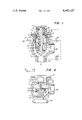
  • FIG. 1 is a cross-sectional view, in elevation, of one embodiment of the invention wherein the valve is a quick-closing valve;
  • FIG. 2 is an elevational cross-sectional view of another embodiment of the invention wherein the valve comprises a quick-opening valve.
  • valve shown includes a valve body or casing 1 and an upper cover 2 which is secured to the main valve body 1 by means of screws or bolts, not shown.
  • cover 2 Depending downwardly from the cover 2 is a cylindrical valve insert 3 which receives the valve operating elements about to be described.
  • first cylindrical cavity 4 Formed in the insert 3 is upper or first cylindrical cavity 4 and a communicating lower cylindrical cavity 5 at a smaller diameter.
  • the bottom termination of the insert 3 is in the form of a projection having a surface 6 adapted to abut the upper periphery of a valve element 7. When the valve is in a closed position, a sealing surface on valve element 7 engages annular valve seat 8 formed in the body 1.
  • Valve element 7 is part of a valve spool which includes actuating piston 9 coaxial with and connected to a larger diameter damping piston 10.
  • Piston 9 is reciprocable within the cylinder 5 and is surrounded by piston ring 11 which abuts the walls of the cylinder 5.
  • the piston ring 11 separates two operating chambers (i.e., the relief chamber 12 and damping chamber 13) one from the other but at the same time can permit a certain amount of leakage from one chamber to the other.
  • the piston 10 is provided with two spaced piston rings 14 separated by an annular gap between the periphery of the piston and the periphery of chamber 4.
  • a passageway 15 of restricted cross section is formed in the adjoining pistons 9 and 10 and extends from the annular gap formed between the piston rings 14 to the relief chamber 12.
  • Projecting upwardly from the upper surface of the piston 10 is a cylindrical projection 16 which terminates in a flanged portion 17.
  • a helical compression spring 19 is disposed between flange 17 and annular shoulder 18 formed in the cover 2 and acts to hold the valve element 7 in an open position wherein it is separated from the valve seat 8.
  • the valve body 1 is provided with a valve inlet port 23 and a valve outlet port 24 between which is the valve seat 8.
  • Auxiliary lines which extend from the inlet port 23 and the outlet port 24 are shown in broken lines in the drawing and are connected to a bore 25 in the cover 2. These auxiliary lines or conduits insure that the space above the damping piston is filled with the medium controlled by the valve at the maximum operating pressure.
  • Check valves 26 in the auxiliary conduits insure that, when the valve is in a closed condition, there can be no transfer of fluid from the inlet port 23 to the outlet port 24.
  • a discharge duct 20 which communicates with the relief chamber 12 and is connected at its other end throrough control valve 21 to a low pressure conduit 22.
  • the passageway 15 formed in the pistons 9 and 10 is connected through a transverse duct 27 to the damping chamber 13.
  • the damping chamber 13 and the relief chamber 12 are in communication with each other.
  • the duct 27 is provided with a variable restriction, not shown, which enables the issuing quantity of fluid medium to be varied as well as the closing time of the valve.
  • valves shown in FIG. 1 Operation of the valve shown in FIG. 1 is as follows: When the valve is open, all of its internal chambers are accessible to the flow medium and are at the pressure existing at the valve inlet 23. This occurs, as regards chambers 12 and 13, by virtue of a certain amount of leakage around the piston rings 11 and 14 as explained above.
  • the control valve 21 In order to close the valve, the control valve 21 is opened, thereby reducing the pressure in the relief chamber 12. Under these conditions, the upward force on the valve spool is less than the downward force exerted by the fluid passing into the valve body through port 25. As a result, the valve spool including valve element 7 are moved rapidly from an opened position to a closed position. The closing operation is damped since the movement of the damping piston reduces the volume of the compressible medium in the damping chamber 13. When the valve is in proper working order, and because of the relatively short actuation time, there is no appreciable relief of the damping chamber via the passageway 15 during normal operation.
  • the size and design of the duct passageway 15 is such that after the valve 21 has opened, pressure in the annular gap between the piston rings 14 decreases to the pressure in the relief chamber 12, such that fluid cannot pass from the chamber above the damping piston 10 into damping chamber 13 in normal operation, nor in conditions of operation of reduced effectiveness.
  • the bore 27, which comprises a restriction of variable cross section as described above, provides a means for controlling the time for pressure equalization between the damping chamber and the relief chamber 12 when there is a tendency of the spool valve to stick and in addition, it can control the speed of closure during normal or abnormal conditions of operation.
  • FIG. 2 shows another embodiment of the invention as applied to a quick-opening valve. Since many of the elements in FIG. 2 correspond to those of FIG. 1, they are identified by like reference numerals. Operation as regards adding the damping chamber 13 as a relief chamber in order to increase the actuating force (which in the case of FIG. 2 is the opening force) is the same as for the quick-closing valve shown in FIG. 1. That is, when the valve element or spool tends to stick, fluid from damping chamber 13 flows to the relief chamber 5 through restriction 27 and through the valve 21. As in the embodiment of FIG. 1, the restricted orifice 27 comprises a means for varying the opening time for the quick-opening valve of FIG. 2.

Landscapes

  • Engineering & Computer Science (AREA)
  • General Engineering & Computer Science (AREA)
  • Mechanical Engineering (AREA)
  • Safety Valves (AREA)
  • Fluid-Damping Devices (AREA)
  • Fluid-Driven Valves (AREA)
  • Valve Device For Special Equipments (AREA)

Abstract

A valve of the type which is actuated under the pressure of the medium it controls and in which axially-aligned actuating and damping pistons are disposed within cylindrical relief and damping chambers and are connected to a valve element engageable with a valve seat disposed between inlet and outlet valve ports. The actuating piston acts under the pressure of the medium it controls to actuate the valve element in response to a reduction in pressure in the relief chamber. The invention itself resides in the provision of a restricted passageway which interconnects the relief and damping chambers whereby the pressure in the damping chamber will be reduced slowly in response to a reduction in pressure in the relief chamber whereby, if the valve should stick or otherwise become slow-acting, the pressure within the damping chamber will assist and insure that the valve is actuated even though it may not be in the best operating condition.

Description

CROSS-REFERENCES TO RELATED APPLICATIONS
This application is a division of copending application Ser. No. 21,060, filed Mar. 16, 1979, now U.S. Pat. No. 4,309,021.
BACKGROUND OF THE INVENTION
As is known, ON-OFF valves for compressible fluid media have been provided in the past which are actuated by the pressure of the fluid they control, the valve spool being connected to an actuating piston movable within a cylindrical relief chamber and to a damping piston, usually coaxial with the actuating piston, reciprocable in a cylindrical damping chamber. The actuating piston is subjected to the pressure of the compressible medium controlled by the valve to actuate the valve in response to a reduction in pressure in the aforesaid relief chamber in which the actuating piston reciprocates.
Various constructions of valves of this type are known. They are used as either quick-closing valves serving to shut off sections of a pipeline in the event of dangerous operating conditions arising, such as line breaks or the like, or as quick-opening valves responding to excess pressure. Forces for actuating the valve can be produced by an actuating piston which experiences either the pressure of the flow medium itself or a reduction in such pressure.
Since valves of this type are primarily used for safety purposes, they must be very reliable in operation. It is for this reason that such valves are often of a size and design to insure that the forces which actuate them are much larger than necessary so that the valve operates satisfactorily even when the valve spool or the like has a tendency to stick or becomes difficult to move for any reason once the valve has been in use for a period of time.
SUMMARY OF THE INVENTION
It is an object of the present invention to insure that in the event that a valve of the type which has a tendency to stick or otherwise become difficult to move after a period of time, additional forces will automatically become effective to enhance the normal valve operating force and thus make it possible for the valve to operate under conditions where it might not otherwise operate under conditions where it might not otherwise operate after an extended period of use.
In accordance with the invention, a valve is provided of the type in which axially-aligned actuating and damping pistons are disposed within cylindrical relief and damping chambers, respectively, and are connected to a valve element engageable with a valve seat disposed between inlet and outlet valve ports. Typically, the actuating piston, the damping piston and the valve element, comprising the valve spool, are coaxial and housed within a common valve body. Forces exerted on the valve spool by the fluid within the relief and damping chambers are equalized under normal operating conditions. However, by reducing the pressure in the relief chamber, the valve can be actuated to assume either an open or closed condition, depending upon the particular design of the valve. In the usual case, the pressure within the damping chamber remains relatively constant when the valve is actuated, actuation of the valve being totally dependent upon a reduction in pressure in the relief chamber. A restricted passage, however, interconnects the relief and damping chambers such that, while the pressure in the damping chamber will not be reduced during a normal valve actuation, it will be reduced slowly and will assist in the valve actuation in the event of a sticking or otherwise difficult-to-operate valve condition. In this manner, and in the event of sticking or otherwise unsatisfactory operation of the valve when the normal actuating forces cannot move the spool satisfactorily, the damping chamber is used as an additional relief chamber (i.e., the effective surface area presented to the fluid medium is increased by the effective surface area of the damping piston, in addition to that of the actuating piston). Appropriate dimensioning of the restricted passageway assures that the damping chamber will come into operation as an additional relief chamber only when the valve has failed to operate after the normal actuation time period.
In an advantageous embodiment of the invention, the damping piston and relief piston are coaxial, stepped pistons, the damping piston being of larger diameter than the relief piston, and the damping chamber being separated from the relief chamber by a sealing element in the form of a piston ring disposed on the periphery of the relief piston. A second pair of piston rings surrounds the damping piston to form an annular gap which is connected to the relief chamber through the aforesaid restricted passageway. The provision of a direct connection from the annular gap between the aforesaid piston rings on the damping piston to the relief chamber insures that high-pressure fluid will not be transferred from the high-pressure side of the valve to the damping chamber, a condition which would inhibit the required pressure relief of the damping chamber. The invention can be carried into effect in a valve having substantially leak-free piston rings or one in which the piston rings permit a certain amount of leakage, depending upon requirements.
Preferably, the aforesaid restricted passageway connecting the relief and damping chambers incorporates a variable restriction, whereby flow through the restriction can be controlled as well as the operating time of the valve.
The above and other objects and features of the invention will become apparent from the following detailed description taken in connection with the accompanying drawings which form a part of this specification and in which:
FIG. 1 is a cross-sectional view, in elevation, of one embodiment of the invention wherein the valve is a quick-closing valve; and
FIG. 2 is an elevational cross-sectional view of another embodiment of the invention wherein the valve comprises a quick-opening valve.
With reference now to the drawings, and particularly to FIG. 1, the valve shown includes a valve body or casing 1 and an upper cover 2 which is secured to the main valve body 1 by means of screws or bolts, not shown. Depending downwardly from the cover 2 is a cylindrical valve insert 3 which receives the valve operating elements about to be described.
Formed in the insert 3 is upper or first cylindrical cavity 4 and a communicating lower cylindrical cavity 5 at a smaller diameter. The bottom termination of the insert 3 is in the form of a projection having a surface 6 adapted to abut the upper periphery of a valve element 7. When the valve is in a closed position, a sealing surface on valve element 7 engages annular valve seat 8 formed in the body 1.
Valve element 7 is part of a valve spool which includes actuating piston 9 coaxial with and connected to a larger diameter damping piston 10. Piston 9 is reciprocable within the cylinder 5 and is surrounded by piston ring 11 which abuts the walls of the cylinder 5. The piston ring 11 separates two operating chambers (i.e., the relief chamber 12 and damping chamber 13) one from the other but at the same time can permit a certain amount of leakage from one chamber to the other.
In a similar manner, the piston 10 is provided with two spaced piston rings 14 separated by an annular gap between the periphery of the piston and the periphery of chamber 4. A passageway 15 of restricted cross section is formed in the adjoining pistons 9 and 10 and extends from the annular gap formed between the piston rings 14 to the relief chamber 12. Projecting upwardly from the upper surface of the piston 10 is a cylindrical projection 16 which terminates in a flanged portion 17. A helical compression spring 19 is disposed between flange 17 and annular shoulder 18 formed in the cover 2 and acts to hold the valve element 7 in an open position wherein it is separated from the valve seat 8.
The valve body 1 is provided with a valve inlet port 23 and a valve outlet port 24 between which is the valve seat 8. Auxiliary lines which extend from the inlet port 23 and the outlet port 24 are shown in broken lines in the drawing and are connected to a bore 25 in the cover 2. These auxiliary lines or conduits insure that the space above the damping piston is filled with the medium controlled by the valve at the maximum operating pressure. Check valves 26 in the auxiliary conduits insure that, when the valve is in a closed condition, there can be no transfer of fluid from the inlet port 23 to the outlet port 24.
Formed in the outer wall of the valve insert 3 is a discharge duct 20 which communicates with the relief chamber 12 and is connected at its other end throrough control valve 21 to a low pressure conduit 22. The passageway 15 formed in the pistons 9 and 10 is connected through a transverse duct 27 to the damping chamber 13. In this way, it will be appreciated that the damping chamber 13 and the relief chamber 12 are in communication with each other. Preferably, the duct 27 is provided with a variable restriction, not shown, which enables the issuing quantity of fluid medium to be varied as well as the closing time of the valve.
Operation of the valve shown in FIG. 1 is as follows: When the valve is open, all of its internal chambers are accessible to the flow medium and are at the pressure existing at the valve inlet 23. This occurs, as regards chambers 12 and 13, by virtue of a certain amount of leakage around the piston rings 11 and 14 as explained above. In order to close the valve, the control valve 21 is opened, thereby reducing the pressure in the relief chamber 12. Under these conditions, the upward force on the valve spool is less than the downward force exerted by the fluid passing into the valve body through port 25. As a result, the valve spool including valve element 7 are moved rapidly from an opened position to a closed position. The closing operation is damped since the movement of the damping piston reduces the volume of the compressible medium in the damping chamber 13. When the valve is in proper working order, and because of the relatively short actuation time, there is no appreciable relief of the damping chamber via the passageway 15 during normal operation.
On the other hand, if the valve has become difficult to move after a prolonged period of operation, such that the closing force arising from the normal pressure difference is insufficient to actuate the valve, fluid will be transferred from the damping chamber 13 to the relief chamber 12 via the clearance around the piston ring 11 and via the bore 27 and duct 15. As a result, the pressure in the damping chamber 13 drops slowly but surely to the pressure in relief chamber 12. As a result, the differential force acting to close the valve correspondingly increases and causes the valve to close. This feature insures that sufficient reserves of closing force are present when, after prolonged operation, the spool valve does not move as readily as previously.
The size and design of the duct passageway 15 is such that after the valve 21 has opened, pressure in the annular gap between the piston rings 14 decreases to the pressure in the relief chamber 12, such that fluid cannot pass from the chamber above the damping piston 10 into damping chamber 13 in normal operation, nor in conditions of operation of reduced effectiveness.
The bore 27, which comprises a restriction of variable cross section as described above, provides a means for controlling the time for pressure equalization between the damping chamber and the relief chamber 12 when there is a tendency of the spool valve to stick and in addition, it can control the speed of closure during normal or abnormal conditions of operation.
FIG. 2 shows another embodiment of the invention as applied to a quick-opening valve. Since many of the elements in FIG. 2 correspond to those of FIG. 1, they are identified by like reference numerals. Operation as regards adding the damping chamber 13 as a relief chamber in order to increase the actuating force (which in the case of FIG. 2 is the opening force) is the same as for the quick-closing valve shown in FIG. 1. That is, when the valve element or spool tends to stick, fluid from damping chamber 13 flows to the relief chamber 5 through restriction 27 and through the valve 21. As in the embodiment of FIG. 1, the restricted orifice 27 comprises a means for varying the opening time for the quick-opening valve of FIG. 2. Aside from this, the relationship between the operative surfaces of the stepped piston and spool arrangement in FIG. 2 is the same as that in FIG. 1 in that adequate opening force reserves are available, thus assuring that the valve can operate reliably even though it is not in particularly good operating condition.
Although the invention has been shown in connection with certain specific embodiments, it will be readily apparent to those skilled in the art that various changes in form and arrangement of parts may be made to suit requirements without departing from the spirit and scope of the invention.
Claims (6)

I claim as my invention:
1. A normally closed on/off valve for use with compressible fluids, actuated by the fluid which it controls, said valve including:
a valve body having a fluid inlet in one sidewall and having aligned openings in opposed end walls, a first of said openings being a fluid outlet;
a valve seat on the inner rim of said first opening;
a one-piece valve cover including an insert extending into said valve body through the second of said aligned openings, said valve insert being spaced apart from the inner walls at the said valve body, said valve insert defining a first wide cylindrical bore extending from its inner end to its central portion, and defining a second narrow cylindrical bore narrower than the said first cylindrical bore and extending from the inner end of said first cylindrical bore toward the outer end of said valve insert;
a valve spool having aligned a first piston, a second piston and a valve closing element, said valve closing element being normally engaged with the said valve seat; said second piston being in said second bore to define therewith a relief chamber; said first piston being in said first bore to define therewith an annular damping chamber, a fluid passageway extending through said valve spool connecting said damping chamber with said relief chamber; relief conduit means extending from said relief chamber through an outer wall of said valve insert; a relief control valve for regulating the flow of fluid through said relief conduit means; said first piston engaging said first bore in such manner that fluid from inside the valve body can leak into said damping chamber; whereby, when the said control valve is normally closed, the said valve element is tightly seated against the said valve seat as a result of the differential fluid pressure applied to the first piston; and, when the said relief control valve is opened, the said valve closing element is displaced from engagement with the said valve seat to permit said compressible fluid to flow from said fluid inlet through said valve body to said fluid outlet.
2. The valve of claim 1 wherein the said fluid passageway has a variable restriction within the said valve spool to vary the speed of operation of said valve.
3. The normally closed on/off valve of claim 1 whrerin fluid in the said annular damping chamber and fluid in the said relief chamber cooperate to apply a valve closing pressure against the said first piston and against the said second piston respectively.
4. The normally closed on/off valve of claim 1 wherein the said first piston has two spaced apart piston rings engaged with the said wide cylindrical bore; a first fluid passageway in the said piston communicating the space between the said two piston rings with the said relief chamber whereby fluid leaking past one of said piston rings can pass directly to the said relief chamber.
5. In a normally-closed on/off valve for use with compressible fluids and actuated by the fluid which said valve controls, the combination of a valve body having a fluid inlet, a fluid outlet and a valve seat on the inner rim of said fluid outlet, a one-piece cover including a cylindrical insert extending into said valve body and being spaced from the inner walls of the valve body, a valve spool reciprocable within said cylindrical insert and having a valve closing element normally engaged with said valve seat, means for maintaining said valve closing element in engagement with said valve seat, said cover a first cylindrical bore adjacent the outer end of the insert and defining a relief chamber and a second cylindrical bore adjacent the inner end of the insert near the valve seat and defining a damping chamber which individually apply fluid pressure of the fluid being controlled against distinct surfaces of said valve spool, the relief chamber and the damping chamber being interconnected and the damping chamber being essentially isolated from the fluid which the valve controls by a direct connection therebetween such that the damping chamber can become an additional relief chamber, control valve means for rapidly releasing fluid from said relief chamber to rapidly unseat the valve closing element, and flow restriction means between said damping chamber and said relief chamber to release fluid slowly to seat the valve closing element.
6. The normally closed on/off valve of claim 5 wherein the said damping chamber and the relief chamber generate a combined opening force to move the valve spool away from the said fluid outlet.
US06/264,338 1978-03-18 1981-05-18 Valve structure Expired - Fee Related US4482127A (en)

Applications Claiming Priority (2)

Application Number Priority Date Filing Date Title
DE2811879 1978-03-18
DE2811879A DE2811879C2 (en) 1978-03-18 1978-03-18 Switching valve controlled by its own medium

Related Parent Applications (1)

Application Number Title Priority Date Filing Date
US06/021,060 Division US4309021A (en) 1978-03-18 1979-03-16 Valve structure

Publications (1)

Publication Number Publication Date
US4482127A true US4482127A (en) 1984-11-13

Family

ID=6034822

Family Applications (2)

Application Number Title Priority Date Filing Date
US06/021,060 Expired - Lifetime US4309021A (en) 1978-03-18 1979-03-16 Valve structure
US06/264,338 Expired - Fee Related US4482127A (en) 1978-03-18 1981-05-18 Valve structure

Family Applications Before (1)

Application Number Title Priority Date Filing Date
US06/021,060 Expired - Lifetime US4309021A (en) 1978-03-18 1979-03-16 Valve structure

Country Status (5)

Country Link
US (2) US4309021A (en)
JP (1) JPS54125533A (en)
DE (1) DE2811879C2 (en)
FR (1) FR2420069A1 (en)
GB (1) GB2016655B (en)

Cited By (9)

* Cited by examiner, † Cited by third party
Publication number Priority date Publication date Assignee Title
US4610423A (en) * 1984-03-06 1986-09-09 Toshiba Kikai Kabushiki Kaisha Poppet valve
US4785851A (en) * 1987-07-20 1988-11-22 Mks Instruments Inc. Vacuum security valve having a buffer volume
US6073651A (en) * 1996-01-19 2000-06-13 Siemens Aktiengesellschaft Damped valve
US20060283503A1 (en) * 2003-07-23 2006-12-21 Mccausland Andrew J Poppet type flow control valve
US20080048141A1 (en) * 2006-08-23 2008-02-28 Gammon James H Pilot valve
DE102012001954A1 (en) * 2012-02-02 2013-08-08 Robert Bosch Gmbh Valve assembly with pilot pump
US20150210243A1 (en) * 2014-01-28 2015-07-30 Robert Bosch Gmbh Device and method for controlling a volume flow of a stored pressurized medium for the purpose of activating an impact protection device as well as a device for activating an impact protection device
US20180266421A1 (en) * 2015-01-15 2018-09-20 Atlas Copco Airpower, Naamloze Vennootschap Inlet valve and vacuum pump provided with such an inlet valve
US20190211938A1 (en) * 2016-09-21 2019-07-11 Knorr-Bremse Systeme Fuer Nutzfahrzeuge Gmbh Minimum Pressure Valve for a Screw Compressor for a Vehicle, in Particular a Utility Vehicle

Families Citing this family (10)

* Cited by examiner, † Cited by third party
Publication number Priority date Publication date Assignee Title
DE3447380A1 (en) * 1984-12-24 1986-07-03 Mannesmann Rexroth GmbH, 8770 Lohr Device for securing a conduit leading to a load
DE3602362A1 (en) * 1986-01-27 1987-07-30 Man Nutzfahrzeuge Gmbh VALVE ARRANGEMENT FOR A HYDRAULIC PRESSURE STORAGE
DE3729222A1 (en) * 1987-09-02 1989-03-16 Wabco Westinghouse Fahrzeug ELECTROMAGNETICALLY ACTUABLE VALVE DEVICE
JPH0342831U (en) * 1989-09-06 1991-04-23
SE468721B (en) * 1991-07-04 1993-03-08 Flaekt Ab VALVE DEVICE FOR GENERATING SHORT-TERM PRESSURE PULSES EXAMPLE FOR BLEASING BASIC FILTER ELEMENTS
JPH05346025A (en) * 1991-10-07 1993-12-27 Hitoshi Mori Multi-functional beam member
US8256738B2 (en) 2007-09-13 2012-09-04 John Leslie Johnson Double action directional fluid flow valve
US8857644B2 (en) * 2008-11-26 2014-10-14 B.E. Inventive, Llc Container
US12442168B2 (en) * 2020-07-24 2025-10-14 Sloan Valve Company Flushometer system
CA3197872A1 (en) * 2022-05-09 2023-11-09 Palamar Industries Inc. Piston for adjustable pressure reducing valve and an adjustable pressure reducing valve

Citations (11)

* Cited by examiner, † Cited by third party
Publication number Priority date Publication date Assignee Title
US1297836A (en) * 1918-03-16 1919-03-18 David E Gulick Flushing-valve.
US1501331A (en) * 1918-04-26 1924-07-15 David E Gulick Flushing device
US1874793A (en) * 1932-08-30 nightingale et a
US2329001A (en) * 1941-11-25 1943-09-07 Randolph B Delmore Pilot operated valve
US2480712A (en) * 1945-04-07 1949-08-30 Parker Appliance Co Fluid pressure operated valve
US2532123A (en) * 1945-03-21 1950-11-28 William E Shafer Pressure operated valve
US3063423A (en) * 1961-08-17 1962-11-13 Gen Precision Inc Seal means for hydraulic actuator
US3177861A (en) * 1963-07-29 1965-04-13 Southwest Res Inst Internal combustion engine
US3862738A (en) * 1972-04-17 1975-01-28 Hydromatik Gmbh Two-way valve of the seated type
US4149565A (en) * 1977-02-02 1979-04-17 International Harvester Company Pilot controlled poppet valve assembly
US4227674A (en) * 1977-06-30 1980-10-14 Grant Jr Walter H Liquid metering valve

Family Cites Families (13)

* Cited by examiner, † Cited by third party
Publication number Priority date Publication date Assignee Title
US506221A (en) * 1893-10-10 Closet-flushing device
DE7208994U (en) * 1972-08-24 Rosista Gmbh Valve, especially for the beverage industry
US1260100A (en) * 1916-04-21 1918-03-19 Louis N Udell Gas-compressor.
US1846483A (en) * 1930-05-07 1932-02-23 American Valve And Meter Compa Water hammer and relief valve
US2250464A (en) * 1939-12-08 1941-07-29 Boynton Alexander Differential stage lift flow device
US2869500A (en) * 1956-11-21 1959-01-20 Ernest J Svenson Hydraulic valve control for bilge discharge
DE1107038B (en) * 1959-02-12 1961-05-18 Basf Ag Drive device for glandless shut-off or control devices, especially for high pressures
DE1179434B (en) * 1960-09-27 1964-10-08 Wijk & Boerma N V Van Pressure medium drive for a valve or similar locking device
DE1177444B (en) * 1961-01-19 1964-09-03 Boehler & Co Ag Geb Device for damping the closing or opening movement of a valve or the like that is pressurized via a drive piston.
GB1195178A (en) * 1969-03-18 1970-06-17 Hills Mccanna Co Fluid Actuated Diaphragm Valve.
US3672628A (en) * 1970-11-25 1972-06-27 Westinghouse Electric Corp Controller for a back seated valve
CA1025836A (en) * 1974-07-22 1978-02-07 Norman F. Prescott Closing assist for valves
SE7603831L (en) * 1976-03-31 1977-10-01 Sund Akesson Ab DEVICE FOR THE REGULATION OF THE LIQUID RIVER

Patent Citations (11)

* Cited by examiner, † Cited by third party
Publication number Priority date Publication date Assignee Title
US1874793A (en) * 1932-08-30 nightingale et a
US1297836A (en) * 1918-03-16 1919-03-18 David E Gulick Flushing-valve.
US1501331A (en) * 1918-04-26 1924-07-15 David E Gulick Flushing device
US2329001A (en) * 1941-11-25 1943-09-07 Randolph B Delmore Pilot operated valve
US2532123A (en) * 1945-03-21 1950-11-28 William E Shafer Pressure operated valve
US2480712A (en) * 1945-04-07 1949-08-30 Parker Appliance Co Fluid pressure operated valve
US3063423A (en) * 1961-08-17 1962-11-13 Gen Precision Inc Seal means for hydraulic actuator
US3177861A (en) * 1963-07-29 1965-04-13 Southwest Res Inst Internal combustion engine
US3862738A (en) * 1972-04-17 1975-01-28 Hydromatik Gmbh Two-way valve of the seated type
US4149565A (en) * 1977-02-02 1979-04-17 International Harvester Company Pilot controlled poppet valve assembly
US4227674A (en) * 1977-06-30 1980-10-14 Grant Jr Walter H Liquid metering valve

Cited By (14)

* Cited by examiner, † Cited by third party
Publication number Priority date Publication date Assignee Title
US4610423A (en) * 1984-03-06 1986-09-09 Toshiba Kikai Kabushiki Kaisha Poppet valve
US4785851A (en) * 1987-07-20 1988-11-22 Mks Instruments Inc. Vacuum security valve having a buffer volume
US6073651A (en) * 1996-01-19 2000-06-13 Siemens Aktiengesellschaft Damped valve
US8011639B2 (en) * 2003-07-23 2011-09-06 Goyen Controls Co. Pty Ltd. Poppet type flow control valve
US20060283503A1 (en) * 2003-07-23 2006-12-21 Mccausland Andrew J Poppet type flow control valve
US20080048141A1 (en) * 2006-08-23 2008-02-28 Gammon James H Pilot valve
US7654503B2 (en) 2006-08-23 2010-02-02 Gammon James H Pilot valve
DE102012001954A1 (en) * 2012-02-02 2013-08-08 Robert Bosch Gmbh Valve assembly with pilot pump
CN103244493A (en) * 2012-02-02 2013-08-14 罗伯特·博世有限公司 Valve assembly with pilot pump
US20150210243A1 (en) * 2014-01-28 2015-07-30 Robert Bosch Gmbh Device and method for controlling a volume flow of a stored pressurized medium for the purpose of activating an impact protection device as well as a device for activating an impact protection device
US9352722B2 (en) * 2014-01-28 2016-05-31 Robert Bosch Gmbh Device and method for controlling a volume flow of a stored pressurized medium for the purpose of activating an impact protection device as well as a device for activating an impact protection device
US20180266421A1 (en) * 2015-01-15 2018-09-20 Atlas Copco Airpower, Naamloze Vennootschap Inlet valve and vacuum pump provided with such an inlet valve
US10619637B2 (en) * 2015-01-15 2020-04-14 Atlas Copco Airpower, Naamloze Vennootschap Inlet valve and vacuum pump provided with such an inlet valve
US20190211938A1 (en) * 2016-09-21 2019-07-11 Knorr-Bremse Systeme Fuer Nutzfahrzeuge Gmbh Minimum Pressure Valve for a Screw Compressor for a Vehicle, in Particular a Utility Vehicle

Also Published As

Publication number Publication date
GB2016655A (en) 1979-09-26
GB2016655B (en) 1982-04-15
JPS54125533A (en) 1979-09-29
JPS6120751B2 (en) 1986-05-23
US4309021A (en) 1982-01-05
DE2811879C2 (en) 1982-04-15
DE2811879A1 (en) 1979-09-27
FR2420069A1 (en) 1979-10-12
FR2420069B1 (en) 1983-05-20

Similar Documents

Publication Publication Date Title
US4482127A (en) Valve structure
US2799466A (en) Solenoid pilot controlled piston valve
US4274434A (en) Automatic low-friction check valve
EP0854992B1 (en) In-line control valves
US5873561A (en) Two-port cartridge seat valve
US4004607A (en) Conduit arrangement with protection against rupture and leakage
US8424836B2 (en) Bidirectional force feedback poppet valve
US2707484A (en) Valves
US2345306A (en) Fluid controlled valve
US2477247A (en) Relief valve
US2655173A (en) Piston actuated sleeve type relief valve
US3389796A (en) Balanced pressure relief valve
US2700983A (en) Fluid pressure regulator
EP1252557B1 (en) Pressure relief valve system including a pilot valve including aving a radial damper mechanism
US2694545A (en) Fluid pressure operated valve
US2532123A (en) Pressure operated valve
US5058623A (en) Valve assembly
US4113317A (en) Brake pressure reducing control valve
US3575213A (en) Control valves with balanced action
US6220280B1 (en) Pilot operated relief valve with system isolating pilot valve from process media
US4917140A (en) Pressure regulator valve
US2719532A (en) Valve
US2687743A (en) Pressure reducing valve with overpressure release
US3656708A (en) Dump valve
US3144039A (en) Hydraulic valve

Legal Events

Date Code Title Description
FEPP Fee payment procedure

Free format text: PAYOR NUMBER ASSIGNED (ORIGINAL EVENT CODE: ASPN); ENTITY STATUS OF PATENT OWNER: SMALL ENTITY

AS Assignment

Owner name: ALCATEL USA, CORP.

Free format text: CHANGE OF NAME;ASSIGNOR:U.S. HOLDING COMPANY, INC.;REEL/FRAME:004827/0276

Effective date: 19870910

Owner name: ALCATEL USA, CORP.,STATELESS

Free format text: CHANGE OF NAME;ASSIGNOR:U.S. HOLDING COMPANY, INC.;REEL/FRAME:004827/0276

Effective date: 19870910

REMI Maintenance fee reminder mailed
FPAY Fee payment

Year of fee payment: 4

SULP Surcharge for late payment
REMI Maintenance fee reminder mailed
FPAY Fee payment

Year of fee payment: 8

SULP Surcharge for late payment
REMI Maintenance fee reminder mailed
LAPS Lapse for failure to pay maintenance fees
FP Lapsed due to failure to pay maintenance fee

Effective date: 19961113

STCH Information on status: patent discontinuation

Free format text: PATENT EXPIRED DUE TO NONPAYMENT OF MAINTENANCE FEES UNDER 37 CFR 1.362