US4463799A - Heat storage medium for latent heat thermal energy storage unit - Google Patents
Heat storage medium for latent heat thermal energy storage unit Download PDFInfo
- Publication number
- US4463799A US4463799A US06/315,865 US31586581A US4463799A US 4463799 A US4463799 A US 4463799A US 31586581 A US31586581 A US 31586581A US 4463799 A US4463799 A US 4463799A
- Authority
- US
- United States
- Prior art keywords
- heat
- storage medium
- heat storage
- latent heat
- thermal energy
- Prior art date
- Legal status (The legal status is an assumption and is not a legal conclusion. Google has not performed a legal analysis and makes no representation as to the accuracy of the status listed.)
- Expired - Fee Related
Links
- 238000005338 heat storage Methods 0.000 title claims abstract description 50
- 238000004146 energy storage Methods 0.000 title description 12
- 229920000098 polyolefin Polymers 0.000 claims abstract description 44
- 238000004132 cross linking Methods 0.000 claims abstract description 9
- -1 polyethylene Polymers 0.000 claims description 39
- 239000004698 Polyethylene Substances 0.000 claims description 33
- 229920000573 polyethylene Polymers 0.000 claims description 33
- 239000008188 pellet Substances 0.000 description 30
- 150000002500 ions Chemical class 0.000 description 14
- XKRFYHLGVUSROY-UHFFFAOYSA-N Argon Chemical compound [Ar] XKRFYHLGVUSROY-UHFFFAOYSA-N 0.000 description 11
- 239000002245 particle Substances 0.000 description 10
- 230000004927 fusion Effects 0.000 description 9
- 238000000034 method Methods 0.000 description 9
- 229910052786 argon Inorganic materials 0.000 description 7
- 230000008018 melting Effects 0.000 description 7
- 238000002844 melting Methods 0.000 description 7
- 238000003860 storage Methods 0.000 description 7
- 239000002775 capsule Substances 0.000 description 6
- 238000010894 electron beam technology Methods 0.000 description 6
- 239000007788 liquid Substances 0.000 description 6
- 229910052782 aluminium Inorganic materials 0.000 description 5
- XAGFODPZIPBFFR-UHFFFAOYSA-N aluminium Chemical compound [Al] XAGFODPZIPBFFR-UHFFFAOYSA-N 0.000 description 5
- 230000015556 catabolic process Effects 0.000 description 5
- 238000006731 degradation reaction Methods 0.000 description 5
- 229910052751 metal Inorganic materials 0.000 description 5
- 239000002184 metal Substances 0.000 description 5
- 229920002545 silicone oil Polymers 0.000 description 5
- XEEYBQQBJWHFJM-UHFFFAOYSA-N Iron Chemical compound [Fe] XEEYBQQBJWHFJM-UHFFFAOYSA-N 0.000 description 4
- XUIMIQQOPSSXEZ-UHFFFAOYSA-N Silicon Chemical compound [Si] XUIMIQQOPSSXEZ-UHFFFAOYSA-N 0.000 description 4
- 239000007789 gas Substances 0.000 description 4
- 239000000463 material Substances 0.000 description 4
- 239000003921 oil Substances 0.000 description 4
- 229910052710 silicon Inorganic materials 0.000 description 4
- 239000010703 silicon Substances 0.000 description 4
- LYCAIKOWRPUZTN-UHFFFAOYSA-N Ethylene glycol Chemical compound OCCO LYCAIKOWRPUZTN-UHFFFAOYSA-N 0.000 description 3
- BLRPTPMANUNPDV-UHFFFAOYSA-N Silane Chemical compound [SiH4] BLRPTPMANUNPDV-UHFFFAOYSA-N 0.000 description 3
- 235000010290 biphenyl Nutrition 0.000 description 3
- 239000004305 biphenyl Substances 0.000 description 3
- 230000000052 comparative effect Effects 0.000 description 3
- 238000010276 construction Methods 0.000 description 3
- ZUOUZKKEUPVFJK-UHFFFAOYSA-N phenylbenzene Natural products C1=CC=CC=C1C1=CC=CC=C1 ZUOUZKKEUPVFJK-UHFFFAOYSA-N 0.000 description 3
- 229910000077 silane Inorganic materials 0.000 description 3
- 239000000126 substance Substances 0.000 description 3
- QVGXLLKOCUKJST-UHFFFAOYSA-N atomic oxygen Chemical compound [O] QVGXLLKOCUKJST-UHFFFAOYSA-N 0.000 description 2
- 238000006243 chemical reaction Methods 0.000 description 2
- 239000003431 cross linking reagent Substances 0.000 description 2
- 230000000694 effects Effects 0.000 description 2
- 239000012530 fluid Substances 0.000 description 2
- 229910052742 iron Inorganic materials 0.000 description 2
- 239000001301 oxygen Substances 0.000 description 2
- 229910052760 oxygen Inorganic materials 0.000 description 2
- 229910001220 stainless steel Inorganic materials 0.000 description 2
- 239000010935 stainless steel Substances 0.000 description 2
- IJGRMHOSHXDMSA-UHFFFAOYSA-N Atomic nitrogen Chemical compound N#N IJGRMHOSHXDMSA-UHFFFAOYSA-N 0.000 description 1
- 238000013019 agitation Methods 0.000 description 1
- 239000003570 air Substances 0.000 description 1
- 239000012080 ambient air Substances 0.000 description 1
- 150000001793 charged compounds Chemical class 0.000 description 1
- 238000005229 chemical vapour deposition Methods 0.000 description 1
- 239000013078 crystal Substances 0.000 description 1
- 229910001873 dinitrogen Inorganic materials 0.000 description 1
- 238000007599 discharging Methods 0.000 description 1
- 238000002474 experimental method Methods 0.000 description 1
- 238000010559 graft polymerization reaction Methods 0.000 description 1
- 238000010438 heat treatment Methods 0.000 description 1
- 230000001939 inductive effect Effects 0.000 description 1
- 239000011261 inert gas Substances 0.000 description 1
- 230000001678 irradiating effect Effects 0.000 description 1
- 238000004519 manufacturing process Methods 0.000 description 1
- 231100000956 nontoxicity Toxicity 0.000 description 1
- 238000010525 oxidative degradation reaction Methods 0.000 description 1
- 238000012856 packing Methods 0.000 description 1
- 150000002978 peroxides Chemical class 0.000 description 1
- 238000009832 plasma treatment Methods 0.000 description 1
- 239000010453 quartz Substances 0.000 description 1
- 230000000717 retained effect Effects 0.000 description 1
- 238000000926 separation method Methods 0.000 description 1
- VYPSYNLAJGMNEJ-UHFFFAOYSA-N silicon dioxide Inorganic materials O=[Si]=O VYPSYNLAJGMNEJ-UHFFFAOYSA-N 0.000 description 1
- 238000007711 solidification Methods 0.000 description 1
- 230000008023 solidification Effects 0.000 description 1
- 229920005992 thermoplastic resin Polymers 0.000 description 1
- 230000007704 transition Effects 0.000 description 1
Images
Classifications
-
- C—CHEMISTRY; METALLURGY
- C09—DYES; PAINTS; POLISHES; NATURAL RESINS; ADHESIVES; COMPOSITIONS NOT OTHERWISE PROVIDED FOR; APPLICATIONS OF MATERIALS NOT OTHERWISE PROVIDED FOR
- C09K—MATERIALS FOR MISCELLANEOUS APPLICATIONS, NOT PROVIDED FOR ELSEWHERE
- C09K5/00—Heat-transfer, heat-exchange or heat-storage materials, e.g. refrigerants; Materials for the production of heat or cold by chemical reactions other than by combustion
- C09K5/02—Materials undergoing a change of physical state when used
- C09K5/06—Materials undergoing a change of physical state when used the change of state being from liquid to solid or vice versa
-
- F—MECHANICAL ENGINEERING; LIGHTING; HEATING; WEAPONS; BLASTING
- F28—HEAT EXCHANGE IN GENERAL
- F28D—HEAT-EXCHANGE APPARATUS, NOT PROVIDED FOR IN ANOTHER SUBCLASS, IN WHICH THE HEAT-EXCHANGE MEDIA DO NOT COME INTO DIRECT CONTACT
- F28D20/00—Heat storage plants or apparatus in general; Regenerative heat-exchange apparatus not covered by groups F28D17/00 or F28D19/00
- F28D20/02—Heat storage plants or apparatus in general; Regenerative heat-exchange apparatus not covered by groups F28D17/00 or F28D19/00 using latent heat
- F28D20/023—Heat storage plants or apparatus in general; Regenerative heat-exchange apparatus not covered by groups F28D17/00 or F28D19/00 using latent heat the latent heat storage material being enclosed in granular particles or dispersed in a porous, fibrous or cellular structure
-
- Y—GENERAL TAGGING OF NEW TECHNOLOGICAL DEVELOPMENTS; GENERAL TAGGING OF CROSS-SECTIONAL TECHNOLOGIES SPANNING OVER SEVERAL SECTIONS OF THE IPC; TECHNICAL SUBJECTS COVERED BY FORMER USPC CROSS-REFERENCE ART COLLECTIONS [XRACs] AND DIGESTS
- Y02—TECHNOLOGIES OR APPLICATIONS FOR MITIGATION OR ADAPTATION AGAINST CLIMATE CHANGE
- Y02E—REDUCTION OF GREENHOUSE GAS [GHG] EMISSIONS, RELATED TO ENERGY GENERATION, TRANSMISSION OR DISTRIBUTION
- Y02E60/00—Enabling technologies; Technologies with a potential or indirect contribution to GHG emissions mitigation
- Y02E60/14—Thermal energy storage
Definitions
- This invention relates to a heat storage medium for use in a latent heat thermal energy storage unit.
- thermal energy storage units are divided into sensible heat TES units which make use of advantageous heat capacities and latent heat TES units which make use of latent heat as in fusion and solidification of substances or transition of crystals.
- TES units are divided into sensible heat TES units which make use of advantageous heat capacities and latent heat TES units which make use of latent heat as in fusion and solidification of substances or transition of crystals.
- the capacities are determined by the temperature and heat capacity of the heat storage media used therein. To increase capacities, therefore, the TES units are required to either heighten the temperature of heat storage media or increase the volume of heat storage media to be used.
- Crystalline polyolefins are inexpensive, possess high thermal stability, produce no corrosive actions upon containers and other vessels, exhibit no toxicity, and generate relatively large latent heat. These are excellent qualities for a heat storage medium in a latent heat TES unit. Nevertheless, they have a disadvantage that, even in a fused state, they are so viscous as to defy flowing motion by convection or agitation unlike ordinary liquids and further that, because of their low thermal conductivity, they cannot be effectively used in the form of large blocks.
- the polyolefins when crosslinked with a crosslinking agent incorporated therein, suffer degradation of the particular qualities which make them suitable for storage of latent heat.
- the crosslinking of polyolefins is effected by irradiating polyolefins with electron beams, the polyolefins are crosslinked to the interior and are apt to suffer degradation of the qualities which make them suitable for storage of latent heat.
- the method which effects form-stability by grafting the surface of polyolefins with a silane is not economical because it requires large equipment and complicates the production process.
- An object of this invention is to provide a heat storage medium for a latent heat TES unit, which is made of a crystalline polyolefin so treated that it retains the particular qualities which make it suitable for storage of latent heat undegraded and also retains its original form unaffected by fusion or flow even when it is held in direct contact with a heat transfer medium.
- a heat storage medium which is obtained by forming crystalline polyethylene in a required shape such as pellets, rods, or films and treating the formed polyethylene with ion plasma.
- a required shape such as pellets, rods, or films
- ion plasma ion plasma
- crosslinking occurs only in the surface region of the formed crystalline polyolefin. Consequently, the heat storage medium is allowed to retain its form unaffected by external impacts such as of fusion or flow even when it is held in direct contact with a heat transfer medium. In addition, it retains intact the desirable heat conduction properties attributable to its particular pellet, rod or film shape.
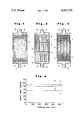
- FIG. 1 is a longitudinal cross section illustrating the first embodiment of the latent heat TES unit packed with the heat storage medium of the present invention.
- FIG. 2 is a longitudinal cross section illustrating the second embodiment of the latent heat TES unit packed with the heat storage medium of the present invention.
- FIG. 3 is a longitudinal cross section illustrating the third embodiment of the latent heat TES unit packed with the heat storage medium of the present invention.
- FIG. 4 is a graph showing the relation between the heating time and the latent heat obtained of the heat storage medium of the present invention.
- polyolefins possess excellent qualities such as low price, high safety, and relatively large latent heat.
- a heat storage medium made of a polyolefin in particulate form is fused, the individual particles of the medium mutually adhere and induce degradation of heat transfer characteristics due to low heat transfer area.
- There have been proposed methods for precluding the mutual adhesion of the individual particles of the heat storage medium during its fusion by grafting with a silane or by crosslinking the crystalline polyolefin or a thermoplastic resin, or by irradiation with electron beams, for example. These efforts, however, tend to impair the desirable qualities of polyolefins as materials for the heat storage medium in the latent heat TES unit.
- the inventors made various studies and experiments in search for a crystalline polyolefin capable of retaining its advantageous qualities for the storage of latent heat intact and defying flow and mutual adhesion during fusion. They have consequently found that when a crystalline polyolefin formed in a required shape such as pellets, films or rods is treated with ion plasma, the polyolefin in the particulate form is crosslinked only in the surface region thereof so that the heat storage medium, on contact with the heat transfer medium, is fused only inside the individual polyolefin pieces and, therefore, is prevented from mutual adhesion and allowed to retain the original advantageous qualities of the polyolefin virtually intact. This invention has been accomplished on this knowledge.
- any polyolefin can be used for the purpose of this invention so far as it is crystalline.
- crystalline polyethylene proves advantageous over all the other polyolefins.
- the crystalline polyolefin is formed by a known method in any desired shape such as pellets, rods, or films to suit the particular structure of the latent heat TES unit to be used.
- the heat storage medium is desirably molded in the shape of pellets of a diameter roughly in the range of 0.5 to 3 mm, rods of a diameter roughly in the range of 2 to 10 mm, or films of a thickness roughly in the range of 0.3 to 1.0 mm.
- the plasma reactor to be used for this treatment can be of any of the known types using any of various power sources such as high frequency waves, micro-waves, direct current, alternating current, etc.
- the treating time is suitably fixed, depending on the structure of the reactor, the type of power source, the inner pressure of the reactor, the flow volume of gas, the shape of the crystalline polyolefin particles, etc. If the treating time is more or less greater than is actually required, since the collision cross-section of molecular ions or atomic ions colliding with the polyolefin particles is large enough, the crosslinking reaction is allowed to occur only within the surface region of the polyolefin particles. Thus, the polyolefin retains its crystallinity (latent heat) substantially intact. Volume treatment of the polyolefin with ion plasma can be obtained by causing the polyolefin already formed in the required shape to be retained for a required length of time in the current of ion plasma. In this manner, the treatment can be carried out continuously.
- the crystalline polyolefin particles which have been subjected to the ion plasma treatment as described above are exposed to a heat transfer medium at an elevated temperature of about 150° C., they melt by absorbing the latent heat and become fluid in their inner region but are not rendered fluid on their surface to the extent of inducing mutual adhesion of adjacent polyolefin particles. As the temperature falls, the polyolefin particles resume their original shape.
- the crystalline polyolefin particles which have been treated with ion plasma as described above are placed in the latent heat TES unit and left in contact with the heat transfer medium.
- FIG. 1 illustrates one embodiment of the latent heat TES unit usable with the heat storage medium of this invention. It comprises a thermal energy storage tank 2, an inlet 4 and an outlet 5 both provided in the thermal energy storage tank and adapted for permitting flow of a heat transfer medium through the interior of the thermal energy storage tank, and metal nets 3 provided one each in the upper and lower parts of the interior of the thermal energy storage tank.
- the interior space defined by the wall of the tank and the two metal nets is packed with a heat storage medium 1 prepared by treating a pelletized polyolefin with ion plasma.
- the latent heat TES unit constructed as described above, storage of heat is effected by passing a heat transfer medium 6 at an elevated temperature through the inlet 4 into direct contact with the heat storage medium 1 thereby melting the interior of the particles of the heat storage medium 1.
- the heat transfer medium 6 which has completed heat exchange and has consequently been cooled to a lower temperature is discharged through the outlet 5.
- the packing density of the heat storage medium in the tank is lowered, the medium is fluidized by the flow of the heat transfer medium and, in the fluidized state, is allowed to exchange heat with the heat transfer medium.
- the heat transfer medium Since the polyolefin is oxidized and consequently embrittled in the presence of oxygen, the heat transfer medium must be free from oxygen. Thus, an inert gas such as argon or nitrogen gas can be used advantageously as the heat transfer medium.
- a liquid heat transfer medium may be used on condition that it is prevented from exposure to air.
- FIG. 2 illustrates a latent heat TES unit which is packed with a multiplicity of rods of the heat storage medium of this invention.
- the heat storage medium 1 which is in the shape of rods exchanges heat with the heat transfer medium 6, it is wholly softened as its interior is fused. If the heat storage medium is in the shape of rods of a large length, the rods wholly softened as described above are no longer able to retain their straight shape but are bent out of shape. Consequently, the heat transfer medium finds its way through particular paths formed between bent rods within the thermal energy storage tank interior and tends to depart from the outlet 5 before it has amply exchanged heat with the heat storage medium. To preclude this trouble, therefore, a multiplicity of metal nets 3 are spaced in the direction of the flow of the heat transfer medium inside the thermal energy storage tank 2 so as to ensure effective contact beteen the heat transfer medium and the heat storage medium.
- FIG. 3 illustrates another manner in which the heat storage medium of the present invention is put to use.
- the latent heat TES unit in this embodiment is formed by preparing a multiplicity of capsules 7 each made of a metal such as iron, aluminum, or stainless steel and packed airtightly with the heat storage medium 1 of a suitable shape in conjunction with a liquid heat transfer medium of low vapor pressure such as, for example, silicone oil or ethylene glycol, and encasing these capsules within a thermal energy storage tank 2.
- a liquid heat transfer medium of low vapor pressure such as, for example, silicone oil or ethylene glycol
- any gaseous or liquid substance which is incapable of corroding the TES unit can be used as the heat transfer medium 6 serving to effect heat exchange even if it is capable of affecting the inherent properties of the heat storage medium.
- the present embodiment proves economical.
- iron, stainless steel or other similar metal is adopted as the material for the capsules, the capsules can be safely exposed without any cnange in appearance to the heat transfer medium even at such
- Release of the stored latent heat from the TES unit is accomplished by introducing a medium desired to be heated through the inlet 4 into the thermal energy storage tank 2 in the same way as in the storage of heat thereby allowing the medium to absorb the heat of fusion (latent heat) from the heat storage medium 1 and thereafter discharging the medium through the outlet 5.
- the latent heat TES unit in which the heat storage medium of the present invention can be effectively used, three typical constructions have been cited above by way of illustration.
- the heat storage medium is in the shape of films, for example, the latent heat TES unit is required to be in a construction which befits the particular shape of the heat storage medium.
- the present invention prepares the heat storage medium by treating separate pieces of a crystalline polyolefin with ion plasma thereby crosslinking the crystalline polyolefin in the surface region of the separate pieces thereof. Consequently, when this heat storage medium is exposed to the heat transfer medium at an elevated temperature, it is softened but is left unfused with the exception of the interior thereof by the action of the heat. When it is formed in the shape of pellets, rods, or films, the separate pieces thereof do not adhere to one another. When the separate pieces of the heat storage medium are surrounded by the heat transfer medium, they are prevented from contact with the ambient air and consequently from the otherwise possible oxidative degradation and are enabled to offer stable service for a long time.
- a plasma C.V.D. chemical vapor deposition
- a quartz reaction tube 150 mm in diameter 225 mm in height provided 100 mm thereabove with two semicircular electrodes
- 5 g of crystalline polyethylene pellets about 1 mm in diameter were placed in a specimen receptacle.
- the container of the apparatus was evacuated to 10 -3 Torr and, thereafter, argon gas was fed to the container at a rate of 300 ml/min until the inner pressure of the container rose to about 0.25 Torr.
- an electric current of 0.24 A and 1.5 kV was applied to the anode to cause generation of argon ions, with the pellets exposed to the argon ions for a varying contact time (20, 30, and 40 minutes).
- the specimen was tested for latent heat and melting point.
- the results were as shown in the following Table.
- the latent heat and melting point obtained of the same polyethylene pellets in their untreated form are also shown in the Table.
- melting point as used herein means the temperature at which a given polyethylene sample was fused to a substantially liquid state retaining virtually no crystalline phase.
- the polyethylene pellets of Specimen Nos. 1, 2, and 3 which had been treated with ion plasma and the polyethylene pellets of Comparative specimen which had not been treated were brought into contact with silicon oil heated to 150° C. While those of Specimen Nos. 1, 2 and 3 were found to show no change and resume their original form after removel of heat.
- the polyethylene pellets of Comparative specimen fused to one another in the hot silicone oil and remained in the fused state even after removal of heat.
- the polyethylene pellets of Specimen No. 2 were placed in an aluminum container with silicon oil (made by Shinetsu Chemical Co., Japan and marketed under designation of KF-54) sealed therein, set in position within a constant temperature bath, and tested for possible loss of latent heat and possible degradation of material.
- silicon oil made by Shinetsu Chemical Co., Japan and marketed under designation of KF-54
- the characteristic curve "a” represents the results of the polyethylene pellets produced by the method of this invention
- the characteristic curve "b” those of the specimen including both polyethylene pellets and silicone oil
- the characteristic curve "c” those of the specimen including both polyethylene pellets and alkyl diphenyl
- the characteristic curve "d” those of the polyethylene pellets treated by irradiation with electron beam.
- Polyethylene pellets were treated under the same conditions as those of Example 1, except that the voltage and current at the anode were changed to 2.5 kV and 0.38 A. Consequently, there were obtained polyethylene pellets which possessed practically the same properties as those of Specimen No. 3 of Example 1.
- the resultant polyethylene pellets on contact with silicone oil at 150° C. were found to curl slightly. Despite the curling, these pellets could be used effectively as a latent heat storage medium without any trouble.
- Example 2 In the same apparatus as used in Example 1, a polyethylene film 0.5 mm in thickness and 20 mm ⁇ 20 mm in area was placed in a container. The container was evacuated to 10 -3 Torr. Then, argon gas was fed at a flow rate of 200 ml/min into the container and an electric current of 1.5 kV and 0.27 A was fed to the anode to cause generation of argon ions, with the polyethylene film exposed to the ion plasma for 30 minutes. Thereafter, the polyethylene film was turned upside down and was exposed similarly to the ion plasma for 30 minutes. The resultant film was found to have latent heat of 49.3 cal/g (206.5 J/g) and a melting point of 135.2° C.
- the same polyethylene film as used above was treated under the same conditions described above, except that the flow rate of argon gas was changed to 300 ml/min and the current at the anode was changed to 0.31 A.
- the resultant polyethylene film was found to have latent heat of 48.2 cal/g (201.1 J/g) and a melting point of 135° C. When the films were exposed to silicone oil at 150° C., absolutely no adhesion was observed between the films. When untreated polyethylene film was placed in contact with silicon oil at 150° C., it was found to shrink and undergo adhesion.
Landscapes
- Chemical & Material Sciences (AREA)
- Engineering & Computer Science (AREA)
- Physics & Mathematics (AREA)
- Thermal Sciences (AREA)
- Dispersion Chemistry (AREA)
- Mechanical Engineering (AREA)
- General Engineering & Computer Science (AREA)
- Chemical Kinetics & Catalysis (AREA)
- Combustion & Propulsion (AREA)
- Materials Engineering (AREA)
- Organic Chemistry (AREA)
- Treatments Of Macromolecular Shaped Articles (AREA)
Abstract
Description
TABLE
______________________________________
Treating time
Latent heat
Melting point
Specimen No.
(min) (Cal/g) (°C.)
______________________________________
20 47.2 136.1
2 30 46.7 136.7
3 40 46.8 135.8
Comparative
-- 43.3 135.2
specimen
______________________________________
Claims (3)
Applications Claiming Priority (2)
| Application Number | Priority Date | Filing Date | Title |
|---|---|---|---|
| JP55151845A JPS5776078A (en) | 1980-10-29 | 1980-10-29 | Heat accumulator utilizing latent heat |
| JP55-151845 | 1980-10-29 |
Publications (1)
| Publication Number | Publication Date |
|---|---|
| US4463799A true US4463799A (en) | 1984-08-07 |
Family
ID=15527529
Family Applications (1)
| Application Number | Title | Priority Date | Filing Date |
|---|---|---|---|
| US06/315,865 Expired - Fee Related US4463799A (en) | 1980-10-29 | 1981-10-28 | Heat storage medium for latent heat thermal energy storage unit |
Country Status (2)
| Country | Link |
|---|---|
| US (1) | US4463799A (en) |
| JP (1) | JPS5776078A (en) |
Cited By (35)
| Publication number | Priority date | Publication date | Assignee | Title |
|---|---|---|---|---|
| WO1987003290A1 (en) * | 1985-11-22 | 1987-06-04 | University Of Dayton | Polyethylene composites containing a phase change material |
| US4807696A (en) * | 1987-12-10 | 1989-02-28 | Triangle Research And Development Corp. | Thermal energy storage apparatus using encapsulated phase change material |
| US4908166A (en) * | 1985-11-22 | 1990-03-13 | University Of Dayton | Method for preparing polyolefin composites containing a phase change material |
| US5007478A (en) * | 1989-05-26 | 1991-04-16 | University Of Miami | Microencapsulated phase change material slurry heat sinks |
| US5053446A (en) * | 1985-11-22 | 1991-10-01 | University Of Dayton | Polyolefin composites containing a phase change material |
| US5106520A (en) * | 1985-11-22 | 1992-04-21 | The University Of Dayton | Dry powder mixes comprising phase change materials |
| US5163504A (en) * | 1988-07-08 | 1992-11-17 | Resnick Joseph A | Container heating or cooling device and building material |
| US5211949A (en) * | 1990-01-09 | 1993-05-18 | University Of Dayton | Dry powder mixes comprising phase change materials |
| US5254380A (en) * | 1985-11-22 | 1993-10-19 | University Of Dayton | Dry powder mixes comprising phase change materials |
| DE4315492A1 (en) * | 1993-05-10 | 1994-11-17 | Daimler Benz Ag | Latent heat storage and a method for producing the same |
| US5477917A (en) * | 1990-01-09 | 1995-12-26 | The University Of Dayton | Dry powder mixes comprising phase change materials |
| US5547016A (en) * | 1992-10-29 | 1996-08-20 | L'air Liquide, Societe Anonyme Pour L'etude Et L'exploitation Des Procedes Georges Claude | Method for heating a gas in a regenerator |
| WO1997002408A1 (en) * | 1995-06-30 | 1997-01-23 | Lewis Ralph H | Non-polluting, open brayton cycle automotive power unit |
| US6547222B2 (en) * | 1999-08-17 | 2003-04-15 | Koch Knight, Llc | Packing element |
| US6652771B2 (en) | 2001-07-11 | 2003-11-25 | Ronald M. Carn | Phase change material blend, method for making, and devices using same |
| US20070029064A1 (en) * | 2005-08-03 | 2007-02-08 | Honeywell International, Inc. | Compact heat battery |
| US20090178409A1 (en) * | 2006-08-01 | 2009-07-16 | Research Foundation Of The City University Of New York | Apparatus and method for storing heat energy |
| US20110081134A1 (en) * | 2010-12-15 | 2011-04-07 | Salyer Ival O | Water heating unit with integral thermal energy storage |
| US20110083459A1 (en) * | 2010-12-15 | 2011-04-14 | Salyer Ival O | Heat exchanger with integral phase change material for heating and cooling applications |
| US20110083827A1 (en) * | 2010-12-15 | 2011-04-14 | Salyer Ival O | Cooling system with integral thermal energy storage |
| US20110108020A1 (en) * | 2009-11-11 | 2011-05-12 | Mcenerney Bryan William | Ballast member for reducing active volume of a vessel |
| DE102010033571A1 (en) * | 2010-08-06 | 2012-02-09 | Enolcon Gmbh | High-temperature heat storage for solar thermal power plants |
| US20120251087A1 (en) * | 2008-02-22 | 2012-10-04 | Dow Global Technologies Llc | Heat storage devices |
| US20120279679A1 (en) * | 2010-01-29 | 2012-11-08 | Soukhojak Andrey N | Thermal energy storage |
| US20130126122A1 (en) * | 2010-08-06 | 2013-05-23 | Enolcon Gmbh | High-temperature heat store for solar-thermal power plants |
| US20140000583A1 (en) * | 2011-03-11 | 2014-01-02 | Stellenbosch University | Thermal storage facility especially suitable for concentrating solar power installations |
| WO2014039318A1 (en) * | 2012-09-10 | 2014-03-13 | Saint-Gobain Ceramics & Plastics, Inc. | Structured media and methods for thermal energy storage |
| CN103712501A (en) * | 2014-01-02 | 2014-04-09 | 上海电气集团股份有限公司 | Single-pot fused salt thermal storage device in distributed type micro-grid |
| WO2014146844A1 (en) * | 2013-03-18 | 2014-09-25 | Siemens Aktiengesellschaft | Composite material for a thermal energy storage means and process for producing a composite material for a thermal energy storage means |
| WO2014183892A1 (en) * | 2013-05-15 | 2014-11-20 | Siemens Aktiengesellschaft | Thermal energy store |
| US20150211804A1 (en) * | 2014-01-28 | 2015-07-30 | Kunshan Jue-Chung Electronics Co., Ltd. | Energy storage assembly and energy storage element thereof |
| DE102014202125A1 (en) * | 2014-02-06 | 2015-08-06 | Siemens Aktiengesellschaft | Heat storage and method for storing thermal energy |
| US20160061534A1 (en) * | 2014-08-27 | 2016-03-03 | Peter B. Choi | Latent Thermal Energy System (LTES) Bubbling Tank System |
| US10294824B2 (en) * | 2015-12-04 | 2019-05-21 | IFP Energies Nouvelles | Compressed gas energy storage and restitution system and method |
| US20250189237A1 (en) * | 2023-12-07 | 2025-06-12 | Hamilton Sundstrand Corporation | Phase change material heat exchanger |
Families Citing this family (6)
| Publication number | Priority date | Publication date | Assignee | Title |
|---|---|---|---|---|
| JPS5981492A (en) * | 1982-10-29 | 1984-05-11 | Showa Alum Corp | Enclosing method of latent heat accumulating material |
| JPS5986894A (en) * | 1982-11-10 | 1984-05-19 | Agency Of Ind Science & Technol | Regenerating method and regenerator |
| JPS59124981A (en) * | 1982-12-29 | 1984-07-19 | Fujikura Ltd | Latent thermal energy storage material |
| JPS6050373U (en) * | 1983-09-09 | 1985-04-09 | 三菱電機株式会社 | heat storage container |
| KR102056414B1 (en) | 2015-09-03 | 2020-01-22 | 마루분 가부시키가이샤 | Deep ultraviolet LED and manufacturing method |
| WO2019146737A1 (en) | 2018-01-26 | 2019-08-01 | 丸文株式会社 | Deep ultraviolet led and production method for same |
Citations (3)
| Publication number | Priority date | Publication date | Assignee | Title |
|---|---|---|---|---|
| US4063546A (en) * | 1975-04-28 | 1977-12-20 | Ciba-Geigy Corporation | Heat store and installation for the utilization of solar energy |
| US4182398A (en) * | 1977-04-04 | 1980-01-08 | The United States Of America As Represented By The United States Department Of Energy | Crosslinked crystalline polymer and methods for cooling and heating |
| US4259198A (en) * | 1975-04-28 | 1981-03-31 | Ciba-Geigy Corporation | Use of crystalline, crosslinked synthetic resins as a storage material in latent heat stores |
-
1980
- 1980-10-29 JP JP55151845A patent/JPS5776078A/en active Granted
-
1981
- 1981-10-28 US US06/315,865 patent/US4463799A/en not_active Expired - Fee Related
Patent Citations (3)
| Publication number | Priority date | Publication date | Assignee | Title |
|---|---|---|---|---|
| US4063546A (en) * | 1975-04-28 | 1977-12-20 | Ciba-Geigy Corporation | Heat store and installation for the utilization of solar energy |
| US4259198A (en) * | 1975-04-28 | 1981-03-31 | Ciba-Geigy Corporation | Use of crystalline, crosslinked synthetic resins as a storage material in latent heat stores |
| US4182398A (en) * | 1977-04-04 | 1980-01-08 | The United States Of America As Represented By The United States Department Of Energy | Crosslinked crystalline polymer and methods for cooling and heating |
Cited By (50)
| Publication number | Priority date | Publication date | Assignee | Title |
|---|---|---|---|---|
| US5053446A (en) * | 1985-11-22 | 1991-10-01 | University Of Dayton | Polyolefin composites containing a phase change material |
| US5254380A (en) * | 1985-11-22 | 1993-10-19 | University Of Dayton | Dry powder mixes comprising phase change materials |
| WO1987003290A1 (en) * | 1985-11-22 | 1987-06-04 | University Of Dayton | Polyethylene composites containing a phase change material |
| AU584245B2 (en) * | 1985-11-22 | 1989-05-18 | University Of Dayton, The | Polyethylene containing a phase change material |
| US4908166A (en) * | 1985-11-22 | 1990-03-13 | University Of Dayton | Method for preparing polyolefin composites containing a phase change material |
| US5106520A (en) * | 1985-11-22 | 1992-04-21 | The University Of Dayton | Dry powder mixes comprising phase change materials |
| US4711813A (en) * | 1985-11-22 | 1987-12-08 | University Of Dayton | Polyethylene composites containing a phase change material having a C14 straight chain hydrocarbon |
| US4807696A (en) * | 1987-12-10 | 1989-02-28 | Triangle Research And Development Corp. | Thermal energy storage apparatus using encapsulated phase change material |
| US5163504A (en) * | 1988-07-08 | 1992-11-17 | Resnick Joseph A | Container heating or cooling device and building material |
| US5007478A (en) * | 1989-05-26 | 1991-04-16 | University Of Miami | Microencapsulated phase change material slurry heat sinks |
| US5211949A (en) * | 1990-01-09 | 1993-05-18 | University Of Dayton | Dry powder mixes comprising phase change materials |
| US5282994A (en) * | 1990-01-09 | 1994-02-01 | The University Of Dayton | Dry powder mixes comprising phase change materials |
| US5477917A (en) * | 1990-01-09 | 1995-12-26 | The University Of Dayton | Dry powder mixes comprising phase change materials |
| US5690164A (en) * | 1992-10-29 | 1997-11-25 | L'air Liquide, Societe Anonyme Pour L'etude Et L'exploitation Des Procedes Georges Claude | Method and regenerator for heating a gas |
| US5547016A (en) * | 1992-10-29 | 1996-08-20 | L'air Liquide, Societe Anonyme Pour L'etude Et L'exploitation Des Procedes Georges Claude | Method for heating a gas in a regenerator |
| DE4315492A1 (en) * | 1993-05-10 | 1994-11-17 | Daimler Benz Ag | Latent heat storage and a method for producing the same |
| DE4315492C2 (en) * | 1993-05-10 | 1998-07-09 | Daimler Benz Ag | Latent heat storage and a method for producing the same |
| US5634339A (en) * | 1995-06-30 | 1997-06-03 | Ralph H. Lewis | Non-polluting, open brayton cycle automotive power unit |
| WO1997002408A1 (en) * | 1995-06-30 | 1997-01-23 | Lewis Ralph H | Non-polluting, open brayton cycle automotive power unit |
| US5873250A (en) * | 1995-06-30 | 1999-02-23 | Ralph H. Lewis | Non-polluting open Brayton cycle automotive power unit |
| US6547222B2 (en) * | 1999-08-17 | 2003-04-15 | Koch Knight, Llc | Packing element |
| US6652771B2 (en) | 2001-07-11 | 2003-11-25 | Ronald M. Carn | Phase change material blend, method for making, and devices using same |
| US20070029064A1 (en) * | 2005-08-03 | 2007-02-08 | Honeywell International, Inc. | Compact heat battery |
| US7225860B2 (en) | 2005-08-03 | 2007-06-05 | Honeywell International, Inc. | Compact heat battery |
| US20090178409A1 (en) * | 2006-08-01 | 2009-07-16 | Research Foundation Of The City University Of New York | Apparatus and method for storing heat energy |
| US8544275B2 (en) * | 2006-08-01 | 2013-10-01 | Research Foundation Of The City University Of New York | Apparatus and method for storing heat energy |
| US20120251087A1 (en) * | 2008-02-22 | 2012-10-04 | Dow Global Technologies Llc | Heat storage devices |
| US8590598B2 (en) * | 2008-02-22 | 2013-11-26 | Dow Global Technologies Llc | Devices for storing and discharging heat and methods thereof |
| US20110108020A1 (en) * | 2009-11-11 | 2011-05-12 | Mcenerney Bryan William | Ballast member for reducing active volume of a vessel |
| US20120279679A1 (en) * | 2010-01-29 | 2012-11-08 | Soukhojak Andrey N | Thermal energy storage |
| DE102010033571A1 (en) * | 2010-08-06 | 2012-02-09 | Enolcon Gmbh | High-temperature heat storage for solar thermal power plants |
| US20130126122A1 (en) * | 2010-08-06 | 2013-05-23 | Enolcon Gmbh | High-temperature heat store for solar-thermal power plants |
| US9410748B2 (en) * | 2010-08-06 | 2016-08-09 | Enolcon Gmbh | High-temperature heat store for solar-thermal power plants |
| US20110081134A1 (en) * | 2010-12-15 | 2011-04-07 | Salyer Ival O | Water heating unit with integral thermal energy storage |
| US20110083459A1 (en) * | 2010-12-15 | 2011-04-14 | Salyer Ival O | Heat exchanger with integral phase change material for heating and cooling applications |
| US20110083827A1 (en) * | 2010-12-15 | 2011-04-14 | Salyer Ival O | Cooling system with integral thermal energy storage |
| US20140000583A1 (en) * | 2011-03-11 | 2014-01-02 | Stellenbosch University | Thermal storage facility especially suitable for concentrating solar power installations |
| AU2013313163B2 (en) * | 2012-09-10 | 2015-12-24 | Saint-Gobain Ceramics & Plastics, Inc. | Structured media and methods for thermal energy storage |
| CN104755872A (en) * | 2012-09-10 | 2015-07-01 | 圣戈本陶瓷及塑料股份有限公司 | Structured media and methods for thermal energy storage |
| WO2014039318A1 (en) * | 2012-09-10 | 2014-03-13 | Saint-Gobain Ceramics & Plastics, Inc. | Structured media and methods for thermal energy storage |
| WO2014146844A1 (en) * | 2013-03-18 | 2014-09-25 | Siemens Aktiengesellschaft | Composite material for a thermal energy storage means and process for producing a composite material for a thermal energy storage means |
| RU2620843C2 (en) * | 2013-03-18 | 2017-05-30 | Сименс Акциенгезелльшафт | Composite material for thermal energy storage device and method for producing of composite material for thermal energy storage device |
| WO2014183892A1 (en) * | 2013-05-15 | 2014-11-20 | Siemens Aktiengesellschaft | Thermal energy store |
| CN103712501A (en) * | 2014-01-02 | 2014-04-09 | 上海电气集团股份有限公司 | Single-pot fused salt thermal storage device in distributed type micro-grid |
| CN103712501B (en) * | 2014-01-02 | 2017-08-11 | 上海电气集团股份有限公司 | Single tank fused salt heat-storing device in a kind of distributed micro-grid |
| US20150211804A1 (en) * | 2014-01-28 | 2015-07-30 | Kunshan Jue-Chung Electronics Co., Ltd. | Energy storage assembly and energy storage element thereof |
| DE102014202125A1 (en) * | 2014-02-06 | 2015-08-06 | Siemens Aktiengesellschaft | Heat storage and method for storing thermal energy |
| US20160061534A1 (en) * | 2014-08-27 | 2016-03-03 | Peter B. Choi | Latent Thermal Energy System (LTES) Bubbling Tank System |
| US10294824B2 (en) * | 2015-12-04 | 2019-05-21 | IFP Energies Nouvelles | Compressed gas energy storage and restitution system and method |
| US20250189237A1 (en) * | 2023-12-07 | 2025-06-12 | Hamilton Sundstrand Corporation | Phase change material heat exchanger |
Also Published As
| Publication number | Publication date |
|---|---|
| JPS5776078A (en) | 1982-05-12 |
| JPS5757512B2 (en) | 1982-12-04 |
Similar Documents
| Publication | Publication Date | Title |
|---|---|---|
| US4463799A (en) | Heat storage medium for latent heat thermal energy storage unit | |
| EP0095109B1 (en) | Process for producing expanded particles of a polyolefin resin | |
| US3251728A (en) | Stranded aliphatic olefin polymer foam for loose-fill packaging | |
| US4515210A (en) | Heat exchanger having a plastics membrane | |
| JPS6341958B2 (en) | ||
| JPS6086188A (en) | Polyolefin thermal energy storage material | |
| JPH08502903A (en) | Treatment methods for the destruction of halocarbons | |
| JP4794028B2 (en) | Functional polytetrafluoroethylene resin and method for producing the same | |
| US3144398A (en) | Polyethylene product and process | |
| US4608309A (en) | Thermal energy storage slurry material | |
| WO1994029015A1 (en) | Apparatus for direct fluorination of polymeric resins | |
| JPS5855435B2 (en) | heat storage body | |
| JPS5925160B2 (en) | Polyolefin heat storage body with heat-resistant coating film | |
| US4092381A (en) | Methods of fabricating microsponge deuterated hydrocarbon polymer targets which emit neutrons when irradiated by high energy beams | |
| JPH0211606B2 (en) | ||
| JPS6341957B2 (en) | ||
| JPS6341956B2 (en) | ||
| CN101460394B (en) | Hydrogen supplier and method of supplying hydrogen | |
| JPS63125590A (en) | Heat storing material | |
| Kritskaya et al. | Radiation‐induced gas‐phase grafted polymerization as a method for producing macromolecular carries for active catalytic sites | |
| US4192700A (en) | Process for fusion-bonding of resins | |
| JPH0124831B2 (en) | ||
| JPH0313276B2 (en) | ||
| JPH0254380B2 (en) | ||
| JPS60130624A (en) | Production of polyolefin molding for heat storage |
Legal Events
| Date | Code | Title | Description |
|---|---|---|---|
| AS | Assignment |
Owner name: AGENCY OF INDUSTRIAL SCIENCE & TECHNOLOGY, MINISTR Free format text: ASSIGNMENT OF ASSIGNORS INTEREST.;ASSIGNORS:TAKAHASHI, YOSHIO;OZAWA, TAKEO;SAKAMOTO, RYUJI;AND OTHERS;REEL/FRAME:004258/0901 Effective date: 19811015 |
|
| FEPP | Fee payment procedure |
Free format text: PAYOR NUMBER ASSIGNED (ORIGINAL EVENT CODE: ASPN); ENTITY STATUS OF PATENT OWNER: LARGE ENTITY |
|
| FPAY | Fee payment |
Year of fee payment: 4 |
|
| FPAY | Fee payment |
Year of fee payment: 8 |
|
| REMI | Maintenance fee reminder mailed | ||
| LAPS | Lapse for failure to pay maintenance fees | ||
| FP | Lapsed due to failure to pay maintenance fee |
Effective date: 19960807 |
|
| STCH | Information on status: patent discontinuation |
Free format text: PATENT EXPIRED DUE TO NONPAYMENT OF MAINTENANCE FEES UNDER 37 CFR 1.362 |