US4400640A - Temperature stable cuts of quartz - Google Patents
Temperature stable cuts of quartz Download PDFInfo
- Publication number
- US4400640A US4400640A US06/378,668 US37866882A US4400640A US 4400640 A US4400640 A US 4400640A US 37866882 A US37866882 A US 37866882A US 4400640 A US4400640 A US 4400640A
- Authority
- US
- United States
- Prior art keywords
- cuts
- quartz
- yxwlt
- surface acoustic
- temperature
- Prior art date
- Legal status (The legal status is an assumption and is not a legal conclusion. Google has not performed a legal analysis and makes no representation as to the accuracy of the status listed.)
- Expired - Fee Related
Links
- 239000010453 quartz Substances 0.000 title claims abstract description 18
- VYPSYNLAJGMNEJ-UHFFFAOYSA-N silicon dioxide Inorganic materials O=[Si]=O VYPSYNLAJGMNEJ-UHFFFAOYSA-N 0.000 title claims abstract description 18
- 238000010897 surface acoustic wave method Methods 0.000 claims description 35
- 239000000758 substrate Substances 0.000 claims description 13
- 230000035945 sensitivity Effects 0.000 abstract description 4
- 239000013078 crystal Substances 0.000 description 11
- 230000008859 change Effects 0.000 description 7
- 238000004519 manufacturing process Methods 0.000 description 7
- 230000008878 coupling Effects 0.000 description 3
- 238000010168 coupling process Methods 0.000 description 3
- 238000005859 coupling reaction Methods 0.000 description 3
- 230000000694 effects Effects 0.000 description 3
- 238000000034 method Methods 0.000 description 2
- 230000001419 dependent effect Effects 0.000 description 1
- 238000005516 engineering process Methods 0.000 description 1
- 238000012986 modification Methods 0.000 description 1
- 230000004048 modification Effects 0.000 description 1
Images


Classifications
-
- H—ELECTRICITY
- H03—ELECTRONIC CIRCUITRY
- H03H—IMPEDANCE NETWORKS, e.g. RESONANT CIRCUITS; RESONATORS
- H03H9/00—Networks comprising electromechanical or electro-acoustic elements; Electromechanical resonators
- H03H9/02—Details
- H03H9/02535—Details of surface acoustic wave devices
- H03H9/02543—Characteristics of substrate, e.g. cutting angles
- H03H9/02551—Characteristics of substrate, e.g. cutting angles of quartz substrates
Definitions
- the present invention relates, in general, to cuts of quartz on which surface acoustic waves propagate with small temperature dependence. More particularly, the invention relates to several families of doubly rotated cuts of quartz which provide temperature stable surface acoustic wave (SAW) propagation and have other properties desirable for SAW devices.
- SAW surface acoustic wave
- Yet another object of the present invention is to provide SAW devices fabricated on improved temperature stable cuts of quartz.
- Doubly rotated cuts having improved temperature stability are chosen from the group consisting of the families of cuts: (YXwlt) 0/27/138, 7/27/135.5, 15/40/40, 15/30/38, 12.5/35/130 and rotational equivalents thereof.
- Each family consists of many possible cuts specified by angle values relatively close to the values which are used to denote the family.
- the cuts are found to have piezoelectric coupling factors, power flow angles, bulk acoustic wave inverse velocity surfaces and fabrication tolerances which are consistent with practical SAW device requirements.
- a particular embodiment of the present invention comprises a SAW device fabricated on a quartz substrate chosen from the group consisting of the families of cuts: (YXwlt) 0/27/138, 7/27/135.5, 15/40/40, 15/30/38, 12.5/35/130 and rotational equivalents thereof.
- the transducer design of the SAW device is generally conventional, it is advantageous to fabricate several complete devices with slightly different propagation angles on each substrate and to choose the most nearly temperature stable device for actual use. This is due to the fact that temperature stability is highly dependent on the propagation angle, which is determined by mask alignment during fabrication.
- SAW devices have been fabricated according to the principles of the present invention which exhibit a total frequency change of less than 80 ppm over the temperature range of -45° C. to +140° C.
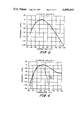
- FIG. 1 is a graph of frequency change (in ppm) versus temperature (in degrees C.) for the cut (YXwlt) 12.010/31.210/39.800;
- FIG. 2 is a similar graph for the cut (YXwlt) 15.130/31.130/37.330;
- FIG. 3 is a similar graph for the cut (YXwlt) 14.310/41.067/40.5;
- FIG. 4 is a similar graph for the cut (YXwlt) 19.050/40.283/123.2;
- FIG. 5 is a view of a surface acoustic wave device according to the principles of the present invention.
- Crystal angles herein are presented in the form (YXwlt) phi/theta/psi and are specified in accordance with "Standards on Piezoelectric Crystals 1949", Proc. IRE 14, December 1949, pages 1378 to 1395.
- TCF's temperature coefficients of frequency
- the present invention relates primarily to the first, second and third order coefficients: TCF 1 , TCF 2 and TCF 3 , respectively.
- TCF 1 , TCF 2 and TCF 3 first, second and third order coefficients
- a zero first order coefficient Zero TCF 1
- TCF 2 and TCF 3 five regions have been defined wherein a zero first order coefficient (Zero TCF 1 ) is accompanied by very small TCF 2 and TCF 3 .
- These regions are referred to herein as families of cuts and each is designated by reference to a particular cut in the region. For instance, one of the families is referred to as: (YXwlt) 0/27/138 and consists of a large number of temperature stable cuts with angle values close to those specified.
- a particular direction in a quartz crystal is identical to one or more different directions in the crystal due to symmetries in the crystal structure.
- the five families of cuts discussed herein are specified in the range 0 ⁇ phi ⁇ 30°,-90° ⁇ theta ⁇ 90°,0 ⁇ psi ⁇ 180°. Rotational equivalents of the particular cuts discussed herein, which will fall outside this range, are included in the scope of the present invention.
- the five families of cuts described are: (YXwlt) 0/27/138, 7/27/135.5, 15/40/40, 15/30/38, and 12.5/35/130.
- Table I contains a list of a number of cuts within these families which have a zero first order coefficient. For each cut listed the table contains a calculated value for TCF 2 and TCF 3 .
- the cuts listed are merely representative and the scope of the present invention is not limited to these cuts. As described above, each of these cuts will have rotational equivalents due to crystal symmetries. From Table I it will be apparent to one skilled in the art that considerable variation in the cut angles is possible while remaining within the temperature stable family.
- Table II contains a list of selected cuts suitable for temperature stable SAW devices and the corresponding surface acoustic wave velocity, the piezoelectric coupling factor K 2 and the power flow angle. As is apparent, the velocity effects the length of delay lines, for instance, the coupling constant effects transducer design and the power flow angle effects transducer layout and design.
- FIGS. 1, 2, 3 and 4 graphs of the frequency change versus temperature are shown for several representative cuts of quartz. As is standard, the frequency change is expressed in ppm and the temperature in degrees centigrade.
- FIG. 1 is the graph for the cut (YXwlt) 12.010/31.210/38.800 and represents the most temperature stable cut located to date. This does not preclude the location of more stable cuts in the future, since investigating every possible cut in the stable families is virtually impossible.
- the total frequency change for this cut is less than 80 ppm over the temperature range -40° C. to 145° C., which is approximately a factor of 2 better than previously reported results.
- FIGS. 2, 3 and 4 are similar graphs of very stable cuts and FIG. 4 includes a dashed curve representing the graph for the well known ST cut for comparison.
- Table III contains a list of selected cuts and corresponding partial derivative of the first order coefficient, TCF 1 , with respect to psi.
- TCF 1 first order coefficient
- Table IV contains a list of selected cuts and the corresponding partial derivatives of TCF 1 with respect to phi and theta. The relatively low sensitivity of TCF 1 to variations in phi and theta indicates that practical SAW devices are achieveable with standard fabrication techniques. The derivatives of TCF 2 and TCF 3 do not exhibit characteristics which render practical SAW devices unobtainable.
- a substrate 10 comprises a doubly rotated cut of quartz chosen from the group consisting of the five families of temperature stable cuts described above and rotational equivalents thereof. Double rotated cuts of quartz are available from the Walpey Company and Crystal Technology, among other crystal suppliers. It is found that the accuracy of the cut in the angles phi and theta should be approximately 12 minutes or less to achieve best results. However, as demonstrated by Table III, the sensitivity of TCF 1 to variations in psi demands a high degree of accuracy. Since psi is determined by mask alignment with respect to crystal axes which do not necessarily correspond to visible indications on a finished substrate, alignment to within a few minutes is difficult.
- a first Saw device 16 comprises an input transducer 12 and an output transducer 14.
- Transducers 12 and 14 shown here are intended to be merely representative of the wide variety of surface acoustic wave transducers which are known in the art.
- a second SAW device comprises an input transducer 18 and an output transducer 20 and a third SAW device comprises an input transducer 24 and an output transducer 26. All of the above transducers are fabricated using a single mask so that the alignment difference between the different devices may be precisely controlled.
- each succeeding device may be skewed with respect to its neighbor by approximately 0.2° which would of course not be apparent at the scale of FIG. 5.
- the choice of the number of devices fabricated on a single substrate and the amount of skewing between them admit of a large range of possibilities. After such a device has been fabricated each individual SAW device can be tested for temperature stability and only the most stable one will ultimately be used.
Landscapes
- Physics & Mathematics (AREA)
- Acoustics & Sound (AREA)
- Surface Acoustic Wave Elements And Circuit Networks Thereof (AREA)
Abstract
Description
              TABLE I
______________________________________
Progagation Characteristics of Selected Cuts
Angles of Zero
TCF.sup.1 Degrees  TCF.sup.2 /°C..sup.2
                             TCF.sup.3 /°C..sup.3
PHI     THETA    PSI       (× 10.sup.-8)
                                   (× 10.sup.-10)
______________________________________
6       26       136.31    -1.4
6       27       135.93    -1.3    0.67
6       28       135.59    -1.3    0.57
7       26       135.99    -1.5
7       27       135.64    -1.4
7       28       135.27    -1.3    0.65
8       26       135.74    -1.4    0.65
8       27       135.36    -1.4
8       28       134.97    -1.3
1       26       137.78    -1.2    0.68
1       27       137.48    -1.2    0.65
1       28       137.17    -1.1    0.67
0       26       138.07    -1.2    0.67
0       27       137.78    -1.1    0.68
0       28       137.49    -1.1    0.62
-1      26       138.37    -1.2    0.60
-1      27       138.09    -1.2    0.62
-1      28       137.80    -1.1    0.73
14      39       40.195    -1.0    0.64
14      40       40.415    -1.0    0.66
14      41       40.64     -1.0    0.75
15      39       39.79     -1.0    0.63
15      40       40        -1.0    0.74
15      41       40.23     - 1.0   0.73
16      39       39.4      -1.0    0.68
16      40       39.605    -1.0    0.66
16      41       39.825    -1.1    0.60
7.5     35.0     41.77      -0.95  0.58
10      35       40.82      -0.94  0.58
12.5    30       38.88      -0.93  0.57
12.5    32.5     39.4       -0.93  0.57
15.0    30.0     38.12      -0.93  0.57
15.0    32.5     38.55      -0.93  0.57
17.5    30.0     37.35      -0.94  0.56
20.0    30.0     36.6       -0.97  0.55
22.5    30.0     35.85     -1.0    0.54
25.0    30.0     35.07     -1.0    0.52
27.5    30.0     34.28     -1.1    0.50
7.5     35.0     132.68    -1.1    0.54
10.0    40.0     129.4     -1.1    0.57
12.5    35.0     130.62    -1.0    0.41
12.5    42.5     127.15    -1.1    0.58
15.0    45.0     124.43    -1.1    0.58
17.5    40.0     126.14    -1.1    0.54
20.0    40.0     124.92    -1.0    0.44
______________________________________
              TABLE II
______________________________________
Progagation Characteristics of Selected Cuts
Angles of Zero                   Power Flow
TCF.sup.1 Degrees
               Velocity K.sup.2  Angle
PHI   THETA    PSI     (M/Sec)
                              (× 10.sup.-3)
                                     (Degrees)
______________________________________
6     26       136.31  3296.84
                              1.12   -0.3
6     27       135.93  3293.60
                              1.12   -0.2
6     28       135.59  3290.63
                              1.12   -0.1
7     26       135.99  3303.33
                              1.12   -0.5
7     27       135.64  3299.70
                              1.12   -0.4
7     28       135.27  3296.33
                              1.12   -0.3
8     26       135.74  3310.15
                              1.12   -0.7
8     27       135.36  3306.11
                              1.12   -0.6
8     28       134.97  3302.32
                              1.10   -0.5
1     26       137.78  3268.80
                              1.10   +0.7
1     27       137.48  3267.44
                              1.10   +0.9
1     28       137.17  3266.36
                              1.10   +1.0
0     26       138.07  3264.09
                              1.12   +0.9
0     27       137.78  3263.09
                              1.10   +1.1
0     28       137.49  3262.35
                              1.10   +1.2
-1    26       138.37  3259.65
                              1.10   +1.1
-1    27       138.09  3259.01
                              1.10   -1.3
-1    28       137.80  3258.64
                              1.08   +1.5
14    39       40.195  3298.60
                              0.96   -7.7
14    40       40.415  3306.67
                              0.96   -8.1
14    41       40.64   3315.19
                              0.94   -8.6
15    39       39.79   3301.82
                              0.96   -7.8
15    40       40.00   3310.14
                              0.94   -8.3
15    41       40.23   3319.09
                              0.98   -8.6
16    39       39.4    3305.38
                              0.96   -8.0
16    40       39.605  3314.03
                              0.98   -8.4
7.5   35.0     41.77   3262.43
                              1.00   -4.8
10    35.0     40.82   3264.23
                              1.01   -5.3
12.5  30.0     38.88   3243.27
                              1.01   -4.1
12.5  32.5     39.4    3254.49
                              1.00   -4.9
15.0  30.0     38.12   3244.99
                              0.98   -4.6
15.0  32.5     38.55   3257.82
                              0.98   -5.3
______________________________________
              TABLE III
______________________________________
δTCF.sup.1 /δΨ For Selected Cuts
Angles of Zero
TCF.sup.1 Degrees    δTCF.sup.1 /δΨ
PHI     THETA    PSI         (PPM/C.°)/DEGREE
______________________________________
6       26       136.31      +2.7
6       27       135.93      +2.7
6       28       135.59      +2.7
7       26       135.99      +2.7
7       27       135.64      +2.7
7       28       135.27      +2.7
8       26       135.74      +2.7
8       27       135.36      +2.7
8       28       134.97      +2.7
1       26       137.78      +2.8
1       27       137.48      +2.8
1       28       137.17      +2.8
0       26       138.07      +3.0
0       27       137.78      +3.0
0       28       137.49      +3.0
-1      26       138.37      +3.0
-1      27       138.09      +3.0
-1      28       137.08      +3.0
14      39       40.195      -3.5
14      40       40.415      -3.5
14      41       40.64       -3.5
15      39       39.79       -3.5
15      40       40          -3.5
15      41       40.23       -3.5
16      39       39.4        -3.7
16      40       39.605      -3.7
16      41       39.825      -3.7
7.5     35.0     41.77       -3.3
10.0    35.0     40.82       -3.4
12.5    30.0     38.88       - 3.3
12.5    32.5     39.4        -3.2
15.0    30.0     38.12       -3.4
15.0    32.5     38.55       -3.6
17.5    30.0     37.35       -3.4
20.0    30.0     36.6        -3.5
22.5    30.0     35.85       -3.5
25.0    30.0     35.07       -3.3
27.5    30.0     34.28       -3.4
7.5     35.0     132.68      +2.7
10.0    40.0     129.40      +2.8
12.5    35.0     130.62      +2.0
12.5    42.5     127.15      +2.5
15.0    45.0     124.43      +2.6
17.5    40.0     126.14      +2.1
20.0    40.0     124.92      +2.6
______________________________________
              TABLE IV
______________________________________
δTCF.sup.1 /δΨ And δTCF.sup.1 /δΘ For
Selected Cuts
Angles of Zero   TCF.sup.1 /δφ
                            δTCF.sup.1 /δΘ
TCF.sup.1 Degrees
                 (PPM/C.°)/
                            (PPM/C.°)/
PHI   THETA    PSI       DEGREE   DEGREE
______________________________________
7     27       135.64    -0.7     -0.5
0     27       137.78    -0.8     -0.8
15    40       40.00     +1.5     -0.7
15.0  32.5     38.55     -1.2      0.6
12.5  35.0     130.62      0.95    1.1
______________________________________
Claims (5)
Priority Applications (1)
| Application Number | Priority Date | Filing Date | Title |
|---|---|---|---|
| US06/378,668 US4400640A (en) | 1982-05-17 | 1982-05-17 | Temperature stable cuts of quartz |
Applications Claiming Priority (1)
| Application Number | Priority Date | Filing Date | Title |
|---|---|---|---|
| US06/378,668 US4400640A (en) | 1982-05-17 | 1982-05-17 | Temperature stable cuts of quartz |
Publications (1)
| Publication Number | Publication Date |
|---|---|
| US4400640A true US4400640A (en) | 1983-08-23 |
Family
ID=23494046
Family Applications (1)
| Application Number | Title | Priority Date | Filing Date |
|---|---|---|---|
| US06/378,668 Expired - Fee Related US4400640A (en) | 1982-05-17 | 1982-05-17 | Temperature stable cuts of quartz |
Country Status (1)
| Country | Link |
|---|---|
| US (1) | US4400640A (en) |
Cited By (4)
| Publication number | Priority date | Publication date | Assignee | Title |
|---|---|---|---|---|
| US5010270A (en) * | 1986-12-22 | 1991-04-23 | Raytheon Company | Saw device |
| WO2008046393A1 (en) * | 2006-10-16 | 2008-04-24 | Epcos Ag | Electroacoustic component |
| DE102007051314A1 (en) * | 2007-10-26 | 2009-04-30 | Epcos Ag | Electro-acoustic component has substrate made of quartz-single crystal for three Euler angle gilts, where sliding surface is provided for acoustic wave |
| WO2013074422A1 (en) | 2011-11-17 | 2013-05-23 | Transense Technologies Plc | Quartz Substrate Orientations for Compact Monolithic Differential Temperature Sensor, and Sensors Using Same |
Citations (3)
| Publication number | Priority date | Publication date | Assignee | Title |
|---|---|---|---|---|
| US4220888A (en) * | 1978-05-25 | 1980-09-02 | Quartz Et Electronique | Double and triple rotated quartz plates for surface waves |
| US4247835A (en) * | 1978-05-24 | 1981-01-27 | The Secretary Of State For Defence In Her Britannic Majesty's Government Of The United Kingdom Of Great Britain And Northern Ireland | Surface acoustic wave devices |
| JPS56103518A (en) * | 1980-01-23 | 1981-08-18 | Hitachi Ltd | Electrode for elastic surface wave element |
-
1982
- 1982-05-17 US US06/378,668 patent/US4400640A/en not_active Expired - Fee Related
Patent Citations (3)
| Publication number | Priority date | Publication date | Assignee | Title |
|---|---|---|---|---|
| US4247835A (en) * | 1978-05-24 | 1981-01-27 | The Secretary Of State For Defence In Her Britannic Majesty's Government Of The United Kingdom Of Great Britain And Northern Ireland | Surface acoustic wave devices |
| US4220888A (en) * | 1978-05-25 | 1980-09-02 | Quartz Et Electronique | Double and triple rotated quartz plates for surface waves |
| JPS56103518A (en) * | 1980-01-23 | 1981-08-18 | Hitachi Ltd | Electrode for elastic surface wave element |
Cited By (10)
| Publication number | Priority date | Publication date | Assignee | Title |
|---|---|---|---|---|
| US5010270A (en) * | 1986-12-22 | 1991-04-23 | Raytheon Company | Saw device |
| WO2008046393A1 (en) * | 2006-10-16 | 2008-04-24 | Epcos Ag | Electroacoustic component |
| JP2010507297A (en) * | 2006-10-16 | 2010-03-04 | エプコス アクチエンゲゼルシャフト | Electroacoustic element |
| US20100109485A1 (en) * | 2006-10-16 | 2010-05-06 | Ulrike Roesler | Electroacoustic component |
| US8247955B2 (en) * | 2006-10-16 | 2012-08-21 | Epcos Ag | Electroacoustic component |
| DE102006048879B4 (en) * | 2006-10-16 | 2018-02-01 | Snaptrack, Inc. | Electroacoustic component |
| DE102007051314A1 (en) * | 2007-10-26 | 2009-04-30 | Epcos Ag | Electro-acoustic component has substrate made of quartz-single crystal for three Euler angle gilts, where sliding surface is provided for acoustic wave |
| DE102007051314B4 (en) * | 2007-10-26 | 2011-12-22 | Epcos Ag | Electroacoustic component |
| WO2013074422A1 (en) | 2011-11-17 | 2013-05-23 | Transense Technologies Plc | Quartz Substrate Orientations for Compact Monolithic Differential Temperature Sensor, and Sensors Using Same |
| US9673777B2 (en) | 2011-11-17 | 2017-06-06 | Transense Technologies Plc | Quartz substrate orientations for compact monolithic differential temperature sensor, and sensors using same |
Similar Documents
| Publication | Publication Date | Title |
|---|---|---|
| CN1571919A (en) | Temperatures stable saw sensor with third-order elastic constants | |
| GB1591624A (en) | Acoustic wave devices | |
| Levinson | Free vibrations of a simply supported, rectangular plate: an exact elasticity solution | |
| US4400640A (en) | Temperature stable cuts of quartz | |
| US3311854A (en) | Single crystal quartz filter elements, transducers and delay lines | |
| US6031315A (en) | Optimal cut for saw devices on quartz | |
| WO2022168799A1 (en) | Elastic wave device | |
| JPWO2022224470A5 (en) | ||
| US4232240A (en) | High piezoelectric coupling X-cuts of lead potassium niobate, Pb2 Knb5 O15 , for surface acoustic wave applications | |
| US4247835A (en) | Surface acoustic wave devices | |
| US4670680A (en) | Doubly rotated orientations of cut angles for quartz crystal for novel surface acoustic wave devices | |
| US4319154A (en) | Temperature insensitive reflective array S.A.W. device | |
| US4224548A (en) | Singly rotated cut of Y-axis boule lead potassium niobate, Pb2 KNb.sub. O15, for surface acoustic wave applications | |
| GB2070379A (en) | Acoustic wave bandpass electrical filters | |
| JPH09135142A (en) | Surface acoustic wave converter and surface acoustic wave filter using the converter | |
| US20020017828A1 (en) | Substrate lamina made of langasite or langatate | |
| US3771072A (en) | Low velocity zero temperature coefficient acoustic surface wave delay line having group and phase velocity vector coincidence | |
| EP0188604B1 (en) | Improved surface acoustic wave filter | |
| JPH06334469A (en) | Surface acoustic wave filter | |
| US4602182A (en) | X33 cut quartz for temperature compensated SAW devices | |
| JP2817041B2 (en) | Surface acoustic wave device | |
| JP3404461B2 (en) | Surface acoustic wave device and its substrate | |
| US3866153A (en) | Ultra low diffraction loss substrate members for acoustic surface wave devices | |
| US4220888A (en) | Double and triple rotated quartz plates for surface waves | |
| JP3201088B2 (en) | Surface acoustic wave resonator |
Legal Events
| Date | Code | Title | Description |
|---|---|---|---|
| AS | Assignment |
Owner name: MOTOROLA, INC. SCHAUMBURG, IL A CORP OF DE Free format text: ASSIGNMENT OF ASSIGNORS INTEREST.;ASSIGNORS:CHO, FREDERICK Y.;WILLIAM, DYLAN F.;REEL/FRAME:004002/0523;SIGNING DATES FROM 19820504 TO 19820512 Owner name: MOTOROLA, INC. SCHAUMBURG, IL A CORP OF DE, ILLINO Free format text: ASSIGNMENT OF ASSIGNORS INTEREST;ASSIGNORS:CHO, FREDERICK Y.;WILLIAM, DYLAN F.;SIGNING DATES FROM 19820504 TO 19820512;REEL/FRAME:004002/0523 |
|
| MAFP | Maintenance fee payment |
Free format text: PAYMENT OF MAINTENANCE FEE, 4TH YEAR, PL 96-517 (ORIGINAL EVENT CODE: M170); ENTITY STATUS OF PATENT OWNER: LARGE ENTITY Year of fee payment: 4 |
|
| MAFP | Maintenance fee payment |
Free format text: PAYMENT OF MAINTENANCE FEE, 8TH YEAR, PL 96-517 (ORIGINAL EVENT CODE: M171); ENTITY STATUS OF PATENT OWNER: LARGE ENTITY Year of fee payment: 8 |
|
| FEPP | Fee payment procedure |
Free format text: MAINTENANCE FEE REMINDER MAILED (ORIGINAL EVENT CODE: REM.); ENTITY STATUS OF PATENT OWNER: LARGE ENTITY |
|
| LAPS | Lapse for failure to pay maintenance fees | ||
| FP | Lapsed due to failure to pay maintenance fee |
Effective date: 19950823 |
|
| STCH | Information on status: patent discontinuation |
Free format text: PATENT EXPIRED DUE TO NONPAYMENT OF MAINTENANCE FEES UNDER 37 CFR 1.362 |