US4359727A - Detector of defective coating - Google Patents
Detector of defective coating Download PDFInfo
- Publication number
- US4359727A US4359727A US06/180,896 US18089680A US4359727A US 4359727 A US4359727 A US 4359727A US 18089680 A US18089680 A US 18089680A US 4359727 A US4359727 A US 4359727A
- Authority
- US
- United States
- Prior art keywords
- guide means
- detector
- electrically conductive
- arcuate
- movement
- Prior art date
- Legal status (The legal status is an assumption and is not a legal conclusion. Google has not performed a legal analysis and makes no representation as to the accuracy of the status listed.)
- Expired - Lifetime
Links
- 239000011248 coating agent Substances 0.000 title claims description 6
- 238000000576 coating method Methods 0.000 title claims description 6
- 230000002950 deficient Effects 0.000 title description 3
- 230000007547 defect Effects 0.000 claims description 4
- 239000002184 metal Substances 0.000 abstract description 10
- 238000004519 manufacturing process Methods 0.000 abstract description 6
- 230000011664 signaling Effects 0.000 abstract 1
- 230000003213 activating effect Effects 0.000 description 1
- 238000009924 canning Methods 0.000 description 1
- 238000006243 chemical reaction Methods 0.000 description 1
- 239000004020 conductor Substances 0.000 description 1
- 210000003298 dental enamel Anatomy 0.000 description 1
- 238000010586 diagram Methods 0.000 description 1
- 230000000694 effects Effects 0.000 description 1
- 239000012774 insulation material Substances 0.000 description 1
- JEIPFZHSYJVQDO-UHFFFAOYSA-N iron(III) oxide Inorganic materials O=[Fe]O[Fe]=O JEIPFZHSYJVQDO-UHFFFAOYSA-N 0.000 description 1
- 239000000463 material Substances 0.000 description 1
- 230000004048 modification Effects 0.000 description 1
- 238000012986 modification Methods 0.000 description 1
- 238000006467 substitution reaction Methods 0.000 description 1
Images
Classifications
-
- G—PHYSICS
- G01—MEASURING; TESTING
- G01N—INVESTIGATING OR ANALYSING MATERIALS BY DETERMINING THEIR CHEMICAL OR PHYSICAL PROPERTIES
- G01N27/00—Investigating or analysing materials by the use of electric, electrochemical, or magnetic means
- G01N27/02—Investigating or analysing materials by the use of electric, electrochemical, or magnetic means by investigating impedance
- G01N27/04—Investigating or analysing materials by the use of electric, electrochemical, or magnetic means by investigating impedance by investigating resistance
- G01N27/20—Investigating the presence of flaws
- G01N27/205—Investigating the presence of flaws in insulating materials
Definitions
- a panel of such members is strong enough to indefinitely remain in proper shape and to contact sheet metal at all times.
- a panel consists of several strips each carrying a low voltage electrical charge having polarity opposite that of the strip next to it. The strips are of uniform height whereby they support the weight of rapidly moving coated metal sheets passing between a supply stack of sheets and the machinery for fabricating the sheets into a product. Dies for "cupping" the sheets in manufacture of cans is an example.
- Oppositely disposed like panel of strips may be positioned over the moving sheets and in contact therewith to detect defects in the coating on the upper surface of the sheet at the same time as defects in the underside are being detected.
- the ability to test both sides of a sheet at one time is an important feature of my invention.
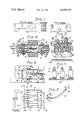
- FIG. 1 is a top plan diagram showing the alignment of my invention between the supply stack of sheets and the fabrication equipment.
- FIG. 2 is a cross sectional side elevation showing a sheet between the double form of my invention.
- FIG. 3 is a fragmentary sectional view taken along lines 3--3 of FIG. 2.
- FIG. 4 is a partial side elevational view taken from the left side of FIG. 2.
- FIG. 5 is a fragmentary cross sectional view through the upper central portion of FIG. 2.
- FIG. 6 is a schematic showing the electrical connections between the components.
- FIG. 7 is a perspective view of a sensor member.
- the numeral 10 is a novel sensor member. It is made of metal for conducting an electrical current. For best results I use rigid strips of arcuate configuration in their central portion with flat end portion for appropriate connections. See FIG. 7. A plurality of such strips are aligned parallel to each other and are spaced sufficiently close to each other, preferably about one-fourth of an inch, to detect an exposed spot 38' coming between them. A panel or set of such sensor members support the weight of light sheets moving over it, eliminating the necessity of "dead plates" over which sheets usually slide on their way from a stack to fabricating machinery. For heavier sheets, additional support means may be used.
- Each end 16 of each strip is planar to facilitate its remaining in position at all times.
- a boss 14 surrounded by a spiral spring 12 is mounted at each end to complete the sensor assembly. The sensors “float" on the springs.
- mounting plate 32 with a groove 34 in which the sensor assembly is freely positioned. Also support strip 36 is secured adjacent thereto to support ends 16 which rest thereon when a sheet 38 is not present.
- the end of spring 12 not secured to the sensor, is secured to threaded bolt 18 at its flange head as can best be seen in FIG. 3.
- the bolt is mounted on buss bar 26, being the lower one in said illustration.
- Bar 26 has an orifice 30 transversely through its body.
- Nuts 22 hold the bolt and the end of an electrical wire 20 so that a current may flow from the wire through the bolt and into the sensor with the spring serving as a conduit in the circuit.
- bolt 18' Attention is directed to a corresponding longer bolt 18' with its electrical wire terminal 20' similarly mounted.
- This bolt 18' is parallel to bolt 18 and functions the same except that it carries an opposite electrical charge to that first mentioned.
- bolt 18' is correspondingly mounted to the upper buss bar 24 of the illustration.
- Bolt 18' is mounted through orifice 30 without making contact. Contact would result in an electrical short.
- the buss bars are separated by strip 28 of insulation material.
- a modification would be the substitution of well-known printed electrical circuits in place of buss bars.
- frame 40 and oppositely disposed frame 40' are secured to the mounting plate 32 for retaining the described parts.
- a double, oppositely disposed detector assembly may be used.
- a single assembly is all that is required.
- a double assembly is used because the sheets are enameled on both sides.
- My novel device is positioned for use between the conventional supply of sheets and the machinery which will press the sheets into a can. See FIG. 1. If a bare, uncoated area exists anywhere on the surface of the sheet, an electrical current will immediately flow from one sensor to the next, activating a relay which stops the power to the machinery. Although the sheets move at a rapid pace and some defects in coating are quite minute, the device causes an immediate halt in the operation so the defective sheet may be removed.
Landscapes
- Chemical & Material Sciences (AREA)
- Chemical Kinetics & Catalysis (AREA)
- Electrochemistry (AREA)
- Physics & Mathematics (AREA)
- Health & Medical Sciences (AREA)
- Life Sciences & Earth Sciences (AREA)
- Analytical Chemistry (AREA)
- Biochemistry (AREA)
- General Health & Medical Sciences (AREA)
- General Physics & Mathematics (AREA)
- Immunology (AREA)
- Pathology (AREA)
- Investigating Or Analyzing Materials By The Use Of Electric Means (AREA)
Abstract
A sensor assembly for electrically signalling the presence of bare spots on coated sheet metal for removal before further fabrication.
Description
During the conventional coating of sheet metal small surface areas are sometimes inadvertently allowed to remain uncoated. That is, the coating material, such as enamel, fails to cover the entire sheet leaving small areas of the metal'surface exposed to the atmosphere. Left undetected, such bare spots cause serious problems as rust and other undesirable chemical reactions will result. The canning industry is an example of an activity that cannot afford to make its product from defectively coated sheet metal. Sheets which have bare spots must be detected and removed before fabrication.
Efforts have been made to detect such bare spots. The results have been disappointing. One attempt has been to use electrically charged free-end terminals which contact the coated sheet metal as it moves under the terminals. Proximate terminals carry opposite electrical charges. A current does not normally flow. However, when a bare spot exists between the terminals it causes the sheet metal itself to become a conductor between the terminals. The complete circuit activates means to stop the fabrication machinery so the defective sheet may be removed.
Unfortunately, with protracted use the terminals become bent out of shape and no longer contact the sheet metal. Also, they can only be used on one side of sheets which are often coated on both sides. Until my invention it has been necessary to check each coated side, one after another, rather than both simultaneously.
I have provided a device that overcomes the shortcomings of the prior art. I replace the free-end contacts with rigid sensor members, secured at both of two ends by spring means. A panel of such members is strong enough to indefinitely remain in proper shape and to contact sheet metal at all times. A panel consists of several strips each carrying a low voltage electrical charge having polarity opposite that of the strip next to it. The strips are of uniform height whereby they support the weight of rapidly moving coated metal sheets passing between a supply stack of sheets and the machinery for fabricating the sheets into a product. Dies for "cupping" the sheets in manufacture of cans is an example. Oppositely disposed like panel of strips may be positioned over the moving sheets and in contact therewith to detect defects in the coating on the upper surface of the sheet at the same time as defects in the underside are being detected. The ability to test both sides of a sheet at one time is an important feature of my invention.
FIG. 1 is a top plan diagram showing the alignment of my invention between the supply stack of sheets and the fabrication equipment.
FIG. 2 is a cross sectional side elevation showing a sheet between the double form of my invention.
FIG. 3 is a fragmentary sectional view taken along lines 3--3 of FIG. 2.
FIG. 4 is a partial side elevational view taken from the left side of FIG. 2.
FIG. 5 is a fragmentary cross sectional view through the upper central portion of FIG. 2.
FIG. 6 is a schematic showing the electrical connections between the components.
FIG. 7 is a perspective view of a sensor member.
Referring to the accompanying drawing wherein like numerals represent like parts throughout, the numeral 10 is a novel sensor member. It is made of metal for conducting an electrical current. For best results I use rigid strips of arcuate configuration in their central portion with flat end portion for appropriate connections. See FIG. 7. A plurality of such strips are aligned parallel to each other and are spaced sufficiently close to each other, preferably about one-fourth of an inch, to detect an exposed spot 38' coming between them. A panel or set of such sensor members support the weight of light sheets moving over it, eliminating the necessity of "dead plates" over which sheets usually slide on their way from a stack to fabricating machinery. For heavier sheets, additional support means may be used.
Each end 16 of each strip is planar to facilitate its remaining in position at all times. A boss 14 surrounded by a spiral spring 12 is mounted at each end to complete the sensor assembly. The sensors "float" on the springs.
There is a mounting plate 32 with a groove 34 in which the sensor assembly is freely positioned. Also support strip 36 is secured adjacent thereto to support ends 16 which rest thereon when a sheet 38 is not present.
The end of spring 12 not secured to the sensor, is secured to threaded bolt 18 at its flange head as can best be seen in FIG. 3. The bolt is mounted on buss bar 26, being the lower one in said illustration. Bar 26 has an orifice 30 transversely through its body. Nuts 22 hold the bolt and the end of an electrical wire 20 so that a current may flow from the wire through the bolt and into the sensor with the spring serving as a conduit in the circuit.
Attention is directed to a corresponding longer bolt 18' with its electrical wire terminal 20' similarly mounted. This bolt 18' is parallel to bolt 18 and functions the same except that it carries an opposite electrical charge to that first mentioned. In the later unit, bolt 18' is correspondingly mounted to the upper buss bar 24 of the illustration. Bolt 18' is mounted through orifice 30 without making contact. Contact would result in an electrical short. The buss bars are separated by strip 28 of insulation material. A modification would be the substitution of well-known printed electrical circuits in place of buss bars.
Finally frame 40 and oppositely disposed frame 40' are secured to the mounting plate 32 for retaining the described parts. When two sides of the sheet stock are coated, a double, oppositely disposed detector assembly may be used. When only one side is coated, a single assembly is all that is required.
For use in detecting bare or uncoated spots on enameled sheets in the manufacture of cans, a double assembly, as illustrated, is used because the sheets are enameled on both sides. My novel device is positioned for use between the conventional supply of sheets and the machinery which will press the sheets into a can. See FIG. 1. If a bare, uncoated area exists anywhere on the surface of the sheet, an electrical current will immediately flow from one sensor to the next, activating a relay which stops the power to the machinery. Although the sheets move at a rapid pace and some defects in coating are quite minute, the device causes an immediate halt in the operation so the defective sheet may be removed.
Claims (3)
1. A detector for detecting defects comprising the absence of an insulated coating on a conductive member passed through the detector, the detector comprising:
a first plurality of electrically conductive guide means transversely positioned with respect to the direction of movement of said member through said detector for supporting said member in an electrically conductive manner;
a second plurality of electrically conductive guide means transversely positioned with respect to the direction of movement of said member through said detector for supporting said member in an electrically conductive manner, each of said first guide means and said second guide means comprising flexible arcuate electrode for tangentially supporting said member passing through said detector, said first guide means and said second guide means being alternately arranged in said positions transverse to the direction of movement of said member:
means for applying an electrical charge of a first polarity to each of said first guide means and a second electrical charge of the opposite polarity to each of said second guide means and
means electrically connected to said first guide means and to said second means for detecting a current flowing between a pair of adjacent first guide means and second guide means responsive to an uninsulated area of said member simultaneously electrically contacting one of said first guide means and one of said second guide means.
2. A detector according to claim 1 wherein each of said arcuate electrodes includes straight terminal portions at the ends thereof and wherein said detector further includes a slotted base support for receiving said straight terminal portions of said arcuate electrodes to bias said apexes of said arcuate electrodes against the surface of said member moving through said detector.
3. A detector according to claim 2 further including means for spring mounting said arcuate members in said slotted member.
Priority Applications (1)
| Application Number | Priority Date | Filing Date | Title |
|---|---|---|---|
| US06/180,896 US4359727A (en) | 1980-08-25 | 1980-08-25 | Detector of defective coating |
Applications Claiming Priority (1)
| Application Number | Priority Date | Filing Date | Title |
|---|---|---|---|
| US06/180,896 US4359727A (en) | 1980-08-25 | 1980-08-25 | Detector of defective coating |
Publications (1)
| Publication Number | Publication Date |
|---|---|
| US4359727A true US4359727A (en) | 1982-11-16 |
Family
ID=22662124
Family Applications (1)
| Application Number | Title | Priority Date | Filing Date |
|---|---|---|---|
| US06/180,896 Expired - Lifetime US4359727A (en) | 1980-08-25 | 1980-08-25 | Detector of defective coating |
Country Status (1)
| Country | Link |
|---|---|
| US (1) | US4359727A (en) |
Cited By (1)
| Publication number | Priority date | Publication date | Assignee | Title |
|---|---|---|---|---|
| US20060033387A1 (en) * | 2002-06-29 | 2006-02-16 | Wagner Philippa C | Control device |
Citations (5)
| Publication number | Priority date | Publication date | Assignee | Title |
|---|---|---|---|---|
| US2572597A (en) * | 1951-01-02 | 1951-10-23 | Gen Electric | Porosity tester for coating materials |
| US2696589A (en) * | 1952-04-18 | 1954-12-07 | Continental Can Co | Means for detecting scratches in lacquer coatings |
| US3037163A (en) * | 1957-10-02 | 1962-05-29 | Roy B Wiprud | Apparatus for detecting a fault in web material |
| US3146431A (en) * | 1958-07-22 | 1964-08-25 | Dow Chemical Co | Web end control |
| US3193630A (en) * | 1962-08-01 | 1965-07-06 | Jr Bernard Edward Shlesinger | Multiple contact switch having cable switch operating means |
-
1980
- 1980-08-25 US US06/180,896 patent/US4359727A/en not_active Expired - Lifetime
Patent Citations (5)
| Publication number | Priority date | Publication date | Assignee | Title |
|---|---|---|---|---|
| US2572597A (en) * | 1951-01-02 | 1951-10-23 | Gen Electric | Porosity tester for coating materials |
| US2696589A (en) * | 1952-04-18 | 1954-12-07 | Continental Can Co | Means for detecting scratches in lacquer coatings |
| US3037163A (en) * | 1957-10-02 | 1962-05-29 | Roy B Wiprud | Apparatus for detecting a fault in web material |
| US3146431A (en) * | 1958-07-22 | 1964-08-25 | Dow Chemical Co | Web end control |
| US3193630A (en) * | 1962-08-01 | 1965-07-06 | Jr Bernard Edward Shlesinger | Multiple contact switch having cable switch operating means |
Cited By (1)
| Publication number | Priority date | Publication date | Assignee | Title |
|---|---|---|---|---|
| US20060033387A1 (en) * | 2002-06-29 | 2006-02-16 | Wagner Philippa C | Control device |
Similar Documents
| Publication | Publication Date | Title |
|---|---|---|
| US4843315A (en) | Contact probe arrangement for electrically connecting a test system to the contact pads of a device to be tested | |
| RU1808121C (en) | Tactile sensitive element | |
| US4313087A (en) | Apparatus for detecting electrically conductive coatings on documents | |
| US5903154A (en) | Battery test contact assembly | |
| US4344009A (en) | Brush wear indicator for a dynamoelectric machine brush | |
| EP0207579A2 (en) | Tactile pressure sensor | |
| US3971371A (en) | Urine-sensing pad | |
| EP0294939A3 (en) | Multiple lead probe for integrated circuits in wafer form | |
| US3745270A (en) | Slide selector switch assembly | |
| JP3390513B2 (en) | Charge / discharge device for cylindrical secondary battery | |
| US4006336A (en) | Normally closed wafer thin switch | |
| KR102343192B1 (en) | Probe and solar battery cell measurement apparatus | |
| AU586642B2 (en) | An isolating device | |
| JPH0711549B2 (en) | Crimping defective terminal detection method | |
| JP3653956B2 (en) | Aging jig for chip capacitors | |
| EP0130643A1 (en) | Device for soldering an element to a print substrate | |
| EP3114491A1 (en) | Method and device for testing the connections of batteries | |
| JPH037810Y2 (en) | ||
| ES8204874A1 (en) | Electrical switch | |
| JPH0311822Y2 (en) | ||
| JP2948802B2 (en) | Electrical connection members | |
| Wardell | Measuring the AC Electrical Conductance of a Polymeric Composite | |
| JPH0318936Y2 (en) | ||
| JPH03148074A (en) | Conductor-pattern testing method using measuring probe | |
| JPH0448536Y2 (en) |
Legal Events
| Date | Code | Title | Description |
|---|---|---|---|
| STCF | Information on status: patent grant |
Free format text: PATENTED CASE |