US4307295A - Mass spectrometers - Google Patents
Mass spectrometers Download PDFInfo
- Publication number
- US4307295A US4307295A US06/128,161 US12816180A US4307295A US 4307295 A US4307295 A US 4307295A US 12816180 A US12816180 A US 12816180A US 4307295 A US4307295 A US 4307295A
- Authority
- US
- United States
- Prior art keywords
- magnetic field
- electrostatic
- field
- normal
- angle
- Prior art date
- Legal status (The legal status is an assumption and is not a legal conclusion. Google has not performed a legal analysis and makes no representation as to the accuracy of the status listed.)
- Expired - Lifetime
Links
- 230000005686 electrostatic field Effects 0.000 claims description 29
- 230000003287 optical effect Effects 0.000 claims description 4
- 230000004075 alteration Effects 0.000 abstract description 6
- 150000002500 ions Chemical class 0.000 description 7
- 230000002411 adverse Effects 0.000 description 2
- 238000001514 detection method Methods 0.000 description 2
- 230000000694 effects Effects 0.000 description 2
- 238000013459 approach Methods 0.000 description 1
- 238000000205 computational method Methods 0.000 description 1
- 238000010884 ion-beam technique Methods 0.000 description 1
- 238000004949 mass spectrometry Methods 0.000 description 1
Images


Classifications
-
- H—ELECTRICITY
- H01—ELECTRIC ELEMENTS
- H01J—ELECTRIC DISCHARGE TUBES OR DISCHARGE LAMPS
- H01J49/00—Particle spectrometers or separator tubes
- H01J49/26—Mass spectrometers or separator tubes
- H01J49/28—Static spectrometers
- H01J49/32—Static spectrometers using double focusing
Definitions
- This invention relates to improved mass spectrometers, in particular to double focussing zero second-order aberration spectrometers with first-order spectrograph properties.
- Double focussing instruments consisting of electric and magnetic fields in tandem were devised in the 1930's to provide the high resolution needed for accurate atomic-mass determinations.
- the problems of improving focussing by eliminating second-order aberrations were studied and designs were produced in which, for correction of second order aberrations, the coefficients B 11 , B 12 and B 22 could be reduced by numerical computational methods.
- the spectrometers of this invention comprise an electrostatic analyser and a magnet producing a radial electrostatic field and a homogeneous magnetic field respectively, so arranged in tandem that an ion optical beam passing through them is normal to the entry and exit boundaries of the electrostatic field and to the inner face of the magnetic field adjacent to the analyser, but non-normal to the outer face of the magnetic field, the deflection of the ion-optical beam in the electrostatic and magnetic fields being in the same sense, the parameters 1' e /R e , ⁇ e , R e /R m , d/R m , ⁇ ', R m /R', ⁇ m , ⁇ " and 1" m /R m
- R e the radius of curvature of the mean beam axis in the electrostatic field
- R m the radius of curvature of the mean beam axis in the magnetic field
- FIG. 1 shows dependence of ⁇ e
- FIG. 2 shows dependence of ⁇
- FIG. 3 shows dependence of (1' e /R e )
- FIG. 4 shows dependence of (1" m /R m )
- FIG. 5 shows dependence of (R e /R m )
- FIG. 6 shows dependence of (d/R m )
- FIG. 7 shows dependence of (R m /R')
- the upper limit of ⁇ m is determined by the need to produce a real final image i.e. 1" m /R m ⁇ 0.
- the parameters so defined will produce a mass spectrometer with a focal point after the magnetic field when the electrostatic field is forward of the magnetic field or a mass spectrometer with a focal point after the electrostatic field when the magnetic field is forward of the electrostatic field.
- the characteristics of this focus will be that the five aberration coefficients B 1 , B 2 , B 11 , B 12 and B 22 , as defined by H. Hintenberger and L A Konig in Advances in Mass Spectrometry, volume 1, pages 16-35 1959, will all be simultaneously zero.
- the spectrometers when the electrostatic field is forward of the magnetic field the spectrometers will have spectrograph properties such that there will be a focal plane along the line joining the point focus to the point of entry of the ion beam into the magnetic field.
- the characteristics of the foci along this focal plane will be that the two coefficients B 1 and B 2 will be simultaneously zero at all points along this plane, i.e. independent of mass.
- the ion optical beam may be passed through the spectrometer in either direction, by interchange of the ion source and the detection means, according to the use of which the instrument is to be put, i.e. the reverse geometry may be used only as a spectrometer.
- the focal plane of the spectrometer is coincident with the exit face of the magnetic field when the ion-optical beam is passed first through the electrostatic field. This is advantageous when the instrument is used in a mass spectrograph mode since the adverse defocussing effect of the fringe magnetic field on the emergent beam is eliminated. A further advantage arises when the newer types of electronic multichannel plate detectors are used since they function more efficiently when the detector is located in the fringe magnetic field, as this reduces electron loss in the detector.
- the parameter (R m /R') is zero, i.e. the inner face of the magnetic field advantageously is planar.
- the instrument can be used with an electronic ion detector behind the exit slit, i.e. as a true double focussing mass spectrometer.
Landscapes
- Chemical & Material Sciences (AREA)
- Analytical Chemistry (AREA)
- Electron Tubes For Measurement (AREA)
- Other Investigation Or Analysis Of Materials By Electrical Means (AREA)
Abstract
In improved mass spectrometers of the double focussing zero second-order aberration type with first-order spectrograph properties, parameters are related by specific equations as a result of which the five aberration coefficients B1, B2, B11, B12 and B22 can all be simultaneously zero.
Description
This invention relates to improved mass spectrometers, in particular to double focussing zero second-order aberration spectrometers with first-order spectrograph properties.
Double focussing instruments consisting of electric and magnetic fields in tandem were devised in the 1930's to provide the high resolution needed for accurate atomic-mass determinations. In later years the problems of improving focussing by eliminating second-order aberrations were studied and designs were produced in which, for correction of second order aberrations, the coefficients B11, B12 and B22 could be reduced by numerical computational methods. We have now developed designs of spectrometers in which these coefficients can be eliminated by analytical solutions of the focussing equations so making possible an improved degree of resolution.
The spectrometers of this invention comprise an electrostatic analyser and a magnet producing a radial electrostatic field and a homogeneous magnetic field respectively, so arranged in tandem that an ion optical beam passing through them is normal to the entry and exit boundaries of the electrostatic field and to the inner face of the magnetic field adjacent to the analyser, but non-normal to the outer face of the magnetic field, the deflection of the ion-optical beam in the electrostatic and magnetic fields being in the same sense, the parameters 1'e /Re, φe, Re /Rm, d/Rm, ε', Rm /R', φm, ε" and 1"m /Rm
having the values in the following ranges:
φm : 64.2619° to 90.000°
ε': zero
φe : 155.2559° to 159.0990°
ε": -57.8691° to -45.0000°
1'e /Re : 0.8558 to 0.7071
1"m /Rm : 0.2727 to 0.0000
Re /Rm : +∞ to 3.6336
d/Rm : 4.7930×10⁵ to 0.8348
Rm /R': -1.2222 to 0.7854
wherein the above symbols have the following meanings:
1'e --the distance from the ion source to the entrance to the electrostatic field when the beam passes first through the electrostatic field, or the corresponding distance from the exit of the electrostatic field to the aberration-free focal point when the beam passes first through the electromagnet;
Re --the radius of curvature of the mean beam axis in the electrostatic field;
Rm --the radius of curvature of the mean beam axis in the magnetic field;
φe --the angle of deflection of the beam in the electrostatic field;
φm --the angle of deflection of the beam in the magnetic field;
d--the distance separating the electrostatic and magnetic fields along the path of the beam;
ε'--the angle of the beam to the normal to the inner face of the magnetic field, i.e. zero;
ε"--the angle of the beam to the normal to the outer face of the magnetic field;
R'--the radius of curvature of the inner face of the magnetic field, and
1"m --the distance from the outer face of the magnetic field to the aberration-free focal point when the beam passes first through the electrostatic analyser, or the corresponding distance from the ion source to the outer face of the magnetic field when the beam passes first through the electromagnet, and the above parameters are
related by the following equations numbered (1) to (7): ##EQU1##
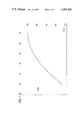
Possible values of φm lie in the range 64.2619° to 90.000°; all other parameters have dependant unique values determined by the above equations. The dependant value of these other parameters determined by the values of φm in the above range are shown in FIGS. 1-7 of the accompanying drawings in which:
FIG. 1 shows dependence of φe
FIG. 2 shows dependence of ε"
FIG. 3 shows dependence of (1'e /Re)
FIG. 4 shows dependence of (1"m /Rm)
FIG. 5 shows dependence of (Re /Rm)
FIG. 6 shows dependence of (d/Rm)
FIG. 7 shows dependence of (Rm /R')
In the above-mentioned range of possible values of φm the lower limit is critical because, as can be seen from the above, this is the value at which (Re /Rm) assymptotically approaches infinity corresponding to cos φm =1/6 [√13-1]. The upper limit of φm is determined by the need to produce a real final image i.e. 1"m /Rm ≧0.
It can be calculated from the above equations that when φm lies in the range 64.2619° to 90.000° the other parameters lie in the ranges given above.
It is, of course, possible first to select a value of any parameter within the above ranges and from that determined the unique values of the other parameters which must be associated with it.
The parameters so defined will produce a mass spectrometer with a focal point after the magnetic field when the electrostatic field is forward of the magnetic field or a mass spectrometer with a focal point after the electrostatic field when the magnetic field is forward of the electrostatic field. The characteristics of this focus will be that the five aberration coefficients B1, B2, B11, B12 and B22, as defined by H. Hintenberger and L A Konig in Advances in Mass Spectrometry, volume 1, pages 16-35 1959, will all be simultaneously zero.
Additionally, when the electrostatic field is forward of the magnetic field the spectrometers will have spectrograph properties such that there will be a focal plane along the line joining the point focus to the point of entry of the ion beam into the magnetic field. The characteristics of the foci along this focal plane will be that the two coefficients B1 and B2 will be simultaneously zero at all points along this plane, i.e. independent of mass.
It will be clear from the definitions of 1'e and 1"m given above that the ion optical beam may be passed through the spectrometer in either direction, by interchange of the ion source and the detection means, according to the use of which the instrument is to be put, i.e. the reverse geometry may be used only as a spectrometer.
At the higher limit of φm the focal plane of the spectrometer is coincident with the exit face of the magnetic field when the ion-optical beam is passed first through the electrostatic field. This is advantageous when the instrument is used in a mass spectrograph mode since the adverse defocussing effect of the fringe magnetic field on the emergent beam is eliminated. A further advantage arises when the newer types of electronic multichannel plate detectors are used since they function more efficiently when the detector is located in the fringe magnetic field, as this reduces electron loss in the detector.
It will be noted from FIG. 7 that at one value of φm, 70.956322°, the parameter (Rm /R') is zero, i.e. the inner face of the magnetic field advantageously is planar.
When the electrostatic field is forward of the magnetic field the beam enters normal to the inner face of the magnetic field, i.e. normal to the entry face of the magnetic field, and this reduces the adverse defocussing effect of the fringe field. Further, since the deflections in the two fields are in the same sense, the detection of metestable ions is improved. In this mode the instrument can be used with an electronic ion detector behind the exit slit, i.e. as a true double focussing mass spectrometer.
Claims (10)
1. A spectrometer comprising an electrostatic analyser and a magnet producing a radial electrostatic field and a homogeneous magnetic field respectively, so arranged in tandem that an ion optical beam passing through them is normal to the entry and exit boundaries of the electrostatic field and to the inner face of the magnetic field adjacent to the analyser, but non-normal to the outer face of the magnetic field, the deflection of the ion-optical beam in the electrostatic and magnetic fields being in the same sense, characterised in that the parameters (1'e /Re), φe, Re /Rm), d,/Rm ε', (Rm /R") φm, ε" and (1"m /Rm), have values in the following ranges:
φm --64.2619° to 90.000°
ε'--zero
φe --155.2559° to 159.0990°
ε"---57.8691° to -45.0000°
(1'e /Re)--0.8558 to 0.7071
1"m /Rm --0.2727 to 0.0000
(Re Rm)--+∞ to 3.6336
(d/Rm)--4.7930 ×105 to 0.8348
(Rm /R'---1.2222 to 0.7854
wherein the above symbols have the following meanings:
'.sub. e --the distance from the ion source to the entrance to the electrostatic field when the beam passes first through the electrostatic field, or the corresponding field to the aberration-free focal point when the beam passes first through the electromagnet;
Re --the radius of curvature of the mean beam axis in the electrostatic field;
Rm --the radius of curvature of the mean beam axis in the magnetic field;
φe --the angle of deflection of the beam in the electrostatic field;
φm --the angle of deflection of the beam in the magnetic field;
d--the distance separating the electrostatic and magnetic fields along the path of the beam;
α'--the angle of the beam to the normal to the inner face of the magnetic field, i.e. zero;
α"--the angle of the beam to the normal to the outer face of the magnetic field;
R'--the radius of curvature of the inner face of the magnetic field, and
1"m --the distance from the outer face of the magnetic field to the aberration-free focal point when the beam passes first through the electrostatic analyser, or the corresponding distance from the ion source to the outer face of the magnetic field when the beam passes first through the electromagnet,
the parameters being related by following equations 1 to 7: ##EQU2## ##EQU3## ##EQU4## ##EQU5## ##EQU6## ##EQU7## ##EQU8##
2. A spectrometer as claimed in claim 1 in which the parameter φm has the value 90° with a focal plane coincident with the magnet exit boundary when the electrostatic field is forward of the magnetic field.
3. A spectrometer as claimed in claim 1 in which the parameter φm has the value 70.956322° and the magnetic field has planar entrance and exit boundaries.
4. A spectrometer as claimed in claim 1 in which the electrostatic field is forward of the magnetic field.
5. A spectrometer as claimed in claim 4 with an ion detector behind the exit slit.
6. A spectrometer as claimed in claim 1 in which the magnetic field is forward of the electrostatic field, with an ion detector behind the exit slit after the electrostatic field.
7. A spectrograph comprising an electrostatic analyser producing a radial electrostatic field forward of a magnet producing a homogeneous magnetic field so arranged in tandem that an ion optical beam passing through them is normal to the entry and exit boundaries of the electrostatic field and to the inner face of the magnetic field adjacent to the analyser but non-normal to the outer face of the magnetic field, the deflection of the ion-optical beam in the electrostatic and magnetic fields being in the same sense, characterized in that the parameters 1'e /Re, φe, Re /Rm, d/Rm, ε', Rm /R' φm, ε"and 1"m /Rm having values in the following ranges:
φm --64.2619°to 90.000°
ε'--zero
φe --155.2559° to 159. 0990°
ε"---57.8691° to -45.0000°
1'e /Re --0.8558 to 0.7071
1"m Rm --0.2727 to 0.0000
Re /Rm --+∞ to 3.6336
d/Rm --4.7930 ×10⁵ to 0.8348
Rm /R'---1.2222 to 0.7854
wherein the above symbols have the following meanings:
'.sub. e --the distance from the ion source to the entrance to the electrostatic field when the beam passes first through the electrostatic field, or the corresponding field to the aberration-free focal point when the beam passes first through the electromagnet;
Re --the radius of curvature of the mean beam axis in the electrostatic field;
Rm --the radius of curvature of the mean beam axis in the magnetic field;
φe --the angle of deflection of the beam in the electrostatic field;
φm --the angle of deflection of the beam in the magnetic field;
d--the distance separating the electrostatic and magnetic fields along the path of the beam;
ε'--the angle of the beam to the normal to the inner face of the magnetic field, i.e. zero;
ε"--the angle of the beam to the normal to the outer face of the magnetic field;
R'--the radius of curvature of the inner face of the magnetic field, and
1"m --the distance from the outer face of the magnetic field to the aberration-free focal point when the beam passes first through the electrostatic analyser, or the corresponding distance from the ion source to the outer face of the magnetic field when the beam passes first through the electromagnet,
the parameters being related by following equations 1 to 7: ##EQU9## ##EQU10## ##EQU11## ##EQU12## ##EQU13## ##EQU14## ##EQU15##
8. A spectrograph as claimed in claim 7 in which the parameter φm has the value 90° with a focal plane coincident with the magnetic exit boundary.
9. A spectrograph as claimed in claim 7 in which the parameter φm has the value 70.956322° and the magnetic field has planar entrance and exit boundaries.
10. A spectrograph as claimed in claim 7 with a planar ion detector at the focal plane.
Applications Claiming Priority (2)
| Application Number | Priority Date | Filing Date | Title |
|---|---|---|---|
| GB7909101 | 1979-03-15 | ||
| GB09101/79 | 1979-03-15 |
Publications (1)
| Publication Number | Publication Date |
|---|---|
| US4307295A true US4307295A (en) | 1981-12-22 |
Family
ID=10503892
Family Applications (1)
| Application Number | Title | Priority Date | Filing Date |
|---|---|---|---|
| US06/128,161 Expired - Lifetime US4307295A (en) | 1979-03-15 | 1980-03-07 | Mass spectrometers |
Country Status (4)
| Country | Link |
|---|---|
| US (1) | US4307295A (en) |
| EP (1) | EP0016561A1 (en) |
| JP (1) | JPS5619858A (en) |
| CA (1) | CA1140684A (en) |
Cited By (1)
| Publication number | Priority date | Publication date | Assignee | Title |
|---|---|---|---|---|
| US4435642A (en) | 1982-03-24 | 1984-03-06 | The United States Of America As Represented By The United States National Aeronautics And Space Administration | Ion mass spectrometer |
Families Citing this family (1)
| Publication number | Priority date | Publication date | Assignee | Title |
|---|---|---|---|---|
| JPS58209855A (en) * | 1982-05-31 | 1983-12-06 | Shimadzu Corp | High-mass-range double-focused mass spectrometer |
Citations (3)
| Publication number | Priority date | Publication date | Assignee | Title |
|---|---|---|---|---|
| US2851608A (en) * | 1956-12-07 | 1958-09-09 | Cons Electrodynamics Corp | Mass spectrometer |
| US3061720A (en) * | 1960-02-29 | 1962-10-30 | Ewald Heinz | Spectrograph |
| US3920988A (en) * | 1973-05-07 | 1975-11-18 | Hitachi Ltd | Mass spectrometer |
Family Cites Families (2)
| Publication number | Priority date | Publication date | Assignee | Title |
|---|---|---|---|---|
| GB1134448A (en) * | 1965-09-30 | 1968-11-20 | Hitachi Ltd | Double focussing mass spectrometer |
| GB1152258A (en) * | 1966-12-06 | 1969-05-14 | Ass Elect Ind | Improvements relating to Mass Spectrometers |
-
1980
- 1980-02-27 EP EP80300588A patent/EP0016561A1/en not_active Ceased
- 1980-03-04 CA CA000346911A patent/CA1140684A/en not_active Expired
- 1980-03-07 US US06/128,161 patent/US4307295A/en not_active Expired - Lifetime
- 1980-03-14 JP JP3256980A patent/JPS5619858A/en active Pending
Patent Citations (3)
| Publication number | Priority date | Publication date | Assignee | Title |
|---|---|---|---|---|
| US2851608A (en) * | 1956-12-07 | 1958-09-09 | Cons Electrodynamics Corp | Mass spectrometer |
| US3061720A (en) * | 1960-02-29 | 1962-10-30 | Ewald Heinz | Spectrograph |
| US3920988A (en) * | 1973-05-07 | 1975-11-18 | Hitachi Ltd | Mass spectrometer |
Cited By (1)
| Publication number | Priority date | Publication date | Assignee | Title |
|---|---|---|---|---|
| US4435642A (en) | 1982-03-24 | 1984-03-06 | The United States Of America As Represented By The United States National Aeronautics And Space Administration | Ion mass spectrometer |
Also Published As
| Publication number | Publication date |
|---|---|
| EP0016561A1 (en) | 1980-10-01 |
| JPS5619858A (en) | 1981-02-24 |
| CA1140684A (en) | 1983-02-01 |
Similar Documents
| Publication | Publication Date | Title |
|---|---|---|
| EP0647960A1 (en) | Energy filter with correction of a second-order chromatic aberration | |
| US3445650A (en) | Double focussing mass spectrometer including a wedge-shaped magnetic sector field | |
| Reuben et al. | Ion trajectories in exactly determined quadrupole fields | |
| EP0952607B1 (en) | Simultaneous detection isotopic ratio mass spectrometer | |
| US4760261A (en) | Alpha-type electron energy filter | |
| US4536652A (en) | Hybrid mass spectrometer | |
| US4672204A (en) | Mass spectrometers | |
| US4952803A (en) | Mass Spectrometry/mass spectrometry instrument having a double focusing mass analyzer | |
| CA1190666A (en) | Method of broad band mass spectrometry and apparatus therefor | |
| US5783823A (en) | Apparatus to be used in the field of accelerator mass spectrometry | |
| US3984682A (en) | Mass spectrometer with superimposed electric and magnetic fields | |
| JPH0578903B2 (en) | ||
| US5621209A (en) | Attomole detector | |
| JPS5829577B2 (en) | Double convergence mass spectrometer | |
| CA3012283A1 (en) | Extraction system for charged secondary particles for use in a mass spectrometer or other charged particle device | |
| US3774026A (en) | Ion-optical system for mass separation | |
| EP0016561A1 (en) | Mass spectrometers | |
| US3944827A (en) | Virtual image type double focusing mass spectrometer | |
| US3967116A (en) | Mass spectrometer | |
| US3920988A (en) | Mass spectrometer | |
| US4645928A (en) | Sweeping method for superimposed-field mass spectrometer | |
| US3087055A (en) | Particle spectrometers with high transmission, dispersion and resolution | |
| Wollnik | The correction of image aberrations of second order for mass or energy separators consisting of one single magnetic sector field | |
| US3213276A (en) | Magnetic analyzing system for a mass spectrometer having bi-directional focusing | |
| US4458150A (en) | Mass spectrometer |
Legal Events
| Date | Code | Title | Description |
|---|---|---|---|
| STCF | Information on status: patent grant |
Free format text: PATENTED CASE |