US4213301A - Compressed air apparatus for driving fastening elements - Google Patents
Compressed air apparatus for driving fastening elements Download PDFInfo
- Publication number
- US4213301A US4213301A US06/015,612 US1561279A US4213301A US 4213301 A US4213301 A US 4213301A US 1561279 A US1561279 A US 1561279A US 4213301 A US4213301 A US 4213301A
- Authority
- US
- United States
- Prior art keywords
- chamber
- piston
- compressed air
- casing
- rear end
- Prior art date
- Legal status (The legal status is an assumption and is not a legal conclusion. Google has not performed a legal analysis and makes no representation as to the accuracy of the status listed.)
- Expired - Lifetime
Links
- 238000003860 storage Methods 0.000 claims abstract description 27
- 239000000463 material Substances 0.000 claims abstract description 18
- 238000004891 communication Methods 0.000 claims abstract description 5
- 238000010276 construction Methods 0.000 claims description 6
- 230000009471 action Effects 0.000 claims description 3
- 238000007789 sealing Methods 0.000 description 11
- 230000001133 acceleration Effects 0.000 description 5
- 230000000694 effects Effects 0.000 description 3
- 239000002360 explosive Substances 0.000 description 3
- 238000003780 insertion Methods 0.000 description 3
- 230000037431 insertion Effects 0.000 description 3
- 239000000843 powder Substances 0.000 description 3
- 229910000831 Steel Inorganic materials 0.000 description 2
- 238000000034 method Methods 0.000 description 2
- 239000010959 steel Substances 0.000 description 2
- 230000005540 biological transmission Effects 0.000 description 1
- 238000011109 contamination Methods 0.000 description 1
- 238000004519 manufacturing process Methods 0.000 description 1
- 230000007246 mechanism Effects 0.000 description 1
- 238000009527 percussion Methods 0.000 description 1
- 238000003825 pressing Methods 0.000 description 1
- 230000008569 process Effects 0.000 description 1
- 239000003380 propellant Substances 0.000 description 1
- 230000001141 propulsive effect Effects 0.000 description 1
- 230000008439 repair process Effects 0.000 description 1
- 230000000717 retained effect Effects 0.000 description 1
- 239000002023 wood Substances 0.000 description 1
Images



Classifications
-
- B—PERFORMING OPERATIONS; TRANSPORTING
- B25—HAND TOOLS; PORTABLE POWER-DRIVEN TOOLS; MANIPULATORS
- B25C—HAND-HELD NAILING OR STAPLING TOOLS; MANUALLY OPERATED PORTABLE STAPLING TOOLS
- B25C1/00—Hand-held nailing tools; Nail feeding devices
- B25C1/04—Hand-held nailing tools; Nail feeding devices operated by fluid pressure, e.g. by air pressure
- B25C1/044—Hand-held nailing tools; Nail feeding devices operated by fluid pressure, e.g. by air pressure with movable main cylinder
-
- Y—GENERAL TAGGING OF NEW TECHNOLOGICAL DEVELOPMENTS; GENERAL TAGGING OF CROSS-SECTIONAL TECHNOLOGIES SPANNING OVER SEVERAL SECTIONS OF THE IPC; TECHNICAL SUBJECTS COVERED BY FORMER USPC CROSS-REFERENCE ART COLLECTIONS [XRACs] AND DIGESTS
- Y10—TECHNICAL SUBJECTS COVERED BY FORMER USPC
- Y10S—TECHNICAL SUBJECTS COVERED BY FORMER USPC CROSS-REFERENCE ART COLLECTIONS [XRACs] AND DIGESTS
- Y10S60/00—Power plants
- Y10S60/916—Unitary construction
Definitions
- the present invention is directed to an apparatus for inserting fastening elements, such as bolts and nails, into a receiving material in which compressed air is used to propel a driving piston which in turn drives the fastening element.
- compressed air acts against a drive piston which, in turn, drives the fastening element into the receiving material.
- Such devices are usually connected to a stationary source of compressed air and are capable of driving the fastening elements only into soft receiving materials, such as wood, carbdoard or the like.
- fastening elements can be driven into hard receiving materials, such as concrete or steel, only if significantly high speeds are used, however, such speeds cannot be developed in the conventional apparatus which is operated by compressed air.
- the inserting speed or velocity must be kept within specific limits, usually between 30 and 100 meters per second. If the velocity falls below such limits, experience has shown that the fastening element tends to buckle during the driving procedure. On the other hand, if such velocity limits are exceeded, effects similar to those which take placed in hand guns can occur which are unacceptable for safety reasons.
- a notable disadvantage of such driving devices is that, before the fastening element is driven in, a new propellant charge in the form of a cartridge must be inserted and such an operation leads to handling problems and, as a result, to lost time, particularly when a single charge device is being operated under normal construction site conditions.
- a new propellant charge in the form of a cartridge must be inserted and such an operation leads to handling problems and, as a result, to lost time, particularly when a single charge device is being operated under normal construction site conditions.
- driving devices using explosive powder force require a relatively sensitive ignition mechanism which, for safety reasons, is very expensive.
- fastening element driving devices operated by explosive powder force are suitable for inserting fastening elements into a hard receiving material they have the above-mentioned disadvantages regarding costs, handling and safety, the known driving devices operated by compressed air do not provide sufficient driving energy for propelling fastening elements into a hard receiving material.
- the primary object of the present invention is to provide a fastening element inserting device which is driven by compressed air and is capable of driving the fastening elements into hard receiving materials and, further, the device affords a compact construction and a fast rate of operation.
- such a compressed air operated fastening element insertion apparatus is provided by:
- a pressure converter supplies the compressed air into the chamber containing the driving cylinder and the converter includes a double headed piston arrangement for providing the higly compressed air used for the driving piston;
- the pressure converter includes a storage chamber for storing the highly compressed air before it is charged into the chamber containing the driving piston;
- the part of the apparatus containing the drive piston is constructed as a so-called percussion cylinder.
- This name is derived from the characteristic sudden acceleration of the drive piston within its chamber. The sudden acceleration is achieved by initially admitting the highly compressed air to only a relatively small portion of the rear end surface of the head of the drive piston. This portion of the rear end surface is sealed so that the highly compressed air does not act against the entire rear end surface of the drive piston head until the sealing effect is overcome. When the sealing effect is overcome, the highly compressed air acts on the full rear end surface of the head of the drive piston causing it to be accelerated in the driving direction.
- the propelling power of the drive piston takes place as the piston moves toward the front end of the chamber in which it is located, the return stroke of the piston takes place after each fastening element insertion step is completed by admitting compressed air into the chamber in front of the piston head.
- the compressed air supplied into the chamber is advantageously at a pressure only insigificantly greater than atmospheric pressure.
- the drive piston To insert a fastening element into a hard receiving material, the drive piston must travel at a velocity between 30 and 100 meters per second, as explained above. Accordingly, the compressed air must be directed against the drive piston at a sufficient level to provide the desired velocity. It has been established that a pressure of 20 bars is sufficient to provide the required energy for adequately driving the fastening elements into a hard receiving material.
- the highly compressed air is supplied by a pressure converter including a double-headed piston with each head located within a separate chamber.
- One of the chambers has a much smaller transverse cross-sectional area than the other.
- the small cross-sectional area chamber is in communication with the chamber containing the drive piston.
- the velocity of the double-headed piston in the pressure converter is, of course, much slower than the working velocity of the drive piston.
- the compressed air produced by the pressure converter is, initially, stored within a storage chamber which is in communication with the chamber containing the drive piston through the smaller cross-sectional area chamber of the pressure converter.
- the highly compressed air in the storage chamber acts only on a relatively small area of the drive piston head and when the seal between the drive piston head and the opening to its chamber is broken the highly compressed air can act on the full crosssectional area of the drive piston head causing it to accelerate to the necessary velocity.
- the drive piston propels the fastening element forwardly through a tubular muzzle member and drives it into the receiving material.
- the volume of the chambers within the pressure converter and also of the storage chamber are dimensioned so that the quantity of compressed air produced in one working stroke of the pressure converter can be retained in the storage space and is sufficient for carrying out one driving stroke of the drive piston.
- the pressure converter and the chamber containing the drive piston are controllably coupled so that the working stroke of the drive piston can begin only after the completion of the working stroke of the pressure converter. Accordingly, it is assured that the peak pressure acts on the drive piston and, therefore, the maximum kinetic energy is imparted to the drive piston.
- a very compact and mobile apparatus capable of use as a hand-held driving device can be provided when, in accordance with the present invention, the cylinder forming the chamber for the drive piston and the pressure converter are integrated as a unit with the drive piston and the double-headed piston disposed in axial arrangement one behind the other. Accordingly, it is not necessary to provide connecting lines between the pressure converter and the chamber of the drive piston. Such an arrangement affords a device which does not require much in the way of repairs and does not afford any problems when it is used under the rough conditions experienced at a construction site.
- compressed air can be supplied to the smaller cross-sectional area chamber of the pressure converter.
- the transmission ratio of the pressure can be increased in accordance with the transverse area of the small piston which permits a smaller construction of the pressure converter at the same pressure level of the compressed air used for driving the drive piston.
- a requirement in this arrangement is that the smaller cross-sectional area chamber in the pressure converter is sealed from the larger cross-sectional area chamber and receives a separate supply of the compressed air.
- the cylinder forming the drive piston chamber is supported in a casing so that it is slidable in the axial direction. Normally, its front end provides a seal with the casing.
- the drive piston When the drive piston is driven forwardly the action of the compressed air on the cylinder displaces it axially rearwardly opening the seal and providing access between the chamber and discharge openings in the casing.
- the cylinder As the drive piston is moved in the driving direction, the cylinder is automatically displaced in the rearward direction relative to the casing so that an opening is provided through which the air located in front of the drive piston can be discharged from the chamber assuring that no aircushion is formed which counteracts the acceleration of the piston.
- the cylinder can be held in its sealed position against the casing by a spring member. The pressure within the chamber during the working stroke of the drive piston overcomes the spring pressure and permits the cylinder to move axially rearwardly.
- the storage chamber is ventilated via a control valve.
- the drive piston can be placed in the starting position by supplying pressure in front of the drive piston head within its chamber which pressure is only slightly above atmospheric pressure. The pressure applied in front of the drive piston head causes it to move rearwardly into the starting position.
- the storage chamber is formed as an annular space laterally enclosing the cylinder forming the chamber of the drive piston.
- feed pipes interconnecting the chambers are unnecessary and, furthermore, the drive piston cylinder is protected, especially from contamination from the outside of the casing. Further, it is advantageous to combine the storage chamber with the pressure converter.
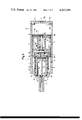
- FIG. 1 is a sectional view of a compressed air operated apparatus for driving fastening elements into a receiving material with the various parts of the apparatus in position after a fastening element has been inserted;
- FIG. 2 is a view similar to FIG. 1 with the drive piston displaced axially rearwardly into a ready-to-fire position and with the double-headed piston in the starting position;
- FIG. 3 is a view similar to FIGS. 1 and 2, however, the double-headed piston has moved forwardly for providing the required supply of highly compressed air for use in displacing the drive piston;
- FIG. 4 is a view similar to FIGS. 1-3, however, the highly air compressed air is supplied into the chamber of the drive piston and the drive piston is being accelerated forwardly for driving the fastening element.
- FIG. 1 a compressed air operated device is shown for driving fastening elements into a hard receiving material, such as steel or concrete.
- the left-hand end of the apparatus is its front or muzzle end and its right-hand end is its rear end, the same directional arrangement applies to the individual parts of the apparatus.
- the apparatus includes an axially extending casing, that is one extending between the front end and the rear end and containing a drive cylinder 2 within the front portion of the casing.
- the cylinder 2 is mounted within the casing so that it can move in the axial direction.
- a pressure converter 3 is located within the casing rearwardly of the drive cylinder 2.
- the drive cylinder 2 includes an axially extending cylinder 4 containing a drive piston 5 having a piston head 5a at its rear end and a shaft 5b extending forwardly from the piston head.
- the piston head 5a is guided in the cylindrical chamber 4a and the shaft 5b extends forwardly into an axially extending tubular muzzle part 6 which forms the front end of the casing.
- the head 5a has a sealing ring 5c encircling its circumferential periphery so that a seal is provided with the surface of the chamber 4a as the piston is axially displaced through the chamber.
- a seal ring 6a is located within the rearward end of the tubular muzzle part 6 providing a seal with the shaft 5b of the drive piston 5.
- a flange 8 is screwed into the casing 1 so that the rear end of the cylinder can move axially within the flange.
- the rear end of the cylinder is sealed within the flange 8 by a sealing ring 8a and another sealing ring 8b.
- the cylinder is sealed to the casing via a sealing ring 7a.
- a spring 9 laterally encloses the cylinder 4 and extends between a shoulder 4b extending radially outwardly from the cylinder adjacent its front end and the flange 8 at its rear end.
- An additional seal is provided between the front end of the cylinder 4 and the juxtaposed surface of the shoulder 7 by a sealing ring 7b.
- the cylinder At its rearward end the cylinder has a transversely extending base 4c containing a centrally arranged bore 4d communicating between the chamber 4a and the space rearwardly of the cylinder 4.
- an annular sealing lip 4e On the surface of the base 4c facing into the chamber 4a, an annular sealing lip 4e is provided which extends around the opening of the central bore 4d.
- the pressure converter 3 consists of an axially extending insert 11 which is threaded into the casing 1 so that its front end contacts the rear surface of the flange 8.
- the insert 11 consists of axially extending and transversely extending walls forming a small pressure chamber 11a directly rearwardly of the rear end of the cylinder 4.
- the casing 1 includes a rear casing section 12 closed at its rear end by a transversely extending cover 12a which is threaded into the casing section 12.
- the rear casing section 12 in combination with its cover 12a and the rearward surface of the inset 11 forms a large pressure chamber 12b.
- a double-headed piston 13 is located with its small area piston head 13a within the small pressure chamber 11a and with its large area piston head 13b located within the large pressure chamber 12b.
- the double-headed piston in combination with the pressure converter 3 and the rear casing section 12 affords the production of the highly compressed air which is required for driving the drive piston and inserting the fastening elements.
- the small and large piston heads 13a, 13b are interconnected by a piston rod 13c extending between them.
- the piston rod 13c is in generally axial alignment with the axis of the drive piston chamber 4a.
- An annular seal ring 13d, 13e laterally encircles each of the small and large piston heads 13a and 13b to provide a seal with the surface of the chamber in which the heads are located.
- a seal 11b, note FIG. 4, located in the rear end wall 11c of the insert 11 provides a seal between the rod and the insert.
- a hermetic seal is provided between the small pressure chamber 11a and the large pressure chamber 12b.
- the forward movement of the double-headed piston 13 is limited by the wall 11c of the insert 11 which provides a stop for the large piston head 13b, note FIG. 1.
- the reverse movement of the large piston head of the double headed piston 13 is limited by an annular stop shoulder 12c formed on the cover 12a at the rear end of the apparatus. Accordingly, radially inwardly of the shoulder 12c, a pressure buildup space 12d is provided at the rearward end of the large pressure chamber 12b.
- the highly compressed air produced in the small pressure chamber 11a forwardly of the small piston head 13a is supplied into an annular storage chamber 14 which laterally encloses the cylinder 4.
- the compressed air flows through a radially extending channel 11d and a groove 8c in the flange 8 from the small pressure chamber 11a into the storage chamber 14.
- the storage chamber 14 is formed between the casing 1 and the cylinder 4.
- Pneumatic control of the apparatus is provided through a plurality of openings A, B, B', C, D and E.
- the description is limited to the control function of the openings in each of the different operational stages and to the air pressure conditions required for each stage.
- the air pressure conditions can be provided conventionally by any pneumatic control circuit and, therefore, because such a control circuit is well known it is not shown or described to simplify the description.
- the position of the various movable parts as illustrated in FIG. 1 is the position which these parts assume at the completion of the step of driving a fastening element into a receiving material, not shown.
- the opening A located in the casing 1 forwardly of the flange 8 admits air having a pressure only slightly greater than atmospheric pressure or, for example, the pressure provided by a conventional compressed air source. After passing through opening A the compressed air enters the storage chamber 14, flows through the groove 8c and the channel 11d into the space forwardly of the small piston head 13a and causes the doubleheaded piston 13 to move rearwardly into the starting position shown in FIG. 2.
- the openings B and B' as well as C are kept open to the atmosphere to allow air rearwardly of the heads of the doubleheaded piston to discharge into the atmosphere.
- the opening D is also kept open to allow the introduction of atmospheric air into the large pressure chamber 12b ahead of the piston head 13b. If the opening D is not kept open, a partial vacuum would develop in the large pressure chamber 12b in front of the piston head 13b and the return movement of the double-headed piston to its position in FIG. 2 would tend to be inhibited.
- no compressed air is supplied through the opening E. However, as soon as the double-headed piston 13 has reached the position shown in FIG.
- the opening E is preferably kept open to the atmosphere so that air can move through the bore 4d in the rear end of the cylinder 4 and out through the passage 11d and the groove 8c into the storage chamber 14 and through the opening A.
- the openings B or B', C and D are preferably kept open to the atmosphere so that air can move through the bore 4d in the rear end of the cylinder 4 and out through the passage 11d and the groove 8c into the storage chamber 14 and through the opening A.
- the rearward face of the drive piston 5a is sealed against the sealing lip 4e laterally surrounding the bore 4d through the base of the cylinder 4.
- the drive piston is kept in this sealed position by the pressure provided through the opening E while the opening A is closed.
- the compressed air is supplied from a source, not shown, through the opening C into the pressure buildup space 12d at the rearward end of the large pressure chamber 12b.
- the pressure within the space 12d acts on the rearward surface of the piston head 13b and moves the double-headed piston 13 in the forward direction, that is toward the drive piston 5.
- This working stroke of the double-headed piston can be additonally supported by the introduction of compressed air through the openings B and B' so that the pressurized air acts against the rearward face of the small piston head 13a.
- the opening D is kept open to the atmosphere. Accordingly, based on the ratio of the cross-sectional areas of the large piston head 13b and the small piston head 13a, highly pressurized air is developed in the small pressure chamber 11a ahead of the small piston head 13a. This highly compressed air flows from the chamber 11a through the channel 11d and the groove 8c into the storage space 14 laterally enclosing the cylinder 4.
- the highly pressurized air is maintained in the storage chamber 14 ready for use and it also flows through the central bore 4d in the rear end of the cylinder 4 and acts against the inner circular portion of the rear end surface of the drive piston head 5a defined by the cross-sectional area of the bore 4d, since the rear end surface of the head 5a initially seats in sealed engagement with the lip 4e encircling the opening from the bore 4d.
- This position of the apparatus is shown in FIG. 3.
- the drive piston 5 remains temporarily in the position shown in FIG. 3 because the force of the pressure introduced through opening E acting on the front surface of the piston head 5a is greater than the force exerted on the surface defined by the opening from the bore 4d.
- a fastening element 15, note FIGS. 3 and 4 has been inserted into the tubular muzzle part 6 of the casing and the front end of the muzzle portion is pressed against a receiving material, not shown, the pressure acting on the front surface of the piston head 5a is allowed to escape through the opening E.
- the propulsive thrust acting on the rear surface of the piston head 5a can now displace the piston 5 in the driving direction so that the rear end surface of the head 5a is disengaged from the sealing lip 4e at the commencement of movement.
- the highly compressed air from the storage chamber 14 flows over the entire rear end surface of the drive piston head 5a and the drive piston 5 is suddenly accelerated in the forward direction driving the piston element 15 ahead of it out of the tubular muzzle part 6.
- FIG. 4 the drive piston 5 is shown at the commencement of its acceleration forwardly through the chamber 4a.
- the highly pressurized air acting on the drive piston head 5a also acts on the forwardly facing base 4c of the cylinder pressing it backwardly against the biasing force of the spring 9.
- the axially rearward movement of the cylinder 4 displaces its forward end from the surface of the annular shoulder 7 and an annular space is opened between the shoulder and the forward end of the cylinder 4.
- This annular opening permits air in front of the head 5a within the chamber 4a to flow outwardly through the annular space F to the outlet opening G. Accordingly, the possibility of an air cushion being developed in front of the drive piston head 5a is prevented which could result in interference with the forward movement of the drive piston.
- the drive piston 5 and the double-headed piston 13 can be returned into the rear positions at the same time. It is also possible that no compressed air from the compressed air source acts on the rear surface of the smaller piston head 13a. It is particularly significant, however, that the dead spaces of the apparatus during operation are properly ventilated during the stroke movements of the pistons 5 and 13 in order to assure the proper axial movement of the pistons. Accordingly, a brief operational time is achieved for carrying out the process of driving in a fastening element.
Landscapes
- Physics & Mathematics (AREA)
- Fluid Mechanics (AREA)
- Engineering & Computer Science (AREA)
- Mechanical Engineering (AREA)
- Portable Nailing Machines And Staplers (AREA)
- Percussive Tools And Related Accessories (AREA)
- Actuator (AREA)
Applications Claiming Priority (2)
| Application Number | Priority Date | Filing Date | Title |
|---|---|---|---|
| DE2811083 | 1978-03-14 | ||
| DE19782811083 DE2811083A1 (de) | 1978-03-14 | 1978-03-14 | Vorrichtung zum eintreiben von bolzen und naegeln mittels druckluft |
Publications (1)
| Publication Number | Publication Date |
|---|---|
| US4213301A true US4213301A (en) | 1980-07-22 |
Family
ID=6034418
Family Applications (1)
| Application Number | Title | Priority Date | Filing Date |
|---|---|---|---|
| US06/015,612 Expired - Lifetime US4213301A (en) | 1978-03-14 | 1979-02-27 | Compressed air apparatus for driving fastening elements |
Country Status (20)
| Country | Link |
|---|---|
| US (1) | US4213301A (de) |
| JP (1) | JPS54128074A (de) |
| AT (1) | AT371042B (de) |
| AU (1) | AU526277B2 (de) |
| BE (1) | BE874788A (de) |
| CA (1) | CA1098251A (de) |
| CH (1) | CH633989A5 (de) |
| DE (1) | DE2811083A1 (de) |
| DK (1) | DK103579A (de) |
| FI (1) | FI67672C (de) |
| FR (1) | FR2419803A1 (de) |
| GB (1) | GB2016352B (de) |
| IT (1) | IT1110042B (de) |
| MX (1) | MX148425A (de) |
| NL (1) | NL7900498A (de) |
| NO (1) | NO146312C (de) |
| PL (1) | PL214094A1 (de) |
| SE (1) | SE431075B (de) |
| YU (1) | YU58679A (de) |
| ZA (1) | ZA79769B (de) |
Cited By (7)
| Publication number | Priority date | Publication date | Assignee | Title |
|---|---|---|---|---|
| US4736879A (en) * | 1983-12-30 | 1988-04-12 | Max Company Limited | Pneumatic tool with pressure intensifier |
| US5210918A (en) * | 1991-10-29 | 1993-05-18 | Wozniak Walter E | Pneumatic slide hammer |
| US5437339A (en) * | 1992-03-18 | 1995-08-01 | Max Co., Ltd. | Air-pressure-operated implusion mechanism |
| US5611200A (en) * | 1993-07-28 | 1997-03-18 | Honeywell Inc. | Linear hydraulic actuator with adjustable output speed |
| US5729977A (en) * | 1996-12-09 | 1998-03-24 | General Motors Corporation | Exhaust collector for pneumatic tool |
| US6622802B2 (en) * | 2001-03-29 | 2003-09-23 | Intel Corporation | Fastener installation tool and methods of use |
| US20060043142A1 (en) * | 2004-08-24 | 2006-03-02 | Caringella Anthony R | Fastening system for attaching metal studs to metal track |
Families Citing this family (4)
| Publication number | Priority date | Publication date | Assignee | Title |
|---|---|---|---|---|
| DE3816092C2 (de) * | 1987-05-28 | 1996-12-05 | Noell Serv & Maschtechn Gmbh | Hydraulischer Hubzylinder |
| DE3850564D1 (de) * | 1988-04-07 | 1994-08-11 | Umberto Monacelli | Pneumatisches Befestigungsmitteleintreibgerät. |
| FR2701512B1 (fr) * | 1993-02-16 | 1995-05-12 | Tubesca | Procédé et dispositif de fixation d'accessoires pour échelles. |
| CN115383684B (zh) * | 2022-09-06 | 2024-11-19 | 浙江荣鹏气动工具股份有限公司 | 一种锁止机构简化的双缸电动钉枪 |
Citations (4)
| Publication number | Priority date | Publication date | Assignee | Title |
|---|---|---|---|---|
| US2351872A (en) * | 1941-03-31 | 1944-06-20 | Parker Appliance Co | Hydraulic press |
| US2854953A (en) * | 1955-10-17 | 1958-10-07 | Lloyd M Osborne | Fluid-actuated fastener-applying machine |
| US3150488A (en) * | 1961-11-22 | 1964-09-29 | Emmett L Haley | Power devices |
| US3255942A (en) * | 1964-06-12 | 1966-06-14 | Star Expansion Ind Corp | Piston tool with fastener resetting arrangement |
Family Cites Families (2)
| Publication number | Priority date | Publication date | Assignee | Title |
|---|---|---|---|---|
| GB728273A (en) * | 1952-09-10 | 1955-04-13 | Fmc Corp | Machine for nailing lids on boxes |
| DE1627852C3 (de) * | 1967-06-08 | 1974-09-19 | Josef 6200 Wiesbaden-Bierstadt Nemetz | Hydropneumatischer Spannzylinder |
-
1978
- 1978-03-14 DE DE19782811083 patent/DE2811083A1/de not_active Withdrawn
-
1979
- 1979-01-02 FI FI790003A patent/FI67672C/fi not_active IP Right Cessation
- 1979-01-22 NL NL7900498A patent/NL7900498A/xx not_active Application Discontinuation
- 1979-01-23 IT IT19545/79A patent/IT1110042B/it active
- 1979-01-29 MX MX176431A patent/MX148425A/es unknown
- 1979-02-08 GB GB7904526A patent/GB2016352B/en not_active Expired
- 1979-02-19 ZA ZA79769A patent/ZA79769B/xx unknown
- 1979-02-20 CH CH164379A patent/CH633989A5/de not_active IP Right Cessation
- 1979-02-26 AT AT0145679A patent/AT371042B/de not_active IP Right Cessation
- 1979-02-27 US US06/015,612 patent/US4213301A/en not_active Expired - Lifetime
- 1979-03-01 AU AU44723/79A patent/AU526277B2/en not_active Ceased
- 1979-03-09 FR FR7906091A patent/FR2419803A1/fr active Granted
- 1979-03-09 YU YU00586/79A patent/YU58679A/xx unknown
- 1979-03-09 CA CA323,080A patent/CA1098251A/en not_active Expired
- 1979-03-12 NO NO790818A patent/NO146312C/no unknown
- 1979-03-13 BE BE0/193978A patent/BE874788A/xx not_active IP Right Cessation
- 1979-03-13 DK DK103579A patent/DK103579A/da not_active Application Discontinuation
- 1979-03-13 JP JP2931179A patent/JPS54128074A/ja active Pending
- 1979-03-13 PL PL21409479A patent/PL214094A1/xx unknown
- 1979-03-13 SE SE7902243A patent/SE431075B/sv unknown
Patent Citations (4)
| Publication number | Priority date | Publication date | Assignee | Title |
|---|---|---|---|---|
| US2351872A (en) * | 1941-03-31 | 1944-06-20 | Parker Appliance Co | Hydraulic press |
| US2854953A (en) * | 1955-10-17 | 1958-10-07 | Lloyd M Osborne | Fluid-actuated fastener-applying machine |
| US3150488A (en) * | 1961-11-22 | 1964-09-29 | Emmett L Haley | Power devices |
| US3255942A (en) * | 1964-06-12 | 1966-06-14 | Star Expansion Ind Corp | Piston tool with fastener resetting arrangement |
Cited By (13)
| Publication number | Priority date | Publication date | Assignee | Title |
|---|---|---|---|---|
| US4736879A (en) * | 1983-12-30 | 1988-04-12 | Max Company Limited | Pneumatic tool with pressure intensifier |
| US5210918A (en) * | 1991-10-29 | 1993-05-18 | Wozniak Walter E | Pneumatic slide hammer |
| US5437339A (en) * | 1992-03-18 | 1995-08-01 | Max Co., Ltd. | Air-pressure-operated implusion mechanism |
| US5611200A (en) * | 1993-07-28 | 1997-03-18 | Honeywell Inc. | Linear hydraulic actuator with adjustable output speed |
| US5729977A (en) * | 1996-12-09 | 1998-03-24 | General Motors Corporation | Exhaust collector for pneumatic tool |
| US20040045728A1 (en) * | 2001-03-29 | 2004-03-11 | Intel Corporation | Fastener installation tools, systems, and methods of use |
| US6622802B2 (en) * | 2001-03-29 | 2003-09-23 | Intel Corporation | Fastener installation tool and methods of use |
| US7048073B2 (en) | 2001-03-29 | 2006-05-23 | Intel Corporation | Fastener installation systems |
| US20060175068A1 (en) * | 2001-03-29 | 2006-08-10 | Intel Corporation | Fastener installation tools, systems, and methods of use |
| US7407070B2 (en) | 2001-03-29 | 2008-08-05 | Intel Corporation | Fastener installation tool |
| US20060043142A1 (en) * | 2004-08-24 | 2006-03-02 | Caringella Anthony R | Fastening system for attaching metal studs to metal track |
| EP1629947A3 (de) * | 2004-08-24 | 2006-09-27 | Illinois Tool Works Inc. | Befestigungs-System zur Befestigung von Metallstützen auf Metallrahmen |
| US7343672B2 (en) | 2004-08-24 | 2008-03-18 | Illinois Tool Works Inc. | Fastening system for attaching metal studs to metal track |
Also Published As
| Publication number | Publication date |
|---|---|
| ZA79769B (en) | 1980-02-27 |
| NO146312C (no) | 1982-09-08 |
| FR2419803A1 (fr) | 1979-10-12 |
| FI790003A7 (fi) | 1979-09-15 |
| NL7900498A (nl) | 1979-09-18 |
| AU4472379A (en) | 1979-09-20 |
| BE874788A (fr) | 1979-07-02 |
| NO146312B (no) | 1982-06-01 |
| MX148425A (es) | 1983-04-20 |
| NO790818L (no) | 1979-09-17 |
| JPS54128074A (en) | 1979-10-04 |
| SE7902243L (sv) | 1979-09-15 |
| CH633989A5 (de) | 1983-01-14 |
| FR2419803B1 (de) | 1983-03-11 |
| SE431075B (sv) | 1984-01-16 |
| AU526277B2 (en) | 1982-12-23 |
| PL214094A1 (pl) | 1979-12-17 |
| AT371042B (de) | 1983-05-25 |
| YU58679A (en) | 1982-08-31 |
| CA1098251A (en) | 1981-03-31 |
| GB2016352B (en) | 1982-05-26 |
| FI67672B (fi) | 1985-01-31 |
| IT7919545A0 (it) | 1979-01-23 |
| GB2016352A (en) | 1979-09-26 |
| DK103579A (da) | 1979-09-15 |
| FI67672C (fi) | 1985-05-10 |
| IT1110042B (it) | 1985-12-23 |
| DE2811083A1 (de) | 1979-09-20 |
| ATA145679A (de) | 1982-10-15 |
Similar Documents
| Publication | Publication Date | Title |
|---|---|---|
| US4213301A (en) | Compressed air apparatus for driving fastening elements | |
| US5538172A (en) | Explosive powder charge operated setting tool | |
| US5181495A (en) | Internal combustion powered device for setting fastening elements | |
| US4863101A (en) | Accelerating slugs of liquid | |
| US4099445A (en) | Pressure differential piston-combustion chamber system | |
| US4711385A (en) | Explosive powder charge actuated fastening element driving device | |
| CA2195219A1 (en) | Ejection apparatus for high-pressure ejection of a liquid | |
| JPS5841377A (ja) | スリ−ブシヤトルエアガン | |
| MXPA97000396A (en) | System of the stabilizer of the holder and speed control for tools with motorde combust | |
| US3990351A (en) | Pneumatic impact device | |
| GB1446096A (en) | Impact actuator | |
| CA1209463A (en) | Accelerating slugs of liquid | |
| US4074777A (en) | Pneumatic impact tool | |
| US4762277A (en) | Apparatus for accelerating slugs of liquid | |
| EP0484672B1 (de) | Tauchfähige pneumatische Bohreinheit | |
| US5394702A (en) | Explosive powder charge operated setting tool | |
| US4062268A (en) | Fluid operable hammer | |
| US5199504A (en) | High efficiency pneumatic impacting mechanism with a plunger valve | |
| US4138788A (en) | Explosive powder operated setting device | |
| CA2057883A1 (en) | Impact hammer and control arrangement therefor | |
| US4012909A (en) | Hammer | |
| US4815694A (en) | High speed, high volume gas pulse generator | |
| KR100739904B1 (ko) | 동력공구용 동력원 | |
| US4261249A (en) | Hammer | |
| US5664361A (en) | Explosive powder charge operating setting tool |