US4206266A - Printer arm blank - Google Patents
Printer arm blank Download PDFInfo
- Publication number
- US4206266A US4206266A US05/865,006 US86500677A US4206266A US 4206266 A US4206266 A US 4206266A US 86500677 A US86500677 A US 86500677A US 4206266 A US4206266 A US 4206266A
- Authority
- US
- United States
- Prior art keywords
- arm
- web
- blank
- elongated
- web region
- Prior art date
- Legal status (The legal status is an assumption and is not a legal conclusion. Google has not performed a legal analysis and makes no representation as to the accuracy of the status listed.)
- Expired - Lifetime
Links
- 241001422033 Thestylus Species 0.000 abstract description 14
- 239000011159 matrix material Substances 0.000 abstract description 9
- 238000005219 brazing Methods 0.000 abstract description 4
- 239000000463 material Substances 0.000 description 10
- 238000005452 bending Methods 0.000 description 2
- 238000010276 construction Methods 0.000 description 2
- 230000003247 decreasing effect Effects 0.000 description 1
- 230000003467 diminishing effect Effects 0.000 description 1
- 238000004519 manufacturing process Methods 0.000 description 1
- 239000002184 metal Substances 0.000 description 1
- 229910001220 stainless steel Inorganic materials 0.000 description 1
- 239000010935 stainless steel Substances 0.000 description 1
- 238000003466 welding Methods 0.000 description 1
Images

Classifications
-
- B—PERFORMING OPERATIONS; TRANSPORTING
- B41—PRINTING; LINING MACHINES; TYPEWRITERS; STAMPS
- B41J—TYPEWRITERS; SELECTIVE PRINTING MECHANISMS, i.e. MECHANISMS PRINTING OTHERWISE THAN FROM A FORME; CORRECTION OF TYPOGRAPHICAL ERRORS
- B41J2/00—Typewriters or selective printing mechanisms characterised by the printing or marking process for which they are designed
- B41J2/22—Typewriters or selective printing mechanisms characterised by the printing or marking process for which they are designed characterised by selective application of impact or pressure on a printing material or impression-transfer material
- B41J2/23—Typewriters or selective printing mechanisms characterised by the printing or marking process for which they are designed characterised by selective application of impact or pressure on a printing material or impression-transfer material using print wires
- B41J2/235—Print head assemblies
- B41J2/25—Print wires
- B41J2/26—Connection of print wire and actuator
-
- Y—GENERAL TAGGING OF NEW TECHNOLOGICAL DEVELOPMENTS; GENERAL TAGGING OF CROSS-SECTIONAL TECHNOLOGIES SPANNING OVER SEVERAL SECTIONS OF THE IPC; TECHNICAL SUBJECTS COVERED BY FORMER USPC CROSS-REFERENCE ART COLLECTIONS [XRACs] AND DIGESTS
- Y10—TECHNICAL SUBJECTS COVERED BY FORMER USPC
- Y10T—TECHNICAL SUBJECTS COVERED BY FORMER US CLASSIFICATION
- Y10T428/00—Stock material or miscellaneous articles
- Y10T428/12—All metal or with adjacent metals
- Y10T428/12229—Intermediate article [e.g., blank, etc.]
- Y10T428/12236—Panel having nonrectangular perimeter
-
- Y—GENERAL TAGGING OF NEW TECHNOLOGICAL DEVELOPMENTS; GENERAL TAGGING OF CROSS-SECTIONAL TECHNOLOGIES SPANNING OVER SEVERAL SECTIONS OF THE IPC; TECHNICAL SUBJECTS COVERED BY FORMER USPC CROSS-REFERENCE ART COLLECTIONS [XRACs] AND DIGESTS
- Y10—TECHNICAL SUBJECTS COVERED BY FORMER USPC
- Y10T—TECHNICAL SUBJECTS COVERED BY FORMER US CLASSIFICATION
- Y10T428/00—Stock material or miscellaneous articles
- Y10T428/12—All metal or with adjacent metals
- Y10T428/12229—Intermediate article [e.g., blank, etc.]
- Y10T428/12264—Intermediate article [e.g., blank, etc.] having outward flange, gripping means or interlocking feature
-
- Y—GENERAL TAGGING OF NEW TECHNOLOGICAL DEVELOPMENTS; GENERAL TAGGING OF CROSS-SECTIONAL TECHNOLOGIES SPANNING OVER SEVERAL SECTIONS OF THE IPC; TECHNICAL SUBJECTS COVERED BY FORMER USPC CROSS-REFERENCE ART COLLECTIONS [XRACs] AND DIGESTS
- Y10—TECHNICAL SUBJECTS COVERED BY FORMER USPC
- Y10T—TECHNICAL SUBJECTS COVERED BY FORMER US CLASSIFICATION
- Y10T428/00—Stock material or miscellaneous articles
- Y10T428/12—All metal or with adjacent metals
- Y10T428/12229—Intermediate article [e.g., blank, etc.]
- Y10T428/12271—Intermediate article [e.g., blank, etc.] having discrete fastener, marginal fastening, taper, or end structure
-
- Y—GENERAL TAGGING OF NEW TECHNOLOGICAL DEVELOPMENTS; GENERAL TAGGING OF CROSS-SECTIONAL TECHNOLOGIES SPANNING OVER SEVERAL SECTIONS OF THE IPC; TECHNICAL SUBJECTS COVERED BY FORMER USPC CROSS-REFERENCE ART COLLECTIONS [XRACs] AND DIGESTS
- Y10—TECHNICAL SUBJECTS COVERED BY FORMER USPC
- Y10T—TECHNICAL SUBJECTS COVERED BY FORMER US CLASSIFICATION
- Y10T428/00—Stock material or miscellaneous articles
- Y10T428/12—All metal or with adjacent metals
- Y10T428/12361—All metal or with adjacent metals having aperture or cut
Definitions
- the present invention is related to copending U.S. Patent application Ser. No. 850,848 filed Nov. 11, 1977, in the names of James E. Bellinger and John H. MacNeill, which was a continuation of U.S. Patent application Ser. No. 621,526, filed Oct. 10, 1975 (now abandoned) in the names of James E. Bellinger and John H. MacNeill for High Speed Electromagnetic Printing Head, and assigned to the same assignee as the present application.
- the present invention relates to high speed dot matrix impact printers and more specifically to the structure of an arm which carries at one end a stylus at substantially right angles to the arm which stylus impacts a record material through an inked ribbon to apply a dot to the material.
- a dot matrix printer operating at speeds of 600 characters per second and higher.
- Each character is formed in accordance with a prescribed matrix such as 5 ⁇ 7, such a matrix requiring 7 stylii disposed in a vertical column.
- Each stylus is provided with an individual driver mechanism comprising a magnetic circuit for holding an arm in a cocked position against a spring force and releasing the arm upon command to permit the spring to move the arm rapidly in a printing direction.
- the arm carries a printing stylus at one end; the stylus being generally perpendicular to the arm. Impact of the stylus against the recording material and underlying platten causes a rebound which aids the recapture of the arm by the magnetic circuit.
- the arm and the stylus must be of quite light weight and thus of thin material to permit the high speeds of operation achieved by the aforesaid device.
- the strain on the bond between the stylus and the arm is severe considering the thinness of the material and the limited bonding area of the construction of the arm in the aforesaid device.
- the present invention provides an elongated arm for holding and actuating a stylus of a dot matrix impact printer formed from a blank generally symetrical about a centerline perpendicular to the elongated dimension of the blank.
- Each half of the blank has a central elongated rectangular region and triangular members along both elongated edges. The rectangular regions are joined by a web of material to complete the blank.
- One of the rectangular members is wider than the other by approximately twice the thickness of the metal from which the blank is formed.
- the triangular members taper from a minimum width at the joined ends of the two rectangular members to a maximum width adjacent the unconnected ends of the rectangular members.
- the arm is formed by folding the triangular members at right angles to the rectangular members to provide two squared, C-shaped members with the cross section of the "C" diminishing as the web is approached.
- the two C-shaped members are rotated into facing relationships, with the triangular sections overlapping, by bending the web about a mandrel.
- the two members are then secured as by brazing adjacent triangular sections to form a hollow rectangular box of decreasing width and double thickness top and bottom walls for added strength.
- the stylus is completed bounded by the web and overlapping triangular sections and when brazed, spot welded, etc. to the arm is securely held thereby over a large surface area.
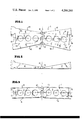
- FIG. 1 is a top view of the blank from which the arm of the present invention is formed.
- FIG. 2 is a top view of the blank after the triangular members have been folded at right angles to the rectangular members.
- FIG. 3 is a side view in elevation of the structure of FIG. 2.
- FIG. 4 is a top view of the assembled arm.
- FIG. 5 is an end view of the assembled arm
- FIG. 6 is a side view in elevation of the fully assembled arm.
- FIG. 1 of the accompanying drawings there is illustrated a blank, generally designated by the reference numeral 1, from which the arm of the present invention may be formed.
- the blank includes two rectangular sections 2 and 3, each bounded along both of its elongated edges by triangular sections 4 and 6 and 7 and 8, respectively.
- the rectangular sections 2 and 3 are joined by a web of material 9 extending between dashed lines 10 and 15 of FIG. 1 of the accompanying drawings.
- the rectangular section 3 is wider (vertical dimension in FIG. 1) than section 2 by about twice the thickness of the material from which the blank is formed.
- the triangular sections 4 and 6 of section 2 may fit within the triangular sections 7 and 8 of section 3.
- Arcuate recesses 11 and 12 are semicircles having centers lying along vertical centerline 13 of the blank as viewed in FIG. 1.
- the centers of recesses 11 and 12 are located halfway between the intersection of extensions of the outer edges of the triangular sections with the centerline 13.
- edges 14 and 16 of triangular sections 6 and 8, respectively, intersect centerline 13 at 17 and 18, and the center of arc 11 is located halfway between them.
- the same arrangement applies with respect to arc 12.
- the arcuate recesses 11 and 12 are formed to provide the triangular members 4, 6, 7 and 8 with curved ends that engage, in the assembled arm, the side of the stylus remote from the web 9.
- the stylus is engaged by the web over approximately 180° of its surface and the end surfaces of the triangular members over the opposed 180° surface at the top and bottom of the stylus.
- a second deviation from complete symmetry of the blank results from the arrangement of arms in the printer.
- the spacing between stylii must, to form a proper dot matrix character, be less than the spacing between stylii permitted by the width of the arms along such column of stylii.
- the arms are alternately offset to either side of the desired centerline of the stylii at the printing surface.
- the stylii are angled in slightly and guided to near perfect alignment by a guide block.
- the second deviation from symmetry of the block provides the necessary angling of its associated stylus.
- the centerline of each rectangular section, reference numerals 17 and 18, respectively, is angled down by 2.5° from a straight line 19 that passes through the center of and is perpendicular to the axis 13.
- This result is accomplished by forming the web 9 as a regular trapezoid with sides diverging at 2.5° from the centerline 13, for a total devergence at the intersection of the arc 12 and the upper edges 21 and 22 of triangular sections 4 and 7, respectively, of 5°.
- the angular values given herein are for a particular configuration of printer and are not intended to be limiting; the angles are of necessity tailored to specific structures.
- triangular sections 4, 6, 7 and 8 have been folded along fold lines 23 so as to be positioned at right angles to rectangular sections 2 and 3 whereby to define two C-shaped members.
- the top members 4 and 7 of the "C" taper down as they approach the web 9 and it will be readily noted in FIG. 3 that the bottom and top surfaces of the folded structure slope downward due to the 5° divergence of the web 9. Also, it is apparent from FIG. 3 that the distance between the bottom and top surfaces of the left member are equal to the distance between the inner surfaces of triangular members 7 and 8.
- FIGS. 4, 5 and 6 of the accompanying drawings the completed arm is illustrated.
- the left and right halves of the device of FIGS. 2 and 3 are folded about a mandrel 24 so that the triangular members 4 and 6 lie inside of members 7 and 8 and each pair may be spot welded to one another as indicated by reference numerals 26, or otherwise appropriately secured.
- the double thickness of the top and bottom walls of the arm is essentially to prevent undue whipping, twisting and bending of the arm; the requirement for such double thickness being provided inherently by the fabrication of the arm from a single blank.
- the web 9 substantially completely encircles one half of the mandrel 24 while the arcuate ends of the triangular sections 4, 6, 7 and 8 engage the opposed 180° surface of the mandrel 24 at the top and bottom thereof.
- the arcuate recesses 11 and 12 not only provide additional support for the stylus but also serve to positively locate the stylus in the arm.
- a stylus may be inserted; the dimensioning being such as to provide a light push - fit for the size stylus rod to be employed. Thereafter the stylus is appropriately secured, as by brazing, spot welding, etc. to the arm to provide a very strong well supported bond between arm and stylus.
- the triangular members 4, 6, 7 and 8 carry on their ends remote from the web various tabs employed to connect the arms to adjacent members of the printer head.
- the tabs form no part of the present invention and are not discussed herein.
- the various holes in the blank are provided to reduce the weight of the arm.
- the blank 1 may be fabricated from various light and strong materials, for instance 17-7 PH stainless steel; one of many acceptable, like materials.
Landscapes
- Impact Printers (AREA)
- Folding Of Thin Sheet-Like Materials, Special Discharging Devices, And Others (AREA)
Abstract
An arm for holding the impact stylus of a high speed dot matrix printer is fabricated from a single stamping which when properly folded defines two members having C-shaped cross-sections joined by a thin web. The web is folded around the stylus to bring the 4 legs of the two C-shaped members into overlapping relationship to define a hollow elongated and tapered arm having the stylus substantially wholey encircled by the web whereby after brazing the stylus is securely held.
Description
The present invention is related to copending U.S. Patent application Ser. No. 850,848 filed Nov. 11, 1977, in the names of James E. Bellinger and John H. MacNeill, which was a continuation of U.S. Patent application Ser. No. 621,526, filed Oct. 10, 1975 (now abandoned) in the names of James E. Bellinger and John H. MacNeill for High Speed Electromagnetic Printing Head, and assigned to the same assignee as the present application.
The present invention relates to high speed dot matrix impact printers and more specifically to the structure of an arm which carries at one end a stylus at substantially right angles to the arm which stylus impacts a record material through an inked ribbon to apply a dot to the material.
In the said copending application, there is disclosed a dot matrix printer operating at speeds of 600 characters per second and higher. Each character is formed in accordance with a prescribed matrix such as 5×7, such a matrix requiring 7 stylii disposed in a vertical column. Each stylus is provided with an individual driver mechanism comprising a magnetic circuit for holding an arm in a cocked position against a spring force and releasing the arm upon command to permit the spring to move the arm rapidly in a printing direction. The arm carries a printing stylus at one end; the stylus being generally perpendicular to the arm. Impact of the stylus against the recording material and underlying platten causes a rebound which aids the recapture of the arm by the magnetic circuit.
It is believed apparent that the arm and the stylus must be of quite light weight and thus of thin material to permit the high speeds of operation achieved by the aforesaid device. The strain on the bond between the stylus and the arm is severe considering the thinness of the material and the limited bonding area of the construction of the arm in the aforesaid device.
It is an object of the present invention to provide an arm for dot matrix impact printers which permits a printer stylus to be securely held at the end of the arm and which provides thickened top and bottom portions of said arm for optimum strength-to-weight ratio.
It is another object of the present invention to provide an arm for dot matrix impact printers constructed from a single stamping or other appropriately formed blank which when folded provides two C-shaped members joined by a web adapted to encircle substantially half a stylus whereby to provide a large surface of contact therebetween and permit a secure bonding by brazing or otherwise.
The present invention provides an elongated arm for holding and actuating a stylus of a dot matrix impact printer formed from a blank generally symetrical about a centerline perpendicular to the elongated dimension of the blank. Each half of the blank has a central elongated rectangular region and triangular members along both elongated edges. The rectangular regions are joined by a web of material to complete the blank.
One of the rectangular members is wider than the other by approximately twice the thickness of the metal from which the blank is formed. The triangular members taper from a minimum width at the joined ends of the two rectangular members to a maximum width adjacent the unconnected ends of the rectangular members.
The arm is formed by folding the triangular members at right angles to the rectangular members to provide two squared, C-shaped members with the cross section of the "C" diminishing as the web is approached. The two C-shaped members are rotated into facing relationships, with the triangular sections overlapping, by bending the web about a mandrel. The two members are then secured as by brazing adjacent triangular sections to form a hollow rectangular box of decreasing width and double thickness top and bottom walls for added strength. The stylus is completed bounded by the web and overlapping triangular sections and when brazed, spot welded, etc. to the arm is securely held thereby over a large surface area.
The above and still further objects, features and advantages of the present invention will become apparent upon consideration of the following detailed description of several specific embodiments thereof, especially when taken in conjunction with the accompanying drawings, wherein:
FIG. 1 is a top view of the blank from which the arm of the present invention is formed.
FIG. 2 is a top view of the blank after the triangular members have been folded at right angles to the rectangular members.
FIG. 3 is a side view in elevation of the structure of FIG. 2.
FIG. 4 is a top view of the assembled arm.
FIG. 5 is an end view of the assembled arm; and
FIG. 6 is a side view in elevation of the fully assembled arm.
Referring specifically to FIG. 1 of the accompanying drawings, there is illustrated a blank, generally designated by the reference numeral 1, from which the arm of the present invention may be formed. The blank includes two rectangular sections 2 and 3, each bounded along both of its elongated edges by triangular sections 4 and 6 and 7 and 8, respectively. The rectangular sections 2 and 3 are joined by a web of material 9 extending between dashed lines 10 and 15 of FIG. 1 of the accompanying drawings.
Since it is intended that when the arm is fully formed the triangular members overlap one another, the rectangular section 3 is wider (vertical dimension in FIG. 1) than section 2 by about twice the thickness of the material from which the blank is formed. Thus, the triangular sections 4 and 6 of section 2 may fit within the triangular sections 7 and 8 of section 3. Arcuate recesses 11 and 12, are semicircles having centers lying along vertical centerline 13 of the blank as viewed in FIG. 1. The centers of recesses 11 and 12 are located halfway between the intersection of extensions of the outer edges of the triangular sections with the centerline 13. Specifically, for example, edges 14 and 16 of triangular sections 6 and 8, respectively, intersect centerline 13 at 17 and 18, and the center of arc 11 is located halfway between them. The same arrangement applies with respect to arc 12.
The arcuate recesses 11 and 12 are formed to provide the triangular members 4, 6, 7 and 8 with curved ends that engage, in the assembled arm, the side of the stylus remote from the web 9. Thus, the stylus is engaged by the web over approximately 180° of its surface and the end surfaces of the triangular members over the opposed 180° surface at the top and bottom of the stylus.
A second deviation from complete symmetry of the blank results from the arrangement of arms in the printer. The spacing between stylii must, to form a proper dot matrix character, be less than the spacing between stylii permitted by the width of the arms along such column of stylii. In order to align the stylii, the arms are alternately offset to either side of the desired centerline of the stylii at the printing surface. The stylii are angled in slightly and guided to near perfect alignment by a guide block.
The second deviation from symmetry of the block provides the necessary angling of its associated stylus. Specifically, the centerline of each rectangular section, reference numerals 17 and 18, respectively, is angled down by 2.5° from a straight line 19 that passes through the center of and is perpendicular to the axis 13. This result is accomplished by forming the web 9 as a regular trapezoid with sides diverging at 2.5° from the centerline 13, for a total devergence at the intersection of the arc 12 and the upper edges 21 and 22 of triangular sections 4 and 7, respectively, of 5°. The angular values given herein are for a particular configuration of printer and are not intended to be limiting; the angles are of necessity tailored to specific structures.
Each linear intersection of triangular and rectangular sections is defined by a fold line 23. Referring now specifically to FIGS. 2 and 3, triangular sections 4, 6, 7 and 8 have been folded along fold lines 23 so as to be positioned at right angles to rectangular sections 2 and 3 whereby to define two C-shaped members. The top members 4 and 7 of the "C", as viewed in FIG. 2, taper down as they approach the web 9 and it will be readily noted in FIG. 3 that the bottom and top surfaces of the folded structure slope downward due to the 5° divergence of the web 9. Also, it is apparent from FIG. 3 that the distance between the bottom and top surfaces of the left member are equal to the distance between the inner surfaces of triangular members 7 and 8.
Referring now specifically to FIGS. 4, 5 and 6 of the accompanying drawings, the completed arm is illustrated. To form the structure of FIGS. 4, 5 and 6, the left and right halves of the device of FIGS. 2 and 3 are folded about a mandrel 24 so that the triangular members 4 and 6 lie inside of members 7 and 8 and each pair may be spot welded to one another as indicated by reference numerals 26, or otherwise appropriately secured. As pointed out in the aforesaid copending application the double thickness of the top and bottom walls of the arm is essentially to prevent undue whipping, twisting and bending of the arm; the requirement for such double thickness being provided inherently by the fabrication of the arm from a single blank.
After forming as above, it is noted that the web 9 substantially completely encircles one half of the mandrel 24 while the arcuate ends of the triangular sections 4, 6, 7 and 8 engage the opposed 180° surface of the mandrel 24 at the top and bottom thereof. The arcuate recesses 11 and 12 not only provide additional support for the stylus but also serve to positively locate the stylus in the arm. After removal of the mandrel a stylus may be inserted; the dimensioning being such as to provide a light push - fit for the size stylus rod to be employed. Thereafter the stylus is appropriately secured, as by brazing, spot welding, etc. to the arm to provide a very strong well supported bond between arm and stylus.
The triangular members 4, 6, 7 and 8 carry on their ends remote from the web various tabs employed to connect the arms to adjacent members of the printer head. The tabs form no part of the present invention and are not discussed herein. The various holes in the blank are provided to reduce the weight of the arm.
The blank 1 may be fabricated from various light and strong materials, for instance 17-7 PH stainless steel; one of many acceptable, like materials.
While I have described and illustrated specific embodiments of our invention, it will be clear that variations of the details of construction which are specifically illustrated and described may be resorted to without department from the true spirit and scope of the invention as defined in the appended claims.
Claims (6)
1. A flat, elongated, thin blank for forming an arm comprising,
two generally rectangular regions having short and long dimensions,
a web region lying between said rectangular regions and having short and long dimensions,
said web region having its long dimensions each juxtaposed to a short dimension of a different one of said rectangular regions,
four truncated generally right triangular regions each extending along a different long dimension of said rectantular regions,
said triangular regions each tapering from a maximum outward extension from its adjacent rectangular region remote from said web region to a minimum outward extension adjacent said web region.
2. A flat, elongated, thin blank for forming an arm according to claim 1 wherein said short dimension of one of said rectangular regions is longer than said short dimension of the other of said rectangular regions by approximately twice the thickness of the blank.
3. A flat, elongated, thin blank for forming an arm according to claim 1 wherein said web region has one of said short dimensions longer than the other of said short dimensions, the center of said web region being symmetrical with respect to said blank.
4. A flat, elongated, thin blank for forming an arm according to claim 3 wherein the minimum length of said web region is substantially equal to one-half the circumference of a member to be contacted by said web in an assembled arm.
5. A flat, elongated, thin blank for forming an arm according to claim 4 wherein arcuate cut-outs are formed in opposed edges of said blank in and symmetrical with respect to said web region with the centers of said cut-outs lying generally equidistant between the truncated ends of said triangular members; and arcuate cut-outs having radii several times the radius of said member to be contacted by said web in an assembled arm.
6. A flat, elongated, thin blank for forming an arm according to claim 1 wherein said triangular regions terminate adjacent said web region in arcuate surfaces having radii of curvature substantially equal to the radius of curvature of a member to be contacted thereby.
Priority Applications (6)
| Application Number | Priority Date | Filing Date | Title |
|---|---|---|---|
| US05/865,006 US4206266A (en) | 1977-12-27 | 1977-12-27 | Printer arm blank |
| GB7844535A GB2010748B (en) | 1977-12-27 | 1978-11-15 | Printer arm |
| DE2850300A DE2850300C2 (en) | 1977-12-27 | 1978-11-20 | Flat, thin punched piece to form an arm as well as a needle holder for a dot matrix printer |
| DE19787834508U DE7834508U1 (en) | 1977-12-27 | 1978-11-20 | ARRANGEMENT OF AN ARM AND A NEEDLE |
| JP53156574A JPS5852505B2 (en) | 1977-12-27 | 1978-12-20 | Arm for impact printer |
| FR7836420A FR2413218A1 (en) | 1977-12-27 | 1978-12-27 | FLAT AND THIN BLANKET INTENDED TO FORM AN ARM |
Applications Claiming Priority (1)
| Application Number | Priority Date | Filing Date | Title |
|---|---|---|---|
| US05/865,006 US4206266A (en) | 1977-12-27 | 1977-12-27 | Printer arm blank |
Related Child Applications (2)
| Application Number | Title | Priority Date | Filing Date |
|---|---|---|---|
| US62152675A Division | 1975-10-10 | 1975-10-10 | |
| US06/029,658 Division US4248540A (en) | 1979-04-13 | 1979-04-13 | Printer arm |
Publications (1)
| Publication Number | Publication Date |
|---|---|
| US4206266A true US4206266A (en) | 1980-06-03 |
Family
ID=25344514
Family Applications (1)
| Application Number | Title | Priority Date | Filing Date |
|---|---|---|---|
| US05/865,006 Expired - Lifetime US4206266A (en) | 1977-12-27 | 1977-12-27 | Printer arm blank |
Country Status (5)
| Country | Link |
|---|---|
| US (1) | US4206266A (en) |
| JP (1) | JPS5852505B2 (en) |
| DE (2) | DE2850300C2 (en) |
| FR (1) | FR2413218A1 (en) |
| GB (1) | GB2010748B (en) |
Cited By (4)
| Publication number | Priority date | Publication date | Assignee | Title |
|---|---|---|---|---|
| US4531848A (en) * | 1982-10-27 | 1985-07-30 | Royden C. Sanders, Jr. | Dot matrix print head |
| US4618277A (en) * | 1982-11-18 | 1986-10-21 | Brother Kogyo Kabushiki Kaisha | Print head |
| US4772141A (en) * | 1982-10-27 | 1988-09-20 | Royden C. Sanders, Jr. | Dot matrix printhead pin driver and method of assembly |
| US5568680A (en) * | 1995-01-26 | 1996-10-29 | Regent Lighting Corporation | Method for making a reflector for a luminaire |
Families Citing this family (4)
| Publication number | Priority date | Publication date | Assignee | Title |
|---|---|---|---|---|
| FR2471279B1 (en) * | 1979-12-07 | 1987-07-17 | Seikosha Kk | MOBILE COIL TYPE PRINTHEAD |
| JPS5869447U (en) * | 1981-11-05 | 1983-05-11 | 小林 八郎 | Dot-type printing member structure in word processors |
| EP0152117A3 (en) * | 1984-02-16 | 1987-05-27 | Dataproducts Corporation | Actuator for dot matrix printhead |
| DE3502471A1 (en) * | 1985-01-25 | 1986-07-31 | Mannesmann AG, 4000 Düsseldorf | MATRIX PRINT HEAD |
Citations (7)
| Publication number | Priority date | Publication date | Assignee | Title |
|---|---|---|---|---|
| US3330632A (en) * | 1965-05-10 | 1967-07-11 | Jasper Blackburn Corp | Earth anchor wing |
| DE1270859B (en) * | 1965-09-03 | 1968-06-20 | Arthur Klemt | Device for actuating the needles of a needle printing unit |
| US3426140A (en) * | 1966-11-10 | 1969-02-04 | Collins Radio Co | Connector rfi seal spring |
| US3672482A (en) * | 1970-08-31 | 1972-06-27 | Ibm | Wire matrix print head |
| US3822005A (en) * | 1972-05-04 | 1974-07-02 | Sagem | Device for printing characters by points |
| US3835975A (en) * | 1971-09-10 | 1974-09-17 | R Howard | Printer head assembly |
| NL7607826A (en) * | 1975-10-10 | 1977-04-13 | Florida Data Corp | PIN-OPERATING PRESSURE DEVICE AND A DRIVE DEVICE THEREOF. |
Family Cites Families (2)
| Publication number | Priority date | Publication date | Assignee | Title |
|---|---|---|---|---|
| SE356149B (en) * | 1971-09-24 | 1973-05-14 | Philips Svenska Ab | |
| JPS5610181B2 (en) * | 1972-10-10 | 1981-03-06 |
-
1977
- 1977-12-27 US US05/865,006 patent/US4206266A/en not_active Expired - Lifetime
-
1978
- 1978-11-15 GB GB7844535A patent/GB2010748B/en not_active Expired
- 1978-11-20 DE DE2850300A patent/DE2850300C2/en not_active Expired
- 1978-11-20 DE DE19787834508U patent/DE7834508U1/en not_active Expired
- 1978-12-20 JP JP53156574A patent/JPS5852505B2/en not_active Expired
- 1978-12-27 FR FR7836420A patent/FR2413218A1/en active Granted
Patent Citations (7)
| Publication number | Priority date | Publication date | Assignee | Title |
|---|---|---|---|---|
| US3330632A (en) * | 1965-05-10 | 1967-07-11 | Jasper Blackburn Corp | Earth anchor wing |
| DE1270859B (en) * | 1965-09-03 | 1968-06-20 | Arthur Klemt | Device for actuating the needles of a needle printing unit |
| US3426140A (en) * | 1966-11-10 | 1969-02-04 | Collins Radio Co | Connector rfi seal spring |
| US3672482A (en) * | 1970-08-31 | 1972-06-27 | Ibm | Wire matrix print head |
| US3835975A (en) * | 1971-09-10 | 1974-09-17 | R Howard | Printer head assembly |
| US3822005A (en) * | 1972-05-04 | 1974-07-02 | Sagem | Device for printing characters by points |
| NL7607826A (en) * | 1975-10-10 | 1977-04-13 | Florida Data Corp | PIN-OPERATING PRESSURE DEVICE AND A DRIVE DEVICE THEREOF. |
Cited By (4)
| Publication number | Priority date | Publication date | Assignee | Title |
|---|---|---|---|---|
| US4531848A (en) * | 1982-10-27 | 1985-07-30 | Royden C. Sanders, Jr. | Dot matrix print head |
| US4772141A (en) * | 1982-10-27 | 1988-09-20 | Royden C. Sanders, Jr. | Dot matrix printhead pin driver and method of assembly |
| US4618277A (en) * | 1982-11-18 | 1986-10-21 | Brother Kogyo Kabushiki Kaisha | Print head |
| US5568680A (en) * | 1995-01-26 | 1996-10-29 | Regent Lighting Corporation | Method for making a reflector for a luminaire |
Also Published As
| Publication number | Publication date |
|---|---|
| JPS5492822A (en) | 1979-07-23 |
| DE7834508U1 (en) | 1979-07-19 |
| DE2850300C2 (en) | 1983-03-10 |
| GB2010748B (en) | 1982-05-19 |
| FR2413218B1 (en) | 1983-11-25 |
| DE2850300A1 (en) | 1979-07-05 |
| FR2413218A1 (en) | 1979-07-27 |
| JPS5852505B2 (en) | 1983-11-22 |
| GB2010748A (en) | 1979-07-04 |
Similar Documents
| Publication | Publication Date | Title |
|---|---|---|
| US4248540A (en) | Printer arm | |
| JPS5852505B2 (en) | Arm for impact printer | |
| US4340165A (en) | Printer arm | |
| EP0285766B1 (en) | Printing hammer provided with a piezoelectric actuator | |
| EP0255148B1 (en) | Armature supporting structure of a print head | |
| US4457635A (en) | Printer arm | |
| US4704041A (en) | Print head having rolled spring arms with uniform response | |
| US5245644A (en) | Spacer for a fuel assembly of a pressurized water reactor | |
| US5169246A (en) | Reduced diameter wire tips in a wire printing head | |
| JPH051895A (en) | Side support mounting structure for heat exchanger | |
| JPS6310297Y2 (en) | ||
| JPS564470A (en) | Printing wire bearing for dot printer | |
| JPS58993B2 (en) | dot printer | |
| JPH0119406Y2 (en) | ||
| JP2789621B2 (en) | Print head for wire dot printer | |
| JPS63125348A (en) | Printing wire guide for dot printer | |
| JPH038267B2 (en) | ||
| JPS6185438U (en) | ||
| JPH0326550A (en) | Armature for printing head | |
| JPS62119051A (en) | Wire guide for wire dot head | |
| JPH01175822U (en) | ||
| JPH05112017A (en) | Piezoelectric actuator | |
| JPH037352A (en) | Printing head | |
| JPH02162057A (en) | Printing head for serial printer | |
| JPS6331943U (en) |