US4201848A - Process for preparing polymers having high molecular weight - Google Patents
Process for preparing polymers having high molecular weight Download PDFInfo
- Publication number
- US4201848A US4201848A US05/881,914 US88191478A US4201848A US 4201848 A US4201848 A US 4201848A US 88191478 A US88191478 A US 88191478A US 4201848 A US4201848 A US 4201848A
- Authority
- US
- United States
- Prior art keywords
- molecular weight
- peroxide
- butyl
- polymerization
- peroxy
- Prior art date
- Legal status (The legal status is an assumption and is not a legal conclusion. Google has not performed a legal analysis and makes no representation as to the accuracy of the status listed.)
- Expired - Lifetime
Links
- 229920000642 polymer Polymers 0.000 title description 39
- 238000004519 manufacturing process Methods 0.000 title description 4
- -1 aromatic alkenyl compound Chemical class 0.000 claims abstract description 52
- PPBRXRYQALVLMV-UHFFFAOYSA-N Styrene Chemical compound C=CC1=CC=CC=C1 PPBRXRYQALVLMV-UHFFFAOYSA-N 0.000 claims abstract description 24
- KAKZBPTYRLMSJV-UHFFFAOYSA-N Butadiene Chemical compound C=CC=C KAKZBPTYRLMSJV-UHFFFAOYSA-N 0.000 claims abstract description 12
- RRHGJUQNOFWUDK-UHFFFAOYSA-N Isoprene Chemical compound CC(=C)C=C RRHGJUQNOFWUDK-UHFFFAOYSA-N 0.000 claims abstract description 12
- 150000001993 dienes Chemical class 0.000 claims abstract description 10
- 229920001400 block copolymer Polymers 0.000 claims description 14
- 125000000391 vinyl group Chemical group [H]C([*])=C([H])[H] 0.000 claims description 3
- 150000002978 peroxides Chemical class 0.000 abstract description 43
- 238000009826 distribution Methods 0.000 abstract description 18
- 239000000178 monomer Substances 0.000 abstract description 18
- 239000003638 chemical reducing agent Substances 0.000 abstract description 16
- 229920001577 copolymer Polymers 0.000 abstract description 16
- 125000000864 peroxy group Chemical group O(O*)* 0.000 abstract description 13
- 238000007720 emulsion polymerization reaction Methods 0.000 abstract description 7
- 229920001519 homopolymer Polymers 0.000 abstract description 7
- 239000003999 initiator Substances 0.000 abstract description 6
- VVQNEPGJFQJSBK-UHFFFAOYSA-N Methyl methacrylate Chemical compound COC(=O)C(C)=C VVQNEPGJFQJSBK-UHFFFAOYSA-N 0.000 abstract description 4
- 150000007934 α,β-unsaturated carboxylic acids Chemical class 0.000 abstract description 4
- 230000000052 comparative effect Effects 0.000 description 36
- 238000006116 polymerization reaction Methods 0.000 description 25
- 238000000034 method Methods 0.000 description 22
- AGGKEGLBGGJEBZ-UHFFFAOYSA-N tetramethylenedisulfotetramine Chemical compound C1N(S2(=O)=O)CN3S(=O)(=O)N1CN2C3 AGGKEGLBGGJEBZ-UHFFFAOYSA-N 0.000 description 19
- 239000004793 Polystyrene Substances 0.000 description 16
- 229920002223 polystyrene Polymers 0.000 description 16
- IJGRMHOSHXDMSA-UHFFFAOYSA-N Atomic nitrogen Chemical compound N#N IJGRMHOSHXDMSA-UHFFFAOYSA-N 0.000 description 12
- MUBZPKHOEPUJKR-UHFFFAOYSA-N Oxalic acid Chemical compound OC(=O)C(O)=O MUBZPKHOEPUJKR-UHFFFAOYSA-N 0.000 description 12
- YXFVVABEGXRONW-UHFFFAOYSA-N Toluene Chemical compound CC1=CC=CC=C1 YXFVVABEGXRONW-UHFFFAOYSA-N 0.000 description 12
- 239000003708 ampul Substances 0.000 description 12
- RAXXELZNTBOGNW-UHFFFAOYSA-N imidazole Natural products C1=CNC=N1 RAXXELZNTBOGNW-UHFFFAOYSA-N 0.000 description 12
- 150000002148 esters Chemical class 0.000 description 10
- XLYOFNOQVPJJNP-UHFFFAOYSA-N water Substances O XLYOFNOQVPJJNP-UHFFFAOYSA-N 0.000 description 10
- OKKJLVBELUTLKV-UHFFFAOYSA-N Methanol Chemical compound OC OKKJLVBELUTLKV-UHFFFAOYSA-N 0.000 description 9
- ZMANZCXQSJIPKH-UHFFFAOYSA-N Triethylamine Chemical compound CCN(CC)CC ZMANZCXQSJIPKH-UHFFFAOYSA-N 0.000 description 9
- OAKJQQAXSVQMHS-UHFFFAOYSA-N Hydrazine Chemical compound NN OAKJQQAXSVQMHS-UHFFFAOYSA-N 0.000 description 8
- 239000007864 aqueous solution Substances 0.000 description 8
- 238000005227 gel permeation chromatography Methods 0.000 description 8
- 229920002873 Polyethylenimine Polymers 0.000 description 7
- HZAXFHJVJLSVMW-UHFFFAOYSA-N 2-Aminoethan-1-ol Chemical compound NCCO HZAXFHJVJLSVMW-UHFFFAOYSA-N 0.000 description 6
- ATUOYWHBWRKTHZ-UHFFFAOYSA-N Propane Chemical compound CCC ATUOYWHBWRKTHZ-UHFFFAOYSA-N 0.000 description 6
- 150000001447 alkali salts Chemical class 0.000 description 6
- 239000003995 emulsifying agent Substances 0.000 description 6
- NAQMVNRVTILPCV-UHFFFAOYSA-N hexane-1,6-diamine Chemical compound NCCCCCCN NAQMVNRVTILPCV-UHFFFAOYSA-N 0.000 description 6
- 229910052757 nitrogen Inorganic materials 0.000 description 6
- IMNIMPAHZVJRPE-UHFFFAOYSA-N triethylenediamine Chemical compound C1CN2CCN1CC2 IMNIMPAHZVJRPE-UHFFFAOYSA-N 0.000 description 6
- DMWVYCCGCQPJEA-UHFFFAOYSA-N 2,5-bis(tert-butylperoxy)-2,5-dimethylhexane Chemical compound CC(C)(C)OOC(C)(C)CCC(C)(C)OOC(C)(C)C DMWVYCCGCQPJEA-UHFFFAOYSA-N 0.000 description 5
- WQZGKKKJIJFFOK-GASJEMHNSA-N Glucose Natural products OC[C@H]1OC(O)[C@H](O)[C@@H](O)[C@@H]1O WQZGKKKJIJFFOK-GASJEMHNSA-N 0.000 description 5
- 229920003171 Poly (ethylene oxide) Polymers 0.000 description 5
- 239000008121 dextrose Substances 0.000 description 5
- FVCOIAYSJZGECG-UHFFFAOYSA-N diethylhydroxylamine Chemical compound CCN(O)CC FVCOIAYSJZGECG-UHFFFAOYSA-N 0.000 description 5
- 239000004816 latex Substances 0.000 description 5
- 229920000126 latex Polymers 0.000 description 5
- FOWDZVNRQHPXDO-UHFFFAOYSA-N propyl hydrogen carbonate Chemical compound CCCOC(O)=O FOWDZVNRQHPXDO-UHFFFAOYSA-N 0.000 description 5
- VILCJCGEZXAXTO-UHFFFAOYSA-N 2,2,2-tetramine Chemical compound NCCNCCNCCN VILCJCGEZXAXTO-UHFFFAOYSA-N 0.000 description 4
- PLIKAWJENQZMHA-UHFFFAOYSA-N 4-aminophenol Chemical compound NC1=CC=C(O)C=C1 PLIKAWJENQZMHA-UHFFFAOYSA-N 0.000 description 4
- PAYRUJLWNCNPSJ-UHFFFAOYSA-N Aniline Chemical compound NC1=CC=CC=C1 PAYRUJLWNCNPSJ-UHFFFAOYSA-N 0.000 description 4
- 229920001174 Diethylhydroxylamine Polymers 0.000 description 4
- QUSNBJAOOMFDIB-UHFFFAOYSA-N Ethylamine Chemical compound CCN QUSNBJAOOMFDIB-UHFFFAOYSA-N 0.000 description 4
- BAPJBEWLBFYGME-UHFFFAOYSA-N Methyl acrylate Chemical compound COC(=O)C=C BAPJBEWLBFYGME-UHFFFAOYSA-N 0.000 description 4
- 239000004743 Polypropylene Substances 0.000 description 4
- WUGQZFFCHPXWKQ-UHFFFAOYSA-N Propanolamine Chemical compound NCCCO WUGQZFFCHPXWKQ-UHFFFAOYSA-N 0.000 description 4
- WYURNTSHIVDZCO-UHFFFAOYSA-N Tetrahydrofuran Chemical compound C1CCOC1 WYURNTSHIVDZCO-UHFFFAOYSA-N 0.000 description 4
- 239000002253 acid Substances 0.000 description 4
- WQZGKKKJIJFFOK-VFUOTHLCSA-N beta-D-glucose Chemical compound OC[C@H]1O[C@@H](O)[C@H](O)[C@@H](O)[C@@H]1O WQZGKKKJIJFFOK-VFUOTHLCSA-N 0.000 description 4
- PAFZNILMFXTMIY-UHFFFAOYSA-N cyclohexylamine Chemical compound NC1CCCCC1 PAFZNILMFXTMIY-UHFFFAOYSA-N 0.000 description 4
- JQVDAXLFBXTEQA-UHFFFAOYSA-N dibutylamine Chemical compound CCCCNCCCC JQVDAXLFBXTEQA-UHFFFAOYSA-N 0.000 description 4
- 230000000694 effects Effects 0.000 description 4
- 230000009477 glass transition Effects 0.000 description 4
- 235000006408 oxalic acid Nutrition 0.000 description 4
- 229920001155 polypropylene Polymers 0.000 description 4
- 125000001453 quaternary ammonium group Chemical group 0.000 description 4
- JVBXVOWTABLYPX-UHFFFAOYSA-L sodium dithionite Chemical compound [Na+].[Na+].[O-]S(=O)S([O-])=O JVBXVOWTABLYPX-UHFFFAOYSA-L 0.000 description 4
- GEHJYWRUCIMESM-UHFFFAOYSA-L sodium sulfite Chemical compound [Na+].[Na+].[O-]S([O-])=O GEHJYWRUCIMESM-UHFFFAOYSA-L 0.000 description 4
- 125000000999 tert-butyl group Chemical group [H]C([H])([H])C(*)(C([H])([H])[H])C([H])([H])[H] 0.000 description 4
- HWCKGOZZJDHMNC-UHFFFAOYSA-M tetraethylammonium bromide Chemical compound [Br-].CC[N+](CC)(CC)CC HWCKGOZZJDHMNC-UHFFFAOYSA-M 0.000 description 4
- WGTYBPLFGIVFAS-UHFFFAOYSA-M tetramethylammonium hydroxide Chemical compound [OH-].C[N+](C)(C)C WGTYBPLFGIVFAS-UHFFFAOYSA-M 0.000 description 4
- UMGDCJDMYOKAJW-UHFFFAOYSA-N thiourea Chemical compound NC(N)=S UMGDCJDMYOKAJW-UHFFFAOYSA-N 0.000 description 4
- XFNJVJPLKCPIBV-UHFFFAOYSA-N trimethylenediamine Chemical compound NCCCN XFNJVJPLKCPIBV-UHFFFAOYSA-N 0.000 description 4
- QEQBMZQFDDDTPN-UHFFFAOYSA-N (2-methylpropan-2-yl)oxy benzenecarboperoxoate Chemical compound CC(C)(C)OOOC(=O)C1=CC=CC=C1 QEQBMZQFDDDTPN-UHFFFAOYSA-N 0.000 description 3
- AFBPFSWMIHJQDM-UHFFFAOYSA-N N-methylaniline Chemical compound CNC1=CC=CC=C1 AFBPFSWMIHJQDM-UHFFFAOYSA-N 0.000 description 3
- LSNNMFCWUKXFEE-UHFFFAOYSA-N Sulfurous acid Chemical compound OS(O)=O LSNNMFCWUKXFEE-UHFFFAOYSA-N 0.000 description 3
- GSEJCLTVZPLZKY-UHFFFAOYSA-N Triethanolamine Chemical compound OCCN(CCO)CCO GSEJCLTVZPLZKY-UHFFFAOYSA-N 0.000 description 3
- XTXRWKRVRITETP-UHFFFAOYSA-N Vinyl acetate Chemical compound CC(=O)OC=C XTXRWKRVRITETP-UHFFFAOYSA-N 0.000 description 3
- BZHJMEDXRYGGRV-UHFFFAOYSA-N Vinyl chloride Chemical compound ClC=C BZHJMEDXRYGGRV-UHFFFAOYSA-N 0.000 description 3
- 238000000862 absorption spectrum Methods 0.000 description 3
- 239000003513 alkali Substances 0.000 description 3
- 235000011114 ammonium hydroxide Nutrition 0.000 description 3
- 125000000129 anionic group Chemical group 0.000 description 3
- 125000004432 carbon atom Chemical group C* 0.000 description 3
- 230000007423 decrease Effects 0.000 description 3
- GVGUFUZHNYFZLC-UHFFFAOYSA-N dodecyl benzenesulfonate;sodium Chemical compound [Na].CCCCCCCCCCCCOS(=O)(=O)C1=CC=CC=C1 GVGUFUZHNYFZLC-UHFFFAOYSA-N 0.000 description 3
- JRBPAEWTRLWTQC-UHFFFAOYSA-N dodecylamine Chemical compound CCCCCCCCCCCCN JRBPAEWTRLWTQC-UHFFFAOYSA-N 0.000 description 3
- 239000000839 emulsion Substances 0.000 description 3
- 238000010551 living anionic polymerization reaction Methods 0.000 description 3
- VLKZOEOYAKHREP-UHFFFAOYSA-N n-Hexane Chemical compound CCCCCC VLKZOEOYAKHREP-UHFFFAOYSA-N 0.000 description 3
- 150000004965 peroxy acids Chemical class 0.000 description 3
- 239000001294 propane Substances 0.000 description 3
- 229940080264 sodium dodecylbenzenesulfonate Drugs 0.000 description 3
- 239000000243 solution Substances 0.000 description 3
- 238000003756 stirring Methods 0.000 description 3
- SWAXTRYEYUTSAP-UHFFFAOYSA-N tert-butyl ethaneperoxoate Chemical compound CC(=O)OOC(C)(C)C SWAXTRYEYUTSAP-UHFFFAOYSA-N 0.000 description 3
- DDFYFBUWEBINLX-UHFFFAOYSA-M tetramethylammonium bromide Chemical compound [Br-].C[N+](C)(C)C DDFYFBUWEBINLX-UHFFFAOYSA-M 0.000 description 3
- KDGNCLDCOVTOCS-UHFFFAOYSA-N (2-methylpropan-2-yl)oxy propan-2-yl carbonate Chemical compound CC(C)OC(=O)OOC(C)(C)C KDGNCLDCOVTOCS-UHFFFAOYSA-N 0.000 description 2
- FFJCNSLCJOQHKM-CLFAGFIQSA-N (z)-1-[(z)-octadec-9-enoxy]octadec-9-ene Chemical compound CCCCCCCC\C=C/CCCCCCCCOCCCCCCCC\C=C/CCCCCCCC FFJCNSLCJOQHKM-CLFAGFIQSA-N 0.000 description 2
- BLKRGXCGFRXRNQ-SNAWJCMRSA-N (z)-3-carbonoperoxoyl-4,4-dimethylpent-2-enoic acid Chemical compound OC(=O)/C=C(C(C)(C)C)\C(=O)OO BLKRGXCGFRXRNQ-SNAWJCMRSA-N 0.000 description 2
- MEBONNVPKOBPEA-UHFFFAOYSA-N 1,1,2-trimethylcyclohexane Chemical compound CC1CCCCC1(C)C MEBONNVPKOBPEA-UHFFFAOYSA-N 0.000 description 2
- XMNIXWIUMCBBBL-UHFFFAOYSA-N 2-(2-phenylpropan-2-ylperoxy)propan-2-ylbenzene Chemical compound C=1C=CC=CC=1C(C)(C)OOC(C)(C)C1=CC=CC=C1 XMNIXWIUMCBBBL-UHFFFAOYSA-N 0.000 description 2
- OEPOKWHJYJXUGD-UHFFFAOYSA-N 2-(3-phenylmethoxyphenyl)-1,3-thiazole-4-carbaldehyde Chemical compound O=CC1=CSC(C=2C=C(OCC=3C=CC=CC=3)C=CC=2)=N1 OEPOKWHJYJXUGD-UHFFFAOYSA-N 0.000 description 2
- BIISIZOQPWZPPS-UHFFFAOYSA-N 2-tert-butylperoxypropan-2-ylbenzene Chemical compound CC(C)(C)OOC(C)(C)C1=CC=CC=C1 BIISIZOQPWZPPS-UHFFFAOYSA-N 0.000 description 2
- JLBJTVDPSNHSKJ-UHFFFAOYSA-N 4-Methylstyrene Chemical compound CC1=CC=C(C=C)C=C1 JLBJTVDPSNHSKJ-UHFFFAOYSA-N 0.000 description 2
- RNMDNPCBIKJCQP-UHFFFAOYSA-N 5-nonyl-7-oxabicyclo[4.1.0]hepta-1,3,5-trien-2-ol Chemical compound C(CCCCCCCC)C1=C2C(=C(C=C1)O)O2 RNMDNPCBIKJCQP-UHFFFAOYSA-N 0.000 description 2
- SOGAXMICEFXMKE-UHFFFAOYSA-N Butylmethacrylate Chemical compound CCCCOC(=O)C(C)=C SOGAXMICEFXMKE-UHFFFAOYSA-N 0.000 description 2
- RPNUMPOLZDHAAY-UHFFFAOYSA-N Diethylenetriamine Chemical compound NCCNCCN RPNUMPOLZDHAAY-UHFFFAOYSA-N 0.000 description 2
- JIGUQPWFLRLWPJ-UHFFFAOYSA-N Ethyl acrylate Chemical compound CCOC(=O)C=C JIGUQPWFLRLWPJ-UHFFFAOYSA-N 0.000 description 2
- QIGBRXMKCJKVMJ-UHFFFAOYSA-N Hydroquinone Chemical compound OC1=CC=C(O)C=C1 QIGBRXMKCJKVMJ-UHFFFAOYSA-N 0.000 description 2
- ZWEHNKRNPOVVGH-UHFFFAOYSA-N Methyl ethyl ketone Natural products CCC(C)=O ZWEHNKRNPOVVGH-UHFFFAOYSA-N 0.000 description 2
- BAVYZALUXZFZLV-UHFFFAOYSA-N Methylamine Chemical compound NC BAVYZALUXZFZLV-UHFFFAOYSA-N 0.000 description 2
- 239000005062 Polybutadiene Substances 0.000 description 2
- DBMJMQXJHONAFJ-UHFFFAOYSA-M Sodium laurylsulphate Chemical compound [Na+].CCCCCCCCCCCCOS([O-])(=O)=O DBMJMQXJHONAFJ-UHFFFAOYSA-M 0.000 description 2
- XSQUKJJJFZCRTK-UHFFFAOYSA-N Urea Natural products NC(N)=O XSQUKJJJFZCRTK-UHFFFAOYSA-N 0.000 description 2
- 125000000217 alkyl group Chemical group 0.000 description 2
- XYLMUPLGERFSHI-UHFFFAOYSA-N alpha-Methylstyrene Chemical compound CC(=C)C1=CC=CC=C1 XYLMUPLGERFSHI-UHFFFAOYSA-N 0.000 description 2
- 150000003842 bromide salts Chemical class 0.000 description 2
- HQABUPZFAYXKJW-UHFFFAOYSA-N butan-1-amine Chemical compound CCCCN HQABUPZFAYXKJW-UHFFFAOYSA-N 0.000 description 2
- 125000002091 cationic group Chemical group 0.000 description 2
- 238000006243 chemical reaction Methods 0.000 description 2
- YACLQRRMGMJLJV-UHFFFAOYSA-N chloroprene Chemical compound ClC(=C)C=C YACLQRRMGMJLJV-UHFFFAOYSA-N 0.000 description 2
- 150000001875 compounds Chemical class 0.000 description 2
- 238000007796 conventional method Methods 0.000 description 2
- 238000004132 cross linking Methods 0.000 description 2
- 125000000113 cyclohexyl group Chemical group [H]C1([H])C([H])([H])C([H])([H])C([H])(*)C([H])([H])C1([H])[H] 0.000 description 2
- LSXWFXONGKSEMY-UHFFFAOYSA-N di-tert-butyl peroxide Chemical compound CC(C)(C)OOC(C)(C)C LSXWFXONGKSEMY-UHFFFAOYSA-N 0.000 description 2
- ZQMIGQNCOMNODD-UHFFFAOYSA-N diacetyl peroxide Chemical compound CC(=O)OOC(C)=O ZQMIGQNCOMNODD-UHFFFAOYSA-N 0.000 description 2
- ZBCBWPMODOFKDW-UHFFFAOYSA-N diethanolamine Chemical compound OCCNCCO ZBCBWPMODOFKDW-UHFFFAOYSA-N 0.000 description 2
- HPNMFZURTQLUMO-UHFFFAOYSA-N diethylamine Chemical compound CCNCC HPNMFZURTQLUMO-UHFFFAOYSA-N 0.000 description 2
- DMBHHRLKUKUOEG-UHFFFAOYSA-N diphenylamine Chemical compound C=1C=CC=CC=1NC1=CC=CC=C1 DMBHHRLKUKUOEG-UHFFFAOYSA-N 0.000 description 2
- JBKVHLHDHHXQEQ-UHFFFAOYSA-N epsilon-caprolactam Chemical compound O=C1CCCCCN1 JBKVHLHDHHXQEQ-UHFFFAOYSA-N 0.000 description 2
- 239000010408 film Substances 0.000 description 2
- 239000012535 impurity Substances 0.000 description 2
- 238000005259 measurement Methods 0.000 description 2
- 125000002496 methyl group Chemical group [H]C([H])([H])* 0.000 description 2
- 239000000203 mixture Substances 0.000 description 2
- CFJYNSNXFXLKNS-UHFFFAOYSA-N p-menthane Chemical compound CC(C)C1CCC(C)CC1 CFJYNSNXFXLKNS-UHFFFAOYSA-N 0.000 description 2
- PNJWIWWMYCMZRO-UHFFFAOYSA-N pent‐4‐en‐2‐one Natural products CC(=O)CC=C PNJWIWWMYCMZRO-UHFFFAOYSA-N 0.000 description 2
- HKOOXMFOFWEVGF-UHFFFAOYSA-N phenylhydrazine Chemical compound NNC1=CC=CC=C1 HKOOXMFOFWEVGF-UHFFFAOYSA-N 0.000 description 2
- 229940067157 phenylhydrazine Drugs 0.000 description 2
- 230000000704 physical effect Effects 0.000 description 2
- 229920002857 polybutadiene Polymers 0.000 description 2
- 229920001195 polyisoprene Polymers 0.000 description 2
- 230000000379 polymerizing effect Effects 0.000 description 2
- HEZHYQDYRPUXNJ-UHFFFAOYSA-L potassium dithionite Chemical compound [K+].[K+].[O-]S(=O)S([O-])=O HEZHYQDYRPUXNJ-UHFFFAOYSA-L 0.000 description 2
- BHZRJJOHZFYXTO-UHFFFAOYSA-L potassium sulfite Chemical compound [K+].[K+].[O-]S([O-])=O BHZRJJOHZFYXTO-UHFFFAOYSA-L 0.000 description 2
- 235000019252 potassium sulphite Nutrition 0.000 description 2
- WGYKZJWCGVVSQN-UHFFFAOYSA-N propylamine Chemical compound CCCN WGYKZJWCGVVSQN-UHFFFAOYSA-N 0.000 description 2
- KIDHWZJUCRJVML-UHFFFAOYSA-N putrescine Chemical compound NCCCCN KIDHWZJUCRJVML-UHFFFAOYSA-N 0.000 description 2
- 229920005604 random copolymer Polymers 0.000 description 2
- 229920002379 silicone rubber Polymers 0.000 description 2
- 239000004945 silicone rubber Substances 0.000 description 2
- 235000019333 sodium laurylsulphate Nutrition 0.000 description 2
- 235000010265 sodium sulphite Nutrition 0.000 description 2
- GWLWWNLFFNJPDP-UHFFFAOYSA-M sodium;2-aminoethanesulfonate Chemical compound [Na+].NCCS([O-])(=O)=O GWLWWNLFFNJPDP-UHFFFAOYSA-M 0.000 description 2
- 229920003048 styrene butadiene rubber Polymers 0.000 description 2
- XOAAWQZATWQOTB-UHFFFAOYSA-N taurine Chemical compound NCCS(O)(=O)=O XOAAWQZATWQOTB-UHFFFAOYSA-N 0.000 description 2
- YMBCJWGVCUEGHA-UHFFFAOYSA-M tetraethylammonium chloride Chemical compound [Cl-].CC[N+](CC)(CC)CC YMBCJWGVCUEGHA-UHFFFAOYSA-M 0.000 description 2
- 229940073455 tetraethylammonium hydroxide Drugs 0.000 description 2
- LRGJRHZIDJQFCL-UHFFFAOYSA-M tetraethylazanium;hydroxide Chemical compound [OH-].CC[N+](CC)(CC)CC LRGJRHZIDJQFCL-UHFFFAOYSA-M 0.000 description 2
- YLQBMQCUIZJEEH-UHFFFAOYSA-N tetrahydrofuran Natural products C=1C=COC=1 YLQBMQCUIZJEEH-UHFFFAOYSA-N 0.000 description 2
- IMFACGCPASFAPR-UHFFFAOYSA-N tributylamine Chemical compound CCCCN(CCCC)CCCC IMFACGCPASFAPR-UHFFFAOYSA-N 0.000 description 2
- GETQZCLCWQTVFV-UHFFFAOYSA-N trimethylamine Chemical compound CN(C)C GETQZCLCWQTVFV-UHFFFAOYSA-N 0.000 description 2
- 238000005199 ultracentrifugation Methods 0.000 description 2
- FVQMJJQUGGVLEP-UHFFFAOYSA-N (2-methylpropan-2-yl)oxy 2-ethylhexaneperoxoate Chemical compound CCCCC(CC)C(=O)OOOC(C)(C)C FVQMJJQUGGVLEP-UHFFFAOYSA-N 0.000 description 1
- HCXVPNKIBYLBIT-UHFFFAOYSA-N (2-methylpropan-2-yl)oxy 3,5,5-trimethylhexaneperoxoate Chemical compound CC(C)(C)CC(C)CC(=O)OOOC(C)(C)C HCXVPNKIBYLBIT-UHFFFAOYSA-N 0.000 description 1
- RIPYNJLMMFGZSX-UHFFFAOYSA-N (5-benzoylperoxy-2,5-dimethylhexan-2-yl) benzenecarboperoxoate Chemical compound C=1C=CC=CC=1C(=O)OOC(C)(C)CCC(C)(C)OOC(=O)C1=CC=CC=C1 RIPYNJLMMFGZSX-UHFFFAOYSA-N 0.000 description 1
- NALFRYPTRXKZPN-UHFFFAOYSA-N 1,1-bis(tert-butylperoxy)-3,3,5-trimethylcyclohexane Chemical compound CC1CC(C)(C)CC(OOC(C)(C)C)(OOC(C)(C)C)C1 NALFRYPTRXKZPN-UHFFFAOYSA-N 0.000 description 1
- HSLFISVKRDQEBY-UHFFFAOYSA-N 1,1-bis(tert-butylperoxy)cyclohexane Chemical compound CC(C)(C)OOC1(OOC(C)(C)C)CCCCC1 HSLFISVKRDQEBY-UHFFFAOYSA-N 0.000 description 1
- YBQZXXMEJHZYMB-UHFFFAOYSA-N 1,2-diphenylhydrazine Chemical compound C=1C=CC=CC=1NNC1=CC=CC=C1 YBQZXXMEJHZYMB-UHFFFAOYSA-N 0.000 description 1
- SPPWGCYEYAMHDT-UHFFFAOYSA-N 1,4-di(propan-2-yl)benzene Chemical compound CC(C)C1=CC=C(C(C)C)C=C1 SPPWGCYEYAMHDT-UHFFFAOYSA-N 0.000 description 1
- FJLUATLTXUNBOT-UHFFFAOYSA-N 1-Hexadecylamine Chemical compound CCCCCCCCCCCCCCCCN FJLUATLTXUNBOT-UHFFFAOYSA-N 0.000 description 1
- HXKKHQJGJAFBHI-UHFFFAOYSA-N 1-aminopropan-2-ol Chemical compound CC(O)CN HXKKHQJGJAFBHI-UHFFFAOYSA-N 0.000 description 1
- HQOVXPHOJANJBR-UHFFFAOYSA-N 2,2-bis(tert-butylperoxy)butane Chemical compound CC(C)(C)OOC(C)(CC)OOC(C)(C)C HQOVXPHOJANJBR-UHFFFAOYSA-N 0.000 description 1
- ODBCKCWTWALFKM-UHFFFAOYSA-N 2,5-bis(tert-butylperoxy)-2,5-dimethylhex-3-yne Chemical compound CC(C)(C)OOC(C)(C)C#CC(C)(C)OOC(C)(C)C ODBCKCWTWALFKM-UHFFFAOYSA-N 0.000 description 1
- XKBHBVFIWWDGQX-UHFFFAOYSA-N 2-bromo-3,3,4,4,5,5,5-heptafluoropent-1-ene Chemical compound FC(F)(F)C(F)(F)C(F)(F)C(Br)=C XKBHBVFIWWDGQX-UHFFFAOYSA-N 0.000 description 1
- JJRDRFZYKKFYMO-UHFFFAOYSA-N 2-methyl-2-(2-methylbutan-2-ylperoxy)butane Chemical compound CCC(C)(C)OOC(C)(C)CC JJRDRFZYKKFYMO-UHFFFAOYSA-N 0.000 description 1
- FRIBMENBGGCKPD-UHFFFAOYSA-N 3-(2,3-dimethoxyphenyl)prop-2-enal Chemical compound COC1=CC=CC(C=CC=O)=C1OC FRIBMENBGGCKPD-UHFFFAOYSA-N 0.000 description 1
- CAMBAGZYTIDFBK-UHFFFAOYSA-N 3-tert-butylperoxy-2-methylpropan-1-ol Chemical compound CC(CO)COOC(C)(C)C CAMBAGZYTIDFBK-UHFFFAOYSA-N 0.000 description 1
- JRLTTZUODKEYDH-UHFFFAOYSA-N 8-methylquinoline Chemical group C1=CN=C2C(C)=CC=CC2=C1 JRLTTZUODKEYDH-UHFFFAOYSA-N 0.000 description 1
- NLXLAEXVIDQMFP-UHFFFAOYSA-N Ammonia chloride Chemical compound [NH4+].[Cl-] NLXLAEXVIDQMFP-UHFFFAOYSA-N 0.000 description 1
- 239000004342 Benzoyl peroxide Substances 0.000 description 1
- OMPJBNCRMGITSC-UHFFFAOYSA-N Benzoylperoxide Chemical compound C=1C=CC=CC=1C(=O)OOC(=O)C1=CC=CC=C1 OMPJBNCRMGITSC-UHFFFAOYSA-N 0.000 description 1
- VEXZGXHMUGYJMC-UHFFFAOYSA-M Chloride anion Chemical compound [Cl-] VEXZGXHMUGYJMC-UHFFFAOYSA-M 0.000 description 1
- ZAMOUSCENKQFHK-UHFFFAOYSA-N Chlorine atom Chemical compound [Cl] ZAMOUSCENKQFHK-UHFFFAOYSA-N 0.000 description 1
- 229920000181 Ethylene propylene rubber Polymers 0.000 description 1
- PIICEJLVQHRZGT-UHFFFAOYSA-N Ethylenediamine Chemical compound NCCN PIICEJLVQHRZGT-UHFFFAOYSA-N 0.000 description 1
- MHAJPDPJQMAIIY-UHFFFAOYSA-N Hydrogen peroxide Chemical compound OO MHAJPDPJQMAIIY-UHFFFAOYSA-N 0.000 description 1
- YIVJZNGAASQVEM-UHFFFAOYSA-N Lauroyl peroxide Chemical compound CCCCCCCCCCCC(=O)OOC(=O)CCCCCCCCCCC YIVJZNGAASQVEM-UHFFFAOYSA-N 0.000 description 1
- CERQOIWHTDAKMF-UHFFFAOYSA-M Methacrylate Chemical compound CC(=C)C([O-])=O CERQOIWHTDAKMF-UHFFFAOYSA-M 0.000 description 1
- OKIZCWYLBDKLSU-UHFFFAOYSA-M N,N,N-Trimethylmethanaminium chloride Chemical compound [Cl-].C[N+](C)(C)C OKIZCWYLBDKLSU-UHFFFAOYSA-M 0.000 description 1
- GEYBMYRBIABFTA-UHFFFAOYSA-N O-methyltyrosine Chemical compound COC1=CC=C(CC(N)C(O)=O)C=C1 GEYBMYRBIABFTA-UHFFFAOYSA-N 0.000 description 1
- CBENFWSGALASAD-UHFFFAOYSA-N Ozone Chemical compound [O-][O+]=O CBENFWSGALASAD-UHFFFAOYSA-N 0.000 description 1
- 229910019142 PO4 Inorganic materials 0.000 description 1
- 101100386054 Saccharomyces cerevisiae (strain ATCC 204508 / S288c) CYS3 gene Proteins 0.000 description 1
- 239000000853 adhesive Substances 0.000 description 1
- 230000001070 adhesive effect Effects 0.000 description 1
- 150000008055 alkyl aryl sulfonates Chemical class 0.000 description 1
- 125000005907 alkyl ester group Chemical group 0.000 description 1
- 150000005215 alkyl ethers Chemical class 0.000 description 1
- 125000003277 amino group Chemical group 0.000 description 1
- 239000000908 ammonium hydroxide Substances 0.000 description 1
- BFNBIHQBYMNNAN-UHFFFAOYSA-N ammonium sulfate Chemical compound N.N.OS(O)(=O)=O BFNBIHQBYMNNAN-UHFFFAOYSA-N 0.000 description 1
- 229910052921 ammonium sulfate Inorganic materials 0.000 description 1
- 235000011130 ammonium sulphate Nutrition 0.000 description 1
- 150000001450 anions Chemical class 0.000 description 1
- 239000003963 antioxidant agent Substances 0.000 description 1
- 230000003078 antioxidant effect Effects 0.000 description 1
- 150000004982 aromatic amines Chemical class 0.000 description 1
- 235000019400 benzoyl peroxide Nutrition 0.000 description 1
- BXIQXYOPGBXIEM-UHFFFAOYSA-N butyl 4,4-bis(tert-butylperoxy)pentanoate Chemical compound CCCCOC(=O)CCC(C)(OOC(C)(C)C)OOC(C)(C)C BXIQXYOPGBXIEM-UHFFFAOYSA-N 0.000 description 1
- CQEYYJKEWSMYFG-UHFFFAOYSA-N butyl acrylate Chemical compound CCCCOC(=O)C=C CQEYYJKEWSMYFG-UHFFFAOYSA-N 0.000 description 1
- SHZIWNPUGXLXDT-UHFFFAOYSA-N caproic acid ethyl ester Natural products CCCCCC(=O)OCC SHZIWNPUGXLXDT-UHFFFAOYSA-N 0.000 description 1
- 239000000460 chlorine Substances 0.000 description 1
- 229910052801 chlorine Inorganic materials 0.000 description 1
- OEYIOHPDSNJKLS-UHFFFAOYSA-N choline Chemical compound C[N+](C)(C)CCO OEYIOHPDSNJKLS-UHFFFAOYSA-N 0.000 description 1
- 229960001231 choline Drugs 0.000 description 1
- 230000015271 coagulation Effects 0.000 description 1
- 238000005345 coagulation Methods 0.000 description 1
- 238000007334 copolymerization reaction Methods 0.000 description 1
- 238000000354 decomposition reaction Methods 0.000 description 1
- 239000008367 deionised water Substances 0.000 description 1
- 229910021641 deionized water Inorganic materials 0.000 description 1
- 239000012933 diacyl peroxide Substances 0.000 description 1
- 235000014113 dietary fatty acids Nutrition 0.000 description 1
- 238000000113 differential scanning calorimetry Methods 0.000 description 1
- 239000012153 distilled water Substances 0.000 description 1
- QZYRMODBFHTNHF-UHFFFAOYSA-N ditert-butyl benzene-1,2-dicarboperoxoate Chemical compound CC(C)(C)OOC(=O)C1=CC=CC=C1C(=O)OOC(C)(C)C QZYRMODBFHTNHF-UHFFFAOYSA-N 0.000 description 1
- GRWZHXKQBITJKP-UHFFFAOYSA-L dithionite(2-) Chemical compound [O-]S(=O)S([O-])=O GRWZHXKQBITJKP-UHFFFAOYSA-L 0.000 description 1
- 238000001035 drying Methods 0.000 description 1
- 238000010556 emulsion polymerization method Methods 0.000 description 1
- 125000002573 ethenylidene group Chemical group [*]=C=C([H])[H] 0.000 description 1
- SUPCQIBBMFXVTL-UHFFFAOYSA-N ethyl 2-methylprop-2-enoate Chemical compound CCOC(=O)C(C)=C SUPCQIBBMFXVTL-UHFFFAOYSA-N 0.000 description 1
- REYZQLSIADJXGD-UHFFFAOYSA-N ethyl prop-2-enoate;2-methylbuta-1,3-diene Chemical compound CC(=C)C=C.CCOC(=O)C=C REYZQLSIADJXGD-UHFFFAOYSA-N 0.000 description 1
- 229930195729 fatty acid Natural products 0.000 description 1
- 239000000194 fatty acid Substances 0.000 description 1
- 229960002089 ferrous chloride Drugs 0.000 description 1
- 235000003891 ferrous sulphate Nutrition 0.000 description 1
- 239000011790 ferrous sulphate Substances 0.000 description 1
- 230000008014 freezing Effects 0.000 description 1
- 238000007710 freezing Methods 0.000 description 1
- 238000010438 heat treatment Methods 0.000 description 1
- 150000002432 hydroperoxides Chemical class 0.000 description 1
- 238000009776 industrial production Methods 0.000 description 1
- NMCUIPGRVMDVDB-UHFFFAOYSA-L iron dichloride Chemical compound Cl[Fe]Cl NMCUIPGRVMDVDB-UHFFFAOYSA-L 0.000 description 1
- BAUYGSIQEAFULO-UHFFFAOYSA-L iron(2+) sulfate (anhydrous) Chemical compound [Fe+2].[O-]S([O-])(=O)=O BAUYGSIQEAFULO-UHFFFAOYSA-L 0.000 description 1
- 229910000359 iron(II) sulfate Inorganic materials 0.000 description 1
- 229940102253 isopropanolamine Drugs 0.000 description 1
- GKQPCPXONLDCMU-CCEZHUSRSA-N lacidipine Chemical compound CCOC(=O)C1=C(C)NC(C)=C(C(=O)OCC)C1C1=CC=CC=C1\C=C\C(=O)OC(C)(C)C GKQPCPXONLDCMU-CCEZHUSRSA-N 0.000 description 1
- 238000002156 mixing Methods 0.000 description 1
- 239000003607 modifier Substances 0.000 description 1
- 239000012778 molding material Substances 0.000 description 1
- GEMHFKXPOCTAIP-UHFFFAOYSA-N n,n-dimethyl-n'-phenylcarbamimidoyl chloride Chemical compound CN(C)C(Cl)=NC1=CC=CC=C1 GEMHFKXPOCTAIP-UHFFFAOYSA-N 0.000 description 1
- OOHAUGDGCWURIT-UHFFFAOYSA-N n,n-dipentylpentan-1-amine Chemical compound CCCCCN(CCCCC)CCCCC OOHAUGDGCWURIT-UHFFFAOYSA-N 0.000 description 1
- 238000000655 nuclear magnetic resonance spectrum Methods 0.000 description 1
- 230000001590 oxidative effect Effects 0.000 description 1
- 229930004008 p-menthane Natural products 0.000 description 1
- 239000003973 paint Substances 0.000 description 1
- DPBLXKKOBLCELK-UHFFFAOYSA-N pentan-1-amine Chemical compound CCCCCN DPBLXKKOBLCELK-UHFFFAOYSA-N 0.000 description 1
- 125000001997 phenyl group Chemical group [H]C1=C([H])C([H])=C(*)C([H])=C1[H] 0.000 description 1
- 235000021317 phosphate Nutrition 0.000 description 1
- 229920000333 poly(propyleneimine) Polymers 0.000 description 1
- 239000003505 polymerization initiator Substances 0.000 description 1
- 229920000346 polystyrene-polyisoprene block-polystyrene Polymers 0.000 description 1
- 239000000843 powder Substances 0.000 description 1
- 238000001556 precipitation Methods 0.000 description 1
- 150000003242 quaternary ammonium salts Chemical class 0.000 description 1
- 238000011084 recovery Methods 0.000 description 1
- 238000004062 sedimentation Methods 0.000 description 1
- FQENQNTWSFEDLI-UHFFFAOYSA-J sodium diphosphate Chemical compound [Na+].[Na+].[Na+].[Na+].[O-]P([O-])(=O)OP([O-])([O-])=O FQENQNTWSFEDLI-UHFFFAOYSA-J 0.000 description 1
- 229940048086 sodium pyrophosphate Drugs 0.000 description 1
- AKHNMLFCWUSKQB-UHFFFAOYSA-L sodium thiosulfate Chemical compound [Na+].[Na+].[O-]S([O-])(=O)=S AKHNMLFCWUSKQB-UHFFFAOYSA-L 0.000 description 1
- 235000019345 sodium thiosulphate Nutrition 0.000 description 1
- 239000002904 solvent Substances 0.000 description 1
- 238000001228 spectrum Methods 0.000 description 1
- 101150035983 str1 gene Proteins 0.000 description 1
- 229920003002 synthetic resin Polymers 0.000 description 1
- 239000000057 synthetic resin Substances 0.000 description 1
- OPQYOFWUFGEMRZ-UHFFFAOYSA-N tert-butyl 2,2-dimethylpropaneperoxoate Chemical compound CC(C)(C)OOC(=O)C(C)(C)C OPQYOFWUFGEMRZ-UHFFFAOYSA-N 0.000 description 1
- NMOALOSNPWTWRH-UHFFFAOYSA-N tert-butyl 7,7-dimethyloctaneperoxoate Chemical compound CC(C)(C)CCCCCC(=O)OOC(C)(C)C NMOALOSNPWTWRH-UHFFFAOYSA-N 0.000 description 1
- CIHOLLKRGTVIJN-UHFFFAOYSA-N tert‐butyl hydroperoxide Chemical compound CC(C)(C)OO CIHOLLKRGTVIJN-UHFFFAOYSA-N 0.000 description 1
- 235000019818 tetrasodium diphosphate Nutrition 0.000 description 1
- 239000001577 tetrasodium phosphonato phosphate Substances 0.000 description 1
- 238000005979 thermal decomposition reaction Methods 0.000 description 1
- 239000010409 thin film Substances 0.000 description 1
- YFTHZRPMJXBUME-UHFFFAOYSA-N tripropylamine Chemical compound CCCN(CCC)CCC YFTHZRPMJXBUME-UHFFFAOYSA-N 0.000 description 1
- DCXPBOFGQPCWJY-UHFFFAOYSA-N trisodium;iron(3+);hexacyanide Chemical compound [Na+].[Na+].[Na+].[Fe+3].N#[C-].N#[C-].N#[C-].N#[C-].N#[C-].N#[C-] DCXPBOFGQPCWJY-UHFFFAOYSA-N 0.000 description 1
- 229920006305 unsaturated polyester Polymers 0.000 description 1
- 229920006337 unsaturated polyester resin Polymers 0.000 description 1
Images
Classifications
-
- C—CHEMISTRY; METALLURGY
- C08—ORGANIC MACROMOLECULAR COMPOUNDS; THEIR PREPARATION OR CHEMICAL WORKING-UP; COMPOSITIONS BASED THEREON
- C08F—MACROMOLECULAR COMPOUNDS OBTAINED BY REACTIONS ONLY INVOLVING CARBON-TO-CARBON UNSATURATED BONDS
- C08F293/00—Macromolecular compounds obtained by polymerisation on to a macromolecule having groups capable of inducing the formation of new polymer chains bound exclusively at one or both ends of the starting macromolecule
-
- C—CHEMISTRY; METALLURGY
- C08—ORGANIC MACROMOLECULAR COMPOUNDS; THEIR PREPARATION OR CHEMICAL WORKING-UP; COMPOSITIONS BASED THEREON
- C08F—MACROMOLECULAR COMPOUNDS OBTAINED BY REACTIONS ONLY INVOLVING CARBON-TO-CARBON UNSATURATED BONDS
- C08F4/00—Polymerisation catalysts
- C08F4/40—Redox systems
Definitions
- This invention relates to a process for producing a homopolymer or copolymer of an aromatic alkenyl compound, ⁇ , ⁇ -unsaturated carboxylic acid ester and a conjugated diolefin, having a narrow molecular weight distribution and super-high molecular weight by emulsion polymerization.
- a polymer having a narrow molecular weight distribution can be obtained by a living anionic polymerization method.
- Polystyrene and the like having a narrow molecular weight distribution are commercially available as a standard sample in gel permeation chromatography for characterizing high polymers.
- the polystyrene seems to be obtained by polymerizing using living anions and purifying the resulting polymer using a fractional precipitation method and the like.
- an initiator is used in an amount inversely proportional to the molecular weight of the polymer produced.
- the initiator loses its activity by the reaction with a very small amount of impurities such as water in the polymerization system, it requires fine technique to produce polymers having super-high molecular weight of millions to several ten millions by the living anionic polymerization method and therefore the industrial scale production of such polymers was very difficult.
- the present inventors have studied earnestly a process for producing polymers having a narrow molecular weight distribution and super-high molecular weight industrially easily and accomplished the present invention.
- the present invention provides a process for preparing a homopolymer or copolymer having high weight-average molecular weight, Mw, of about 3,000,000 to about 50,000,000 with a narrow molecular weight distribution, the ratio of weight-average molecular weight, Mw, to number-average molecular weight, Mn, i.e. Mw/Mn being 1 to 2, which comprises emulsion polymerizing at least one monomer selected from the group consisting of an aromatic alkenyl compound, an ⁇ , ⁇ -unsaturated carboxylic acid ester and a conjugated diolefin using an initiator consisting of
- At least one reducing agent selected from the group consisting of an alkyl primary amine, an alkyl tertiary amine, a polyalkylenepolyamine, a polyalkyleneimine, an alkylamino alcohol, an alkyl primary amino sulfonic acid and an alkali salt thereof, a quaternary ammonium hydroxide, a quaternary ammonium bromide, hydrazine, dextrose, an alkali salt of sulfurous acid, an alkali dithionite, oxalic acid and imidazole, at a polymerization temperature of 0° to 70° C.
- dialkyl peroxides Since there has been no suitable decomposition accelerator for dialkyl peroxides, the latter has been used alone either for crosslinking of silicone rubber and ethylene-propylene rubber and curing of unsaturated polyesters by thermal decomposition, or for polymerizations over 100° C. (H. Warson: The Application of Synthetic Resin Emulsions, Benn, London, page 14, (1972)).
- the peroxy esters which are used in the present invention as another type of peroxide have been mainly used for curing of unsaturated polyester resins and crosslinking of silicone rubber.
- the present inventors have studied effect of dialkyl peroxides and peroxy esters as a polymerization initiator and found that the combination of peroxides with special reducing agents could afford homopolymers or copolymers having a narrow molecular weight distribution and super-high molecular weight by emulsion polymerization.
- dialkyl peroxides used in the present invention have one, two or four groups of the formula: ##STR3## wherein R 1 is as defined above, in the molecule.
- dialkyl peroxides having one group of the formula (i) are di-t-butyl peroxide, t-butyl cumyl peroxide, dicumyl peroxide, di-t-amyl peroxide, and the like.
- dialkyl peroxides having two groups of the formula (i) are ⁇ , ⁇ '-bis(t-butylperoxy)p-diisopropylbenzene, 2,5-dimethyl-2,5-di(t-butylperoxy)hexane, 2,5-dimethyl-2,5-di(t-butylperoxy)hexyne-3, 1,1-bis(t-butylperoxy)-3,3,5-trimethyl cyclohexane, n-butyl 4,4-bis(t-butylperoxy)valerate, 2,2-bis(t-butylperoxy)butane, 1,1-di(t-butylperoxy)cyclohexane, and the like.
- dialkyl peroxide having four groups of the formula (i) examples are 2,2-bis(4,4-di-t-butylperoxy cyclohexyl)propane, and the like.
- dialkyl peroxides examples include t-butyl cumyl peroxide, 2,5-dimethyl-2,5-di(t-butylperoxy)hexane and 2,2-bis(4,4-di-t-butyl peroxy cyclohexyl)propane are particularly preferable.
- the peroxy esters used in the present invention have one or two groups of the formula: ##STR4## in the molecule.
- Examples of the peroxy esters having one group of the formula (ii) are t-butyl peroxyacetate, t-butyl peroxyisobutylate, t-butyl peroxypivalate, t-butyl peroxyneodecanoate, t-butyl peroxy 2-ethylhexanoate, t-butyl peroxy 3,5,5-trimethyl hexanoate, t-butyl peroxylaurate, t-butyl peroxybenzoate, t-butyl peroxymaleic acid, t-butyl peroxy isopropylcarbonate, and the like.
- Examples of the peroxy esters having two groups of the formula (ii) are di-t-butyl diperoxyphthalate, 2,5-dimethyl-2,5-di(benzoylperoxy)hexane, and the like.
- these peroxy esters t-butyl peroxyacetate, t-butyl peroxybenzoate, t-butyl peroxymaleic acid, and t-butyl peroxy isopropylcarbonate are particularly preferable.
- the amount of the peroxide used in the process of the present invention is preferably about 0.0001 to 1% by mole, more preferably 0.005 to 0.5% by mole based on the monomer used. If the amount of the peroxide is lower than 0.0001% by mole, the conversion decreases, while if the amount of the peroxide is over 1% by mole, molecular weight of the polymer produced decreases.
- the reducing agents used in the process of the present invention are as follows.
- alkyl primary amines those having an alkyl group of 1 to 16 carbon atoms are preferably used.
- the alkyl primary amines are methylamine, ethylamine, propylamine, butylamine, amylamine, laurylamine, cetylamine, and the like.
- Examples of those having two or more amino groups in the molecule are ethylenediamine, trimethylenediamine, tetramethylenediamine, hexamethylenediamine, and the like.
- alkyl tertiary amines those having an alkyl group of 1 to 6 carbon atoms are preferably used.
- alkyl tertiary amines are trimethylamine, triethylamine, tripropylamine, tri-n-butylamine, triamylamine, triethylenediamine, and the like.
- polyalkylenepolyamines there may preferably be used diethylenetriamine, triethylenetetramine, dipropylenetriamine, tripropyleneteramine, and the like.
- polyalkyleneimines there may preferably be used polyethyleneimine, polypropyleneimine, and the like.
- alkylamino alcohols those having 1 to 6 carbon atoms are preferably used. Examples of them are ethanolamine, propanolamine, n-propanolamine, isopropanolamine, diethanolamine, triethanolamine, and the like.
- alkyl primary amino sulfonic acids and alkali salts thereof there may preferably be used aminoethyl sulfonic acid, sodium aminoethyl sulfonate, and the like.
- quaternary ammonium hydroxides and bromides there may preferably be used choline, tetramethylammonium hydroxide, tetramethylammonium bromide, tetraethylammonium bromide, tetraethylammonium hydroxide, tetraethylammonium bromide, and the like.
- reducing agents which can be used preferably in the process of the present invention are hydrazine, dextrose, alkali salts of sulfurous acid such as sodium sulfite and potassium sulfite, alkali dithionites such as sodium dithionite and potassium dithionite, oxalic acid and imidazole.
- Aromatic amines such as aniline, N-methylaniline, p-aminophenol, diphenylamine, and the like, alkyl secondary amines such as diethylamine, di-n-butylamine, and the like, and quaternary ammonium chloride such as phenyltriethylammonium chloride, tetramethylammonium chloride, tetraethylammonium chloride, and the like cannot be used in the present invention, although they may be analogous to the reducing agents mentioned above. Further such compounds as alicyclic amines, e.g. cyclohexylamine, phenylhydrazine, diphenylhydrazine, ⁇ -caprolactam, thiourea, ammonium sulfate, and the like cannot be used in the present invention.
- the amount of the reducing agent used in the process of the present invention is preferably 0.001 to 1% by mole, more preferably 0.01 to 0.5% by mole based on the monomer used.
- the repeating unit is regarded as a molecule. If the amount of the reducing agent is less than 0.001% by mole, effect as an initiator decreases, while if the amount is more than 1% by mole, it is not preferable economically.
- the peroxide (a) and the reducing agent (b) may be used in the range of the product of mole percentages of (a) and (b) being 0.00001 to 1, preferably 0.0001 to 1. If the product is less than 0.00001, the effect as an initiator is little, and if the product is more than 1, the molecular weight of the polymer produced is lowered.
- aromatic alkenyl compounds such as styrene, methyl styrene, and alpha-methyl styrene
- ⁇ , ⁇ -unsaturated carboxylic acid ester such as methyl methacrylate, ethyl methacrylate, butyl methacrylate, methyl acrylate, ethyl acrylate, and butyl acrylate
- conjugated diolefins such as butadiene, isoprene, and chloroprene.
- styrene, butadiene, isoprene ethylacrylate and methyl methacrylate are particularly preferable.
- styrene or methyl methacrylate for example, is polymerized alone, a homopolymer can be obtained. If two or more monomers are polymerized, a copolymer such as a random copolymer or a block copolymer can be obtained. For example, styrene-butadiene copolymer, methyl methacrylate-butadiene copolymer, or the like having extremely high molecular weight and a narrow molecular weight distribution can be produced according to the process of the present invention. If the polymerization is carried out in the presence of two or more monomers, a random copolymer can be obtained. If one monomer is polymerized almost completely and then another monomer is added and the polymerization is continued, a block copolymer can be obtained.
- a block copolymer of an aromatic alkenyl compound and a conjugated diolefin having extremely high molecular weight is a novel copolymer.
- the novel block copolymer comprising (A) at least one poly (aromatic alkenyl) block having atactic structure with molecular weight (Mw) of 1,000,000 to 30,000,000, and (B) at least one poly (conjugated diolefin) block having microstructure of 15-30% by weight of cis-1,4, 60-75% by weight of trans-1,4 and 10-25% by weight of vinyl structure with molecular weight (Mw) of 50,000 to 10,000,000, the proportion of said poly (aromatic alkenyl) block in the block copolymer being 10 to 95% by weight.
- the block copolymer may have the poly (aromatic alkenyl) block (A) and the poly (conjugated diolefin) block (B) in the form of A-B, A-B-A, A-B-A-B, B-A-B, or the like.
- styene-butadiene block copolymer and styrene-isoprene block copolymer are particularly preferable.
- Emulsifiers used in the process of the present invention may be of any type, whether anionic, cationic or non-ionic. Particularly non-ionic and anionic emulsifiers are preferable in a viewpoint of giving great polymerization rate.
- anionic emulsifiers are fatty acid salts, higher alcohol ester sulfates, aliphatic alcohol ester phosphates, alkyl aryl sulfonates, etc.
- examples of non-ionic emulsifiers are polyoxyethylene alkyl ethers, polyoxyethylene alkyl phenol ethers, polyoxyethylene alkyl esters, sorbitan alkyl esters, etc.
- examples of cationic emulsifiers are aliphatic amine salts, quaternary ammonium salts, etc.
- sodium dodecylbenzene sulfonate, sodium lauryl sulfate, polyoxyethylene oleyl ether, polyoxyethylene nonyl phenol ether and the like are preferably used.
- the emulsifier may preferably be used in the range of 0.1 to 10% by weight based on the weight of the monomer used as in the case of conventional emulsion polymerizations.
- the water to be used in the emulsion polymerization is not preferable as in the case of conventional ones, it is preferable to use pure water or deionized water.
- the water may be used 0.5 to 10 times, preferably 1 to 5 times the weight of the monomer used.
- the polymerization is carried out at a temperature of 0° to 70° C., preferably 5° to 60° C. Since the polymerization is carried out in an aqueous system, a temperature lower than 0° C. cannot be used because of freezing. If the temperature is higher than 70° C., the molecular weight of polymers lowers and its distribution broadens.
- a shortstop, an antioxidant, and the like are added to the emulsion and the unreacted monomer is removed according to a conventional method, and the resulting polymer may be used in the form of latex, or conventional techniques of coagulation and drying may be used.
- the homopolymer or copolymer prepared by the process of the present invention has super-high molecular weight (Mw) of about 3,000,000 to about 50,000,000 and the ratio of Mw/Mn of 1 to 2, preferably 1 to 1.3, wherein Mw is weight-average molecular weight and Mn is number-average molecular weight.
- the homopolymer or copolymer having super-high molecular weight prepared by the process of the present invention has good moldability and thin film can be produced.
- a solution of the polymer is remarkably viscous even at a low concentration and good spinnability.
- the polymer having super-high molecular weight can be used not only as a standard sample in gel permeation chromatography for characterizing high polymers but also as adhesives, films, sheets, paints, molding materials and polymer modifiers for improving mechanical properties by mixing with other polymers.
- the super-high molecular weight and narrow molecular weight distribution characters of the polymer produced by the process of the present invention was identified by comparing with the standard samples of polystyrene commercially available in intrinsic viscosity [ ⁇ ], GPC (gel permeation chromatography) curve and ultracentrifugation.
- such reducing agents as alkyl primary amines, alkyl tertiary amines, alkylamino alcohols, polyethyleneimine, alkyl primary amino sulfonic acids or alkali salts thereof, quaternary ammonium hydroxides or bromides, hydrazine, dextrose, alkali salts of sulfurous acid, alkali dithionites, oxalic acid and imidazole are effective for producing high polymers having super-high molecular weight and a narrow molecular weight distribution.
- Example 1 Then the ampule was opened and 1 ml of N,N-diethylhydroxylamine aqueous solution (concentration 0.1 mole/l.) was added to terminate the polymerization. The resulting polymer was treated as described in Example 1 and the physical properties of the polymer were measured according to Example 1.
- Example 57 The polymerization of Example 57 was repeated except for changing the polymerization temperature as listed in Table 4. The polymer obtained was treated as described in Example 1. The results are as shown in Table 4.
- styrene alone was polymerized for 6 hours and the polymerization was terminated by adding 1 ml of an aqueous solution of N,N-diethylhydroxylamine (concentration 0.1 mole/l.). Then the polymer latex was dropped into methanol and the polystyrene was recovered as mentioned above.
- the polystyrene had intrinsic viscosity [ ⁇ ] in toluene at 30° C. of 9.0 and weight-average molecular weight of 6,000,000. Schlielen pattern of the polystyrene was also measured as mentioned above.
- the copolymer obtained in Example 60 was a block copolymer having intrinsic viscosity [ ⁇ ] of 13.7, the yield being 97%.
- Glass transition temperature of the copolymer was -92° C. and 94° C. which correspond to Tg of the polybutadiene block and the polystyrene block, respectively.
- the infrared absorption spectra showed that the polystyrene block had atactic structure and the polystyrene content was 60%, and that the polybutadiene block had microstructure of 18% of cis-1,4 structure, 66% of trans-1,4 structure, and 16% of vinyl structure.
- the copolymer produced was identified as a pure block copolymer by the GPC and thin layer chromatograph.
- the Schlielen pattern of the copolymer showed that the molecular weight distribution of the copolymer was considerably narrow and that the copolymer was a block copolymer since there was one peak in the higher molecular weight side comparing with the Schlielen pattern of the polystyrene obtained before the copolymerization as mentioned above.
Landscapes
- Chemical & Material Sciences (AREA)
- Health & Medical Sciences (AREA)
- Chemical Kinetics & Catalysis (AREA)
- Medicinal Chemistry (AREA)
- Polymers & Plastics (AREA)
- Organic Chemistry (AREA)
- Engineering & Computer Science (AREA)
- Materials Engineering (AREA)
- Addition Polymer Or Copolymer, Post-Treatments, Or Chemical Modifications (AREA)
Abstract
A homopolymer or copolymer having extremely high weight-average molecular weight of about 3,000,000 to about 50,000,000 with a narrow molecular weight distribution is prepared by emulsion polymerization of at least one monomer of an aromatic alkenyl compound such as styrene, an α,β-unsaturated carboxylic acid ester such as methyl methacrylate, or a conjugated diolefin such as butadiene or isoprene using an initiator consisting of (a) at least one peroxide of dialkyl peroxides and peroxy esters, and (b) at least one reducing agent such as alkyl primary amines, alkyl tertiary amines, polyalkylenepolyamines, alkylamino alcohols, and the like at a temperature of 0° to 70° C.
Description
This is a continuation of application Ser. No. 752,925 filed Dec. 21, 1976, abandoned.
This invention relates to a process for producing a homopolymer or copolymer of an aromatic alkenyl compound, α,β-unsaturated carboxylic acid ester and a conjugated diolefin, having a narrow molecular weight distribution and super-high molecular weight by emulsion polymerization.
There has been known the production of polystyrene, styrene-butadiene rubber, polyisoprene, and the like by emulsion polymerization. But it has been impossible to obtain a polymer having a relatively narrow molecular weight distribution and super-high molecular weight of from millions to several ten millions by known emulsion polymerization methods. Recently, it was reported that polystyrene having super-high molecular weight was obtained by combining triethylenetetramine and the like with polypropylene powder which had been prepared by oxidizing polypropylene with ozone after removing atactic polypropylene therefrom completely, followed by hydroperoxidation (European Polymer J. 10, 551 (1974) and Makromol. Chem. 175, 2091 (1974)). But this process has difficulties in industrial production of the hydroperoxidized polypropylene and recovery thereof.
On the other hand, it is known that a polymer having a narrow molecular weight distribution can be obtained by a living anionic polymerization method. Polystyrene and the like having a narrow molecular weight distribution are commercially available as a standard sample in gel permeation chromatography for characterizing high polymers. The polystyrene seems to be obtained by polymerizing using living anions and purifying the resulting polymer using a fractional precipitation method and the like. In the living anionic polymerization method, an initiator is used in an amount inversely proportional to the molecular weight of the polymer produced. Since the initiator loses its activity by the reaction with a very small amount of impurities such as water in the polymerization system, it requires fine technique to produce polymers having super-high molecular weight of millions to several ten millions by the living anionic polymerization method and therefore the industrial scale production of such polymers was very difficult.
The present inventors have studied earnestly a process for producing polymers having a narrow molecular weight distribution and super-high molecular weight industrially easily and accomplished the present invention.
The present invention provides a process for preparing a homopolymer or copolymer having high weight-average molecular weight, Mw, of about 3,000,000 to about 50,000,000 with a narrow molecular weight distribution, the ratio of weight-average molecular weight, Mw, to number-average molecular weight, Mn, i.e. Mw/Mn being 1 to 2, which comprises emulsion polymerizing at least one monomer selected from the group consisting of an aromatic alkenyl compound, an α,β-unsaturated carboxylic acid ester and a conjugated diolefin using an initiator consisting of
(a) at least one peroxide selected from the group consisting of a dialkyl peroxide having one, two or four groups of the formula: ##STR1## wherein R1 is methyl or phenyl, in the molecule and a peroxy ester having one or two groups of the formula: ##STR2## in the molecule, and
(b) at least one reducing agent selected from the group consisting of an alkyl primary amine, an alkyl tertiary amine, a polyalkylenepolyamine, a polyalkyleneimine, an alkylamino alcohol, an alkyl primary amino sulfonic acid and an alkali salt thereof, a quaternary ammonium hydroxide, a quaternary ammonium bromide, hydrazine, dextrose, an alkali salt of sulfurous acid, an alkali dithionite, oxalic acid and imidazole, at a polymerization temperature of 0° to 70° C.
Since there has been no suitable decomposition accelerator for dialkyl peroxides, the latter has been used alone either for crosslinking of silicone rubber and ethylene-propylene rubber and curing of unsaturated polyesters by thermal decomposition, or for polymerizations over 100° C. (H. Warson: The Application of Synthetic Resin Emulsions, Benn, London, page 14, (1972)).
The peroxy esters which are used in the present invention as another type of peroxide have been mainly used for curing of unsaturated polyester resins and crosslinking of silicone rubber.
The present inventors have studied effect of dialkyl peroxides and peroxy esters as a polymerization initiator and found that the combination of peroxides with special reducing agents could afford homopolymers or copolymers having a narrow molecular weight distribution and super-high molecular weight by emulsion polymerization.
The dialkyl peroxides used in the present invention have one, two or four groups of the formula: ##STR3## wherein R1 is as defined above, in the molecule. Examples of the dialkyl peroxides having one group of the formula (i) are di-t-butyl peroxide, t-butyl cumyl peroxide, dicumyl peroxide, di-t-amyl peroxide, and the like. Examples of the dialkyl peroxides having two groups of the formula (i) are α,α'-bis(t-butylperoxy)p-diisopropylbenzene, 2,5-dimethyl-2,5-di(t-butylperoxy)hexane, 2,5-dimethyl-2,5-di(t-butylperoxy)hexyne-3, 1,1-bis(t-butylperoxy)-3,3,5-trimethyl cyclohexane, n-butyl 4,4-bis(t-butylperoxy)valerate, 2,2-bis(t-butylperoxy)butane, 1,1-di(t-butylperoxy)cyclohexane, and the like. Examples of the dialkyl peroxide having four groups of the formula (i) are 2,2-bis(4,4-di-t-butylperoxy cyclohexyl)propane, and the like. Among these dialkyl peroxides, t-butyl cumyl peroxide, 2,5-dimethyl-2,5-di(t-butylperoxy)hexane and 2,2-bis(4,4-di-t-butyl peroxy cyclohexyl)propane are particularly preferable.
The peroxy esters used in the present invention have one or two groups of the formula: ##STR4## in the molecule. Examples of the peroxy esters having one group of the formula (ii) are t-butyl peroxyacetate, t-butyl peroxyisobutylate, t-butyl peroxypivalate, t-butyl peroxyneodecanoate, t-butyl peroxy 2-ethylhexanoate, t-butyl peroxy 3,5,5-trimethyl hexanoate, t-butyl peroxylaurate, t-butyl peroxybenzoate, t-butyl peroxymaleic acid, t-butyl peroxy isopropylcarbonate, and the like. Examples of the peroxy esters having two groups of the formula (ii) are di-t-butyl diperoxyphthalate, 2,5-dimethyl-2,5-di(benzoylperoxy)hexane, and the like. Among these peroxy esters, t-butyl peroxyacetate, t-butyl peroxybenzoate, t-butyl peroxymaleic acid, and t-butyl peroxy isopropylcarbonate are particularly preferable.
The use of other peroxides such as hydroperoxides, diacyl peroxides, ketone peroxides, and the like in the process of the present invention is not preferable, since the polymers produced have lower molecular weights or the yields are very low.
The amount of the peroxide used in the process of the present invention is preferably about 0.0001 to 1% by mole, more preferably 0.005 to 0.5% by mole based on the monomer used. If the amount of the peroxide is lower than 0.0001% by mole, the conversion decreases, while if the amount of the peroxide is over 1% by mole, molecular weight of the polymer produced decreases.
The reducing agents used in the process of the present invention are as follows.
As the alkyl primary amines, those having an alkyl group of 1 to 16 carbon atoms are preferably used. Examples of the alkyl primary amines are methylamine, ethylamine, propylamine, butylamine, amylamine, laurylamine, cetylamine, and the like. Examples of those having two or more amino groups in the molecule are ethylenediamine, trimethylenediamine, tetramethylenediamine, hexamethylenediamine, and the like.
As the alkyl tertiary amines, those having an alkyl group of 1 to 6 carbon atoms are preferably used. Examples of the alkyl tertiary amines are trimethylamine, triethylamine, tripropylamine, tri-n-butylamine, triamylamine, triethylenediamine, and the like.
As the polyalkylenepolyamines, there may preferably be used diethylenetriamine, triethylenetetramine, dipropylenetriamine, tripropyleneteramine, and the like.
As the polyalkyleneimines, there may preferably be used polyethyleneimine, polypropyleneimine, and the like.
As the alkylamino alcohols, those having 1 to 6 carbon atoms are preferably used. Examples of them are ethanolamine, propanolamine, n-propanolamine, isopropanolamine, diethanolamine, triethanolamine, and the like.
As the alkyl primary amino sulfonic acids and alkali salts thereof, there may preferably be used aminoethyl sulfonic acid, sodium aminoethyl sulfonate, and the like.
As the quaternary ammonium hydroxides and bromides, there may preferably be used choline, tetramethylammonium hydroxide, tetramethylammonium bromide, tetraethylammonium bromide, tetraethylammonium hydroxide, tetraethylammonium bromide, and the like.
Other reducing agents which can be used preferably in the process of the present invention are hydrazine, dextrose, alkali salts of sulfurous acid such as sodium sulfite and potassium sulfite, alkali dithionites such as sodium dithionite and potassium dithionite, oxalic acid and imidazole.
Among these reducing agents, laurylamine, hexamethylenediamine, triethylamine, tri-n-butylamine, triethylenediamine, triethylenetetramine, polyethyleneimine, ethanolamine, n-propanolamine, triethanolamine, tetramethylammonium bromide, tetraethylammonium bromide, tetraethylammonium hydroxide, dextrose, sodium dithionite and potassium dithionite are particularly preferable.
Aromatic amines such as aniline, N-methylaniline, p-aminophenol, diphenylamine, and the like, alkyl secondary amines such as diethylamine, di-n-butylamine, and the like, and quaternary ammonium chloride such as phenyltriethylammonium chloride, tetramethylammonium chloride, tetraethylammonium chloride, and the like cannot be used in the present invention, although they may be analogous to the reducing agents mentioned above. Further such compounds as alicyclic amines, e.g. cyclohexylamine, phenylhydrazine, diphenylhydrazine, ε-caprolactam, thiourea, ammonium sulfate, and the like cannot be used in the present invention.
The amount of the reducing agent used in the process of the present invention is preferably 0.001 to 1% by mole, more preferably 0.01 to 0.5% by mole based on the monomer used. In the case of using a polymeric compound such as polyethyleneimine, the repeating unit is regarded as a molecule. If the amount of the reducing agent is less than 0.001% by mole, effect as an initiator decreases, while if the amount is more than 1% by mole, it is not preferable economically.
The peroxide (a) and the reducing agent (b) may be used in the range of the product of mole percentages of (a) and (b) being 0.00001 to 1, preferably 0.0001 to 1. If the product is less than 0.00001, the effect as an initiator is little, and if the product is more than 1, the molecular weight of the polymer produced is lowered.
As the monomer used in the process of the present invention, there may be used aromatic alkenyl compounds such as styrene, methyl styrene, and alpha-methyl styrene; α,β-unsaturated carboxylic acid ester such as methyl methacrylate, ethyl methacrylate, butyl methacrylate, methyl acrylate, ethyl acrylate, and butyl acrylate; and conjugated diolefins such as butadiene, isoprene, and chloroprene. Among them, styrene, butadiene, isoprene ethylacrylate and methyl methacrylate are particularly preferable.
On the other hand, vinyl acetate, vinyl chloride, vinylidene chloride or the like are hardly polymerized or do not produce a high polymer having extremely high molecular weight. The monomers cannot be used in the process of the present invention.
According to the process of the present invention, if styrene or methyl methacrylate, for example, is polymerized alone, a homopolymer can be obtained. If two or more monomers are polymerized, a copolymer such as a random copolymer or a block copolymer can be obtained. For example, styrene-butadiene copolymer, methyl methacrylate-butadiene copolymer, or the like having extremely high molecular weight and a narrow molecular weight distribution can be produced according to the process of the present invention. If the polymerization is carried out in the presence of two or more monomers, a random copolymer can be obtained. If one monomer is polymerized almost completely and then another monomer is added and the polymerization is continued, a block copolymer can be obtained.
Particularly a block copolymer of an aromatic alkenyl compound and a conjugated diolefin having extremely high molecular weight is a novel copolymer. The novel block copolymer comprising (A) at least one poly (aromatic alkenyl) block having atactic structure with molecular weight (Mw) of 1,000,000 to 30,000,000, and (B) at least one poly (conjugated diolefin) block having microstructure of 15-30% by weight of cis-1,4, 60-75% by weight of trans-1,4 and 10-25% by weight of vinyl structure with molecular weight (Mw) of 50,000 to 10,000,000, the proportion of said poly (aromatic alkenyl) block in the block copolymer being 10 to 95% by weight. The block copolymer may have the poly (aromatic alkenyl) block (A) and the poly (conjugated diolefin) block (B) in the form of A-B, A-B-A, A-B-A-B, B-A-B, or the like. Among these block copolymer, styene-butadiene block copolymer and styrene-isoprene block copolymer are particularly preferable.
Emulsifiers used in the process of the present invention may be of any type, whether anionic, cationic or non-ionic. Particularly non-ionic and anionic emulsifiers are preferable in a viewpoint of giving great polymerization rate. Examples of anionic emulsifiers are fatty acid salts, higher alcohol ester sulfates, aliphatic alcohol ester phosphates, alkyl aryl sulfonates, etc.; examples of non-ionic emulsifiers are polyoxyethylene alkyl ethers, polyoxyethylene alkyl phenol ethers, polyoxyethylene alkyl esters, sorbitan alkyl esters, etc.; and examples of cationic emulsifiers are aliphatic amine salts, quaternary ammonium salts, etc. Among them, sodium dodecylbenzene sulfonate, sodium lauryl sulfate, polyoxyethylene oleyl ether, polyoxyethylene nonyl phenol ether and the like are preferably used. The emulsifier may preferably be used in the range of 0.1 to 10% by weight based on the weight of the monomer used as in the case of conventional emulsion polymerizations.
Since the presence of impurities such as chlorine, phosphoric compounds and the like in the water to be used in the emulsion polymerization is not preferable as in the case of conventional ones, it is preferable to use pure water or deionized water. The water may be used 0.5 to 10 times, preferably 1 to 5 times the weight of the monomer used.
The polymerization is carried out at a temperature of 0° to 70° C., preferably 5° to 60° C. Since the polymerization is carried out in an aqueous system, a temperature lower than 0° C. cannot be used because of freezing. If the temperature is higher than 70° C., the molecular weight of polymers lowers and its distribution broadens.
After the polymerization, a shortstop, an antioxidant, and the like are added to the emulsion and the unreacted monomer is removed according to a conventional method, and the resulting polymer may be used in the form of latex, or conventional techniques of coagulation and drying may be used.
The homopolymer or copolymer prepared by the process of the present invention has super-high molecular weight (Mw) of about 3,000,000 to about 50,000,000 and the ratio of Mw/Mn of 1 to 2, preferably 1 to 1.3, wherein Mw is weight-average molecular weight and Mn is number-average molecular weight.
The homopolymer or copolymer having super-high molecular weight prepared by the process of the present invention has good moldability and thin film can be produced. A solution of the polymer is remarkably viscous even at a low concentration and good spinnability. The polymer having super-high molecular weight can be used not only as a standard sample in gel permeation chromatography for characterizing high polymers but also as adhesives, films, sheets, paints, molding materials and polymer modifiers for improving mechanical properties by mixing with other polymers.
The super-high molecular weight and narrow molecular weight distribution characters of the polymer produced by the process of the present invention was identified by comparing with the standard samples of polystyrene commercially available in intrinsic viscosity [η], GPC (gel permeation chromatography) curve and ultracentrifugation.
In the following examples, percents are by weight unless otherwise specified.
In a 100-ml branched ampule previously washed and dried and filled with nitrogen, 4.2 ml of styrene, 22.5 ml of an aqueous solution of sodium dodecylbenzene sulfonate (concentration 2.5%) and a peroxide and a reducing agent as listed in Table 1 were placed and the ampule was sealed. The polymerization was carried out for 3 hours while rotating the ampule in a thermostat at 40° C. Then the ampule was opened and 1 ml of an aqueous solution of N,N-diethylhydroxy amine (concentration 0.1 mole/l.) was added to terminate the polymerization. The thus obtained polymer latex was dropped into methanol to precipitate the polymer, which was washed with water sufficiently and dried under reduced pressure to measure yield, intrinsic viscosity [η] in toluene at 30° C., and gel permeation chromatogram using tetrahydrofuran as a solvent at 35° C. The results are as shown in Table 1.
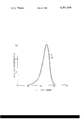
The attached drawing shows GPC curves of the polystyrene produced by Example 3 (curve I) and the standard sample of polystyrene commercially available having average molecular weight of 5,500,000, and Mw/Mn=1.06 produced by Pressure Chemical Co., Ltd. (curve II).
As is clear from the results in Table 1, only the peroxides having the structures of dialkyl peroxide and peroxy ester as defined in the present invention can produce the polymer having a narrow molecular weight distribution and super-high molecular weight. Table 1 also shows that too much amount or too less amount of these effective peroxides give unfavorable results.
                                  Table 1
__________________________________________________________________________
                                           Mol.**
                                                Mol.***
       Peroxide          Reducing agent    weight
                                                weight
                   Amount*        Amount*
                                       Yield
                                           (--Mw
                                                distri-
                                                    Kind of
No.    Name        (mole %)
                         Name     (mole %)
                                       (%) × 10.sup.-4)
                                                bution
                                                    peroxide
__________________________________________________________________________
Comparative
       t-Butyl hydroperoxide
                   0.5   Triethylene-
                                  1.0  95  30   ±
                                                    Hydro-
Example 1                tetramine                  peroxide
Comparative
Example 2
       p-Menthane hydro-
                   0.5   Triethylene-
                                  1.0  60  18   ±
                                                    Hydro-
       peroxide          tetramine                  peroxide
Comparative
Example 3
       Cumene hydroperoxide
                   0.5   Triethylene-
                                  1.0  93  15   ±
                                                    Hydro-
Comparative              tetramine                  peroxide
Example 4
       2,5-Dimethylhexane-
                   0.5   Triethylene-
                                  1.0  21   2   ±
                                                    Hydro-
       2,5-dihydroperoxide
                         tetramine                  peroxide
Comparative
Example 5
       Benzoyl peroxide
                   0.5   Triethylene-
                                  1.0   0  --   --  Diacyl
                         tetramine                  peroxide
Comparative
Example 6
       Acetyl peroxide
                   0.5   Triethylene-
                                  1.0  41  55   ±
                                                    Diacyl
Comparative              tetramine                  peroxide
Example 7
       Lauroyl peroxide
                   0.5   Triethylene-
                                  1.0  16  13   ±
                                                    Diacyl
Comparative              tetramine                  peroxide
Example 8
       Methyl ethyl ketone
                   0.5   Triethylene-
                                  1.0   0  --   --  Ketone
                         tetramine                  peroxide
Example 1
       Di-t-butyl peroxide
                   0.5   Triethylene-
                                  1.0  95   900 ++  Dialkyl
                         tetramine                  peroxide
Example 2
       Di-cumyl peroxide
                   0.5   Triethylene-
                                  1.0  93   570 ++  Dialkyl
                         tetramine                  peroxide
Example 3
       2,5-Dimethyl-2,5-di-
                   0.5   Triethylene-
                                  1.0  96  960  +++ Dialkyl
       (t-butylperoxy)-  tetramine                  peroxide
       hexane
Example 4
       t-Butyl cumyl
                   0.5   Triethylene-
                                  1.0  87  1100 +++ Dialkyl
       peroxide          tetramine                  peroxide
Example 5
       1,1-Bis(t-butyl-
                   0.5   Triethylene-
                                  1.0  91  530  ++  Dialkyl
       peroxy)3,3,5-     tetramine                  peroxide
       trimethyl cyclohexane
Example 6
       2,2-Bis(4,4-di-t-
                   0.5   Triethylene-
                                  1.0  75  630  +++ Dialkyl
       butyl peroxy      tetramine                  peroxide
       cyclohexyl)propane
Example 7
       2,5-Dimethyl-2,5-di-
                   0.5   Triethylene-
                                  1.0  96  450  ++  Dialkyl
       (t-butylperoxy)-  tetramine                  peroxide
       hexyne-3
Example 8
       Di-t-butyl  0.5   Triethylene-
                                  1.0  84  470  ++  Peroxy
       diperoxyphthalate tetramine                  ester
Example 9
       t-Butyl peroxymaleic
                   0.5   Triethylene-
                                  0.1  90  780  +++ Peroxy
       acid              tetramine                  ester
Example 10
       t-Butyl peroxymaleic
                   0.5   Triethylamine
                                  0.1  85  710  +++ Peroxy
       acid                                         ester
Example 11
       t-Butyl peroxymaleic
                   0.1   Polyethyleneimine
                                  0.5  89  1300 +++ Peroxy
       acid                                         ester
Example 12
       t-Butyl peroxy 2-
                   0.5   Triethylene-
                                  1.0  91  760  ++  Peroxy-
       ethylhexanoate    tetramine                  ester
Example 13
       t-Butyl peroxy iso-
                   0.05  Triethylene-
                                  1.0  92  1200 ++  Peroxy
       propylcarbonate   tetramine                  ester
Example 14
       t-Butyl peroxy iso-
                   0.005 Triethylene-
                                  1.0  81  4300 +++ Peroxy
       propylcarbonate   tetramine                  ester
Comparative
       t-Butyl peroxy iso-
                   3.0   Triethylene-
                                  0.5  96  80   ±
                                                    Peroxy
Example 9
       propylcarbonate                              ester
Comparative
       t-Butyl peroxy iso-
                   2.0   Triethylene-
                                  1.0  97  89   ±
                                                    Peroxy
Example 10
       propylcarbonate   tetramine                  ester
Comparative
       t-Butyl peroxy iso-
                   0.00005
                         Triethylene-
                                  0.1  nil --   --  Peroxy
Example 11
       propylcarbonate   tetramine                  ester
__________________________________________________________________________
 Note
 *: Based on the monomer used.
 **: Molecular weight was calculated from intrinsic viscosity.
 ***: Molecular weight distribution was determined by GPC comparing with
 three standard samples of polystyrene.
 Sample (a): Pressure Chemical Co., Ltd. --Mw = 550 × 10.sup.4,
 --Mw/--Mn = 1.06
 Sample (b): National Bureau of Standards. --Mw = 26 × 10.sup.4,
 --Mw/--Mn = 2.1
 Sample (c): National Physical Laboratory. 1 × 10.sup.4 <--Mw <150
 × 10.sup.4, --Mw/--Mn = 3.5
 +++:equal to or narrower than Sample (a)
 ++: broader than Sample (a) but narrower than Sample (b)
 +: broader than Sample (b) but narrower than Sample (c)
 ±: equal to or broader than Sample (c)
In a 100-ml branched ampule previously washed and dried and filled with nitrogen, 4.2 ml of styrene, 22.5 ml of an aqueous solution of polyoxyethylene oleyl ether (concentration 1.5%) and a peroxide and a reducing agent as listed in Table 2 were placed and the ampule was sealed. The polymerization was carried out for 4 hours while rotating the ampule at 25° C. Then the ampule was opened and 1 ml of an aqueous solution of N,N-diethylhydroxylamine (concentration 0.1 mole/l.) was added to terminate the polymerization. The thus obtained polymer latex was dropped into methanol to precipitate the polymer, which was washed with water sufficiently and dried under reduced pressure to carry out the same measurements as described in Example 1. The results are as shown in Table 2.
As is clear from Table 2, such reducing agents as alkyl primary amines, alkyl tertiary amines, alkylamino alcohols, polyethyleneimine, alkyl primary amino sulfonic acids or alkali salts thereof, quaternary ammonium hydroxides or bromides, hydrazine, dextrose, alkali salts of sulfurous acid, alkali dithionites, oxalic acid and imidazole are effective for producing high polymers having super-high molecular weight and a narrow molecular weight distribution.
                                  Table 2
__________________________________________________________________________
       Peroxide   Reducing agent
           Amount                 Amount
                                       Yield
                                           Mol. weight
                                                  Mol. weight
No.    Name
           (mole %)
                  Name            (mole %)
                                       (%) (--Mw × 10.sup.-4)
                                                  distribution
__________________________________________________________________________
Comparative
       B   0.5    Ferrous chloride
                                  1.0  nil
Example 12
Comparative
Example 13
       "   "      Ferrous sulfate "    "
Comparative
Example 14
       "   "      Aniline         "    "
Comparative
Example 15
       "   "      Methylaniline   "    "
Comparative
Example 16
       "   "      Sodium thiosulfate
                                  "    "
Comparative
Example 17
       "   "      Cobalt naphthenate
                                  "    "
Comparative
Example 18
       "   "      Hydroquinone    "    "
Comparative
Example 19
       "   "      Sodium ferricyanide
                                  0.5  80  18     ±
                  Sodium pyrophosphate
                                  0.5
Comparative
Example 20
       "   "      Phenylhydrazine 1.0  nil
Comparative
Example 21
       "   "      Tetraethylammonium chloride
                                  "    "
Comparative
Example 22
       "   "      Thiourea        "    "
Comparative
Example 23
       "   "      p-Aminophenol   "    "
Comparative
Example 24
       "   "      Cyclohexylamine "    "
Comparative
Example 25
       "   "      Diethylamine    1.0  nil
Comparative
Example 26
       "   "      Di-n-butylamine "    "
Example 15
       "   "      Triethylenediamine
                                  "    78  1800   +++
Example 16
       "   "      Ethanolamine    "    73  1100   +++
Example 17
       "   "      Triethanolamine "    69  950    ++
Example 18
       "   "      n-Propanolamine "    70  1300   +++
Example 19
       "   "      Tetraethylhydroxylamine
                                  "    85  530    +++
Example 20
       "   "      Ethylamine      "    83  420    ++
Example 21
       "   "      Hydrazine       "    90  350    ++
Example 22
       "   "      Tetraethylammonium bromide
                                  "    60  630    +++
Example 23
       "   "      Aminoethyl sulfonate
                                  "    53  730    ++
Example 24
       "   "      Oxalic acid     "    55  550    ++
Example 25
       "   "      Sodium aminoethyl sulfonate
                                  "    52  470    ++
Example 26
       "   "      Diethylenetriamine
                                  "    49  620    ++
Example 27
       B   0.5    Sodium sulfite  1.0  52  760    ++
Example 28
       "   "      Potassium sulfite
                                  "    53  830    ++
Example 29
       "   "      Imidazole       "    52  990    ++
Example 30
       "   "      Dextrose        "    49  1200   +++
Example 31
       "   1.0    Triethylometetramine
                                  1.0  93  1300   +++
Example 32
       "   0.5    Sodium dithionite
                                  0.5  90  860    +++
Example 33
       M   "      n-Tributylamine 0.2  60  1800   +++
Example 34
       "   "      Polyethyleneimine
                                  "    92  3300   +++
Example 35
       I   0.025  Triethylenetramine
                                  1.0  95  890    +++
Example 36
       "   0.0005 Sodium dithionite
                                  0.1  83  2300   +++
Example 37
       "   0.01   "               0.0015
                                       37  4800   +++
Example 38
       B   0.05   "               0.0015
                                       60  2200   +++
Example 39
       "   0.5    Laurylamine     0.5  89  860    +++
Example 40
       "   "      Trimethylenediamine
                                  "    75  450    ++
Example 41
       B   0.5    Hexamethylenediamine
                                  0.5  69  660    +++
Example 42
       "   "      Tetramethylammonium hydroxide
                                  "    83  730    ++
Example 43
       "   "      Tetramethylammonium bromide
                                  "    76  1050   +++
Example 44
       "   0.01   Triethylenetramine
                                  0.01 70  1680   +++
Comparative
Example 27
       "   "      "               0.0005
                                       nil
Example 45
       M   0.001  "               0.01 23  2500   +++
Example 46
       "   0.01   "               0.01 42  1900   +++
Example 47
       "   0,1    "               0.1  59  1100   +++
__________________________________________________________________________
 Note
 B: 2,5Dimethyl-2,5-di(t-butyl peroxy)hexane
 M: tButyl peroxymaleic acid
 I: tButyl peroxy isopropyl carbonate
 The other marks or signs are the same as defined in Note of Table 1.
Using the same procedure as described in Example 1, but using as a peroxide 0.5% by mole of 2,5-dimethyl-2,5-di(t-butylperoxy)hexane based on the monomer used, as a reducing agent 1.0% by mole of triethyltetramine based on the monomer used, and a monomer as listed in Table 3, the polymerization was carried out for 24 hours. The results are as shown in Table 3.
As is clear from Table 3, vinyl acetate, vinyl chloride and vinylidene chloride, which can be polymerized in a usual emulsion polymerization, are not polymerized.
              Table 3
______________________________________
                                       Mol.
                              Mol.     weight
                      Yield   weight   distri-
No.      Monomer      (%)     (--Mw × 10.sup.-4)
                                       bution
______________________________________
Example 48
         α-Methyl styrene
                      91       450     ++
Example 49
         Methyl       89       990     +++
         methacrylate
Example 50
         Butadiene    95      2500     +++
Example 51
         Isoprene     90      1300     +++
Example 52
         p-Methyl styrene
                      89      2100     +++
Example 53
         Methyl acrylate
                      97       800     ++
Example 54
         Ethyl acrylate
                      91       730     +++
Example 55
         Chloroprene  85      1300     ++
Comparative
Example 28
         Vinyl acetate
                      0
Comparative
Example 29
         Vinyl chloride
                      0
Comparative
Example 30
         Vinylidene   0
         chloride
______________________________________
 Note
 Marks or signs are the same as defined in Note of Table 1.
In a 200-ml branched ampule previously washed and dried and filled with nitrogen, 4.2 ml of styrene, 12.6 ml of isoprene, 50 ml of an aqueous solution of sodium dodecylbenzene sulfonate (concentration 0.6 mole/l.) were placed and the contents were stirred. Then 0.2 mmole of 2,5-dimethyl-2,5-di(t-butylperoxy)hexane was added to the resulting mixture and the ampule was sealed. The polymerization was carried out for 3 hours while rotating the ampule in a water bath maintained at 5° C. Then the ampule was opened and 1 ml of N,N-diethylhydroxylamine aqueous solution (concentration 0.1 mole/l.) was added to terminate the polymerization. The resulting polymer was treated as described in Example 1 and the physical properties of the polymer were measured according to Example 1.
That the resulting polymer was the copolymer was identified by infrared absorption spectra and NMR spectra, which show spectra of the polymers of styrene and isoprene, and by differential scanning calorimetry, which showed glass transition temperature of -26° C. but did not show the glass transition temperatures of polystyrene and polyisoprene.
The results of GPC measurement showed that weight-average molecular weight was about 7,600,000 and the ratio of Mw/Mn was 1.15.
In a 500-ml three necked flask, 190 ml of water, 8 g of sodium lauryl sulfate and 0.5 g of polyethyleneimine were placed under nitrogen with sufficient stirring. After dissolved, 100 ml of styrene and 0.01 g of t-butyl peroxyacetate were added to the solution and the polymerization was carried out at 37° C. for 4 hours. The resulting polymer was treated as described in Example 1. The yield was 97%. The intrinsic viscosity in toluene at 30° C. was 17.2. The molecular weight distribution was very narrow and the ratio of Mw/Mn was 1.03 assuming that sedimentation constant b obtained by ultracentrifugation was S=1.5×10⁻¹⁵ M0.5.
The polymerization of Example 57 was repeated except for changing the polymerization temperature as listed in Table 4. The polymer obtained was treated as described in Example 1. The results are as shown in Table 4.
As is clear from Table 4, the polymerizations over 70° C. do not afford polymers having super-high molecular weight and the molecular weight distributions are remarkably broad.
              Table 4
______________________________________
         Polymeri-                     Mol.
         zation                        weight
         temperature
                    Yield    Mol. weight
                                       distri-
No.      (°C.)
                    (%)      (--Mw × 10.sup.-4)
                                       bution
______________________________________
Example 58
         55         71       560       +++
Example 59
         65         83       350       ++
Comparative
Example 31
         75         98       120       +
Comparative
Example 32
         90         100       19       ±
______________________________________
 Note-
 Marks or signs are the same as defined in Note of Table 1.
In a 500-ml pressure bottle previously washed and dried, 50 g of styrene, 10 g of polyoxyethylene nonyl phenol ether, 0.5 g of triethylenetetramine and 200 ml of distilled water were placed under nitrogen with stirring. After emulsified, 0.01 g of t-butyl peroxybenzoate was added to the resulting mixture and the polymerization was carried out under nitrogen at 40° C. for 6 hours with stirring. Then 34 g of butadiene was added to the polymerization system and the polymerization was continued at 40° C. for 24 hours. Then 1 ml of an aqueous solution of N,N-diethylhydroxylamine (concentration 0.1 mole/l.) was added to terminate the polymerization. The polymer latex thus obtained was treated as described in Example 1 and the resulting polymer was used to measure physical properties, i.e. intrinsic viscosity [η] in toluene at 30° C., Schlielen pattern of tetrahydrofuran solution, glass transition temperature (Tg) using a differential scanning calorimeter (heating rate 20° C./min), and infrared absorption spectra of cast film.
For reference, using the same conditions as mentioned above, styrene alone was polymerized for 6 hours and the polymerization was terminated by adding 1 ml of an aqueous solution of N,N-diethylhydroxylamine (concentration 0.1 mole/l.). Then the polymer latex was dropped into methanol and the polystyrene was recovered as mentioned above. The polystyrene had intrinsic viscosity [η] in toluene at 30° C. of 9.0 and weight-average molecular weight of 6,000,000. Schlielen pattern of the polystyrene was also measured as mentioned above.
The copolymer obtained in Example 60 was a block copolymer having intrinsic viscosity [η] of 13.7, the yield being 97%. Glass transition temperature of the copolymer was -92° C. and 94° C. which correspond to Tg of the polybutadiene block and the polystyrene block, respectively. The infrared absorption spectra showed that the polystyrene block had atactic structure and the polystyrene content was 60%, and that the polybutadiene block had microstructure of 18% of cis-1,4 structure, 66% of trans-1,4 structure, and 16% of vinyl structure. The copolymer produced was identified as a pure block copolymer by the GPC and thin layer chromatograph. The Schlielen pattern of the copolymer showed that the molecular weight distribution of the copolymer was considerably narrow and that the copolymer was a block copolymer since there was one peak in the higher molecular weight side comparing with the Schlielen pattern of the polystyrene obtained before the copolymerization as mentioned above.
Claims (2)
1. A block copolymer of an aromatic alkenyl compound and a conjugated diolefin having extremely high molecular weight comprising
(A) at least one poly (aromatic alkenyl) block having atactic structure with molecular weight (Mw) of 1,000,000 to 30,000,000, and
(B) at least one poly (conjugated diolefin) block having microstructure of 15-30% by weight of cis-1,4, 60-75% by weight of trans-1,4 and 10-25% by weight of vinyl structure with molecular weight (Mw) of 50,000 to 10,000,000,
the proportion of said poly (aromatic alkenyl) block in the block copolymer being 10 to 95% by weight.
2. A block copolymer according to claim 1, wherein the aromatic alkenyl compound is styrene and the conjugated diolefin is butadiene or isoprene.
Priority Applications (1)
| Application Number | Priority Date | Filing Date | Title |
|---|---|---|---|
| US05/881,914 US4201848A (en) | 1976-01-01 | 1978-02-28 | Process for preparing polymers having high molecular weight |
Applications Claiming Priority (8)
| Application Number | Priority Date | Filing Date | Title |
|---|---|---|---|
| JP51-297 | 1976-01-01 | ||
| JP51-298 | 1976-01-01 | ||
| JP51-299 | 1976-01-01 | ||
| JP29876A JPS6023682B2 (en) | 1976-01-01 | 1976-01-01 | Method for producing ultra-high molecular weight polymers |
| JP29776A JPS6023681B2 (en) | 1976-01-01 | 1976-01-01 | Method for producing ultra-high molecular weight polymer |
| JP29976A JPS5913525B2 (en) | 1976-01-01 | 1976-01-01 | Ultra-high molecular weight block copolymer |
| US75292576A | 1976-12-21 | 1976-12-21 | |
| US05/881,914 US4201848A (en) | 1976-01-01 | 1978-02-28 | Process for preparing polymers having high molecular weight |
Related Parent Applications (1)
| Application Number | Title | Priority Date | Filing Date |
|---|---|---|---|
| US75292576A Continuation | 1976-01-01 | 1976-12-21 |
Publications (1)
| Publication Number | Publication Date |
|---|---|
| US4201848A true US4201848A (en) | 1980-05-06 |
Family
ID=27517939
Family Applications (1)
| Application Number | Title | Priority Date | Filing Date |
|---|---|---|---|
| US05/881,914 Expired - Lifetime US4201848A (en) | 1976-01-01 | 1978-02-28 | Process for preparing polymers having high molecular weight |
Country Status (1)
| Country | Link |
|---|---|
| US (1) | US4201848A (en) |
Cited By (21)
| Publication number | Priority date | Publication date | Assignee | Title |
|---|---|---|---|---|
| US4284551A (en) * | 1979-11-30 | 1981-08-18 | American Dental Association Health Foundation | Tertiary aromatic amine accelerators derived from para-aminophenethanol |
| US4427837A (en) | 1981-03-27 | 1984-01-24 | The Dow Chemical Company | Process for preparation of diene-styrene-α-methylstyrene block polymers and polymers therefrom |
| US4431777A (en) * | 1979-02-15 | 1984-02-14 | The Dow Chemical Company | Block copolymers of diene having their terminal end blocks of a random copolymer of styrene or alkylstyrene and an alpha-methylstyrene |
| US5045614A (en) * | 1989-04-07 | 1991-09-03 | The Dow Chemical Company | Process for polymerizing vinyl monomers using amine containing compounds which simultaneously act as initiators and crosslinking agents as part of a redox initiator system |
| US5071918A (en) * | 1988-08-10 | 1991-12-10 | Mitsubishi Rayon Company, Ltd. | Process for producing resin for a toner |
| EP0476662A1 (en) * | 1990-09-21 | 1992-03-25 | Bridgestone/Firestone, Inc. | Ultra high molecular weight copolymers of conjugated dienes and aromatic vinyl compounds |
| EP0476641A1 (en) * | 1990-09-21 | 1992-03-25 | Bridgestone Corporation | Ultra high molecular weight elastomer composition |
| EP0476665A1 (en) * | 1990-09-21 | 1992-03-25 | Bridgestone Corporation | Oil extended ultra high molecular weight elastomers |
| EP0476640A1 (en) * | 1990-09-21 | 1992-03-25 | Bridgestone Corporation | High performance tire treads and tires |
| US5102952A (en) * | 1989-08-04 | 1992-04-07 | Rohm And Haas Company | Thermoplastic polymer compositions containing melt-rheology modifiers |
| US5204413A (en) * | 1988-08-10 | 1993-04-20 | Mitsubishi Rayon Company, Limited | Process fro producing resin for a toner |
| US5231152A (en) * | 1990-12-18 | 1993-07-27 | Bridgestone Corporation | Continuous process for preparing copolymers of conjugated dienes and aromatic vinyl compounds |
| US5322912A (en) * | 1992-11-16 | 1994-06-21 | Xerox Corporation | Polymerization processes and toner compositions therefrom |
| US5449724A (en) * | 1994-12-14 | 1995-09-12 | Xerox Corporation | Stable free radical polymerization process and thermoplastic materials produced therefrom |
| US5962616A (en) * | 1990-07-17 | 1999-10-05 | General Electric Company | Anaerobic hardening composition |
| US6087451A (en) * | 1994-08-18 | 2000-07-11 | Xerox Corporation | Process for preparing polymers using bifunctional free radical reactive compounds |
| US6320007B1 (en) | 1994-11-18 | 2001-11-20 | Xerox Corporation | Process for producing thermoplastic resin polymers |
| US20020198298A1 (en) * | 2000-07-31 | 2002-12-26 | Hideo Arikawa | Aqueous dispersion composition for imparting chipping resistance |
| US20120056128A1 (en) * | 2009-03-23 | 2012-03-08 | Total Petrochemicals Research Feluy | Stabilised Composititions Comprising Olefins |
| EP2455408A4 (en) * | 2009-07-16 | 2013-12-25 | Daikin Ind Ltd | METHOD FOR PRODUCING A FLUOROUS BLOCK COPOLYMER |
| US20170174901A1 (en) * | 2014-07-16 | 2017-06-22 | Lixil Corporation | Hydrophilic treatment coating composition and hydrophilizing treatment method |
Citations (2)
| Publication number | Priority date | Publication date | Assignee | Title |
|---|---|---|---|---|
| US3948846A (en) * | 1971-11-01 | 1976-04-06 | Imperial Chemical Industries Limited | Polymeric dispersion |
| US4010226A (en) * | 1975-07-17 | 1977-03-01 | Shell Oil Company | Block polymers and their preparation |
-
1978
- 1978-02-28 US US05/881,914 patent/US4201848A/en not_active Expired - Lifetime
Patent Citations (2)
| Publication number | Priority date | Publication date | Assignee | Title |
|---|---|---|---|---|
| US3948846A (en) * | 1971-11-01 | 1976-04-06 | Imperial Chemical Industries Limited | Polymeric dispersion |
| US4010226A (en) * | 1975-07-17 | 1977-03-01 | Shell Oil Company | Block polymers and their preparation |
Non-Patent Citations (3)
| Title |
|---|
| Hsieh et al., "J. Polymer Science," vol. XXVI, No. 113, pp. 240-242, 1957. * |
| Hsieh, "J. Polymer Science," Part A, vol. 3, pp. 181-190, 1965. * |
| Kuntz et al., "J. Polymer Science," vol. XLII, pp. 299-308, 1960. * |
Cited By (35)
| Publication number | Priority date | Publication date | Assignee | Title |
|---|---|---|---|---|
| US4431777A (en) * | 1979-02-15 | 1984-02-14 | The Dow Chemical Company | Block copolymers of diene having their terminal end blocks of a random copolymer of styrene or alkylstyrene and an alpha-methylstyrene |
| US4284551A (en) * | 1979-11-30 | 1981-08-18 | American Dental Association Health Foundation | Tertiary aromatic amine accelerators derived from para-aminophenethanol |
| US4427837A (en) | 1981-03-27 | 1984-01-24 | The Dow Chemical Company | Process for preparation of diene-styrene-α-methylstyrene block polymers and polymers therefrom |
| US5071918A (en) * | 1988-08-10 | 1991-12-10 | Mitsubishi Rayon Company, Ltd. | Process for producing resin for a toner |
| US5204413A (en) * | 1988-08-10 | 1993-04-20 | Mitsubishi Rayon Company, Limited | Process fro producing resin for a toner |
| US5045614A (en) * | 1989-04-07 | 1991-09-03 | The Dow Chemical Company | Process for polymerizing vinyl monomers using amine containing compounds which simultaneously act as initiators and crosslinking agents as part of a redox initiator system |
| US5102952A (en) * | 1989-08-04 | 1992-04-07 | Rohm And Haas Company | Thermoplastic polymer compositions containing melt-rheology modifiers |
| US5302429A (en) * | 1989-08-04 | 1994-04-12 | Rohm And Haas Company | Thermoplastic polymer compositions containing high molecular weight poly(vinyl aromatic) melt-rheology modifiers |
| US5962616A (en) * | 1990-07-17 | 1999-10-05 | General Electric Company | Anaerobic hardening composition |
| EP0476640A1 (en) * | 1990-09-21 | 1992-03-25 | Bridgestone Corporation | High performance tire treads and tires |
| US5147951A (en) * | 1990-09-21 | 1992-09-15 | Bridgestone/Firestone, Inc. | Method for preparing ultra high molecular weight copolymers of conjugated dienes and aromatic vinyl compounds |
| US5260370A (en) * | 1990-09-21 | 1993-11-09 | Bridgestone Corporation | Oil extended ultra high molecular weight elastomers |
| US5272203A (en) * | 1990-09-21 | 1993-12-21 | Bridgestone/Firestone, Inc. | High performance tire treads and tires |
| EP0476665A1 (en) * | 1990-09-21 | 1992-03-25 | Bridgestone Corporation | Oil extended ultra high molecular weight elastomers |
| EP0476641A1 (en) * | 1990-09-21 | 1992-03-25 | Bridgestone Corporation | Ultra high molecular weight elastomer composition |
| US5331036A (en) * | 1990-09-21 | 1994-07-19 | Bridgestone Corporation | Oil extended ultra high molecular weight elastomers |
| EP0476662A1 (en) * | 1990-09-21 | 1992-03-25 | Bridgestone/Firestone, Inc. | Ultra high molecular weight copolymers of conjugated dienes and aromatic vinyl compounds |
| US5489660A (en) * | 1990-12-18 | 1996-02-06 | Bridgestone Corporation | Copolymers of conjugated dienes and aromatic vinyl compounds prepared by continuous process |
| US5231152A (en) * | 1990-12-18 | 1993-07-27 | Bridgestone Corporation | Continuous process for preparing copolymers of conjugated dienes and aromatic vinyl compounds |
| US5322912A (en) * | 1992-11-16 | 1994-06-21 | Xerox Corporation | Polymerization processes and toner compositions therefrom |
| US5401804A (en) * | 1992-11-16 | 1995-03-28 | Xerox Corporation | Polymerization process and toner compositions therefrom |
| US6087451A (en) * | 1994-08-18 | 2000-07-11 | Xerox Corporation | Process for preparing polymers using bifunctional free radical reactive compounds |
| US6320007B1 (en) | 1994-11-18 | 2001-11-20 | Xerox Corporation | Process for producing thermoplastic resin polymers |
| US5449724A (en) * | 1994-12-14 | 1995-09-12 | Xerox Corporation | Stable free radical polymerization process and thermoplastic materials produced therefrom |
| US20020198298A1 (en) * | 2000-07-31 | 2002-12-26 | Hideo Arikawa | Aqueous dispersion composition for imparting chipping resistance |
| US6897252B2 (en) * | 2000-07-31 | 2005-05-24 | Mitsui Chemicals, Inc. | Aqueous dispersion composition for imparting chipping resistance |
| US20120056128A1 (en) * | 2009-03-23 | 2012-03-08 | Total Petrochemicals Research Feluy | Stabilised Composititions Comprising Olefins |
| EP2455408A4 (en) * | 2009-07-16 | 2013-12-25 | Daikin Ind Ltd | METHOD FOR PRODUCING A FLUOROUS BLOCK COPOLYMER |
| US9127111B2 (en) | 2009-07-16 | 2015-09-08 | Daikin Industries, Ltd. | Process for production of fluorine-containing block copolymer |
| US9290628B2 (en) | 2009-07-16 | 2016-03-22 | Daikin Industries, Ltd. | Process for production of fluorine-containing block copolymer |
| US9518140B2 (en) | 2009-07-16 | 2016-12-13 | Daikin Industries, Ltd. | Process for production of fluorine-containing block copolymer |
| US20170174901A1 (en) * | 2014-07-16 | 2017-06-22 | Lixil Corporation | Hydrophilic treatment coating composition and hydrophilizing treatment method |
| US10563067B2 (en) * | 2014-07-16 | 2020-02-18 | Lixil Corporation | Hydrophilic treatment coating composition and hydrophilizing treatment method |
| US10774221B2 (en) | 2014-07-16 | 2020-09-15 | Lixil Corporation | Hydrophilic treatment coating composition and hydrophilizing treatment method |
| US10793721B2 (en) | 2014-07-16 | 2020-10-06 | Lixil Corporation | Hydrophilic treatment coating composition and hydrophilizing treatment method |
Similar Documents
| Publication | Publication Date | Title |
|---|---|---|
| JP3953522B2 (en) | Thermoplastic molding material | |
| US3498942A (en) | Emulsion polymerization of unsaturated monomers utilizing alkyl sulfide terminated oligomers as emulsifiers and resulting product | |
| JP2730163B2 (en) | Method for producing high trans low vinyl conjugated diene polymer | |
| US3830880A (en) | Diene block copolymers | |
| KR100298534B1 (en) | Process for the preparation of vinylic polymers, polymerization initiator for vinylic m0nomers, and styrene resin composition | |
| US3652724A (en) | Process for producing block copolymers | |
| US3264375A (en) | Process for the graft polymerization of styrene on alkyl lithium catalyzed polybutadiene using a peroxide catalyst | |
| JPH03403B2 (en) | ||
| US4014843A (en) | Latex compositions | |
| JP2002504576A (en) | Preparation of block copolymers by suppressed anionic polymerization | |
| JP2002506478A (en) | Improved acid-catalyzed polymerization method | |
| JP2002515520A (en) | Process for producing anionic polymeric bifunctional and multifunctional polymers using protected functional initiators | |
| US5962605A (en) | High molecular weight polystyrene production by vinyl acid catalyzed free radical polymerization | |
| US2941971A (en) | Process for preparing stable emulsifierfree alkali metal-free latices of vinylidene monomers | |
| US3776874A (en) | Alkyl-sulfoxide and alkyl-sulfone terminated oligomers as emulsi-fiers in emulsion polymerizations | |
| US7368504B2 (en) | Method for the production of impact polystyrene | |
| GB1558835A (en) | Process for preparing polymers having high molecular weight | |
| US4312802A (en) | Polymer compositions and articles therefrom | |
| US3557254A (en) | Polymerization process | |
| US6825271B2 (en) | Anionically polymerized, impact-resistant polystyrene with capsule particle morphology | |
| EP0862586B1 (en) | A process for preparing a branched polymer from a vinyl aromatic monomer | |
| JPH02265913A (en) | Manufacture of polymer by anionic polymerization | |
| US3641209A (en) | Emulsion polymerization employing azoacyl catalysts | |
| SU671302A1 (en) | Method of obtaining cis-1,4-polyisoprene | |
| JPS6023681B2 (en) | Method for producing ultra-high molecular weight polymer |