US4123173A - Rotatable flexible cuvette arrays - Google Patents
Rotatable flexible cuvette arrays Download PDFInfo
- Publication number
- US4123173A US4123173A US05/694,303 US69430376A US4123173A US 4123173 A US4123173 A US 4123173A US 69430376 A US69430376 A US 69430376A US 4123173 A US4123173 A US 4123173A
- Authority
- US
- United States
- Prior art keywords
- cuvette
- array
- compartments
- cuvettes
- disc
- Prior art date
- Legal status (The legal status is an assumption and is not a legal conclusion. Google has not performed a legal analysis and makes no representation as to the accuracy of the status listed.)
- Expired - Lifetime
Links
- 238000003491 array Methods 0.000 title description 12
- 239000012530 fluid Substances 0.000 claims description 21
- 239000012815 thermoplastic material Substances 0.000 claims description 3
- 210000002445 nipple Anatomy 0.000 claims 1
- 239000000463 material Substances 0.000 abstract description 44
- 230000003287 optical effect Effects 0.000 abstract description 32
- 229920003023 plastic Polymers 0.000 abstract description 13
- 239000004033 plastic Substances 0.000 abstract description 13
- 230000004927 fusion Effects 0.000 abstract description 7
- 230000009977 dual effect Effects 0.000 abstract description 3
- 238000006243 chemical reaction Methods 0.000 description 14
- 238000004458 analytical method Methods 0.000 description 12
- 238000005119 centrifugation Methods 0.000 description 12
- 230000005540 biological transmission Effects 0.000 description 11
- 239000003153 chemical reaction reagent Substances 0.000 description 11
- 238000005259 measurement Methods 0.000 description 11
- 239000000376 reactant Substances 0.000 description 10
- 238000012360 testing method Methods 0.000 description 10
- 239000000203 mixture Substances 0.000 description 8
- 238000007789 sealing Methods 0.000 description 8
- 239000008280 blood Substances 0.000 description 7
- 238000000034 method Methods 0.000 description 7
- 238000000465 moulding Methods 0.000 description 7
- 210000004369 blood Anatomy 0.000 description 6
- 210000004027 cell Anatomy 0.000 description 6
- 238000012937 correction Methods 0.000 description 5
- 230000033001 locomotion Effects 0.000 description 5
- 230000013011 mating Effects 0.000 description 5
- XLYOFNOQVPJJNP-UHFFFAOYSA-N water Substances O XLYOFNOQVPJJNP-UHFFFAOYSA-N 0.000 description 5
- 238000002156 mixing Methods 0.000 description 4
- 230000008569 process Effects 0.000 description 4
- 230000000712 assembly Effects 0.000 description 3
- 238000000429 assembly Methods 0.000 description 3
- 210000001124 body fluid Anatomy 0.000 description 3
- 239000010839 body fluid Substances 0.000 description 3
- 238000011161 development Methods 0.000 description 3
- 239000003085 diluting agent Substances 0.000 description 3
- 238000006073 displacement reaction Methods 0.000 description 3
- 239000007788 liquid Substances 0.000 description 3
- 230000007246 mechanism Effects 0.000 description 3
- 238000002835 absorbance Methods 0.000 description 2
- 239000007853 buffer solution Substances 0.000 description 2
- 239000011248 coating agent Substances 0.000 description 2
- 238000000576 coating method Methods 0.000 description 2
- 238000004891 communication Methods 0.000 description 2
- 239000012153 distilled water Substances 0.000 description 2
- 230000007613 environmental effect Effects 0.000 description 2
- 229920002457 flexible plastic Polymers 0.000 description 2
- 238000010438 heat treatment Methods 0.000 description 2
- 238000007373 indentation Methods 0.000 description 2
- 238000003780 insertion Methods 0.000 description 2
- 230000037431 insertion Effects 0.000 description 2
- 238000004519 manufacturing process Methods 0.000 description 2
- 239000003973 paint Substances 0.000 description 2
- 238000011160 research Methods 0.000 description 2
- 230000002441 reversible effect Effects 0.000 description 2
- 210000002966 serum Anatomy 0.000 description 2
- 238000007493 shaping process Methods 0.000 description 2
- 230000001052 transient effect Effects 0.000 description 2
- 230000000007 visual effect Effects 0.000 description 2
- 238000003260 vortexing Methods 0.000 description 2
- 102000009123 Fibrin Human genes 0.000 description 1
- 108010073385 Fibrin Proteins 0.000 description 1
- 238000011481 absorbance measurement Methods 0.000 description 1
- 238000010521 absorption reaction Methods 0.000 description 1
- 230000009471 action Effects 0.000 description 1
- 230000003044 adaptive effect Effects 0.000 description 1
- 239000000654 additive Substances 0.000 description 1
- 230000002411 adverse Effects 0.000 description 1
- 230000004075 alteration Effects 0.000 description 1
- XAGFODPZIPBFFR-UHFFFAOYSA-N aluminium Chemical compound [Al] XAGFODPZIPBFFR-UHFFFAOYSA-N 0.000 description 1
- 229910052782 aluminium Inorganic materials 0.000 description 1
- 238000001286 analytical centrifugation Methods 0.000 description 1
- 230000015572 biosynthetic process Effects 0.000 description 1
- 230000009172 bursting Effects 0.000 description 1
- 230000008859 change Effects 0.000 description 1
- 239000004020 conductor Substances 0.000 description 1
- 239000000356 contaminant Substances 0.000 description 1
- 238000011109 contamination Methods 0.000 description 1
- 230000001276 controlling effect Effects 0.000 description 1
- 230000008021 deposition Effects 0.000 description 1
- 230000000994 depressogenic effect Effects 0.000 description 1
- 230000001066 destructive effect Effects 0.000 description 1
- 238000007723 die pressing method Methods 0.000 description 1
- 238000010790 dilution Methods 0.000 description 1
- 239000012895 dilution Substances 0.000 description 1
- 230000003467 diminishing effect Effects 0.000 description 1
- 230000000694 effects Effects 0.000 description 1
- 230000008030 elimination Effects 0.000 description 1
- 238000003379 elimination reaction Methods 0.000 description 1
- 238000001704 evaporation Methods 0.000 description 1
- 230000008020 evaporation Effects 0.000 description 1
- JEGUKCSWCFPDGT-UHFFFAOYSA-N h2o hydrate Chemical compound O.O JEGUKCSWCFPDGT-UHFFFAOYSA-N 0.000 description 1
- 238000005286 illumination Methods 0.000 description 1
- 230000003116 impacting effect Effects 0.000 description 1
- 238000010348 incorporation Methods 0.000 description 1
- 238000011534 incubation Methods 0.000 description 1
- 238000003754 machining Methods 0.000 description 1
- 238000012986 modification Methods 0.000 description 1
- 230000004048 modification Effects 0.000 description 1
- 238000005457 optimization Methods 0.000 description 1
- 238000010979 pH adjustment Methods 0.000 description 1
- 238000010422 painting Methods 0.000 description 1
- 230000036961 partial effect Effects 0.000 description 1
- 238000005192 partition Methods 0.000 description 1
- 230000002093 peripheral effect Effects 0.000 description 1
- 210000002381 plasma Anatomy 0.000 description 1
- 229920000642 polymer Polymers 0.000 description 1
- 230000002265 prevention Effects 0.000 description 1
- 238000007639 printing Methods 0.000 description 1
- 238000004393 prognosis Methods 0.000 description 1
- 230000001681 protective effect Effects 0.000 description 1
- 230000005855 radiation Effects 0.000 description 1
- 230000002829 reductive effect Effects 0.000 description 1
- 230000001105 regulatory effect Effects 0.000 description 1
- 230000003014 reinforcing effect Effects 0.000 description 1
- 230000003252 repetitive effect Effects 0.000 description 1
- 230000000452 restraining effect Effects 0.000 description 1
- 238000000926 separation method Methods 0.000 description 1
- 230000011664 signaling Effects 0.000 description 1
- 239000007787 solid Substances 0.000 description 1
- 239000000243 solution Substances 0.000 description 1
- 239000000126 substance Substances 0.000 description 1
- 238000012546 transfer Methods 0.000 description 1
- 238000005199 ultracentrifugation Methods 0.000 description 1
- 229920002554 vinyl polymer Polymers 0.000 description 1
Images


Classifications
-
- G—PHYSICS
- G01—MEASURING; TESTING
- G01N—INVESTIGATING OR ANALYSING MATERIALS BY DETERMINING THEIR CHEMICAL OR PHYSICAL PROPERTIES
- G01N21/00—Investigating or analysing materials by the use of optical means, i.e. using sub-millimetre waves, infrared, visible or ultraviolet light
- G01N21/01—Arrangements or apparatus for facilitating the optical investigation
- G01N21/03—Cuvette constructions
- G01N21/07—Centrifugal type cuvettes
-
- B—PERFORMING OPERATIONS; TRANSPORTING
- B04—CENTRIFUGAL APPARATUS OR MACHINES FOR CARRYING-OUT PHYSICAL OR CHEMICAL PROCESSES
- B04B—CENTRIFUGES
- B04B5/00—Other centrifuges
- B04B5/04—Radial chamber apparatus for separating predominantly liquid mixtures, e.g. butyrometers
- B04B5/0407—Radial chamber apparatus for separating predominantly liquid mixtures, e.g. butyrometers for liquids contained in receptacles
Definitions
- This invention relates generally to rotatable disc cuvette arrays and assemblies adapted for use in a centrifugal fast analyzer having means to centrifugally rotate the array in order to produce measurements of the optical density or absorbance values of a light path passing successively through each of a series of radially spaced cuvettes during their rotation.
- Such systems are in wide use, particularly for absorbance measurements utilized with analytical apparatus.
- these fast analyzers are generally furnished with an array usually having individual inner and outer compartments for each of the cuvettes. These compartments are physically separated from each other by a wall such as an annular ramp which divides each cuvette into these inner and outer compartments and prevents fluid communication therebetween prior to centrifugation.
- Such arrays have a structure wherein a central hub portion has positioned outwardly thereof a selected number of radially disposed cuvettes. Normally each of the individual cuvettes are radially positioned side by side and have a common radially extending dividing wall between each pair of adjacent cuvettes to form the disc portion of the assembly into the rotatable cuvette array.
- the inner compartments usually comprise a holding means for whatever reagents or reactants which are placed therein prior to the centrifugation run and read cycle.
- the outer compartments are also formed into an annular ring, spaced radially outward from the inner compartments, and are divided therefrom prior to centrifugation by the described wall or walls, preferably ramp-shaped in form and having an inner vertical wall which preferably has an inclination in the vertical plane of approximately 40° to 60° degrees, so as to form the desired ramp angle between the inner and outer compartments.
- Such rotary cuvette assemblies are particularly adapted for use in a clinical analyzer in their most common useage, in order to produce a reaction between the material contained within the inner compartment and that material which is contained in the outer compartment, the latter usually comprising an unknown sample, for example, a body fluid.
- the most common use of these analyses is the determination of blood or blood plasma or serum components, the blood forming the sample, or unknown, material under test and being deposited in the outer ring of compartments.
- the reagent or reactant materials contained in the inner compartments diluted if desired to a fixed concentration and/or pH, are thrown outwardly and rise over the inner inclined walls or ramps of the cuvette compartment dividers and then flow into the outer chambers where they intimately contact and mix with the materials contained in the chambers.
- the parameters of the blood or other material contained in the outer compartments, as well as those of the materials contained within the inner compartments are carefully fixed as to volume, temperature, acidity, etc., and have been treated prior to use for removal of fibrins or similar debris which would have an adverse effect upon the reaction and upon the uniformity and light tramsmission characteristics of the measured optical density of the materials when they become mixed in the outer compartments.
- an assembly of rotary cuvettes which is provided with an additional radially aligned chamber, or compartment, for each of the individual cuvettes, the third compartments being spaced radially outwardly from the second compartments, so as to form a third annular ring of compartments.
- an additional annular compartment separating or partition wall which may also be of the slope or ramp type, provides the separation means between the second annular series of cuvette compartments and the outermost third series of compartments of the overall assembly.
- the reaction takes place for the most part in the third compartment, although in some analytical or other reactions a portion of the reaction will occur while the materials from the first, most inwardly positioned compartments are flowing in partially mixed form with the materials from the second compartments prior to the combined flow reaching the third compartments.
- the centrifugation speeds generally used with such analyzers are not of such great magnitude as to fall within the ultra centrifugation range of 20,000 rpm or more, the usual fast analyzer rotor speed is sufficient so that the mixed materials will generally be centrifugally forced into a vertical layer against the outer vertical walls which form the final vertical wall of the overall cuvettes.
- the cuvettes are physically made as identical as is possible in so far as each component part thereof is concerned.
- the heights of the dividing ramps are so selected relative to the greater height of the radial walls which divide the cuvettes from each other, and which form the side walls of each of the compartments of the cuvettes, that such spillage is avoided without undue interference with the travel of the materials to their most radially outward position, where the components from the inner compartments are mixed and form a substantially vertical layer against the vertical outer wall of each of the cuvettes.
- a multi-cuvette array which essentially consists of an array composed of a plurality of pie-shaped, radially disposed cuvettes which radiate out from a central hub portion and which contain in radial order in each of the chambers or cuvettes, proceeding radially outwardly from the hub or center of the generally round, substantially disc-shaped array structure: a first annular series of chambers for initially holding a first group of reactants, an annular series of dividing walls or ramps, one for each cuvette, a second annular series of compartments for holding initially different reagents which frequently are the unknown samples of blood or other body fluids, and an outer annular series of vertical end walls.
- cover means On top of the cuvettes there are generally placed some form of cover means to prevent evaporation and contamination, the cover means still leaving paths for the measurement of the optical density or fluorescent emission characteristics of the reacting materials, when the array is rotated, with these openings, one for each cuvette, passing between a source of illumination, in the case of measurement of absorption, and an optical light transmission sensing means.
- the disc array is usually driven at speeds of between about 300 and about 500 rpm during most of such measurement run cycles after a preliminary initial fast run at higher speeds in the vicinity of 3,000 to 5,000 rpm to cause more rapid initial reaction by increasing initial reactant material contact.
- the chamber in which the cuvette and other apparatus is placed and/or the cuvette array itself has its temperature controlled closely, usually by heating during an incubation period both prior to and during this run in which the reaction is occurring.
- the light transmission characteristics are changing as the reaction proceeds and, since the temperature affects this rate, it must be accurately controlled.
- each component of the system including the entire optical system, the rotation motor drive speed, the means for holding the rotor, as well as the cuvette array, are all accurate to within less than 0.1 percent variation.
- each of the cuvettes with some identification means, such as numbers therefor, which enables the users thereof to program an electronic readout system and digital computer, or to program the electronic interfacing means for coaction with the computer, so as to identify the readings by cuvette number, such number identification of each cuvette being utilized with an automatic printout mechanism, all as described in the above references.
- the most commonly used system is one in which the rotor holder for the cuvette array has positioned thereon, or associated physically therewith, some form of encoding system, which may consist of an optically transmissive annular series of slots, each of which is positioned opposite the center of each cuvette when the cuvette is aligned in, and supported by, the rotor holder.
- This series of indexing slots or other such means may be used to locate the particular cuvette area which is being measured; i.e., which is passing through the main optical path during the rotation of the run cycle.
- a rotatable cuvette array for use with so-called fast anlyzers of the centrifugal type is described in various embodiments in all of which the array is disposable.
- the array consists of a series of radially spaced, pie-shaped cuvettes, preferably formed by sheet molding, extending from a hub or center portion.
- the cuvettes are separated from each other by side walls which are preferably double thickness with a space between the two layers thereof.
- the cuvettes are divided radially into an inner and an outer series of side-by-side compartments.
- Each inner compartment is divided from each outer compartment for each cuvette by a division wall which is preferably ramp-shaped on its radially inward wall, so that this inner wall thereof is inclined vertically, angularly upward, while the outer wall thereof is inclined downward at a sharp vertical angle which may, in fact be 90 degrees.
- each of the outer compartments have inwardly or reverse curved side walls to direct the fluids during centrifugal motion toward the cuvette centers so as to increase the vortexing or swirling and, hence, to promote intimate mixing.
- the center portion of the outside wall of each outer compartment is a substantially vertical wall, which may be inclined at a slight angle to the vertical plane and which forms the wall against which the centrifuged materials are held by centrifugal force during rotation in a vertical fluid layer.
- a horizontal annular flange at the outer extremity of the integral plastic member forming this cuvette part of the structure.
- Circumferentially bonded thereto is a preferably flexible horizontal annulus formed of thin plastic material, having the desired light transmissive properties, and which overlies the cuvette end walls and is provided on the portion thereof beyond the end walls with a first series of slots which serve as encoding means, the slots having their edges radially aligned approximately with one edge of the associated cuvette.
- These slots are substantially rectangular in their preferred form.
- Substantially aligned with the cuvette radial division walls are a second series of slots, one for each division wall, these slots being also part of the encoding system and being used to provide for a zero referencing of the reading of each cuvette during the optical density analytical measurement.
- This portion of the annulus beyond the outer walls which contains the slots is made opaque by painting or the like.
- the innermost part of the annulus is provided with lengthy slots therein extending horizontally beyond both walls of the ramp, so that these slots form access passage to each inner and outer compartment of each cuvette.
- a single opening may be formed for each cuvette just beyond the dividing ramp wall so as to provide a means of access to the outer compartments of the cuvettes.
- the edges of the slots or holes are surrounded by an opaque material.
- each cuvette having its inner wall formed as a part of the hub vertical wall with the bottom of the hub wall extending vertically downward and inclined forward radially to aid in directional fluid flow.
- the hub may have a recessed or otherwise configured form to index the hub in a fixed position relative to the rotary carrier therefor during centrifugation.
- the reverse curvature, outer compartment, walls form a series of annularly spaced notches or indentations which, in addition to controlling the flow of fluid or reagents or reactants placed in the inner and the outer compartments enable accurate alignment of the cuvette array disc with a rotor adapted to hold the array during the centrifugation.
- a rotary carrier is formed with a series of annularly spaced projections which have a shape and size such as to closely fit the notches when the array is positioned thereon.
- notch members Projecting upwardly from the walls of these notch members are one or more sets of protrusions spaced the same distances radially outwardly, this spacing being 180 degrees apart where they number only two, ninety degrees apart where the projections number four, 45 degrees apart where they number eight, etc. If desired, there may be such a projection or protrusion formed at each notch. This enables any one of a plurality, or all, of the individual cuvettes to be used as the reference cuvette, which is generally numbered one or which has no number.
- the means by which this selectable, numbering identification of cuvettes is accomplished is a separate, opaque ring of generally flat shape having positioned therein a radial series of substantially rectangular openings, which openings will optically mate and align with the outer portions of the outer compartments positioned beyond the points of curvature, which portions pass through the optical path during reading.
- This ring bears a locating arrow and has cuvette numbers thereon, one number being opposite each of the optical openings and aligned with the cuvette.
- Between the openings there is provided in the ring a series of apertures each of which has a size slightly larger than the projections, so that they fit thereover in close, mating, coacting spatial relation.
- the cuvette array including the hub portion and the inner and outer compartments and notches and flange, the dividing side walls, the dividing compartment ramp walls and the projections are all formed from a single piece of thin, flexible plastic which is substantially transparent and which has a high degree of flexibility.
- the described configured structure may be performed in a single molding operation, such as pressure sheet shaping, and the necessary strength or rigidity is provided by the dual folded side walls, the dual inner and outer compartment walls, the end walls, the curved walls and other side wall ridges, if desired.
- the material at the center is forced downwardly so that the hub portion is vertically, integrally biased below the outermost ring adjacent the notches and end walls. This causes the thin plastic material to be biased downward against any force attempting to raise the hub portion relative to the outer edges, providing these edges are fixed in space relative to the hub.
- the plastic material is so selected that it will have sufficient flexibility and heat and light transmission characteristics, while remaining sufficiently rigid during use. This will vary according to the composition of the plastic material.
- the annulus carrying the opaque encoding slots is preferably fusion bonded to a thin, relatively narrow outer annular flange positioned beyond the cuvette end walls. It serves in coaction with a centrally positioned cover member substantially sealing the cuvettes from the atmosphere.
- a five cuvette run is made, after which the indexing disc is elevated off the projections and rotated, for example, 180°, following which it is repositioned on the cuvette disc array by registered lowering onto the projections, so that a new series of cells, starting with a new reference cuvette may be utilized to make a new analytical run before discarding the disposable disc cuvette array.
- the above described cuvette array and its encoding means are geometrically, spatially fixed, so as to eliminate many of the possible prior art errors while providing signals which control the speed of rotation of the array, locate and identify selectively the first cuvette, at which the optical density readings are taken to enable determination of chemical analysis and to provide an accurate, constant zero light transmissive reference level for each cuvette.
- the invention broadly involves a cuvette array for a centrifugal analyzer, in which the array comprises a plurality of compartments circumferentially spaced about a central point, which array is disposable and is formed from upper and lower discs of flexible thermoplastic material, the lower disc being formed with the compartments and the upper disc being bonded to the lower disc and closing off at least a portion of each of the compartments.
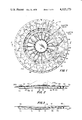
- FIG. 1 is a top plan view of the overall assembly of the disc array with a portion of the locator referencing ring broken away.
- FIG. 2 is a view in vertical cross section taken on the line 2--2 of FIG. 1 and showing the hub portion flexed upwardly.
- FIG. 3 is a view similar to FIG. 2 showing the hub portion flexed downwardly.
- FIG. 4 is a view in vertical cross section of the disc cuvette array positioned indexed in fixed relation substantially horizontally within the rotor which coacts with and rotates the array during an analysis run.
- FIG. 5 is a view in perspective of the disc array with its recesses and cuvettes aligned axially and radially and spaced from and above the supporting rotor in which it is adapted to fit in fixed alignment in centrifugation runs and also showing the coacting means on the frame of the analyzer with which the cuvette array is adapted for use and the vertically reciprocable frame mounted stop member used to index the rotor angularly aligned fixedly with the disc cuvette array.
- FIG. 6 is a plan view of a blown-up portion of the top outer array portion showing the opaque markings thereon in detail.
- FIG. 7 is a top plan view of a modified form of the cuvette array disc located within the rotor holder for use with which it is adapted with the identifying ring removed.
- FIG. 8 is a partial view in cross section of the dividing ramp wall taken on the lines 8-8 of FIG. 5 with the rotor holder removed.
- FIG. 9 is similar to FIG. 8, and shows an alternative embodiment having three compartments and two dividing ramp walls; it is a section of the array shown in FIG. 10.
- FIG. 10 is a plan view of an alternative array with holes replacing the slots.
- FIG. 11 is an enlarged plan view of the annulus of the array before integral fusion bonding.
- FIG. 12 is a plan view similar to FIG. 1 showing the entire locator ring in its run position.
- FIG. 13 is a perspective view of the cuvette array positioned above a shipping support and protective disc with which it is adapted to coact with the array notches angularly aligned with inner indentions found on the support.
- FIG. 14 is an enlarged plan view of a different embodiment in which there are no encoder rim slots.
- FIG. 15 is an enlarge plan view of the cuvette array of FIG. 12 having been displaced 90° from its position in FIG. 12, so that an unused set of cuvettes from the first run are usably identified for a second run.
- FIG. 16 is an enlarged plan view of a portion of a different embodiment wherein only one of the run encoder slots opposite the cuvette chambers is elongated, so that no indexing ring is required.
- the integral, disposable cuvette array being generally disc shaped, is designated in its entirety by numeral 10.
- the cuvette array is formed from a preferably optically transparent, flexible, plastic material.
- the plastic material from which the array is manufactured may be made as thin as possible, so long as the rotor holder for the disc will function in conjunction therewith to prevent the disc from becoming overly distorted or broken during the contrifugation run which is conducted for purposes of analysis. It is to be understood that the material of the array is sufficiently flexible so that some stretching thereof along radial lines would occur if no restraining means are utilized during the analytical centrifugation runs. As explained hereafter, this is prevented by a vertical wall of the rotor which is used as a rotatable carrier for the array during centrifugation. The overall strength and rigidity of the array is also determined and increased by the use of additional ridge lines or walls 17 which form a part or parts of the configurations described and disclosed in detail hereafter.
- the cuvette array has a first, fluid chamber part 12 which has a relatively horizontal hub member 14 from which radiate a series of cuvettes 15,15 in side-by-side relation to each other. Adjacent cuvettes are separated by wall members 17,17 each having an integral top wall 18, and side walls 19 and 20, the side wall 19 forming a portion of cuvette No. 4 (of a total number of 20 cuvettes in the array of FIG. 1) with the side wall 20 forming a portion of adjacent cuvette No. 5.
- the horizontal top wall 18 and the side walls 19 and 20 are integral and are shaped during a molding or die pressing forming process utilized to produce the part 12, this part having in each curvette 15 a bottom wall 23 with vertical radially extending integral slots 16,16 formed from the side (19 and 20) and top (18) walls and adding rigidity to the array.
- Each of the cuvettes 15,15 has an inner compartment 30 defined by two side walls shown at 19 and 20, there being positioned at each of the cuvette rear portions 21,21, generally vertical (inclined) hub inner walls 32,32 which are integrally united with the hub flat portion 34 14 and with the side walls 19,19 and 20,20 and with a thin bottom compartment wall 36 having generally horizontal surfaces, the upper surface being designated as 37, and the bottom surface as 38, each cuvette 15 having this bottom compartment wall 36.
- Compartment inner walls 32,32 integrally connect the hub flat portion 14 with the compartment 30, the walls 32,32 being inclined forwardly at their lower portions 35,35 in order to better direct fluid flow.
- a groove 40 Formed in a ring of generally circular shape during the molding operation completely around lower surfaces 23,23 of part 12, and positioned slightly radially outwardly of the center thereof, is a groove 40 which extends upwardly so as to form an inclined ramp wall 42,42, one for each compartment, and radially outward vertical outer walls 44,44, said groove adding rigidity to part 12.
- ramp walls 42,42 are inclined at an angle to the vertical. This angle of inclination generally will lie within the range of 45° to 60°.
- the ridge-like tops 45,45 of ramps 42,42 teminate in each of the cuvettes at a level so as to leave a clearance or passageway 48 between the tops 18 of each of the adjacent pair of side walls 19 and 20.
- each vertical wall 44,44 Radially outward from each vertical wall 44,44 is a second compartment or chamber 50 for each of the cuvettes, the radially inner or back walls of chambers 50,50 being formed by the walls 44,44.
- the radial side walls 52,52 for each second or outer chamber 50 of each cuvette 15 are formed as extensions of the radial lines of side walls 19 and 20.
- the side walls 52,52 are each curved reversely inwardly to form arcuate walls 54,54 which terminate in a substantially vertical end wall 56, one for each cuvette 15,15.
- a pocket or recess 62 On the outside of the semicircular portion 60 there is thus formed a pocket or recess 62, which has a width 64 at its outermost point which is slightly greater than the width at the midpoint of the recess, as shown at 66,66.
- Flat upper walls 68,68 are formed on each of the outer chambers 50,50, preferably by the clamping action of the forming dies while the cuvettes 15,15 are being depressed, or otherwise formed, in the molding operation.
- the pockets 62,62 are in direct communication with slots 16a formed by extension side wll 52,52.
- the end top surfaces 18a of each outer chamber dividing member are slightly higher than the top surfaces 18,18. As indicated by the downwardly directed portions 67,67, these elevated portions 18a continue radially inwardly past the tops 45,45 of ramp radial dividing means 42,42.
- rim portion 70 which forms the extreme outer annular portion of the member 12, rim 70 having the same elevation as the tops of walls 56, 52, and the radially outermost elevated portions of top walls 182.
- top walls 68,68 protrusions, or projections 72,72.
- these notches are utilized as accurate registration means, being geometrically fixed relative to the cuvette chambers, since they are spatially positioned in integral fixed relation thereto and are preferably integral therewith.
- this member 80 is a substantially horizontal annulus having a generally flat upper surface 82 and a generally flat lower surface 84 extending between a circular outer edge 86 and a circular inner edge 88.
- locating or registration means 90 for coaction with the registration projections 72 extending upwardly from member 12, these being preferably equal in number so that there are one or more sets of locating means on members 12 and 80 coacting together to fixedly position these members.
- Such locating means may consist of circular passages cut entirely through the thickness of the annulus 80, leaving an opening 90 which is of slightly greater diameter than the top of projection 72. A careful examination of these protrusions 72 will show that their vertical walls 75,75 (FIG.
- the annulus 80 are preferably tapered outwardly in the downward vertical direction so as to have a maximum outer diameter at the bottoms of these walls 75,75 thereof, which diameter is chosen so that it will bind frictionally with the openings 90,90 to fixedly position the annular member 80 relative to member 12.
- the annulus may have projections extending upwardly which will frictionally bind in coacting mating relation with the side walls 75,75 of the protrusions 72.
- the recesses 90 must be of sufficient diameter so that the lower surface 84 of the annulus 80 can be joined by fusion, or by other suitable, fluid sealing producing means, to the upper outer surface of member 12 formed by the thin annular ring of flange 70 and upper notch walls 68,68 in fluid sealing reation thereto.
- the annulus 80 will also be joined to the radially outward upper surface 18a of the cuvette division walls in fluid sealing relation thereto. Accordingly, the annulus 80 is geometrically positioned in fluid sealing relation with the outer portion of the individual cuvette outer chambers 50,50 and with the outermost portion of the inner cuvette chambers 30,30.
- annulus member 80 Formed in annulus member 80 at the inner edge 88 thereof is an annularly disposed series of radial slots 100, one for each cuvette.
- the slots are formed by removal of material from the annulus member 80 and are cut or otherwise formed so as to have their side walls 102 and 104 positioned a distance apart equal to that shown at 106,106, this distance preferably being equal for each of the cuvettes.
- Preferably their edges are outlined with an opaque paint 107 paint or the like to aid in visual identification of the slot.
- each of the slots 100,100 end in walls 110,110, one for each cuvette and thus leave openings 114,114, one for each cuvette, each of which provides a passage into its associated outer chamber 50 for insertion of a pipette, syringe, or the like for the deposition in the cuvettes' outer chambers of materials in the form of reactants, or reagents, or unknown samples, such as blood, in these outer compartments 50,50.
- the inner cuvette compartments 30,30 have the major radially innerportions of the slots 100,100 positioned thereover, so as to allow entrance into each inner chamber 30,30 of a pipette or other dispensing means for desposition therein of materials such as reagents or reactants which may vary from compartment to compartment in composition, depending upon the particular reaction or test desired.
- known reagents for a desired specific test are generally positioned within these inner compartments. They may be, if desired, dried or lyophilized, so as to form a soluble coating on at least the lower surfaces 36,36 of the individual cuvette inner chambers 30, 30; if this is done, then the disc need not have additional reagents added thereto prior to or during the analysis run, since either pure water or buffer solution, the latter being properly chosen for the specific desired test, may be added to the inner chambers 30,30, preferably at the sloping hub walls 32,32 to better direct the flow of the added diluent or dissolving fluid.
- the outer compartments 50,50 generally have the unknown sample, such as blook or other body fluid, added thereto in the proper amount. This sample addition may be made to as many cuvettes as are required to run the programmed tests.
- each of the inner cuvette chambers which are utilized may be the same for each cuvette 15,15 both as to amount and composition, if the same test is to be conducted in each cuvette. However, frequently a different test will be conducted in each cuvette which is used. In the latter case it is necessary of course, to add reagents of differing compositions and/or amounts to the inner chambers 30,30. Additionally, the amount of materials added may differ from cuvette to cuvette in a fixed relation so as to obtain dilution series results, as is well understood in the art.
- the combined volume of the fluids contained at rest in each cuvette i.e., the combination of the amount initially in any given inner chamber 30 and the amount in its aligned outer chamber 50 should, if possible, be known and may be the same for each cuvette, so that there will be elimination of variations in optical density readings taken through the optical path due to variance of the thickness of the vertical layer of mixed materials located against wall member 56.
- the outermost ring 120 of the annulus 80 is made opaque between the outer annulus edge 86 and a circular line designated as 122, located radially inwardly from edge 86 and from the cuvette outer walls 56,56.
- a notch 130 Spaced with one of its edges 124 radially aligned with the cuvette associated therewith is a notch 130 having a fixed width 126.
- Such notches are positioned radially around the annulus, each slot 130 having the same positioning relative to its cuvette, each notch 130.130 preferably having the same width 126,126 and being spaced geometrically fixedly relative to the remaining members of the disc array.
- One of these notches, as indicated at 134 in FIG. 7, may be longer in an inner radial direction than any of the others. This will produce transmission of a greater amount of light when positioned to intercept an encoder reading means. It therefore may be used as the beginning, or indexing notch, during rotation of the cuvette array while it is being centrifuged.
- This slot may be used to measure rotor speed, as well as signalling the start of a new rotation of the array.
- the notches 130 extend inwardly the same radial distance.
- a separate locator ring as described in more detail below, is utilized to establish one of the notches as an indexing notch.
- the other notches 130 Positioned substantially opposite the remaining cuvettes are the other notches 130 used for the formation of encoding pulses by transmission of light.
- a series of equally spaced smaller notches 140,140 each having smaller but preferably identical depths 142,142 and smaller but preferably identical widths 144,144,
- Each slot 140, 140 is positioned approximately aligned with the centerline of the dividing walls between the cuvettes, i.e., on a radial line with the center of top wall 18 and projection 72, for encoding purposes.
- this array has its notches or recesses 62 aligned with inward projections carried by a rotor 150, as shown in FIG. 5.
- the diameter between the side walls of this rotor will be only slightly larger than the maximum diameter of the cuvette array when at rest, so that the array may fit snugly therein.
- the cuvettes may tend to be stretched radially under the applied centrifugal force, but such stretching will be prevented by the contacting support of the end walls 56, 56 of the cuvettes 15,15 with the inner wall 159 of the rotatable carrier 150.
- the projections 152,152 extending inwardly also are adapted to snugly fit each corresponding outer wall notches or recesses 62,62 to provide resistance to radial stretching and to accurately position the cuvette array 12 radially with its intended carrier 150. This also serves to prevent relative radial and axial misalignment occurrence during the analytical centrifugal run.
- one of the cuvettes will be selected as the start or reference cuvette.
- it will be filled with water or buffer solution so that the optical density value of a fixed intensity, fixed length light path intercepted by the fluid vertical layer centrifugally held against its outer wall 56 will represent both the start of a rotation of 360°during centrifugal test running and also will give a reading which sets the maximum or 100 percent light transmission characteristic of the cuvette array and is used as a reference.
- the cuvettes in the array structures 10 of the invention form a round, generally disc shaped array of horizontally uniformly disposed, integral units which are disclosed in detail above and hereafter, and are generally utilized in so-called fast analyzers.
- the necessary samples, or standars which coact, as by chemical reaction, with a chosen set of one or more reactants or additives, there generally being a much greater volume of the fluid of the chosen set than that of the sample, in order so as to produce the desired change in opacity by reaction or pH adjustment or other appropriate means generally designated as a diagnostic analytical test.
- the opacity is preferably quantified, so that users of the cuvette array and its associated operational mechanisms and control structures and circuitry therefor will receive, preferably printed automatically on a cuvette associated card by a small printer, highly accurate and reliable information upon which to base the prognosis of a physical condition of a patient, for example, or to accurately monitor the environmental effects, or to determine the maximal output decision, or are provided with sufficient information to enable them to display a profile of the analog of the individual cuvettes, thus determining the rate and direction of the reaction.
- the outer annular series of chambers 50,50 will be loaded with, for example, ten microliters of serum or the like, while the inner chambers 30,30 are loaded with a sufficient amount of reactants and a diluent therefor such as distilled water, these mixed materials being added by manual or automatic pipetting and in a much greater amount, e.g., 170 microliters. It will be understood that these amounts are not great enough to cause the fluids in the cuvette chambers to overflow when the cuvette array is stationary. There is little possibility of leakage between the two main members 12 and 80 or at any joint, particularly because the fusion bonded joint which unites the sheet member 12 to the flat annulus 80 prevents leakage.
- the liquid contained within the inner chambers is forced outwardly at a relatively initially high rate of speed due to the rapid rotation of the support means, or rotor carrier 150 with which the cuvette array 10 is adapted to be functionally fixedly associated, so far as spatial relations are concerned.
- the rotor and the cuvette array may, for example, during an initial mixing cycle, have a speed of between 2,000 and 5000 rpm, preferably between 4,000 and 5,000 rpm.
- This centrifugal pressure in the generally radial direction causes the fluids in chambers 15,15 to climb over the ramp portion 42 of annular dividing wall 40 and to pass through the passageway 48 defined by the lower part or surface of annulus 80 and the side walls 19 and 20 and the bottom wall 23 of each cuvette.
- the opaque encoder outer portion 20 has positioned thereon as encoding indexing and synchronization means two sets of slots 130 and 140 described above. Therefore, as the array rotates, each of the slots 140 will transmit light for a time determined by the width of the slot, which is giometrically, spatially related to its adjacent cuvette, and by the rotary speed of the cuvette array. The value of these uniform light transmissions is determined by photocells or photodiodes located adjacent the slots. This gives a series of pulses, each substantially uniform, while the value of the opaque area forms the dark current read value which feeds a cuvette analyzer. Hence, the dark current level reference for each cuvette is automatically adjusted by the size and geometric positioning to produce slot pulses which compensate for both transient and steady background errors just prior to the adjacent cuvette absorbance reading.
- the cuvette array will generally be slowed to a rotary speed of about 600 rpm.
- the cuvette arrays of the present invention have vertical outer walls which closely fit, but do not frictionally fit, at rest, the inner vertical walls of the rotor.
- the projections 152 of the rotor 150 may be formed from a series of angularly related planar surfaces such as shown at 154,155,156,157,158 extending inward from vertical circular wall 159.
- an index stop member 161 Positioned on the vertical outside wall 160 is an index stop member 161, coacting with a vertically adjustable stop member 162 connected to a fixed reference frame 163 by connection means 164 to stop the rotor from rotation when it and the cuvette array are to be initially aligned, so that annular optical openings 165,165 match the optical areas of the array.
- the slight play which is present when the cuvette array is first inserted into the rotor carrier produces no error because, the cuvette array and its rotor support, once mated and assembled, are fixedly held by a vertical clamping force (by means not shown) applied to the array to prevent relative motion between array and rotor.
- the centrifugal force also causes a slight stretching of the thin plastic, flexible material of the array, radially and in a curved radial path, further preventing error by relative shift.
- the rotor carrier 150 for the cuvette arrays of the present invention has a flat heating annulus 190 on its lower surface 192.
- the rotor is preferably formed of aluminum or other substantially rigid heat conducting material, so that it forms a thermal mass for fine, instantaneous heat adjustment of the cuvette array, by measurement with a transistor or the like 194 at or near the center 195 of the rotor.
- Electric lead lines may project downwardly into a rotor drive shaft equipped with slip rings.
- the upper rotor surface 196 is substantially flat so as to produce maximum contact with all of the lower wall or bottom wall portions of the cuvette array. Since the disc array is thin and flexible, its bottom portions 23,23 will mate with the upper wall of the rotor.
- the array may be formed of any material inert to the materials to be contained therein, such materials as polyvinyl or polyvinyledene polymers or terphthalates, etc., preferably having a light transmission of at least 35% at 3400 Angstroms. Since most systems use the first cuvette as a measurement of maximum transmission with either no water, or distilled water or the diluent being placed in this cuvette, a similar use may be made of the second cuvette.
- the geometry of slots 130 may take the form of FIGS. 7 and 16 wherein slot 134 is longer and/or wider than the other slots in the sync set.
- the flange 120 is unslotted, as shown in FIG. 14.
- the customer may be provided with a punch to produce the slots desired.
- FIGS. 1, 7 and 11 The most preferred and versatile embodiment, however, is that shown in FIGS. 1, 7 and 11, wherein all of the pulse slots 130 initially have the identical width, radial spacing and length. This produces, especially if combined with an indexing upwardly projection between each adjacent pairs of cuvettes, a means whereby any cuvette can be made the number one cuvette which generates a speed reset pulse once for ech rotation.
- a separate opaque indexing or locator ring, or annulus 200 is provided. It has windows 202,202 formed therein, preferably of rectangular shape to allow an unhindered optical path through the measured area of the outer portion of each cuvette.
- the ring may be seated removably over the array with the start cycle arrow 205 thereof pointing to any cuvette by relatively rotating the ring and dropping it so that the projections 72 pass through holes or passages 204,204 or other mating means of which there may be one opposite each wall between adjacent cuvettes, or the selectivity may be reduced as described above with pairs of registering passages coacting with pairs of projections.
- the ring slot 208 opposite the arrow does not cover the inner parts of selected slot 130, but the radially inner ends of all the rest of slots 130 are covered by the outer portion 210 of the ring, so that only one slot is longer than the rest.
- the arrays even if plastic, have been thick and expensive, and usually made by fine precision machining. Hence, they must be reused, so that if only, e.g., three cuvettes thereof are used, the entire array must be carefully washed, usually repeatedly, before reuse. This requires an expensive and space-consuming wash station and lengthens the overall complete analysis cycle by a large factor.
- the present invention allows ready array reuse, using the cuvettes not previously utilized in the first run. This is readily apparent from FIGS. 1, 12 and 15.
- the first run may use cuvettes 1 and 2 as references, with tests in only cuvettes 3 and 4.
- the annular locator or indexing ring 200 is lifted off the array and rotated relative thereto before being repositioned.
- the locator ring 200 is positioned with the initial cuvette slot 208 registered with cuvette 5.
- Ring 200 has indicia 206 and array 10 has indicia 207 to aid in cuvette location.
- the new starting cell need not be the first adjacent cuvette not previously used; it may be any unused cell.
- annulus 12 instead of using reagent adding slots which communicate with both inner and outer chambers of the radially disposed cuvettes, there may be provided in integral annulus 12 a series of holes 220 as shown in FIG. 11 to communicate with outer chambers 50. Also, more than one annular dividing wall may be used.
- FIGS. 9 and 10 show this structure with annular slot 240, ramp 242, top 245 and passage 248 serving as the second series of dividing means. Also shown are radial reinforcing ribs 250.
- the integral array is formed during molding with more material placed near the center than the outer edge so that the flexible array has a built-in bias pressure.
- downward force exerted at the flat hub portions 14 will force the hub down if the array is seated in a rotor carrier or is clamped at the annulus.
- a cap 270 which holds it against the rotor more firmly, since the hub is trying to push itself down and thus enhances the thermal contact.
- the cap 270 used for this exertion of strength will also serve as a sealing member, since the cap (as shown in dotted lines in FIG. 20 will cover from the hub center past the ends 110 of these slots without causing appreciable deformation of the upper array structure.
- the cuvette array is shown in FIG 13 above a shipping support 300.
- the notches 62 in the array align with indentations 302 in the support.
- the array is intended especially for use in systems of the above-listed applications, but may be adapted to most other centrifugal fast analyzers.
Landscapes
- Physics & Mathematics (AREA)
- Health & Medical Sciences (AREA)
- Life Sciences & Earth Sciences (AREA)
- Chemical & Material Sciences (AREA)
- Analytical Chemistry (AREA)
- Biochemistry (AREA)
- General Health & Medical Sciences (AREA)
- General Physics & Mathematics (AREA)
- Immunology (AREA)
- Pathology (AREA)
- Optical Measuring Cells (AREA)
- Centrifugal Separators (AREA)
Priority Applications (15)
| Application Number | Priority Date | Filing Date | Title |
|---|---|---|---|
| US05/694,303 US4123173A (en) | 1976-06-09 | 1976-06-09 | Rotatable flexible cuvette arrays |
| CA280,129A CA1097942A (en) | 1976-06-09 | 1977-06-08 | Disposable cuvette array |
| NL7706292A NL7706292A (nl) | 1976-06-09 | 1977-06-08 | Kommenreeks. |
| CH705977A CH615755A5 (en:Method) | 1976-06-09 | 1977-06-08 | |
| ES459635A ES459635A1 (es) | 1976-06-09 | 1977-06-08 | Perfeccionamientos introducidos en una disposicion de cube- tas para analizadores centrifugos. |
| GB2411577A GB1565561A (en) | 1976-06-09 | 1977-06-09 | Disposable cuvette array |
| JP6735677A JPS5316968A (en) | 1976-06-09 | 1977-06-09 | Assembly dish |
| BE178345A BE855559A (fr) | 1976-06-09 | 1977-06-09 | Cuvette compartimentee a jeter apres usage |
| AU26003/77A AU510059B2 (en) | 1976-06-09 | 1977-06-09 | Disposable cuvette array |
| SE7706742A SE7706742L (sv) | 1976-06-09 | 1977-06-09 | Kuvettanordning |
| FR7717672A FR2354140A1 (fr) | 1976-06-09 | 1977-06-09 | Ensemble de cuvettes a jeter apres usage |
| IT2454077A IT1062253B (it) | 1976-06-09 | 1977-06-09 | Gruppo a provette a perdere |
| DE19772726219 DE2726219C2 (de) | 1976-06-09 | 1977-06-10 | Rotor für einen optischen Schnellanalysator nach dem Drehküvettentyp |
| AT411977A AT367908B (de) | 1976-06-09 | 1977-06-10 | Kuevettenanordnung |
| ES1977231828U ES231828Y (es) | 1976-06-09 | 1977-11-04 | Una disposicion de cubetas para analizadores centrifugos. |
Applications Claiming Priority (1)
| Application Number | Priority Date | Filing Date | Title |
|---|---|---|---|
| US05/694,303 US4123173A (en) | 1976-06-09 | 1976-06-09 | Rotatable flexible cuvette arrays |
Publications (1)
| Publication Number | Publication Date |
|---|---|
| US4123173A true US4123173A (en) | 1978-10-31 |
Family
ID=24788258
Family Applications (1)
| Application Number | Title | Priority Date | Filing Date |
|---|---|---|---|
| US05/694,303 Expired - Lifetime US4123173A (en) | 1976-06-09 | 1976-06-09 | Rotatable flexible cuvette arrays |
Country Status (3)
| Country | Link |
|---|---|
| US (1) | US4123173A (en:Method) |
| ES (2) | ES459635A1 (en:Method) |
| FR (1) | FR2354140A1 (en:Method) |
Cited By (63)
| Publication number | Priority date | Publication date | Assignee | Title |
|---|---|---|---|---|
| US4226531A (en) * | 1977-08-29 | 1980-10-07 | Instrumentation Laboratory Inc. | Disposable multi-cuvette rotor |
| US4298570A (en) * | 1980-04-18 | 1981-11-03 | Beckman Instruments, Inc. | Tray section for automated sample handling apparatus |
| US4314970A (en) * | 1980-08-27 | 1982-02-09 | Instrumentation Laboratory Inc. | Analysis system |
| US4316872A (en) * | 1979-05-10 | 1982-02-23 | Hoffmann-La Roche Inc. | Ring of cells for analytical devices |
| WO1982003459A1 (en) * | 1981-04-02 | 1982-10-14 | Baxter Travenol Lab | Centrifugal analyzer |
| US4373812A (en) * | 1981-03-25 | 1983-02-15 | Instrumentation Laboratory Inc. | Cuvette assembly |
| US4470954A (en) * | 1983-06-13 | 1984-09-11 | Chiknas Steven G | Rotor or carrier for centrifugal analyzer and bead washer |
| USD277891S (en) | 1982-09-13 | 1985-03-05 | Technicon Instruments Corporation | Cuvette tray |
| US4566790A (en) * | 1983-04-15 | 1986-01-28 | Electro-Nucleonics, Inc. | Cuvette array |
| US4580897A (en) * | 1984-05-31 | 1986-04-08 | Allied Corporation | Centrifugal analyzer rotors |
| US4580898A (en) * | 1984-05-31 | 1986-04-08 | Allied Corporation | Analytical system |
| US4580896A (en) * | 1983-11-07 | 1986-04-08 | Allied Corporation | Multicuvette centrifugal analyzer rotor with annular recessed optical window channel |
| USD288124S (en) | 1984-05-31 | 1987-02-03 | Fisher Scientific Company | Centrifugal analyzer rotor |
| US4735502A (en) * | 1986-11-21 | 1988-04-05 | Medatron, Inc. | Reusable plastic cuvette array |
| US4756883A (en) * | 1986-09-16 | 1988-07-12 | E. I. Du Pont De Nemours And Company | Analysis device |
| US4762683A (en) * | 1986-09-16 | 1988-08-09 | E. I. Du Pont De Nemours And Company | Analysis device |
| US4902479A (en) * | 1983-11-07 | 1990-02-20 | Fisher Scientific Company | Centrifugal analyzer rotor |
| US4938927A (en) * | 1982-01-08 | 1990-07-03 | Environmental Diagnostics, Inc. | Rotary fluid manipulator |
| US4951512A (en) * | 1988-06-23 | 1990-08-28 | Baxter International Inc. | System for providing access to sealed containers |
| US5071625A (en) * | 1985-02-27 | 1991-12-10 | Fisher Scientific Company | Cuvette handling |
| US5141875A (en) * | 1982-01-08 | 1992-08-25 | Environmental Diagnostics, Inc. | Rotary fluid manipulator |
| US5220161A (en) * | 1992-03-23 | 1993-06-15 | Miles Inc. | Position-sensing and motion verification assembly for a motor-driven mechanism |
| US5246665A (en) * | 1991-06-03 | 1993-09-21 | Abbott Laboratories | Heat and air flow control for assay carrier |
| US5292484A (en) * | 1992-07-16 | 1994-03-08 | Spectrum Systems, Inc. | Cuvette and cuvette cartridge for a chemical analyzer |
| US5315887A (en) * | 1988-06-23 | 1994-05-31 | Baxter Diagnostics Inc. | Multiport equalization probe |
| US5413000A (en) * | 1988-06-23 | 1995-05-09 | Dade International Inc. | Assembly for removing waste from closed sample containers |
| US5462715A (en) * | 1992-04-06 | 1995-10-31 | Hoffmann-La Roche Inc. | Cuvette conveyor |
| US5496520A (en) * | 1982-01-08 | 1996-03-05 | Kelton; Arden A. | Rotary fluid manipulator |
| US5622871A (en) * | 1987-04-27 | 1997-04-22 | Unilever Patent Holdings B.V. | Capillary immunoassay and device therefor comprising mobilizable particulate labelled reagents |
| EP1046916A1 (en) * | 1999-04-20 | 2000-10-25 | INSTRUMENTATION LABORATORY S.p.A. | Photometric analysis apparatus with automatic loading |
| US6187598B1 (en) | 1987-04-27 | 2001-02-13 | Conopco Inc. | Capillary immunoassay and device therefor comprising mobilizable particulate labelled reagents |
| US6352862B1 (en) | 1989-02-17 | 2002-03-05 | Unilever Patent Holdings B.V. | Analytical test device for imuno assays and methods of using same |
| WO2002086465A1 (en) * | 2001-04-24 | 2002-10-31 | Dade Microscan Inc. | Identification test device in a random access microbiological analyzer |
| US20030017613A1 (en) * | 2001-07-13 | 2003-01-23 | Jakubowicz Raymond Francis | Tandem incubator for clinical analyzer |
| US20030064872A1 (en) * | 2001-07-20 | 2003-04-03 | Worthington Mark Oscar | Optical analysis disc and related drive assembly for performing interactive centrifugation |
| US20030124506A1 (en) * | 2001-12-28 | 2003-07-03 | 3M Innovative Properties Company | Modular systems and methods for using sample processing devices |
| US20050185177A1 (en) * | 2004-02-23 | 2005-08-25 | Moran Donald J.Jr. | Determining an analyte by multiple measurements through a cuvette |
| US20050185176A1 (en) * | 2004-02-23 | 2005-08-25 | Moran Donald J.Jr. | Determining an analyte by multiple measurements through a cuvette |
| US20070007270A1 (en) * | 2005-07-05 | 2007-01-11 | 3M Innovative Properties Company | Modular sample processing apparatus kits and modules |
| US20070253866A1 (en) * | 2004-07-23 | 2007-11-01 | Alain Rousseau | Multidisciplinary Automatic Analyzer for in Vitro Diagnosis |
| USD564667S1 (en) | 2005-07-05 | 2008-03-18 | 3M Innovative Properties Company | Rotatable sample processing disk |
| US20090219527A1 (en) * | 2008-02-29 | 2009-09-03 | Alan Keith Hulme | Apparatus and Method for Adapting Conventional Cuvettes for Use in a Vertical Light Beam Spectrophotometer |
| US7754474B2 (en) | 2005-07-05 | 2010-07-13 | 3M Innovative Properties Company | Sample processing device compression systems and methods |
| US7763210B2 (en) | 2005-07-05 | 2010-07-27 | 3M Innovative Properties Company | Compliant microfluidic sample processing disks |
| USD638550S1 (en) | 2009-11-13 | 2011-05-24 | 3M Innovative Properties Company | Sample processing disk cover |
| USD638951S1 (en) | 2009-11-13 | 2011-05-31 | 3M Innovative Properties Company | Sample processing disk cover |
| FR2955268A1 (fr) * | 2010-01-20 | 2011-07-22 | Apex Biosolutions | Dispositif de repartition, notamment pour un echantillon biologique |
| US20110194114A1 (en) * | 2010-02-05 | 2011-08-11 | Samsung Electronics Co., Ltd. | Light absorbance measurement method and apparatus |
| USD667561S1 (en) | 2009-11-13 | 2012-09-18 | 3M Innovative Properties Company | Sample processing disk cover |
| USD672467S1 (en) | 2011-05-18 | 2012-12-11 | 3M Innovative Properties Company | Rotatable sample processing disk |
| US20140139832A1 (en) * | 2012-11-16 | 2014-05-22 | Honeywell International Inc. | Rotating optics for multiple cuvette array |
| US8834792B2 (en) | 2009-11-13 | 2014-09-16 | 3M Innovative Properties Company | Systems for processing sample processing devices |
| US8931331B2 (en) | 2011-05-18 | 2015-01-13 | 3M Innovative Properties Company | Systems and methods for volumetric metering on a sample processing device |
| US9036153B1 (en) * | 2013-08-30 | 2015-05-19 | Google Inc. | Instrument for reflectivity measurement |
| US9067205B2 (en) | 2011-05-18 | 2015-06-30 | 3M Innovative Properties Company | Systems and methods for valving on a sample processing device |
| US9168523B2 (en) | 2011-05-18 | 2015-10-27 | 3M Innovative Properties Company | Systems and methods for detecting the presence of a selected volume of material in a sample processing device |
| US9470633B2 (en) | 2014-02-14 | 2016-10-18 | Google Inc. | Method, apparatus and system for transmittance measurement |
| US20170095783A1 (en) * | 2015-10-01 | 2017-04-06 | Micro Matic Usa, Llc | Pulsed gas mixing apparatus |
| USD810959S1 (en) * | 2015-09-29 | 2018-02-20 | Bd Kiestra B.V. | Cuvette tray |
| USD839448S1 (en) | 2015-09-29 | 2019-01-29 | Bd Kiestra B.V. | Cuvette |
| US10545162B2 (en) * | 2016-07-21 | 2020-01-28 | Siemens Healthcare Diagnostics Inc. | Alignment system for cuvette segments on clinical chemistry instruments |
| WO2020112801A1 (en) * | 2018-11-28 | 2020-06-04 | V&P Scientific, Inc. | Spinning vessel systems and methods for mixing, suspending particulates, aliquoting, washing magnetic beads, and concentrating analytes |
| US20240110868A1 (en) * | 2021-09-06 | 2024-04-04 | The Wave Talk, Inc. | Device for water examination |
Citations (13)
| Publication number | Priority date | Publication date | Assignee | Title |
|---|---|---|---|---|
| US3441383A (en) * | 1966-10-26 | 1969-04-29 | Francis C Moore | Multiple cup tray |
| US3532470A (en) * | 1968-01-22 | 1970-10-06 | Beckman Instruments Inc | Sample holder with centrifugation means |
| US3555284A (en) * | 1968-12-18 | 1971-01-12 | Norman G Anderson | Multistation, single channel analytical photometer and method of use |
| US3679129A (en) * | 1970-09-08 | 1972-07-25 | Technicon Instr | Blood sample tray apparatus |
| US3759666A (en) * | 1971-12-09 | 1973-09-18 | Union Carbide Corp | Analytical process |
| US3804533A (en) * | 1972-11-29 | 1974-04-16 | Atomic Energy Commission | Rotor for fluorometric measurements in fast analyzer of rotary |
| US3811780A (en) * | 1971-04-12 | 1974-05-21 | Abbott Lab | Chemical analysis cuvette |
| US3829223A (en) * | 1973-07-20 | 1974-08-13 | Atomic Energy Commission | Mixing rotor for fast analyzer of rotary cuvette type with means for enhancing the mixing of sample and reagent liquids |
| US3854508A (en) * | 1973-04-13 | 1974-12-17 | Atomic Energy Commission | Automated sample-reagent loader |
| US3856470A (en) * | 1973-01-10 | 1974-12-24 | Baxter Laboratories Inc | Rotor apparatus |
| US3873217A (en) * | 1973-07-24 | 1975-03-25 | Atomic Energy Commission | Simplified rotor for fast analyzer of rotary cuvette type |
| US3890101A (en) * | 1974-02-15 | 1975-06-17 | Us Energy | Collection ring for use in multiple-sample blood fractionation centrifugal rotors |
| US3986534A (en) * | 1974-07-30 | 1976-10-19 | Intertechnique S.A. | Device for measuring and dispensing fractionary volumes of liquid samples |
Family Cites Families (2)
| Publication number | Priority date | Publication date | Assignee | Title |
|---|---|---|---|---|
| BE791935A (fr) * | 1971-11-30 | 1973-03-16 | Atomic Energy Commission | Disque chargeur et de transfert pour analyseur photometrique rotatif a cuvettes |
| US3798459A (en) * | 1972-10-06 | 1974-03-19 | Atomic Energy Commission | Compact dynamic multistation photometer utilizing disposable cuvette rotor |
-
1976
- 1976-06-09 US US05/694,303 patent/US4123173A/en not_active Expired - Lifetime
-
1977
- 1977-06-08 ES ES459635A patent/ES459635A1/es not_active Expired
- 1977-06-09 FR FR7717672A patent/FR2354140A1/fr active Granted
- 1977-11-04 ES ES1977231828U patent/ES231828Y/es not_active Expired
Patent Citations (13)
| Publication number | Priority date | Publication date | Assignee | Title |
|---|---|---|---|---|
| US3441383A (en) * | 1966-10-26 | 1969-04-29 | Francis C Moore | Multiple cup tray |
| US3532470A (en) * | 1968-01-22 | 1970-10-06 | Beckman Instruments Inc | Sample holder with centrifugation means |
| US3555284A (en) * | 1968-12-18 | 1971-01-12 | Norman G Anderson | Multistation, single channel analytical photometer and method of use |
| US3679129A (en) * | 1970-09-08 | 1972-07-25 | Technicon Instr | Blood sample tray apparatus |
| US3811780A (en) * | 1971-04-12 | 1974-05-21 | Abbott Lab | Chemical analysis cuvette |
| US3759666A (en) * | 1971-12-09 | 1973-09-18 | Union Carbide Corp | Analytical process |
| US3804533A (en) * | 1972-11-29 | 1974-04-16 | Atomic Energy Commission | Rotor for fluorometric measurements in fast analyzer of rotary |
| US3856470A (en) * | 1973-01-10 | 1974-12-24 | Baxter Laboratories Inc | Rotor apparatus |
| US3854508A (en) * | 1973-04-13 | 1974-12-17 | Atomic Energy Commission | Automated sample-reagent loader |
| US3829223A (en) * | 1973-07-20 | 1974-08-13 | Atomic Energy Commission | Mixing rotor for fast analyzer of rotary cuvette type with means for enhancing the mixing of sample and reagent liquids |
| US3873217A (en) * | 1973-07-24 | 1975-03-25 | Atomic Energy Commission | Simplified rotor for fast analyzer of rotary cuvette type |
| US3890101A (en) * | 1974-02-15 | 1975-06-17 | Us Energy | Collection ring for use in multiple-sample blood fractionation centrifugal rotors |
| US3986534A (en) * | 1974-07-30 | 1976-10-19 | Intertechnique S.A. | Device for measuring and dispensing fractionary volumes of liquid samples |
Cited By (103)
| Publication number | Priority date | Publication date | Assignee | Title |
|---|---|---|---|---|
| US6228660B1 (en) | 1908-04-27 | 2001-05-08 | Conopco Inc. | Capillary immunoassay and device therefor comprising mobilizable particulate labelled reagents |
| US4226531A (en) * | 1977-08-29 | 1980-10-07 | Instrumentation Laboratory Inc. | Disposable multi-cuvette rotor |
| US4316872A (en) * | 1979-05-10 | 1982-02-23 | Hoffmann-La Roche Inc. | Ring of cells for analytical devices |
| US4298570A (en) * | 1980-04-18 | 1981-11-03 | Beckman Instruments, Inc. | Tray section for automated sample handling apparatus |
| US4314970A (en) * | 1980-08-27 | 1982-02-09 | Instrumentation Laboratory Inc. | Analysis system |
| US4373812A (en) * | 1981-03-25 | 1983-02-15 | Instrumentation Laboratory Inc. | Cuvette assembly |
| WO1982003459A1 (en) * | 1981-04-02 | 1982-10-14 | Baxter Travenol Lab | Centrifugal analyzer |
| US4360360A (en) * | 1981-04-02 | 1982-11-23 | Baxter Travenol Laboratories, Inc. | Centrifugal analyzer |
| US5141875A (en) * | 1982-01-08 | 1992-08-25 | Environmental Diagnostics, Inc. | Rotary fluid manipulator |
| US4938927A (en) * | 1982-01-08 | 1990-07-03 | Environmental Diagnostics, Inc. | Rotary fluid manipulator |
| US5496520A (en) * | 1982-01-08 | 1996-03-05 | Kelton; Arden A. | Rotary fluid manipulator |
| USD277891S (en) | 1982-09-13 | 1985-03-05 | Technicon Instruments Corporation | Cuvette tray |
| US4566790A (en) * | 1983-04-15 | 1986-01-28 | Electro-Nucleonics, Inc. | Cuvette array |
| US4470954A (en) * | 1983-06-13 | 1984-09-11 | Chiknas Steven G | Rotor or carrier for centrifugal analyzer and bead washer |
| US4580896A (en) * | 1983-11-07 | 1986-04-08 | Allied Corporation | Multicuvette centrifugal analyzer rotor with annular recessed optical window channel |
| US4902479A (en) * | 1983-11-07 | 1990-02-20 | Fisher Scientific Company | Centrifugal analyzer rotor |
| EP0169306A3 (en) * | 1984-05-31 | 1987-06-16 | Allied Corporation | Multicuvette rotor for use in a centrifugal analyzer |
| USD288124S (en) | 1984-05-31 | 1987-02-03 | Fisher Scientific Company | Centrifugal analyzer rotor |
| US4580898A (en) * | 1984-05-31 | 1986-04-08 | Allied Corporation | Analytical system |
| US4580897A (en) * | 1984-05-31 | 1986-04-08 | Allied Corporation | Centrifugal analyzer rotors |
| US5071625A (en) * | 1985-02-27 | 1991-12-10 | Fisher Scientific Company | Cuvette handling |
| US4762683A (en) * | 1986-09-16 | 1988-08-09 | E. I. Du Pont De Nemours And Company | Analysis device |
| US4756883A (en) * | 1986-09-16 | 1988-07-12 | E. I. Du Pont De Nemours And Company | Analysis device |
| US4735502A (en) * | 1986-11-21 | 1988-04-05 | Medatron, Inc. | Reusable plastic cuvette array |
| US7109042B2 (en) | 1987-04-27 | 2006-09-19 | Inverness Medical Switzerland Gmbh | Assays |
| US6818455B2 (en) | 1987-04-27 | 2004-11-16 | Inverness Medical Switzerland Gmbh | Capillary immunoassay and device therefor comprising mobilizable particulate labelled reagents |
| US6187598B1 (en) | 1987-04-27 | 2001-02-13 | Conopco Inc. | Capillary immunoassay and device therefor comprising mobilizable particulate labelled reagents |
| US5656503A (en) * | 1987-04-27 | 1997-08-12 | Unilever Patent Holdings B.V. | Test device for detecting analytes in biological samples |
| US5622871A (en) * | 1987-04-27 | 1997-04-22 | Unilever Patent Holdings B.V. | Capillary immunoassay and device therefor comprising mobilizable particulate labelled reagents |
| US5413000A (en) * | 1988-06-23 | 1995-05-09 | Dade International Inc. | Assembly for removing waste from closed sample containers |
| US5315887A (en) * | 1988-06-23 | 1994-05-31 | Baxter Diagnostics Inc. | Multiport equalization probe |
| US4951512A (en) * | 1988-06-23 | 1990-08-28 | Baxter International Inc. | System for providing access to sealed containers |
| US7384796B2 (en) | 1989-02-17 | 2008-06-10 | Inverness Medical Switzerland Gmbh | Assays |
| US6352862B1 (en) | 1989-02-17 | 2002-03-05 | Unilever Patent Holdings B.V. | Analytical test device for imuno assays and methods of using same |
| US7238537B2 (en) | 1989-02-17 | 2007-07-03 | Inverness Medical Switzerland Gmbh | Assays |
| US7407813B2 (en) | 1989-02-17 | 2008-08-05 | Inverness Medical Switzerland Gmbh | Assays |
| US5246665A (en) * | 1991-06-03 | 1993-09-21 | Abbott Laboratories | Heat and air flow control for assay carrier |
| US5220161A (en) * | 1992-03-23 | 1993-06-15 | Miles Inc. | Position-sensing and motion verification assembly for a motor-driven mechanism |
| US5462715A (en) * | 1992-04-06 | 1995-10-31 | Hoffmann-La Roche Inc. | Cuvette conveyor |
| US5292484A (en) * | 1992-07-16 | 1994-03-08 | Spectrum Systems, Inc. | Cuvette and cuvette cartridge for a chemical analyzer |
| EP1046916A1 (en) * | 1999-04-20 | 2000-10-25 | INSTRUMENTATION LABORATORY S.p.A. | Photometric analysis apparatus with automatic loading |
| US7256046B2 (en) * | 1999-04-20 | 2007-08-14 | Instrumentation Laboratory S.P.A. | Method of operating a photometric analysis apparatus |
| US20040082073A1 (en) * | 1999-04-20 | 2004-04-29 | Luigi Nebuloni | Method of operating a photometric analysis apparatus |
| US6653122B2 (en) | 2001-04-24 | 2003-11-25 | Dade Microscan Inc. | Indentification test device in a random access microbiological analyzer |
| WO2002086465A1 (en) * | 2001-04-24 | 2002-10-31 | Dade Microscan Inc. | Identification test device in a random access microbiological analyzer |
| US20030017613A1 (en) * | 2001-07-13 | 2003-01-23 | Jakubowicz Raymond Francis | Tandem incubator for clinical analyzer |
| US7312084B2 (en) | 2001-07-13 | 2007-12-25 | Ortho-Clinical Diagnostics, Inc. | Tandem incubator for clinical analyzer |
| US20030064872A1 (en) * | 2001-07-20 | 2003-04-03 | Worthington Mark Oscar | Optical analysis disc and related drive assembly for performing interactive centrifugation |
| US8003051B2 (en) | 2001-12-28 | 2011-08-23 | 3M Innovative Properties Company | Thermal structure for sample processing systems |
| US7569186B2 (en) | 2001-12-28 | 2009-08-04 | 3M Innovative Properties Company | Systems for using sample processing devices |
| US6889468B2 (en) * | 2001-12-28 | 2005-05-10 | 3M Innovative Properties Company | Modular systems and methods for using sample processing devices |
| US20030124506A1 (en) * | 2001-12-28 | 2003-07-03 | 3M Innovative Properties Company | Modular systems and methods for using sample processing devices |
| US7307718B2 (en) | 2004-02-23 | 2007-12-11 | Ortho-Clinical Diagnostics, Inc. | Determining an analyte by multiple measurements through a cuvette |
| US20050185176A1 (en) * | 2004-02-23 | 2005-08-25 | Moran Donald J.Jr. | Determining an analyte by multiple measurements through a cuvette |
| US7764372B2 (en) | 2004-02-23 | 2010-07-27 | Moran Jr Donald James | Determining an analyte by multiple measurements through a cuvette |
| US20050185177A1 (en) * | 2004-02-23 | 2005-08-25 | Moran Donald J.Jr. | Determining an analyte by multiple measurements through a cuvette |
| US20090192744A1 (en) * | 2004-02-23 | 2009-07-30 | Moran Jr Donald James | Determining an analyte by multiple measurements through a cuvette |
| US20100247385A1 (en) * | 2004-07-23 | 2010-09-30 | Biocode Hycel France Sa | Multidisciplinary automatic analyzer for in vitro diagnosis |
| US20070253866A1 (en) * | 2004-07-23 | 2007-11-01 | Alain Rousseau | Multidisciplinary Automatic Analyzer for in Vitro Diagnosis |
| US7998432B2 (en) * | 2004-07-23 | 2011-08-16 | Immunodiagnostic System France | Multidisciplinary automatic analyzer for in vitro diagnosis |
| US7943100B2 (en) | 2004-07-23 | 2011-05-17 | Immunodiagnostic System France | Cuvette for in vitro diagnosis |
| AU2005276346B2 (en) * | 2004-07-23 | 2011-02-24 | Immunodiagnostic System France | Multidisciplinary automatic analyser for in vitro diagnosis |
| US7323660B2 (en) | 2005-07-05 | 2008-01-29 | 3M Innovative Properties Company | Modular sample processing apparatus kits and modules |
| US7767937B2 (en) | 2005-07-05 | 2010-08-03 | 3M Innovative Properties Company | Modular sample processing kits and modules |
| US7763210B2 (en) | 2005-07-05 | 2010-07-27 | 3M Innovative Properties Company | Compliant microfluidic sample processing disks |
| US7754474B2 (en) | 2005-07-05 | 2010-07-13 | 3M Innovative Properties Company | Sample processing device compression systems and methods |
| US20070007270A1 (en) * | 2005-07-05 | 2007-01-11 | 3M Innovative Properties Company | Modular sample processing apparatus kits and modules |
| US8092759B2 (en) | 2005-07-05 | 2012-01-10 | 3M Innovative Properties Company | Compliant microfluidic sample processing device |
| US8080409B2 (en) | 2005-07-05 | 2011-12-20 | 3M Innovative Properties Company | Sample processing device compression systems and methods |
| USD564667S1 (en) | 2005-07-05 | 2008-03-18 | 3M Innovative Properties Company | Rotatable sample processing disk |
| US8115922B2 (en) * | 2008-02-29 | 2012-02-14 | Starna Cells, Inc. | Apparatus and method for adapting conventional cuvettes for use in a vertical light beam spectrophotometer |
| US20090219527A1 (en) * | 2008-02-29 | 2009-09-03 | Alan Keith Hulme | Apparatus and Method for Adapting Conventional Cuvettes for Use in a Vertical Light Beam Spectrophotometer |
| US8834792B2 (en) | 2009-11-13 | 2014-09-16 | 3M Innovative Properties Company | Systems for processing sample processing devices |
| USD638951S1 (en) | 2009-11-13 | 2011-05-31 | 3M Innovative Properties Company | Sample processing disk cover |
| USD638550S1 (en) | 2009-11-13 | 2011-05-24 | 3M Innovative Properties Company | Sample processing disk cover |
| USD667561S1 (en) | 2009-11-13 | 2012-09-18 | 3M Innovative Properties Company | Sample processing disk cover |
| EP2347826A2 (fr) | 2010-01-20 | 2011-07-27 | Apex Biosolutions | Dispositif de répartition, notamment pour un échantillon biologique |
| FR2955268A1 (fr) * | 2010-01-20 | 2011-07-22 | Apex Biosolutions | Dispositif de repartition, notamment pour un echantillon biologique |
| EP2347826A3 (fr) * | 2010-01-20 | 2012-01-04 | Apex Biosolutions | Dispositif de répartition, notamment pour un échantillon biologique |
| US8542362B2 (en) * | 2010-02-05 | 2013-09-24 | Samsung Electronics Co., Ltd. | Light absorbance measurement method and apparatus |
| US20130280818A1 (en) * | 2010-02-05 | 2013-10-24 | Samsung Electronics Co., Ltd. | Light absorbance measurement method and apparatus |
| US8823940B2 (en) * | 2010-02-05 | 2014-09-02 | Samsung Electronics Co., Ltd. | Light absorbance measurement method and apparatus |
| US20110194114A1 (en) * | 2010-02-05 | 2011-08-11 | Samsung Electronics Co., Ltd. | Light absorbance measurement method and apparatus |
| USD677395S1 (en) | 2011-05-18 | 2013-03-05 | 3M Innovative Properties Company | Rotatable sample processing disk |
| US9725762B2 (en) | 2011-05-18 | 2017-08-08 | Diasorin S.P.A. | Systems and methods for detecting the presence of a selected volume of material in a sample processing device |
| USD672467S1 (en) | 2011-05-18 | 2012-12-11 | 3M Innovative Properties Company | Rotatable sample processing disk |
| US8931331B2 (en) | 2011-05-18 | 2015-01-13 | 3M Innovative Properties Company | Systems and methods for volumetric metering on a sample processing device |
| US9067205B2 (en) | 2011-05-18 | 2015-06-30 | 3M Innovative Properties Company | Systems and methods for valving on a sample processing device |
| US9168523B2 (en) | 2011-05-18 | 2015-10-27 | 3M Innovative Properties Company | Systems and methods for detecting the presence of a selected volume of material in a sample processing device |
| US20140139832A1 (en) * | 2012-11-16 | 2014-05-22 | Honeywell International Inc. | Rotating optics for multiple cuvette array |
| US9360412B2 (en) * | 2012-11-16 | 2016-06-07 | Honeywell International Inc. | Rotating optics for multiple cuvette array |
| US9036153B1 (en) * | 2013-08-30 | 2015-05-19 | Google Inc. | Instrument for reflectivity measurement |
| US9470633B2 (en) | 2014-02-14 | 2016-10-18 | Google Inc. | Method, apparatus and system for transmittance measurement |
| USD810959S1 (en) * | 2015-09-29 | 2018-02-20 | Bd Kiestra B.V. | Cuvette tray |
| USD831844S1 (en) | 2015-09-29 | 2018-10-23 | Bd Kiestra B.V. | Cuvette tray |
| USD839448S1 (en) | 2015-09-29 | 2019-01-29 | Bd Kiestra B.V. | Cuvette |
| USD939727S1 (en) | 2015-09-29 | 2021-12-28 | Bd Kiestra B.V. | Cuvette tray |
| US20170095783A1 (en) * | 2015-10-01 | 2017-04-06 | Micro Matic Usa, Llc | Pulsed gas mixing apparatus |
| US10173186B2 (en) * | 2015-10-01 | 2019-01-08 | Micro Matic Usa, Llc | Pulsed gas mixing apparatus |
| US10545162B2 (en) * | 2016-07-21 | 2020-01-28 | Siemens Healthcare Diagnostics Inc. | Alignment system for cuvette segments on clinical chemistry instruments |
| WO2020112801A1 (en) * | 2018-11-28 | 2020-06-04 | V&P Scientific, Inc. | Spinning vessel systems and methods for mixing, suspending particulates, aliquoting, washing magnetic beads, and concentrating analytes |
| US11623188B2 (en) | 2018-11-28 | 2023-04-11 | V&P Scientific, Inc. | Spinning vessel systems and methods for mixing, suspending particulates, aliquoting, washing magnetic beads, and concentrating analytes |
| US20240110868A1 (en) * | 2021-09-06 | 2024-04-04 | The Wave Talk, Inc. | Device for water examination |
Also Published As
| Publication number | Publication date |
|---|---|
| ES231828Y (es) | 1978-05-16 |
| ES231828U (es) | 1978-01-01 |
| FR2354140B1 (en:Method) | 1983-08-26 |
| ES459635A1 (es) | 1978-04-01 |
| FR2354140A1 (fr) | 1978-01-06 |
Similar Documents
| Publication | Publication Date | Title |
|---|---|---|
| US4123173A (en) | Rotatable flexible cuvette arrays | |
| US4956148A (en) | Locking rack and disposable sample cartridge | |
| US5035861A (en) | Locking rack and disposable sample cartridge | |
| US4226531A (en) | Disposable multi-cuvette rotor | |
| JP4423189B2 (ja) | 表面プラズモン共鳴に基づく検出装置 | |
| US5939024A (en) | Microplate assembly | |
| US4580896A (en) | Multicuvette centrifugal analyzer rotor with annular recessed optical window channel | |
| US3798459A (en) | Compact dynamic multistation photometer utilizing disposable cuvette rotor | |
| US7273591B2 (en) | Slide cartridge and reagent test slides for use with a chemical analyzer, and chemical analyzer for same | |
| US4234538A (en) | Apparatus for monitoring chemical reactions and employing moving photometer means | |
| US3681029A (en) | Sample holder and transferring device for a centrifuge | |
| US20070009393A1 (en) | Efficient microfluidic devices | |
| EP0261531B1 (en) | Analysis device | |
| WO1983000391A1 (en) | Self-stacking reagent slide | |
| JPS6118986B2 (en:Method) | ||
| US6653122B2 (en) | Indentification test device in a random access microbiological analyzer | |
| US20020155590A1 (en) | Canister for inventorying susceptability test devices in an automated microbiological analyzer | |
| US4680164A (en) | Centrifugal analyzer | |
| US3582218A (en) | Multistation photometric analyzer | |
| US6855540B2 (en) | Reagent container and canister for use in an automated microbiological analyzer | |
| US4935374A (en) | Polyethylene evaporation covers | |
| EP0287900B1 (en) | Locking rack and disposable sample cartridge | |
| US20030031601A1 (en) | Canister for inventorying identification test devices in an automated microbiological analyzer | |
| CA1122943A (en) | Cover for rotatable sample tray | |
| CN212341017U (zh) | 一种反应试纸及光化学poct多合一测试系统 |
Legal Events
| Date | Code | Title | Description |
|---|---|---|---|
| AS | Assignment |
Owner name: PHARMACIA DIAGNOSTICS INC. Free format text: CHANGE OF NAME;ASSIGNORS:ELECTRO-NUCLEONICS, INC. TO PHARMACIA;PHARMACIA ENI DIAGNOSTICS INC.;REEL/FRAME:005518/0418;SIGNING DATES FROM 19890313 TO 19891212 |
|
| AS | Assignment |
Owner name: SCHIAPPARELLI BIOSYSTEMS, INC., NEW YORK Free format text: ASSIGNMENT OF ASSIGNORS INTEREST.;ASSIGNOR:PHARMACIA DIAGNOSTICS INC.;REEL/FRAME:005864/0410 Effective date: 19910724 |