US4101853A - Frequency sampling filter - Google Patents
Frequency sampling filter Download PDFInfo
- Publication number
- US4101853A US4101853A US05/721,408 US72140876A US4101853A US 4101853 A US4101853 A US 4101853A US 72140876 A US72140876 A US 72140876A US 4101853 A US4101853 A US 4101853A
- Authority
- US
- United States
- Prior art keywords
- output
- filter
- coupled
- input
- filter means
- Prior art date
- Legal status (The legal status is an assumption and is not a legal conclusion. Google has not performed a legal analysis and makes no representation as to the accuracy of the status listed.)
- Expired - Lifetime
Links
- 238000005070 sampling Methods 0.000 title claims abstract description 29
- 230000003111 delayed effect Effects 0.000 claims 7
- 239000002131 composite material Substances 0.000 claims 1
- 238000010586 diagram Methods 0.000 description 4
- 230000007423 decrease Effects 0.000 description 2
- 238000000034 method Methods 0.000 description 2
- 238000004519 manufacturing process Methods 0.000 description 1
Images


Classifications
-
- H—ELECTRICITY
- H03—ELECTRONIC CIRCUITRY
- H03H—IMPEDANCE NETWORKS, e.g. RESONANT CIRCUITS; RESONATORS
- H03H17/00—Networks using digital techniques
- H03H17/02—Frequency selective networks
- H03H17/0211—Frequency selective networks using specific transformation algorithms, e.g. WALSH functions, Fermat transforms, Mersenne transforms, polynomial transforms, Hilbert transforms
- H03H17/0213—Frequency domain filters using Fourier transforms
-
- H—ELECTRICITY
- H03—ELECTRONIC CIRCUITRY
- H03H—IMPEDANCE NETWORKS, e.g. RESONANT CIRCUITS; RESONATORS
- H03H17/00—Networks using digital techniques
- H03H17/02—Frequency selective networks
- H03H17/04—Recursive filters
Definitions
- the present invention relates to frequency sampling filter and in particular to a frequency sampling filter adapted for the high pass type and the band stop type.
- a frequency sampling filter according to the prior art is constituted as shown, for example, in FIG. 1.
- the transfer function of the circuit shown in FIG. 1(c) is represented in general by the following formula, ##EQU1##
- FIG. 1(c) A concrete circuit satisfying the formula (1) can be embodied as shown in FIG. 1(c).
- reference numeral 1 is a comb filter
- numerals 2, 3, 4, 5, 6, 7 and 8 are elemental filters.
- the concrete constitutions of the comb filter 1 and the elemental filters 2 to 8 are shown in FIG. 1(a) and (b), respectively.
- Z -1 signifies a delay element for providing a delay of one sampling period T
- symbols ⁇ and + signify a multiplier and an adder, respectively.
- the elemental filters 2 to 8 have, as shown in FIG. 1(c), different k values and thus the input coefficient to the multiplier ⁇ in FIG. 1(b) is different for each filter.
- the coefficients of multiplication are different for respective elemental filters.
- the transfer functions of the respective elemental filters are ##EQU2##
- the output Y(nT) can be obtained by adding the outputs Y k (nT) of the elemental filters respectively multiplied by (-1) k ⁇ k .
- the value (-1) k is +1 for even k while -1 for odd k.
- the gains of the respective elemental filters at the corresponding resonance frequencies become unity.
- the elemental filter 4 has a gain of unity while the other elemental filters are of very small gain thus causing the entire gain to be unity.
- the elemental filters 5 and 6 have, respectively, a gain of unit thus causing the entire gain to be unity.
- the entire gain is 0.707 at 300 and 700 Hz, 0.221 at 200 and 800 Hz.
- the entire gain is zero because there is provided no elemental filter having these frequencies as resonant frequencies. Further, at frequencies which are not multiples of 100 Hz, the gain has values on a curve formed by smoothly connecting these points.
- a band pass filter can be designed which has an arbitrary bandwidth.
- a low pass filter can be constituted by selecting the resonant frequencies at lower values. For example, by using five elemental filters having resonant frequencies at 0, 100, . . . and 400 Hz, respectively, a low pass filter can be constituted.
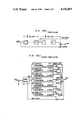
- FIGS. 1(a), (b) and (c) show the constitution, in the case of a band pass filter, of a frequency sampling filter according to the prior art.
- FIG. 2 shows the amplitude versus frequency characteristics of the filter shown in FIG. 1(c),
- FIGS. 3(a ) and 3(b ) show the phase characteristics of the filter shown in FIG. 1(c),
- FIGS. 4(a), (b) and (c) show the constitution, in the case of a band stop filter, of a frequency sampling filter according to the present invention
- FIG. 5 shows the amplitude versus frequency characteristics of the filter shown in FIG. 4(c)
- FIGS. 6(a) and 6(b) show the constitution, in the case of a complex resonator and complex band pass filter, of a frequency sampling filter according to the prior art wherein FIG. 6(a) is a block diagram of a complex resonator, FIG. 6(b) is an entire block diagram of a complex band pass filter;
- FIG. 7 shows the amplitude versus frequency characteristics of the filter shown in FIG. 6(a);
- FIGs. 8(a) and 8(b) show other embodiments of the present invention in which FIG. 8(a) is a block diagram of a comb filter, FIG. 8(b) is an entire block diagram of a complex band stop filter; and
- FIG. 9 shows the amplitude versus frequency characteristics of the filter shown in FIG. 8(a).
- the object of the present invention is to eliminate the disadvantage of the constitution according to the prior art, to make possible to constitute a high pass filter or a band stop filter with a small number of elemental filters, and to reduce substantially the number of multipliers, adders and delay elements as a whole.
- the output of a band pass filter or a low pass filter is subtracted by the output of a circuit which has the same modulus as the gain at each sampling point in the pass band of the band pass filter or the low pass filter and a similarly varying phase to that in the pass band thereby to provide an output having the characteristics of a band stop filter or a high pass filter.
- FIGS. 4(a), (b) and (c) show a first embodiment of the present invention, in which parts similar to those in FIGS. 1(a), (b) and (c) are designated by the same symbols.
- the comb filter 1 in FIG. 4(a) is of the same constitution as the comb filter 1 in FIG. 1(a) except that the output is derived at the point after the m/2th of the m delay elements Z -1 . Since this output has a delay of m/2 times the sampling period T, it can be represented by x(nT - m/2T).
- the elemental filters 2 to 8 in FIG. 4(b) are the same in constitution as the elemental filters in FIG. 1(b).
- FIG. 4(c) is the same in configuration as FIG. 1(c) except that the output of the comb filter x(nT - m/2 T) is multiplied by - m/2 to be added to the adder.
- the characteristics of the filter shown in FIG. 4(c) will be described.
- phase angle of 1 -e -jm ⁇ changes ⁇ /2 ⁇ 0 ⁇ - ⁇ /2 as ⁇ increases from zero to 2 ⁇ /m.
- phase angle of H k (e j ⁇ T) decreases as ⁇ ⁇ ⁇ /2 ⁇ 0 when i ⁇ k, while decreases as 0 ⁇ - ⁇ /2 ⁇ - ⁇ when i ⁇ k.
- phase angle of H k behaves with respect to ⁇ T as shown in FIG. (a).
- elemental filters 4, 5 and 6 in FIG. 4(c) which have the same modulus of coefficient W k of unity.
- the phases of the outputs Y' 4 (nT), y' 5 (nT) and y' 6 (nT) are as shown in FIG. 3(b).
- y' 4 (nT) and y' 6 (nT) behave just in the same way as shown in FIG. 3(a), while y' 5 (nT) behaves with its phase inverted to that shown in FIG. 3(a) because of the factor -1 being multiplied to y k (nT).
- phase of the sum y(nT) of y' 4 (nT), y' 5 (nT) and y' 6 (nT) behaves as shown in FIG. 3(b) since the phase characteristics of y(nT) are dominated by the elemental filter the resonance frequency of which is the nearest to ⁇ T. That is, when ⁇ T is between 2 ⁇ /m ⁇ 3 and 2 ⁇ /m ⁇ 7, the phase of y(nT) varies just as e -j (m/2) ⁇ T does, or, in terms of the operator Z, just as Z -m/2 does.
- the circuit shown in FIG. 4(c) has the following transfer function, ##EQU7##
- the formula (3) has the form provided by reducing (m/2 Z - (m/2) from the transfer function of the formula (1). This means that the output of the filter shown in FIG. 4(c) is equal to the difference between the output of the filter shown in FIG. 1(c) and the output of a circuit which is equal in gain to and varies in phase with the output at a sampling point in the pass band of the band pass filter shown in FIG. 1(c).
- FIG. 5 shows the gain of the circuit of FIG. 4(c) as normalized by m/2.
- the imput frequency f is between 400 Hz and 600 Hz, that is, when ⁇ T is between (2 ⁇ /m) ⁇ 4 and (2 ⁇ /m) ⁇ 6, the transfer function of the circuit shown in FIG. 1 has, as hereinbefore described, a modulus of m/2 and a phase varying as Z - (m/2) and thus gives approximately zero when m/2 Z - (m/2) is subtracted therefrom.
- the gain of the band pass filter is, as shown in FIG.
- the characteristics of a band stop filter can be provided by the circuit constitution shown in FIG. 4. It is also possible to provide the characteristics of a high pass filter by similarly modifying a low pass filter.
- (m/2) Z - (m/2) is subtracted from the output of a band pass filter or a low pass filter
- the output of a band pass filter or a low pass filter may be subtracted from (m/2) Z - (m/2).
- the coefficients of the multipliers in FIG. 4 have to be inversed in sign and the transfer function has the form of the formula (3) with (-1) multiplied on the right side.
- the transfer function of the formula (3) is changed only in its phase by 180° and thus the amplitude versus frequency characteristics remain unchanged as shown in FIG. 5.
- a band stop filter and a high pass filter can be constituted from a band pass filter and a low pass filter, respectively, having supplementary characteristics without adding a large number of elemental filters, that is, without adding further number of elemental filters and by adding only one multiplier.
- a band stop filter and a high pass filter are constituted according to the prior art as shown in FIG. 1 thereby to manufacture a band pass filter and a low pass filter, respectively, according to the present invention as shown in FIG. 4.
- the present invention is meaningless unless the number of elemental filters in the band pass filter or the low pass filter is smaller in FIG. 4 than in FIG. 1, that is, the present invention is effective only when the band pass filter or the low pass filter which is to be realized has a pass band broader than the corresponding stop band.
- a conventional digital filter is used, just as an analogue filter, as a real filter having a real impulse response.
- the input frequencies f of the filter have to satisfy the condition f ⁇ fs/2.
- the concept of a complex filter is known. This is free from the condition of symmetry on positive and negative frequencies because of the multiplication coefficient being complex.
- the complex coefficient causes also the output signal to be complex.
- the input signal frequencies f suffice if only the condition f ⁇ fs is satisfied and, when the range of the input signal frequencies f is fixed, the sampling frequency fs can be reduced by half as compared with the case of a real filter.
- FIGS. 6(a) and (b) show an embodiment in which a complex band pass filter is constituted by means of a frequency sampling technique.
- the transfer function of such a complex band pass filter is represented in general by the following formula. ##EQU8## The factor 1/2 serves to give the same gain at poles as in the formula (1) and may be omitted.
- the transfer function ##EQU9## of complex resonators 2' to 8' in the formula (4) can be transformed to give the real part Hreal(Z) and the imaginary part Himag(Z) as follows: ##EQU10## It is evident in view of the equations above that a complex resonator can be provided by the constitution shown in FIG. 6(a). Further, a band pass filter which has a passband of 400 to 600 Hz can be formed by employing seven such complex resonators as shown in FIG. 6(b). The comb filter in FIG. 6(b) is the same as that in FIG. 1(a).
- the filter in FIG. 6(b) has a gain of approximately zero in the range of -600 to -400 Hz (that is, 11.8 to 12.0 KHz), which is different from the case of FIG. 1 and is a feature of a complex filter.
- FIG. 7 shows the amplitude versus frequency characteristics of the filter shown in FIG. 6(b).
- the transfer function of a band stop filter is represented as follows: ##EQU11##Since the transfer function of the formula (4) has the values of nearly (m/2)Z - (m/2) in the pass band and nearly zero in the stop band, the transfer function of the formula (5) which is formed by subtracting (m/2) ⁇ Z - (m/2) has the values of nearly zero and nearly -(m/2) ⁇ Z -m/2 in the respective bands. That is, the pass band of a bandpass filter is made to be the stop band.
- FIGS. 8(a) and (b) show the constitution as an embodiment of a complex band stop filter according to the formula (5).
- the complex resonator in FIG. 8(a) is the same in constitution as that in FIG. 6(a).
- FIG. 9 shows the amplitude versus frequency characteristics of the filter shown in FIG. 8. If a band pass filter having the characteristics as shown in FIG. 9 is intended to be formed by means of the constitution as shown in FIG. 6, 121 complex resonators are necessary. However, if by means of the constitution as shown in FIG. 8, only seven complex resonators suffice.
- a complex high pass filter from a complex low pass filter.
- a band stop filter and a high pass filter are constituted according to the prior art as shown in FIG. 6 and then a band pass filter and a low pass filter are respectively derived therefrom.
- this is advantageous, as in the case of a real filter, only when the band pass filter or the low pass filter which is to be derived has a pass band broader than the stop band.
- an economical and compact filter not only in the case of real but also in the case of complex.
Landscapes
- Physics & Mathematics (AREA)
- Mathematical Physics (AREA)
- Engineering & Computer Science (AREA)
- Computer Hardware Design (AREA)
- Mathematical Analysis (AREA)
- General Physics & Mathematics (AREA)
- Computing Systems (AREA)
- Mathematical Optimization (AREA)
- Pure & Applied Mathematics (AREA)
- Theoretical Computer Science (AREA)
- Algebra (AREA)
- Processing Of Color Television Signals (AREA)
- Networks Using Active Elements (AREA)
Applications Claiming Priority (2)
| Application Number | Priority Date | Filing Date | Title |
|---|---|---|---|
| JP50-109989 | 1975-09-12 | ||
| JP50109989A JPS5234647A (en) | 1975-09-12 | 1975-09-12 | Frequency sampling filter |
Publications (1)
| Publication Number | Publication Date |
|---|---|
| US4101853A true US4101853A (en) | 1978-07-18 |
Family
ID=14524254
Family Applications (1)
| Application Number | Title | Priority Date | Filing Date |
|---|---|---|---|
| US05/721,408 Expired - Lifetime US4101853A (en) | 1975-09-12 | 1976-09-08 | Frequency sampling filter |
Country Status (3)
| Country | Link |
|---|---|
| US (1) | US4101853A (enExample) |
| JP (1) | JPS5234647A (enExample) |
| NL (1) | NL175125C (enExample) |
Cited By (7)
| Publication number | Priority date | Publication date | Assignee | Title |
|---|---|---|---|---|
| DE3118473A1 (de) * | 1981-05-09 | 1982-11-25 | TE KA DE Felten & Guilleaume Fernmeldeanlagen GmbH, 8500 Nürnberg | Verfahren zur aufbereitung elektrischer signale mit einer digitalen filteranordnung |
| DE3627679A1 (de) * | 1986-08-14 | 1988-02-25 | Blaupunkt Werke Gmbh | Filteranordnung |
| DE3744187A1 (de) * | 1987-12-24 | 1989-07-13 | Ant Nachrichtentech | Einstellbares filter |
| US4922509A (en) * | 1987-06-26 | 1990-05-01 | Cgee Alsthom | Method of implementing programmable matched filters, and corresponding filters and filter banks |
| US6225928B1 (en) * | 1999-03-10 | 2001-05-01 | Cirrus Logic Inc. | Complex bandpass modulator and method for analog-to-digital converters |
| EP1860457A2 (en) | 2006-05-25 | 2007-11-28 | Kabushiki Kaisha Toshiba | Transmission signal generating unit and radar transmission device using the same |
| CN109151672A (zh) * | 2018-09-19 | 2019-01-04 | 西安交通大学 | 基于列阵麦克风的声源跟踪系统及其控制方法 |
Families Citing this family (1)
| Publication number | Priority date | Publication date | Assignee | Title |
|---|---|---|---|---|
| JPS5733821A (en) * | 1980-08-06 | 1982-02-24 | Matsushita Electric Ind Co Ltd | Digital equalizer |
Citations (7)
| Publication number | Priority date | Publication date | Assignee | Title |
|---|---|---|---|---|
| US2716733A (en) * | 1950-05-10 | 1955-08-30 | Exxon Research Engineering Co | Variable bandwidth band-pass filter |
| US3026475A (en) * | 1958-01-13 | 1962-03-20 | Gen Electric | Frequency scanning filter arrangement |
| US3135932A (en) * | 1959-08-14 | 1964-06-02 | Bell Telephone Labor Inc | Signal delay system |
| US3336539A (en) * | 1965-04-15 | 1967-08-15 | Giannini Scient Corp | Variable equalizer system having a plurality of parallel connected tuned circuits |
| US3568107A (en) * | 1969-09-09 | 1971-03-02 | Ronald D Haggarty | Method and apparatus for effecting tapped delay line synthesis of large time bandwidth filters |
| US3657669A (en) * | 1970-09-02 | 1972-04-18 | Gte Laboratories Inc | Frequency domain adaptive equalizer |
| US3858240A (en) * | 1971-01-11 | 1974-12-31 | Communications Satellite Corp | Reduced rate sampling process in pulse code modulation of analog signals |
-
1975
- 1975-09-12 JP JP50109989A patent/JPS5234647A/ja active Granted
-
1976
- 1976-09-08 US US05/721,408 patent/US4101853A/en not_active Expired - Lifetime
- 1976-09-10 NL NLAANVRAGE7610083,A patent/NL175125C/xx not_active IP Right Cessation
Patent Citations (7)
| Publication number | Priority date | Publication date | Assignee | Title |
|---|---|---|---|---|
| US2716733A (en) * | 1950-05-10 | 1955-08-30 | Exxon Research Engineering Co | Variable bandwidth band-pass filter |
| US3026475A (en) * | 1958-01-13 | 1962-03-20 | Gen Electric | Frequency scanning filter arrangement |
| US3135932A (en) * | 1959-08-14 | 1964-06-02 | Bell Telephone Labor Inc | Signal delay system |
| US3336539A (en) * | 1965-04-15 | 1967-08-15 | Giannini Scient Corp | Variable equalizer system having a plurality of parallel connected tuned circuits |
| US3568107A (en) * | 1969-09-09 | 1971-03-02 | Ronald D Haggarty | Method and apparatus for effecting tapped delay line synthesis of large time bandwidth filters |
| US3657669A (en) * | 1970-09-02 | 1972-04-18 | Gte Laboratories Inc | Frequency domain adaptive equalizer |
| US3858240A (en) * | 1971-01-11 | 1974-12-31 | Communications Satellite Corp | Reduced rate sampling process in pulse code modulation of analog signals |
Non-Patent Citations (1)
| Title |
|---|
| Rader et al.,--"Digital Filter Design Techniques in the Frequency Domain" in Proceedings of the IEEE, vol. 55, No. 2, Feb. 1967; pp. 149-171. * |
Cited By (10)
| Publication number | Priority date | Publication date | Assignee | Title |
|---|---|---|---|---|
| DE3118473A1 (de) * | 1981-05-09 | 1982-11-25 | TE KA DE Felten & Guilleaume Fernmeldeanlagen GmbH, 8500 Nürnberg | Verfahren zur aufbereitung elektrischer signale mit einer digitalen filteranordnung |
| DE3627679A1 (de) * | 1986-08-14 | 1988-02-25 | Blaupunkt Werke Gmbh | Filteranordnung |
| US4922509A (en) * | 1987-06-26 | 1990-05-01 | Cgee Alsthom | Method of implementing programmable matched filters, and corresponding filters and filter banks |
| DE3744187A1 (de) * | 1987-12-24 | 1989-07-13 | Ant Nachrichtentech | Einstellbares filter |
| US6225928B1 (en) * | 1999-03-10 | 2001-05-01 | Cirrus Logic Inc. | Complex bandpass modulator and method for analog-to-digital converters |
| EP1860457A2 (en) | 2006-05-25 | 2007-11-28 | Kabushiki Kaisha Toshiba | Transmission signal generating unit and radar transmission device using the same |
| US20070273577A1 (en) * | 2006-05-25 | 2007-11-29 | Kabushiki Kaisha Toshiba | Transmission signal generating unit and radar transmission device using the same |
| EP1860457A3 (en) * | 2006-05-25 | 2008-02-20 | Kabushiki Kaisha Toshiba | Transmission signal generating unit and radar transmission device using the same |
| US7839953B2 (en) | 2006-05-25 | 2010-11-23 | Kabushiki Kaisha Toshiba | Transmission signal generating unit and radar transmission device using the same |
| CN109151672A (zh) * | 2018-09-19 | 2019-01-04 | 西安交通大学 | 基于列阵麦克风的声源跟踪系统及其控制方法 |
Also Published As
| Publication number | Publication date |
|---|---|
| NL175125C (nl) | 1984-09-17 |
| JPS557728B2 (enExample) | 1980-02-28 |
| NL175125B (nl) | 1984-04-16 |
| NL7610083A (nl) | 1977-03-15 |
| JPS5234647A (en) | 1977-03-16 |
Similar Documents
| Publication | Publication Date | Title |
|---|---|---|
| Loomis Jr et al. | High-speed recursive digital filter realization | |
| Kormylo et al. | Two-pass recursive digital filter with zero phase shift | |
| Hogenauer | An economical class of digital filters for decimation and interpolation | |
| Martinez et al. | A class of infinite-duration impulse response digital filters for sampling rate reduction | |
| EP0746095B1 (en) | Surface acoustic wave filter | |
| US6643675B2 (en) | Filtering method and filter | |
| EP0693235B1 (en) | Decimation filter | |
| US4101853A (en) | Frequency sampling filter | |
| US4495591A (en) | Pipelined digital filters | |
| US4920507A (en) | Recursive digital filter with less no-signal noise | |
| CN102025377B (zh) | 一种改进型级联积分梳妆插值滤波器 | |
| US5835390A (en) | Merged multi-stage comb filter with reduced operational requirements | |
| Crooke et al. | Digital filters for sample-rate reduction | |
| Lian | Complexity reduction for FRM-based FIR filters using the prefilter-equalizer technique | |
| US6009445A (en) | Reconfigurable infinite impulse response digital filter | |
| CA1269136A (en) | Interpolator/decimator filter structure and a digital filter therefor | |
| US4794556A (en) | Method and apparatus for sampling in-phase and quadrature components | |
| Hogenauer | A class of digital filters for decimation and interpolation | |
| US4827443A (en) | Corrective digital filter providing subdivision of a signal into several components of different frequency ranges | |
| GB2180114A (en) | Digital filters | |
| Ahuja et al. | Variable digital filters | |
| Jovanovic-Dolecek et al. | Efficient multistage comb-modified rotated sinc (RS) decimator | |
| Erfani et al. | Variable cut-off digital ladder filters | |
| Dolecek et al. | Generalized CIC-cosine decimation filter | |
| Anastassopoulos et al. | Method for designing half-band delta-modulation FIR filters |