US4045981A - Process for bulking knitted fabric articles - Google Patents
Process for bulking knitted fabric articles Download PDFInfo
- Publication number
- US4045981A US4045981A US05/709,261 US70926176A US4045981A US 4045981 A US4045981 A US 4045981A US 70926176 A US70926176 A US 70926176A US 4045981 A US4045981 A US 4045981A
- Authority
- US
- United States
- Prior art keywords
- fabric
- article
- chamber
- yarn
- bulk
- Prior art date
- Legal status (The legal status is an assumption and is not a legal conclusion. Google has not performed a legal analysis and makes no representation as to the accuracy of the status listed.)
- Expired - Lifetime
Links
Images
Classifications
-
- D—TEXTILES; PAPER
- D04—BRAIDING; LACE-MAKING; KNITTING; TRIMMINGS; NON-WOVEN FABRICS
- D04B—KNITTING
- D04B35/00—Details of, or auxiliary devices incorporated in, knitting machines, not otherwise provided for
Definitions
- This invention relates to yarn bulk development in knitted fabrics and particularly but not exclusively, to knitted garments such as pantihose.
- hose knitted from bulked yarn or yarn with latent bulk is scoured and dyed and the bulk developed during these wet processes.
- the bulk can be developed rapidly and fully and in a time compatible with the throughput of the knitting machine.
- a one-piece garment comprises yarns possessing potential bulk then an automatic integrated process is possible from knitting to bulk development, for example, in the case of hose legs or one-piece pantihose.
- the present invention provides a process for developing potential yarn bulk in a knitted fabric in which the fabric is introduced into a turbulent flow of heated air where it is agitated by the turbulence for a time sufficient to develop the required bulk.
- the fabric comprises pre-coloured yarns (spun coloured or dyed) so that the dyeing step where bulk is usually developed may be completely eliminated.
- the knitted fabric is dyed after bulk development according to the invention, in which case dyeing may also be accompanied by additional bulking.
- An important advantage of the present invention is that following bulk development the knitted fabric has a flat, crease-free appearance requiring, in most cases, no conventional finishing.
- this means the garment may be packaged immediately after bulk development, i.e. in an integrated process, e.g. one-piece pantihose.
- Apparatus suitable for effecting the process of the invention comprises a chamber in which the fabric may be agitated in a flow of turbulent air heated to a required temperature, the chamber having at least one door for introducing and ejecting the fabric and which may be operated automatically to match the throughput of a knitting machine.
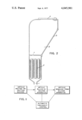
- FIG. 1 is a diagrammatic illustration of an automatic integrated process embodying the present invention.
- FIG. 2 is a detailed sectional view of the bulking apparatus of FIG. 1.
- the apparatus comprises an air inlet 1, an air heater 2, a chamber 3 and fabric inlet and outlet doors 4 and 5.
- an air blower (not shown) supplies air to inlet 1 and the heater 2 is controlled to provide a constant air temperature in chamber 3.
- Air may escape from chamber 3 via the inlet and outlet doors or alternatively may be recycled or piped via a vent in the chamber (not shown) away from the apparatus.
- a fabric discharged from a knitting machine is delivered to a position above door 4 and on opening door 4 it drops into chamber 3 in which the turbulent air flow from the heater 2 agitates and tumbles it. After a sufficient time to develop bulk, door 5 is opened and the fabric is ejected.
- the opening and closing of the doors may be automatic to match the rate of knitting and the time required for bulk development.
- a single knitting machine feeds a single chamber though in some instances more than one machine may be coupled to the same chamber.
- a hose leg knitted from producer textured (false twist crimped) 22 decitex 6 filament yarn (panel portion) and 33 decitex 10 filament yarn (body portion) derived from polyhexamethylene adipamide was supported under zero tension and agitated in a partially closed, cylindrical, 31/4 inch diameter vertical tube 60 inches long, bu a turbulent upward flow of 400 liters/minute of air preheated to 140° C. Maximum fabric bulk development was achieved in 2.8 minutes. It was also found that 200 liters/minute of air was sufficient to support and agitate the hose.
- hose legs were subjected for different time intervals to various air temperatures and flow rates in order to determine optimum treatment conditions. These conditions were considered to be those combinations of time, temperature and flow which resulted in a relaxed bulked hose length of 18 to 20 inches (measured from the sole side of the heel to the junction of the panel and the body).
- the hose legs used in the trials were knitted (construction 3 ⁇ 1 micromesh) from the same producer textured yarns described in Example 1. A conventional hose stitch length was used and the legs were knitted to give a relaxed panel portion length of 40 inches, i.e. heel to body portion.
- the present invention is not limited to bulk development in knitted hose, but is also applicable to the development of bulk in any knitted fabric subject, of course, to the determination of optimum treatment conditions.
Landscapes
- Engineering & Computer Science (AREA)
- Textile Engineering (AREA)
- Knitting Of Fabric (AREA)
Abstract
Method for developing potential yarn bulk in knitted fabric by introducing the fabric into a turbulent flow of heated air.
Description
This is a continuation of application Ser. No. 510,140 filed Sep. 27, 1974, now abandoned.
This invention relates to yarn bulk development in knitted fabrics and particularly but not exclusively, to knitted garments such as pantihose.
Normally, hose knitted from bulked yarn or yarn with latent bulk is scoured and dyed and the bulk developed during these wet processes. In the present invention we have found that by agitating a knitted garment with potential yarn bulk in a turbulent flow of heated air, the bulk can be developed rapidly and fully and in a time compatible with the throughput of the knitting machine. Thus if a one-piece garment comprises yarns possessing potential bulk then an automatic integrated process is possible from knitting to bulk development, for example, in the case of hose legs or one-piece pantihose.
Accordingly, the present invention provides a process for developing potential yarn bulk in a knitted fabric in which the fabric is introduced into a turbulent flow of heated air where it is agitated by the turbulence for a time sufficient to develop the required bulk.
Preferably the fabric comprises pre-coloured yarns (spun coloured or dyed) so that the dyeing step where bulk is usually developed may be completely eliminated.
When undyed yarn is used the knitted fabric is dyed after bulk development according to the invention, in which case dyeing may also be accompanied by additional bulking.
An important advantage of the present invention is that following bulk development the knitted fabric has a flat, crease-free appearance requiring, in most cases, no conventional finishing. Thus for one-piece garments comprising pre-coloured yarns, this means the garment may be packaged immediately after bulk development, i.e. in an integrated process, e.g. one-piece pantihose.
Apparatus suitable for effecting the process of the invention comprises a chamber in which the fabric may be agitated in a flow of turbulent air heated to a required temperature, the chamber having at least one door for introducing and ejecting the fabric and which may be operated automatically to match the throughput of a knitting machine.
In the drawings:
FIG. 1 is a diagrammatic illustration of an automatic integrated process embodying the present invention; and
FIG. 2 is a detailed sectional view of the bulking apparatus of FIG. 1.
The apparatus comprises an air inlet 1, an air heater 2, a chamber 3 and fabric inlet and outlet doors 4 and 5. In operation, an air blower (not shown) supplies air to inlet 1 and the heater 2 is controlled to provide a constant air temperature in chamber 3. The heated air jets into the chamber 3 through an orifice 7. Air may escape from chamber 3 via the inlet and outlet doors or alternatively may be recycled or piped via a vent in the chamber (not shown) away from the apparatus. A fabric discharged from a knitting machine is delivered to a position above door 4 and on opening door 4 it drops into chamber 3 in which the turbulent air flow from the heater 2 agitates and tumbles it. After a sufficient time to develop bulk, door 5 is opened and the fabric is ejected. The opening and closing of the doors may be automatic to match the rate of knitting and the time required for bulk development.
Normally a single knitting machine feeds a single chamber though in some instances more than one machine may be coupled to the same chamber.
The following examples are intended to illustrate but not limit the present invention.
A hose leg knitted from producer textured (false twist crimped) 22 decitex 6 filament yarn (panel portion) and 33 decitex 10 filament yarn (body portion) derived from polyhexamethylene adipamide was supported under zero tension and agitated in a partially closed, cylindrical, 31/4 inch diameter vertical tube 60 inches long, bu a turbulent upward flow of 400 liters/minute of air preheated to 140° C. Maximum fabric bulk development was achieved in 2.8 minutes. It was also found that 200 liters/minute of air was sufficient to support and agitate the hose.
In this Example a series of trials were carried out using apparatus similar to that described above and shown in the accompanying drawing. The chamber of the apparatus was 6 inches square at the top and tapered down over 8 inches to a 2 inch diameter circular base having a 1/8 inch diameter orifice. Air was supplied via a 1.8 kw rated heater.
In these trials hose legs were subjected for different time intervals to various air temperatures and flow rates in order to determine optimum treatment conditions. These conditions were considered to be those combinations of time, temperature and flow which resulted in a relaxed bulked hose length of 18 to 20 inches (measured from the sole side of the heel to the junction of the panel and the body).
The hose legs used in the trials were knitted (construction 3 × 1 micromesh) from the same producer textured yarns described in Example 1. A conventional hose stitch length was used and the legs were knitted to give a relaxed panel portion length of 40 inches, i.e. heel to body portion.
The results of the trials are shown in the Table below, from which it is clear that for hose legs of the kind used, optimum treatment conditions correspond substantially to those shown in the final section of the Table.
It is to be understood that the present invention is not limited to bulk development in knitted hose, but is also applicable to the development of bulk in any knitted fabric subject, of course, to the determination of optimum treatment conditions.
                                  TABLE
__________________________________________________________________________
          Relaxed    Relaxed    Relaxed    Relaxed      Relaxed
          bulked     bulked     bulked     bulked       bulked
Air       hose       hose       hose       hose         hose
flow Temp.
          length
                Temp.
                     Length
                           Temp.
                                Length
                                      Temp.
                                           Length Temp. Length
rate of air
          (inches)
                of air
                     (inches)
                           of air
                                (inches)
                                      of air
                                           (inches)
                                                  of air
                                                        (inches)
(cold)
     entering
          Time  entering
                     Time  entering
                                Time  entering
                                           Time   entering
                                                        Time
(liters/
     chamber
          (minutes)
                chamber
                     (minutes)
                           chamber
                                (minutes)
                                      chamber
                                           (minutes)
                                                  chamber
                                                        (minutes)
min.)
     (° C.)
          0.5 1.0 2.0
                (° C.)
                     0.5 1.0 2.0
                           (° C.)
                                0.5 1.0 2.0
                                      (° C.)
                                           0.5 1.0 2.0
                                                  (° C.)
                                                        0.5 1.0
__________________________________________________________________________
                                                        2.0
 28  47   29   291/2 331/2
                67   291/2 32   293/4
                           89   24   231/2 231/4
                                      117  20   191/4 19
                                                  160   181/2 181/2
                                                        171/2
 57  44   303/4 31   303/4
                62   31   281/2 291/4
                           83   241/4 241/4 233/4
                                      108  203/4 201/4 201/4
                                                  147   18   181/4 173/4
 85  41   311/4 311/4 311/2
                57   31   303/4 30
                           77   241/4 251/4 26
                                       99  223/4 221/2 22
                                                  135   181/2 181/4 18
115  38   311/2 32  313/4
                54   31  301/2 31
                           71   261/2 271/4 271/4
                                       92  22  231/4 231/2
                                                  120   191/2 191/4 19
145  35   313/4 33  32
                50   313/4 32  31
                           67   271/4 273/4 273/4
                                       87  243/4 233/4 231/4
                                                  112   201/2 21  20
__________________________________________________________________________
Claims (8)
1. A process for developing yarn bulk in a knitted fabric article comprising yarn having potential bulk which is compatible with the time required to knit the article, said process comprising agitating and tumbling the fabric article in a chamber, directly after knitting in an automatic integrated process therewith and before said article is subjected to any wet treatment, by a turbulent stream of upwardly flowing heated air introduced into the chamber so as to support the fabric therein and removing the fabric in crease-free condition from the chamber after a period of time sufficient to develop the bulk.
2. A process according to claim 1 in which the fabric comprises knitted one-piece pantyhose.
3. A process according to claim 1 in which the fabric comprises knitted hose legs.
4. A process according to claim 1 in which the fabric comprises yarn derived from a polyamide.
5. A process according to claim 4 in which the fabric comprises yarn derived from polyhexamethylene adipamide.
6. A process as in claim 1 wherein only a single knitted article at any one time is agitated and tumbled in the chamber.
7. A process as in claim 6 wherein the yarn in said knitted article is precolored yarn.
8. A process for developing yarn bulk in a knitted fabric article comprising yarn having potential bulk which is compatible with the time required to knit the article, said process comprising agitating and tumbling the fabric article in a chamber, directly after knitting in an automatic integrated process therewith and before said article is subjected to any wet treatment, by a turbulent stream of upwardly flowing heated air introduced into the chamber at a flow rate of 28-145 liters/minute and at a temperature of 112° C-160° C. so as to support the fabric therein and removing the fabric in crease-free condition from the chamber after a treatment time of 0.5-2.0 minutes and sufficient to develop the bulk.
Priority Applications (1)
| Application Number | Priority Date | Filing Date | Title |
|---|---|---|---|
| US05/709,261 US4045981A (en) | 1974-09-27 | 1976-07-27 | Process for bulking knitted fabric articles |
Applications Claiming Priority (2)
| Application Number | Priority Date | Filing Date | Title |
|---|---|---|---|
| US51014074A | 1974-09-27 | 1974-09-27 | |
| US05/709,261 US4045981A (en) | 1974-09-27 | 1976-07-27 | Process for bulking knitted fabric articles |
Related Parent Applications (1)
| Application Number | Title | Priority Date | Filing Date |
|---|---|---|---|
| US51014074A Continuation | 1974-09-27 | 1974-09-27 |
Publications (1)
| Publication Number | Publication Date |
|---|---|
| US4045981A true US4045981A (en) | 1977-09-06 |
Family
ID=27056806
Family Applications (1)
| Application Number | Title | Priority Date | Filing Date |
|---|---|---|---|
| US05/709,261 Expired - Lifetime US4045981A (en) | 1974-09-27 | 1976-07-27 | Process for bulking knitted fabric articles |
Country Status (1)
| Country | Link |
|---|---|
| US (1) | US4045981A (en) |
Cited By (1)
| Publication number | Priority date | Publication date | Assignee | Title |
|---|---|---|---|---|
| ITBS20110179A1 (en) * | 2011-12-22 | 2013-06-23 | Salvatore Gorgaini | APPARATUS FOR A HOT TREATMENT OF PREFIXING MANUFACTURED ARTICLES ON FOOTWEAR MACHINES |
Citations (16)
| Publication number | Priority date | Publication date | Assignee | Title |
|---|---|---|---|---|
| US151838A (en) * | 1874-06-09 | Improvement in wash-boilers | ||
| US1434193A (en) * | 1921-04-23 | 1922-10-31 | Charles F Noftzger | Laundry drier |
| US1652276A (en) * | 1926-03-18 | 1927-12-13 | Charles F Gregg | Drying machine |
| US1671442A (en) * | 1926-07-30 | 1928-05-29 | Charles F Noftzger | Laundry drier |
| US2050626A (en) * | 1934-09-22 | 1936-08-11 | American Laundry Mach Co | Drying machine |
| US2350021A (en) * | 1940-08-07 | 1944-05-30 | Paramount Textile Mach Co | Method of treating textiles |
| US2679739A (en) * | 1953-08-04 | 1954-06-01 | Belmont Throwing Company | Knitted fabric having supertwisted variegated areas and method of manufacture |
| US2848146A (en) * | 1955-06-25 | 1958-08-19 | Emma Elfriede Bellmann | Treating hosiery made of synthetic fibers |
| US3021588A (en) * | 1958-04-03 | 1962-02-20 | Deering Milliken Res Corp | Knitted textile products and methods for their preparation |
| US3125848A (en) * | 1964-03-24 | Yarn and fabric product and process | ||
| US3271837A (en) * | 1964-09-25 | 1966-09-13 | Du Pont | Method of manufacturing stockings from two-component filaments |
| US3330451A (en) * | 1964-12-30 | 1967-07-11 | Du Pont | Apparatus and process for steam processing of textile articles |
| US3358387A (en) * | 1965-10-20 | 1967-12-19 | Garnet H Eckardt | Hosiery dryer |
| US3499196A (en) * | 1968-02-15 | 1970-03-10 | Chadbourn Inc | Method of making miniature stockings |
| US3686726A (en) * | 1969-08-05 | 1972-08-29 | Autoboard Corp | Method of shrinking and/or dyeing knit garments |
| US3906750A (en) * | 1973-09-10 | 1975-09-23 | Herman M Routh | Apparatus for knitting and heat-setting circular knit articles |
-
1976
- 1976-07-27 US US05/709,261 patent/US4045981A/en not_active Expired - Lifetime
Patent Citations (16)
| Publication number | Priority date | Publication date | Assignee | Title |
|---|---|---|---|---|
| US3125848A (en) * | 1964-03-24 | Yarn and fabric product and process | ||
| US151838A (en) * | 1874-06-09 | Improvement in wash-boilers | ||
| US1434193A (en) * | 1921-04-23 | 1922-10-31 | Charles F Noftzger | Laundry drier |
| US1652276A (en) * | 1926-03-18 | 1927-12-13 | Charles F Gregg | Drying machine |
| US1671442A (en) * | 1926-07-30 | 1928-05-29 | Charles F Noftzger | Laundry drier |
| US2050626A (en) * | 1934-09-22 | 1936-08-11 | American Laundry Mach Co | Drying machine |
| US2350021A (en) * | 1940-08-07 | 1944-05-30 | Paramount Textile Mach Co | Method of treating textiles |
| US2679739A (en) * | 1953-08-04 | 1954-06-01 | Belmont Throwing Company | Knitted fabric having supertwisted variegated areas and method of manufacture |
| US2848146A (en) * | 1955-06-25 | 1958-08-19 | Emma Elfriede Bellmann | Treating hosiery made of synthetic fibers |
| US3021588A (en) * | 1958-04-03 | 1962-02-20 | Deering Milliken Res Corp | Knitted textile products and methods for their preparation |
| US3271837A (en) * | 1964-09-25 | 1966-09-13 | Du Pont | Method of manufacturing stockings from two-component filaments |
| US3330451A (en) * | 1964-12-30 | 1967-07-11 | Du Pont | Apparatus and process for steam processing of textile articles |
| US3358387A (en) * | 1965-10-20 | 1967-12-19 | Garnet H Eckardt | Hosiery dryer |
| US3499196A (en) * | 1968-02-15 | 1970-03-10 | Chadbourn Inc | Method of making miniature stockings |
| US3686726A (en) * | 1969-08-05 | 1972-08-29 | Autoboard Corp | Method of shrinking and/or dyeing knit garments |
| US3906750A (en) * | 1973-09-10 | 1975-09-23 | Herman M Routh | Apparatus for knitting and heat-setting circular knit articles |
Cited By (1)
| Publication number | Priority date | Publication date | Assignee | Title |
|---|---|---|---|---|
| ITBS20110179A1 (en) * | 2011-12-22 | 2013-06-23 | Salvatore Gorgaini | APPARATUS FOR A HOT TREATMENT OF PREFIXING MANUFACTURED ARTICLES ON FOOTWEAR MACHINES |
Similar Documents
| Publication | Publication Date | Title |
|---|---|---|
| US5461742A (en) | Mist treatment of garments | |
| US2157119A (en) | Method of making fabric | |
| AU2010237667B2 (en) | Operating method for laundry equipment including a scent supply module | |
| US5320873A (en) | Process and apparatus for treating cellulosic fiber-containing fabric to improve durable press and shrinkage resistance | |
| US2911810A (en) | Washing and drying clothes and the like | |
| US2990087A (en) | Treating textiles on a form | |
| US4045981A (en) | Process for bulking knitted fabric articles | |
| US5010612A (en) | Method for continuous dyeing of tubular cotton knit fabrics | |
| US4931064A (en) | Method and apparatus for discontinuous wet processing of knitted or worked textile material | |
| US3840340A (en) | Detergent preconditioning process for dry cleaning | |
| US3728076A (en) | Process for the heat-setting of padded and printed endless synthetic filament groups and top slivers | |
| AU766491B2 (en) | Method and apparatus for treating strand-like material | |
| NO743504L (en) | ||
| US3984198A (en) | Device for the impregnation and drying of textile material | |
| US5273548A (en) | Method of controlling the shirnkage of garments containing cotton | |
| US6308506B2 (en) | Production of color blended yarn for denim construction | |
| US1418275A (en) | Method of handling starch mixture | |
| Payet | ALMI-Set Process: A New Approach to Carefree Garments | |
| US4025305A (en) | Process for the heat-setting of padded or printed continuous synthetic filament groups | |
| US3533145A (en) | Process and apparatus for the treatment of synthetic filament groups | |
| GB684046A (en) | Improvements in or relating to the dyeing of aromatic polyester fibres, filaments, yarns, fabrics, films and like shaped articles | |
| US4833747A (en) | Dyeing method | |
| JPS6426773A (en) | Method for dyeing fiber fabric or knitted fabric produced from polyester fiber or mixture of said fiber and other fiber by jet dyeing apparatus | |
| GB1490515A (en) | Process for heat treating knitted fabric articles | |
| Rattee | The combined dyeing and finishing of cellulosic fabrics |