US3955972A - Method of producing sheets and article to practice such method - Google Patents
Method of producing sheets and article to practice such method Download PDFInfo
- Publication number
- US3955972A US3955972A US05/468,971 US46897174A US3955972A US 3955972 A US3955972 A US 3955972A US 46897174 A US46897174 A US 46897174A US 3955972 A US3955972 A US 3955972A
- Authority
- US
- United States
- Prior art keywords
- boron
- steel
- stainless steel
- rolling
- typically
- Prior art date
- Legal status (The legal status is an assumption and is not a legal conclusion. Google has not performed a legal analysis and makes no representation as to the accuracy of the status listed.)
- Expired - Lifetime
Links
Images

Classifications
-
- C—CHEMISTRY; METALLURGY
- C21—METALLURGY OF IRON
- C21D—MODIFYING THE PHYSICAL STRUCTURE OF FERROUS METALS; GENERAL DEVICES FOR HEAT TREATMENT OF FERROUS OR NON-FERROUS METALS OR ALLOYS; MAKING METAL MALLEABLE, e.g. BY DECARBURISATION OR TEMPERING
- C21D8/00—Modifying the physical properties of ferrous metals or ferrous alloys by deformation combined with, or followed by, heat treatment
- C21D8/02—Modifying the physical properties of ferrous metals or ferrous alloys by deformation combined with, or followed by, heat treatment during manufacturing of plates or strips
-
- B—PERFORMING OPERATIONS; TRANSPORTING
- B21—MECHANICAL METAL-WORKING WITHOUT ESSENTIALLY REMOVING MATERIAL; PUNCHING METAL
- B21B—ROLLING OF METAL
- B21B3/00—Rolling materials of special alloys so far as the composition of the alloy requires or permits special rolling methods or sequences ; Rolling of aluminium, copper, zinc or other non-ferrous metals
- B21B3/02—Rolling special iron alloys, e.g. stainless steel
-
- C—CHEMISTRY; METALLURGY
- C21—METALLURGY OF IRON
- C21D—MODIFYING THE PHYSICAL STRUCTURE OF FERROUS METALS; GENERAL DEVICES FOR HEAT TREATMENT OF FERROUS OR NON-FERROUS METALS OR ALLOYS; MAKING METAL MALLEABLE, e.g. BY DECARBURISATION OR TEMPERING
- C21D1/00—General methods or devices for heat treatment, e.g. annealing, hardening, quenching or tempering
- C21D1/68—Temporary coatings or embedding materials applied before or during heat treatment
-
- G—PHYSICS
- G21—NUCLEAR PHYSICS; NUCLEAR ENGINEERING
- G21C—NUCLEAR REACTORS
- G21C21/00—Apparatus or processes specially adapted to the manufacture of reactors or parts thereof
- G21C21/18—Manufacture of control elements covered by group G21C7/00
-
- Y—GENERAL TAGGING OF NEW TECHNOLOGICAL DEVELOPMENTS; GENERAL TAGGING OF CROSS-SECTIONAL TECHNOLOGIES SPANNING OVER SEVERAL SECTIONS OF THE IPC; TECHNICAL SUBJECTS COVERED BY FORMER USPC CROSS-REFERENCE ART COLLECTIONS [XRACs] AND DIGESTS
- Y02—TECHNOLOGIES OR APPLICATIONS FOR MITIGATION OR ADAPTATION AGAINST CLIMATE CHANGE
- Y02E—REDUCTION OF GREENHOUSE GAS [GHG] EMISSIONS, RELATED TO ENERGY GENERATION, TRANSMISSION OR DISTRIBUTION
- Y02E30/00—Energy generation of nuclear origin
- Y02E30/30—Nuclear fission reactors
Definitions
- Control rods are typically composed of plates fabricated into an elongated structure of cruciform cross section. To control the reactivity of a reactor the cruciform structure is slid in and out of the reactor body.
- boron and specifically, boron 10 (B10) has a high abosrption cross section, ⁇ a b s. It is then desirable that control rods be formed of a material or alloy containing substantial quantities of boron 10 and it is an object of this invention to provide plates for control rods of such a material.
- stainless steel lends itself readily to use in the corrosive surroundings of a reactor and it is an object of this invention to provide such plates of a stainless steel containing substantial quantities of boron 10.
- the content of B10 in naturally occurring boron is only 18.83 percent.
- the enrichment of B10 be about 90 percent.
- Such enriched boron is available but it is costly.
- the enriched boron is supplied in the form of a fine powder costing between about $4.00 and $6.00 per gram.
- the stainless steel alloy for producing control rods contains up to 2.3 percent or 2.5 percent B10 and is produced in the form of billets or slabs having a thickness of about 1.3 inches; typically 11/8 inches thick ⁇ 5 inches wide ⁇ 12 inches long. It is necessary that the slabs be reduced to plates or sheets having a thickness of about 0.350 inches. Typically, sheets or plates having the following dimensions are required.
- the maximum TIR (Total Indicated Runout) is 0.010 over the 36 inches length. Attempts have been made to produce these plates by rolling the slabs directly in a rolling mill but these attempts have not produced satisfactory sheets. The sheets produced were cracked at the edges. Both opposite surfaces of the sheets fabricated in this manner had regions from which the B10 was depleted extending to a depth of about 0.070 inches from each surface. Boron or borides was released from the slabs during the rolling and was deposited on surfaces throughout the shop where the rolling was carried out. In a nuclear fabrication shop the boron is deposited on materials being prepared for use in reactors. Such materials have a tolerance of only 1 or 2 parts per million of boron and the deposit of boron on their surfaces would poison the reactors, further the depletion of the boron resulted in gross inhomogeneities in the boron distribution.
- This invention arises from the realization that the cracking and the depletion of boron at the surfaces are caused by the reaction of the slab material with the oxygen in the atmosphere.
- the boron in the alloy is in the form of complex borides and the borides react with air to produce the harmful effects of the steel.
- the boron is also released from the steel probably in the form of fine oxide particles to produce contamination of the shop.
- the reduction is carried out with the stainless steel confined in cladding of mild carbon steel.
- Each slab is coated with a wash of a material, typically, zirconia, which prevents the slab surface from sticking to mild steel and is then sealed in a pocket of mild steel.
- the composite pack is then reduced by repeated rolling to the desired thickness. Prior to each rolling operation the pack is heated to 1125°C ⁇ 50°C. It is essential that the temperature shall not exceed about 1165°C. during the heating because the boron-containing stainless steel exhibits hot-shortness and deteriorates above 1165°C. During the rolling it is essential that the temperature shall not fall below about 1075°C. because at this temperature the boron-containing steel becomes brittle and cannot be rolled.
- the pack according to this invention has the additional advantage that it retains the heat longer than a slab of the stainless steel and thus facilitates the rolling.
- the cladding also constrains the slab and prevents edge cracking.
- type AISI 304 stainless steel is melted with a requisite quantity of 90 percent enriched B10 powder in a vacuum furnace. Where low carbon is essential type 304L steel may be used.
- Table I presents the nominal composition of the alloy elements in percent of 304 steel and the actual analyzed composition in alloy elements of such steel used in the typical practice of this invention.
- the boron which is melted with such steel has the composition given in the following Table IA.
- the boron is supplied in the form of a powder which would be partially dissipated during the evacuation of the furnace if charged directly into the furnace.
- the boron powder is enclosed in a thin can of mild steel and the can is placed in the furnace.
- about 140 pounds of 304 steel and about 3 pounds of boron powder are deposited and the effect of the mild steel of the can is negligible.
- the charge material consisted of certified 304 stainless steel 3 inch diameter bar and 90 percent purity-90 percent enriched B-10 produced by the boron facility at Niagara of Nuclear Materials And Equipment Corp. (NUMEC).
- the virgin boron powder ( ⁇ 100 micron particle size) was weighed to the nearest 0.1 gram encapsulated in a 10 mil mild steel can and placed in the bottom of a 200 lb. steel capacity commercial grade MgO crucible.
- the virgin stainless and/or scrap was weighed to the nearest 0.1 lb. and placed on top of the encapsulated boron.
- the crucible had a 200 lb. stainless steel capacity, the low bulk density of the virgin boron limited the charge to approximately 140 lbs.
- Table II below shows the make up of Melts Nos. 1 through 21 produced.
- Table III presents the actual analyzed alloy composition of typical melts produced by melting the stainless steel having the composition shown in the second column of Table I and the boron having the above tabulated composition.
- the melt is cast in molds to produce billets or slabs having a thickness of about 1.3 inches.
- the billets are then sand-blasted, trimmed and coated with the adhesion-preventing wash coating which may be zirconia.
- the coated slabs are then encased in cladding of mild steel.
- the cladding is produced in the form of a frame with separate cover plates.
- the opening in the frame is dimensioned so that a slab is sliding fit in the opening.
- the thickness of the frame is about the same as the initial thickness of the slab.
- the plates are typically 12 gauge sheet. One plate is seal welded to the frame. Then the coated slab is inserted and the other plate is seal welded.
- the composite pack is then reduced by hot rolling.
- the pack is repeatedly heated to 1125°C. ⁇ 50°C. and then rolled.
- FIG. 1 is a diagrammatic view of apparatus used in producing the alloy with which this invention is practiced
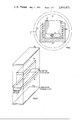
- FIG. 2 is an exploded view showing the cladding parts of the pack according to this invention.
- FIGS. 3a, b, c, d, e and f are photo-micrographs at 200 magnification of cuts of sheets produced in the practice of this invention.
- the apparatus shown in FIG. 1 is a vacuum furnace 11 which typically may be bought from Stokes Vacuum Furnace Co.
- This furnace 11 includes a crucible 13 in the base of which a can 15 containing powder 17 enriched to 90% B-10 is enclosed.
- the can may be composed of mild steel and may contain typically about 3 pounds of powder.
- a crucible rods 19 of stainless steel are disposed. Typically AISI 304 or 304L steel may be used.
- the rods 19 may have a weight of 150 pounds.
- the crucible may be disposed in an induction heater 21 having induction heating coils 23 embedded in insulation.
- the heating coils 23 may be energized from an INDUCTOTHERM 100 Kw motor generator set delivering power at about 4000 cycles per second.
- the furnace 21 and its contents are disposed in a chamber 25 which may be evacuated by adequate pumping equipment not shown.
- the furnace chamber 11 is evacuated to ⁇ 5 microns.
- the chamber is backfilled with argon to a negative 5 inches of mercury.
- the power is turned off and the melt outgassed by evacuating the chamber to ⁇ 5 microns.
- the chamber is backfilled with argon to a negative 5 inches of mercury.
- the cast billets are attached to the hot top by means of a 3/4 inch riser which is easily broken.
- the billets were than coated with zirconia, dried, and welded into a mild steel jacket which had also been coated with zirconia.
- the zirconia formed an effective reaction barrier between the billet and jacket material.
- FIG. 2 shows the cladding including a frame 31 within which a billet is disposed for reducing. Each billet is sealed in the frame by end plates 33 and 35.
- FIG. 2 shows the dimensions of typical cladding. The following typical procedure is followed in preparing and applying the zirconia wash to the billets.
- the slab should have a white surface after application of the wash and drying.
- the jacketed billets Prior to rolling, the jacketed billets are given a furnace soak for 1/2 hour at 1125°C. in an impure argon atmoshpere. The plates are then removed from the furnace and rolled on a Waterbury Farrel, two high, 200,000 lb. capacity mill with 14 in. diameter ⁇ 22 in. rolls as per the typical rolling schedule in the following Table V.
- the rolling speed is ⁇ 75 fpm.
- the major problem in rolling is maintaining the proper rolling temperature. Severe edge cracking occurs if the plate temperature is above 1165°C. or below ⁇ 1075°C.
- the plate After rolling, the plate is air cooled and then stripped from the jacket.
- the zirconia coating on the plate prevents any reaction between the plate and the cladding and consequently the cladding is readily removed. Stripping is accomplished by clamping the plate in a vice and bending the mild steel side strip until the cover plate fractures.
- FIGS. 3(a) through (f) show the quality of the alloy produced in the practice of this invention.
- FIGS. 3(a) and (b) are photomicrographs of cuts from the two ends of a plate from billet 1 (see Table III); and
- FIGS. 3(c) and (d) and 3(e) and (f) are respectively like photomicrographs of cuts from the opposite ends of other plates.
- the dark dots correspond to boron or boride and are seen to be uniformly distributed throughout the graphs revealing that the boron is uniform throughout the alloy.
Landscapes
- Engineering & Computer Science (AREA)
- Chemical & Material Sciences (AREA)
- Physics & Mathematics (AREA)
- Mechanical Engineering (AREA)
- Materials Engineering (AREA)
- Crystallography & Structural Chemistry (AREA)
- Thermal Sciences (AREA)
- Metallurgy (AREA)
- Organic Chemistry (AREA)
- Manufacturing & Machinery (AREA)
- Plasma & Fusion (AREA)
- General Engineering & Computer Science (AREA)
- High Energy & Nuclear Physics (AREA)
- Manufacture And Refinement Of Metals (AREA)
Abstract
This invention relates to the art of reducing metallic bodies from a greater thickness to a substantially smaller thickness and has particular relationship to such reduction of stainless steel containing substantial quantities of boron, typically in the fabrication of sheets for nuclear reactor control rods.
Description
This is a division of application Ser. No. 566,603, filed July 20, 1966, now U.S. Pat. No. 3,827,264.
Control rods are typically composed of plates fabricated into an elongated structure of cruciform cross section. To control the reactivity of a reactor the cruciform structure is slid in and out of the reactor body. Of the elements, which are readily usable for control rod purposes, boron, and specifically, boron 10 (B10) has a high abosrption cross section, ρ a b s. It is then desirable that control rods be formed of a material or alloy containing substantial quantities of boron 10 and it is an object of this invention to provide plates for control rods of such a material. Specifically, stainless steel lends itself readily to use in the corrosive surroundings of a reactor and it is an object of this invention to provide such plates of a stainless steel containing substantial quantities of boron 10. The content of B10 in naturally occurring boron is only 18.83 percent. For control rod use it is necessary that the enrichment of B10 be about 90 percent. Such enriched boron is available but it is costly. Typically, the enriched boron is supplied in the form of a fine powder costing between about $4.00 and $6.00 per gram. In the interest of economy it is essential that in the producing of the alloy and in the fabrication of plates for the control rods loss of B10 be minimized and it is an object of this invention to accomplish this desideratum.
Typically, the stainless steel alloy for producing control rods contains up to 2.3 percent or 2.5 percent B10 and is produced in the form of billets or slabs having a thickness of about 1.3 inches; typically 11/8 inches thick × 5 inches wide × 12 inches long. It is necessary that the slabs be reduced to plates or sheets having a thickness of about 0.350 inches. Typically, sheets or plates having the following dimensions are required.
       Thickness
               0.312"   ±.003"
       Width   4.125"   +.000"
                        -.015"
       Length  36.00"   +.000"
                        -.030"
The maximum TIR (Total Indicated Runout) is 0.010 over the 36 inches length. Attempts have been made to produce these plates by rolling the slabs directly in a rolling mill but these attempts have not produced satisfactory sheets. The sheets produced were cracked at the edges. Both opposite surfaces of the sheets fabricated in this manner had regions from which the B10 was depleted extending to a depth of about 0.070 inches from each surface. Boron or borides was released from the slabs during the rolling and was deposited on surfaces throughout the shop where the rolling was carried out. In a nuclear fabrication shop the boron is deposited on materials being prepared for use in reactors. Such materials have a tolerance of only 1 or 2 parts per million of boron and the deposit of boron on their surfaces would poison the reactors, further the depletion of the boron resulted in gross inhomogeneities in the boron distribution.
It is an object of this invention to overcome the above-described difficulties and to produce boron-containing stainless steel sheets by reduction of slabs without spread of contaminating boron throughout the reduction shop, which sheets shall be homogenious in boron distribution, shall not be cracked at the edges and shall not have surfaces depleted of boron. Typically the homogeniety shall be better than ±5 percent relative boron content in analysis of specimens taken from different parts of the sheet.
While this object is in the practice of this invention achieved for stainless steel containing B10, it is applicable to stainless steel containing boron of only isotopic compositions and the fabrication of such steel containing any such composition of boron is within the scope of this invention.
This invention arises from the realization that the cracking and the depletion of boron at the surfaces are caused by the reaction of the slab material with the oxygen in the atmosphere. The boron in the alloy is in the form of complex borides and the borides react with air to produce the harmful effects of the steel. The boron is also released from the steel probably in the form of fine oxide particles to produce contamination of the shop.
In accordance with this invention the reduction is carried out with the stainless steel confined in cladding of mild carbon steel. Each slab is coated with a wash of a material, typically, zirconia, which prevents the slab surface from sticking to mild steel and is then sealed in a pocket of mild steel. The composite pack is then reduced by repeated rolling to the desired thickness. Prior to each rolling operation the pack is heated to 1125°C ± 50°C. It is essential that the temperature shall not exceed about 1165°C. during the heating because the boron-containing stainless steel exhibits hot-shortness and deteriorates above 1165°C. During the rolling it is essential that the temperature shall not fall below about 1075°C. because at this temperature the boron-containing steel becomes brittle and cannot be rolled. The pack according to this invention has the additional advantage that it retains the heat longer than a slab of the stainless steel and thus facilitates the rolling. The cladding also constrains the slab and prevents edge cracking.
In producing boron containing stainless steel, typically, type AISI 304 stainless steel, is melted with a requisite quantity of 90 percent enriched B10 powder in a vacuum furnace. Where low carbon is essential type 304L steel may be used. The following Table I presents the nominal composition of the alloy elements in percent of 304 steel and the actual analyzed composition in alloy elements of such steel used in the typical practice of this invention.
                                  TABLE I
__________________________________________________________________________
C        Mn  P   S   Si  Ni   Cr   Mo  Co  Cu
__________________________________________________________________________
Nominal
     .08 2.00
             .045
                 .030
                     1.00
                          8.00
                              18.00
                         to   to
                         12.00
                              20.00
Actual
     .072
         1.51
             .021
                 .013
                      .62
                          8.38
                              18.43
                                   .28 .10 .36
__________________________________________________________________________
The remainder for each row is iron.
Typically, the boron which is melted with such steel has the composition given in the following Table IA.
              TABLE IA
______________________________________
Lot No.     NB-4     NBL-1   NBL-3 NBL-4 NBL-5
______________________________________
Total Boron 88.81    90.83   91.50 91.73 89.51
Niagara Analysis
Total Boron 88.46            91.58
NUMEC Analysis
            88.36            91.63
Isotopic B-10
            90.02    91.70   91.40 91.00 91.14
Niagara Analysis
C           1.85
O           1.10
H.sub.2 O   0.37
Ti          0.09
Ca          0.75
Mg          0.001
Cr          0.007
Cu          1.19
Fe          0.110
Mn          0.028
Ni          1.20
Si          2.2
Pb          0.004
K           0.30
Na          0.03
______________________________________
The boron is supplied in the form of a powder which would be partially dissipated during the evacuation of the furnace if charged directly into the furnace. In accordance with an aspect of this invention, the boron powder is enclosed in a thin can of mild steel and the can is placed in the furnace. Typically, about 140 pounds of 304 steel and about 3 pounds of boron powder are deposited and the effect of the mild steel of the can is negligible. Specifically, the charge material consisted of certified 304 stainless steel 3 inch diameter bar and 90 percent purity-90 percent enriched B-10 produced by the boron facility at Niagara of Nuclear Materials And Equipment Corp. (NUMEC). Two of the five supplied lots were analyzed by NUMEC for total boron prior to production and were found to agree with the shipper certification within the accuracy limits for the analysis. See Table IA for the Niagara and NUMEC analyses of the as-supplied enriched boron and Table I for the certified analysis results of the virgin 304 stainless. Scrap resulting from turning or from rejected plates was remelted and converted into useful alloy.
The virgin boron powder (<100 micron particle size) was weighed to the nearest 0.1 gram encapsulated in a 10 mil mild steel can and placed in the bottom of a 200 lb. steel capacity commercial grade MgO crucible. The virgin stainless and/or scrap was weighed to the nearest 0.1 lb. and placed on top of the encapsulated boron. Although the crucible had a 200 lb. stainless steel capacity, the low bulk density of the virgin boron limited the charge to approximately 140 lbs.
Table II below shows the make up of Melts Nos. 1 through 21 produced.
                                  TABLE II
__________________________________________________________________________
(All wgts. in grams)
   Charge Charge Wgt    Wgt    Wgt   Wgt    Wgt B-
                                                  Wgt
Melt
   Composition
          Composition
                 Virgin Virgin Alloy B in   10 in Virgin  Charge
No.
   w/o    w/o B-10
                 B      B-10   Scrap Scrap  Scrap S.S.    Wgt
__________________________________________________________________________
1  2.09   1.90   1448.88
                        131989 --    --     --    67918.  70656.8
2  1.97   1.79   870.13 792.40 19658.
                                     399.68 363.61
                                                  43.856  64384.1
3  1.99   1.80   1230.47
                        1109.87
                                8399.
                                     167.98 153.70
                                                  60563.  70192.5
4  1.99   1.79   1219.78
                        1098.77
                               10308.5
                                     196.81 177.31
                                                  59610.  71138.3
5  1.93   1.76   1120.44
                        1019.73
                               12258.0
                                     234.24 212.01
                                                  56704.  70082.4
6  1.96   1.79   1071.11
                        982.49 11804.0
                                     226.57 205.00
                                                  53299.  66174.1
7  2.03   1.83   624.32 562.01 34549.4
                                     675.72 609.20
                                                  28829.  64002.7
8  2.06   1.88   74.4   67.0   65875.4
                                     1287.81
                                            1172.17
                                                  --      65949.8
9  2.11   1.91   104.6  94.2   59493.0
                                     1147.39
                                            1037.49
                                                  --      59297.6
10 2.06   1.86   215.16 193.69 52391.6
                                     1048.92
                                            950.05
                                                  8716.0  61322.7
11 2.09   1.89   491.79 442.71 38771.6
                                     794.44 719.17
                                                  22064.4 61327.8
12 2.06   1.86   --     --     60155.0
                                     1239.21
                                            1118.97
                                                  --      60155.0
13 2.00   1.82   --     --     64422.6
                                     1293.45
                                            1174.29
                                                  --      64422.6
14 2.00   1.82   --     --     64331.8
                                     1286.64
                                            1170.83
                                                  --      64331.8
15 2.01   1.82   --     --     41858.8
                                     841.90 764.21
                                                  --      41858.8
16 1.97   1.79   --     --     47624.6
                                     942.86 853.87
                                                  --      47624.6
17 1.99   1.80   --     --     59655.5
                                     1189.31
                                            1077.01
                                                  --      59655.6
18 1.96   1.77   --     --     58929.2
                                     1156.50
                                            1045.69
                                                  --      58929.2
19 1.97   1.78   --     --     62288.8
                                     1227.6 1114.9
                                                  --      62288.8
20 1.93   1.75   --     --     30554.2
                                     592.02 536.34
                                                  --      30554.2
21 1.92   1.74   --     --     33958.1
                                     604.23 593.94
                                                  --      33958.1
__________________________________________________________________________
The following Table III presents the actual analyzed alloy composition of typical melts produced by melting the stainless steel having the composition shown in the second column of Table I and the boron having the above tabulated composition.
                                  TABLE III
__________________________________________________________________________
Melt No.
      B   C   Mn  P   S   Si  Ni  Cr
__________________________________________________________________________
4     1.87
          .15 1.45
                  .016
                      .016
                          .62 8.92
                                  17.39
12    2.04
          .12 1.50
                  0.17
                      .014
                          .65 8.70
                                  17.59
8     2.03
          .12 1.47
                  .017
                      .016
                          .59 8.80
                                  17.23
2     1.93
          .13 1.53
                  .017
                      .016
                          .54 9.03
                                  17.13
1     2.00
          .13 1.35
                  .017
                      .015
                          .58 9.25
                                  17.60
__________________________________________________________________________
For each row the remainder is iron. There was no analysis for Mo, Co and Cu.
The melt is cast in molds to produce billets or slabs having a thickness of about 1.3 inches. The billets are then sand-blasted, trimmed and coated with the adhesion-preventing wash coating which may be zirconia.
The coated slabs are then encased in cladding of mild steel. The cladding is produced in the form of a frame with separate cover plates. The opening in the frame is dimensioned so that a slab is sliding fit in the opening. The thickness of the frame is about the same as the initial thickness of the slab. The plates are typically 12 gauge sheet. One plate is seal welded to the frame. Then the coated slab is inserted and the other plate is seal welded.
The composite pack is then reduced by hot rolling. The pack is repeatedly heated to 1125°C. ± 50°C. and then rolled.
The following Table IV presents a flow diagram of typical practice of the process.
                                  Table IV
__________________________________________________________________________
Process Flow Diagram
__________________________________________________________________________
          Receipt of Boron             Receipt of Certified 304
                                       stainless
          ↓                      Sample →Chemistry
          Weigh                          ↓
          ↓                      Clean
Chemistry →Sample
                        Charge Makeup  ← Mold Prep
          Clean         Melt and Cast
          Remelt Scrap  Mold Strip
                        Sample Billet  → Chemistry
                        Sand Blast Billet
                        Trim Billet    Jacket Fabrication
                        Zirconia Wash  ↓
                        Jacket Assembly
                                       ← Zirconia Wash
          Clean         Furnace Soak
                        Hot Roll
                        Jacket Strip
Clean                   Zirconia Wash
                        Flat Pack Assembly
                        Stress-Relief
          Sample        Flat Pack Dis-assembly
          End Cropping  End & Side Crop
          ↓↓
                        Surface Machine
          Chemistry Metallography
                        Surface Grind
                        Radiograph
                        Zirconia Wash
                        Flat Pack Assembly
                        Stress Relief
                        Grind to Width
                        Machine to Length
                        Straighten
                        Sand Blast
                        Water Rinse
                        Forced Air Dry
                        Re-Straighten if necessary
                        Detergent Wash
                        Water Rinse
                        Aceton Wipe
                        QC inspection
                        Package and Ship
__________________________________________________________________________
Study of typical sheets produced in this way has shown them to be free of end cracks and to have uniform boron distribution throughout. Contamination of the shop by boron during rolling is eliminated.
For a better understanding of this invention, both as to its organization and as to its method of operation, together with additional objects and advantages thereof, reference is made to the following description taken in connection with the accompanying drawings.
FIG. 1 is a diagrammatic view of apparatus used in producing the alloy with which this invention is practiced;
FIG. 2 is an exploded view showing the cladding parts of the pack according to this invention; and
FIGS. 3a, b, c, d, e and f are photo-micrographs at 200 magnification of cuts of sheets produced in the practice of this invention.
The apparatus shown in FIG. 1 is a vacuum furnace 11 which typically may be bought from Stokes Vacuum Furnace Co. This furnace 11 includes a crucible 13 in the base of which a can 15 containing powder 17 enriched to 90% B-10 is enclosed. The can may be composed of mild steel and may contain typically about 3 pounds of powder. Upon the can, but within the crucible rods 19 of stainless steel are disposed. Typically AISI 304 or 304L steel may be used. The rods 19 may have a weight of 150 pounds.
The crucible may be disposed in an induction heater 21 having induction heating coils 23 embedded in insulation. The heating coils 23 may be energized from an INDUCTOTHERM 100 Kw motor generator set delivering power at about 4000 cycles per second. The furnace 21 and its contents are disposed in a chamber 25 which may be evacuated by adequate pumping equipment not shown.
In producing the boron stainless steel the following typical procedure is followed:
a. The furnace chamber 11 is evacuated to <5 microns.
b. The chamber is backfilled with argon to a negative 5 inches of mercury.
c. The power is applied and slowly increased (˜1 kw per minute) to prevent thermal shock to crucible. Maximum power is approxiimately 55 kw. Melting temperature is approximately 1250°C. Time for complete melting is about 1 hour after reaching full power.
d. After melting, the temperature is increased to ˜1300°C. and held at this temperature for 15 minutes.
e. The power is turned off and the melt outgassed by evacuating the chamber to <5 microns.
f. The chamber is backfilled with argon to a negative 5 inches of mercury.
g. The power is turned on and the melt temperature raised again to ˜1300°C.
h. Once 1300°C. is reached the melt is cast into cold graphite molds.
i. After cooling, the mold is unbolted and stripped from the casting.
j. The cast billets are attached to the hot top by means of a 3/4 inch riser which is easily broken.
During the melting the furnace is stirred inductively.
After mold stripping, the billets were sand-blasted. All burrs were ground off. Any surface porosity is ground smooth. It has been found that sand-blasted billets resulted in a better as-rolled finish than billets that had not been sand blasted.
Chemistry samples were taken from the top and bottom of one plate in each melt and submitted to chemistry for total boron analysis.
The billets were than coated with zirconia, dried, and welded into a mild steel jacket which had also been coated with zirconia. The zirconia formed an effective reaction barrier between the billet and jacket material.
FIG. 2 shows the cladding including a frame 31 within which a billet is disposed for reducing. Each billet is sealed in the frame by end plates 33 and 35. FIG. 2 shows the dimensions of typical cladding. The following typical procedure is followed in preparing and applying the zirconia wash to the billets.
a. Add one part polyvinyl alcohol (PVA) to 50 parts water.
b. Heat until the water comes to a slow boil
c. Stir until all the PVA is dissolved
d. Mix the PVA-water solution with approximately 2 -micron mesh zirconia. The amount of zirconia added is determined by the specific use for which it is intended; i.e., for smooth surfaces it is mixed so it can be brushed evenly; for filling large cracks, etc., the coating is mixed with a higher zirconia to liquid ratio.
e. Apply the coating. Various application techniques can be used such as brushing, spraying, or dipping.
f. Dry the coating part at 400°F.±50°F. for a minimum of 2 hours.
g. The slab should have a white surface after application of the wash and drying.
Prior to rolling, the jacketed billets are given a furnace soak for 1/2 hour at 1125°C. in an impure argon atmoshpere. The plates are then removed from the furnace and rolled on a Waterbury Farrel, two high, 200,000 lb. capacity mill with 14 in. diameter × 22 in. rolls as per the typical rolling schedule in the following Table V.
                                  TABLE V
__________________________________________________________________________
        Includes cover plates
                          Minutes:Seconds
        Thickness
              Thickness
Pass    in    out   %     Time in
                               Time out
No.     (in.) (in.) Reduction
                          Furnace
                               of Furnace
__________________________________________________________________________
Furnace Soak              1:40 2:10
1       1.400 1.200 14    2:13 2:20
2       1.200 1.000 16.5  2:23 2:31
3       1.000 0.800 20.0  Double
                               Pass
4       0.800 0.700 12.5  2:35 2:42
5       0.700 0.600 14.3  Double
                               Pass
6       0.600 0.500 16.7  2:48 2:55
7       0.500 0.450 10.0  2:58 3:05
8       0.450 0.420 6.7   3:08 3:15
Total Elapsed Time -- 1 hour 35 minutes
Total Reduction -- 70%
Actual Plate Thickness after Removal of the Jacket-
0.350" to 0.360"
__________________________________________________________________________
The rolling speed is ˜75 fpm. The major problem in rolling is maintaining the proper rolling temperature. Severe edge cracking occurs if the plate temperature is above 1165°C. or below ˜1075°C.
After rolling, the plate is air cooled and then stripped from the jacket. The zirconia coating on the plate prevents any reaction between the plate and the cladding and consequently the cladding is readily removed. Stripping is accomplished by clamping the plate in a vice and bending the mild steel side strip until the cover plate fractures.
FIGS. 3(a) through (f) show the quality of the alloy produced in the practice of this invention. FIGS. 3(a) and (b) are photomicrographs of cuts from the two ends of a plate from billet 1 (see Table III); and FIGS. 3(c) and (d) and 3(e) and (f) are respectively like photomicrographs of cuts from the opposite ends of other plates. The dark dots correspond to boron or boride and are seen to be uniformly distributed throughout the graphs revealing that the boron is uniform throughout the alloy.
While preferred embodiments have been disclosed herein many modifications thereof are feasible. This invention then is not to be restricted except insofar as is necessitated by the spirit of the prior art.
Claims (2)
1. The method of producing an alloy of stainless steel having substantial quantities of boron therein, the said method comprising depositing the required quantity of boron powder in a thin can of mild steel, inserting said can in a crucible adapted to be evacuated, inserting the required mass of a virgin stainless steel boron in said crucible, evacuating said crucible, and heating said crucible to about 1300°C to produce the said alloy.
2. The process of claim 1 wherein said boron is boron-10.
Priority Applications (2)
| Application Number | Priority Date | Filing Date | Title |
|---|---|---|---|
| US05/468,971 US3955972A (en) | 1966-07-20 | 1974-05-13 | Method of producing sheets and article to practice such method |
| US05/572,239 US3985514A (en) | 1966-07-20 | 1975-04-28 | Hot rolled composite billet for nuclear control rods |
Applications Claiming Priority (2)
| Application Number | Priority Date | Filing Date | Title |
|---|---|---|---|
| US00566603A US3827264A (en) | 1966-07-20 | 1966-07-20 | Method of producing sheets and article to practice such method |
| US05/468,971 US3955972A (en) | 1966-07-20 | 1974-05-13 | Method of producing sheets and article to practice such method |
Related Parent Applications (1)
| Application Number | Title | Priority Date | Filing Date |
|---|---|---|---|
| US00566603A Division US3827264A (en) | 1966-07-20 | 1966-07-20 | Method of producing sheets and article to practice such method |
Related Child Applications (1)
| Application Number | Title | Priority Date | Filing Date |
|---|---|---|---|
| US05/572,239 Division US3985514A (en) | 1966-07-20 | 1975-04-28 | Hot rolled composite billet for nuclear control rods |
Publications (1)
| Publication Number | Publication Date |
|---|---|
| US3955972A true US3955972A (en) | 1976-05-11 |
Family
ID=27042612
Family Applications (1)
| Application Number | Title | Priority Date | Filing Date |
|---|---|---|---|
| US05/468,971 Expired - Lifetime US3955972A (en) | 1966-07-20 | 1974-05-13 | Method of producing sheets and article to practice such method |
Country Status (1)
| Country | Link |
|---|---|
| US (1) | US3955972A (en) |
Cited By (2)
| Publication number | Priority date | Publication date | Assignee | Title |
|---|---|---|---|---|
| US4259413A (en) * | 1977-05-16 | 1981-03-31 | Carpenter Technology Corporation | Composite stainless steel boron-containing article |
| JPS6376703A (en) * | 1986-09-18 | 1988-04-07 | Nippon Steel Corp | Production of high-b stainless steel for shielding thermal neutron |
Citations (5)
| Publication number | Priority date | Publication date | Assignee | Title |
|---|---|---|---|---|
| US654984A (en) * | 1900-04-17 | 1900-07-31 | Elias M Johnson | Process of producing steel. |
| US1848323A (en) * | 1928-05-04 | 1932-03-08 | Davies Edith Vail | Composition of matter for use in metallurgical operations |
| GB878429A (en) * | 1958-12-29 | 1961-09-27 | Mannesmann Ag | Method and apparatus for the addition of deoxidising agents and alloying elements tomolten metal baths |
| US3681050A (en) * | 1970-03-27 | 1972-08-01 | Aikoh Co | Agent for desulfurizing molten pig iron |
| US3754899A (en) * | 1970-12-14 | 1973-08-28 | J Kanter | Austenitic alloy containing boron and processes for manufacturing thesame |
-
1974
- 1974-05-13 US US05/468,971 patent/US3955972A/en not_active Expired - Lifetime
Patent Citations (5)
| Publication number | Priority date | Publication date | Assignee | Title |
|---|---|---|---|---|
| US654984A (en) * | 1900-04-17 | 1900-07-31 | Elias M Johnson | Process of producing steel. |
| US1848323A (en) * | 1928-05-04 | 1932-03-08 | Davies Edith Vail | Composition of matter for use in metallurgical operations |
| GB878429A (en) * | 1958-12-29 | 1961-09-27 | Mannesmann Ag | Method and apparatus for the addition of deoxidising agents and alloying elements tomolten metal baths |
| US3681050A (en) * | 1970-03-27 | 1972-08-01 | Aikoh Co | Agent for desulfurizing molten pig iron |
| US3754899A (en) * | 1970-12-14 | 1973-08-28 | J Kanter | Austenitic alloy containing boron and processes for manufacturing thesame |
Cited By (2)
| Publication number | Priority date | Publication date | Assignee | Title |
|---|---|---|---|---|
| US4259413A (en) * | 1977-05-16 | 1981-03-31 | Carpenter Technology Corporation | Composite stainless steel boron-containing article |
| JPS6376703A (en) * | 1986-09-18 | 1988-04-07 | Nippon Steel Corp | Production of high-b stainless steel for shielding thermal neutron |
Similar Documents
| Publication | Publication Date | Title |
|---|---|---|
| US3622313A (en) | Hot isostatic pressing using a vitreous container | |
| US4559429A (en) | Microwave coupler and method | |
| CN110643853A (en) | A kind of preparation method of high strength, toughness and high stability TiAl-Ni alloy sheet | |
| US4824481A (en) | Sputtering targets for magneto-optic films and a method for making | |
| CN103691910A (en) | Preparation method of aluminum-coated magnesium composite plate material | |
| US3985514A (en) | Hot rolled composite billet for nuclear control rods | |
| US3955972A (en) | Method of producing sheets and article to practice such method | |
| TWI605130B (en) | Titanium composites and titanium materials for hot rolling | |
| US3778261A (en) | Manufacturing composite articles | |
| US3827264A (en) | Method of producing sheets and article to practice such method | |
| Secrest Jr et al. | Preparation and properties of uranium monocarbide castings | |
| JPH0354189B2 (en) | ||
| US4259413A (en) | Composite stainless steel boron-containing article | |
| Karasek | Fabrication of target foils by rolling techniques | |
| US2894889A (en) | Jacketed uranium slugs and method | |
| US3798075A (en) | Method of making stainless steel containing borides | |
| JPH05453B2 (en) | ||
| US3816189A (en) | Solid-state diffusion process for the manufacture of permanent magnet alloys of transition elements and metals of the rare-earth group | |
| Muir et al. | Electrical resistivity and the band structure of Fe 3 Si 1− x Al x alloys | |
| CN1056420C (en) | High-temp antioxidant chromium-silicon cast steel | |
| US20020004017A1 (en) | Melting crucible | |
| US3822736A (en) | Method for manufacturing cooling members for cooling systems of metallurgical furnaces | |
| US4790874A (en) | Method for forming metals with reduced impurity concentrations | |
| Stachowicz et al. | Effect of temperature on chromite-based moulding sands bonded with sodium silicate | |
| JPH0742530B2 (en) | Manufacturing method of low oxygen alloy compact |