US3914419A - Two compartment one unit consecutively injectable liquid vitamin package - Google Patents
Two compartment one unit consecutively injectable liquid vitamin package Download PDFInfo
- Publication number
- US3914419A US3914419A US540060A US54006075A US3914419A US 3914419 A US3914419 A US 3914419A US 540060 A US540060 A US 540060A US 54006075 A US54006075 A US 54006075A US 3914419 A US3914419 A US 3914419A
- Authority
- US
- United States
- Prior art keywords
- vitamin
- syringe
- preparation
- compartment
- niacinamide
- Prior art date
- Legal status (The legal status is an assumption and is not a legal conclusion. Google has not performed a legal analysis and makes no representation as to the accuracy of the status listed.)
- Expired - Lifetime
Links
- 229940088594 vitamin Drugs 0.000 title claims abstract description 43
- 229930003231 vitamin Natural products 0.000 title claims abstract description 43
- 235000013343 vitamin Nutrition 0.000 title claims abstract description 43
- 239000011782 vitamin Substances 0.000 title claims abstract description 43
- 150000003722 vitamin derivatives Chemical class 0.000 title claims abstract description 30
- 239000007788 liquid Substances 0.000 title abstract description 18
- 238000002360 preparation method Methods 0.000 claims abstract description 45
- OVBPIULPVIDEAO-LBPRGKRZSA-N folic acid Chemical compound C=1N=C2NC(N)=NC(=O)C2=NC=1CNC1=CC=C(C(=O)N[C@@H](CCC(O)=O)C(O)=O)C=C1 OVBPIULPVIDEAO-LBPRGKRZSA-N 0.000 abstract description 32
- DFPAKSUCGFBDDF-UHFFFAOYSA-N Nicotinamide Chemical compound NC(=O)C1=CC=CN=C1 DFPAKSUCGFBDDF-UHFFFAOYSA-N 0.000 abstract description 31
- 229960003966 nicotinamide Drugs 0.000 abstract description 28
- 235000005152 nicotinamide Nutrition 0.000 abstract description 28
- 239000011570 nicotinamide Substances 0.000 abstract description 28
- RMRCNWBMXRMIRW-BYFNXCQMSA-M cyanocobalamin Chemical compound N#C[Co+]N([C@]1([H])[C@H](CC(N)=O)[C@]\2(CCC(=O)NC[C@H](C)OP(O)(=O)OC3[C@H]([C@H](O[C@@H]3CO)N3C4=CC(C)=C(C)C=C4N=C3)O)C)C/2=C(C)\C([C@H](C/2(C)C)CCC(N)=O)=N\C\2=C\C([C@H]([C@@]/2(CC(N)=O)C)CCC(N)=O)=N\C\2=C(C)/C2=N[C@]1(C)[C@@](C)(CC(N)=O)[C@@H]2CCC(N)=O RMRCNWBMXRMIRW-BYFNXCQMSA-M 0.000 abstract description 22
- OVBPIULPVIDEAO-UHFFFAOYSA-N N-Pteroyl-L-glutaminsaeure Natural products C=1N=C2NC(N)=NC(=O)C2=NC=1CNC1=CC=C(C(=O)NC(CCC(O)=O)C(O)=O)C=C1 OVBPIULPVIDEAO-UHFFFAOYSA-N 0.000 abstract description 16
- 229960000304 folic acid Drugs 0.000 abstract description 16
- 235000019152 folic acid Nutrition 0.000 abstract description 16
- 239000011724 folic acid Substances 0.000 abstract description 16
- YBJHBAHKTGYVGT-ZKWXMUAHSA-N (+)-Biotin Chemical compound N1C(=O)N[C@@H]2[C@H](CCCCC(=O)O)SC[C@@H]21 YBJHBAHKTGYVGT-ZKWXMUAHSA-N 0.000 abstract description 14
- SNPLKNRPJHDVJA-ZETCQYMHSA-N D-panthenol Chemical compound OCC(C)(C)[C@@H](O)C(=O)NCCCO SNPLKNRPJHDVJA-ZETCQYMHSA-N 0.000 abstract description 14
- 235000004866 D-panthenol Nutrition 0.000 abstract description 14
- 239000011703 D-panthenol Substances 0.000 abstract description 14
- LXNHXLLTXMVWPM-UHFFFAOYSA-N pyridoxine Chemical compound CC1=NC=C(CO)C(CO)=C1O LXNHXLLTXMVWPM-UHFFFAOYSA-N 0.000 abstract description 14
- 235000019155 vitamin A Nutrition 0.000 abstract description 14
- 239000011719 vitamin A Substances 0.000 abstract description 14
- 229960003949 dexpanthenol Drugs 0.000 abstract description 13
- 229960002104 cyanocobalamin Drugs 0.000 abstract description 11
- 235000000639 cyanocobalamin Nutrition 0.000 abstract description 11
- 239000011666 cyanocobalamin Substances 0.000 abstract description 11
- 229960003495 thiamine Drugs 0.000 abstract description 9
- JZRWCGZRTZMZEH-UHFFFAOYSA-N Thiamine Natural products CC1=C(CCO)SC=[N+]1CC1=CN=C(C)N=C1N JZRWCGZRTZMZEH-UHFFFAOYSA-N 0.000 abstract description 8
- 235000019157 thiamine Nutrition 0.000 abstract description 8
- 239000011721 thiamine Substances 0.000 abstract description 8
- KYMBYSLLVAOCFI-UHFFFAOYSA-N thiamine Chemical compound CC1=C(CCO)SCN1CC1=CN=C(C)N=C1N KYMBYSLLVAOCFI-UHFFFAOYSA-N 0.000 abstract description 8
- 229960002685 biotin Drugs 0.000 abstract description 7
- 235000020958 biotin Nutrition 0.000 abstract description 7
- 239000011616 biotin Substances 0.000 abstract description 7
- 235000008160 pyridoxine Nutrition 0.000 abstract description 7
- 239000011677 pyridoxine Substances 0.000 abstract description 7
- 229940011671 vitamin b6 Drugs 0.000 abstract description 7
- 235000010378 sodium ascorbate Nutrition 0.000 abstract description 5
- 229960005055 sodium ascorbate Drugs 0.000 abstract description 5
- PPASLZSBLFJQEF-RKJRWTFHSA-M sodium ascorbate Substances [Na+].OC[C@@H](O)[C@H]1OC(=O)C(O)=C1[O-] PPASLZSBLFJQEF-RKJRWTFHSA-M 0.000 abstract description 5
- PPASLZSBLFJQEF-RXSVEWSESA-M sodium-L-ascorbate Chemical compound [Na+].OC[C@H](O)[C@H]1OC(=O)C(O)=C1[O-] PPASLZSBLFJQEF-RXSVEWSESA-M 0.000 abstract description 5
- AUNGANRZJHBGPY-MBNYWOFBSA-N 7,8-dimethyl-10-[(2R,3R,4S)-2,3,4,5-tetrahydroxypentyl]benzo[g]pteridine-2,4-dione Chemical compound OC[C@H](O)[C@H](O)[C@H](O)CN1C=2C=C(C)C(C)=CC=2N=C2C1=NC(=O)NC2=O AUNGANRZJHBGPY-MBNYWOFBSA-N 0.000 abstract 1
- WVDDGKGOMKODPV-UHFFFAOYSA-N Benzyl alcohol Chemical compound OCC1=CC=CC=C1 WVDDGKGOMKODPV-UHFFFAOYSA-N 0.000 description 39
- CIWBSHSKHKDKBQ-JLAZNSOCSA-N Ascorbic acid Chemical compound OC[C@H](O)[C@H]1OC(=O)C(O)=C1O CIWBSHSKHKDKBQ-JLAZNSOCSA-N 0.000 description 23
- 239000000243 solution Substances 0.000 description 22
- 239000000203 mixture Substances 0.000 description 17
- XLYOFNOQVPJJNP-UHFFFAOYSA-N water Chemical compound O XLYOFNOQVPJJNP-UHFFFAOYSA-N 0.000 description 16
- AUNGANRZJHBGPY-SCRDCRAPSA-N Riboflavin Chemical compound OC[C@@H](O)[C@@H](O)[C@@H](O)CN1C=2C=C(C)C(C)=CC=2N=C2C1=NC(=O)NC2=O AUNGANRZJHBGPY-SCRDCRAPSA-N 0.000 description 14
- 235000019156 vitamin B Nutrition 0.000 description 14
- 239000011720 vitamin B Substances 0.000 description 14
- 235000019445 benzyl alcohol Nutrition 0.000 description 13
- DNIAPMSPPWPWGF-UHFFFAOYSA-N Propylene glycol Chemical compound CC(O)CO DNIAPMSPPWPWGF-UHFFFAOYSA-N 0.000 description 12
- 229930003270 Vitamin B Natural products 0.000 description 11
- 238000002347 injection Methods 0.000 description 11
- 239000007924 injection Substances 0.000 description 11
- 235000019154 vitamin C Nutrition 0.000 description 11
- 239000011718 vitamin C Substances 0.000 description 11
- JVTAAEKCZFNVCJ-UHFFFAOYSA-N lactic acid Chemical compound CC(O)C(O)=O JVTAAEKCZFNVCJ-UHFFFAOYSA-N 0.000 description 10
- AUNGANRZJHBGPY-UHFFFAOYSA-N D-Lyxoflavin Natural products OCC(O)C(O)C(O)CN1C=2C=C(C)C(C)=CC=2N=C2C1=NC(=O)NC2=O AUNGANRZJHBGPY-UHFFFAOYSA-N 0.000 description 9
- ZZZCUOFIHGPKAK-UHFFFAOYSA-N D-erythro-ascorbic acid Natural products OCC1OC(=O)C(O)=C1O ZZZCUOFIHGPKAK-UHFFFAOYSA-N 0.000 description 9
- 229930003268 Vitamin C Natural products 0.000 description 9
- 239000003153 chemical reaction reagent Substances 0.000 description 9
- 238000000034 method Methods 0.000 description 9
- 235000019166 vitamin D Nutrition 0.000 description 9
- 239000011710 vitamin D Substances 0.000 description 9
- 239000008215 water for injection Substances 0.000 description 9
- GVJHHUAWPYXKBD-UHFFFAOYSA-N (±)-α-Tocopherol Chemical compound OC1=C(C)C(C)=C2OC(CCCC(C)CCCC(C)CCCC(C)C)(C)CCC2=C1C GVJHHUAWPYXKBD-UHFFFAOYSA-N 0.000 description 8
- IJGRMHOSHXDMSA-UHFFFAOYSA-N Atomic nitrogen Chemical compound N#N IJGRMHOSHXDMSA-UHFFFAOYSA-N 0.000 description 8
- VYGQUTWHTHXGQB-FFHKNEKCSA-N Retinol Palmitate Chemical compound CCCCCCCCCCCCCCCC(=O)OC\C=C(/C)\C=C\C=C(/C)\C=C\C1=C(C)CCCC1(C)C VYGQUTWHTHXGQB-FFHKNEKCSA-N 0.000 description 8
- 235000019850 ferrous citrate Nutrition 0.000 description 8
- 239000011640 ferrous citrate Substances 0.000 description 8
- 239000004615 ingredient Substances 0.000 description 8
- APVZWAOKZPNDNR-UHFFFAOYSA-L iron(ii) citrate Chemical compound [Fe+2].OC(=O)CC(O)(C([O-])=O)CC([O-])=O APVZWAOKZPNDNR-UHFFFAOYSA-L 0.000 description 8
- 239000008365 aqueous carrier Substances 0.000 description 7
- 229960002477 riboflavin Drugs 0.000 description 7
- 235000019192 riboflavin Nutrition 0.000 description 7
- 239000002151 riboflavin Substances 0.000 description 7
- 235000019165 vitamin E Nutrition 0.000 description 7
- 239000011709 vitamin E Substances 0.000 description 7
- 229940046008 vitamin d Drugs 0.000 description 7
- FPIPGXGPPPQFEQ-UHFFFAOYSA-N 13-cis retinol Natural products OCC=C(C)C=CC=C(C)C=CC1=C(C)CCCC1(C)C FPIPGXGPPPQFEQ-UHFFFAOYSA-N 0.000 description 6
- FPIPGXGPPPQFEQ-BOOMUCAASA-N Vitamin A Natural products OC/C=C(/C)\C=C\C=C(\C)/C=C/C1=C(C)CCCC1(C)C FPIPGXGPPPQFEQ-BOOMUCAASA-N 0.000 description 6
- 229930003316 Vitamin D Natural products 0.000 description 6
- QYSXJUFSXHHAJI-XFEUOLMDSA-N Vitamin D3 Natural products C1(/[C@@H]2CC[C@@H]([C@]2(CCC1)C)[C@H](C)CCCC(C)C)=C/C=C1\C[C@@H](O)CCC1=C QYSXJUFSXHHAJI-XFEUOLMDSA-N 0.000 description 6
- FPIPGXGPPPQFEQ-OVSJKPMPSA-N all-trans-retinol Chemical compound OC\C=C(/C)\C=C\C=C(/C)\C=C\C1=C(C)CCCC1(C)C FPIPGXGPPPQFEQ-OVSJKPMPSA-N 0.000 description 6
- 238000011049 filling Methods 0.000 description 6
- 150000003710 vitamin D derivatives Chemical class 0.000 description 6
- 229940045997 vitamin a Drugs 0.000 description 6
- 238000001990 intravenous administration Methods 0.000 description 5
- 235000014655 lactic acid Nutrition 0.000 description 5
- 239000004310 lactic acid Substances 0.000 description 5
- VYGQUTWHTHXGQB-UHFFFAOYSA-N Retinol hexadecanoate Natural products CCCCCCCCCCCCCCCC(=O)OCC=C(C)C=CC=C(C)C=CC1=C(C)CCCC1(C)C VYGQUTWHTHXGQB-UHFFFAOYSA-N 0.000 description 4
- 229930003427 Vitamin E Natural products 0.000 description 4
- 239000007864 aqueous solution Substances 0.000 description 4
- 238000009472 formulation Methods 0.000 description 4
- WIGCFUFOHFEKBI-UHFFFAOYSA-N gamma-tocopherol Natural products CC(C)CCCC(C)CCCC(C)CCCC1CCC2C(C)C(O)C(C)C(C)C2O1 WIGCFUFOHFEKBI-UHFFFAOYSA-N 0.000 description 4
- 238000002156 mixing Methods 0.000 description 4
- 229910052757 nitrogen Inorganic materials 0.000 description 4
- 230000000717 retained effect Effects 0.000 description 4
- 229940108325 retinyl palmitate Drugs 0.000 description 4
- 235000019172 retinyl palmitate Nutrition 0.000 description 4
- 239000011769 retinyl palmitate Substances 0.000 description 4
- DPJRMOMPQZCRJU-UHFFFAOYSA-M thiamine hydrochloride Chemical compound Cl.[Cl-].CC1=C(CCO)SC=[N+]1CC1=CN=C(C)N=C1N DPJRMOMPQZCRJU-UHFFFAOYSA-M 0.000 description 4
- 229940046009 vitamin E Drugs 0.000 description 4
- DGAQECJNVWCQMB-PUAWFVPOSA-M Ilexoside XXIX Chemical compound C[C@@H]1CC[C@@]2(CC[C@@]3(C(=CC[C@H]4[C@]3(CC[C@@H]5[C@@]4(CC[C@@H](C5(C)C)OS(=O)(=O)[O-])C)C)[C@@H]2[C@]1(C)O)C)C(=O)O[C@H]6[C@@H]([C@H]([C@@H]([C@H](O6)CO)O)O)O.[Na+] DGAQECJNVWCQMB-PUAWFVPOSA-M 0.000 description 3
- 229910019142 PO4 Inorganic materials 0.000 description 3
- 239000003708 ampul Substances 0.000 description 3
- 235000010323 ascorbic acid Nutrition 0.000 description 3
- 239000011668 ascorbic acid Substances 0.000 description 3
- 229960005070 ascorbic acid Drugs 0.000 description 3
- 239000012298 atmosphere Substances 0.000 description 3
- 239000011521 glass Substances 0.000 description 3
- 238000003780 insertion Methods 0.000 description 3
- 230000037431 insertion Effects 0.000 description 3
- 239000012528 membrane Substances 0.000 description 3
- 239000012299 nitrogen atmosphere Substances 0.000 description 3
- 239000010452 phosphate Substances 0.000 description 3
- 239000000244 polyoxyethylene sorbitan monooleate Substances 0.000 description 3
- 235000010482 polyoxyethylene sorbitan monooleate Nutrition 0.000 description 3
- 229920000053 polysorbate 80 Polymers 0.000 description 3
- 229940068968 polysorbate 80 Drugs 0.000 description 3
- 239000000047 product Substances 0.000 description 3
- ZUFQODAHGAHPFQ-UHFFFAOYSA-N pyridoxine hydrochloride Chemical compound Cl.CC1=NC=C(CO)C(CO)=C1O ZUFQODAHGAHPFQ-UHFFFAOYSA-N 0.000 description 3
- 229960004172 pyridoxine hydrochloride Drugs 0.000 description 3
- 235000019171 pyridoxine hydrochloride Nutrition 0.000 description 3
- 239000011764 pyridoxine hydrochloride Substances 0.000 description 3
- 229910052708 sodium Inorganic materials 0.000 description 3
- 239000011734 sodium Substances 0.000 description 3
- 159000000000 sodium salts Chemical class 0.000 description 3
- 229960000344 thiamine hydrochloride Drugs 0.000 description 3
- 235000019190 thiamine hydrochloride Nutrition 0.000 description 3
- 239000011747 thiamine hydrochloride Substances 0.000 description 3
- CIWBSHSKHKDKBQ-UHFFFAOYSA-N 2-(1,2-dihydroxyethyl)-3,4-dihydroxy-2h-furan-5-one Chemical compound OCC(O)C1OC(=O)C(O)=C1O CIWBSHSKHKDKBQ-UHFFFAOYSA-N 0.000 description 2
- 239000002253 acid Substances 0.000 description 2
- 238000011109 contamination Methods 0.000 description 2
- 239000013020 final formulation Substances 0.000 description 2
- 239000013505 freshwater Substances 0.000 description 2
- 238000001802 infusion Methods 0.000 description 2
- 238000007918 intramuscular administration Methods 0.000 description 2
- 230000007794 irritation Effects 0.000 description 2
- 238000004806 packaging method and process Methods 0.000 description 2
- 230000035515 penetration Effects 0.000 description 2
- 239000000843 powder Substances 0.000 description 2
- 239000002244 precipitate Substances 0.000 description 2
- 239000002002 slurry Substances 0.000 description 2
- 208000000412 Avitaminosis Diseases 0.000 description 1
- XZMCDFZZKTWFGF-UHFFFAOYSA-N Cyanamide Chemical compound NC#N XZMCDFZZKTWFGF-UHFFFAOYSA-N 0.000 description 1
- 235000002414 D-alpha-tocopherylacetate Nutrition 0.000 description 1
- 239000011740 D-alpha-tocopherylacetate Substances 0.000 description 1
- ZAKOWWREFLAJOT-CEFNRUSXSA-N D-alpha-tocopherylacetate Chemical compound CC(=O)OC1=C(C)C(C)=C2O[C@@](CCC[C@H](C)CCC[C@H](C)CCCC(C)C)(C)CCC2=C1C ZAKOWWREFLAJOT-CEFNRUSXSA-N 0.000 description 1
- 206010047627 Vitamin deficiencies Diseases 0.000 description 1
- ZAKOWWREFLAJOT-ADUHFSDSSA-N [2,5,7,8-tetramethyl-2-[(4R,8R)-4,8,12-trimethyltridecyl]-3,4-dihydrochromen-6-yl] acetate Chemical group CC(=O)OC1=C(C)C(C)=C2OC(CCC[C@H](C)CCC[C@H](C)CCCC(C)C)(C)CCC2=C1C ZAKOWWREFLAJOT-ADUHFSDSSA-N 0.000 description 1
- 230000003444 anaesthetic effect Effects 0.000 description 1
- 229940085469 ascorbic acid 300 mg Drugs 0.000 description 1
- 229940085394 ascorbic acid 500 mg Drugs 0.000 description 1
- 238000003556 assay Methods 0.000 description 1
- 239000008364 bulk solution Substances 0.000 description 1
- 230000015556 catabolic process Effects 0.000 description 1
- 238000006243 chemical reaction Methods 0.000 description 1
- 239000003795 chemical substances by application Substances 0.000 description 1
- 239000000470 constituent Substances 0.000 description 1
- ZAKOWWREFLAJOT-UHFFFAOYSA-N d-alpha-Tocopheryl acetate Natural products CC(=O)OC1=C(C)C(C)=C2OC(CCCC(C)CCCC(C)CCCC(C)C)(C)CCC2=C1C ZAKOWWREFLAJOT-UHFFFAOYSA-N 0.000 description 1
- 229940039770 d-alpha-tocopheryl acetate Drugs 0.000 description 1
- 230000007812 deficiency Effects 0.000 description 1
- 238000006731 degradation reaction Methods 0.000 description 1
- 238000011161 development Methods 0.000 description 1
- 238000002845 discoloration Methods 0.000 description 1
- 238000005562 fading Methods 0.000 description 1
- 238000005429 filling process Methods 0.000 description 1
- 229940083563 folic acid 1 mg Drugs 0.000 description 1
- 239000012634 fragment Substances 0.000 description 1
- 238000010438 heat treatment Methods 0.000 description 1
- IPCSVZSSVZVIGE-UHFFFAOYSA-M hexadecanoate Chemical compound CCCCCCCCCCCCCCCC([O-])=O IPCSVZSSVZVIGE-UHFFFAOYSA-M 0.000 description 1
- 230000007062 hydrolysis Effects 0.000 description 1
- 238000006460 hydrolysis reaction Methods 0.000 description 1
- 230000036512 infertility Effects 0.000 description 1
- 238000010255 intramuscular injection Methods 0.000 description 1
- 239000007927 intramuscular injection Substances 0.000 description 1
- 238000012423 maintenance Methods 0.000 description 1
- 229940089784 niacinamide 20 mg Drugs 0.000 description 1
- 230000033116 oxidation-reduction process Effects 0.000 description 1
- 238000007911 parenteral administration Methods 0.000 description 1
- 229920000136 polysorbate Polymers 0.000 description 1
- 229950008882 polysorbate Drugs 0.000 description 1
- 238000001556 precipitation Methods 0.000 description 1
- 239000003755 preservative agent Substances 0.000 description 1
- 230000002335 preservative effect Effects 0.000 description 1
- 238000011160 research Methods 0.000 description 1
- 238000007789 sealing Methods 0.000 description 1
- 239000007787 solid Substances 0.000 description 1
- 229910001220 stainless steel Inorganic materials 0.000 description 1
- 239000010935 stainless steel Substances 0.000 description 1
- 238000011146 sterile filtration Methods 0.000 description 1
- 238000003756 stirring Methods 0.000 description 1
- 208000011580 syndromic disease Diseases 0.000 description 1
- 230000001225 therapeutic effect Effects 0.000 description 1
Images
Classifications
-
- A—HUMAN NECESSITIES
- A61—MEDICAL OR VETERINARY SCIENCE; HYGIENE
- A61K—PREPARATIONS FOR MEDICAL, DENTAL OR TOILETRY PURPOSES
- A61K9/00—Medicinal preparations characterised by special physical form
- A61K9/0012—Galenical forms characterised by the site of application
- A61K9/0019—Injectable compositions; Intramuscular, intravenous, arterial, subcutaneous administration; Compositions to be administered through the skin in an invasive manner
-
- A—HUMAN NECESSITIES
- A61—MEDICAL OR VETERINARY SCIENCE; HYGIENE
- A61M—DEVICES FOR INTRODUCING MEDIA INTO, OR ONTO, THE BODY; DEVICES FOR TRANSDUCING BODY MEDIA OR FOR TAKING MEDIA FROM THE BODY; DEVICES FOR PRODUCING OR ENDING SLEEP OR STUPOR
- A61M5/00—Devices for bringing media into the body in a subcutaneous, intra-vascular or intramuscular way; Accessories therefor, e.g. filling or cleaning devices, arm-rests
- A61M5/178—Syringes
- A61M5/28—Syringe ampoules or carpules, i.e. ampoules or carpules provided with a needle
- A61M5/284—Syringe ampoules or carpules, i.e. ampoules or carpules provided with a needle comprising means for injection of two or more media, e.g. by mixing
-
- A—HUMAN NECESSITIES
- A61—MEDICAL OR VETERINARY SCIENCE; HYGIENE
- A61M—DEVICES FOR INTRODUCING MEDIA INTO, OR ONTO, THE BODY; DEVICES FOR TRANSDUCING BODY MEDIA OR FOR TAKING MEDIA FROM THE BODY; DEVICES FOR PRODUCING OR ENDING SLEEP OR STUPOR
- A61M5/00—Devices for bringing media into the body in a subcutaneous, intra-vascular or intramuscular way; Accessories therefor, e.g. filling or cleaning devices, arm-rests
- A61M5/178—Syringes
- A61M2005/1787—Syringes for sequential delivery of fluids, e.g. first medicament and then flushing liquid
-
- A—HUMAN NECESSITIES
- A61—MEDICAL OR VETERINARY SCIENCE; HYGIENE
- A61M—DEVICES FOR INTRODUCING MEDIA INTO, OR ONTO, THE BODY; DEVICES FOR TRANSDUCING BODY MEDIA OR FOR TAKING MEDIA FROM THE BODY; DEVICES FOR PRODUCING OR ENDING SLEEP OR STUPOR
- A61M5/00—Devices for bringing media into the body in a subcutaneous, intra-vascular or intramuscular way; Accessories therefor, e.g. filling or cleaning devices, arm-rests
- A61M5/178—Syringes
- A61M5/31—Details
- A61M5/3129—Syringe barrels
- A61M2005/3132—Syringe barrels having flow passages for injection agents at the distal end of the barrel to bypass a sealing stopper after its displacement to this end due to internal pressure increase
Definitions
- ABSTRACT A stable liquid multivitamin preparation in injectable form contains thiamine (B riboflavin (B niacinamide, pyridoxine (B B (cyanocobalamin), and 0ptionally biotin and dexpanthenol in one phase at pH 4.5 to 5.5; and in a second phase, at pH 6.8 to 7.6, sodium ascorbate (C), folic acid, and niacinamide, and optionally Vitamins A, D and E so that storage incompatible vitamin components are held in separate compartments of a syringe, in separate phases, for consecutive administration from a two compartment syringe; thereby minimizing loss of potency on storage.
- This invention is concerned with an improved injectable multivitamin package having two storage incompatible liquid mixtures of vitamins separately maintained in sterile injectable condition and capable of being administered consecutively by intramuscular injection.
- the mixture may also be injected through a rubber stopper into an intravenous feeding bottle without compromising sterility.
- the commercial means of providing a mixture of vitamins A, B,, 8,, and C and others in an injectable form was to prepare certain of the vitamins in liquid form while the balance of the vitamins were prepared as a dried powder; or as two liquids in separate packages, usually consisting of an ampul and a vial.
- the powder was dissolved in the liquid and the combination was then injected into the host. This cumbersome method was necessitated by the incompatibility of the various vitamin components. If all of these components were combined in one liquid form, the product would be unstable. If the solution pH of certain of the vitamin components was adjusted to alkaline or acid conditions in order to improve stability, the result was a product which caused irritation at the site of injection, or in which at least some of the vitamins were not storage stable.
- an injectable multivitamin preparation containing vitamins A, B,, 8, and C and others in liquid form which is stable, non-initating and which, because of its unique mode of maintenance, provides an easy and safe one step method of administering said vitamins.
- U.S. Pat. No. 3,626,065 Maekawa and Egawa, is concerned with a stable aqueous multivitamin preparation in which vitamin B, is isolated from vitamins A and C and nicotinamide.
- This patent points out that it is known that vitamin B,, vitamin C and vitamin A are unstable together in aqueous multivitamin preparations.
- U.S. Pat. No. 3,626,065 states that vitamins B, and C are stable against hydrolysis in different pH regions, below pH 4.0 for vitamin B, and pH 5.0 to 7.0 for vitamin C.
- Said U.S. Pat. No. 3,626,065 is concerned with a stable aqueous multivitamin preparation stored in a two compartment bottle-type container wherein the two liquid vitamins, vitamin B, containing and vitamin A, C, and nicotinamide containing, are admixed together before use.
- the pH of the vitamin A, C, and nicotinamide preparation is maintained at about pH 6, and the pH of the vitamin B, preparation below pH 4, at about pH 3.0.
- Said U.S. Pat. No. 3,626,065 does not disclose consecutive or serial injection of the two separately held vitamin preparations into a host. It is concerned solely with storage and admixture immediately prior to use.
- the pH of the vitamin B, preparation of the present invention is maintained at a pH above 4 in contrast to the U.S. Pat. No. 3,626,065 disclosure of below pH 4.0 (Col. 1, line 32) and at about pH 3.0 (Col. 4, Line 69).
- the invention here lies in the concept of an injectable, two compartment, one unit, liquid-liquid preparation of vitamins A, 8,, 8, and C and others, maintained separately because of incompatibility and capable of being administered to a host in one step.
- Thiamine (B,), riboflavin (B niacinamide, pyridoxine (B 13, (cyanocobalamin), and optionally biotin and dexpanthenol are dissolved in a clear aqueous solution in one phase at a pH of 4.5 to 5.5.
- a second phase at pH 6.8 to 7.6, sodium ascorbate (C), folic acid, and niacinamide, and optionally Vitamins A, D and E are similarly dissolved in a clear aqueous solution.
- the cyanocobalamin (8, and the thiamine (B,) are both sufficiently stable for satisfactory shelf life.
- the thiamine would be more stable at a more acid pH, but the 13, would be less stable.
- a small amount of ferrous citrate may be used to control oxidationreduction so as to permit storage stability.
- the type of two compartment syringe is not critical so long as it is capable of maintaining the two liquids separately and administering the two liquids consecutively, sequentially or serially.
- Suitable two compartment syringes are the two compartment syringe with a conventional by-pass valve such as is manufactured by Becton-Dickenson.
- Another suitable two compartment syringe is that with a separator valve such as those sold by Century Laboratories, Inc., Turnersville, New Jersey.
- One aspect of the present invention is a stable aqueous multivitamin preparation consisting of two incompatible aqueous vitamin preparations each held in a separate compartment of a two compartment syringe capable of consecutively, or sequentially or serially injecting said preparations into a host, one of which is at a pH of 6.8 to 7.6 containing vitamin A, D, E, C, niacinamide and folic acid; and the other of which is at a pH above 4.5 to 5.5 containing vitamins B,, B B 8, dexpanthenol and niacinamide.
- a further aspect of the present invention is the method of administering the above aqueous vitamin preparations to a host serially through a single needle at a single injection.
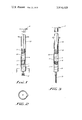
- FIG. 1 is a by-pass type syringe, with the tip cover in place, capable of maintaining, and upon removal of the tip cover and replacement with a needle for injection, administering the aqueous multivitamin preparations according to this invention.
- FIG. 2 is a cross-section across 2-2 in FIG. 1 to more clearly show the by-pass aspect of the syringe of FIG. 1.
- FIG. 3 is a separator valve type of syringe capable of maintaining and administering the aqueous multivitamin preparations according to this invention, with the tip cover removed and a needle for injection in place.
- the aqueous pH 4.5 to 5.5 (vitamin 8,, B etc.) preparation is placed in lower chamber 1, in a conventional manner, and is separately retained or maintained therein by container wall 15 of syringe l9, tip cap 2 and divider plug 3.
- the aqueous pH 6.8 to 7.6 (vitamin C, folic acid, etc.) preparation is placed in upper chamber 4, in a conventional manner, and is separately retained or maintained therein by container wall 16 of syringe l9, divider plug 3 and plunger plug 5.
- the aqueous pH 4.5 to 5.5 (vitamin 8,, B etc.) preparation is placed in lower chamber 8, in a conventional manner, and is separately retained or maintained therein by container wall 17 of syringe 18, needle 10 and separator valve 9.
- the aqueous pH 6.8 to 7.6 (vitamin C, folic acid, etc.) preparation is placed in upper chamber 11, in a conventional manner, and is separately retained or maintained therein by container wall 20 of syringe l8, plunger plug 12 and separator valve 9.
- Separator valve 9 is made of rubber, or the like, with slit l4 centrally located therein which opens under pressure from plunger 13 permitting the contents of upper chamber 11 to pass through slit 14 into lower chamber 8. Slit 14 in separator valve 9 is closed when not under pressure thereby sealing off upper chamber 11 from lower chamber 8.
- intravenous infusion or intramuscular penetration is made with needle 10 in the host, and as plunger 13 of syringe 18 is activated, the host receives an initial injection of the vitamin preparation from lower chamber 8 followed, as plunger 13 moves toward the separator valve 9, and as the contents of lower chamber 8 are emptied, by a consecutive, sequential or serial injection of the vitamin preparation from upper chamber 11.
- the host conveniently receives with a maximum of safety, the total multivitamin content of the syringe in one easy step.
- the concentrations of the vitamins in the two compartments is in part limited by solubility considerations, but is more controlled by therapeutic considerations.
- two components of one milliliter each can provide the therapeutically preferred dose for most patients.
- additional components may be added, or the patient treated with massive doses for a particular syndrome but for general usage the following formulation is preferred for a complete multivitamin preparation:
- Benzyl alcohol is present in both components. Its function as a preservative and local anaesthetic is well recognized.
- the polysorbate 80 and propylene glycol serve to insure solubility of the constituents.
- Ferrous citrate serves to stabilize the vitamin B
- biotin and dexpanthenol may be considered as vitamins, and are advantageously added to insure completeness of the vitamin dosage. Because vitamin deficiencies may be so varied, and because an excess of vitamins are usually so innocuous, it is generally desirable to administer doses large enough to be sure of adequacy, rather than attempt to use minimum dosages.
- a similar preparation may be prepared with the B complex, and omitting vitamins A, D, and E:
- the syringe package should be filled so as to deliver 1 milliliter of each component which, depending on the dead space in the syringe can require from about 1.1 to 1.25 milliliter per component per syringe.
- the solutions are sterilized by sterile filtration techniques, and the syringes are aseptically assembled. Such packaging procedures are conventional in the industry.
- Phase B balamin, dexpanthenol, and a portion of the total amount of niacinamide
- Phase B aqueous solution sterile filtered and filled aseptically into the lower chamber of a syringe such as shown in FIGS. 1 and 3, in a conventional manner, so as to discharge the above amounts per syringe.
- the vitamin C, folic acid and the balance of the total amount of niacinamide (Phase A) are put into aqueous solution, sterile filtered and aseptically filled in the upper chamber of a syringe such as shown in FIGS. 1 and 3, in a conventional manner so as to obtain the above amounts per syringe. All filling is done using sterile techniques.
- the pH of Phase A is a natural pH of from 6.8 to 7.6 and that of Phase B a natural pH of from 4.5 to 5.5.
- Phase A is prepared under an atmosphere of nitrogen.
- Fresh water for injection representing of the final formulation volume is added to a glass or stainless steel container and brought to 60C. with nitrogen sparging.
- the sodium ascorbate is added and dissolved.
- the solution is reduced to room temperature.
- the folic acid and niacinamide are mixed together using only enough water to produce a heavy, homogeneous slurry.
- This slurry is added to the bulk solution and dissolved.
- the benzyl alcohol is added and mixed.
- the solution is brought to final volume with water for injection and possesses a natural pH of from 6.8 to 7.6. It is sterile filtered through an 0.2um membrane into a sterile container under a nitrogen atmosphere.
- Phase B is also prepared under an atmosphere of ni trogen.
- the niacinamide and riboflavin are dissolved in fresh water for injection representing of the final formulation volume.
- the thiamine and pyridoxine are added and dissolved.
- the dexpanthenol is weighed in a container, a small quantity of water is added and the mixture is warmed to 50C. on a steam bath. This mixture is added to the above solution of vitamins.
- the ferrous citrate is added and dissolved by mixing for 30 minutes.
- the cyanocobalamin is added and dissolved.
- the benzyl alcohol is added and mixed for 30 minutes.
- the solution is brought to volume with water for injection and mixed. This mixture possesses a natural pH of 4.5 to 5.5. it is sterile filtered through a 0.22 um membrane into a sterile container under a nitrogen atmosphere.
- EXAMPLE 2 Phase A Per Syringe vitamin A palmitate 10,000 Units vitamin D crystalline 500 Units d-Alpha tocopheryl acetate NF. 30 Units ascorbic acid USP (as sodium salt 300 mg. folic acid U.S.P. 1 mg. niacinamide U.S.P. 20 mg. polysorbate 8O U.S.P. 10% w/v benzyl alcohol a reagent 10 mg. propylene glycol U.S.P. 100 mg. water for injection U.S.P. qs to 1 milliliter Phase B thiamine HCl U.S.P. 10 mg. riboflavin USPtas '-phosphate.
- Phase A and B are prepared and placed in a syringe such as shown in FIGS. 1 and 3.
- the pH of Phase A is a natural pH of from 6.8 to 7.6 and that of Phase B 4.5
- Phase A is prepared under an atmosphere of nitrogen.
- the benzyl alcohol is weighed into a container.
- the vitamin D is added and dissolved.
- the vitamin A and d-alpha tocopheryl are added and mixed.
- the polysorbate 80 is added and the mixture is stirred thoroughly while heating to 50C. on a steam bath. This mixture is added slowly with vigorous stirring to a mixture of propylene glycol and water.
- the sodium ascorbate is added and dissolved. (If turbidity occurs it will clarify later when brought to volume).
- the folic acid and niacinamide are mixed together with small increments of water to provide a thin paste.
- This paste is diluted with additional water and added to the above described vitamin solution.
- the solution is diluted to volume with water for injection and filtered through a sterile 0.2 pm membrane into a sterile container under a nitrogen atmosphere.
- the natural pH of this solution is 6.8 to 7.6.
- Phase B formulation and preparation are exactly as described under Phase B of Example 1.
- the Phase B component is aseptically filled at 1.15 cc into presterilized and siliconized 3 cc syringes, containing tip caps at the needle end. These syringes are then fitted with a center divider plug (slit type, if the syringe does not contain a by-pass valve, or solid type if a bypass valve is present) by passing several (18) at a time held in a filling rack into a vacuum chamber. A sleeve containing the plugs is placed over the syringe rack and, under vacuum, a bar of insertion fingers displaces the plugs into the syringe barrel to a point slightly above the liquid surface.
- a center divider plug slit type, if the syringe does not contain a by-pass valve, or solid type if a bypass valve is present
- the syringes are then recycled through the filling chamber.
- the Phase A component is filled at 1.15 cc into the upper chamber.
- the syringes are vacuum fitted with an upper, threaded plug. (The thread is for plunger rod insertion).
- the syringes are then removed from sterile conditions and packaged.
- the same filling procedure may be conducted without the use of vacuum equipment by employing a hollow needle wire which is placed at the plug edge at the time of plug insertion, allowing the escape of trapped air.
- the syringes are recycled for the second chamber filling and the needle wire is again used to position the upper plug.
- solutions were prepared containing:
- a stable aqueous multivitamin preparation in sterile, storage-stable injectable form in a two compartment hypodermic syringe comprising two incompatible vitamin components each held in a separate compartment of said syringe, one of said components having a pH of 6.8 to 7.6 consisting essentially of:
- vitamin A palmitate 0 10.000 units vitamin D 0 500 units vitamin E 0 30 units ascorbic acid 500 mg. folic acid 0.1 l mg., and niacinamide 2O 25 mg.
- vitamin-ingredients thereof per milliliter as the vitamin-ingredients thereof; in an aqueous carrier.
- niacinamide per milliliter as the vitamin ingredients thereof; in an aqueous carrier having -15 mg. of benzyl alcohol therein; and the other of said components having a pH of 4.5 to 5.5 consisting essentially of:
- aqueous carrier having therein lO-15 mg. of benzyl alcohol and 0.046 mg. of ferrous citrate.
- aqueous carrier having therein 10-15 mg. of benzyl alcohol and 0.046 mg. of ferrous citrate.
Landscapes
- Health & Medical Sciences (AREA)
- Life Sciences & Earth Sciences (AREA)
- Veterinary Medicine (AREA)
- Public Health (AREA)
- General Health & Medical Sciences (AREA)
- Animal Behavior & Ethology (AREA)
- Pharmacology & Pharmacy (AREA)
- Epidemiology (AREA)
- Medicinal Chemistry (AREA)
- Chemical & Material Sciences (AREA)
- Dermatology (AREA)
- Vascular Medicine (AREA)
- Engineering & Computer Science (AREA)
- Anesthesiology (AREA)
- Biomedical Technology (AREA)
- Heart & Thoracic Surgery (AREA)
- Hematology (AREA)
- Medicinal Preparation (AREA)
- Pharmaceuticals Containing Other Organic And Inorganic Compounds (AREA)
Abstract
A stable liquid multivitamin preparation in injectable form contains thiamine (B1), riboflavin (B2), niacinamide, pyridoxine (B6), B12 (cyanocobalamin), and optionally biotin and dexpanthenol in one phase at pH 4.5 to 5.5; and in a second phase, at pH 6.8 to 7.6, sodium ascorbate (C), folic acid, and niacinamide, and optionally Vitamins A, D2 and E so that storage incompatible vitamin components are held in separate compartments of a syringe, in separate phases, for consecutive administration from a two compartment syringe; thereby minimizing loss of potency on storage.
Description
United States Patent [1 1 Haeger et a1.
[4 1 Oct. 21, 1975 Mills; Robert Arnold Nash, Spring Valley, both of NY.
[73] Assignee: American Cyanamid Company,
Stamford, Conn.
[22] Filed: Jan. 10, 1975 [21] Appl. No.: 540,060
Related US. Application Data [63] Continuation-in-part of Ser. No. 384,995, Aug. 2,
1973, abandoned.
[56] References Cited UNITED STATES PATENTS 10/1957 Aterno et a1 424/344 2/1'958 Newark et a1. 424/201 Conine et al. 424/280 2,846,352 8/1958 Bryant 424/280 2,914,446 11/1959 MacDonald 424/280 2,939,821 6/1960 Freedman et al..... 424/280 2,939,829 6/1960 Gerber et al 424/280 2,959,520 11/1960 Kawasiri 424/255 3,168,440 2/1965 Meyer 424/104 3,626,065 12/1971 Maerawa et a1. 424/280 Primary ExaminerNorman A. Drezin Attorney, Agent, or FirmSamuel Branch Walker [57] ABSTRACT A stable liquid multivitamin preparation in injectable form contains thiamine (B riboflavin (B niacinamide, pyridoxine (B B (cyanocobalamin), and 0ptionally biotin and dexpanthenol in one phase at pH 4.5 to 5.5; and in a second phase, at pH 6.8 to 7.6, sodium ascorbate (C), folic acid, and niacinamide, and optionally Vitamins A, D and E so that storage incompatible vitamin components are held in separate compartments of a syringe, in separate phases, for consecutive administration from a two compartment syringe; thereby minimizing loss of potency on storage.
5 Claims, 3 Drawing Figures us. Patent 0ct.2 1,1975 3,914,419
TWO COMPARTMENT ONE UNIT CONSECUTIVELY INJECTABLE LIQUID VITAMIN PACKAGE This application is a continuation-in-part of copending application Ser. No. 384,995, filed Aug. 2, 1973, and now abandoned.
BACKGROUND OF THE INVENTION This invention is concerned with an improved injectable multivitamin package having two storage incompatible liquid mixtures of vitamins separately maintained in sterile injectable condition and capable of being administered consecutively by intramuscular injection. The mixture may also be injected through a rubber stopper into an intravenous feeding bottle without compromising sterility.
Prior to the development of this invention, the commercial means of providing a mixture of vitamins A, B,, 8,, and C and others in an injectable form was to prepare certain of the vitamins in liquid form while the balance of the vitamins were prepared as a dried powder; or as two liquids in separate packages, usually consisting of an ampul and a vial. Just prior to administration, the powder was dissolved in the liquid and the combination was then injected into the host. This cumbersome method was necessitated by the incompatibility of the various vitamin components. If all of these components were combined in one liquid form, the product would be unstable. If the solution pH of certain of the vitamin components was adjusted to alkaline or acid conditions in order to improve stability, the result was a product which caused irritation at the site of injection, or in which at least some of the vitamins were not storage stable.
Now, for the first time, an injectable multivitamin preparation containing vitamins A, B,, 8, and C and others in liquid form has been developed which is stable, non-initating and which, because of its unique mode of maintenance, provides an easy and safe one step method of administering said vitamins.
The advantage of the two component injectable liquid system within one package unit set forth herein, rather than two package injectable units, offers a great convenience to the administrator and danger of con tamination is practically eliminated. Current packaging of a product of this type consists of a two package unit, i.e., vial and ampul or two vials. One unit requires reconstitution with the other or withdrawal from each prior to administration. This is considered tedious and sometimes a dangerous practice. The latter involves possible contamination of sample when a common needle used to withdraw from one unit is also used to withdraw from the second, and the danger of glass fragments when one package unit consists of an ampul.
U.S. Pat. No. 3,626,065, Maekawa and Egawa, is concerned with a stable aqueous multivitamin preparation in which vitamin B, is isolated from vitamins A and C and nicotinamide. This patent points out that it is known that vitamin B,, vitamin C and vitamin A are unstable together in aqueous multivitamin preparations. U.S. Pat. No. 3,626,065 states that vitamins B, and C are stable against hydrolysis in different pH regions, below pH 4.0 for vitamin B, and pH 5.0 to 7.0 for vitamin C.
The U.S. Pat. No. 3,626,065 notes that, in general, the pH of the aqueous multivitamin preparations on the market is adjusted to stabilize either vitamin B, or C, or alternatively, the pH is maintained at pH 4.0-5.0. These methods are unsatisfactory since the former sacrifices one or more vitamins to a specific vitamin and the latter is only a compromise.
Said U.S. Pat. No. 3,626,065 is concerned with a stable aqueous multivitamin preparation stored in a two compartment bottle-type container wherein the two liquid vitamins, vitamin B, containing and vitamin A, C, and nicotinamide containing, are admixed together before use. According to said U.S. Pat. No. 3,626,065, the pH of the vitamin A, C, and nicotinamide preparation is maintained at about pH 6, and the pH of the vitamin B, preparation below pH 4, at about pH 3.0. Said U.S. Pat. No. 3,626,065 does not disclose consecutive or serial injection of the two separately held vitamin preparations into a host. It is concerned solely with storage and admixture immediately prior to use. Moreover, as will be pointed out herein, the pH of the vitamin B, preparation of the present invention is maintained at a pH above 4 in contrast to the U.S. Pat. No. 3,626,065 disclosure of below pH 4.0 (Col. 1, line 32) and at about pH 3.0 (Col. 4, Line 69).
Numerous patents are concerned with and point up the problem of maintaining stable liquid vitamin preparations, for example, U.S. Pat. Nos. 2,939,821; 2,846,352; 2,939,820; 3,168,440: 2,823,167; 2,835,627; 2,914,446; and 2,959,520. However, no art is known which discloses the claimed aqueous multivitamin package or its claimed method of administration.
SUMMARY OF THE INVENTION The invention here lies in the concept of an injectable, two compartment, one unit, liquid-liquid preparation of vitamins A, 8,, 8, and C and others, maintained separately because of incompatibility and capable of being administered to a host in one step.
Thiamine (B,), riboflavin (B niacinamide, pyridoxine (B 13, (cyanocobalamin), and optionally biotin and dexpanthenol are dissolved in a clear aqueous solution in one phase at a pH of 4.5 to 5.5. In a second phase, at pH 6.8 to 7.6, sodium ascorbate (C), folic acid, and niacinamide, and optionally Vitamins A, D and E are similarly dissolved in a clear aqueous solution. These solutions are consecutively placed, in a conventional manner, in a two compartment syringe, the pH 4.5 to 5.5 phase in one compartment and the pH 6.8 to 7.6 in the other compartment, The purpose of the two compartment syringe is to consecutively, se quentially or serially deliver the two incompatible vita min preparations which have been separated until the moment of administration.
Surprisingly, at these pH values, the cyanocobalamin (8, and the thiamine (B,) are both sufficiently stable for satisfactory shelf life. As taught by Maekawa, et al., the thiamine would be more stable at a more acid pH, but the 13, would be less stable. A small amount of ferrous citrate may be used to control oxidationreduction so as to permit storage stability.
Because vitamins are characteristically very reactive under body conditions, and catalyze reactions in the host, it is to be expected that they can react with each other and other components, so the formulation of compatible storage stable compositions containing as many different vitamins as can be packaged together has been the subject of much research in the industry.
The type of two compartment syringe is not critical so long as it is capable of maintaining the two liquids separately and administering the two liquids consecutively, sequentially or serially. Suitable two compartment syringes are the two compartment syringe with a conventional by-pass valve such as is manufactured by Becton-Dickenson. Another suitable two compartment syringe is that with a separator valve such as those sold by Century Laboratories, Inc., Turnersville, New Jersey.
Two componentsyringes with a by-pass are shown in Brown, US. Pat. No. 2,7l7,60l, Sept. '13, 1955 and Visser, et al., US. Pat. No. 3,330,282, July II, 1967. A valved free piston in a two-compartment syringe is shown by McConnaughey and Cohen, US. Pat. No. 3,091,240, May 28, 1963.
One aspect of the present invention is a stable aqueous multivitamin preparation consisting of two incompatible aqueous vitamin preparations each held in a separate compartment of a two compartment syringe capable of consecutively, or sequentially or serially injecting said preparations into a host, one of which is at a pH of 6.8 to 7.6 containing vitamin A, D, E, C, niacinamide and folic acid; and the other of which is at a pH above 4.5 to 5.5 containing vitamins B,, B B 8, dexpanthenol and niacinamide.
A further aspect of the present invention is the method of administering the above aqueous vitamin preparations to a host serially through a single needle at a single injection.
BRIEF DESCRIPTION OF THE DRAWING The advantages of the invention as well as specific embodiments and use thereof may be seen by referring to the following description and the accompanying drawing, in which:
FIG. 1 is a by-pass type syringe, with the tip cover in place, capable of maintaining, and upon removal of the tip cover and replacement with a needle for injection, administering the aqueous multivitamin preparations according to this invention.
FIG. 2 is a cross-section across 2-2 in FIG. 1 to more clearly show the by-pass aspect of the syringe of FIG. 1.
FIG. 3 is a separator valve type of syringe capable of maintaining and administering the aqueous multivitamin preparations according to this invention, with the tip cover removed and a needle for injection in place.
DESCRIPTION OF THE INVENTION With reference to FIG. 1, the aqueous pH 4.5 to 5.5 (vitamin 8,, B etc.) preparation is placed in lower chamber 1, in a conventional manner, and is separately retained or maintained therein by container wall 15 of syringe l9, tip cap 2 and divider plug 3. The aqueous pH 6.8 to 7.6 (vitamin C, folic acid, etc.) preparation is placed in upper chamber 4, in a conventional manner, and is separately retained or maintained therein by container wall 16 of syringe l9, divider plug 3 and plunger plug 5.
To use the unit shown by FIG. 1, rubber tip cap 2 is removed, a sterile needle for injection is attached, intravenous infusion or intramuscular penetration is made in the host, and as plunger 6 of syringe 19 is activated, the host receives an initial injection of the vitamin B,, B etc. preparation from lower chamber 1 followed, as divider plug 3 reaches by-pass valve 7, by a consecutive or sequential or serial injection of the vitamin C, folic acid etc. preparation from upper chamber 4. In such a manner the host conveniently receives, with a maximum of safety, the entire multivitamin preparation contents of the syringe in one step. The storage-incompatible vitamin components, which cause stability problems, are maintained separately and yet the administration of the total vitamin content can be made without irritation to the host in one easy step, obviating the need for mixing components prior to administration.
The order of the multivitamin preparations can be reversed in the two chambers without departing from the scope of the invention.
By serially injecting, the components are injected into a subject at the time any mixing occurs, or for intravenous feeding, are diluted into the intravenous bottle, so as to minimize intraction. In a package system which requires mixing before administration, there is always a chance that the user will mix the components and keep the mixture an undesirably long time. With sequential injection, this misuse by the ultimate user is prevented.
With reference to FIG. 3, the aqueous pH 4.5 to 5.5 (vitamin 8,, B etc.) preparation is placed in lower chamber 8, in a conventional manner, and is separately retained or maintained therein by container wall 17 of syringe 18, needle 10 and separator valve 9. The aqueous pH 6.8 to 7.6 (vitamin C, folic acid, etc.) preparation is placed in upper chamber 11, in a conventional manner, and is separately retained or maintained therein by container wall 20 of syringe l8, plunger plug 12 and separator valve 9. Separator valve 9 is made of rubber, or the like, with slit l4 centrally located therein which opens under pressure from plunger 13 permitting the contents of upper chamber 11 to pass through slit 14 into lower chamber 8. Slit 14 in separator valve 9 is closed when not under pressure thereby sealing off upper chamber 11 from lower chamber 8.
To use the unit shown in FIG. 3, intravenous infusion or intramuscular penetration is made with needle 10 in the host, and as plunger 13 of syringe 18 is activated, the host receives an initial injection of the vitamin preparation from lower chamber 8 followed, as plunger 13 moves toward the separator valve 9, and as the contents of lower chamber 8 are emptied, by a consecutive, sequential or serial injection of the vitamin preparation from upper chamber 11. Thus, again, in such a manner the host conveniently receives with a maximum of safety, the total multivitamin content of the syringe in one easy step.
Here again, the order of the multivitamin preparations can be reversed in the two chambers.
The concentrations of the vitamins in the two compartments is in part limited by solubility considerations, but is more controlled by therapeutic considerations. In general, two components of one milliliter each can provide the therapeutically preferred dose for most patients. For special deficiencies, either additional components may be added, or the patient treated with massive doses for a particular syndrome but for general usage the following formulation is preferred for a complete multivitamin preparation:
COMPLETE MULTIVITAMIN FORMULA FOR PARENTERAL ADMINISTRATION Per syringe of Phase A l milliliter vitamin A (as palmitate) 2500 l0.000 units vitamin D crystalline 200 500 units vitamin E 3 30 units ascorbic acid USP as sodium salt)(C) 90 500 units folic acid U.S.P. 0.1 l.0 mg. niacinamide U.S.P. 20 35 mg. polysorbate 80 U.S.P. 50 100 mg. benzyl alcohol reagent l5 mg. propylene glycol 50 100 mg. water for injection U.S.P. qs
to pH 6.8 to 7.6 100% Per syringe of Phase 8 l milliliter thiamine (as HCl U.S.P.) (8,) l 10 mg. riboflavin USP(as 5- phosphate, sodium, 70%) (B 1 10 mg. niacinamide U.S.P. 55 65 mg. pyridoxine (as HCl U.S.P.)
(B 1 mg. cyanocobalamin U.S.P. 5 25 mcg. biotin 0 100 mcg. dexpanthenol 0 l0 mg. ferrous citrate reagent 0.046 mg. benzyl alcohol reagent l0 15 mg. water for injection U.S.P.
qs to pH 4.5 to 5.5 100% Benzyl alcohol is present in both components. Its function as a preservative and local anaesthetic is well recognized. The polysorbate 80 and propylene glycol serve to insure solubility of the constituents. Ferrous citrate serves to stabilize the vitamin B Both biotin and dexpanthenol (D-pantothenyl alcohol) may be considered as vitamins, and are advantageously added to insure completeness of the vitamin dosage. Because vitamin deficiencies may be so varied, and because an excess of vitamins are usually so innocuous, it is generally desirable to administer doses large enough to be sure of adequacy, rather than attempt to use minimum dosages.
A similar preparation may be prepared with the B complex, and omitting vitamins A, D, and E:
B COMPLEX Per syringe of Phase A l milliliter ascorbic acid U.S.P.(as
sodium salt) (C) 90 500 mg. folic acid U.S.P. v 0.l 1.0 mg. niacinamide U.S.P. 35 mg. benzyl alcohol reagent l0 15 mg. water for injection U.S.P. qs
to pH 6.8 to 7.6 100% Per syringe of Phase B l milliliter thiamine (as HCl U.S.P.)(B,) l [0 mg. riboflavin USP(as 5'- phosphate, sodium 70%) (B l 10 mg. niacinamideU.S.P. 55 65 mg. pyridoxine (as HCI U.S.P.)
(B 1 l5 mg. cyanocobalamin U.S.P.(B, 5 mcg. biotin 1 O 100 mcg. dexpanthenol 0 l0 mg. ferrous citrate reagent 0.046 mg. benzyl alcohol reagent vl0 l5 mg. water for injection U.S.P.
qs to pH 4.5 to 5.5 I00% In filling these formulations, an overage should be provided. That is, the syringe package should be filled so as to deliver 1 milliliter of each component which, depending on the dead space in the syringe can require from about 1.1 to 1.25 milliliter per component per syringe. Preferably, the solutions are sterilized by sterile filtration techniques, and the syringes are aseptically assembled. Such packaging procedures are conventional in the industry.
The invention is illustrated by the following examples:
balamin, dexpanthenol, and a portion of the total amount of niacinamide (Phase B) are put into aqueous solution sterile filtered and filled aseptically into the lower chamber of a syringe such as shown in FIGS. 1 and 3, in a conventional manner, so as to discharge the above amounts per syringe. The vitamin C, folic acid and the balance of the total amount of niacinamide (Phase A) are put into aqueous solution, sterile filtered and aseptically filled in the upper chamber of a syringe such as shown in FIGS. 1 and 3, in a conventional manner so as to obtain the above amounts per syringe. All filling is done using sterile techniques. The pH of Phase A is a natural pH of from 6.8 to 7.6 and that of Phase B a natural pH of from 4.5 to 5.5.
In detail, Phase A is prepared under an atmosphere of nitrogen. Fresh water for injection representing of the final formulation volume is added to a glass or stainless steel container and brought to 60C. with nitrogen sparging. The sodium ascorbate is added and dissolved. The solution is reduced to room temperature. The folic acid and niacinamide are mixed together using only enough water to produce a heavy, homogeneous slurry. This slurry is added to the bulk solution and dissolved. The benzyl alcohol is added and mixed. The solution is brought to final volume with water for injection and possesses a natural pH of from 6.8 to 7.6. It is sterile filtered through an 0.2um membrane into a sterile container under a nitrogen atmosphere.
Phase B is also prepared under an atmosphere of ni trogen. The niacinamide and riboflavin are dissolved in fresh water for injection representing of the final formulation volume. The thiamine and pyridoxine are added and dissolved. The dexpanthenol is weighed in a container, a small quantity of water is added and the mixture is warmed to 50C. on a steam bath. This mixture is added to the above solution of vitamins. The ferrous citrate is added and dissolved by mixing for 30 minutes. The cyanocobalamin is added and dissolved. The benzyl alcohol is added and mixed for 30 minutes. The solution is brought to volume with water for injection and mixed. This mixture possesses a natural pH of 4.5 to 5.5. it is sterile filtered through a 0.22 um membrane into a sterile container under a nitrogen atmosphere.
EXAMPLE 2 Phase A Per Syringe vitamin A palmitate 10,000 Units vitamin D crystalline 500 Units d-Alpha tocopheryl acetate NF. 30 Units ascorbic acid USP (as sodium salt 300 mg. folic acid U.S.P. 1 mg. niacinamide U.S.P. 20 mg. polysorbate 8O U.S.P. 10% w/v benzyl alcohol a reagent 10 mg. propylene glycol U.S.P. 100 mg. water for injection U.S.P. qs to 1 milliliter Phase B thiamine HCl U.S.P. 10 mg. riboflavin USPtas '-phosphate.
sodium, 70%) (B mg. niacinamide U.S.P. 55 mg. dexpanthenol 10 mg. pyridoxine HCI U.S.P. mg. cyanocobalamin U.S.P. 15 mcg. ferrous citrate reagent 0.046 mg. benzyl alcohol reagent 10 mg. water for injection U.S.P. qs to l milliliter In a conventional manner similar to that of Example 1, Phase A and B are prepared and placed in a syringe such as shown in FIGS. 1 and 3. The pH of Phase A is a natural pH of from 6.8 to 7.6 and that of Phase B 4.5
In detail, Phase A is prepared under an atmosphere of nitrogen. The benzyl alcohol is weighed into a container. The vitamin D is added and dissolved. The vitamin A and d-alpha tocopheryl are added and mixed. The polysorbate 80 is added and the mixture is stirred thoroughly while heating to 50C. on a steam bath. This mixture is added slowly with vigorous stirring to a mixture of propylene glycol and water. The sodium ascorbate is added and dissolved. (If turbidity occurs it will clarify later when brought to volume). The folic acid and niacinamide are mixed together with small increments of water to provide a thin paste. This paste is diluted with additional water and added to the above described vitamin solution. The solution is diluted to volume with water for injection and filtered through a sterile 0.2 pm membrane into a sterile container under a nitrogen atmosphere. The natural pH of this solution is 6.8 to 7.6.
Phase B formulation and preparation are exactly as described under Phase B of Example 1.
Following is a brief description of the filling process. The Phase B component is aseptically filled at 1.15 cc into presterilized and siliconized 3 cc syringes, containing tip caps at the needle end. These syringes are then fitted with a center divider plug (slit type, if the syringe does not contain a by-pass valve, or solid type if a bypass valve is present) by passing several (18) at a time held in a filling rack into a vacuum chamber. A sleeve containing the plugs is placed over the syringe rack and, under vacuum, a bar of insertion fingers displaces the plugs into the syringe barrel to a point slightly above the liquid surface. Vacuum pulls the plugs to or close to the liquid surface. The syringes are then recycled through the filling chamber. The Phase A component is filled at 1.15 cc into the upper chamber. The syringes are vacuum fitted with an upper, threaded plug. (The thread is for plunger rod insertion). The syringes are then removed from sterile conditions and packaged.
The same filling procedure may be conducted without the use of vacuum equipment by employing a hollow needle wire which is placed at the plug edge at the time of plug insertion, allowing the escape of trapped air. The syringes are recycled for the second chamber filling and the needle wire is again used to position the upper plug.
As illustrative of the storage characteristics of the present compositions, solutions were prepared containing:
The solution was separated into seven equal portions of approximately 400 ml each in 500 ml glass stoppered graduated cylinders under nitrogen. The pH of each fraction was adjusted as follows:
Fraction Final pH ingredient Employed A 4.52 none (no adjustment) B 4.0 10.6 ml of 10% HCI C 3.5 26.8 ml of 10% HCl D 3.0 48.8 ml of 10% HO E 4.0 5.1 ml of lactic acid F 3.5 22.7 ml of lactic acid G 3.0 66 ml of lactic acid of physical instability (precipitation, discoloration) prior to determining potency stability through appropriate assay means. Samples from solution D, in syringes and vials, precipitated but were assayed for Vitamins B B B and B nevertheless. The results appear in Tables I, II and III:
Table I Physical Stability in Vials and Syringes Storage Conditions Solutions Adjusted w/HCl Solutions Adjusted w/Lactic Acid Time Temperature A(pH 4.5) M40) C(3.5) D(3.0) E(4.0) F(3.5) G(3.0)
1 Week 42C. D L" LT PPT L D D RT" NC NC NC PPT NC NC NC 3C. NC NC NC PPT NC NC NC 2 Weeks 42C. D L LT PPT D D D RT NC NC NC PPT NC NC NC 3C. NC NC NC PPT NC NC NC 4 Weeks 42C. D L LT PPT D D D RT NC NC NC PPT NC NC NC 3C. NC NC NC PPT NC NC NC 8 Weeks 42C. D L LT PPT D D D RT NC NC NC PPT NC NC i NC 3C. NC NC NC PPT NC NC NC "D dark solution "L lighter solution than D LT lightest solution (lighter than L) PPT precipitate 'RT room temperature NC no change Color fading is a sign of instability. Solution C(pH 3.5) precipitated when ejected from syringes in 8 week room temperature sample, and, hence, was unsatisfactory.
Table II Stability in Vials as Percent of Initial After Storage for 1 Month at 42C.
Vitamin Potency in Solution pH B, B 5 12 A 4.52 9l 102 l02 92 B 4.0 96 102 97 92 C 3.5 99 I02 l05 78 D 3.0 99 98 I 93 E 4.0 92 99 97 91 F 3.5 91 100 103 83 G 3.0 90 103 I 68 Table Ill Stability in Syringes as Percent of Initial After Storage for 4 Month at Room Temperature Vitamin Potency in 7:
Solution pH B, B B B A 4.52 97 101 97 97 B 4.0 98 102 99 96 C 3.5 99 I00 98 93 D 3.0 PPT" PPT PPT PPT E 4.0 97 100 99 95 F 3.5 98 I02 99 86 G 3.0 98 I02 98 76 "PPT precipitate -mins B,, B and B but losses in Vitamin B potency were observed when solutions were adjusted to pH values below 4. This degradation was accelerated by the presence of lactic acid, an organic acidulant.
Even though there is some loss of stability of B at the pH of 4.52, this pH permits stability of Vitamin B The storage-stability of multivitamin preparation must be based on a series of compromises, and the present packages are uniquely satisfactory.
What is claimed:
1. A stable aqueous multivitamin preparation in sterile, storage-stable injectable form in a two compartment hypodermic syringe comprising two incompatible vitamin components each held in a separate compartment of said syringe, one of said components having a pH of 6.8 to 7.6 consisting essentially of:
vitamin A palmitate 0 10.000 units vitamin D 0 500 units vitamin E 0 30 units ascorbic acid 500 mg. folic acid 0.1 l mg., and niacinamide 2O 25 mg.
per milliliter as the vitamin ingredients thereof; in an aqueous carrier; and the other of said components having a pH of 4.5 to 5.5 consisting essentially of:
thiamine hydrochloride 1 10 mg. riboflavin l 10 mg. niacinamide 55 65 mg. pyridoxine hydrochloride 1 l5 mg. cyanocobalamin 5 25 mcg. dexpanthenol 0 10 mg.. and biotin 0 mcg.
per milliliter as the vitamin ingredients thereof, in an aqueous carrier.
2. The preparation of claim 1 in which the component having a pH of 6.8 to 7.6 consists essentially of:
ascorbic acid 90 500 mg. folic acid 0.1 l mg. and niacinamide 20 35 mg.
per milliliter as the vitamin ingredients thereof; in an aqueous carrier.
3. The preparation of claim 1 in which the component having a pH of 6.8 to 7.6 consists essentially of:
vitamin A palmitate 2500 10,000 units vitamin D 200 500 units vitamin E 3 30 units ascorbic acid 90 500 mg. I folic acid 0.1 l Rigahtl niacinamide 20 35 mg.
per milliliter as the vitamin-ingredients thereof; in an aqueous carrier.
4. The preparation of claim 1 in which the component having a pH of 6.8 to 7.6 consists essentially of:
1 mg, and 20 mg.
niacinamide per milliliter as the vitamin ingredients thereof; in an aqueous carrier having -15 mg. of benzyl alcohol therein; and the other of said components having a pH of 4.5 to 5.5 consisting essentially of:
thiamine hydrochloride 10 mg. riboflavin 10 mg. niacinamide 55 mg. dexpanthenol 10 mg. pyridoxine hydrochloride 15 mg. and cyanocobalamin 15 mcg.
per milliliter as the vitamin ingredients thereof, in an aqueous carrier having therein lO-15 mg. of benzyl alcohol and 0.046 mg. of ferrous citrate.
5. The preparation of claim 1 in which the comp0- nent having a pH of 6.8 to 7.6 consists essentially of:
vitamin A palmitate 10,000 units vitamin D 500 units vitamin E 30 units ascorbic acid 300 mg. folic acid 1 mg.v and niacinamide 20 mg.
thiamine hydrochloride 10 mg. riboflavin 10 mg. niacinamide 55 mg. dexpanthenol l0 mg. pyridoxine hydrochloride 15 mg.. and cyanocobalamin 15 mcg.
per milliliter as the vitamin ingredients thereof, in an aqueous carrier having therein 10-15 mg. of benzyl alcohol and 0.046 mg. of ferrous citrate.
l l l
Claims (5)
1. A STABLE AQUEOUS MULTIVITAMIN PREPARATION IN STERILE, STORAGE-STABLE INJECTABLE FORM IN A TWO COMPARTMENT HYPODERMIC SYRINGE COMPRISING TWO INCOMPATIBLE VITAMIN COMPONENTS EACH HELD IN A SEPARATE COMPARTMENT OF SAID SYRINGE, ONE OF SAID COMPONENTS HAVING A PH OF 6.8 TO 7.6 CONSISTING ESSENTIALLY OF:
2. The preparation of claim 1 in which the component having a pH of 6.8 to 7.6 consists essentially of:
3. The preparation of claim 1 in which the component having a pH of 6.8 to 7.6 consists essentially of:
4. The preparation of claim 1 in which the component having a pH of 6.8 to 7.6 consists essentially of:
5. The preparation of claim 1 in which the component having a pH of 6.8 to 7.6 consists essentially of:
Priority Applications (1)
| Application Number | Priority Date | Filing Date | Title |
|---|---|---|---|
| US540060A US3914419A (en) | 1973-08-02 | 1975-01-10 | Two compartment one unit consecutively injectable liquid vitamin package |
Applications Claiming Priority (2)
| Application Number | Priority Date | Filing Date | Title |
|---|---|---|---|
| US38499573A | 1973-08-02 | 1973-08-02 | |
| US540060A US3914419A (en) | 1973-08-02 | 1975-01-10 | Two compartment one unit consecutively injectable liquid vitamin package |
Publications (1)
| Publication Number | Publication Date |
|---|---|
| US3914419A true US3914419A (en) | 1975-10-21 |
Family
ID=27010845
Family Applications (1)
| Application Number | Title | Priority Date | Filing Date |
|---|---|---|---|
| US540060A Expired - Lifetime US3914419A (en) | 1973-08-02 | 1975-01-10 | Two compartment one unit consecutively injectable liquid vitamin package |
Country Status (1)
| Country | Link |
|---|---|
| US (1) | US3914419A (en) |
Cited By (19)
| Publication number | Priority date | Publication date | Assignee | Title |
|---|---|---|---|---|
| EP0072057A1 (en) * | 1981-08-10 | 1983-02-16 | Duphar International Research B.V | Automatic injection syringe |
| US4740373A (en) * | 1986-05-27 | 1988-04-26 | Usv Pharmaceutical Corporation | Stabilization of multivitamin/trace elements formulations |
| US4804535A (en) * | 1986-05-27 | 1989-02-14 | Rorer Pharmaceutical Corporation | Stabilization of multivitamin/trace elements formulations |
| US4822340A (en) * | 1985-10-11 | 1989-04-18 | Duphar International Research B.V. | Automatic injector |
| US4931442A (en) * | 1987-12-07 | 1990-06-05 | Holger Blum | Stabilized aqueous folic acid preparation |
| US4994043A (en) * | 1987-06-16 | 1991-02-19 | Akzo N.V. | Two compartment syringe |
| US6274170B1 (en) | 1999-02-18 | 2001-08-14 | Richard Heibel | Compounds for cardiovascular treatment comprising multi-vitamin and anti-platelet aggregating agents and methods for making and using the same |
| WO2001070044A1 (en) * | 2000-03-24 | 2001-09-27 | Aventis Animal Nutrition S.A. | Liquid vitamin composition |
| WO2003090822A1 (en) * | 2002-04-24 | 2003-11-06 | Ares Trading Sa | Device for preparing a medicinal liquid and method for preserving a solution of medicament for injection |
| US20080124397A1 (en) * | 1999-12-29 | 2008-05-29 | Regeneration Technologies, Inc. | System For Reconstituting Pastes And Methods Of Using Same |
| CN102068453A (en) * | 2009-11-23 | 2011-05-25 | 北京京卫信康医药科技发展有限公司 | Stable complex vitamin composite and preparation method thereof |
| US20130116657A1 (en) * | 2004-02-02 | 2013-05-09 | Bimeda Research & Development Limited | Method and device |
| GB2499612A (en) * | 2012-02-22 | 2013-08-28 | Consort Medical Plc | Syringe assembly with a stopper |
| RU2589824C1 (en) * | 2014-12-26 | 2016-07-10 | Общество С Ограниченной Ответственностью "Валента-Интеллект" | Injectable composition based on group b vitamins and lidocaine |
| EA026056B1 (en) * | 2014-12-26 | 2017-02-28 | Общество С Ограниченной Ответственностью "Валента-Интеллект" | Injectable composition based on group b vitamins and lidocaine |
| AU2013255887B2 (en) * | 2012-05-02 | 2017-03-23 | Dsm Ip Assets B.V. | Aqueous, sterile vitamin formulation |
| CN108601898A (en) * | 2016-02-05 | 2018-09-28 | 豪夫迈·罗氏有限公司 | Injection syringe with multi-cavity chamber unit |
| US10259635B2 (en) | 2014-11-28 | 2019-04-16 | Sulzer Mixpac Ag | Apparatus and methods for storing and mixing separate substances |
| AU2024204291B2 (en) * | 2023-09-28 | 2025-08-14 | Paul O'keeffe | Dual chamber syringe for staged injections |
Citations (10)
| Publication number | Priority date | Publication date | Assignee | Title |
|---|---|---|---|---|
| US2811483A (en) * | 1954-12-09 | 1957-10-29 | Pfizer & Co C | Pharmaceutical composition and process for preparing the same |
| US2823167A (en) * | 1955-03-29 | 1958-02-11 | Vitarine Co Inc | Stable vitamin b12-containing solution |
| US2835627A (en) * | 1957-07-05 | 1958-05-20 | Lilly Co Eli | Stable vitamin b12 solutions |
| US2846352A (en) * | 1953-12-10 | 1958-08-05 | Parke Davis & Co | Vitamin compositions and method for producing the same |
| US2914446A (en) * | 1958-06-26 | 1959-11-24 | Upjohn Co | Nitrite stabilized ascorbic acid-cyanocobalamin compositions |
| US2939821A (en) * | 1959-09-21 | 1960-06-07 | U S Vitamin And Pharmaceutical | Stable solutions containing vitamin b12 |
| US2939829A (en) * | 1958-01-15 | 1960-06-07 | Kaiser Aluminium Chem Corp | Electrolytic cell |
| US2959520A (en) * | 1958-04-07 | 1960-11-08 | Takeda Pharmaceutical | Stabilized aqueous solution of vitamin b complex containing cyanocobalamin and thiocyanates |
| US3168440A (en) * | 1954-06-09 | 1965-02-02 | Upjohn Co | Stable vitamin composition |
| US3626065A (en) * | 1967-05-25 | 1971-12-07 | Shionogi & Co | Stable aqueous multivitamin preparations |
-
1975
- 1975-01-10 US US540060A patent/US3914419A/en not_active Expired - Lifetime
Patent Citations (10)
| Publication number | Priority date | Publication date | Assignee | Title |
|---|---|---|---|---|
| US2846352A (en) * | 1953-12-10 | 1958-08-05 | Parke Davis & Co | Vitamin compositions and method for producing the same |
| US3168440A (en) * | 1954-06-09 | 1965-02-02 | Upjohn Co | Stable vitamin composition |
| US2811483A (en) * | 1954-12-09 | 1957-10-29 | Pfizer & Co C | Pharmaceutical composition and process for preparing the same |
| US2823167A (en) * | 1955-03-29 | 1958-02-11 | Vitarine Co Inc | Stable vitamin b12-containing solution |
| US2835627A (en) * | 1957-07-05 | 1958-05-20 | Lilly Co Eli | Stable vitamin b12 solutions |
| US2939829A (en) * | 1958-01-15 | 1960-06-07 | Kaiser Aluminium Chem Corp | Electrolytic cell |
| US2959520A (en) * | 1958-04-07 | 1960-11-08 | Takeda Pharmaceutical | Stabilized aqueous solution of vitamin b complex containing cyanocobalamin and thiocyanates |
| US2914446A (en) * | 1958-06-26 | 1959-11-24 | Upjohn Co | Nitrite stabilized ascorbic acid-cyanocobalamin compositions |
| US2939821A (en) * | 1959-09-21 | 1960-06-07 | U S Vitamin And Pharmaceutical | Stable solutions containing vitamin b12 |
| US3626065A (en) * | 1967-05-25 | 1971-12-07 | Shionogi & Co | Stable aqueous multivitamin preparations |
Cited By (31)
| Publication number | Priority date | Publication date | Assignee | Title |
|---|---|---|---|---|
| EP0072057A1 (en) * | 1981-08-10 | 1983-02-16 | Duphar International Research B.V | Automatic injection syringe |
| US4529403A (en) * | 1981-08-10 | 1985-07-16 | Duphar International Research B.V. | Automatic injection syringe |
| US4573971A (en) * | 1981-08-10 | 1986-03-04 | Duphar International Research B.V. | Automatic injection device |
| US4822340A (en) * | 1985-10-11 | 1989-04-18 | Duphar International Research B.V. | Automatic injector |
| US4740373A (en) * | 1986-05-27 | 1988-04-26 | Usv Pharmaceutical Corporation | Stabilization of multivitamin/trace elements formulations |
| US4804535A (en) * | 1986-05-27 | 1989-02-14 | Rorer Pharmaceutical Corporation | Stabilization of multivitamin/trace elements formulations |
| US4994043A (en) * | 1987-06-16 | 1991-02-19 | Akzo N.V. | Two compartment syringe |
| US4931442A (en) * | 1987-12-07 | 1990-06-05 | Holger Blum | Stabilized aqueous folic acid preparation |
| US6274170B1 (en) | 1999-02-18 | 2001-08-14 | Richard Heibel | Compounds for cardiovascular treatment comprising multi-vitamin and anti-platelet aggregating agents and methods for making and using the same |
| US20080124397A1 (en) * | 1999-12-29 | 2008-05-29 | Regeneration Technologies, Inc. | System For Reconstituting Pastes And Methods Of Using Same |
| US7824702B2 (en) | 1999-12-29 | 2010-11-02 | Rti Biologics, Inc. | Composition for making a bone paste |
| US20040018217A1 (en) * | 2000-03-24 | 2004-01-29 | Crepeau Michel Andre | Liquid vitamin composition |
| US6852332B2 (en) * | 2000-03-24 | 2005-02-08 | Adisseo France S.A.S. | Liquid vitamin composition |
| WO2001070044A1 (en) * | 2000-03-24 | 2001-09-27 | Aventis Animal Nutrition S.A. | Liquid vitamin composition |
| US20050113747A1 (en) * | 2002-04-24 | 2005-05-26 | Andrew Moir | Device for preparing a medicinal liquid and method for preserving a solution of medicament for injection |
| US7462164B2 (en) | 2002-04-24 | 2008-12-09 | Ares Trading S.A. | Device for preparing a medicinal liquid and method for preserving a solution of medicament for injection |
| AU2003206609B2 (en) * | 2002-04-24 | 2008-12-11 | Ares Trading Sa | Device for preparing a medicinal liquid and method for preserving a solution of medicament for injection |
| WO2003090822A1 (en) * | 2002-04-24 | 2003-11-06 | Ares Trading Sa | Device for preparing a medicinal liquid and method for preserving a solution of medicament for injection |
| US9180249B2 (en) * | 2004-02-02 | 2015-11-10 | Bimeda Research & Development Limited | Method and device |
| US20130116657A1 (en) * | 2004-02-02 | 2013-05-09 | Bimeda Research & Development Limited | Method and device |
| CN102068453A (en) * | 2009-11-23 | 2011-05-25 | 北京京卫信康医药科技发展有限公司 | Stable complex vitamin composite and preparation method thereof |
| GB2499612A (en) * | 2012-02-22 | 2013-08-28 | Consort Medical Plc | Syringe assembly with a stopper |
| US9962492B2 (en) | 2012-02-22 | 2018-05-08 | Consort Medical Plc | Syringe assembly |
| AU2013255887B2 (en) * | 2012-05-02 | 2017-03-23 | Dsm Ip Assets B.V. | Aqueous, sterile vitamin formulation |
| US10259635B2 (en) | 2014-11-28 | 2019-04-16 | Sulzer Mixpac Ag | Apparatus and methods for storing and mixing separate substances |
| RU2589824C1 (en) * | 2014-12-26 | 2016-07-10 | Общество С Ограниченной Ответственностью "Валента-Интеллект" | Injectable composition based on group b vitamins and lidocaine |
| EA026056B1 (en) * | 2014-12-26 | 2017-02-28 | Общество С Ограниченной Ответственностью "Валента-Интеллект" | Injectable composition based on group b vitamins and lidocaine |
| CN108601898A (en) * | 2016-02-05 | 2018-09-28 | 豪夫迈·罗氏有限公司 | Injection syringe with multi-cavity chamber unit |
| US20190038836A1 (en) * | 2016-02-05 | 2019-02-07 | Hoffmann-La Roche Inc. | Multi chamber syringe unit |
| US11357914B2 (en) * | 2016-02-05 | 2022-06-14 | Hoffmann-La Roche Inc. | Multi chamber syringe unit |
| AU2024204291B2 (en) * | 2023-09-28 | 2025-08-14 | Paul O'keeffe | Dual chamber syringe for staged injections |
Similar Documents
| Publication | Publication Date | Title |
|---|---|---|
| US11944629B2 (en) | Concentrated methotrexate solutions | |
| RU97104030A (en) | PHARMACEUTALLY STABLE DRUG OF OXALIPLATIN | |
| EA008308B1 (en) | Liquid stabilized protein formulations in coated pharmaceutical containers | |
| EP3624829B1 (en) | Octreotide injection | |
| US4654345A (en) | Occular formulation comprising bromocriptine | |
| US4477452A (en) | Composition of matter comprising a lyophilized preparation of a penicillin derivative | |
| EP2662073B1 (en) | Octreotide Injection | |
| US4534977A (en) | Composition of matter comprising a low bulk density lyophilized preparation of Sodium Piperacillin | |
| CA1269205A (en) | Adsorption-resistant peptide composition | |
| CN112402371B (en) | Rudesiwei injection and preparation method thereof | |
| MXPA06007208A (en) | Pharmaceutical composition of vinflunine which is intended for parenteral administration preparation method thereof and use of same. | |
| IE790194L (en) | Pharmaceutical formulation | |
| CA1209477A (en) | Composition of matter comprising a lyophilized preparation of a penicillin derivative | |
| GB2029700A (en) | Etomidate-containing compositions | |
| US4058213A (en) | Low temperature vapor phase sterilization and storage of biologically active injectable materials | |
| RU2236227C1 (en) | Stable pharmaceutical formulation of anticancer preparation | |
| Chapman | Parenteral products | |
| CA1142434A (en) | Pharmaceutical composition | |
| RU2777554C2 (en) | Octreotide injection | |
| US4490383A (en) | Pharmaceutical composition | |
| ITTO20070479A1 (en) | VETERINARY COMPOSITION INJECTABLE TO ANTI-PROLACTINIC ACTIVITY | |
| JPS6346160A (en) | Container for injection drug | |
| KR860000512B1 (en) | Method of preparing a dosage unit of a lyophilized penicillin derivatives | |
| GB2300121A (en) | Complete infusion set with thioctic acid solution | |
| HK40020581B (en) | Octreotide injection |