US3760736A - Non-metallic rotary bands - Google Patents
Non-metallic rotary bands Download PDFInfo
- Publication number
- US3760736A US3760736A US00190158A US3760736DA US3760736A US 3760736 A US3760736 A US 3760736A US 00190158 A US00190158 A US 00190158A US 3760736D A US3760736D A US 3760736DA US 3760736 A US3760736 A US 3760736A
- Authority
- US
- United States
- Prior art keywords
- resin
- bands
- projectile
- tape
- band
- Prior art date
- Legal status (The legal status is an assumption and is not a legal conclusion. Google has not performed a legal analysis and makes no representation as to the accuracy of the status listed.)
- Expired - Lifetime
Links
- 229920005989 resin Polymers 0.000 claims abstract description 52
- 239000011347 resin Substances 0.000 claims abstract description 52
- 239000000835 fiber Substances 0.000 claims abstract description 19
- 229920000728 polyester Polymers 0.000 claims abstract description 13
- 229920000642 polymer Polymers 0.000 claims abstract description 9
- 239000003822 epoxy resin Substances 0.000 claims description 9
- 229920000647 polyepoxide Polymers 0.000 claims description 9
- IISBACLAFKSPIT-UHFFFAOYSA-N bisphenol A Chemical compound C=1C=C(O)C=CC=1C(C)(C)C1=CC=C(O)C=C1 IISBACLAFKSPIT-UHFFFAOYSA-N 0.000 claims description 8
- BRLQWZUYTZBJKN-UHFFFAOYSA-N Epichlorohydrin Chemical compound ClCC1CO1 BRLQWZUYTZBJKN-UHFFFAOYSA-N 0.000 claims description 4
- 239000007859 condensation product Substances 0.000 claims description 3
- 150000004985 diamines Chemical class 0.000 claims description 2
- 239000007788 liquid Substances 0.000 abstract description 10
- 239000002184 metal Substances 0.000 abstract description 9
- 229910052751 metal Inorganic materials 0.000 abstract description 9
- 238000004804 winding Methods 0.000 abstract description 9
- 239000004593 Epoxy Substances 0.000 abstract description 6
- 239000002131 composite material Substances 0.000 abstract description 6
- 239000003054 catalyst Substances 0.000 abstract description 5
- 238000006073 displacement reaction Methods 0.000 abstract description 4
- 238000010008 shearing Methods 0.000 abstract description 4
- 229920002994 synthetic fiber Polymers 0.000 abstract description 2
- 239000012209 synthetic fiber Substances 0.000 abstract description 2
- 239000000463 material Substances 0.000 description 17
- LYCAIKOWRPUZTN-UHFFFAOYSA-N Ethylene glycol Chemical compound OCCO LYCAIKOWRPUZTN-UHFFFAOYSA-N 0.000 description 6
- PEDCQBHIVMGVHV-UHFFFAOYSA-N Glycerine Chemical compound OCC(O)CO PEDCQBHIVMGVHV-UHFFFAOYSA-N 0.000 description 6
- DNIAPMSPPWPWGF-UHFFFAOYSA-N Propylene glycol Chemical compound CC(O)CO DNIAPMSPPWPWGF-UHFFFAOYSA-N 0.000 description 6
- RYGMFSIKBFXOCR-UHFFFAOYSA-N Copper Chemical compound [Cu] RYGMFSIKBFXOCR-UHFFFAOYSA-N 0.000 description 5
- 229910052802 copper Inorganic materials 0.000 description 5
- 239000010949 copper Substances 0.000 description 5
- 230000009471 action Effects 0.000 description 4
- 230000015556 catabolic process Effects 0.000 description 4
- 238000006243 chemical reaction Methods 0.000 description 4
- 238000004132 cross linking Methods 0.000 description 4
- 239000003431 cross linking reagent Substances 0.000 description 4
- 238000006731 degradation reaction Methods 0.000 description 4
- 239000004850 liquid epoxy resins (LERs) Substances 0.000 description 4
- 239000004033 plastic Substances 0.000 description 4
- 229920003023 plastic Polymers 0.000 description 4
- 239000004952 Polyamide Substances 0.000 description 3
- 150000001875 compounds Chemical class 0.000 description 3
- -1 epichlorohydrin Chemical class 0.000 description 3
- 235000011187 glycerol Nutrition 0.000 description 3
- 238000004519 manufacturing process Methods 0.000 description 3
- 239000011159 matrix material Substances 0.000 description 3
- 239000000203 mixture Substances 0.000 description 3
- 229920002647 polyamide Polymers 0.000 description 3
- 239000000047 product Substances 0.000 description 3
- 230000009467 reduction Effects 0.000 description 3
- KUBDPQJOLOUJRM-UHFFFAOYSA-N 2-(chloromethyl)oxirane;4-[2-(4-hydroxyphenyl)propan-2-yl]phenol Chemical compound ClCC1CO1.C=1C=C(O)C=CC=1C(C)(C)C1=CC=C(O)C=C1 KUBDPQJOLOUJRM-UHFFFAOYSA-N 0.000 description 2
- 229910000881 Cu alloy Inorganic materials 0.000 description 2
- 239000009261 D 400 Substances 0.000 description 2
- VZCYOOQTPOCHFL-OWOJBTEDSA-N Fumaric acid Chemical compound OC(=O)\C=C\C(O)=O VZCYOOQTPOCHFL-OWOJBTEDSA-N 0.000 description 2
- 229910000562 Gilding metal Inorganic materials 0.000 description 2
- UQSXHKLRYXJYBZ-UHFFFAOYSA-N Iron oxide Chemical compound [Fe]=O UQSXHKLRYXJYBZ-UHFFFAOYSA-N 0.000 description 2
- 229920002302 Nylon 6,6 Polymers 0.000 description 2
- PPBRXRYQALVLMV-UHFFFAOYSA-N Styrene Chemical compound C=CC1=CC=CC=C1 PPBRXRYQALVLMV-UHFFFAOYSA-N 0.000 description 2
- 239000007795 chemical reaction product Substances 0.000 description 2
- 239000003795 chemical substances by application Substances 0.000 description 2
- 229940093476 ethylene glycol Drugs 0.000 description 2
- 239000004744 fabric Substances 0.000 description 2
- LNEPOXFFQSENCJ-UHFFFAOYSA-N haloperidol Chemical compound C1CC(O)(C=2C=CC(Cl)=CC=2)CCN1CCCC(=O)C1=CC=C(F)C=C1 LNEPOXFFQSENCJ-UHFFFAOYSA-N 0.000 description 2
- 125000002887 hydroxy group Chemical group [H]O* 0.000 description 2
- 238000005470 impregnation Methods 0.000 description 2
- 239000012263 liquid product Substances 0.000 description 2
- 238000000034 method Methods 0.000 description 2
- 150000002924 oxiranes Chemical group 0.000 description 2
- 229920000570 polyether Polymers 0.000 description 2
- 229920002635 polyurethane Polymers 0.000 description 2
- 239000004814 polyurethane Substances 0.000 description 2
- 229920005749 polyurethane resin Polymers 0.000 description 2
- GHMLBKRAJCXXBS-UHFFFAOYSA-N resorcinol Chemical compound OC1=CC=CC(O)=C1 GHMLBKRAJCXXBS-UHFFFAOYSA-N 0.000 description 2
- 239000007787 solid Substances 0.000 description 2
- 230000003068 static effect Effects 0.000 description 2
- VZCYOOQTPOCHFL-UHFFFAOYSA-N trans-butenedioic acid Natural products OC(=O)C=CC(O)=O VZCYOOQTPOCHFL-UHFFFAOYSA-N 0.000 description 2
- 239000004641 Diallyl-phthalate Substances 0.000 description 1
- LFQSCWFLJHTTHZ-UHFFFAOYSA-N Ethanol Chemical compound CCO LFQSCWFLJHTTHZ-UHFFFAOYSA-N 0.000 description 1
- IAYPIBMASNFSPL-UHFFFAOYSA-N Ethylene oxide Chemical compound C1CO1 IAYPIBMASNFSPL-UHFFFAOYSA-N 0.000 description 1
- 239000005057 Hexamethylene diisocyanate Substances 0.000 description 1
- 229920002292 Nylon 6 Polymers 0.000 description 1
- 102100035593 POU domain, class 2, transcription factor 1 Human genes 0.000 description 1
- 101710084414 POU domain, class 2, transcription factor 1 Proteins 0.000 description 1
- 239000004721 Polyphenylene oxide Substances 0.000 description 1
- 239000004793 Polystyrene Substances 0.000 description 1
- OFOBLEOULBTSOW-UHFFFAOYSA-N Propanedioic acid Natural products OC(=O)CC(O)=O OFOBLEOULBTSOW-UHFFFAOYSA-N 0.000 description 1
- GOOHAUXETOMSMM-UHFFFAOYSA-N Propylene oxide Chemical compound CC1CO1 GOOHAUXETOMSMM-UHFFFAOYSA-N 0.000 description 1
- 239000002253 acid Substances 0.000 description 1
- 125000001931 aliphatic group Chemical group 0.000 description 1
- 150000001412 amines Chemical class 0.000 description 1
- 239000010425 asbestos Substances 0.000 description 1
- QUDWYFHPNIMBFC-UHFFFAOYSA-N bis(prop-2-enyl) benzene-1,2-dicarboxylate Chemical compound C=CCOC(=O)C1=CC=CC=C1C(=O)OCC=C QUDWYFHPNIMBFC-UHFFFAOYSA-N 0.000 description 1
- 239000000805 composite resin Substances 0.000 description 1
- 238000010276 construction Methods 0.000 description 1
- 238000005520 cutting process Methods 0.000 description 1
- 230000007812 deficiency Effects 0.000 description 1
- 230000006735 deficit Effects 0.000 description 1
- 230000005489 elastic deformation Effects 0.000 description 1
- 238000009730 filament winding Methods 0.000 description 1
- 238000010304 firing Methods 0.000 description 1
- 239000001530 fumaric acid Substances 0.000 description 1
- 239000003365 glass fiber Substances 0.000 description 1
- 238000010438 heat treatment Methods 0.000 description 1
- 239000012948 isocyanate Substances 0.000 description 1
- IQPQWNKOIGAROB-UHFFFAOYSA-N isocyanate group Chemical group [N-]=C=O IQPQWNKOIGAROB-UHFFFAOYSA-N 0.000 description 1
- 150000002513 isocyanates Chemical class 0.000 description 1
- 239000002655 kraft paper Substances 0.000 description 1
- 238000003754 machining Methods 0.000 description 1
- 230000014759 maintenance of location Effects 0.000 description 1
- VZCYOOQTPOCHFL-UPHRSURJSA-N maleic acid Chemical compound OC(=O)\C=C/C(O)=O VZCYOOQTPOCHFL-UPHRSURJSA-N 0.000 description 1
- 239000011976 maleic acid Substances 0.000 description 1
- FPYJFEHAWHCUMM-UHFFFAOYSA-N maleic anhydride Chemical compound O=C1OC(=O)C=C1 FPYJFEHAWHCUMM-UHFFFAOYSA-N 0.000 description 1
- 230000000873 masking effect Effects 0.000 description 1
- 238000002844 melting Methods 0.000 description 1
- 230000008018 melting Effects 0.000 description 1
- 239000007769 metal material Substances 0.000 description 1
- 230000004048 modification Effects 0.000 description 1
- 238000012986 modification Methods 0.000 description 1
- 150000002978 peroxides Chemical class 0.000 description 1
- 150000002989 phenols Chemical class 0.000 description 1
- 230000000704 physical effect Effects 0.000 description 1
- 239000004417 polycarbonate Substances 0.000 description 1
- 229920000515 polycarbonate Polymers 0.000 description 1
- 229920001225 polyester resin Polymers 0.000 description 1
- 239000004645 polyester resin Substances 0.000 description 1
- 229920000921 polyethylene adipate Polymers 0.000 description 1
- 229920000139 polyethylene terephthalate Polymers 0.000 description 1
- 239000005020 polyethylene terephthalate Substances 0.000 description 1
- 229920001228 polyisocyanate Polymers 0.000 description 1
- 239000005056 polyisocyanate Substances 0.000 description 1
- 229920002223 polystyrene Polymers 0.000 description 1
- 125000002924 primary amino group Chemical group [H]N([H])* 0.000 description 1
- 230000008569 process Effects 0.000 description 1
- 239000000376 reactant Substances 0.000 description 1
- 239000011541 reaction mixture Substances 0.000 description 1
- 230000001105 regulatory effect Effects 0.000 description 1
- 229910052895 riebeckite Inorganic materials 0.000 description 1
- 238000005488 sandblasting Methods 0.000 description 1
- 238000007789 sealing Methods 0.000 description 1
- 229920003002 synthetic resin Polymers 0.000 description 1
- 239000000057 synthetic resin Substances 0.000 description 1
- 239000004753 textile Substances 0.000 description 1
- 229920001187 thermosetting polymer Polymers 0.000 description 1
- DVKJHBMWWAPEIU-UHFFFAOYSA-N toluene 2,4-diisocyanate Chemical compound CC1=CC=C(N=C=O)C=C1N=C=O DVKJHBMWWAPEIU-UHFFFAOYSA-N 0.000 description 1
- 229920006305 unsaturated polyester Polymers 0.000 description 1
- 150000003673 urethanes Chemical class 0.000 description 1
- 239000011800 void material Substances 0.000 description 1
Images
Classifications
-
- F—MECHANICAL ENGINEERING; LIGHTING; HEATING; WEAPONS; BLASTING
- F42—AMMUNITION; BLASTING
- F42B—EXPLOSIVE CHARGES, e.g. FOR BLASTING, FIREWORKS, AMMUNITION
- F42B14/00—Projectiles or missiles characterised by arrangements for guiding or sealing them inside barrels, or for lubricating or cleaning barrels
- F42B14/02—Driving bands; Rotating bands
Definitions
- This invention relates to non-metallic rotating bands for projectiles.
- rotary type projectiles are provided with a rotating band to cause the projectile to spin and become gyroscopically stabilized in its trajectory.
- rotating bands have been made of relatively soft metallic material, usually copper or copper alloy.
- the band is engraved by the rifling in the gun barrel, thereby forming grooves or splines, which engage the rifling and impart a rotary motion to the projectile.
- These engraving forces exert great compressive forces on the wall of the projectile and expansive forces on the wall of the gun barrel.
- both the projectile wall in the region of the bands and the gun barrel wall must be made thicker with consequent reduction in payload of the projectile and increase in weight of the gun barrel.
- the projectile wall can be lightened with resultant increase in payload of the projectile
- Plastic rotating bands proposed to date have not been completely satisfactory for a variety of reasons. For example, although plastic bands reduce the engraving force required, they are usually not strong enough to transmit the required rotational velocity to stabilize the projectile in flight. Further, they tend to be torn loose from the projectile exiting from the gun barrel by centrifugal, shear, etc. forces with consequent hazard to personnel and impairment of the projectile trajectory.
- An object of this invention is to provide an improved rotating band for rotary type projectiles, which overcomes the aforementioned and other deficiencies of the prior art.
- Another object is to provide an improved projectile possessing a rotating band, which has sufficient strength to impart the desired rotation to the projectile but at the same time requires a reduced radial band pressure therefor, thereby permitting a reduction in the wall thickness of the projectile with consequent increase in the payload.
- a further object is to provide a projectile rotating band which is strong enough to produce proper rotation and gas sealing action without tearing loose or melting.
- a still further object is to provide a rotating band, which lowers friction and requires a reduced engraving force, thereby improving the ballistic performance of the projectile and reducing the wear on the rifling of the gun.
- Another object is to provide a projectile rotating band of reinforced flexible synthetic resin and process for producing same, which possesses a unique combination of flexibility, stiffness, strength and toughness which permits proper rotation of the projectile but utilizes a different mode of radial band deformation from conventional copper rotating bands, which engrave due to a shearing action and rearward displacement of metal.
- novel rotating bands which comprise multiple layers of tape bonded together in a matrix of a flexible, crosslinked, resin, said tape consisting essentially of continuous filament synthetic organic fiber polymer randomly arranged and bonded at the filament junctions.
- the novel rotating bands generally possess an elastic modulus (tensile) generally between about 400,000 and about 600,000 psi. They can be produced by impregnating the aforesaid tape material with a liquid, crosslinking resin, which on curing yields a flexible, crosslinked resin, applying multiple layers of the liquid resin-impregnated tape circumferentially on a projectile casing, preferably by winding, to form an annular band, and then curing the resin to form the flexible, crosslinked, resin.
- the composite product thus obtained provides a nonmetallic rotating band, which is tough, strong and of such flexibility and stiffness as to impart the correct spin and muzzle velocity to the projectile when fired through a rifled barrel, while at the same time reducing radial band pressure and friction.
- Conventional rotating bands of copper and copper alloys e.g. gilding metal
- the novel composite bands of this invention do not suffer a physical degradation but rather exhibit an apparent malleability, whereby they physically deform to match the rifling of the barrel to impart the correct rotational velocity to the projectile but undergo only temporary or relatively slight permanent deformation.
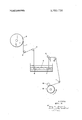
- the drawing illustrates a schematic of apparatus suitable for impregnating the tape material with a liquid flexible resin and winding the resin-impregnated tape on the projectile to produce the rotating band, wherein the resin is subsequently cured.
- the tape material employed for producing the novel rotating bands of this invention consists essentially of a sheet structure, wherein continuous filament synthetic organic fiber polymer, such as polyesters and polyamides, is spun-bonded, i.e. randomly arranged,
- the spun bonded structure is composed of crimped fibers as they impart increased elongation to the structure.
- the tape material can be prepared from any essentially non-elastic synthetic organic fiber capable of being spun-bonded, notably polyesters, such as polyethyleneterephthalate and polycyclohexyleneterephthalate, and polyamides, such as polyhexamethyleneadipamide (nylon 66) and poly-e-caproamide (nylon 6).
- polyesters such as polyethyleneterephthalate and polycyclohexyleneterephthalate
- polyamides such as polyhexamethyleneadipamide (nylon 66) and poly-e-caproamide (nylon 6).
- the high degree of elongation of the rotating band of fiber-resin composite is provided by the flexibility of both the resin and the spun-bonded fiber tape.
- the tape material preferably should possess a break elongation ranging between about 50 percent and about 100 percent.
- Particularly suitable tape material for use in this invention is a spun-bonded polyester sheet material known as Reemay, Reeman, a du Pont registered trademark, manufactured by E. I. du Pont de Nemours & Co., especially that produced with crimped fibers.
- the tape material and crosslinked flexible resin possess similar elongation characteristics.
- the void span between the fibers of the tape material is impregnated or filled with the flexible crosslinked resin, whereby the composite fiber-resin structure permits very substantial mechanical deformation without exceeding the ultimate strength and elongation of the basic fiber.
- the novel rotating bands generally possess an elastic modulus (tensile) between about 400,000 and about 600,000 psi., and a break elongation preferably between about 50 percent and about 100 percent, wich permits an elastic deformation of the band by the rifling of the barrel rather than the conventional cutting action which normally occurs with the engraving of metal rotating bands.
- any liquid resin can be employed which on curing produces a flexible, crosslinked resin possessing a break elongation of at least 10 percent but not greater than about 150 percent.
- the cured resin should possess an elongation of between about 50 and about 100 percent.
- Cross-linked resins having an elongation greater than about 150 percent are excessively flexible and hence unsuitable for use in this invention, since bands produced therefrom are not sufficiently stiff or hard to provide the required rotation of the projectile.
- bands made from resins having an elongation of substantially less than 10 percent are not sufficiently flexible and suffer undesirable shearing, breakage, and/or high radial pressures in use.
- Suitable flexible, crosslinked resins include reaction products of liquid epoxy resins with curing agents.
- Epoxy resins contain the reactive epoxide group which accounts for the crosslinking and thermosetting properties of this class of resins.
- the more common liquid epoxy resins are reaction products of epoxy compounds, e.g. epichlorohydrin, with dihydric phenols,
- the liquid epoxy resin can be cured by reaction with a' suitable cross-linking agent, such as an organic amine containing 2 or more primary amino groups, which crosslinks the epoxy resin to produce the desired solid, flexible, cross-linked resin.
- a suitable cross-linking agent such as an organic amine containing 2 or more primary amino groups
- the crosslinking reaction can be effected under the influence of heat or in the presence of a suitable catalyst without heating.
- polyesters and polyurethanes Other flexible, crosslinked resins besides epoxy resins can be employed in this invention, notably polyesters and polyurethanes.
- Suitable polyester resins can be prepared by reacting a compound containing at least two hydroxyl groups, e.g. ethyleneglycol, propylene glycol and glycerine, with a polycarboxylic acid containing an unsaturated ethylenic double bond, e.g. maleic acid, maleic anhydride and fumaric acid.
- the resulting unsaturated polyester can be mixed with a suitable crosslinking agent, e.g. styrene, diallyl phthalate, etc.
- Suitable polyurethanes can be obtained by reacting an organic dior polyisocyanate, e.g. 2,4-toluene diisocyanate, 4,4-diphenylmethane diisocyanate, and l,6-hexamethylene diisocyanate, with a dior poly functional alcohol, e.g. polyethers and polyesters obtained by reaction of ethylene oxide and/or propylene oxide with ethylene glycol, propylene glycol, glycerine, polyethylene adipate, etc.
- a dior polyisocyanate e.g. 2,4-toluene diisocyanate, 4,4-diphenylmethane diisocyanate, and l,6-hexamethylene diisocyanate
- a dior poly functional alcohol e.g. polyethers and polyesters obtained by reaction of ethylene oxide and/or propylene oxide with ethylene glycol, propylene glycol, glycerine, polyethylene adipate
- liquid polyether urethanes containing terminal isocyanate groups often referred to as prepolymers; such liquid products can be reacted with suitable crosslinking agents, e.g. aliphatic polyhydroxy compounds such as glycerine, in the presence of a suitable catalyst to produce the flexible crosslinked polyurethane resin.
- suitable crosslinking agents e.g. aliphatic polyhydroxy compounds such as glycerine
- the ratio of resin to tape material employed in the novel rotating bands can be varied widely. It should be sufficient to bond the layers of tape in a matrix of the flexible resin but not so great that the rotating band possesses to an excessive degree the properties of the unreinforced resin.
- the amount of resin employed should not substantially exceed about 100 percent by weight of the tape.
- An amount of resin between about 30 percent and about percent by weight of the tape is especially preferred.
- the tape material employed in the present invention possesses a high bulk and porous, sponge-like structure, which facilitates impregnation and retention of the liquid resin under a relatively wide range of roller pressures during winding of the impregnated tape on the projectile shell.
- a rotating band of this invention by circumferentially winding a resin-impregnated tape on a projectile.
- a tape of spunbonded polyester fiber 1 from spool 2 is passed over guide rollers 3 and 4 through a resin impregnating bath 5 under guide rollers 6 and 7. From the impregnating bath the tape is passed over guide rollers 9, 10 and 11 and wound around projectile casing 12 being rotated about a horizontal axis in a lathe-like machine (not shown).
- the amount of resin pickup by the tape can be regulated by the proper squeezing of the impregnated tape by squeeze roller 8.
- a pressure roller 13 is used to compress the tape as it is being wound on the projectile. When the desired band thickness is obtained, the projectile is removed and resin is cured to produce the final band, which can then be machined to the desired configuration.
- a preferred embodiment of the invention is set forth in the following example, which describes the production of a rotating band of this invention by winding an epoxy resin-impregnated tape on a 1105 mm projectile.
- the winding operation was carried out with a conventional lathe type filament winding machine modified to perform tape winding, similar to the apparatus illustrated in the drawing.
- the tape was one inch wide Reemay spunbonded polyester, style No. 2430, a sheet product of continuous-filament polyester fibers that are randomly arranged, highly dispersed and bonded at the filament junctions.
- the tape possessed a thickness of 17 mils and a break elongation of 75 percent.
- the spool of tape was mounted on a constant tension device, which maintained a one pound load on the tape after it had been threaded through the rollers of the resin impregnating device (the tension was measured before the resin was introduced into the device).
- the resin impregnating device was charged with a liquid epoxy resin-curing agent mixture of the following composition:
- Epon 828 100 parts Jeffamine D-400 77 i 5 parts Epon 828 is a resin marketed by the Shell Chemical Co. I! is a liquid epoxy resin condensation product of epichlorohydrin and Bisphenol A (2,2 bis (p-hydroxyphenyl) propane) having a viscosity of from lOO to 160 poises and an epoxide equivalent of from ISO to 195. .Iefiamine D-400 is a crosslinking agent marketed by the Jefferson Chemical Co. It is a liquid product which is represented by the following structure:
- x is 5.6 (average) and possesses an approximate average molecular weight of 400 and an epoxy equivalent weight of 100.
- the tape was passed through the aforesaid liquid mixture at a rate of about 2 inches/second with approximately 20 inches submerged in the bath to insure good impregnation, then wound on the projectile.
- a pressure roller which applied a pressure of about 30 psi. on the tape, was used to debulk the impregnated tape as it was being wound on the projectile.
- the projectile was removed and masking tape was applied over the band to contain the resin and to prevent slippage of the band material during the curing period.
- the band was then cured at room temperature for about 2 hours and thereafter post-cured at 325F for 4 hours.
- the rotating band thus obtained was 0.287 inches thick (ID. 3.930 inches, OD. 4.217 inches), and contained about 30 percent by weight of the cured resin.
- a projectile having a circumferentially mounted rotating band comprising multiple layers of tape bonded together in a matrix of a flexible, crosslinked, resin, said tape consisting essentially of continuous filament synthetic organic fiber polymer randomly arranged and bonded at the filament junctions.
- a projectile according to claim 3, wherein the resin is an epoxy resin.
- a projectile according to claim 6, wherein the resin is an epoxy resin condensation product of epichlorohydrin and 2,2-bis (p-hydroxyphenyl) propane crosslinked with an organic diamine.
Landscapes
- Engineering & Computer Science (AREA)
- General Engineering & Computer Science (AREA)
- Reinforced Plastic Materials (AREA)
Abstract
Rotating bands comprising a composite product of a flexible, cross-linked, resin and a spunbonded synthetic organic fiber tape composed of randomly arranged, continuous filament synthetic organic fiber polymer, e.g. polyester, bonded at the filament junctions. The bands can be produced by winding on the projectile shell a tape of the spunbonded synthetic fiber impregnated with a liquid epoxy or equivalent resin, which on curing yields a flexible, cross-linked resin, and then curing the resin by heat and/or a catalyst. The novel bands, which possess a unique combination of flexibility, stiffness, strength and toughness, impart the correct spin and muzzle velocity to the projectile when fired through a rifled barrel. The bands reduce friction and engraving force, since engraving is accomplished by depression of the rifling of the barrel (lands) into the novel band without permanent deformation as distinguished from conventional metal rotating bands, which are engraved by shearing and displacement of metal.
Description
United States Patent 11 1 111 Ju /3e Eng Sept. 25, 11973 NON-METALLIC ROTARY BANDS [75] Inventor: Merrill Eig, Parsippany, NJ. [57] ABSTRACT [73] Asslgnee: The United states of America as Rotating bands comprising a composite product of :1 represented P the Secretary of the flexible, cross-linked, resin and a spunbonded synthetic Army washmgton organic fiber tape composed of randomly arranged, [22] Fil Oct 1 1971 continuous filament synthetic organic fiber polymer, e.g. polyester, bonded at the filament junctions. The [21] Appl' N05 190,158 bands can be produced by winding on the projectile shell a tape of the spunbonded synthetic fiber impreg- 52 us. ca 102/93, 156/185 hated with a liquid epoxy or equivalent resin, which on 51 int. CH F42b 31/4110 Curing yields a flexible, Cross-linked resin, and 58 Field of Search 102/93, 94, 92.1-92.7, Curing the resin by heat and/or a catalyst The novel 102/56 5 bands, which possess a unique combination of flexibility, stiffness, strength and toughness, impart the correct [56] References Cited spin and muzzle velocity to the projectile when fired UNITED STATES PATENTS through a rifled barrel. The bands reduce friction and engraving force, since engraving is accomplished by de- 2,837,456 6/1958 Parilla 102/43 P pression of the rifling of the barrel (lands) into the novel band without permanent deformation as distin- 3:439:620 4/1969 Crossley 102 93 gushed from conventonal metal rotatmg bands wh'ch Primary Examiner-Robert F. Stahl Attorney-Harry M. Saragovitz et al.
are engraved by shearing and displacement of metal.
7 Claims, 1 Drawing Figure PMEWU Z EJEUJHE INVENTOR.
MERRILL EIG BYW 7% ,AA .4x am I NON-METALLIC ROTARY BANDS The invention described herein may be manufactured, used and licensed by or for the Government for governmental purposes without the payment to me of any royalty thereon.
BACKGROUND OF THE INVENTION This invention relates to non-metallic rotating bands for projectiles. As is well known in the art, rotary type projectiles are provided with a rotating band to cause the projectile to spin and become gyroscopically stabilized in its trajectory. Hitherto such rotating bands have been made of relatively soft metallic material, usually copper or copper alloy. When the projectile is fired, the band is engraved by the rifling in the gun barrel, thereby forming grooves or splines, which engage the rifling and impart a rotary motion to the projectile. These engraving forces exert great compressive forces on the wall of the projectile and expansive forces on the wall of the gun barrel. To withstand these forces, both the projectile wall in the region of the bands and the gun barrel wall must be made thicker with consequent reduction in payload of the projectile and increase in weight of the gun barrel.
Attempts have been made to replace strategically valuable copper with other materials, particularly nonmetallic bands made of organic plastics, such as polyamides, polystyrene and polycarbonates. Rotating bands made of plastic rather than copper etc. would provide a number of advantages, e.g.
a. They utilize relatively low cost, non-strategic materials;
b. They are considerably less expensive to manufacture and can be fabricated directly onto the projectile with little or no post machining;
c. The radial band pressure resulting from the interference between the projectile and the gun barrel, is significantly reduced, and the useful life of the gun barrel is consequently increased;
d. The projectile wall can be lightened with resultant increase in payload of the projectile;
e. The reduction achieved in the structural loading on the launch system permits lightening of the recoil systems, etc.
Plastic rotating bands proposed to date have not been completely satisfactory for a variety of reasons. For example, although plastic bands reduce the engraving force required, they are usually not strong enough to transmit the required rotational velocity to stabilize the projectile in flight. Further, they tend to be torn loose from the projectile exiting from the gun barrel by centrifugal, shear, etc. forces with consequent hazard to personnel and impairment of the projectile trajectory.
BRIEF SUMMARY OF THE INVENTION v An object of this invention is to provide an improved rotating band for rotary type projectiles, which overcomes the aforementioned and other deficiencies of the prior art.
Another object is to provide an improved projectile possessing a rotating band, which has sufficient strength to impart the desired rotation to the projectile but at the same time requires a reduced radial band pressure therefor, thereby permitting a reduction in the wall thickness of the projectile with consequent increase in the payload.
A further object is to provide a projectile rotating band which is strong enough to produce proper rotation and gas sealing action without tearing loose or melting.
A still further object is to provide a rotating band, which lowers friction and requires a reduced engraving force, thereby improving the ballistic performance of the projectile and reducing the wear on the rifling of the gun.
Another object is to provide a projectile rotating band of reinforced flexible synthetic resin and process for producing same, which possesses a unique combination of flexibility, stiffness, strength and toughness which permits proper rotation of the projectile but utilizes a different mode of radial band deformation from conventional copper rotating bands, which engrave due to a shearing action and rearward displacement of metal.
Other objects will be obvious or become apparent from the following description of the invention.
These objects are achieved according to this invention by novel rotating bands which comprise multiple layers of tape bonded together in a matrix of a flexible, crosslinked, resin, said tape consisting essentially of continuous filament synthetic organic fiber polymer randomly arranged and bonded at the filament junctions. The novel rotating bands generally possess an elastic modulus (tensile) generally between about 400,000 and about 600,000 psi. They can be produced by impregnating the aforesaid tape material with a liquid, crosslinking resin, which on curing yields a flexible, crosslinked resin, applying multiple layers of the liquid resin-impregnated tape circumferentially on a projectile casing, preferably by winding, to form an annular band, and then curing the resin to form the flexible, crosslinked, resin.
The composite product thus obtained provides a nonmetallic rotating band, which is tough, strong and of such flexibility and stiffness as to impart the correct spin and muzzle velocity to the projectile when fired through a rifled barrel, while at the same time reducing radial band pressure and friction. Conventional rotating bands of copper and copper alloys (e.g. gilding metal) are engraved by lands of the gun barrel, the resulting grooves matching the rifling of the gun barrel with attendant physical degradation of the metal by displacement or removal of said metal. In contrast, the novel composite bands of this invention do not suffer a physical degradation but rather exhibit an apparent malleability, whereby they physically deform to match the rifling of the barrel to impart the correct rotational velocity to the projectile but undergo only temporary or relatively slight permanent deformation.
BRIEF DESCRIPTION OF THE DRAWING The drawing illustrates a schematic of apparatus suitable for impregnating the tape material with a liquid flexible resin and winding the resin-impregnated tape on the projectile to produce the rotating band, wherein the resin is subsequently cured.
DETAILED DESCRIPTION OF THE INVENTION The tape material employed for producing the novel rotating bands of this invention consists essentially of a sheet structure, wherein continuous filament synthetic organic fiber polymer, such as polyesters and polyamides, is spun-bonded, i.e. randomly arranged,
usually highly dispersed, and bonded at the filament junctions, e.g. by heat and pressure. Such material possesses a unique combination of physical properties, which make it particularly advantageous for making resin-bonded rotating bands, notably, high tensile strength combined with high elongation, outstanding toughness and tear strength and high bulk and porous structure, and excellent dimensional stability. Preferably, the spun bonded structure is composed of crimped fibers as they impart increased elongation to the structure. The tape material can be prepared from any essentially non-elastic synthetic organic fiber capable of being spun-bonded, notably polyesters, such as polyethyleneterephthalate and polycyclohexyleneterephthalate, and polyamides, such as polyhexamethyleneadipamide (nylon 66) and poly-e-caproamide (nylon 6).
The high degree of elongation of the rotating band of fiber-resin composite is provided by the flexibility of both the resin and the spun-bonded fiber tape. The tape material preferably should possess a break elongation ranging between about 50 percent and about 100 percent. Particularly suitable tape material for use in this invention is a spun-bonded polyester sheet material known as Reemay, Reeman, a du Pont registered trademark, manufactured by E. I. du Pont de Nemours & Co., especially that produced with crimped fibers. Preferably, the tape material and crosslinked flexible resin possess similar elongation characteristics. In the rotating bands of this invention, the void span between the fibers of the tape material is impregnated or filled with the flexible crosslinked resin, whereby the composite fiber-resin structure permits very substantial mechanical deformation without exceeding the ultimate strength and elongation of the basic fiber. The novel rotating bands generally possess an elastic modulus (tensile) between about 400,000 and about 600,000 psi., and a break elongation preferably between about 50 percent and about 100 percent, wich permits an elastic deformation of the band by the rifling of the barrel rather than the conventional cutting action which normally occurs with the engraving of metal rotating bands.
For producing the novel rotating bands of this invention any liquid resin can be employed which on curing produces a flexible, crosslinked resin possessing a break elongation of at least 10 percent but not greater than about 150 percent. Preferably, the cured resin should possess an elongation of between about 50 and about 100 percent. Cross-linked resins having an elongation greater than about 150 percent are excessively flexible and hence unsuitable for use in this invention, since bands produced therefrom are not sufficiently stiff or hard to provide the required rotation of the projectile. Conversely, bands made from resins having an elongation of substantially less than 10 percent are not sufficiently flexible and suffer undesirable shearing, breakage, and/or high radial pressures in use.
Suitable flexible, crosslinked resins include reaction products of liquid epoxy resins with curing agents. Epoxy resins contain the reactive epoxide group which accounts for the crosslinking and thermosetting properties of this class of resins. The more common liquid epoxy resins are reaction products of epoxy compounds, e.g. epichlorohydrin, with dihydric phenols,
such as 2,2-bis (p-hydroxyphenyl) propane (Bisphenol A), resorcinol, etc.
The liquid epoxy resin can be cured by reaction with a' suitable cross-linking agent, such as an organic amine containing 2 or more primary amino groups, which crosslinks the epoxy resin to produce the desired solid, flexible, cross-linked resin. The crosslinking reaction can be effected under the influence of heat or in the presence of a suitable catalyst without heating.
Other flexible, crosslinked resins besides epoxy resins can be employed in this invention, notably polyesters and polyurethanes. Suitable polyester resins can be prepared by reacting a compound containing at least two hydroxyl groups, e.g. ethyleneglycol, propylene glycol and glycerine, with a polycarboxylic acid containing an unsaturated ethylenic double bond, e.g. maleic acid, maleic anhydride and fumaric acid. The resulting unsaturated polyester can be mixed with a suitable crosslinking agent, e.g. styrene, diallyl phthalate, etc. and the crosslinking reaction effected by the action of heat and/or a catalyst, such as a peroxide, in known manner. Suitable polyurethanes can be obtained by reacting an organic dior polyisocyanate, e.g. 2,4-toluene diisocyanate, 4,4-diphenylmethane diisocyanate, and l,6-hexamethylene diisocyanate, with a dior poly functional alcohol, e.g. polyethers and polyesters obtained by reaction of ethylene oxide and/or propylene oxide with ethylene glycol, propylene glycol, glycerine, polyethylene adipate, etc. and including in the reaction mixture a reactant having three or more isocyanate or hydroxyl groups in the molecule in sufficient amount to produce a solid, cross-linked polyurethane resin of the desired flexibility. Particularly suitable for use in this invention are liquid polyether urethanes containing terminal isocyanate groups, often referred to as prepolymers; such liquid products can be reacted with suitable crosslinking agents, e.g. aliphatic polyhydroxy compounds such as glycerine, in the presence of a suitable catalyst to produce the flexible crosslinked polyurethane resin.
The ratio of resin to tape material employed in the novel rotating bands can be varied widely. It should be sufficient to bond the layers of tape in a matrix of the flexible resin but not so great that the rotating band possesses to an excessive degree the properties of the unreinforced resin. Preferably, the amount of resin employed should not substantially exceed about 100 percent by weight of the tape. An amount of resin between about 30 percent and about percent by weight of the tape is especially preferred. In this connection the tape material employed in the present invention possesses a high bulk and porous, sponge-like structure, which facilitates impregnation and retention of the liquid resin under a relatively wide range of roller pressures during winding of the impregnated tape on the projectile shell.
The following description together with the accompanying diagrammatic drawing illustrates the production of a rotating band of this invention by circumferentially winding a resin-impregnated tape on a projectile. Referring to the drawing, a tape of spunbonded polyester fiber 1 from spool 2 is passed over guide rollers 3 and 4 through a resin impregnating bath 5 under guide rollers 6 and 7. From the impregnating bath the tape is passed over guide rollers 9, 10 and 11 and wound around projectile casing 12 being rotated about a horizontal axis in a lathe-like machine (not shown). The amount of resin pickup by the tape can be regulated by the proper squeezing of the impregnated tape by squeeze roller 8. A pressure roller 13 is used to compress the tape as it is being wound on the projectile. When the desired band thickness is obtained, the projectile is removed and resin is cured to produce the final band, which can then be machined to the desired configuration.
A preferred embodiment of the invention is set forth in the following example, which describes the production of a rotating band of this invention by winding an epoxy resin-impregnated tape on a 1105 mm projectile. The winding operation was carried out with a conventional lathe type filament winding machine modified to perform tape winding, similar to the apparatus illustrated in the drawing.
The tape was one inch wide Reemay spunbonded polyester, style No. 2430, a sheet product of continuous-filament polyester fibers that are randomly arranged, highly dispersed and bonded at the filament junctions. The tape possessed a thickness of 17 mils and a break elongation of 75 percent.
The spool of tape was mounted on a constant tension device, which maintained a one pound load on the tape after it had been threaded through the rollers of the resin impregnating device (the tension was measured before the resin was introduced into the device).
The resin impregnating device was charged with a liquid epoxy resin-curing agent mixture of the following composition:
Epon 828 100 parts Jeffamine D-400 77 i 5 parts Epon 828 is a resin marketed by the Shell Chemical Co. I! is a liquid epoxy resin condensation product of epichlorohydrin and Bisphenol A (2,2 bis (p-hydroxyphenyl) propane) having a viscosity of from lOO to 160 poises and an epoxide equivalent of from ISO to 195. .Iefiamine D-400 is a crosslinking agent marketed by the Jefferson Chemical Co. It is a liquid product which is represented by the following structure:
wherein x is 5.6 (average) and possesses an approximate average molecular weight of 400 and an epoxy equivalent weight of 100.
The tape was passed through the aforesaid liquid mixture at a rate of about 2 inches/second with approximately 20 inches submerged in the bath to insure good impregnation, then wound on the projectile. A pressure roller, which applied a pressure of about 30 psi. on the tape, was used to debulk the impregnated tape as it was being wound on the projectile. To insure good bonding of the rotating band to the projectile band seat the latter was given a medium knurl and a light sand blasting to remove iron oxide.
The projectile was removed and masking tape was applied over the band to contain the resin and to prevent slippage of the band material during the curing period. The band was then cured at room temperature for about 2 hours and thereafter post-cured at 325F for 4 hours. The rotating band thus obtained was 0.287 inches thick (ID. 3.930 inches, OD. 4.217 inches), and contained about 30 percent by weight of the cured resin.
Projectiles with rotating bands obtained in the manner described above were subjected to static engraving tests using an engraving fixture with zero twist rifling, which subjected the rotating band to simultaed engraving, shear and radial pressure as it passed through the rifling. The tests revealed that the depth of rifling of the band was barely visible to the eye, showing that the band had physically deformed to match the rifling of the fixture and returned essentially to the original configuration. No degradation of the band had occurred under the engraving load of about 24,000 lbs. The radial band pressure was only about one-fifth that of the standard gilding metal projectile band. When test-first in a rifled gun barrel, the projectile exhibited the correct muzzle velocity and spin and considerably reduced radial band pressure compared with a similar projectile having a standard gliding metal rotating band.
Unsatisfactory results were obtained when tapes of other materials, e. g. Kraft paper, glass fiber coth, asbestos cloth, and other textile materials were employed in place of spun-bonded polyester cloth in the foregoing example. The composite resin-tape rotating bands thus obtained were relatively rigid and brittle, suffered considerable physical degradation, e.g. splitting and rupturing, and exhibited relatively high radial barrel pressures in the static engraving tests and in test firings of the projectile.
I wish it to be understood that I do not desire to be limited to the exact method and detail of construction described for obvious modification will occur to persons skilled in the art.
What is claimed is:
ll. A projectile having a circumferentially mounted rotating band comprising multiple layers of tape bonded together in a matrix of a flexible, crosslinked, resin, said tape consisting essentially of continuous filament synthetic organic fiber polymer randomly arranged and bonded at the filament junctions.
2. A projectile according to claim ll, wherein the rotating band possesses an elastic modulus (tensile) between about 400,000 psi and about 600,000 psi.
3. A projectile according to claim ll, wherein the continuous filament synthetic organic fiber polymer is a continuous filament synthetic polyester fiber polymer.
4. A projectile according to claim 3, wherein the tape and the resin each possess an elongation of from about 50 percent to about percent.
5. A projectile according to claim 3, wherein the resin is an epoxy resin.
6. A projectile according to claim 5, wherein the amount of resin is between about 30 and about 100 percent by weight of the tape, and the tape and the epoxy resin each possess an elongation between about 50 and about 100 percent.
7. A projectile according to claim 6, wherein the resin is an epoxy resin condensation product of epichlorohydrin and 2,2-bis (p-hydroxyphenyl) propane crosslinked with an organic diamine.
at: :1: .i: :k
Claims (6)
- 2. A projectile according to claim 1, wherein the rotating band possesses an elastic modulus (tensile) between about 400,000 psi and about 600,000 psi.
- 3. A projectile according to claim 1, wherein the continuous filament synthetic organic fiber polymer is a continuous filament synthetic polyester fiber polymer.
- 4. A projectile according to claim 3, wherein the tape and the resin each possess an elongation of from about 50 percent to about 100 percent.
- 5. A projectile according to claim 3, wherein the resin is an epoxy resin.
- 6. A projectile according to claim 5, wherein the amount of resin is between about 30 and about 100 percent by weight of the tape, and the tape and the epoxy resin each possess an elongation between about 50 and about 100 percent.
- 7. A projectile according to claim 6, wherein the resin is an epoxy resin condensation product of epichlorohydrin and 2,2-bis (p-hydroxyphenyl) propane crosslinked with an organic diamine.
Applications Claiming Priority (1)
| Application Number | Priority Date | Filing Date | Title |
|---|---|---|---|
| US19015871A | 1971-10-18 | 1971-10-18 |
Publications (1)
| Publication Number | Publication Date |
|---|---|
| US3760736A true US3760736A (en) | 1973-09-25 |
Family
ID=22700238
Family Applications (1)
| Application Number | Title | Priority Date | Filing Date |
|---|---|---|---|
| US00190158A Expired - Lifetime US3760736A (en) | 1971-10-18 | 1971-10-18 | Non-metallic rotary bands |
Country Status (1)
| Country | Link |
|---|---|
| US (1) | US3760736A (en) |
Cited By (12)
| Publication number | Priority date | Publication date | Assignee | Title |
|---|---|---|---|---|
| US4366015A (en) * | 1980-05-16 | 1982-12-28 | Murray Myles N | Rubber driving band, artillery shell employing same, and method of making the band and assembling same in the shell |
| US4450770A (en) * | 1980-09-22 | 1984-05-29 | The United States Of America As Represented By The Secretary Of The Army | Pivot ring for a discarding sabot |
| US4907513A (en) * | 1988-05-18 | 1990-03-13 | Honeywell Inc. | High volume obturator assembly method |
| EP1111329A1 (en) * | 1999-12-20 | 2001-06-27 | SM Schweizerische Munitionsunternehmung | Projectile and manufacturing method therefor |
| US6295934B1 (en) | 1999-06-29 | 2001-10-02 | Raytheon Company | Mid-body obturator for a gun-launched projectile |
| US6369373B1 (en) | 1999-06-29 | 2002-04-09 | Raytheon Company | Ramming brake for gun-launched projectiles |
| US6453821B1 (en) * | 1999-06-29 | 2002-09-24 | Raytheon Company | High-temperature obturator for a gun-launched projectile |
| EP1442841A1 (en) * | 2003-01-30 | 2004-08-04 | Robert Bosch Gmbh | Dry blasting of groove geometries |
| EP2697599A4 (en) * | 2011-04-14 | 2014-10-15 | Bae Systems Bofors Ab | PERMANENTLY SLIDING ROTATION BELT AND METHOD FOR PRODUCING SUCH A ROTATION BELT |
| WO2015199786A3 (en) * | 2014-04-07 | 2016-04-07 | Einstein Noodles, Llc | Providing spin to composite projectile |
| US20240263436A1 (en) * | 2021-09-15 | 2024-08-08 | Cscon S.R.L. | Prefabricated building structure |
| US12339107B2 (en) | 2021-11-12 | 2025-06-24 | Peter D. Rebar | Metallic, non-leaded projectile for muzzle-loading firearms and methods of making and using the same |
Citations (4)
| Publication number | Priority date | Publication date | Assignee | Title |
|---|---|---|---|---|
| US2837456A (en) * | 1952-02-29 | 1958-06-03 | Kellogg M W Co | Filament wound container |
| US2928348A (en) * | 1955-01-07 | 1960-03-15 | William A Zisman | Projectile rotating band |
| US2996012A (en) * | 1955-11-17 | 1961-08-15 | Rex B Butler | Rotating band and seat therefor |
| US3439620A (en) * | 1966-10-25 | 1969-04-22 | Henry Crossley Packings Ltd | Projectile driving bands |
-
1971
- 1971-10-18 US US00190158A patent/US3760736A/en not_active Expired - Lifetime
Patent Citations (4)
| Publication number | Priority date | Publication date | Assignee | Title |
|---|---|---|---|---|
| US2837456A (en) * | 1952-02-29 | 1958-06-03 | Kellogg M W Co | Filament wound container |
| US2928348A (en) * | 1955-01-07 | 1960-03-15 | William A Zisman | Projectile rotating band |
| US2996012A (en) * | 1955-11-17 | 1961-08-15 | Rex B Butler | Rotating band and seat therefor |
| US3439620A (en) * | 1966-10-25 | 1969-04-22 | Henry Crossley Packings Ltd | Projectile driving bands |
Cited By (15)
| Publication number | Priority date | Publication date | Assignee | Title |
|---|---|---|---|---|
| US4366015A (en) * | 1980-05-16 | 1982-12-28 | Murray Myles N | Rubber driving band, artillery shell employing same, and method of making the band and assembling same in the shell |
| US4450770A (en) * | 1980-09-22 | 1984-05-29 | The United States Of America As Represented By The Secretary Of The Army | Pivot ring for a discarding sabot |
| US4907513A (en) * | 1988-05-18 | 1990-03-13 | Honeywell Inc. | High volume obturator assembly method |
| US6369373B1 (en) | 1999-06-29 | 2002-04-09 | Raytheon Company | Ramming brake for gun-launched projectiles |
| US6453821B1 (en) * | 1999-06-29 | 2002-09-24 | Raytheon Company | High-temperature obturator for a gun-launched projectile |
| US6295934B1 (en) | 1999-06-29 | 2001-10-02 | Raytheon Company | Mid-body obturator for a gun-launched projectile |
| EP1111329A1 (en) * | 1999-12-20 | 2001-06-27 | SM Schweizerische Munitionsunternehmung | Projectile and manufacturing method therefor |
| WO2001046640A1 (en) * | 1999-12-20 | 2001-06-28 | Sm Schweizerische Munitionsunternehmung Ag | Projectile and method for producing a projectile |
| EP1442841A1 (en) * | 2003-01-30 | 2004-08-04 | Robert Bosch Gmbh | Dry blasting of groove geometries |
| EP2697599A4 (en) * | 2011-04-14 | 2014-10-15 | Bae Systems Bofors Ab | PERMANENTLY SLIDING ROTATION BELT AND METHOD FOR PRODUCING SUCH A ROTATION BELT |
| US8950335B2 (en) | 2011-04-14 | 2015-02-10 | Bae Systems Bofors Ab | Permanent slipping rotating band and method for producing such a band |
| WO2015199786A3 (en) * | 2014-04-07 | 2016-04-07 | Einstein Noodles, Llc | Providing spin to composite projectile |
| US20240263436A1 (en) * | 2021-09-15 | 2024-08-08 | Cscon S.R.L. | Prefabricated building structure |
| US12378760B2 (en) * | 2021-09-15 | 2025-08-05 | Cscon S.R.L. | Prefabricated building structure |
| US12339107B2 (en) | 2021-11-12 | 2025-06-24 | Peter D. Rebar | Metallic, non-leaded projectile for muzzle-loading firearms and methods of making and using the same |
Similar Documents
| Publication | Publication Date | Title |
|---|---|---|
| US4181768A (en) | Body armor laminate | |
| US3444033A (en) | Lightweight armor with laminated base member resistant to delamination | |
| US3108433A (en) | Rocket motor and solid propellent grain with woven polymeric inhibitor coating | |
| US3159104A (en) | Laminated tape propellants | |
| US3745927A (en) | Casing and propellant of nitrocellulose filaments and nitrocellulose fibers | |
| US3732821A (en) | Nose ogive for nonlethal projectile | |
| US3956447A (en) | Method of making deep drawn, laminated articles | |
| EP0833742B2 (en) | Ballistic-resistant moulded article and a process for the manufacture of the moulded article | |
| US3901153A (en) | Wrapped laminated felted monolithic combustible cartridge case | |
| US3949894A (en) | Laminated container | |
| US4263243A (en) | Method for making a flexible bearing | |
| EP0081968A1 (en) | Energy storage flywheels | |
| US4080845A (en) | Shaped disc flywheel | |
| US3948697A (en) | Gum propellant grains with inhibitor coating | |
| US3090196A (en) | Rocket propellent | |
| US5132167A (en) | Bonded laminate having high anti-piercing characteristics | |
| FR2977933A1 (en) | COMPOSITE MATERIAL LAMINATED FOR BALLISTIC PROTECTION | |
| US6179944B1 (en) | Process for preparing composite warhead casings and product | |
| US5429865A (en) | Composite materials | |
| US4024008A (en) | Plastic to metal bonding method | |
| US3321101A (en) | Filament-wound hollow cylindrical articles | |
| NL1010568C1 (en) | Polyurethane composite. | |
| US2779702A (en) | Fuel cell supporting panel | |
| US3439620A (en) | Projectile driving bands | |
| US4706567A (en) | Explosive charges |