US3672487A - Vertical conveyors - Google Patents
Vertical conveyors Download PDFInfo
- Publication number
- US3672487A US3672487A US17242A US3672487DA US3672487A US 3672487 A US3672487 A US 3672487A US 17242 A US17242 A US 17242A US 3672487D A US3672487D A US 3672487DA US 3672487 A US3672487 A US 3672487A
- Authority
- US
- United States
- Prior art keywords
- run
- chute
- switch member
- conveyor
- discharge
- Prior art date
- Legal status (The legal status is an assumption and is not a legal conclusion. Google has not performed a legal analysis and makes no representation as to the accuracy of the status listed.)
- Expired - Lifetime
Links
- 230000000903 blocking effect Effects 0.000 claims description 9
- 230000004044 response Effects 0.000 claims description 5
- 230000007246 mechanism Effects 0.000 description 10
- 238000007599 discharging Methods 0.000 description 3
- 230000004913 activation Effects 0.000 description 1
- 235000015241 bacon Nutrition 0.000 description 1
- 238000010586 diagram Methods 0.000 description 1
- 230000009977 dual effect Effects 0.000 description 1
- 230000000694 effects Effects 0.000 description 1
- 150000003278 haem Chemical class 0.000 description 1
- 238000003780 insertion Methods 0.000 description 1
- 230000037431 insertion Effects 0.000 description 1
- 238000009434 installation Methods 0.000 description 1
- 230000004048 modification Effects 0.000 description 1
- 238000012986 modification Methods 0.000 description 1
Images



Classifications
-
- B—PERFORMING OPERATIONS; TRANSPORTING
- B07—SEPARATING SOLIDS FROM SOLIDS; SORTING
- B07C—POSTAL SORTING; SORTING INDIVIDUAL ARTICLES, OR BULK MATERIAL FIT TO BE SORTED PIECE-MEAL, e.g. BY PICKING
- B07C3/00—Sorting according to destination
- B07C3/10—Apparatus characterised by the means used for detection ofthe destination
- B07C3/12—Apparatus characterised by the means used for detection ofthe destination using electric or electronic detecting means
-
- B—PERFORMING OPERATIONS; TRANSPORTING
- B07—SEPARATING SOLIDS FROM SOLIDS; SORTING
- B07C—POSTAL SORTING; SORTING INDIVIDUAL ARTICLES, OR BULK MATERIAL FIT TO BE SORTED PIECE-MEAL, e.g. BY PICKING
- B07C3/00—Sorting according to destination
- B07C3/02—Apparatus characterised by the means used for distribution
- B07C3/08—Apparatus characterised by the means used for distribution using arrangements of conveyors
- B07C3/082—In which the objects are carried by transport holders and the transport holders form part of the conveyor belts
- B07C3/087—In which the objects are carried by transport holders and the transport holders form part of the conveyor belts the objects being taken up in transport files or holders which are not part of the conveyor belts
-
- B—PERFORMING OPERATIONS; TRANSPORTING
- B65—CONVEYING; PACKING; STORING; HANDLING THIN OR FILAMENTARY MATERIAL
- B65G—TRANSPORT OR STORAGE DEVICES, e.g. CONVEYORS FOR LOADING OR TIPPING, SHOP CONVEYOR SYSTEMS OR PNEUMATIC TUBE CONVEYORS
- B65G37/00—Combinations of mechanical conveyors of the same kind, or of different kinds, of interest apart from their application in particular machines or use in particular manufacturing processes
-
- B—PERFORMING OPERATIONS; TRANSPORTING
- B65—CONVEYING; PACKING; STORING; HANDLING THIN OR FILAMENTARY MATERIAL
- B65G—TRANSPORT OR STORAGE DEVICES, e.g. CONVEYORS FOR LOADING OR TIPPING, SHOP CONVEYOR SYSTEMS OR PNEUMATIC TUBE CONVEYORS
- B65G2812/00—Indexing codes relating to the kind or type of conveyors
- B65G2812/01—Conveyors composed of several types of conveyors
- B65G2812/016—Conveyors composed of several types of conveyors for conveying material by co-operating units in tandem
- B65G2812/018—Conveyors composed of several types of conveyors for conveying material by co-operating units in tandem between conveyor sections
Definitions
- the present invention relates to a conveyor for vertically transporting articles and, in particular, to the mechanism for feeding articles to and for discharging articles from such devices.
- one of the conveyor belts is interrupted to expose one of the up or down runs.
- a feed chute and a discharge chute having certain common structural features are located in association with the exposed run.
- a switch member such as a flap is mounted between the chute and the run and is selectively operable to close one or the other chute so as to have one or the other communicate with the run as desired.
- the operation of the switch is controlled by a signal derived from the passage of a container in the run.
- the container as is known, carries indicia of destination capable of being sensed fully or semi-automatically.
- Various control and interlocking safety features are also provided.
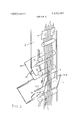
- FIG. 1 is a schematic view of a portion of a vertical conveyor embodying the principles of the present invention
- FIG. 2 is an enlarged perspective view showing the arrangement of conveyor belts and the discharge operation
- FIG. 3 is a view similar to that of FIG. 2 showing the feed operation
- FIG. 4 is a view similar to FIG. I on which is superimposed a schematic diagram for operating the infeed and discharge gates.
- the containers are inserted between the belts and carried therealong either upwardly or downwardly until they reach their proper level or destination where, in response to indicia carried by the container, they are automatically ejected and removed.
- the copending application is concerned with the disclosure of a switch mechanism for transferring containers between the up and down runs.
- the present invention is directed to the provision of an intake feed and discharge mechanism for supplying the conveyor initially with containers and for removing the containers from the conveyor.
- the feed and discharge units are preferably placed in predetermined locations, along the downward side of the conveyor so as to remove the containers as they move downwardly. It is, of course, possible to place them in the upward side.
- a portion of a vertical conveyor located within a vertical shaft, preferably mounted within the wall of a building although it might be mounted exteriorly thereof.
- Mounted on to the shaft 1 and communicating exteriorly of it are an intake chute 2 and a discharge chute 3 for manually or automatically feeding or removing article containers 4.
- the conveyor itself comprises endless belt 5 straddling a centrally positioned endless belt 6 to form a double belt upward run 17 and a double belt downward run 18 as indicated by the arrows A and B.
- Belt 6, and belt 5, if so desired, is formed of a pair of similar bands arranged parallel to each other in side by side relationship in a common plane.
- the bands of belt 6 (and of belt 5 if so constructed) are spaced apart laterally to form a slot between them. It will be appreciated that since the Figure is an end elevational view, only one of the bands are seen.
- the belt 5 comprises a single band which is positioned oppositely to the slot between the pair of bands forming the belt 6.
- the belts 5 and 6 are spaced relative to each other so that the containers 4 are securely held or clamped therebetween and are consequently carried along the respective runs as the belts are moved.
- the belts are provided with idler positioning rollers 8 and drive means, of a conventional nature to drive each of the belts synchronously.
- the belt 5 comprises a single endless band which runs up along path A on the right of belt 6, turns over its upper end and then runs downwardly along path B on the left side of the central belt 6.
- the belt 5 is withdrawn from its normal plane and passed through a conduit 15 which moves the belt 5 behind the infeed and discharge chutes 2 and 3 to a position where they can then be returned to the plane of the run 18 as shown in the lower left portion of the Figure.
- the single band 5 can be withdrawn, interrupting the run 18, exposing the belt 6 to the infeed and discharge chutes while maintaining the belt 5 as an endless band.
- the feed chute 2 and the discharge chute 3 are located one above the other. Each comprises a rectangular housing having a cover flap which is openable to insert or remove articles therefrom; the feed 2 has a lower wall 22 inclined downwardly from its cover in a direction toward the conveyor run 18. This wall 22 also forms the upper wall of the discharge 3.
- the chute 2 also has an upper wall 220 spaced from it and generally parallel to the lower wall 22 forming therewith a throat 226. Both walls 22 and 22a terminate some distance from the path ofthe downward run 18 in the open area 11 within the shaft l.
- the discharge chute 3 is also formed rectangularly, and in addition to the wall 22, is provided with a back wall 33 which extends at an angle from the interior of the shaft 1 outwardly and downwardly.
- the wall 22 and wall 33 are spaced from each other to provide a passage from the shaft opening I I into the discharge chute 3.
- the discharge passage is generally perpendicular to the feed throat 22b.
- a switch member 12 Located within the interruption on the run 18 and bridging the opening 11 between belt 6 and the feed and discharge chutes is a switch member 12 in the form of a shaped flap having a straight back 12a and an angular face 12b joined at their apex in a pointed tongue 21.
- the base 12c of the switch member 12 is mounted about a movable shaft 20 which is normally biased by spring means into the full line position shown.
- the shaft is provided with a fixed pulley 23 connected by a conventional belt or other drive means to a solenoid or similar electro-mechanical motive means responsive to an electrical signal.
- the motive means is adapted to rotate the pulley 23 and consequently swing the switch member 12 in an arc shown by the arrow C, into the dotted line position.
- Suitable stop means, or motive limiting means, are employed to define the are C, so that the switch flap 12 moves between the first position with its back 120 in line with the wall 22 so as to extend the wall 22 from its terminus to a point adjacent the belt 6', and to the second position where the angular face 12b assumes the dotted-line position between the spaced bands of the belt 6 and the lower wall 33 of discharge chute 3.
- the switch member forms within the opening 11 a slide through which a container may move from the throat 22b into entrainment in the run 18.
- the switch member blocks the downward path of the run 18 forming a slide by which a container is ejected from the run into the discharge chute 3.
- the feed chute 2 is also provided with a control gate 13 which is located in the throat 22b and adapted to pivot between a first position (shown in full lines) opening the throat and a second position (shown in dotted lines) closing the throat 22b.
- the gate 13 is also biased by its own weight or by suitable spring means to be initially located and subsequently returned to the first position and is provided with a solenoid plunger or other mechanism, responsive to an electric signal, which will move it selectively into its second position.
- the gate 13 can be made to act in combination with the movement of the switch member 12 to block the infeed on passage of a container downwardly along the run 18 or open the infeed on insertion ofa container into the conveyor.
- a sensing device 9 such as a micro-switch, magnetic head or other indicia sensing mechanism, is located along the run 18 before the interruption for the switch member 12.
- the sensor 9 is provided with a number of cooperating heads [4 designed to produce electrical signals which indicate the presence of a container in the run 18 and whether the container is destined for discharge at chute 3 or for a chute elsewhere further along the conveyor.
- the sensor 9 or the actuating mechanisms of the switch member 12 and gate 33 include a timing device or timing circuit which limits the effect of the pulse obtained from passage of the container passed the sensor 9 for a time sufficient to permit the container to pass beyond the area 11.
- the con tainer be provided with a plurality of indicia indicating such things as sender, receiver and conveying path. Accordingly, the sensing device 9 is provided with multiple heads 14 adapted to read the plural indicia and to provide one or more signals for selective movement and activation of the conveyor components. It will be understood, however, that the sensing device 9 could be modified to conform it to any system of indicia employed.
- the signal from the sensor 9 is transmitted via line 40 to a solenoid actuator 41, the rod 42 of which is linked to a lever arm 43 connected to the pulley 23 of the shaft 20.
- the output of the sensor 9 is transmitted by line 44 to another solenoid actuator 45 the rod of which is connected, also, to a lever 46 which is fixed to the pivot shaft of the gate 13.
- a signal produced by the output of the sensing device 9, determining the presence ofa container 4 in the run 18, is transmitted to the solenoid actuator operating the control gate 13 in throat 22b which as a result is caused to pivot into its second position (dotted lines), thus blocking the infeed passage and permitting the downwardly moving container 4 to pass the area 11 without interference.
- This movement of the gate 13 occurs independently of whether the container is destined for discharge at chute 3 or is to pass beyond the area 11 to a further located discharge unit.
- the sensing device 9 determines that the container 4 is to be discharged at the chute 3, it produces another signal which simultaneously operates the solenoid actuator rotating the pulley 23.
- the switch member 12 pivots to its second position (dotted lines) placing the tongue between the belt 6.
- the discharge chute 3 is opened and the container 4 is discharged. Simultaneously, the gate 13 continues to remain closed.
- a container may be freely inserted in the infeed.
- the sensing device 9 is placed sufficiently ahead of the area 1! so that advance warning and closing of the gate 13 can be effected in order to avoid collision of containers in the area 11.
- the device may be placed in the upward run of the conveyor by simply inverting and turning the arrangement around; the shape of the switch member may be varied, as well as the angular directions of the feed and discharge chute.
- the noted solenoid actuator may be replaced by hydraulic or pneumatic means and the sensing device by one or more mechanical or magnetic sensors.
- the present invention provides simple and effective means for feeding and discharging vertical belt conveyors.
- the mechanism is small and not complex. Many parts serving dual functions in both the feed and discharge portions. Because of the interlocking and cooperatin g control mechanism, reliable operation is obtained and collisions and jam-up are avoided.
- a conveyor for the vertical transport of articles comprising a pair of endless belts cooperating to form a moving run for said articles, one of said belts being interrupted along its length to expose said run, an infeed chute and discharge chute associated with said exposed run, a switch member mounted between said chutes and said exposed run said switch selectively moveable between a first position blocking said discharge chute and extending said infeed chute and a second position extending said discharge chute to said exposed run, and gate means for blocking said infeed chute at least when said switch member is in its second position, whereby said articles may be selectively fed to or removed from said run.
- the conveyor according to claim 1 including a sensor located along said run prior to said exposed run for producing a signal indicative of the presence of an article in said conveyor and motive means for moving said gate means in to said blocking position in response to said signal.
Landscapes
- Engineering & Computer Science (AREA)
- Mechanical Engineering (AREA)
- Control Of Conveyors (AREA)
- Separation, Sorting, Adjustment, Or Bending Of Sheets To Be Conveyed (AREA)
- Structure Of Belt Conveyors (AREA)
- Branching, Merging, And Special Transfer Between Conveyors (AREA)
- Discharge Of Articles From Conveyors (AREA)
Applications Claiming Priority (1)
| Application Number | Priority Date | Filing Date | Title |
|---|---|---|---|
| DE19691938388 DE1938388C3 (de) | 1969-07-29 | Förderbandanlage für den Vertikaltransport von Schriftgutbehältern |
Publications (1)
| Publication Number | Publication Date |
|---|---|
| US3672487A true US3672487A (en) | 1972-06-27 |
Family
ID=5741191
Family Applications (1)
| Application Number | Title | Priority Date | Filing Date |
|---|---|---|---|
| US17242A Expired - Lifetime US3672487A (en) | 1969-07-29 | 1970-03-06 | Vertical conveyors |
Country Status (7)
| Country | Link |
|---|---|
| US (1) | US3672487A (de) |
| AT (1) | AT302892B (de) |
| CH (1) | CH500887A (de) |
| FR (1) | FR2053234B1 (de) |
| GB (1) | GB1261148A (de) |
| NL (1) | NL7011172A (de) |
| SE (1) | SE360333B (de) |
Cited By (4)
| Publication number | Priority date | Publication date | Assignee | Title |
|---|---|---|---|---|
| US4333640A (en) * | 1978-12-28 | 1982-06-08 | Compagnie Internationale Pour L'informatique Cii Honeywell Bull (Societe Anonyme) | Automatic document processing machine |
| US4482057A (en) * | 1981-12-30 | 1984-11-13 | Ncr Corporation | Record media dispensing apparatus |
| US5174563A (en) * | 1990-09-19 | 1992-12-29 | Koninklijke Ptt Nederland N.V. | Deflecting device |
| US5392897A (en) * | 1992-10-27 | 1995-02-28 | Kabushiki Kaisha Iseki Kaihatsu Koki | Conveyor |
Citations (2)
| Publication number | Priority date | Publication date | Assignee | Title |
|---|---|---|---|---|
| US1858416A (en) * | 1929-03-08 | 1932-05-17 | Cutler Hammer Inc | Conveyer |
| US2593242A (en) * | 1947-02-21 | 1952-04-15 | Cutler Hammer Inc | Switching type conveyer |
Family Cites Families (1)
| Publication number | Priority date | Publication date | Assignee | Title |
|---|---|---|---|---|
| FR655563A (fr) * | 1927-06-25 | 1929-04-20 | Mix & Genest Ag | Dispositif de changement de direction pour installations de tubes pneumatiques postaux, dont la boîte sert en même temps à l'expédition |
-
1970
- 1970-03-06 US US17242A patent/US3672487A/en not_active Expired - Lifetime
- 1970-07-02 CH CH1003370A patent/CH500887A/de not_active IP Right Cessation
- 1970-07-06 AT AT608670A patent/AT302892B/de not_active IP Right Cessation
- 1970-07-15 SE SE09793/70A patent/SE360333B/xx unknown
- 1970-07-20 FR FR7026647A patent/FR2053234B1/fr not_active Expired
- 1970-07-22 GB GB35486/70A patent/GB1261148A/en not_active Expired
- 1970-07-28 NL NL7011172A patent/NL7011172A/xx unknown
Patent Citations (2)
| Publication number | Priority date | Publication date | Assignee | Title |
|---|---|---|---|---|
| US1858416A (en) * | 1929-03-08 | 1932-05-17 | Cutler Hammer Inc | Conveyer |
| US2593242A (en) * | 1947-02-21 | 1952-04-15 | Cutler Hammer Inc | Switching type conveyer |
Cited By (4)
| Publication number | Priority date | Publication date | Assignee | Title |
|---|---|---|---|---|
| US4333640A (en) * | 1978-12-28 | 1982-06-08 | Compagnie Internationale Pour L'informatique Cii Honeywell Bull (Societe Anonyme) | Automatic document processing machine |
| US4482057A (en) * | 1981-12-30 | 1984-11-13 | Ncr Corporation | Record media dispensing apparatus |
| US5174563A (en) * | 1990-09-19 | 1992-12-29 | Koninklijke Ptt Nederland N.V. | Deflecting device |
| US5392897A (en) * | 1992-10-27 | 1995-02-28 | Kabushiki Kaisha Iseki Kaihatsu Koki | Conveyor |
Also Published As
| Publication number | Publication date |
|---|---|
| NL7011172A (de) | 1971-02-02 |
| CH500887A (de) | 1970-12-31 |
| SE360333B (de) | 1973-09-24 |
| DE1938388A1 (de) | 1971-02-11 |
| FR2053234B1 (de) | 1975-01-10 |
| FR2053234A1 (de) | 1971-04-16 |
| GB1261148A (en) | 1972-01-19 |
| AT302892B (de) | 1972-10-25 |
| DE1938388B2 (de) | 1976-11-18 |
Similar Documents
| Publication | Publication Date | Title |
|---|---|---|
| US3871511A (en) | Sorter system induction means | |
| US3799319A (en) | Article aligning apparatus | |
| US20040226262A1 (en) | Machine for sealing containers by applying a covering film | |
| US1706632A (en) | Lumber-sorting machine | |
| CA3076429C (en) | Transportation path diverter | |
| US4010594A (en) | Method for supplying boxes to a plurality of filling and weighing stations and removal of filled boxes thereof | |
| US5101767A (en) | Separator counter | |
| US3780850A (en) | Sliding pallet article sorter | |
| US4181055A (en) | Apparatus for automatically cutting sheet material | |
| US3327848A (en) | Bottle sorter | |
| US4010595A (en) | Apparatus for supplying boxes to a plurality of filling and weighing stations and removal of filled boxes thereof | |
| EP1574431B1 (de) | Vorrichtung zum Versiegeln von Behältern durch Anbringen einer Deckelfolie | |
| US3613863A (en) | Induction scheme and automatic loader | |
| US3820648A (en) | Control system for feed of articles | |
| ES417376A1 (es) | Dispositivo para la alimentacion continua y automatica de productos a maquinas envasadoras o envolvedoras. | |
| US4466529A (en) | Separation unit for processed book blocks | |
| US3854613A (en) | Batch to continuous flow mail handling | |
| JPH01106456U (de) | ||
| GB1524428A (en) | Automatic doffing apparatus | |
| GB1034055A (en) | Means for feeding articles to conveyor and elevator systems | |
| US3310142A (en) | Autoamtic cap ejector | |
| JPS6246410B2 (de) | ||
| JPS63252871A (ja) | 紙葉類分類装置 | |
| CA2469544C (en) | Elevated grade station drive system | |
| GB2123375A (en) | Improved conveyor feeding device |