US3652932A - Method and apparatus for measurement of surface charge of an electret - Google Patents
Method and apparatus for measurement of surface charge of an electret Download PDFInfo
- Publication number
- US3652932A US3652932A US59531A US3652932DA US3652932A US 3652932 A US3652932 A US 3652932A US 59531 A US59531 A US 59531A US 3652932D A US3652932D A US 3652932DA US 3652932 A US3652932 A US 3652932A
- Authority
- US
- United States
- Prior art keywords
- electret
- probe
- electrode
- charge
- area
- Prior art date
- Legal status (The legal status is an assumption and is not a legal conclusion. Google has not performed a legal analysis and makes no representation as to the accuracy of the status listed.)
- Expired - Lifetime
Links
Images

Classifications
-
- H—ELECTRICITY
- H01—ELECTRIC ELEMENTS
- H01G—CAPACITORS; CAPACITORS, RECTIFIERS, DETECTORS, SWITCHING DEVICES, LIGHT-SENSITIVE OR TEMPERATURE-SENSITIVE DEVICES OF THE ELECTROLYTIC TYPE
- H01G7/00—Capacitors in which the capacitance is varied by non-mechanical means; Processes of their manufacture
- H01G7/02—Electrets, i.e. having a permanently-polarised dielectric
-
- G—PHYSICS
- G01—MEASURING; TESTING
- G01N—INVESTIGATING OR ANALYSING MATERIALS BY DETERMINING THEIR CHEMICAL OR PHYSICAL PROPERTIES
- G01N27/00—Investigating or analysing materials by the use of electric, electrochemical, or magnetic means
- G01N27/60—Investigating or analysing materials by the use of electric, electrochemical, or magnetic means by investigating electrostatic variables, e.g. electrographic flaw testing
-
- G—PHYSICS
- G01—MEASURING; TESTING
- G01R—MEASURING ELECTRIC VARIABLES; MEASURING MAGNETIC VARIABLES
- G01R5/00—Instruments for converting a single current or a single voltage into a mechanical displacement
- G01R5/28—Electrostatic instruments
-
- Y—GENERAL TAGGING OF NEW TECHNOLOGICAL DEVELOPMENTS; GENERAL TAGGING OF CROSS-SECTIONAL TECHNOLOGIES SPANNING OVER SEVERAL SECTIONS OF THE IPC; TECHNICAL SUBJECTS COVERED BY FORMER USPC CROSS-REFERENCE ART COLLECTIONS [XRACs] AND DIGESTS
- Y10—TECHNICAL SUBJECTS COVERED BY FORMER USPC
- Y10T—TECHNICAL SUBJECTS COVERED BY FORMER US CLASSIFICATION
- Y10T29/00—Metal working
- Y10T29/49—Method of mechanical manufacture
- Y10T29/49002—Electrical device making
Definitions
- ABSTRACT Electret surface charge is measured accurately and in a reproducible fashion by supporting an electret between fixed electrodes positioned at a finite distance from the electret, one at ground potential and the other employed as a voltage probe. A conductive shutter is interposed between the electret and the probe. A capacitor connecting the electrodes is discharged and the shutter opened to induce a charge on the probe. This charge is drawn from the capacitor and the voltage thus generated across the capacitor is measured with an electrometer. Since electrode spacing is fixed, repeated measurement yields the same measure and the charges on different samples are directly comparable.
- Dielectric materials in the form of thin films of various polyesters such as the one known by the brand name Mylar, various fluorocarbons, such as the one available commercially under the brand name Teflon, polypropylene, and various polycarbonate resins, or the like, are used widely in a variety of electric transducers, and for the fabrication of capacitors, and similar devices.
- these materials When charged electrostatically, these materials are known as electrets.
- electrets To assure a standard of quality for such electrets, it is necessary to know the effective surface charge and the charge distribution of the electret.
- Several basic methods ha e been used for determining electret charge strength.
- One method is based on the measurement of the charge induced in a metallic body as it is moved to or away from one surface of an electret.
- Such induction methods implemented for example by the well-known dissectible capacitor, are widely used.
- Electret charge is, by this technique, induced in an electrode and measuredin a charge or voltage-sensitive instrument, such as a low-capacity electrostatic voltmeter, an electrometer, or a ballistic galvanometer. Because reproducibility of charge measurement is low, largely because of changes in electrode position, an average of a number of measurements is generally used to obtain a reasonably accurate evaluation.
- Another procedure makes use of the depolarization of the electret, for example, by the application of heat and the simultaneous measurement of displacement current. This process is capable ofproviding data that cannot be obtained from induction methods and, therefore, is frequently used even though it destroys the electret.
- measurements have been made by subjecting an electret incorporated in a microphone to sound pressure and to a DC bias of opposite polarity. The bias is then adjusted for a signal output null and surface charge is computed on the basis of a known value of bias necessary to cancel all output signals. The DC bias of opposite polarity results in a deterrent to the electret charge.
- measurement of the effective surface charge of an electret is achieved by means of a variation of the first technique discussed above. Measurement is achieved simply and conveniently in a fashion that preserves the electret and yet' provides an extremely accurate and reproducible measurement.
- a static conductive probe is positioned at a finite, constant distance from one surface of an electret. It is connected by way of a shunt capacitor to the input of an electrometer operated in its voltmeter mode and adjusted to exhibit a high input resistance.
- a film of electret material preferably framed and often equipped with a metallie coating on one surface, is supported in a taut condition, for example, on a conductive support, such as a ring, with the metallic coating of the electret in contact with the ring,
- the sample is preferably shielded from external fields.
- a conductive shutter preferably maintained at the potential of the conductive support, is interposed between the electret and the probe.
- the shutter is arranged to shield the probe completely from the electret in the closed position and to expose it to the fields generated by the electret surface when in the open position.
- Charge measurement is obtained, for example, by positioning the probe assembly in proximity to the electret with the shutter closed and the meter input short-circuited. After removing the short circuit, the shutter is opened. The charge induced in the fixed probe is drawn from the capacitor, or the like, and the voltage thus developed across the capacitor is measured on the meter within a time interval much shorter than the time constant of the connective circuit. The measured voltage is directly related to the surface charge on the electret.
- the physically static system in accordance with the invention, permits measurements to be made repeatedly without recalibration. Hence, the technique is faster than known induction systems and is well suited to production applications.
- Surface charge can also be measured in accordance with the invention, by short-circuiting the input to the electrometer briefly prior to closing the shutter.
- the meter reading in this case, except for the sign, is equal to the reading obtained in the method described above if the capacitance of the shutter probe system is negligible.
- measurement may also be obtained by calibrating the system with the shutter open and by then moving the probe assembly laterally with respect to the surface of the electret, i.e., in or out of the field of the electret. Since the probe to electret spacing is preserved, this arrangement also yields reasonably accurate and reproducible results.
- the support table for the electret preferably is mounted on a positioning platform capable of precise movement in two dimensions.
- the probe assembly may be supported for controlled motion in two dimensions. This allows surface charge distribution on an electret to be measured with a small probe, e.g., for mapping the lateral distribution of charge.
- the probe to electret surface spacing is made adjustable to permit electrets of different charge strengths to be measured without the fear of voltage breakdown.
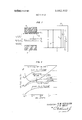
- FIG. 1 is a schematic illustration of the relationship between an electret, metallic support, shutter and probe with the associated electrical circuits.
- d represents distance
- 6 represents dielectric constant
- 0 represents surface charge
- C depicts an external capacitor
- R represents the input resistance of an electrometer
- V represents the voltage across capacitor C;
- FIG. 2 is a schematic illustration of a charge measuring arrangement which embodies the principles of the invention.
- the invention is applicable to thin electrets, such as film or foil electrets as well as to thick electrets, such as plate electrets. Any of these forms of electret may be metallized on one surface.
- a conductive shutter maintained at ground or reference potential, and interposed between the probe and the electret is opened to expose the probe to the electric field of the electret.
- the probe is connected by way of a shunt capacitance system to an electrometer, or the like.
- the electret is suspended in proximity to the probe to limit contact of the metallized layer of the electret with the support.
- a switch is employed to discharge the capacitor system prior to measurement.
- FIG. 1 A typical arrangement is illustrated in FIG. 1. Suppose a measurement of the charge retention characteristic of a thin film electret 10 is taken with metallic probe 11 positioned directly opposite to electret 10 by performing the following sequence of operations:
- the spacings d and d as related to the thickness d of electret 10, is also depicted in the figure. In practice, it has been found that for foil electrets with a thickness of approximately 10 cm., a distance d of approximately 0.5 centimeters is satisfactory.
- the induction charge density cr, on probe 11 is related to field E, by Gauss's theorem Since the charge Azr, on probe 11, where A represents probe area in square centimeters, is drawn from capacitor C, the initial voltage V across the capacitor is given by The term on the left represents the capacitance formed by electret 10 and the two gaps of thickness :1 and d Equation (4) is easily satisfied in practice, since d is chosen to be large.
- equation (5) can be written Since all quantities on the right-hand side of equation (6) are either known or precisely measurable, (T, can be obtained accurately.
- FIG. 2 illustrates apparatus suitable for measuring the effective surface charge of an electret in accordance with the invention.
- Thin film electret 10 is supported at its periphery by a semirigid frame 15.
- a cardboard or plastic ring framing the electret has been found to be satisfactory.
- the framed electret foil with a diameter typically of 10 centimeters is placed on a cup-shaped support table 14, maintained at reference ground potential, so that contact is made with the metallized surface of the electret only at the edge of the electret inside frame 15.
- support table 14 has a recess 13 in its upper surface forming a cuplike opening to a depth of approximately 0.25 centimeters to permit the electret to be positioned properly.
- Support table 14 may be mounted on a positioning table of any desired construction.
- a two-element table including platforms 16 and 17, may be used.
- Table 17 is, for example, adapted for lateral movement, and table 16 is adapted for movement at right angles to table 17.
- Retaining ring 18 may be placed over the outer periphery of frame mounted electret 10 to force the framed electret down on table 14 thus to provide a flat foil surface that is held immobile.
- Electret 10 is thus tautly held over the cup-shaped support table and maintained in contact with the table only at its outer edge. The cup prevents contact between the table and the area of the electret to be investigated. This is of particular importance for metallized foils.
- Probe 11 is supported in proximity to support table 14, for example, by means of arm 19, rotatably attached to mounting rod 20 by means of collar 21 and adjustment lock 22.
- Rod 20 is firmly attached to mounting plate 23 which also supports support table 14.
- a system for indicating the position of probe 11 may be provided by means ofa disc 24 affixed to rod 20 and an indicator probe 25 affixed to movable probe mounting 19. With this arrangement, probe 11 may be rotated about rod 20 and raised and lowered as desired to obtain cor rect positioning with regard to the electret.
- a number of different disc-shaped probes with diameters ranging from 0.03 centimeters to approximately l0 centimeters are used interchangeably in order that the surface charge of the electret may be measured either in its entirety or at selected subarea locations.
- Guard ring 26 circumscribes probe 11 with its lower surface in a plane with the lower surface of the probe. Preferably, it is maintained at the potential of probe 11, using any of the techniques well known in the art. Both probe 11 and guard ring 26 are covered by a conductive housing 27, preferably held at reference or ground potential. Housing 27 thus constitutes a shield to guard against external fields. In the embodiment illustrated, the lower surface of shield 27 is in the plane of the probe surface. Alternatively, housing 27, held at ground potential, may be used to function as a guard ring, thus eliminating the need for ring 26. With this construction, however, there is a slight potential difference between the probe and guard which will give rise to a small measuring error.
- Shutter l2 slidably supported in proximity to probe 11, may be closed to shield probe 11 completely from outside fields.
- shutter 12 is removed, as by slidably withdrawing it from a frame 23 or the like, or rotating it out of the area between probe 11 and electret 10, the front surface of probe 11 is exposed to the electric field of electret 10.
- Probe assembly 11, shutter 12, and support table 14, are preferably coated with a clean layer of nonoxidizing metal to avoid space charges on deposits and oxide layers.
- Probe assembly 11 is connected to the input of an electrometer 29 used in its voltmeter mode and set at maximum input resistance.
- an input resistance in excess of l0 ohms is preferred.
- This input impedance and other voltmeter characteristics are found in the Keithley model 615 digital electrometer.
- This instrument also includes switch 30 as an integral part of its operation.
- the input of electrometer 29 is shunted by a capacitor C of a known value, typically a few hundred picofarads.
- capacitor C includes the capacitance of the connecting cable as well as the input capacitance of meter 29.
- the RC-constant of the connecting system is on the order of seconds.
- additional shunt capacitance can be used to extend the range of the meter.
- Switch 30 is used to short circuit the capacitance and the meter input to remove residual charges prior to a measurement.
- measurements made as described above are effective for surface charge densities on foil electrets within a useful range of about 10 to about 10 C/cmF.
- the reproducibility error has been found to be about 1 percent with systematic errors equally low.
- the charge on electret.l0 can also be measured by short circuiting the input to electrometer 69 briefly prior to closing shutter 12 from its open position.
- Another important application afforded by the invention is the ability to map the lateral charge distribution of an electret. Mapping is achieved by employing a relatively small probe, comparable in size to the detail required in the mapping process, and by moving the table supporting the electret, or the probe arm (provided that the arm is arranged for adjustment both laterally and radially), to move the probe systematically relative to the electret. Charge density in a two-dimensional matrix of locations on the electret is indicated by the metering system, thus to indicate nonuniformities in charge density. Due to the long RC time constant of the capacitormeter combination, consecutive readings can be made without re'peatedly Zeroing the meter, without actuating the shutter, and without changing the distance between probe and electret.
- Apparatus for the measurement of the surface charge of an electret which comprises,
- first and second electrodes fixedly supported in juxtaposition to one another, the first held at reference ground potential and the second being coupled as a probe to ground by a capacitive system
- said probe electrode has a surface area coextensive with the area ofsaid electret that overlays said first electrode.
- said probe electrode has a surface area substantially smaller than the area of said electret that overlays said first electrode.
- said probe electrode, said shutter, and said first electrode are coated with a layer of nonoxidizing metal to avoid the accumulation of erratic space charge thereon.
- said film electret is supported at its periphery by a semirigid frame.
- said first electrode has a recess in the form of a cuplike depression in its surface juxtaposed to said probe electrode.
- said first electrode and said probe electrode are adjustably mounted so that they may be fixedly supported in jux taposition with prescribed amounts of overlap and separation.
- Apparatus for the measurement of surface charge on a film electret which comprises:
- capacitor means interconnecting said probe and said support
- a movable conductive shutter held at said first potential and supported intermediate said probe and said electret for electrically shielding said probe from said electret in a first position and for exposing said probe to said electret in a second position, said shutter having an area at least equal to the area encompassed by said probe, and
- Apparatus for the measurement of surface charge on a film electret which comprises:
- capacitor means interconnecting said probe and said ring
- a movable conductive electrode held at said first potential and supported intermediate said probe and said electret for electrically isolating said probe from said electret in a first position and for exposing said probe to said electret in a second position, said movable electrode having an area at least equal to an area coextensive with said ring support, and
Landscapes
- Physics & Mathematics (AREA)
- Power Engineering (AREA)
- General Physics & Mathematics (AREA)
- Chemical & Material Sciences (AREA)
- Engineering & Computer Science (AREA)
- Chemical Kinetics & Catalysis (AREA)
- Electrochemistry (AREA)
- Health & Medical Sciences (AREA)
- Life Sciences & Earth Sciences (AREA)
- Analytical Chemistry (AREA)
- Biochemistry (AREA)
- General Health & Medical Sciences (AREA)
- Microelectronics & Electronic Packaging (AREA)
- Immunology (AREA)
- Pathology (AREA)
- Measurement Of Current Or Voltage (AREA)
- Other Investigation Or Analysis Of Materials By Electrical Means (AREA)
- Measurement Of Resistance Or Impedance (AREA)
Applications Claiming Priority (1)
| Application Number | Priority Date | Filing Date | Title |
|---|---|---|---|
| US5953170A | 1970-07-30 | 1970-07-30 |
Publications (1)
| Publication Number | Publication Date |
|---|---|
| US3652932A true US3652932A (en) | 1972-03-28 |
Family
ID=22023564
Family Applications (1)
| Application Number | Title | Priority Date | Filing Date |
|---|---|---|---|
| US59531A Expired - Lifetime US3652932A (en) | 1970-07-30 | 1970-07-30 | Method and apparatus for measurement of surface charge of an electret |
Country Status (4)
| Country | Link |
|---|---|
| US (1) | US3652932A (Direct) |
| JP (1) | JPS573022B1 (Direct) |
| CA (1) | CA944023A (Direct) |
| NL (1) | NL162743C (Direct) |
Cited By (17)
| Publication number | Priority date | Publication date | Assignee | Title |
|---|---|---|---|---|
| US3789294A (en) * | 1972-07-19 | 1974-01-29 | Chubu Seiki Kk | Apparatus for measuring insulating and voltage resistant characteristics of articles |
| US3854337A (en) * | 1973-10-01 | 1974-12-17 | Us Atomic Energy | Charge storage device |
| FR2438839A1 (fr) * | 1978-10-11 | 1980-05-09 | Johnson Controls Inc | Element non conducteur charge detecteur de gaz polaire et appareil de detection comportant un tel element |
| EP0018293A1 (fr) * | 1979-04-23 | 1980-10-29 | Jacques Lewiner | Perfectionnements aux dispositifs de mesure des paramètres susceptibles de modifier la charge d'un électret |
| FR2455286A1 (fr) * | 1979-04-23 | 1980-11-21 | Dreyfus Gerard | Perfectionnements aux dispositifs de mesure des parametres susceptibles de modifier la charge d'un electret |
| FR2475740A2 (fr) * | 1980-02-11 | 1981-08-14 | Lewiner Jacques | Perfectionnements aux dispositifs de mesure de parametres susceptibles de modifier la charge d'un electret |
| US4884031A (en) * | 1988-09-29 | 1989-11-28 | Friedemann Freund | Method and apparatus for charge distribution analysis |
| US5187442A (en) * | 1988-09-29 | 1993-02-16 | Friedemann Freund | Method and apparatus for charge distribution analysis |
| US5388163A (en) * | 1991-12-23 | 1995-02-07 | At&T Corp. | Electret transducer array and fabrication technique |
| US5405584A (en) * | 1992-04-03 | 1995-04-11 | Zito; Richard R. | Device for detecting adsorbed molecules |
| US5835027A (en) * | 1996-11-07 | 1998-11-10 | Tyburski; Robert M. | Residual charge effect traffic sensor |
| US20040207369A1 (en) * | 2003-04-18 | 2004-10-21 | Landolt Oliver D. | Electromechanical power converter |
| US20080048521A1 (en) * | 2006-07-28 | 2008-02-28 | Sanyo Electric Co., Ltd. | Electric power generator |
| RU2393476C2 (ru) * | 2008-08-26 | 2010-06-27 | Государственное образовательное учреждение высшего профессионального образования Иркутский государственный университет | Устройство для диагностики функционального состояния крови человека |
| CN104237605A (zh) * | 2014-09-04 | 2014-12-24 | 兰州空间技术物理研究所 | 一种高压静电电压测量装置 |
| CN105785103A (zh) * | 2016-03-03 | 2016-07-20 | 兰州空间技术物理研究所 | 一种电容分压式卫星表面电位监测装置 |
| US9929679B2 (en) * | 2013-03-19 | 2018-03-27 | Sendai Smart Machines Co., Ltd. | Electrostatic induction-type vibration power generation device and method of manufacturing the same |
Families Citing this family (1)
| Publication number | Priority date | Publication date | Assignee | Title |
|---|---|---|---|---|
| JPS52111515U (Direct) * | 1976-02-19 | 1977-08-24 |
Citations (1)
| Publication number | Priority date | Publication date | Assignee | Title |
|---|---|---|---|---|
| US3496461A (en) * | 1967-05-25 | 1970-02-17 | Bell Telephone Labor Inc | Method of measuring the volume resistivity of thin,solid dielectric material utilizing the decay rates of a number of measured decay intervals |
-
1970
- 1970-07-30 US US59531A patent/US3652932A/en not_active Expired - Lifetime
-
1971
- 1971-03-12 CA CA107,599A patent/CA944023A/en not_active Expired
- 1971-07-27 JP JP5574071A patent/JPS573022B1/ja active Pending
- 1971-07-28 NL NL7110406.A patent/NL162743C/xx not_active IP Right Cessation
Patent Citations (1)
| Publication number | Priority date | Publication date | Assignee | Title |
|---|---|---|---|---|
| US3496461A (en) * | 1967-05-25 | 1970-02-17 | Bell Telephone Labor Inc | Method of measuring the volume resistivity of thin,solid dielectric material utilizing the decay rates of a number of measured decay intervals |
Cited By (22)
| Publication number | Priority date | Publication date | Assignee | Title |
|---|---|---|---|---|
| US3789294A (en) * | 1972-07-19 | 1974-01-29 | Chubu Seiki Kk | Apparatus for measuring insulating and voltage resistant characteristics of articles |
| US3854337A (en) * | 1973-10-01 | 1974-12-17 | Us Atomic Energy | Charge storage device |
| FR2438839A1 (fr) * | 1978-10-11 | 1980-05-09 | Johnson Controls Inc | Element non conducteur charge detecteur de gaz polaire et appareil de detection comportant un tel element |
| EP0018293A1 (fr) * | 1979-04-23 | 1980-10-29 | Jacques Lewiner | Perfectionnements aux dispositifs de mesure des paramètres susceptibles de modifier la charge d'un électret |
| FR2455286A1 (fr) * | 1979-04-23 | 1980-11-21 | Dreyfus Gerard | Perfectionnements aux dispositifs de mesure des parametres susceptibles de modifier la charge d'un electret |
| FR2475740A2 (fr) * | 1980-02-11 | 1981-08-14 | Lewiner Jacques | Perfectionnements aux dispositifs de mesure de parametres susceptibles de modifier la charge d'un electret |
| US4884031A (en) * | 1988-09-29 | 1989-11-28 | Friedemann Freund | Method and apparatus for charge distribution analysis |
| WO1990003571A1 (en) * | 1988-09-29 | 1990-04-05 | Friedemann Freund | Method and apparatus for charge distribution analysis |
| US5187442A (en) * | 1988-09-29 | 1993-02-16 | Friedemann Freund | Method and apparatus for charge distribution analysis |
| US5388163A (en) * | 1991-12-23 | 1995-02-07 | At&T Corp. | Electret transducer array and fabrication technique |
| US5405584A (en) * | 1992-04-03 | 1995-04-11 | Zito; Richard R. | Device for detecting adsorbed molecules |
| US5835027A (en) * | 1996-11-07 | 1998-11-10 | Tyburski; Robert M. | Residual charge effect traffic sensor |
| US6130627A (en) * | 1996-11-07 | 2000-10-10 | Tyburski; Robert M. | Residual charge effect sensor |
| US20040207369A1 (en) * | 2003-04-18 | 2004-10-21 | Landolt Oliver D. | Electromechanical power converter |
| US6833687B2 (en) * | 2003-04-18 | 2004-12-21 | Agilent Technologies, Inc. | Electromechanical power converter |
| US20080048521A1 (en) * | 2006-07-28 | 2008-02-28 | Sanyo Electric Co., Ltd. | Electric power generator |
| US7525205B2 (en) * | 2006-07-28 | 2009-04-28 | Sanyo Electric Co., Ltd. | Electric power generator |
| RU2393476C2 (ru) * | 2008-08-26 | 2010-06-27 | Государственное образовательное учреждение высшего профессионального образования Иркутский государственный университет | Устройство для диагностики функционального состояния крови человека |
| US9929679B2 (en) * | 2013-03-19 | 2018-03-27 | Sendai Smart Machines Co., Ltd. | Electrostatic induction-type vibration power generation device and method of manufacturing the same |
| CN104237605A (zh) * | 2014-09-04 | 2014-12-24 | 兰州空间技术物理研究所 | 一种高压静电电压测量装置 |
| CN104237605B (zh) * | 2014-09-04 | 2018-01-09 | 兰州空间技术物理研究所 | 一种高压静电电压测量装置 |
| CN105785103A (zh) * | 2016-03-03 | 2016-07-20 | 兰州空间技术物理研究所 | 一种电容分压式卫星表面电位监测装置 |
Also Published As
| Publication number | Publication date |
|---|---|
| CA944023A (en) | 1974-03-19 |
| JPS573022B1 (Direct) | 1982-01-19 |
| JPS473491A (Direct) | 1972-02-21 |
| NL162743B (nl) | 1980-01-15 |
| NL7110406A (Direct) | 1972-02-01 |
| NL162743C (nl) | 1980-06-16 |
Similar Documents
| Publication | Publication Date | Title |
|---|---|---|
| US3652932A (en) | Method and apparatus for measurement of surface charge of an electret | |
| Collins | Measurement of charge distribution in electrets | |
| Sessler et al. | Foil‐electret microphones | |
| US3919627A (en) | Conductivity measuring method and apparatus utilizing coaxial electrode cells | |
| US2933677A (en) | Probe for a thickness testing gage | |
| US3373353A (en) | Electron beam scanning system for quality control of materials | |
| US3716782A (en) | Capacitance gage for measuring small distances | |
| US3873919A (en) | AC electric fieldmeter | |
| Sessler et al. | Method for measurement of surface charge densities on electrets | |
| US3544889A (en) | Method and apparatus for measuring the electrostatic properties of plastic materials including means for rotating the materials past a charging electrode and a measurement probe | |
| US3866114A (en) | Electrostatic measurement system | |
| Okabe et al. | Measurement methods of accumulated electric charges on spacer in gas insulated switchgear | |
| GB1590081A (en) | Apparatus for gauging the surface texture and surface irregularities of a conducting surface | |
| US3852662A (en) | Proximity measuring employing a self-balancing bridge and measuring the adjustable balancing component thereof | |
| CN206773072U (zh) | 一种非接触测试半绝缘半导体电阻率的装置 | |
| US3287637A (en) | High frequency current means including capacitive probe members for determining the electrical resistance of a semiconductor layer | |
| US2809346A (en) | Apparatus for measuring the thickness of electroconductive films | |
| US4023102A (en) | Test fixture | |
| US3496461A (en) | Method of measuring the volume resistivity of thin,solid dielectric material utilizing the decay rates of a number of measured decay intervals | |
| Kakimoto et al. | Improvements on the measurements of dielectric constant and dissipation factor in a wide frequency range | |
| Brodie et al. | Measurement of charge transfer in electrographic processes | |
| Bachtin | A very short response time electronic system for the measurement of surface potential changes by means of a static capacitor method | |
| Fort Jr et al. | Measurement of contact potential difference between metals in liquid environments | |
| US2930977A (en) | Method of and device for detecting differences and changes in bodies | |
| RU2086995C1 (ru) | Способ определения электрической прочности твердых диэлектриков |