US3554833A - Method for the production of laminar thermoplastic films - Google Patents
Method for the production of laminar thermoplastic films Download PDFInfo
- Publication number
- US3554833A US3554833A US697342A US3554833DA US3554833A US 3554833 A US3554833 A US 3554833A US 697342 A US697342 A US 697342A US 3554833D A US3554833D A US 3554833DA US 3554833 A US3554833 A US 3554833A
- Authority
- US
- United States
- Prior art keywords
- tube
- thermoplastic
- tubing
- film
- rollers
- Prior art date
- Legal status (The legal status is an assumption and is not a legal conclusion. Google has not performed a legal analysis and makes no representation as to the accuracy of the status listed.)
- Expired - Lifetime
Links
- 229920001169 thermoplastic Polymers 0.000 title abstract description 25
- 239000004416 thermosoftening plastic Substances 0.000 title abstract description 24
- 238000000034 method Methods 0.000 title abstract description 22
- 238000004519 manufacturing process Methods 0.000 title abstract description 7
- 229920003023 plastic Polymers 0.000 abstract description 2
- 239000004033 plastic Substances 0.000 abstract description 2
- 238000001125 extrusion Methods 0.000 description 9
- 239000000463 material Substances 0.000 description 7
- -1 polyethylene Polymers 0.000 description 7
- 239000004698 Polyethylene Substances 0.000 description 6
- 229920000573 polyethylene Polymers 0.000 description 6
- 239000000853 adhesive Substances 0.000 description 5
- 230000001070 adhesive effect Effects 0.000 description 5
- 230000000694 effects Effects 0.000 description 4
- 239000012815 thermoplastic material Substances 0.000 description 4
- 230000004927 fusion Effects 0.000 description 3
- 229920000642 polymer Polymers 0.000 description 3
- 239000004793 Polystyrene Substances 0.000 description 2
- 239000011248 coating agent Substances 0.000 description 2
- 238000000576 coating method Methods 0.000 description 2
- 238000001816 cooling Methods 0.000 description 2
- 229920001577 copolymer Polymers 0.000 description 2
- 238000010030 laminating Methods 0.000 description 2
- 239000000203 mixture Substances 0.000 description 2
- 238000012986 modification Methods 0.000 description 2
- 230000004048 modification Effects 0.000 description 2
- 230000000704 physical effect Effects 0.000 description 2
- 229920002223 polystyrene Polymers 0.000 description 2
- 101100113576 Arabidopsis thaliana CINV2 gene Proteins 0.000 description 1
- 239000004743 Polypropylene Substances 0.000 description 1
- 229920001328 Polyvinylidene chloride Polymers 0.000 description 1
- XTXRWKRVRITETP-UHFFFAOYSA-N Vinyl acetate Chemical compound CC(=O)OC=C XTXRWKRVRITETP-UHFFFAOYSA-N 0.000 description 1
- 235000008429 bread Nutrition 0.000 description 1
- DQXBYHZEEUGOBF-UHFFFAOYSA-N but-3-enoic acid;ethene Chemical compound C=C.OC(=O)CC=C DQXBYHZEEUGOBF-UHFFFAOYSA-N 0.000 description 1
- 238000006243 chemical reaction Methods 0.000 description 1
- 230000001419 dependent effect Effects 0.000 description 1
- 239000005038 ethylene vinyl acetate Substances 0.000 description 1
- 239000012530 fluid Substances 0.000 description 1
- 239000000155 melt Substances 0.000 description 1
- 150000005673 monoalkenes Chemical class 0.000 description 1
- 238000004806 packaging method and process Methods 0.000 description 1
- 229920001200 poly(ethylene-vinyl acetate) Polymers 0.000 description 1
- 229920001083 polybutene Polymers 0.000 description 1
- 229920000098 polyolefin Polymers 0.000 description 1
- 229920001155 polypropylene Polymers 0.000 description 1
- 239000004800 polyvinyl chloride Substances 0.000 description 1
- 229920000915 polyvinyl chloride Polymers 0.000 description 1
- 239000005033 polyvinylidene chloride Substances 0.000 description 1
- 238000002360 preparation method Methods 0.000 description 1
- 238000003860 storage Methods 0.000 description 1
- 229920005992 thermoplastic resin Polymers 0.000 description 1
- 125000000391 vinyl group Chemical group [H]C([*])=C([H])[H] 0.000 description 1
- 229920002554 vinyl polymer Polymers 0.000 description 1
- 238000003466 welding Methods 0.000 description 1
- OENHQHLEOONYIE-JLTXGRSLSA-N β-Carotene Chemical compound CC=1CCCC(C)(C)C=1\C=C\C(\C)=C\C=C\C(\C)=C\C=C\C=C(/C)\C=C\C=C(/C)\C=C\C1=C(C)CCCC1(C)C OENHQHLEOONYIE-JLTXGRSLSA-N 0.000 description 1
Images
Classifications
-
- B—PERFORMING OPERATIONS; TRANSPORTING
- B29—WORKING OF PLASTICS; WORKING OF SUBSTANCES IN A PLASTIC STATE IN GENERAL
- B29C—SHAPING OR JOINING OF PLASTICS; SHAPING OF MATERIAL IN A PLASTIC STATE, NOT OTHERWISE PROVIDED FOR; AFTER-TREATMENT OF THE SHAPED PRODUCTS, e.g. REPAIRING
- B29C48/00—Extrusion moulding, i.e. expressing the moulding material through a die or nozzle which imparts the desired form; Apparatus therefor
- B29C48/03—Extrusion moulding, i.e. expressing the moulding material through a die or nozzle which imparts the desired form; Apparatus therefor characterised by the shape of the extruded material at extrusion
-
- B—PERFORMING OPERATIONS; TRANSPORTING
- B29—WORKING OF PLASTICS; WORKING OF SUBSTANCES IN A PLASTIC STATE IN GENERAL
- B29C—SHAPING OR JOINING OF PLASTICS; SHAPING OF MATERIAL IN A PLASTIC STATE, NOT OTHERWISE PROVIDED FOR; AFTER-TREATMENT OF THE SHAPED PRODUCTS, e.g. REPAIRING
- B29C48/00—Extrusion moulding, i.e. expressing the moulding material through a die or nozzle which imparts the desired form; Apparatus therefor
- B29C48/001—Combinations of extrusion moulding with other shaping operations
- B29C48/0018—Combinations of extrusion moulding with other shaping operations combined with shaping by orienting, stretching or shrinking, e.g. film blowing
-
- B—PERFORMING OPERATIONS; TRANSPORTING
- B29—WORKING OF PLASTICS; WORKING OF SUBSTANCES IN A PLASTIC STATE IN GENERAL
- B29C—SHAPING OR JOINING OF PLASTICS; SHAPING OF MATERIAL IN A PLASTIC STATE, NOT OTHERWISE PROVIDED FOR; AFTER-TREATMENT OF THE SHAPED PRODUCTS, e.g. REPAIRING
- B29C48/00—Extrusion moulding, i.e. expressing the moulding material through a die or nozzle which imparts the desired form; Apparatus therefor
- B29C48/001—Combinations of extrusion moulding with other shaping operations
- B29C48/0019—Combinations of extrusion moulding with other shaping operations combined with shaping by flattening, folding or bending
-
- B—PERFORMING OPERATIONS; TRANSPORTING
- B29—WORKING OF PLASTICS; WORKING OF SUBSTANCES IN A PLASTIC STATE IN GENERAL
- B29C—SHAPING OR JOINING OF PLASTICS; SHAPING OF MATERIAL IN A PLASTIC STATE, NOT OTHERWISE PROVIDED FOR; AFTER-TREATMENT OF THE SHAPED PRODUCTS, e.g. REPAIRING
- B29C48/00—Extrusion moulding, i.e. expressing the moulding material through a die or nozzle which imparts the desired form; Apparatus therefor
- B29C48/03—Extrusion moulding, i.e. expressing the moulding material through a die or nozzle which imparts the desired form; Apparatus therefor characterised by the shape of the extruded material at extrusion
- B29C48/09—Articles with cross-sections having partially or fully enclosed cavities, e.g. pipes or channels
- B29C48/10—Articles with cross-sections having partially or fully enclosed cavities, e.g. pipes or channels flexible, e.g. blown foils
Definitions
- thermoplastic film laminates which comprises extruding a thermoplastic tube; inflating the extruded tube with a gaseous medium; flattening the inflated tube by passing it through a pair of rotating nip rollers, said collapsing step being effected while the tubular film is still in a heat-softened plastic condition whereby the walls of the tube fuse together thereby forming a flat, two-layer thermoplastic film laminate.
- the present invention relates to a method of forming thermoplastic laminar structures and more particularly to a method whereby such laminates are formed as an integral part of the tubular film extrusion step.
- thermoplastic film laminates by adhesively securing individual layers of thermoplastic film together.
- U.S. Pat. No. 3,322,588 discloses a method for the preparation of heavy gauge laminated thermoplastic sheets by extrusion of a thermoplastic tube, inflating the tubing to a selected diameter and applying an adhesive material to the inner wall of the tubing, and subsequently flattening the tubing to form an adhesively bonded laminated sheet having a thickness which is double the Wall thickness of the inflated extruded tubing.
- Such a method for the manufacture of'a laminar film structure is undesirable from the standpoint of the necessity to employ special adhesive coating to effect the Welding together of the individual layers to effect the laminate.
- the method of the present invention eliminates the need for the employment of such adhesive coating materials.
- thermoplastic material is continuously extruded through an annular die orifice thereby forming a tube.
- the still semimolten thermoplastic material is drawn fromthe die by subsequent passage of the tube through a pair of rotating collapsing rollers.
- the collapsing rollers flatten the tube and seal air in the tube between the die and the collapsing rollers. The amount of air entrapped in the tube at this location determines the diameter of the thermoplastic tube.
- the aforedescribed collapsing of the tube is effected while the inner surfaces of the tube arestill in a semi-molten, heat-softened condition whereby passage of the tube through the nip of the collapsing rollers causes-the inner surfaces of the tube to fuse and weld together thereby forming a two-layer film laminate upon emergence from the colapsing rollers.
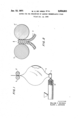
- FIG. 1 is a diagrammatic illustration of an apparatus which may be employed in the method of the present invention.
- FIG. 2' is an enlarged sectional taken through line 2-2 of FIG. 1.
- the present invention provides for the production of flat laminar films characterized by improved physical properties from thermoplastic tubing which has been extruded utilizing the standard trappedbubble technique.
- the present invention provides a method whereby laminates may be formed in the absence of such adhesive materials.
- the present invention provides a method whereby molten thermoplastic material is extruded in the conventional manner from an annular orifice forming a tube which is subsequently drawn off by a pair of rotating collapsing rollers.
- the interior surface of the tubular film is maintained at a temperature generally above the softening point thereof prior to its point of entry into the collapsing rollers.
- Such temperature control is effected by carefully controlling extrusion and cooling conditions and by allowing the collapsing rollers to be operated at a temperature substantially equivalent to that of the film temperature as it enters the collapsing rollers.
- FIG. 1 a molten thermoplastic polymer is extruded in the form of a seamless tubing 2 from an extrusion die head 11 of conventional extruder 12.
- Tubing 2 was expanded while still in a semi-molten condition by employing a trappedbubble of air within the tubing between extrusion die head 11 and collapsing rotating pressure rollers 3 and 3, the function of which will be described subsequently.
- the rate of withdrawal of tubing 2. from die head 11 may vary and is dependent on factors such as the type of polymer being extruded, the rotational speed of the screw contained with- .in the conventional extruder 12, the gauge of the material being extruded, and the desired physical properties of the finished film product.
- the rotating pressure rollers 3 and 3' are located close enough to the die outlet orifice so that once tubing 2 is expanded to its final predetermined diameter, it may be collapsed by rotating pressure rollers 3 and 3 while the interior surfaces of tubing 2 are still at an elevated temperature, i.e. at a temperature at least above the softening point of the particular polymer being extruded.
- heaters e.g. radiant heaters, positioned between die head 11 and rotating pressure rollers 3 and 3 in order to insure that the interior surfaces of tubing 2 remain in a semi-molten condition immediately prior to the tube entry into the nip of rollers 3 and 3'.
- a temperature is generally in the range of about F. to about 200 F. and preferably about F.
- the temperature of the interior surface of tubing 2 is maintained so that it remains above the softening point of the polymer, i.e. such inner surface still being in a semi-molten condition, when the tubing is collapsed and pinched in the nip of rotating pressure rollers 3 and 3'.
- the opposed interior surfaces of the collapsed film tube weld and fuse together whereby a two-layer film laminate, the layers of which are securely heat welded together, emerges from the exit end of pressure rollers 3 and 3'.
- the laminar film is subsequently allowed to cool to approximately ambient temperatures prior to passage to wind-up rollers (not shown).
- wind-up rollers not shown.
- polyolefins such as polyethylene, polypropylene and polybutene and copolymers or mixtures and blends thereof
- polystyrene rubber modified polystyrene materials
- vinyls such as polyvinyl-chloride, polyvinylidenechloride
- vinyl acetate as well as copolymers of the latter with mono-olefins such as ethylene-vinyl acetate for example.
- thermoplastic tube is maintained prior to passage thereof through pressure rollers 3 and 3' in order to insure thermal fusion thereof will depend upon the nature of the thermoplastic materials being employed.
- Pressures utilized to effect a fusion of the interior walls of the thermoplastic tubing will also depend upon the nature of the thermoplastic being laminated. When laminating polyethylene tubing, suitable pressures have been found to be at least about 15 p.s.i. and preferably about 25 p.s.i.
- EXAMPLE 1 Polyethylene, having a density of about 0.919, and a melt index of about 1.5, was fed into a standard thermoplastic extruder which had an extruder bore size of 4 /2". The extruder had 5 heated zones, maintained at 275 F. to 300 F. The polyethylene was screw fed along the barrel of the extruder to the extrusion die head and extruded from the die orifice thereof, at a temperature of 275 F., into the form of a continuous tubing having an outside diameter of 19 and a wall gauge of 1.0 ml. The emerging tubing was fed from the extrusion orifice into the nip formed by a pair of rotating pressure rollers. The rate of extrusion was 200 lbs. per hour. The tubing was expanded by introducing air into the interior of the tubing located between the orifice of the extrusion die and the rotating collapsing pressure rollers. This air was maintained within the tubing at this location under pressure.
- the laminar films produced in accord with the method of the present invention, exhibit improved tensile properties as compared with non-laminar films of equivalent thickness.
- a method for the production of two-layer thermoplastic film laminates which comprises continuously extruding a single wall tubular film of molten thermoplastic resin, inflating said tube to at least twice its diameter to a predetermined thickness by maintaining a fluid, under a relatively low pressure interiorly of said tube, flattening said inflated tube into a sheet twice said predetermined thickness while the interior surfaces thereof are in a heatsoftened semi-molten condition by passing said tube through the nip formed by a pair of rotating nip rollers, said nip rollers exerting a pressure of about at least 15 psi. to flatten said tube, and simultaneously, during passage of said flattened tube through said rotating nip rollers heat-fusing the contacting interior wall surfaces of the heat-softened tube together and subsequently cooling said laminate to a permanent set condition.
- thermoplastic film is polyethylene
Landscapes
- Engineering & Computer Science (AREA)
- Mechanical Engineering (AREA)
- Extrusion Moulding Of Plastics Or The Like (AREA)
Abstract
A METHOD FOR THE PRODUCTION OF THERMOPLASTIC FILM LAMINATES WHICH COMPRISES EXTRUDING A THERMOPLASTIC TUBE; INFLATING THE EXTRUDED TUBE WITH A GASEOUS MEDIUM; FLATTENING THE INFLATED TUBE BY PASSING IT THROUGH A PAIR OF ROTATING NIP ROLLERS, SAID COLLAPSING STEP BEING EFFECTED WHILE THE TUBULAR FILM IS STILL IN A HEAT-SOFTENED PLASTIC CONDITION WHEREBY THE WALLS OF THE TUBE FUSE TOGETHER THEREBY FORMING A FLAT, TWO-LAYER THERMOPLASTIC FILM LAMINATE.
Description
Jan. 12, 1971 w DE vm s ETAL 3,554,833
METHOD FOR THE PRODUQTION OF LAMINAR THERMOPLASTIC FILMS Filed Jan. 12, 1968 INVI'JNIOICS WILLIAM C. DEVRIES ELDON L. JOHNSON METHOD FOR THE PRODUCTION OF LAMINAR THERMOPLASTIC FILMS William C. De Vries, Macedon, and Eldon L. Johnson, Shortseille, N.Y., assignors to Mobil Oil Corporation, a corporation of New York Filed Jan. 12, 1968, Ser. No. 697,342 Int. Cl. B29c 17/02 U.S. Cl. 156229 2 Claims ABSTRACT OF THE DISCLOSURE A method for the production of thermoplastic film laminates which comprises extruding a thermoplastic tube; inflating the extruded tube with a gaseous medium; flattening the inflated tube by passing it through a pair of rotating nip rollers, said collapsing step being effected while the tubular film is still in a heat-softened plastic condition whereby the walls of the tube fuse together thereby forming a flat, two-layer thermoplastic film laminate.
BACKGROUND OF THE INVENTION (I) Field of the invention The present invention relates to a method of forming thermoplastic laminar structures and more particularly to a method whereby such laminates are formed as an integral part of the tubular film extrusion step.
(II) Description of the prior art In the past it has been known to form thermoplastic film laminates :by adhesively securing individual layers of thermoplastic film together. U.S. Pat. No. 3,322,588 discloses a method for the preparation of heavy gauge laminated thermoplastic sheets by extrusion of a thermoplastic tube, inflating the tubing to a selected diameter and applying an adhesive material to the inner wall of the tubing, and subsequently flattening the tubing to form an adhesively bonded laminated sheet having a thickness which is double the Wall thickness of the inflated extruded tubing. Such a method for the manufacture of'a laminar film structure is undesirable from the standpoint of the necessity to employ special adhesive coating to effect the Welding together of the individual layers to effect the laminate. The method of the present invention eliminates the need for the employment of such adhesive coating materials.
SUMMARY OF THE INVENTION 7 In the method of the present invention, molten thermoplastic material is continuously extruded through an annular die orifice thereby forming a tube. The still semimolten thermoplastic material is drawn fromthe die by subsequent passage of the tube through a pair of rotating collapsing rollers. The collapsing rollers flatten the tube and seal air in the tube between the die and the collapsing rollers. The amount of air entrapped in the tube at this location determines the diameter of the thermoplastic tube. In the method of the present invention the aforedescribed collapsing of the tube is effected while the inner surfaces of the tube arestill in a semi-molten, heat-softened condition whereby passage of the tube through the nip of the collapsing rollers causes-the inner surfaces of the tube to fuse and weld together thereby forming a two-layer film laminate upon emergence from the colapsing rollers.
BRIEF DESCRIPTION OF THE DMWING FIG. 1 is a diagrammatic illustration of an apparatus which may be employed in the method of the present invention.
FIG. 2' is an enlarged sectional taken through line 2-2 of FIG. 1.
United States Patent DESCRIPTION OF SPECIFIC EMBODIMENTS As hereinbefore described, the present invention provides for the production of flat laminar films characterized by improved physical properties from thermoplastic tubing which has been extruded utilizing the standard trappedbubble technique. In addition, whereas in the past such laminates were formed utilizing special adhesive applied interiorly of the tube, the present invention provides a method whereby laminates may be formed in the absence of such adhesive materials.
Accordingly, the present invention provides a method whereby molten thermoplastic material is extruded in the conventional manner from an annular orifice forming a tube which is subsequently drawn off by a pair of rotating collapsing rollers. The interior surface of the tubular film, however, in accordance with the present method, is maintained at a temperature generally above the softening point thereof prior to its point of entry into the collapsing rollers. Such temperature control is effected by carefully controlling extrusion and cooling conditions and by allowing the collapsing rollers to be operated at a temperature substantially equivalent to that of the film temperature as it enters the collapsing rollers. Because of the aforedescribed general temperature conditions as the film tube assumes a lay-flat condition as a result of being pinched in the nip of the collapsing rollers, the interior surfaces of the film which come into contact with one another, as a result of such collapsing action, become fused and welded together whereby the lay-flat film tube as it emerges or exits from the collapsing rollers is converted into a two-layer laminated film structure which cannot be easily delaminated during subsequent handling and processing thereof. Such a laminar film product has been found useful for general packaging applications such as for example film overwrap material, e.g. bread overwrap, or conversion into thermoplastic bags, e.g. side seal bags for example.
Referring now to the accompanying drawing, FIG. 1, a molten thermoplastic polymer is extruded in the form of a seamless tubing 2 from an extrusion die head 11 of conventional extruder 12. Tubing 2 was expanded while still in a semi-molten condition by employing a trappedbubble of air within the tubing between extrusion die head 11 and collapsing rotating pressure rollers 3 and 3, the function of which will be described subsequently. The rate of withdrawal of tubing 2. from die head 11 may vary and is dependent on factors such as the type of polymer being extruded, the rotational speed of the screw contained with- .in the conventional extruder 12, the gauge of the material being extruded, and the desired physical properties of the finished film product. The rotating pressure rollers 3 and 3' are located close enough to the die outlet orifice so that once tubing 2 is expanded to its final predetermined diameter, it may be collapsed by rotating pressure rollers 3 and 3 while the interior surfaces of tubing 2 are still at an elevated temperature, i.e. at a temperature at least above the softening point of the particular polymer being extruded. In some instances it has been found desirable to employ heaters (not shown), e.g. radiant heaters, positioned between die head 11 and rotating pressure rollers 3 and 3 in order to insure that the interior surfaces of tubing 2 remain in a semi-molten condition immediately prior to the tube entry into the nip of rollers 3 and 3'. In the case of polyethylene, for example, such a temperature is generally in the range of about F. to about 200 F. and preferably about F.
The temperature of the interior surface of tubing 2 is maintained so that it remains above the softening point of the polymer, i.e. such inner surface still being in a semi-molten condition, when the tubing is collapsed and pinched in the nip of rotating pressure rollers 3 and 3'. As a result, the opposed interior surfaces of the collapsed film tube weld and fuse together whereby a two-layer film laminate, the layers of which are securely heat welded together, emerges from the exit end of pressure rollers 3 and 3'. The laminar film is subsequently allowed to cool to approximately ambient temperatures prior to passage to wind-up rollers (not shown). Although not illustrated in FIG. 1, rather than passing the laminated film material to a wind-up roller for storage, it may be processed in-line continuously into bag forming equipment and/ or printing equipment for imprinting advertising indicia on the surface thereof.
Illustrative examples of suitable thermoplastics which may be employed in the method of the present invention include polyolefins such as polyethylene, polypropylene and polybutene and copolymers or mixtures and blends thereof; polystyrene, rubber modified polystyrene materials; vinyls such as polyvinyl-chloride, polyvinylidenechloride; and vinyl acetate as well as copolymers of the latter with mono-olefins such as ethylene-vinyl acetate for example.
It will be understood that the actual working temperature, or temperature at which the extruded thermoplastic tube is maintained prior to passage thereof through pressure rollers 3 and 3' in order to insure thermal fusion thereof will depend upon the nature of the thermoplastic materials being employed.
Pressures utilized to effect a fusion of the interior walls of the thermoplastic tubing will also depend upon the nature of the thermoplastic being laminated. When laminating polyethylene tubing, suitable pressures have been found to be at least about 15 p.s.i. and preferably about 25 p.s.i.
The following example is intended to serve as an illustration of the method of the present invention and accordingly is not intended to be construed in a limitative sense.
EXAMPLE 1 Polyethylene, having a density of about 0.919, and a melt index of about 1.5, was fed into a standard thermoplastic extruder which had an extruder bore size of 4 /2". The extruder had 5 heated zones, maintained at 275 F. to 300 F. The polyethylene was screw fed along the barrel of the extruder to the extrusion die head and extruded from the die orifice thereof, at a temperature of 275 F., into the form of a continuous tubing having an outside diameter of 19 and a wall gauge of 1.0 ml. The emerging tubing was fed from the extrusion orifice into the nip formed by a pair of rotating pressure rollers. The rate of extrusion was 200 lbs. per hour. The tubing was expanded by introducing air into the interior of the tubing located between the orifice of the extrusion die and the rotating collapsing pressure rollers. This air was maintained within the tubing at this location under pressure.
Enough air was maintained within the tubing to expand the tubing to twice its diameter. As the inflated tubing was collapsed by being pressed into the nip of rotating pressure rollers 3 and 3 (as identified in the accompanying drawings), the interior walls of the tubing were forced together under suificient pressure to effect a fusion thereof. The laminated tubing was subsequently cooled to a permanent set and subsequently passed to a wind-up roller.
Properties of the laminated fiat film are tabulated below in Table l and compared to properties of a nonlaminated flat film produced in the manner described above with the exception that the laminating step was omitted.
1 Film gauge 2.0 mils; LaminatedzLO mil film layers laminated together to equal 20 mils total wall thickness. Non-laminated:2.0 mils extruded wall thickness.
- Machine direction.
3 Transverse direction.
As seen from the foregoing table, the laminar films, produced in accord with the method of the present invention, exhibit improved tensile properties as compared with non-laminar films of equivalent thickness.
Although the present invention has been described with preferred embodiments, resort to modifications and variations can be had without departing from the spirit and scope of the invention, as those skilled in the art will readily appreciate. Such variations and modifications are therefore considered to be within the purview and scope of the appended claims.
What is claimed is:
l. A method for the production of two-layer thermoplastic film laminates which comprises continuously extruding a single wall tubular film of molten thermoplastic resin, inflating said tube to at least twice its diameter to a predetermined thickness by maintaining a fluid, under a relatively low pressure interiorly of said tube, flattening said inflated tube into a sheet twice said predetermined thickness while the interior surfaces thereof are in a heatsoftened semi-molten condition by passing said tube through the nip formed by a pair of rotating nip rollers, said nip rollers exerting a pressure of about at least 15 psi. to flatten said tube, and simultaneously, during passage of said flattened tube through said rotating nip rollers heat-fusing the contacting interior wall surfaces of the heat-softened tube together and subsequently cooling said laminate to a permanent set condition.
2. A method in accordance with claim 1 wherein said thermoplastic film is polyethylene.
References Cited UNITED STATES PATENTS 2,753,596 7/1956 Bailey 156244 3,091,807 6/1963 Turner et a1 264210 3,094,449 6/1963 Sisson 156-244 3,159,698 12/1964 Suh et a1 156244 3,187,982 6/1965 Underwood et a1. 156-244 3,277,221 10/1966 Parrish 156244 3,291,876 12/1966 Justus 264-210 3,322,588 5/1967 Schelhorn l56-244 3,384,531 5/1968 Parrish 264210 CARL D. QUARFORTH, Primary Examiner H. E. BEHR-END, Assistant Examiner U.S. Cl. X.R. 156244
Applications Claiming Priority (1)
| Application Number | Priority Date | Filing Date | Title |
|---|---|---|---|
| US69734268A | 1968-01-12 | 1968-01-12 |
Publications (1)
| Publication Number | Publication Date |
|---|---|
| US3554833A true US3554833A (en) | 1971-01-12 |
Family
ID=24800757
Family Applications (1)
| Application Number | Title | Priority Date | Filing Date |
|---|---|---|---|
| US697342A Expired - Lifetime US3554833A (en) | 1968-01-12 | 1968-01-12 | Method for the production of laminar thermoplastic films |
Country Status (1)
| Country | Link |
|---|---|
| US (1) | US3554833A (en) |
Cited By (1)
| Publication number | Priority date | Publication date | Assignee | Title |
|---|---|---|---|---|
| DE2659191A1 (en) * | 1976-01-23 | 1977-07-28 | Mobil Oil Corp | LAMINATE, METHOD FOR MANUFACTURING IT AND ITS USE |
-
1968
- 1968-01-12 US US697342A patent/US3554833A/en not_active Expired - Lifetime
Cited By (3)
| Publication number | Priority date | Publication date | Assignee | Title |
|---|---|---|---|---|
| DE2659191A1 (en) * | 1976-01-23 | 1977-07-28 | Mobil Oil Corp | LAMINATE, METHOD FOR MANUFACTURING IT AND ITS USE |
| FR2338795A1 (en) * | 1976-01-23 | 1977-08-19 | Mobil Oil | LOW DENSITY POLYETHYLENE BLOCKED LAMINATES, THEIR PREPARATION PROCESS AND BAGS AND POUCHES MADE WITH SUCH LAMINATES |
| US4160053A (en) * | 1976-01-23 | 1979-07-03 | Mobil Oil Corporation | Blocked film laminate of low density polyethylene |
Similar Documents
| Publication | Publication Date | Title |
|---|---|---|
| US3075868A (en) | Method of bonding polymer plastics to substrate webs of dissimilar materials | |
| US3996323A (en) | Method of producing double-walled synthetic plastics tubes having an outer wall with annular or helical corrugations | |
| US3187982A (en) | Method for forming coated uniaxially oriented films and the product formed thereby | |
| US3821182A (en) | Method for preparing of film of a vinylidene chloride polymer | |
| CN103442878B (en) | Manufacture the apparatus and method of the pressure compensating irrigation pipe with desired molecule orientation and thus obtained pipe | |
| US3223761A (en) | Melt extrusion of multi-wall plastic tubing | |
| US3955697A (en) | Multilayered hollow plastic container | |
| US3957940A (en) | Wrinkle free extrusion coating of heat fusible foam sheet | |
| US3682730A (en) | Method for laminating oriented thermoplastic film to thermoplastic foam | |
| US4011357A (en) | Laminate of biaxially oriented polystyrene film and polystyrene foam | |
| US3959425A (en) | Method for extruding tubular thermoplastic film | |
| US3461496A (en) | Apparatus for extruding a skin covered,foamed thermoplastic | |
| US3726743A (en) | Film blowing method and apparatus | |
| US3837773A (en) | Extruded plastic film method and apparatus for the manufacture thereof | |
| US3926706A (en) | Film blowing method | |
| US4289727A (en) | Method for extrusion of tubular films | |
| US3467565A (en) | Method of laminating a carrier web and a high melting plastic film | |
| US3322870A (en) | Method of producing clear, crystalline, high-gloss thermoplastic film | |
| EP0023739B1 (en) | Method and apparatus for the manufacture of biaxially orientation-stretched plastic film and film produced thereby | |
| US3486196A (en) | Apparatus for the production of multilayer tubes from thermoplastics | |
| GB2156268A (en) | Manufacturing thermoplastic tubular containers | |
| US3551243A (en) | Method of producing a laminated foamed thermoplastic sheet | |
| US3554833A (en) | Method for the production of laminar thermoplastic films | |
| US4871506A (en) | Process for manufacturing films from semi-crystalline fluid polymers by coextrusion and tubular film blowing | |
| US3388425A (en) | Apparatus for coating the interior surfaces of hollow shaped articles |