US3553064A - Highly-drafted,sinusoidal patterned nonwoven fabric laminates and method of making same - Google Patents
Highly-drafted,sinusoidal patterned nonwoven fabric laminates and method of making same Download PDFInfo
- Publication number
- US3553064A US3553064A US551605A US3553064DA US3553064A US 3553064 A US3553064 A US 3553064A US 551605 A US551605 A US 551605A US 3553064D A US3553064D A US 3553064DA US 3553064 A US3553064 A US 3553064A
- Authority
- US
- United States
- Prior art keywords
- fibers
- adhesive
- web
- layer
- drafted
- Prior art date
- Legal status (The legal status is an assumption and is not a legal conclusion. Google has not performed a legal analysis and makes no representation as to the accuracy of the status listed.)
- Expired - Lifetime
Links
- 239000004745 nonwoven fabric Substances 0.000 title abstract description 11
- 238000004519 manufacturing process Methods 0.000 title abstract description 8
- 239000000835 fiber Substances 0.000 abstract description 108
- 239000000853 adhesive Substances 0.000 abstract description 51
- 230000001070 adhesive effect Effects 0.000 abstract description 51
- 238000000034 method Methods 0.000 abstract description 20
- 229920002678 cellulose Polymers 0.000 abstract description 11
- 239000001913 cellulose Substances 0.000 abstract description 11
- 238000010030 laminating Methods 0.000 abstract description 3
- 239000004744 fabric Substances 0.000 description 11
- 229920001169 thermoplastic Polymers 0.000 description 11
- 239000004416 thermosoftening plastic Substances 0.000 description 11
- 229920006240 drawn fiber Polymers 0.000 description 8
- 229920000297 Rayon Polymers 0.000 description 5
- 238000003490 calendering Methods 0.000 description 5
- 239000004753 textile Substances 0.000 description 5
- 229920001944 Plastisol Polymers 0.000 description 4
- 239000000463 material Substances 0.000 description 4
- -1 or preferably Substances 0.000 description 4
- 239000004999 plastisol Substances 0.000 description 4
- 238000003475 lamination Methods 0.000 description 3
- 229920000728 polyester Polymers 0.000 description 3
- 229920000742 Cotton Polymers 0.000 description 2
- 239000004677 Nylon Substances 0.000 description 2
- 239000004743 Polypropylene Substances 0.000 description 2
- BZHJMEDXRYGGRV-UHFFFAOYSA-N Vinyl chloride Chemical compound ClC=C BZHJMEDXRYGGRV-UHFFFAOYSA-N 0.000 description 2
- 150000008360 acrylonitriles Chemical class 0.000 description 2
- 238000000151 deposition Methods 0.000 description 2
- 239000002648 laminated material Substances 0.000 description 2
- 229920001778 nylon Polymers 0.000 description 2
- 230000000149 penetrating effect Effects 0.000 description 2
- 229920000098 polyolefin Polymers 0.000 description 2
- 229920001155 polypropylene Polymers 0.000 description 2
- 239000002964 rayon Substances 0.000 description 2
- 229920002994 synthetic fiber Polymers 0.000 description 2
- 239000012209 synthetic fiber Substances 0.000 description 2
- 229920002554 vinyl polymer Polymers 0.000 description 2
- QTBSBXVTEAMEQO-UHFFFAOYSA-M Acetate Chemical compound CC([O-])=O QTBSBXVTEAMEQO-UHFFFAOYSA-M 0.000 description 1
- 239000004925 Acrylic resin Substances 0.000 description 1
- 229920000178 Acrylic resin Polymers 0.000 description 1
- 229920000459 Nitrile rubber Polymers 0.000 description 1
- 229910019142 PO4 Inorganic materials 0.000 description 1
- 239000004698 Polyethylene Substances 0.000 description 1
- WNLRTRBMVRJNCN-UHFFFAOYSA-N adipic acid Chemical class OC(=O)CCCCC(O)=O WNLRTRBMVRJNCN-UHFFFAOYSA-N 0.000 description 1
- 125000005250 alkyl acrylate group Chemical group 0.000 description 1
- 238000001246 colloidal dispersion Methods 0.000 description 1
- 229920001577 copolymer Polymers 0.000 description 1
- 238000013461 design Methods 0.000 description 1
- 230000000694 effects Effects 0.000 description 1
- 230000001815 facial effect Effects 0.000 description 1
- 238000010348 incorporation Methods 0.000 description 1
- 238000010409 ironing Methods 0.000 description 1
- 238000013508 migration Methods 0.000 description 1
- 230000005012 migration Effects 0.000 description 1
- 239000000203 mixture Substances 0.000 description 1
- 150000002895 organic esters Chemical class 0.000 description 1
- 230000002093 peripheral effect Effects 0.000 description 1
- 235000021317 phosphate Nutrition 0.000 description 1
- 150000003013 phosphoric acid derivatives Chemical class 0.000 description 1
- 125000005498 phthalate group Chemical class 0.000 description 1
- 239000004014 plasticizer Substances 0.000 description 1
- 229920002239 polyacrylonitrile Polymers 0.000 description 1
- 229920002857 polybutadiene Polymers 0.000 description 1
- 229920000573 polyethylene Polymers 0.000 description 1
- 229920000642 polymer Polymers 0.000 description 1
- 229920000915 polyvinyl chloride Polymers 0.000 description 1
- 238000003825 pressing Methods 0.000 description 1
- 238000012545 processing Methods 0.000 description 1
- 230000002035 prolonged effect Effects 0.000 description 1
- 229920005989 resin Polymers 0.000 description 1
- 239000011347 resin Substances 0.000 description 1
- CXMXRPHRNRROMY-UHFFFAOYSA-N sebacic acid Chemical class OC(=O)CCCCCCCCC(O)=O CXMXRPHRNRROMY-UHFFFAOYSA-N 0.000 description 1
- 229920003002 synthetic resin Polymers 0.000 description 1
- 239000000057 synthetic resin Substances 0.000 description 1
- 125000000391 vinyl group Chemical group [H]C([*])=C([H])[H] 0.000 description 1
Images

Classifications
-
- D—TEXTILES; PAPER
- D04—BRAIDING; LACE-MAKING; KNITTING; TRIMMINGS; NON-WOVEN FABRICS
- D04H—MAKING TEXTILE FABRICS, e.g. FROM FIBRES OR FILAMENTARY MATERIAL; FABRICS MADE BY SUCH PROCESSES OR APPARATUS, e.g. FELTS, NON-WOVEN FABRICS; COTTON-WOOL; WADDING ; NON-WOVEN FABRICS FROM STAPLE FIBRES, FILAMENTS OR YARNS, BONDED WITH AT LEAST ONE WEB-LIKE MATERIAL DURING THEIR CONSOLIDATION
- D04H1/00—Non-woven fabrics formed wholly or mainly of staple fibres or like relatively short fibres
- D04H1/40—Non-woven fabrics formed wholly or mainly of staple fibres or like relatively short fibres from fleeces or layers composed of fibres without existing or potential cohesive properties
- D04H1/58—Non-woven fabrics formed wholly or mainly of staple fibres or like relatively short fibres from fleeces or layers composed of fibres without existing or potential cohesive properties by applying, incorporating or activating chemical or thermoplastic bonding agents, e.g. adhesives
- D04H1/64—Non-woven fabrics formed wholly or mainly of staple fibres or like relatively short fibres from fleeces or layers composed of fibres without existing or potential cohesive properties by applying, incorporating or activating chemical or thermoplastic bonding agents, e.g. adhesives the bonding agent being applied in wet state, e.g. chemical agents in dispersions or solutions
- D04H1/66—Non-woven fabrics formed wholly or mainly of staple fibres or like relatively short fibres from fleeces or layers composed of fibres without existing or potential cohesive properties by applying, incorporating or activating chemical or thermoplastic bonding agents, e.g. adhesives the bonding agent being applied in wet state, e.g. chemical agents in dispersions or solutions at spaced points or locations
-
- D—TEXTILES; PAPER
- D04—BRAIDING; LACE-MAKING; KNITTING; TRIMMINGS; NON-WOVEN FABRICS
- D04H—MAKING TEXTILE FABRICS, e.g. FROM FIBRES OR FILAMENTARY MATERIAL; FABRICS MADE BY SUCH PROCESSES OR APPARATUS, e.g. FELTS, NON-WOVEN FABRICS; COTTON-WOOL; WADDING ; NON-WOVEN FABRICS FROM STAPLE FIBRES, FILAMENTS OR YARNS, BONDED WITH AT LEAST ONE WEB-LIKE MATERIAL DURING THEIR CONSOLIDATION
- D04H1/00—Non-woven fabrics formed wholly or mainly of staple fibres or like relatively short fibres
- D04H1/70—Non-woven fabrics formed wholly or mainly of staple fibres or like relatively short fibres characterised by the method of forming fleeces or layers, e.g. reorientation of fibres
- D04H1/74—Non-woven fabrics formed wholly or mainly of staple fibres or like relatively short fibres characterised by the method of forming fleeces or layers, e.g. reorientation of fibres the fibres being orientated, e.g. in parallel (anisotropic fleeces)
-
- Y—GENERAL TAGGING OF NEW TECHNOLOGICAL DEVELOPMENTS; GENERAL TAGGING OF CROSS-SECTIONAL TECHNOLOGIES SPANNING OVER SEVERAL SECTIONS OF THE IPC; TECHNICAL SUBJECTS COVERED BY FORMER USPC CROSS-REFERENCE ART COLLECTIONS [XRACs] AND DIGESTS
- Y10—TECHNICAL SUBJECTS COVERED BY FORMER USPC
- Y10T—TECHNICAL SUBJECTS COVERED BY FORMER US CLASSIFICATION
- Y10T428/00—Stock material or miscellaneous articles
- Y10T428/24—Structurally defined web or sheet [e.g., overall dimension, etc.]
- Y10T428/24058—Structurally defined web or sheet [e.g., overall dimension, etc.] including grain, strips, or filamentary elements in respective layers or components in angular relation
- Y10T428/24124—Fibers
-
- Y—GENERAL TAGGING OF NEW TECHNOLOGICAL DEVELOPMENTS; GENERAL TAGGING OF CROSS-SECTIONAL TECHNOLOGIES SPANNING OVER SEVERAL SECTIONS OF THE IPC; TECHNICAL SUBJECTS COVERED BY FORMER USPC CROSS-REFERENCE ART COLLECTIONS [XRACs] AND DIGESTS
- Y10—TECHNICAL SUBJECTS COVERED BY FORMER USPC
- Y10T—TECHNICAL SUBJECTS COVERED BY FORMER US CLASSIFICATION
- Y10T428/00—Stock material or miscellaneous articles
- Y10T428/24—Structurally defined web or sheet [e.g., overall dimension, etc.]
- Y10T428/24802—Discontinuous or differential coating, impregnation or bond [e.g., artwork, printing, retouched photograph, etc.]
-
- Y—GENERAL TAGGING OF NEW TECHNOLOGICAL DEVELOPMENTS; GENERAL TAGGING OF CROSS-SECTIONAL TECHNOLOGIES SPANNING OVER SEVERAL SECTIONS OF THE IPC; TECHNICAL SUBJECTS COVERED BY FORMER USPC CROSS-REFERENCE ART COLLECTIONS [XRACs] AND DIGESTS
- Y10—TECHNICAL SUBJECTS COVERED BY FORMER USPC
- Y10T—TECHNICAL SUBJECTS COVERED BY FORMER US CLASSIFICATION
- Y10T428/00—Stock material or miscellaneous articles
- Y10T428/24—Structurally defined web or sheet [e.g., overall dimension, etc.]
- Y10T428/24802—Discontinuous or differential coating, impregnation or bond [e.g., artwork, printing, retouched photograph, etc.]
- Y10T428/24851—Intermediate layer is discontinuous or differential
Definitions
- a nonwoven fabric comprising at least one layer of highly-drafted, staple length fibers extended to substantially their full length and arranged in a sinusoidal pattern with the fibers embedded in and bonded by a spaced patterned layer of flexible adhesive to at least one layer of lightweight cellulose wadding and the method of making same are disclosed. Also disclosed is the method and product resulting from laminating two such nonwoven fabrics together wtih the fiber layers facing one another and with the sinusoidal pattern of fibers in the opposing layers out of phase with one another.
- This invention relates to an improved process for the manufacture of nonwoven webs and to products obtained thereby. More specifically it relates to a process for forming a bonded nonwoven web from a lamination of highly-drafted fibers and a carrier sheet.
- individual textile fibers may be drawn out and substantially aligned to form a thin web-like layer by passing an array of juxtaposed slivers of staple length fibers through a multiple roll draw frame.
- the layer of fibers discharged from such a device is flimsy, film-like and gossamer in character, and, to be useful in web form while still retaining its highly-drafted alignment, must be immediately bonded to each other by some means, or supported by and bonded to as supplementary web.
- Highly-drafted fiber Webs have approximately 80% to 95% of the fibers oriented substantially in the longitudinal direction.
- the present invention overcomes the latter difiiculties and provides a drawn-fiber nonwoven web of high trans verse strength 'without cross-laying.
- a primary object of the invention is to provide a process for fabricating a nonwoven web having "ice improved cross-direction strength from a laminate of highly-drafted fibers and an integral carrier sheet.
- Another object is to provide a laminated web in which at least one element is an array of highly-drafted and aligned fibers, and a second element comprises a carrier sheet to which the highly-drafted and aligned fibers are bonded in a regular sinusoidal pattern.
- An additional object is to provide a laminated web comprised of multiple layers of highly-drafted substantially parallelized fibers arranged in a regular sinusoidal pattern combined with tissue carrier sheets.
- Still another object is to provide a method for the economical, high-speed manufacture of 'webs of the character indicated.
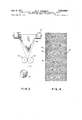
- FIG. 1 is a diagrammatic view in persepective of a device suitable for carrying out one embodiment of the process of this invention.
- FIG. 2 illustrates in side elevation a schematic arrangement for folding and further laminating the web produced by the device of FIG. 1.
- FIG. 3 is a front elevation of the arrangement shown in FIG. 2.
- FIG. 4 is a representation of the appearance of a laminated product fabricated as taught herein, when viewed by transmitted light.
- multiple slivers of textile fibers 11 are drawn from their respective supply cans over a guide comb 13 in juxtaposed relationship into a draw frame 15 comprising a series of paired grooved rolls 14 and 14a.
- the rolls of each pair are driven by appropriate gearing, well known in the art, at a peripheral speed slightly faster than the rate of operation of the preceding pair to draw out and align the individual fibers from the slivers into substantially parallelized arrangement with the fibers extended to their full length.
- the drawn fibers are discharged from draw frame 15 in the form of a flat web 16 in substantially aligned arrangement.
- Web 16 is of such flimsy and gossamer-like character that it must be quickly deposited on a supporting carrier sheet 17 immediately after discharge from draw frame 15 in order to maintain its form. While other types of carrier sheets may be employed for this purpose, in the particular embodiment here shown and described, the carrier sheet 17 comprises a single ply of lightweight cellulose wadding which eventually becomes an integral part of the finished product. Wadding sheet 17 preferably has been stretched and ironed to facial tissue softness by known means to provide a like softness and hand to the finished product. However, for certain products stretching and ironing may not be desirable.
- the wadding sheet 17 is drawn from supply roll 21 into a nip formed by a printing roll 22 and a back-up roll 24 maintained in very light pressure engagement with sheet 17.
- the surface of printing roll 22 is provided with an intaglio pattern 23 which picks up adhesive 25 from dip pan 26. Excess adhesive is scraped off by doctor blade 27.
- the adhesive preferably is a low viscosity thermoplastic adhesive which remains substantially on the surface of the wadding in the form of the pattern selected.
- the pattern shown on the drawing comprises parallel, discontinuous transverse lines in a brick-like design as shown at 18 merely for illustrative purposes, it being understood that the adhesive actually is on the underside of sheet 17 at this point.
- the printed sheet 17, bearing adhesive 18 on its undersurface is then drawn around roll 19 positioned adjacent the discharge end of draw frame 15 at which point the adhesive is on the upper surface and the drawn fiber web 16 is deposited thereon.
- Roll 19 in addition to rotating in the direction shown, is also simultaneously oscillated transversely as indicated by double arrow 12, by known means, such as by a mechanized Scotch yoke or similar device. Because wadding sheet 17 is flexible, the oscillating roll 19 can move the sheet back and forth transversely without tearing the sheet.
- the drawn fiber web 16 is discharged from the draw frame with the fibers aligned substantially in the direction of discharge.
- the oscillating motion causes the web to take the form of a sinusoidal pattern shown at while the fibers still remain substantially parallel to one another.
- the adhesive 18 has suflicient tack and viscosity to hold the fibers in alignment in spite of the oscillating movement.
- the sinusoidal pattern comprises individual fibers in a substantially parallel wave-like arrangement. While the sinusoidal pattern 10 is shown as parallel continuous lines, this showing is merely figurative. In reality, the web at this stage comprises a multiplicity of individual fibers aligned in side-by-side arrangement in the pattern illustrated by these continuous lines.
- the combined sheet 17 and patterned fiber lay 10 is carried around guide roll 28 into prolonged contact with heated drum 20.
- the heat fuses and cures the adhesive to a substantially nontacky condition while the fibers are in firm contact with the drum surface.
- travel around a substantial portion of drum 20 as in the manner shown is desirable.
- the laminated web with the fibers partially embedded in the adhesive then passes under a pressure roll, or calender roll .30, which presses the fiber layer more firmly into the adhesive to assure permanent attachment.
- the laminated web is subsequently wound up in a roll 29.
- the laminated product in roll 29 which comprises a drawn fiber web with the fibers arranged in an aligned sinusoidal pattern and adhesively bonded and laminated to a lightweight cellulose wadding sheet, has a limited number of uses without further processing, especially for uses where cross-direction strength is unimportant. However, a larger number of potential uses are obtained when the resulting sheet is further laminated to develop crossdirection strength.
- FIGS. 2 and 3 One means of accomplishing this is shown in FIGS. 2 and 3.
- the laminated sinusoidal pattern material produced in the above-described manner is fed from supply roll 29a around guide roll 31, over a conventional V-shaped folding board or frame 32, between the nip of heated calender rolls 33, bringing the fiber side of the material together in face-to-face contact to form laminated web 34 which is wound up into finished roll 35.
- the heat and pressure from the calender rolls activates the adhesive causing portions, causing adhesive in one layer to intrude between the fibers in that layer to join the adhesive from the opposing layer whereby the laminated material is bonded together into a unitary web.
- Selvage edge 36 subsequently may be trimmed ofl.
- the folded laminated material has the fiber surfaces disposed face-to-face
- the material may also have the wadding surfaces face-toface before calendering.
- the resulting product has less transverse strength than the preferred embodiment, probably because less adhesive migrates between layers to form bonds between sheets.
- the arrangement as illustrated might be defined as the overlapping of several parallelly-aligned vibrating strings in which the nodes 3-7 intersect and are bonded to each other, and the segments 38 and 39 overlie and cross each other at multiple points to form additional bonds. These multiple bonds form a diamond-like arrangement of fibers and adhesive and when force is exerted in a transverse direction provide flexible restraint and resilient cross-direction strength.
- thermoplastic adhesive previously applied to the carrier sheet
- another means of bonding may be used without materially disturbing the fiber alignment.
- a number of the slivers introduced into the draw frame may comprise thermoplastic fibers, or preferably, thermoplastic fibers may be mixed into each sliver.
- thermoplastic fibers A large variety of such man-made fibers are now available including polyethylene, polypropylene, polyesters, polyacrylonitrile, polyvinyls, etc.
- slivers were prepared containing 20% polypropylene fibers and rayon fibers. These mixed slivers were run through the draw frame as shown in FIG. 1 and described above. Roll 19 was oscillated as before causing the highly-drafted fiber web emerging from the draw frame to be deposited on the carrier sheet in a uniform sinusoidal pattern of parallellyaligned fibers. No adhesive was applied to the tissue carrier sheet. The fibers, nevertheless, retain the aligned sinusoidal pattern. It is not known why the fibers remain aligned in the wave pattern shown, but apparently, suflicient electrostatic or frictional attraction exists between the carrier sheet and the drawn web to keep the pattern undisturbed. Upon hot calendering, a self-sustaining laminate was obtained. This product was in turn folded and further laminated to provide a nonwoven web with improved cross-directional strength, and having an appearance similar to that shown in FIG. 4. The bonding strength in this instance coming from the thermoplastic nature of some of the fibers.
- FIGS. 2 and 3 While a folding arrangement is shown in FIGS. 2 and 3 as the means employed to obtain the laminated product of FIG. 4, it will readily be seen that a similar product may be obtained by taking two rolls of the product obtained from the first stage of the process, and by running the webs together in face-to-face arrangement between rolls of a heated calender stack for bonding purposes.
- the sinusoidal patterns of the webs before lamination should be arranged with respect to one another so that the sinusoidal pattern in one web is out of phase from the sinusoidal pattern in the other web, to overlap and intersect the aligned fibers of the other web in the manner shown in FIG. 4.
- plastisols which, as is well known, comprise colloidal dispersions of synthetic resins in a suitable organic ester plasticizer, and which, under the influence of heat, provide good binding power while remaining soft and flexible.
- adhesives of this type include vinyl chloride polymers, and copolymers of vinyl chloride with other vinyl resins, plasticized by organic phthalates, sebacates, adipates, or phosphates. These provide a fast curing plastisol adhesive characterized by relatively low viscosity, low migration tendencies, and minimum volatility.
- Such adhesives remain soft and flexible after curing, can be reactivated by the application of heat and pressure, such as by hot-calendering for the aforesaid lamination purposes, and insure that the resultant product retains a desirable softness and proper hand and feel.
- plastisols are preferred, polyvinyl resins per se, plasticized or unplasticized may also be used.
- Other flexible adhesives which may be employed, although generally less desirable, include materials such as acrylic resins like the alkyl acrylates and butadiene resins such as buna-S and buna-N.
- the adhesive pattern shown in the illustrations comprises a spaced brick-like arrangement.
- Other well-known patterns may be employed, such as spaced continuous parallel lines, spaced circles, dots, Vs, herringbones, etc. It is preferred that the pattern be substantially open with large adhesive free areas. If flexibility is desired, it is preferred that the total area occupied by the adhesive com prise not more than 25% of the total area of the original fiber-wadding laminate. No matter what adhesive arrangement is chosen, care should be taken to assure that the adhesive-free area between adjoining adhesive patterns be less in the longitudinal direction of the fibers than the average length of the individual fibers, in order that the integrity of the web is maintained.
- the fibers .used in the process may comprise most of the staple length fibers employed in textiles. These include both natural and synthetic fibers such as cotton, viscose or acetate rayon, nylon, polyesters, acrylonitriles, polyolefins, and the like. When synthetic fibers are used, a denier range of 0.5 to 3 is preferred. However, coarser denier may be used. It is also preferred that the fibers be of staple length, or in the range of /2 to about 3 inches or longer, with the majority of fibers being at least one inch in length. For most purposes, the drafted Web should be as light weight as possible commensurate with handleability on the drawing frame. Suitable webs in the weight range of 3 to 20 grams per square yard have been successfully drafted and bonded at speeds of from 20 feet per minute to well over 500 feet per minute. Webs of a higher weight may also be successfully made by this process.
- sheet 17 is oscillated transversely by means of oscillating roll 19, it will readily be seen that a sinusoidal pattern may also be obtained by oscillating the entire draw frame 15.
- the weight of the starting slivers may be varied to provide adrawn web of varying thickness throughout its width.
- various mixtures of thermoplastic and nonthermoplastic fibers may be used.
- a method for producing a laminated web from layers of highly-drafted fibers and plies of cellulose Wadding comprising the steps of providing multiple slivers of staple length textile fibers; juxtaposing said slivers in side-by-side relation and drawing the individual fibers in said slivers out to substantially their full length while parallelly disposed with other drawn fibers to form a tenuous web of highly-drafted and longitudinally aligned individual fibers; applying a thin layer of adhesive to a lightweight cellulose wadding sheet in a spaced pattern; positioning a continuous length of said adhesive carryrng wadding under said aligned fiber tenuous web; moving said tenuous web and said sheet in the same direction at approximately the same speed and depositing said tenuous web on said adhesive printed wadding sheet while providing oppositely reciprocating side-to-side motion between said tenuous web and said wadding sheet at the point where said tenuous web is deposited on said sheet in contact with said adhesive whereby said tenuous web assumes a regular sinusoidal pattern on said sheet; maintaining said fibers and
- An adhesively bonded nonwoven fabric consisting essentially of at least one layer of highly-drafted individual staple length fibers extended to substantially their full length and arranged in a sinusoidal pattern wherein the individual fibers are substantially parallel to each other, at least one layer of lightweight cellulose wadding, and a layer of flexible adhesive between said fiber layer and said wadding layer to bond said layers together; said adhesive being arranged in a spaced pattern and partially penetrating said wadding; said fiber layer being embedded and held in said adhesive.
- An ahesively-bonded nonwoven fabric consisting essentially of outer layers of lightweight cellulose wadding, inner layers of highly-drafted individual staple length fibers extended to substantially their full length and arranged in a sinusoidal pattern wherein the individual fibers are substantially parallel to each other, and a layer of flexible adhesive in a predetermined pattern between each of said wadding layers and said fiber layers; said fiber layers being arranged in face-to-face relationship so that the sinusoidal pattern of one layer is out of phase with the sinusoidal pattern of the opposing layer and the fibers in one layer cross the fibers in the adjoining layer; said adhesive partially penetrating said wadding layers with the fibers embedded in said adhesive and with portions of said adhesive between one fiber layer and one wadding layer extending between fibers in one layer to join portions of said adhesive extending between the fibers of the other fiber layer and bonding the layers into a unitary fabric.
- a method for producing a laminated web from layers of highly-drafted fibers and plies of cellulose wadding comprising the steps of providing multiple slivers of staple length textile fibers containing a portion of thermoplastic fibers therein; juxtaposing said slivers in side-by-side relation and drawing the individual fibers in said slivers out to substantially their full length while parallelly disposed with other drawn fibers to form a tenuous web of highly-drafted and longitudinally aligned individual fibers; positioning a continuous sheet of lightweight cellulose wadding sheet under said aligned fiber tenuous web; moving said sheet and said tenuous web in the same direction at approximately the same speed and depositing said tenuous web on said sheet while providing oppositely reciprocating side-to-side motion between said tenuous web and said sheet at the point where said tenuous web is deposited on said sheet whereby said tenuous web assumes a regular sinusoidal pattern of aligned fibers in contact with said sheet; and while maintaining said tenuous web and said sheet in contact applying heat and pressure to said sheet to activate said thermoplastic
- a nonwoven fabric consisting essentially of at least one layer of highly-drafted individual staple length fibers extended to substantially their full length and arranged in a sinusoidal pattern wherein the individual fibers are substantially parallel to each other and at least one layer of lightweight cellulose wadding; a portion of said fibers being thermoplastic; said thermoplastic fibers binding said fiber layer and said wadding layer together.
Landscapes
- Engineering & Computer Science (AREA)
- Textile Engineering (AREA)
- Chemical & Material Sciences (AREA)
- Chemical Kinetics & Catalysis (AREA)
- Dispersion Chemistry (AREA)
- General Chemical & Material Sciences (AREA)
- Nonwoven Fabrics (AREA)
- Laminated Bodies (AREA)
Abstract
A NONWOVEN FABRIC COMPRISING AT LEAST ONE LAYER OF HIGHLY-DRAFTED, STAPLE LENGTH FIBERS EXTENDED TO SUBSTANTIALLY THEIR FULL LENGTH AND ARRANGED IN A SINUSOIDAL PATTERN WITH THE FIBERS EMBEDDED IN AND BONDED BY A SPACED PATTERNED LAYER OF FLEXIBLE ADHESIVE TO AT LEAST ONE LAYER OF LIGHTWEIGHT CELLULOSE WADDING AND THE METHOD OF MAKING SAME ARE DISCLOSED. ALSO DISCLOSED IS THE METHOD AND PRODUCT RESULTING FROM LAMINATING TWO SUCH NONWOVEN FABRICS TOGETHER WITH THE FILTER LAYERS FACING ONE ANOTHER AND WITH THE SINUSODIAL PATTERN OF FIBERS IN THE OPPOSING LAYERS OUT OF PHASE WITH ONE ANOTHER.
D R A W I N G
D R A W I N G
Description
Jan. 5, 1971 R. H. WIDEMAN HIGHLY-DRAFTED SINUSOIDAL PATTERNED NONWOVEN FABRIC LAMINATES AND METHOD OF MAKING SAME 2 Sheets-Sheet 1 Filed May 20, 1966 Jam. 5, 1971 w M 3,553,064
HIGHLY-DRAFTED I U DAL P TERNED NONWOVEN FABRIC LAMI ES AND M OD OF MAKING SAME Filed May 20, 1966 I 2 Sheets-Sheet 2 United States Patent 3,553,064 HIGHLY-DRAFTED, SINUSOIDAL PATTERNED NONWOVEN FABRIC LAMINATES AND METH- OD OF' MAKING SAME Ronald H. Wideman, Menasha, Wis., assignor to Kimberly-Clark Corporation, Neenah, Wis., a corporation of Delaware Filed May 20, 1966, Ser. No. 551,605 Int. Cl. B32b /12, 7/14; D04h 1/74 U.S. Cl. 161-59 Claims ABSTRACT OF THE DISCLOSURE A nonwoven fabric comprising at least one layer of highly-drafted, staple length fibers extended to substantially their full length and arranged in a sinusoidal pattern with the fibers embedded in and bonded by a spaced patterned layer of flexible adhesive to at least one layer of lightweight cellulose wadding and the method of making same are disclosed. Also disclosed is the method and product resulting from laminating two such nonwoven fabrics together wtih the fiber layers facing one another and with the sinusoidal pattern of fibers in the opposing layers out of phase with one another.
This invention relates to an improved process for the manufacture of nonwoven webs and to products obtained thereby. More specifically it relates to a process for forming a bonded nonwoven web from a lamination of highly-drafted fibers and a carrier sheet.
It is known that individual textile fibers may be drawn out and substantially aligned to form a thin web-like layer by passing an array of juxtaposed slivers of staple length fibers through a multiple roll draw frame. The layer of fibers discharged from such a device is flimsy, film-like and gossamer in character, and, to be useful in web form while still retaining its highly-drafted alignment, must be immediately bonded to each other by some means, or supported by and bonded to as supplementary web. Highly-drafted fiber Webs have approximately 80% to 95% of the fibers oriented substantially in the longitudinal direction. As disclosed in U.S. Pat. No. 3,327,708, such a high degree of fiber alignment is desirable in that it contributes substantially to improved longitudinal strength properties per unit weight when compared with prior art carded fiber webs in which only about 50% to 70% of the fibers are longitudinally aligned. However, while this high degree of fiber alignment improves the longitudinal strength, the transverse strength of the resulting web is lessened because of the relative paucity of crossing fibers, even though the bonding means may comprise transverse lines of strong adhesive or the like. Ordinarily this problem may be overcome by cross-laying and bonding two such webs together whereby the strength in each direction is equalized as disclosed in copending Saunders et a1. application Ser. No. 498,929, filed Oct. 20, 1965 and assigned to the same assignee as the present application. However, known cross-laying methods usually entail either costly or low-speed equipment, adding considerable expense to the cost of the finished product.
The present invention overcomes the latter difiiculties and provides a drawn-fiber nonwoven web of high trans verse strength 'without cross-laying.
Accordingly, a primary object of the invention is to provide a process for fabricating a nonwoven web having "ice improved cross-direction strength from a laminate of highly-drafted fibers and an integral carrier sheet.
Another object is to provide a laminated web in which at least one element is an array of highly-drafted and aligned fibers, and a second element comprises a carrier sheet to which the highly-drafted and aligned fibers are bonded in a regular sinusoidal pattern.
An additional object is to provide a laminated web comprised of multiple layers of highly-drafted substantially parallelized fibers arranged in a regular sinusoidal pattern combined with tissue carrier sheets.
Still another object is to provide a method for the economical, high-speed manufacture of 'webs of the character indicated.
Other objects and advantages will become apparent to persons skilled in the art upon examination of the following description and drawings.
In the drawings:
FIG. 1 is a diagrammatic view in persepective of a device suitable for carrying out one embodiment of the process of this invention.
FIG. 2 illustrates in side elevation a schematic arrangement for folding and further laminating the web produced by the device of FIG. 1.
FIG. 3 is a front elevation of the arrangement shown in FIG. 2.
FIG. 4 is a representation of the appearance of a laminated product fabricated as taught herein, when viewed by transmitted light.
In one embodiment of the invention, as shown in FIG. 1, multiple slivers of textile fibers 11 are drawn from their respective supply cans over a guide comb 13 in juxtaposed relationship into a draw frame 15 comprising a series of paired grooved rolls 14 and 14a. The rolls of each pair are driven by appropriate gearing, well known in the art, at a peripheral speed slightly faster than the rate of operation of the preceding pair to draw out and align the individual fibers from the slivers into substantially parallelized arrangement with the fibers extended to their full length. The drawn fibers are discharged from draw frame 15 in the form of a flat web 16 in substantially aligned arrangement. Web 16 is of such flimsy and gossamer-like character that it must be quickly deposited on a supporting carrier sheet 17 immediately after discharge from draw frame 15 in order to maintain its form. While other types of carrier sheets may be employed for this purpose, in the particular embodiment here shown and described, the carrier sheet 17 comprises a single ply of lightweight cellulose wadding which eventually becomes an integral part of the finished product. Wadding sheet 17 preferably has been stretched and ironed to facial tissue softness by known means to provide a like softness and hand to the finished product. However, for certain products stretching and ironing may not be desirable.
The wadding sheet 17 is drawn from supply roll 21 into a nip formed by a printing roll 22 and a back-up roll 24 maintained in very light pressure engagement with sheet 17. In this case, the surface of printing roll 22 is provided with an intaglio pattern 23 which picks up adhesive 25 from dip pan 26. Excess adhesive is scraped off by doctor blade 27. The adhesive preferably is a low viscosity thermoplastic adhesive which remains substantially on the surface of the wadding in the form of the pattern selected.
The pattern shown on the drawing comprises parallel, discontinuous transverse lines in a brick-like design as shown at 18 merely for illustrative purposes, it being understood that the adhesive actually is on the underside of sheet 17 at this point. The printed sheet 17, bearing adhesive 18 on its undersurface, is then drawn around roll 19 positioned adjacent the discharge end of draw frame 15 at which point the adhesive is on the upper surface and the drawn fiber web 16 is deposited thereon. Roll 19, in addition to rotating in the direction shown, is also simultaneously oscillated transversely as indicated by double arrow 12, by known means, such as by a mechanized Scotch yoke or similar device. Because wadding sheet 17 is flexible, the oscillating roll 19 can move the sheet back and forth transversely without tearing the sheet. The drawn fiber web 16 is discharged from the draw frame with the fibers aligned substantially in the direction of discharge. However, when the aligned fibers are deposited on the adhesive printed sheet 17a, the oscillating motion causes the web to take the form of a sinusoidal pattern shown at while the fibers still remain substantially parallel to one another. The adhesive 18 has suflicient tack and viscosity to hold the fibers in alignment in spite of the oscillating movement. As a result, the sinusoidal pattern comprises individual fibers in a substantially parallel wave-like arrangement. While the sinusoidal pattern 10 is shown as parallel continuous lines, this showing is merely figurative. In reality, the web at this stage comprises a multiplicity of individual fibers aligned in side-by-side arrangement in the pattern illustrated by these continuous lines.
The combined sheet 17 and patterned fiber lay 10 is carried around guide roll 28 into prolonged contact with heated drum 20. The heat fuses and cures the adhesive to a substantially nontacky condition while the fibers are in firm contact with the drum surface. To provide this curing effect, travel around a substantial portion of drum 20 as in the manner shown is desirable. The laminated web with the fibers partially embedded in the adhesive then passes under a pressure roll, or calender roll .30, which presses the fiber layer more firmly into the adhesive to assure permanent attachment. The laminated web is subsequently wound up in a roll 29.
The laminated product in roll 29 which comprises a drawn fiber web with the fibers arranged in an aligned sinusoidal pattern and adhesively bonded and laminated to a lightweight cellulose wadding sheet, has a limited number of uses without further processing, especially for uses where cross-direction strength is unimportant. However, a larger number of potential uses are obtained when the resulting sheet is further laminated to develop crossdirection strength.
One means of accomplishing this is shown in FIGS. 2 and 3. As shown in these figures, the laminated sinusoidal pattern material produced in the above-described manner is fed from supply roll 29a around guide roll 31, over a conventional V-shaped folding board or frame 32, between the nip of heated calender rolls 33, bringing the fiber side of the material together in face-to-face contact to form laminated web 34 which is wound up into finished roll 35. The heat and pressure from the calender rolls activates the adhesive causing portions, causing adhesive in one layer to intrude between the fibers in that layer to join the adhesive from the opposing layer whereby the laminated material is bonded together into a unitary web. Selvage edge 36 subsequently may be trimmed ofl.
While the preferred embodiment of the folded laminated material has the fiber surfaces disposed face-to-face, the material may also have the wadding surfaces face-toface before calendering. However, the resulting product has less transverse strength than the preferred embodiment, probably because less adhesive migrates between layers to form bonds between sheets.
The appearance of the finished web 34, when viewed by transmitted light, is shown in FIG. 4. The arrangement as illustrated might be defined as the overlapping of several parallelly-aligned vibrating strings in which the nodes 3-7 intersect and are bonded to each other, and the segments 38 and 39 overlie and cross each other at multiple points to form additional bonds. These multiple bonds form a diamond-like arrangement of fibers and adhesive and when force is exerted in a transverse direction provide flexible restraint and resilient cross-direction strength.
While the above-described process provides bonding between the sinusoidal array of drawn fibers and the underlying carrier sheet by means of a thermoplastic adhesive previously applied to the carrier sheet, another means of bonding may be used without materially disturbing the fiber alignment. In the latter case, a number of the slivers introduced into the draw frame may comprise thermoplastic fibers, or preferably, thermoplastic fibers may be mixed into each sliver. A large variety of such man-made fibers are now available including polyethylene, polypropylene, polyesters, polyacrylonitrile, polyvinyls, etc.
In one specific example, slivers were prepared containing 20% polypropylene fibers and rayon fibers. These mixed slivers were run through the draw frame as shown in FIG. 1 and described above. Roll 19 was oscillated as before causing the highly-drafted fiber web emerging from the draw frame to be deposited on the carrier sheet in a uniform sinusoidal pattern of parallellyaligned fibers. No adhesive was applied to the tissue carrier sheet. The fibers, nevertheless, retain the aligned sinusoidal pattern. It is not known why the fibers remain aligned in the wave pattern shown, but apparently, suflicient electrostatic or frictional attraction exists between the carrier sheet and the drawn web to keep the pattern undisturbed. Upon hot calendering, a self-sustaining laminate was obtained. This product was in turn folded and further laminated to provide a nonwoven web with improved cross-directional strength, and having an appearance similar to that shown in FIG. 4. The bonding strength in this instance coming from the thermoplastic nature of some of the fibers.
While a folding arrangement is shown in FIGS. 2 and 3 as the means employed to obtain the laminated product of FIG. 4, it will readily be seen that a similar product may be obtained by taking two rolls of the product obtained from the first stage of the process, and by running the webs together in face-to-face arrangement between rolls of a heated calender stack for bonding purposes. To be effective with respect to cross-direction strength, however, the sinusoidal patterns of the webs before lamination should be arranged with respect to one another so that the sinusoidal pattern in one web is out of phase from the sinusoidal pattern in the other web, to overlap and intersect the aligned fibers of the other web in the manner shown in FIG. 4.
While various well-known adhesives may be employed in the process, advantages reside in the use of plastisols, which, as is well known, comprise colloidal dispersions of synthetic resins in a suitable organic ester plasticizer, and which, under the influence of heat, provide good binding power while remaining soft and flexible. While many adhesives of this type are known, those found particularly useful for incorporation in the product of this invention include vinyl chloride polymers, and copolymers of vinyl chloride with other vinyl resins, plasticized by organic phthalates, sebacates, adipates, or phosphates. These provide a fast curing plastisol adhesive characterized by relatively low viscosity, low migration tendencies, and minimum volatility. Such adhesives remain soft and flexible after curing, can be reactivated by the application of heat and pressure, such as by hot-calendering for the aforesaid lamination purposes, and insure that the resultant product retains a desirable softness and proper hand and feel.
While plastisols are preferred, polyvinyl resins per se, plasticized or unplasticized may also be used. Other flexible adhesives, which may be employed, although generally less desirable, include materials such as acrylic resins like the alkyl acrylates and butadiene resins such as buna-S and buna-N.
The adhesive pattern shown in the illustrations comprises a spaced brick-like arrangement. Other well-known patterns may be employed, such as spaced continuous parallel lines, spaced circles, dots, Vs, herringbones, etc. It is preferred that the pattern be substantially open with large adhesive free areas. If flexibility is desired, it is preferred that the total area occupied by the adhesive com prise not more than 25% of the total area of the original fiber-wadding laminate. No matter what adhesive arrangement is chosen, care should be taken to assure that the adhesive-free area between adjoining adhesive patterns be less in the longitudinal direction of the fibers than the average length of the individual fibers, in order that the integrity of the web is maintained.
The fibers .used in the process may comprise most of the staple length fibers employed in textiles. These include both natural and synthetic fibers such as cotton, viscose or acetate rayon, nylon, polyesters, acrylonitriles, polyolefins, and the like. When synthetic fibers are used, a denier range of 0.5 to 3 is preferred. However, coarser denier may be used. It is also preferred that the fibers be of staple length, or in the range of /2 to about 3 inches or longer, with the majority of fibers being at least one inch in length. For most purposes, the drafted Web should be as light weight as possible commensurate with handleability on the drawing frame. Suitable webs in the weight range of 3 to 20 grams per square yard have been successfully drafted and bonded at speeds of from 20 feet per minute to well over 500 feet per minute. Webs of a higher weight may also be successfully made by this process.
While in the illustrated process, sheet 17 is oscillated transversely by means of oscillating roll 19, it will readily be seen that a sinusoidal pattern may also be obtained by oscillating the entire draw frame 15.
It will be apparent to those skilled in the art that many variations from the examples given may be employed without departing from the spirit of this invention. For example, the weight of the starting slivers may be varied to provide adrawn web of varying thickness throughout its width. Similarly, various mixtures of thermoplastic and nonthermoplastic fibers may be used.
What is claimed is:
1. A method for producing a laminated web from layers of highly-drafted fibers and plies of cellulose Wadding; said method com-prising the steps of providing multiple slivers of staple length textile fibers; juxtaposing said slivers in side-by-side relation and drawing the individual fibers in said slivers out to substantially their full length while parallelly disposed with other drawn fibers to form a tenuous web of highly-drafted and longitudinally aligned individual fibers; applying a thin layer of adhesive to a lightweight cellulose wadding sheet in a spaced pattern; positioning a continuous length of said adhesive carryrng wadding under said aligned fiber tenuous web; moving said tenuous web and said sheet in the same direction at approximately the same speed and depositing said tenuous web on said adhesive printed wadding sheet while providing oppositely reciprocating side-to-side motion between said tenuous web and said wadding sheet at the point where said tenuous web is deposited on said sheet in contact with said adhesive whereby said tenuous web assumes a regular sinusoidal pattern on said sheet; maintaining said fibers and said adhesive in contact, while applying heat thereto, and pressing said fibers firmly in said adhesive to embed said fibers therein in said sinusoidal pattern, and curing said adhesive.
2. The method of claim 1 in which fiber-faced surfaces of the resulting fiber-wadding sheet laminate are placed in face-to-face contact with the sinusoidal pattern of fibers in one of said surfaces out of phase with the sinusoidal pattern of fibers in the opposing surface, and hot calendering said contacting sheets to reactivate said adhesive,
causing said adhesive to migrate between fibers and bind said laminates to each other.
3. The method of claim 2 in which the fiber-faced surfaces are placed in face-to-face contact by folding.
4. The method of claim 2 in Which the fiber-faced surfaces are placed in contact by aligning separately formed sheets of said laminate.
5. An adhesively bonded nonwoven fabric consisting essentially of at least one layer of highly-drafted individual staple length fibers extended to substantially their full length and arranged in a sinusoidal pattern wherein the individual fibers are substantially parallel to each other, at least one layer of lightweight cellulose wadding, and a layer of flexible adhesive between said fiber layer and said wadding layer to bond said layers together; said adhesive being arranged in a spaced pattern and partially penetrating said wadding; said fiber layer being embedded and held in said adhesive.
6. An ahesively-bonded nonwoven fabric consisting essentially of outer layers of lightweight cellulose wadding, inner layers of highly-drafted individual staple length fibers extended to substantially their full length and arranged in a sinusoidal pattern wherein the individual fibers are substantially parallel to each other, and a layer of flexible adhesive in a predetermined pattern between each of said wadding layers and said fiber layers; said fiber layers being arranged in face-to-face relationship so that the sinusoidal pattern of one layer is out of phase with the sinusoidal pattern of the opposing layer and the fibers in one layer cross the fibers in the adjoining layer; said adhesive partially penetrating said wadding layers with the fibers embedded in said adhesive and with portions of said adhesive between one fiber layer and one wadding layer extending between fibers in one layer to join portions of said adhesive extending between the fibers of the other fiber layer and bonding the layers into a unitary fabric.
7. The fabric of claim 6 in which the adhesive is a plastisol.
8. The fabric of claim 6 in which the fibers are selected from the group consisting of cotton, viscose, acetate, rayon, nylon, polyesters, acrylonitriles, and polyolefins.
9. The fabric of claim 8 in which the fibers are in the denier range of 0.5 to 3.
10. The fabric of claim 8 in which the fibers have a length in the range of about /2 to about 3 inches.
11. The fabric of claim 10 in which the space between adjoining portions of adhesive in the spaced pattern is less than the average length of the individual fibers.
12. A method for producing a laminated web from layers of highly-drafted fibers and plies of cellulose wadding; said method comprising the steps of providing multiple slivers of staple length textile fibers containing a portion of thermoplastic fibers therein; juxtaposing said slivers in side-by-side relation and drawing the individual fibers in said slivers out to substantially their full length while parallelly disposed with other drawn fibers to form a tenuous web of highly-drafted and longitudinally aligned individual fibers; positioning a continuous sheet of lightweight cellulose wadding sheet under said aligned fiber tenuous web; moving said sheet and said tenuous web in the same direction at approximately the same speed and depositing said tenuous web on said sheet while providing oppositely reciprocating side-to-side motion between said tenuous web and said sheet at the point where said tenuous web is deposited on said sheet whereby said tenuous web assumes a regular sinusoidal pattern of aligned fibers in contact with said sheet; and while maintaining said tenuous web and said sheet in contact applying heat and pressure to said sheet to activate said thermoplastic fibers and "bond said tenuous web and said sheet into a unitary fabric.
13. The method of claim 12 in which fiber-faced surfaces of the resulting unitary fiber-wadding fabric are placed in face-to-face contact with the sinusoidal pattern of fibers in one of said surfaces out of phase with the sinusoidal pattern of fibers in the opposing surface, and hot calendering said contacting fabrics to reactivate said thermoplastic fibers and bind said fabrics together.
14. A nonwoven fabric consisting essentially of at least one layer of highly-drafted individual staple length fibers extended to substantially their full length and arranged in a sinusoidal pattern wherein the individual fibers are substantially parallel to each other and at least one layer of lightweight cellulose wadding; a portion of said fibers being thermoplastic; said thermoplastic fibers binding said fiber layer and said wadding layer together.
15. The fabric of claim 14 in which two of said fiber layers are in face-to-face contact with the sinusoidal pattern in one layer out of phase with the sinusoidal pattern of the other layer, the fibers in one layer intersecting and overlying the fibers in the other layer.
References Cited UNITED STATES PATENTS 11/1877 Turner et a1 156176X 11/1960 Barnard 161l70X 11/1963 Bletzinger 16159X 4/1967 Romanin 156-479 9/1946 Goldman 16157X 6/ 1964 Andrews 156289X 6/1967 Sokolowski 161143X WILLIAM J. VAN BALEN, Primary Examiner W. W. SCHWARZE, Assistant Examiner US. Cl. X.R.
Applications Claiming Priority (2)
| Application Number | Priority Date | Filing Date | Title |
|---|---|---|---|
| US55160566A | 1966-05-20 | 1966-05-20 | |
| DE19691938671 DE1938671A1 (en) | 1966-05-20 | 1969-07-30 | Nonwoven fabric and method of making a nonwoven fabric |
Publications (1)
| Publication Number | Publication Date |
|---|---|
| US3553064A true US3553064A (en) | 1971-01-05 |
Family
ID=25757721
Family Applications (1)
| Application Number | Title | Priority Date | Filing Date |
|---|---|---|---|
| US551605A Expired - Lifetime US3553064A (en) | 1966-05-20 | 1966-05-20 | Highly-drafted,sinusoidal patterned nonwoven fabric laminates and method of making same |
Country Status (2)
| Country | Link |
|---|---|
| US (1) | US3553064A (en) |
| DE (1) | DE1938671A1 (en) |
Cited By (8)
| Publication number | Priority date | Publication date | Assignee | Title |
|---|---|---|---|---|
| US3663344A (en) * | 1970-12-31 | 1972-05-16 | Kimberly Clark Co | Orthotropic fiber-reinforced thermoplastic film and method of manufacture |
| US3816228A (en) * | 1968-10-23 | 1974-06-11 | Kimberly Clark Co | Elastic nonwoven fabric |
| US4398650A (en) * | 1978-12-08 | 1983-08-16 | International Paper Company | Energy absorbing corrugated paper container |
| WO1987001655A1 (en) * | 1985-09-11 | 1987-03-26 | Lydall, Inc. | Composite having improved transverse structural integrity and flexibility for use in high temperature environnments and method of making the same |
| US4996091A (en) * | 1987-05-26 | 1991-02-26 | Acumeter Laboratories, Inc. | Product comprising substrate bearing continuous extruded fiber forming random crisscross pattern layer |
| US20060191618A1 (en) * | 2005-02-28 | 2006-08-31 | Michelin Recherche Et Technique S.A. | Device and process for manufacturing undulating plies |
| US20090266468A1 (en) * | 2008-03-26 | 2009-10-29 | Edward Pilpel | Method and apparatus for making sheets of composite material |
| US10596746B1 (en) * | 2016-03-11 | 2020-03-24 | R. H. Tamlyn & Sons | House wrap and method of manufacture |
-
1966
- 1966-05-20 US US551605A patent/US3553064A/en not_active Expired - Lifetime
-
1969
- 1969-07-30 DE DE19691938671 patent/DE1938671A1/en active Pending
Cited By (13)
| Publication number | Priority date | Publication date | Assignee | Title |
|---|---|---|---|---|
| US3816228A (en) * | 1968-10-23 | 1974-06-11 | Kimberly Clark Co | Elastic nonwoven fabric |
| US3663344A (en) * | 1970-12-31 | 1972-05-16 | Kimberly Clark Co | Orthotropic fiber-reinforced thermoplastic film and method of manufacture |
| US4398650A (en) * | 1978-12-08 | 1983-08-16 | International Paper Company | Energy absorbing corrugated paper container |
| WO1987001655A1 (en) * | 1985-09-11 | 1987-03-26 | Lydall, Inc. | Composite having improved transverse structural integrity and flexibility for use in high temperature environnments and method of making the same |
| US4687697A (en) * | 1985-09-11 | 1987-08-18 | Lydall, Inc. | Composite having improved transverse structural integrity and flexibility for use in high temperature environments |
| US4996091A (en) * | 1987-05-26 | 1991-02-26 | Acumeter Laboratories, Inc. | Product comprising substrate bearing continuous extruded fiber forming random crisscross pattern layer |
| US20060191618A1 (en) * | 2005-02-28 | 2006-08-31 | Michelin Recherche Et Technique S.A. | Device and process for manufacturing undulating plies |
| US20090266468A1 (en) * | 2008-03-26 | 2009-10-29 | Edward Pilpel | Method and apparatus for making sheets of composite material |
| JP2011515255A (en) * | 2008-03-26 | 2011-05-19 | ポリストランド インコーポレイティッド | Method and apparatus for producing a sheet of composite material |
| US8201608B2 (en) * | 2008-03-26 | 2012-06-19 | Polystrand, Inc. | Apparatus for making sheets of composite material |
| US8763668B2 (en) | 2008-03-26 | 2014-07-01 | Polystrand, Inc. | Apparatus for making sheets of composite material |
| US9333732B2 (en) | 2008-03-26 | 2016-05-10 | Gordon Holdings, Inc. | Method for making sheets of composite material |
| US10596746B1 (en) * | 2016-03-11 | 2020-03-24 | R. H. Tamlyn & Sons | House wrap and method of manufacture |
Also Published As
| Publication number | Publication date |
|---|---|
| DE1938671A1 (en) | 1971-02-04 |
Similar Documents
| Publication | Publication Date | Title |
|---|---|---|
| US3327708A (en) | Laminated non-woven fabric | |
| US3047444A (en) | Non-woven fabric and method of making the same | |
| US3770562A (en) | Composite nonwoven fabrics | |
| US3484330A (en) | Disposable fabric | |
| US3765997A (en) | Laminate | |
| US3695967A (en) | Method of preparing air-permeable laminate | |
| US3597299A (en) | Disposable washcloth | |
| US3485705A (en) | Nonwoven fabric and method of manufacturing the same | |
| US3214323A (en) | Nonwoven fabrics and methods of making the same | |
| KR890014814A (en) | Nonwoven Elastic Web by Hydraulic Tangle and Forming Method Thereof | |
| US3505155A (en) | Nonwoven continuous filament product and method of preparation | |
| US4307145A (en) | Decorative fabric and method of making the same | |
| US3664905A (en) | Non-woven needled fibrous structure | |
| US3709764A (en) | Heavy-duty wipe and method for producing same | |
| GB1453447A (en) | Nonwoven thermoplastic fabric | |
| GB804282A (en) | Improvements in and relating to reinforced, laminated sheet material | |
| IE55983B1 (en) | Elastic thermal bonded non-woven fabric | |
| JPH02289158A (en) | Fabric for lamination and preparation thereof | |
| US3530023A (en) | Laminated sheet material and methods of making such material | |
| CN1131214A (en) | A kind of non-woven fabric method using hot air and its product | |
| US3764450A (en) | Elastic fiber fleece material | |
| US3553064A (en) | Highly-drafted,sinusoidal patterned nonwoven fabric laminates and method of making same | |
| US3666608A (en) | Disposable towel | |
| JPH0788615B2 (en) | Thermal adhesive bonding cloth | |
| JPH0698728B2 (en) | Composite lining cloth and manufacturing method thereof |