US3550488A - Apparatus for and method of machining cylindrical shell heads - Google Patents
Apparatus for and method of machining cylindrical shell heads Download PDFInfo
- Publication number
- US3550488A US3550488A US670243A US3550488DA US3550488A US 3550488 A US3550488 A US 3550488A US 670243 A US670243 A US 670243A US 3550488D A US3550488D A US 3550488DA US 3550488 A US3550488 A US 3550488A
- Authority
- US
- United States
- Prior art keywords
- housing
- shell
- shaft
- machining
- tool
- Prior art date
- Legal status (The legal status is an assumption and is not a legal conclusion. Google has not performed a legal analysis and makes no representation as to the accuracy of the status listed.)
- Expired - Lifetime
Links
- 238000003754 machining Methods 0.000 title description 30
- 238000000034 method Methods 0.000 title description 4
- 230000007246 mechanism Effects 0.000 description 26
- 238000005520 cutting process Methods 0.000 description 6
- 230000005855 radiation Effects 0.000 description 6
- 238000006243 chemical reaction Methods 0.000 description 2
- 229910000831 Steel Inorganic materials 0.000 description 1
- 230000015572 biosynthetic process Effects 0.000 description 1
- 244000145845 chattering Species 0.000 description 1
- 150000001875 compounds Chemical class 0.000 description 1
- 238000005755 formation reaction Methods 0.000 description 1
- 239000010959 steel Substances 0.000 description 1
- 238000005728 strengthening Methods 0.000 description 1
- 238000003466 welding Methods 0.000 description 1
Images


Classifications
-
- B—PERFORMING OPERATIONS; TRANSPORTING
- B23—MACHINE TOOLS; METAL-WORKING NOT OTHERWISE PROVIDED FOR
- B23Q—DETAILS, COMPONENTS, OR ACCESSORIES FOR MACHINE TOOLS, e.g. ARRANGEMENTS FOR COPYING OR CONTROLLING; MACHINE TOOLS IN GENERAL CHARACTERISED BY THE CONSTRUCTION OF PARTICULAR DETAILS OR COMPONENTS; COMBINATIONS OR ASSOCIATIONS OF METAL-WORKING MACHINES, NOT DIRECTED TO A PARTICULAR RESULT
- B23Q17/00—Arrangements for observing, indicating or measuring on machine tools
- B23Q17/22—Arrangements for observing, indicating or measuring on machine tools for indicating or measuring existing or desired position of tool or work
- B23Q17/2233—Arrangements for observing, indicating or measuring on machine tools for indicating or measuring existing or desired position of tool or work for adjusting the tool relative to the workpiece
- B23Q17/2275—Arrangements for observing, indicating or measuring on machine tools for indicating or measuring existing or desired position of tool or work for adjusting the tool relative to the workpiece of a tool-axis relative to a workpiece-axis
-
- B—PERFORMING OPERATIONS; TRANSPORTING
- B23—MACHINE TOOLS; METAL-WORKING NOT OTHERWISE PROVIDED FOR
- B23Q—DETAILS, COMPONENTS, OR ACCESSORIES FOR MACHINE TOOLS, e.g. ARRANGEMENTS FOR COPYING OR CONTROLLING; MACHINE TOOLS IN GENERAL CHARACTERISED BY THE CONSTRUCTION OF PARTICULAR DETAILS OR COMPONENTS; COMBINATIONS OR ASSOCIATIONS OF METAL-WORKING MACHINES, NOT DIRECTED TO A PARTICULAR RESULT
- B23Q17/00—Arrangements for observing, indicating or measuring on machine tools
- B23Q17/24—Arrangements for observing, indicating or measuring on machine tools using optics or electromagnetic waves
-
- B—PERFORMING OPERATIONS; TRANSPORTING
- B23—MACHINE TOOLS; METAL-WORKING NOT OTHERWISE PROVIDED FOR
- B23Q—DETAILS, COMPONENTS, OR ACCESSORIES FOR MACHINE TOOLS, e.g. ARRANGEMENTS FOR COPYING OR CONTROLLING; MACHINE TOOLS IN GENERAL CHARACTERISED BY THE CONSTRUCTION OF PARTICULAR DETAILS OR COMPONENTS; COMBINATIONS OR ASSOCIATIONS OF METAL-WORKING MACHINES, NOT DIRECTED TO A PARTICULAR RESULT
- B23Q9/00—Arrangements for supporting or guiding portable metal-working machines or apparatus
- B23Q9/0014—Portable machines provided with or cooperating with guide means supported directly by the workpiece during action
- B23Q9/0021—Portable machines provided with or cooperating with guide means supported directly by the workpiece during action the tool being guided in a circular path
-
- Y—GENERAL TAGGING OF NEW TECHNOLOGICAL DEVELOPMENTS; GENERAL TAGGING OF CROSS-SECTIONAL TECHNOLOGIES SPANNING OVER SEVERAL SECTIONS OF THE IPC; TECHNICAL SUBJECTS COVERED BY FORMER USPC CROSS-REFERENCE ART COLLECTIONS [XRACs] AND DIGESTS
- Y10—TECHNICAL SUBJECTS COVERED BY FORMER USPC
- Y10T—TECHNICAL SUBJECTS COVERED BY FORMER US CLASSIFICATION
- Y10T82/00—Turning
- Y10T82/25—Lathe
- Y10T82/2522—Portable
Definitions
- the faces or heads of large cylindrical vessels or shells are machined so that the surfaces machined are precisely parallel and have a common centerline.
- ball mill or rod mill shells too large to place in any lathe are machined to receive the conventional trunnions at their opposite ends.
- the operation is accomplished with great precision, the faces being machined parallel and any shoulders being machined on a common centerline, i.e., the axis of the shell.
- Two machining mechanisms are temporarily mounted within and one at each end of the shell.
- the tool shafts of these mechanisms are hollow and are aligned by the use of a laser or other suitable radiation beam.
- a machining mechanism is supported within but adjacent each end of the shell on a temporary framework usually welded to the interior of the shell and connected to the front end of the housing for the machining mechanism. Also radially adjustable arms for supporting the inner end of the housing are provided.
- Each of these mechanisms includes a hollow tool carrying shaft having a tool arm fixed at right angles thereto at its outer end, a cutting tool and tool holder being mounted on the tool arm. Appropriate means are provided for positioning the tool shaft with respect to the shell axis.
- the two machining mechanisms are first centered with respect to the axis of the shell, and then a radiation beam source such as a laser source is mounted within the hollow shaft of one of the machining mechanisms, and a target for such beam is mounted within the hollow shaft of the other machining mechanism at the opposite end of the shell. Adjustment of the two supporting housings is carried on through the use of the radiation beam and target until the two tool shafts are supported in precise axial alignment by their respective machine mechanism housings. The tool arm is then rotated by means of an electric motor arranged to drive the tool shaft, and the machining operations on the ends of the shell are carried out.
- a radiation beam source such as a laser source
- a target for such beam is mounted within the hollow shaft of the other machining mechanism at the opposite end of the shell.
- Adjustment of the two supporting housings is carried on through the use of the radiation beam and target until the two tool shafts are supported in precise axial alignment by their respective machine mechanism housings.
- the tool arm is then rotated by means of an electric motor arranged to drive
- the machining mechanisms although of considerable weight, are portable, and can be transferred from one mill shell, or other type of shell to another. They are also comparatively inexpensive.
- FIG. 1 is a diagrammatic side elevation of a ball mill
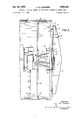
- FIG. 2 is a diagrammatic vertical central section of the ball mill shell drawn to a somewhat larger scale, with the central part of the shell broken away, and illustrating the aligning of the. hollow tool shafts at opposite ends of the shell;
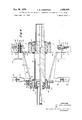
- FIG. 3 is a vertical section of the right end portion of the shell drawn to a much larger scale and showing the machining apparatus at that end of the shell;
- FIG. 4 is a central section of the machining mechanism housing drawn to a still larger scale and showing portions of the supporting means at each end of the housing and with only the lower portion of the shaft shown in section, the driving mechanism and the tool arm being omitted;
- FIG. 5 is an end view of the parts shown in FIG. 3 drawn to a somewhat smaller scale and with the tool arm omitted.
- the ball mill comprises a cylindrical steel shell 1 having inwardly projecting circular flanges 2 somewhat thicker than the wall of the shell and welded thereto at its opposite ends.
- a trunnion 3 is mounted on each end of shell 1 and these turn in stationary bearings 4 which are bolted to a common support as shown. It is evident that the trunnions 3 must be in accurate alignment on the centerline of the shell for proper operation of the ball mill. For this reason each of the trunnions includes a flange 5 which is bolted to the respective opposite end surfaces 6 of the shell.
- Trunnions 3 are centered on the respective ends of the shell by cylindrical inward projections (not shown) each of which engages a narrow shoulder 7 (FIG. 3) on the edge of the corresponding flange 2. It is essential that the surfaces 6 on the opposite ends of the shell be machined to precise parallelism on a common centerline namely the axis of cylinder 1; it is also essential that shoulders 7 be machined precisely concentric with the same axis; otherwise trunnions 3 will not be in proper alignment with each other.
- the apparatus for such precise machining of the surfaces at the ends of shell 1 comprises a housing 8 for the machining mechanism within which is mounted a hollow shaft 9 having an enlarged recess 10 at its outer end and a somewhat smaller recess 11 at its inner end, the two recesses being connected by a relatively narrow passageway 12.
- Housing 8 is built up of welded parts including an outer framework 13 and an inner collar 14 which are interconnected by a cone 16 having a number of rectangular apertures 17 and reinforced by a number of strengthening ribs 15, six being shown.
- Framework 13 is a welded assembly made up of an inner circular member 19 and outer circular end plate 20, and a series of radially arranged web members 21 which serve to interconnect members 19 and 20.
- End plate 20 is substantially thicker than member 19 and is also larger in diameter so as to provide a flange-like rim to aid in supporting the housing 8 within the outer end portion of shell 1.
- Shaft 9 is rotatably supported near its outer end by a spherical roller bearing 23, the outer member of which is fixed within the central portion of framework 13.
- the inner end portion of shaft 9 is also supported in a spherical roller bearing indicated by numeral 24, the housing of which is indicated by reference numeral 25 which is positioned inwardly of collar 14.
- the first step in the operation of machining the ends of shell 1 is the placing at each end of the shell of a special framework indicated generally by numeral 26 and shown more particularly in FIG. 5.
- This framework comprises parallel upper and lower horizontal wide flange beams 27, and two vertical channel members 28 which are welded at their opposite ends to beams 27 and serve to interconnect them.
- Beams 27 are welded at their ends as indicated in FIG. 5 to the inside surface of the shell end flange 2.
- beams 27 In order to position the outer end portion of housing 8, outwardly beyond the inner surface of flange 2, beams 27 have special formations at their outer ends as indicated in FIG. 5.
- a portion of the outer flange 29 is cut away as indicated and a short flange section is welded to the web at a distance inwardly from the outer flange as shown in FIG. 4.
- the two beams 27 are supported by welding these short inwardly placed flange sections 30 to the inside of the circular flange 2 of the mill shell.
- housing 8 is supported on framework 26 by means of a square mounting plate 31 having a circular hole 32 therein shown in dotted lines in FIG. 5.
- Plate 31 is secured in position by means of holding bolts or screws 33, three of which are arranged centrally in line along the top edge and also along the bottom edge of the plate, and four of which are near the corners of the plate as shown.
- bolts or screws 33 three of which are arranged centrally in line along the top edge and also along the bottom edge of the plate, and four of which are near the corners of the plate as shown.
- four jackscrews 34 are arranged at the centers of the four sides of square plate 31.
- the two jackscrews at the top and bottom respectively are threaded into bosses 35 which are welded to the edges of flanges 29 of the beams 27.
- Jackscrews 34 at the sides of the square plate are threaded into bosses 35 which are welded to the outer flanges of channel members 28.
- housing 8 is secured to the square mounting plate 31 by means of six screws, three of which are part of an adjusting complex indicated generally by reference letter X, the other three being merely mounting screws.
- One of the adjusting complexes is shown at the top of FIG. 4 and includes screw 36. These complexes are arranged 120 apart around the end plate 20, and the holding screws such as screw 37 shown at the bottom of FIG. 4 are located in intermediate positions.
- ring member 38 Surrounding the hole 32 in mounting plate 31 and welded to this plate there is a ring member 38, the width of which corresponds approximately to the rim portion 22 of plate 20.
- Each of the adjusting complexes includes bolt 36 which is threaded in an aperture in end plate 20, a collar 39 which turns on the outer portion of bolt 36, and is externally threaded, and a lock nut 40.
- Threaded collar 39 has an operating head 41 at its inner or left-hand end. The threads of collar 39 are engaged in aligned threaded apertures in mounting plate 31 and its companion ring 38.
- collar 39 always projects slightly beyond the outer surface of ring 38 into contact with the inner portion of rim portion 32 and thus holds end plate 20 out of contact with ring 38.
- the turning of collars 39 is accomplished by applying a wrench or any other suitable tool to the operating head 41.
- This adjustment is accomplished with bolt 36 slightly released from its tightened position, and after the desired angular position of shaft 9 has been arrived at bolt 36 is tightened forcing the inner end of threaded sleeve 39 against the inner surface of end plate 20 and lock nut 40 is also tightened on sleeve 39 against the inner surface of mounting plate 31.
- the same adjusting and tightening operations are followed in connection with the other two adjusting complexes, and when this has been done the simple clamping bolts 37 arranged intermediate the adjusting bolts 36 are tightened.
- housing 8 At the inner end of housing 8 there is a further means of adjustment of the position of shaft 9 in this housing. This is accomplished by means of three adjusting screws 42, each having a lock nut 43 and arranged apart in threaded openings in collar 14. The inner ends of these screws cooperate with housing 25 for the inner roller bearings 24.
- braces 44 In order to support the inner end portion of housing 8 four radially mounted angle bars 44 are provided. These are each bolted to a short anchor member 45 which, like the ends of channel beams 2 are temporarily welded to the inner surface of shell 1 in positions to place the bracing members 44 approximately parallel with the end flange 2.
- suitable connecting members 46 are bolted as shown in FIG. 4 to the ring surrounding collar 14 of housing 8.
- the inner ends of braces 44 and the outer ends of connectors 46 are constructed to receive interconnecting screws 47, and the adjacent ends of each member 44 and its connector 46 are spaced somewhat apart so as to permit the angular adjustment of housing -8 in the manner above described After such adjustment has been completed connecting screws 47 are tightened in order to support the housing.
- machining mechanism housing 8 is mounted in the opposite end of mill shell 1 in the same manner as described above. After this has been done the shafts 9 of the two housings 8 are brought into precise alignment in the following manner:
- a device 48 which is a source of a radiation beam, such as a laser, is mounted in recess 10 at the outer end of shaft 9 at the right end of the mill shell, and a target member 49 is mounted in recess 10 at the left end of the shaft 9 of housing 8 which has been mounted on the left end of mill shell 1. This places the target outwardly from the center of shaft 9 and near the shell end.
- the respective supports for the beam source 48 and the target 49 are accurately machined to closely fit the respective recesses in the two shafts 9.
- the three adjusting complexes X (FIG. 4), for adjusting the angular position of housing 8 with respect to supporting frame 31, are manipulated until the radiation beam is on the center of target 49.
- the three adjusting complexes X and screws 37 are then tightened into clamped position.
- Target 49 is now moved to the dotted position (FIG. 2) at the forward end of the same shaft 9, and by means of the three complexes X in the same device, the angular position is adjusted until the laser beam also hits the center of the target in that position.
- the target may now be moved back to its former position and the alignment checked again.
- the centers of the two shafts 9 are located precisely in alignment with each other. If desired however this may be checked further by interchanging the positions of the laser beam source and the target. It may be desirable to make several of these checks but in a relatively short time the center lines of the two shafts can be brought into perfect alignment.
- a tool arm 50 is mounted on the outer end of one or both of the shafts and the outside surface at one end or both ends of the mill body may be machined with full assurance of the parallelism and concentricity of surfaces machined.
- Tool arm 50 In order to carry out this machining operation a cutting tool (not shown) and the tool holder indicated diagrammatically at 51 in FIG. 3 are provided on tool arm 50.
- Tool holder 51 is mounted on a compound ways, namely a radial ways 52 and a ways 53 which is parallel to the axis of shaft 9.
- the position of the tool holder 51 is adjusted along ways 52 in a convenient manner as for example by means of a screw 54.
- a similar feed screw 55 adjusts the position of the tool holder along Ways 53.
- the tool will be adjusted along ways 52 to machine the end surface 6 on the mill head, and when it is desired to machine the narrow cylindrical shoulder 7 the tool holder 51 is adjusted along ways 53.
- the feed of the screws 54 and 55 can be accomplished in any conventional manner.
- machining of surfaces 6 and 7 at the opposite ends of the mill body may be done simultaneously if desired.
- a driving mechanism indicated generally by numeral 56 is mounted on the lefthand end of the shaft as shown in FIG. 3.
- Such mechanism comprises an electric or other driving motor 57, suitable speed reducing mechanism (not shown) arranged within a housing 58, and a chain 59 interconnecting the motor shaft and the drive shaft 60 of the speed reducing mechanism.
- a suitable bearing (not shown) is arranged within housing 58 so that shaft 9 may turn freely in this housing.
- the entire driving mechanism is held in stationary position so as to absorb the reaction of the torque necessary to rotate tool arm 50, by means of any appropriate connection with the interior of the shell 1.
- Such a connection may include an upper rod 61 connected with an eye member 62 bolted to the lower portion of housing 58, and a lower rod 63, the lower end of which is secured to a bracket 64 temporarily welded to the interior of the shell.
- the adjacent ends of rods 61 and 63 are connected together by means of a turnbuckle 65.
- mill shell as used in this application includes not only a grinding mill shell for a ball mill or a rod mill, but also any elongated hollow vessel or body the ends of which require machining to precise parallelism, or which require a bore or shoulder to be machined concentric with the axis of the shell.
- Apparatus for machining surfaces at the end of a hollow member as set forth in claim 1 wherein said framework comprises two parallel beams spaced equidistant from the center of the member with their opposite ends welded to the member, and a fiat rigid plate secured at its opposite marginal edge portions to the central portions of said beams, said plate having a central aperture therein for receiving the machining mechanism housing, said adjusting means serving to secure said housing to said plate.
- the adjusting means associated with the housing includes two plate members disposed respectively on the framework and the housing, three adjustment devices interconnecting said plate members and disposed apart, each of said devices including a bolt threaded in an aperture in one of said plate members, and an externally threaded sleeve surrounding the bolt and having its threads engaged in an aperture in the companion plate member, the end of said sleeve serving to maintain said plate members in slightly spaced relation, the extent of such spacing being varied by the adjustment of said threaded sleeve member in changing the angular position of the housing with respect to said framework.
- 4 36 '9 of the two housings 9 and 9' of the two housing 4 36 8 are biought "x 8 and 8 I are brought 4 43 shaft 9 shaft 9' 4 43 housing a housing a 4' 44 shaft 9 shaft 9' 4 4s shaft 9 shafts 9 and 9' 4 s5 shaft 9 shaft 9' '4 S6 device, the angular emi device and 8", the angular '4 a1 a A a and a r 4 as s a and a 4 68 9 9 and 9 4 74 9 9 and 9' n I Signed and sealed tliis 30th day of March 1971,
Landscapes
- Engineering & Computer Science (AREA)
- Mechanical Engineering (AREA)
- Physics & Mathematics (AREA)
- Optics & Photonics (AREA)
- Turning (AREA)
Description
Dec. 29, 1970 B. ANbaRsEN 3,550,488
APPARATUS FOR AND METHOD OF MACHINING CYLINDRICAL SHELL HEADS Filed Sept. 25 1967 4 Sheets-Sheet z INVENTOR AXEL BQ/X ANDEPSf/V A ORNEYS Dec. 2 9, 1970 ANDERSEN I 3,550,48fi
APPARATUS FOR AND METHOD OF MACHINING CYLINDRICAL SHELL HEADS Filed Sept. 25 1967 4 Sheets-Sheet I;
INVENTOR 4X62 RIP/X ANDfASE/V Dec. 29, I970 ANDERSEN 3,550,488
APPARATUS FOR AXD METHOD OF MACHINING CYLINDRICAL SHELL HEADS Filed Sept. 25 1967 4 Sheets-Sheet 4 United States Patent O T ware Filed Sept. 25, 1967, Ser. No. 670,243 Int. Cl. B23b 3/22, /04
US. Cl. 82-4 4 Claims ABSTRACT OF THE DISCLOSURE The faces or heads of large cylindrical vessels or shells are machined so that the surfaces machined are precisely parallel and have a common centerline. For example, ball mill or rod mill shells too large to place in any lathe, are machined to receive the conventional trunnions at their opposite ends. The operation is accomplished with great precision, the faces being machined parallel and any shoulders being machined on a common centerline, i.e., the axis of the shell. Two machining mechanisms are temporarily mounted within and one at each end of the shell. The tool shafts of these mechanisms are hollow and are aligned by the use of a laser or other suitable radiation beam.
BRIEF SUMMMARY OF THE INVENTION Surfaces such as the faces or heads of, or cylindrical shoulders in the faces of, the large cylindrical shells are machined while the shell rests upon any convenient support such as the factory floor. A machining mechanism is supported within but adjacent each end of the shell on a temporary framework usually welded to the interior of the shell and connected to the front end of the housing for the machining mechanism. Also radially adjustable arms for supporting the inner end of the housing are provided. Each of these mechanisms includes a hollow tool carrying shaft having a tool arm fixed at right angles thereto at its outer end, a cutting tool and tool holder being mounted on the tool arm. Appropriate means are provided for positioning the tool shaft with respect to the shell axis.
The two machining mechanisms are first centered with respect to the axis of the shell, and then a radiation beam source such as a laser source is mounted within the hollow shaft of one of the machining mechanisms, and a target for such beam is mounted within the hollow shaft of the other machining mechanism at the opposite end of the shell. Adjustment of the two supporting housings is carried on through the use of the radiation beam and target until the two tool shafts are supported in precise axial alignment by their respective machine mechanism housings. The tool arm is then rotated by means of an electric motor arranged to drive the tool shaft, and the machining operations on the ends of the shell are carried out.
The machining mechanisms, although of considerable weight, are portable, and can be transferred from one mill shell, or other type of shell to another. They are also comparatively inexpensive.
BRIEF DESCRIPTION OF THE VIEWS OF THE DRAWINGS FIG. 1 is a diagrammatic side elevation of a ball mill;
FIG. 2 is a diagrammatic vertical central section of the ball mill shell drawn to a somewhat larger scale, with the central part of the shell broken away, and illustrating the aligning of the. hollow tool shafts at opposite ends of the shell;
FIG. 3 is a vertical section of the right end portion of the shell drawn to a much larger scale and showing the machining apparatus at that end of the shell;
3,550,488 Patented Dec. 29, 1970 FIG. 4 is a central section of the machining mechanism housing drawn to a still larger scale and showing portions of the supporting means at each end of the housing and with only the lower portion of the shaft shown in section, the driving mechanism and the tool arm being omitted; and
FIG. 5 is an end view of the parts shown in FIG. 3 drawn to a somewhat smaller scale and with the tool arm omitted.
DETAILED DESCRIPTION Referring now to FIGS. 1 and 2 the ball mill comprises a cylindrical steel shell 1 having inwardly projecting circular flanges 2 somewhat thicker than the wall of the shell and welded thereto at its opposite ends. A trunnion 3 is mounted on each end of shell 1 and these turn in stationary bearings 4 which are bolted to a common support as shown. It is evident that the trunnions 3 must be in accurate alignment on the centerline of the shell for proper operation of the ball mill. For this reason each of the trunnions includes a flange 5 which is bolted to the respective opposite end surfaces 6 of the shell.
The apparatus for such precise machining of the surfaces at the ends of shell 1 comprises a housing 8 for the machining mechanism within which is mounted a hollow shaft 9 having an enlarged recess 10 at its outer end and a somewhat smaller recess 11 at its inner end, the two recesses being connected by a relatively narrow passageway 12. Housing 8 is built up of welded parts including an outer framework 13 and an inner collar 14 which are interconnected by a cone 16 having a number of rectangular apertures 17 and reinforced by a number of strengthening ribs 15, six being shown.
Framework 13 is a welded assembly made up of an inner circular member 19 and outer circular end plate 20, and a series of radially arranged web members 21 which serve to interconnect members 19 and 20. End plate 20 is substantially thicker than member 19 and is also larger in diameter so as to provide a flange-like rim to aid in supporting the housing 8 within the outer end portion of shell 1.
Shaft 9 is rotatably supported near its outer end by a spherical roller bearing 23, the outer member of which is fixed within the central portion of framework 13. The inner end portion of shaft 9 is also supported in a spherical roller bearing indicated by numeral 24, the housing of which is indicated by reference numeral 25 which is positioned inwardly of collar 14.
The first step in the operation of machining the ends of shell 1 is the placing at each end of the shell of a special framework indicated generally by numeral 26 and shown more particularly in FIG. 5. This framework comprises parallel upper and lower horizontal wide flange beams 27, and two vertical channel members 28 which are welded at their opposite ends to beams 27 and serve to interconnect them. Beams 27 are welded at their ends as indicated in FIG. 5 to the inside surface of the shell end flange 2. In order to position the outer end portion of housing 8, outwardly beyond the inner surface of flange 2, beams 27 have special formations at their outer ends as indicated in FIG. 5. That is to say, at each end of' the two beams 27 a portion of the outer flange 29 is cut away as indicated and a short flange section is welded to the web at a distance inwardly from the outer flange as shown in FIG. 4. The two beams 27 are supported by welding these short inwardly placed flange sections 30 to the inside of the circular flange 2 of the mill shell.
The outer end portion of housing 8 is supported on framework 26 by means of a square mounting plate 31 having a circular hole 32 therein shown in dotted lines in FIG. 5. Plate 31 is secured in position by means of holding bolts or screws 33, three of which are arranged centrally in line along the top edge and also along the bottom edge of the plate, and four of which are near the corners of the plate as shown. However before these bolts are tightened it is important to locate the center of hole 32 fairly closely to the center of shell 1. For this purpose four jackscrews 34 are arranged at the centers of the four sides of square plate 31. The two jackscrews at the top and bottom respectively are threaded into bosses 35 which are welded to the edges of flanges 29 of the beams 27. Jackscrews 34 at the sides of the square plate are threaded into bosses 35 which are welded to the outer flanges of channel members 28.
In order to properly locate square plate 31 the distance from the edge of hole 32 therein to the inside of shell 1, or to the inside surface of flange 2 is measured in any appropriate manner and the position of plate 31 is adjusted by means of jackscrews 34 until the plate is in the desired central position. Thereupon the holding bolts 33 are tightened.
Referring now more particularly to FIG. 4 the outer end portion of housing 8 is secured to the square mounting plate 31 by means of six screws, three of which are part of an adjusting complex indicated generally by reference letter X, the other three being merely mounting screws. One of the adjusting complexes is shown at the top of FIG. 4 and includes screw 36. These complexes are arranged 120 apart around the end plate 20, and the holding screws such as screw 37 shown at the bottom of FIG. 4 are located in intermediate positions.
Surrounding the hole 32 in mounting plate 31 and welded to this plate there is a ring member 38, the width of which corresponds approximately to the rim portion 22 of plate 20.
Each of the adjusting complexes includes bolt 36 which is threaded in an aperture in end plate 20, a collar 39 which turns on the outer portion of bolt 36, and is externally threaded, and a lock nut 40. Threaded collar 39 has an operating head 41 at its inner or left-hand end. The threads of collar 39 are engaged in aligned threaded apertures in mounting plate 31 and its companion ring 38.
The outer or right-hand end of collar 39 always projects slightly beyond the outer surface of ring 38 into contact with the inner portion of rim portion 32 and thus holds end plate 20 out of contact with ring 38. By adjusting the collars 39 of the three adjusting complexes arranged 120 apart the angular position of end plate 20 and therefore of the entire machining mechanism housing 8 can be adjusted at will to thereby change the position of the axis of shaft 9 in any direction.
The turning of collars 39 is accomplished by applying a wrench or any other suitable tool to the operating head 41. This adjustment is accomplished with bolt 36 slightly released from its tightened position, and after the desired angular position of shaft 9 has been arrived at bolt 36 is tightened forcing the inner end of threaded sleeve 39 against the inner surface of end plate 20 and lock nut 40 is also tightened on sleeve 39 against the inner surface of mounting plate 31. The same adjusting and tightening operations are followed in connection with the other two adjusting complexes, and when this has been done the simple clamping bolts 37 arranged intermediate the adjusting bolts 36 are tightened.
At the inner end of housing 8 there is a further means of adjustment of the position of shaft 9 in this housing. This is accomplished by means of three adjusting screws 42, each having a lock nut 43 and arranged apart in threaded openings in collar 14. The inner ends of these screws cooperate with housing 25 for the inner roller bearings 24.
In order to support the inner end portion of housing 8 four radially mounted angle bars 44 are provided. These are each bolted to a short anchor member 45 which, like the ends of channel beams 2 are temporarily welded to the inner surface of shell 1 in positions to place the bracing members 44 approximately parallel with the end flange 2. In order to connect braces 44 at their inner ends with housing 8 suitable connecting members 46 are bolted as shown in FIG. 4 to the ring surrounding collar 14 of housing 8. The inner ends of braces 44 and the outer ends of connectors 46 are constructed to receive interconnecting screws 47, and the adjacent ends of each member 44 and its connector 46 are spaced somewhat apart so as to permit the angular adjustment of housing -8 in the manner above described After such adjustment has been completed connecting screws 47 are tightened in order to support the housing. As all roller bearings are manufactured Within a certain tolerance, it is important that any bearing slack be eliminated before the devices are put to use so as to prevent the chattering of the cutting tool during the machining operations. The end cover 66 is fixed to collar 14 by means of a number of screws 67 in such a manner that the circular projection 68 is brought to bear against the outer race of roller bearing 24. When tightening the screws 67, the hollow shaft 9 will move axially until resisted by bearing 23, i.e., the bearing slack in both bearings has been eliminated through this maneuver.
It will be understood that a machining mechanism housing 8 is mounted in the opposite end of mill shell 1 in the same manner as described above. After this has been done the shafts 9 of the two housings 8 are brought into precise alignment in the following manner:
A device 48 which is a source of a radiation beam, such as a laser, is mounted in recess 10 at the outer end of shaft 9 at the right end of the mill shell, and a target member 49 is mounted in recess 10 at the left end of the shaft 9 of housing 8 which has been mounted on the left end of mill shell 1. This places the target outwardly from the center of shaft 9 and near the shell end. The respective supports for the beam source 48 and the target 49 are accurately machined to closely fit the respective recesses in the two shafts 9.
With the radiation source 48 in operation the three adjusting complexes X (FIG. 4), for adjusting the angular position of housing 8 with respect to supporting frame 31, are manipulated until the radiation beam is on the center of target 49. The three adjusting complexes X and screws 37 are then tightened into clamped position.
The bolts 47 by which the inner end of the housings 8 are bolted to the eight braces are now tightened. Any mis alignment which may have been caused by this last operation is corrected by means of the three adjustment screws 42 at the inner end of the housings '8.
When such adjustment has brought the laser beam to the center of target 49 in both position the centers of the two shafts 9 are located precisely in alignment with each other. If desired however this may be checked further by interchanging the positions of the laser beam source and the target. It may be desirable to make several of these checks but in a relatively short time the center lines of the two shafts can be brought into perfect alignment.
With the positions of the two shafts 9 securely fixed a tool arm 50 is mounted on the outer end of one or both of the shafts and the outside surface at one end or both ends of the mill body may be machined with full assurance of the parallelism and concentricity of surfaces machined.
In order to carry out this machining operation a cutting tool (not shown) and the tool holder indicated diagrammatically at 51 in FIG. 3 are provided on tool arm 50. Tool holder 51 is mounted on a compound ways, namely a radial ways 52 and a ways 53 which is parallel to the axis of shaft 9. The position of the tool holder 51 is adjusted along ways 52 in a convenient manner as for example by means of a screw 54. A similar feed screw 55 adjusts the position of the tool holder along Ways 53. It will be understood the tool will be adjusted along ways 52 to machine the end surface 6 on the mill head, and when it is desired to machine the narrow cylindrical shoulder 7 the tool holder 51 is adjusted along ways 53. The feed of the screws 54 and 55 can be accomplished in any conventional manner.
The machining of surfaces 6 and 7 at the opposite ends of the mill body may be done simultaneously if desired.
In order to rotate tool shaft 9 a driving mechanism indicated generally by numeral 56 is mounted on the lefthand end of the shaft as shown in FIG. 3. Such mechanism comprises an electric or other driving motor 57, suitable speed reducing mechanism (not shown) arranged within a housing 58, and a chain 59 interconnecting the motor shaft and the drive shaft 60 of the speed reducing mechanism.
A suitable bearing (not shown) is arranged within housing 58 so that shaft 9 may turn freely in this housing. The entire driving mechanism is held in stationary position so as to absorb the reaction of the torque necessary to rotate tool arm 50, by means of any appropriate connection with the interior of the shell 1. Such a connection :may include an upper rod 61 connected with an eye member 62 bolted to the lower portion of housing 58, and a lower rod 63, the lower end of which is secured to a bracket 64 temporarily welded to the interior of the shell. The adjacent ends of rods 61 and 63 are connected together by means of a turnbuckle 65.
It will be understood that the term mill shell as used in this application includes not only a grinding mill shell for a ball mill or a rod mill, but also any elongated hollow vessel or body the ends of which require machining to precise parallelism, or which require a bore or shoulder to be machined concentric with the axis of the shell.
I claim:
1. In apparatus for machining the surface of an annular radial face of a hollow member:
(A) a machining mechanism including:
(1) a'housing,
(2) a tool shaft,
(3) a tool arm fixed at right angles to the shaft at its outer end,
(4) a cutting tool, and
(S) a tool holder adjustably mounted on said arm to move the cutting tool over the surface to be machined,
(B) the improvement in combination therewith which comprises:
(1) a framework for supporting the machining mechanism housing, (2) means at the outer end of the hollow member for supporting the outer end of said housing,
(3) means secured within the hollow member for supporting the inner end of said housing, the outer end of the housing being near the end of the hollow member, said housing including:
(a) bearings for the tool shaft spaced apart so as to give firm support to the shaft for proper operation of the cutting tool,
(b) adjusting means associated with said housing for positioning the tool shaft with respect to the axis of the hollow member,
(0) driving mechanism for turning the tool shaft connected to the inner end portion of said shaft, said mechanism including a housing supported by a bearing on said shaft inner end portion, and
(d) a connection between said driving mechanism housing and the interior surface of said hollow member to absorb the reaction of the torque required to drive the tool arm.
2. Apparatus for machining surfaces at the end of a hollow member as set forth in claim 1 wherein said framework comprises two parallel beams spaced equidistant from the center of the member with their opposite ends welded to the member, and a fiat rigid plate secured at its opposite marginal edge portions to the central portions of said beams, said plate having a central aperture therein for receiving the machining mechanism housing, said adjusting means serving to secure said housing to said plate.
3. Apparatus for machining surfaces at the end of a hollow member as set forth in claim 2 wherein means are provided for adjusting said plate with respect to said beams both horizontally and vertically.
4. Apparatus for machining surfaces at the end of a hollow member as set forth in claim 1 wherein the adjusting means associated with the housing includes two plate members disposed respectively on the framework and the housing, three adjustment devices interconnecting said plate members and disposed apart, each of said devices including a bolt threaded in an aperture in one of said plate members, and an externally threaded sleeve surrounding the bolt and having its threads engaged in an aperture in the companion plate member, the end of said sleeve serving to maintain said plate members in slightly spaced relation, the extent of such spacing being varied by the adjustment of said threaded sleeve member in changing the angular position of the housing with respect to said framework.
References Cited UNITED STATES PATENTS 145,103 12/1873 Henderson 824 1,953,402 4/ 1934 Graham 824X 1,973,597 9/1934 Anderson 824 2,011,940 8/1935 Myers 824 3,264,911 8/ 1966 Crider 824 3,273,432 9/1966 Hasund 824 FOREIGN PATENTS 819,483 10/1951 Germany 824 832,988 3/1952 Germany 824 1,204,497 5/1965 Germany 844 HARRISON L. HINSON, Primary Examiner 1515; UNITED STATES PATENT 01mm;
CERTIFICATE OF CORRECTION en No, 3,550,488 Dated December '29, 1970 Invcntor(s) Alex Brix Andersen 1 It is certified that error appears'flin the above-identified patent and that said Letters Patent are hereby corrected as shown below:
4 36 '9 of the two housings 9 and 9' of the two housing 4 36 8 are biought "x 8 and 8 I are brought 4 43 shaft 9 shaft 9' 4 43 housing a housing a 4' 44 shaft 9 shaft 9' 4 4s shaft 9 shafts 9 and 9' 4 s5 shaft 9 shaft 9' '4 S6 device, the angular emi device and 8", the angular '4 a1 a A a and a r 4 as s a and a 4 68 9 9 and 9 4 74 9 9 and 9' n I Signed and sealed tliis 30th day of March 1971,
(SEAL) Attest: l
EDWARD M.FLETCHER,JR. wILLI'AM E. SCHUYLEB,JR.
Attesting Officer Commissioner of Patents
Applications Claiming Priority (1)
| Application Number | Priority Date | Filing Date | Title |
|---|---|---|---|
| US67024367A | 1967-09-25 | 1967-09-25 |
Publications (1)
| Publication Number | Publication Date |
|---|---|
| US3550488A true US3550488A (en) | 1970-12-29 |
Family
ID=24689589
Family Applications (1)
| Application Number | Title | Priority Date | Filing Date |
|---|---|---|---|
| US670243A Expired - Lifetime US3550488A (en) | 1967-09-25 | 1967-09-25 | Apparatus for and method of machining cylindrical shell heads |
Country Status (1)
| Country | Link |
|---|---|
| US (1) | US3550488A (en) |
Cited By (1)
| Publication number | Priority date | Publication date | Assignee | Title |
|---|---|---|---|---|
| FR2614225A1 (en) * | 1987-04-27 | 1988-10-28 | Framatome Sa | DEVICE FOR ADJUSTING THE WORKING POSITION OF A MACHINE FOR MACHINING A CHAMFER AND USE OF THIS DEVICE. |
-
1967
- 1967-09-25 US US670243A patent/US3550488A/en not_active Expired - Lifetime
Cited By (3)
| Publication number | Priority date | Publication date | Assignee | Title |
|---|---|---|---|---|
| FR2614225A1 (en) * | 1987-04-27 | 1988-10-28 | Framatome Sa | DEVICE FOR ADJUSTING THE WORKING POSITION OF A MACHINE FOR MACHINING A CHAMFER AND USE OF THIS DEVICE. |
| EP0289389A1 (en) * | 1987-04-27 | 1988-11-02 | Framatome | Position-adjusting apparatus for a chamfering device, and use of this apparatus |
| US4824301A (en) * | 1987-04-27 | 1989-04-25 | Framatome | Device for adjusting the working position of a machine for producing a chamfer |
Similar Documents
| Publication | Publication Date | Title |
|---|---|---|
| US5054342A (en) | Pipe machining apparatus | |
| US4568070A (en) | Positioning and turning apparatus | |
| US4641820A (en) | Weld fixture mounting | |
| US4615688A (en) | Coupling device | |
| RU2062687C1 (en) | Apparatus for welding constructions | |
| US5660093A (en) | Portable journal turning lathe | |
| EP1004377A2 (en) | Portable journal turning lathe | |
| US5882158A (en) | Drive assembly | |
| US4493232A (en) | Adjustable mandrel for portable lathe | |
| US4614136A (en) | Angularly adjustable mandrel assembly | |
| US5204507A (en) | Work rotating device for laser beam machine tool | |
| US2079791A (en) | Method and device for locating and maching parts of apparatus | |
| US3646838A (en) | Method of machining cylindrical shells | |
| US4177610A (en) | Apparatus for machining large heavy workpieces in situs | |
| CN111922580A (en) | Heavy-duty end socket and taper sleeve rotary welding clamping and supporting device | |
| US4406566A (en) | Line boring machine | |
| US4824301A (en) | Device for adjusting the working position of a machine for producing a chamfer | |
| CN113172445B (en) | A flexible tooling for high-precision rotating body and a clamping method thereof | |
| CN209986448U (en) | Multi-station clamping device for welding | |
| KR101843958B1 (en) | Nozzle Hole cutter. | |
| US5447070A (en) | Rotor of an ultrasonic test device for detection of oblique deflects | |
| US3678781A (en) | Adjustable throw eccentric | |
| US5980171A (en) | Method and apparatus for milling crankshafts | |
| JPS5813281B2 (en) | Lathe with a plate-shaped turret placed on a flat carriage | |
| US4713873A (en) | Weld fixture mounting method |