US3532068A - Propulsion of a boat - Google Patents
Propulsion of a boat Download PDFInfo
- Publication number
- US3532068A US3532068A US721825A US3532068DA US3532068A US 3532068 A US3532068 A US 3532068A US 721825 A US721825 A US 721825A US 3532068D A US3532068D A US 3532068DA US 3532068 A US3532068 A US 3532068A
- Authority
- US
- United States
- Prior art keywords
- speed
- ratio
- hull
- propeller
- gearing
- Prior art date
- Legal status (The legal status is an assumption and is not a legal conclusion. Google has not performed a legal analysis and makes no representation as to the accuracy of the status listed.)
- Expired - Lifetime
Links
- 230000009467 reduction Effects 0.000 description 8
- XLYOFNOQVPJJNP-UHFFFAOYSA-N water Substances O XLYOFNOQVPJJNP-UHFFFAOYSA-N 0.000 description 8
- 230000008859 change Effects 0.000 description 5
- 230000001141 propulsive effect Effects 0.000 description 4
- 244000309464 bull Species 0.000 description 3
- 230000001133 acceleration Effects 0.000 description 2
- 230000007704 transition Effects 0.000 description 2
- 201000005947 Carney Complex Diseases 0.000 description 1
- 235000019687 Lamb Nutrition 0.000 description 1
- 230000009471 action Effects 0.000 description 1
- 230000005540 biological transmission Effects 0.000 description 1
- 230000006835 compression Effects 0.000 description 1
- 238000007906 compression Methods 0.000 description 1
- 239000012530 fluid Substances 0.000 description 1
- 239000000446 fuel Substances 0.000 description 1
- 230000006872 improvement Effects 0.000 description 1
- 239000000314 lubricant Substances 0.000 description 1
- 230000007935 neutral effect Effects 0.000 description 1
Images


Classifications
-
- B—PERFORMING OPERATIONS; TRANSPORTING
- B63—SHIPS OR OTHER WATERBORNE VESSELS; RELATED EQUIPMENT
- B63H—MARINE PROPULSION OR STEERING
- B63H23/00—Transmitting power from propulsion power plant to propulsive elements
- B63H23/02—Transmitting power from propulsion power plant to propulsive elements with mechanical gearing
- B63H23/04—Transmitting power from propulsion power plant to propulsive elements with mechanical gearing the main transmitting element, e.g. shaft, being substantially vertical
-
- B—PERFORMING OPERATIONS; TRANSPORTING
- B63—SHIPS OR OTHER WATERBORNE VESSELS; RELATED EQUIPMENT
- B63H—MARINE PROPULSION OR STEERING
- B63H20/00—Outboard propulsion units, e.g. outboard motors or Z-drives; Arrangements thereof on vessels
- B63H20/14—Transmission between propulsion power unit and propulsion element
- B63H20/20—Transmission between propulsion power unit and propulsion element with provision for reverse drive
Definitions
- propulsion system comprises a change-speed gearing arranged between the engine and the propeller.
- the gearing provides a lower forward drive ratio to be engaged at sub-planing speed whereby full engine power can be used to accelerate the hull to planing speed, and a higher forward drive ratio, to be engaged at planing speed whereby the hull can be maintained at planing speed with reduced engine speed and power output.
- Sheet 3 of s INVENTOR ALAN $AL ⁇ 5BURY LAmsuRN This invention relates'to the propulsion of a boat and is specifically concerned with the propulsion of a boat having a hull which will plane along the water when a predetermined relative speed between the hull and the water is achieved.
- the total drag coefficient of a boat hull that is the sum of the form and friction drag coefficients, is substantially lower when the boat is planing than when the boat is below the minimum planing speed and is consequently deeper in the water.
- the total drag force applied to a boat hull increases as a function of the relative speed between the hull and the water, some. boat hulls have a total drag coefficient whilst planing which is sufficiently lower than the total drag coefficient before planing takes place-s that less power is required to propel the hull at its minimum planing speed than.
- a propulsion system for a boat hull of the kind which requires less propulsive power at its minimum planing speed than is required at a lower speed, includes a change-speed gearing arranged between a prime mover and a propeller to provide two alternative forward drive ratios between the prime mover and the propeller, the lower forward ratio being for engagement at sub-planing speeds whereby the prime mover can apply optimum power to the propeller for accelerating the hull to at least its minimum planing speed, and the higher forward ratio being for engagement when the hull has achieved a planing speed whereby the prime mover can be operated at reduced rotational speed and reduced power output whilst still driving the propeller at a sufficient rotational speed to maintain the hull at a planing speed.
- the change-speed gearing provides a power gear change from the lower forward ratio to the higher forward ratio whereby there will be no interruption in the transmission of power from the prime mover to the propeller.
- the change-speed gearing is preferably an overdrive epicyclic gearing which provides a direct ratio constituting said lower forward ratio, and an overdrive epicyclic ratio constituting said higher forward ratio.
- the full prime move torque would be applied to the, propeller at subplaning speeds, and the gear change into the epicyclic overdrive ratiowould, if the rotational speed of the prime mover remained constant, reduce the torque applied to the propeller but would also increase the propeller speed by an equivalent amount on the other hand, if a conventional marine reduction gearing were present, similar conditions would exist except that the torque applied to the propeller would be multiplied by the ratio of the reduction gearing.
- the torque-speed characteristic applied to the propeller at planing speeds can be arranged to match the drag speed characteristics of the hull at planing speeds without effecting the corresponding characteristics at sub-planing speeds.
- the overdrive ratio enables the hull to be driven more economically at planing speeds as the rotational speed of the prime mover will be lower with consequent fuel savings, lower wear, and a reduction in the noise level.
- the overdrive ratio enables the bull to be driven at a higher planing speed by more closely matching the maximum power of the prime mover and the speed of the propeller to the drag speed characteristic of the hull.
- the prime mover is capable of accelerating the hull to a planing speed when the overdrive ratio is engaged, the engagement of the direct ratio will increase the acceleration of the hull to the planing speed. It will also be appreciated that a power gear change from the direct ratio to the overdrive ratio enables a smooth transition of drive ratio to occur without interrupting the application of propulsion to the hull.
- the change-speed gearing could be an underdrive epicyclic gearing which provides an underdrive epicyclic ratio constituting said lower forward ratio. and a direct drive ratio constituting said higher forward ratio.
- the change-speed gearing could be an underdrive epicyclic gearing which provides an underdrive epicyclic ratio constituting said lower forward ratio. and a direct drive ratio constituting said higher forward ratio.
- the gear change into the direct drive ratio would, if the rotational speed of the prime mover remained constant, reduce the torque applied to the propeller to full prime mover torque but would also increase the propeller speed by an equivalent amount --on the other hand, if a conventional marine reduction gearing were present, similar conditions would exist except that the torque applied to the propeller would be multiplied by the ratio of the reduction gearing.
- the torque-speed characteristic of the prime mover can be matched with the drag speed characteristic of the hull at planing speeds, and the underdrive ratio will enable higher torque to be applied to the propeller at subplaning speeds.
- the prime mover is capable of accelerating the bull to a planing speed when the direct drive ratio is engaged, the engagement of the underdrive ratio will increase the acceleration of the hull to the planing speed.
- the hull could be powered by a smaller engine than usual, the power output of the engine being determined by the lower power requirement to maintain a planing speed rather than the higher power requirement which is required to acdrive ratio enablesa smooth transition of drive ratio to occur without interrupting the application of propulsion to the hull.
- the change-speed gearing could also include a reverse drive ratio to enable the hull to be manoeuvred at subplaning speeds.
- the propulsion system may comprise an out board boat propulsion unit incorporating the prime mover together with the propeller and the change-speed gearing, and a casing for the change-speed gearing is secured to a casing of the prime mover and a casing supporting said propeller.
- the propulsion system may comprise a sterndrive boat propulsion unit incorporating the prime mover together with the propeller and the change-speed gearing, and a casing for the change-speed gearing is secured to a casing of the prime mover and a casing supporting said propeller.
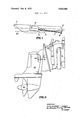
- FIG. 1 is a side elevationaldiagram of a boat hull and the means for driving it;.
- FIG. 2 is a side elevation, shown partly in section, of an outboard boat propulsion unit
- FIG. 3 is a side elevation of a stern-drive boat propulsion unit
- FIG. 4 is a side elevation similar to that of FIG. 1 and shows a reversing device incorporated with an outboard. boat propulpropeller shaft 17 extending through the bottom of the boat for driving a propeller 18 in a manner well-known in the art.
- the boat hull and the. propeller drive are conventional with the exception of the overdrive gearing 16.
- the latter is preferably of the type commonly used in motor vehicles and may, for instance, be of the kind already disclosed in one of US. Pat. Specifications Nos. 3,182,528, filed 24th May, 1962 and 3,164,036, filed 9th May, 1963.
- the gearing preferably provides a power gear-change from the lower to the higher ratio. Nevertheless, the gearing could be of the dog-engaged type taught in our US. ApplicationsNos. 597,463 now U.S. Pat. No. 3,426,623 and 644,913, now U.S. Pat. No. 3,459,285.
- an underdrive epicyclic gearing or other suitable change-speed gearing could be used and, if desired, a reverse drive device 47 providing an optionally engageable reverse drive ratio may also be incorporated as illustrated in FIG. 4.
- the line 19 indicates the normal water level relative to the hull l and it will be appreciated that as the speed of the hull increases it will lift progressively out of the water due to the functioning of the step 13 until the water level is as indicated by the line and the hull is then in a planing condition.
- the form drag coefficient and the friction drag coefficient decrease as the water line drops from line 19 to line 20 and the hull requires less propulsive power to maintain its lowest planing speed than is required to accelerate the bull to this speed.
- a conventional marine reduction or multiplication gearing may be arranged either between the prime mover l4 and the change-speed gearing 16, or between the latter and the propeller 18.
- an outboard boat propulsion unit comprises a prime mover 21 having a vertical power output shaft 22 arranged to drive a planet carrier 23 of an overdrive epicyclic gearing which is arranged in a casing 24 secured to a casing 25 of the prime mover 21 and a casing 26 supporting the propeller 27.
- the planet carrier 23 supports three planet gear wheels 28, only one of which can be.seen, and each planet gear wheel 28 meshes with a common sun gear wheel 29 and a common annulus gear wheel 30 drivingly fast with a power output shaft 31 from the overdrive gearing.
- the overdrive gearing is the subject of our US. Pat. Specification No.
- 3,164,036 and its gear ratio is determined by the condition of the sun gear wheel 29 which can be locked by a movable friction-engaging member 32 optionally to the annulus gear wheel 30 under the action of compression coil springs 33 to provide the direct drive ratio, or to the casing 24 by the actuation of a nonrotatable piston 34 to provide the overdrive ratio.
- a further piston 35 is operable to engage a disc 36 axially fast with the friction-engaging member 32 so that the piston 34 can be disengaged from the friction-engaging member 32 before the latter engages the annulus gear wheel 30.
- the outboard unit is arranged to be clamped to the stern of a boat by a fixing screw 37.
- the power output shaft 31 extends vertically downwards into the casing 26 to drive unshown bevel gears for transmitting drive to the propeller 27 which is supported for rotation about a horizontal axis.
- a stern drive boat propulsion unit comprises a prime mover 41 having an unshown horizontal power output shaft arranged to drive an overdrive epicyclic gearing which is of the same type illustrated in FIG. 2 and is disposed within a casing 42 so that its power output shaft is also horizontal and is connected to drive an unshown universal joint having its centre of articulation lying on the transverse horizontal axis of a pivot 43 carrying a casing 44 supporting the propeller 45.
- a drive shaft extends through a tubular housing 46 into the casing 44 where a first set of bevel gears transfers the drive to the top of a vertical drive shaft having its bottom end connected to drive the propeller through a second set of bevel gears.
- overdrive epicyclic gearing of specific form has been illustrated in both FIGS. 2 and 3, it may, if desired, be replaced by other forms of overdrive or underdrive epicyclic or other gearings.
- the piston 35 shown in FIG. 2 may be actuated to operate the disc 36 to a position in which the epicyclic gearing is in a neutral condition. In this manner the prime mover 21 can be disconnected from the propeller 27 whilst it is being started.
- the fluid pressure for operating the pistons 34 and 35 can be obtained either from a lubricant pump or an air pump driven by the prime mover 21, or can be in the form of compressed air from a pressure vessel.
- a boat hull as in claim 1, in which said change-speed gearing includes a reverse drive device to enable the hull to be manoeuvred at sub-planing speeds.
- a boat hull as in claim 1, including an outboard boat propulsion unit incorporating said prime mover together with propulsion unit incorporating said prime mover together with said propeller and said change-speed gearing, and a casing for the change-speed gearing is secured to a casing of the prime mover and a casing supporting said propeller.
Landscapes
- Chemical & Material Sciences (AREA)
- Engineering & Computer Science (AREA)
- Combustion & Propulsion (AREA)
- Mechanical Engineering (AREA)
- Ocean & Marine Engineering (AREA)
- Structure Of Transmissions (AREA)
Description
United states Patent lnventor Alan S. Lamburn,
Kencott, Via Lechlade, Gloucestershire, England Appl. No. 721,825 Filed Apr. I6, 1968 Patented Oct. 6, 1970 Assignee By mesne assignments-Jo Axel Charles Wickman, Sarasota, Fla. Priority Apr. 19, 1967 (treat Britain 17,907/67 PROPULSION OF A BOAT 12 Claims, 4 Drawing Figs.
U.S. CL. 115/34 lnt.Cl B63h 1/14 Field ofSearch 115/34, 35;
l I l/66.566515); 74/781 [56] References Cited UNITED STATES PATENTS 1,608,471 1 1/1926 Lascombes ll5/34X 2,656,814 10/1953 Kiekhaefer ...l14/66.5(S)UX 3,164,036 1/1965 Lamburn et al. 74/781 Primary ExaminerTrygve M. Blix Alrorneyl-lolman, Glascock, Downing and Seebold ABSTRACT: In a boat hull requiring less propulsive power at minimum planing speed than is required at a lower speed, a
propulsion system comprises a change-speed gearing arranged between the engine and the propeller. The gearing provides a lower forward drive ratio to be engaged at sub-planing speed whereby full engine power can be used to accelerate the hull to planing speed, and a higher forward drive ratio, to be engaged at planing speed whereby the hull can be maintained at planing speed with reduced engine speed and power output.
Patented Oct. 6, 1970 3,532,068
Sheet 1 of :s"
FIG. 3.
mvemoar- ALAN SALISBUIQY LAMB RN ATTORNEY Patented Oct. 6, 1970 3,532,068
mvemo v ALAN SALISBURY LAMBURN Patented Oct. 6, 197.0 :3,32;06s
The total drag coefficient of a boat hull, that is the sum of the form and friction drag coefficients, is substantially lower when the boat is planing than when the boat is below the minimum planing speed and is consequently deeper in the water. Although the total drag force applied to a boat hull increases as a function of the relative speed between the hull and the water, some. boat hulls have a total drag coefficient whilst planing which is sufficiently lower than the total drag coefficient before planing takes place-s that less power is required to propel the hull at its minimum planing speed than.
is required to propel the hull at a lower speed.
According to the invention a propulsion system, for a boat hull of the kind which requires less propulsive power at its minimum planing speed than is required at a lower speed, includes a change-speed gearing arranged between a prime mover and a propeller to provide two alternative forward drive ratios between the prime mover and the propeller, the lower forward ratio being for engagement at sub-planing speeds whereby the prime mover can apply optimum power to the propeller for accelerating the hull to at least its minimum planing speed, and the higher forward ratio being for engagement when the hull has achieved a planing speed whereby the prime mover can be operated at reduced rotational speed and reduced power output whilst still driving the propeller at a sufficient rotational speed to maintain the hull at a planing speed. Preferably, the change-speed gearing provides a power gear change from the lower forward ratio to the higher forward ratio whereby there will be no interruption in the transmission of power from the prime mover to the propeller.
The change-speed gearing is preferably an overdrive epicyclic gearing which provides a direct ratio constituting said lower forward ratio, and an overdrive epicyclic ratio constituting said higher forward ratio. In this case, provided that no reduction gearing is arranged between the change-speed gearing and either the prime mover or the propeller, the full prime move torque would be applied to the, propeller at subplaning speeds, and the gear change into the epicyclic overdrive ratiowould, if the rotational speed of the prime mover remained constant, reduce the torque applied to the propeller but would also increase the propeller speed by an equivalent amount on the other hand, if a conventional marine reduction gearing were present, similar conditions would exist except that the torque applied to the propeller would be multiplied by the ratio of the reduction gearing. By appropriately selecting the epicyclic overdrive ratio, the torque-speed characteristic applied to the propeller at planing speeds can be arranged to match the drag speed characteristics of the hull at planing speeds without effecting the corresponding characteristics at sub-planing speeds. It will be appreciated that the overdrive ratio enables the hull to be driven more economically at planing speeds as the rotational speed of the prime mover will be lower with consequent fuel savings, lower wear, and a reduction in the noise level. Furthermore, under some circumstances, the overdrive ratio enables the bull to be driven at a higher planing speed by more closely matching the maximum power of the prime mover and the speed of the propeller to the drag speed characteristic of the hull. Also, if the prime mover is capable of accelerating the hull to a planing speed when the overdrive ratio is engaged, the engagement of the direct ratio will increase the acceleration of the hull to the planing speed. It will also be appreciated that a power gear change from the direct ratio to the overdrive ratio enables a smooth transition of drive ratio to occur without interrupting the application of propulsion to the hull.
Alternatively the change-speed gearing could be an underdrive epicyclic gearing which provides an underdrive epicyclic ratio constituting said lower forward ratio. and a direct drive ratio constituting said higher forward ratio. In this case, provided that no reduction gearing is arranged between the change-speed gearing and either the prime mover or the propeller, the full prime mover torque multiplied by the underdrive ratio would be applied to the propeller at sub-planing speeds, and the gear change into the direct drive ratio would, if the rotational speed of the prime mover remained constant, reduce the torque applied to the propeller to full prime mover torque but would also increase the propeller speed by an equivalent amount --on the other hand, if a conventional marine reduction gearing were present, similar conditions would exist except that the torque applied to the propeller would be multiplied by the ratio of the reduction gearing. Under these circumstances the torque-speed characteristic of the prime mover can be matched with the drag speed characteristic of the hull at planing speeds, and the underdrive ratio will enable higher torque to be applied to the propeller at subplaning speeds. Also, if the prime mover is capable of accelerating the bull to a planing speed when the direct drive ratio is engaged, the engagement of the underdrive ratio will increase the acceleration of the hull to the planing speed. Alternatively the hull could be powered by a smaller engine than usual, the power output of the engine being determined by the lower power requirement to maintain a planing speed rather than the higher power requirement which is required to acdrive ratio enablesa smooth transition of drive ratio to occur without interrupting the application of propulsion to the hull.
If desired, the change-speed gearing could also include a reverse drive ratio to enable the hull to be manoeuvred at subplaning speeds. The propulsion system may comprise an out board boat propulsion unit incorporating the prime mover together with the propeller and the change-speed gearing, and a casing for the change-speed gearing is secured to a casing of the prime mover and a casing supporting said propeller. Alternatively the propulsion system may comprise a sterndrive boat propulsion unit incorporating the prime mover together with the propeller and the change-speed gearing, and a casing for the change-speed gearing is secured to a casing of the prime mover and a casing supporting said propeller.
The invention is now described, by way of example only, with reference tothe accompanying drawings, in which:
FIG. 1 is a side elevationaldiagram of a boat hull and the means for driving it;.
FIG. 2 is a side elevation, shown partly in section, of an outboard boat propulsion unit;
FIG. 3 is a side elevation of a stern-drive boat propulsion unit; and
FIG. 4 is a side elevation similar to that of FIG. 1 and shows a reversing device incorporated with an outboard. boat propulpropeller shaft 17 extending through the bottom of the boat for driving a propeller 18 in a manner well-known in the art. The boat hull and the. propeller drive are conventional with the exception of the overdrive gearing 16. The latter is preferably of the type commonly used in motor vehicles and may, for instance, be of the kind already disclosed in one of US. Pat. Specifications Nos. 3,182,528, filed 24th May, 1962 and 3,164,036, filed 9th May, 1963. However, the gearing preferably provides a power gear-change from the lower to the higher ratio. Nevertheless, the gearing could be of the dog-engaged type taught in our US. ApplicationsNos. 597,463 now U.S. Pat. No. 3,426,623 and 644,913, now U.S. Pat. No. 3,459,285.
As previously stated, an underdrive epicyclic gearing or other suitable change-speed gearing could be used and, if desired, a reverse drive device 47 providing an optionally engageable reverse drive ratio may also be incorporated as illustrated in FIG. 4.
The line 19 indicates the normal water level relative to the hull l and it will be appreciated that as the speed of the hull increases it will lift progressively out of the water due to the functioning of the step 13 until the water level is as indicated by the line and the hull is then in a planing condition. The form drag coefficient and the friction drag coefficient decrease as the water line drops from line 19 to line 20 and the hull requires less propulsive power to maintain its lowest planing speed than is required to accelerate the bull to this speed.
Ifdesired a conventional marine reduction or multiplication gearing may be arranged either between the prime mover l4 and the change-speed gearing 16, or between the latter and the propeller 18.
In the embodiment illustrated in FIG. 2, an outboard boat propulsion unit comprises a prime mover 21 having a vertical power output shaft 22 arranged to drive a planet carrier 23 of an overdrive epicyclic gearing which is arranged in a casing 24 secured to a casing 25 of the prime mover 21 and a casing 26 supporting the propeller 27. The planet carrier 23 supports three planet gear wheels 28, only one of which can be.seen, and each planet gear wheel 28 meshes with a common sun gear wheel 29 and a common annulus gear wheel 30 drivingly fast with a power output shaft 31 from the overdrive gearing. The overdrive gearing is the subject of our US. Pat. Specification No. 3,164,036 and its gear ratio is determined by the condition of the sun gear wheel 29 which can be locked by a movable friction-engaging member 32 optionally to the annulus gear wheel 30 under the action of compression coil springs 33 to provide the direct drive ratio, or to the casing 24 by the actuation of a nonrotatable piston 34 to provide the overdrive ratio. A further piston 35 is operable to engage a disc 36 axially fast with the friction-engaging member 32 so that the piston 34 can be disengaged from the friction-engaging member 32 before the latter engages the annulus gear wheel 30. The outboard unit is arranged to be clamped to the stern of a boat by a fixing screw 37. The power output shaft 31 extends vertically downwards into the casing 26 to drive unshown bevel gears for transmitting drive to the propeller 27 which is supported for rotation about a horizontal axis.
With reference to FIG. 3 a stern drive boat propulsion unit comprises a prime mover 41 having an unshown horizontal power output shaft arranged to drive an overdrive epicyclic gearing which is of the same type illustrated in FIG. 2 and is disposed within a casing 42 so that its power output shaft is also horizontal and is connected to drive an unshown universal joint having its centre of articulation lying on the transverse horizontal axis of a pivot 43 carrying a casing 44 supporting the propeller 45. From the universal joint a drive shaft extends through a tubular housing 46 into the casing 44 where a first set of bevel gears transfers the drive to the top of a vertical drive shaft having its bottom end connected to drive the propeller through a second set of bevel gears.
Although an overdrive epicyclic gearing of specific form has been illustrated in both FIGS. 2 and 3, it may, if desired, be replaced by other forms of overdrive or underdrive epicyclic or other gearings.
If desired the piston 35 shown in FIG. 2 may be actuated to operate the disc 36 to a position in which the epicyclic gearing is in a neutral condition. In this manner the prime mover 21 can be disconnected from the propeller 27 whilst it is being started. The fluid pressure for operating the pistons 34 and 35 can be obtained either from a lubricant pump or an air pump driven by the prime mover 21, or can be in the form of compressed air from a pressure vessel.
[claim:
1. A boat hull, of the kind which requires less propulsive power at its minimum planing speed than is required at a lower speed, provided with a propulsion system comprising a prime mover, a propeller, a change-speed gearing arranged between said prime mover and said propeller, said change-speed gearing providing two alternative forward drive ratios between the prime mover and the propeller, wherein the improvement comprises said change-speed gearing providing a power gear change from a lower forward drive ratio to a higher forward drive ratio with substantially no interruption of power, the lower of said forward drive ratios being for engagement at subplaning speeds whereby the prime mover can apply optimum power to the propeller for accelerating the hull to at least its minimum planing speed, and the higher of said forward drive ratios being for engagement when the hull has achieved a planing speed whereby the prime mover can be operated at reduced rotational speed and reduced power output whilst still driving the propeller at a sufficient rotational speed to maintain the hull at a planing speed.
2. A boat hull, as in claim 1, in which said change-speed gearing is an overdrive epicyclic gearing which provides a direct ratio constituting said lower forward ratio, and an overdrive epicyclic ratio constituting said higher forward ratio.
3. A boat hull, as in claim 2, in which the rotational speed/torque characteristic of the prime mover as applied to the propeller through the direct ratio of the overdrive epicyclic gearing is arranged to be compatible with the drag/speed characteristics of the hull at sub-planing speeds, and the overdrive ratio of the overdrive epicyclic gearing is selected to modify the application of the rotational speed/torque characteristic of the prime mover to the propeller to be compatible with the drag/speed characteristics of the hull at planing speeds.
4. A boat hull, as in claim I, in which said change-speed gearing is an overdrive epicyclic gearing which provides a direct ratio constituting said lower forward ratio, and an overdrive epicyclic ratio constituting said higher forward ratio.
5. A boat hull, as in claim 4 in which the rotational speed/torque characteristic of the prime mover as applied to the propeller through the direct ratio of the overdrive epicyclic gearing is arranged to be compatible with the drag/speed characteristics of the hull at sub-planing speeds, and the overdrive ratio of the overdrive epicyclic gearing is selected to modify the application of the rotational speed/torque characteristic of the prime mover to the propeller to be compatible with the drag/speed characteristics of the hull at planing speeds.
6. A boat hull, as in claim 1, in which said change-speed gearing is an underdrive epicyclic gearing which provides an underdrive epicyclic ratio constituting said lower forward ratio, and a direct drive ratio constituting said higher forward ratio.
7. A boat hull, as in claim 6, in which the rotational speed/torque characteristic of the prime mover as applied to the propeller through the direct ratio of the underdrive epicyclic gearing is arranged to be compatible with the drag/speed characteristics of the hull at planing speeds, and the underdrive ratio of the underdrive epicyclic gearing is selected to modify the application of the rotational speed/torque characteristic of the prime mover to the propeller to be compatible with the drag/speed characteristics of the hull at sub-planing speeds.
8. A boat hull, as in claim 1, in which said change-speed gearing is an underdrive epicyclic gearing which provides an underdrive epicyclic ratio constituting said lower forward ratio, and a direct drive ratio constituting said higher forward ratio.
9. A boat hull, as in claim 8, in which the rotational speed/torque characteristic of the prime mover as applied to the propeller through the direct ratio of the underdrive epicyclic gearing is arranged to be compatible with the drag/speed characteristics of the hull at planing speeds, and the underdrive ratio of the underdrive epicyclic gearing is selected to modify the application of the rotational speed/torque characteristic of the prime mover to the propeller to be compatible with the drag/speed characteristics of the hull at sub-planing speeds.
10. A boat hull, as in claim 1, in which said change-speed gearing includes a reverse drive device to enable the hull to be manoeuvred at sub-planing speeds.
11. A boat hull, as in claim 1, including an outboard boat propulsion unit incorporating said prime mover together with propulsion unit incorporating said prime mover together with said propeller and said change-speed gearing, and a casing for the change-speed gearing is secured to a casing of the prime mover and a casing supporting said propeller.
Applications Claiming Priority (1)
| Application Number | Priority Date | Filing Date | Title |
|---|---|---|---|
| GB07907/67A GB1222073A (en) | 1967-04-19 | 1967-04-19 | Improvements in or relating to the propulsion of a boat |
Publications (1)
| Publication Number | Publication Date |
|---|---|
| US3532068A true US3532068A (en) | 1970-10-06 |
Family
ID=10103348
Family Applications (1)
| Application Number | Title | Priority Date | Filing Date |
|---|---|---|---|
| US721825A Expired - Lifetime US3532068A (en) | 1967-04-19 | 1968-04-16 | Propulsion of a boat |
Country Status (3)
| Country | Link |
|---|---|
| US (1) | US3532068A (en) |
| FR (1) | FR1570666A (en) |
| GB (1) | GB1222073A (en) |
Cited By (5)
| Publication number | Priority date | Publication date | Assignee | Title |
|---|---|---|---|---|
| US3994254A (en) * | 1974-07-10 | 1976-11-30 | Brunswick Corporation | Transmission for a marine jet drive |
| US4173939A (en) * | 1976-10-04 | 1979-11-13 | Outboard Marine Corporation | Two-speed transmission |
| US4323354A (en) * | 1979-02-15 | 1982-04-06 | Outboard Marine Corporation | Two-speed automatic transmission for a marine propulsion device |
| US4428734A (en) | 1978-04-27 | 1984-01-31 | Ludlow Roy S | Planing-hull type boats and power drives therein |
| US6439937B1 (en) * | 1998-12-16 | 2002-08-27 | Ab Volvo Penta | Boat propeller transmission |
-
1967
- 1967-04-19 GB GB07907/67A patent/GB1222073A/en not_active Expired
-
1968
- 1968-04-16 US US721825A patent/US3532068A/en not_active Expired - Lifetime
- 1968-04-18 FR FR1570666D patent/FR1570666A/fr not_active Expired
Cited By (6)
| Publication number | Priority date | Publication date | Assignee | Title |
|---|---|---|---|---|
| US3994254A (en) * | 1974-07-10 | 1976-11-30 | Brunswick Corporation | Transmission for a marine jet drive |
| US4173939A (en) * | 1976-10-04 | 1979-11-13 | Outboard Marine Corporation | Two-speed transmission |
| US4428734A (en) | 1978-04-27 | 1984-01-31 | Ludlow Roy S | Planing-hull type boats and power drives therein |
| US4323354A (en) * | 1979-02-15 | 1982-04-06 | Outboard Marine Corporation | Two-speed automatic transmission for a marine propulsion device |
| US4400163A (en) * | 1979-02-15 | 1983-08-23 | Outboard Marine Corporation | Marine propulsion device including an overdrive transmission |
| US6439937B1 (en) * | 1998-12-16 | 2002-08-27 | Ab Volvo Penta | Boat propeller transmission |
Also Published As
| Publication number | Publication date |
|---|---|
| FR1570666A (en) | 1969-06-13 |
| GB1222073A (en) | 1971-02-10 |
Similar Documents
| Publication | Publication Date | Title |
|---|---|---|
| US7704183B2 (en) | Outboard motor | |
| US6350165B1 (en) | Marine stern drive two-speed transmission | |
| US7891263B2 (en) | Dual speed transmission | |
| US4304150A (en) | Transmission unit for motor vehicles | |
| US9676463B1 (en) | Planetary transmission arrangements for marine propulsion devices | |
| US7685899B2 (en) | Single clutch transmission | |
| US4173939A (en) | Two-speed transmission | |
| US4309914A (en) | Controlled transmission system | |
| US4428734A (en) | Planing-hull type boats and power drives therein | |
| GB2281886A (en) | Motor vehicle with a continuously variable transmission | |
| EP1789313B1 (en) | Decoupler | |
| US7361069B2 (en) | Multiple speed marine propulsion system | |
| US3532068A (en) | Propulsion of a boat | |
| JP3061061B2 (en) | Booster of ship propulsion | |
| US10161482B1 (en) | Planetary transmission arrangements for marine propulsion devices | |
| US5312277A (en) | Method and apparatus for power transmission to a surface driving propeller mechanism and use of a turbine between the driving engine and propeller mechanism | |
| EP0835206B1 (en) | Marine drive system | |
| US20240425165A1 (en) | Marine hybrid drive unit and method to drive such a marine hybrid drive unit | |
| CA1081005A (en) | Two-speed transmission | |
| JP2008507665A (en) | Decoupler | |
| JPH11182582A (en) | Shifting method of inboard/outboard motor | |
| CN213109754U (en) | Ship propulsion device with main engine automatically matched with propeller rotating speed and torque | |
| JPS6030157Y2 (en) | Slow-speed navigation device in marine reducer | |
| JP6430895B2 (en) | Marine gear device |