US3385960A - Electronic ratio calculator performing aligning and subtraction operations - Google Patents
Electronic ratio calculator performing aligning and subtraction operations Download PDFInfo
- Publication number
- US3385960A US3385960A US359037A US35903764A US3385960A US 3385960 A US3385960 A US 3385960A US 359037 A US359037 A US 359037A US 35903764 A US35903764 A US 35903764A US 3385960 A US3385960 A US 3385960A
- Authority
- US
- United States
- Prior art keywords
- data
- divisor
- register
- transmitted
- dividend
- Prior art date
- Legal status (The legal status is an assumption and is not a legal conclusion. Google has not performed a legal analysis and makes no representation as to the accuracy of the status listed.)
- Expired - Lifetime
Links
Images



Classifications
-
- G—PHYSICS
- G06—COMPUTING OR CALCULATING; COUNTING
- G06F—ELECTRIC DIGITAL DATA PROCESSING
- G06F7/00—Methods or arrangements for processing data by operating upon the order or content of the data handled
- G06F7/38—Methods or arrangements for performing computations using exclusively denominational number representation, e.g. using binary, ternary, decimal representation
- G06F7/48—Methods or arrangements for performing computations using exclusively denominational number representation, e.g. using binary, ternary, decimal representation using non-contact-making devices, e.g. tube, solid state device; using unspecified devices
- G06F7/57—Arithmetic logic units [ALU], i.e. arrangements or devices for performing two or more of the operations covered by groups G06F7/483 – G06F7/556 or for performing logical operations
Definitions
- an effective data processing system capable of meeting these requirements must include means for performing the desired division operations.
- a mechanical or electromechanical calculator such as those manufactured by the Monroe Calculator Machine Company, Inc.
- Such a system being electromechanical in operation, has proved to be relatively slow and requires considerable maintenance by personnel having special qualifications enabling them to understand the operation of such units.
- Another object of the invention is to provide new and improved methods and apparatus for processing information bits based upon different observed and calculated quantities representative of diverse characteristics of radioactive test samples such, by way of example, as the energy or activity level of each sample as measured by conventional spectrometer apparatus in terms of count time, counts recorded in one or more scalers, counts per unit time for each different sealer and ratios of counts recorded in the different scalers.
- a more specific object of the invention is to provide an all-electronic calculator system capable of performing desired ratio calculations by (l) initially aligning the divisor with the dividend by digitally shifting it to the left to the last position at which the value of the dividend is greater than the value of the divisor, (l) subtracting the divisor digits from the corresponding dividend digits in the initial aligned position on a repetitive basis to determine the most significant digit of the quotient, (3) aligning the divisor with the remainder dividend by digitally shifting the divisor one digit to the right, (4) subtracting the divisor from the dividend in the second aligned position on a repetitive basis to determine the second mcst significant digit of the quotient, and (5) repetitively aligning the divisor with the remainder dividend by digitally shifting the divisor one digit to the right and subtracting the divisor from the dividend in each aligned position to 3,385,960 Patented May 28, 1968 ice determine successive digits of the quotient until the divisor has been subtracted from the dividend to determine the
- FIG. 1 is a block diagram of lan exemplary data processing system embodying the principles of the present invention
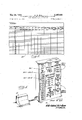
- FIG. 2 illustrates a typical record sheet upon which data, processed by the system shown in FIG. 1 and representative of particular observed or calculated pieces or categories of information associated with a radioactive test sample, may be printed;
- FIG. 3 is a perspective view of a composite radioactive sample measuring and recording system employing the components shown in FIG. l;
- FIGS. 4a and 4b when combined form a more detailed block diagram of the computing and print-out portions of the exemplary system shown in FIG. 1;
- FIG. 5 is a block diagram of a typicall one of the gate circuits shown in FIG. 4;
- FIG. 6 is a more detailed block diagram of the listing logic circuit shown in FIG. 1;
- FIG. 7 is a more detailed block diagram of the compute logic circuit shown in FIG. 1;
- FIG. 8 is -a more detailed block diagram of the compute control unit shown in FIG. l;
- FIG. 9 is a more detailed block diagram of the print control unit shown in FIG. l.
- FIG. l() is a perspective view showing the relationship between a typewriter key and associated solenoid control apparatus illustrated in simplified form in FIG. 4.
- flip-flops, AND gates and OR gates have been symbolically illustrated. Since these elements are conventional and are commonly utilized in the electronics art, the details thereof have not been set forth. However, a brief description of the operation of the flip-Hops may be helpful in understanding the operation of the present invention.
- the iiip-liops are illustrated as rectangles having two sections, one being identified by the reference character S and the other by the reference character R.
- Inputs to the flip-flops are connected to the: left-hand sides thereof and outputs are connected to the right-hand sides thereof.
- Some of the flip-flops are of the monostable type designated by the characters MS, whereas the remaining tlip-iiops are of the bistable type.
- the pulses may be counted for a predetermined time period (preset time operation) or the time necessary to receive a predetermined number of pulses may be measured (preset count operation), the ratio of counted pulses to the elapsed time period being indicative of the activity level.
- the environmental spectrometer is a liquid scintillation counting system which can be used in conjunction with any automatic, semi-automatic or manual sample changer for selectively conveying radioactive samples to a radioactivity detecting and measuring station in seriatim order and where decay events occurring in each sample are then counted in either preset time or preset count operation so as to provide an indication of the energy level of the test sample.
- a typical automatic sample changer that can be utilized in conjunction with such a spectrometer is illustrated in the copending application of Lyle E. Packard, Alfred E. Munn, Roy E. Smith and Edward F. Polic, Ser. No. 273,189, tiled Apr. 15, 1963, now Patent No. 3,257,561, and assigned to the assignee of the present invention.
- Such a sample changer may be loaded with any desired number of sample trays, each having stations for receiving twentyfour radioactive samples.
- the sample changer sequentially conveys selected ones of the trays to an indexing station where the samples on each tray are sequentially conveyed to the measuring and detecting station one at a time.
- the sample changer includes a rotary wafer switch which produces an output representative of the number of the sample in a tray at the indexing station upon which the desired measuring and detecting operation is being performed. This output may be transmitted to a converter which produces desired data representative of the sample number
- the spectrometer may be programmed to produce, for example, data representative of the following:
- the data produced by the converter and the spectrometer is then transmitted to a desired print-out system so that composite numbers corresponding to the data are printed-out 0n a desired record sheet.
- composite numbers representative of the counts per unit time for each Scaler i.e., the ratio of the scaler counts to the counting time, and representative of various possible ratios of the scaler counts. Consequently, a computational system must be provided for performing the desired dividing operations and for transmitting the resultant data to the print-out system.
- a data processing system for causing desired data to be selectively printed-out. More specifically, a data processing system is provided for processing data representative of particular specified characteristics of radioactive samples and which is 1) lcapable of selectively and automatically performing specified divisional operations and (2) capable of causing such observed and calculated data to be selectively printed-out on a record sheet.
- FIGURE 1 an exemplary arrangement of such a data processing system is shown.
- a spectrometer 29, Ia radioactive sample changer 21 and a converter 21a have been provided which may simply take the form of the aforementioned exemplary scintillation spectrometer and sample changer and converter.
- numerical output data is produced by the converter 21a and the spectrometer 20 which is representative of the following:
- a typewriter 22 has been provided.
- the typewriter is preferably an IBM Selectric typewriter, wherein the carriage does not move relative to the keys, but rather a ball type printing head is moved relative to the carriage.
- a solenoid control unit 23 has been provided for controlling the operation of the typewriter 22 in accordance with the transmission thereto of desired data.
- a listing logic circuit 25 has been provided.
- a signal is transmitted from the spectrometer 20 to the listing logic circuit 25 causing the listing logic circuit to be rendered operative.
- the listing logic circuit controls the operation of a gating circuit 26 so that the numerical output data produced by the converter 21a and spectrometer 20 is selectively transmitted to -an information register 27.
- the numerical data representative of the different characteristics is transmitted to the information register 27 and stored therein at different times during a cycle of operation.
- a signal is transmitted from the listing logic circuit 25 to a print control circuit 28 causing the print control circuit to be rendered operative.
- the ⁇ print control circuit conditions the solenoid control unit 23 for operation and causes the data stored in the information register 27 to be digitally and sequentially read out from the information register and transmitted to the solenoid control unit.
- the solenoid control unit 23 controls the operation of the typewriter 22 so that a composite number represented by the data in the information register 27 is printed-out.
- Data representative of the most significa-nt digit of the composite number is the first to be transmitted to the solenoid control unit and printed-out by the typewriter7 whereas data representative of the least significant digit is the last to be transmitted to the solenoid control unit and printed-out.
- the listing logic circuit 25 controls the operations of the gating circuit 26 and the print control, circuit 28 so that composite numbers representative of the time of count, the count on the red scaler, the count on the green Scaler and the count on the blue sealer are sequentially printed-out by the typewriter 22.
- a computational system For the purpose of performing the desired division yoperations between selected numerical data produced by the spectrometer 20, a computational system must be provided.
- a new and improved computational system has been provided for performing the desired divisional operations and for controlling the operation of the typewriter 22 in accordance with the resultant data produced ⁇ More specifically, a new and improved computational system has been provided for performing a desired divisional operation by Iperforming the following steps:
- a dividend register 30 and a divisor register 31 have been provided.
- a compute logic circuit 33 controls the operation of the gating circuit 26 so that data from the spectrometer is selectively transmitted to the dividend register 30 and the divisor register 31.
- the compute logic circuit 33 may be preprogrammed by an operator to selectively and sequentially control the ⁇ following transmission of data:
- a compute control unit 35 is rendered operative to control the performance of the desired divisional operation.
- the compute control unit controls the aligning of the divisor data with the dividend data.
- the cornpute control unit initially causes the numerical data stored in the registers 30 and 31 to he transmitted to an addersubtractor unit 36 wherein the divisor data is subtracted from the dividend data.
- the resultant answer produced by the adder-subtractor unit is then transmitted to the dividend register 30 wherein it is stored, the numerical data stored in the dividend register thus being reduced in value.
- the numerical data transmitted from the divisor register 31 to the addersubtractor unit 36 is fed back into the divisor register via a feedback loop so that it is restored therein and the value thereof remains the same.
- the compute control unit 35 is rendered operative (l) to cause the numerical data stored in the registers to again be transmitted to the adder-subtractor unit 36 wherein an adding operation is performed so that the numerical data stored in the dividend register 30 is restored to its initial value, (2) to digitally shift the numerical data stored in the divisor register 31 one digit to the left so that the value thereof is increased by a multiple of ten, and (3) to repeat the subtraction operation between the dividend data and the divisor data.
- the compute control unit 3S is rendered operative (1) to transmit the numerical data in the registers 30 and 31 to the adder-subtractor unit 36 wherein they are added so that the numerical data in the dividend register 30 is restored to its initial value, (2) to digitally shift the numerical data in the divisor register 31 one digit to the right so that the divisor data is aligned with the dividend data, and (3) to co-ntrol the desired divisional operation.
- the compute control unit (l) causes the dividend and the divisor numerical data to be repetitively transmitted to the adder-subtractor unit 36 so that the divisor data is repetitively subtracted from the dividend data, (2) responds to the production of a negative answer to stop the repetitive subtraction operations and to cause the dividend and divisor data to be transmitted to the adder-subtractor unit wherein they are added so that the dividend numerical data is restored to its value prior to the last subtraction operation, (3) digitally shifts the divisor numerical data one digit to the right subsequent to the adding and restoring operation, (4) repeats the foregoing operating steps until the divisor numerical data is returned to its initial position and a negative answer is produced by the adder-subtractor unit, counts the number of subtracting operations performed at each divisor data position prior to the production of a negative answer and causes numerical data representative of the number of subtraction operations performed to be stored in the information register 27, and (6) renders the print control unit 28 operative when the divisor is returned to its initial position and a negative answer is produced
- the desired numerical data for a given sample is typed out in seriatim order across a record sheet by .the type writer 22.
- the ball type printing head of the typewriter is returned to its initial position and the typewrited platen is rotated one step to condition the typewriter for a subsequent printing operation on the next line of the record sheet.
- the numerical data for each additional sample being analyzed is subsequently typed out in seriatim order across the record sheet in like manner so that successive lines typed data on the record sheet are respectively representative of observed and calculated data corresponding to successive different ones of the samples. In this manner, corresponding data for the various samples is disposed in columnar form on the record sheet.
- a special record sheet 39 is shown whereupon the observed and calculated numerical data for each sample is printed in seriatim order by the typewriter 22 (FIG. l) in the exemplary arrangement.
- the typewriter 22 FIG. l
- specific columns have been provided for he recordation of data representative of the different desired characteristics. Consequently, corresponding data for all of the different samples is disposed in columnar form.
- the number 456 is divided by the number 2.
- the number 456 is rst stored in ⁇ the divident register 30 as the dividend, while the number 2 is stored in the divisor register 31 as the divisor.
- the number 2 is first subtracted from the number 456 by the adder-subtracter unit 36 thus leaving a positive remainder of 454.
- the number 456 is then restored in the dividend register, and the number 2 in the divisor register is digitally shifted one digit to the left thus increasing the divisor by a factor of to the number 20.
- the divisor number is then subtracted from the dividend number 456, leaving a positive remainder of 436.
- the number 456 is again restored in the dividend register and the divisor 20 is again digitally shifted one digit to the left thus again increasing the divisor by a factor of 10 to the number 200.
- the divisor number 200 is now subtracted from the dividend number 456 leaving a positive remainder of 256. Consequently, the number 456 is again restored in the dividend register and the divisor is again digitally shifted one digit to the left thus again increasing the divisor by a factor of 10 to the number 2,000.
- the divisor 2,000 is now subtracted from the dividend 456 .thus producing a negative answer.
- the number 456 is again restored in the dividend register and the number in the divisor register is shifted one digit to the right thus decreasing the divisor by a factor of l0 and restoring the divisor to the number 200.
- the divisor is aligned with the dividend. The divisional operation of the computational system is then initiated.
- the number 200 is subtracted from the number 456 leaving a positive remainder of 256 which is then stored in the dividend register.
- a count of l is registered in compute control unit 35.
- the subtracting operation is then repeated, leaving a positive remainder of 56 which is stored in the dividend register.
- the count registered in the compute control unit 35 (which is, of course, a count representative of the number of subtraction steps performed) is now increased to 2, thus indicating that two subtraction operations have been performed with the divisor number of 200.
- the divisor of 200 is now subtracted from the positive remainder 56, producing a negative answer which is ineffective to increase the count registered in the compute control unit 35 to a count of B-that is, the count registered in the compute control unit remains at 2.
- the divisor number is again shifted digtally one digit to the right, decreasing the divisor by a factor of l0 to the number 20, and the previously attained or calculated count of 2 in the compute control unit 35 is stored in the information register 27 as the most signficant digit of the quotient.
- the foregoing subtracting operations are again repetitively performed with a divisor of 20 and a stored dividend which is initially 56. It will be apparent that during the ⁇ third subtraction operation a negative answer is again produced.
- the positive remainder 16 is restored in the dividend register 30, and the number in the divisor register 31 is again digitally shifted one digit to the right, decreasing the divisor by a factor of 10 to the number 2.
- the count of 2 which has been attained in the compute control unit 35 is stored in the information register 27 as the second most significant digit of the quotient.
- subtracting operations are again repetitively performed, this with an initial divident of 16 and a divisor of 2. It follows that during the ninth subsequent subtraction operation (i.e., when 2 is subtracted from 40) a negative answer is porduced. When this negative answer is produced, the computational system is rendered inoperative since, at this time, the divisor will have been restored to its initial position and no further digital shift to the right is possible.
- a count of 8 will have been attained in compute control unit 35 during the latter subtratcion operations (since the divisor 2 can be subtracted from the dividend 16 eight times without having leaving a negaitve remainder) and this count is stored in the information register 27 as the least significant digit of the quotient. Consequently, a quotient of 228 has been stored in the information register 27. Moreover, the quotient 228 will thereafter be printed out by the typewriter 22 on the record sheet 39 so that a permanent record thereof is provided.
- FIG. 3 there has been illustrated an exemplary data processing apparatus including a typewriter 22 and a console housing the spectrometer 20 and the computational system depicted in block form in FIG. 1.
- a tray reject push PB1 has been provided for the purpose of permitting a tray to be selectively rejected when the latter is located in the indexing station.
- control switches CS1-GS15 have been provided for the purpose of permitting manual selection by an operator of a particular one, or ones, of the trays of samples stored in the exemplary sample changer 21 (FIG. l), so as to ⁇ enable the selected trays :to 1be sequentially conveyed to a tray indexing station from which the individual samples are transferred one at a time in sequential order to and from a radiation detection and measuring station.
- Print control switches PCSl-PCSS have also been provided for conditioning the system to print out data produced by the converter Zia and the spectrometer (FIG. l), which data ⁇ is representative of selected characteristics for each sample.
- count per unit time control switches CTSl-CTSS are provided for conditioning the ⁇ system .to perform selected division cperations representative of the ratio of count-s recorded in each of the red, green and blue scalers to the count time, such selected calculated ratios then being printed out on the record sheet 39 shown in FIG. 2.
- Scaler ratio con-trol knobs SRCNLSRCN are provid-ed for conditioning the system to perform calculations of the ratios between selected Scaler counts and for causing the resul-tant data to be printed out.
- FIGS. 4a and 4b the computing and printing out portions of the illustrative data processing system (i.e., the portions enclosed by the broken line in FIG. l) are disclosed in somewhat more detailed block form.
- the exemplary spectrometer 2@ and the converter 21a provide numerical data inputs for the gating circuit 26, such inputs being representative of the selected information categories for each sample.
- sample number time T and recorded counts R, G," and B in each of the scalers are transmitted to the gating circuit 26 as numerical data in the form of binary coded decimal signals.
- each digit of the numerical data is represented by a four bit binary coded output.
- the numerical data representative of a given sample information category will have a plurality of digits and, for the purpose of this description, it will lbe assumed that each information category or characteristic is represented by a ten digit number. Since, as previously mentioned, it is assumed for purposes of this description that numerical data representative of five characteristics T, R, G :and B) can be produced for each sample, it follows that lthe exemplary system can produce up t-o fifty four bit binary coded outputs for each sample.
- the exemplary dividend register 3i? wherein data representative of a particular dividend is to be stored, is shown in FIGS. 4a :and 4b as including four shift register-s SRlA-SRdA.
- Each of the shift registers in the dividend, divisor and inform-ation registers is provided for the purpose of storing one bit of the binary coded output data for each digit of the numerical data representative of a selected characteristic for a given sample. Since it has been assumed that ten digit numerical data is produced by the spectrometer 29 for each characteristic, and further assuming that it is desired to print-out all of the digits ⁇ for each characlteristic, the shift registers have been provided with ten stages, each ⁇ stage having ⁇ an independent input for the storage of a bit of binary coded data therein.
- the -gating circuit 26 is provided for controlling the transmission of data from the spectrometer to the dividend, divisor ⁇ and information registers.
- the gating circuit 26 is disclosed as including forty gate circuits, only three of the gate circuits actually being shown.
- a corresponding bit of the binary coded output data for a corresponding digit of the ten digit numerical data representative of each characteristic is transmitted from the spectrometer 20 or converter 21a to each of the 4gate circuits so that each gate circuit controls the transmission of a selected one of the bits of the binary coded output data to a prescribed stage in an associated one of the shift registers.
- the first bit of the first digit for each of the characteristics is transmitted from the spectrometer to a gate circuit GC-ID- 1B which selectively controls the transmission of a bit to either (l) the first (least significant) stage of the first bit shift register SRIA in the dividend register 30, (2) the first stage of the first bit shift register SRIB in the divisor register 3l, or (3) the first stage of the first bit shift register SRIC in the information register 2.7.
- the remaining gate circuits in like manner, selectively control the transmission of bits of the binary coded output data to other prescribed stages of the associated shift registers.
- the operations of the gate circuits GC-lD-IB to GC-XD-tl are concurrently controlled so that, during a controlling operation, all of the binary coded output data bits for a selected characteristic are concurrently stored in the shift registers of the dividened register 3), the divisor register 31, or the information register 27.
- the rst bit of the binary coded output data for each digit of a selected characteristic is stored in the -first bit shift register
- the second bit for each digit is stored in the second bit shift register
- the third bit for each digit is stored in the third bit shift register
- the fourth bit for each digit is stored in the fourth bit shift register.
- FIG. 5 wherein a ⁇ more detailed block diagram of a typical gate circuit is depicted.
- the illustrative gate circuit includes live input AND gates ANDq'g, ANDT, ANDR, ANDG and ANDB which control the transmission of bits of data from the spectrometer 20 and the converter 21a through a gate ORI to output control gates ANDSR-A, ANDSR-B and ANDSR-C in accordance with the operation of the listing logic circuit Z5 and the compute logic circuit 33 (FIG. l).
- the transmission of the data bits through the output gates ANDSR-A, ANDSR-B and ANDSiR-C is also controlled by the listing logic circuit 25 ⁇ and the compute logic circuit 33.
- the gate ANDSR-A is associated with a prescribed stage of an associated shift register in the dividend register Sti so that, when gate ANDSRA is opened, a data bit is controllably stored therein;
- the gate ANDSR-B is associated with a prescribed stage of an ⁇ associated shift register in the divisor register 31 so that, when gate ANDSR-B is opened, a data bit is controllably stored therein;
- the gate ANDER-C is, in like manner, associated with a prescribed stage of an associated shift register in the information register 27 so that, when gate ANDSR-C is opened, a data bit is controllably stored therein.
- the listing logic circuit 25 (FIG. 6) controls the operation of the gate circuits in the gating circuit 26. Control signals are sequentially transmitted lfrom the listing logic circuit 25 to succeeding ones of the input gates AND#, ANDT, ANDR, ANDG and ANDB with prescribed time intervals existing therebetween so that the input gates are sequentially opened. At the same time, a control signal is transmitted from a flipflop FP1 in the listing logic circuit to the output control gate ANDSR-C so that the output control gate is opened.
- All the gate circuits in the gating circuit are likewise controlled so that bits of binary coded output data representative of the sample number are initially Stored in the shift registers of the information register 27 at the end of a rst time interval and the numerical value thereof is subsequently printed-out by the typewriter 22 is the associated print control switch PCSI (FIG. 3) is preset for a printout operation.
- PCSI print control switch
- bits of binary Coded output data respectively representative of the time of count, count in the red scaler, count in the green Scaler and count in the blue scaler are stored in the shift registers of the information register 27 and thereafter the numerical values thereof are selectively printed-out by the typewriter 22, depending on the preset state of vprint control switches PCSI/.- PCSS.
- the listing logic circuit 25 controls the operation of the gate circuits in the gating circuit 26 so that composite numbers representative of the sample number and the selected sample characteristics detected and measured by the spectrometer 29 are selectively and Sequentially printed-out by the typewriter 22 in seriatim order across the recordation sheet shown in FIG. 2.
- the operation of the gate circuits in the gating circuit 26 are controlled by the compute logic circuit 33 (FlG. 7).
- the compute logic circuit 33 FlG. 7
- the binary coded output data representative of the count in the red sealer must he stored in the dividend register 3f, whereas the binary coded output data .representative of the time of the count must be stored in the divisor register 31.
- a control signal is initially transmitted from the compute logic circuit 33 to the gate ANDR causing the gate to be opened so that a bit of the data representative of the red Scaler count R is transmitted therethrough and through the gate ORI to the inputs of the output control gates ANDSR-A, ANDSR-B and ANDSR-C.
- a control signal is transmitted from the compute logic circuit to the gate ANDSR-A causing it to be opened so that the bit of red Scaler count data is transmitted therethrough to the prescribed stage of the associated shift register in the dividend ⁇ register 30 wherein it is stored.
- All of the gate circuits in the gating circuit 26 are correspondingly rendered operative so that all of the bits of binary coded output data representative of the red Scaler count are concurrently stored in the shift registers of the dividend register 30.
- a control signal is transmitted from the compute logic circuit 33 to the gate ANDT so that a bit of the data representative of the counting time T is transmitted therethrough and through the gate ORl to the inputs of the output control gates ANDSR-A, ANDSR-B and ANDSR-C-
- a control signal is transmitted from the compute logic circuit to the gate ANDSR-B so that the bit of counting time data is transmitted therethrough to the prescribed stage of the associated shift register in the divisor register 31 wherein it is stored.
- All of the gate circuits in the gating circuit 2d are again correspondingly rendered operative so that all of the bits of binary coded output data representative of the time of count are concurrently stored in the shift registers of the divisor register 3l.
- the desired dividend data is stored in the dividend register 30 and the desired divisor data is stored in the divisor register 31 so that the desired dividing operation may be performed.
- the same operation is repeated for the numerical data representative o-f other characteristics between which it is desired to perform division operations, such, for example, as Scaler counts divided. by the timc of count and ratios between scalcr counts.
- the print control unit causes a control pulse to be transmitted through terminal a in FIG, 4b to the left shift inputs LS of the shift registers SRlC-SR-@C of the information register 27. ln response thereto, the binary coded data stored in the shift registers SRlC-SRftC is repeatedly shifted to the left in digital steps so that the bits of binary coded data representative of succeeding digits of the data stored in the information register are sequentially .read out of the shift registers and are transmitted to a decoder riti.
- the decoder 46 transforms the ⁇ binary coded output data into straight decimal data.
- the straight decimal data produced by the decoder ⁇ 4G is then utilized to control the energization of an associated one of a plurality of solenoids Sti-S9 which respectively control the operation of typewriter keys bearing the numbers 0 9 so that a desired number is printedout.
- the print control unit 28 transmits control pulses through terminal a to the left shift inputs LS of the shift registers SRlC-SR4C
- the print control unit also transmits a control signal through terminal b to a common terminal of the solenoids St- S9 causing the solenoids to be conditioned for energization in response to the production of a straight decimal signal by the decoder lid.
- bits of binary coded data representative of each digit of the data stored in the information register 27 are sequentially read out and are decoded so that selected ones of the solenoids Sil-S9 are sequentially energized to control the operation of associated keys of the typewriter 22 whereby numbers represented by the bits of ⁇ binary coded data are sequentially typed out.
- a composite number representative of (l) the data produced by the converter 2la or (2) a characteristic detected and measured by the spectrometer 20 is printed-out o-n the recordation sheet (FIG. 2).
- bits of binary coded output data representative of the sample number and the various characteristics detected and measured by the spectrometer 2@ are stored in the information register 27 at different times during operation of the listing logic circuit 25. Accordingly, the data representative of the various characteristics is transmitted to the decoder 4G at different times so that composite numbers representative of the data are sequentially printed-out by the typewriter in seriatim order on the recordation sheet.
- a control signal is transmitted from the print control unit 218 through terminal c in FIG. 4b to ⁇ a tab control solenoid ST subsequent to the printing-out of a composite number representative of one of the characteristics.
- the tab control solenoid ST is energized causir;J an associated tab key of the typewriter to be operated so that the bail like printing head of the typewriter is moved relative to the recordation sheet to a position whereat it is conditioned for printing the composite number of the next succeeding characteristic.
- a tab control signal is transmitted from the print control unit to the tab control solenoid ST when the data representative of a Selected characteristic is ready for printing-out so that the typewriter printing head bypasses the column for the characteristic selected to be omitted and is positioned at the next subsequent column in readiness to print-out the composite number for the next succeeding characteristic.
- decoder 4t While the details of the decoder 4t have not been shown, it will be readily apparent to those skilled in the art that various conventional circuits capable of transforming binary coded data into straight decimal data may ybe utilized.
- a conventional relay tree network may be employed lfor this purpose.
- a dividing operation as previously described in connection with FIG. l is performed.
- a subtract control signal is initially transmitted from the compute control units 35 (FIG. 8) through terminal d (FIG. 4b) to the subtract control input of the adder-subtractor unit 36 so that the adder-subtractor unit is conditioned for a subtracting operation.
- control pulses are transmitted from the compute control unit 35 through terminal e in FIG. 4b to right shift inputs RS of the shift registers in the dividend and divisor regirters 30 and 31.
- the binary coded data stored in the shift registers is repetitively shifted to the right in digital steps so that the bits of binary coded data representative of the succeeding digits of the stored characteristics are sequentially read out of the shift registers and are transmitted to the adder-subtractor unit.
- the data bits representative of the least signincant digits of the stored characteristics are the rst to be read out, whereas the data bits representative of the most significant digits are the last to be read o-ut.
- the adder-subtractor unit 36 performs a desired subtracting operation and transmits the resultant binary coded data, i.e., the answers, back to the shift registers of the dividend register 3G wherein the resultant data is stored.
- a carry signal having a rst polarity and representative thereof is transmitted through terminal f (FIGS. 4b, 8) to the compute control unit 35.
- the compute control unit causes a restore control signal to be transmitted through terminal g (FIGS. 4b, 8) to the restore control input of the adder-suhtractor unit 36 so that the adder-subtractor unit is conditioned for an adding operation.
- control pulses are again transmitted through terminal e to the right shift inputs RS of the shift registers in the dividend and divisorregisters 30 and 31 so that the data stored therein is again sequentially read out and trans* mitted to the adder-subtractor unit 36.
- a carry signal having a second polarity and representative thereof is transmitted through terminal "f (FlGS. 4b, 8) to the compute control unit 35.
- a restore control signal is transmittedV from the compute control unit through terminal g to the adder-subtractor unit 36 causing the adder-subtractor unit to be conditioned for an adding operation.
- control pulses are transmitted from the compute control unit through terminal e to the right shift inputs RS of the shift registers in the dividend register 30 and the divisor register 31.
- the binary coded data stored in the dividend register 30 and the divisor register 31 is transmitted to the adder-subtract0r unit 36 wherein an addition operation is performed so that the data stored in the dividend register 36 is restored to the value thereof prior to the last subtracting operation.
- a control pulse is transmitted from the compute logic circuit through terminal i to the right shift inputs RS of the shift registers in the divisor register 31 so that the data stored therein is digitally shifted one digit to the right.
- the divisor data is aligned with the dividend data and the dividing operation is initiated by the transmission of a subtract control signal from the compute control unit 35 through terminal d (FIGS. 4b, 8) to the adder-subtractor unit 36 so that the adder-subtractor unit is conditioned for a substracting operation.
- control pulses are transmitted from the cornpute control unit through terminal e to the right shift inputs RS of the shift registers in the dividend and divisor registers 30 and Sli so that the data stored therein is sequentially read out into the adder-subtractor unit 36 which subtracts the divisor data from the dividend data and transmits the answer back into the dividend register 30 wherein it is sto-red.
- the data in the divisor register is restored through the feedback loop during the read out operation. The divisor is repeatedly subtracted from lthe dividend in this manner until a negative answer is produced by the adder-subtractor unit 36.
- a restore control signal is applied to the adder-subtractor unit 36 through terminal g by the compute control unit so that the adder-subtractor unit is conditioned for an adding operation.
- control pulses are applied to the right shift inputs RS of the shift registers in the dividend and divisor registers 30 and 31 by the compute control unit through terminal e so that the data stored therein is sequentially transmitted to the addersubtractor unit 36 which performs an adding operation and transmits the answer back to the dividend register 30 wherein it is stored. Consequently, the data stored in the dividend register 30 is restored to the value thereof prior to the last subtracting operation while the data in the divisor register 31 is again restored via the feedback loop.
- a control pulse is transmitted from the compute control unit through terminal i to the right shift inputs RS of the shift registers in the divisor register 31 so that the data stored therein is digitally shifted one digit, i.e., is shifted one stage, to the right whereby the system is conditioned for performing subsequent subtracting operations.
- the foregoing subtracting operation is again repeatedly Iperformed until a negative answer is produced by the adder-subtractor unit.
- the data in the dividend register is restored to its value prior to the last subtracting operation and the data in the divisor register 31 is again digitally shifted one digit to the right to condition the system for a subsequent subtracting operation.
- a count pulse is transmitted from the compute control unit through terminal j to a Q input unit wherein a count is stored indicating the number of subtracting operations performed at any given divisor data position.
- the Q input unit transforms the stored count from straight decimal form into binary coded decimal form.
- the binary coded data stored in the shift registers of the information register 27 is representative of the quotient produced by dividing the selected divisor data into the selected dividend data.
- control pulses are transmitted from the print control unit 28 (FIG. 9) through terminal a (FIG. 4b) to the left shift inputs LS of the shift registers in the information register 27 so that the data therein is sequentially read out and is transmitted to the decoder 40.
- the data representative of the most significant digit of the quotient is the first to be read out, whereas the data representative of the least significant digit is the last to be read out.
- particular ones of the solenoids Sii-S9 are energized one at a time in the manner previously described, thus causing correspondnig ones of the typewriter l-:eys to be rendered operative one at a time. Consequently, the succeeding digits of the quotient are sequentially typed out on the recordation sheet.
- a tab solenoid control signal is transmitted from the print control unit 28 through terminal c (FIG.
- a period control signal is transmitted from the print control unit 28 during the time interval between the reading out of those particular digits of the quotient data stored in the information register 27 between which a period is to be positioned.
- the period control signal is transmitted through terminal "k (FIGS. 4b, 9) to a period control solenoid SP (FIG. 4a), thereby energizing the latter and causing the period key in the typewriter 22 to be operated so that a period is printed between the desired digits.
- adder-subtractor unit 36 The details of the adder-subtractor unit 36 have not been set forth herein since it is a conventional unit for adding and subtracting binary coded numbers. However, reference may be made to pages 491-497 of the text Digital Computer and Control Engineering 'by Robert S. Ledley, published by McGraw-Hill (1960), for the details of a typical unit of this type.
- Listing logic circuit Referring to FIG. 6, there is illustrated a more detailed block diagram of the listing logic circuit 25 which serves to cause selected ones of the detected and measured characteristics of the various samples to be serially printed-out by the typewriter 22 on the recordation sheet.
- the shift register counter SRC-1 is a six stage counter having its first five stages controllably connected to the logic gating circuit YGC1.
- the shift register counter SRC-2 is a four stage counter having its second and third stages controllably connected to the logic gating circuit.
- the logic gating circuit LGC-l has ten ⁇ stages each having an output terminal respectively numbered 1-10.
- the logic gating circuit LGC-l is so arranged that output signals are sequentially produced at the output terminals, with desired time intervals therebetween, in accordance with the operations of the shift register counters SRC-1 and SRC-2. For example, when output signals are simultaneously pro pokerd at the :second stage of the counter SRC-2 and the first stage of the counter SRC-1, an output signal is produced at the first stage output terminal of the logic gating circuit LGC-l. When output signals are simultaneously produced at the third stage of the counter SRC-2 and the first stage of the counter SRC-1, an output signal is producd at the second stage output terminal of the logic gating circuit LGC-.
- the second and third stages of the counter SRC-2 respectively combine with (1) the third stage of the counter SRC-1 to control the sequential production of output signals at the fifth and sixth stage output terminals of the gating circuit LGC-l, (2) the fourth stage output of the counter SRC-1 to control the sequential production of output signals at the seventh and eighth stage output terminals of the gating circuit, and (3) the iifh stage output of the counter SRC-1 to control the sequential production of output signals at the ninth and tenth stage output terminals of the gating circuit.
- a start input pulse is transmitted therefrom to the S input of a monostable flip-flop FF2, causing the flip-flop to be set for a prescribed period of time. Consequently, a desired output pulse is produced at the S output of the Hip-dop FFZ which is transmitted to the S input of the flip-flop FFS, thereby causing the flip-flop FFS, in turn, to be driven to the set condition.
- the flip-flop FF3 being of the bistable type, remains in the set condition until a reset signal is subsequently applied to the R input thereof.
- the R output signal produced by the flip-flop FFS is transmitted (l) back to the S input of the flip-flop FFS so as to inhibit the operation thereof in response to a subsequent start input pulse applied to the flip-flop FP2 until the iiip-liop FFS has been reset, (2) to the S input of a flip-flop FF-i, causing the latter flip-flop to be set so that a desired output signal is produced at the S output thereof which is transmitted to a control unit of 'a gate AND1, opening the latter, (3) to the S input of a monostable flip-flop FFS causing a desired output pulse to be produced at the S output thereof, which pulse is then transmitted through a gate ORZ and the gate AND1, and (4) to the S input of a flip-flop FFI causing 'a desired output signal to be produced at the S output.
- the pulse transmitted through the gate AND1 is also applied to the S input of a flip-flop FF7 causing the flip-Hop to be set so that a desired output signal is produced lat the S output thereof which is transmitted to a control input of a gate ANDZ causing the gate to be opened. Consequently, pulses are permitted to pass through the gate AND2 from an oscillator OSC-1 to the input of the shift register SRC-2, causing output signals to be sequentially produced at the four stages thereof at desired times.
- an output signal is produced at the first stage output of the counter SRC-2 which is transmitted through terminal n to reset inputs R of the shift registers in the information register 27 so that the shift registers are reset to condition the information register 27 for the storage of binary coded data representative of a selected sample characteristic.
- an output signal is produced at the second stage output of the counter SRC-2 which combines With the outpuut signal produced at the first stage output of the shift register counter SRC-1 to cause an output signal to be produced at the rst stage output terminal of the logic gating circuit LGC-l.
- the output signal produced by the logic gating circuit is transmitted to the control inputs of the gating circuit 26 so that the data representative of the sample number is transmitted from the converter 21a to the information register 27 wherein it is stored.
- an output signal is produced at the third stage output of the counter SRC-2 which combines with the output signal of the first stage of the shift register counter SRC-1 to cause an output signal to be produced at the second stage output terminal of the logic gating circuit LGO-1.
- the latter output signal produced by the logic gating circuit is transmitted through the print control switch PSC-1 to either (l) the print control input of the print control unit 28 so that the sample number representative of data stored in the information register 27 is printed-out in straight decimal form, or (2) the tab control input of the print control unit 28 so that printing out of the sample number representative data is bypassed.
- an output pulse is produced by the shift register counter SRC-2 which is transmitted to the R input of the flip-liep FF7, causing the flip-flop to be reset so that the gate AND2 is closed and the further transmission of pulses from the oscillator to the counter SRC-2 is prohibited until the flip-flop FF7 is again set.
- the print control unit 28 Upon completion of a printing-out operation or a bypassing operation, the print control unit 28 (FIGS. 1 and 9) produces a pulse which is transmitted through terminal q (FIGS. 6 and 9), through gates OR?. and AND1 to (l) the input of the shift register counter SRC-1 and (2) the S input of the fiipilop FF7. Consequently, an output signal is produced at the second stage output of the counter SRC-lt and pulses from the oscillator OSC-1 are again applied to the input of the counter SRC-2.
- the counter SRC-2 is swept through another stepping operation during which (l) the information register 27 is reset, (2) the binary coded output data produced by the spectrometer 2t) which is representative of the time of count T is stored in the information register, (3) numerical data representative of the time of count is printed-out by the typewriter 22 or the tab key of the typewriter is operated to bypass the printingout of this data, and (4) the further transmission of pulses to the counter SRC2 is again prohibited.
- this output signal indicates the completion of the printing-out of numerical data representative of selected ones of the sample characteristics detected and measured by the converter 21a and spectrometer 20.
- the end list signal is transmitted to the R inputs of the ip-ops FF3 and FF@ causing the iiip-tlops to be reset so that the gate AND1 is closed and the listing logic circuit is thereby rendered inoperative until a subsequent.
- start input signal is received from the sample changer indicating the beginning of detecting and measuring operations for a subsequent sample.
- the end list signal is also transmitted to the R input of the flip-flop PF1 causing it to be reset so that the gating circuit 26 is no longer conditioned for l@ the transmission of data from the spectrometer 2t) to the information register 27.
- the end list signal is transmitted through terminal r to the compute logic circuit 33 (FIG. 7) to initiate the operation thereof.
- Compute logic circuit The computer logic circuit 33 shown in more detailed block form in FIG. 7 is similar to the previously described listing logic circuit. However, the compute logic circuit does not control the transmission of data from the spectrometer to the information register 27, but rather controls the transmission of data from the spectrometer to the dividend and divisor registers and 31.
- a pair of shift register counters SRC- 11 and SRC-12 and a logic gating circuit LGC-llL have been provided.
- the counter SRC-11 has seven stages, the outputs of the first six stages being connected to the logic gating circuit LGC-ll.
- the counter SRC-12 has four stages with the second and third stage outputs being connected to the logic gating circuit.
- the logic gating circuit has twelve stages, each having an output terminal respectively numbered l-12. The combined operation of the counters SRC-i1 and SRC-i2 and the gating circuit LGO-11 corresponds to that discussed in connection with the listing logic circuit.
- output signals are sequentially produced at the twelve output terminals of the logic gating circuit at desired times so that binary coded output data representative of designated characteristics is selectively stored in the dividend and divisor registers 30 and 3l and the desired dividing operations are performed therebetween.
- an output signal is produced at the R output of the Hip-flop FFM which is transmitted 1) back to the S input of the ip-flop FFB to inhibit further o-peration thereof in response to the setting of the flip-fiop FFIZ by a subsequent end list signal from the listing logic circuit until the flip-flop FF13 has been reset, (2) to the S input of a flip-dop FFM causing the latter fliptiop to be set so that an output signal is produced at the S output which is applied to a control input of a gate ANDll causing the gate to be opened, and (3) to the S input of a monostable fiip-op FFlS causing it to be momentarily set so that a pulse having a prescribed time period is produced thereby which is transmitted through a gate ORZ and the gate ANDl.
- the pulse transmitted through the gate ANDl is transmitted to the input of the shift register counter SRC-lll so that an output signal is produced at the first stage output thereof.
- the pulse transmitted through the gate ANDll is also transmitted to the S input of a flip-flop FFM causing the latter to be set so that a desired output signal is transmitted from the S output to the control input of a gate ANDZ, thus opening the gate. Consequently, pulses from an oscillator OSC-11 are transmitted through the gate AND12 to the input of the shift register counter SRC-12. In response thereto, output signals are sequentially produced at the four stages of the counter SRC-12 at desired times.
- the fourth stage output signal produced by the counter SRC-lli?. is lalso transmitted through terminal s to the compute control unit 3S (FIG. 8) to initiate a dividing operation so that the data representative of the time of count is divided into the data representative of the red sealer count and the resultant data is stored in the information register 27 wherefrom it is read out land numerical data representative thereof is printed-out.
- a signal is transmitted from thc print control unit 2S through terminal q (FlGS. 7 and 9) and through the gates 0R12 and ANDH to (l) the input of the shift register counter SRC-iii and (2) the S input of the flip-iop FF16.
- control switches CTSl-CTSS are provided for causing data representative of the quotients of the red, green and lue sealer counts divided by the counting time T to be selectively provided and printed-out.
- switches CTSl-CTSS are selectively opened, corresponding signals are not transmitted to the respective R, G, and B inputs of the gate circuits in the gating circuit 26. Consequently, the R, G and B data is not transmitted to the dividend register 30 in response to operation of the logic gating circuit LGC-l when the associated switches CTSli-CTSS are open so that data representative of the selected counts per unit time is not pro- 21 quizd and printed-out.
- the switches CTS1-CTS3 allow for the preprogramming of the system by an operator to selectively print-out data representative of selected sealer counts per unit time.
- the previously mentioned control knobs SRCNI- SRCN3 (FIG. 3) control the operation of associated switches so that desired ratios between the sealer counts may be preprogrammed by an operator.
- the switch SRCNI is operable to reverse the relationship between the R and G inputs and the SR-A and SR-B inputs of the gate circuits in the gating circuit 26,
- the switch SRCNZ is operable to reverse the relationship between the R and B inputs and the SR-A and SR-B inputs
- ⁇ and (3) ⁇ the switch SRCN3 is operable to rever-se the relationship between the G and B inputs and the SR-A and SR-B inputs.
- control knobs SRCN1-SRCN3 allow for programming the logic gating circuit LGC11 to selectively regulate the transmission of data representative of the scaler counts to the dividend register 30 and the divisor register 31 so that data representative of the desired ratios is produced and printed-out.
- a signal is transmitted from the print -control unit 28 through terminal q and the gates R12 and ANDII to .the input of the counter SRC-11. Consequently, an output signal is produced at the seventh stage output thereof which is indicative of the end of the desired computing operation.
- the end compute signal is transmitted to the R inputs of the flip-flops FF13 and FFM causing these Hip-flops to be reset and thereby causing the compute logic circuit to be rendered inoperative until a subsequent end list signal is transmitted to the S input of the ilip-op FFIZ from the listing logic circuit.
- the end compute signal is also transmitted through terminal l to the carriage shift solenoid SCS (FIG.
- Compute control unit 35 As previously mentioned, the compute control unit 35 (FIGS. 1 and 8) is provided for the purpose of controlling the desired divisional operations. More specifically, the compute c-ontrol unit initially controls the aligning of the data stored in the divisor register 31 with data stored in the dividend ⁇ register 30 and subsequently controls repeated subtracting operations at each position between the aligned position and the initial position of the divisor whereby the dividing operation is performed. Referring to FIG. 8, the compute control unit is shown in more detailed block form.
- a fourth stage output signal is produced by the shift register counter SRG-12 subsequent to the storage of desired data in the dividend and divisor registers 30 and 31 and this signal is transmitted through terminal s to the compute control unit to initiate a subtracting operation.
- this signal is transmitted through terminal s to the S input of an operation control ip-op FFZI causing the nip-flop to be set so that a desired output signal is produced at the S output thereof.
- This latter signal is transmitted through terminal d to the subtract control input of the adder-subtractor unit 36 (FIG. 4b) causing the adder-subtraetor unit to be conditioned for a subtracting operation.
- the Signal from the compute logic circuit transmitted through terminal s is also transmitted to the S input of a control flip-flop PFZ() causing the flip-flop to be set so that a desired output signal is produced at the S output thereof which causes a gate ANDZO to be opened.
- a gate AND is opened, pulses from an oscillator OSC-20 are permitted to flow (1) through the gate to the input of a decade counter DCl and (2) through the gate and terminal e to the right shift inputs RS of the shift registers in the dividend register 30 and the divisor register 31 (FIGS. 4a and 4b).
- the data stored in the shift registers of the dividend and divisor registers 30 and 31 is repeatedly shifted digitally to the right so that the data stored therein is sequentially read out and is transmitted to the adder-subtractor unit 36 which performs a subracting operation thereon.
- the decade counter DC1 When ten pulses have been applied to the right shift inputs RS of the shift registers in the dividend and divisor registers 30 indicating that all of the data stored therein has been sequentially read out, the decade counter DC1 is titled and produces an end shift pulse which is transmitted to the R input of the flip-flop FF20 causing the nip-flop to be reset so that the gate AND20 is closed and the further transmission of pulses therethrough to the dividend and divisor registers 30 and 31 is prohibited until the ip- Hop FP2() ⁇ is again set.
- a carry signal is transmitted from the adder-subtractor unit 36 (FIG. 4b), (1) through terminal f (FIGS. 4b and 8) and an inverter INVl to an input of a gate AND21 and (2) through terminal f directly to an input of a gate AND22.
- the signal produced at the S output of the flip-flop FF21 (indicative of a subtracting operation) is transmitted to inputs of the gates AND21 and AND22.
- the end shift signal produced by the decade counter DCI is likewise transmitted to inputs of the gates AND21 and AND22.
- the gates AND21 and AND22 are identical so that they are responsive to the application thereto of the same polarity signals, assumed to be signals of a second polarity in the exemplary arrangement. However, since the inverter INV1, which reverses the polarity of a signal applied thereto, is interposed between the gate AND21 and terminal f, the effective polarity Kof a carry signal transmitted to the gates AND21 and AND22 is different so that, for a given polarity carry signal, only one of the gates is rendered operative.
- a desired output is produced at the S output of the tlip-lop FFZZ causing the gate AND24 to be open so that the signal from the gate AND21 is transmitted (1) through the gate AND24 and a gate 0R20 to the S input of a monostable restore flip-op FF23, and 2) through the gate AND24, the gate 0R20 and a gate 0R21 to the S input of a monostable restart flip-op FF24.
- the flip-flop FFZ3 is momentarily set causing a desired output pulse to be produced at the R output thereof which is transmitted to the R input of the Hip-flop FFZl and the flipflop FFM is momentarily set causing a desired output pulse to be produced at the R output thereof which is transmitted to the S input of the nip-flop FF20.
Landscapes
- Engineering & Computer Science (AREA)
- Physics & Mathematics (AREA)
- General Physics & Mathematics (AREA)
- Theoretical Computer Science (AREA)
- Computational Mathematics (AREA)
- Computing Systems (AREA)
- Mathematical Analysis (AREA)
- Mathematical Optimization (AREA)
- Pure & Applied Mathematics (AREA)
- General Engineering & Computer Science (AREA)
- Record Information Processing For Printing (AREA)
Description
s. M. BUU 3,385,960 ELECTRONIC RATIO CALCULATOR PERFORMING ALIGNING May 28, 1968 AND SUBTRACTION OPERATIONS Filed April l5, 1964 9 Sheets-Sheet 1 May 28, 1968 S. M. BUU l 3,385,960
ELECTRONIC RATIO CALCULATOR PERFORMING ALIGNING AND SUBTRACTION OPERATIONS Filed April 13, 1964 9 Sheets-Sheet E INVENTOR .ffii/f' M 3M? S. M. BUU
May 28, 1968 ELECTRONIC RATIO CALCULATOR PERFORMING ALIGNING AND SUBTRACTION OPERATIONS 9 Sheets-Sheet 3 Filed April 1.3, 1964 S, M. BUU
May 28, 1968 9 Sheets-Sheet 4 Filed April 13, 1964 9 Sheets-Shecevrl 5 S. M. BUU
AND SUBTRACTON OPERATIONS ELECTRONC RATIO CALCULATOR PERFORMING ALIGNING NNP May 28, 1968 Filed April l5, 1964 SKY.
s. M. BUU 3,385,960 ELECTRONIC RATIO CALCULATOR PERFORMING ALIGNNG May 28, 1968 AND SUBTRACTION OPERATIONS Filed April 13, 1964 9 Sheets-Sheet 6 May 28, 1968 S. M. BUU
, ELECTRONIC RATIO CALCULATOR PERFORMING ALIGNING AND SUBTRACTION OPERATIONS 'Filed April 13, 1964 9 Sheets-Sheet 'I S. M. BUU
May 28, 1968 ELECTRONIC RATIO CALCULATOR PERFORMING ALIGNING AND SUBTRACTION OPERATIONS 9 Sheets-Sheet 8 Filed April l5, 1964 .N VL? May 28, 1968 s M. BUU
ELECTRONIC RATIO CALCULATOR PERFORMING ALIGNING AND SUBTRACTION OPERATIONS Filed April 13, 1964 9 SheetS--Shelel Nfml United States Patent O 3,385,960 ELECTRONIC RATIO CALCULATOR PER- FORMING ALIGNING AND SUBTRAC- TION OPERATIONS Steve M. Bun, Brookfield, lll., assignor, by mesne assignments, to Packard Instrument Company, Inc., Downers Grove, Ill., a corporation of Delaware Filed Apr. 13, 1964, Ser. No. 359,037 13 Claims. (Cl. 23S- 159) The present invention relates in general to a data processing system and, more particularly, to apparatus for rapidly producing the ratio of two numbers.
When processing observed or measured information representative, for example, of the activity levels or similar characteristics of particular radioactive test samples, it is not only desirable to generate data representative of the detected or measured characteristics, but it is often also desirable to produce data representative of one or more ratios of some or all of the detected or measured characteristics. Accordingly, an effective data processing system capable of meeting these requirements must include means for performing the desired division operations. In the past, it has been a common expedient to employ a mechanical or electromechanical calculator such, for example, as those manufactured by the Monroe Calculator Machine Company, Inc., for performing the desired division operations. However, such a system, being electromechanical in operation, has proved to be relatively slow and requires considerable maintenance by personnel having special qualifications enabling them to understand the operation of such units.
It is a general aim of the present invention to provide an improved data processing system which overcomes the foregoing disadvantages and which is characterized by its rapidity and reliability in operation. In this connection, it is an object of the invention to provide improved apparatus for processing observed or measured information bits.
Another object of the invention is to provide new and improved methods and apparatus for processing information bits based upon different observed and calculated quantities representative of diverse characteristics of radioactive test samples such, by way of example, as the energy or activity level of each sample as measured by conventional spectrometer apparatus in terms of count time, counts recorded in one or more scalers, counts per unit time for each different sealer and ratios of counts recorded in the different scalers.
In another of its important aspects, it is an object of the invention to provide new calculating methods and apparatus characterized by their ability to rapidly, reliably and quietly divide observed, detected or known quantities by other observed, detected or known quantities so as to attain useful ratio information.
A more specific object of the invention is to provide an all-electronic calculator system capable of performing desired ratio calculations by (l) initially aligning the divisor with the dividend by digitally shifting it to the left to the last position at which the value of the dividend is greater than the value of the divisor, (l) subtracting the divisor digits from the corresponding dividend digits in the initial aligned position on a repetitive basis to determine the most significant digit of the quotient, (3) aligning the divisor with the remainder dividend by digitally shifting the divisor one digit to the right, (4) subtracting the divisor from the dividend in the second aligned position on a repetitive basis to determine the second mcst significant digit of the quotient, and (5) repetitively aligning the divisor with the remainder dividend by digitally shifting the divisor one digit to the right and subtracting the divisor from the dividend in each aligned position to 3,385,960 Patented May 28, 1968 ice determine successive digits of the quotient until the divisor has been subtracted from the dividend to determine the least significant digit of the quotient.
Other objects and advantages of the invention will become apparent as the following description proceeds, taken in conjunction with the accompanying drawings, in which:
FIG. 1 is a block diagram of lan exemplary data processing system embodying the principles of the present invention;
FIG. 2 illustrates a typical record sheet upon which data, processed by the system shown in FIG. 1 and representative of particular observed or calculated pieces or categories of information associated with a radioactive test sample, may be printed;
FIG. 3 is a perspective view of a composite radioactive sample measuring and recording system employing the components shown in FIG. l;
FIGS. 4a and 4b when combined form a more detailed block diagram of the computing and print-out portions of the exemplary system shown in FIG. 1;
FIG. 5 is a block diagram of a typicall one of the gate circuits shown in FIG. 4;
FIG. 6 is a more detailed block diagram of the listing logic circuit shown in FIG. 1;
FIG. 7 is a more detailed block diagram of the compute logic circuit shown in FIG. 1;
FIG. 8 is -a more detailed block diagram of the compute control unit shown in FIG. l;
FIG. 9 is a more detailed block diagram of the print control unit shown in FIG. l; and
FIG. l() is a perspective view showing the relationship between a typewriter key and associated solenoid control apparatus illustrated in simplified form in FIG. 4.
While the invention has been shown and will be described in some detail with reference to a specific exemplary embodiment thereof, there is no intention that it be limited to such detail. On the contrary, it is intended here to embrace all modifications, alternatives and equivalents as are included within the spirit and scope of the invention as defined by the appended claims.
In order to facilitate a complete understanding of the present invention, an exemplary system for processing data representative of observed or measured characteristics of radioactive test samples will be described below. However, it is merely intended to illustrate one environment in which the invention will find particularly advantageous use, and it is to be understood that the invention may iind use in conjunction with the processing of any desired data.
In various ones of the drawings, flip-flops, AND gates and OR gates have been symbolically illustrated. Since these elements are conventional and are commonly utilized in the electronics art, the details thereof have not been set forth. However, a brief description of the operation of the flip-Hops may be helpful in understanding the operation of the present invention.
The iiip-liops are illustrated as rectangles having two sections, one being identified by the reference character S and the other by the reference character R. Inputs to the flip-flops are connected to the: left-hand sides thereof and outputs are connected to the right-hand sides thereof. Some of the flip-flops are of the monostable type designated by the characters MS, whereas the remaining tlip-iiops are of the bistable type. When an input signal or pulse as applied to the S section of a monostable flip-flop, the flip-flop is set and, after a predetermined time period, the flip-flop resets itself in a conventional manner. During such operation of a monostable dip-flop, desired output pulses are selectively produced at the S and R output terminals. When an input signal or pulse is applied to the S section of a bistable flipflop, the latter is set and desired output signals are selectively produced at the S and R output terminals. Subsequently, when an input signal or pulse is applied to the R section of a bistable dip-flop, the flip-flop is reset and desired output signals are selectively produced at the S and R output terminals.
Environment of invention Before treating the present invention in detail, it will be helpful rst to consider briey the exemplary environment in which the invention finds particular, but by no means exclusive, use. In radioactivity measurements, it is frequently an objective to determine the rate at which decay events in a radioactive isotope present in a test sample occurs, this rate generally being expressed as counts per unit time, eg., counts per minute. The quantity of a particular isotope present in a radioactive source is, in general, proportional to the rate of decay events produced by the isotope, such rate being termed the activity level of the source. Generally, the decay events or radiation emanations from a radioactive source are, for purposes ofmeasurement or counting, converted into corresponding voltage pulses which can then be counted. The pulses may be counted for a predetermined time period (preset time operation) or the time necessary to receive a predetermined number of pulses may be measured (preset count operation), the ratio of counted pulses to the elapsed time period being indicative of the activity level.
For the purpose of this description, it will be assumed that a scintillation spectrometer is used such as that illustrated and described in U.S. Letters Patent 3,114,835 to Lyle E. Packard and assigned to the assignee of the present invention. However, the particular spectrometer used is not critical to the invention and, therefore, the details of such an exemplary spectrometer will not be set forth hereinbelow, but rather a general description thereof will be given. The environmental spectrometer is a liquid scintillation counting system which can be used in conjunction with any automatic, semi-automatic or manual sample changer for selectively conveying radioactive samples to a radioactivity detecting and measuring station in seriatim order and where decay events occurring in each sample are then counted in either preset time or preset count operation so as to provide an indication of the energy level of the test sample.
A typical automatic sample changer that can be utilized in conjunction with such a spectrometer is illustrated in the copending application of Lyle E. Packard, Alfred E. Munn, Roy E. Smith and Edward F. Polic, Ser. No. 273,189, tiled Apr. 15, 1963, now Patent No. 3,257,561, and assigned to the assignee of the present invention. Such a sample changer may be loaded with any desired number of sample trays, each having stations for receiving twentyfour radioactive samples. The sample changer sequentially conveys selected ones of the trays to an indexing station where the samples on each tray are sequentially conveyed to the measuring and detecting station one at a time. The sample changer includes a rotary wafer switch which produces an output representative of the number of the sample in a tray at the indexing station upon which the desired measuring and detecting operation is being performed. This output may be transmitted to a converter which produces desired data representative of the sample number In actual practice, the spectrometer may be programmed to produce, for example, data representative of the following:
(l) The counting time T (2) The count recorded on a red scaler R (3) The count recorded on a green sealer G (4) The count recorded on a blue sealer B The terms red, green and blue scalers are utilized to indicate the count attained in different channels of the spectrometer. Accordingly, for the purpose of this description, it will be assumed that a three channel spectrometer is utilized. While the exemplary spectrometer in the abovedescribed Patent 3,114,835 is a two channel spectrometer, it is clearly disclosed therein that a greater number of channels may be utilized and reference may be made thereto for the details of a three channel spectrometer.
The data produced by the converter and the spectrometer is then transmitted to a desired print-out system so that composite numbers corresponding to the data are printed-out 0n a desired record sheet. In addition to the foregoing data, it is often desirable to print-out composite numbers representative of the counts per unit time for each Scaler, i.e., the ratio of the scaler counts to the counting time, and representative of various possible ratios of the scaler counts. Consequently, a computational system must be provided for performing the desired dividing operations and for transmitting the resultant data to the print-out system.
Data processing system In accordance with one aspect of the present invention, a data processing system is provided for causing desired data to be selectively printed-out. More specifically, a data processing system is provided for processing data representative of particular specified characteristics of radioactive samples and which is 1) lcapable of selectively and automatically performing specified divisional operations and (2) capable of causing such observed and calculated data to be selectively printed-out on a record sheet.
Referring to FIGURE 1, an exemplary arrangement of such a data processing system is shown. For the purpose of producing numerical output data representative of particular characteristics of radioactive test samples, a spectrometer 29, Ia radioactive sample changer 21 and a converter 21a have been provided which may simply take the form of the aforementioned exemplary scintillation spectrometer and sample changer and converter. For the purpose of this description, it will be assumed that numerical output data is produced by the converter 21a and the spectrometer 20 which is representative of the following:
(1) The sample number (2) The .counting time T (3) The count on the red scaler R 4) The count on the green Scaler G (5 The count on the blue sealer B For the purpose of printing-out the desired data, a typewriter 22 has been provided. In the interest of compactness, the typewriter is preferably an IBM Selectric typewriter, wherein the carriage does not move relative to the keys, but rather a ball type printing head is moved relative to the carriage. A solenoid control unit 23 has been provided for controlling the operation of the typewriter 22 in accordance with the transmission thereto of desired data.
As previously mentioned, it is desirable to selectively print-out composite numbers corresponding to the data produced by the converter and spectrometer. For the' purpose of controlling printing-out of the data, a listing logic circuit 25 has been provided. In response to the completion of a detecting and measuring operation for a given radioactive sample, a signal is transmitted from the spectrometer 20 to the listing logic circuit 25 causing the listing logic circuit to be rendered operative. The listing logic circuit controls the operation of a gating circuit 26 so that the numerical output data produced by the converter 21a and spectrometer 20 is selectively transmitted to -an information register 27. In other words, the numerical data representative of the different characteristics is transmitted to the information register 27 and stored therein at different times during a cycle of operation. Subsequent to the storage of data in the information register 27, for example, the data `from the converter 21a representative of the sample number, a signal is transmitted from the listing logic circuit 25 to a print control circuit 28 causing the print control circuit to be rendered operative. The `print control circuit, in turn, conditions the solenoid control unit 23 for operation and causes the data stored in the information register 27 to be digitally and sequentially read out from the information register and transmitted to the solenoid control unit. In response thereto, the solenoid control unit 23 controls the operation of the typewriter 22 so that a composite number represented by the data in the information register 27 is printed-out. Data representative of the most significa-nt digit of the composite number is the first to be transmitted to the solenoid control unit and printed-out by the typewriter7 whereas data representative of the least significant digit is the last to be transmitted to the solenoid control unit and printed-out.
Subsequent to the printing-out of the 1composite number representative of the sample number, the listing logic circuit 25 controls the operations of the gating circuit 26 and the print control, circuit 28 so that composite numbers representative of the time of count, the count on the red scaler, the count on the green Scaler and the count on the blue sealer are sequentially printed-out by the typewriter 22.
As previously mentioned, it is also desirable to produce composite numbers representative of the counts per unit time for each sealer and representative of ratios between selected ones of the scalers. For the purpose of performing the desired division yoperations between selected numerical data produced by the spectrometer 20, a computational system must be provided. In accordance with another aspect of the present invention, a new and improved computational system has been provided for performing the desired divisional operations and for controlling the operation of the typewriter 22 in accordance with the resultant data produced` More specifically, a new and improved computational system has been provided for performing a desired divisional operation by Iperforming the following steps:
(1) Initially aligning the divisor with the dividend by digitally shifting it to the left to the last position at which the value of the -dividend is greater than the value of the divisor,
(2) Subtracting the divisor digits from the corresponding dividend digits in the initial aligned position on a repetitive basis to determine the most significant digit of the quotient.
(3) Aligning the divisor with the remainder dividend by digitally shifting the divisor one digit to the right,
(4) Subtracting the divisor from the dividend in the second aligned position on a repetitive basis to determme the second most significant digit of the quotient, and
(5 Repetitively aligning the divisor with the remainder dividend by digitally shifting the divisor one digit to the right and subtracting the divisor from the dividend 1n each aligned position to determine successive digits of the quotient until the divisor has been subtracted from the dividend to determine the least significant digit of the quotient.
For the purpose of storing numerical data representative of a particular dividend and numerical data representative of a particular divisor, a dividend register 30 and a divisor register 31 have been provided. To control the transmission of data from the spectrometer to the registers 30 and 31, a compute logic circuit 33 has also been provided. The compute logic circuit 33 controls the operation of the gating circuit 26 so that data from the spectrometer is selectively transmitted to the dividend register 30 and the divisor register 31. As will become readily apparent, the compute logic circuit 33 may be preprogrammed by an operator to selectively and sequentially control the `following transmission of data:
(l) Data R representative of the red sealer count to the dividend register 30 and data T representative of the counting time to the divisor register 31;
(2) Data G representative of the green Scaler count to the dividend register and data T representative of the counting time to the divisor register;
(3) Data B representative of the blue sealer count to the dividend register and data T representative of the counting time to the divisor register;
(4) Data R representative of the red Scaler count to one of the registers and data G representative of the green scaler count to the other register;
(5) Data R representative of the red scaler count to one of the registers and data B representative of the blue scaler count to the other register; and
(6) Data G representative of the` green sealer count to one of the registers and data B representative of the blue Scaler count to the other register.
Subsequent to the storage of data in the dividend reigister 30 and the divisor register 31, a compute control unit 35 is rendered operative to control the performance of the desired divisional operation. First, the compute control unit controls the aligning of the divisor data with the dividend data. During this aligning operation, the cornpute control unit initially causes the numerical data stored in the registers 30 and 31 to he transmitted to an addersubtractor unit 36 wherein the divisor data is subtracted from the dividend data. The resultant answer produced by the adder-subtractor unit is then transmitted to the dividend register 30 wherein it is stored, the numerical data stored in the dividend register thus being reduced in value. During the subtraction operation, the numerical data transmitted from the divisor register 31 to the addersubtractor unit 36 is fed back into the divisor register via a feedback loop so that it is restored therein and the value thereof remains the same. When a positive answer is produced by the adder-subtractor unit during such a subtracting operation, the compute control unit 35 is rendered operative (l) to cause the numerical data stored in the registers to again be transmitted to the adder-subtractor unit 36 wherein an adding operation is performed so that the numerical data stored in the dividend register 30 is restored to its initial value, (2) to digitally shift the numerical data stored in the divisor register 31 one digit to the left so that the value thereof is increased by a multiple of ten, and (3) to repeat the subtraction operation between the dividend data and the divisor data.
The foregoing addition and subtraction operations are performed rapidly on a repetitive basis until such time that a negative answer is produced by the adder-subtractor unit 36. Such a negative answer is an indication that the divisor data can then be aligned with the dividend data simply by shifting the former one digit to the right. In responsive to the negative answer, the compute control unit 3S is rendered operative (1) to transmit the numerical data in the registers 30 and 31 to the adder-subtractor unit 36 wherein they are added so that the numerical data in the dividend register 30 is restored to its initial value, (2) to digitally shift the numerical data in the divisor register 31 one digit to the right so that the divisor data is aligned with the dividend data, and (3) to co-ntrol the desired divisional operation. In controlling the desired divisional operation, the compute control unit (l) causes the dividend and the divisor numerical data to be repetitively transmitted to the adder-subtractor unit 36 so that the divisor data is repetitively subtracted from the dividend data, (2) responds to the production of a negative answer to stop the repetitive subtraction operations and to cause the dividend and divisor data to be transmitted to the adder-subtractor unit wherein they are added so that the dividend numerical data is restored to its value prior to the last subtraction operation, (3) digitally shifts the divisor numerical data one digit to the right subsequent to the adding and restoring operation, (4) repeats the foregoing operating steps until the divisor numerical data is returned to its initial position and a negative answer is produced by the adder-subtractor unit, counts the number of subtracting operations performed at each divisor data position prior to the production of a negative answer and causes numerical data representative of the number of subtraction operations performed to be stored in the information register 27, and (6) renders the print control unit 28 operative when the divisor is returned to its initial position and a negative answer is produced by the adder-subtractor unit 36 thus insuring that a composite number represented by the data stored in the information register 27 and representative of a -desired ratio is sequentially printedout by the typewriter 22 on the record sheet.
The foregoing divisional operation is therefore performed for each of the desired ratios and the resultant quotients are sequentially typed out by the typewriter 22.
It will be readily appreciated that, in respense to the foregoing operations of the exemplary data processing system shown in FIG. l, the desired numerical data for a given sample is typed out in seriatim order across a record sheet by .the type writer 22. Upon completion of the printing-out of the composite number representative of the last characteristic to be recorded for a given sample, the ball type printing head of the typewriter is returned to its initial position and the typewrited platen is rotated one step to condition the typewriter for a subsequent printing operation on the next line of the record sheet. The numerical data for each additional sample being analyzed is subsequently typed out in seriatim order across the record sheet in like manner so that successive lines typed data on the record sheet are respectively representative of observed and calculated data corresponding to successive different ones of the samples. In this manner, corresponding data for the various samples is disposed in columnar form on the record sheet.
Referring to FIG. 2, a special record sheet 39 is shown whereupon the observed and calculated numerical data for each sample is printed in seriatim order by the typewriter 22 (FIG. l) in the exemplary arrangement. As may be seen, specific columns have been provided for he recordation of data representative of the different desired characteristics. Consequently, corresponding data for all of the different samples is disposed in columnar form.
For the purpose of providing a better understanding of the foregoing divisional operation, a typical dividing operation will now be described `by way of example wherein the number 456 is divided by the number 2. Thus, consistent with foregoing description, the number 456 is rst stored in `the divident register 30 as the dividend, while the number 2 is stored in the divisor register 31 as the divisor. Initially, it is necessary to align the dividend and the divisor so as to permit the desired divisional operation to be performed. To accomplish this, the number 2 is first subtracted from the number 456 by the adder-subtracter unit 36 thus leaving a positive remainder of 454. The number 456 is then restored in the dividend register, and the number 2 in the divisor register is digitally shifted one digit to the left thus increasing the divisor by a factor of to the number 20. The divisor number is then subtracted from the dividend number 456, leaving a positive remainder of 436. Thereafter, the number 456 is again restored in the dividend register and the divisor 20 is again digitally shifted one digit to the left thus again increasing the divisor by a factor of 10 to the number 200. The divisor number 200 is now subtracted from the dividend number 456 leaving a positive remainder of 256. Consequently, the number 456 is again restored in the dividend register and the divisor is again digitally shifted one digit to the left thus again increasing the divisor by a factor of 10 to the number 2,000. The divisor 2,000 is now subtracted from the dividend 456 .thus producing a negative answer. In response to the production of the negative answer, the number 456 is again restored in the dividend register and the number in the divisor register is shifted one digit to the right thus decreasing the divisor by a factor of l0 and restoring the divisor to the number 200. At this time, the divisor is aligned with the dividend. The divisional operation of the computational system is then initiated.
During the divisional operation, the number 200 is subtracted from the number 456 leaving a positive remainder of 256 which is then stored in the dividend register. At the same time, a count of l is registered in compute control unit 35. The subtracting operation is then repeated, leaving a positive remainder of 56 which is stored in the dividend register. The count registered in the compute control unit 35 (which is, of course, a count representative of the number of subtraction steps performed) is now increased to 2, thus indicating that two subtraction operations have been performed with the divisor number of 200. The divisor of 200 is now subtracted from the positive remainder 56, producing a negative answer which is ineffective to increase the count registered in the compute control unit 35 to a count of B-that is, the count registered in the compute control unit remains at 2. However, since the last subtraction operation produced a negative remainder, the number in the dividend register is now restored to the number 56, the divisor number is again shifted digtally one digit to the right, decreasing the divisor by a factor of l0 to the number 20, and the previously attained or calculated count of 2 in the compute control unit 35 is stored in the information register 27 as the most signficant digit of the quotient. The foregoing subtracting operations are again repetitively performed with a divisor of 20 and a stored dividend which is initially 56. It will be apparent that during the `third subtraction operation a negative answer is again produced. In this instance, the positive remainder 16 is restored in the dividend register 30, and the number in the divisor register 31 is again digitally shifted one digit to the right, decreasing the divisor by a factor of 10 to the number 2. The count of 2 which has been attained in the compute control unit 35 is stored in the information register 27 as the second most significant digit of the quotient. Subsequently, subtracting operations are again repetitively performed, this with an initial divident of 16 and a divisor of 2. It follows that during the ninth subsequent subtraction operation (i.e., when 2 is subtracted from 40) a negative answer is porduced. When this negative answer is produced, the computational system is rendered inoperative since, at this time, the divisor will have been restored to its initial position and no further digital shift to the right is possible. A count of 8 will have been attained in compute control unit 35 during the latter subtratcion operations (since the divisor 2 can be subtracted from the dividend 16 eight times without having leaving a negaitve remainder) and this count is stored in the information register 27 as the least significant digit of the quotient. Consequently, a quotient of 228 has been stored in the information register 27. Moreover, the quotient 228 will thereafter be printed out by the typewriter 22 on the record sheet 39 so that a permanent record thereof is provided.
Referring now to FIG. 3, there has been illustrated an exemplary data processing apparatus including a typewriter 22 and a console housing the spectrometer 20 and the computational system depicted in block form in FIG. 1. As may .be seen, provision is made in the console for providing a visual indication of (l) the number of the tray which i-s at the indexing station in the sample changer. (2) the cycle of the detecting and measuring operation being performed on the samples in the tray, and (3) the number of the particular sample in the tray which is presently being measured. For the purpose of permitting a tray to be selectively rejected when the latter is located in the indexing station, a tray reject push PB1 has been provided. In order to allow all of the samples in each tray to be counted a selected number of times, a manually operable cycles per tray switch. having a control knob CNI has been provided. Additionally, it will `be observed that control switches CS1-GS15 have been provided for the purpose of permitting manual selection by an operator of a particular one, or ones, of the trays of samples stored in the exemplary sample changer 21 (FIG. l), so as to `enable the selected trays :to 1be sequentially conveyed to a tray indexing station from which the individual samples are transferred one at a time in sequential order to and from a radiation detection and measuring station. Print control switches PCSl-PCSS have also been provided for conditioning the system to print out data produced by the converter Zia and the spectrometer (FIG. l), which data `is representative of selected characteristics for each sample. Additionally, count per unit time control switches CTSl-CTSS are provided for conditioning the `system .to perform selected division cperations representative of the ratio of count-s recorded in each of the red, green and blue scalers to the count time, such selected calculated ratios then being printed out on the record sheet 39 shown in FIG. 2. Finally, Scaler ratio con-trol knobs SRCNLSRCN are provid-ed for conditioning the system to perform calculations of the ratios between selected Scaler counts and for causing the resul-tant data to be printed out. In view of the foregoing, it will be readily appreciated that means have been provided for prep-rogramming the exemplary data processing system to print out numerical dat-a representative of a selected one, or ones, of designated characteristics or information categories pertaining to radioactive samples stored in selected ones of the trays positioned on the sample changer 2l (FIG. l).
Computing and printing out portion-s of computational system Referring to FIGS. 4a and 4b, the computing and printing out portions of the illustrative data processing system (i.e., the portions enclosed by the broken line in FIG. l) are disclosed in somewhat more detailed block form. With reference thereto, it will be observed that the exemplary spectrometer 2@ and the converter 21a provide numerical data inputs for the gating circuit 26, such inputs being representative of the selected information categories for each sample. Thus, sample number time T and recorded counts R, G," and B in each of the scalers are transmitted to the gating circuit 26 as numerical data in the form of binary coded decimal signals. In other words, each digit of the numerical data is represented by a four bit binary coded output. Addition-ally, the numerical data representative of a given sample information category will have a plurality of digits and, for the purpose of this description, it will lbe assumed that each information category or characteristic is represented by a ten digit number. Since, as previously mentioned, it is assumed for purposes of this description that numerical data representative of five characteristics T, R, G :and B) can be produced for each sample, it follows that lthe exemplary system can produce up t-o fifty four bit binary coded outputs for each sample.
The exemplary dividend register 3i?, wherein data representative of a particular dividend is to be stored, is shown in FIGS. 4a :and 4b as including four shift register-s SRlA-SRdA. In like manner, the divisor register 31, wherein data .representa-tive of :a particular divisor is to be stored, is illustrated as including four shift registers SRItB-SRrE-B, while exemplary information register Z7, wherein data to be printed-out is to be stored, is depicted as including four shift registers SRlC-SRdC. Each of the shift registers in the dividend, divisor and inform-ation registers is provided for the purpose of storing one bit of the binary coded output data for each digit of the numerical data representative of a selected characteristic for a given sample. Since it has been assumed that ten digit numerical data is produced by the spectrometer 29 for each characteristic, and further assuming that it is desired to print-out all of the digits `for each characlteristic, the shift registers have been provided with ten stages, each `stage having `an independent input for the storage of a bit of binary coded data therein.
As previously mentioned, the -gating circuit 26 is provided for controlling the transmission of data from the spectrometer to the dividend, divisor `and information registers. In FIGS. 4a and 4b, the gating circuit 26 is disclosed as including forty gate circuits, only three of the gate circuits actually being shown. A corresponding bit of the binary coded output data for a corresponding digit of the ten digit numerical data representative of each characteristic is transmitted from the spectrometer 20 or converter 21a to each of the 4gate circuits so that each gate circuit controls the transmission of a selected one of the bits of the binary coded output data to a prescribed stage in an associated one of the shift registers. For example, the first bit of the first digit for each of the characteristics is transmitted from the spectrometer to a gate circuit GC-ID- 1B which selectively controls the transmission of a bit to either (l) the first (least significant) stage of the first bit shift register SRIA in the dividend register 30, (2) the first stage of the first bit shift register SRIB in the divisor register 3l, or (3) the first stage of the first bit shift register SRIC in the information register 2.7. The remaining gate circuits, in like manner, selectively control the transmission of bits of the binary coded output data to other prescribed stages of the associated shift registers. As will become apparent, the operations of the gate circuits GC-lD-IB to GC-XD-tl are concurrently controlled so that, during a controlling operation, all of the binary coded output data bits for a selected characteristic are concurrently stored in the shift registers of the dividened register 3), the divisor register 31, or the information register 27. During such a storing operation, the rst bit of the binary coded output data for each digit of a selected characteristic is stored in the -first bit shift register, the second bit for each digit is stored in the second bit shift register, the third bit for each digit is stored in the third bit shift register and the fourth bit for each digit is stored in the fourth bit shift register.
For the purpose of providing a better understanding of the operation of the gate circuits GC-lD-llB to GC-XD- 4B, reference is made to FIG. 5 wherein a `more detailed block diagram of a typical gate circuit is depicted. As may be seen, the illustrative gate circuit includes live input AND gates ANDq'g, ANDT, ANDR, ANDG and ANDB which control the transmission of bits of data from the spectrometer 20 and the converter 21a through a gate ORI to output control gates ANDSR-A, ANDSR-B and ANDSR-C in accordance with the operation of the listing logic circuit Z5 and the compute logic circuit 33 (FIG. l). The transmission of the data bits through the output gates ANDSR-A, ANDSR-B and ANDSiR-C is also controlled by the listing logic circuit 25 `and the compute logic circuit 33. The gate ANDSR-A is associated with a prescribed stage of an associated shift register in the dividend register Sti so that, when gate ANDSRA is opened, a data bit is controllably stored therein; the gate ANDSR-B is associated with a prescribed stage of an `associated shift register in the divisor register 31 so that, when gate ANDSR-B is opened, a data bit is controllably stored therein; and the gate ANDER-C is, in like manner, associated with a prescribed stage of an associated shift register in the information register 27 so that, when gate ANDSR-C is opened, a data bit is controllably stored therein.
During a listing operation. the listing logic circuit 25 (FIG. 6) controls the operation of the gate circuits in the gating circuit 26. Control signals are sequentially transmitted lfrom the listing logic circuit 25 to succeeding ones of the input gates AND#, ANDT, ANDR, ANDG and ANDB with prescribed time intervals existing therebetween so that the input gates are sequentially opened. At the same time, a control signal is transmitted from a flipflop FP1 in the listing logic circuit to the output control gate ANDSR-C so that the output control gate is opened. All the gate circuits in the gating circuit are likewise controlled so that bits of binary coded output data representative of the sample number are initially Stored in the shift registers of the information register 27 at the end of a rst time interval and the numerical value thereof is subsequently printed-out by the typewriter 22 is the associated print control switch PCSI (FIG. 3) is preset for a printout operation. At the end of succeeding, prescribed time intervals, bits of binary Coded output data respectively representative of the time of count, count in the red scaler, count in the green Scaler and count in the blue scaler are stored in the shift registers of the information register 27 and thereafter the numerical values thereof are selectively printed-out by the typewriter 22, depending on the preset state of vprint control switches PCSI/.- PCSS. Thus, the listing logic circuit 25 controls the operation of the gate circuits in the gating circuit 26 so that composite numbers representative of the sample number and the selected sample characteristics detected and measured by the spectrometer 29 are selectively and Sequentially printed-out by the typewriter 22 in seriatim order across the recordation sheet shown in FIG. 2.
During a dividing operation, the operation of the gate circuits in the gating circuit 26 are controlled by the compute logic circuit 33 (FlG. 7). For the purpose of providing a description of a typical operation, it will be assumed that it is desired to print-out a composite number representative of the count R in the red scalcr divided by the time T of the count. For this operation, the binary coded output data representative of the count in the red sealer must he stored in the dividend register 3f, whereas the binary coded output data .representative of the time of the count must be stored in the divisor register 31. With reference to the exemplary gate circuit shown in FIG. 5, a control signal is initially transmitted from the compute logic circuit 33 to the gate ANDR causing the gate to be opened so that a bit of the data representative of the red Scaler count R is transmitted therethrough and through the gate ORI to the inputs of the output control gates ANDSR-A, ANDSR-B and ANDSR-C. At the same time, a control signal is transmitted from the compute logic circuit to the gate ANDSR-A causing it to be opened so that the bit of red Scaler count data is transmitted therethrough to the prescribed stage of the associated shift register in the dividend `register 30 wherein it is stored. All of the gate circuits in the gating circuit 26 are correspondingly rendered operative so that all of the bits of binary coded output data representative of the red Scaler count are concurrently stored in the shift registers of the dividend register 30. Subsequently, at the end of a -prescribed time interval, a control signal is transmitted from the compute logic circuit 33 to the gate ANDT so that a bit of the data representative of the counting time T is transmitted therethrough and through the gate ORl to the inputs of the output control gates ANDSR-A, ANDSR-B and ANDSR-C- At the same time, a control signal is transmitted from the compute logic circuit to the gate ANDSR-B so that the bit of counting time data is transmitted therethrough to the prescribed stage of the associated shift register in the divisor register 31 wherein it is stored. All of the gate circuits in the gating circuit 2d are again correspondingly rendered operative so that all of the bits of binary coded output data representative of the time of count are concurrently stored in the shift registers of the divisor register 3l. At this time, the desired dividend data is stored in the dividend register 30 and the desired divisor data is stored in the divisor register 31 so that the desired dividing operation may be performed. Subsequently, at the end of succeeding prescribed imc intervals, the same operation is repeated for the numerical data representative o-f other characteristics between which it is desired to perform division operations, such, for example, as Scaler counts divided. by the timc of count and ratios between scalcr counts.
Referring again to FlGS. la and 4b conjointly, the operation of the shift registers in conjunction with a printing operation will be brieily discussed. The shift registers are assumed to be conventional units commonly utilized in electronic switching and counting operations and, therefore, the details thereof will not be set forth. Subsequent to the storage of bits of binary coded data representative of a particular characteristic in the shift registers of the information register 27' during operation of the listing logic circuit 25, a control signal is transmitted from the listing logic circuit to the print control unit 28 (FIG. 9), causing the print control unit to be rendered operative to control the printing-out of the data in the information register. The print control unit, in turn, causes a control pulse to be transmitted through terminal a in FIG, 4b to the left shift inputs LS of the shift registers SRlC-SR-@C of the information register 27. ln response thereto, the binary coded data stored in the shift registers SRlC-SRftC is repeatedly shifted to the left in digital steps so that the bits of binary coded data representative of succeeding digits of the data stored in the information register are sequentially .read out of the shift registers and are transmitted to a decoder riti. Since the binary coded data stored in the shift registers SRlC-SRdC is repeatedly shifted from right to left, it will be apparent that the data bits representative of the moet significant digit of the data stored in the information register 27 are the first to -be readout, whereas the data hits representative of the least significant digit thereof are the last to be read out. In response to the transmission thereto of the four bits of binary coded data representative of a given digit of the data stored in the information register' 27, the decoder 46 transforms the `binary coded output data into straight decimal data. The straight decimal data produced by the decoder `4G is then utilized to control the energization of an associated one of a plurality of solenoids Sti-S9 which respectively control the operation of typewriter keys bearing the numbers 0 9 so that a desired number is printedout. During the time period when the print control unit 28 transmits control pulses through terminal a to the left shift inputs LS of the shift registers SRlC-SR4C, the print control unit also transmits a control signal through terminal b to a common terminal of the solenoids St- S9 causing the solenoids to be conditioned for energization in response to the production of a straight decimal signal by the decoder lid.
In view of the foregoing, it follows that the bits of binary coded data representative of each digit of the data stored in the information register 27 are sequentially read out and are decoded so that selected ones of the solenoids Sil-S9 are sequentially energized to control the operation of associated keys of the typewriter 22 whereby numbers represented by the bits of `binary coded data are sequentially typed out. Thus. a composite number representative of (l) the data produced by the converter 2la or (2) a characteristic detected and measured by the spectrometer 20 is printed-out o-n the recordation sheet (FIG. 2).
As previously mentioned, bits of binary coded output data representative of the sample number and the various characteristics detected and measured by the spectrometer 2@ are stored in the information register 27 at different times during operation of the listing logic circuit 25. Accordingly, the data representative of the various characteristics is transmitted to the decoder 4G at different times so that composite numbers representative of the data are sequentially printed-out by the typewriter in seriatim order on the recordation sheet. To insure that the Composite number representative of each characteristic is printed-out in the desired column of the recordation sheet siown in FIG. 2, a control signal is transmitted from the print control unit 218 through terminal c in FIG. 4b to `a tab control solenoid ST subsequent to the printing-out of a composite number representative of one of the characteristics. ln response thereto, the tab control solenoid ST is energized causir;J an associated tab key of the typewriter to be operated so that the bail like printing head of the typewriter is moved relative to the recordation sheet to a position whereat it is conditioned for printing the composite number of the next succeeding characteristic. Additionally, in the event selected ones of the print control switches PCSLPCSS shown in FIG. 3 have been thrown to the off position, a tab control signal is transmitted from the print control unit to the tab control solenoid ST when the data representative of a Selected characteristic is ready for printing-out so that the typewriter printing head bypasses the column for the characteristic selected to be omitted and is positioned at the next subsequent column in readiness to print-out the composite number for the next succeeding characteristic.
While the details of the decoder 4t) have not been shown, it will be readily apparent to those skilled in the art that various conventional circuits capable of transforming binary coded data into straight decimal data may ybe utilized. For example, a conventional relay tree network may be employed lfor this purpose.
Subsequent to the storage of bits of binary coded out put data representative of selected characteristics in the shift registers of the dividend register 30 and the divisor register 31 during operation of the compute logic circuit 33, a dividing operation as previously described in connection with FIG. l is performed. During the aligning portion of the dividing operation, a subtract control signal is initially transmitted from the compute control units 35 (FIG. 8) through terminal d (FIG. 4b) to the subtract control input of the adder-subtractor unit 36 so that the adder-subtractor unit is conditioned for a subtracting operation. At the same time, control pulses are transmitted from the compute control unit 35 through terminal e in FIG. 4b to right shift inputs RS of the shift registers in the dividend and divisor regirters 30 and 31. In response thereto, the binary coded data stored in the shift registers is repetitively shifted to the right in digital steps so that the bits of binary coded data representative of the succeeding digits of the stored characteristics are sequentially read out of the shift registers and are transmitted to the adder-subtractor unit. It will be readily appreciated that the data bits representative of the least signincant digits of the stored characteristics are the rst to be read out, whereas the data bits representative of the most significant digits are the last to be read o-ut. During the time interval when the binary coded data stored in the shift registers of the divisor register 31 is being sequentially read out, the data is being fed back into the shift registers via feedback loops so that the binary coded data stored in the divisor register 31 is continuously being restored during the aligning portion of the dividing operation. In response to the transmission thereto of the binary coded data from the dividend register 3i) and the divisor register 31, the adder-subtractor unit 36 performs a desired subtracting operation and transmits the resultant binary coded data, i.e., the answers, back to the shift registers of the dividend register 3G wherein the resultant data is stored.
In the event the answer produced by the adder-subtractor unit 36 is positive, a carry signal having a rst polarity and representative thereof is transmitted through terminal f (FIGS. 4b, 8) to the compute control unit 35. In response thereto, the compute control unit causes a restore control signal to be transmitted through terminal g (FIGS. 4b, 8) to the restore control input of the adder-suhtractor unit 36 so that the adder-subtractor unit is conditioned for an adding operation. At the same time, control pulses are again transmitted through terminal e to the right shift inputs RS of the shift registers in the dividend and divisorregisters 30 and 31 so that the data stored therein is again sequentially read out and trans* mitted to the adder-subtractor unit 36. During this reading out operation, the data in the divisor register 31 is again being continuously restored via the feedback loop. In response to the transmission of the binary coded data from the register 39 and 31 to the adder-subtractor unit 36, an adding operation is performed and the resultant binary coded data is transmitted to the shift registers of the dividend register 3i) wherein it is stored. Consequently, the binary coded data stored in the dividend register 39 is restored to its initial value. Upon completion of this restoring operation, a control pulse is transmitted from the compute control unit 35 through terminal h in FIG. 4b to left shift inputs LS of the shift registers in the diviso-r register 3l, thus causing the data stored in the divisor register 31 to be digitally shifted one digit to the left so that the value thereof is increased by a multiple of ten. Thereafter, the foregoing operations are repeated until a negative answer is produced during a subtracting operation. i
When a negative answer is produced by the adder-sub tractor unit 35, a carry signal having a second polarity and representative thereof is transmitted through terminal "f (FlGS. 4b, 8) to the compute control unit 35. In response thereto, a restore control signal is transmittedV from the compute control unit through terminal g to the adder-subtractor unit 36 causing the adder-subtractor unit to be conditioned for an adding operation. Additionally, control pulses are transmitted from the compute control unit through terminal e to the right shift inputs RS of the shift registers in the dividend register 30 and the divisor register 31. Consequently, the binary coded data stored in the dividend register 30 and the divisor register 31 is transmitted to the adder-subtract0r unit 36 wherein an addition operation is performed so that the data stored in the dividend register 36 is restored to the value thereof prior to the last subtracting operation. Subsequent to the restoring of the data in the dividend register7 a control pulse is transmitted from the compute logic circuit through terminal i to the right shift inputs RS of the shift registers in the divisor register 31 so that the data stored therein is digitally shifted one digit to the right.
At this time, the divisor data is aligned with the dividend data and the dividing operation is initiated by the transmission of a subtract control signal from the compute control unit 35 through terminal d (FIGS. 4b, 8) to the adder-subtractor unit 36 so that the adder-subtractor unit is conditioned for a substracting operation. Thereafter, control pulses are transmitted from the cornpute control unit through terminal e to the right shift inputs RS of the shift registers in the dividend and divisor registers 30 and Sli so that the data stored therein is sequentially read out into the adder-subtractor unit 36 which subtracts the divisor data from the dividend data and transmits the answer back into the dividend register 30 wherein it is sto-red. As previously mentioned, the data in the divisor register is restored through the feedback loop during the read out operation. The divisor is repeatedly subtracted from lthe dividend in this manner until a negative answer is produced by the adder-subtractor unit 36.
When this latter negative answer is produced, a restore control signal is applied to the adder-subtractor unit 36 through terminal g by the compute control unit so that the adder-subtractor unit is conditioned for an adding operation. At the same time, control pulses are applied to the right shift inputs RS of the shift registers in the dividend and divisor registers 30 and 31 by the compute control unit through terminal e so that the data stored therein is sequentially transmitted to the addersubtractor unit 36 which performs an adding operation and transmits the answer back to the dividend register 30 wherein it is stored. Consequently, the data stored in the dividend register 30 is restored to the value thereof prior to the last subtracting operation while the data in the divisor register 31 is again restored via the feedback loop. Subsequently, a control pulse is transmitted from the compute control unit through terminal i to the right shift inputs RS of the shift registers in the divisor register 31 so that the data stored therein is digitally shifted one digit, i.e., is shifted one stage, to the right whereby the system is conditioned for performing subsequent subtracting operations. At this time, the foregoing subtracting operation is again repeatedly Iperformed until a negative answer is produced by the adder-subtractor unit. When this latter negative answer is produced, the data in the dividend register is restored to its value prior to the last subtracting operation and the data in the divisor register 31 is again digitally shifted one digit to the right to condition the system for a subsequent subtracting operation. The foregoing operations are continued until the number of times the data in the divisor register 3l is shifted digitally to the right equals the number of times that it was previously shifted digitally to the left and a negative answer is produced by the adder-subtractor unit 36, at which time the operation of the system is stopped indicating the completion of the dividing operation.
For each repetitive subtraction operation performed leaving a positive remainder in the dividend during the division operation, a count pulse is transmitted from the compute control unit through terminal j to a Q input unit wherein a count is stored indicating the number of subtracting operations performed at any given divisor data position. The Q input unit transforms the stored count from straight decimal form into binary coded decimal form. Upon Iproduction of a negative answer by the adder-subtractor unit 3e and when a control pulse is transmitted from the compute control unit through terminal i to the right shift inputs RS of the shift registers in the divisor register 31, the same control pulse is transmitted through terminal i to a shift and reset input SR of the Q input unit, thus causing the binary codeddata stored therein to be read out and transmitted to the shift registers of the information register 27 wherein this binary coded data is stored as a digit of the particular quotient being calculated.
When the number of times the divisor data is digitally shifted to the right equals the number of times it was previously shifted digitally to the left (i.e., during the aligning operation) and when a negative answer is produced by the adder-subtractor unit 36, the binary coded data stored in the shift registers of the information register 27 is representative of the quotient produced by dividing the selected divisor data into the selected dividend data. Thereafter, control pulses are transmitted from the print control unit 28 (FIG. 9) through terminal a (FIG. 4b) to the left shift inputs LS of the shift registers in the information register 27 so that the data therein is sequentially read out and is transmitted to the decoder 40. The data representative of the most significant digit of the quotient is the first to be read out, whereas the data representative of the least significant digit is the last to be read out. Upon transmission of the numerical data to the decoder 40, particular ones of the solenoids Sii-S9 are energized one at a time in the manner previously described, thus causing correspondnig ones of the typewriter l-:eys to be rendered operative one at a time. Consequently, the succeeding digits of the quotient are sequentially typed out on the recordation sheet. Subsequent to the completion of the printing-out of the composite quotient, a tab solenoid control signal is transmitted from the print control unit 28 through terminal c (FIG. 4b) to the tab control solenoid ST so that the solenoid is energized and the tab key of the typewriter is operated to position the printing head for printing-out data representative of the next desired ratio. In the event that decimal information is to be printed-out subsequent to the performance of the foregoing dividing operation, a period control signal is transmitted from the print control unit 28 during the time interval between the reading out of those particular digits of the quotient data stored in the information register 27 between which a period is to be positioned. The period control signal is transmitted through terminal "k (FIGS. 4b, 9) to a period control solenoid SP (FIG. 4a), thereby energizing the latter and causing the period key in the typewriter 22 to be operated so that a period is printed between the desired digits.
It will be readily appreciated that the foregoing dividing operation is performed for each of the selected ratios so that numerical data representative of each desired ratio is likewise printed-out on the recordation sheet, the numerical data for all the ratios being printed-out in seriatim order in the desired columns of the recordation sheet (FIG. 2). Consequently, for each sample being analyzed, numerical data representative of selected ones of the characteristics measured by the spectrometer 20 and numerical data representative of the ratios between selected ones of the characteristics measured by the spectrometer 20 are printed-out in seriatim order in desired columns of the recordation sheet. Subsequent to the printing-out of all the desired data for a given sample, a carriage shift control signal is transmitted from the compute logic circuit 33 (FIG. 7) through terminal l into a carriage shift control solenoid SCS (FIG. 4a), thereby energizing the latter and causing the carriage shift key on the typewriter to be operated. In response to operation of the carriage shift key, the carriage or lplaten is rotated one step so that the recordation sheet is positioned for receipt of the desired data for the next sample to be tested and measured and the printing head of the typewriter is positioned for printing-out the numerical data representative of the first characteristic which, in the exemplary arrangement, is the sample number.
The details of the adder-subtractor unit 36 have not been set forth herein since it is a conventional unit for adding and subtracting binary coded numbers. However, reference may be made to pages 491-497 of the text Digital Computer and Control Engineering 'by Robert S. Ledley, published by McGraw-Hill (1960), for the details of a typical unit of this type.
Listing logic circuit Referring to FIG. 6, there is illustrated a more detailed block diagram of the listing logic circuit 25 which serves to cause selected ones of the detected and measured characteristics of the various samples to be serially printed-out by the typewriter 22 on the recordation sheet.
For the purpose of controlling the storage of data produced lby the converter 21a and the spectrometer 20 in the information register 27 and for controlling the selected printing-out thereof, a pair of shift register counters SRC-1 and SRC-2 Iand a logic gating circuit LGC-l have been provided. In the exemplary arrangement, the shift register counter SRC-1 is a six stage counter having its first five stages controllably connected to the logic gating circuit YGC1. The shift register counter SRC-2, on the other hand, is a four stage counter having its second and third stages controllably connected to the logic gating circuit. As may be seen, the logic gating circuit LGC-l has ten `stages each having an output terminal respectively numbered 1-10. The logic gating circuit LGC-l is so arranged that output signals are sequentially produced at the output terminals, with desired time intervals therebetween, in accordance with the operations of the shift register counters SRC-1 and SRC-2. For example, when output signals are simultaneously pro duced at the :second stage of the counter SRC-2 and the first stage of the counter SRC-1, an output signal is produced at the first stage output terminal of the logic gating circuit LGC-l. When output signals are simultaneously produced at the third stage of the counter SRC-2 and the first stage of the counter SRC-1, an output signal is producd at the second stage output terminal of the logic gating circuit LGC-. Likewise, when output signals are simultaneously produced at the second stage of the counter SRC-2 and the second stage of the counter SRC-1, an output signal is produced at the third stage output terminal of the logic gating circuit LGC-1, whereas when output signals are simultaneously produced at the third stage of the counter' SRC-2 and thc second stage of the counter SRC-41, an output signal is produced at the fourth stage output terminal of the logic gating circuit. In like manner, the second and third stages of the counter SRC-2 respectively combine with (1) the third stage of the counter SRC-1 to control the sequential production of output signals at the fifth and sixth stage output terminals of the gating circuit LGC-l, (2) the fourth stage output of the counter SRC-1 to control the sequential production of output signals at the seventh and eighth stage output terminals of the gating circuit, and (3) the iifh stage output of the counter SRC-1 to control the sequential production of output signals at the ninth and tenth stage output terminals of the gating circuit.
When a new sample is positioned in the radioactivity detecting and measuring station by the sample changer 21 (FIG. l), a start input pulse is transmitted therefrom to the S input of a monostable flip-flop FF2, causing the flip-flop to be set for a prescribed period of time. Consequently, a desired output pulse is produced at the S output of the Hip-dop FFZ which is transmitted to the S input of the flip-flop FFS, thereby causing the flip-flop FFS, in turn, to be driven to the set condition. The flip-flop FF3, being of the bistable type, remains in the set condition until a reset signal is subsequently applied to the R input thereof. In response to the flip-dop FF3 being driven to the set condition, desired output signals are produced at the S and R outputs thereof. The S output signal produced by the tiip-op FFE is transmitted through terminal m to the print control unit 28 (FIG. 9) so that the print control unit is thereby conditioned for a print controlling operation. The R output signal produced by the flip-flop FFS is transmitted (l) back to the S input of the flip-flop FFS so as to inhibit the operation thereof in response to a subsequent start input pulse applied to the flip-flop FP2 until the iiip-liop FFS has been reset, (2) to the S input of a flip-flop FF-i, causing the latter flip-flop to be set so that a desired output signal is produced at the S output thereof which is transmitted to a control unit of 'a gate AND1, opening the latter, (3) to the S input of a monostable flip-flop FFS causing a desired output pulse to be produced at the S output thereof, which pulse is then transmitted through a gate ORZ and the gate AND1, and (4) to the S input of a flip-flop FFI causing 'a desired output signal to be produced at the S output. thereof which is transmitted to the SR-C control inputs of the gating circuit 26 in FIGS. 4a Iand 4b (see details of gate circuit in FIG. 5) so that the gating circuit 26 is conditioned to control the .sequential transmission of selected data produced by the converter 21a and spectrometer to the shift registers in the information register 27. The pulse transmitted through the gate AND1 is applied to the shift register counter SRC-1 so that, initially, an output signal is transmitted from the first stage thereof to the logic gating circuit LSC-1. The pulse transmitted through the gate AND1 is also applied to the S input of a flip-flop FF7 causing the flip-Hop to be set so that a desired output signal is produced lat the S output thereof which is transmitted to a control input of a gate ANDZ causing the gate to be opened. Consequently, pulses are permitted to pass through the gate AND2 from an oscillator OSC-1 to the input of the shift register SRC-2, causing output signals to be sequentially produced at the four stages thereof at desired times.
In response to a first pulse from the oscillator OSC-1, an output signal is produced at the first stage output of the counter SRC-2 which is transmitted through terminal n to reset inputs R of the shift registers in the information register 27 so that the shift registers are reset to condition the information register 27 for the storage of binary coded data representative of a selected sample characteristic. In response to a second pulse from the oscillator OSC-1, an output signal is produced at the second stage output of the counter SRC-2 which combines With the outpuut signal produced at the first stage output of the shift register counter SRC-1 to cause an output signal to be produced at the rst stage output terminal of the logic gating circuit LGC-l. The output signal produced by the logic gating circuit is transmitted to the control inputs of the gating circuit 26 so that the data representative of the sample number is transmitted from the converter 21a to the information register 27 wherein it is stored. In like manner, in response to a third oscillator pulse, an output signal is produced at the third stage output of the counter SRC-2 which combines with the output signal of the first stage of the shift register counter SRC-1 to cause an output signal to be produced at the second stage output terminal of the logic gating circuit LGO-1. The latter output signal produced by the logic gating circuit is transmitted through the print control switch PSC-1 to either (l) the print control input of the print control unit 28 so that the sample number representative of data stored in the information register 27 is printed-out in straight decimal form, or (2) the tab control input of the print control unit 28 so that printing out of the sample number representative data is bypassed. In response to a fourth pulse from the oscillator OSC-1, an output pulse is produced by the shift register counter SRC-2 which is transmitted to the R input of the flip-liep FF7, causing the flip-flop to be reset so that the gate AND2 is closed and the further transmission of pulses from the oscillator to the counter SRC-2 is prohibited until the flip-flop FF7 is again set.
Upon completion of a printing-out operation or a bypassing operation, the print control unit 28 (FIGS. 1 and 9) produces a pulse which is transmitted through terminal q (FIGS. 6 and 9), through gates OR?. and AND1 to (l) the input of the shift register counter SRC-1 and (2) the S input of the fiipilop FF7. Consequently, an output signal is produced at the second stage output of the counter SRC-lt and pulses from the oscillator OSC-1 are again applied to the input of the counter SRC-2. Accordingly, the counter SRC-2 is swept through another stepping operation during which (l) the information register 27 is reset, (2) the binary coded output data produced by the spectrometer 2t) which is representative of the time of count T is stored in the information register, (3) numerical data representative of the time of count is printed-out by the typewriter 22 or the tab key of the typewriter is operated to bypass the printingout of this data, and (4) the further transmission of pulses to the counter SRC2 is again prohibited.
It follows that the foregoing operation is cyclically repeated so that subsequently (l) numerical data representative of the red sealer count R is printed-out or bypassed, (2) numerical data representative of the green scaler count G is printedout or bypassed, and (3) the numerical data representative of the blue scaler count B is printed-out or bypassed. Upon printing-out or bypassing of the numerical data representative of the blue scaler count, a pulse is again transmitted from the print control unit 28 through terminal q (FIGS. 6 and 9) and the gates OR2 and AND1 to the shift register counter SRC-1, causing an output signal to be produced at the sixth stage output thereof, this output signal being designated as the end list output signal. In other words, this output signal indicates the completion of the printing-out of numerical data representative of selected ones of the sample characteristics detected and measured by the converter 21a and spectrometer 20. The end list signal is transmitted to the R inputs of the ip-ops FF3 and FF@ causing the iiip-tlops to be reset so that the gate AND1 is closed and the listing logic circuit is thereby rendered inoperative until a subsequent. start input signal is received from the sample changer indicating the beginning of detecting and measuring operations for a subsequent sample. The end list signal is also transmitted to the R input of the flip-flop PF1 causing it to be reset so that the gating circuit 26 is no longer conditioned for l@ the transmission of data from the spectrometer 2t) to the information register 27. Finally, the end list signal is transmitted through terminal r to the compute logic circuit 33 (FIG. 7) to initiate the operation thereof.
Compute logic circuit The computer logic circuit 33 shown in more detailed block form in FIG. 7 is similar to the previously described listing logic circuit. However, the compute logic circuit does not control the transmission of data from the spectrometer to the information register 27, but rather controls the transmission of data from the spectrometer to the dividend and divisor registers and 31.
For this purpose, a pair of shift register counters SRC- 11 and SRC-12 and a logic gating circuit LGC-llL have been provided. The counter SRC-11 has seven stages, the outputs of the first six stages being connected to the logic gating circuit LGC-ll. On the other hand, the counter SRC-12 has four stages with the second and third stage outputs being connected to the logic gating circuit. The logic gating circuit has twelve stages, each having an output terminal respectively numbered l-12. The combined operation of the counters SRC-i1 and SRC-i2 and the gating circuit LGO-11 corresponds to that discussed in connection with the listing logic circuit. in other words, output signals are sequentially produced at the twelve output terminals of the logic gating circuit at desired times so that binary coded output data representative of designated characteristics is selectively stored in the dividend and divisor registers 30 and 3l and the desired dividing operations are performed therebetween.
To accomplish this end list output signal produced by the listing logic circuit 2S (FIG. 6) transmitted through terminal r to the S input of a monostable fiip-iiop FFM, the end list signal initiating operation of the compute logic circuit. In response thereto, the iiip-iiop FFIZ is driven to the set condition for a prescribed time period so that a desired output pulse is produced at the S output terminal thereof. Such pulse is then applied to the S input of a bistable iiip-flop FF13 causing the flip-flop FF13 to be set. In response to setting of the flipflop FFlS, an output signal is produced at the S output which is transmitted through terminal m to the print control unit 28 so as to condition it for operation. Additionally, an output signal is produced at the R output of the Hip-flop FFM which is transmitted 1) back to the S input of the ip-flop FFB to inhibit further o-peration thereof in response to the setting of the flip-fiop FFIZ by a subsequent end list signal from the listing logic circuit until the flip-flop FF13 has been reset, (2) to the S input of a flip-dop FFM causing the latter fliptiop to be set so that an output signal is produced at the S output which is applied to a control input of a gate ANDll causing the gate to be opened, and (3) to the S input of a monostable fiip-op FFlS causing it to be momentarily set so that a pulse having a prescribed time period is produced thereby which is transmitted through a gate ORZ and the gate ANDl. The pulse transmitted through the gate ANDl is transmitted to the input of the shift register counter SRC-lll so that an output signal is produced at the first stage output thereof. The pulse transmitted through the gate ANDll is also transmitted to the S input of a flip-flop FFM causing the latter to be set so that a desired output signal is transmitted from the S output to the control input of a gate ANDZ, thus opening the gate. Consequently, pulses from an oscillator OSC-11 are transmitted through the gate AND12 to the input of the shift register counter SRC-12. In response thereto, output signals are sequentially produced at the four stages of the counter SRC-12 at desired times.
When an output signal is produced at the first stage output of the counter SRC-12, it is transmitted through terminal t (FIGS. 4b and 7) to the reset inputs R of the shift registers in the dividend, divisor and information registers 30, 31 and 27 so that these registers are reset to condition them for the storage of desired data. When an output signal is produced at the second stage output of the counter SRC-12, it combines with the first stage output signal produced by the counter SRC-11 to cause an output signal to be produced at the first stage output of the logic gating circuit LGO-11. This latter output signal is transmitted to the R and SR-A control inputs of the gate circuits in the gating circuit 26 (see FIGS. 4a, 4b and 5) so that the binary coded output data produced by the spectrometer 2t) which is representative of the red Scaler count is transmitted to the dividend register 30 wherein it is stored. Subsequently, when the third stage output signal is produced by the counter SRC-12, it combines with the first stage output signal of the counter SRC-11 to cause an output signal to be produced at the second stage output of the logic gating circuit LGC-11. This latter output signal is transmitted to the T and SR-B control inputs of the gate circuits in the gating circuit 26 (FIGS. 4a, 4b and 5) so that the binary coded output data produced by the spectrometer 2G which is representative of the time of count is transmitted to the divisor register 31 wherein it is stored. Thereafter, when the fourth stage output signal is poduced by the counter SRC-12, it is transmitted to the R input of the iiip-op FF16 causing it to be reset so that the further transmission of pulses from the oscillator OSC-i1 to the counter SRC-12 is prohibited.
The fourth stage output signal produced by the counter SRC-lli?. is lalso transmitted through terminal s to the compute control unit 3S (FIG. 8) to initiate a dividing operation so that the data representative of the time of count is divided into the data representative of the red sealer count and the resultant data is stored in the information register 27 wherefrom it is read out land numerical data representative thereof is printed-out. Upon completion of the dividing and printing-out operations, a signal is transmitted from thc print control unit 2S through terminal q (FlGS. 7 and 9) and through the gates 0R12 and ANDH to (l) the input of the shift register counter SRC-iii and (2) the S input of the flip-iop FF16. Consequently, an output signal is produced at the second stage output of the counter SRC-1l and pulses from the oscillator OSC-l are again applied to the counter SRC-12. Accordingly, the counter SRC12 is swept through another stepping operation during which (1) the registers 30, 3l and Z7 are reset, (2) the binary coded data representative of the green sealer count is stored in the dividend register 30, (3) the binary coded data representative of the time of count is stored in the divisor register 31, and (4) the further transmission of pulses to the counter SRC-12 is prohibited and the dividing and printing-out operation is repeated. It follows that the foregoing operation is cyclically repeated so that subsequently 1) numerical data representative of the blue Scaler count per unit time is printed-out, (2) numerical data representative of a desired ratio between the red and green Scaler counts is printed-out, (3) numerical data representative of a desired ratio between the red and blue sealer counts is printed-out, and (4) numerical data representative of a desired ratio between the green and blue sealer counts is printed-out.
As previously mentioned with respect to FIG. 3, control switches CTSl-CTSS are provided for causing data representative of the quotients of the red, green and lue sealer counts divided by the counting time T to be selectively provided and printed-out. As may be seen, when these switches CTSl-CTSS are selectively opened, corresponding signals are not transmitted to the respective R, G, and B inputs of the gate circuits in the gating circuit 26. Consequently, the R, G and B data is not transmitted to the dividend register 30 in response to operation of the logic gating circuit LGC-l when the associated switches CTSli-CTSS are open so that data representative of the selected counts per unit time is not pro- 21 duced and printed-out. Thus, the switches CTS1-CTS3 allow for the preprogramming of the system by an operator to selectively print-out data representative of selected sealer counts per unit time.
The previously mentioned control knobs SRCNI- SRCN3 (FIG. 3) control the operation of associated switches so that desired ratios between the sealer counts may be preprogrammed by an operator. As may be seen (1) the switch SRCNI is operable to reverse the relationship between the R and G inputs and the SR-A and SR-B inputs of the gate circuits in the gating circuit 26, (2) the switch SRCNZ is operable to reverse the relationship between the R and B inputs and the SR-A and SR-B inputs, `and (3) `the switch SRCN3 is operable to rever-se the relationship between the G and B inputs and the SR-A and SR-B inputs. Consequently, the control knobs SRCN1-SRCN3 allow for programming the logic gating circuit LGC11 to selectively regulate the transmission of data representative of the scaler counts to the dividend register 30 and the divisor register 31 so that data representative of the desired ratios is produced and printed-out.
Subsequent to the completion of the last dividing and printing-out operation, a signal is transmitted from the print -control unit 28 through terminal q and the gates R12 and ANDII to .the input of the counter SRC-11. Consequently, an output signal is produced at the seventh stage output thereof which is indicative of the end of the desired computing operation. The end compute signal is transmitted to the R inputs of the flip-flops FF13 and FFM causing these Hip-flops to be reset and thereby causing the compute logic circuit to be rendered inoperative until a subsequent end list signal is transmitted to the S input of the ilip-op FFIZ from the listing logic circuit. The end compute signal is also transmitted through terminal l to the carriage shift solenoid SCS (FIG. 4a) so that the typewriter carriage is rotated one step, whereby the recordation sheet is positioned for receiving data representative of the characteristics of the next succeeding sample and the printing head is positioned to print-out data representative of the rst characteristic, i.e., the sample number in the exemplary arrangement.
Compute control unit As previously mentioned, the compute control unit 35 (FIGS. 1 and 8) is provided for the purpose of controlling the desired divisional operations. More specifically, the compute c-ontrol unit initially controls the aligning of the data stored in the divisor register 31 with data stored in the dividend `register 30 and subsequently controls repeated subtracting operations at each position between the aligned position and the initial position of the divisor whereby the dividing operation is performed. Referring to FIG. 8, the compute control unit is shown in more detailed block form.
As mentioned above with respect to the operation of the compute logic circuit 33 (FIG. 7), a fourth stage output signal is produced by the shift register counter SRG-12 subsequent to the storage of desired data in the dividend and divisor registers 30 and 31 and this signal is transmitted through terminal s to the compute control unit to initiate a subtracting operation. As may be seen, this signal is transmitted through terminal s to the S input of an operation control ip-op FFZI causing the nip-flop to be set so that a desired output signal is produced at the S output thereof. This latter signal is transmitted through terminal d to the subtract control input of the adder-subtractor unit 36 (FIG. 4b) causing the adder-subtraetor unit to be conditioned for a subtracting operation. The Signal from the compute logic circuit transmitted through terminal s is also transmitted to the S input of a control flip-flop PFZ() causing the flip-flop to be set so that a desired output signal is produced at the S output thereof which causes a gate ANDZO to be opened. When the gate AND is opened, pulses from an oscillator OSC-20 are permitted to flow (1) through the gate to the input of a decade counter DCl and (2) through the gate and terminal e to the right shift inputs RS of the shift registers in the dividend register 30 and the divisor register 31 (FIGS. 4a and 4b). In response to the pulses from the oscillator *OSC-20, the data stored in the shift registers of the dividend and divisor registers 30 and 31 is repeatedly shifted digitally to the right so that the data stored therein is sequentially read out and is transmitted to the adder-subtractor unit 36 which performs a subracting operation thereon. When ten pulses have been applied to the right shift inputs RS of the shift registers in the dividend and divisor registers 30 indicating that all of the data stored therein has been sequentially read out, the decade counter DC1 is titled and produces an end shift pulse which is transmitted to the R input of the flip-flop FF20 causing the nip-flop to be reset so that the gate AND20 is closed and the further transmission of pulses therethrough to the dividend and divisor registers 30 and 31 is prohibited until the ip- Hop FP2()` is again set.
Upon the completion of the subtracting operation, a carry signal is transmitted from the adder-subtractor unit 36 (FIG. 4b), (1) through terminal f (FIGS. 4b and 8) and an inverter INVl to an input of a gate AND21 and (2) through terminal f directly to an input of a gate AND22. At the same time, the signal produced at the S output of the flip-flop FF21 (indicative of a subtracting operation) is transmitted to inputs of the gates AND21 and AND22. The end shift signal produced by the decade counter DCI is likewise transmitted to inputs of the gates AND21 and AND22.
The gates AND21 and AND22 are identical so that they are responsive to the application thereto of the same polarity signals, assumed to be signals of a second polarity in the exemplary arrangement. However, since the inverter INV1, which reverses the polarity of a signal applied thereto, is interposed between the gate AND21 and terminal f, the effective polarity Kof a carry signal transmitted to the gates AND21 and AND22 is different so that, for a given polarity carry signal, only one of the gates is rendered operative. Assuming that a carry signal of a first polarity is transmitted through terminal which is thus indicative of the production Iof a positive answer by the adder-subtractor unit 36, the signal is reversed to a second polarity signal by the inverter INVl so that the gate AND21 is rendered operative to produce a signal at the output thereof which iis transmitted to inputs of gates ANDZS and AND24, whereas the gate AND22 is ineffective to produce an output signal.
Transmission of the signal produced at the output of gate AND21 through the gates AND23 and AND24 is controlled by a flip-dop FF22, the Si output thereof being connected to a control input 'of the gate ANDZ4, whereas the R output thereof is connected to a control input of the gate AND23. As may be seen, the S input of the flip-flop FFZZ is connected to terminal s and, therefore, the flip-flop FFZZ will have been driven to the set condition by the signal produced at the fourth stage output of the shift register SRC-12 in the compute logic circuit 33 (FIG. 7) which initiated operation of the compute control unit. Consequently, a desired output is produced at the S output of the tlip-lop FFZZ causing the gate AND24 to be open so that the signal from the gate AND21 is transmitted (1) through the gate AND24 and a gate 0R20 to the S input of a monostable restore flip-op FF23, and 2) through the gate AND24, the gate 0R20 and a gate 0R21 to the S input of a monostable restart flip-op FF24. In response thereto, the flip-flop FFZ3 is momentarily set causing a desired output pulse to be produced at the R output thereof which is transmitted to the R input of the Hip-flop FFZl and the flipflop FFM is momentarily set causing a desired output pulse to be produced at the R output thereof which is transmitted to the S input of the nip-flop FF20. As a
Claims (1)
- 7. IN A SYSTEM FOR PERFORMING A DIVIDING OPERATION, THE COMBINATION WHICH COMPRISES, A DIVIDEND REGISTER, A DIVISOR REGISTER, MEANS FOR STORING DATA REPRESENTATIVE OF DESIRED NUMBERS IN THE REGISTERS, ALIGNING MEANS RENDERED OPERATIVE IN RESPONSE TO THE STORAGE OF DATA IN THE REGISTERS FOR DIGITALLY SHIFTING THE DIVISOR DATA TO THE LEFT TO THE LAST POSITION AT WHICH THE DIVIDEND HAS A GREATER VALUE THAN THE DIVISOR, AND DIVIDING MEANS RENDERED OPERATIVE IN RESPONSE TO THE COMPLETION OF OPERATION OF THE ALIGNING MEANS FOR (1) REPEATEDLY SUBTRACTING THE DIVISOR FROM THE DIVIDEN UNTIL A NEGATIVE ANSWER IS PRODUCED, (2) RESTORING THE DIVIDEND TO ITS VALUE PRIOR TO THE LAST SUBTRACTING OPERATION AND DIGITALLY SHIFTING THE DIVISOR ONE DIGIT TO THE RIGHT WHEN A NEGATIVE ANSWER IS PRODUCED, AND (3) REPEATING THE SUBTRACTING, RESTORING AND SHIFTING OPERATIONS UNTIL THE DIVISOR IS RESTORED TO ITS INITIAL POSITION AND A NEGATIVE ANSWER IS PRODUCED, THE NUMBER OF SUBTRACTING OPERATION OF A NEGATIVE ANSWER BEING REPRESENTATIVE OF PRODUCTION OF A NEGATIVE ANSWER BEING REPRESENTATIVE OF A SUCCEEDING DIGIT OF THE QUOTIENT.
Priority Applications (1)
| Application Number | Priority Date | Filing Date | Title |
|---|---|---|---|
| US359037A US3385960A (en) | 1964-04-13 | 1964-04-13 | Electronic ratio calculator performing aligning and subtraction operations |
Applications Claiming Priority (1)
| Application Number | Priority Date | Filing Date | Title |
|---|---|---|---|
| US359037A US3385960A (en) | 1964-04-13 | 1964-04-13 | Electronic ratio calculator performing aligning and subtraction operations |
Publications (1)
| Publication Number | Publication Date |
|---|---|
| US3385960A true US3385960A (en) | 1968-05-28 |
Family
ID=23412049
Family Applications (1)
| Application Number | Title | Priority Date | Filing Date |
|---|---|---|---|
| US359037A Expired - Lifetime US3385960A (en) | 1964-04-13 | 1964-04-13 | Electronic ratio calculator performing aligning and subtraction operations |
Country Status (1)
| Country | Link |
|---|---|
| US (1) | US3385960A (en) |
Cited By (5)
| Publication number | Priority date | Publication date | Assignee | Title |
|---|---|---|---|---|
| US3515861A (en) * | 1966-10-10 | 1970-06-02 | Beckman Instruments Inc | Data reduction system for radiation counting equipment |
| US3548179A (en) * | 1966-05-06 | 1970-12-15 | Canon Kk | Miniature desk computer |
| US3555256A (en) * | 1968-07-26 | 1971-01-12 | Gen Radio Co | Automatic electronic counter apparatus |
| US3562501A (en) * | 1966-06-16 | 1971-02-09 | Mobil Oil Corp | Computer control of chromatographs |
| US3638005A (en) * | 1968-07-18 | 1972-01-25 | Sumlock Anita Electronics Ltd | Shift register operated calculating machines |
Citations (6)
| Publication number | Priority date | Publication date | Assignee | Title |
|---|---|---|---|---|
| US2905821A (en) * | 1955-10-31 | 1959-09-22 | Phillips Petroleum Co | Mass spectrometry |
| US2932450A (en) * | 1954-09-17 | 1960-04-12 | Int Computers & Tabulators Ltd | Electronic calculating apparatus |
| US2947475A (en) * | 1960-08-02 | Rauch ettal | ||
| US2961159A (en) * | 1956-06-06 | 1960-11-22 | James D Gallagher | Multi-channel electric pulse height analyser with binary coded decimal display |
| US3009062A (en) * | 1956-12-05 | 1961-11-14 | Jr William A Brooksbank | Absorption analyzer |
| US3120606A (en) * | 1947-06-26 | 1964-02-04 | Sperry Rand Corp | Electronic numerical integrator and computer |
-
1964
- 1964-04-13 US US359037A patent/US3385960A/en not_active Expired - Lifetime
Patent Citations (6)
| Publication number | Priority date | Publication date | Assignee | Title |
|---|---|---|---|---|
| US2947475A (en) * | 1960-08-02 | Rauch ettal | ||
| US3120606A (en) * | 1947-06-26 | 1964-02-04 | Sperry Rand Corp | Electronic numerical integrator and computer |
| US2932450A (en) * | 1954-09-17 | 1960-04-12 | Int Computers & Tabulators Ltd | Electronic calculating apparatus |
| US2905821A (en) * | 1955-10-31 | 1959-09-22 | Phillips Petroleum Co | Mass spectrometry |
| US2961159A (en) * | 1956-06-06 | 1960-11-22 | James D Gallagher | Multi-channel electric pulse height analyser with binary coded decimal display |
| US3009062A (en) * | 1956-12-05 | 1961-11-14 | Jr William A Brooksbank | Absorption analyzer |
Cited By (5)
| Publication number | Priority date | Publication date | Assignee | Title |
|---|---|---|---|---|
| US3548179A (en) * | 1966-05-06 | 1970-12-15 | Canon Kk | Miniature desk computer |
| US3562501A (en) * | 1966-06-16 | 1971-02-09 | Mobil Oil Corp | Computer control of chromatographs |
| US3515861A (en) * | 1966-10-10 | 1970-06-02 | Beckman Instruments Inc | Data reduction system for radiation counting equipment |
| US3638005A (en) * | 1968-07-18 | 1972-01-25 | Sumlock Anita Electronics Ltd | Shift register operated calculating machines |
| US3555256A (en) * | 1968-07-26 | 1971-01-12 | Gen Radio Co | Automatic electronic counter apparatus |
Similar Documents
| Publication | Publication Date | Title |
|---|---|---|
| US3564223A (en) | Digital differential analyzer | |
| Burks et al. | Preliminary discussion of the logical design of an electronic computing instrument | |
| US3403386A (en) | Format control | |
| US3328763A (en) | Electronic desk-type computer | |
| GB1103384A (en) | Improvements in or relating to electronic computers | |
| US3691531A (en) | Electronic computer with cyclic program memory | |
| US4091446A (en) | Desk top electronic computer with a removably mounted ROM | |
| US2861744A (en) | Verification system | |
| US3358125A (en) | Circuit for displaying the decimal location in electronic type arithmetical computing devices, particularly in connection with digital data readout devices on decimal indicators | |
| US3430226A (en) | Calculators | |
| US3983380A (en) | Auxiliary memory unit for use with an electronic display calculator | |
| US3492656A (en) | Zero reproduction in calculators | |
| US4301511A (en) | Programmable calculator with a device for controlling the reading of program data | |
| US3402285A (en) | Calculating apparatus | |
| Wilkes et al. | The EDSAC (electronic delay storage automatic calculator) | |
| US3566097A (en) | Electronic calculator utilizing delay line storage and interspersed serial code | |
| US3210737A (en) | Electronic data processing | |
| US3226684A (en) | Computer control apparatus | |
| US3821711A (en) | Self adaptive compression and expansion apparatus for changing the length of digital information | |
| US3126475A (en) | Decimal computer employing coincident | |
| GB742869A (en) | Impulse-circulation electronic calculator | |
| US3508037A (en) | Decimal add/subtract circuitry | |
| GB1116675A (en) | General purpose digital computer | |
| US2782985A (en) | Tape control arrangement for computer | |
| US3531632A (en) | Arithmetic system utilizing recirculating delay lines with data stored in polish stack form |