US3336282A - Complexes of azonitriles with friedelcrafts metal halides - Google Patents
Complexes of azonitriles with friedelcrafts metal halides Download PDFInfo
- Publication number
- US3336282A US3336282A US379704A US37970464A US3336282A US 3336282 A US3336282 A US 3336282A US 379704 A US379704 A US 379704A US 37970464 A US37970464 A US 37970464A US 3336282 A US3336282 A US 3336282A
- Authority
- US
- United States
- Prior art keywords
- azonitrile
- complexes
- complex
- lewis acid
- azonitriles
- Prior art date
- Legal status (The legal status is an assumption and is not a legal conclusion. Google has not performed a legal analysis and makes no representation as to the accuracy of the status listed.)
- Expired - Lifetime
Links
- 238000005727 Friedel-Crafts reaction Methods 0.000 title description 8
- 229910001507 metal halide Inorganic materials 0.000 title description 3
- 150000005309 metal halides Chemical class 0.000 title description 3
- 239000000126 substance Substances 0.000 claims description 7
- 150000004820 halides Chemical class 0.000 claims description 3
- OZAIFHULBGXAKX-UHFFFAOYSA-N 2-(2-cyanopropan-2-yldiazenyl)-2-methylpropanenitrile Chemical compound N#CC(C)(C)N=NC(C)(C)C#N OZAIFHULBGXAKX-UHFFFAOYSA-N 0.000 description 24
- 150000007517 lewis acids Chemical class 0.000 description 24
- 239000002841 Lewis acid Substances 0.000 description 23
- 229910052757 nitrogen Inorganic materials 0.000 description 10
- 239000003795 chemical substances by application Substances 0.000 description 9
- 239000000460 chlorine Substances 0.000 description 8
- 125000002560 nitrile group Chemical group 0.000 description 8
- 239000003505 polymerization initiator Substances 0.000 description 8
- 125000002723 alicyclic group Chemical group 0.000 description 7
- 125000004433 nitrogen atom Chemical group N* 0.000 description 7
- IJGRMHOSHXDMSA-UHFFFAOYSA-N Atomic nitrogen Chemical compound N#N IJGRMHOSHXDMSA-UHFFFAOYSA-N 0.000 description 6
- 239000000178 monomer Substances 0.000 description 6
- 150000003254 radicals Chemical class 0.000 description 6
- ZOXJGFHDIHLPTG-UHFFFAOYSA-N Boron Chemical compound [B] ZOXJGFHDIHLPTG-UHFFFAOYSA-N 0.000 description 5
- 229910052796 boron Inorganic materials 0.000 description 5
- 238000012690 ionic polymerization Methods 0.000 description 5
- 238000006116 polymerization reaction Methods 0.000 description 5
- ZAMOUSCENKQFHK-UHFFFAOYSA-N Chlorine atom Chemical compound [Cl] ZAMOUSCENKQFHK-UHFFFAOYSA-N 0.000 description 4
- 125000004432 carbon atom Chemical group C* 0.000 description 4
- 229910052801 chlorine Inorganic materials 0.000 description 4
- 230000009918 complex formation Effects 0.000 description 4
- 239000008139 complexing agent Substances 0.000 description 4
- 238000010526 radical polymerization reaction Methods 0.000 description 4
- 239000011541 reaction mixture Substances 0.000 description 4
- 229920006395 saturated elastomer Polymers 0.000 description 4
- FAQYAMRNWDIXMY-UHFFFAOYSA-N trichloroborane Chemical compound ClB(Cl)Cl FAQYAMRNWDIXMY-UHFFFAOYSA-N 0.000 description 4
- 229910021627 Tin(IV) chloride Inorganic materials 0.000 description 3
- 125000000217 alkyl group Chemical group 0.000 description 3
- 230000015572 biosynthetic process Effects 0.000 description 3
- 150000001875 compounds Chemical class 0.000 description 3
- VLKZOEOYAKHREP-UHFFFAOYSA-N n-Hexane Chemical compound CCCCCC VLKZOEOYAKHREP-UHFFFAOYSA-N 0.000 description 3
- 229960005419 nitrogen Drugs 0.000 description 3
- LYGJENNIWJXYER-UHFFFAOYSA-N nitromethane Chemical compound C[N+]([O-])=O LYGJENNIWJXYER-UHFFFAOYSA-N 0.000 description 3
- 238000002360 preparation method Methods 0.000 description 3
- 239000007870 radical polymerization initiator Substances 0.000 description 3
- 239000000376 reactant Substances 0.000 description 3
- HPGGPRDJHPYFRM-UHFFFAOYSA-J tin(iv) chloride Chemical compound Cl[Sn](Cl)(Cl)Cl HPGGPRDJHPYFRM-UHFFFAOYSA-J 0.000 description 3
- XEEYBQQBJWHFJM-UHFFFAOYSA-N Iron Chemical compound [Fe] XEEYBQQBJWHFJM-UHFFFAOYSA-N 0.000 description 2
- PPBRXRYQALVLMV-UHFFFAOYSA-N Styrene Chemical compound C=CC1=CC=CC=C1 PPBRXRYQALVLMV-UHFFFAOYSA-N 0.000 description 2
- 125000000751 azo group Chemical group [*]N=N[*] 0.000 description 2
- -1 azo nitriles Chemical class 0.000 description 2
- 238000006243 chemical reaction Methods 0.000 description 2
- 230000000977 initiatory effect Effects 0.000 description 2
- 150000002825 nitriles Chemical class 0.000 description 2
- 229920000642 polymer Polymers 0.000 description 2
- 230000001105 regulatory effect Effects 0.000 description 2
- 125000001424 substituent group Chemical group 0.000 description 2
- VEXZGXHMUGYJMC-UHFFFAOYSA-M Chloride anion Chemical compound [Cl-] VEXZGXHMUGYJMC-UHFFFAOYSA-M 0.000 description 1
- 239000002879 Lewis base Substances 0.000 description 1
- ATJFFYVFTNAWJD-UHFFFAOYSA-N Tin Chemical compound [Sn] ATJFFYVFTNAWJD-UHFFFAOYSA-N 0.000 description 1
- RTAQQCXQSZGOHL-UHFFFAOYSA-N Titanium Chemical compound [Ti] RTAQQCXQSZGOHL-UHFFFAOYSA-N 0.000 description 1
- HCHKCACWOHOZIP-UHFFFAOYSA-N Zinc Chemical compound [Zn] HCHKCACWOHOZIP-UHFFFAOYSA-N 0.000 description 1
- 239000002253 acid Substances 0.000 description 1
- 229910052782 aluminium Inorganic materials 0.000 description 1
- XAGFODPZIPBFFR-UHFFFAOYSA-N aluminium Chemical compound [Al] XAGFODPZIPBFFR-UHFFFAOYSA-N 0.000 description 1
- VSCWAEJMTAWNJL-UHFFFAOYSA-K aluminium trichloride Chemical group Cl[Al](Cl)Cl VSCWAEJMTAWNJL-UHFFFAOYSA-K 0.000 description 1
- 125000003118 aryl group Chemical group 0.000 description 1
- 238000012662 bulk polymerization Methods 0.000 description 1
- 230000000536 complexating effect Effects 0.000 description 1
- 230000001276 controlling effect Effects 0.000 description 1
- 238000000354 decomposition reaction Methods 0.000 description 1
- 238000010528 free radical solution polymerization reaction Methods 0.000 description 1
- 239000007789 gas Substances 0.000 description 1
- 229910052736 halogen Inorganic materials 0.000 description 1
- 150000002367 halogens Chemical class 0.000 description 1
- 238000002329 infrared spectrum Methods 0.000 description 1
- 229910052742 iron Inorganic materials 0.000 description 1
- 150000007527 lewis bases Chemical class 0.000 description 1
- 239000000463 material Substances 0.000 description 1
- 238000000034 method Methods 0.000 description 1
- 239000000203 mixture Substances 0.000 description 1
- 239000003607 modifier Substances 0.000 description 1
- 230000000051 modifying effect Effects 0.000 description 1
- 125000000896 monocarboxylic acid group Chemical group 0.000 description 1
- 235000011837 pasties Nutrition 0.000 description 1
- 238000001228 spectrum Methods 0.000 description 1
- 238000003756 stirring Methods 0.000 description 1
- 238000003786 synthesis reaction Methods 0.000 description 1
- 238000005979 thermal decomposition reaction Methods 0.000 description 1
- 229910052718 tin Inorganic materials 0.000 description 1
- 239000010936 titanium Substances 0.000 description 1
- 229910052719 titanium Inorganic materials 0.000 description 1
- WXRGABKACDFXMG-UHFFFAOYSA-N trimethylborane Chemical compound CB(C)C WXRGABKACDFXMG-UHFFFAOYSA-N 0.000 description 1
- 125000000391 vinyl group Chemical group [H]C([*])=C([H])[H] 0.000 description 1
- 229920002554 vinyl polymer Polymers 0.000 description 1
- 229910052725 zinc Inorganic materials 0.000 description 1
- 239000011701 zinc Substances 0.000 description 1
Images
Classifications
-
- C—CHEMISTRY; METALLURGY
- C08—ORGANIC MACROMOLECULAR COMPOUNDS; THEIR PREPARATION OR CHEMICAL WORKING-UP; COMPOSITIONS BASED THEREON
- C08F—MACROMOLECULAR COMPOUNDS OBTAINED BY REACTIONS ONLY INVOLVING CARBON-TO-CARBON UNSATURATED BONDS
- C08F4/00—Polymerisation catalysts
- C08F4/04—Azo-compounds
Definitions
- This invention relates to a novel class of polymerization initiators, and more particularly, to novel azonitrile complexes.
- One object of the present invention is to provide novel complexes of azonitriles.
- Another object of the present invention is to provide a novel class of polymerization initiators.
- Still another object is to provide a class of polymerization initiators, the members of which are capable of decomposing at different rates and temperatures to provide free radicals.
- the invention accordingly comprises the .product possessing the features, properties and the relation of components which are exemplified in the following detailed disclosure, and the scope of the application of which will be indicated in the claims.
- Azonitriles are known to be satisfactory free radical polymerization initiators for the polymerization of numerous monomers, particularly vinyl monomers. It is believed that when these compounds are employed in bulk or solution polymerization, when the monomer mixture is heated to the temperature at which the azonitrile decomposes, free radicals :are generated in accordance with the following equation:
- each of R R R and R may be alkyl or alicyclic groups or where R and R or R and R taken together may be an alicyclic group, can be reacted with Lewis acids, and particularly, with those Lewis acids which may be characterized as Friedel Crafts agents, to provide novel chemical complexes.
- Substituents on R R R and R for purposes of making the novel complexes of this invention are not critical, so long as the resulting azonitrile is capable of use as a free radical polymerization initiator.
- R is the same as R and R is the same as R the reactant is thus a symmetrical azonitrile.
- Lewis acids those compounds are intended which are capable of accepting and sharing a pair of electrons from electron donors.
- the chemical structure of the complexes of this invention varies somewhat, depending upon the choice of Lewis acid and the particular azonitrile; certain agents such as boron trifiuoride and boron trichloride appear to form 2:1 complexes with azobisisobutyronitrile, for example, while others, such as s-tannic chloride appear to form 1:1 complexes.
- the complex is formed by the donation of one electron pair from the nitrogen atom of the nitrile group; where the azonitrile is reacted with a stoichi-ometric amount of, and preferably an excess of, such a Lewis acid, all of the nitrile groups enter into complex formation to provide a complex of the following formula:
- the structure of the resulting complex is not entirely clear.
- the structure of the resulting complex is believed to take one of the following forms:
- R R R and R have the same meanings as given above, or
- the azo group in the azonitrile is capable of acting as a Lewis base, and can donate at least one pair of electrons to the electron-receptive site of a Lewis acid reactant, thereby possibly establishing complex bonds in addition to those created to the nitrile group.
- azonitrile complexes of the type described in this invention irrespective of the Lewis acid complexing agent selected, there is complex formation between said Lewis acid and the nitrile group on the azonitrile, as may be readily demonstrated by infrared analysis.
- Such complex formation produces characteristic changes in the infrared spectrum of the azonitrile, particularly in the shift of the nitrile band at 2240 cm.- to higher wave numbers (2320-2340 cmf While the exact structure of the complexes formed is uncertain, the complexes in every case are readily synthesized by the reaction of the azonitrile and Lewis acid under anhydrous conditions. Moreover, while the structure of the complex may vary somewhat depending upon the relative quantity of Lewis acid present in the reaction mixture, the synthesis of each complex is entirely reproducible; for any reaction mixture having a given ratio of reactants, the same product as determined by subsequent analysis may be isolated.
- the structure of the complex may be characterized in that each Lewis acid molecule is chemically linked to the nitrogen atom of at least one of the nitrile groups on the azonitrile molecule, each chemical linkage being established by the donation of an electron pair by said nitrogen atom to the electron-receptive site on the acid.
- azonitrile polymerization initiators which may be used in the preparation of the novel chemical complexes described in this invention include:
- Lewis acids which are suitable for use as complexing agents for azo nitriles in accordance with this invention, mention may be made of the metal halides, e.g., halides of tin, aluminum, boron, zinc, titanium, iron, etc.; and trimethyl boron.
- the novel complexes of this invention are also suitable for use as ionic polymerization initiators in all cases where the selected Lewis acid is a Friedel-Crafts agent which is an ionic polymerization initiator in its own right.
- the Lewis acid serves as a means for controlling the rate at which polymerization takes place using free radical polymerization initiators, where the monomers under consideration are those which are susceptible to ionic polymerization, the azonitrile can perform the function of a complexing modifier on the Lewis acid, thereby providing a method for regulating the rate at which ionic polymerization occurs.
- Example 1 The complex of azobisisobutyronitrile (AIBN) and stannic chloride was prepared as follows: (1 gram) of AIBN was dissolved in 10 ml. of nitromethane dried over anhydrous CaSO and placed in a small reaction vessel equipped with a stirrer, inlet for dry nitrogen, and dropping funnel. Excess SnCl (5 ml.) dissolved in dry nitromethane was added slowly with stirring at room temperature. The complex precipitated immediately, and was filtered off in a dry box, washed with nitromethane, and dried over pa-rafiin and P under vacuum at 50 C.
- AIBN azobisisobutyronitrile
- stannic chloride was prepared as follows: (1 gram) of AIBN was dissolved in 10 ml. of nitromethane dried over anhydrous CaSO and placed in a small reaction vessel equipped with a stirrer, inlet for dry nitrogen, and dropping funnel. Excess SnCl (5 ml.
- Example 2 formed.
- Example 3 The complex of azobisisobutyronitrile and boron trichloride was prepared by passing excess BCl gas into a dry hexane solution of azobisisobutyronitrile at room temperature. The resulting complex was analyzed for chlorine, and was found to comprise azobisisobutyronitrile and boron trichloride in a ratio of 1:2.
- a chemical omplex of a Friedel-C-rafts agent which is a metallic halide with an azonitrile having the formula:
- each of R R R and R is a radical selected from the group consisting of a lower alkyl and a saturated mononuclear alicyclic group containing from three to six nuclear carbon atoms, inclusive, and R and R when taken'together, and R and R when taken together, may comprise a saturated mononuclear alicyclic group containing from three to six nuclear carbon atoms, inclusive, said Friedel-Crafts agent being linked to the nitrogen atom of at least one of said nitrile groups by the donation of an electron pair from said nitrogen atom to the electron-receptive site of said Friedel-Crafts agent.
- each of R R R and R is a radical selected from the group consisting of a lower alkyl and a saturated, mononuclear alicyclic group containing from three to six nuclear carbon atoms, inclusive, and R and R when taken together, and R and R when taken together, may comprise a saturated, mononuclear alicyclic group containing from three to six nuclear carbon atoms, inclusive, said lower trialkyl boron being linked to the nitrogen atom of at least one of said nitrile groups by the donation of an electron pair from said nitrogen atom to the electronreceptive site of said lower trialkyl boron.
Landscapes
- Chemical & Material Sciences (AREA)
- Engineering & Computer Science (AREA)
- Materials Engineering (AREA)
- Health & Medical Sciences (AREA)
- Chemical Kinetics & Catalysis (AREA)
- Medicinal Chemistry (AREA)
- Polymers & Plastics (AREA)
- Organic Chemistry (AREA)
Description
United States Patent 3,336,282 COMPLEXES 0F AZONITRILES WITH FRIEDEL- CRAFTS METAL HALIDES Howard C. Haas, Arlington, Mass., assignor to Polaroid Corporation, Cambridge, Mass., a corporation of Delaware No Drawing. Filed July 1, 1964, Ser. No. 379,704
6 Claims. (Q1. 260149) This invention relates to a novel class of polymerization initiators, and more particularly, to novel azonitrile complexes.
One object of the present invention is to provide novel complexes of azonitriles.
Another object of the present invention is to provide a novel class of polymerization initiators.
Still another object is to provide a class of polymerization initiators, the members of which are capable of decomposing at different rates and temperatures to provide free radicals.
Other objects of the invention will in part be obvious and will in part appear hereinafter.
The invention accordingly comprises the .product possessing the features, properties and the relation of components which are exemplified in the following detailed disclosure, and the scope of the application of which will be indicated in the claims.
Azonitriles are known to be satisfactory free radical polymerization initiators for the polymerization of numerous monomers, particularly vinyl monomers. It is believed that when these compounds are employed in bulk or solution polymerization, when the monomer mixture is heated to the temperature at which the azonitrile decomposes, free radicals :are generated in accordance with the following equation:
One of the disadvantages in the use of azobisisobutyronitrile or other azonitriles as polymerization initiators, is that the rate at which polymerization occurs is limited to the rate at which the azonit'rile decomposes at any given temperature. Consequently, where it is desired to increase the rate of polymerization initiation at a given temperature, it is generally necessary to either add substantially more azonitrile to the reaction mixture, or resort to a different, often less satisfactory or less economical polymerizat-ion initiator.
It has now been found that azonitriles having the formula;
wherein each of R R R and R may be alkyl or alicyclic groups or where R and R or R and R taken together may be an alicyclic group, can be reacted with Lewis acids, and particularly, with those Lewis acids which may be characterized as Friedel Crafts agents, to provide novel chemical complexes. Substituents on R R R and R for purposes of making the novel complexes of this invention are not critical, so long as the resulting azonitrile is capable of use as a free radical polymerization initiator. As nonlimiting examples of such Substituents, mention may be made of COOH, COOR, halogen, aryl, alicyclic, NO' SO H, SO R, SO NI-I SO NR OR, CN, etc. In a preferred embodiment, R is the same as R and R is the same as R the reactant is thus a symmetrical azonitrile.
3,336,282 Patented Aug. 15, 1967 By Lewis acids, those compounds are intended which are capable of accepting and sharing a pair of electrons from electron donors. The chemical structure of the complexes of this invention varies somewhat, depending upon the choice of Lewis acid and the particular azonitrile; certain agents such as boron trifiuoride and boron trichloride appear to form 2:1 complexes with azobisisobutyronitrile, for example, while others, such as s-tannic chloride appear to form 1:1 complexes. Where the selected Lewis acid, such as BF is capable of accepting only one electron pair, the complex is formed by the donation of one electron pair from the nitrogen atom of the nitrile group; where the azonitrile is reacted with a stoichi-ometric amount of, and preferably an excess of, such a Lewis acid, all of the nitrile groups enter into complex formation to provide a complex of the following formula:
where R R R and R have the same meanings as given above. Where less than an excess of Lewis acid is employed in the reaction mixture, obviously less than all of the nitrile groups will be complexed.
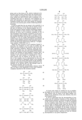
Where the selected Lewis acid, as in the case of A101 or SnCl is capable of accepting more than one electron pair, the structure of the resulting complex is not entirely clear. When the azonitrile is reacted with an excess of the Lewis acid, the structure of the resulting complex is believed to take one of the following forms:
(1) Monomers, having the following type of configuration:
Cl Cl where R R R and R have the same meanings as given above;
(2) Polymers, having recurring units of the following types of configurations:
where R R R and R have the same meanings as given above, or
R5(|JN= 01 NO or s R2 X where R R R and R have the same meanings as given above, and R and R have the same meanings as either R and R respectively, or R and R respectively.
Upon analysis of the configurations shown in 1 and 2a, which configurations are believed to be typical of the complexes formed when the selected Lewis acid is capable of accepting two pairs of electrons, the ratio of the complex has been found in every case to be 1 Lewis acidt'l azonitrile; however, such analysis does not differentiate between monomeric and polymeric forms. Analysis of complexes such as that shown in 2b, which is believed to be basically typical of those formed where the selected Lewis acid is capable of accepting more than two pairs of electrons, reveals the ratio of Lewis acid to azonitrile to be something other than 1:1. Moreover, such complexes are pasty and amorphous in appearance, as compared with complexes formed with Lewis acids capable of accepting only one or two electron pairs, further evidencing polymer formation.
It will be noted that the azo group in the azonitrile is capable of acting as a Lewis base, and can donate at least one pair of electrons to the electron-receptive site of a Lewis acid reactant, thereby possibly establishing complex bonds in addition to those created to the nitrile group. However, in every case of azonitrile complexes of the type described in this invention, irrespective of the Lewis acid complexing agent selected, there is complex formation between said Lewis acid and the nitrile group on the azonitrile, as may be readily demonstrated by infrared analysis. Such complex formation produces characteristic changes in the infrared spectrum of the azonitrile, particularly in the shift of the nitrile band at 2240 cm.- to higher wave numbers (2320-2340 cmf While the exact structure of the complexes formed is uncertain, the complexes in every case are readily synthesized by the reaction of the azonitrile and Lewis acid under anhydrous conditions. Moreover, while the structure of the complex may vary somewhat depending upon the relative quantity of Lewis acid present in the reaction mixture, the synthesis of each complex is entirely reproducible; for any reaction mixture having a given ratio of reactants, the same product as determined by subsequent analysis may be isolated. In all cases, the structure of the complex may be characterized in that each Lewis acid molecule is chemically linked to the nitrogen atom of at least one of the nitrile groups on the azonitrile molecule, each chemical linkage being established by the donation of an electron pair by said nitrogen atom to the electron-receptive site on the acid.
Examples of azonitrile polymerization initiators which may be used in the preparation of the novel chemical complexes described in this invention include:
l OZNQ l CH2 As Lewis acids which are suitable for use as complexing agents for azo nitriles in accordance with this invention, mention may be made of the metal halides, e.g., halides of tin, aluminum, boron, zinc, titanium, iron, etc.; and trimethyl boron.
It will be appreciated that the decomposition of azonitriles and the resulting formation of free radicals for polymerization initiation is achieved through the breaking of the carbon-azo bond. Moreover, it will be recognized that the conditions under which said bond can be cleaved can be made to depend largely upon the electron withdrawing efiect of complexing agents present on the azonitrile molecule. Accordingly, by the proper selection of complexing agents and the preparation of the compounds described in this invention, a series of azonitrile complexes can be obtained having a spectrum of rates for thermal decomposition at any given temperature.
In addition to providing free-radical polymerization initators, the novel complexes of this invention are also suitable for use as ionic polymerization initiators in all cases where the selected Lewis acid is a Friedel-Crafts agent which is an ionic polymerization initiator in its own right. Moreover, in the same way the Lewis acid serves as a means for controlling the rate at which polymerization takes place using free radical polymerization initiators, where the monomers under consideration are those which are susceptible to ionic polymerization, the azonitrile can perform the function of a complexing modifier on the Lewis acid, thereby providing a method for regulating the rate at which ionic polymerization occurs.
Where a monomer such as styrene is sought to be polymerized, since such materials may be polymerized by either free radical or ionic polymerization, or both, the modifying and regulating effects of both the azonitrile function and the Lewis acid function of the complex may be taken advantage of.
The following non-limiting examples illustrate the preparation of the novel azonitrile complexes of this invention:
Example 1 The complex of azobisisobutyronitrile (AIBN) and stannic chloride was prepared as follows: (1 gram) of AIBN was dissolved in 10 ml. of nitromethane dried over anhydrous CaSO and placed in a small reaction vessel equipped with a stirrer, inlet for dry nitrogen, and dropping funnel. Excess SnCl (5 ml.) dissolved in dry nitromethane was added slowly with stirring at room temperature. The complex precipitated immediately, and was filtered off in a dry box, washed with nitromethane, and dried over pa-rafiin and P under vacuum at 50 C.
The complex was analyzed for chlorine and nitrogen, the results of which analysis are given below. Stannic chloride was found to form a 1:1 complex with azobisisobutyronitrile.
Analysis.Found: percent chlorine, 34.0; percent nitro gen, 13.18. Theoretical (for AIBN-SnCl Cl, 33.4; H, 13.21.
Complex formation was confirmed by infrared analysis, as evidenced by the fact that the nitrile band at 2240 cm.- was shifted to a hi her wave number, i.e., 2320 cm.-
Example 2 formed.
Example 3 The complex of azobisisobutyronitrile and boron trichloride was prepared by passing excess BCl gas into a dry hexane solution of azobisisobutyronitrile at room temperature. The resulting complex was analyzed for chlorine, and was found to comprise azobisisobutyronitrile and boron trichloride in a ratio of 1:2.
6 Analysis.Found: percent chlorine, 51.1. Theoretical (for AIBN-2BCl Cl, 53.3.
Since certain changes may be made in the above product without departing from the scope of the invention herein involved, it is intended that all matter contained in the above description shall be interpreted as illustrative and not in a limiting sense.
What is claimed is:
1. A chemical omplex of a Friedel-C-rafts agent which is a metallic halide with an azonitrile having the formula:
wherein each of R R R and R is a radical selected from the group consisting of a lower alkyl and a saturated mononuclear alicyclic group containing from three to six nuclear carbon atoms, inclusive, and R and R when taken'together, and R and R when taken together, may comprise a saturated mononuclear alicyclic group containing from three to six nuclear carbon atoms, inclusive, said Friedel-Crafts agent being linked to the nitrogen atom of at least one of said nitrile groups by the donation of an electron pair from said nitrogen atom to the electron-receptive site of said Friedel-Crafts agent.
2. The complex defined in claim 1 wherein said azonitrile is azobisisobutyronitrile.
3. The complex defined in claim 1 wherein said azonitrile is azo'bisisobutyronitrile and said Friedel-Crafts agent is stannic chloride.
4. The complex as defined in claim 1 wherein said azonitrile is .azobisisobutyronitrile and said Friedel-Crafts agent is aluminum trichloride.
5. The complex as defined in claim 1 wherein said azonitrile is azobisisobutyronitrile and said Friedel-Crafts agent is boron trichloride.
6. A chemical complex of lower trialkyl boron with an azonitrile having the formula:
wherein each of R R R and R is a radical selected from the group consisting of a lower alkyl and a saturated, mononuclear alicyclic group containing from three to six nuclear carbon atoms, inclusive, and R and R when taken together, and R and R when taken together, may comprise a saturated, mononuclear alicyclic group containing from three to six nuclear carbon atoms, inclusive, said lower trialkyl boron being linked to the nitrogen atom of at least one of said nitrile groups by the donation of an electron pair from said nitrogen atom to the electronreceptive site of said lower trialkyl boron.
Claims (1)
1. A CHEMICAL COMPLEX OF A FRIEDEL-CRAGTS AGENT WHICH IS AMETALLIC HALIDE WITH AN AZONITRILE HAVING THE FORMULA:
Priority Applications (1)
| Application Number | Priority Date | Filing Date | Title |
|---|---|---|---|
| US379704A US3336282A (en) | 1964-07-01 | 1964-07-01 | Complexes of azonitriles with friedelcrafts metal halides |
Applications Claiming Priority (1)
| Application Number | Priority Date | Filing Date | Title |
|---|---|---|---|
| US379704A US3336282A (en) | 1964-07-01 | 1964-07-01 | Complexes of azonitriles with friedelcrafts metal halides |
Publications (1)
| Publication Number | Publication Date |
|---|---|
| US3336282A true US3336282A (en) | 1967-08-15 |
Family
ID=23498330
Family Applications (1)
| Application Number | Title | Priority Date | Filing Date |
|---|---|---|---|
| US379704A Expired - Lifetime US3336282A (en) | 1964-07-01 | 1964-07-01 | Complexes of azonitriles with friedelcrafts metal halides |
Country Status (1)
| Country | Link |
|---|---|
| US (1) | US3336282A (en) |
Citations (1)
| Publication number | Priority date | Publication date | Assignee | Title |
|---|---|---|---|---|
| US3041324A (en) * | 1959-07-28 | 1962-06-26 | Solvic Sa | Polymerization of olefinic compounds in the presence of catalysts having a trialkyl boron base |
-
1964
- 1964-07-01 US US379704A patent/US3336282A/en not_active Expired - Lifetime
Patent Citations (1)
| Publication number | Priority date | Publication date | Assignee | Title |
|---|---|---|---|---|
| US3041324A (en) * | 1959-07-28 | 1962-06-26 | Solvic Sa | Polymerization of olefinic compounds in the presence of catalysts having a trialkyl boron base |
Similar Documents
| Publication | Publication Date | Title |
|---|---|---|
| EP0906342B1 (en) | Polymerisation catalyst and process | |
| US2924593A (en) | Polymerization of ethylene using as a catalyst the product formed by mixing a bis(cyclopentadienyl) zirconium salt with an alkyl metallic compound | |
| ES396471A1 (en) | Polymerization of alpha-olefins | |
| US3236823A (en) | Process for the polymerization of unsaturated compounds with borazane catalysts | |
| US3700647A (en) | Alternating copolymers of alpha-olefins and acrylic compounds | |
| Sloan et al. | Cyclopentadienyltitanium trihalides and bis-cyclopentadienyltitanium dihalides | |
| Kern | Acrylonitrile and propionitrile complexes of metal chlorides in the first transition series | |
| Overberger et al. | Ionic Polymerization. The Effect of Solvents on the Copolymer Composition in Cationic Catalyzed Polymerization | |
| Dawans et al. | Copolymerizations initiated with phenyl magnesium bromide | |
| US3388141A (en) | Di-schiff bases of hydroxyl substituted diamines and beta-diketones, derivatives, and metal chelates thereof | |
| US2726232A (en) | P-xylylene bis (5 cyclopentadiene) and polymer | |
| US3894997A (en) | Process for preparing an alternating copolymer of a conjugated vinyl compound and an olefinic unsaturated compound | |
| Furukawa et al. | Catalytic reactivity of organometallic compounds for olefin polymerization. II. Vinyl chloride polymerization catalyzed by binary systems involving organometallic compounds | |
| Ilge et al. | Mixed Alkali Metal Cages Containing the Cap‐shaped [S (NtBu) 3] 2− Triazasulfite Dianion | |
| US4121032A (en) | Process for preparing alternating copolymer of conjugated vinyl compound and olefinic unsaturated compound with oxygen and boron compound | |
| US3742019A (en) | Production of chlorinated cotelomers | |
| Bartoň et al. | Radical reactions initiated by chelate complexes of transition metals. III. Grafting of polymers containing halogen atoms | |
| GB1561968A (en) | Cationic polymerisation | |
| US3864319A (en) | Method for preparing alternating copolymers using a friedel-crafts catalyst and a free radical initiator in an aqueous medium | |
| Pasynkiewicz et al. | Copolymerization of methyl vinyl ketone with vinyl compounds or dienes in the presence of alkyl‐aluminium chloride or aluminium bromide | |
| US3422079A (en) | Coordination complexes of vinylphosphine oxides and metal salts,and polymers thereof | |
| US3989882A (en) | Process for preparing an alternating copolymer of a conjugated vinyl compound and an olefinic unsaturated compound | |
| Rzaev et al. | Radical copolymerization of maleic anhydride with organotin acrylates | |
| US3817967A (en) | Modification of organic polymers | |
| Bartoň et al. | Radical reactions initiated by chelate complexes of transition metals. II. Radical polymerization of styrene |